Acute respiratory tract infections (ARIs) are common in outpatient settings.Reference Fleming-Dutra, Hersh and Shapiro1 Diagnostic and treatment recommendations for appropriate management of ARI rarely recommend antibiotics.Reference Harris, Hicks and Qaseem2,Reference Chow, Benninger and Brook3 Nonetheless, 30%–40% of outpatient antibiotic prescriptions are unnecessary, providing ample opportunity for improvement.Reference Fleming-Dutra, Hersh and Shapiro1,Reference Havers, Hicks and Chung4 Clinicians who prescribe antibiotics most frequently prescribe them in 95% of ARI visits, while those who prescribe least frequently do so in <40% of visits, demonstrating variability across individual prescriber behavior.Reference Jones, Sauer and Jones5 This variability emphasizes the importance of antibiotic stewardship strategies directed at clinician behavior to drive change.
The theory of planned behavior is a social cognitive theory that posits links between people’s beliefs, behavioral intentions, and behavior.Reference Ajzen, Kuhl and Beckmann6,Reference Ajzen7 This theory predicts that clinicians’ behavioral intentions are strongly linked to clinician behavior.Reference Limbert and Lamb8–Reference Hardcastle, Kane and Chivers10 Figure 1 shows that attitudes toward behavior such as appropriate prescribing are influenced by beliefs about the relationship between a behavior and a positive outcome (eg, less antibiotic resistance will result from appropriate prescribing). Subjective norms are influenced by perceptions of what constitutes socially normative behavior such as perceptions of how peers are prescribing. Perceived behavioral control is how effective a person believes themselves to be. These beliefs and perceptions influence behavioral intentions and behavior.
Theory of planned behavior—beliefs impact behavior.

Clinician-focused antibiotic stewardship strategies such as audit and feedback with peer comparison, academic detailing, and clinician communication training are promising approaches to reduce unnecessary antibiotic treatment of ARIs.Reference Persell, Friedberg and Meeker11–Reference Drekonja, Filice and Greer13 Audit and feedback with peer comparison has been perceived by clinicians as an acceptable method for improving antibiotic prescribing.Reference Linder, Meeker and Fox14 However, not all audit-and-feedback strategies targeting inappropriate ARI management have demonstrated improvements in antibiotic prescribing, suggesting additional interaction with clinicians may be necessary to facilitate behavior change.Reference Hemkens, Saccilotto and Reyes15 Academic detailing consists of education delivered one-on-one to clinicians by a respected peer. Academic detailing for ARIs has demonstrated short-term improvements in antibiotic prescribing.Reference Gjelstad, Hoye, Straand, Brekke, Ingvild and Lindaek16 Clinician overestimation of patient demand for antibiotics is associated with overprescribing for ARIs, suggesting an opportunity to improve prescribing by improving clinician–patient communication. Clinician training focused on enhanced patient communication, including the use of shared decision-making techniques, is associated with reductions in antibiotic prescribing for ARIs without diminishing patient satisfaction.Reference Mangione-Smith, McGlynn, Elliott, Krogstad and Brook17,Reference Coxeter, Del Mar, McGregor, Beller and Hoffmann18 Although such clinician-focused behavioral interventions can improve ARI antibiotic prescribing, limited information is available to characterize clinicians’ preferences.
Our study was developed to aid in planning a multifaceted implementation strategy to improve ARI antibiotic prescribing practices within outpatient Veterans’ Health Administration (VHA) settings, using the Centers for Disease Control and Prevention’s (CDC’s) Core Elements of Outpatient Antibiotic Stewardship.Reference Sanchez, Fleming-Dutra, Roberts and Hicks19 We investigated clinician knowledge, attitudes, and behaviors (consistent with the theory of planned behavior), and their perceived barriers to appropriate prescribing for ARIs as well as their preferences for clinician-focused behavioral interventions prior to broad implementation.
Methods
We conducted one-on-one interviews with clinicians (n = 20), physicians and nurse practitioners, from 10 clinics within 5 VHA academically affiliated medical centers to provide representation across included study clinics. Clinics were selected to provide a mix of clinics that did and did not accept clinician trainees and to give a range of sizes: large (22–79 clinicians), medium (11–18 clinicians), and small (2–10 clinicians). Study investigators identified clinic leaders who identified clinicians who met the following criteria: (1) federal employees with VHA appointments; (2) routinely diagnose and treat patients with ARIs; and (3) could speak to the knowledge, attitudes, and behaviors of their peers. Clinicians identified as potential interviewees were sent an e-mail with an option to decline interviews. Those who did not decline were contacted to schedule an interview and were provided a summary of the study and an informed consent document. Consent was obtained verbally upon interview initiation.
Interview questions based upon the theory of planned behavior were developed by the study behavioral scientist and tailored through discussions with a panel of physicians, pharmacists, and study personnel. Questions aimed to assess knowledge, beliefs, and attitudes about personal and peer antibiotic prescribing (Table 1). Future plans to prescribe antibiotics were gauged by asking about intentions to change practice, support needed to make improvements in antibiotic prescribing, and preferences for delivery of potential implementation strategy components such as audit-and-feedback reports, peer comparison, academic detailing, and clinician communication training.
ARI Antibiotic Prescribing Interview Sample Questions

The study behavioral scientist or a trained associate interviewed each clinician by phone. Thematic saturation was reached when no new information emerged from interviews. Interviews were audio recorded, transcribed, and deidentified for qualitative analysis, which was performed by an experienced 4-person coding team using ATLAS.ti version 7.5.18v software. An iterative approach to coding included team members assigning initial codes to interviewee quotes, with discrepancies resolved by consensus discussions. Codes related to beliefs, barriers, desired features, and suggestions regarding potential implementation strategies were assigned, and iterative coding resulted in examination of each transcript multiple times by the full coding team. This research complies with all federal guidelines and VHA policies relative to human subject research and was approved by the institutional review boards of each participating facility.
Results
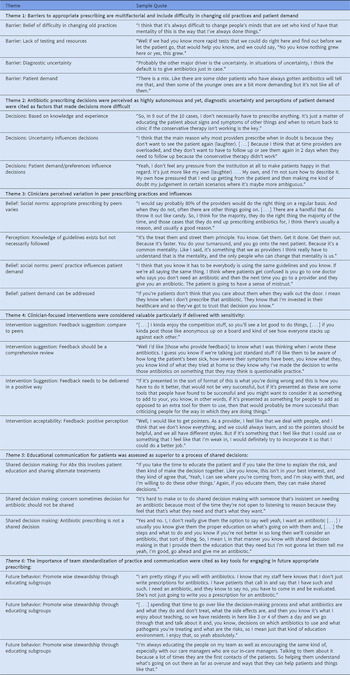
Participants included physicians (n = 9) and nurse practitioners (n = 11) practicing within different settings: 2 large emergency departments (EDs; 35%); 2 large and 3 medium primary care clinics (30%); and 1 large and 4 small community-based outreach clinics (CBOCs; 35%). Most participants were female (65%) and most were practicing in academic clinics (60%). Six themes emerged, which are described below and in Table 2.
Sample Clinician Quotes for Acute Respiratory Tract Infections (ARI) Antibiotic Prescribing Themes

Theme 1: Barriers to appropriate prescribing are multifactorial and include difficulty in changing old practices and patient demand
Respondents cited difficulty in several areas: changing established practice behaviors; time constraints for clinician and patient education; frustration with patient education effectiveness; and, within CBOC settings, limited point-of-care testing. Clinicians felt that changing routine practice takes conscious effort:
“[Clinicians are] ingrained in their way of how they do it and instead of taking new evidence-based practice into consideration, it’s just hard to change their habits.”
Clinicians cited time constraints during a visit as limiting opportunities for clinicians to learn, apply new practices, and educate patients:
“[Patients] are getting fit into a busy schedule already … people are more likely to go ahead and prescribe because it’s easier. Do I really have time to go into a discussion with this person as to why they don’t need an antibiotic?”
In some clinics, difficulty in obtaining rapid molecular diagnostic tests or chest radiographs is perceived as impeding the ability to make informed diagnoses:
“… We don’t have the ability to do a lot of lab testing … every time they come in, it’s not certain …”
This comment contrasts with data indicating that a minority of ambulatory patients with ARI require such tests to determine if antibiotic treatment is necessary or cost-effective.Reference Harris, Hicks and Qaseem2,Reference Chow, Benninger and Brook3
Theme 2: Antibiotic prescribing decisions are perceived as highly autonomous, yet diagnostic uncertainty and perceptions of patient demand make prescribing decisions more difficult
Clinicians perceive a high degree of control over their prescribing. Decisions to prescribe antibiotics were described as easy to make, and antibiotic prescribing is an autonomous decision:
“Absolute. Nobody had ever questioned anything that I’ve prescribed or didn’t prescribe as far as antibiotics.”
Diagnostic uncertainty influenced a clinician’s decision to prescribe antibiotics. When the diagnosis is uncertain, and patient follow-up might be difficult, clinicians felt that they were more likely to prescribe inappropriately:
“… these people don’t have really close follow-up with their primary … I think now you have to make a decision a little sooner than you prefer sometimes. ”
To remedy this, some clinicians prescribe “just in case.” Clinicians reported that they considered additional clinical criteria, the patient’s age, and overall health when deciding to prescribe antibiotics. Few clinicians specifically noted patient opinion and few perceived demand influencing prescribing decisions. However, clinicians felt patient demand might influence practice due to value placed on patient preferences.
Theme 3: Clinicians perceived variation in peer prescribing practices and influences
Clinicians’ perception of peers’ practice varied substantially. When clinicians were asked “How many people at your institution do the right thing in terms of antibiotic prescribing?” responses ranged from 25% to 90%:
“I would say probably half”. “… probably 25%” … “I think we are over 90% …”
However, clinicians acknowledged that they were unaware of how their peers actually prescribed:
“We’re not aware of others’ prescribing decisions, … I’ve never heard it or had any questions or heard anything about antibiotic use in particular.”
Clinicians valued the opinion of their peers and experts:
“… If I am doing the wrong thing, I hope somebody jumps in and lets me know.”
Clinicians empathized with those faced with a patient demanding antibiotics and felt that all clinicians are exposed to patient demand for antibiotics:
“I think everybody caves once in a while. I mean, you just can’t keep it up. Water on a rock, after a while you’ll cave, and I think everybody has caved at some point.”
For clinicians, mechanisms beyond clinician and patient education are considered necessary to alter prescribing beliefs and behavior. Clinicians felt that information is available to make appropriate prescribing decisions:
“I think that they know in one part of their brain that antibiotic resistance is a huge issue …, in the moment, they’re responding to the person in front of them and making a decision based on that.”
This rationale is complicated by perceived social norms that inappropriate practices by peers reinforces patient demand:
“… If people don’t get what they want [… they go to somebody else and get it”
and contributes to inappropriate prescribing.
Theme 4: Clinician-focused interventions are considered valuable if delivered with sensitivity
Interviewees were open to proposed audit-and-feedback behavioral interventions including comparison to peers. Respondents indicated that delivery of feedback should consider the clinician’s good intentions and be clear and concise. Academic detailing was viewed as a potentially useful approach to delivering clinician education, and patient education tools supporting decisions not to prescribe were desired.
Clinicians perceived that feedback had the potential to improve their personal practice behavior:
“I think that it would be very helpful, and I’m open to it, and I wish that we got more feedback. Because I would rather know early rather than late whether or not you’re doing something right or wrong.”
The way feedback is received depends on the person giving the feedback and the way feedback is delivered:
“If it’s presented as something for people to add as an extra tool for them to use …, then that would probably be more successful than criticizing people for the way in which they are doing things.”
Those delivering feedback need to consider that poor decisions are not made intentionally and should create opportunity for clinicians to justify decisions.
Consistent with the conversational framework of academic detailing, clinicians suggested that communication with clinicians should include concise recommendations for improvement and provide supportive educational information, which is short and to the point. Furthermore, the interaction with clinicians should be recurring and delivered by a respected individual in a nonpunitive, conversational way. In addition, consistent messaging and education should be delivered to all healthcare team members due to the potential for others to influence patient expectations:
“I don’t have problems with people giving me advice or information. I believe that knowledge is power, and we learn along the way that it’s a good thing. You can act upon it or not act upon it, but I don’t really look at people giving me pointers or giving me input is a bad thing … I don’t feel threatened by people doing that.”
Clinicians specifically noted interest in education concerning local bacterial resistance patterns to guide antibiotic prescribing.
Patient education tools were also viewed as desirable enablers of the implementation strategy. Tools should be understandable and support the decision of the clinician to not prescribe antibiotics:
“They [patients] also need to understand that it’s a recommended practice everywhere.”
In addition, educational tools should highlight evidence-based standards of care concerning antibiotic use.
Theme 5: Communication strategies for educating patients are preferred to a process of shared decisions
Overall, clinicians were open to promotion of evidence based, communication techniques to clarify perceived patient demand and promote the judicious use of antibiotics, but they did not consider antibiotic prescribing an appropriate topic for shared decision making. Most clinicians were receptive to learning communication techniques to address patient demand:
“Just mainly what are good ways to communicate to the patient? Just what are objective ways and how do we overcome any barriers that may occur while talking to the patient.”
Shared decision making was not anticipated to be an efficient tool to improve prescribing practices because clinicians felt it is their responsibility to either give or withhold an antibiotic. Clinicians viewed shared decision making as a useful tool in situations where patients expressed the desire to look for alternative treatments:
“Well, it’s tough because usually you’ve already decided if you’re going to prescribe it or not, … sharing in the decision about whether or not to get an x-ray or whether to use a nose spray or a costly medication or something like that, but with antibiotics it’s tricky. If you’ve decided not to prescribe it, you can’t really, you can’t open it up for discussion.”
Clinicians expressed the belief that such decisions should not be shared, but rather the reasons for their decisions communicated to the patient:
“If you take the time to educate the patient and explain the risk[… and they kind of agree that, “yeah, I can see where you’re coming from, and I’m okay with that, and I’m willing to [take your recommendations]. Again, if you educate them, they can make shared decisions.”
Theme 6: The importance of clinical team standardization of practice and communication are key to facilitating future appropriate prescribing
Clinicians emphasized that information for patients needs to be consistently delivered by all staff:
“I’m always educating the people on my team … helping them understand what’s going on out there as far as overuse and ways that they can help patients ….”
Also, standardizing appropriate antibiotic prescribing creates a clear expectation for patients:
“I know that my staff here knows that I don’t just write prescriptions for antibiotics. I have patients that call in and say that I have such and such. I need an antibiotic, and they know to say no, you have to come in and be evaluated.”
Overall, clinicians planned to promote judicious use of antibiotic prescribing.
Discussion
In this study, we elicited rationale from clinicians for inappropriate antibiotic prescribing decisions in self-described typical practice. Findings confirmed those from other qualitative studies of antibiotic prescribing practices.Reference McKay, Mah, Law, McGrail and Patrick20,Reference Yates, Davis and Taylor21 Clinicians identified typical barriers of insufficient time to learn and teach, diagnostic uncertainty, and patient demand for antibiotics, but they also identified preferences on how clinician-directed behavioral interventions should be implemented. They viewed making inappropriate decisions as having “caved” and perceived this was an issue for most clinicians. Lack of clinician resolve to prescribe appropriately and a mentality that patients will get an antibiotic somewhere was a concern. Clinician estimates of appropriate prescribing rates for their peers varied greatly.
We did not ask clinicians about how often they prescribed appropriately, but we noted that clinicians value their peers’ opinion and desire to know how they perform relative to institutional expectations. These observations support the use of peer comparison within audit and feedback reports which parallel those of Linder and colleagues who found audit and feedback with peer comparison both effective and accepted by clinicians to improve antibiotic prescribing.Reference Drekonja, Filice and Greer13
Clinicians expressed desire to improve personal prescribing practices and welcomed implementation of tools to improve prescribing. Clinicians suggested that feedback should include both positive and negative prescribing behaviors and that feedback discussions should include opportunity for decision justification because clinicians are well intentioned. Such desires support the importance of conversational education from relatable and respected sources, which provides an avenue for delivery of education and feedback through academic detailing. Barriers to clinician education included changes in evidence-based messages over time and lack of clinician time for education. These barriers emphasize the need for clinician feedback and education to be short, to the point, and recurring. These points are consistent with both academic detailing and audit-feedback approaches.
The perception that other clinicians are likely to inappropriately prescribe antibiotics to their patients if they initially do not prescribe one themselves may contribute to the perception of patient demand. Implementation strategies to address patient demand include education on enhanced clinician communication techniques and clear communication of the standard of care among all staff and peers when interacting with patients during ARI visits. Overall, clinicians generally were receptive to learning new communication techniques; however, less so for shared decision making. It is possible that the perceived high control of decision making within a patient visit made shared decision making a nonintuitive solution to overcome patient demand. Other studies conducted in non-US healthcare settings has found that shared decision making is effective and does not contribute to diverging from clinical guidelines.Reference Coxeter, Del Mar, McGregor, Beller and Hoffmann18,Reference van Esch, Brabers, Hek, van Dijk, Verheij and de Jong22 Patient communication can be tailored to clearly delineate the role of the clinician as the prescribing decision maker with sensitivity to patient preferences that can result in a decision that is better understood by the patient. Patient education tools should increase transparency concerning the standard of care for ARI visits and support clinician decisions not to prescribe antibiotics unless truly necessary, such as those illustrated with public commitment posters.Reference Meeker, Knight and Friedberg23
Our qualitative study did not directly compare clinic culture factors based on practice setting. Our heterogeneous sample with diverse practice settings and diverse educational and training backgrounds contributes to the generalizability of emergent themes but also is a limitation. Future work could employ direct comparisons of barriers cited in different contexts and by different types of clinicians. An additional limitation is that clinicians were selected by clinic leaders as able to speak to the prescribing climate of his/her clinic, but this was not validated.
Clinicians intend to prescribe antibiotics appropriately; however, insufficient time to educate, diagnostic uncertainty, and patient demand for antibiotics are perceived as barriers to optimal prescribing. Clinicians perceived behavior-focused strategies such as audit and feedback with peer comparison, academic detailing, and enhanced clinician communication training as acceptable approaches to improve ARI management. These findings can inform healthcare systems implementing outpatient stewardship programs. Such programs should consider our findings and leverage existing resources when designing provider behavior focused strategies.24–26
Acknowledgments
We recognize the dedication of clinician participants, clinic champions, and site investigators at the Durham, Kansas City, Salt Lake City, Boise, and Greater Los Angeles VA medical centers for their commitment to providing quality care for US veterans. The findings and conclusions in this report are those of the authors and do not necessarily represent the official position of the Department of Veterans’ Affairs or the Centers for Disease Control and Prevention.
Financial support
This work was supported in part with resources and use of the Department of Veterans’ Affairs and was funded by the Centers for Disease Control and Prevention (Safety and Healthcare Epidemiology Prevention Research Development contract no. 200-2011-47039).
Conflicts of interest
All authors report no conflicts of interest relevant to this article.