Introduction
Mild cognitive Impairment (MCI) involves an individual's cognitive decline greater than expected for age-related changes, but does not significantly interfere with activities of daily living (Gauthier et al., Reference Gauthier2006). Most types of dementia are preceded by cognitive decline (Lonie et al., Reference Lonie, Herrmann, Donaghey, O'Carroll and Ebmeier2010); however, not all persons with MCI will develop dementia (Chertkow et al., Reference Chertkow2008). The prevalence of MCI for people age 65 and older ranges from 3% to 19% (Gauthier et al., Reference Gauthier2006), suggesting 71,000–447,000 persons in Taiwan currently have MCI, and this number could increase to between 170,000 and 1,080,000 by the year 2031.
In Taiwan, family caregivers occupy a pivotal role in providing care to family members with dementia. Studies on family caregivers of persons with MCI are limited; most involve preventing or slowing the development of dementia (Burns and Zaudig, Reference Burns and Zaudig2002; Gauthier et al., Reference Gauthier2006). Twenty years ago, only 3.5% to 5.9% of persons with dementia were institutionalized in Taiwan because family members were the primary caregivers (Liu et al., Reference Liu1991; Tiang et al., Reference Tiang, Mao, Chou, Chen and Liu1992). Although 20.6% were institutionalized in 2009 (Taiwan Alzheimer's Disease Association, 2010) family members remain the primary caregivers for persons with dementia and MCI and the increased prevalence of MCI will result in an increase in the number of persons adopting caregiving roles (Alzheimer's Association, 1998).
Family caregivers experience high caregiver burden due to managing multiple neurological and psychiatric symptoms associated with MCI, such as depression, anxiety, hallucinations, agitation, and irritability (Rozzini et al., Reference Rozzini2007; Di et al., Reference Di Iulio2010) and this burden is compounded by supervision and decision-making responsibilities (Garand et al., Reference Garand, Dew, Eazor, DeKosky and Reynolds2005; Adams, Reference Adams2006). Fifty to eighty-five percent of patients with MCI have other neurological symptoms and psychiatric disorders, including dysphoria, sleep problems, apathy, and appetite disturbance, which add to caregivers’ distress (Rozzini et al., Reference Rozzini2007; Muangpaisan et al., Reference Muangpaisan, Intalapaporn and Assantachai2008; Di Iulio et al., Reference Di Iulio2010). Marital quality for spouse caregivers can also be negatively impacted (Lu and Haase, Reference Lu and Haase2009). Family caregivers of persons with mild dementia or MCI report frustration, resentment, grief, relational deprivation, and increased protectiveness (Adams, Reference Adams2006). When a family member is newly diagnosed with mild dementia or MCI, caregivers experience anticipatory grief, characterized as “putting the pieces of the puzzle together” (Lu and Haase, Reference Lu and Haase2009). Anticipatory grief has also been described as “missing the person” they once knew (Garand et al., Reference Garand2012).
The family caregiving process in Western countries may not entirely explain the phenomena in Taiwan due to differences cultural values. The kinship system of Taiwanese/Chinese families is father–son dominated and characterized by continuity and inclusiveness. In contrast, Western families are dominated by a husband–wife system, characterized by discontinuity and exclusiveness (Hsu, Reference Hsu1971; Hsu, Reference Hsu and Spindler1978). Unlimited self-sacrifice, devotion to parents, social orientation, and interdependence are valued in Chinese culture. Western cultures value autonomy, independence; children's self-sacrifice for the benefit of parents is not encouraged (Dai and Dimond, Reference Dai and Dimond1998).
MCI is an accurate predictor of Alzheimer's disease (AD) (Geslani et al., Reference Geslani, Tierney, Herrmann and Szalai2005). Like all chronic diseases the trajectory varies and changes over time (Corbin and Strauss, Reference Corbin and Strauss1991) and caregiving practices could change accordingly. Family caregivers of persons with MCI in Taiwan employ “ambivalent normalization,” which involves adopting multiple behavioral approaches to adjust to conflicts and changes in relationships with the care-receiver (Kuo and Shyu, Reference Kuo and Shyu2010). However, the evolution of the caregiver's role in the context of the progression of MCI has not been explored. Therefore, the purpose of this study was to explore and develop a theoretical model to explain the longitudinal changes in the caregiving process for family caregivers of persons with MCI in Taiwan.
Methods
Because the family caregiver's role for persons with MCI has not been explored, the purpose of this study was to examine the caregiving process over a two-year period in order to understand the longitudinal changes in the caregiving process for family caregivers of persons with MCI in Taiwan. A grounded theory approach (Glaser and Strauss, Reference Glaser and Strauss1967) was selected because it allows one to construct a new theory based on actions and observations of participants; this approach allows the researcher to describe the experiences of the caregivers of persons with MCI, which can generate new hypotheses and theoretical concepts to better explain the phenomenon (Glaser, Reference Glaser1978; Strauss and Corbin, 1990; Glaser, Reference Glaser1992). There are no related studies or instruments for Taiwan; therefore, we chose Glaser's approach (Glaser, Reference Glaser1978; Glaser, Reference Glaser1992), which allows more flexibility in theorizing as a result of data analysis strategies and understanding the caregivers’ reality (Heath and Cowley, Reference Heath and Cowley2004).
Participants
Neurologists from neurological clinics of one northern and one southern medical center in Taiwan identified families who met the sample criteria and assessed their willingness to participate. Inclusion criteria for family caregivers of persons with MCI (the care-receiver) were: (1) age 20 years or older, (2) assuming primary care responsibility for the care-receiver, and (3) the care-receiver met inclusion criteria. The criteria for care-receivers were: (1) age 65 years or older, (2) a clinical dementia rating (CDR) = 0.5 and diagnosed with MCI by a neurologist or psychiatrist, which was based on the core clinical criteria for MCI as recommended by the National Institute on Aging-Alzheimer's Association (NIA-AA), and (3) being cared for in a home setting. In order to be more open to the possibilities of understanding the phenomenon of caregiving for persons with MCI, including the caregiver's perception of the overall illness trajectory, we did not have specific restrictions with regard to subtype of MCI, comorbidity, or pre-existing conditions; therefore, there were no exclusion criteria. The researchers contacted the families and further explained the study. Interviews were conducted after obtaining written informed consent from all caregivers and care-receivers. Approval was obtained from the Institutional Review Board of the study hospital (NO102-3346C) prior to beginning the study.
Sampling methods
Grounded theory employs theoretical sampling to guide data collection. This is a process based on concepts that become relevant as the theory evolves, and maximizes opportunities to discover variations among concepts and to generate as many properties of the categories as possible (Strauss and Corbin, Reference Strauss and Corbin1998). Demographics, cognitive functioning, and behavioral problems described the sample and provided a reference for theoretical sampling. Emergent theory guided whom to sample (Glaser, Reference Glaser1978; Glaser, Reference Glaser1992). During early data analysis, the process of protective preparation emerged and the relationship of the family caregiver and the person with MCI, such as child and spouse was a possible concept that influenced the process, thus we decided to include family caregivers with different relationships to the persons with MCI. The concept of “vigilant preparation” emerged from a preliminary study on family caregivers of persons with MCI (Kuo and Shyu, Reference Kuo and Shyu2010). Therefore, we selected family caregivers who looked for signs and symptoms of cognitive and behavioral changes, while simultaneously expecting a further decline in cognitive function, and those who seemed to “wait and see” for comparison. The sampling process ceased once theoretical saturation was reached, which occurred when no new data appeared and the properties of the theory's concepts and incidents were well-developed (Glaser, Reference Glaser1978; Glaser, Reference Glaser1992). Theoretical saturation was determined by a consensus decision of the research team.
Interview guide
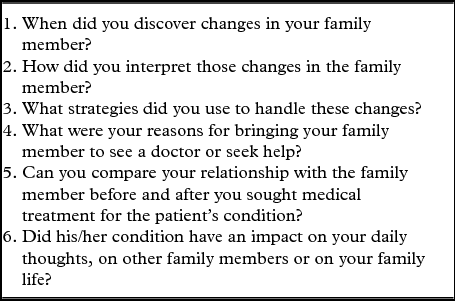
Face-to-face interviews were conducted using an open-ended interview guide (Table 1) modified from a previous study (Kuo and Shyu, Reference Kuo and Shyu2010). The guide was refined based on theoretical sampling of evolving concepts during the interviews (Glaser, Reference Glaser1978; Glaser, Reference Glaser1992). For example, when protective preparation emerged from the data, subsequent interviews focused on family caregivers’ descriptions of a possible further decline in the care-receiver's cognitive functions.
Interview guide

Interview procedure
Interviews were conducted one month following the diagnosis of MCI (baseline), then at approximately six month intervals for two years in the home of the caregiver and lasted between 30 and 100 minutes. Participants were instructed to make themselves comfortable and told there was no right or wrong answer to the questions. Of the 13 caregivers, nine participants completed all four interviews, one died before the fourth interview, and three dropped-out after the first interview. After the core concept emerged, the interviews became focused on experiences related to the caregiving process of “protective preparation.” During the interviews, the interviewer maintained written field notes related to thoughts, as well as observations that captured the interviewer's interest, such as signs of depression or anxiety, as well as comments that occurred spontaneously. In addition, the cognitive function of the person with MCI was noted as well as any indication of the caregiver's perception of the disease progression. To avoid interfering with the caregiving interactions, observational notes were used instead of videotaping. After participant 11 had been interviewed four times, it was determined that data saturation had been reached (Strauss and Corbin, Reference Strauss and Corbin1998; Heath and Cowley, Reference Heath and Cowley2004) regarding the core concept of “protective preparation.” Recruiting new participants ceased after conducting additional interviews with three of the 13 participants to confirm that sufficient information had been obtained regarding the properties of the core category and additional data was redundant.
Data analysis
Interviews were audio-recorded and transcribed verbatim. We used open coding for detailed line-by-line analysis to develop categories and establish tentative relationships among categories (Strauss and Corbin, Reference Strauss and Corbin1998; Heath and Cowley, Reference Heath and Cowley2004). The coding families provide different potential schematics of the theory for the connections among the categories (Glaser, Reference Glaser1978). Constant comparative analysis reformulated the focus of the data to reflect emerging concepts. Theoretical coding identified the relationship between concepts throughout the data analysis (Strauss and Corbin, Reference Strauss and Corbin1998; Heath and Cowley, Reference Heath and Cowley2004). During the coding process memo writing, data collection, coding, and categorizing were conducted concurrently to record thoughts and ideas regarding the core category (Glaser, Reference Glaser1978). During research meetings, patterns in the transcripts, codes, and memos were explored. After analyzing and discussing data from participant 11, the research team reached the consensus about the potential core concept of “protective preparation,” which was and further verified in subsequent data analysis. To avoid preconceived concepts, coding families (Glaser, Reference Glaser1978) provided different perspectives for theory formulation, and categories of the theory, which guided the theoretical coding, and a core category identified the central concept around which all other categories were integrated (Strauss and Corbin, Reference Strauss and Corbin2008). Once the core category of “protective preparation” emerged, incidents relating to “protective preparation” were analyzed by selective coding to enrich and verify the core category [(Glaser, Reference Glaser1978; Glaser, Reference Glaser1992).
Trustworthiness of the data
The criteria of Lincoln and Guba (Reference Lincoln and Guba1985) established trustworthiness. Transcribing interviews verbatim, peer debriefing, and audit trails enhanced credibility of the data. Four experts in gerontological nursing and two experts in qualitative methods met monthly to review the fit of the raw data, codes, categories, and emergent core categories; these researchers’ positions, assumptions, and preconceptions of the topics and potential biases that could influence the research process were declared to other members of the team in order to consciously allow more flexibility and an open mind during data collection and analysis. Reviewing transcripts and codes by the researchers ensured conformability of the data. Transferability was enhanced by rich description and conceptualization of contextual conditions of the phenomena, maintained by the first author as field notes. Prolonged engagement with the caregivers over two years allowed the researcher to establish close relationships, thus participants were more willing to express their feelings and experiences. Member checks (Lincoln and Guba, Reference Lincoln and Guba1985) were conducted with three of the most thoughtful, reflective, and knowledgeable participants to validate and clarify the interview data. These participants provided feedback and enriched the information regarding the phenomena.
Findings
Study participants
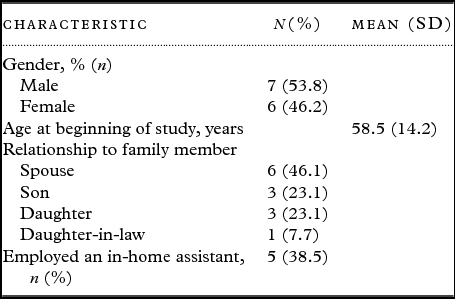
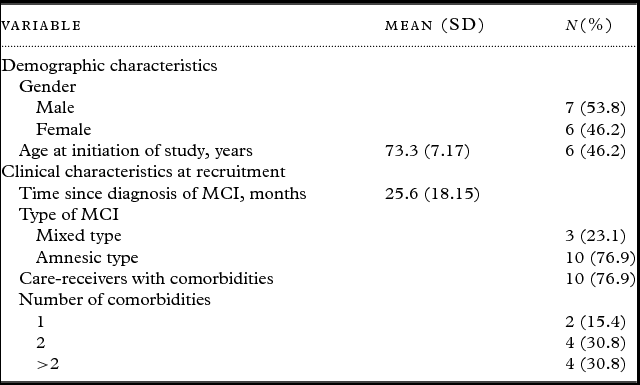
Fourteen family caregivers were approached and 13 (92.8%) agreed to participate. The gender of caregivers was 42.6% female and 53.8% male; additional characteristics are shown in Table 2. Characteristics of the care-receivers with MCI are shown in Table 3. The average of age was 73.3 years, six were female and seven were male. The average time since diagnoses of MCI was 25.6 months and 76.9% had comorbidities, which included hypertension (4), heart disease (1) Parkinson's disease (2), diabetes mellitus (2), and stroke (1).
Demographic characteristics of family caregivers of persons with mild cognitive impairment (N = 13)

SD, standard deviation.
Demographic and clinical characteristics of family care receivers with mild cognitive impairment (N = 13)

SD, standard deviation; MCI, mild cognitive impairment.
Protective preparation
The core process central to the role of family caregiver for a person with MCI was protective preparation. The process of protective preparation incorporated three distinct components, which occurred simultaneously and interactively: ambivalent normalization, vigilant preparation, and protective management. There were no predictable sequences or phases among these three components, although ambivalent normalization was most likely to occur after the initial diagnosis of MCI and remain with the other components during the entire process of protective preparation. One example of the three components occurring simultaneously was exhibited by a son who cared for his mother. He said:
Her brain has slightly shrunk. . .I think that you cannot control the shrinking of her brain, just go along with nature [ambivalent normalization]. . . Both my wife and I are prepared [vigilant preparation], but still feel really sad about her condition. . . . I am okay right now to take care of her, but after a couple years, when I get old myself, I would need to ask my brother to hire someone to help [protective management].
A second example occurred when a wife caregiver noticed a significant decline in her husband's cognitive function, which was confirmed by his medical record. The wife said:
I am worried that his condition will get worse; some people will gradually get worse [ambivalent normalization]. I think providing stimulation to him is very important and necessary [vigilant preparation]. . .My daughter lives in LA (USA) and she is a nurse. She told me that there were stages for dementia. If some day, he will not be able to recognize me, I will send him to the nursing home [protective management].
Component 1: Ambivalent normalization
The feelings a caregiver experiences when attempting to accept and rationalize the care-receiver as normal is defined as “ambivalent normalization,” which occurs when the family member is initially diagnosed with MCI (Kuo and Shyu, Reference Kuo and Shyu2010). Caregivers entered into this process when confronted by behavioral changes in the family member with MCI. During the initial interviews at one month, caregivers maintained the belief that cognitive decline was “a normal aging phenomenon,” but also endeavored to prepare for a possible decline in cognitive function if the care-receiver became more incapacitated. One son-caregiver said of his mother:
. . . she is already 90 years old, compared to other older people, we are glad that we do not need to take too much care of her, she can do most of the things herself. . . It is a must, we must be prepared, we do not know when she will get (worse). . .”
This response was typical of many caregivers in our study; they did not view the care-receiver's condition as problematic. Another son-caregiver said of his father:
His memory is not as good, but it has nothing to do with dementia, it's not that severe. We are not worried.
The degree of ambivalence regarding normal behavior was correlated with the caregiver's perception and interpretation of the cognitive impairment of the care-receiver. The ambivalence about normality changed if the care-receiver exhibited a decline in cognition and functional abilities. In later interviews, caregivers became less ambivalent about normalcy and more certain the care-receiver was exhibiting symptoms of MCI, not behaviors related to aging. This resulted in an increase in the caregiver's level of worry, concern, and a change in interactions and interventions with the person with MCI. One daughter caregiver said:
In the beginning, we found that she was very suspicious and emotionally unstable. . . My father already died, but she thought he would come back. . . so we took her to see the doctor. Doctor told us that her cognitive impairment is mild. . . . I am still worried that she will get lost, so we keep her company when she goes out.
When a care-receiver had not undergone a significant change in behavior over the course of the study, caregivers continued to apply ambivalent normalization.
Component 2: Vigilant preparation
The process of vigilant preparation occurred when caregivers recognized the person with MCI was having functional difficulties. They began to look for signs and symptoms of cognitive and behavioral changes, while simultaneously expecting a further decline in the cognitive functions of the care-receiver. Two forms of vigilant preparation were employed: reactive and perspective. Reactive vigilant preparation was the process of caregivers adopting an attitude of “wait and see.” Although these participants were alert for signs and symptoms of cognitive decline, they did not have a plan for what they would do when the eventual change occurred. For example, one daughter caregiver said of her father:
His condition remains the same, I think that is wonderful. . .I am still worried that if the disease get worse, one day he might not able to take care of himself and cannot recognize us. . . we do not have any plan so far, because the time has not come.
Another daughter-caregiver said of her father:
The things are fine now. . . . I think we would make some decisions when the time arrives. . . I would not think what we would do or predict what would happen. Not yet, not there yet. . . I hope that he can be really stable and not keep deteriorating.
In contrast, perspective vigilant preparation incorporated specific plans for the future. Participants planned ahead. One wife planned a trip to the USA with her husband, while he could still recognize his daughter and grandson. Another wife-caregiver acknowledged her husband would need a nursing home when he could no longer feed himself. At seven months, one daughter stated:
Also, I think I need to let her wear an identity bracelet, in case she goes out by herself and gets lost. If it will happen, it will happen. I need to be prepared. If her condition gets worse, I will need to find an aide to take care of her with me, or send her to a nursing home.
For others, perspective vigilant preparation did not begin until later. One son-caregiver adopted this strategy, which he shared during the interview at 24 months:
I know that her cognitive function is declining and she becomes forgetful. Sometimes I tried to explain things to her, but we ended up having an argument, she gets really mad. It might get worse. I should do exactly what the doctor said to slow down the speed of decline. I need to be prepared in advance.
As the disease progressed, some participants exhibited signs of anxiety or worry. Perspective vigilant preparation helped them to cope with their concern about their family member with MCI. This is exemplified by a description from one son-caregiver as follows:
Her memory is gradually getting worse, I am very worried. . .,so I told her that if there are no important things to do, don't go out by yourself riding a motorbike, you might forget how to get back. I cancelled her motorcycle license.
Component 3: Protective management
Participants employed protective management of care-receivers’ self-esteem, safety, symptom control (pain management and medication adjustment), and cognitive maintenance, which was an on-going process that continued throughout the duration of the study. As the disease progressed and cognitive functioning declined, this process became more complex. In the initial interview at 1 month, a son-caregiver protected his mother by not telling her neurologist that she overpaid for a store purchase:
I did not tell the doctor yet. If you say things like this in front of her, she would know and get mad. I am afraid that she would get angry. . . I just comfort her and say it is ok, not a big deal.
During an interview at seven months a wife-caregiver told about protecting her husband's self-esteem, which concerned her because his physical function had declined. She said:
He really cares if people laugh at him or think he is useless, so I told my daughters that they have to be very careful when talking to Dad, he is very sensitive now. . .
Safety protection was most frequently used and focused on accident prevention, which many caregivers considered their most important task. One wife-caregiver cancelled her husband's driver's license, and another followed her husband to prevent him from getting lost. One son-caregiver said:
Safety is very important, we have to watch out and prevent him from falling down, need to watch out using the stove too. . . .(interview at 13 months)
Symptom control required pain management and medication adjustment because of care-receivers’ comorbidities. At seven months, a wife complained of headaches and worms under her scalp. The husband-caregiver said:
I put some ointment on to make her feel better, I have to do it probably 5 to 6 times a day, but it (relief) did not last more than one hour. Not long after, she would start again. . .
Comorbidities required medication adjustment, monitoring and managing medications, and awareness of contraindications. One wife's husband also had Parkinson disease. During the last interview (24 months) he said:
One time we gave him Chinese medicine to control his symptoms. The doctor got really mad saying there might be an interaction between the Chinese medicine and the medicine he prescribed. . . so we did not dare to give him the Chinese medicine anymore.
Caregivers maintained cognitive functions by providing stimulating activities, which began soon after the diagnosis of MCI. One son-caregiver said:
Her grandson plays with her often. . . . I show her pictures on the computer, or find some Japanese songs for her. To keep her busy, so she would not decline too fast. (First interview)
A husband-caregiver said:
Whenever I go to the farm, I would ask her to come along. . .If I go shopping for food, I asked her to come along. This way, she can get more exercise, and her brain is active. (First interview)
Ambivalent normalization, vigilant preparation, and protective management occurred simultaneously and interactively. When caregivers were more ambivalent in normalization, they planned and prepared for further decline, and utilized more protective management strategies during daily activities for the care-receiver. In contrast, less ambivalent caregivers tended to wait and see, used reactive vigilant preparation, and implemented less protective management.
Illness trajectory of MCI as a contextual variable
Perception of the illness trajectory of MCI was an important contextual variable for participants. When caregivers had no perception of diminishing cognitive impairment or daily functioning, vigilance about caregiving and management needs was less. At two years, during the last interview, a daughter's mother had not changed since the study began. She said:
I think she is quite stable. . .she can still cook, so we do not discuss or think about her future condition. . . She does not get lost; she remembers to turn off the fire on the stove. . . . We trust her and would not feel anxious. Her daily living can go on without any assistance. Everything is ok now.
On the other hand, if, over time, there was an obvious progression in neurological and psychological symptoms of MCI, caregivers employed greater vigilance and protective management. During the initial interview, one son-caregiver said:
She is better, she is quite clear at times, but sometimes she is forgetful, sometimes is quite clear.
However, the interview conducted 24-months later revealed the son's mother had exhibited an increased loss of physical and mental abilities, but was also extremely irritable as a result of Dengue fever, which made her more difficult to manage. The son modified his vigilance and protective management; both increased. He also expressed sadness and concern about his mother's future. The son explained:
She would not sleep all night, she seemed like a crazy person. She took off her clothes and wanted to run out, very scary . . . . her condition is getting worse, my wife and I are prepared. . .We think that we need to be patient, if she scolds us or gets angry, we need to accept it. Sometimes I feel very sad, why does she become like this? Just thinking about what she could be like someday makes me really sad. We cannot leave her alone. My brother and I are discussing that perhaps we need to hire an aide to help in the near future.
The process of protective preparation was influenced by the caregiver's interpretation of the family member's illness trajectory regarding cognitive function, overall condition, and whether the decline was irreversible.
Discussion
This longitudinal examination of the caregiving process for persons with MCI was an expansion of a prior cross-sectional study (Kuo and Shyu, Reference Kuo and Shyu2010), which focused on the concept of ambivalent normalization during the initial diagnosis of MCI. The current longitudinal study captured the caregiving experiences of the participants over a two-year period. Interviews revealed that although ambivalent normalization continued to be an important component of caregiving, “protective preparation” emerged as a more comprehensive concept of the phenomena over time. Family caregivers protected their family member by preparing for and/or trying to prevent a further decline resulting from MCI. The illness trajectory of MCI resulted in a concomitant change in variability in ambivalent normalization according to the family caregiver's perception of the illness trajectory. These findings provide a more complete picture of this phenomenon by illustrating the changing and dynamic nature of the family caregiving process for persons with MCI.
Protecting the care-receiver from the impact of low self-esteem, accidents, symptoms of MCI, and co-morbidities involved three components: ambivalent normalization, vigilant preparation, and protective management. If the care-receiver's cognitive and functional abilities remained stable, ambivalent normalization continued, which consisted of “putting the pieces of the puzzle together” and “taking charge of care” (Lu and Haase, Reference Lu and Haase2009). Over the course of the interviews, some caregivers expressed sadness and worry about the changes in the family member's behavior and concern about their future, which is similar to anticipatory grief described previously for caregivers of persons with MCI (Garand et al., Reference Garand2012). If the care-receiver's symptoms changed over the ensuing months, family caregivers incorporated vigilant preparation to monitor cognitive decline while simultaneously preparing for further decline in the future.
For family caregivers of persons with MCI in Western cultures the central process is described as increased protectiveness, which incorporates increased decision-making and supervision (Adams, Reference Adams2006). The process for Taiwan family caregivers in this study identified the core concept as protective preparation, which not only involved increased decision-making (protective management) and supervision (vigilant preparation), but also the emotional involvement of ambivalent normalization. Our findings also identified the cultural norm of filial piety as an important component for family caregivers. Traditionally, children are responsible for the care of their aging parents in ethnic Chinese societies, which focuses on interdependence, in contrast to the values of autonomy and independence seen in Western cultures (Dai and Dimond, Reference Dai and Dimond1998).
The stages and severity of the illness trajectory of dementia are factors influencing the coping and well-being of family caregivers (Berger et al., Reference Berger, Bernhardt, Weimer, Peters, Kratzsch and Frolich2005; Huang et al., Reference Huang2015). A relationship between the illness trajectory of the early stages of dementia and the caregiving experience has been demonstrated for Taiwanese caregivers (Berger et al., Reference Berger, Bernhardt, Weimer, Peters, Kratzsch and Frolich2005); however, the study did not include persons with MCI. Our findings showed the illness trajectory of the care-receivers influenced the caregiving process of protective preparation. Caregivers were less ambivalent in their normalization when the care-receiver's condition was stable. In contrast, caregivers of a family member with a decline in cognitive function were more ambivalent in their normalization, taking a perspective of vigilant preparation, and implementing more protective management strategies. Innovative intervention programs are important in dementia care (Chao et al., Reference Chao, Kaas, Su, Lin, Huang and Wang2016). Therefore, the findings of this study could provide a basis for development of innovative programs during the initial stages of dementia, which could reduce the burden of family caregivers for persons with MCI.
Limitations
Our study has some limitations. The number of participants was small and the results can only be applied to family caregivers in Taiwan. The participants were recruited from clinics that treat persons with MCI, which may bias the sample toward those caregivers actively seeking healthcare for their family member and may not be representative of the general population. Future studies from different settings are suggested to enhance the transferability of the data.
Implications
The process of “protective preparation” provides a knowledge base for developing effective interventions and facilitating high quality family care. The transition from MCI to dementia is neither inevitable nor predictable; therefore, interventions to help family caregivers monitor symptoms of cognitive decline are encouraged. Providing caregivers with information regarding available support, consultations, and interventions could be individualized according to the caregiver's perception of the illness trajectory. Information technology and improved environmental devices could enhance protection strategies available to family caregivers and reduce caregiver burden. This model may be applicable for understanding and facilitating family caregiving for persons with MCI in Chinese/Taiwanese communities and home settings as well as for immigrants with Chinese/Taiwanese cultural backgrounds.
Conflicts of interest
None.
Description of authors’ roles
YILS was responsible for study design, obtaining funding, data analysis, drafting, and completion of the manuscript. LMK, and CLW were all involved in data collection, analysis, and completion of the manuscript. YCC, HLH, and HLH were involved in analysis and interpretation of data. WCH, CHL, THH, and SH contributed in acquisition of data.
Acknowledgments
The authors are grateful to all respondents who participated in this study. This work was supported by the Ministry of Science and Technologygrant number NSC102-2314-B-182-051-MY3, Chang Gung Medical Foundation (grant number BMRP297) and Healthy Aging Research Center, Chang Gung University, Taiwan (grant number EMRPD1G0211).