INTRODUCTION
Syntactic priming has been utilized extensively to examine the nature of linguistic representations in children (Bencini & Valian, Reference Bencini and Valian2008; Huttenlocher, Vasilyeva & Shimpi, Reference Huttenlocher, Vasilyeva and Shimpi2004; Savage, Lieven, Theakston & Tomasello, Reference Savage, Lieven, Theakston and Tomasello2003; Reference Savage, Lieven, Theakston and Tomasello2006; Shimpi, Gámez, Huttenlocher & Vasilyeva, Reference Shimpi, Gámez, Huttenlocher and Vasilyeva2007; Thothathiri & Snedeker, Reference Thothathiri and Snedeker2008). Research thus far has focused on children's ability to represent abstract syntactic forms. The present work adds a new dimension to the literature by exploring the relation between an abstract form and a corresponding discourse function.Footnote 1 To understand the nature of this relation, we examine sentence production in Russian speakers following their exposure to passive primes. Compared to the English passive, Russian allows for a greater variety of syntactic forms to accomplish the same general discourse function: emphasizing the patient of the action (Nakazawa, Reference Nakazawa, Takagaki, Zaima, Tsuruga, Fernandez and Kawaguchi2005; Schaarschmidt, Reference Schaarschmidt1971; Zolotova, Reference Zolotova1982). Our research question is whether, in Russian speakers, hearing a priming sentence containing a particular form of the passive will increase the likelihood of using only that form or whether it will increase the likelihood of using various other forms that also emphasize the patient.
The use of priming technique to examine syntactic representation
The syntactic priming paradigm was introduced in work with adults by Bock and colleagues (Bock, Reference Bock1986; Reference Bock1990; Bock, Loebell & Morey, Reference Bock, Loebell and Morey1992). Although details of the method vary across studies, the basic procedure involves participants describing pictures after hearing experimenter's sentences, or primes. Results indicate that adults are more likely to use a particular syntactic form if that form has been previously used by the experimenter. Recently, priming methodology has been used in developmental research to examine the nature of early linguistic representations in English-speaking children, in particular, to determine whether they can represent abstract syntactic patterns (e.g. Bencini & Valian, Reference Bencini and Valian2008; Huttenlocher et al., Reference Huttenlocher, Vasilyeva and Shimpi2004; Savage et al., Reference Savage, Lieven, Theakston and Tomasello2003; Thothathiri & Snedeker, Reference Thothathiri and Snedeker2008). Indeed, if children have generalized syntactic representations, they should be able to extract a common structure across diverse lexical items and thus show priming effects. In contrast, if early syntactic representations are lexically based, children would not show evidence of priming because they would not establish a link among sentences containing a common syntactic form but different lexical items.
In line with the view that early syntax may be lexically based, Savage and colleagues found that three- and four-year-olds showed priming effects only when prime sentences had a high lexical overlap with target sentences; six-year-olds, on the other hand, showed priming even when there was no lexical overlap between primes and targets (Savage et al., Reference Savage, Lieven, Theakston and Tomasello2003; Reference Savage, Lieven, Theakston and Tomasello2006). However, a growing body of work has demonstrated syntactic priming in the absence of lexical overlap in children as young as three and four (Bencini & Valian, Reference Bencini and Valian2008; Shimpi et al., Reference Shimpi, Gámez, Huttenlocher and Vasilyeva2007; Thothathiri & Snedeker, Reference Thothathiri and Snedeker2008). The lack of priming effects in some prior studies could be attributable to the extraneous cognitive demands of the task. In fact, Shimpi et al. (Reference Shimpi, Gámez, Huttenlocher and Vasilyeva2007) found that young participants did not show priming effects when the task had a substantial memory component, but showed robust priming when cognitive demands were reduced. The accumulating evidence clearly indicates that young children are sensitive to the syntactic form of the priming sentence. It also underscores the importance of considering task demands when examining priming effects in young children. In the present study, we have adopted the procedure that had been successfully used in the past to elicit priming of passives in English-speaking children under the age of six (Huttenlocher et al., Reference Huttenlocher, Vasilyeva and Shimpi2004; Shimpi et al., Reference Shimpi, Gámez, Huttenlocher and Vasilyeva2007).
Although the evidence obtained with English-speaking participants provides important insights into the nature of syntactic representations, this work has some limitations related to particular characteristics of English. For example, to emphasize the patient of the action, English speakers mainly use one primary form, the participial passive (e.g. The boy was stung by the bee). Thus, for English, there is a strong association between the syntactic form of the passive and its communicative function, namely foregrounding the patient. Because of this association, when we observe an increase in the production of passives in English speakers, it is impossible to tease apart several potential interpretations – whether this increase reflects an activation of the syntactic form of the prime or the activation of its corresponding function, or both.
To address the possibility that priming activates a functional aspect of the passive, it is useful to look at languages in which the form and function of the passive are less uniquely linked. One example is Spanish, in which the discourse function of emphasizing the patient has multiple syntactic realizations. This feature of Spanish can be seen in a study conducted by Prat-Sala and Branigan (Reference Prat-Sala and Branigan2000) . In that study, Spanish-speaking adults were exposed to stories that increased the salience of either the patient or the agent of the transitive action. Later, when asked to describe a novel picture, speakers tended to use passives more often following a patient-salient discourse. At the same time, a patient-salient discourse increased speakers' production of dislocated actives. These sentences had the same grammatical elements as canonical actives, but a different word order – the patient was moved to the beginning of the sentence (e.g. A la chica la besó el niño ‘The girl, the boy kissed her’). The investigators emphasized the pragmatic equivalence of dislocated actives and passives with respect to their discourse function.
A recent study with Spanish-speaking children further demonstrated the importance of considering functional aspects of the prime when examining priming effects (Gámez, Shimpi, Waterfall & Huttenlocher, Reference Gámez, Shimpi, Waterfall and Huttenlocher2009). In Spanish, the participial, or fue-passive, parallel in structure to the English passive, is often viewed as a literary form rarely used in everyday speech and mastered by children relatively late (Berman & Slobin, Reference Berman and Slobin1994; Pierce, Reference Pierce1992). The original goal of the Gámez et al. study was to determine whether priming would increase the production of this form in four- to five-year-old children. Although the findings did not show an increased use of participial passives, they showed an increase in the use of an alternative form, the se-passive, following passive primes. These findings strongly suggest that for languages with a variety of syntactic forms for expressing a certain discourse function, a priming sentence containing one of these forms may activate other forms associated with the same general function. In the present study, we provide a test of this hypothesis by examining another language, Russian, which uses a great variety of syntactic forms to emphasize the patient (Nakazawa, Reference Nakazawa, Takagaki, Zaima, Tsuruga, Fernandez and Kawaguchi2005).
Passive voice in English and in Russian
In both English and Russian, the primary function of the passive is to highlight the patient of the transitive action. In English, the passive form includes a patient as the syntactic subject, an auxiliary, and the past participle form of a transitive verb. Full passives also include a prepositional by-phrase containing the agent of an action (e.g. The cat was chased by the dog) whereas truncated passives omit the by-phrase. Other than the passive voice, English does not provide many commonly used alternative ways of emphasizing the patient and de-emphasizing the agent. For example, a possible way of foregrounding the patient is through the use of complex sentences with relative clauses known as clefts (e.g. It is her kindness that we will remember) and pseudo-clefts (e.g. What he gave her was his attention). However, both of these sentence types are relative rare in oral English and children are especially unlikely to use these multi-clause forms because of their complexity (Collins, Reference Collins1991). Another structure serving a function similar to the passive is the ergative construction, which involves transitive verbs used intransitively to express an action without an agent (e.g. The balloon popped). In this construction, the patient is the syntactic subject. The use of ergatives is restricted to verbs that have alternate transitive and intransitive forms and have a causative meaning, such as break or pop (Fagan, Reference Fagan1988; Fujita, Reference Fujita1994; Keyser & Roeper, Reference Keyser and Roeper1984).
Turning now to Russian, an important distinction must be pointed out. Compared to English, Russian has highly flexible word order, which is often used to switch emphasis from one element to another (Zavitnevich, Reference Zavitnevich2005). It has been posited that Russian can be classified as a discourse-configurational language – that is, a language in which the relative order of arguments is solely determined by their discourse function (Kiss, Reference Kiss1995). In contrast, English, a configurational language, has a fairly rigid word order in which syntactic elements generally appear in fixed positions in a sentence. Because of its flexibility, Russian has several ways of foregrounding the patient, in addition to canonical passives (Djurkovic, Reference Djurkovic, Gülzow and Gagarina2007; Shibatani, Reference Shibatani1985).
There are two sentence forms in Russian that are recognized in the literature as true syntactic passives; their use depends on the verb's aspect, perfective or imperfective (Babyonyshev & Brun, Reference Babyonyshev and Brun2004). For perfective verbs (denoting completed actions), the passive form is similar to its English counterpart: it includes a patient as the syntactic subject, an auxiliary and the past participle form of a verb, as seen in (1). For imperfective verbs (denoting ongoing actions), the passive includes a patient as the syntactic subject and the imperfective reflexive form of a verb, as seen in (2). In both forms, the agent is optional.
(1) Perfective (participial) passive
Dom byl razrushen (uraganom).House-nom. be-past destroy-perf.part. (hurricane-instr.)‘The house was destroyed (by a hurricane).’
(2) Imperfective passive
Dom stroilsya (brigadoy).House-nom. build-past.imp.reflex. (team-instr.)‘The house was being built (by the team).’
In addition to forms (1) and (2), Russian offers a third way of highlighting the patient – through word order. Whereas English subjects and objects are determined by their position in a sentence, in Russian, case endings denote the syntactic relations of nouns within a sentence. In particular, nominative case indicates the syntactic subject, accusative case indicates the syntactic object, and instrumental case indicates how something was done (analogous to by or with in English). The ordering of the object and the subject in a sentence can be freely exchanged since their case endings always indicate their syntactic role (e.g. subject vs. object).
Thus, it is possible in Russian to form an active sentence as in (3) that would be parallel to the English active. In addition, the patient can be brought to the beginning of the sentence by simply changing the order of words in the active sentence while keeping the same case endings and the same morphological form of the verb as in (4). We term this form the Altered Word-Order construction. It has been suggested that this type of sentence has a similar discourse function to the passive (Zolotova, Reference Zolotova1982; Zolotova, Onipenko & Sidorova, Reference Zolotova, Onipenko and Sidorova1998). Yet another Russian structure emphasizing the patient is provided in (5). In this form, the patient is followed by a verb with a plural ending. The verb ending agrees with the syntactic subject of the sentence and, in this case, it indicates that there are some unspecified agents (‘they’) who are responsible for the action. We use the term Impersonal Active to refer to this type of construction.
(3) Active voice – agent/subject first
Osa uzhalila mal'chika.Bee-nom. sting-past.perf. boy-acc.‘The bee stung the boy.’
(4) Altered Word-Order construction – patient/object first
Mal'chika uzhalila osa.Boy-acc. sting-past.perf. bee-nom.‘The boy was stung by the bee.’
(5) Impersonal Active – patient/object first
Mal'chika nakazali.Boy-acc. punish-past.perf.pl.‘The boy was punished/They punished the boy.’
In addition to the forms described above, Russian offers other ways of foregrounding the patient, including those similar to the English ergative, cleft and pseudo-cleft constructions (Abels, Reference Abels, Franks and Yardoff2001; Partee, Reference Partee, Dziwirek, Coats and Vakareliyska1998; Shibatani, Reference Shibatani1985). For example, as in the case of English ergatives, Russian non-agentive reflexive constructions include an inanimate patient as the syntactic subject and no external agent (e.g. Okno razbilos' ‘The window broke’; literally, ‘The window broke itself’). Also, similar to English pseudo-cleft sentences, the order of clauses in certain complex sentences can be manipulated to emphasize the patient, although this structure is uncommon, especially in children's speech (e.g. Chto mne nravitsya risovat' eto morye ‘What I like to paint is the sea’).
To summarize, in English the principal way of emphasizing the patient of an action is through the passive voice. There are a few other ways of accomplishing this function, but they are either lexically restricted or involve complex multi-clause structures. In Russian, however, there are many more syntactic methods of expressing this discourse function, including altered word-order constructions and impersonal active voice. Note that in addition to characterizing these structures according to their discourse function as we have done here, it is also possible to characterize them by the order of the thematic arguments of the verb – that is, as patient-first active structures. In the following sections, we will continue to refer to these structures in terms of their common discourse function; in the ‘General discussion’, we will further consider the relation between discourse function and thematic role order.
Acquisition of passives
Although first passives appear in the language of English-speaking children quite early (around three years of age), the acquisition of the passive in English is often described as gradual or late (Djurkovic, Reference Djurkovic, Gülzow and Gagarina2007; Fox & Grodzinsky, Reference Fox and Grodzinsky1998; Maratsos, Fox, Becker & Chalkley, Reference Maratsos, Fox, Becker and Chalkley1985). This could be partly due to the fact that the range of passives produced early on is restricted semantically (Israel, Johnson & Brooks, Reference Israel, Johnson and Brooks2000) and there are typically no full passives in spontaneous speech until about five years of age (Harris & Flora, Reference Harris and Flora1982). Further, a poor mastery of passives in younger children is suggested by comprehension studies that show chance-level performance until four to five years (Fox & Grodzinsky, Reference Fox and Grodzinsky1998; Vasilyeva, Waterfall & Huttenlocher, Reference Vasilyeva, Waterfall and Huttenlocher2006). Several researchers, however, found above-chance comprehension of passives in four- and even three-year-olds (Bencini & Valian, Reference Bencini and Valian2008; Gordon & Chafetz, Reference Gordon and Chafetz1990), suggesting that failure to demonstrate comparable levels of performance in other studies may be due to higher cognitive demands of comprehension tasks used in those studies. It should be noted though that even when young children perform above-chance on the passive comprehension test, their accuracy is far below the level of mature speakers: participants in the Bencini and Valian (Reference Bencini and Valian2008) study, for example, were on average 60% correct, with the chance level being 50%.
In Russian, there are no studies (that we are aware of) exploring the acquisition of active structures with passive-like functions. Studies examining the acquisition of ‘canonical’ perfective and imperfective passives documented an asymmetry in the early use of these two forms (Babyonyshev & Brun, Reference Babyonyshev and Brun2004; Bar-Shalom, Reference Bar-Shalom2002). Babyonyshev and Brun (Reference Babyonyshev and Brun2004) analyzed samples of spontaneous speech from eight Russian-speaking children between the ages of 2 ; 6 and 3 ; 0. There were some passives in children's speech, but most of them were perfective passives that did not include an agent by-phrase. It has been argued that these early constructions are similar to English adjectival passives (e.g. on sloman ‘it's broken’) and may lack the underlying syntactic complexity of true passives (Djurkovic, Reference Djurkovic, Gülzow and Gagarina2007). Also similar to English, comprehension studies demonstrate mixed performance in Russian children younger than five. In particular, three- to five-year-olds showed excellent comprehension of active sentences and actional passives, but performed at chance on trials involving non-actional passives, such as ‘The boy is seen by the horse’ (Babyonyshev, Fein, Ganger, Pesetsky & Wexler, Reference Babyonyshev, Fein, Ganger, Pesetsky and Wexler2001). Generally, there is an agreement that the full mastery of passives is achieved later than the mastery of actives in English and Russian (Demuth, Reference Demuth1990; Djurkovic, Reference Djurkovic, Gülzow and Gagarina2007; Schaarschmidt, Reference Schaarschmidt1979; Shibatani, Reference Shibatani1985).
It should be noted that, even in languages where the mastery of passives is viewed as a relatively late accomplishment, there is evidence that passives can be produced following priming at an early age. For example, English-speaking three-year-olds who do not use full passives spontaneously, do so when primed by the experimenter's use of such constructions (Bencini & Valian, Reference Bencini and Valian2008; Shimpi et al., Reference Shimpi, Gámez, Huttenlocher and Vasilyeva2007). Nevertheless, for the present study, we chose five- to six-year-olds as a target age group. Even though children can show priming of passives at an earlier age, we decided to include older participants whose level of comprehension of passives is more comparable to that of mature speakers.
Present study
In the present work, we utilized an experimental paradigm that had been previously used in priming research with English-speaking children (Huttenlocher et al., Reference Huttenlocher, Vasilyeva and Shimpi2004). Rather than testing only a Russian group and drawing comparisons across studies, we tested both English- and Russian-speaking children (Studies 1 and 2, respectively), ensuring that the two language groups received parallel stimuli and procedures. To better understand the nature of findings obtained with Russian-speaking children, we also conducted a priming experiment with Russian-speaking adults (Study 3). The procedure used in Study 3 had to be slightly modified, given the considerations raised in priming research with adults; however, the key manipulation, as well as the priming and target stimuli, were the same across the three studies. In each study, we asked participants to describe scenes of transitive actions after they have heard the experimenter describing other scenes using either the passive voice (Passive priming condition) or active voice (Active priming condition). In our analyses, we aimed to determine whether the pattern of responses varied depending on the priming condition.
Based on prior studies, we hypothesized that English-speaking children would show a greater likelihood of using the passive voice in the Passive priming condition as compared to the Active priming condition. With respect to the Russian participants, we considered several possible scenarios. One possibility was that their responses would be parallel to those of English speakers. That is, following a passive prime, they may show an increased likelihood of producing only the same syntactic form that was used in the prime, whereas the use of other syntactic forms may be unaffected by priming. Another possibility was that following a passive prime, they would increase the production of a variety of syntactic forms that can be used to convey a discourse function similar to that of the priming sentence.
Finally, we considered a possibility of age-related differences among Russian speakers. Even though our participating children were not as young as in some prior studies of priming, the nature of the priming effect could still vary by age. For example, adults may show equal sensitivity to both the syntactic form and function of the prime (thus significantly increasing the production of both the primed structure and functionally related structures), whereas children may be more sensitive to one of these characteristics.
STUDY 1: PRIMING A PASSIVE FORM IN ENGLISH
METHOD
Participants
The study involved 21 children (11 girls, 10 boys). The participants ranged in age from 5 ; 6 to 6 ; 8 (mean age: 5 ; 11). They were recruited from schools in the Greater Boston area serving middle-class families. According to the information provided by the teachers and parents, all participants were native and monolingual speakers of English.
Materials
The materials included twenty black-and-white line drawings, each made on a separate sheet of paper, 8·5 in.×11 in. The drawings depicted simple events that involved transitive actions. Ten drawings were designated as the experimenter's set (to be used with priming sentences) and the other ten served as target pictures for children to describe. The experimenter's and target drawings differed in terms of objects and actions depicted so as to minimize a possible lexical overlap. For each drawing in the experimenter's set, two sentences were created to be used as primes, one for the Active and the other for the Passive condition. The difference between the two primes was only in the syntactic form – both the active and passive sentences described a given drawing using the same lexical items. (See Appendix for a full list of priming sentences and descriptions of target pictures.) Note that the experimenter's and target drawings involved various combinations of animate and inanimate participants. Thus, both the priming sentences and children's picture descriptions contained different pairings of patients and agents in terms of animacy. (See Appendix for a summary of each kind of pairing.).
Procedure
Children were randomly assigned to receive either active or passive primes. In both conditions, children were presented with the same pictures and the only difference was in whether the pictures were described by the experimenter with the active or passive voice. Each child was tested individually. The experimenter began by telling the child that they were going to play a game with pictures. On each trial, the experimenter showed the child a picture from the experimenter's set and described it. Then the child was presented with a target picture and was asked to describe it. The pictures from the experimenter's set were paired randomly with target pictures. The procedure was audiotaped and children's descriptions were later transcribed.
RESULTS
Children's utterances were coded for syntactic form and divided into categories as follows. Responses were coded as active if they contained an agent in the subject position followed by a transitive verb. These included sentences where the object was either expressed (e.g. The bunny was eating the flower) or omitted (e.g. The bunny was eating). Responses were coded as passive if they contained a patient in the subject position, followed by an auxiliary, followed by a transitive verb. As in other developmental research (e.g. Harris & Flora, Reference Harris and Flora1982; Huttenlocher et al., Reference Huttenlocher, Vasilyeva and Shimpi2004; Israel et al., Reference Israel, Johnson and Brooks2000), this category included both full passives (e.g. The flower was eaten by the bunny) and truncated passives (e.g. The flower was eaten). Utterances that contained an incorrect verb form but included all structural elements of the passive were categorized as passives (e.g. The flower was aten/eated by the bunny). A separate category was created for the ergative and middle English constructions. The ergative category was to include active sentences with a patient in the subject position, in which a transitive verb was used intransitively (e.g. The window broke). Finally, sentences were coded as other when utterances contained none of the forms described above. This category was designed to include partial sentences as well as complete sentences with intransitive verbs (e.g. The boy is crying).
Table 1 presents the number and percentage of utterances in different categories that were produced following either an active or passive prime. As shown in the table, children tended to use transitive (mostly active) sentences in describing the pictures. The use of the passive voice varied depending on the condition, with a greater percentage of passives produced after a passive than an active prime. Furthermore, children were more likely to use full passives in the Passive condition (22 full and 4 truncated passives) than in the Active condition (2 full and 3 truncated passives). In terms of individual participants, all eleven children in the Passive condition, and only three out of ten children in the Active condition, produced at least one passive response.
Children's utterances produced after active or passive primes, Study 1

To examine the effect of priming statistically, we subjected the proportion of passives (calculated relative to the total number of utterances) to an analysis of variance, with the priming condition as a between-subject independent variable. The dependent variable, the proportion of passives, was arcsine-transformed in order to normalize the distribution of values. The ANOVA was first carried out with subject and then with item as the unit of analysis (F 1 and F 2, respectively). Both tests returned a significant effect of priming condition (F 1(1, 19)=16·37, p<0·01; F 2(1, 9)=10·80, p<0·01), confirming that children were more likely to use the passive voice following the passive prime than following the active prime.
Similar to previous studies (Bock et al., Reference Bock, Loebell and Morey1992; Lempert, Reference Lempert1990), the animacy of the arguments played a role in children's responses. The two drawings involving animate patients and inanimate agents (e.g. The man was splashed by water) were more likely to elicit a passive sentence than others. A third drawing that was also likely to elicit a passive depicted a boy being stung by a bee. Even though this picture involved animate agent and patient, it could be argued that children perceived it as asymmetric with respect to animacy as the boy has more of the agent-like quality than a small insect. These three pictures accounted for 71% of all passives produced. However, it is important to point out that the drawings used in the Active condition were identical to those used in the Passive condition and yet the Active condition did not produce nearly as many passive responses as the Passive condition. Thus, it is not just the animacy of the objects involved in the transitive action, but also the presence of the passive prime that increased the production of passives in children.
Finally, we note that in examining children's responses, we found two sentences in which they seemed to make an attempt to emphasize the patient within the active structure. Describing a picture showing a boy being stung by the bee, a child said, The boy had a sting by the wasp; describing a picture showing a mouse being caught by the snake, another child said, The mouse caught himself with the snake. These sentences were not coded as passives, but they clearly had elements of the passive voice: they began with the patient while the agent was placed at the end of the sentence within a prepositional (by- or with-) phrase. Both sentences were produced in the Passive priming condition. It is interesting that even though English does not formally have an active alternative to the passive voice, children primed with passives occasionally come up with their own creative solutions that may resemble passive alternatives in other languages.
STUDY 2: PRIMING A PASSIVE FORM IN RUSSIAN
METHOD
Participants
The study involved 30 children (16 girls, 14 boys). The participants ranged in age from 5 ; 5 to 6 ; 6 (mean age: 5 ; 10). They were recruited from schools in Moscow serving middle-class families. According to the information provided by the teachers and parents, all participants were native and monolingual speakers of Russian.
Materials
The pictures used in this study were identical to those used in Study 1. For each picture in the experimenter's set, two sentences were created to be used as primes in the Active and Passive conditions. As in Study 1, the two sentences utilized the same object names and the same lexical verb but differed in syntactic structure. The particular forms of Russian primes were chosen so as to make them parallel to the English primes. In the Active condition, all priming sentences began with the agent in the nominative case, followed by a verb, followed by a patient in the accusative case. This form corresponds to the English active in terms of word order and verb form. In the Passive condition, we used the participial passive form; as in example (1) above, all passive primes began with a patient in the nominative case, followed by an auxiliary and a past participle verb form, followed by the agent in the instrumental case. This form corresponds to the English passive both in word order and verb form. (See Appendix for a full list of Russian priming sentences).
Procedure
The procedure was parallel to that used in Study 1. The only difference was that the testing was conducted in Russian by the experimenter who was a native speaker of Russian.
RESULTS
Responses were transcribed from audiotapes and syntactically coded. The active category included sentences whose syntactic form mirrored the form of the active primes. The passive category included sentences whose syntactic form mirrored the form of the participial passive primes. As in Study 1, this category included both full and truncated passives. In addition, we created a separate category of passive alternatives to include various sentence forms described in the ‘Introduction’ that could be used to express the discourse function similar to the function of the participial passive (e.g. altered word-order actives, impersonal actives, non-agentive reflexives). Finally, responses were coded as other when utterances contained none of the above forms.
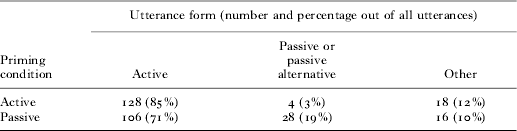
In the first set of analyses, we addressed the question of children's sensitivity to the discourse function of the passive. To examine the use of sentence forms that emphasized the patient of the transitive action and de-emphasized (or omitted) the agent, we combined responses that mirrored the form of the participial passive prime with responses containing various passive alternatives. Table 2 presents the breakdown of children's responses into three broad categories: active sentences, passive or passive alternative sentences, and other utterances.
Children's utterances produced after active or passive primes, Study 2
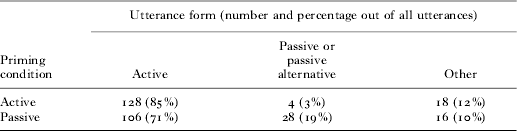
Examination of Table 2 reveals that, like English-speaking children, Russian-speaking children tended to produce transitive (mostly active) sentences in describing pictures of transitive actions. The percentage of ‘other’ utterances was small and there was no difference between the two priming conditions in the production of such utterances (t(28)=0·86, p>0·05). The key difference between the conditions was that the frequency of responses containing a passive or an alternative passive form was higher in the Passive than Active condition. In terms of individual participants, twelve out of fifteen children in the Passive condition and four out of fifteen children in the Active condition produced at least one response categorized as passive or passive alternative.
To determine whether the effect of priming was statistically significant, we carried out an ANOVA with the proportion of utterances containing a passive or passive alternative form (relative to the total number of utterances) as the dependent variable. The results showed that the priming condition was a significant factor (F 1(1, 28)=28·40, p<0·01; F 2(1, 9)=9·23, p<0·05), indicating that children were more likely to produce a sentence categorized as passive or passive alternative after a passive, compared to active, prime.
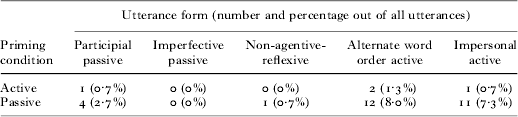
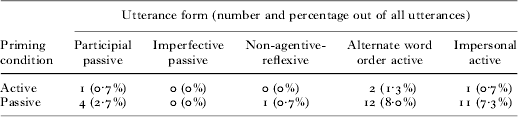
In the second set of analyses, we focused more closely on the individual syntactic forms that were coded as ‘passive or passive alternative’ (Table 3). Children produced relatively few responses that directly mirrored the form of the passive prime. With respect to passive alternative forms, most responses in this category were of two syntactic types. The first type, the Altered Word-Order construction, consisted of utterances in which the patient occurred at the beginning of the sentence and the agent followed the verb (6). The second type, the Impersonal Active, included utterances in which the patient preceded a verb with plural ending (7). Many of these utterances also included a noun in the instrumental case indicating the means by which the action was carried out.
The breakdown of children's utterances categorized as ‘passive or passive alternative’, Study 2
(6) Mal'chika ukusila osa.Boy-acc. bite-past.perf. bee-nom.‘The boy was bitten by the bee.’
(7) Devochku obryzgali shlangom.Girl-acc. sprinkle-past.perf.pl. hose-instr.‘The girl was sprinkled with the hose/They sprinkled the girl with the hose.’
Both Altered Word-Order constructions and Impersonal Active responses are active sentences that begin with the patient of a transitive action. In examining children's use of these sentence forms, we noticed animacy effects similar to those in Study 1, whereby drawings involving animate patients and inanimate agents were more likely to elicit these forms. The three pictures that were most likely to elicit a passive description in Study 1 accounted for 65% of passive alternatives in Study 2. The fact that Russian-speaking children tended to use patient-first active sentences to describe the same drawings that tended to elicit passives from English-speaking children underscores the similarity in the use of these active structures and English passives. Critically, most Altered Word-Order and Impersonal Active sentences were produced following participial passive primes and only a few were produced following active primes.
We conducted a statistical analysis to compare children's use of the individual syntactic forms listed in Table 3 across the two priming conditions. Because imperfective passives were not produced in either condition and non-agentive reflexives were produced only once, these forms were excluded from the analysis. Thus, the current analyses were run with three remaining syntactic forms: Participial passive, Altered word-order active, and Impersonal active. To determine whether these forms were used more frequently after passive compared to active primes, we conducted one-tailed t-tests with Bonferroni correction, adjusting the critical p-value based on the number of comparisons run (p=0·05/3=0·017).
We found no difference between the two priming conditions in the use of the Participial passive (t(28)=0·837, p>0·017). However, there was a significant difference between conditions in the use of the other two forms, the Altered word-order active (t(28)=2·46, p<0·017) and the Impersonal active (t(28)=2·80, p<0·017). These findings allow us to better understand the nature of results reported in the previous statistical analysis. Whereas hearing a participial passive prime increased the overall likelihood of using a range of forms with a similar discourse function, it did not increase the use of the participial passive itself. It appears then that the observed priming effect in our sample of Russian-speaking children was carried by the passive alternative forms.
The activation of functionally related constructions demonstrated by Russian-speaking children raises the question of whether this type of priming effect is specific to children. To address this question, we conducted a follow-up study with Russian-speaking adults (Study 3), investigating whether their responses to passive primes were similar to those observed in children. In order to be able to draw comparisons between child and adult data, we kept the key features of the experimental design identical to those in Study 2. However, we also introduced some new aspects of the procedure due to the nature of testing adults. In previous work with adults, investigators disguised the priming experiment in the context of a different task, usually presented as a memory test (e.g. Bock, Reference Bock1986; Pickering & Branigan, Reference Pickering and Branigan1998). In Study 3, we used elements of adult priming methodology, such as including a cover story where the procedure is presented as a memory task, and inserting filler sentences between priming trials.
STUDY 3. PRIMING A PASSIVE FORM IN RUSSIAN: ADULT FOLLOW-UP
METHOD
Participants
The study involved 19 adults (12 females, 7 males) who were native speakers of Russian. All of the participants were faculty and students from universities in Moscow.
Materials
The materials used in the priming trials included the same 20 pictures (10 to be described by the experimenter and 10 by the participants) as those in Studies 1 and 2. The set of priming sentences was identical to that in Study 2. In addition, we created 32 pictures to be used as fillers. The filler pictures depicted intransitive events, such as a boy running or a monkey sitting on a table. The size and the drawing style of the filler pictures were the same as in the pictures used during priming trials.
Procedure
As in Studies 1 and 2, participants were randomly assigned to receive either active or passive primes; they were tested individually. The experimenter began by telling the participant that he/she would be shown a series of pictures and that the participant's task was to determine whether the picture had been shown during one of the previous trials. To aid in this memory test, each picture was described verbally either by the experimenter or by the participant; the pictures to be described by the participant were marked by a red dot in the top right corner. Thus, on each trial, the participant (a) saw the picture, (b) heard its description or described it him/herself, and (c) said ‘yes’ or ‘no’ to indicate whether the picture had been presented before.
A total of sixty-eight trials were conducted. Twenty of them were the priming trials, on which one of the experimenter's pictures from Studies 1 and 2 was presented along with a priming sentence, immediately followed by the target picture to be described by the participant. Priming trials were separated by four to six filler trials. The forty-eight filler trials included filler pictures, half of which were to be described by the experimenter and the other half by the participant. Note that there were thirty-two unique filler pictures, sixteen of which were presented once and sixteen twice, so that participants could identify some pictures as being repeated.
RESULTS
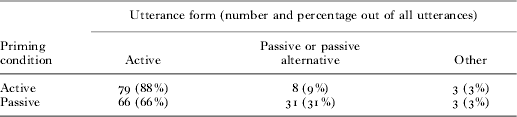
The coding and analysis were parallel to Study 2. Table 4 presents the distribution of responses across the three broad categories: active, passive or passive alternative, and other utterances. Examination of the table reveals a pattern similar to that obtained in Study 2, except that, compared to children, adults had fewer utterances categorized as ‘other’ and more utterances categorized as ‘passive or passive alternative’. In terms of individual participants, all ten adults tested in the Passive condition and four out of nine adults in the Active condition produced at least one response containing a passive or an alternative passive form. A statistical analysis showed the main effect of priming condition (F 1(1, 17)=9·87, p<0·01; F 2(1, 9)=13·96, p<0·01), with more ‘passive or passive alternative’ forms produced after a passive, compared to active, prime. As in Study 2, the use of the passive alternative forms was particularly frequent on trials involving the three pictures that tended to produce participial passives in English speakers. These three trials accounted for 59% of all such utterances.
Adults' utterances produced after active or passive primes, Study 3
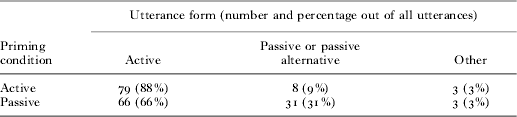
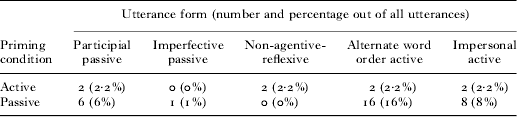
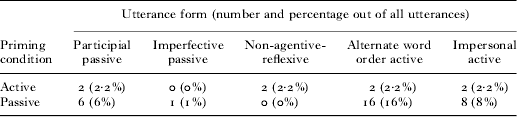
Table 5 presents a breakdown of sentences from the ‘passive or passive alternative’ category. We conducted a further analysis, parallel to Study 2, with the three most frequent sentence types in this category. A t-test, comparing performance in the Active versus Passive priming conditions, showed that the use of participial passives did not vary across conditions (t(17)=1·11, p>0·017). For the Altered word-order active, the effect of condition was significant (t(17)=4·38, p<0·017). For the Impersonal actives, there was a trend in the expected direction (t(17)=1·65, p=0·052). Thus, the findings of the adult study largely replicated the results obtained with Russian-speaking children.
The breakdown of adults' utterances categorized as ‘passive or passive alternative’, Study 3
General discussion
Evidence for the activation of related syntactic structures
In the present article we examined sentences produced by speakers of English and Russian following exposure to either passive or active primes. Because the passive voice in English is the principal way of emphasizing a patient, activating either the syntactic form of the passive or its discourse function should produce the same result, namely the increased production of passives. Indeed, consistent with previous findings, Study 1 showed a straightforward priming effect in English-speaking five- to six-year-olds: hearing a passive sentence form increased the likelihood of producing exactly the same form. In contrast, Russian has a number of ways of emphasizing the patient and de-emphasizing the agent of the action. We used this property of Russian to examine priming effects in terms of both form and function.
Study 2 showed that for Russian-speaking children, hearing a passive prime increased the likelihood of producing a sentence with a discourse function similar to that of the prime. That is, when we pooled together participial and alternative passive forms, the resulting measure showed a substantial increase in the Passive condition compared to the Active condition. A further analysis revealed that this increase was not carried by children's use of participial passives that mirrored the structure of the priming sentences. Thus, rather than producing a particular syntactic structure mirroring the prime, children used several different structures that shared a common discourse function.
As noted earlier, we selected the participial passive as the prime form in the Russian study because of its equivalence to the form of the English passive prime. A question may be raised of whether the lack of priming for this syntactic form in Russian children could be due to the fact that it is relatively rare and children may have difficulty generating it. However, the low frequency of a syntactic form in spontaneous speech is not an obstacle for priming that form. After all, in English, the passive voice is not frequently used in spontaneous speech either (Gordon & Chafetz, Reference Gordon and Chafetz1990; Maratsos et al., Reference Maratsos, Fox, Becker and Chalkley1985), and yet there is substantial evidence indicating that this form can be primed in children (e.g. Bencini & Valian, Reference Bencini and Valian2008; Shimpi et al., Reference Shimpi, Gámez, Huttenlocher and Vasilyeva2007). Further, although the participial passive is not a frequently used form in spoken Russian, prior studies have shown that children even younger than the Study 2 participants produce this form in spontaneous speech (Babyonyshev & Brun, Reference Babyonyshev and Brun2004; Bar-Shalom, Reference Bar-Shalom2002).
Finally, the data obtained in Study 3 provided direct evidence that the lack of a priming effect for the syntactic form of the participial passive cannot be attributed to participants' linguistic immaturity. Indeed, the pattern of responses obtained with Russian-speaking adults largely replicated the findings with children. Even though adults produced more participial passives than children, the effect of priming condition on the use of this particular syntactic form did not reach significance, whereas the effect of condition on the use of altered-word order active sentence forms was highly significant. The combined evidence from the present and prior studies suggests that the low production of the primed form in Russian speakers may not have to do with the low frequency of this form in spontaneous speech or participants' unfamiliarity with the form. Rather, the lack of priming for this specific syntactic form, which contrasts with the findings in the English-speaking sample, may be explained by the availability of alternative forms. That is, exposure to participial passives in Russian increased the production of sentences with the corresponding discourse function, but this increase was distributed among several syntactic forms, of which the participial passive was just one possible alternative.
The analysis of priming (and lack thereof) for specific syntactic forms
Although we argue that a low baseline frequency may not completely prevent priming effects, we acknowledge that the relative frequencies of different forms in spontaneous speech clearly influence children's responses in priming studies. One compelling piece of evidence comes from the overall analysis of utterances produced in the present as well as previous priming studies. Even though the percentage of passives produced by English-speaking participants generally increases in the Passive compared to the Active condition, the majority of responses in the Passive condition are still active sentences, reflecting the tendency to use active voice in spontaneous speech. Russian-speaking participants in the present study showed a similar pattern, also reflecting an unequal distribution of these forms in spontaneous speech.
Another piece of evidence comes from the analysis of Russian responses classified as ‘passives or passive alternatives’. Among these responses, there were many more active sentences with alternate word order and impersonal actives than proper passive sentences. This, again, could reflect the general distribution of passive versus active forms in Russian. Although the existing literature does not provide specific data on the frequency of variable word order, several researchers noted that, in everyday speech, Russian speakers prefer to use active forms with preverbal objects rather than strict passives to emphasize the patient (Krylova & Khavronina, Reference Krylova and Khavronina1986; Nakazawa, Reference Nakazawa, Takagaki, Zaima, Tsuruga, Fernandez and Kawaguchi2005; Zolotova, Reference Zolotova1982). Our own informal analysis of transcripts from a Russian-speaking family available through the CHILDES database (ID# 1-59642-117-7) showed that child-directed speech contained five times as many alternative passive forms as proper passives. Among the alternative forms, about 50% were altered word-order actives, 40% impersonal actives, and 10% included ergatives and pseudo-clefts. These findings are consistent with the claims that active sentences with variable word order are more frequent than passives in Russian. The results of our priming studies suggest that when several forms are available to convey a certain discourse function that has been primed, both adults and five- to six-year-old children tend to use more readily available forms.
In order to further understand the nature of the priming phenomena we observed, it is useful to look at the syntactic forms that could convey the emphasis on the patient but did not get primed in this study. In particular, it is interesting to note that imperfective passives that highlight the patient of the transitive action involving an imperfective verb were virtually absent from the Russian responses. Russian makes a strong distinction between the use of perfective verbs, which denote completed actions, and imperfective verbs, which denote actions as ongoing (Poupynin, Reference Poupynin1996). In spontaneous speech, children use imperfective passives less frequently than perfectives, whereas adults use imperfective and perfective passives in equal proportions (Babyonyshev & Brun, Reference Babyonyshev and Brun2004; Vinnitskaya & Wexler, Reference Vinnitskaya and Wexler2001). Yet there was just one response containing an imperfective passive among adults and no such responses among children. We suggest that because the primes involved only perfective verbs, hearing these primes may have increased speakers' tendency to interpret depicted scenes as completed rather than ongoing actions, leading them to use perfective verbs in their own sentences.
Interpretation of the findings: Theoretical implications
The evidence from Russian suggests that exposing speakers to a passive form may activate a discourse function associated with that form, namely emphasizing the patient of the action. This activated discourse function can be then conveyed via a number of structures available in that particular language system. Furthermore, priming may activate other kinds of representational information, such as verb aspect. It appears that what gets primed is not just the formal structure of the passive voice but a particular way of looking at and interpreting a given situation that is captured by the priming sentence. These findings are relevant to the ongoing discussion in the literature concerning the degree of autonomy of syntactic representations and the extent to which priming findings reveal syntactic autonomy (Pickering & Ferreira, Reference Pickering and Ferreira2008).
The results of the original priming work by Bock (Reference Bock1986), showing an increase in the production of passives following passive primes in English speakers, were interpreted as evidence for the existence of autonomous syntactic representations. In discussing this evidence, Pickering and Ferreira (Reference Pickering and Ferreira2008) pointed out that the increase in passives could not be due to some form of non-syntactic priming, for example, the priming of a particular construal of the picture (e.g. focus on the patient). This is because, if the priming were due to an increasing focus on the patient, then “speakers should describe target pictures with any sort of structures in which patients are prominent (e.g. the church is burning), and not just passive structures specifically (the church was hit by lightning)” (Pickering & Ferreira, Reference Pickering and Ferreira2008: 429). Yet Bock (Reference Bock1986) did not find any evidence of increase in the production of alternative structures, such as ergatives. What we argue is that the lack of the alternative structures in Bock's data could reflect the fact that passive is a much more common way of emphasizing a patient in English and that the alternatives – ergatives and clefts – are much more restricted in their use. For example, since ergative sentences generally involve inanimate patients and causative verbs (Fagan, Reference Fagan1988; Fujita, Reference Fujita1994; Hale & Keyser, Reference Hale, Keyser, Hale and Keyser1993), it takes a very particular type of drawing to enable participants to use such sentences. The present study and the work by Gámez et al. (Reference Gámez, Shimpi, Waterfall and Huttenlocher2009) show that, in languages where alternative structures with passive-like functions are more common, speakers indeed tend to use these alternative forms to describe target pictures following passive primes.
As noted in the ‘Introduction’, while we discuss our results in terms of the activation of a common discourse function, it is also possible to characterize these findings as the activation of a particular order of thematic roles. The term ‘thematic role’ refers to the general meaning of the verb arguments – that is, to the roles they play in the event described by the sentence (e.g. agent, goal, theme, patient). A possibility of priming thematic role order has been shown in a study with adults, in which they were presented with alternative sentences that had the same syntactic structure but different role orders (Chang, Bock & Goldberg, Reference Chang, Bock and Goldberg2003). An example of such alteration can be seen in the sentences The man sprayed wax on the car and The man sprayed the car with wax – the two sentences vary in the order of arguments indicating the theme (wax) and location (car). The participants were more likely to use a particular order of thematic roles after hearing a prime with the same role order. Extrapolating these findings to our study, one could argue that, in the passive condition, children were primed for a particular role order – that is, they were primed to place the patient before the agent.
It should be noted, however, that thematic role ordering is almost universally associated with discourse function (Goldberg, Reference Goldberg2003; Erteschik-Shir, Reference Erteschik-Shir, Laberge and Sankoff1979). That is, alterations of thematic role ordering are typically used to change the emphasis of the sentence and to express a specific discourse function. Given the difficulty of distinguishing discourse function (focus on the patient) from thematic role order (patient before agent) in our data, we would like to point out the large degree of overlap between these two explanations. A discourse focus captures a functional, meaningful aspect of sentence production; a thematic role array captures the relational meaning of a sentence. That is, in contrast to an abstract syntactic structure, viewed independently of the meaning, both the discourse focus and thematic role ordering refer to aspects of the meaning (such as patient or agent and the emphasis placed on them) that can be reproduced in sentences with different lexical items. Thus, under either interpretation, our findings point to the activation of functional information through priming whereas in prior work priming effects were generally explained as limited to the activation of a specific syntactic structure.
Despite our emphasis on function and meaning, we do not claim that there is no such thing as structural priming and that all prior results of syntactic priming studies can be explained by the activation of discourse function (or patient-first focus). There is evidence, at least in work with adults, that structural relations can be primed independently of conceptual roles (Bock et al., Reference Bock, Loebell and Morey1992). We propose that both structural and functional aspects of the sentence can get activated and reproduced with a new set of lexical items. Following the terminology of constructionist grammar, we suggest that what gets activated is a particular construction, that is, a pairing of form and function (Goldberg, Reference Goldberg2003).
Remaining questions
In future work, it would be productive to examine the developmental course of the observed phenomenon by expanding this type of investigation to younger children. It is possible that the relative importance of the discourse, versus structural information, changes with age. Some investigators have suggested that learning form rather than meaning is easier at earlier ages (Naigles, Reference Naigles2002). This suggestion may lead one to expect that young children would be more dependent on the syntactic form of the prime. Although the present study produced similar findings for Russian-speaking children and adults, the children were older than those in other priming studies. Thus, extending this line of research to younger participants would clarify whether the observed sensitivity to discourse function is a later emerging developmental feature.
Further, it may be useful to extend the investigation to other languages and systematically test whether there are differences in the pattern of priming between the languages in which a single primary structure versus multiple structures are available to convey a particular discourse function. At the same time, a reanalysis of the data gathered in previous studies with English-speaking children may be warranted. In these studies, analyses commonly focus on responses that have either active or passive structure corresponding to the structure of the prime. Alternative structures, including ergatives, are generally classified as ‘other’. There are reports that English-speaking children sometimes use creative, ungrammatical ways of foregrounding the patient when primed by the passive, but again, such responses are excluded from the analysis (Huttenlocher et al., Reference Huttenlocher, Vasilyeva and Shimpi2004). Yet it is possible that these responses reflect children's attempts to convey a particular construal of the event that was primed by the passive.
Lastly, in discussing future research, methodological limitations of the present study should be acknowledged. The stimuli in this study included a mix of regular and irregular verbs, but the study did not investigate the role of verb morphology with respect to priming. Future work could determine whether such morphological differences affect priming results. Further, our stimuli were not sufficiently balanced with respect to the animacy of depicted characters. The results showed that priming effects were largely carried by the trials that involved animate patients and inanimate agents; however, without a systematic manipulation of animacy, our ability to analyze animacy effects was limited. Using a more balanced set of stimuli would allow researchers to better understand how the choice of a syntactic structure may be affected by various non-structural aspects of language.
In sum, priming methodology has been useful in examining the nature of children's linguistic representations, in particular the representation of the passive voice. Prior work has shown that priming increases the likelihood of using the syntactic form of the passive voice independently of specific lexical items. Our results suggest that priming also taps into the agent/patient focus of the sentence. Future cross-linguistic research has the potential to provide a more precise picture of the relation between structure and function in sentence production and possible developmental changes in this relation.
APPENDIX
I. English primes from Study 1 and corresponding Russian primes from Studies 2 and 3
Active condition Passive condition(agent animacy – patient animacy)
1. The ball broke the window./The window was broken by the ball. (Inanimate – Inanimate)
M'ach razbil okno./Okno bylo razbito m'achom.
2. The frog caught the butterfly./The butterfly was caught by the frog. (Animate – Animate)
Lyagushka poymala babochku./Babochka byla poymana lyagushkoy.
3. The wind blew the leaves./The leaves were blown by the wind. (Inanimate – Inanimate)
Veter razbrosal list'a./List'a byli razbrosany vetrom.
4. The hippo licked the giraffe./The giraffe was licked by the hippo. (Animate – Animate)
Gipopotam oblizal zhirafa./Zhiraf byl oblizan gipopotamom.
5. The dog brought the boy./The boy was brought by the dog. (Animate – Animate)
Sobaka utaschila mal'chika./Mal'chik byl utaschen sobakoi.
6. The trap hurt the bear./The bear was hurt by the trap. (Inanimate – Animate)
Kapkan poranil medved'a./Medved' byl poranen kapkanom.
7. The sun melted the snowman./The snowman was melted by the sun. (Inanimate – Animate*)
Solntze rastopilo snegovika./Snegovik byl rastoplen solntzem.
8. The elephant carried the monkey./The monkey was carried by the elephant. (Animate – Anim.)
Slon priv'oz obez'any./Obez'ana byla privezena slonom.
9. The lightning hit the tree./The tree was hit by the lightning. (Inanimate – Inanimate)
Molniya slomala derevo./Derevo bylo slomano molniei.
10. The raccoon scratched the tree./The tree was scratched by the raccoon. (Animate–Inanimate)
Enot rastzarapal derevo./Derevo bylo rastzarapano enotom.
*Although ‘snowmen’ are inanimate entities, they are often treated culturally and linguistically as animate and referred to as ‘he’.
Number of primes with animate agent and animate patient: 4
Number of primes with inanimate agent and inanimate patient: 3
Number of primes with animate agent and inanimate patient: 1
Number of primes with inanimate agent and animate patient: 2
II. Descriptions of target pictures presented to participants in Studies 1−3:
Picture description (Agent animacy – Patient animacy)
1. The mailman is being bitten by the dog. (Animate – Animate)
2. The boy is being stung by the bee. (Animate – Animate)
3. The girl is being sprinkled by the hose. (Inanimate – Animate)
4. The gate is being crushed by the car. (Inanimate – Inanimate)
5. The shoe is being ripped by the dog. (Animate – Inanimate)
6. The flower is being eaten by the rabbit. (Animate – Inanimate)
7. The horse is being fed by the boy. (Animate – Animate)
8. The man is being splashed by the water fountain. (Inanimate – Animate)
9. The dirt is being dumped by the truck. (Inanimate – Inanimate)
10. The duck is being caught by the tiger. (Animate – Animate)
Number of pictures with animate agent and animate patient: 3
Number of pictures with inanimate agent and inanimate patient: 2
Number of pictures with animate agent and inanimate patient: 3
Number of pictures with inanimate agent and animate patient: 2