1. Introduction
This article draws attention to a corner of English grammar that has received little documentation in the linguistic literature, and has been altogether ignored within generative grammar: ditransitive constructions where the oblique PP consists of a preposition and a gerund complement clause.

Such constructions have often fallen between the chairs; studies of ditransitive VPs tend to focus on nonclausal arguments, and studies of clausal complementation tend to focus on finite or infinitival clauses, not on gerunds, and certainly not on gerunds introduced by prepositions. Yet we will see that even in such a narrow corner one can discern patterns of a much broader generality. Far from being avoided, ‘non-canonical’ data should be fully attended to by linguists seeking to validate their general hypotheses.
Examples (1a–b) both display object control; the reference of the understood subject of the gerund is Bill, not they. Such will be the character of the entire range of cases to be examined below, although I should note that English also provides for subject control in P-gerund constructions, whether transitive or not (e.g. John revelled in listening to their stories, I am writing to formally inform you of leaving my position). These are left out of the present investigation for no principled reason. As it turns out, some of the syntactic tests are inapplicable to them. Ultimately, we do not expect subject controlled gerunds to raise any special difficulties.Footnote 2
As a necessary preliminary, observe that the P-gerund complementation frame is a special case of the more common P-DP frame. The latter, in fact, is more common and does not guarantee the former (Rudanko Reference Rudanko1989).

It is far more difficult – perhaps impossible – to find the opposite pattern, where a gerund is available as a complement of P but a DP is not. This state of affairs suggests that gerunds and DPs are ‘close enough’ for c-selection not to distinguish between them, but s-selection still does; presumably, the semantic spectrum of DPs subsumes that of gerunds, but not vice versa. These selectional differences deserve to be studied in their own right, but will not concern us here.
Instead, my focus will be on a hitherto unnoticed distinction, of a rather fundamental sort, between the complements in (1a) and (1b). The construction in (1a) is causative, and it induces a direct predication relation between the object and the gerund; hence, Bill is ascribed the property of committing a crime. Alongside into, this construction also occurs with to, out of and from. The construction in (1b) lacks a causative force and does not induce a similar predication relation. Alongside against, it also occurs with of and with. It will be shown that each of these two classes of constructions displays a characteristic cluster of syntactic and semantic properties. To shed light on this duality, I will adopt the Two-tiered Theory of Control (TTC) of Landau (Reference Landau2015), in which the dual nature of control is a fundamental tenet.
The structure of this paper is as follows. Section 2 lays out the proposal: P-gerund constructions can be projected either inside a PredP small clause or as part of the VP-shell, accounting for (1a)-type and (1b)-type sentences, respectively. Section 3 describes the two classes in more detail, demonstrating that the causative construction yields implicative control (Section 3.1) and the noncausative one yields nonimplicative control (Section 3.2). Section 4 focuses on the different semantic types of the gerunds in the two constructions and their consequences: The implicative gerund denotes a property, resists partial control and disallows a lexical subject; the nonimplicative gerund denotes a proposition, and allows either partial control or a lexical subject. Section 5 examines specific predictions made by the two different structures assigned to the two constructions. It is shown that the presence of PredP inside the VP imposes certain syntactic restrictions: The matrix object cannot be dropped and the predicative PP cannot be fronted. The nonimplicative construction is free of these restrictions. Section 6 considers some broader implications of the present account, specifically as regards alternative approaches. Section 6.1 points out a challenge raised to a popular semantic analysis of control, whereby all controlled clauses are treated as property-denoting; Section 6.2 discusses the limitations of corpus studies and Construction Grammar in detecting and explaining the patterns documented here. Section 7 concludes the paper.
2. The proposal
Control, as viewed in the TTC, operates through two mechanisms: predication or logophoric anchoring. Each mechanism is associated with its characteristic syntax and semantics.
In predicative control, the clausal complement projects up to FinP.Footnote 3 PRO moves to [Spec,FinP] and is interpreted as a λ-abstractor over the subject’s position, yielding a property of type <e,<s,t>>. This property is predicated of the individual denoted by the controller, as part of the lexical semantics of the matrix verb. ‘Control’ in this scenario is nothing but the attribution of the complement property to the referent of the controller.
Meanwhile, in logophoric control the complement clause projects a CP layer on top of the predicative FinP. C introduces a logophoric tuple (<world,time,author,addressee>) that is anchored to the speech/thought event of the matrix clause. It also projects one of its individual coordinates as pro in its specifier, denoting the doxastic counterpart of the referent of the controller. This pro is syntactically bound by the controller, and furthermore, saturates the predicative FinP, delivering a propositional complement of type <s,t>. ‘Control’ in this scenario is achieved in two steps: First, the coordinate pro saturates the FinP-property; second, this pro is construed as the doxastic counterpart of the referent of the controller via the intensional semantics of the matrix verb (see Landau Reference Landau2015 for the explicit exposition).
The two types of complements are schematized as follows:

Predicative control is found with aspectual, modal and implicative verbs, as well as evaluative adjectives. Logophoric control is found with desiderative, propositional, factive and interrogative verbs. The pair below illustrates the distinction with infinitival complements.

A hallmark of implicative verbs is that they entail the truth of their complements; thus, (4a) but not (4b) entails that Bill signed the contrast. This is entirely parallel to what we observe in the pair in (1): (1a) but not (1b) entails that Bill committed a crime. Note that (1a) and (4a) share another property: Both are causative. I return to this aspect below.
The proposal for P-gerund constructions is, therefore, straightforward: They display the same duality of mechanism that more familiar constructions of complement control do. And this duality has testable consequences, which are demonstrated in the sections to come, not only for into-gerund and against-gerund constructions, but for the entire classes for which they stand. Thus, we will be able to discern common grammatical types underneath constructions that involve different prepositions and, superficially, quite disparate semantic relations.
Putting together the different pieces, these are the two structures I propose for implicative (causative, predicative) P-gerund constructions, (5), and for nonimplicative (logophoric) ones, (6).


For the causative construction (5), I assume that the lexical root is directly merged with the causative light v and interpreted as an event modifier (e.g. ‘cause by talking’), following the treatment of ‘manner incorporation’ in Marantz Reference Marantz2005, Folli & Harley Reference Folli and Harley2007 and Alexiadou, Martin & Schäfer Reference Alexiadou, Martin and Schäfer2017; alternatively, it could be merged as a v′-adjunct (Folli & Harley Reference Folli and Harley2019), like other modifiers, and undergo subsequent m-nerger with light v.
Syntactically, two differences between (5) and (6) will play a central role below. First, the controller DP (Bill) is a subject of a PredP in the former but a VP-shell specifier in the latter; second, the unit [P gerund] is only a maximal projection in (6), not in (5). In Section 5, I discuss syntactic consequences of these differences.
3. Two classes of prepositional gerund control
We now turn to a closer description of the two classes of P-gerund constructions: implicative (Section 3.1) and nonimplicative (Section 3.2) constructions. Particular attention will be given to the former class in order to establish its causative character, which underlies its main features.
3.1 Causative-implicative P-gerund complements
Four prepositions combine with gerundive complements to yield implicative meanings: to, into, out of and from. While the first two produce positive implicatives, the second two produce negative ones. Semantically, they form two polar pairs (into–out of and to–from).

Under a positive implicative verb, the complement is entailed, while negative implicative verbs entail the negation of the complement (Karttunen Reference Karttunen1971). When the matrix clause itself is negated, the entailment disappears, indicating that the complement is asserted, not presupposed.

It is known that when a strong implicative verb is negated, the complement entailment is reversed. Thus, John didn’t manage to solve the exercise entails that John didn’t solve the exercise. With weak implicative verbs, however, the entailment simply disappears (see Landau Reference Landau2000: 77): John didn’t force Bill to solve the exercise neither entails that Bill solved the exercise nor that he didn’t. This seems to be a general property of causative implicatives, extending to the present four classes in (7), as seen in (8b, d).
The literature on into-gerunds recognized their implicative character (Rudanko Reference Rudanko2002: 267, Reference Rudanko2005: 172, Reference Rudanko2006: 317). Kim & Davies (Reference Kim and Davies2015: 60) cite (9a–b) as evidence.

The productivity of the causative P-gerund construction greatly varies across the four prepositions. The following lists are based on Rudanko (Reference Rudanko1989); they are given as illustration and are far from exhaustive:

The from-gerund construction also occurs with Raising-to-Object verbs like prevent, ban, stop, and keep (Postal Reference Postal1974, Landau Reference Landau2002, Baltin Reference Baltin, Irwin and Maldonado2009); I exclude them from the present discussion as they differ from the control constructions in a number of ways, not directly relevant to us.
The into-gerund construction has received considerable attention in the descriptive and diachronic literature but very little in the way of formal analysis (see Hunston & Francis Reference Hunston and Francis2000; Gries & Stefanowitsch Reference Gries, Stefanowitsch, Achard and Kemmer2004; Rudanko Reference Rudanko1989, Reference Rudanko2005, Reference Rudanko2006, Reference Rudanko2011, Reference Rudanko, Hoffman, Rayson and Leech2012; Wulff, Stefanowitsch & Gries Reference Wulff, Stefanowitsch, Gries, Radden, Köpcke, Berg and Siemund2007; Kim & Lee Reference Kim and Lee2013; Kim & Davies Reference Kim and Davies2015). This literature has documented a continual increase in the frequency of the construction over the past 200 years, as well as nuanced lexical differences between the verbs taking it in British vs. American English. The most extensive study to date is Kim & Davies (Reference Kim and Davies2015), whose findings I follow below.
Kim & Davies (Reference Kim and Davies2015) analyzed over 20,000 tokens of the construction from both British and American English corpora. Although it most frequently occurs with a relatively small group of verbs (talk, trick, fool, force, coerce, mislead, delude, bully, pressure), it is found with hundreds of other verbs. Quite evidently, speakers frequently use it in innovative ways. (11a–b) are from Kim & Davies (Reference Kim and Davies2015: 65–66). (11c), found on the internet, shows that even proper names can be used as verbs in this context.

Although many of the verbs participating in the construction fall into consistent lexical subclasses (means of deception, exerting force, arousing fear etc.; see Rudanko Reference Rudanko2011), Kim & Davies (Reference Kim and Davies2015: 12) observe that ‘there seem to be no limits on the creativity of speakers’.Footnote 4 The question of how speakers extend the use of the into-gerund construction to novel verbs, and what constrains this process, is an important topic for the study of language change, but I will have nothing to say about it here. Rather, my focus will be on the shared syntactic properties that characterize any member in this class as well as in the other three causative classes (to/out of/from-gerund).
Two pieces of evidence suggest that these constructions are indeed grammatically causative. First, insofar as the matrix verb accepts a non-agentive subject, it can co-occur with the P-gerund complement. Causative constructions famously do not select for a [±human] feature on the Causer ((12a) is from Kim & Davies Reference Kim and Davies2015: 55).

Secondly, the characteristic scope ambiguity with almost – modifying either the result or the causing event – is attested in these constructions as well (13a)/(14a). The continuations in (13b)/(14b) target the high scope, cause-modifying reading, while those in (13c)/(14c) target the low scope, result-modifying reading.


Structure (5) above, proposed for these constructions, implies that the causative-implicative meaning is ‘constructional’; that is, it does not inhere in the verbal root itself but rather arises from the functional skeleton in which it is embedded. Striking confirmation for this view comes from verbs that alternate between a V–P–gerund frame and a V–infinitive frame. Although the alternation is semantically neutral with some of these verbs, it is not so with others. In particular, the implicative sense is obligatory with P-gerund complements; the infinitival variants may receive an irrealis interpretation.


One may be tempted to attribute the implicative sense solely to the preposition into, but this cannot be true, for that sense depends on which verb it combines with (Kim & Davies Reference Kim and Davies2015: 60), as seen in (17).

Likewise, although from-gerund complements are nearly always implicative, sometimes they are not. In the following example, the event described in the gerund is not entailed:

This is yet another indication that the implicative entailment is not written into the denotation of the preposition.
Instead, I propose that the implicative sense arises from the presence of PredP in (5). In principle, each one of the prepositions to/into/out of/from can project such a PredP, and when it does, it no longer conveys a spatial relation, but some kind of an incohative sense (becoming X or becoming not-X). The prepositional head mediates direct predication between its two argument – the DP and the gerund, yielding the implicative entailment. Selection or non-selection for PredP is what distinguishes implicative verbs like dissuade from nonimplicative ones like discourage. Without PredP, no direct predication between the two objects applies. Instead, an indirect, intensional relation is established via the semantics of the verb itself. This furnishes a semantic argument for the existence of PredP in the structure. In Section 5, I adduce independent syntactic arguments to the same effect.
Before proceeding, let me mention one type of P-gerund construction that superficially seems to belong with the verb classes in (10), but upon closer inspection turns out to be irrelevant: These are for-gerund constructions.

As argued extensively in Green (Reference Green2018, Reference Green2019) and Landau (Reference Landau2021), for-gerunds are adjuncts, not complements; specifically, adjuncts that specify the justification for the matrix event. This is true even with verbs like thank and praise, as seen by the fact that the for-gerund can be spared by VP-ellipsis (Green Reference Green2018: 168).

This is clearly impossible with the causative-implicative constructions examined here.

For-gerund adjuncts are therefore not discussed in this paper.
3.2 Nonimplicative P-gerund complements
Three prepositions combine with gerundive complements to yield nonimplicative meanings: of, with and against.

There are far fewer nonimplicative P-gerund complements than implicative ones, and none of the sublcasses of the former type appears to be lexically innovative. The following classification of verbs according to the preposition they select draws on Rudanko (Reference Rudanko1989), with my own extensions; the lists are not exhaustive:

The small size of these classes makes it difficult to state solid semantic generalizations. Some of the verbs (accuse, convict, suspect, reproach) select complements that are held as true in the attitude holder’s past, thus invoking an epistemic attitude. Others (warn, entrust, task, advise, caution, counsel) select complements that represent the attitude holder’s normative preferences, thus invoking a deontic attitude. Either way, no direct predication applies between the direct object and the gerund, hence no implicative entailment is generated. For example, a sentence like (22a) implies that John has the property of stealing the formulae in all the worlds that conform to Mary’s accusations (i.e. where Mary’s accusations hold true). This, of course, implies nothing as regards John’s guilt in the actual world.Footnote 5
4. Property vs. propositional gerunds
A major debate within the literature on control concerns the status of subjectless (or PRO-containing) complements: Do they denote propositions or properties? Traditionally, the propositional analysis has been favored in syntactically oriented treatments while the property analysis has been favored in semantically oriented ones.Footnote 6 However, a number of works assumed a duality of mechanism that can be naturally expressed as the property–proposition opposition (Williams Reference Williams, Larson, Iatridou, Lahiri and Higginbotham1992, Wurmbrand Reference Wurmbrand, Zwart and Abraham2002, Grano Reference Grano2015). Landau (Reference Landau2015, Reference Landau, Halpert, Kotek and Urk2017, Reference Landau2021) continues the latter strand, supplementing it with the specific syntactic proposal that predicative complements project up to FinP and propositional ones project higher to the CP level, as schematized in (3) above. Within the present context, two empirical consequences of that dual system follow. First, implicative P-gerund complements should resist partial control and nonimplicative ones should allow it. Second, implicative P-gerund complements should reject a lexical subject and nonimplicative ones should accept it. Both are tested and confirmed below, in Sections 4.1 and 4.2, respectively. In Section 6.1, I return to consider the implications of these findings for the theoretical debate on the semantic type of controlled complements.
4.1 Exhaustive vs. partial control
Since Landau (Reference Landau2000), it is known that implicative verbs induce exhaustive control (EC) in their complement while attitude verbs allow partial control (PC).Footnote 7 A standard contrast with infinitival complements is the following: While remember is an implicative EC verb, plan is a nonimplicative PC verb. Correspondingly, the subject of to gather can be understood as ‘John plus others’ in (24b) but not in (24a). Note that PC requires context to supply the reference of the ‘others’, which is here facilitated by the introducing clause We were happy that ….

The EC–PC distinction is visible in gerundive complements as well.

Correspondingly, we expect the implicative P-gerund constructions to resist PC and the nonimplicative ones to permit it. The facts bear out this expectation. None of the four types of implicative P-gerund complements allow PC.

In contrast, nonimplicative P-gerund complements allow PC, as shown in the following naturally occurring examples (from the internet):

The EC–PC distinction reflects two mechanisms of control – predicative vs. logophoric control (Landau Reference Landau2015). In implicative-causative constructions, OC is obtained by direct predication between the matrix direct object and the PP predicate. Because predication cannot be ‘partial’, PC is excluded (compare standard predication, e.g. John worked as a crew *(member)). In logophoric control, however, there is no direct semantic relation between the controller and PRO. Rather, PRO is associated with a doxastic counterpart of the controller’s referent, and this association is looser, allowing a partial interpretation.Footnote 8
Landau (Reference Landau2015) further observes that not only PC but also control shift is restricted to logophoric control; predicative control, in contrast, obeys strict locality and disallows a shift from object to subject control. Empirically, this distinction is less robust because control shift is further constrained by subtle lexical factors and is not a pervasive feature of logophoric control as such. Nonetheless, if contrasts emerge, they confirm this prediction: (28a–b) (from the internet) display (shifted) subject control across an object in nonimplicative P-gerund constructions; (28c, d) show this to be impossible with implicative constructions, even when conditions most favorable to control shift are granted (object-directed authority relations and non-agentive complements).

In Landau (Reference Landau2015, Reference Landau, Halpert, Kotek and Urk2017, Reference Landau2021), the EC–PC contrast and the (im)possibility of control shift reflect a fundamental duality of control clauses: property-denoting clauses vs. logophorically-anchored, propositional clauses. This distinction in semantic types has further consequences, to which we turn now.
4.2 Tolerance to lexical subjects
Grano (Reference Grano2015: 19) observed that EC predicates cannot take complements, finite or nonfinite, with lexical subjects. In truth, EC verbs like try and manage do appear with such complements, but only under a special coercion – specifically, causative coercion (e.g. How could I possibly flirt with him and manage for him to fall in love with me?). Those EC verbs that cannot be so coerced strongly resist a lexical subject in their complement.

On Landau’s TTC, this fact immediately follows from the predicative nature of the complement. EC verbs s-select a predicate; an embedded lexical subject would turn the complement into a proposition, resulting in a semantic type clash.
By contrast, PC predicates employ logophoric control, where the complement is propositional. This is achieved by saturating the PRO-infinitive with a logophoric pro – the so called de se center (see Landau Reference Landau2015 for details). One implication is that from a semantic point of view, nothing should rule out an embedded lexical subject; the complement anyway denotes a proposition. This is indeed the case. Although nonfinite clauses are less hospitable to lexical subjects, these may occur under PC verbs – either in nonfinite or in finite complements.

Extending this logic to adjunct control, Landau (Reference Landau2021) shows that nonfinite adjuncts also split according to the property–proposition divide: Those that are necessarily predicative resist lexical subjects while those that are logophoric accept them. A number of other grammatical properties cluster around that same distinction, which is illustrated here with two types of adjuncts:


With this background in mind, let us consider the tolerance of P-gerund complements to lexical subjects. The only study where this question is addressed, even if briefly, is Kim & Davies (Reference Kim and Davies2015: 59), where it is observed that into-gerund complements resist lexical subjects (note that the pronominal subject of the gerund is excluded regardless of its reference, hence this is not a case of obviation).

In fact, the observation holds true for the other three types of causative-implicative complements.

Intuitively, what goes wrong in (33)–(34) is that the attempted indirect causal chains are not supported by the inherent semantics of the construction. It is the referent of the direct object itself that must come to bear the resulting property (expressed by the gerund) following the causing event. This is, of course, a hallmark of direct predication.
In contrast, nonimplicative P-gerund complements readily occur with lexical subjects (all the examples in (35) were found on the internet).

The same, ultimately semantic, reason underlies the availability of PC and the availability of lexical subjects in these complements; namely, they denote propositions. Failure to recognize this may lead to unnecessary stipulations. Thus, considering the theoretical implications of (33), Kim & Davies (Reference Kim and Davies2015: 59) conclude that
the verb also needs to have access to the prepositional object, the gerundive (ger) phrase, which is not accessible within the verb’s local domain. That is, the c-selection … information of the verb fool here thus needs to include the nonlocal VP[ger] too, which makes the construction syntactically peculiar.
None of this peculiar, nonlocal c-selection is needed, though. First, note that it is far from obvious that subjectless gerunds and ACC-/GEN-subject gerunds are categorially distinct; the absence or presence of an internal subject should not be externally detectable on the categorial label of the head of the gerund.Footnote 9
Second, assuming for the sake of the argument that it is visible, c-selection does not appear to provide real insight to the relevant contrast. Why is it that into-gerunds must be subjectless and with-gerunds need not be, and not the other way round? The present account, which appeals to s-selection, offers a principled answer: Into-gerunds function as predicates that form a PredP projection together with the direct object. It is their semantic type (<e,<s,t>>) that clashes with a lexical subject. Strictly speaking, these predicates are not selected by the verb at all, hence nonlocal selection is not invoked. Rather, the entire PredP is selected, being the complement of the causative verb. Nonimplicative verbs, by contrast, select both their direct object and the gerund-containing PP. The latter is s-selected as a proposition, hence a lexical subject is allowed in it. This account has the further advantage of explaining the EC–PC contrast, as shown in Section 4.1, on which the c-selection account is obviously silent.
5. Syntactic differences
The structures proposed for the two P-gerund constructions in Section 2 above are repeated here.


The critical difference between these two structures concerns the status of the two arguments. In (36), the postverbal DP is a subject of a PredP projection, while in (37) it is a specifier in a VP-shell; this difference, of course, reflects the semantic distinction between a causee (not an argument of the verb) and a direct argument of the verb. Correspondingly, the [P gerund] constituent in (36) is a predicate, but in (37) it is a PP argument of the verb. In this section, I discuss two syntactic consequences of these differences. First, whether or not the postverbal DP can be dropped (Section 5.1), and second, whether or not the PP can be fronted (Section 5.2). These consequences provide further evidence that the implicative–nonimplicative distinction is expressed both in the semantics and in the syntax of P-gerund constructions.
5.1 Object drop
Bresnan (Reference Bresnan1982) coined ‘Bach’s generalization’, which stated that object control verbs cannot be detransitivized (i.e. undergo object drop), as in (38a) below. Subsequent research, however, has shown that the generalization is largely spurious: Often it is the lexical properties of the verb itself – mostly unpredictable – that exclude object drop, regardless of control, (38b). Further, not only direct objects but sometimes oblique ones resist omission, (38c) (see Landau Reference Landau2013: 178–180 for a critical discussion, connecting those facts to implicit control).

Landau (Reference Landau2015: 73–75), however, revives some version of Bach’s generalization. Assuming the duality of OC mechanisms – predication vs. logophoric anchoring – Landau observes that predicative control should display characteristic properties of predication; among them, the requirement that the argument saturating the predicate be syntactically present (i.e. not implicit). Given that implicative complements are controlled via predication, the following condition is derived:

Note that (39) is both narrower than Bach’s generalization (applying only to implicative verbs) and broader (applying to indirect and oblique objects as well). Indeed, Landau (Reference Landau2015) demonstrates that even oblique arguments cannot be dropped when controlling an implicative complement, e.g. Mary imposed *(on John) to accept her terms, vs. nonimplicative verbs of communication, e.g. Mary signalled (to John) to stay still. Importantly, (39) is a necessary condition on object drop in OC, not a sufficient one. Given lexically idiosyncratic c-selection (as seen in (38a–c)), no sufficient condition for object drop can be stated. Furthermore, languages famously differ in their tolerance to object drop (English being fairly resistant in this regard), so one should not expect it to be possible with any nonimplicative control construction.Footnote 10
In the present context, the prediction is straightforward: No implicative P-gerund construction will allow object drop, but some nonimplicative P-gerund constructions will. Let us turn now to the facts.
As noted by Rudanko (Reference Rudanko1989: 129), implicative P-gerund constructions prohibit object drop. Although Rudanko only illustrates this with from-gerund constructions, the generalization holds across all four types.

As far as I know, these facts are representative of the entire causative-implicative class (recall that it includes hundreds of verbs), without exception. It goes without saying that generic/habitual sentences should not be tested, due to the general process of generic object drop; the limiting effect of control on object drop can only be discerned in episodic contexts.Footnote 11
Turning to the nonimplicative constructions, the picture is mixed. This is not surprising, given that (39) does not specify any sufficient condition on object drop, and as just noted, idiosyncratic restrictions apply on top of it. To begin with, it seems that the entire class of against-gerunds allows object drop, and concomitantly, implicit control. In (41) and subsequently, I underline the position of the implicit object below, remaining neutral on its grammatical status (but see Landau Reference Landau2010 for a specific proposal). Note that in all these cases, the implicit controller is construed with some salient antecedent.

It is considerably more difficult to drop the object in the other two nonimplicative types, of-gerund and with-gerund constructions. Barring generic contexts, one can still find a few examples, such as those in (42), where the implicit controller is specific. Note that such examples are only acceptable when used in context and are rarely produced in isolation.

There is a potential generalization here, namely, object drop is easier before irrealis/deontic complements (namely, against-gerund complements) than it is before epistemic ones (of-gerund and with-gerund complements). That it is the complement’s mood, rather than the preposition, to which object drop is sensitive, is supported by the fact that implicit control is more easily available into an irrealis of-gerund.Footnote 12

Whether this pattern can be related to a broader and more principled account, I do not know. At any rate, the fundamental contrast with the implicative class corroborates the present analysis.
5.2 PP-fronting
Like nominal complements of prepositions, gerundive complements can be questioned, stranding the preposition behind.

It is well-known that in spoken English, pied-piping is dispreferred if P-stranding is possible. Nonetheless, it is not ungrammatical, and is at most unnatural. Yet, when we compare the two types of P-gerund constructions, a contrast emerges.

The contrast is systematic: Implicative [P-gerund] phrases cannot be fronted while nonimplicative ones can. It is most clearly felt in relativization, where prepositions are comfortably pied-piped in principle.

Consider now PP-fronting with nonimplicative constructions; these are clearly acceptable.

The contrast in the possibility of PP-fronting strongly suggests that underneath their superficial string-identity, implicative and nonimplicative P-gerund constructions harbor a different syntax. How can the structures in (36)–(37) shed light on this difference?
In fact, the syntactic explanation is as simple as it gets: The P-gerund constituent in (36) is a nonmaximal, Pred′ projection, whereas the P-gerund constituent in (37) is a maximal PP projection. Since only minimal or maximal (but not intermediate) projections can move, the implicative [P gerund] phrase is unable to move. The contrast with nonimplicative [P gerund] phrases is striking because superficially, both look like (maximal) PPs. It is only within a syntactic theory that takes predication to be explicitly represented that the necessary contrast emerges between the structures projected by predicative and nonpredicative prepositions (we return to this point in Section 6.2).
This account, which crucially appeals to the predicative status of the prepositional head in implicative constructions, meshes well with the evidence presented in Section 4 for the same conclusion; namely, that the implicative gerund complement functions as a predicate. We now have converging semantic and syntactic evidence for the existence of PredP in these environments.Footnote 13
A natural question to ask is why the entire PredP cannot be moved either.

These are no different from movement of causative PredP with nominal predicates.

Quite generally, many types of small clauses resist movement in English.

Nonetheless, small clause complements of want-type verbs can be moved and pseudoclefted (Svenonius Reference Svenonius1994: 92).

In Romance languages, small clauses with stage-level predicates are moveable but those with individual-level predicates are not, as seen in Spanish (52) (Raposo & Uriagereka Reference Raposo, Uriagereka, Cardinaletti and Guasti1995).

Crosslinguistically, there is considerable variation; in Irish, Lithuanian and Korean, most types of small clauses can be displaced (Chung & McCloskey Reference Chung and McCloskey1987, Giparaitė Reference Giparaitė2010, Ko Reference Ko2015). Overall, we still lack a principled account of the restrictions on PredP displacement (which may or may not coalesce with an account of the restrictions on TP displacement). That being so, the ungrammaticality of (48) should not be taken at face value as undermining the PredP analysis, and indeed, it has not in the relevant literature.Footnote 14
To sum up: Movement of the sequence DP–P–gerund is disallowed for both implicative and nonimplicative constructions. A difference emerges, however, in movement of the [P gerund] constituent by itself: This is sharply ungrammatical with the former class and possible with the latter. The reason is that P in the implicative construction is a two-place predicator, which forms a nonmaximal projection with the gerund, and nonmaximal projections resist movement. The same P–gerund sequence is a complete PP, hence available to movement, in the nonimplicative construction, where P does not mediate a predicative relation.
6. Theoretical implications
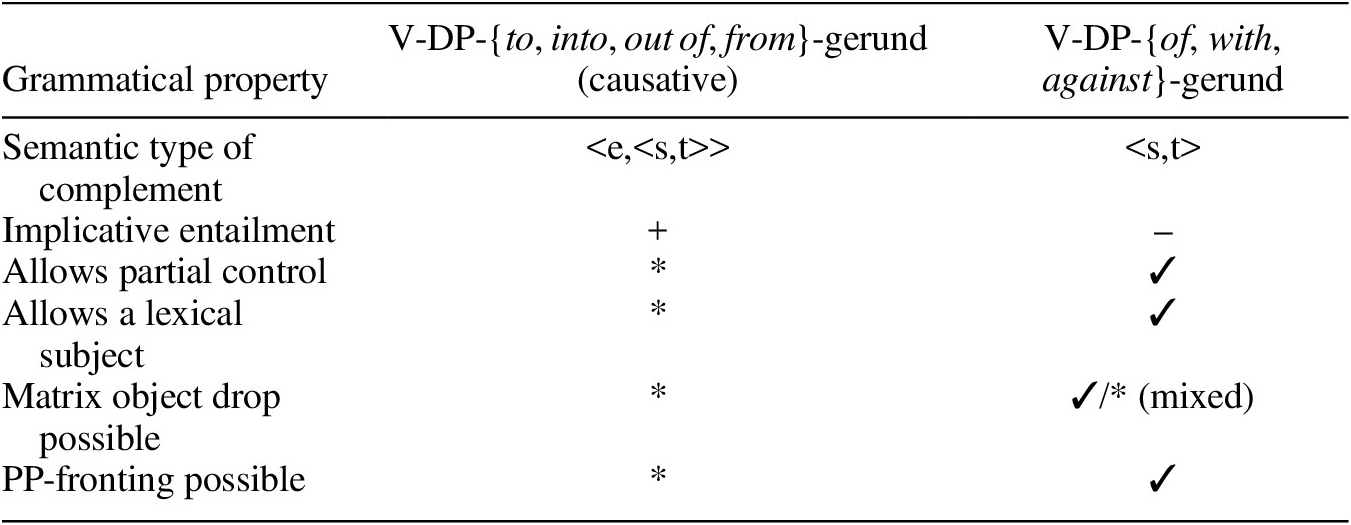
Table 1 summarizes the empirical differences between the two types of P-gerund constructions.Footnote 15 To wit, the first row in Table 1 does not strictly state an empirical property, but rather a theoretical claim about one. The assumption that the two types of complements differ in their semantic type is the underlying reason for the properties observed in the next three rows; ultimately, the direct predication imposed between the object and the complement derives the implicative entailment and the exclusion of PC and lexical subjects. The last two rows in the table, in turn, reflect the syntax behind predication: Namely, the requirement that the argument predicated of be syntactically present, and the fact that the predicative head and its complement form a nonmaximal projection. These assumptions on the syntax of predication are, of course, not logically necessary. The fact that they are corroborated in this empirical domain is interesting and encouraging from the standpoint of the general theory of predication, which introduced these assumptions for a variety of independent motivations. The alignment of semantic and syntactic properties of predication is precisely what we would expect on this theory, where the predicative relation is explicitly represented in the syntax.Footnote 16
Empirical differences between two classes of P-gerund constructions.

It is instructive to consider these conclusions in light of alternative accounts of control and gerundive complementation. While a full comparison is beyond the scope of this article, I will focus on a number of claims made within such alternatives that are particularly challenged by the present conclusions. Section 6.1 discusses the challenge to semantic analyses of control that uniformly analyze the clausal complement as property-denoting, and Section 6.2 discusses the challenge to corpus- and construction-based accounts of gerundive complementation.
6.1 Against uniform property-analyses of OC
The consistent clustering of properties around the implicative and the nonimplicative classes bears on the classical question, already alluded to in Section 4, of whether control complements denote properties or propositions. Consider the fact that tolerance to PC and tolerance to lexical subjects go hand in hand, while obligatory EC and intolerance to lexical subjects are likewise correlated. Under the TTC, these correlations are predicted and principled. The mechanism of control in implicative constructions involves direct predication. The gerund is selected as a predicate, hence can neither give rise to partial readings nor allow a lexical subject (which would turn it into a proposition). Nonimplicative complements, on the other hand, denote propositions, whose subject may either be realized lexically or as PRO, the latter also admitting PC.
Under the property theory of control, however, all OC complements denote properties and so these correlations are accidental. In Pearson (Reference Pearson2016), PC results from the semantics of a certain class of verbs. Specifically, verbs that (i) select properties, (ii) denote attitudes, and (iii) introduce events that are non-simultaneous with the matrix event. PC arises from quantification over ‘extensions’ of the centered worlds in which the attitude holds. Whether or not the same predicate may also select a propositional complement (with a lexical subject) is not addressed or deemed relevant. Thus, the pairings in (53) and (54) are not derived.


In Chierchia’s Reference Chierchia1984 system, (53b) (next to standard OC examples like (22a), Mary accused John of stealing the formulae) would classify accuse as a verb with ambiguous s-selection – either for property or for proposition. (54b) would classify coerce as a verb that unambiguously s-selects a property. Presumably, any analysis of OC within the property-camp would concur. However, given that PC is expressly not handled by a propositional analysis in this camp (at least not in Pearson Reference Pearson2016), there is no way to relate the (a) and (b) examples above to each other – and this holds across the entire range of implicative and nonimplicative constructions.
This problem was, in fact, already hinted at by Grano’s (Reference Grano2015) observation that implicative verbs resist finite complementation whereas nonimplicative verbs allow it. Yet in the context of controlled infinitives, the database was rather limited. Moreover, the correlation was less than perfect due to the irregularities of selection for finiteness (a formal feature), which does not perfectly align with selection for a proposition (a semantic feature). For example, while want may select a propositional complement (Raising-to-Object or for-infinitive), it cannot take a finite complement.
The picture is much sharper in the domain of P-gerund complements, which is available with hundreds of verbs. Here, the property–proposition divide is visible without any shift in finiteness, and furthermore, the tolerance to lexical subjects within the nonimplicative class seems to be completely systematic. Thus, we observe a real linguistic generalization, one which, I would argue, strongly favors the dual analysis of control complements, as envisaged in the TTC.Footnote 17
6.2 ‘Abstract’ vs. constructional explanation
As noted in the introduction, P-gerund constructions have only received scattered attention in the linguistic literature. Almost all of it is focused on the causative into-gerund construction and takes it to be an instance of the ‘caused motion’ frame in Construction Grammar (CG). The focus in these studies is largely descriptive and consists in searching through different corpora for more-or-less coherent lexical characteristics of the verbs that take into-gerund complements; in addition, the diachrony of the construction is studied as well as its different distribution in British vs. American English.
Thus, Gries & Stefanowitsch (Reference Gries, Stefanowitsch, Achard and Kemmer2004) found that when the gerundive verb is a cognitive verb, the matrix verb is more likely to be a causative cognitive verb than an action verb, but when the gerundive verb is an action verb, no preference is detected in the type of matrix verb. This tendency, they argue, reflects certain cognitive frames of causal chains. Other non-random correlations between the matrix and embedded verb are attributed to cultural entrenchment of particular social scenarios. Rudanko (Reference Rudanko2006) documents the spread of the construction from ‘flavored causation’ verbs (like trick, fool) to manner-neutral ones (like influence, induce). Wulff et al. (Reference Wulff, Stefanowitsch, Gries, Radden, Köpcke, Berg and Siemund2007) found that British English mainly uses the construction to express physical causation, while American English does so to express verbal persuasion. Kim & Davies (Reference Kim and Davies2015) show that indirect causation is possible with into-gerund complements, unlike in the related into+DP construction (*They convinced him into the room), and document further distinctions between British and American varieties.
This is just a sample but it represents the whole quite well. The kind of questions that are addressed in the corpus/construction-oriented studies are very different from those addressed here. It is certainly not my intention to underrate the significance of the former questions by simply not attending to them. However, it is important to realize that the theoretical toolbox of these studies is quite limited when it comes to uncovering significant grammatical generalizations.
Note, first, that the into-gerund construction, which has been intensively investigated within that literature for over two decades, was treated in isolation from other P-gerund constructions. Even the first level generalization over the entire implicative class – including to-gerund, out of-gerund and from-gerund complements – is nowhere to be found in those works. The only generalization entertained is to the causative types, specifically caused motion. Clearly, the negative implicatives (out of/from-gerund) cannot be similarly viewed, and that is, presumably, the reason for their neglect. In other words, by restricting their theoretical vocabulary only to low-level categories, corpus and CG grammarians missed important generalizations that reflect genuine grammatical mechanisms.
At the next level of abstractness, the fundamental split between implicative and nonimplicative complements has also gone unnoticed. Here, the reasons seem even clearer. There is no shared semantic core to of, with and against – the three prepositions that introduce nonimplicative complements. What makes them a class is their complementary status with respect to the natural class of implicative complements (itself already somewhat abstract, subsuming both positive and negative implicatives). Thus, corpus and CG grammarians are unlikely to view constructions built with these three prepositions as instantiating a single type. Yet at a deeper level, they do form a single type, as Table 1 teaches us. Such discoveries are inhibited by disproportionate emphasis on the lexical semantics of specific prepositions and by reluctance to engage with well-established bodies of knowledge, both in syntax and in semantics, that license very specific and testable predictions about the properties of these constructions, seen as a group and not as isolated items.
Lastly, viewing complex sentences as unanalyzed ‘constructions’ takes its toll. Structures such as (36)–(37) are not part of grammatical explanations within corpus linguistics or CG. The idea that accuse-DP-of-gerund and warn-DP-against-gerund project the same syntactic structure, and confine-DP-to-gerund and bluff-DP-out of-gerund also project the same structure (different from the former), was naturally used in Section 5 to explain the syntactic unity of each pair, and in general, of the implicative and nonimplicative classes as a whole. Generalizations over the predicted behavior of arguments in [Spec,PredP] or the nonmaximal Pred’ projection are possible precisely because these constructs are made available by syntactic theory. Absent such constructs, and constrained to appeal to unstructured constructions, corpus studies and CG are unable to express the requisite generalizations, let alone derive them.
The methodological upshot of these remarks (no doubt part of a continuous, much broader debate in the linguistic community), is that abstractness in theorizing is neither an evasion nor a luxury to be shunned, but rather an indispensable feature of any serious attempt to go beyond the appearances of linguistic phenomena. In the words of Chomsky (Reference Chomsky1980a: 218f.):
Progress in such an inquiry is unlikely unless we are willing to entertain radical idealization, to construct abstract systems and to study their special properties, hoping to account for the observed phenomena indirectly in terms of the properties of the systems postulated and their interaction… Any serious study will, furthermore, abstract away from variation tentatively regarded as insignificant and from external interference dismissed as irrelevant at a given stage of inquiry. Such steps may eventually prove to have been misguided, but the only alternative is a form of natural history, tabulation and arrangement of facts.
7. Conclusion
Gerundive complements introduced by prepositions have received relatively little attention in the theoretical literature, and even less in studies of control. The one class that has been described in detail involves into-gerund complements, yet the available descriptions do not attempt to relate its behavior to parallel P-gerund constructions or to the more general theory of control. The present study attempted to fill both these lacunas.
Specifically, we advanced two main claims. First, the entire range of P-gerund constructions can be divided into two super-classes. One super-class expresses a causative relation such that the referent of the subject causes the referent of the direct object to bear (or not to bear) the property denoted by the gerund. This was labelled the implicative class. The other super-class expresses a range of intensional relations between the referent of the direct object and the proposition denoted by the gerund, holding in worlds conforming to the attitude of the referent of the matrix subject. This was labelled the nonimplicative class.
The second claim was that this fundamental split has consistent repercussions for the syntactic and semantic behavior of the two classes. Furthermore, lexical differences among particular prepositions notwithstanding, members of each super-class pattern uniformly with respect to the following properties: licensing of partial control, licensing of an overt subject in the gerund, object drop of the controller and fronting of the P-gerund PP. This clustering of properties reflects the workings of semantic predication within a dedicated PredP in the VP of implicative constructions, versus its absence in the nonimplicative class. They receive a natural account within the TTC, where control is already modeled in two ways – via predication or via logophoric anchoring. Similarly supported is the conception of predication as a dependence explicitly represented in both syntax and in semantics.
Important questions remained unaddressed here. First among them concerns the lexical semantics of the prepositions introducing the gerund. We have not said anything substantive on how the particular meanings of these prepositions contribute to the overall meaning of the construction and what constrains their combination with specific verbs. It is surely not an accident that all the four (or five, counting in) prepositions that figure in the implicative construction denote bounded scalar relations: The object moves towards a resultant state or away from a starting state. The boundary of the scale underlies the implicative entailment. Conversely, the nonimplicative prepositions denote nonscalar relations (like central coincidence in the case of with). These are merely cursory remarks that certainly should be expanded into a much more systematic analysis.
Nevertheless, this investigation has shown that it is possible to make considerable advances in our understanding of P-gerund constructions even when we abstract away from these lexical issues, and focus on the shared patterns of each class. The emerging picture challenges unitary conceptions of control as applying only to property-denoting complements, and raises serious questions for corpus- and construction-based treatments, in which the attested patterns are not obviously expected. At the same time, current formal approaches in syntax and semantics must become more responsive to ‘non-canonical’ data of the sort examined here if they are to achieve satisfactory empirical coverage. I hope that the present study is a step in the right direction.