Introduction
A growing body of research has yielded insights into the important role of human resource management (HRM) in contributing to innovation (Jiang, Wang, & Zhao, Reference Jiang, Wang and Zhao2012; Laursen & Foss, Reference Laursen and Foss2013), as well as employee outcomes (Aryee, Walumbwa, Seidu, & Otaye, Reference Aryee, Walumbwa, Seidu and Otaye2012; Seidu, Reference Seidu2011). Innovation plays an important role in organizational performance (Pieters, Knippenberg, Schippers, & Stam, Reference Pieters, Knippenberg, Schippers and Stam2010), and employees are major source of the formulation and implementation of innovative ideas by generating new ways to perform their job (Scott & Bruce, Reference Scott and Bruce1994). Individual innovative behavior is defined as a multi-stage process of problem recognition, generation of ideas or solutions, building support for ideas, and idea implementation, which plays a crucial role in organizational effectiveness and long-term survival (Scott & Bruce, Reference Scott and Bruce1994). Innovative behavior reflects an individual’s competence and willingness to adopt new ideas and decision making. Thus, individual-level foundations are crucial in understanding how HRM influences innovative performance outcomes (Bowen & Ostroff, Reference Bowen and Ostroff2004). This study focused on the relationship between HRM and individual innovative behavior.
Huselid’s (Reference Huselid1995) study suggests that HRM practices bundled together as a system has more profound impact on performance than each HRM practice separately because of the synergistic effect. Laursen and Foss (Reference Laursen and Foss2003) conceded that a complimentary package (bundle) of HRM practices focused on developing innovative behavior should more strongly influence innovative behavior than HRM practices in isolation. In line with the current practices, following Liao, Toya, Lepak, and Hong (Reference Liao, Toya, Lepak and Hong2009) and Aryee et al. (Reference Aryee, Walumbwa, Seidu and Otaye2012), we adopted an innovation-based HRM bundle (IHRMB) which refers to the extent to which organizations are prepared to look for new ways of dealing with HRM practices. IHRMB combines HRM practices, including broad job design with variety and autonomy, highly selective staffing, training with focus on creativity and innovation, rewards contingent on innovation and organizational performance, a variety of career paths, and employee participation, are designed to enhance employee ability, motivation, and opportunity to engage in innovative behavior.
Although there is evidence HRM should be treated as a bundle, the underlying mechanisms how HRM bundle affects individual innovation behavior remains unclear. The ability–motivation–opportunity framework stipulates that skillful, motivated employees, with opportunities to contribute and use their knowledge and competence, are likely to perform better and behave more innovatively (Appelbaum, Bailey, Berg, & Kalleberg, Reference Appelbaum, Bailey, Berg and Kalleberg2000). Thus, we contend that the competence, autonomy and support experienced by employees are generally conducive to engaging in innovative behavior, and empowerment and support are important mediating mechanisms for the IHRMB-innovative behavior relationship.
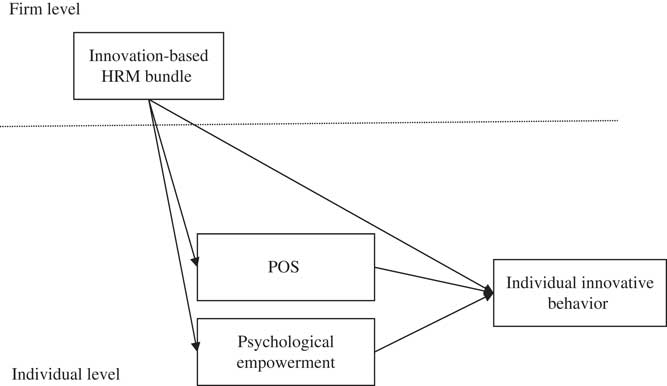
Psychological empowerment reflects an individual’s experience of perceived competence, self-determination, meaning, and impact (Spreitzer, Reference Spreitzer1995). From the motivational perspective, IHRMB creates conditions that enhance employees’ experience of competence and autonomy, which in turn increase employee’s engagement in innovative behavior. Perceived organizational support (POS) is defined as the extent to which employees believe that the organization values their contributions and cares about their well-being (Eisenberger, Huntington, Hutchison, & Sowa, Reference Eisenberger, Huntington, Hutchison and Sowa1986). Informed by the social exchange theory (Blau, Reference Blau1964), employees feel being truly valued and cared through IHRMB would be more willing to provide reciprocal favor in displaying innovative behavior. Thus, we further posit that IHRMB exerts influence on individual innovative behavior through psychological empowerment and POS. The overall conceptual model is depicted in Figure 1.
Theoretical framework
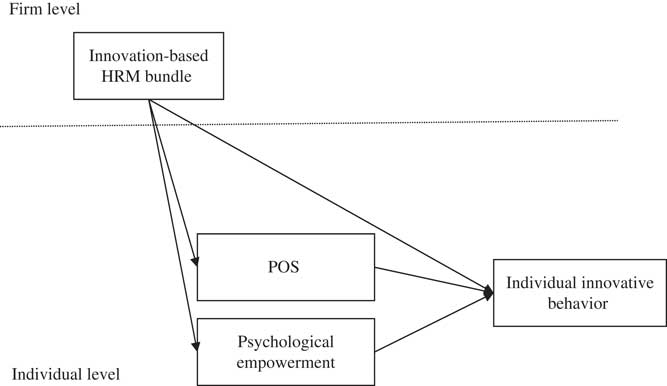
This study contributes to the current HRM literature by examining the mechanisms underlying IHRMB and individual innovative behavior. It responds to the call for HRM to be strategy focus (Bowen & Ostroff, Reference Bowen and Ostroff2004) as well as more cross-level studies for better understanding how HRM exerts influence on individual behavior (Liao et al., Reference Liao, Toya, Lepak and Hong2009; Aryee et al., Reference Aryee, Walumbwa, Seidu and Otaye2012). Motivation-based psychological empowerment and exchange-based POS are posited as significant mediators in the IHRMB–innovative behavior relationship. This study enriches the HRM literature on ability–motivation–opportunity framework that HRM bundle is designed to induce empowerment and support to foster innovative behavior.
In the sections that follow, we first elaborate the mediating role of psychological empowerment and POS in the IHRMB–individual innovative behavior relationship. We then examine the cross-level model and present the results from the multilevel analysis of data involving 705 employees of 162 firms from across a wide variety of industries located in six cities in south China. Finally, we conclude by discussing the implications of the findings for research and practices.
Theoretical Background and Hypotheses
IHRMB and individual innovative behavior
Scott and Bruce (Reference Scott and Bruce1994) defined individual innovative behavior as a multi-stage process of problem recognition, generation of ideas or solutions, building support for ideas, and idea implementation. To be innovative, employees must develop their knowledge, skills, and abilities, concentrate and invest substantial effort in their work, ‘be more opportunistic, creative and achievement oriented, yet tolerant of ambiguity and willing to take risks’ (Jones, Morris, & Rockmore, Reference Jones, Morris and Rockmore1995: 86–87), and get great autonomy and organizational and management support (Scott & Bruce, Reference Scott and Bruce1994). Thus, companies with an innovation strategy need to design HRM bundle to ensure that employees are able and willing to engage in innovation, especially in the current rapidly changing business environment. Cooke and Saini (Reference Cooke and Saini2010) investigated the role of strategic HRM in supporting an innovation-oriented business strategy. Messersmith and Guthrie (Reference Messersmith and Guthrie2010) showed that high performance work systems (HPWS) had a positive relationship with product innovation and organizational innovation. Schmelter, Mauer, Börsch, and Brettel (Reference Schmelter, Mauer, Börsch and Brettel2010) provided empirical support for the strong influence of HRM practices (including staff selection, staff development, training, and staff rewards) on corporate entrepreneurship, and innovativeness is one dimension of corporate entrepreneurship. HRM bundle, to some extent as a form of HPWS aims to improve employee performance, may increase work intensification and may result in negative spillover effects for employees to be innovative (e.g., too stressful, lower commitment, and job satisfaction, etc.) (e.g., Ehrnrooth & Björkman, Reference Ehrnrooth and Björkman2012; Jensen, Patel, & Messersmith, Reference Jensen, Patel and Messersmith2013).
IHRMB consists of practices that provide employees with knowledge, skills, and ability, resources, information, discretion, and support to engage in innovative behavior. For instance, a broad job design offers greater variety, significance, and autonomy to increase employee motivation to involve in innovative activities, in contrast to narrow, routine job design that stifle creativity (Jong, Parker, Wennekers, & Wu, Reference Jong, Parker, Wennekers and Wu2013). Selective staffing helps identifying candidates with high levels of innovative capability, creativity, and autonomy (Hayton, Reference Hayton2005; Schmelter et al., Reference Schmelter, Mauer, Börsch and Brettel2010). Through extensive training and collaborative learning, employees are able to expand their breadth of knowledge and generate new ideas (Shipton, West, Dawson, Birdi, & Patterson, Reference Shipton, West, Dawson, Birdi and Patterson2006). Reward systems encourage employees to acquire knowledge outside their own immediate job domain (Bartol & Srivastava, Reference Bartol and Srivastava2002). Incentives contingent on innovation and organizational performance may induce them to analyze problems in a variety of ways, and motivate employees to maximize their efforts to engage in innovative behavior (Scott & Bruce, Reference Scott and Bruce1994). The opportunities for career development enable employees to establish networks (Seibert, Kraimer, & Liden, Reference Seibert, Kraimer and Liden2001), and gaining knowledge in more extensive networks foster novel ideas (Scott & Bruce, Reference Scott and Bruce1994; Amabile, Reference Amabile1998). Employee participation offers chances for employees to use their personal initiative and to engage in problem-solving and making decisions (Huselid, Reference Huselid1995). Using participative HRM practices have been shown to be positively related to innovation in Taiwan (Tsai, Reference Tsai2006).
IHRMB gives a significant signal that organizations, which adopt these practices, will positively expect and value employees’ innovative behavior, and thus facilitate the cognition of a supportive work environment as regards innovation. This, in turn, motivates employees to display innovative behavior. IHRMB establishes an environment that encourages cooperation, facilitates the development of human and social capital, promotes organizational learning, encourages employees to take risks, and is therefore finally supportive of individual innovative behavior (Hayton, Reference Hayton2005). Jiang, Wang, and Zhao (Reference Jiang, Wang and Zhao2012) found that employee creativity fully mediated the relationships between four HRM practices (hiring and selection, reward, job design, and teamwork) and organizational innovation.
Hypothesis 1: IHRMB positively relates to individual innovative behavior.
The mediating effect of psychological empowerment
IHRMB and psychological empowerment
One important mechanism through which IHRMB influences individual innovative behavior is psychological empowerment. Spreitzer (Reference Spreitzer1995) conceptualized psychological empowerment as an individual’s self-motivating mechanisms; consisting of four components: (1) competence (perceived ability to accomplish work-related tasks), (2) self-determination (having choice or being able to initiate actions), (3) meaning (the value or purpose of a work goal), and (4) impact (the degree to which an individual can influence outcomes).
Psychological empowerment reflects an individuals’ intrinsic task motivation (Spreitzer, Reference Spreitzer1995; Liao et al., Reference Liao, Toya, Lepak and Hong2009). From the motivational perspective, we argue that IHRMB leads to empowering work practices. The high level of skill variety, task significance, and autonomy associated with broad job design (Seibert, Wang, & Courtright, Reference Seibert, Wang and Courtright2011) may enhance employees’ perceived competence, self-determination, meaning, and impact. The enhanced knowledge, skills, and ability resulting from training (Huselid, Reference Huselid1995) may be reflected in employees’ feelings of competence in innovation. Rewards contingent on innovation and organizational performance enable employees to experience self-determination at work. Increased discretion and participation in decision making give employees a feeling of greater control over their work and the realization of their novel ideas, thus promoting a sense of self-determination and impact (Huselid, Reference Huselid1995; Sun, Aryee, & Law, Reference Sun, Aryee and Law2007). Making relevant information available may allow employees to better understand the innovation tasks and better decide for themselves how to innovate, thus enhancing the perception of meaning and self-determination (Huselid, Reference Huselid1995). A recent meta-analytic review by Seibert, Wang, and Courtright (Reference Seibert, Wang and Courtright2011) demonstrated that high-performance practices are strongly related to psychological empowerment. Aryee et al. (Reference Aryee, Walumbwa, Seidu and Otaye2012) also discovered the positive influence of HRM bundle on psychological empowerment. Hence, effective implementation of IHRMB will lead to psychological empowerment.
Psychological empowerment and individual innovation behavior
We further theorize that psychological empowerment has an important influence on individual innovative behavior. Psychologically empowered individual is considered as having an active orientation toward work (Spreitzer, Reference Spreitzer2008), and contributing to elements that facilitate innovative behavior, such as persistence of effort and resilience in facing unusual contexts and difficulties (Bandura, Reference Bandura1977), initiatives and flexibility (Thomas & Velthouse, Reference Thomas and Velthouse1990), proactive behavior and acting independently (Spreitzer, Reference Spreitzer1995), and resourcefulness (Aryee et al., Reference Aryee, Walumbwa, Seidu and Otaye2012). More specifically, psychologically empowered employees perceive their work as meaningful and personally important, and thus they may be more inclined to work hard to grasp a task from diverse perspectives, to try to solve problems by exploiting information from diverse sources, and to engender a variety of alternatives by making connections between divergent stimuli (Gilson & Shalley, Reference Gilson and Shalley2004). Hence, they are more likely to be innovative. Furthermore, psychologically empowered employees have confidence in their ability to perform a task successfully, hence they are more likely to implement their ideas and suggestions for change (Seibert, Wang, & Courtright, Reference Seibert, Wang and Courtright2011), and they may become more innovative in their work. Further, psychologically empowered employees believe themselves to have self-determination over job execution to some degree, and to have influence on their jobs and work environments in meaningful ways (Spreitzer, Reference Spreitzer1995). Prior studies provide support for a positive relationship between psychological empowerment and individual innovative behavior (Spreitzer, Reference Spreitzer1995; Zhang & Bartol, Reference Zhang and Bartol2010). Seibert, Wang, and Courtright (Reference Seibert, Wang and Courtright2011) meta-analysis identified a positive relationship between psychological empowerment and the employee work behaviors of innovation.
IHRMB – psychological empowerment – individual innovative behavior
IHRMB is designed to make individuals feel psychologically empowered, be more likely to believe that they feel able to be innovative, have a choice in initiating and changing actions, perceive meaningfulness of innovation, and have an impact on innovation. It is logical to expect that individuals’ innovative behavior will be determined by their psychological empowerment, competence, and autonomy in particular. The level of innovative behavior that employees display depends on the amount of psychological empowerment experienced through granting support, providing autonomy, offering decision-making responsibilities and coping with challenging tasks and opportunities for skill development. Building on these rationales and findings, we propose that the positive influence of IHRMB on individual innovative behavior is channeled through psychological empowerment.
Hypothesis 2: Psychological empowerment mediates the relationship of IHRMB and individual innovative behavior.
The mediating role of POS
IHRMB and POS
In high-quality social exchange context, POS provides another explanation as to why employees are likely to be motivated by IHRMB. According to social exchange theory (Blau, Reference Blau1964), people are likely to pay much more attention to resources voluntarily provided by others, and they will appreciate such voluntary support because they believe that the providers truly value and care about them (Cotterell, Eisenberger, & Speicher, Reference Cotterell, Eisenberger and Speicher1992). If an organization offers positive and favorable activities toward employees, it is likely to establish excellent exchange relationships with employees that create obligations for them to reciprocate positively and beneficially (Settoon, Bennett, & Liden, Reference Settoon, Bennett and Liden1996).
IHRMB sends out significant signals that an organization truly values employees’ contributions and cares about their well-being. For instance, participation in developmental activities is considered as an investment in enhancing employees’ competence, and therefore is viewed by employees as a positive signal that the organization respects and attaches importance to them, and cares about their development (Shore & Shore, Reference Shore and Shore1995). Hence, they will perceive organizational support through the actions of the organization in providing training. Another example is recognition of accomplishments in various forms, such as salary increases and promotion, indicating positive evaluation by the organization (Wayne, Shore, Bommer, & Tetrick, Reference Wayne, Shore, Bommer and Tetrick2002). Rewards with focus on innovative behavior and organizational performance foster a supportive climate as they show that the organization appreciates employees’ contributions toward innovation and competitive advantage, concern about their well-being, and thus facilitates the development of their POS (Rhoades & Eisenberger, Reference Rhoades and Eisenberger2002). Chiang, Han, and Chuang (Reference Chiang, Han and Chuang2011) reported a positive relationship between high commitment HRM systems and POS. Recent work by Liao et al. (Reference Liao, Toya, Lepak and Hong2009) and Seidu (Reference Seidu2011) provided evidence to support for a positive relationship between HPWS and POS. Thus, IHRMB may be perceived as supportive means from organizations. We posit that IHRMB is positively related to POS.
POS and individual innovative behavior
Social exchange theory, as one of the most powerful paradigms to realize work place behavior Seidu (Reference Seidu2011), provides a theoretical explanation for the relationship between POS and individual innovative behavior. POS plays a critical role in shaping and inducing obligations for employees to reciprocate in positive, beneficial ways due to positive, beneficial actions directed at employees by the organization as Settoon, Bennett, and Liden (Reference Settoon, Bennett and Liden1996) indicated. Specifically, if employees perceive a high level of organizational support for innovation, they may reciprocate by engaging more readily in innovative behavior valued by the organization. POS unleashes the intrinsic motivation to explore and become involved in innovative activities (Kark & Carmeli, Reference Kark and Carmeli2009). Furthermore, from a social-political perspective, POS addresses ‘expectancies’ and ‘instrumentalities’ (Scott & Bruce, Reference Scott and Bruce1994), then employees realize that they should be innovative and engage in innovative behavior to maintain a good image. In addition, POS fosters innovative behavior because it provides a psychologically safe and supportive environment for individuals to try new ideas, explore novel directions, and behave creatively (Kark & Carmeli, Reference Kark and Carmeli2009). Research has shown that POS is positively related to innovation (Eisenberger, Fasolo, & Davis-LaMastro, Reference Eisenberger, Fasolo and Davis-LaMastro1990), and innovative behavior (Eisenberger, Armeli, Rexwinkel, Lynch, & Rhoades, Reference Eisenberger, Armeli, Rexwinkel, Lynch and Rhoades2001; Yuan & Woodman, Reference Yuan and Woodman2010; Xerri, Reference Xerri2013; Agarwal, Reference Agarwal2014). In addition, research has indicated that supervisor supportiveness (Janssen, Reference Janssen2005) and organizational support for idea development and tolerance for risk (Alpkan, Bulut, Gunday, Ulusoy, & Killic, Reference Alpkan, Bulut, Gunday, Ulusoy and Killic2010) exert positive effects on innovative behavior.
IHRMB–POS–individual innovative behavior
When employees perceive IHRMB as organizational support, they are likely to reciprocate through positive work attitudes and innovative behaviors. Furthermore, we argue that the greater the extent to which employees perceive the organizational value and care provided by IHRMB, due to the reciprocity norm, they feel more obligated to care about the organizational welfare and to help the organization to achieve its goals (Eisenberger et al., Reference Eisenberger, Armeli, Rexwinkel, Lynch and Rhoades2001; Rhoades & Eisenberger, Reference Rhoades and Eisenberger2002). This undoubtedly includes engaging in individual innovative behavior, which is beneficial for the organization (Pieters et al., Reference Pieters, Knippenberg, Schippers and Stam2010). In addition, Liao et al. (Reference Liao, Toya, Lepak and Hong2009) provides support that POS serves as a mediator between HPWS and general service performance. Seidu (Reference Seidu2011) reported that POS mediates the relationship between experienced HPWS and service-oriented organizational citizenship behavior. Hence, it logically follows that POS is expected to mediate the relationship between IHRMB and individual innovative behavior.
Hypothesis 3: POS mediates the relationship of IHRMB and individual innovative behavior.
Methods
Research setting
Although strategic HRM researchers noted that small and medium-sized enterprises (SMEs) are the key to innovation and economic growth (Hayton, Reference Hayton2003), SMEs have received less attention (Hayton, Reference Hayton2003, Reference Hayton2005; Klaas, Semadeni, Klimchak, & Ward, Reference Klaas, Semadeni, Klimchak and Ward2012), particularly in emerging economy like China aims to accelerate the transformation from a manufacture-oriented one into an innovation-driven one. Facing slower economic growth, SMEs need restructuring efforts to place more focus on higher quality and innovation. Thus, we investigated the relationship between IHRMB and individual innovative behavior through individual-level mechanisms based on data obtained from SMEs across various industries in Guangdong province in China.
Sample and procedures
We tested the proposed theoretical framework using data from multiple sources, such as questionnaire survey, interviews, and documentations, to ensure accuracy and to cross-validate the research findings. The study surveyed both employees and firms across various industries in Guangdong province in China. The company list was obtained from the local governments or industry associations. We conducted face-to-face interviews with senior management in half of these firms. Each firm received follow-up phone calls and emails. A representative was in charge of distributing and collecting questionnaires from employees in each firm. The sample was chosen from different work units, job levels, gender, age groups, and education level at the individual level. A cover letter attached to each questionnaire explained the objective of the survey and assured respondents of the confidentiality of their responses and the voluntary nature of their participation. The employees completed the questionnaires during breaks at work or at home and returned them in a sealed envelope to the representative of each firm in charge of data collection.
HRM managers were deemed key informants in evaluating HRM bundle in the previous research (e.g., Sun, Aryee, & Law, Reference Sun, Aryee and Law2007). However, many SMEs have no independent and professional HRM department, or even a staff position dedicated to HRM (Messersmith & Guthrie, Reference Messersmith and Guthrie2010). Thus, we deemed senior management to be the main decision-makers and executors of IHRMB in SMEs, and an appropriate source of information. In the present study, for each firm, senior management (president/vice-president) provided data on industry, years of establishment, firm size, and IHRMB; employees provided data on employee gender, age, and education, psychological empowerment, POS, and individual innovative behavior. The multi-source of data collection reduces the common method bias.
Questionnaires were distributed to 1200 employees in 200 companies. A total of 705 usable and completed questionnaires were return from 162 companies. The response rate for senior managers and for employees is 81 and 58.75%, respectively.
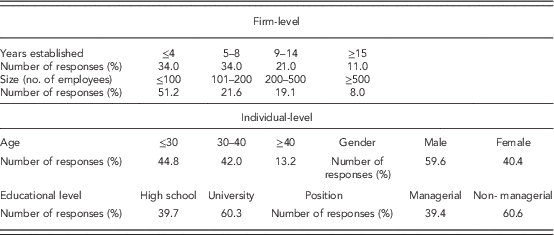
At the firm level, the 162 firms were located in six cities in Guangdong, China. The sample characteristics are as given in Table 1.
Sample characteristics

Measures
The translation back-translation procedures were followed to ensure equivalence of the translated Chinese items (Brislin, Reference Brislin1980). Responses to all the measures (except for control variables) were made on a 5-point scale (1=strongly disagree, 5=strongly agree).
Firm-level variable: IHRMB
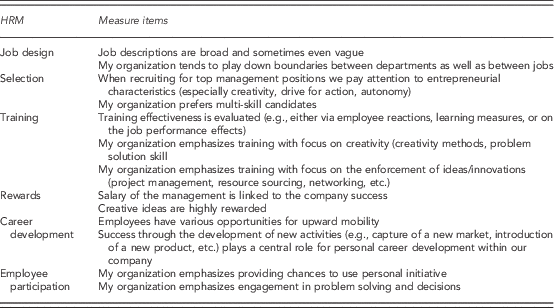
Synthesis from the interview with HR professionals, experts, and an extensive review of the literature, we constructed a 13-item scale to measure IHRMB (see Appendix). We used items from existing studies when available and further developed new ones specifically for this study. These items include job design, selection, training, rewards, careers, and employee participation. Consistent with the current literature (Liao et al., Reference Liao, Toya, Lepak and Hong2009; Aryee et al., Reference Aryee, Walumbwa, Seidu and Otaye2012), we summed these practices to form a composite index of IHRMB. We further conducted a principal factor analysis for the six practices included in IHRMB. Only one factor had an eigenvalue of greater than 1 (2.894), providing additional support for the composite index approach. The Cronbach’s α was 0.82.
Individual-level variables
Psychological empowerment
We used the 12-item measure of psychological empowerment developed by Spreitzer (Reference Spreitzer1995). The scale was composed of four subscales measuring competence (e.g., ‘I am confident about my ability to do my job’), self-determination (e.g., ‘I have significant autonomy in determining how I do my job’), meaning (e.g., ‘The work I do is meaningful to me’), and impact (e.g., ‘My impact on what happens in my department is large’). The alpha coefficient for this scale was 0.91.
POS
POS was measured with the 6-item scale developed by Eisenberger et al. (Reference Eisenberger, Armeli, Rexwinkel, Lynch and Rhoades2001). Sample items included ‘My organization values my contributions to its well-being.’ The reliability estimate for this scale was 0.77.
Individual innovative behavior
Following Scott and Bruce (Reference Scott and Bruce1994), we adopted the 6-item scale to measure individual innovative behavior. Sample item was ‘I always search out new technologies, processes, techniques, and/or product ideas.’ The Cronbach’s alpha for this scale was 0.90.
Firm-level control variables
Firm size and firm age was measured by number of employees using natural logarithm and years since establishment, respectively.
Individual-level control variables
Gender (0=male, 1=female), age, and education (using five order categories) were measured at the individual level.
Results
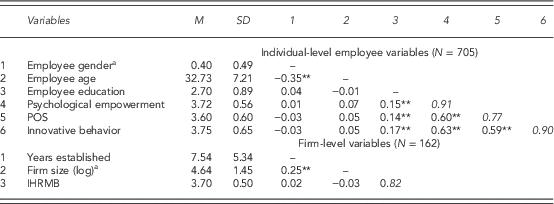
Descriptive statistics, correlations, and α values for the study variables are presented in Table 2. At the firm level, years established shows significant correlation with firm size but no significant correlation with IHRMB. At the individual-level, education is positively related to psychological empowerment, POS and individual innovative behavior. It is observed that psychological empowerment, POS and individual innovative behavior are significantly correlated among each other.
Means, standard deviations, and correlations of the study variables

Notes. Numbers 1–6 in the top row correspond to the variables in the respective sections of the table. Coefficient α values are presented in italics along the diagonal.
POS=perceived organizational support.
**p<.01.
a Female=1; male=0.
Besides the reasonably high α coefficient, confirmatory factor analysis was conducted on variables at the individual level, that is, psychological empowerment, POS, and individual innovative behavior, to ensure the scale measuring each construct is valid for research. A three-factor structure was ascertained with an acceptable fit to the data (Marsh, Hau, & Wen, Reference Marsh, Hau and Wen2004): χ2 (212, N=705)=905.49, p<.001, the Root Mean Square Error of Approximation=0.068, the Non-Normed Fit Index=0.97, the Comparative Fit Index=0.98, the Incremental Fit Index=0.98, the Standardized Root Mean Squared Residual=0.051. All factor loadings were significant at p<.05, with t-values ranging from 3.42 to 28.16. The confirmatory factor analysis results indicated that factor loadings of the scales items were statistically significant (t>2.0). The measures showed sufficiently high reliability and good validity for research purposes.
Because of the nested nature of the sample (individual respondents were nested inside firm), we followed the procedure recommended by De Stobbeleir, Ashford, and Buyens (Reference De Stobbeleir, Ashford and Buyens2011), we tested our model using multilevel modeling (hierarchical linear model (HLM) 7.0) to control for the effects of different firms. We used 2-1-1 HLM-based multilevel mediation model (Zhang, Zyphur, & Preacher, Reference Zhang, Zyphur and Preacher2009) to test the hypotheses, controlling for employees’ age, gender, and education as Level 1 effects and firm size and firm age as Level 2 effects. We followed the three-step test procedure for the 2-1-1 HLM-based multilevel mediation model proposed by Zhang, Zyphur, and Preacher (Reference Zhang, Zyphur and Preacher2009) to test Hypotheses 2 and 3.
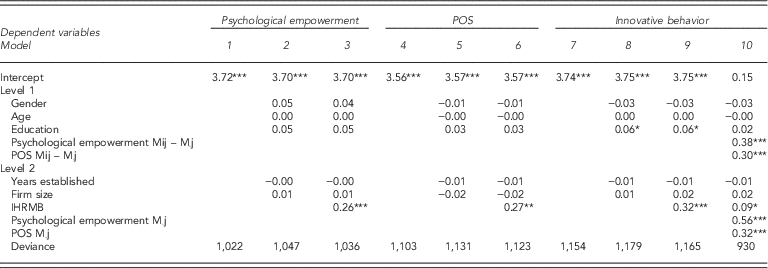
Since a firm-level variable can only explain differences among firms, it is important to show that significant differences among firms exist with regard to the dependent variables of interest for a hierarchical analysis (Hofmann, Reference Hofmann1997). Thus, we first ran three null hierarchical models without firm-level explanatory variables, in which psychological empowerment, POS, and innovative behavior were set as the individual-level dependent variable, respectively. As shown in Models 1, 4, and 7 of Table 3, the results provided evidence of significant between-groups variance in psychological empowerment (γ00=3.72, df=161, χ2=698.85, p<.001), POS (γ00=3.56, df=161, χ2=861.18, p<.001), and individual innovative behavior (γ00=3.74, df=161, χ2=801.91, p<.001), and thus justified further cross-level analyses.
Results for two-level hierarchical linear modeling models

Notes. N=162.
Mij is the individual-level mediator. M·j is the average value of mediator for group j.
POS=perceived organizational support.
*p<.05; ** p<.01; ***p<.001.
Second, we controlled for firm size and years established at the firm level, and employee gender, age, and education at individual level in all analyses. When the control variables were entered, there were no statistically significant influences on psychological empowerment, POS, and individual innovative behavior, but employee education was related to individual innovative behavior in a statistically significant manner (γ=0.06, p<.05), as indicated in Table 3 Models 2, 5, and 8.
Third, we tested a relationship between IHRMB and individual innovative behavior. As shown in Model 9 in Table 3, IHRMB had a significant positive relationship with individual innovative behavior (γ=0.32, p<.001), providing support for Hypothesis 1.
Fourthly, Level 2 antecedent should be related to Level 1 mediators. Firm-level IHRMB had a significant positive relationship with psychological empowerment (γ=0.26, p<.001) as given in Model 3, and POS (γ=0.27, p<.01) as given in Model 6 of Table 3.
Finally, we used group-mean centering for Level 1 variables except employee gender. Compared with the positive relationship between firm-level IHRMB and individual innovative behavior (γ=0.32, p<.001) in Model 9, after adding psychological empowerment and POS to the model at Level 1 as shown in Model 10 in Table 3, the relationship between firm-level IHRMB and individual innovative behavior was still significant but was reduced in magnitude (γ=0.09, p=.05). These results suggest that psychological empowerment and POS partially mediate the relationship between firm-level IHRMB and individual innovative behavior respectively, providing support for Hypotheses 2 and 3.
Results from further analysis revealed that as mediating links between IHRMB and individual innovation behavior, psychological empowerment (
 $\gamma _{{01}}^{{(2)}} {\times}\gamma _{{02}}^{{(4)}} {\,\equals\,}0.{\rm 26}{\times}0.{\rm 56}{\,\equals\,}0.{\rm 15}$
) is stronger than POS (
 $\gamma _{{01}}^{{(2)}} {\times}\gamma _{{02}}^{{(4)}} {\,\equals\,}0.{\rm 27}{\times}0.{\rm 32}{\,\equals\,}0.0{\rm 9}$
).
Discussion and Conclusion
The aim of this study is to explore the mechanisms underlying the IHRMB-innovative behavior relationship by examining both psychological empowerment and POS as mediators. The results provide strong support for the positive and significant relationship of IHRMB and individual innovative behavior (Hypothesis 1). Further, we found partial support for the mediating effects of IHRMB on individual innovative behavior via psychological empowerment (Hypothesis 2) and POS (Hypothesis 3).
As hypothesized, IHRMB displays a direct and positive relationship with individual innovative behavior by developing employees’ knowledge, skills, and abilities, enhancing their motivation, and providing them with opportunities and support to contribute to innovative behavior. These findings support the belief that HRM bundle directly influence employees’ workplace behavior in a way that is beneficial for organizations (Sun, Aryee, & Law, Reference Sun, Aryee and Law2007; Seidu, Reference Seidu2011). While research has shown HRM bundle can be related to service-oriented organizational citizenship behavior at both the organizational level (Sun, Aryee, & Law, Reference Sun, Aryee and Law2007) and the individual level (Seidu, Reference Seidu2011), our findings add to the current literature that IHRMB is related to innovative behavior at the individual level.
The mediating result of psychological empowerment indicates that IHRMB effectively enhances employees’ perception of meaning, competence, self-determination, and impact on innovation, and eventually increases the level of individual innovative behavior (Zhang & Bartol, Reference Zhang and Bartol2010; Seibert, Wang, & Courtright, Reference Seibert, Wang and Courtright2011). Further, the mediating role of POS demonstrates that IHRMB effectively enhances the employees’ perception of the extent to which an organization values and cares for them (Eisenberger et al., Reference Eisenberger, Huntington, Hutchison and Sowa1986), and reciprocated by engaging in behaviors favorable to the organization (Rhoades & Eisenberger, Reference Rhoades and Eisenberger2002), hence, results in increasing the level of individual innovative behavior. The present study, together with a few of recent empirical studies (e.g., Liao et al., Reference Liao, Toya, Lepak and Hong2009; Aryee et al., Reference Aryee, Walumbwa, Seidu and Otaye2012; Seidu, Reference Seidu2011), moves the field a step forward in understanding how HRM bundle exert their impact on behavioral outcomes at the individual level by examining the mediating effects of both psychological empowerment and POS in models of HRM bundle. Thus, our findings contribute to understand the important role of psychological empowerment and POS in strategic HRM theorization.
It is worth noting that the mediating effect of psychological empowerment is stronger than POS. One possible explanation is that competence and autonomy are more important than perceived support in the HRM-innovation link. Results confirm that IHRMB affects individual innovative behavior through empowerment and perceived support. We simultaneously investigated two mediators. Future studies should explicitly study the sequential relationships, such as, IHRMB leads to POS, POS leads to psychological empowerment and psychological empowerment leads to innovative behavior.
Theoretical and managerial implications
The findings of this study have two noteworthy theoretical implications. First, in response to Bowen and Ostroff’s (Reference Bowen and Ostroff2004) call for HRM for organization’s strategy focus, we constructed IHRMB based on the principle of strategic focused HRM bundle. A bundle of interrelated and internally consistent HRM practices, rather than HRM practices in isolation, can provide a clear direction for employees and should aim to achieve organizational strategy, such as innovation or service (Bowen & Ostroff, Reference Bowen and Ostroff2004). Taking this strategically focused approach is consistent with the contention advanced in strategic HRM research that to be effective, HRM bundle should be selected and planned to realize the goal by achieving a horizontal fit among diverse HRM practices (a set of complementary HRM practices) as well as a vertical fit with organizational strategy, that is, alignment with organizational goals and strategies (Huselid, Reference Huselid1995; Liao et al., Reference Liao, Toya, Lepak and Hong2009). The rationale behind this alignment is that organizations pursuing a certain strategy (innovation) should select HRM practices that complement such a strategic direction.
Second, the results confirm that motivation-based psychological empowerment and exchange-based POS are significant mediators in the IHRMB-innovative behavior relationship, adding to the limited cross-level research on the underlying process through which macro level HRM affects micro level individual behavior (e.g., Liao et al., Reference Liao, Toya, Lepak and Hong2009; Aryee et al., Reference Aryee, Walumbwa, Seidu and Otaye2012). Motivation-based intervention focuses on the core principles of competence and autonomy (empowerment), whereas exchange-based intervention focuses on the core principles of benefits and supportiveness (POS).
Results from the present study also offer some managerial implications for HRM professionals and practitioners. Research has shown individual innovative behavior to be influenced by several factors, such as leadership (Pieters et al., Reference Pieters, Knippenberg, Schippers and Stam2010), individual problem-solving style, and work group relationships (Scott & Bruce, Reference Scott and Bruce1994). Our findings demonstrate that investment in strategic HRM can be an effective way to foster innovative behavior. Yet, in order to facilitate innovative behavior, managers should note that such an investment must have a strategic focus on innovation, and complimentary HRM practices including broad job design with variety and autonomy, highly selective staffing, training with focus on creativity and innovation, rewards contingent on innovation and organizational performance, a variety of career paths, and employee participation, should be bundled together as a system. The mediating roles of psychological empowerment and POS further provide concrete suggestions on how to facilitate innovative behavior. Just implementing IHRMB is not enough. Organizations should pay more attention to employees’ psychological empowerment and POS. Employees may become psychologically empowered to feel able to be innovative, have a choice in initiating and changing actions, perceive meaningfulness of innovation, and have an impact on innovation, and feel being truly valued and cared by the organization, and thus engage in innovative behavior. By providing concrete suggestions on how to promote innovative behavior, this study contributes to organizational effectiveness and long-term survival at an organizational level, and even economic growth and innovation at a national level.
Limitations and future research
A number of limitations of the study should be considered. First, the cross-sectional nature of the data does not allow judgment of causality, nor fully capture the dynamic nature of the IHRMB-innovative behavior relationship. Future research should use longitudinal data to establish the relationship among IHRMB, psychological empowerment, POS, and individual innovative behavior more clearly.
Second, although we have separately collected data from employees and management, potential common method variance could be arising due to the same source of mediating and dependent variables. The results from Harman’s ex post one-factor test showed that there were five factors which explained 67.41% of variance with no dominant single factor. Common method variance is not a serious problem inhibiting the adequate testing of the hypotheses and interpretations of results. However, future research should use more objective measures of innovative behavior.
The use of self-reported measures might be another limitation. In particular, our measure of individual innovative behavior was likely to be exaggerated because of self-enhancement bias. In addition, IHRMB is rated by senior management that is a suitable source of information on HRM in SMEs. Nevertheless, the management perspective of IHRMB may be not consistent with the employee perspective (Liao et al., Reference Liao, Toya, Lepak and Hong2009; Aryee et al., Reference Aryee, Walumbwa, Seidu and Otaye2012). Thus, HRM researchers should consider both perspectives in future. Hence, replicating the findings with data from multiple sources using multi-stage would add to confidence in our findings.
Finally, we conducted the analyses using data from 162 firms in Southern China. The conceptual arguments used to propose the hypotheses are not bound organizationally and culturally, and the findings are consistent with the conceptual arguments supported by strategic HRM literature, psychological empowerment literature, POS literature, and individual innovative behavior literature. However, it would be interesting, for instance, to identify the mediating roles of psychological empowerment and POS in the IHRMB-innovative behavior relationship in different organizational and cultural contexts.
Acknowledgments
This research was supported by the Ministry of Education in China Project of Humanities and Social Sciences (grant no. 15YJC630072), the PhD Start-up Fund of Natural Science Foundation of Guangdong Province, China (grant no. 2015A030310192), and the National Natural Science Foundation of China (grant no. 71502078).
Appendix
IHRMB measure