I. INTRODUCTION
In recent decades, research and applications of composites have attracted extensive attraction for their excellent overall performance,Reference Cornsweet1–Reference Wu, Zhang, Peker, Mao, Das and Eckert7 for instance, low cost,Reference Bai, Xing, Liu, Ma, Liu and Gao8–Reference Bai, Xing, Wu, Liu, Huang, Ma and Gao11 ability to produce composites with high volume fraction,Reference He, Eckert, Loser and Schultz12 high productivity, and possibility to fabricate components with complex geometry.Reference He, Eckert, Loser and Schultz12–Reference Hofmann, Suh, Wiest, Duan, Lind, Demetriou and Johnson15 Among them, selectively reinforced composites (surface compositesReference Pagounis, Talvitie and Lindroos16–Reference Guo, Kang and Zhang20) have been developed and applied in the industry of wear resistance.Reference Ibrahim, Mohamed and Lavernia18 Tungsten carbide (WC) particle–reinforced metal matrix surface composite has gained much attention and become one of the hottest topics among the studies of the surface composites.Reference Zhou, Jiang and Lu21–Reference Huang, Samandi and Brandt26 Liu et al. prepared WC/metal matrix surface composites by laser melt injection and investigated the microstructure of the composites.Reference Liu, Li, Li and Chen23 The influence of WC particle volume fractions in the surface composites on erosion wear resistance was studied by Zhou et al.,Reference Zhou, Jiang and Lu21 and the research on three-body abrasive wear resistance of WC/iron matrix surface composites was also reported by Li et al.Reference Zhou, Jiang and Lu21,Reference Li, Jiang, Zhou, Lu and Zhou24
Because of the high brittleness of WC particle and weak interfacial bond between WC particles and matrices,Reference Zhou, Jiang and Lu21,Reference Li, Jiang, Zhou, Lu and Zhou24,Reference Ritchie27 the impact abrasive wear resistance of WC particle–reinforced metal matrix composites has been limited. Research on the microstructure and wear resistance mechanism of WC/metal matrix composite has been fabricated in recent years,Reference Ibrahim, Mohamed and Lavernia18,Reference Zhou, Jiang and Lu21,Reference Li, Jiang, Zhou, Lu and Zhou24–Reference Huang, Samandi and Brandt26,Reference Sornakumar, Kathiresan and Senthilkumar28–Reference Kim, Sekino, Nakayama, Wada, Lee and Niihara30 which mainly focused on the influences of ceramic particle parameters (particle size, shape, volume fraction, uniformity, etc.) on the microstructure, interface, and wear resistance of the composites. However, only little research has devoted to the influences of the matrices parameters.Reference Zhou, Jiang and Lu21–Reference Huang, Samandi and Brandt26 In some cases, the matrices were actually changeable when the influences of ceramic particle parameters were made. Lou et al. have reported the impact of matrices in WC/metal matrix surface composites on the interfacial reaction between WC particles and matrices as well as the structural stability of the tungsten carbide particle.Reference Lou, Hellman, Luhulima, Liimatainen and Lindroos22 However, only few researchers discussed the influences of the matrix parameters on the impact abrasive wear resistance of WC particle–reinforced metal matrix composite. Therefore, the influence mechanism of the matrices on the abrasive wear of the composites is still in debate and further investigations need to be carried out.
In this work, WC particle–reinforced iron matrix surface composites were fabricated using vacuum evaporative pattern casting (V-EPC) infiltration processing. The influences of the addition of Cr in the matrices on microstructure, impact abrasive wear resistance, and three-body abrasive wear resistance of the surface composites were studied utilizing x-ray diffraction (XRD), scanning electron microscopy (SEM), and three-body abrasive wear test and impact abrasive wear test under different kinds of impact load. The abrasive wear mechanism of Cr addition was studied in detail.
II. EXPERIMENTAL
A. Composites fabrication
The surface composites fabrication using the V-EPC infiltration processing was summarized in three steps as follows.
The first step was the fabrication of the expandable polystyrene (EPS) “cluster”, which was a binding of EPS gating system and pattern using a plastering agent. One of the surfaces of the pattern was paved with a kind of uniform mixture layer-by-layer to form a certain thickness preform layer, and then the pattern was dried at 50 °C. The mixture contained a certain weight percent (wt%) of cast WC particles (particulate size under 0.2–0.3 mm, volume fraction under 40%) used as a reinforcing agent, chromium–iron alloy powder (particulate size under 0.18–0.25 mm, with composition of 59.5 wt% Cr and 7.8 wt% C) and gray cast iron powder (particulate size under 0.07–0.08 mm, with composition of 3.2 wt% C) used as the matrix, and polyvinyl vinyl alcohol water solution (6% of the weight of the preform) as a binding agent. After fabrication of the “cluster”, it was painted with self-made coating in about 1 mm thickness and dried at 50 °C.
The second step was the preparation of the EPC sand mold. The sand box containing the “cluster” was first filled with dry quartz sand (0.2–0.3 mm), and then executed on a shake table for good degree of ramming and gas permeability of the sand mold.
The last step was the preparation of final composites by the casting infiltration process. The parameters of the process before and during the course of pouring molten gray cast iron (containing 3.2 wt% carbon element) into the mold are shown in Table I. And the liquid metal was infiltrated into the preform layer under the force of suction of the vacuum to form composites reinforced with WC particles with a good surface quality and dimensional precision. Thus, EPS cluster was replaced by the molten gray cast iron.
The parameters of the process.

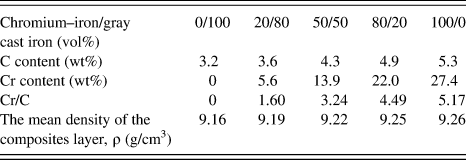
In this work, five surface composites containing different matrices were produced by controlling the volume ratio of the chromium–iron to the gray cast iron in the mixtures. The space in the preforms was assumed to be thoroughly filled with the substrate, the chemical compositions of the matrices and the average density of five kinds of surface composites were calculated, and the results were listed in Table II.
Contents of C and Cr elements in the matrices of the different surface composites.

B. Abrasive wear tests
Three-body abrasive wear tests were carried out on a self-made tester, and its experimental method and schematic diagram were based on a previous work.Reference Li, Jiang, Zhou, Lu and Zhou24 A test sample was horizontally rotated (60 r/min) against a ring-shaped (270 mm in diameter) counter face under 40 N loads for 30 min. The counter-face was made of M2 tool steel hardened in the range of HV 800–850 and covered with 0.1–0.2 mm loose quartz sand (SiO2) as an abrasive during the test.
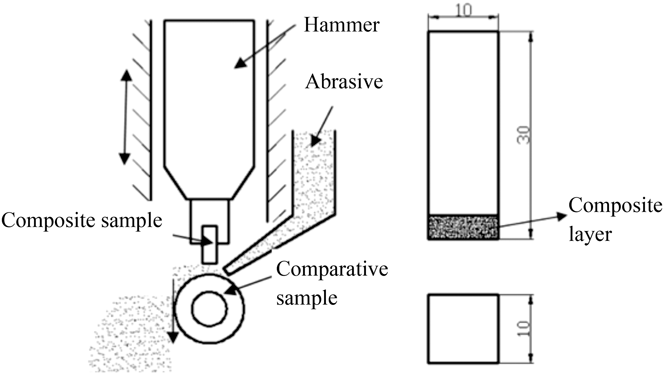
Figure 1 shows the experimental method and dimension of the samples of the impact abrasive wear tests conducted with a modified MLD-10 wear tester (Zhangjiakou, China). Impact frequency and free falling height of hammer (with mass of 10 kg) were 50 times/min and 0–50 mm, respectively. An increase in the free falling height indicated an increase in impact power. In this paper, the impact power was 1 J and 3 J. The rotation speed of comparative sample was 200 r/min, which was made of GCr15 steel after heat treatment hardened in the range of HRC 50–55. During the test period, loose quartz sands (SiO2, with the size of 1–2 mm and the rate of flow, 50 kg/h) were used as the abrasive between the composites and comparative samples.
Schematic diagram of impact abrasive wear and the dimension of the samples: (a) the schematic diagram of impact abrasive wear; (b) the dimension of the samples.

For the two wear tests mentioned above, the samples were machined and the surface roughness was R a 6.3. Mass losses of the samples were measured on an electronic balance with an accuracy of 0.0001 g. The abrasive wear rate was expressed as volume loss rate (ΔV), given by the expression as follows:
 $$\Delta V = {{\Delta {M \mathord{\left/ {\vphantom {M \rho }} \right. \kern-\nulldelimiterspace} \rho }} \over t}$$
Where, ΔM represented the mass loss (average value of three test results) of the composites sample; ρ was the average density of the composites (Table II); and t represented the wear time. A decrease in ΔV indicated an increase in the three-body abrasive wear resistance and the impact abrasive wear resistance.
Optical microscopy, SEM with an energy dispersive x-ray analyzer, and XRD analysis with Cu Kα radiation were employed to analyze the matrices of the composites. The observation of the worn surfaces of the composites was carried out on SEM.
III. RESULTS AND DISCUSSION
A. Microstructure
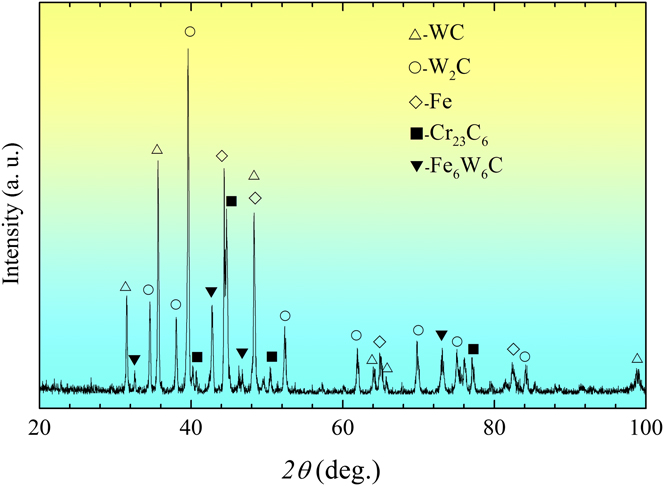
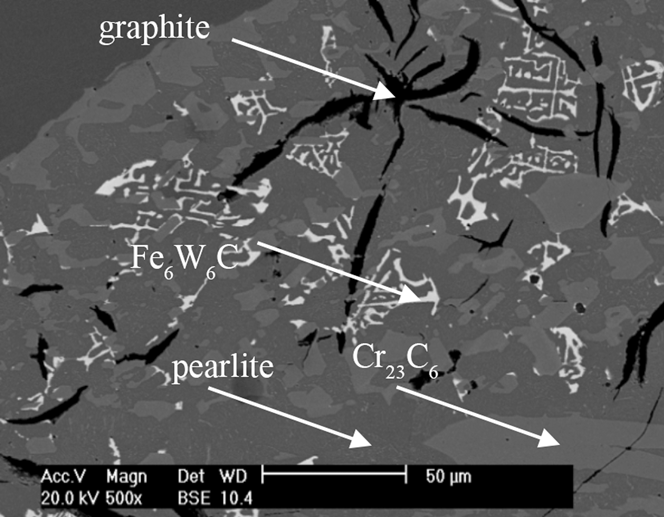
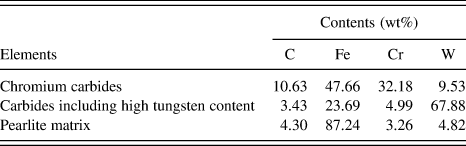
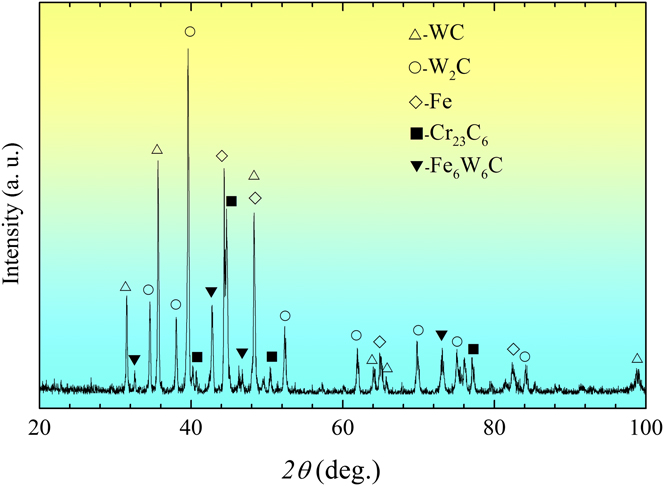
WC particle–reinforced iron matrix surface composites with different content of Cr were fabricated using V-EPC technique. These composites were consisted of Fe and carbides. The mean density of the composite layer increased from 9.16 to 9.26 g/cm3 with the increasing Cr content, shown in Table II. Figure 2 exhibited the XRD patterns of the surface composites with 27.4 wt% Cr in the matrix, illustrating the composite containing Fe, WC, W2C, Cr23C6, and Fe6W6C. Typical SEM image and corresponding EDX results of the surface composite with 27.4 wt% Cr content in the matrix was shown in Fig. 3 and Table III, revealing that the composite consisted of graphite, pearlite, fish-bone-shaped Fe6W6C, and bar-shaped Cr23C6 carbides, which further confirmed the results from XRD.
XRD patterns of the surface composites with 27.4 wt% Cr in the matrix.
Typical SEM image of the surface composite with 27.4 wt% Cr content in the matrix, revealing that the composite consisted of graphite, pearlite, fish-bone-shaped Fe6W6C, and bar-shaped Cr23C6 carbides.

Energy spectrum analysis results of the matrix with 27.4 wt% Cr.

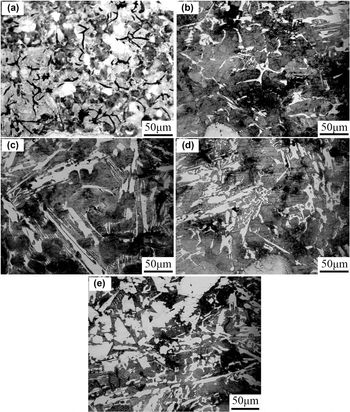
The matrices of the surface composites with different Cr content, shown in Fig. 4, indicated more and more carbides precipitation from the matrices with increasing Cr content. Furthermore, the comparison between Figs. 4(a) and 4(b)–4(e) showed that the morphology of the carbides changed from continuous net-shape to isolated block-shape patterns with increasing Cr content in the matrix.
The matrices of the surface composites with different Cr content in the matrices: (a) without Cr; (b) 5.6 wt% Cr; (c) 13.9 wt% Cr; (d) 22.0 wt% Cr; and (e) 27.4 wt% Cr, indicating more and more carbides precipitation from the matrices with increasing Cr content.

B. Abrasives wear resistance
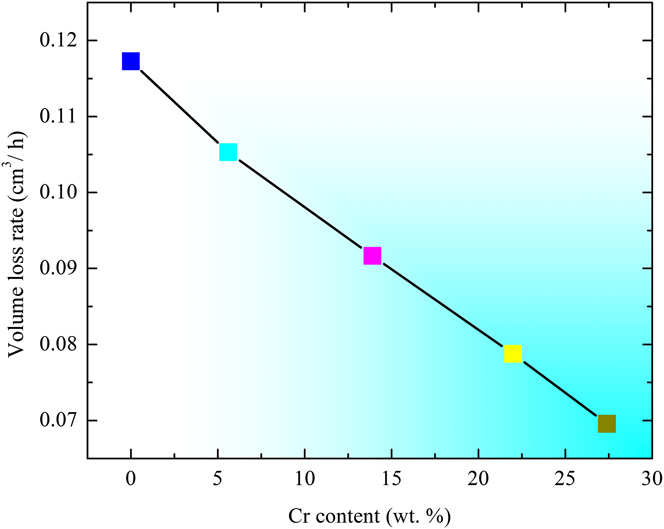
The three-body abrasive wear volume loss rate of the composites as a function of Cr content in the matrices was shown in Fig. 5. The volume loss rate was high as 0.117 cm3/h, when the matrix was Cr-free, indicating low abrasive wear resistance. With increasing Cr content, the volume loss rate approximately linearly decreased to 0.07 cm3/h, revealing that the three-body abrasive wear resistance of the composites increased. Therefore, the composites with different Cr content in the matrices presented a better three-body abrasive wear resistance than the composite without Cr. With the increase of Cr content in the matrices, the wear resistance of the composite with 27.4 wt% Cr content in the matrix was increased by 40.6% as compared with the composite without Cr.
Three-body abrasive wear volume loss rate as a function of different Cr content in the matrices.

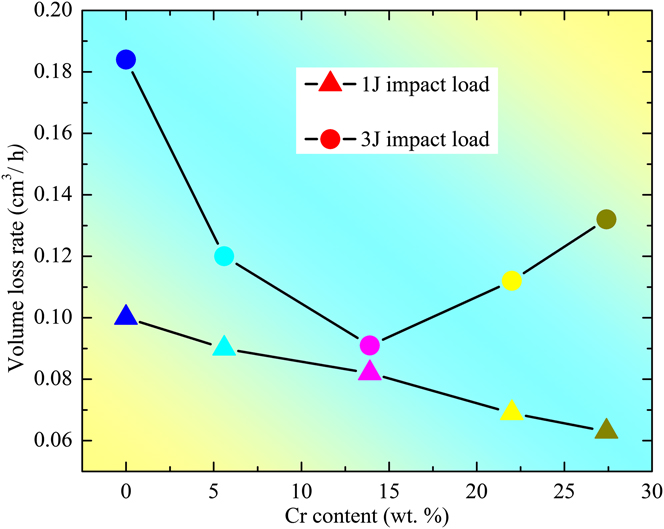
Figure 6 depicted a comparative research of the impact abrasive wear volume loss rate of the composites with different Cr content in the matrices under different kinds of impact load. The changes of the wear resistance with Cr content in the matrices were found to be significantly different under different loads, i.e., under low load (1 J), impact abrasive wear resistance of the composites increased with increasing Cr content in the matrices. However, the volume loss rate dropped down from 0.184 to 0.091 cm3/h, then climbed up to 0.132 cm3/h, with the increasing Cr content under higher load (3 J), indicating that the impact abrasive wear resistance of the composites first increased, and then decreased under high load (3 J). When Cr content is 13.9 wt%, composites manifested the best impact abrasive wear resistance under high load (3 J).
Comparative research of the impact abrasive wear properties of the composites with different Cr content in the matrices under different kinds of impact load.

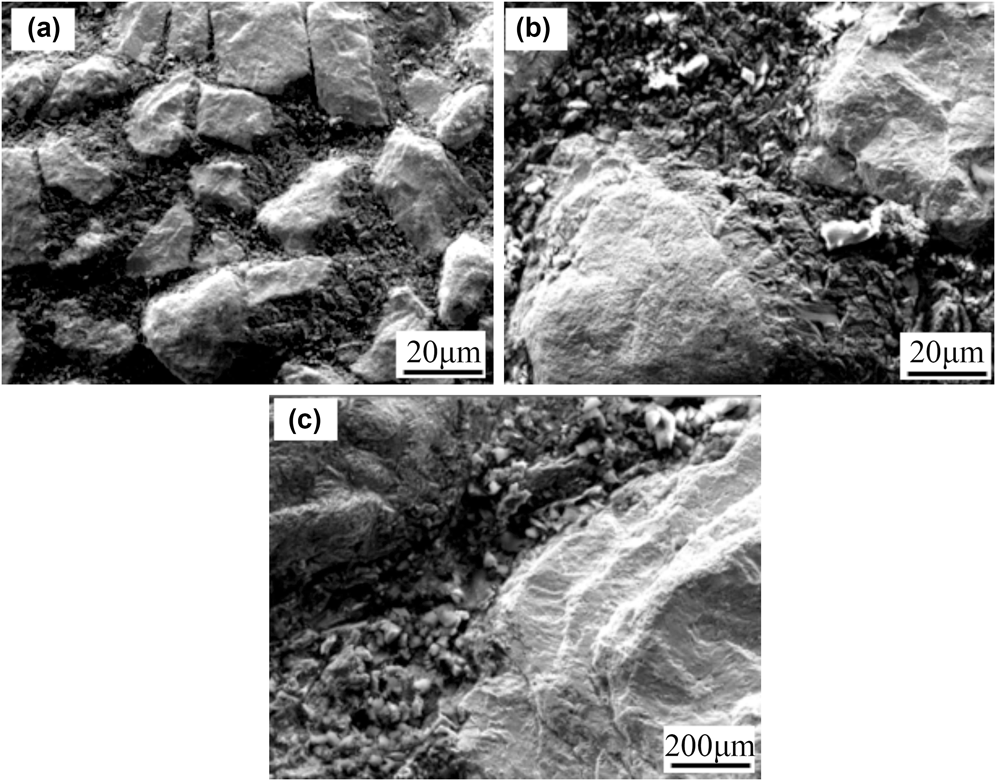
The worn surfaces of the composite with 13.9 wt% Cr content in the matrix under three-body abrasive wear and impact abrasive wear, shown in Fig. 7 and Fig. 8, separately, could help to understand the abrasive wear mechanism of the composites. In a three-body abrasive wear process, WC particles with high hardness (HV 2093) in Fig. 7(a) could effectively resist the cutting of the quartz abrasive (particulate size under 0.15–0.18 mm, with hardness of HV 1020), and thus the wear resistance of the composite improved.Reference Chen, Gao, Chen and Xing31 Although the matrix with lower hardness (below HV 800) was cut in the abrasive process, the matrix offered supporting effect to the WC particles, which ensured that the protruded WC particles in the matrix bonded well with the matrix,Reference Ma, Xing, Yi, Fu, Zhang, Li, Zhang, Liu and Zhu32 illustrated in Figs. 7(b) and 7(c). Thus, the protruded WC particles could offer the protecting effect to the matrix, while the matrix could give the support to the WC particles.Reference Zhou, Jiang and Lu21,Reference Li, Jiang, Zhou, Lu and Zhou24
SEM micrographs of three-body abrasive wear surfaces of the composite with 13.9 wt% Cr content in the matrix: (a) overall surface; (b) WC particle with few cracks; and (c) packing of chip of material in front of WC particle.

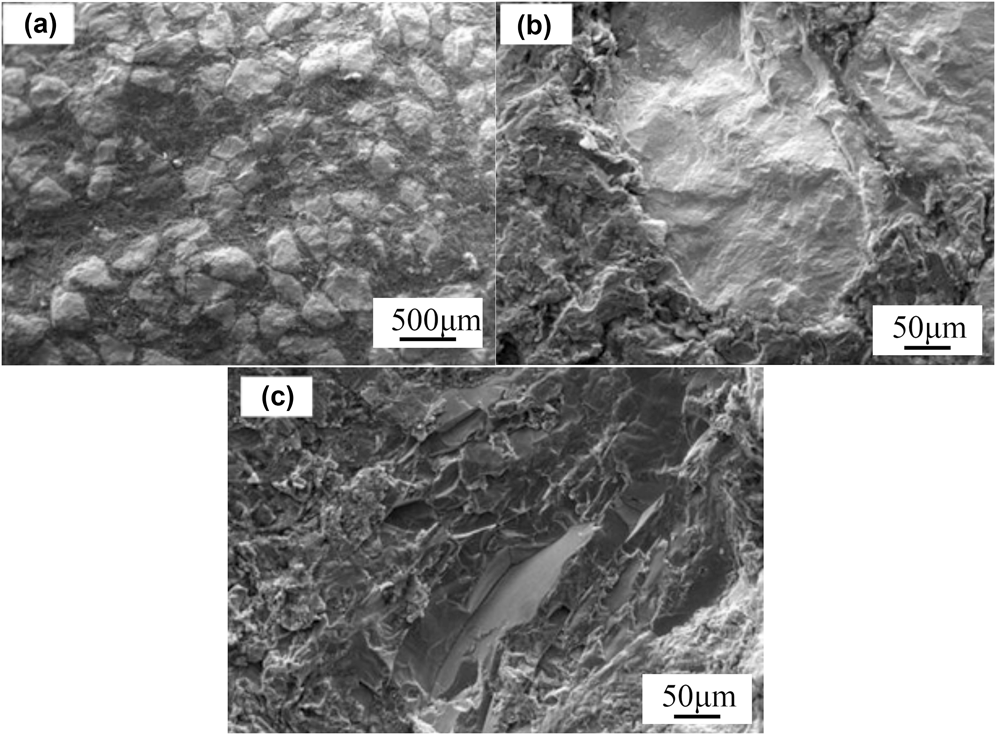
SEM micrographs of impact abrasive wear surfaces of the composite with 13.9 wt% Cr content in the matrix under 3 J load: (a) overall surface; (b) WC particle dropped from the matrix; and (c) cleavage fracture surface in the matrix.

Furthermore, Fig. 8(a) showed that WC particles also protruded in the matrix during the impact abrasive wear process. Although this phenomenon was not as obvious as that of the three-body abrasive wear shown in Fig. 7(a), the protecting effect of the WC particles on the matrix still existed.Reference Pagounis and Lindroos17,Reference Zhou, Jiang and Lu21,Reference Lou, Hellman, Luhulima, Liimatainen and Lindroos22,Reference Huang, Samandi and Brandt26 A few WC particles dropping from the matrix could be observed in Fig. 8(b). Figure 8(c) showed some furrows and microcracks appeared on the matrix.Reference Chen, Gao, Chen and Xing31 All these results indicated that the supporting effect of the matrix to WC particles was rather significant. All in all, two types of wear resistance of the composites with different Cr content in the matrices were influenced by the protecting effect of the surface of WC particles on the matrix (First protecting effect) and the supporting effect of the matrix to WC particles (First supporting effect).Reference Zhou, Jiang and Lu21,Reference Li, Jiang, Zhou, Lu and Zhou24
The influences of the matrices on impact abrasive wear resistance and three-body abrasive wear resistance mainly focused on the supporting effect of the matrix to WC particles and wear resistance of the composites.Reference Pagounis and Lindroos17,Reference Zhou, Jiang and Lu21,Reference Lou, Hellman, Luhulima, Liimatainen and Lindroos22,Reference Huang, Samandi and Brandt26 In this study, volume fractions of the WC particles in the composites were maintained at 40 vol%. In the matrices, the carbides, i.e., (Fe, Cr)23C6 and Fe6W6C, were also regarded as reinforced phases in relative to the pearlite microstructure. Thus, the protecting effect of the carbides on the pearlite (Second protecting effect) and the supporting effect of the pearlite to the carbides (Second supporting effect) could be used to explain the difference in the wear resistance of the matrices.
The increasing Cr content in the matrices raised the quantity of the carbides, which could increase the second protecting effect.Reference Zhou, Jiang and Lu21,Reference Li, Jiang, Zhou, Lu and Zhou24 Therefore, the wear resistance of the composites increased. This result can only be used to explain the changes of the three-body abrasive wear resistance and the impact abrasive wear resistance under lower load, but not the change of the impact abrasive wear resistance under higher impact load (3 J).
As is known that the attainment of both strength and toughness is a vital requirement for most structural materials; unfortunately these properties are generally mutually exclusive.Reference Ritchie27 Here, the high hardness and wear resistance are also incompatible. Different from the three-body abrasive wear, the impact abrasive wear of the surface composites was completed under regular impact condition, which would inevitably lead to a few brittle cracks and even fracture in the brittle phases such as WC particles and other carbides. For the same composite, the probability of forming cracks and even fracture in the composite increased with the increasing impact load, resulting in the decrease of impact abrasive wear resistance of the composite.
When the impact load was low (1 J), few cracks and fracture occurred in the brittle phases, and the load had little influence on the interfaces between WC particles and matrices or carbides and pearlite.Reference Chen, Gao, Chen and Xing31 Thus, under 1 J impact load, with the increase of Cr content, the protecting effect of the carbides on the pearlite (Second protecting effect) was strengthened, and the supporting effect of the pearlite to the carbides (Second supporting effect) was basically maintained invariably, which increased the impact abrasive wear resistance of the composites.
When the impact load reached 3 J, with the increase of Cr content in the matrices, the cracks and fracture increased, and these two kinds of supporting effects discussed above were weakened, which decreased abrasive wear resistance. Therefore, under 3 J impact load, Cr content with 13.9 wt% in the matrices was found to be a critical value, at which the two protecting effects and the two supporting effects well cooperated so that the wear resistance of the composite could reach the maximum. When the content of Cr was higher than 13.9 wt%, the wear resistance decreased with the Cr content.
Therefore, the addition of Cr in the matrices could notably affect the impact abrasive wear resistance and three-body abrasive wear resistance of the surface composites. The influences of Cr on the wear resistance were synergistic effects of the two protecting effects (the protecting effects of the surface WC particles on the matrix and the carbides on the pearlite) and two supporting effects (the supporting effects of the matrix to WC particles and the pearlite to the carbides). Among them, both protecting effects contributed to the three-body abrasive wear resistance and impact abrasive wear resistance under low load. However, under high load, the impact abrasive wear of the composites depended on the competition between two protecting effects and two supporting effects.
It is also noted that for the hard particle–reinforced soft matrix composites, the wear mechanism is different from the ductile phase–reinforced hard matrix composites. As is discussed above, the wear mechanisms of the former were abrasive wear. Because of the high brittleness of hard particle and weak interfacial bond between particles and matrices, in this case, two types of wear resistance of the composites with different Cr content in the matrices were influenced by the protecting effect of the surface WC particles on the matrix and the supporting effect of the matrix to WC particles. The wear mechanisms of the latter were adhesive wear, abrasive wear, and oxidative wear. However, adhesive wear and oxidative wear occurred slightly for the composites with the binder modified.Reference Yang and Luo33 The poor affinity between particles and binder might bring weak interfaces with the consequent negative effect on the mechanical properties. Therefore, the utilization of an appropriate binder to facilitate the interaction and wetting between particles is the last choice during the preparation of the ductile phase–reinforced hard matrix composites.Reference Yang and Luo33
IV. CONCLUSIONS
In this work, WC particle–reinforced iron matrix surface composites with different content of Cr were fabricated using V-EPC technique successfully. The results and discussion above allow the following conclusion:
(1) With increasing Cr content in the matrix, the amount of carbides increased and the morphology of the carbides changed from continuous net-shape into isolated block-shape patterns.
(2) Compared with the composite without Cr, the composites with different Cr content in the matrices presented a better three-body abrasive wear resistance.
(3) With increasing Cr content in the matrices, the three-body abrasive wear resistance of the composites increased.
(4) The impact abrasive wear resistance of the composites increased under low load (1 J), but first increased and then decreased under high load (3 J), with increasing Cr in the matrices. The high hardness and wear resistance were incompatible for impact abrasive wear resistance of the composites under high impact load.
(5) The influences of Cr on the wear resistance were synergistic effects of two protecting effects and two supporting effects. The abrasive wear resistance of the composites depended on the competition between two protecting effects and two supporting effects.
ACKNOWLEDGMENT
The authors acknowledge the funding support from the National Science Foundation of China (51241002, 51361019).