1. INTRODUCTION
Countries that have had a profound reform of their legal systems sometimes face a gap between “law in books” and “law in action.”Footnote 1 Legislators from the developing countries put significant effort into learning the legal principles from the legal system from which the rules are transplanted due to differences regarding political and economic power and the pressure of globalization.Footnote 2 Nevertheless, a reform can cause tension between the law and local culture.
Law and society researchers have recognized that formally promulgated law can never completely supplant “unofficial” regulations in society.Footnote 3 For instance, Chinese culture contains a value system that includes widely accepted standards used to evaluate “what is valuable to do” in Chinese society.Footnote 4 These cultural values provide a series of regulation of conducts that coexist with the black-letter laws, and it has been argued that they may play a role in the application and enforcement of the law.Footnote 5
This paper contributes to the body of knowledge by empirically examining whether Chinese culture affects the judges’ decision-making when the law causes tension with culture. Consequently, this study enhances the understanding of whether the tension between traditional Chinese culture and black-letter law hinders the implementation and application of the law in China. More generally, the more we understand how judges work, the easier it becomes to assess and improve the quality of it. The same applies to the institutional legitimacy of the judiciary, because its legitimacy depends on the quality of the judges’ work.Footnote 6
We approach the relationship between culture and application of the law within the context of the awarding of damages in breach-of-contract cases. Although a rich literature in law and society emphasizes that social, community, and business norms, coupled with formal law, help structure commercial dealings,Footnote 7 it is still not clear whether judges take any social elements into account when making legal decisions. The decision of judges in contract cases might not be influenced by national cultural values, since contract law is “controlled by economic interest rather than national customs or sentiments” and is “more loosely connected with a people’s past” compared to family law.Footnote 8 As a market-oriented regulation, contract law should follow the basic principles of the market economy, such as the rule of value and the rule of supply and demand. Those principles apply globally, regardless of any national character of people, such as culture.Footnote 9
Our findings reveal that Chinese judges ensure that their judgments are in accordance with the law and, at the same time, aim to avoid possibly undesirable consequences of their decisions from the perspective of Chinese cultural values. In addition, the data indicate that some judges prefer to resolve the case by mediation other than adjudication if cultural values are at stake (compared to when they are not). Previous law and society research on mediation of Chinese judges mainly focuses on the political pressure from central government and the Chinese Communist Party (CCP).Footnote 10 Similarly to Ng and He,Footnote 11 our data also show that the administrative pressure from the leadership of the court and from the higher court may cause judges to solve the case by mediation in situations where a tension exists between law and cultural values. However, our paper goes one step further than the previous literature. Our data show that another reason for the Chinese judges to offer mediation may be the tension between black-letter law and traditional cultural values in China, with judges using mediation to avoid apparently socially undesirable outcomes that result from the mere application of the law.
The goal of the paper is to test whether cultural values would impact judges’ decision-making. However, cultural values sometimes merge with other values or considerations. For example, some cultural values might also be perceived as political considerations. As in China, social harmony and stability are also used in the political propaganda. Our data show that the judges view social harmony and stability as desirable values. What they do not agree on is the means applied by politicians to “keep social stability and harmony.” Also, the bureaucratic management of Chinese courts may encourage the judges to consider cultural values of the society. Bureaucratic management requires judges to consider the social effect of their decisions. The consideration of social effect increasingly leads judges to seek social approval of their decisions. Since the cultural values are widely accepted desirable standards, seeking social approval makes cultural values act as components that are used by the Chinese judges to construct strategies for decision-making. This article first briefly reviews the existing literature on the decision-making of judges in relation to culture. Second, the concepts of cultural values in China are introduced, with each concept being discussed in detail. Third, the results of a vignette study and a semi-structured, in-depth interview with 43 judges (36 judges and seven assistant judges)Footnote 12 from 13 cities and provinces of China are presented and discussed. The conclusion follows in the final part of this article.
2. CULTURE AND JUDGES’ DECISION-MAKING
As Friedman suggested, national culture could influence the effectiveness of law.Footnote 13 Differences in culture can lead to different general attitudes, values, and opinions about the interpretation and application of law,Footnote 14 which can affect legal decisions. For example, mutual obligation, interdependency, and group interests in Chinese and Japanese culture diminish the application of formal law in these societies.Footnote 15 He et al. also find that the legal perception of Chinese migrant workers is shaped by moral precepts ingrained in the culture.Footnote 16
Cultural values may also affect legal professionals. MichelsonFootnote 17 argues that Chinese lawyers use cultural stereotypes to sort and filter cases brought by “undeserving” or “troublesome” clients. According to Michelson, lawyers prefer to filter out cases brought by an angry troublemaker or a deserving victim. Linguistic anthropologists have explored how cultural values are involved in discussions in American courts.Footnote 18 They demonstrate that cultural frames and values are pulled into the legal discussion in the courtroom. The study does not provide direct empirical evidence to demonstrate the link between national culture and the decision-making of judges.
Additionally, legal transplants researchers have a theoretical debate regarding the impact of culture on legal professionals’ (judges’) decision-making. The radical debate between “transferists” and “culturists” (Foster)Footnote 19 shows a fundamental disagreement. WatsonFootnote 20 argues that legal elites, such as judges, promote their own “internal legal culture” by sharing unified ideas and practices, and that they are immune to outside influences, including societal demands.Footnote 21 In contrast, LegrandFootnote 22 responded by stating that the content of law is always determined by a given culture. In his view, the meaning of the transplanted rule will be understood differently in one culture compared to another. The decision of judges in the import country would inevitably be influenced by the culture of his/her own nation.
3. THE REFORM OF CONTRACT LAW IN CHINA AND CHINESE CULTURAL VALUES
The establishment of Chinese contract law reflects Chinese law-making based on international practices and advanced (Western) experiences.Footnote 23 After China transitioned from a planned economy to a “socialist market economy,”Footnote 24 Chinese legislators and legal scholars forcefully called for a comprehensive and systematic study of Western laws and legal theories. They started to endorse the adoption and direct transplantation of Western laws and international commercial instruments in order to build a law fit for a market economy that should be foresighted, systematic, and close to international practice.Footnote 25 With a modernized contract law, the Chinese authorities attempted to have Chinese legislation and legal practices be consistent with general market-oriented legal practices. Foreign businesses would consequently be able to understand the law of China and to predict the judgments of Chinese courts. In this way, the new contract law might help China to attract more foreign investment and to promote international trade between Chinese companies and foreign businesses, with the risk of causing tensions with the Chinese culture.
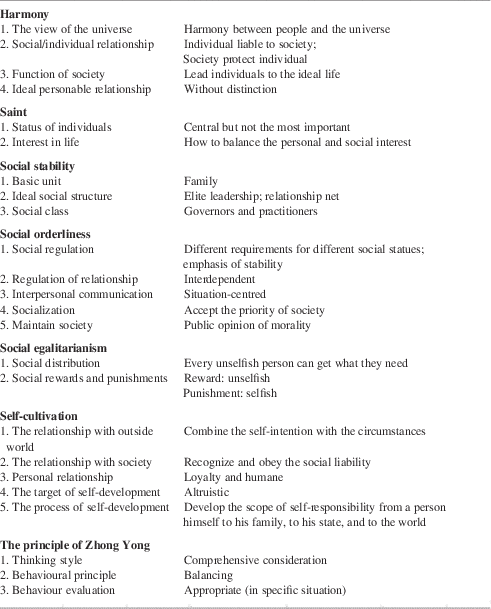
We derive seven main cultural values from traditional classical Chinese literatureFootnote 26 and previous social psychological literaturesFootnote 27: harmony, saint, social stability, social orderliness, social egalitarianism, self-cultivation, and Zhong Yong. According to Rokeach’s classification of “instrumental values” and “end values,”Footnote 28 we divide the main values into ideal values and practical values. The ideal values are the values that the social members believe in as being desirable goals that include the values of harmony, saint, and social stability. The practical values provide for regulations of personal conducts and include social orderliness, social egalitarianism, self-cultivation, and Zhong Yong. These regulations instruct social members how to behave in order to achieve the ideal values. In addition to law, the practical cultural values may also influence the damages awarded, for example by courts, since they may provide customs and social rules that may also play a role in actual observance and enforcement of the law.Footnote 29
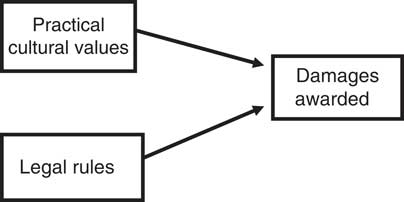
Taking into consideration the existing literatures of cultural influence,Footnote 30 the relationship between cultural values, law, and decisions can be presented as in Figure 1.
The relationship between cultural values, law, and decisions. This figure demonstrates the main hypothesis of this study: when there is tension between Chinese cultural values and transplanted legal rules, the cultural values would not be ignored by the Chinese judges when making decisions.

Based on this relationship, it is expected that, when there is a tension between Chinese cultural values and transplanted legal rules, the cultural values would not be ignored by the Chinese judges when making decisions. The specific contents of the seven main values are presented and elaborated on in Table 1.
Chinese cultural values

Many Chinese scholars consider harmony as the central value of Chinese culture. From a historical point of view, Yu summarizes the basic Chinese cultural values as harmony with the outside world, peace of mind, and social egalitarianism.Footnote 31 Also, Qian indicates that both Chinese culture and the personality of Chinese people emphasize harmony, which means to keep the harmonious atmosphere between people and the outside world.Footnote 32 Moreover, social psychologists suggest that the more suitable summary of the worldview of Chinese society is not collectivism, but harmony, which means using a compromising attitude to achieve harmony between the individual and the outside world.Footnote 33 This value can also be found in the classical Confucian books.Footnote 34 The value of harmony encourages people to create a harmonious atmosphere between people and society. To achieve harmony, the individuals have to cultivate themselves through the requirements of social liability. In turn, the society has to protect every social member and to distribute the social resources according to their needs.Footnote 35 Although the term “harmony” has been used by the government of Mainland China and frequently appears in political propaganda, it by no means affects the value “harmony with the outside world” as the main value of traditional Chinese culture not only in Mainland China, but also in other Chinese societies such as Taiwan, Hong Kong, and Singapore.
Indeed, nowadays, the traditional cultural value system is by no means the only value system in Mainland China. By the second half of the nineteenth century, it was clear that traditional Chinese society was already undergoing rapid change.Footnote 36 Also, after China’s opening to the West from the 1980s, the orthodox Confucianism was not the most influential in Mainland China. Previous literature demonstrates that Chinese society is full of conflicts and many conflicts did or do not resolve in a harmonious way.Footnote 37
The purpose of this paper is to answer whether the traditional cultural values play a role in judges’ decision-making. It is not the aim to discern between traditional and modern-day values. Moreover, we recognize that the traditional cultural value system is not the only or main source that impacts judges’ decision-making, nor do we aim to compare the influence of traditional cultural values with the impact of other value systems. Furthermore, what are considered cultural values in China may also play a role in other countries but have different labels (e.g. policy considerations, political considerations, practical considerations). It was not the purpose of this study to test whether cultural values in China have equivalences in other countries, and whether those equivalences produce similar effects. Those questions may be addressed in future research.
3.1 The Values of Society
Under the value of harmony, the values of society in Chinese culture are stability, orderliness, and egalitarianism. One the one hand, the value of harmony requires an ideal social structure that is stabilized by the hierarchical social status of each social member and the “mutually dependent” relationship between the members’ social statuses.Footnote 38
First, a stable society is a hierarchical one that is led by the social elites who have the capability and morality to find the correct way for social development.Footnote 39 The social elites are classified as governors and are liable to lead the society in a good way. The rest of the people are practitioners who are responsible for implementing the way that the governors have laid out for them.Footnote 40 The distinction of “governors” and “practitioners” provides a hierarchical social status for each person. Each person lives in a hierarchical relationship network.Footnote 41
Second, the stability of society also relies on the interdependency of the social members. In society, individuals are located in “a group relational context, where they are perceived by themselves and by others not as individuals but as contextual actors.”Footnote 42 A person has to consider both his social status and relationship with respect to his counterparty before acting. A person’s social status may change in different relationships. For example, a man may be a governor to his son, but he may also be a practitioner to his boss.
People are trained in their family to accept and behave in line with the hierarchical social status and mutually dependent relationships. Family, which is the natural collective of each person, is the basic social unit in Chinese society. Family relationship is the first and closest interpersonal relationship in Chinese society. Because of the requirement of filial piety, a person not only adopts the value of harmony from the old generation within a family; he also learns how to respect others, especially the elderly, how to take others’ interest as his own, and how to unselfishly work for others.Footnote 43 The patriarchal interpersonal interaction model within the family would be analogized to the interaction outside the family.Footnote 44
On the other hand, a stable social structure requires a set of regulations of conduct that demands from the social members to recognize and to behave properly (orderliness value). The values of social orderliness indemnify the stability social structure by requiring the social members to recognize and behave in line with these regulations. These values first require people to voluntarily take each other into consideration according to the different social status in specific circumstances. Second, they also require a person to recognize the interdependency with others, and to consider the interests of his or her counterparty in a relationship.Footnote 45 Through interpersonal distance, the Chinese intend to identify the others as in-group or out-group members. They apply various rules between out-group members and in-group members.Footnote 46 A person may care more about the one who has much closer interpersonal distance with him than about somebody who is farther removed in this respect.
The values of social orderliness also provide internal and external assurances for the social members to follow the regulations. Internally, the values of social orderliness include an individual socialization process that teaches each social member to accept the priority of society. The socialization process is basically a moral education that aims to bring up an idea that “social development is the primary condition for personal happiness” to the individuals.Footnote 47 The external force of public opinions provides social pressure to the social members, and requires them to think about others before the start of an activity.Footnote 48
In addition, Chinese culture provides social egalitarianism values to ensure that the social members behave in line with the values of social orderliness. These values are considered to provide for the economic basis of social stability. As Mencius said, “the intelligent ruler will regulate the livelihood of his people so that they have enough to support their parents and their own children. After this you can urge them to be good, because they will follow easily.”Footnote 49 Chinese culture emphasizes a hierarchy of social authority and social status. However, it also advocates egalitarianism of wealth in order to avoid social instability as a result of the difference between rich and poor.Footnote 50 The egalitarianism values provide that the distribution of social resources should be in line with the needs of each social member. Since social development depends on the contribution of all social members, the results of the development should be shared by them. The best way of sharing is to distribute based on people’s needs.Footnote 51
The social distribution can only be implemented when the society is just. Social justice can be achieved by rewarding altruism and punishing selfish behaviour. The reason for this is that a person who considers the society and other first would have to sacrifice his own interest. If only a part of the members sacrifice, and the other part selfishly considers their own interest, the members who sacrifice for others or the society will not be able to receive their expectative reward from the society.Footnote 52 Moreover, the selfish people may receive more from a social priority society than they may get from a society where everybody only considers themselves, because they may fulfil their needs from others’ sacrifice without any cost. Thus, unfairness would threaten the social members’ belief in the whole value system. Under the “priority of society,” altruism needs to be rewarded, selfishness needs to be punished, and social resources need to be distributed according the needs of the social members who have fulfilled their social liabilities.Footnote 53 When the social members are altruistic, social resources would be distributed according to their needs.
3.2 The Values of Personality
The value of harmony also shapes the personality value. An ideal personality not only demands the individuals to behave unselfishly, but also requires them to remove the selfish intention from their mind. To achieve the ideal personality, Chinese culture provides both moral and behavioural values to individual people.
The moral value requires a person to cultivate himself in order to deal with others in a peaceful way. The aim of self-cultivation is to fulfil a “priori moral ideal” that aims to change the “subjective stimulus values” of the individuals,Footnote 54 but not to develop their specific cognitive or behavioural ability.Footnote 55 The self-cultivation values provide the aim and process of self-development. The aim of the self-development under Chinese culture is to improve oneself to become an altruistic person. First, an altruistic person should be humane and loyal to his/her social liability and to others. Second, he or she has to behave in line with the social order. Third, he or she must recognize the requirement of the circumstances and combine his own intention with it.Footnote 56 The process is to develop the scope of self-responsibility from a person to his family, and then to the society, and then to the world (修身,齐家,治国,平天下).Footnote 57
Zhong Yong is the behavioural value. It requires people to behave restrainedly, compromisingly, and not extremely.Footnote 58 The principle of Zhong Yong requires people to consider the consequences of their behaviour in order to avoid inappropriate behaviour and to promote interpersonal harmony. Other than categorizing behaviour as “right” or “wrong,” the Zhong Yong principle leads people to realize that, if a right thing is done in an inappropriate way, the consequence may be undesirable. Thus, they have to consider all the possible influences of their behaviour comprehensively before taking action, and then to do the “right” thing in an appropriate way in order to maximize the positive consequences of their behaviour. Specifically, under Zhong Yong principle, people (1) should not behave immediately by impulse; (2) should comprehensively consider all the related parties; (3) should consider the potential influence of his behaviour on other parties; and (4) should behave in a way that is good for every related party.Footnote 59
4. METHOD
Gaining access to the judges through personal connections, 50 judges and judge assistants in China were approached by exponential, non-discriminative snowball sampling. Among them, 43 judges (36 judges and seven assistant judges) from 13 cities and provinces of China (Beijing, Tianjin, Hebei, Henan, Jiangsu, Zhejiang, Sichuan, Chongqing, Shaanxi, Xinjiang, Shanxi, Guangdong, and Shanghai) participated in the research. The judges included in the sample were located in different regions of China. The provinces include the north, south, middle, south-west, and north-west regions of Mainland China. The judges worked at different levels within various courts, ranging from the lowest level to the highest (i.e. the Supreme Court). Among them, 44.2% were working at basic courts (courts of first instance), 27.9% at middle courts, 20.9% at local high courts, 4.6% at the Supreme Court, and 2.3% at a specialized court (Maritime court).
In addition to region and court level, we selected respondents who varied in gender, age, work experience, and education level. Twenty-eight percent of the participants were below 30 years old, 56% were between 30 and 50 years old, and 16% were aged above 50. Sixty-three percent were male. Fifty-one percent of the judges had fewer than ten years’ work experience in courts, 16% had 10–20 years, and 33% had more than 20 years’ work experience. The highest degree of 30% of the participants held a bachelor’s degree; 60% held a master’s degree and 10% held a Ph.D. Only one of the respondents did not have an educational background in law.
Following the principles of experiment, an interview study was conducted to explore the effect of cultural values on judges’ decisions when deciding on the amount of damages in breach-of-contract cases. In-depth interviews are a preferred way for investigating the impact of culture.Footnote 60 However, it is also argued that interviews may not be well suited for the study of human attitudes and behaviour because the judgments required of respondents are often too abstract. Vignettes were developed and used to overcome this limitation. Vignettes, short descriptions of personal and social situations, can present more concrete and detailed stimuli to the respondents that more closely approximate real-life decision-making or a judgment situation.Footnote 61 Moreover, following the experimental principle can help to identify the link between cultural values and the decision-making of judges. By random assignment, extraneous variables are not likely to systematically influence the results of the experiment.Footnote 62
The study included three vignettes, in order to represent commercial and civil contracts, and to include the various legal issues in contractual damages (see Appendix for the vignettes). The vignettes consisted of cases where one party suffered a loss as a result of a breach of contract by another party. The judges who participated in the research were asked to indicate the amount of damages they would award to the party that suffered the loss.
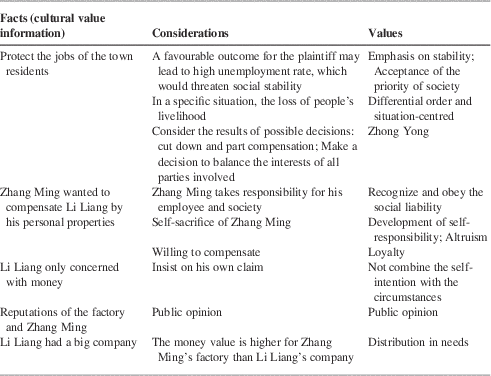
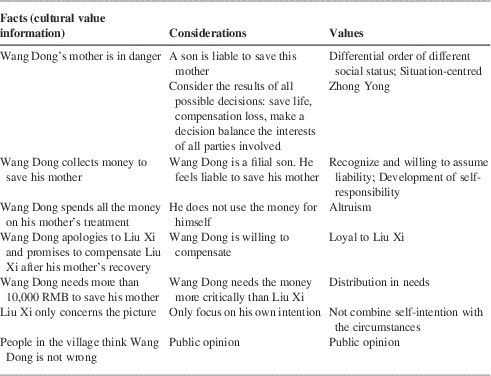
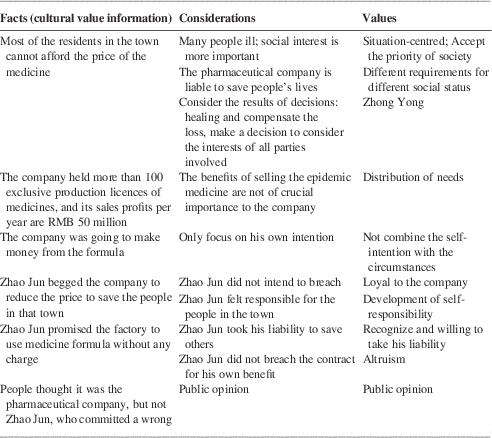
Following the experimental principles, we designed two versions of each vignette. The versions only differed in the presence or absence of information on cultural values (independent variable). Consequently, one version (Version B) of each vignette included information on cultural values, while this information was left out in the other version of the vignette (Version A). The Version B vignettes essentially informed the participants that, although the defendants breached the contract, their behaviour was in line with one or more Chinese cultural values. In all vignettes, a completely legal decision would lead to an undesirable result under the cultural values. Tables 2–4 show how the concepts of Chinese cultural values were operationalized in the three vignettes.
Vignette 1

Vignette 2

Vignette 3

A pilot study was conducted to ensure that the information on cultural factors in the vignettes actually represents Chinese cultural values. We designed a survey based on the vignettes, separating the three vignettes into 20 situations where a seller breached a contract and where a decision-maker offered a solution to remedy the breach. The respondents were asked to indicate whether the decision-maker considered a Chinese cultural value and/or a rule of contract law. They had to indicate their answers on a four-point scale. An example of one of the statements presented to the survey respondents was:
A seller breaches a contract by not delivering a good. Awarding a high amount of damages may lead the seller to go bankrupt and many people to lose their jobs. If the decision maker reduces the amount of damages to prevent the seller from going bankrupt, the decision maker
particularly considers the contract law.
Strongly disagree 1, 2, 3, 4 Strongly agree
particularly considers Chinese cultural values.
Strongly disagree 1, 2, 3, 4 Strongly agree.
The survey included 11 statements that involved culture values, all of them being included in the vignettes. Meanwhile, we included nine statements where we expected higher scores on the legal scale than on the cultural values scale (the statements were also included in the legal information in the vignettes). Including legal items introduced diversity in the statements, which, in turn, would prevent respondents from automatically providing high scores without reading the statements because they provided high scores on all previous statements. All the survey respondents were Chinese and had at least a bachelor’s degree in law, which ensured that the respondents were knowledgeable about both Chinese culture values and contract law, at least to a certain extent.
The 25 responses of the survey showed that all the statements that we labelled as “cultural values” were seen as cultural values (and not as legal values) (p < 0.05). Moreover, all the scores of cultural considerations were higher than 2.0 (a four-point scale was used), which implies that the respondents did consider the cultural values in the vignettes as Chinese cultural values. Based on the survey results, it is reasonable to say that the cultural value factors in the vignette represented Chinese cultural values. The respondents for the pilot test were excluded from the main test.
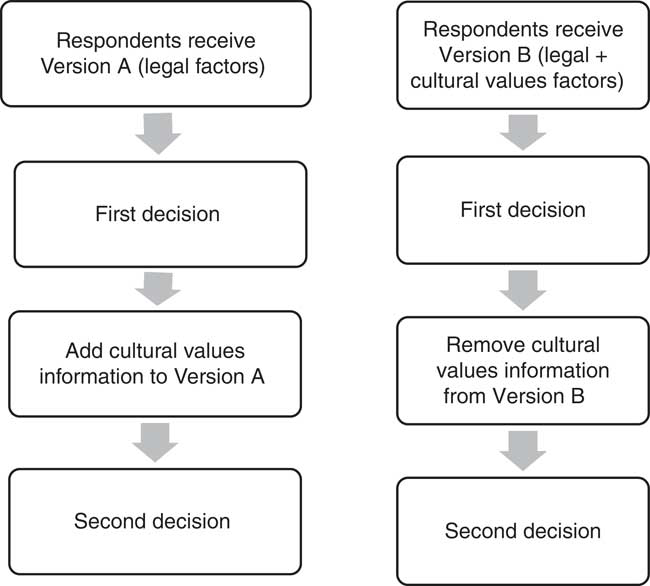
The judges that participated in the main test were randomly assigned to either the condition with information on the cultural values or to the condition without this information (Stage 1). After they made decisions, they were presented with the same vignette, but another version, depending on which information they had initially received (Stage 2). We tested our hypothesis (i.e. judges would not ignore the cultural values factors) by focusing on the damages awarded by the respondents in the first stage, and whether the damages awarded in the second stage differed from those made in the first stage (i.e. when the information on cultural values was added to or removed from the vignette (depending on the version the respondent initially received)). To address the questions regarding how and why the cultural value factors were considered by the respondents, each respondent was interviewed about their consideration when making their decisions in both stages.
The participants were asked to participate in an interview study on judicial decision-making in contract cases. Each respondent randomly received Version A (without cultural value factors) or Version B (with cultural value factors) by flipping a coin. We did not find any substantial or significant differences between Version A group respondents and Version B group respondents with respect to characteristics such as gender, age, education, and working experience.Footnote 63
After the respondents made their decisions and after they were interviewed about the reasons and arguments for their decisions, the respondents who first received Version A were provided with Version B of the vignette, while those who first received Version B were given Version A. The respondents were then again requested to make a decision about damages based on the new version they had received. None of the participants was informed about what would happen during the second stage of the interview. They were instructed to make their judgments only based on the versions they received. After one vignette was completed, a new vignette was presented to the respondents. Subsequently, the same procedure was followed. Figure 2 displays the sequence of events.
The sequence of the vignette study.

The results of interview were organized and analyzed by a coding system that included the legal terms and cultural values. The respondents’ answers that related to cultural values were coded according to the 13 themes that represent the practical values of social orderliness (emphasis of stability, different requirements for different social statuses, interdependent, situation-centred, follow public opinion, and accept the priority of society), social egalitarianism (distribution in needs, unselfish→award; selfish→punishment), self-cultivation (develop the scope of self-responsibility, recognize and obey social liability, loyalty, humane, combine the self-intention with circumstances), and the Zhong Yong principle. Demographic information, including age, gender, educational level, and professional experience inside and outside the court, was also collected.
In addition, since the terms “social harmony” and “social stability” are also used by the government of Mainland China as political propaganda, we have to clarify whether the respondents’ decision is as a result of political pressure or their own desire for social harmony. At the end of the main test, we asked our respondents: “Do you believe that harmony and stability are desirable values for society?” in order to identify the respondents’ own understanding about social harmony and social stability. Since the cultural values are defined as “widely accepted standards of ‘what is valuable to do’ in Chinese society,” it is reasonable to assume that the majority of the respondents would view “social harmony and stability” as desirable values according to their own beliefs. Thus, the previous decisions they made in line with the values of “social harmony” and “social stability” could be seen as a consideration of cultural values, since peoples’ beliefs shape their behaviours. In contrast, if the respondents did not believe in these values and would not consider these values as desirable ones, it might be the case that the respondents would only notice the political meaning of these terms, and have their decisions correspond to “social harmony” and “social stability” in order to complete political tasks.
5. RESULTS
The results confirm that Chinese cultural values have an effect on how judges assess the amount of damages, even if the cultural values are in conflict with what the legal rules prescribe. Most of the respondents reported that the statutory law might not be able to provide an appropriate solution to the cases with cultural value factors, and a purely legal decision might be socially undesirable. In this case, the cultural values were used to supplement the statutory law.
The interview results showed two behavioural patterns of Chinese judges. First, they generally took the cultural values factors into account when determining damages, and they were wary of making decisions that would not violate the cultural values. Second, the attention the judges paid to cultural values factors reduced the weight they put on legal factors, but it did not change the way the respondents understood the law. Also, the answers of additional questions of the respondents’ understanding of “social harmony” and “social stability” show that the respondents intrinsically valued cultural values. Therefore, it may be reasonable to argue that the decisions of respondents related to their consideration of cultural values, although these decisions may also fulfil the requirement of political requirements. The findings are discussed below.
5.1 Between-Subjects Analysis (Stage 1 Results)
We first analyzed the respondents’ decisions at the first stage. Respondents who received Version A (without cultural value) were compared with those who received Version B (with cultural value). The results reveal that judges who received the version without cultural value factors generally provided higher amounts of damages than those who received the version that included the information on cultural values. The results were found in all three vignettes.Footnote 64
The sample size for the amount of damages that were reported turned out to be small, since many respondents said that it was difficult for them to immediately come up with specific amounts of damages.Footnote 65 However, the comparison of the reasoning of the respondent demonstrates that the decision-making of Version B group was affected by the cultural value factors in the vignette.
The comparison of judges’ reasoning shows that the Version A group based their decisions upon legal factors in all three vignettes, while the majority of the Version B group provided decisions based on both legal and cultural values factors. Respondents in both groups took similar legal terms into account.Footnote 66 The cultural values factors were the only different considerations when comparing between the two versions. This provides additional evidence for the relationship between the cultural values factors and the lower damages provided in the Version B group.
Generally, respondents in both groups understood and applied the legal terms in line with the statutory rules under Chinese contract law. When a term did not have statutory basis, they justified their consideration by general legal theories. For example, in Vignette 1, seven respondents in the Version A group and three in the Version B group mentioned that they would consider whether the losses of the injured party were reasonably foreseeable to the breaching party. Six respondents in the Version A group and five in the Version B group referred to the fact that the injured party had to reasonably mitigate his loss by finding substitute goods. The application of “foreseeability” and “mitigation” was generally based on Articles 113 and 119 of the Chinese Contract Law 1999. Only the “reasonable mitigation” was defined in different ways.Footnote 67 The legal theory reasoning appears in Vignette 2; some of the respondents (nine in Version A group and five in Version B group) awarded gain-based damages to the injured party, because of the general principle that “one cannot benefit from his wrongdoing.” The similar understanding of legal terms in both groups shows that, when the respondents decided to consider the legal terms, the existence of cultural values did not change their understanding of the law. The cultural values did not change the meaning of legal rules.
However, the cultural values may influence a respondent’s decision on whether to consider the legal terms. The comparison shows that respondents in the Version B group also paid less attention to legal factors than those in the Version A group. For example, seven respondents in the Version A group of Vignette 1 stated that the recovery of loss of profits is subject to the foreseeability rule. In the Version B group, only three judges applied the foreseeability rule. In Vignette 2, 12 respondents in the Version A group mentioned the gain-based damages, while in Version B group only six did. In Vignette 3, seven respondents in the Version A group wanted to determine the damages upon the loss of profits of the injured party. Only two respondents in the Version B group considered compensating the loss of profits by the pharmaceutical company. Furthermore, some of the respondents explicitly and specifically mentioned that the cultural values were the reason to deviate from what the legal rules prescribed:
I have to consider three elements (when I get a case): (1) how many people work in the factory; (2) the payment ability of the seller; (3) the claim of the buyer. How much money can the buyer give up and how much money can be paid by the seller? When the stakes are high (≥RMB 500 million in local basic court), or too many people are involved, the law is the least important consideration during the trial. (Respondent 21)
When responding to Version A, respondents in all three vignettes mainly made a decision in favour of damages only, based on legal considerations, while they were more likely to take the cultural values factors into account under Version B. First, in Vignette 1, only one respondent in the Version A group mentioned the cultural values, while in the Version B group five respondents reported to have considered cultural value factors. The values of social orderliness and the Zhong Yong principle were more frequently brought up under Version B. The respondents considered the specific situation of the factory (Situational centred), the negative impact of the judgment on social stability (Emphasis of stability), and the factory’s reputation in public opinion (Public opinion), and they wanted to make a decision to protect the defendant factory and social order (Zhong Yong).
Second, only when responding to Version B of Vignette 2, the respondents based their decisions on the cultural values consideration. The reasons included the values of social orderliness (Situation-centred, public opinion), values of social egalitarianism (Distribution in needs, selfish→punish, unselfish→reward), values of self-cultivation (Loyalty, humane), and Zhong Yong. Respondents viewed the illness of the mother, the specific financial difficulty of the defendant (Situation-centred), the defendant’s urgent need for money (Distribution in needs), his intention to save his mother and not to benefit himself (Selfish→punish, unselfish→reward), and his apology to the injured party (Loyalty) as the conditions to reduce damages (Zhong Yong). They also thought that the plaintiff had to understand and accept this decision (Humane). In addition, they believed that making a decision in favour of the breaching party in this case would not receive a lot of rejection from the public (Public opinion).
Third, even though two respondents mentioned the cultural values (Situation-centred, accept the priority of society, and Zhong Yong) in Version A in Vignette 3, the Version B group respondents more frequently mentioned the values of social orderliness (Situation- centred, accept the priority of society), values of social egalitarianism (Selfish→punish; unselfish→reward), and self-cultivation (Recognize and obey the social liability, humane, loyalty). The respondents in the Version B group rationalized their decision by referring to the outbreak of epidemic disease (Situation-centred), the protection of public interests (Accept the priority of society), the unselfishness of the defendant (Selfish→punish; unselfish→reward), as well as to the wrongdoer’s solicitude to the residents and his willingness to take his responsibilities (Recognize and obey the social liability, loyalty). They also considered the inhumane perspective of the plaintiff company (Humane). As a result, judges provided lower damages—sometimes even zero damages.
To summarize, the comparison of Stage 1 decisions—that is, comparing the answers in the Version A group with those of the Version B group—shows that, in the first stage, most of the respondents from the Version A group provided damages only based on the legal terms. Some respondents in the Version B group also considered the legal elements, but most of them would make decisions in accordance with the cultural value factors. Along with the cultural values, they awarded damages in favour of the defendants. Therefore, it is reasonable to conclude that the comparison shows that the cultural values affected (reduced) the amount of damages that were awarded. Moreover, the comparison also shows that, although the existence of cultural values did not influence the respondents’ understanding of law when they decided to consider the legal terms, the judges paid less attention to legal elements when they took the cultural values into account, and sometimes even preferred to provide decisions in line with cultural values, even if this would be contradictory to what the law prescribes.
5.2 Within-Subject Analysis (Comparing Stage 1 Results with Stage 2 Results)
The comparison between the Stage 1 results and the Stage 2 results provides further support for the impact of cultural values on legal decision-making by Chinese judges. The results confirm that the presence of cultural values factors influences the majority of respondents’ decisions on contractual damages. By comparing the respondents’ decisions in the first and second stages, we analyzed their intentions of changing their first decision when they received a different version—that is, a version with (Version A) and without (Version B) information on cultural values.
The results show that most of the respondents made different decisions when the cultural values were added (Version A →Version B) or removed (Version B→Version A) from the cases (Table 5). The majority of respondents (Vignette 1: 72%; Vignette 2: 58%; Vignette 3: 81%) indicated that they would make a different decision in the second stage compared to the first stage, either by increasing or decreasing the amount of damages or by changing their decisions between making a judgment and ordering or recommending mediation. Approximately 40% (Vignette 1), 40% (Vignette 2), and 77% (Vignette 3) of respondents changed the amount of damages they would award. In addition, around 33% (Vignette 1), 19% (Vignette 2), and 5% (Vignette 3) of the respondents preferred mediation over making a judgment in the versions that included the information on cultural values compared to the versions that did not include this information.
Changes in judges’ decisions as a result of being exposed to cultural values information

Respondents believed that, through mediation, they were more able to help the breaching party to negotiate with the injured party in order to achieve a “fairer” solution, as well as preserving or re-establishing the good relationship between contractual parties and the interests of other parties that could be involved.Footnote 68 From this perspective, the decision to adopt mediation can be seen as in line with the Zhong Yong principle under Chinese cultural values.
The results further demonstrate that the respondents who first received Version A were inclined to reduce the damages awarded when they received the additional information regarding the cultural value factors. Those who first received Version B tended to increase the amount of damages when the information regarding the cultural values was removed from the vignette.
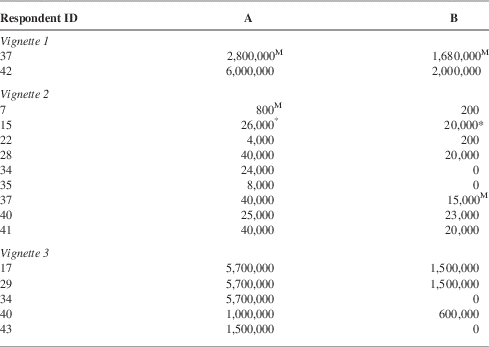
This tendency is also demonstrated by the specific amounts provided by some respondents to both Version A and Version B (Table 6). From this, it becomes evident that the amounts of damages provided are higher for every Version A respondent than for Version B respondents.
Amount of damages recommended by judges

notes:* The damages include amount of bank interests that are left out from the analysis. M The median number of the damages that are determined as a range.
The comparison of the reasons provided by the respondents who changed their decisions going from the first stage to the second stage helps to identify the factors that affected their decisions. Two patterns are found from the answers of the respondents. First, the respondents who first received Version A decreased the amount of damages or settled the cases by mediation when going from Version A (no cultural values) to Version B (cultural values). Cultural value factors are the only different reasons they mentioned between the two stages. Second, the respondents who received first Version B increased the amount of damages or changed their decision from mediation to judgment going from Version B (cultural values) to Version A (no cultural values). The respondents claimed that they changed their decisions because they did not have to take the cultural values factors into account under Version A.
5.2.1 Decreasing Damages
In all three vignettes, the respondents explained their decision to decrease the amount of damages based on the values of social orderliness, social egalitarianism, and self-cultivation. In Vignettes 1 and 2, the respondents’ decisions are also in line with the Zhong Yong principle.
5.2.2 Social Orderliness
In Vignette 1, first, some respondents paid attention to the special difficulty of the factory and massive layoff when making their decisions (Situational centred).Footnote 69 Second, one respondent mentioned the reputation of the factory in public (Public opinion).Footnote 70 Third, another one mentioned “emphasis of stability” by saying that:
Judgement should unify its social, legal and political effects. The livelihoods of employees and social stability should be considered and the social impact of mass layoffs. I cannot tolerate social unrest because of one judgment, cannot make a judgment that causes social unrest, [sets up] people against each other. I cannot sacrifice the interests of majority for the interest of one person. (Respondent 2)
Finally, one respondent mentioned the priority of society by saying that:
The existence of the factory is crucial to many people’s livelihood. It is a social problem…. The toy factory breached the contract, so it is liable to compensate Li Liang, but we can award the lowest damages to him within our discretion. (Respondent 31)
In Vignette 2, the respondents also considered the specific situations (mother’s illness) of the defendant. Three of them expressly said that comparing the property right and the right to live, the latter is more important (Situational centred).Footnote 71 In addition, they mentioned that the defendant’s behaviour was in accordance with what his social status required him to do. As a son, the breaching party’s breach was forgivable, because saving his mother was in line with the requirement under social morality (Different requirements for different social status).Footnote 72
In Vignette 3, the respondents considered the specific background (outbreak of infectious disease) when determining the damages (Situational centred).Footnote 73 Second, they mentioned the positive social effect of the breaching party’s behaviour. They believed that protecting the public interest should come first.Footnote 74 “Since there is a public health emergency, we have to balance the importance of financial interests of the pharmaceutical company and the public interest. …The protection of the public interest has priority. There is no doubt” (Respondent 15) (Accept the priority of society). Third, the respondents stated that the social identity of the pharmaceutical company required it to save others, but it did not do so (Different requirement for different social statuses).Footnote 75 Fourth, one respondent also reduced the damages because the public would feel the chemist was correct (Public opinion).Footnote 76
5.2.3 Social Egalitarianism
In Vignette 2, respondents viewed the unselfishness of the breaching seller as a condition to reduce damages. They indicated that the defendant did not breach for his own benefits, but to save his mother; thus he should not be an unscrupulous person (Selfish→punish; unselfish→reward).Footnote 77 One respondent specifically considered that the defendant more urgently needs money than did the plaintiff (Distribution in needs).Footnote 78
In Vignette 3, the respondents also viewed the unselfishness of the breaching chemist as an element to reduce damages, since he transferred the formula to the factory not for profits, but to save others (Selfish→punish; unselfish→reward).Footnote 79
5.2.4 Self-Cultivation
In Vignette 1, some respondents said that the willingness of the factory and Zhang Ming to take responsibility for the local society and to take care of its employees should be considered when determining damages (Recognize and obey the social liability).Footnote 80 Also, some respondents considered the risk of disloyalty of the injured buyer when deciding damagesFootnote 81:
There are some parties who have known that the other parties would not able to perform the contract but still sign the contract with them, in order to get profit from damages. (So, it is unfair to allow the breaching party to compensate all the loss of profits.) (Respondent 15)
In Vignette 2, the respondents noticed the breaching party’s confession and apology to the injured party (Loyalty).Footnote 82 One respondent also mentioned that the plaintiff had to sympathize with the defendant’s difficulty (Humane).Footnote 83
In Vignette 3, the respondents noticed that the chemist had contacted the company and exhausted his ways to resolve the problem (Loyalty).Footnote 84 Second, they believed the plaintiff violated the social morality by doing nothing to handle the diseases, so the company should not be given significant compensation (Humane).Footnote 85 Third, one respondent said that the plaintiff should recognize that it is the stability of society that ensures its opportunity to get business benefits. When the social stability was threatened by the disease, his profits had also been threatened:
The reasonableness of the plaintiff’s claim depends on the ordinary social order. If a local disease threatens the social order, the profit of the company will also be threatened. Special measures should be adopted to deal with special issues. (Respondent 15) (Combine the self-intention with the circumstances)
5.2.5 Zhong Yong
The Zhong Yong principle requires the judges to make a decision that is appropriate in a specific situation, and to balance the interests of all parties involved in the case. According to the law, the respondents thought that the breaching party should be liable for his breach. However, they would like to reduce the amount of damages using their discretion after considering specific situations and the potential result of the judgment. In Vignette 1, one respondent said:
The contract must be a kind of balance. With a 6.4 million Yuan contract price and more than 10 million Yuan in damages, the factory would close down. It is not the fundamental purpose of contract law to make a market player leave the market just because of one breach. (Respondent 15)
The results in Vignette 2 also showed that the respondents would like to reduce the damages in the second stage, but not completely exempt the breaching party from paying them.
5.2.6 Increasing Damages
In all three vignettes, the respondent increased the amount of damages they awarded in the second stage when the cultural value factors were removed. Since the respondents paid less attention to the specific cultural value factors, they intended to award more damages to the plaintiff.Footnote 86 They expressly said that they considered cultural value factors as a reason for them to provide a lower amount of damages. This is the reason why the amount of damages they provided increased when the cultural values factors were removed.Footnote 87 The specific reasons for the increase are as follows.
First, respondents paid less attention to the undesired social effect of their judgments after removing the cultural values factorsFootnote 88:
The social effect should be considered in every case, no matter whether you wrote this part or not. A normal factory, regardless of its size, would have some local impact. But the effect would not be considered as serious as with the following part. (Respondent 10)
Second, without the cultural value factors, the judges may not have been able to determine whether the motivation of the breach was immoral. After removing the cultural value factors, it is possible that the breaching party breached the contract in bad faith or intentionally.Footnote 89 In Vignette 3, one respondent specifically said that he increased the damages, since, without the cultural values information, the breaching party could be seen as breaching in bad faith.Footnote 90 In Vignette 2, some of them felt that, without the cultural value factors, the breaching party needed to be punished, since he breached the contract deliberately to earn more money.Footnote 91
5.2.7 Mediation
The fact that judges proposed mediation suggests that they not only wanted to compensate the plaintiff, but also wanted to protect the breaching party and society. Some judges wanted to encourage mediation after thinking about the undesirable results of the normal judgment, such as an unenforceable judgment or the harm of social interests. Therefore, mediation can be seen as in line with the requirements of the Zhong Yong principle. The respondents desired to mediate the cases when they took the cultural values factors into account. Generally, the Version A group judges provided a judgment in the first stage and then turned to mediation (or change the way of enforcement) in the second stage, while Version B group judges tended to mediate first (Stage 1), and then wanted to decide based on a judgment when the cultural values factors were removed (Stage 2). Both groups intended to recommend mediation after taking the values of social orderliness, social egalitarianism, and self-cultivation into account. The respondents also chose to apply mediation in different situations. Some respondents solved the case only by mediation, while others intended to first make a judgment by law and then do mediation when enforcing the judgment. The following section reports the respondents’ reasons for mediation on the basis of cultural values.
5.2.8 Social Orderliness
In Vignette 1, the respondents decided to recommend mediation when they started considering five themes of social orderliness. First, the respondents headlined the specific situations in the case, such as the layoffs of the breaching factory (Situational centred)Footnote 92:
If the judgment is against the toy factory, and requires it to pay a very high amount of damages, some employees of that factory will be laid off. … I would do mediation first. If it does not work, then I would consider making a judgment. A judgment that is made under the law would not lead the injured party to take risk of loss, because of the specific situation. (Respondent 38)
Second, some of them intimated that the layoff might lead to “instability” (Emphasis of social stability).Footnote 93 Third, two respondents considered the reputation of the defendant in “public opinion” (Public opinion).Footnote 94 Fourth, some others pointed out the effect of the decision on social economy if the factory would become bankrupt (Accept the priority of society).Footnote 95 In addition, one respondent mentioned that the choice of mediation was as a result of the interdependent relationship between the court and the injured buyer. He wanted to mediate since the plaintiff was a big commercial company, and it would consider its future contact with the court. “Normally, businessmen only require not to lose too much. They often contact with the court, so they will do the court a favour” (Respondent 5) (Interdependency).
In Vignette 2, the respondents in the Version A group considered the specific situations of the defendant, such as the illness of his mother, in the second stage (Situational centred).Footnote 96 Two respondents also thought that the public had no problem in accepting the result of mediation (Public opinion).Footnote 97 In addition, in Vignette 3, one respondents intended to use public opinion to persuade the plaintiff to mediate the case. He said that, if the plaintiff did not agree to mediate in any way, he would warn the plaintiff of disclosure of the case to the public and let public opinion criticize him.Footnote 98
5.2.9 Social Egalitarianism
In Vignette 1, the respondents viewed the different “needs” of the two parties as a condition for mediation. Since the defendant was weaker, judges intended to persuade the plaintiff to mediate. Moreover, because the profits from the contract were not very important to the plaintiff, judges said it was possible for them to mediate the case (Distribution in needs).Footnote 99 Another respondent said that the result of mediation should be in favour of the defendant, since the defendant did not get profits from the breach (Unselfish→award; selfish→punishment).Footnote 100
In Vignette 2, four respondents took the unselfishness of the defendant into account when they decided to mediate the case (Selfish→punish; unselfish→reward).Footnote 101 In Vignette 3, one respondent thought the defendant’s motivation was not for his own benefit (Selfish→punish; unselfish→reward).Footnote 102
5.2.10 Self-Cultivation
In Vignette 1, some respondents considered the intention of the factory owner to take the factory’s responsibility as his own, which made him unlikely to look like a bad person (Development the scope of self-responsibility).Footnote 103 Second, some of them also mentioned that the willingness of the factory and its owner to take their “social responsibility” indicated that the factory owner has a high moral level (Recognize and obey the social liability).Footnote 104 Third, one respondent headlined that the defendant did not breach in bad faith, since he has tried his best to perform but could not fulfil it. Thus, he was not a mercenary and should not be blamed too much (Loyalty).Footnote 105 Fourth, some respondents mentioned that the plaintiff should understand how to balance his own claim on the grounds of the specific circumstances of the case (the difficulty of the defendant). They said that a judge should let the plaintiff know that, if the judgment would result in the factory going bankrupt, enforcement of the judgment would not be possible. Therefore, if the plaintiff insisted on his claim without compromise, he would ruin the defendant factory and get an unenforceable judgment as a piece of paper (Combine the self-intention with the circumstances).Footnote 106
In Vignette 2, one respondent wanted to persuade the plaintiff to lower his claim during mediation, because the defendant was not able to pay a lot of damages (Combine the self-intention with the circumstances).Footnote 107 Another respondent thought that the attitude for the defendant to compensate the injured party should be taken into account (Loyalty).Footnote 108
In Vignette 3, one respondent chose mediation, since the price offered by the pharmaceutical company to transfer the formula was too high (Humane).Footnote 109 Also, another respondent considered that the breaching party had exhausted his means to solve the problem (Loyalty).Footnote 110 In conclusion, the comparison of the respondents’ decisions between Stage 1 and Stage 2 shows that the respondents had a tendency to decrease the amount of damages after the cultural values factors were introduced, and they desired to increase the amount of damages if this information was removed from the case. Also, with cultural values factors, some respondents intended to mediate the cases, while, without these factors, they would like to make “normal” judgments. The results demonstrate that cultural values can be seen as a reason for their decisions (e.g. awarding damages) and for choosing mediation as a procedural mechanism to obtain an outcome.
5.3 Cultural Values and Political Propaganda
The government of Mainland China uses “social harmony” and “social stability” as political slogans. The two terms frequently appear in political propaganda. Therefore, some of the respondents’ decisions seems not only in line with the cultural values, but also consistent with the political requirement of “keeping social stability,” such as in Vignette 1, where the respondents decided to prevent the people from losing jobs. Or, put differently, it may be that differences between the groups of respondents are the result of political propaganda, not of cultural values.
To identify whether the respondents’ decision-making related to their considerations of cultural values, or was merely a politically desirable answer, each respondent was asked the question “Do you believe harmony and stability are desirable values for society?” at the end of the interview. The results show that the majority of the respondents (39 out of 43, around 91% of the total respondents) believed social harmony and stability are desirable for them as a person. It was stated that social stability and harmony is a basic value of social development and personal happiness, as illustrated by the following interviewee:
Social stability is the basis of a happy live. We see more collisions in the unstable times, without organization and government. It is bad for normal people. I think society needs powerful social order. Of course, the social order should be good. And then, keep the social orders effective in the society. I think this kind of society is ideal, and people can live a happy live. (Respondent 11)
Some respondents even explicitly pointed to the difference between stability as a desirable social value and as political propaganda. The respondents believed that an ordered and stable society is desirable, but they did not agree with the way politicians applied the concept to “maintain social stability and harmony”:
I think these (social harmony and social stability) are desirable. … Social stability is a precondition of social development …. Social stability is a kind of social order. It represents a peaceful status of society and nature. Without this order, both the relationship between each other and the development of the nation would be lost in a disorderly situation. However, in these years, stability nearly becomes the only aim of our country. This is not good. Emphasis on social stability is not wrong. But, sacrificing a part of people’s benefits in order to maintain stability is wrong. This actually may lead to the most unstable situation in society. (Respondent 15)
These findings suggest that the respondents intrinsically valued cultural values, and that these values sometimes overlap with what politicians preach.
6. DISCUSSION
6.1 Whether Cultural Values Matter?
The results provide insight into how Chinese judges decide with or without cultural values. First, the vignette study reveals that the consideration of cultural values results in respondents providing lower amounts of damages. Second, they preferred to follow Chinese cultural values over a “pure legal decision,” even though they understood that those considerations may not be legal. The respondents modified their decisions if the judgments otherwise would have led to undesirable results from the perspective of cultural values, such as a disturbance of the social order or social commotion, even though the undesirable results would be legally acceptable. Third, cultural values did not influence the respondents’ understanding of legal rules. The judges understood the legal terms in the vignettes in accordance with statutory law as well as with general legal theories. Additionally, they were able to distinguish between cultural values and the law.
Fourth, the judges intended to make a judicial decision that was both legal and desirable based on cultural values. The interview data reveal that, in a formal procedure (i.e. one that results in a court decision), judges made their decisions based on cultural values when they had discretion to do so. The respondents preferred to not directly violate statutory law by merely judging based on cultural values in their role as judicial adjudicators. Instead, they claimed to use their discretion to consider cultural values when applying the legal rules, but avoided any non-legal (e.g. cultural) considerations appearing in their official judgments. As one respondent (No. 2) noted, she would consider the cultural values when determining the amount of damages, but she would not include the consideration of the cultural value factors in her judgment. Also, another respondent (No. 8) specifically reported that his consideration of cultural values would not be visible in his judgment, since he factored the cultural values in determining the amount of damages. This way, Chinese judges seem to ensure that their judgments are in accordance with the law and, at the same time, aim to avoid possibly undesirable consequences of the judgments that could cause the litigators and society to not accept their decision.
Stern uses the term “rough justice” to describe the judges’ pragmatic decision, which aims to balance interests and keep both sides happy. She argues that judges intend to split damages in order to achieve a compromise acceptable to both parties.Footnote 111 The cultural values provide a clue to understand in which situation the judges are willing to seek a “rough justice” decision but not a “legal” decision. When a legally just decision violated cultural values resulting in, for instance, a serious social conflict, a petition, or an unenforceable judgment, an outcome of the application of the legal rules was considered undesirable. In this case, judges would feel the need to achieve a “rough justice” solution.
Moreover, our data show that the consideration of cultural values may not always lead to the happiness of both parties. The cultural values require judges to consider not only the view of litigators, but also the opinion of overall society. Thus, when the judge believes the breaching party’s behaviour was acceptable according to cultural values while the plaintiff’s was not, they might decide to reduce the damages, as such a decision would be socially approved. As one respondent said, since the breaching party did not breach the contract for his own interest, he (i.e. the judge) could lower the amount of damages, as he believed society would not oppose his decision (No. 7).
Mediation is another way for Chinese judges to avoid “illegal” judgment when they thought the cultural values should be taken into account. Previous research has argued that Chinese judges apply mediation since it is a pragmatic method that can quickly solve the case.Footnote 112 However, our data show that judges recommend mediation not only because they took it as a handy way to solve the case, but also since they took it as an appropriate way to achieve a socially desirable solution. The respondents explained that some of the specific problems in the vignettes could not be resolved by using formalized procedures to adjudicate. Consequently, they tended to avoid resolving the case by means of a legal decision. Instead, they shifted to mediation in instances where the respondents considered that a “legal” decision derived from a formal procedure would lead to undesirable (“extreme”) results. In mediation, judges supervise or persuade the parties involved in the litigation in order to stimulate them to negotiate with each other and to voluntarily come to an agreement. The role of the judge in such instances transitions from an adjudicator to a “social manager.” In mediation, judges are no longer liable to play a neutral role and make their own decision. Instead, they encourage the litigators to agree on a settlement that, in their mind, best balances the interests of the litigants. This way, the judges can hide their own opinion, which may be desirable from the perspective of cultural values but not from a legal perspective.
Cultural values also provide justification for the judges to persuade litigators during mediation. The mediator role allows the judge to move away from legal rules and to explore different avenues to persuade litigators to settle in a different way than the application of the legal rules would result in. Our data show that the cultural values, such as distribution by needs, awarding the altruistic, the requirement of social stability and social priority, were frequently used as resources in mediation to resolve the conflict. Through mediation, the judges in our study were able to help the breaching party to negotiate with the injured party in order to achieve a “fair” solution that could be accepted by the litigants and that could balance the interests of other stakeholders in the case. Here, the cultural values provided guidance as to how to move the parties to an agreement.
6.2 Why Cultural Values Matter?
One explanation of why Chinese judges consider cultural values is that judges apply internalized values. Alternatively, or additionally, judges face external pressure from bureaucratic management to gain social approval, which requires judges to be accountable to not only the law, but also society. Seeking social approval may lead judges to make decisions as much as possible in accordance with the behavioural standards that are widely accepted by society, namely culture values, but not with the legal norms, as this may cause tension with the desirable values of the public.
In China, litigants and society will by no means surely socially approve a purely legal decision. Although Chinese citizens increasingly intend to frame their grievances in terms of legal rights and to protect these rights through legal modes,Footnote 113 many litigants, especially individuals, bring their claim to court without hiring lawyers or consulting someone who has sufficient legal knowledge.Footnote 114 Moreover, culture still plays a role in shaping the legal perception of ordinary Chinese people.Footnote 115 This makes it difficult for the litigators to predict the legal outcome of their claim. Litigants may perceive the court as biased, which can cause protests and hurt the “harmonious society.” As a result, the judges may experience difficulties in making decisions insulated from social influences, even though the decisions are legally correct. Conforming to cultural values that are understandable and acceptable for the majority of the members of society may offer them more opportunity to gain social approval,Footnote 116 especially when the statuary law does not provide a certain response to those social situations. Our data support this explanation, as several respondents mentioned the acceptance of the decision by ordinary people in the society when determining damages, or referred to it, such as “Normal people have no problem to accept these reasons for reducing damages” (Respondent 14) and “I can make the damages as low as possible. The society would not have different opinions with it” (Respondent 7).
The motivation of Chinese judges to obtain social approval may be enhanced by the bureaucratic management of Chinese courts, specifically the assessment criteria and the institutional constraints of Chinese courts. In Mainland China, a judge has to have his decision approved by the litigators, the court leadership, the higher court,Footnote 117 and the public (sometimes the government and the party). Our data suggest that both the authorities’ opinions and the evaluation of the work quality of a judge play a crucial role in the decision-making of Chinese judges. First, two respondents mentioned that their decision would be influenced by the leadership of the court and the higher court. The authorities can influence the decision of an individual judge in a direct or indirect way. According to the respondents, authorities care more about the social effect of a judgment than about achieving the legally correct outcome.Footnote 118 The emphasis on the social impact of a decision could lead the individual judge to not only decide based on a legal approval perspective, but also consider a social approval perspective.
Second, from the 1990s, China established a wrongful case responsibility system. The wrongful case responsibility means that judges, courts, and other related parties are liable for both the procedural and substantive mistakes appearing during the trial and enforcement. The rule of procedure in the wrongful case responsibility system has aggravated the dependence of lower-level courts on higher-level courts.Footnote 119 For example, the Guidance on Quality Assessment of Judicial Decisions (Trial) (2008) provides a relationship between the quality of a judge’s work and the likelihood of his judgment being changed by the appeal court. The higher the likelihood, the lower his work quality will be evaluated.Footnote 120 It is argued that the wrongful case responsibility improved the procedural consciousness of judges.Footnote 121 However, the interview results from this study show that the judges are willing to use discretion and mediation in order to avoid the potential “wrongful case” that may be changed by higher-level courts. In the interviews, two respondents explicitly mentioned that they would try not to make a decision that would lead litigators to complain and appeal against them, since it would bring negative effects to their career. “If my judgment is reversed by the higher court, it will influence my evaluation. It is not possible for me to ignore my personal annual evaluation” (Respondent 21).
Since the rate of lawyer agency is relatively low, the judges may have to consider not only whether the law professional believes their decisions are correct, but also whether the members of society involved (litigants and the other parties of interests of the case) believe the decision is acceptable in order to avoid the appeal or other undesirable results of their decision, such as protest. Applying cultural values that represent the widely accepted standards used to evaluate “what is valuable to do” in society may be preferred to the application of legal norms by judges who aim to have their decisions accepted by layman litigators.
The results contribute to the literature on the relationship between the application of law and national culture. The findings suggest that cultural values are specifically taken into consideration by the Chinese judges when determining contractual damages. Our data suggest that the Chinese cultural values to some extent undermine the effective enforcement of the damages rules in court, when the cultural values demonstrate a tension with the law.
Our findings also contribute to the legal transplant debate. Since cultural values would influence the judge’s decision-making, it may be reasonable to assume that the neglect of cultural values’ influence of legal application may lead the legislative purpose of legal transplants not to be achieved. Although the cultural influence has been denied by some authors,Footnote 122 the data suggest that paying attention to the regulation of conduct derived from traditional culture during legislation might increase the effectiveness of the law.
In addition, the pressure of gaining social approval of Chinese judges may lead to other assumptions. First, since the administrative working evaluation pressure can be seen as a reason that makes the judges to not only consider the law, but also cultural values, it may be possible to assume that, if the evaluation pressure is extenuated, the judges would be less likely to consider cultural values when making decisions. Moreover, encouraging lawyer agency may reduce the number of “protests on the street” and the effect it has on the outcome of legal cases. This assumption is contrary to the recent actions taken by the Chinese government.Footnote 123 Lawyers are likely to be considered by the government as a community that causes trouble and disturbs social order. However, on the basis of our research, it may be reasonable to assume that the development of lawyer agency may reduce the individual litigator’s attention to protest. Judges are more willing to work with lawyers other than individual litigators, since they share common knowledge, which may allow them to easily communicate and reach a consensus. A lawyer can also play a role in explaining to his/her client why the everyday reason they believe may not be relevant to the legal discussion.Footnote 124 These interpretations and assumptions, however, require additional research.
6.3 Limitations
This work has limitations. First, some cultural values, such as social harmony and social stability, overlap with what politicians preach in Mainland China. Consequently, the cultural values that were tested may also have captured political beliefs or propaganda. Although there are reasons to believe that the respondents saw harmony as an intrinsic value and not solely as a political requirement, it is difficult to disentangle whether the respondents’ decision is mainly as a result of their consideration of cultural values or the political requirement. Second, as the paper only covers the influence of Chinese cultural values on the award of damages by Chinese judges, it cannot provide by itself any evidence as to whether this cultural influence is different from other jurisdictions. Similar differences or behaviour may be observed in countries other than China. Third, considering the qualitative nature of this paper, the results pose generalization issues. Given the heterogeneous sample and given the impression that the last interviews did not produce additional insights, it cannot be ruled out that different or additional results would be obtained in a larger sample.
7. CONCLUSION
This article seeks to answer a basic question in social-legal research: whether and how a national culture influences the application of law. By closely observing the decision-making and reasoning of Chinese judges when determining contractual damages, our results reveal two behavioural patterns of Chinese judges toward Chinese cultural values. First, judges take cultural values into account when determining the amount of damages. Second, the consideration of cultural value factors reduces the effect of legal rules or even overrides legal rules, although it does not change the meaning of the rules in the judge’s mind. In sum, the tension between law and cultural values urges judges to merge the legal requirements and cultural requirements from society, which inevitably affects the application of the law. Additionally, the interview results demonstrate that judges use Chinese cultural values as guidance when using discretion offered by the law. Also, they move closer to cultural values and further away from statutory law during mediation.
In terms of the potential reasons of culture influence, our data indicate that the consideration of cultural value factors may be the result of the personal preference of a judge and the requirement of him/her to obtain social approval when deciding a case. The demand of social approval may be emphasized by the administrative pressure that comes from the leadership of the court and higher courts as well as from the evaluation pressure from the working quality assessment guideline of the Supreme Court. These potential explanations require additional research with regard to the decision-making of judges.
APPENDIX
Vignette 1
Version A: A small toy factory owner, Zhang Ming, representing his factory, signed a sales contract with a toy dealer, Li Liang, in June 2011. The contract stipulated that Li Liang would like to buy 1 million Christmas decorations for the price of RMB 64 million ex-factory. The contract mentioned that these Christmas decorations were very special and they needed to be delivered no later than 1 October 2011, otherwise Zhang Ming’s factory had to compensate the loss of Li Liang as a result of the breach. However, he did not specifically mention that he was planning to resell those goods for a wholesale price of RMB 18.4 million. Normally, the wholesale price of a similar kind of decoration was around RMB 17.6 million in the EU Christmas market.
On 26 September 2011, Zhang Ming’s factory notified Li Liang that it might not be able to deliver the goods on time, but it would try to perform the contract. After receiving the notice, Li Liang emphasized again that, if the factory could not perform the contract at the performance date, he would claim damages in court. Zhang Ming’s factory failed to deliver at 1 October 2011. Because of the non-delivery, Li Liang lost the opportunity to sign his resale contract. Li Liang sued Zhang Ming’s factory for breach of contract because of the non-delivery and claimed for loss of profits of RMB 12 million (the resale price of RMB 18.4 million—the contract price of RMB 64 million).
The evidence shows that, on 1 October 2011, there was a market for such decorations in Brazil with an ex-factory price of RMB 12 million. The shipping freight from Brazil to the EU was RMB 160,000. Li Liang argued that it is unreasonable for him to be bound to go hunting the globe to find out where he can get the decorations. The evidence shows that he had 50% opportunity to catch his resale contract, if he provided an offer to the Brazil market before 1 October 2011.
Cultural values: Zhang Ming’s toy factory is the only industry in that small town. More than half of the adults in that town work in Zhang Ming’s factory. Because of the financial crisis from 2010, the factory could not get orders and was faced with the possibility to have to stop production. To protect his employees’ jobs, Zhang Ming went to search for new orders, and then met Li Liang.
After the non-delivery, Zhang Ming pleaded with Li Liang not to sue the factory, because many people’s jobs depended on it. He would like to use his personal property to compensate Li Liang. Li Liang said that protecting the employees’ jobs is not his business. He was only concerned about money. Li Liang chose to sue the factory, because he knew that the value of Zhang Ming’s personal properties was only around RMB 4 million.
Zhang Ming and his factory have a good reputation in the town. When the factory was profitable before 2010, it donated two libraries to the elementary school in the town. Zhang Ming is also very concerned about his employees. Although some of the employees are getting old and less productive, Zhang Ming had tried his best to protect every employee and tried not to cut down. However, if the factory pays more than RMB 8 million, it has no choice but to dismiss more than half of its employees. Plenty of people in that town would lose their job, and some of them would have a hard time finding another job. On the contrary, Li Liang is a very big toy dealer. The Christmas decoration is only a small part of his business.
If you are the judge of this case, how do you determine the amount of damages? Why?
Vignette 2
Version A: Wang Dong sells his family heirloom—an antique picture—to an art collector, Liu Xi, for the price of RMB 20,000. Liu Xi wants this picture because he likes the artist of that picture very much, and he has collected all his works except the one from Wang Dong. However, before delivering the picture to Liu Xi, an art dealer, Guo Bei, finds Wang Doing. He says that he likes the picture and offers to pay RMB 40,000 for it. Wang Dong delivers the picture to Guo Bei for RMB 40,000. Liu Xi sues Wang Dong in court for breach of contract, and claims for damages of RMB 40,000, which is the benefit Wang Dong obtained from Guo Bei. He claims that Wang Dong promised to sell the picture to him, which means he also promised not to sell it to others. Thus, Wang Dong profits from doing the very thing that he has promised not to do and Liu Xi has a legitimate interest in the prevention of that activity. As a result, Liu Xi says that he is entitled to the benefits Wang Dong gets from breach of his promise. In addition, Liu Xi also claims the loss of enjoyment for RMB 4,000. Liu Xi says that he wanted to buy this picture for the enjoyment of having the whole collection of his favourite artist, but Wang Dong’s breach of contract leads him to lose this enjoyment.
Cultural values: Wang Dong is a farmer living in a village with his mother. He sold the picture because his mother suffers from a serious acute disease. If she cannot be sent to the hospital immediately, her life will be in danger. Thus, Wang Dong urgently needs to obtain RMB 20,000 for the hospital deposit.
Wang Dong promises to deliver the picture to Liu Xi as soon as he settles down his mother in hospital. In the hospital, Wang Dong hears from the doctor that his mother urgently needs a surgical treatment, and the costs of the follow-up treatment is more than RMB 10,000.
After receiving the new offer from Guo Bei, the art dealer, Wang Dong struggles mentally for a long time. In order to urgently save his mother, Wang Dong delivers the picture to Guo Bei for RMB 40,000 and spends all the money on his mother’s treatment. He finds Liu Xi in order to say sorry, and indicates that he will compensate Liu Xi after his mother’s recovery. But Liu Xi only cares about the picture.
During the hearing, Wang Dong still continuously tries his best to collect money for his mother’s treatment. He says he has to save his mother, because his mother raised him alone and suffered hardship when he was a child. Most of people in that village think that the mother’s life is the most important for a person, so Wong Dong is not wrong.
If you are the judge of this case, how do you determine the amount of damages? Why?
Vignette 3
Version A: Zhao Jun is a chemist who invents a new medicine to treat a special kind of epidemic disease. Zhao Jun sold the formula of the medicine as a technological secret to a large pharmaceutical company (Company A) for RMB 15 million. In the contract, one term provided that Zhao Jun should not provide unauthorized licence to any third party to use this formula after the contract is concluded. Company A was charging RMB 2,000 for a dose of the medicine, while the production cost of a dose of the medicine is RMB 100. After the contract was concluded, without the permission from the company, Zhao Jun licensed another pharmaceutical factory (Factory B) to use his formula. Factory B started to produce the medicine and sold it at a lower price.
At the same time, the epidemic disease broke out in a small town. The residents of that town chose to buy the medicine produced by Factory B. Company A sued Zhao Jun for breach of contract. It claims that, if Zhao Jun had fulfilled his obligation by not giving the formula to Factory B, Company A might have earned RMB 5.7 million. The quantification is: the whole population of the town × the population rate who can afford the medicine × (the price of the medicine – cost of production) (30,000 × 10% × (2,000 – 100)). The damages might be higher because the other 90% people in that town might also try to buy the medicine. Thus, Company A claimed that the breach of contract made it lose the chance to earn at least RMB 2.3 million in profit by selling the medicine.
Cultural values: Zhao Jun licensed Factory B to use the formula because Factory B is a local pharmaceutical factory in the town where the epidemic disease broke out, and its manager told Zhao Jun that most of the residents in the town cannot afford the price of the medicine. Factory B wanted to buy a licence from Company A, but Company A charged RMB 8 million for the licence that cannot be afforded by Factory B as well. To save lives in that town, Factory B needed to get the formula from Zhao Jun. Zhao Jun begged Company A to reduce the price to save the people in that town. But Company A indicated that it bought the formula and it was going to make money from it. Company A warned Zhao Jun that, if he disclosed the formula to others, it would sue him for breach of contract. Zhao Jun permitted Factory B to use the medicine formula without any charge.
The people in that town praised Zhao Jun for his decision. They thought that it is Company A, and not Zhao Jun, that committed a wrong, because the company preferred money over life. Company A held more than 100 exclusive production licences of medicines, and its sales profits per year are RMB 50 million.
If you are the judge of this case, how do you determine the amount of damages? Why?