Cardiac catheterisation in patients with congenital cardiac disease includes both diagnostic studies and interventional treatment. Diagnoses include a wide range of congenital and acquired cardiac lesions. The patients range from neonates to adulthood. With the introduction of non-invasive diagnostic techniques such as echocardiography, computed tomography, and magnetic resonance imaging, the need for invasive diagnostic studies has decreased. At the same time, treatment by catheter intervention techniques has steadily increased. At present, diagnostic invasive studies are mostly limited to more complex cases. As opposed to echocardiography and MRI, cardiac catheterisation and catheter intervention are unique for their invasive nature and the fact that in many cases, treatment is part of the procedure.Reference Mertens, Helbing and Sieverding1, Reference Helbing, Mertens and Sieverding2 These trends have implications for doctors in training for cardiac catheterisation and catheter intervention.
This document summarises the requirements for training in diagnostic and interventional cardiac catheterisation, which should be provided at three levels, basic, intermediate, and advanced and should include both knowledge and skills.Reference Duke and Qureshi3–Reference Benson, Coe, Houde and Human5 It does not include recommendations for invasive electrophysiology.
Delivery of training
Training should not be undertaken in a random fashion, but should be focused according to the level of training to be achieved. Trainees should only be involved in procedures appropriate for their level of experience and training. In regular appraisal meetings, the trainee and the trainer should set goals, and evaluate whether these goals are being met within a realistic time frame.
Levels of training
Basic level
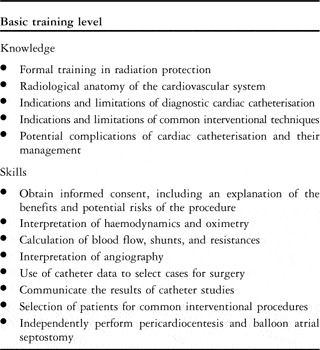
The basic level is required of all trainees to perform as a competent paediatric cardiologist. This training includes an understanding of the indications, complications, and limitations of diagnostic cardiac catheterisation and common catheter interventions (Table 1).
Basic training level

In addition to the knowledge and skills set out in Table 1, the trainee should perform at least 10 balloon atrial septostomies and five pericardiocentesis procedures.
Intermediate level
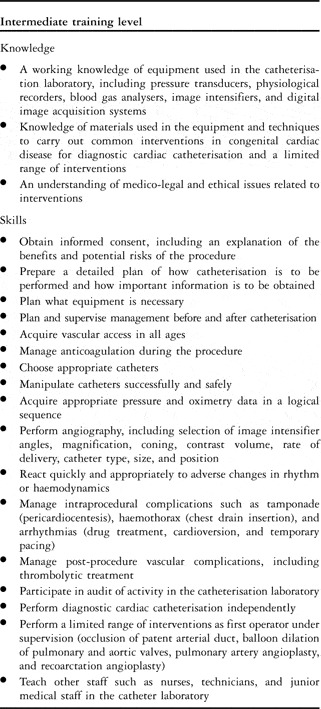
Training to an intermediate level will enable a paediatric cardiologist to perform diagnostic cardiac catheterisation independently and a limited range of simpler interventional procedures such as balloon pulmonary and aortic valvoplasty, occlusion of patent arterial ducts, pulmonary artery, and coarctation/recoarctation angioplasty (Table 2). Many interventional procedures have a diagnostic component as well, and the trainees should obtain competence in using the diagnostic component of these procedures.
Intermediate training level

The trainee should perform 100 diagnostic cardiac catheterisation procedures of which 75 should be as a first operator. The trainee should also perform 100 interventional procedures of which 50 should be as a first operator, under supervision. These interventional procedures should include a variety of techniques such as occlusion of patent arterial duct, balloon dilation of pulmonary and aortic valve, pulmonary artery angioplasty, and coarctation/recoarctation angioplasty.
Advanced level
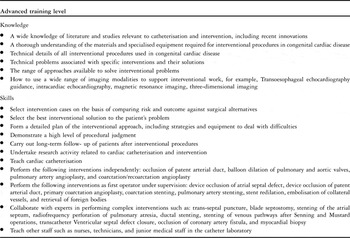
Training at the advanced level will enable a paediatric cardiologist to perform the majority of interventional procedures, including those that require a high level of skill. This level can only be obtained after completion of the normal paediatric cardiology training and basic and intermediate-level competencies should have been achieved. To achieve this, it is anticipated that continuous and intense exposure to a wide variety of interventions will be needed for several years (Table 3). The trainee should be able to perform independently procedures listed in Table 3, such as occlusion of the arterial duct, coarctation/recoarctation angioplasty, stenting of aortic coarctation and pulmonary arteries, a variety of embolisation procedures, and retrieval of devices or foreign bodies. More complex procedures listed in Table 3 will need to be performed in collaboration with an expert.
Advanced training level

No specific numbers are required, but trainees need to be certified as competent by their trainers on the basis of ongoing performance of complex procedures.
Assessment of training
A logbook should be maintained by the trainee to document all diagnostic and interventional procedures undertaken by the trainee. In addition, attendance at catheter conferences and teaching sessions should be documented. The trainer(s) should perform regular standardised direct observation of procedural skills during a procedure and evaluate and provide feedback to the trainee.
It should be understood that merely achieving the minimum numbers of procedures is not adequate. This should be combined with assessments by the trainer, who should certify the trainee as being competent for the appropriate level of training.
Institutional requirements for diagnostic and interventional cardiac catheterisation
The training institute should be equipped with an up-to-date cardiac catheterisation laboratory for infants and children.6–Reference Brzezinska-Rajszys, Carminati and Qureshi7