Introduction
Historically, apathy is reported to have undergone a transformation in its definition. Originally, rooted in apatheia, meaning without (a-) passion (-pathos), it was regarded as a virtue in Greek stoic philosophy, allowing individuals to be more objective. However, the modern meaning of apathy has come to be regarded as undesirable and, as a part of the psychiatric field, can be a syndrome or symptom relating to disease. Clinically, as a behavior, apathy is most often characterized as a deficit in motivation, which is displayed through reduced interest, emotions and goal directed behaviors (Marin, Reference Marin1996). Apathy has been found to have a variable relationship with various symptoms and experiences, such as depression and boredom. As a symptom, apathy has a variable association with depression dependent on the neurodegenerative disease (Levy et al., Reference Levy1998). However, depression is expressed as negative and, in the case of bipolar depression, extremely positive affect (Levy et al., Reference Levy1998), whereas, apathy is observed as emotional neutrality, where neither positive nor negative emotions are observed. Boredom, on the other hand, is a widespread human experience that is linked, through motivational elements, to apathy. However, research has shown them to be statistically distinct when measured by scales (Goldberg et al., Reference Goldberg, Eastwood, LaGuardia and Danckert2011). This is due to apathy scales being designed to measure apathy as a symptom rather than a domain of normal motivational behavior.
Apathy has been frequently observed as a symptom of neurodegenerative diseases (for review see van Reekum et al., Reference van Reekum, Stuss and Ostrander2005; Chase, Reference Chase2011) and is assessed by a variety of methods. Both clinically and in research, these methods often range from administration of measurement scales to observational ratings of behaviors by an experienced or trained individual. While specific methods of assessing apathy have guidelines to ensure that it is administered in a standardized fashion, the problem is that there are many different methods to measure apathy. This creates uncertainty of which method would be most appropriate to measure apathy in a given pathological population. The utility of these methods are often based on previous studies, which have validated the measure in a specific pathological population. However, these methods and the studies validating them are seldom compared within literature.
Since, apathy is a common symptom in neurodegenerative disease, this is an important area in which to produce a comprehensive review of how apathy is measured both generally and for specific neurodegenerative diseases. It would also be beneficial to compare the validity and reliability of assessment methods, so that the highest quality, well-validated and reliable method can be chosen for a specific patient group.
Apathy in neurodegenerative disease
Apathy is common in all types of dementia (Clarke et al., Reference Clarke2008) and most prominent in both Alzheimer's disease (AD) and vascular dementia (VaD; Jonsson et al., Reference Jonsson2010). In both small and large vessel VaD, apathy is a consistent symptom with negative prognostic and treatment implications (Staekenborg et al., Reference Staekenborg2010). In AD, apathy was found to occur in 61%–92% of patients (e.g. Landes et al., Reference Landes, Sperry and Strauss2005) with an almost equally high prevalence in frontotemporal dementia (FTD; e.g. Mendez et al., Reference Mendez, Lauterbach and Sampson2008). However, recent research has found differing apathy profiles which can distinguish between AD and FTD (Quaranta et al., Reference Quaranta, Marra, Rossi, Gainotti and Masullo2012). This distinction between AD and FTD was also observed in functional impairments of activities of daily living, which could be associated with apathy level (Mioshi et al., Reference Mioshi, Kipps and Hodges2009).
Apathy is also a prominent symptom in amyotrophic lateral sclerosis (ALS; Grossman et al., Reference Grossman, WoolleyLevine, Bradley and Miller2007; Girardi et al., Reference Girardi, MacPherson and Abrahams2011), the most common form of motor neurone disease (Goldstein and Abrahams, Reference Goldstein and Abrahams2013). A large cohort study found that apathy was the most common behavioral symptom in ALS, occurring in 31% of patients (Witgert et al., Reference Witgert2010). Recent neuroimaging research in ALS has shown evidence of neuroanatomical correlates relating to apathy of abnormalities in the anterior cingulate cortex (Woolley et al., Reference Woolley, Zhang, Schuff, Weiner and Katz2011). In a recent review of social cognition in ALS, apathy was observed as the most prevalent, overlapping behavioral change in both ALS and FTD (Abrahams, Reference Abrahams2011).
In other motor disorders such as Parkinson's disease (PD), over a third of patients have been found to exhibit apathy (Pedersen et al., Reference Pedersen, Larsen, Alves and Aarsland2009). Apathy may be predictive of cognitive decline and even dementia in PD (Dujardin et al., Reference Dujardin, Sockeel, Delliaux, Destée and Defebvre2009) but may also have marked variability in its relation to the clinical presentation of PD (Dujardin et al., Reference Dujardin2007).
Apathy is also a persistent and progressive symptom across all stages of Huntington's disease (HD; Thompson et al., Reference Thompson2012) with a variable prevalence reported between 34% and 76% associated with stage of disease (van Duijn et al., Reference van Duijn, Kingma and van der Mast2007). A study comparing HD gene mutation carriers versus non-carriers found that the latter had 0% prevalence compared to carriers who had 32% prevalence (van Duijn et al., Reference van Duijn, Reedeker, Giltay, Roos and van der Mast2010). Functional decline was also found to be greater in HD patients with apathy, independent of motor or cognitive symptoms (Hamilton et al., Reference Hamilton2003). Due to this variable prevalence of apathy in these neurodegenerative diseases, this review focuses on apathy as a symptom of these diseases.
Emerging concepts
Apathy is conceptualized by the measurement scales associated with it. It is originally defined by a substructure of cognition, behavior and emotion (Marin et al., Reference Marin, Biedrzycki and Firinciogullari1991) but is measured as singular concept, with specified clinical cut-offs dependent on the scale.
A previous review by Clarke et al. (Reference Clarke2011) looked at all the different measurement methods to assess apathy in research and clinical practice and found that most used rating scales or scale-based interviews. These scales were self-assessments, informant-based or clinical semi-structured interviews for patients or informants. The studies reviewed included a range of pathological populations with variable aetiologies (Clarke et al., Reference Clarke2011). However, Clarke et al's review did not directly examine apathy as a symptom of specific neurodegenerative diseases and was not a systematic review of literature. The present review follows the preferred reporting items for systematic reviews and meta-analyses (PRISMA; Moher et al., Reference Moher, Liberati, Tetzlaff and Altman2009) criteria to methodologically identify the quality of existent apathy scales and define which scales have been validated in neurodegenerative diseases. As apathy occurs as a symptom in a majority of neurodegenerative diseases (for review see van Reekum et al., Reference van Reekum, Stuss and Ostrander2005; Chase, Reference Chase2011) it is important to examine methods of apathy assessment that can identify apathy as a symptom in any neurodegenerative disease. Furthermore, as previously mentioned, patients with specific neurodegenerative diseases, such as HD and AD, exhibit apathy in variable prevalence. So it is important to classify scales that were specifically designed, and therefore only validated, in specific neurodegenerative disease so that they may be used as such in the future. This will allow for identification of apathy scales that are neurodegenerative disease generic and specific. This will result in recommendations for suitable apathy scale choices to be made in future research and clinical practice in a disease group where apathy is a prevalent symptom.
Quality, validity and reliability
The methodology and the measures used within a research study are important determinants of article quality. Individual articles employ different patient groups, inclusion and exclusion criteria, index tests and reference or gold standards of diagnosis, all of which are described with different levels of detail. Due to this variation, we considered it important to use a standardized tool for quality assessment of each study.
In addition, we considered the psychometric properties reported by each study of the specific apathy instrument, which are commonly presented in terms of validity and reliability. Validity is best described as accuracy of an instrument, and can be defined through content, concurrent, convergent, congruent and discriminant or divergent. Content validity relates to the design of a measure and whether the instrument is measuring what it is aiming to measure. Concurrent, convergent or congruent validity are often grouped together as measuring construct validity and measure whether the instrument correlates with other well-validated methods of detection. This method of detection is known as a gold or reference standard. In terms of apathy, a gold standard would be the diagnosis of apathy by one or two trained psychiatrists via observation, a structured or semi structured clinical interview or another apathy instrument. Discriminant or divergent validity is also an important psychometric property and is where two components, or constructs, that are theoretically unrelated are actually shown to dissociate. With symptomatic apathy, this behavioral component is often depression (Levy et al., Reference Levy1998), which is due to the emotional nature of patients with depression and, conversely, the emotionally neutral nature of apathetic patients. This apathetic component also differentiates it from exhilarating happiness observed in elation, the uncomfortable uneasiness of anxiety and excessive agitation associated with irritability. These behavioral components can also be used to determine discriminant validity.
Reliability is best defined as the consistency of the measure. This relates to the replicability of findings independent of how accurate they are. This can be determined through between-item correlations of the specific measure, which is known as internal consistency reliability and usually measured by Cronbach's α (Cronbach, Reference Cronbach1951). Test-retest reliability is another form where the relationship between responses to the measure over several different time periods is recorded and correlated. Another form of reliability is inter-rater based, which examines whether two or more informants or interviewers responses or scores agree.
Both validity and reliability are important determinants of an assessment scale's utility and a good apathy measure should embody both of these characteristics measured in the same sample. Therefore, the focus of this review will be on studies that examine both the validity and reliability of scales. However, there are no gold standards of interpretation regarding validity and reliability psychometric statistics, therefore previously used guidelines were adopted to categorize them.
Study aims
Based on the above points and issues, the aims of this review are:
-
1. To determine apathy assessment scales that have been validated in neurodegenerative populations.
-
2. To determine neurodegenerative generic and neurodegenerative specific apathy assessment scales.
-
3. To quantify the methodological quality of the apathy assessment validation studies.
-
4. To compare reliability and validity statistics of each apathy assessment scale as to establish suitable neurodegenerative generic and specific apathy assessment methods.
Methods
This systematic review was conducted following the PRISMA guidelines (Moher et al., Reference Moher, Liberati, Tetzlaff and Altman2009). The completed checklist can be found in the supplementary materials (see Figure S1, available as supplementary material attached to the electronic version of this paper at www.journals.cambridge.org/jid_IPG).
Eligibility criteria
Only articles, abstracts and letters limited to English language publications between 1980 and 2013 containing human participants, aged 18 years or older were screened.
Information sources
The main search was conducted on 31 December 2013. The electronic databases used were EMBASE, PSYCHINFO, MEDLINE and PUBMED.
Search criteria
Through the use of Boolean operators, the database searches were restricted to an apathy term (“Apathy” or “Motivation” or “Amotivation,”) neurodegenerative disease term (“Dementia” or “Alzhemier disease” or “Alzheimer's disease” or “Multi-infarct Dementia” or “Vascular Dementia” or “Frontotemporal Dementia” or “Semantic Dementia” or “Parkinson disease” or “Parkinson's disease” or “Motor Neuron disease” or “Amyotrophic Lateral Sclerosis” or “Huntington's disease” or “Huntington's Chorea,”) a scale term (“Rating scale” or “Rating scales” or “Summed Rating scale” or “Psychological Rating scale” or “Psychiatric Status Rating scale” or “Questionnaire” or “Questionnaires” or “Measurement”) and a validity or reliability term (“Reliability” or “Validity” or “Test Reliability” or “Inter-rater Reliability” or “Statistical Reliability” or “Test Validity” or “Statistical Validity.”)
Study selection
After applying the above mentioned search criteria and eligibility criteria, duplicate articles were removed. Study selection was conducted in two main stages following the electronic search. In the first stage, two authors (R.R. and C.H.) went through the titles and abstracts independently, selecting which abstracts to include in the next stage, exclude from the next stage and which were ambiguous or disagreed upon by the aforementioned two authors. Inclusion was based on the following: study involved a neurodegenerative disease population, used scalar or quantifiable methods of assessing apathy levels, and recorded both validity and reliability statistics. The ambiguous or disagreed upon abstracts were then forwarded to the third author (J.S.) who made suggestions, of inclusion, exclusion or examination of whole articles.
In the second and final stage, the selected abstracts were then examined as full articles by authors R.R. and C.H., independently. These were classed as include in the review, exclude from the review and ambiguous or disagreed upon by authors R.R. and/or C.H. Articles that were included in the review had to meet the same criteria as in the first stage but authors were additionally asked to record the neurodegenerative disease assessed, apathy assessment methods used and validity and reliability statistics produced. In all cases, the authors had to provide reasons for exclusion or ambiguity. Advice from the third author, J.S., was sought once again for ambiguous or disagreed upon articles. A consensus had to be reached for articles that were to be used in the review.
Neurodegenerative disease generic and specific study grouping
The final articles were then grouped based on whether the study population assessed for apathy was neurodegenerative disease generic (e.g. containing a mixture of AD and PD patients) or specific (e.g. containing only AD patient) as to determine the utility in each group.
Quality assessment
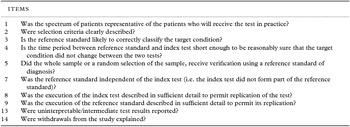
The final articles selected for review were subjected to the quality assessment of diagnostic accuracy studies (QUADAS) checklist (Whiting et al., Reference Whiting, Rutjes, Reitsma, Bossuyt and Kleijnen2003, see Table 1). This was used to determine the quality of each article. The target condition was apathy, the index test was the method by which apathy was assessed and the reference standard was the method by which apathy was diagnosed and, therefore, the validation method for the index test.
QUADAS items for quality review

Target condition = Apathy; Index test = Apathy assessment method; Reference standard = Apathy diagnosis method.
Items 1–5, 7–9 and 13–14 from the QUADAS were found to be applicable for determining quality of methodology and used for this particular review (see Table 1). Some QUADAS items (6 and 10–12) were not included due to their lack of applicability for assessing bias in psychiatric symptom scale validation studies, such as apathy. Items 1 and 2, relate to variability of the studies in the sample assessed and which impacts on the generalizability of findings to the study population. Items 3–5, 7 and 14 examine methodological rigor and bias, which influences the validity of the study results and, therefore, the validity of the scale. Finally, items 8, 9 and 13 determined the quality of reporting of methodology. Items were answered “yes,” “no” or “unsure” after close examination of the articles by author R.R.
There is no standardized scoring system for the QUADAS. Therefore, we categorized each study based on the number of QUADAS items that were answered “yes” to. The categorization was as follows; 9 or 10 items was classed as excellent, 7 or 8 was good, 4 to 6 was adequate, 2 to 3 items was poor and 0 to 1 was considered unacceptable.
Interpretation of psychometric properties
We have provided a table of guidelines for interpreting internal consistency and correlation coefficients in relation to validity and reliability statistics (see Table S1). This was adapted based on Hermans, van der Pas and Evenhuis’ (Reference Hermans, van der Pas and Evenhuis2011) review paper of anxiety scales. However, we have updated the interpretation of internal consistency (George and Mallery, Reference George and Mallery2003) and κ statistic (Viera and Garrett, Reference Viera and Garrett2005).
Results
Systematic review
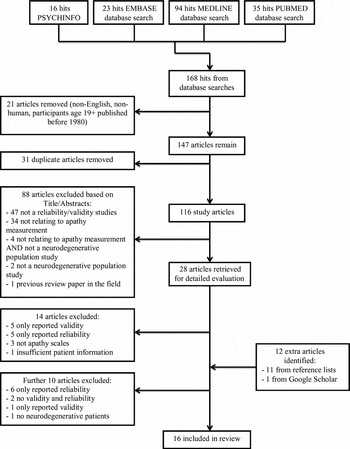
Figure 1 illustrates the review process in a flowchart. From the databases listed and using the search criteria specified earlier, a total of 168 studies were identified. When the eligibility criteria were applied prior to the first stage, 21 articles were removed, leaving 147 articles. After identifying and removing 31 duplicate articles, this left 116 studies eligible for the first stage of study selection; title and abstract screening. These included a variety of neurodegenerative populations that assessed apathy using various methods.
Flowchart of review process.

In the first stage of study selection of the 166 studies, 88 were not relevant or excluded: 47 were not reliability/validity studies, 34 studies were not related to apathy measurement, four studies were not related to apathy measurement and were not conducted in a neurodegenerative population, two were not conducted in a neurodegenerative population and one was a previous review paper in the field (Clarke et al., Reference Clarke2008). This left 28 studies to be included for detailed evaluation. A further 12 articles were identified through Google scholar and reference lists and included for detailed evaluation, resulting in a total of 40 studies for detailed evaluation.
The second stage of study selection, of the 40 studies, 24 articles were excluded: 11 only reported validity for the apathy measurement, six only reported reliability for the apathy measurement, three were not apathy scales, two did not report validity and reliability of the apathy measurement, one had insufficient patient information and one was not conducted in a neurodegenerative population.
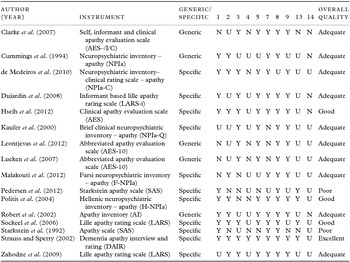
Table 2 shows, in total, 16 studies were included in the review. Seven of these articles validated English versions of a scale (Starkstein et al., Reference Starkstein1992; Cummings et al., Reference Cummings1994; Kaufer et al., Reference Kaufer2000; Strauss and Sperry, Reference Strauss and Sperry2002; Clarke et al., Reference Clarke2007; Zahodne et al., Reference Zahodne2009; de Medeiros et al., Reference de Medeiros2010).
Methodological quality ratings of review studies

The review of methodological quality of each study chosen by the QUADAS criteria is shown in Table 2. There was a range of poor to excellent quality studies with the modal quality rating being adequate.
No studies stated explanations for patient withdrawals; a large proportion of which were unclear about their withdrawals and the remainder did not state any explanations. However, almost all of the studies used a reference standard that was independent of index test for their validation study (see Figure S2, available as supplementary material attached to the electronic version of this paper at www.journals.cambridge.org/jid_IPG). There were five studies that examined apathy scales or subscales in a generic neurodegenerative disease sample and 11 that examined them in specific neurodegenerative disease samples.
Generic neurodegenerative disease scales
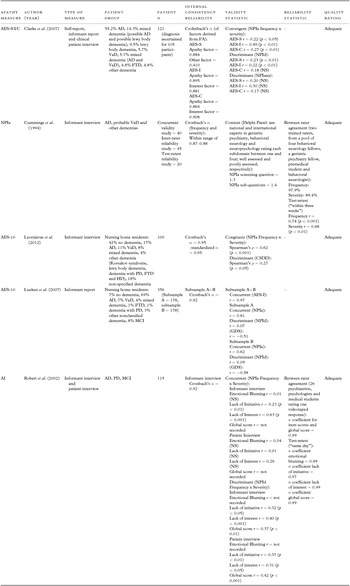
Table 3 shows the descriptors and quality of apathy scale validation studies in generic neuro-degenerative disease patient samples. All five studies were of adequate methodological quality.
Apathy scale psychometric properties in generic neurodegenerative disease studies

NS = not significant; NPId = NPI depression/dysphoria; NPIanx = NPI anxiety; CSDD = cornell scale for depression in dementia.
The apathy evaluation scale (AES) was originally developed and validated in English by Marin et al. (Reference Marin, Biedrzycki and Firinciogullari1991). It is made up of 18 items that assess emotional, behavioral and cognitive aspects of apathy through a four-point Likert scale. The responses are coded to give one apathy score. The AES is available in self report (S), informant report (I) or clinical patient interview (C) forms. The validation study by Clarke et al. (Reference Clarke2007) looks at all three forms of the AES in a generic neurodegenerative dementia sample group. Convergent validity was measured through correlations with the NPIa, all of which were positive ranging from little or no correlation for the AES-S and AES-C to a low correlation with the AES-I. Discriminant validity for AES-S, AES-I and AES-C when compared to the NPId showed little or no positive correlation and with the NPIanx, ranging from low positive correlation for the AES-S and C to a low correlation for the AES-I. This study does not provide internal consistency values for each form of the AES. However, it has subdivided each available form of the AES into two factors each, resulting in numerous internal consistency values. The two factors for the AES-I and AES-C were labeled apathy and interest. For the AES-I the interest factor showed good internal consistency and the apathy factor showed excellent internal consistency. The AES-C showed a good internal consistency for the apathy factor and an excellent internal consistency for the interest factor. The AES-C showed a differing factor structure labeled apathy and other, with internal consistencies that are good and unacceptable, respectively.
Lueken et al. (Reference Lueken2007) developed the abbreviated AES-10 in German as a shortened, ten-item version of the AES-I. The items were developed and, as stated in the study, translated in close cooperation with Dr Robert Marin, the original author of the AES. It is scored almost identically as the original AES, on a four-point Likert scale. It was validated in a sample of nursing home residents, of various neurodegenerative diseases, some of who did not have dementia. The internal consistency reliability was excellent. A high positive correlation between the AES-10 and NPIa in both subsample A and B showed good concurrent validity. This was further supported by a very high, positive correlation with the AES-C. The discriminant validity was shown to be good through little or no positive correlation between the AES-10 and the NPId in both subsamples. Furthermore, a moderate, negative correlation was observed between the AES-10 and the GDS.
A more recent study also looked at the Dutch version of the AES-10 in nursing home residents, almost half of which were without dementia (Leontjevas et al., Reference Leontjevas2012). As with the previous study, the internal consistency was shown to be excellent. For congruent validity, the AES-10 and NPIa showed a moderate positive correlation and when compared to a depression measure (CSDD), there was a little or no positive correlation, showing good discriminant validity.
The neuropsychiatric inventory (NPI; Cummings et al., Reference Cummings1994) is a 12 domain informant interview that assesses behavioral disturbances in various diseases. Originally developed in English, it measures apathy via the NPI apathy/indifference (NPIa) domain first with a screening question to determine the presence of these behaviors (Yes/No/NA answers). This is followed by eight sub-questions to determine the characteristics of apathy (Yes/No answers). The frequency of the NPIa domain is rated on a four-point Likert scale along with a three-point Likert scale for severity. Frequency and severity are then multiplied to give a final NPIa domain score. The internal consistency was difficult to determine specifically for the NPIa due to lack of detailed reporting in the Cummings et al. (Reference Cummings1994) study. However, based on the range of values provided in the article, the internal consistency of the NPIa was good. A Delphi panel determined content validity by rating whether screening question and sub-questions captured the essential elements of behavior. For the NPIa, they rated both as close to being “assessed well.” Inter-rater agreement and test-retest reliability for frequency was also found to be high with a further moderate test retest for severity.
The apathy inventory (AI; Robert et al., Reference Robert2002) was developed and validated in French to assess global and subdomain apathy (emotional blunting, lack of initiative and lack of interest). It is a three-item scale (one item for each domain) and is has been validated as a self-report and informant interview. The self report AI first has the patient assess their own behavior for each item (Yes/No) and then asks them to bisect a line in relation to the severity of their behavior that spans from mild to severe on a covert 12-point scale only know to the scorer. These three item severities are then added to give a composite apathy score. The informant report is similar to the NPIa, recording whether the behaviors are displayed (Yes/No), frequency of behavior on a four-point Likert scale along and severity of behavior on a three-point Likert scale. Again, frequency and severity are multiplied to give a numeric apathy level for each subdomain, which are then added to give a composite apathy level. The internal consistency for the informant interview was excellent. The NPIa generally held little or no to low positive correlations with AI subdomains, with only positive, moderate correlation with the informant lack of interest subdomain. There were no record of the correlation between the NPIa and the AI global scores. Discriminant validity determined by the relationship of the NPId and the AI (global and subdomains), which showed low to moderate positive correlations. The between rater and test-retest reliability was almost perfect for the global and subdomain scores.
Specific neurodegenerative disease scales
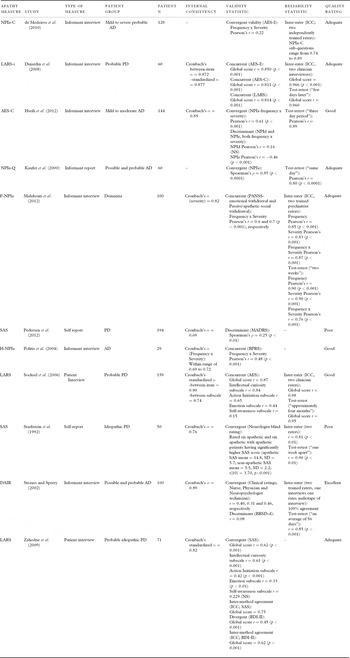
Table 4 shows the different apathy scale validation studies in specific neurodegenerative disease patient samples, with descriptors and quality rating for each. The 11 studies ranged from poor to excellent quality.
Apathy scales psychometric properties in specific neurodegenerative disease patient populations

NS = not significant; ICC = intra-class correlation NPId = NPI depression/dysphoria; NPIanx = NPI anxiety; NPIe = NPI elation/euphoria; PANSS = positive and negative symptoms scale; MADRS = montgomery-aasberg depression rating scale; BPRS = brief psychiatric rating scale; BRSD-d = behavior rating scale for dementia-depression subscale; BDI-II = beck depression inventory II.
The NPI has been translated into Greek (Hellenic; Politis et al., Reference Politis, Mayer, Passa, Maillis and Lyketsos2004) and a Persian language (Farsi; Malakouti et al., Reference Malakouti, Panaghi, Foroughan, Salehi and Zandi2012) and validated in AD and generic dementia populations. Both are administered and scored in the same way as the original NPIa (Cummings et al., Reference Cummings1994). The Hellenic NPIa (H-NPIa) was translated by two bilingual psychiatrists from English to Greek and then independently translated back to English by one other psychiatrist. The quality of the study was classed as good. The H-NPIa frequency x severity internal consistency fell within a range of questionable and acceptable with no further reliability reported. The concurrent validity between the apathy factor derived from the BPRS and the H-NPIa showed a low positive correlation.
The Farsi NPIa (F-NPIa) was also translated by two bilingual psychiatrists from English to Farsi and then back-translated to English independently by two other bilingual psychiatrists. It was then validated in an unspecified dementia patient sample. The methodological quality of the study was classed as adequate. However, the internal consistency was reported of the F-NPIa was good. The concurrent was determined against the PANSS, which was found to be of a high correlation. The reliability of the scale was good, with an excellent inter-rater intra-class correlation coefficient (ICC) and the test-retest correlation coefficient was good.
In addition to the NPI translations above, several revised versions have been developed. The brief clinical NPI (NPI-Q: Kaufer et al., Reference Kaufer2000), developed in English, is scored identically to the NPI but differs in administration method in that it is an informant report measure. The informants are asked to fill in the NPI-Q about the patient. The original validation study by Kaufer et al. (Reference Kaufer2000) recruited AD patients and was found to be of adequate quality. While there was no report of the internal consistency for the NPI-Q apathy (NPIa-Q), the test-retest reliability correlation coefficient and convergent validity against the NPIa were both high positive correlations.
The NPI Clinical rating scale (NPI-C; de Medeiros et al., Reference de Medeiros2010) is a revised version of the NPI with expanded domains and questions. It recognizes the importance of the domain sub-questions and rates frequency and severity through an item-by-item basis. It was validated in mild to severe probable AD patients by de Medeiros et al. (Reference de Medeiros2010). This was a large-scale, cross-sectional validation study with eight participating countries (Argentina, Brazil, Canada, France, Greece, Hungary, Italy and America) and the NPI-C was translated to seven languages (English, French, Greek, Hungarian, Italian, Portuguese and Spanish). The quality of this study was adequate. It does not report internal consistency NPI-C apathy (NPIa-C) and the convergent validity against the AES-I showed little or no positive correlation. The inter-rater ICC for each of the sub-questions of the NPIa-C ranged from good to excellent.
The Starkstein apathy scale (SAS) was developed in English to assess apathy and validated in idiopathic PD patients (Starkstein et al., Reference Starkstein1992). It is a condensed version of the AES, with only 14 items, scored by same four-point Likert scale. It defines itself as less comprehensive than the AES as to be less demanding for PD patients to complete. This study was of poor quality with only an acceptable internal consistency for the SAS. The convergent validity was determined through a blind neurologist rating participants as apathetic or non-apathetic and then examining if their SAS scores are significantly different. They were found to be different, based on a sample size of 12 (six rated as apathetic, six rated as non-apathetic by the neurologist). The inter-rater reliability correlation coefficient was high and the test-retest reliability correlation was very high. In a later study, the SAS was back-translated in to Norwegian, the translation critically appraised by four of the authors and used in a Norwegian PD patient sample study (Pedersen et al., Reference Pedersen2012). This study was also of poor quality. This study reported a questionable internal consistency for the SAS with good discriminant validity due to little or no positive correlation with the MADRS.
The Lille apathy rating scale was originally developed in French and validated in patients with probable PD by Sockeel et al. (Reference Sockeel2006). It is a 33-item scale scored by a mixture of simple (Yes/No/NA) and Likert-type responses. It is composed of factor analytically derived subscales (intellectual curiosity, action initiation, emotional and self awareness), which are also summed to provide a global apathy score. The original validation study (Sockeel et al., Reference Sockeel2006) was of good quality. It showed an acceptable (between subscale) too good (between item) internal consistency. Concurrent validity between the AES and LARS global score was high positive correlation, with LARS subscales being positive and ranging from little or no to high correlations. Inter-rater ICC and test-retest reliability was found to be excellent. A study by Zahodne et al. (Reference Zahodne2009) of a slightly less adequate quality further validated LARS in English in probable idiopathic PD patients. It was showed to have a good internal consistency. For convergent validity, the SAS and the LARS global score correlated positively and moderately, with the subscales positively correlating from little to none to moderately. Additionally, the inter-method agreement (ICC) for the SAS and LARS global score was excellent. Divergent validity between the BDI-II and LARS global score was moderate and the ICC between the two was fair.
Similarly to the LARS, the informant version of the LARS (LARS-i; Dujardin et al., Reference Dujardin, Sockeel, Delliaux, Destée and Defebvre2008) was also developed in French and for validation in a PD population. Some items have been reworded to be suitable as a question for a patient's informant. The administration and scoring methods are the same as the LARS. This particular study was of adequate quality. The internal consistency for the LARS-i was shown to be good. The concurrent validity was good due to high positive correlations with the AES-I, AES-C and LARS. Inter-rater ICC and test-retest reliability was excellent.
The AES-C was further validated in mild to moderate severity AD patient sample (Hseih et al., Reference Hsieh, Chu, Cheng, Shen and Lin2012). It was back-translated to Taiwanese by two bilingual individuals. This was done until an agreement on the translation was reached between the two. In terms of quality, this study was classed as good. The internal consistency for the AES-C was found to be good, with a moderate positive convergent validity against the NPIa. Discriminant validity against the NPId showed little to no correlation while against the NPIe it showed a low negative correlation. Test-retest reliability correlation coefficient for the AES-C was good.
The dementia apathy interview and rating (DAIR) is an informant based interview, developed and validated in English to assess apathy in probable and possible patients on AD (Stuss et al., 2002). The assessment is a 16-question interview of the primary caregiver to assess the patient's initiation behavior, interest and engagement in the environment through a four-point Likert scale. This was the only study with excellent methodological quality. The internal consistency of the DAIR was good with a generally low positive correlation in relation to clinician's ratings, indicative of average convergent validity. It had little or no positive correlation with the BDRS, showing good discriminant validity against depression. It had a prefect inter-rater agreement with a high positive test-retest reliability correlation coefficient.
Discussion
This review systematically examines and provides an overview of the quality and psychometric properties of apathy scales, which have been used within neurodegenerative disease populations. Generally, most of the validation studies in this review were found to be of adequate quality. Studies did not reach higher quality scores due to under described selection criteria, poor reporting of withdrawals from studies and a lacking of a good reference standard for diagnosing apathy. Nevertheless, their merits are that both the reference standards and the index tests for apathy were described in sufficient detail and, mostly, were independent of each other.
Generic neurodegenerative scales
The methodological quality of all the validation studies for the neurodegenerative generic scales was adequate. This could have been improved with better, defined selection criteria and comprehensive sampling to form more generic neurodegenerative patient groups. Therefore, it is important to examine the psychometric properties of each as to determine their practicality.
The widely used NPI, developed and validated in a generic dementia sample by Cummings et al. (Reference Cummings1994), is often used as a reference standard for other apathy measures. In the original validation study by Cummings et al. (Reference Cummings1994), the design of the NPI was done using a Delphi panel of experts as to also determine content validity. They reported apathy as “well assessed” but did not examine any other statistical validity criteria for the NPIa. Specific NPIa internal consistency was not reported but it was deduced as good, with a high between-rater agreement and good test-retest reliability. Most of the NPI subdomains were concurrently validated against existing instruments, whereas the NPIa domain was not. This lack of concurrent validity for the NPIa and a methodological rating of adequate for this study create uncertainty of the robustness of this subscale's ability to assess apathy. It is observed that many studies in this review have used the NPIa as a reference standard to validate their own methods of apathy assessment. As a consequence, perhaps these and any future validation studies using the NPIa as a reference standard should be considered and interpreted with caution.
Similarly to the NPI, the AES is also considered as a validation reference standard. The original Marin et al. (Reference Marin, Biedrzycki and Firinciogullari1991) AES development and validation study was excluded in the earlier stage of this review due to a small sample size of the AD patients (N = 21 out of 123/ less than 20%) and included a very mixed patient sample of AD, stroke (left and right hemisphere), major depression and healthy controls. Additionally, there was no specific AD reliability or validity information reported for the AES. However, a later study by Clarke et al. (Reference Clarke2007) validated all forms of the AES against a generic dementia sample. The Clarke et al. (Reference Clarke2007) study does not report reliability statistics and only factor analytically derived internal consistencies, making it difficult to interpret the scales as a whole. The convergent and discriminant validity was variable for all forms of the AES, resulting in unclear psychometric properties and, once again, therefore caution should be taken in considering its application as a reference standard for a neurodegenerative group.
Two studies validating the AES-10 (Lueken et al., Reference Lueken2007, Leontjevans et al., Reference Leontjevas2012), which is a shortened form of the AES, showed excellent internal consistency reliability and improved validity. Similar to the Clarke et al. study, the AES-10 validation studies documented no other reliability statistics. It should, however, be noted that both studies recruited nursing home residents some of whom did not have a diagnosis of a neurodegenerative disease. The Lueken et al. (Reference Lueken2007) was more representative of a neurodegenerative generic dementia population. However, the Leontjevas et al. (Reference Leontjevas2012) study was not very representative of a neurodegenerative population because almost half of the participants had no signs of dementia. So, while the AES-10 seems psychometrically strong, it could still benefit from further validation in a generic neurodegenerative disease population.
Robert et al. (Reference Robert2002) AI validation study utilized a neurodegenerative generic patient sample containing AD, PD and mild cognitive impairment patients. While the AI was generally reliable, the inter-rater agreement, internal consistency, test-retest reliability being excellent, the validity was unclear. The concurrent validity was underreported for the global score and showed an irregular relationship for the subscale scores. The association between the AI global and subscale scores with depression was stronger than that of the apathy measure. This stronger relationship with depression could indicate that the AI is not measuring the intended apathy, but rather some component associated with both apathy and depression, resulting in a lack of scale validity.
Based on the results of this review, it is difficult to establish which scale is best for assessing apathy in a generic neurodegenerative disease population. There are various methodological flaws with the validation studies that affect the validity and reliability of the each scale. The main issue being that a generic neurodegenerative sample should involve all forms of neurodegenerative disease, not just various dementias (Cummings et al., Reference Cummings1994; Clarke et al., Reference Clarke2007) or a mixture of healthy individuals and neurodegenerative patients (Lueken et al., Reference Lueken2007; Leontjevans et al., Reference Leontjevas2012). Psychometrically, the AES-10 seems to be the most valid, but has not been applied in a purely neurodegenerative population.
Specific neurodegenerative scales
With regard to neurodegenerative specific apathy scales, the DAIR (Strauss and Sperry, Reference Strauss and Sperry2002) validation study has excellent methodological quality for AD patients, due to lack of bias, a superior quality of methodological reporting and high generalizability of the results. This was closely followed by good quality validation studies of the AES-C (Hseih et al., Reference Hsieh, Chu, Cheng, Shen and Lin2012) and the H-NPIa (Politis et al., Reference Politis, Mayer, Passa, Maillis and Lyketsos2004). Both had a representative sample and high generalizability of the results. However, the H-NPIa was validated against a combination of BPRS subscales that were labeled as an apathy factor, which is not a direct or established measure of apathy but rather a new construct. Additionally, when compared psychometrically, the H-NPIa reliability and validity was inferior to both the DAIR and the AES-C, partly due to insufficient reliability criteria reporting. When comparing the DAIR and the AES-C, both are well constructed, informant interviews completed by trained assessor with matched psychometric properties. Both validation studies note good internal consistency reliability but vary in the reporting of reliability and validity. The AES-C reports more detailed convergent and discriminant validity that are marginally superior to the DAIR. Conversely, the DAIR has better inter-rater agreement and test-retest reliability in comparison to the AES-C. Based on the psychometric properties of both these scales and the quality of their validation studies, either of these methods would be recommended for assessing apathy in AD patient populations.
In relation to PD patients, both the SAS validation studies (Starkstein et al., Reference Starkstein1992; Pedersen et al., Reference Pedersen2012) scored poor on quality mostly due to the lack of methodological reporting and selection bias and also showed unfavorable psychometric validity and reliability. Only the Sockeel et al. (Reference Sockeel2006) LARS validation study was methodologically classed as good quality due to minimized bias, detailed methodology reporting and generalizability of results. The internal consistency reliability was found to be acceptable which was supported by very good validity and reliability properties of the LARS global score. The high convergent validity and excellent reliability make this a good measure for apathy in PD. However, it does not examine discriminant or divergent validity against depression, which has been shown to occur with apathy in PD (Lieberman, Reference Lieberman2006). A later validation study showed average discriminant validity against depression (Zahodne et al., Reference Zahodne2009).
In ALS, apathy is continually assessed using the frontal systems behavior scale (Grossman et al., Reference Grossman, WoolleyLevine, Bradley and Miller2007; Witgert et al., Reference Witgert2010) despite this scale not being validated in this neurodegenerative disease population. Additionally, research in HD has been conducted using scales that assess uncorroborated apathy that is a derivation of factor analysis (Thompson et al., Reference Thompson2012) or use scales that have not been validated in an HD sample (Hamilton et al., Reference Hamilton2003; van Duijn et al., Reference van Duijn, Reedeker, Giltay, Roos and van der Mast2010). Therefore, no well-validated scales to assess apathy within these two neurodegenerative disorders have been found.
Strengths and limitations
This review has been undertaken using a systematic methodology (PRISMA), ensuring that eligibility criteria, inclusion and exclusion criteria were carefully outlined and implemented. Second, all studies were included that met the criteria, which could be seen to reduce publication bias. Third, through rating the validation studies for the scales on methodological quality using the QUADAS, allowed us to determine the quality of the validation procedure for the apathy scale in question. Finally, interpreting the psychometric statistics for reliability and validity of the scales (adapted from Hermans et al., Reference Hermans, van der Pas and Evenhuis2011) allowed for a more standardized assessment. This resulted in more objectively driven recommendations for the most robust scale to be used in research or clinical practice to be made.
A limitation for this study could be that we chose to exclude studies that reported just validity or reliability of apathy scales. However, a diagnostic instrument should be both reliable and valid at detecting a symptom (Kimberlin and Winetrstein, Reference Kimberlin and Winetrstein2008) and both of these need to be demonstrated in the same sample (i.e. there is little point in having a scale that is reliable but not valid in one sample, and valid but not reliable in another). Therefore, by including validation studies that examine both of these criteria, we attempted to avoid partially validated scales that might not be suitable for assessment. Additionally, a systematic review using the PRISMA method requires “a clearly formulated question that uses systematic and explicit methods. . .” of identification, selection and critical appraisal of “relevant research” (Moher et al., Reference Moher, Liberati, Tetzlaff and Altman2009). So, by clearly defining those studies reporting complete results (i.e. reliability and validity statistics of a scale) improves the quality of this systematic review, making it possible for more credible, scale-utility recommendations to be made.
Finally, it should be noted that apathy as a lack of motivation may manifest somewhat differently depending on the cultural context. Hence, caution is required when considering applying a scale validated in one country in another, especially if cultural norms are very dissimilar.
Conclusions
In conclusion, there are several recommended instruments to assess apathy for some specific neurodegenerative disease populations. The DAIR is a well-validated instrument in AD patients, shown to have very good psychometric characteristics, which is further supported by excellent methodological quality of the validation study (Strauss and Sperry, Reference Strauss and Sperry2002). In relation to PD patient, the LARS validation study (Sockeel et al., Reference Sockeel2006) showed that the global scoring of apathy was psychometrically strong, with further research needed to determine its subscalar structure and relationship with depression. Finally, scales should be developed and validated in diseases such as HD and ALS, which make apathy difficult to assess due to marked motor symptoms.
This review did not find any methodologically strong studies that validated a psychometrically robust, generic neurodegenerative disease apathy scale. This was partly due to the unrepresentative samples, lack of standardizing selection criteria in the validation studies for generic neurodegenerative disease. Many of the studies validated scales in samples that were biased to dementia patients, with no studies including ALS patients. It may be difficult to design or validate such a generic scale due to practical difficulties of forming a broad and mixed neurodegenerative disease patient sample group. However, further well-constructed validation studies or newly developed scales are needed to explore if it is possible to assess apathy in generic neurodegenerative disease.
Funding
R.R. is jointly funded by the Anne Rowling Regenerative Neurology Clinic and the Alzheimer Scotland Dementia Research Centre.
Conflict of interest
None.
Description of authors’ roles
R.R. and J.S. devised the review. R.R. selected and condensed the material and wrote the paper with support of J.S. C.H. was the second reviewer for the paper, checked material and co-rated papers. J.S. was the third reviewer and supervised R.R. S.A. supervised R.R. and provided intellectual input in to the manuscript.
Acknowledgments
The authors gratefully acknowledge the support of the Alzheimer Scotland Dementia Research Centre and the Anne Rowling Regenerative Neurology Clinic.
Supplementary material
To view supplementary material for this article, please visit http://dx.doi.org/10.1017/S1041610214002221