Introduction
Notable declines have been reported in many guilds of birds in North America, in particular, aerial insectivores (Nebel et al. Reference Nebel, Mills, McCracken and Taylor2010), where populations seem to have fallen significantly in recent decades. Nighthawks (Aves: Caprimulgiformes: Caprimulgidae) are aerial predators feeding on a variety of insects (Holyoak Reference Holyoak2001). The common nighthawk, Chordeiles minor (Forster), breeds throughout North America, undertaking a long migratory flight to winter as far south as northern Argentina (Brigham et al. Reference Brigham, Ng, Poulin and Grindal2011). As such, these birds face considerable risk throughout their range, from habitat modification, predation and parasitism, exposure to pesticides, and depletion of their insect food base (Nebel et al. Reference Nebel, Mills, McCracken and Taylor2010). Populations have been reported in decline in many locations (Nebel et al. Reference Nebel, Mills, McCracken and Taylor2010), including Manitoba, Canada (Taylor Reference Taylor2009). The possible causes are diverse and interrelated, but internal and external parasites are seldom considered as primary factors, rather contributing to host fitness only when their intensity is high. Information about parasites of caprimulgiforms is scattered (Holyoak Reference Holyoak2001) and there is little quantitative data available on even the most basic elements of infestation parameters. As attention is drawn to declining populations of common nighthawk, it is important to understand as much as possible about their parasites, not just because of their potential impact on host fitness, but because as host populations decline to the point where they gain special conservation status (Committee on the Status of Endangered Wildlife in Canada 2007), species of specific parasites are also placed at risk and warrant consideration (Koh et al. Reference Koh, Dunn, Sodhi, Colwell, Proctor and Smith2004; Dunn et al. Reference Dunn, Harris, Colwell, Koh and Sodhi2009; Pérez et al. Reference Pérez, Sánchez and Palma2013). We have had the opportunity to examine 178 common nighthawks in Manitoba for ectoparasites, the most prevalent being the chewing louse, Mulcticola macrocephalus (Kellogg) (Phthiraptera: Philopteridae).
Chewing lice (Phthiraptera; Amblycera, Ischnocera) are ectoparasites of birds feeding on feathers, skin, and sometimes blood. Most bird species are infested by at least one species of louse, and many are infested simultaneously by a number of species (Price et al. Reference Price, Hellenthal, Palma, Johnson and Clayton2003). The body surface of an individual bird is the local habitat for an often abundant population of lice. Chewing lice are wingless and their ability to disperse from host to host is limited. They probably move between pairs when their hosts mate, from parent to offspring in the nest, or from bird to bird in those species that nest communally or roost together (Marshall Reference Marshall1981). Lice are typically multivoltine, but little is known about their seasonal biology. Preening by the host is thought to be the major mortality factor for bird lice (Marshall Reference Marshall1981; Clayton et al. Reference Clayton, Koop, Harbison, Moyer and Bush2010). Inter-specific competition and environmental factors such as humidity may also affect populations (Moyer et al. Reference Moyer, Drown and Clayton2002; Bush et al. Reference Bush, Harbison, Slager, Peterson, Price and Clayton2009).
Parasites, including ectoparasites, provide a remarkable opportunity for addressing many ecological questions (Price Reference Price1980; Poulin Reference Poulin1999, Reference Poulin2007a, Reference Poulin2007b). The well-defined local habitats of bird lice, their accessibility on the surface of a host, their limited capacity for self-directed, long-distance dispersal among hosts, the diversity of species, and sometimes their high abundance make them particularly suitable for ecological studies. Nevertheless, little is known about the population dynamics of bird lice, in part, because few studies have continued beyond one year, or with a sufficient sample of birds for reliable estimation of ecological parameters. In addition, different methods have been used to assess louse populations, making detailed comparisons among studies difficult. Multi-year studies using similar methodologies have been conducted to characterise the infestation parameters for lice infesting common nighthawks, Chordeiles minor (Galloway Reference Galloway2006), and feral pigeons, Columba livia Gmelin (Aves: Columbiformes: Columbidae) (Galloway and Palma Reference Galloway and Palma2008). The first long-term study of louse populations described the dynamics of four louse species on feral pigeons (Galloway and Lamb Reference Galloway and Lamb2014) and their seasonal abundance (Galloway and Lamb Reference Galloway and Lamb2015). These four louse species have distinct average abundances, levels of population variability (PV), and seasonal abundances, even though they often live together on the same birds. These data support the hypothesis that infestation parameters are indeed species-specific traits, subject to evolutionary processes (Poulin Reference Poulin2007b; Galloway and Lamb Reference Galloway and Lamb2014).
The feral pigeon is not migratory and was relatively recently introduced to North America along with four of its ectoparasites. This complex of host and four species of lice provides a narrow perspective on the diverse ecological relationships that might be expected between bird species and their lice. The objective of the current research is to provide a contrasting example of louse populations on a native, migratory bird species with only one species of louse ectoparasite. Populations of the chewing louse, M. macrocephalus, were investigated on its host, the common nighthawk, over the past 22 years in southern Manitoba, Canada. Mulcticola macrocephalus is a chewing louse that feeds on the feathers of nighthawks (Galloway Reference Galloway2006). Essentially the same methodology was used for studying the louse on nighthawks as for lice on feral pigeons (Galloway and Lamb Reference Galloway and Lamb2014). Here we report on the population dynamics and seasonal abundance of M. macrocephalus and compare the louse-nighthawk system with that of the louse-pigeon system.
The life history of the common nighthawk differs substantially from that of the feral pigeon, and these differences may be important for comparing louse populations on these two hosts. The common nighthawk arrives in southern Manitoba in May and June from a winter range in South America, it has a short nesting period from mid-June through July, the flightless young are present from late June to early August, and the parents and young of the year begin migrating south again as early as late July (Taylor Reference Taylor2003; Brigham et al. Reference Brigham, Ng, Poulin and Grindal2011). Lice were obtained from common nighthawks only while the birds were visitors in Manitoba. Feral pigeons, on the other hand, are resident throughout the year in Manitoba and may nest and produce young from early spring through to late summer, depending on the season. An important difference between the two host species is their abundance: pigeons are common, nighthawks much less so and in decline since 1975 (Taylor Reference Taylor1996). Thus, relatively few nighthawks were collected, in comparison with pigeons. Host sample size must, therefore, be considered when drawing conclusions about the abundance of M. macrocephalus.
Materials and methods
Common nighthawks were salvaged from rehabilitation hospitals at the Wildlife Haven (Manitoba Wildlife Rehabilitation Organization, Île-des-Chênes, Manitoba) and Prairie Wildlife Rehabilitation Centre (Winnipeg, Manitoba). Living birds that could not be rehabilitated were euthanised, and the body immediately isolated in a plastic bag, frozen (−20 °C) for at least 48 hours and then examined for lice. This protocol assured that lice present on the living nighthawks were retained and minimised contamination among birds. Most nighthawks came from Winnipeg, Manitoba, with the remainder from elsewhere in southern Manitoba (Galloway Reference Galloway2006). Lice were collected by washing nighthawks two times in warm soapy and once in clean water (Mironov and Galloway Reference Mironov and Galloway2002). The washing method removes nearly the entire population of lice infesting the host (Clayton and Drown Reference Clayton and Drown2001; T.D.G., personal observation). Voucher specimens were deposited in the J.B. Wallis/R.E. Roughley Museum of Entomology, Department of Entomology, University of Manitoba, Winnipeg, Manitoba.
The following data were recorded from 178 nighthawks, 1992–2013: number of lice, number of adult females and males, and number of nymphs. Nymphs were not sexed. From 1998, each nighthawk was weighed. Birds that had fledged recently could not be reliably distinguished from adults. Therefore, data for all birds were considered together, although it was recognised that nighthawks collected in May and June before nesting commenced would have been adults returning from South America, whereas those collected after 1 August would have been an undetermined mix of adults and newly fledged sub-adults. The number of nighthawks assessed each year depended on the number submitted to rehabilitation centres, averaging eight per year, but ranging from 1 to 17. Only one bird was collected in each of 1992 and 1993 and so these two years were excluded from some analyses, because no estimate of variation was possible. In 10 of the 20 remaining years, three to seven birds were collected annually with 8–17 in the other years. These groups of years were considered separately for some analyses, to assess the effect of small sample size on population parameters.
A frequency distribution of the number of lice was calculated for all individual birds. We assume that nighthawks collected each year provide an unbiased estimate of the abundance of lice that year, because we know of no practical method to collect a sample of nighthawks in a way that would assure a random sample in relation to louse abundance.
The abundance of lice each year was considered in terms of prevalence (proportion of birds with lice) and mean intensity (the mean number of lice on infested birds) (Rózsa et al. Reference Rósza, Reiczigel and Majoros2000). The mean abundance of lice each year equals prevalence multiplied by mean intensity. Partitioning abundance into these two components is reasonable for lice because the processes that affect establishment of lice (prevalence) may differ from those that subsequently affect population size (intensity). For each year, the following five parameters were estimated for the louse population: abundance, intensity, prevalence, sex ratio (number of males divided by number of females), and the ratio of nymphs to females.
The stability of louse abundance was assessed using PV (Heath Reference Heath2006). The metric, PV, is calculated as the sum of absolute values of the differences for all pairs of annual estimates of a parameter, with each difference divided by the larger estimate for each pair (Heath Reference Heath2006). The result is a proportion between 0 and 1; a low value indicates low population variability and high stability. This metric is particularly suitable for comparisons among species, because it measures population variability on the same scale, regardless of mean abundance, and does not assume that estimates of population parameters are distributed normally.
Results
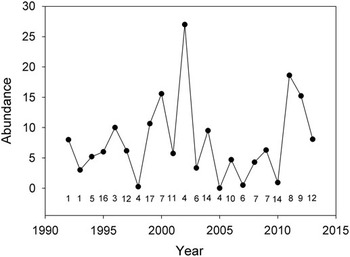
Mulcticola macrocephalus was present on some common nighthawks each year from 1992 to 2013, except on the four birds collected in 2005. Abundance fluctuated from year to year from means of 0 to 27 lice per bird (Fig. 1). Forty-nine per cent of all nighthawks were infested with up to 66 lice on one bird, although almost half of the infested birds had 1–10 lice and the most infested birds had only a small proportion of the lice found (Table 1). The distribution of lice among nighthawks was not normal with a variance to mean ratio of 2.5 and a variance to mean regression coefficient of 1.6 for log-transformed data (Table 1).
Stability of mean annual abundance over 22 years for the louse, Mulcticola macrocephalus, on common nighthawks in southern Manitoba, Canada, with the number of nighthawks collected shown above the x-axis.

Distribution of the louse, Mulcticola macrocephalus, on 178 common nighthawks collected from 1992 to 2013, in southern Manitoba, Canada.

* Linear regression coefficient (SYSTAT 2010) relating variance and mean (log10-transformed) of abundance on individual nighthawks over 19 years (n=19). Three years were excluded because variance was 0, either because only one bird was collected (1992, 1993) or the birds had no lice (2005). A Poisson distribution has a coefficient of 1.
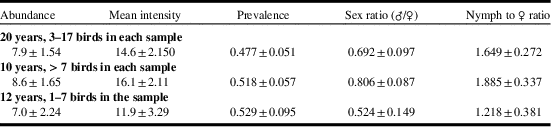
From 1994 to 2013, the average annual abundance was 7.9 lice per bird (Table 2). Data for 1992 and 1993 were excluded because only one bird was collected in each of those years. Mean intensity was ~15 lice per infested bird and prevalence was 0.48 (abundance=mean intensity×prevalence) (Table 2). Intensity and prevalence were weakly correlated (Pearson’s correlation coefficient (SYSTAT 2010): r=0.45, P=0.04, n=20), but this correlation was due to the estimate for 2005 when no lice were detected on four birds, giving 0 for both parameters. Excluding 2005, no relationship between intensity and prevalence was detected (Pearson’s correlation coefficient (SYSTAT 2010): r=0.34, P=0.15, n=19). Furthermore, excluding years with small samples of birds (< 8,< 7, or < 5) resulted in lower, non-significant correlation coefficients (data not shown). Sex ratio measured as males to females was 0.7 and the ratio of nymphs to females was 1.6 (Table 2).
Mean±standard error for population parameters of a louse, Mulcticola macrocephalus, sampled from 178 common nighthawks over 22 years, 1992–2013, in southern Manitoba, Canada.
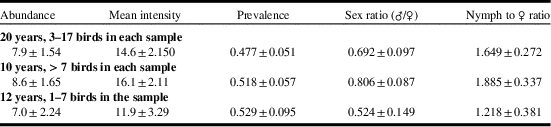
In some years, the sample of birds was low (one to seven birds), reducing the precision of estimates for population parameters (Table 2). Estimates of infestation parameters for years with few birds tended to be lower (only prevalence was higher) than for the 10 years with > 7 birds per year (Table 2). These apparent differences were not significant, though, because of the high standard errors, particularly for years with small samples of birds (Table 2).
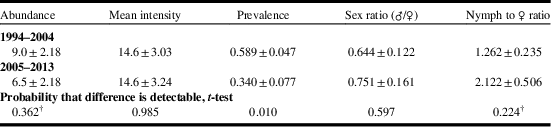
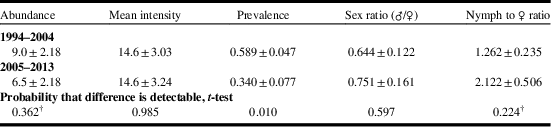
Comparing the early (1992–2004 from Galloway Reference Galloway2006) and late years of the study showed that only prevalence changed with time (Table 3). The difference, however, was substantial with the proportion of nighthawks with lice dropping from a mean of 0.59 before 2005 to 0.34 after 2004. The nymph to female ratio increased substantially after 2004, but not significantly so. Mean intensity was the same for the two periods.
Mean±standard error for population parameters of a louse, Mulcticola macrocephalus, on common nighthawks sampled from 1994 to 2004Footnote * and 2005 to 2013, in southern Manitoba, Canada.
* (Galloway Reference Galloway2006), but excluding data for samples of only one bird collected in each of 1991 and 1992.
† Mann–Whitney rank sum test on data not normally distributed or with unequal variance (SYSTAT 2010).
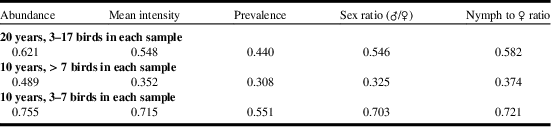
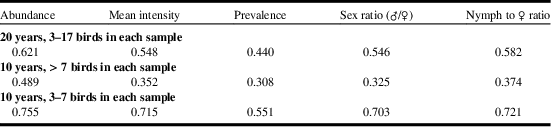
The stability of louse population parameters, estimated by PV, was also affected by the small samples of birds available some years. Population variability was substantially lower for the 10 years with 8–17 birds, than for years with 3–7 birds, or for the 20 years with 3–17 birds (Table 4). This result is expected because the precision (standard error) of parameters was low when smaller numbers of birds were sampled (Table 2), and this imprecision contributed to variability in estimates for infestation parameters from year to year. Therefore, the most accurate estimate of PV for the population parameters is for the 10 years with more than seven birds, although these values may still over-estimate PV for the population because the sample of birds was still relatively low for these years. PV for abundance for M. macrocephalus was near 0.5, with PV for intensity and prevalence both contributing to a similar extent to the stability of abundance (Table 4).
Estimates of population variability (PV) for five population parameters of the louse, Mulcticola macrocephalus, from common nighthawks sampled in southern Manitoba, Canada. Estimates are for groups of years with different sample sizes of birds.
Common nighthawks were collected from May to October, with one straggler in December. Adults returning from the south in May and June comprised 13% of the sample, and in the primary nesting month, July, only two birds were collected over 22 years. In August when most of the young of the year had recently fledged, 59% of all birds were collected, and the remaining 27% were from September and October. The May-June adults were heavier than the mix of adults and newly fledged birds collected later (Table 5; analysis of variance (SYSTAT 2009): F=24.4, P<0.001, df=2, 129).
Population parameters of the louse, Mulcticola macrocephalus, for three two-month periods in the season, collected from common nighthawks over 22 years, in southern Manitoba, Canada.

* Mean±standard error.
† The first ratio is the mean for individual birds with lice; the ratio in parentheses is for totals from all birds sampled during each two-month period.
There was no difference in the mean intensity of lice among adults in May–June and the mix of adults and juveniles in July–August or September–October (Games–Howell test (SYSTAT 2009): P>0.13), although intensity was lowest in July–August (Table 5). Similarly, no difference in the prevalence of lice was detected at any time during the season (Pearson’s χ 2 test (SYSTAT 2009): χ 2=0.475, P=0.788, df=2), although prevalence tended to increase through the season (Table 5). The mean ratios for males and nymphs to females, based on the lice on individual birds had high variance because of the low numbers of lice per bird, and the ratios were not normally distributed. However, ratios based on pooled counts for each two-month period showed a similar pattern of differences over the season. The ratio of male to female lice was lower for adult birds in May–June than for the mix of adults and young-of-the-year in July–October (Table 5; χ 2 test (SYSTAT 2009): χ 2=6.411, P=0.041, df=2). By September–October, although the ratio was still relatively high, there was no difference between the ratio of males to females then and that for May–June (χ 2 test (SYSTAT 2009): χ 2=3.156, P=0.076, df=1). Similarly, the ratio of nymphs to females was lower for adults in May–June than for the mix of adults and juveniles in July–August (Table 5; χ 2 test (SYSTAT 2009): χ 2=5.466, P=0.019, df=1), but by September–October, there was no difference between the nymph to female ratio then and that for May–June (χ 2 test (SYSTAT 2009): χ 2=0.012, P=0.912, df=1).
Discussion
Mulcticola macrocephalus was present on about half of the common nighthawks in Manitoba over the past 20 years, although prevalence was lower after 2004 (0.34) than before (0.59). The cause of this decline in prevalence is not known. Common nighthawk populations have declined since about 1975 (Taylor Reference Taylor1996; Nebel et al. Reference Nebel, Mills, McCracken and Taylor2010), but estimates of nighthawk abundance are not robust enough to assess whether it affected louse prevalence. It is possible that as host populations declined, probability of successful transmission of ectoparasites also declined, resulting in a smaller proportion of hosts being infested. In contrast, once a nighthawk is infested by lice, the numbers of lice on the infested bird are determined by individual host circumstances and environmental conditions, rather than characteristics of the host population as a whole. Therefore, mean intensity, as we observed, would be expected to be the same during early and later years in the study, unaffected by whatever process caused the decline in prevalence. In other words, in the case of M. macrocephalus, prevalence may depend on the density of its host, while intensity does not.
The seasonal changes in mass and number of birds collected over the season were consistent with the hypothesis that many of the nighthawks collected from August to October were young of the year, although adults and their newly fledged young were not distinguished. Nighthawks collected in May, June, and July were all adults that had migrated from the south before any of the young of the year had left the nest; they were collected less frequently and were the heaviest birds. After July, nighthawks were collected more frequently and were lighter, on average. These birds were probably mostly young of the year. Given this seasonal pattern of birds in the collections, infestation of nighthawks would have taken place before the chicks fledged, with lice moving from parents to chicks and from chick to chick; prevalence of lice was as high on the fledged young-of-the-year as on adult birds in spring. Mean intensity was highest on the parents as they arrived back to breed, probably for two reasons: the population of lice that returned to Manitoba on the adults spread from adults to their chicks reducing the mean intensity, and the lice had insufficient time to reproduce and increase their numbers by the time the chicks fledged. By September and October, the population of lice was rising back towards the levels seen on the parent generation.
The ratio of male to female lice was lowest on adults in spring, perhaps because mortality of males was higher than for females in the wintering habitat. As the female lice reproduced on newly fledged birds and the resulting nymphs reached adulthood, the proportion of males would increase if it is assumed the sex ratio at oviposition is close to 1:1. Similarly, the ratio of nymphs to females would be expected to increase as females reproduced on newly fledged birds. Nymphs were present on adult birds when they returned from migration in spring, and on their progeny when they fledged and before they migrated in autumn, consistent with the hypothesis that M. macrocephalus breeds continuously throughout the year.
Annual estimates of all population parameters for M. macrocephalus were affected by the small sample of common nighthawks available some years. Parameters such as prevalence, sex ratio, and nymph to female ratio were most affected because they are ratios. An estimate of a ratio based on a few birds was less precise and therefore means for ratios were more likely to deviate from the population mean than an estimate based on a larger sample of birds. This effect also contributed to a higher value for PV than was the case when sample size was larger. Therefore, the most accurate parameter estimates are likely to be those derived from the 10 years where annual estimates were based on eight or more nighthawks. Common nighthawks were not sufficiently abundant in Manitoba wildlife rehabilitation facilities to provide the large samples needed to determine the sample sizes of birds required for a precise estimate of each of the parameters.
Both sexes and nymphs of M. macrocephalus were present on nighthawks throughout their time in Manitoba. The same was true for four species of lice that are ectoparasites of feral pigeons in Manitoba (Galloway and Lamb Reference Galloway and Lamb2015). Although M. macrocephalus is migratory and has a short nesting period, in comparison to the long breeding period of the non-migratory feral pigeon, the lice on both birds appear to reproduce continuously. This conclusion contrasts with that of Foster (Reference Foster1969), who found that reproduction of a louse appeared to be synchronised with the short nesting period of a migratory warbler.
The population of M. macrocephalus on nighthawks in Manitoba has some similarities to but also many differences from the four species of lice infesting feral pigeons in southern Manitoba (Galloway and Lamb Reference Galloway and Lamb2014). The most infested pigeons have more than 10 times as many lice of all four species as M. macrocephalus, for which the most infested bird had only 66 lice. Furthermore, a much larger proportion of all pigeon lice was on only a small proportion of pigeons than was the case for M. macrocephalus. In other words, the lice on nighthawks are more evenly distributed than on pigeons, although still highly aggregated. The difference in aggregation, however, is not evident from variance to mean ratios, and both M. macrocephalus and Columbicola columbae (Linnaeus) (Phthiraptera: Philopteridae) have similar proportions of birds with 1–10 lice. In terms of prevalence and intensity, M. macrocephalus is intermediate between C. columbae and Campanulotes compar (Burmeister) (Phthiraptera: Philopteridae), on the one hand, and Coloceras tovornikae Tendeiro (Phthiraptera: Philopteridae) and Hohorstiella lata (Piaget) (Phthiraptera: Menoponidae), on the other. The same is true for the ratios of males and nymphs to females and PV, except that the latter two parameters are closer to the values for H. lata than the other three species on pigeons. The population dynamics of M. macrocephalus on a native, migratory species, the common nighthawk, show few marked differences from the introduced louse species on an introduced, non-migratory host, the feral pigeon.
In comparison to other studies on louse populations, the results here are drawn from a long-term study. Nevertheless, the period of time covered in ecological terms is relatively short, just over 20 years. Yet, we have detected a significant reduction in the prevalence of M. macrocephalus infesting common nighthawks examined in Manitoba. We are in a time when populations of aerial insectivores seem to be suffering near catastrophic declines themselves, over similarly short periods of time. The interactions between a host and its specific ectoparasite are complex, with many factors affecting ectoparasite populations. However, it is not unreasonable to expect M. macrocephalus is experiencing the effects of falling host density, with reduced probabilities for successful dispersal to new hosts. Pérez et al. (Reference Pérez, Sánchez and Palma2013) reported the low prevalence of a chewing louse on its endangered mammal host, but as far as we are aware, ours is the first long-term study in which this possible impact on a louse population over time has been detected. It is important we consider these host–parasite relationships, and ultimately the consequences on global biodiversity.
Acknowledgements
The authors thank the staff at the rehabilitation hospitals of the Wildlife Haven and the Prairie Wildlife Rehabilitation Centre for the care with which they handled nighthawks before they reached our laboratory. Thanks also go to Dave Holder, Lisa Babey, and the many students who helped by washing nighthawks for this study. This research was partially funded by Discovery Grants to T.D.G. from the National Sciences and Engineering Council of Canada. The continued support of the Department of Entomology and the Faculty of Agricultural and Food Sciences is greatly appreciated.