Palmer amaranth is the most troublesome weed in cotton and other agronomic crops in the southern United States (Culpepper et al. Reference Culpepper, Webster, Sosnoskie and York2010; Webster Reference Webster2013). The biology of this weed, its impact on cotton yield, and control difficulties in cotton have been reviewed previously (Culpepper et al. Reference Culpepper, Webster, Sosnoskie and York2010; Steckel Reference Steckel2007; Ward et al. Reference Ward, Webster and Steckel2013). Palmer amaranth can dramatically reduce cotton yield (MacRae et al. Reference MacRae, Webster, Sosnoskie, Culpepper and Kichler2013; Morgan et al. Reference Morgan, Baumann and Chandler2001; Rowland et al. Reference Rowland, Murray and Verhalen1999) and interfere with or prevent mechanical harvest (Morgan et al. Reference Morgan, Baumann and Chandler2001; Smith et al. Reference Smith, Baker and Steele2000).
Glyphosate-resistant (GR) cotton was commercialized in 1997, allowing growers to effectively and conveniently control Palmer amaranth and other weeds with glyphosate (Culpepper and York Reference Culpepper and York1998, Reference Culpepper and York1999). Growers quickly adopted the technology. In 2000, 49% to 76% of the cotton in the southeastern states of Alabama, Georgia, North Carolina, South Carolina, and Virginia was planted to a GR cultivar (USDA Agricultural Marketing Service [USDA-AMS] 2001). In the same year, 22% of the cotton in Missouri, 43% to 54% of the cotton in Arkansas, Louisiana, and Mississippi, and 81% of the cotton in Tennessee was planted to a GR cultivar (USDA-AMS 2001). By 2005, 92% to 99% of the cotton in each of the aforementioned states was planted to a GR cultivar (USDA-AMS 2006). Growers reduced or eliminated use of other herbicides and relied heavily or totally on glyphosate for weed control (Shaner Reference Shaner2000; Wilson et al. Reference Wilson, Young, Matthews, Weller, Johnson, Jordan, Owen, Dixon and Shaw2011). Widespread planting of GR cotton and extensive reliance on glyphosate led to selection for glyphosate resistance in Palmer amaranth and other species. Palmer amaranth resistant to glyphosate was first confirmed in Georgia in 2005 (Culpepper et al. Reference Culpepper, Grey, Vencill, Kichler, Webster, Brown, York, Davis and Hanna2006) and has since been confirmed in 27 states (Heap Reference Heap2017). Resistant biotypes are widespread across the Southeast and Mid-South regions of the United States (Culpepper et al. Reference Culpepper, Webster, Sosnoskie and York2010). Palmer amaranth resistant to acetolactate synthase (ALS)-inhibiting herbicides is also prevalent, and multiple resistance to both glyphosate and ALS-inhibiting herbicides is common (Heap Reference Heap2017; Sosnoskie et al. Reference Sosnoskie, Kichler, Wallace and Culpepper2011; Ward et al. Reference Ward, Webster and Steckel2013). In North Carolina, 95% of the Palmer amaranth populations contain at least some individuals resistant to both glyphosate and ALS-inhibiting herbicides (Poirier et al. Reference Poirier, York, Jordan, Chandi, Everman and Whitaker2014).
In an attempt to control GR Palmer amaranth, growers have returned to use of residual herbicides applied preplant, PRE, and POST (Sosnoskie and Culpepper Reference Sosnoskie and Culpepper2014). Residual herbicides are important components of cotton weed management programs, but POST herbicides are still required for adequate control (Everman et al. Reference Everman, Clewis, York and Wilcut2009; Gardner et al. Reference Gardner, York, Jordan and Monks2006). With most of the Palmer amaranth being resistant to glyphosate and ALS-inhibiting herbicides, and with protoporphyrinogen oxidase inhibitor-resistant Palmer amaranth being reported in several states (Heap Reference Heap2017; Salas et al. Reference Salas, Burgos, Tranel, Singh, Glasgow, Scott and Nichols2016), growers have few POST herbicide options. Many growers are now depending upon glufosinate-based programs, which integrate residual herbicides with timely POST applications of glufosinate to effectively control Palmer amaranth (Cahoon et al. Reference Cahoon, York, Jordan, Everman, Seagroves, Braswell and Jennings2015a; Culpepper et al. Reference Culpepper, York, Roberts and Whitaker2009; Sosnoskie and Culpepper Reference Sosnoskie and Culpepper2014). However, Palmer amaranth must be 7.5-cm tall or less for consistent control by glufosinate (Culpepper Reference Culpepper2016; York Reference York2017). Palmer amaranth grows rapidly (Bond and Oliver Reference Bond and Oliver2006; Horak and Loughin Reference Horak and Loughin2000), and growers often struggle to make timely applications. Adverse weather conditions or equipment breakdowns can force growers into making rescue applications, often with inadequate control of the weed (Barnett et al. Reference Barnett, Culpepper, York and Steckel2013; Corbett et al. Reference Corbett, Askew, Thomas and Wilcut2004).
Bollgard II® XtendFlexTM cotton, tolerant of dicamba, glufosinate, and glyphosate, may offer growers a new opportunity to control Palmer amaranth in a rescue situation. Co-application of dicamba plus glufosinate has been more effective on larger Palmer amaranth than either herbicide applied alone (Cahoon et al. Reference Cahoon, York, Jordan, Everman, Seagroves, Culpepper and Eure2015b; Merchant et al. Reference Merchant, Sosnoskie, Culpepper, Steckel, York, Braxton and Ford2013; York et al. Reference York, Culpepper, Sosnoskie and Bollman2012). The objective of this experiment was to compare glufosinate alone, dicamba alone, and co-application of glufosinate plus dicamba for Palmer amaranth control in a rescue situation and the subsequent effects on cotton growth and yield.
Materials and Methods
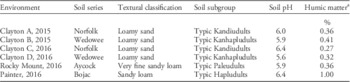
The experiment was conducted in two separate fields each year on the Central Crops Research Station, Clayton, NC (35.67°N, 78.51°W) during 2015 and 2016. The experiment also was conducted at the Upper Coastal Plain Research Station, Rocky Mount, NC (35.90°N, 77.68°W) and the Eastern Shore Agricultural Research and Extension Center, Painter, VA (37.59°N, 75.82°W) in 2016. The combination of location and year comprised an environment. Soils at each environment are described in Table 1. Each environment was in a conventional tillage system. All environments had natural GR Palmer amaranth infestations exceeding 100 plants m−2. No PRE herbicides were applied to ensure heavy Palmer amaranth densities for POST treatments. Some environments also had annual grasses that were controlled as needed with clethodim applied at 100 g ai ha−1 (Select Max®, Valent USA, Walnut Creek, CA) plus crop oil concentrate at 1% (v/v) (Agri-Dex®, Helena Chemical Company, Collierville, TN).
Soil characteristics by environment.

a Soil pH and humic matter determined by the North Carolina Department of Agriculture and Consumer Services, Agronomic Division. Humic matter was determined photometrically according to Mehlich (Reference Mehlich1984).
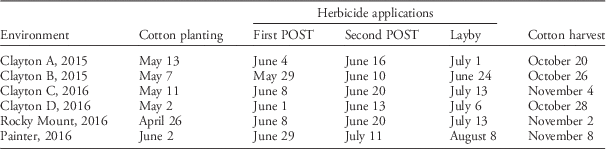
Dyna-Gro® cotton ‘3385 B2XF’ (Crop Production Services, Loveland, CO) was planted in 2015. Dyna-Gro® cotton ‘3526 B2XF’ was planted in 2016 at both environments in Clayton and in Rocky Mount. Cotton ‘DP 1538 B2XF’ (Monsanto, St Louis, MO) was planted in 2016 at Painter, VA. Cotton planting and harvest dates are in Table 2.
Cotton planting, herbicide application, and cotton harvest dates by environment.
The experimental design was a randomized complete block with five replications at the Clayton A, 2015 environment, four replications at the other environments in Clayton and Rocky Mount, and three replications at Painter. Plot size was four rows by 9.1 m at Clayton and Rocky Mount and four rows by 6.1 m at Painter. Row spacing was 97 cm at Clayton and 91 cm at Rocky Mount and Painter.
Treatments consisted of combinations of glufosinate, dicamba, and glufosinate plus dicamba applied POST twice. Palmer amaranth size at the first POST application (POST-1) ranged from 5- to 25-cm tall, with the predominant size being 16 cm in 2015. In 2016, Palmer amaranth at POST-1 ranged from 5 to 35 cm, with the predominant size being 23 cm. Cotton was in the 1- to 2-leaf stage at POST-1 in 2015 and the 2- to 3-leaf stage in 2016. The POST-1 application was followed by a second POST application (POST-2) 12 d later. Application dates are given in Table 2. Application rates included glufosinate-ammonium (Liberty® 280SL, Bayer CropScience, Research Triangle Park, NC) at 590 or 880 g ha−1 and dicamba diglycolamine salt (Clarity®, BASF Ag Products, Research Triangle Park, NC) at 560 g ha−1. Specific treatments are listed in Table 3; a nontreated check was also included. All plots except the nontreated checks also received a directed layby application of glyphosate potassium salt (Roundup PowerMax®, Monsanto) at 1,260 g ae ha−1 plus S-metolachlor (Dual Magnum®, Syngenta Crop Protection, Greensboro, NC) at 1,070 g ai ha−1 plus diuron (Direx® 4L, ADAMA, Raleigh, NC) at 1,120 g ai ha−1 14 to 15 d after POST-2 application (DAP2) in 2015 or 23 to 28 DAP2 in 2016. The POST herbicides were applied using a CO2-pressurized backpack sprayer calibrated to deliver 140 L ha−1 at 165 kPa. When glufosinate was applied alone, DG TeeJet® 11002 Drift Guard nozzles (TeeJet Technologies, Wheaton, IL) were used. When dicamba was applied alone or co-applied with glufosinate, TTI 110015 Turbo TeeJet® Induction nozzles (TeeJet Technologies) were used. Layby herbicides were applied using a CO2-pressurized backpack sprayer calibrated to deliver 140 L ha−1 at 206 kPa with a single flood nozzle (TK-VS2 FloodJet® wide angle flat-spray nozzle, TeeJet Technologies) per row middle.
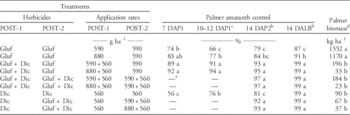
Palmer amaranth control and biomass as affected by glufosinate and dicamba applied POST.a,b

a Abbreviations: DAP1, days after POST-1, DAP2, days after POST-2; DALB, days after layby; Dic, dicamba; Gluf, glufosinate.
b Data for control at 7 DAP1 averaged over five North Carolina environments. Other data averaged over six environments. Means within a column followed by the same letter are not different at P ≤ 0.05 based on Fisher’s protected LSD.
c Palmer amaranth control recorded at 10 DAP1 at Painter, VA, environment and 12 DAP1 at North Carolina environments.
d Palmer amaranth biomass in nontreated check averaged 23,000 kg ha−1.
e Data (—) combined over POST-1 applications at 7 DAP1 and 10–12 DAP1.
Palmer amaranth control and cotton injury (primarily foliar necrosis) were estimated visually using a 0 to 100 scale (Frans et al. Reference Frans, Talbert, Marx and Crowley1986) at 7 and 12 d after POST-1 (DAP1) at North Carolina environments or 10 DAP1 at Painter, 14 DAP2, and 14 d following the layby application (DALB). Height of 20 cotton plants plot−1 was recorded at layby at all environments. The number of cotton main stem nodes at layby and cotton height 30 DALB were recorded from 20 randomly selected plants at all North Carolina environments. Palmer amaranth aboveground fresh biomass was collected in September from three row middles in treated plots (17 to 25 m2) and 1 m2 in the nontreated plots. In mid-September to early October, 10 cotton plants plot−1 at North Carolina environments were randomly selected to determine boll production and percentage of open bolls. Treated plots were mechanically harvested for seed cotton yield (Table 2). Cotton in nontreated checks could not be harvested due to the severe weed infestations, and yield was assumed to be zero. A sample of harvested seed cotton was collected from each plot and ginned to determine lint percentage. This lint percentage was used to convert seed cotton yield to lint yield. Each lint sample was analyzed for fiber strength, fiber length, fiber length uniformity, and micronaire using high-volume instrument analysis by Cotton Incorporated in Cary, NC.
Statistical analyses were performed using the PROC Mixed procedure in SAS (v. 9.3; SAS Institute, Cary, NC). The use of the method=type3 option in PROC Mixed allows for the evaluation of random by fixed interaction terms and provides better control of type I error rates than the default REML estimation (Moore and Dixon Reference Moore and Dixon2015; Stroup and Littell Reference Stroup and Littell2002). All data met model assumptions. Treatments were considered a fixed factor, and replication and environment were considered random factors. Treatment and environment did not interact for cotton height at layby, cotton nodes, total bolls, percent open bolls, lint yield, or any fiber-quality parameter, and therefore combined analyses occurred. A treatment by environment interaction for Palmer amaranth control, Palmer amaranth biomass, and cotton height 30 DALB merited further investigation to ascertain whether treatments were uniform over environments. The treatment mean square was at least 3-fold greater than the treatment by environment interaction mean square, providing justification to combine over environments. Additionally, environments were analyzed individually; similar trends existed among environments, further justifying combined analyses. Treatment means were reported using least-squares means. Nontreated checks were excluded from statistical analyses.
Results and Discussion
Palmer Amaranth Control
Differences among treatments were observed with Palmer amaranth control at 7 DAP1, 10 to 12 DAP1, 14 DAP2, and 14 DALB (P ≤ 0.001 for each). Glufosinate was similarly effective applied at 590 or 880 g ha−1, in combination with dicamba, and controlled Palmer amaranth 89% to 92% at 7 DAP1 and 91% to 94% at 10 to 12 DAP1 (Table 3). Mixtures of glufosinate plus dicamba were more effective than glufosinate at either rate applied alone or dicamba alone. Merchant et al. (Reference Merchant, Sosnoskie, Culpepper, Steckel, York, Braxton and Ford2013) also reported greater control of 15- to 25-cm Palmer amaranth by combinations of glufosinate plus dicamba compared with either herbicide applied alone. Palmer amaranth control by glufosinate alone declined 6% to 8% between 7 DAP1 and 10 to 12 DAP1. This was attributed to regrowth on plants escaping control. Inadequate control of Palmer amaranth greater than 7.5 cm is well documented (Culpepper et al. Reference Culpepper, York, Roberts and Whitaker2009, Reference Culpepper, Webster, Sosnoskie and York2010; Whitaker et al. Reference Whitaker, York, Jordan and Culpepper2011). In contrast, control by mixtures of glufosinate plus dicamba was similar at 7 and 10 to 12 DAP1, while control by dicamba alone increased 20% during this period. Dicamba kills plants more slowly than glufosinate, with an increase in control of susceptible plants by dicamba noted during the first 2 to 3 wk after application (Leon et al. Reference Leon, Ferrell and Brecke2014).
By 14 DAP2, all treatments containing a mixture of glufosinate plus dicamba controlled Palmer amaranth 92% to 97% (Table 3). Glufosinate rate did not influence Palmer amaranth control. Dicamba or glufosinate applied alone twice controlled Palmer amaranth less than 85%.
Glyphosate plus S-metolachlor plus diuron applied layby increased control in all treatments (Table 3). Following the layby application, control by dicamba alone applied twice was greater than control by glufosinate alone applied twice and similar to control by dicamba plus glufosinate applied twice. Palmer amaranth was controlled 99% by all treatments except those with glufosinate applied alone twice (87% to 91%). Similar results were noted with late-season Palmer amaranth biomass. Greater weed biomass was noted in glufosinate-only treatments compared with those containing dicamba. Biomass was similar in all treatments containing dicamba. Compared with the nontreated check, glufosinate applied alone reduced biomass 93% to 95%, while all treatments containing dicamba reduced biomass at least 99%. Cahoon et al. (Reference Cahoon, York, Jordan, Everman, Seagroves, Culpepper and Eure2015b) reported 91% to 98% Palmer amaranth control 14 d after a layby application of diuron plus MSMA when dicamba was included in the first, second, or first and second application of glufosinate.
Cotton Growth and Injury
Cotton injury at 7 DAP1 at North Carolina environments or 10 DAP1 at Painter was 4% or less and consisted primarily of minor foliar necrosis (unpublished data). This injury was transient; no injury was observed at 14 DAP2 at any environment. Previous research has documented transient injury and rapid recovery when dicamba and glufosinate were applied to XtendFlexTM cotton (Cahoon et al. Reference Cahoon, York, Jordan, Everman, Seagroves, Culpepper and Eure2015b; Dixon et al. Reference Dixon, Dodds, Copeland, Reynolds, Samples, Barber, Main and Mills2014).
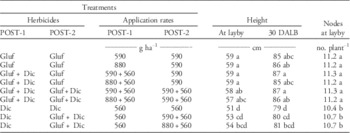
Treatment effects were noted with cotton height at layby, height at 30 DALB, and nodes at layby (P = 0.001 for each). Cotton height and nodes at layby and cotton height at 30 DALB were less when dicamba was applied alone POST-1 compared with glufosinate plus dicamba at POST-1 (Table 4). This can be attributed to prolonged early-season competition resulting from a slower Palmer amaranth death where dicamba was applied alone compared with glufosinate alone or dicamba co-applied with glufosinate (Table 3). Cotton height and number of nodes were similar when glufosinate was applied alone or when glufosinate was co-applied with dicamba (Table 4).
Cotton height and nodes as affected by glufosinate and dicamba applied POST.a,b

a Abbreviations: DAP1, days after POST-1; DALB, days after layby; Dic, dicamba; Gluf, glufosinate.
b Data for height at layby, nodes at layby, and injury averaged over six environments. Data for height 30 DALB averaged over five North Carolina environments. Means within a column followed by the same letter are not different at P ≤0.05 based on Fisher’s protected LSD.
Cotton Boll Production, Maturity, Lint Yield, and Fiber Quality
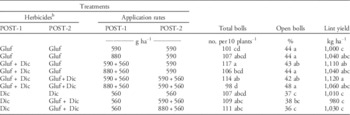
Herbicide treatment effects were noted for total boll production, percent open bolls, and lint yield (P = 0.03, 0.003, and 0.02, respectively). Boll production and lint yield were generally greatest in treatments containing glufosinate at 590 g ha−1 plus dicamba POST-1 (Table 5). Boll production and lint yield were similar with glufosinate at 590 g ha−1 POST-1 followed by glufosinate 590 g ha−1 POST-2 and glufosinate at 880 g ha−1 POST-1 followed by glufosinate at 590 g ha−1 POST-2. Additionally, boll production and lint yield were similar with glufosinate alone at 880 g ha−1 POST-1 and treatments containing glufosinate at 590 g ha−1 plus dicamba POST-1. Consistent with differences noted in Palmer amaranth control (Table 3), boll production and lint yield were greater in the two treatments with glufosinate at 590 g ha−1 plus dicamba POST-1 than in the treatment with glufosinate alone at 590 g ha−1 POST-1 (Table 5). Interestingly, boll production was 9% to 14% less in treatments with glufosinate at 880 g ha−1 plus dicamba POST-1 compared with treatments receiving glufosinate at 590 g ha−1 plus dicamba POST-1. Although not statistically significant, a similar trend was noted for lint yield. Numerically, lint yield was 5% to 6% less with treatments containing glufosinate at 880 g ha−1 plus dicamba POST-1 and those containing glufosinate at 590 g ha−1 plus dicamba at POST-1. These differences in boll production and lint yield could not be attributed to differences in cotton injury (Table 4).
Cotton boll production, percent open bolls, and lint yield as affected by glufosinate and dicamba applied POST.a

a Data for lint yield averaged over six environments. Data for total bolls and open bolls averaged over the five North Carolina environments. Means within a column followed by the same letter are not different at P ≤ 0.05 based on Fisher’s protected LSD.
b Abbreviations: Dic, dicamba; Gluf, glufosinate.
The reduced cotton height and node number (Table 4) in treatments receiving only dicamba POST-1 was not reflected in boll production (Table 5). The cotton appeared to recover from the effects of early-season competition in treatments with only dicamba POST-1 and was able to set a similar number of bolls compared with other treatments. However, the maturity of the crop, measured as percent open bolls, was delayed in treatments receiving only dicamba POST-1. Cotton harvest occurred at least 3 wk after the open-boll counts, and visual examination indicated all harvestable bolls were open when the cotton was picked. Lint yield, but not boll production, was less with treatments that contained only dicamba at POST-1 compared with treatments containing glufosinate at 590 g ha−1 plus dicamba at POST-1. Boll weight was not determined, but boll weight may have been less in plots receiving only dicamba POST-1 due to early competition with slowly dying Palmer amaranth. Cotton boll production was reduced 90% to 93% in the nontreated check, and only 15% of bolls in the nontreated check were open when evaluated (unpublished data).
Herbicide treatments did not impact fiber quality. Averaged over treatments and environments, fiber micronaire, fiber strength, fiber length, and fiber length uniformity were 4.9, 27.7 g tex−1, 1.07 mm, and 82.3%, respectively (unpublished data).
Results of this experiment show potential for rescue control of Palmer amaranth in Bollgard II® XtendFlexTM cotton with co-application of dicamba and glufosinate. Co-application of dicamba plus glufosinate was more effective on Palmer amaranth beyond the optimum size for treatment than either herbicide applied alone. Merchant et al. (Reference Merchant, Sosnoskie, Culpepper, Steckel, York, Braxton and Ford2013) also reported improved Palmer amaranth control when glufosinate and dicamba, glufosinate and 2,4-D, or glufosinate and 2,4-dichlorophenoxy butyric acid were co-applied compared with either herbicide applied alone. In addition to improved control, a co-application would reduce selection pressure on both herbicides compared with application of herbicides individually (Behrens et al. Reference Behrens, Mutlu, Chakraborty, Dumitru, Jiang, LaVallee, Herman, Clemente and Weeks2007; Norsworthy et al. Reference Norsworthy, Ward, Shaw, Llewellyn, Nichols, Webster, Bradley, Frisvold, Powles, Burgos, Witt and Barrett2012). The layby herbicides masked some of the earlier differences in control among treatments, and there was a definite benefit from the layby application. A directed layby herbicide application is recommended in Palmer amaranth management programs (Culpepper Reference Culpepper2016; York Reference York2017), but most growers have abandoned the practice because directed applications are slow and tedious.
Tank mixtures of glufosinate plus dicamba formulations registered for use in Bollgard II® XtendFlexTM cotton are currently prohibited (Anonymous 2017a, 2017c), presumably because the ammonium salt formulation of glufosinate increases dicamba volatility. Research is needed to compare efficacy of sequential applications of dicamba followed by glufosinate or glufosinate followed by dicamba with that from co-applications of the two herbicides. Merchant et al. (Reference Merchant, Culpepper, Eure, Richburg and Braxton2014) reported less control of large Palmer amaranth with 2,4-D followed by glufosinate compared with sequential application of 2,4-D plus glufosinate in nonirrigated cotton, whereas control was similar in irrigated cotton.
A weed-free check and treatments without the layby application were not included in this experiment, so it could not be determined whether the approximately 80% Palmer amaranth control at 14 DAP2 with dicamba or glufosinate alone applied twice would have been adequate to protect the crop against yield loss in the absence of the layby application. Considering the heavy infestation of Palmer amaranth at these sites, a yield reduction may have occurred in the absence of the layby application (Cahoon et al. Reference Cahoon, York, Jordan, Everman and Seagroves2014, Reference Cahoon, York, Jordan, Everman, Seagroves, Culpepper and Eure2015b; Culpepper et al. Reference Culpepper, York, Roberts and Whitaker2009). Enough Palmer amaranth seed would certainly have been produced to replenish the seedbank. Dicamba and glufosinate labels (Anonymous 2017b, 2017d) would allow a third POST application, and a third application would be expected to increase control. However, with its different chemistry, a layby application would be aligned with sound resistance management (Norsworthy et al. Reference Norsworthy, Ward, Shaw, Llewellyn, Nichols, Webster, Bradley, Frisvold, Powles, Burgos, Witt and Barrett2012).
Adverse weather conditions for herbicide application and equipment and labor constraints inevitably lead to POST herbicides being applied to weeds beyond the optimum size for treatment. However, rescue applications should be avoided when possible. Application to weeds larger than the recommended size for treatment simulates sublethal dosages (Tehranchian et al. Reference Tehranchian, Norsworthy, Powles, Bararpour, Bagavathiannan, Barber and Scott2017), and sublethal recurrent selection can lead to resistance in a few generations (Ashworth et al. Reference Ashworth, Walsh, Flower and Powles2016; Norsworthy Reference Norsworthy2014). Tehranchian et al. (Reference Tehranchian, Norsworthy, Powles, Bararpour, Bagavathiannan, Barber and Scott2017) reported resistance to dicamba in Palmer amaranth after three generations of exposure to sublethal rates.