



Deprescribing is a critical component of psychiatric pharmacotherapy, and is most commonly implemented through tapering, a strategy in which doses are progressively reduced to minimise withdrawal symptoms and other adverse effects. Reference Baldessarini and Tondo1 Gradual tapering allows the central nervous system to accommodate decreasing drug concentrations and reduces the risks associated with abrupt cessation. 2 Recent leading guidelines – such as those from the Royal College of Psychiatrists, the National Institute for Health and Care Excellence and The Maudsley Deprescribing Guidelines in Psychiatry (2024) – recommend gradual, hyperbolic dose reduction. Reference Horowitz and Taylor3–5 This approach relies on exponential (proportionate) decrements to promote gradual neuroadaptation and maintain an approximately linear decline in receptor occupancy. Expert groups in the field, including the International Institute for Psychiatric Drug Withdrawal (www.iipdw.org) and the Psychotropic Deprescribing Council (www.psychdeprescribing.org), also support this strategy, reflecting growing scientific evidence for its relevance in minimising withdrawal-related harm.
In exponential tapering, each new dose is calculated as a fixed percentage reduction of the preceding dose rather than of the original dose. Reference Horowitz and Taylor4–Reference Horowitz, Jauhar, Natesan, Murray and Taylor6 For example, a 10% exponential taper from 5 mg produces progressively smaller absolute reductions as the dose decreases. Although tapering occurs in uneven steps, the resulting trajectory of receptor occupancy closely approximates that of reductions derived directly from dose–response curves, which underlie the term hyperbolic tapering. Figure 1 illustrates an exponential taper for haloperidol. D2 receptor occupancy (percentage) was estimated using the dose–response curve equation applied to the doses in the tapering scheme. The final stage of tapering – when doses approach zero – is particularly critical, as even small absolute decrements may produce steep declines in receptor occupancy, increasing the risk of relapse. Reference Horowitz, Jauhar, Natesan, Murray and Taylor6 Achieving extremely low doses is therefore essential for a safe and physiologically coherent taper.
Graphical illustration showing the relationship between haloperidol doses (from 5 to 0 mg) and D2 receptor occupancy (%) under an exponential taper at a constant rate of 10%. D2 occupancy (%) was estimated using the dose–response equation obtained from positron emission tomography data: haloperidol dose = occupancy × 0.65 / (91.9 – occupancy). Reference Eserian, Blanco, Mercuri, Matos and Galduróz7,Reference Lako, van den Heuvel, Knegtering, Bruggeman and Taxis8

Current clinical guidelines acknowledge that commercially available dosage strengths rarely provide the fine gradations needed for exponential or otherwise individualised tapering. 2,5 As a result, smaller and very small doses are often prepared through physical manipulation of existing dosage forms, including tablet splitting, tablet suspension in water, liquid dilution, counting or weighing beads from capsules, and combining tablet fractions with liquid formulations. These practices allow clinicians to implement gradual dose reduction regimens despite the limitations of fixed-dose products. Our central hypothesis – subject to experimental verification – was that any split tablet, tablet suspension or portion of a liquid formulation, whether diluted or not, administered alone or in combination with whole tablets, delivers a drug content proportional to the intended fraction of the original dose.
This study therefore aimed to perform pharmaceutical analyses to assess the accuracy and precision of progressively smaller doses obtained through pharmaceutical dosage form manipulations, as recommended in current guidelines for hyperbolic tapering of psychiatric medications. By providing experimental evidence regarding the safety and practicality of these strategies, we sought to evaluate the extent to which real-world clinical tapering practices are supported by the reliability of these off-label manipulations.
Method
This was a laboratory-based study conducted without patient involvement. All manipulations were performed by a trained pharmacist under controlled laboratory conditions to reduce variability and ensure consistency among dose preparations.
Obtaining individualised smaller doses
To enable exponential tapering, current guidelines recommend the use of small and very small doses obtained through drug manipulation techniques. These include tablet splitting, liquid dilution, counting or weighing beads from capsules, suspending tablets or capsule contents in water, and combining tablet fragments with liquid formulations. 2,5
This is necessary because fixed-dose products rarely cover the range required to implement tapering approaches. As a result, medicines are often subjected to modifications involving physical manipulation of the original dosage form, with the purpose of obtaining doses suitable for gradual dose reduction schemes.
For the purposes of this study, manipulation refers specifically to the physical alteration of a drug dosage form undertaken to obtain and administer the required fraction of the original dose. This definition excludes any manipulations carried out solely for convenience or driven by patient preference.
Samples
Haloperidol was selected as a model drug to illustrate pharmaceutical dosage form manipulations for progressively smaller doses, given its potency as an antipsychotic and availability in both tablet and liquid forms. These methods and findings are nevertheless applicable to other psychiatric drugs, highlighting their broader relevance in dose reduction strategies.
Techniques for preparing smaller doses
An exponential tapering scheme involving successive 10% dose reductions was developed, ranging from 5 mg of haloperidol to 0 mg. Target doses were approximated to the most feasible values, considering practical constraints. Three commercial formulations from the same manufacturer were employed: 5 and 1 mg tablets and a 2 mg/mL oral solution.
Four main strategies were applied to obtain intermediate and small doses (Fig. 2). For very small doses, two complementary approaches – diluted liquid and tablet suspension, both measured with a dosing syringe – were used to complete the tapering scheme.
Experimental strategies for achieving progressively smaller haloperidol doses. Four approaches following an exponential tapering scheme were compared. All strategies followed a 10% taper rate, ranging from 5 to 0 mg.

All dose manipulation techniques adopted in this study were based on practical clinical guidance published by the Royal College of Psychiatrists. 2 For more detailed instructions and practical examples, the original guidance should be consulted.
All strategies began with an initial dose of 5 mg (one whole tablet). For strategies involving tablet splitting, smaller doses were obtained primarily using halves (2.5 or 0.5 mg) and quarters (1.25 and 0.25 mg), with the aid of a tablet cutter. Whenever tablets alone could not provide the target dose, the remaining portion was prepared using the liquid. For the liquid-based strategies, volumes were calculated according to the nominal concentration of the oral solution (2 mg/mL). For example, a target dose of 0.8 mg was prepared by measuring 0.4 mL of the solution using a dosing syringe, or, when using the original dropper, by counting eight drops (1 drop being equal to 0.1 mg). Depending on the strategy, volumes were measured either using the original dropper (drop counting) or a dosing syringe, within a range of 0.02 to 1 mL.
In strategies involving combined solid and liquid manipulations, partial tablet doses were complemented with measured volumes of the oral solution to achieve intermediate target doses that could not be obtained using a single dosage form alone. For example, a target dose of 1.25 mg was prepared either by using one quarter of a 5 mg tablet (1.25 mg), or by combining one 1 mg tablet with 0.12 mL of the 2 mg/mL oral solution measured using the dosing syringe, yielding a total dose of 1.24 mg. Alternatively, one 1 mg tablet combined with two drops of the oral solution resulted in an estimated dose of 1.2 mg.
Similarly, for smaller doses, a target dose of 0.7 mg was obtained by combining half of a 1 mg tablet (0.5 mg) with 0.1 mL of the oral solution measured using the dosing syringe (0.2 mg). A dose of 0.65 mg was prepared by combining one quarter of a 1 mg tablet (0.25 mg) with four drops of the oral solution (0.4 mg).
For diluted liquid preparations, the required volume of the oral solution was first measured using a graduated cylinder, and then diluted in water to obtain a weaker concentration. For instance, 1 mL of the 2 mg/mL solution was diluted with water to a final volume of 10 mL, to yield a 0.2 mg/mL solution, from which smaller doses (e.g. 0.16 mg measured as 0.8 mL) could be drawn using the dosing syringe.
For the preparation of the tablet suspension, tablets were crushed and dispersed in water, followed by vigorous manual agitation for 2 min. The resulting suspension was used to measure portions corresponding to the intended doses with the dosing syringe. As an illustrative example, a suspension was prepared by crushing one 1 mg tablet and dispersing it in 10 mL of water (nominal concentration, 0.1 mg/mL, calculated from the labelled tablet strength and the fixed volume of water added). A 0.4 mL aliquot was withdrawn with the dosing syringe immediately after agitation, corresponding to an intended dose of 0.04 mg.
Assay of haloperidol content
Haloperidol content was determined according to the United States Pharmacopeia (USP) monograph for whole tablets and oral solutions. For manipulated doses, proxy methods based on the USP monograph were used, 9 since no official procedures exist for split tablets, diluted liquids, tablet suspension or individual drops. This ensured consistent comparison of dose accuracy and precision across manipulation methods.
The assay was performed by high-performance liquid chromatography (Alliance; Waters, USA) under the following conditions: mobile phase consisting of methanol (Merck, Germany) and potassium phosphate buffer solution (Dinâmica, Brazil) at pH 4.0 (70:30, v/v); ultraviolet detection at 247 nm; C18 column 4.6 mm × 25 cm, 5 µm (Waters, USA); flow rate of 1 mL/min and injection volume of 50 µL.
A brief verification of the method was performed to confirm analytical robustness. Linearity was assessed through three independent calibration curves within the 10–30 ppm range, all showing correlation coefficients above 0.999, in accordance with the acceptance criterion (r ≥ 0.999). Accuracy, determined from the linear regression of spiked samples, yielded a slope of 0.954 with a 95% confidence interval of 0.895–1.012, indicating compliance with the acceptance criterion. Precision, expressed as the relative standard deviation (%RSD) of replicate determinations, was 1.4%, below the 2% limit adopted for quantitative assays. Peak purity testing confirmed specificity under the chromatographic conditions applied. 10–12
Haloperidol content was considered acceptable if it ranged from 90.0 to 110.0% of the labelled claim, or, in the case of manipulated preparations, if it corresponded to 90.0 to 110.0% of the expected amount based on the portion taken from the original dose. 9
Data analysis and statistical procedures
Data acquisition and integration were performed using Empower software version 3 for Windows (Waters Corporation, Milford, Massachusetts, USA; https://www.waters.com). Quantitative results were exported to Microsoft Excel (version 16.98 for macOS) for further analysis. Measured concentrations were used to determine the actual amount of haloperidol in each individual dose, considering 100% as the target nominal dose. Mean values and %RSD were calculated for each tapering strategy.
Results
Comparison among strategies
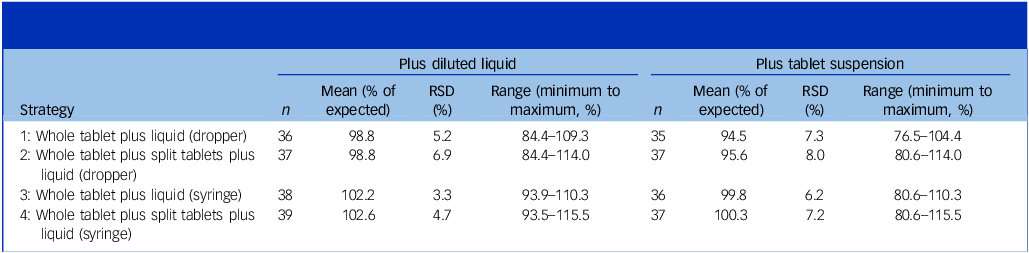
All four strategies yielded mean values within the acceptance range of 90–110% of the expected amount, with RSD not exceeding 8.0% (Table 1). Figure 3 illustrates the distribution of individual values for each strategy. Each strategy comprised approximately 37 steps from the initial 5 mg dose of haloperidol to complete withdrawal, reflecting a highly gradual and meticulously structured exponential dose reduction sequence.
Haloperidol content throughout exponential tapering from 5 mg down to 0 mg, compared with the expected dose (100%) and the acceptance limits of 90–110%, using four strategies to obtain intermediate and small doses: strategy 1, whole tablet plus liquid (dropper); strategy 2, whole tablet plus split tablets plus liquid (dropper); strategy 3, whole tablet plus liquid (syringe); and strategy 4, whole tablet plus split tablets plus liquid (syringe). The lowest dose reductions were completed using two complementary approaches: (a) diluted liquid and (b) tablet suspension.

Mean values, relative standard deviations and ranges for haloperidol doses obtained using four strategies to achieve intermediate and small doses, as well as two complementary approaches – diluted liquid and tablet suspension – used to complete the tapering scheme

RSD, relative standard deviation.
Discrete deviations (up to 5% outside of the 90–110% limits) were mainly observed for split tablets and drop-based preparations. These deviations occurred at intermediate or very small doses (e.g. 114% for half plus one quarter of a 1 mg tablet, 115.5% for one quarter of a 1 mg tablet plus 0.06 mL, 87.6% for half of a 1 mg tablet plus one 1 drop, 88.7% for four drops and 84.4% for one drop). When considering only drop-based doses, several values were near or below the lower acceptance limit (one drop equalled 84.4%; two drops equalled 91.8%; three drops equalled 91.6%; four drops equalled 88.7%). Such deviations are associated with the dispensing accessory rather than the product itself, as previously described. Reference Eserian, Lombardo, Chagas and Galduróz13
Tablet splitting introduced greater variability, and the dropper mechanism contributed to lower accuracy in the smallest doses. Diluted liquid yielded mean values closer to the expected content and lower variability compared with tablet suspension at the same intended doses.
Among the evaluated strategies, strategy 3 ‘(whole tablet plus liquid measured with a dosing syringe) plus diluted liquid’ provided the best accuracy and precision.
Measurement performance at very small volumes
Accurate measurement using a 1 mL dosing syringe appeared to become increasingly difficult below 0.2 mL, as reflected by increased variability in measured dose content, reinforcing the importance of using higher dilution factors when approaching the terminal steps of an exponential taper. This observation was supported by additional exploratory measurements showing systematic overestimation when very small volumes of undiluted liquid were measured. For example, direct measurement of 0.04 and 0.02 mL yielded 115.8% and 154.9% of the nominal doses (0.08 and 0.04 mg, respectively), whereas obtaining the same target doses from diluted solutions using larger measured volumes (0.4 and 0.2 mL) reduced deviations to 104.7% and 109.3%. Overall, dose preparation schemes relying on syringe-measured volumes below 0.2 mL showed lower accuracy and precision (mean 112.1% of expected dose; RSD 15.0%), whereas schemes using larger measured volumes enabled by liquid dilution demonstrated improved performance (mean 104.7%; RSD 3.4%).
Discussion
Principal findings
Taken together, the strategies evaluated were feasible for obtaining progressively smaller doses, with most values falling within adapted acceptance ranges derived from pharmacopoeial criteria. Although minor deviations occurred – mainly with split tablets, drop-based preparations and tablet suspension – the overall performance was consistent with the requirements for implementing gradual dose reduction schemes. These results provide experimental support for dose-obtaining methods commonly recommended in contemporary clinical guidelines for hyperbolic tapering.
Technical limits for achieving smaller doses
In strategies involving tablet splitting (strategies 2 and 4), the lowest achievable tablet-based dose was 0.25 mg, corresponding to one quarter of a 1 mg tablet. In strategies without tablet splitting (strategies 1 and 3), any dose <1 mg required the exclusive use of the liquid formulation.
Because the commercial dropper dispenses 0.1 mg per drop, only doses based on whole-drop increments could be measured (e.g. 0.1 mg, 0.2 mg, 0.3 mg). Missing doses were therefore obtained either from the undiluted liquid measured directly with the syringe or from diluted solutions prepared to enable syringe measurement.
For smaller doses obtained from tablet suspension, vigorous agitation becomes a critical procedural step, particularly for active substances with low aqueous solubility, such as haloperidol. Reference Demoen14 Under these conditions, the drug does not dissolve, but instead forms a suspension, which must be re-homogenised immediately before dose measurement, to ensure adequate drug recovery.
In the present study, when the measured dose was obtained without prior agitation – allowing the suspension to settle – only 18% of the expected haloperidol content was recovered. This finding highlights agitation before dose measurement as the key determinant of dose accuracy in this strategy, and underscores how minor deviations in handling can result in substantial underdosing.
Although diluted liquid showed better preservation of dose proportionality, with values clustering closer to the expected content, tablet suspension exhibited a more erratic profile, particularly in the final dose reductions. This is likely because of rapid sedimentation and the strong dependence on agitation and timing during dose measurements, making this approach more challenging to implement.
Accuracy and precision declined when measuring volumes below approximately 0.2 mL with the dosing syringe, reflecting practical constraints rather than an intrinsic limitation of the haloperidol product. The use of more diluted liquid preparations and tablet suspensions enabled the measurement of larger volumes at the final tapering levels, thereby reducing relative error.
Clinical implications for hyperbolic tapering
Given the hyperbolic relationship between haloperidol dose and D2 receptor occupancy, excessive variability – particularly in the lowest ranges – may destabilise the tapering trajectory, potentially producing abrupt declines in receptor occupancy. This may increase the likelihood of withdrawal symptoms, or other adverse outcomes. The ability to obtain smaller and more individualised doses, therefore, has direct clinical implications for maintaining the near-linear receptor-occupancy decline targeted by modern hyperbolic tapering approaches. Reference Horowitz, Jauhar, Natesan, Murray and Taylor6
Antipsychotic drugs are widely recognised as a central component in the management of psychotic disorders. Reference Williams, Ostinelli, Agorinya, Minichino, De Crescenzo and Maughan15 However, as patients continue on antipsychotic treatment, situations may arise where doses need to be modified – such as the emergence of adverse effects, changes in the patient’s condition or planned adjustments to treatment regimens – underscoring the need for tapering strategies to mitigate withdrawal-related complications.
Abrupt dose reduction or withdrawal of antipsychotics may trigger withdrawal phenomena related to neuroadaptive changes in the dopaminergic system, most notably rebound psychosis and supersensitivity psychosis. The former refers to a rapid and transient exacerbation of psychotic symptoms occurring after treatment changes, typically lasting less than 6 weeks, whereas the latter denotes a post-withdrawal condition in which symptoms persist beyond this period. To reduce the risk of these events, antipsychotic doses should be reduced very gradually, particularly at the lowest dose levels. Reference Chouinard, Samaha, Chouinard, Peretti, Kanahara and Takase16,Reference Cosci and Chouinard17
In the context of antipsychotics – and psychiatric drugs more broadly – hyperbolic tapering strategies have been proposed as a safer approach, despite pharmaceutical challenges related to the limited availability of individualised doses in the current market and the frequent need for off-label use. Even when complete treatment withdrawal is not achievable, gradual dose reduction toward the lowest possible dose may still be clinically meaningful, as lower doses can reduce adverse effects, improve tolerability and help align treatment with patient preferences, potentially enhancing long-term quality of life. Reference Wunderink18,Reference Moncrieff, Gupta and Horowitz19
From a clinical standpoint, our findings also reinforce the feasibility of individualised tapering even in the absence of formulations specifically designed for gradual dose reduction. They further illustrate how pragmatic dose-obtaining strategies can support smoother reductions and help mitigate withdrawal risks, as shown by the hyperbolic relationship between estimated D2 receptor occupancy and the actual doses achieved across strategies (Fig. 4).
Hyperbolic curves showing the relationship between actual haloperidol doses and estimated D2 receptor occupancy (%) according to the dose–response equation. Reference Lako, van den Heuvel, Knegtering, Bruggeman and Taxis8 Each curve represents a different tapering strategy, overlaid in a single plot to allow direct comparison of dose–response profiles. A hyperbolic dose reduction scheme was applied at a constant 10% exponential decrease, from an initial dose of 5 mg down to 0 mg, using the four strategies to achieve intermediate and small doses: strategy 1, whole tablet plus liquid (dropper); strategy 2, whole tablet plus split tablets plus liquid (dropper); strategy 3, whole tablet plus liquid (syringe); and strategy 4, whole tablet plus split tablets plus liquid (syringe), as well as two complementary approaches – (a) diluted liquid and (b) tablet suspension – used to complete the final stages of the tapering scheme at the lowest dose levels.

Regulatory and practical considerations
In routine psychiatric practice, dose adjustments often extend beyond what is explicitly supported by product labelling. This creates a scenario in which clinicians and patients frequently rely on off-label strategies to achieve dose flexibility, particularly when aiming for gradual or hyperbolic reductions. Such practices are not inherently exceptional; rather, they stem from the limited availability of formulations capable of supporting individualised tapering regimens. Reference Van Norman20
The manipulations evaluated in this study – including tablet splitting, tablet suspension in water and liquid dilution – are not explicitly addressed in product labelling, and therefore constitute off-label practices. This situation illustrates a broader regulatory blind spot: although marketed dosage forms are generally not designed to support individualised tapering regimens, psychiatric clinical practice often relies on such manipulations to enable smoother and more gradual dose reductions.
From a regulatory perspective, these findings highlight a structural gap between product design and clinical needs. Current dosage strengths and formulations do not accommodate hyperbolic tapering and small dose regimens. Addressing this gap would require not only clearer regulatory guidance on off-label manipulation practices, but also the development of commercially available small and very small dose formulations that align with real-world tapering needs.
Although these techniques fall outside of formal regulatory frameworks, our results show that most manipulated doses met adapted pharmacopoeial acceptance criteria derived from marketed products. This provides an evidence-based justification for their cautious use in clinical settings, and reinforces the idea that practical solutions already adopted in routine psychiatric care can be both feasible and reliable. These findings strengthen the argument for regulatory bodies and manufacturers to support tapering-friendly formulations and clearer guidance for safe off-label dose modifications.
Study limitations
This study has limitations. First, the experiments were conducted exclusively with haloperidol and specific marketed formulations, which may limit the generalisability of the findings to other drugs with different physicochemical and pharmaceutical properties.
Second, the study focused on the technical feasibility and dosing accuracy and precision of manipulation strategies, without evaluating clinical outcomes such as efficacy, safety or withdrawal symptoms.
Third, regarding tablet suspensions, the experimental design was based on the addition of a fixed volume of liquid during preparation, without adjustment to a predefined final volume. As a result, dose calculations relied on nominal concentrations derived from the added liquid volume rather than on the actual final preparation volume. This may have contributed to discrepancies between the nominal and actual drug amounts, and should therefore be considered when interpreting the results and extrapolating these findings to preparation procedures that rely on adjustment to a predefined final volume.
Finally, only a limited number of manipulation strategies were assessed under controlled laboratory conditions, and in real-world practice, patients may struggle to manipulate these products accurately, potentially leading to different dosing outcomes.
Future investigations assessing other drugs, dosage forms and preparation techniques, informed by different psychiatric tapering guidelines, are warranted to reflect the diversity of tapering practices in routine care.
Practical considerations for implementing hyperbolic tapering
Implementing hyperbolic tapering in routine psychiatric care is challenging because standard dosage forms are generally unsuitable for achieving the very small doses required in the final stages of reduction. Even liquid formulations – often assumed to be flexible – may require additional manipulation to provide sufficiently fine dose decrements.
These manipulations introduce practical and technical vulnerabilities: they are time-consuming, demand calculation accuracy and rely on consistent preparation techniques. Reference Skwierczynski and Conroy21 Without appropriate technical oversight, uncertainties regarding dose uniformity and administration accuracy may undermine the intended pharmacological smoothness of a hyperbolic taper.
Given these limitations, tapering strategies must be supported not only by robust treatment planning, but also by technically reliable methods for dose adjustment. Below, we outline key clinical and technical considerations that can help align tapering practice with both patient safety and dose accuracy.
Clinical considerations are as follows:
-
(a) Rely on evidence-based frameworks: tapering regimens should be guided by evidence-informed principles and best practice recommendations to provide structured reference points for gradual and individualised dose reduction. 2,Reference Horowitz and Taylor3,5
-
(b) Document and communicate the plan clearly: a tapering plan should be formally documented, specifying target doses, intervals between reductions and monitoring strategies, ensuring that all parties involved share a common understanding of the process.
-
(c) Ensure alignment between the patient and clinical team: medication withdrawal should neither be imposed nor discouraged, but openly and transparently discussed. The process should be conducted in partnership with the patient, considering their preferences, values and individual pace. Reference Read, Moncrieff and Horowitz22
-
(d) Respect the patient’s subjective experience: recognising withdrawal symptoms as legitimate is crucial to avoid invalidating the patient’s experience and to allow for appropriate adjustment of the tapering strategy, including the pace of dose reduction. Reference Read23,Reference Read24
Technical considerations are as follows:
-
(a) Prefer larger measurable volumes: very small liquid volumes should be avoided because of dosing inaccuracy. Diluting the liquid at lower dose levels allows for larger and more reliable volumes to be measured during the final tapering steps.
-
(b) Ensure adequate agitation of the tablet suspension: immediately before dose measurement, the suspension should be vigorously agitated to ensure maximal homogeneity and adequate drug recovery.
-
(c) Ensure professional oversight: all manipulations of pharmaceutical products must be performed with great care, based on medical recommendations and under the supervision of a pharmacist, to ensure that tapering strategies remain both safe and clinically effective.
-
(d) Consider the use of tapering strips when available: tapering strips can offer a practical and standardised means of implementing gradual dose reductions, minimising the need for complex product manipulations. Reference Groot and van Os25 However, in countries where these products are not marketed or authorised, dose reduction can still be pursued safely through well-designed manipulation strategies.
Achieving progressively smaller doses in hyperbolic tapering proved technically feasible using whole and split tablets, liquid formulations, diluted liquids and tablet suspensions. Although each strategy exhibited specific strengths and limitations, acceptable accuracy and precision were maintained across most of the tapering range. These findings provide empirical support for tapering practices commonly adopted in clinical settings, particularly in the absence of commercially available formulations designed to achieve progressively smaller doses. Despite their off-label nature, such approaches presently remain the only practical pathway toward gradual and safe medication reduction.
Overall, our findings provide robust experimental support for well-designed manipulation strategies, aligned with current clinical guidelines, as a practical and reliable component of individualised tapering regimens in routine psychiatric care.
Data availability
The data that support the findings of this study are available from the corresponding author, J.K.E., upon reasonable request. No custom analytic code was generated for this study. Chromatographic data were processed using Empower software, and statistical analyses were performed using Microsoft Excel. Therefore, no analytic code is available for public sharing. The materials supporting the findings of this study, including commercial pharmaceutical products and analytical standards, are not publicly available, as they were consumed during the experimental procedures. Detailed methodological information is provided in the Method section, and additional details may be obtained from the corresponding author upon reasonable request.
Author contributions
J.K.E. contributed to project administration, conceptualisation, methodology, investigation and writing the original draft of the manuscript. F.F.d.O. contributed to data curation, formal analysis and reviewing and editing the manuscript. L.P.M. contributed to study investigation, visualisation and writing the original draft of the manuscript. J.d.R.M. contributed to data curation, visualisation and reviewing and editing the manuscript. J.C.F.G. contributed to project administration, supervision and reviewing and editing the manuscript.
Funding
This study received no specific grant from any funding agency, commercial or not-for-profit sectors.
Declaration of interest
None.






eLetters
No eLetters have been published for this article.