Autobiographical memory (ABM), the recall of past personally experienced events, is central to psychological and social functioning. It allows individuals to define themselves in relation to others and to the past. A central principle in this field of study is that ABM is not veridical (or not like a video-taped record), but memories often change or are formed as a function of internal factors (e.g., beliefs and motivations) and external factors (such as suggestive interviewing techniques). Most studies in this area focus on typically developing children, and consequently, little is known about ABM and suggestibility of children with atypical development. The purpose of this study was to examine the accuracy and suggestibility of ABM in children with autism spectrum disorder (ASD). Although accuracy and suggestibility of ABM are intricately related and often assessed conjointly, for the purposes of clarity, the introduction first addresses accuracy and then suggestibility.
Accuracy of Autobiographical Recall
The major characteristic of autobiographical recall is that information about a past event is encapsulated within the broad organizational framework of things that have happened to me. Current evidence suggests that ABM begins to emerge between 2 and 3 years of age (Fivush, Gray, & Fromhoff, 1987; Howe, Courage, & Edison, 2003; Howe, Courage, & Peterson, 1994; Hudson, 1993), and continues to develop during childhood (Fivush et al., 1987; Haden, Haine, & Fivush, 1997; Howe et al., 1994; Nelson & Fivush, 2004). A review of the literature reveals that there are very few studies that directly examine this aspect of memory in children with ASD, and most of these existing studies examine memory for unconnected events.
Two studies of individuals with ASD have focused on source monitoring, a skill that involves the ability to remember the source of one's knowledge (e.g., “Did I say that or did you say that? Did I do that or did you tell me about that?”). In the first study, Russell and Jarrold (1999; Experiment 1) found that children with autism who had moderate linguistic impairments made more errors on a source monitoring task than typically developing but younger children of the same language level and than children with moderate learning disabilities. This pattern was not replicated by Farrant, Blades, and Boucher (1998), who found that children with autism and with moderate verbal impairments performed comparably to normally developing children of the same language level and to learning-disabled children of the same age and language level.
Two studies of memory for unconnected activities showed that children with autism remembered fewer activities (such as playing with a paper football and then with a box camera) after a few minutes delay (Boucher, 1981) and after a 12–14-month delay (Boucher & Lewis, 1989) than children with mental retardation (MR) of the same nonverbal level. These findings suggest that the mnemonic deficits of children with ASD were independent of their low IQs.
Only one study (Millward, Powell, Messer, & Jordan, 2000) has examined memory for coherent, dynamic, interactive, and personally experienced events (rather than for unconnected activities) among children with autism. In this study, children went on two 25-min walks near their school. As they passed distinct locations (e.g., a park, a shopping area), the experimenter pointed to certain events and commented (e.g., “Do you want to go on the slide?”). After the walk, children were asked open-ended questions (e.g., “Tell me what happened”) and cued/leading recall questions (e.g., “Have a look at this photograph. Can you tell me what you did in the park?). Children with autism (ages 12–16) with moderately severe language delays reported fewer events that happened to themselves than typically developing children (ages 5–6) who were matched for language ability. There were no group differences when reporting what happened to other people during the walk. Unfortunately, the analyses did not focus on errors; thus, it is not known if children with ASD are more likely to distort experienced events than normal children of the same language age. Finally, the performance of the children with ASD may have been compromised by the fact that the events were less interesting for 12- to 16-year-olds than for 5- to 6-year-olds.
Although the reviewed data suggest that there may be ABM deficits in children with ASD, their interpretation is limited by the fact that all the existing studies focus on children with mild to moderate language and cognitive deficits. Although researchers sometimes attempted to control for these deficits by matching children with and without autism on verbal or nonverbal measures, this procedure may not be precise enough to equate groups. In the present study, the possible confound of low levels of cognitive functioning on ABM is overcome by excluding children with moderate or severe cognitive impairments.
Despite the sparse data in this area, in light of work in two other fields of study, we predicted that children with ASD would have poorer ABM than typically developing children. The first area that motivated this prediction was research on the non-ABM skills of children with ASD. In the past few decades, there is mounting evidence of a specific rather than a general impairment in the memory of individuals with autism. Individuals with ASD show particular impairments on tasks that require organization of information in memory (e.g., Boucher, 1981; Fein et al., 1996; Hermelin & Frith, 1991; Minshew & Goldstein, 1993, 2001; Renner, Klinger, & Klinger, 2000; Tager-Flusberg, 1991; Toichi & Kamio, 2002, 2003). For example, Hermelin and Frith (1991) found that, unlike mental age (MA)-matched typically developing children or MA-matched mentally retarded children, children with autism did not find it easier to process meaningful versus unmeaningful information. The ability to organize information according to its meaning and to use this for recall of complex events is one example of the types of strategies that individuals use to overcome storage capacity limitations. Because recall of past personally experienced events requires encoding distinctive retrieval cues about complex stimuli (e.g., involving the who, what, when, and why of any event), one would expect deficits among individuals with autism on ABM tasks. On the other hand, it is possible that deficits on non-ABM tasks are unrelated to the ability to recall autobiographical information (Bruck & Melnyk, 2004).
The prediction that children with autism have ABM impairments is also consistent with two prominent theoretical accounts of ABM development in typically developing children. Although the two theories differ in their accounts of the precursors or origins of ABM, both emphasize a cadre of skills that are deficient in children with ASD. Each theoretical position is now described.
The cognitive self theory
According to Howe and colleagues (Howe et al., 1994, 2003; Howe & Courage, 1993, 1997), the emergence of the cognitive self (or self-recognition) heralds the onset of ABM. The attainment of self-recognition, which occurs around the later half of the second year of life in normally developing children, provides a new organization of the mnemonic system. Specifically, memories can now be categorically stored in terms of events that involve the self versus others. With maturation, the cognitive self becomes more complex, and consequently, the mechanism for organizing information about the self also becomes more complex. In support of this theory, Harley and Reese (1999) found that self-recognition at 19 months predicted children's memories of events at 25 and 32 months (see Howe et al., 2003, for similar findings). According to this theory, delays in self recognition result in ABM deficits.
Although there are no direct data to indicate that children with ASD have deficits in the onset of self-recognition,1
Because ASD is only diagnosed after 36 months, and because the onset of self-recognition normally occurs between 15 and 24 months, these data have not been collected in studies of children with ASD. With new research on the infant and toddler markers of autism (e.g., Landa & Garrett-Mayer, in press), researchers may choose in the future to include such tasks in longitudinal studies.
Social–cultural developmental theory
According to Nelson and Fivush (2004), ABM results from a complex, dynamic interplay of cognitive and social factors embedded within a particular social–cultural milieu. Although this framework includes factors such as basic memory abilities and the development of the cognitive self, its central focus is on the development of language and its use in social situations. According to this theory, parents teach their children to construct narratives about personal events by giving them prompts and cues during joint linguistic interactions. Mothers with elaborative styles of interaction while reminiscing with their children have children with better memories for personally experienced events than children of mothers with less elaborative styles (Fivush, Haden, & Reese, 1995; Reese, 2002). In addition, sharing narratives about past events provides children with an opportunity for rehearsal, which enhances memory (Craik & Tulving, 1975; Harley & Reese, 1999; Nelson, 1995). Finally, it is the narratives themselves that provide the basis for representing autobiographical memories.
According to this model, the emergence of ABM should be delayed in children with ASD because of their major deficits in language development (which is frequently marked by semantic and pragmatic difficulties, echolalia, and stereotyped use of language), social interaction, and social cognition. These social and linguistic deficits reduce the opportunity for verbal interactions that allow caretakers to teach children how to organize past events into a coherent structure. Even for ASD children with fairly typical semantic development, their social deficits impair the level of sustained communication (Tager-Flusberg, 1999; Tager-Flusberg & Anderson, 1991) that is thought to be the building block of ABM, according to this theory.
In summary, both the cognitive-self and the social–cultural theories predict deficits in the ABM of individuals with autism, particularly for early life events. Both theories predict that impairments in ABM would persist to the extent that social, cognitive, and communicative deficits persist. As such, memories of their early life should be poor, compared to that of their typically developing peers, but memories for recent events may be less impaired to the extent that delayed cognitive, social, and language skills are attained.
Although the present study was not designed to tease apart these various theories, we briefly described them because they provide a basis for predicting ABM deficits in youngsters with a combination of social, linguistic, and cognitive deficits, such as those displayed in individuals with ASD. Thus, we expected children with ASD to show deficits for events that occurred in early childhood, and, because of persistent deficits in language, cognitive, and social skills that characterize ASD, we predicted that these children would also show deficits for more recent personally experienced events.
Suggestibility of ABM
The extent to which reports of personally experienced events are tainted by false information (i.e., false suggestions) given by the interviewer has not been examined in children with ASD. In contrast, there is a significant body of studies that delineates the conditions under which typically developing children are suggestible (see Bruck & Ceci, 2004; Ceci & Bruck, 1995). The primary findings are that suggestibility decreases across childhood, with preschoolers being the most suggestible. Bruck and Ceci (1999) conceptualize suggestibility effects as resulting from a combination of social and cognitive factors. Cognitive factors include weak memory traces for the original event, poor source monitoring skills, poor understanding of the cognitive self, and impaired language development. Social factors include compliance, a desire to please the interviewer, and self-esteem. According to theoretical accounts (e.g., Ceci & Bruck, 1995), both classes of factors may operate simultaneously or sequentially. Thus, because of social factors, children may initially accept a suggestion that then may become incorporated into memory because children cannot remember whether they just heard about or really saw the suggested event (source monitoring errors).
Based on this review, there are two different hypotheses about the suggestibility of children with ASD. First, they may be less suggestible than typically developing children because their social and pragmatic deficits may make them insensitive to the social cues of misleading questions (i.e., answering to go along with or to please the interviewer); consequently, children with ASD would be less likely to acquiesce to an interviewer's suggestions. They may also be less suggestible if they have memory deficits that would result in forgetting the suggestion. Second, because of cognitive deficits, children with ASD might be more suggestible than typically developing children. For example, they may simply parrot an interviewer's words that contain misleading information and this might become incorporated into memory. In addition, if children with ASD have ABM deficits, they could be more suggestible than typically developing children. This prediction is based on some findings in the suggestibility literature that poorer memory of the actual event (i.e., poor ABM) is associated with higher rates of suggestibility in children (and adults; Howe, 1991; Marche, 1999; Pezdek & Roe, 1995). Based on this last finding, we predicted heightened suggestibility in children with ASD, only if their ABM was poor. However, we did not expect ASD children to display dramatically higher rates of suggestibility compared with typically developing children because children with ASD tend not to be highly outer-directed, compliant individuals.
Unexplored issues: The current study
As reviewed above, there is only one study on memory for connected meaningful experienced events among children with ASD (Millward et al., 2000), and there are no studies on the degree to which these children's memory may be distorted by suggestion. In the present study, we addressed these dual issues in a sample of high functioning children (5–10 years of age) with ASD. The selection of this sample allows the examination of potential memory deficits that are not confounded or compounded by MR. To ensure that poor performance on the ABM tasks did not reflect language comprehension problems, we also specified that children with ASD have sufficient language skills to process the verbal stimuli. The selection of this young age group, with still a fairly wide age range of 6 years, allowed us to examine potential developmental patterns that may be unique to children with ASD. For example, based on the literature review, if the emergence of autobiographical skills in ASD children is relatively late, then perhaps the youngest children would be the most disadvantaged, with the older children catching up to their typically developing peers.
The present study included two different paradigms to investigate ABM. The first paradigm included an autobiographical questionnaire that asked children about facts and events in their lives. The second paradigm measured both ABM and suggestibility for a recent event. In this paradigm, a controlled event was staged for children, ensuring uniformity of the event across all children. After a delay of several days, we asked children to answer questions about some of the details of the staged event. These questions were intended to serve as a rehearsal device. We also asked misleading questions about events that never occurred. Thus, we could examine whether children with ASD were acquiescent in accepting these questions. After a second delay, children were interviewed about the staged event to examine their memory for the event including whether and to what extent they incorporated the suggestions into their reports. The performance of children with ASD was compared to that of chronological age (CA) controls. Because the ASD children were high functioning, a group of MA controls was not included.
Method
Participants
Participants were 38 typically developing children and 30 children with ASD. Written parental permission was attained for all participants. The study was approved by the Institutional Review Board at our institution.
Children with ASD ranged from 5 to 10 years old and were recruited though patient files at a Baltimore area assessment and treatment center for developmental disabilities. Children with ASD met DSM-IV criteria for ASD (i.e., autism, pervasive developmental disorder, or Asperger syndrome),2
More specific diagnostic labels were provided for 20 of the 30 ASD children in the present sample: 10 were diagnosed as autism, 7 as Asperger syndrome, and 3 as pervasive developmental disorder.
Typically developing children from 5 to 10 years old were recruited from Baltimore area day care and public schools. All children had to have normal partial composite IQ scores (>85) on the Stanford–Binet.
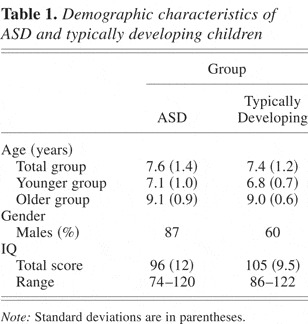
Based on a median split of the entire sample, children were assigned to a young group (5.0–8.25 years) and to an older age group (8.3–10.8 years). The mean ages for each group are presented in Table 1. The results of a 2 (Diagnostic Group) × 2 (Age Group) analysis of variance (ANOVA) indicated that ASD and typically developing children were of similar age in each age group.
Demographic characteristics of ASD and typically developing children

As shown in Table 1, the two groups did differ in terms of gender, χ2 (1) = 5.69, p < .05. There were proportionately more males in the ASD compared to the control group. This reflected the demographic fact that ASD is more common among boys than girls (American Psychiatric Association, 1994). We did not control for gender in the present study because numerous studies (including the results of the present study) failed to find gender differences in suggestibility effects (Bruck & Melnyk, 2004), and there were no gender differences among the control subjects in this study on other autobiographical measures.
The control children had significantly higher IQ scores (M = 105) than the ASD children (M = 96), t (66) = 3.37, p < .05, r2 = .15 (see Table 1). Nonetheless, in the analyses reported in this paper, IQ was not used as a covariate for three related reasons. First, the pattern of results did not change when IQ was entered as a covariate; second, the covariate of IQ was never significant; and third, using a nonsignificant IQ covariate reduces the power of the reported analyses. It should also be noted that these findings are consistent with previous reports that IQ is not related to suggestibility except in extremely low functioning individuals (Bruck & Melnyk, 2004).
Procedures: Overview
Each child participated in three sessions with three different interviewers. All children were interviewed individually and were tested in their home, school, or at the autism clinic. In Session 1, children were administered an ABM questionnaire (ABM-Q) and also participated in a magic show. In Session 2, which occurred approximately 8 days later, children were given information about details of the magic show and were asked leading and misleading questions about these details. The degree to which children provided information to the misleading questions served as one measure of suggestibility. They were also given an abbreviated intelligence test. Session 3 took place approximately 4 days later. Children were asked open-ended (free recall) and yes–no questions to evaluate their memories of the magic show and to assess the degree to which they reported the misleading information provided in Session 2. This latter measure served as a second measure of suggestibility.
For the sake of clarity, we first present the methods and results of the ABM-Q, followed by the methods and results of the staged event (magic show).
Autobiographical Questionnaire: Methods
Instrument: ABM-Q
We developed an instrument that would be suitable for the current sample of children and that would probe for information about personally experienced events from their present, near past, and far past. We asked children about their school, family, home, holidays, and medical history. Children were asked to provide life facts (e.g., “What is your mother's name?”) as well as narratives of life events (e.g., “What happened at your last birthday party?”). This questionnaire was pilot tested on typically developing children and on a small sample of ASD children to ensure that the vocabulary level and the content was appropriate for children in our sample. In addition, for each question, we created a paraphrased version for children who seemed confused or who provided an inappropriate answer. For example, we asked children, “What is your name?” If they did not respond, we asked them, “What do people call you?”
The ABM-Q contained four sections. Section I included 23 questions about the child's current life (e.g., name of child's doctor, teacher, principal; age and occupation of parents). Section II contained eight questions about past events or facts (e.g., name of kindergarten teacher, first day of kindergarten, last year's Halloween costume). In Section III, children were asked 12 yes–no questions about events that sometimes occur in childhood (e.g., “Did you ever get lost on a trip with your mom and dad? Have you ever been on an airplane?”). Three “silly questions” (e.g., “Have you ever helped a lady find a monkey in the park?”) were mixed into the list.
In Section IV, children were asked about four different events: a recent event (one that occurred within the past 6 months), an event that occurred 2 years ago, a distant event (one that occurred when the child was age 2), and an event that required a trip to the hospital. The specific events to be selected for each children were determined by prior phone interviews with each parent who was first asked whether any of the 12 events probed in Section III had been experienced by the child and if so at what age. Events that coincided with any of the target age periods were selected, and the parent was asked to provide details about each of these events. In cases where the Section III events did not match up with a specific age category, parents were asked to supply a meaningful event with details for that age period. Parents were then asked to provide additional significant details for these self-generated events.
Procedures
After a short play period, the interviewer administered the ABM-Q. Children were asked all appropriate questions in Sections I, II, and III (e.g., children were not asked questions about siblings if they were only children). Then, in Section IV, they were asked about the four preselected events. We informed children that their mother told us that they experienced the target event. We first asked them to tell all they could remember about the event. If children denied they experienced a target event, they were informed again that their mother said they had experienced the event and they should think hard to remember. Children were then asked five to seven prewritten scripted wh- questions for each event (who, what, when, where, and how, see Appendix A3
The complete ABM-Q is available by writing to the first author.
Scoring
For Section IV, children's narratives to the “Tell me everything you can remember questions” and to the specific questions were divided into utterances. Only nonrepeated and on-topic utterances were included in the subsequent analyses. An utterance was defined as a statement bound by pauses containing one verb. For example, “Last year, I was in Ms. Hoover's class, and I sat in the front row,” contains two utterances. Two coders were trained to use the scoring system until there was perfect agreement on 10 protocols. The same coders also scored the remaining protocols, which were checked for inconsistencies. In the few cases when this occurred, the disagreement was resolved.
After finishing the three interview sessions with children, we conducted a second telephone interview with parents where we asked them to judge the accuracy of their children's responses to the autobiographical survey. Most responses were objective and easily verified (e.g., “What does your mom do for work?”). For the narratives of the four target events, the parent was asked to judge the accuracy of each detail provided by the child. These judgments were then classified as confirmed (parent and child agree), inconsistent (parent disagrees with child's utterance), and unconfirmed (the parent does not know if the child's utterance is accurate). In addition, six foil child statements were mixed into the statements that parents were asked to judge (e.g., “Your child said that she has a friend at school named Winston.”). Parents were warned that we would ask them to verify some responses that were not reported by their child. The purpose of the foils was to determine the degree to which the mothers' were yea-saying and at the same time to potentially avert this strategy and increase accuracy.
Autobiographical Questionnaire: Results
Present fact questions (Section I)
The accuracy of children's responses to the 23 current questions in Section I was examined. In this and the other analyses in Sections I–III, if the mother confirmed the child's answer, the response was scored as accurate. A 2 (Group: ASD vs. Control) × 2 (Age: Young vs. Old) ANOVA was carried out on the proportion of accurate responses (accurate responses/total number of questions asked). There were main effects of group, F (1, 64) = 34.93, p < .01, η2 = .35, and age, F (1, 64) = 7.32, p < .01, η2 = .10. Typically developing children provided a greater proportion of accurate responses (80%) than did children with ASD (63%). In addition, older children were more accurate than younger children (77 vs. 69%).
Past fact questions (Section II)
The same 2 × 2 statistical model was applied to the proportion of accurate responses for the eight past fact questions from Section II. There was only a main effect of group, F (1, 64) = 9.25, p < .01, η2 = .13. Typically developing children were more accurate (66%) than children with ASD (50%).
Life event and silly questions (Section III)
Accurate answers to the 12 yes/no life event questions were analyzed first. Accurate answers were those where the parent and the child had agreed that the event had or had not happened. Because all children were not asked all 12 questions (see above), the proportion of accurate answers were submitted to a 2 (Group) × 2 (Age) ANOVA.4
There was no between group difference in the number of questions asked. In addition, based on the parents' reports, there was no between difference in the number of events that children had actually experienced.
Because of error, one typically developing child and one child with autism were not asked these questions.
Next, inaccurate answers to these questions were examined. There were two types of errors that could be made on these questions; the child could say that the event happened and the parent would deny it (these are called commission errors, assuming the parent was correct), or the child could deny the occurrence of an event that the mother declared had happened (these are called omission errors, assuming that the mother is correct). A three-way ANOVA (Group × Age × Error Type) with repeated measures on the last factor was carried out on the proportion of total responses that were omission versus commission errors. The focus on this analysis was on main effects and interactions involving the factor of error type. There were interaction effects of error type with age F (1, 62) = 7.82, p < .01, η2 = .14, and of error type with group, F (1, 62) = 6.24, p < .05, η2 = .08. Proportionately more omission errors were made by young children (17%) than by older children (9%), whereas there were no age group differences on the proportion of commission errors (9% younger vs. 11% older). Similarly analysis of the Group × Error interaction showed that proportionately more omission errors were made by ASD children (17%) than by typically developing children (10%), whereas response rates for commission errors were similar for ASD (9%) and for typically developing (11%) children. Thus children with autism (like younger children) were more likely to forget events that were affirmed by their parents than typically developing (and older) children; but they were not more likely to confirm nonexperienced events.
A 2 (Group) × 2 (Age) ANOVA was carried out on the number of assents to the three silly questions that were dispersed among the 12 life event questions. Although false assents were infrequent, ASD children made more errors on these items (13%) than did control children (4%), F (1, 64) = 6.06, p < .05, η2 = .07. There were no other main effects or interactions. More ASD than typically developing children made false assents to at least one of the three silly items, 31 versus 8%, χ2 (1) = 5.74, p < .05.
Four target event narratives (Section IV)
Two different analyses were carried out on each of the four events. A 2 (Group: ASD vs. Control) × 2 (Age: Young vs. Old) × 3 (Detail Status: Confirmed, Inconsistent, Unconfirmed) ANOVA with repeated measures on the last measure was carried out on the number of details elicited by open-ended questions. In some analyses, because there were zero cell values for either the inconsistent or unconfirmed statements, these were summed to yield one category of inconsistent/unconfirmed responses and compared to the confirmed responses. The same model was used for the analyses of details provided to specific questions, with one exception. The number of specific questions that the child was asked was used as a covariate because these varied across children.
In the following analyses, one young typically developing child and one child with autism were excluded because the parents could not be contacted for the follow-up phone call to verify the details.
Recent events
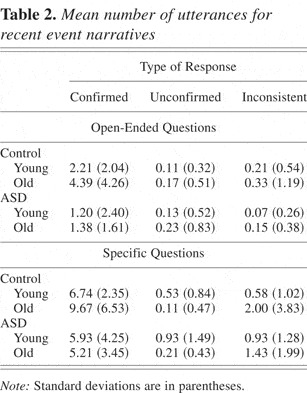
The most common target events were trips, birthdays, holidays, and family/social events. The frequency of these and other topics were fairly evenly distributed across ages and groups. Two children with ASD and one control child did not recall the target event; rather, they recalled an event that was different from what the mother initially had in mind. (In this and other analyses, recall failure occurred when children provided 0 or 1 confirmed utterance across free recall and specific questions.)
Table 2 presents the mean number of utterances in response to the open-ended questions. The results of the three-way ANOVA produced main effects of group, F (1, 62) = 8.25, p < .01, η2 = .12, detail status, F (2, 124) = 33.60, p < .01, η2 = .45, and a significant Group × Detail Status interaction, F (2, 124) = 7.62, p < .01, η2 = .19. As seen in Table 2 and confirmed by tests of simple effects, control children produced more confirmed utterances than ASD children. There were no group differences for inconsistent or unconfirmed details.
Mean number of utterances for recent event narratives

Next, a three-way analysis of covariance (ANCOVA), with number of questions as the covariate, was conducted on the mean number of utterances elicited in response to the specific questions. The results are similar to those for the open-ended questions. There were significant effects for group, F (1, 61) = 6.67, p < .01, η2 = .10, detail status, F (2, 122) = 83.02, p < .01, η2 = .73, a significant Group × Detail Status interaction, F (2, 122) = 4.81, p < .01, η2 = .13, as well as a significant Group × Age interaction F (1, 61) = 4.28, p < .05, η2 = .07. The last interaction was obtained because older control children produced more utterances (11.8) than older children with autism (6.8), younger children with autism (8.7), and younger typically developing children (7.8). The last three groups did not differ from each other. As confirmed by tests of simple effects, the Group × Detail Status interaction indicated that typically developing children produced a greater number of confirmed utterances than children with ASD. There were no differences for inconsistent or unconfirmed details.
Event from 2 years ago
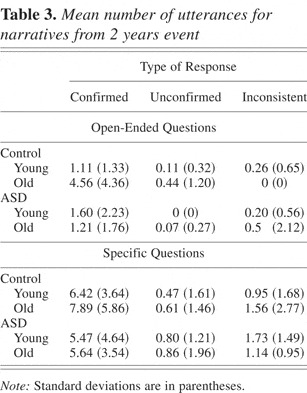
The most frequent topics across groups included trips, birth of a sibling, and moves to new houses or schools. These were fairly evenly distributed across groups. All children remembered at least two confirmed details of the event. The number of utterances in response to open and specific questions is presented in Table 3. Because one of the cells contained a zero-value for the open-ended questions, the unconfirmed and inconsistent responses were combined.
Mean number of utterances for narratives from 2 years event

Analysis of the open-ended responses showed that control children produced more utterances than children with ASD, F (1, 62) = 8.34, p < .01, η2 = .12, that older children produced more utterances than younger children, F (1, 62) = 6.80, p < .01, η2 = .10, and that children produced more confirmed than inconsistent/unconfirmed utterances, F (1, 62) = 7.44, p < .01, η2 = .20.
The ANCOVA of responses to specific questions produced a significant main effect of group, F (1, 61) = 5.40, p < .05, η2 = .10, and a Group × Detail Status interaction, F (2, 122) = 4.38, p < .01, η2 = .17. Based on results of simple effects analyses, control children produced more confirmed utterances than ASD children. There were no group differences for inconsistent or unconfirmed details.
Hospital event
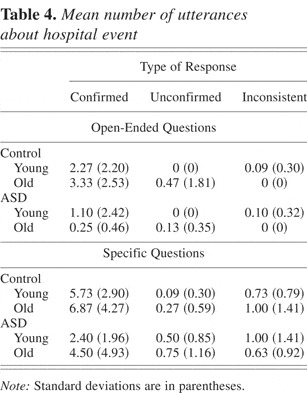
Children who had not been treated at a hospital were eliminated from this analysis, resulting in a sample of 18 ASD children (8 old and 10 young) and 26 control children (15 old and 11 young). The hospital event included operations, broken bones, sickness (pneumonia was the most common), and other medical procedures (e.g., having tubes put in ears). On average, the target hospitalization occurred 2.9 years previously. There were no differences as a function of age or group in terms of length of time between hospitalization and interview.
Proportionately more children with ASD (44%) than typically developing children (4%) did not remember the target hospitalization, χ2 (1) = 7.35, p < .01. Age at interview was not associated with forgetting in the ASD group; thus, there were similar proportions of younger and older children who forgot the event. However, as might be expected, the children with ASD who forgot the event were younger at its occurrence (3.6 years) than were the children who remembered the event (5.6 years).
The results of the ANOVA on the number of utterances produced in free recall yielded main effects of group, F (1, 40) = 10.27, p < .01, η2 = .20, and detail status, F (1, 40)6
Inconsistent and unconfirmed details were combined in this analysis because some of these cells contained zero values.
Mean number of utterances about hospital event

A similar pattern was obtained for the ANCOVA of responses to specific questions. There was a significant Group × Detail Status interaction, F (2, 78) = 6.49, p < .01, η2 = .19. Control children produced a greater number of confirmed utterances than ASD children. There were no group differences for inconsistent or unconfirmed details. The factor of age was not significant.
The open-ended and specific question analyses were rerun, eliminating those children who failed to remember the event. The pattern of results was identical.
Event from 2 years of age
The sample size was reduced for this analysis because some mothers could not remember a suitable target event. The analysis included size 25 children with ASD (13 old, 12 young) and 34 typically developing children (17 old, 17 young). The most common target events included birth of a sibling, moves, negative life events (death, injury), and trips.
More children in the ASD group (40%) than children in the control group (15%) did not recall the 2-year-old target event, χ2 (1) = 4.86, p < .05. The frequency of forgetting was similar for younger and older children in both groups.
For responses to the open-ended questions, there were main effects of group, F (1, 55) = 16.32, p < .01, η2 = .23, and detail status, F (1, 55)7
See footnote 6.
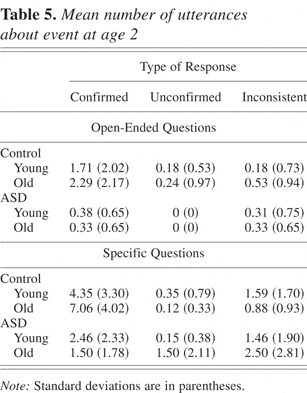
Mean number of utterances about event at age 2

The ANCOVA of responses to specific questions produced significant main effects of group, F (1, 54) = 6.29, p < .015, η2 = .10, and detail status, F (2, 108) = 5.63, p < .01, η2 = .12. There was a significant Group × Detail Status interaction effect, F (2, 108) = 17.54, p < .01, η2 = .30, which was modified by a Group × Age × Detail Status interaction, F (2, 108) = 6.76, p < .01, η2 = .14. Tests of simple effects were run on each of the three types of responses. For the confirmed responses, there was a significant Group × Age interaction effect, F (1, 54) = 4.92, p < .05, η2 = .08. The older control children provided the most confirmed answers compared to the other three groups; and the young control children produced more confirmed responses than the old ASD group. For the inconsistent utterances, there were no main effects or interactions Finally, there was also a significant Group × Age interaction effect, F (1, 54) = 7.79, p < .01, η2 = .13, for the unconfirmed utterances. The older ASD group produced more of these utterances than the other three groups who did not differ from each other.
The open-ended and specific question analyses were rerun eliminating those children who failed to remember the event. The pattern of results was identical.
Parent interview foils
Finally, as noted in the methods sections, mothers were asked to confirm or disconfirm utterances that the child never said (foils). Mothers of typically developing children and mothers of ASD children were equally likely to accept the foils as true (24 vs. 15% for control and ASD mothers, respectively). The factor of child's age was not significant. Thus, although we had to rely on parental reports to gauge the accuracy of children's responses, any biases in the parental reports was equal across the two groups.
Summary ABM-Q
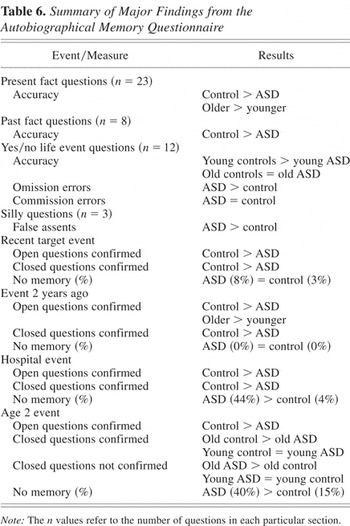
The major significant results are summarized in Table 6. As can be seen, on most measures, children with ASD provided fewer details of recent and past life events. Between group differences are best characterized as differences in rates of omission or forgetting rather than by errors of confabulation or distortion.
Summary of Major Findings from the Autobiographical Memory Questionnaire

Staged Event: Methods
Session 1: Magic show
After conducting the autobiographical questionnaire, the interviewer announced that she was a magician and asked the child to be her assistant. The magic show included 20 prespecified target events (see Appendix B) about which the children were later questioned. The following is a short summary of the details: the magician put on a black hat, put a red helper cape on the child, showed the child a stuffed rabbit, and taught the child a magic word. The magician did two tricks. In the first trick, using special powers (saying the magic word, waving a wand, honking a horn, and pulling the child's ear), the magician made a ball disappear from a cup into his/her pocket and then had it reappear in the container. In the second trick, using other magic powers (a magic spoon), the magician made water disappear from a cup.8
A powder called Lightening Gel was in the “magic cup,” which caused water to evaporate on contact.
Session 2: Suggestive interview
A second interviewer conducted the suggestive interview with children approximately 8 days after the magic show (M = 8.2 days, SD = 1.4).
Baseline free recall
After a brief warmup, the interviewer told children that, because she was not at the magic show, she wanted to hear all about it, from beginning to end. Children were prompted four times (e.g., “Tell me what happened at the beginning.” “What else?”).
Scoring. The number of correct and incorrect utterances in free recall was counted. As with the autobiographical data, an utterance was defined as a statement bound by pauses containing one verb. For example, “The magician waved a magic wand, and we held hands,” contains two utterances.
Reminders and suggestive questions
The staged event contained 20 target details, which were divided into five scenes (setting up, ball trick, water trick, the fall, and cleanup). As shown in Appendix B, each (true) target detail was paired with a generated misleading (false) detail. For example, the target detail “The magician wore a black hat” was paired with the false detail “The magician wore black gloves.”
Each child heard five true targets (these are called true reminders) and five false targets (false reminders). True and false reminders were given in a counterbalanced order. After hearing a reminder, the child was asked a forced-choice question about that reminder. Response choices were alternated so that each response appeared equally often as the first versus second answer choice across interview versions.
The reminders were selected as follows. One true reminder and one false reminder were selected from each of the five scenes. A true reminder and its paired false reminder were never presented together. To ensure that all items were equally used and that different combinations of true and false reminders were used across participants, eight different suggestive interview versions were selected from a large pool of possible choices, such that each true and false reminder was used an equal number of times across interview versions. Children were randomly assigned to the interview versions such that the same interview versions and the frequency of each interview version were counterbalanced across groups.
The interviewer started the suggestion/reminder phase by telling the child that she had heard about some of the things that happened with the magician and that she wanted to talk about these things. As an example of a false reminder, the interviewer said, “I heard that the magician gave you a hug.” The interviewer then asked the child a forced choice question about the reminder (e.g., “Did she hug you at the beginning of the magic show or at the end of the magic show?”). If a child resisted a reminder, the interviewer said “Well I just need to write something down. So did she hug you at the beginning of the magic show or at the end of the magic show?” The interviewer made comments throughout the suggestive interview, such as “You are such a good storyteller” and “You are doing a great job helping me.” Once all the reminders had been presented, the interviewer slowly repeated each reminder, preceded by “You told me that …” or “You remembered that …”
Session 3: Exit interview
Approximately 4 days after the suggestive interview (M = 3.8 days, SD = 0.88), a new interviewer conducted an exit interview with each child.
Free recall
After a warm-up, the interviewer explained that she was not at the magic show and wanted to hear everything that happened. The interviewer prompted the child three times, saying, “What happened next?” and “Can you tell me one more thing?”
Scoring. The number of off-topic and on-topic utterances in free recall was counted. For example, when asked to tell the interviewer about the magic show, responses such as “I have a new puppy” were coded as off topic. On-topic utterances were categorized as correct or incorrect and also as derivative of a true or a false reminder. All transcripts were scored independently by two coders who had previously been trained with this system. Agreement was very high; the few discrepancies were resolved by discussion.
Recognition test
The interviewer first asked children three practice questions and explained that if she asked about something that did not happen, or that was silly, that the child should say no. Children were asked 20 yes/no questions about the target events of the magic show. Ten questions were about true events; 5 were true reminded items and 5 were control items (true nonreminded items) that contained accurate information and that were not used as reminder items. These true nonreminded items allowed an evaluation of the degree to which children benefited from rehearsal of true events. Children were also asked 10 questions containing false information; 5 questions were false reminded items and 5 questions were false nonreminded items. A false nonreminded item is a question about a false event that was not suggested to the child. If the suggestions given during the suggestive interview affected children's reports, then children should assent to more false-reminded than false nonreminded items.
The combination of true and false control questions was determined by the composition of the specific interview version that was assigned for each child. As was the case for the true and false reminders, a true and false control detail was selected from each of the five scenes. Each control detail could not be from the same pair as any other detail in the recognition test. Thus, for each of the five scenes, there was one question about a true reminder, a false reminder, a true nonreminded (control) detail, and a false nonreminded (control) detail.
Scoring. The number of accurate responses for each type of item was counted. “Yes” was the accurate response for true items represent accuracy, and “no” was the accurate response for false items.
Staged Event: Results
Suggestive interview
Free recall
The number of accurate utterances produced in free recall prior to the provision of the suggestive information served as the dependent variable in a 2 (Group) × 2 (Age Group) ANOVA. Only the main effect of group was significant, F (1, 67) = 15.63, p < .01, η2 = .20. Control children provided more correct utterances (M = 7.18, SD = 4.5) than children with ASD (M = 3.7, SD = 2.4).
Next, the number of incorrect utterances was examined. To control for the finding that typically developing children produced more utterances, the proportion of incorrect utterances as a function of total number of utterances was calculated. The results of a 2 (Group) × 2 (Age) ANOVA yielded no main or interaction effects. For both the ASD and control groups, 16% of their overall utterances were incorrect.
Resistance to forced choice questions
ASD and control children did not differ in the nature of their responses to the five misleading questions. On average, ASD and control children resisted 33 and 45% of the questions, respectively. Thus, on this marker of suggestibility, ASD children were as suggestible as control children.
Exit interview
Free recall
A 2 (Group) × 2 (Age) × 2 (Reminder Status: Reminded vs. Nonreminded) ANOVA with repeated measures on the last factor was carried out on the correct on-topic free recall utterances. There was a main effect of group, F (1, 64) =14.72, p < .01, η2 = .17, reminder status, F (1, 64) = 77.96, p < .01, η2 = .54, and a Group × Reminder Status interaction, F (1, 64) = 9.29, p < .01, η2 = .12. Control children produced more nonreminded correct utterances (M = 6.8, SD = 4.4) and reminded utterances (M = 1.13, SD = 0.94) than children with ASD (Mnonreminded = 3.43, SD = 3.38; Mreminded = .67, SD = 0.96). The interaction arose because there was a relatively greater between group difference for nonreminded compared to reminded items.
Because control children provided more accurate recall, the error data were examined as a function total recall. Thus, the errors that reflected false reminders and errors that did not reflect reminders were expressed as proportions of the total number of utterances. The results of a 2 (Group) × 2 (Age) × 3 (Reminder Status: Reminded vs. Nonreminded) ANOVA with repeated measures on the last factor only yielded a main effect of reminder status; proportionately fewer errors reflected false reminders (2% of all utterances were false reminders) compared to other types of errors (17% of all utterances were the result of memory distortions other than false suggestions). Of importance, the two groups did not differ in the total proportion of utterances containing errors (20% for controls, 17% for children with ASD).
Next, a 2 (Group) × 2 (Age) ANOVA was carried out on the proportion of off-topic utterances. There was a main effect of group, F (1, 61) = 4.56, p < .05, η2 = .08. Utterances of children in the ASD group were more apt to be off-topic (15%) than the utterances of children in the control group (3%). Thus, although there were no differences in error rates, children with ASD did report proportionately more utterances that were inappropriate to the theme of the interview.
Recognition test
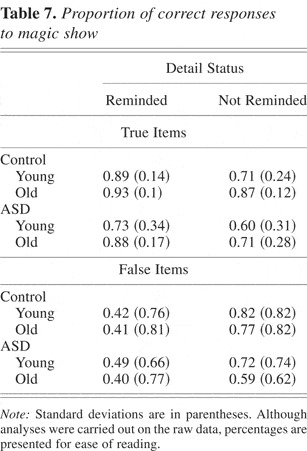
We examined performance on the 10 true yes/no questions first. An ANOVA with group and age as the between subjects factors and reminder status (reminded or not reminded) as the repeated factor was conducted on the correct responses to the true yes/no questions (see top half of Table 7). There were main effects of group, F (1, 64) = 7.62, p < .01, η2 = .11, age, F (1, 64) = 6.8, p < .01, η2 = .10, and reminder status, F (1, 64) = 18.50, p < .01, η2 = .22. Control children were more accurate than children with ASD; older children outperformed younger children; all children performed better on reminded than on nonreminded (control) items.
Proportion of correct responses to magic show

The next analysis examined misinformation effects by comparing the number of rejections to false reminded and false control items. Misinformation effects are revealed when rejections are larger for the control versus reminded items. A 2 (Group) × 2 (Group) × 2 (Reminder Status) with repeated measures on the last factor was conducted on the number of rejections to false items (see bottom half of Table 7). There was a main effect of reminder status, F (1, 64) = 5.53, p < .05, η2 = .50, which was qualified by a Group × Reminder interaction, F (1, 64) = 5.53, p < .05, η2 = .08. Planned comparisons revealed both groups of children showed misinformation effects (i.e., they rejected more control than false reminded items). The interaction was obtained because although both groups rejected the same number of false reminded items,9
For all yes/no questions to which children assented, we also assessed their source-monitoring abilities for this information (i.e., whether they actually saw and/or heard about the event). Generally, all children maintained that they actually experienced these events (which was correct for the experienced events but incorrect for the nonexperienced events). Hence, source-monitoring questions were unsuccessful in prompting children to recant their assents to misinformation. For the sake of space, these results are not reported in this manuscript but can be attained by writing to the first author.
Summary of the exit interview analyses
Compared to control children, children with ASD provided fewer accurate details about a recently experienced event in response to both open-ended and specific questions. In terms of suggestibility measures, the two groups did not differ on a measure of compliance (resistance to interrogative suggestibility) or to the number of suggested items that were later incorporated into recall. The children with ASD, however, did assent to more nonsuggested items than did control children.
Discussion
In this study we used two different paradigms to assess the ABM of children with ASD. The first paradigm, the ABM-Q, allowed the assessment of recall of salient personally experienced events from a variety of periods in children's lives. The selection of events and the scoring of children's recall were dependent upon the accuracy of their parents' own recall. The second paradigm, the staged event (magic show), overcame these problems by allowing full experimental control over the timing and nature of the experienced events. The weakness of this paradigm that was not present in the ABM-Q was the limit on the salience of the events. That is, the magic show might not have been as memorable to children as other naturalistically occurring events in their lives. Despite the pros and cons of each paradigm, they yielded converging results.
We found that children with ASD showed deficits in memory for personally experienced events. Relative to typically developing age-matched peers, ASD children showed these deficits for events in their far past as well as their recent past. The deficits were found in terms of the number of details provided for various events as well as the accuracy of replies to open-ended, specific, and yes/no questions. For events from their distant past, not only did children with ASD show deficits in the number of details provided, but also more of these children compared to normally developing children failed to recall the events at all. At the same time, the autobiographical recall of children with ASD was relatively free of memory errors (distortions, confabulations); they were also as likely as their age-matched control subjects to assent to misleading questions and to incorporate misinformation into later reports. Thus, the autobiographical recall of children with ASD is characterized by the sparseness of true memories but not by the overrepresentations of false reports.
Memory for distant and recent events
As summarized in Table 6, a large proportion of children with ASD could not recall any details from an event that had occurred when they were approximately 2 years and a substantial number of children with ASD could not remember any details of a hospitalization that had occurred when they were 3.6 years of age. ASD children who were hospitalized at later ages were more likely to recall that the event had happened. Thus, a lack of recall of personally experienced events is common for events that occurred during early childhood among children with ASD.
Even when children with ASD did recall a past event, they provided significantly fewer details. Furthermore, sparse recall was not limited to distant events as children with ASD also recalled fewer details about recently experienced events (e.g., magic show, target event in the past 6 months). In addition, their knowledge about facts of their own present lives (where they go to school, information about members of their family) was also impoverished.
Regardless of the type of questions asked (open-ended; specific questions requiring one word responses; recognition questions requiring yes/no responses), children with ASD performed more poorly than normal children. Thus, the performance of children with ASD does not reflect a difficulty in generating sentences or coherent narratives about the event. Rather, as we argue below, differences reflect core ABM memory deficits of children with ASD.
Did the children (normal and ASD) who recalled events from their second and third year of life actually remember these experiences? First, according to the cognitive self-theory (see Howe et al., 2003; Howe & Courage, 1993, 1997), it is possible to have ABM from this early age, and thus, it is possible that they did recall these early experiences. Second, it is also the case that some of the children did rely on external cues such as family stories and family pictures to reproduce these events. For example, when one control child was asked about the birth of a younger sibling, he related that he remembered “because it was in the picture.”
Memory distortion, suggestibility, and forgetting
Although autobiographical memories may be absent or sparse, this does not necessarily mean that they are inaccurate. In other words, poor memories can be characterized by omission of details rather than by the insertion of details (i.e., commission errors). For example in the present study, when children's errors on the 12 yes/no questions (plausible questions of Section III) of the ABM-Q were examined, we found that children with ASD were more likely than control children to deny that actually experienced life events had occurred (errors of omission) but were as likely as control children to inaccurately claim an event had occurred when it had not. Similarly, with one small exception (see Table 6), children with ASD and control children made the same number of statements that were inconsistent with or not confirmed by their parents. Compared to typically developing controls, children with ASD incorporated the same amount of suggested information into their reports and resisted the same number of misleading question. Therefore, children with ASD are not hypersuggestible.
There were two exceptions to the above pattern. Compared to control children, children with ASD assented to more questions about silly events (ABM-Q). However, the effects for the silly questions were quite small; they do not reflect a pattern of yea-saying (or compliance) in that children with ASD did not consistently assent to the other 12 more plausible questions in that section. Second, children with ASD assented to more false control questions about the magic show. Thus, they were more likely to events that had never occurred. We interpret the higher rate of errors on the magic show false control questions as a further reflection of these children's ABM deficits. They could not consistently remember which events had occurred and which ones had not. Again, if there were a pervasive yea-saying response bias, one would have expected much higher rates of “yes” responses for the other types of questions, including those that included true statements.
In light of these results, the finding that the children with ASD showed a smaller misinformation effect (reminded items vs. nonreminded items) than typically developing children has several interpretations. It could mean that these children were less “suggestible” in the sense that they were less prone to accepting the misinformation than normal children. However, this interpretation does not take into account several aspects of the data. Specifically, the two groups did not differ on assents to the false suggestions but only on assents to the false control items. Larger misinformation effects are usually obtained when responses to the suggested items differ not when responses to the control items differ. This leads to the second interpretation, the one favored by the authors of this paper. Normal children were more likely to incorporate the previous suggestion into memory and to use this feeling of familiarity to not only accept these items but to reject never before heard false items. This misinformation effect was reduced in children with ASD. Because of their poorer ABM, they had more difficulty rejecting newly heard false items. This reduced the purity of the misinformation effect for this group whose errors reflected both misinformation and poor ABM. Although we had initially predicted that poorer ABM in the children with ASD would result in higher than normal suggestibility effects. This hypothesis was not supported using the current misinformation paradigm.
Thus, children with ASD have poorer ABM because of poorer recall of events, not because they are more suggestible or more likely to confabulate details independent of suggestive influences.
Foundations of poor ABM of children with ASD
Why do children with ASD show impaired ABM? At the beginning of the paper we provided several frameworks that would predict deficits, without favoring one over the other. Now we reconsider these theories on a post hoc basis, keeping in mind that because the study was not designed to test alternate theoretical formulations, our conclusions are speculative, calling for future research.
Are the ABM deficits specific to events about “me,” do these deficits reflect more general memory deficits that require higher level organizational skills, such as recall of narratives that do not involve the self, or do they reflect a general memory deficit for even nonverbal information? In a follow-up study with a subsample of children from this study, we reinterviewed 20 typically developing and 15 ASD children about the staged event after a 10-month delay (London & Bruck, 2006). We gave children two subtests from the Children's Memory Scale (Cohen, 1997): (a) dot location required that children remember the location of dots on a grid; and (b) stories required that children listen to and recall a story. Preliminary analyses of the data indicate no group differences on the dot location task; however, children with ASD recalled fewer details of the story (both free recall and recognition) than control children. Performance on story recall was also positively correlated with children's recall of the magic show. Thus, it is possible that poor ABM is associated with poor memory of narratives in general. Of course, it is also possible that poor memory of narratives is a consequence of poor memory for narratives about the self. Future studies are needed to tease apart the relationship of memory for events and stories that are personally experienced versus nonexperienced in children with ASD.
Do the children with ASD have deficits in ABM because of early impairments in social language interactions, specifically with their caretakers (see Haden et al., 1997; Reese, Haden, & Fivush, 1993) or are these deficits more closely linked to late developing cognitive concepts of self, as hypothesized by Howe and colleagues (see Howe et al., 2003)? Because we do not know the age at which children with ASD begin to develop a cognitive self, and because we do not know the quality of maternal/child conversations about past events, it is not possible to adjudicate between these theories. However, there are several patterns of results that may be more consistent with one theory over another. First, the control children were able to recall some details of events that occurred when they were 2 and 3 years of age. According to the social interaction theorists, this should not be possible for at least another few years (e.g., see Nelson & Fivush, 2004). Thus, it seems that at least for the control children in this study, the cognitive self-theory is more pertinent. Second, if social factors were to play a relatively smaller role in the recall of children with ASD (i.e., children with ASD would be less sensitive to social cues in language interactions), then one would expect that they would provide fewer “yes” responses to misleading questions or to silly questions. This was not the case. Thus, the ASD children were sensitive to memory cues given during social language interactions.
The aim of our study was to examine the phenomena of ABM in children with ASD and not to pinpoint the specificity of underlying causal mechanisms of impairments. However, these findings are a provocative starting point and indicate the importance of longitudinal studies to determine the critical roles of the development of the cognitive self and of early social language interactions on the emergence and development of ABM in children with ASD.
Caveats
Although ABM among our ASD participants was marked by errors of omission, these children were able to recall some information about past events, albeit less information than typically developing controls. On the ABM-Q, children with ASD were able to accurately generate information on 63 and 50% of the questions for present and past-life events, respectively. Our findings also revealed that a reminder session (i.e., rehearsal) facilitated the memory of children with ASD to a comparable degree as the typically developing children. Furthermore, children with ASD were no more apt to incorporate false suggestions into their reports than their typically developing peers.
However, it should also be taken into account that the pattern of results in this study was obtained from a sample of high functioning, verbal children with ASD. Because of the nature of the ABM tasks, it was necessary to exclude low-functioning children who could not attend to the tasks or understand the questions. Thus, these results reflect the upper bound of performance on our ABM tasks among children with ASD. With more impaired children, it is possible that their ABM deficits and suggestibility would be heightened as compared to the findings of the present study.
Although the ASD children were selected for our study because they were high functioning, they nonetheless had lower IQs than their CA-matched peers. However, as reported in the results section, IQ was not correlated with any of the dependent measures (for either group). This helps establish that the impaired ABM displayed by the ASD individuals was not primarily attributable to general cognitive differences. That IQ was not correlated with ABM, and suggestibility in our study was not surprising considering that previous studies have failed to find such a relationship in children within the normal IQ range (Bruck & Melnyk, 2004).
Many of the results in the analyses did not yield significant age differences; when these did occur it was more likely to occur for the typically developing children, particularly in the ABM-Q. Consistent with these findings, several researchers have failed to find developmental differences in long-term autobiographical recall among children in our age range (e.g., Peterson & Whalen, 2001; Pillemer, Picariello, & Pruett, 1994; Quas et al., 1999). In the present study, the best one can conclude is that children with ASD show deficits in ABM across a 5-year age range, and there is no evidence that older children perform better, especially for more recent events. Because children with ASD showed particular deficits for early life events, it seems that ABM among ASD children begins at a later developmental point and then development takes on a less steep slope compared with typically developing children.
It is also important to point out that, in contrast to many other studies (Ceci & Bruck, 1995), there were no age differences on suggestibility measures for either group. The most probable explanation concerns the specific suggestibility paradigm used in the present study; in contrast to other studies, our paradigm involved putting more pressure on children to provide the false response by answering forced-choice questions in Session 2. This procedure produces very high rates of misinformation consistently across all ages. Because two other studies that have used also used this suggestibility paradigm have also failed to find age differences (Finnilä, Mahlberga, Santtilaa, Sandnabbaa, & Niemib, 2003; Zaragoza, Payment, Kichler, Stines, & Drivdahl, 2001), we conclude that our results are reliable for both the control and ASD group.
In addition to the theoretical implications of the present study, there are also a number of applied contributions. Interviewing children with developmental disabilities presents unique challenges for families and professionals who care for these children. In terms of interviewing children, these data indicate that at least high-functioning children can provide some basic details that are mainly accurate. Nonetheless, when put together, the results of this study indicate that the autobiographical accounts of both recent and long ago experienced events among children with ASD are sparse compared to those of typically developing children. Because children with ASD provide so little information in response to open-ended questions, the most automatic strategy would be to ask more direct and leading yes–no questions. However, as shown by our results, this strategy magnifies their error rates. Specifically, there were no between group differences on error rates for free recall of the magic show; in contrast, except for the false reminded items, children with ASD made more errors on the other three types of items of specific questions on the recognition task. These data highlight the importance of developing questioning strategies for children with ASD whose recall may be limited because of inability to recall many details of their lives.
Appendix A: ABM-Q Sample Questions
Section I examples: Present fact questions
What is your middle name?
What year were you born?
What is your address? (or What is the name of the street that you live on?)
What is the name of your doctor?
Section II examples: Past fact questions
What was the name of your teacher last year?
What was the name of a friend from daycare?
Did you have a birthday party last year?
Section III yes/no questions of possible past events
Have you ever gone to the hospital because you were sick or hurt?
Have you ever been at a party and someone spilled their drink all over and got you wet?
Have you ever broken your sister/brother's or friend's toy on accident?
Have you ever had a pet?
Section IV examples: Life event questions
Event: Hospitalization
Please tell me everything you can about the time that you were in the hospital.
When/ How old were you then?
Why did you have to go to the hospital?
Did you stay in the hospital overnight?
What did the doctors and nurses do to you?
Who else stayed with you there?
Who came to visit you? Did anyone come to your room to see you?
Is there anything else you can think of about when you went to the hospital?
Event: Birthday party
Please tell me everything you can about (child's) birthday party.
How old were you?
Who went to the party? Who else was there?
What gifts did you get (also clarify from whom if possible)?
What food did you have? Cake and ice cream?
Did you play games?
Is there anything else you can think of about the birthday party?
Appendix B
True and false event items given during the suggestive interview involving the magic show