Introduction
The loss of a conceptus in a multiple pregnancy, or so called ‘vanishing twin’, has significant implications for the perinatal outcomes of the survivor in terms of low birthweight, premature birthReference Almog, Levin and Wagman 1 – Reference Pinborg, Lidegaard and Andersen 3 and cerebral palsy.Reference Pinborg, Lidegaard, la Cour Freiesleben and Andersen 4 – Reference Hvidtjorn, Grove and Schendel 7 The reported incidence is highly variable, with estimates ranging from 4 to 36% of multiple pregnancies.Reference Pinborg, Lidegaard, la Cour Freiesleben and Andersen 4 , Reference Mansour, Serour, Aboulghar, Kamal and Al-Inany 8 – Reference Dickey, Taylor and Lu 10 The timing of loss is significant, with loss after 24 weeks being associated with major morbidity for the survivor, although this may be due to obstetric factors in addition to events in early pregnancy.Reference Pharoah, Glinianaia and Rankin 6 In contrast, the importance of very early pregnancy loss for birth defects in the surviving offspring is uncertain.Reference Pharoah, Glinianaia and Rankin 6 , Reference Landy and Keith 11
The study of events in early pregnancy is very difficult in natural conceptions, but is a feature of pregnancies after infertility treatment within specialist clinics due to the planned conception in combination with routine blood tests for biochemical pregnancies and ultrasounds in early pregnancy to detect fetal hearts. Another characteristic of pregnancies from infertility treatment is the elevated rate of multiple pregnancies due to the practices of ovarian hyperstimulation and multiple and embryo transfer to improve the chance of pregnancy. Conjointly, these features may create a unique circumstance for the observational study of multiple gestation and birth outcomes, most particularly for dizygotic twinning as they are greatly overrepresented in the population of infertility patients globally (due to multiple ovulation following ovulation induction and multiple embryo transfer).
We have previously reported that the risk of major birth defects varies according to patient characteristics and treatment modality.Reference Davies, Moore and Willson 12 Compared with spontaneous conceptions, there was an increased risk of major birth defects in the treated group, including cardiovascular defects, musculoskeletal defects, urogenital defects and cerebral palsy. A greater risk was associated with more invasive gamete manipulation procedures such as in vitro fertilization (IVF) and intracytoplasmic sperm injection (ICSI). Defects in singletons were particularly notable, such that the risk in singletons was equivalent to that of twins.Reference Davies, Moore and Willson 12 This is in contrast to natural conceptions where multiple pregnancy is a robust risk factor for birth defects compared with singletons.Reference Li, Ford, Meister and Bodurtha 13 An important subsequent question is whether there are observable events in very early pregnancy related to embryo development that provide a basis for predicting, and possibly modifying, adverse outcomes in singleton births following infertility treatment. However, the study of human conceptions following infertility treatment should also appreciate the potential contribution of both treatment and patient characteristics related to infertility to developmental outcomes, as couples undergoing infertility treatment have an increased prevalence of metabolic factors that contribute to the risk of adverse outcomes.Reference Davies, Moore and Willson 12
We therefore aimed to study the relationship of ‘vanishing twins’ to birth defects in a cohort of women who received infertility treatment, and a routine early pregnancy ultrasound scan. Ascertaining whether an excess of birth defects is associated with the early loss of a co-twin has important implications for basic human biology and clinical practice, most particularly the protocols for ovarian hyperstimulation, embryo selection and multiple embryo transfer during infertility treatment.
Methods
In this study of pregnancies to infertility patients, we compared the risk of birth defects in singleton conceptions proceeding to birth with the risk in twin conceptions proceeding to birth, and separately in singleton births where there had been loss of a co-twin before 6–8 weeks gestation, and after 6–8 weeks gestation.
Assisted conception group
All patient visits for infertility treatment for the period January 1986 to December 2002 were obtained from a single clinic owned by the University of Adelaide in the state of South Australia (population 1.6 million) registered to provide infertility treatment involving embryo manipulation. Over 20,000 individual episodes of treatment of all kinds and 5683 pregnancies were recorded to patients during the observation period. Women often received more than one cycle of treatment and may have more than one pregnancy in the data set. This clinic contributed 92.3% of pregnancies from infertility patients in the state during the observation period. Ultrasound data for the other clinic in the state providing the remainder of Assisted reproductive technologies (ART) treatment (573 pregnancies) was unavailable for the present study and data from this clinic were therefore excluded. Treatment related pregnancies in the current analysis included IVF (n=1407), ICSI (n=1047), gamete intrafallopian tube transfer (n=506), intra-uterine insemination (n=726), frozen embryo transfer (n=727) and donor insemination (n=470). A small group (n=46) received clomiphene citrate as a stand-alone treatment at home, either because of geographic distance from the clinic, which made close monitoring of ovarian stimulation by other means infeasible, or due to preference of the woman for minimal treatment. Other treatments (n=448) included combinations of treatment and ovulation induction. Further, small groups included births following a spontaneous pregnancy that occurred during an observational ‘tracking’ cycle after initial infertility assessment and advice to practise timed intercourse (n=170), and spontaneous pregnancies while awaiting a treatment cycle (n=136). They have been included as concurrent use of low dose ovarian stimulation may have been used. We excluded additional post-treatment naturally conceived pregnancies (n=1203) that were unrelated to ART treatment as the dates of conception and ultrasound were uncertain. Fetuses terminated for defect during ART treatment were included for analysis. However, 19 fetuses from elective fetal reductions were included as we have assumed that the presence of a defect was the most likely reason for termination, as elective multifetal reduction was very rare due to a low prevalence of higher order pregnancies of 2.3%. Misclassification due to this assumption will reduce the prognostic value of fetal health of one sib for the other, and thereby introduce a conservatizing aspect to the observed results.
Ultrasound was routinely performed between 6 and 8 weeks after embryo transfer and/or a positive biochemical pregnancy. The number of fetal sacs and the number of fetal hearts were recorded. Subsequent ultrasound data were not available for this study. The outcome of all pregnancies was recorded according to a uniform protocol as required under the national accreditation and licensing protocol for ART clinics. This enabled the identification of all outcomes of pregnancy, including loss, after a positive biochemical pregnancy test.
Birth outcomes
The state-wide perinatal statistics collection by law requires notification of all live births and stillbirths of at least 20 weeks gestation or 400 g birth weight in South Australia using a standardized notification form (website www.health.sa.gov.au/pehs/pregnancyoutcome.htm). Miscarriages earlier than 20 weeks are not recorded in the general population. However, early pregnancy status and loss was available from the clinical records of the ART clinic and linked to the perinatal birth record. Notifications of all terminations of pregnancy, including terminations for defect, are also independently mandated at the state level of jurisdiction.
Birth defects
Information on birth defects detected at birth or in the neonatal period (within 28 days of birth) is provided by doctors using a standardized Congenital Abnormality Form. The South Australian Birth Defects Register 14 includes statistics on birth defects obtained from the perinatal statistics collection, as well as from terminations of pregnancy. Notifications on birth defects, including cerebral palsy, detected and notified after discharge from the birth hospital extend to the child’s fifth birthday. The collection of birth defects is also required under law and ascertainment is achieved through multiple reporting sources. All birth defect diagnoses are validated by cross referencing of medical information before being registered. Birth defects were coded according to the British Paediatric Association modification of the International Classification of Diseases, 9th Revision (ICD-9 BPA) including abnormalities that are structural, biochemical, chromosomal or genetic. Minor birth defects are excluded from the register. However, birth defects that require treatment or are disfiguring are included. Congenital cerebral palsy coded to ICD-9 is also included, but post-neonatal or ‘acquired’ diagnoses of cerebral palsy, due to events such as brain infections or injury, are not and were not included in this study. A full list of the birth defects included and excluded during the registration of defects is recorded in the annual reports of the birth defect register 14 or are available as a supplement to a previous publication.Reference Davies, Moore and Willson 12 The birth defect data were linked to the perinatal and abortion statistics collections and to the ART pregnancies by using a unique record number for each birth, which is assigned by the Department of Health and permits tracking of an individual birth record across health data collections. Linkage of birth defect outcomes to the ART data was achieved using probabilistic matching on a range of specific patient details contained in both the perinatal record and the patient treatment notes. Hand matching was used where there was an inconsistency in the patient or birth data between the files.
Analysis
The final data set for analysis contained a total of 5683 pregnancy records. The prevalence of birth defects was compared between several groups of pregnancies, including
-
(1) Pregnancy with one fetal sac and one fetal heart detected at the 6–8 week ultrasound and one baby delivered (singleton, no loss).
-
(2) Pregnancy with multiple fetal sacs with a matching number of fetal hearts at the 6–8 week ultrasound, and matching number of babies delivered (twin, no loss).
-
(3) Pregnancy in which there was at least one viable fetus at the 6–8 week ultrasound, plus an empty fetal sac and where there was at least one baby delivered (twin, early loss).
-
(4) Pregnancy in which there were multiple fetal sacs with a matching number of fetal hearts at the 6–8 week ultrasound, and a lesser number of babies delivered (twin, post 6–8 week loss).
The prevalence of birth defects between groups was compared by odds ratios (OR) with 95% confidence intervals (CI) and two-tailed P-values that were calculated using SAS statistical software.
In addition to crude estimates, adjustment was calculated for the effects of clustering of births within women, and for a range of a priori confounders including maternal age, ethnicity, parity, baby sex, maternal urinary tract infection, and mother and father occupation coded according to the Australian Standard Classification of Occupations (Australian Bureau of Statistics, ASCO First Edition. Occupation Definitions. Canberra: ABS, 1990. Catalogue No.1223.0). Multiple birth defects were defined by the presence of more than one ICD-9 code for the record.
Higher order pregnancies were combined with the category of ‘twins’ for all analyses. Zygosity of multiple births was estimated using the method of Weinberg,Reference Weinberg 15 which indicated that ~94% of twins in this study were dizygotic. We did not attempt to adjust for zygosity in the analyses as there were too few monozygotic individuals to the study group.
Approval for the study was obtained from the ethics committees of the South Australian Department of Health, the University of Adelaide, Australia. Individual patient consent was not required for the study by the ethics committees.
Results
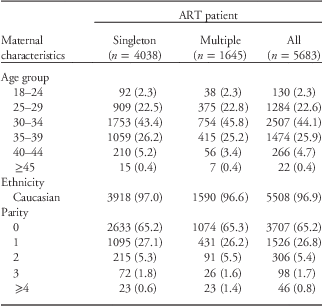
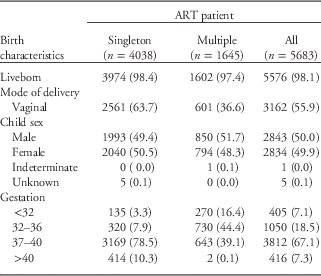
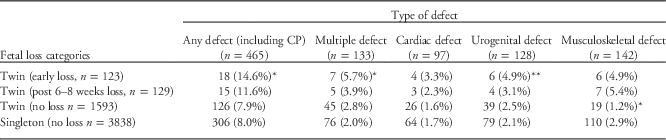
The demographic characteristics of the cohort are presented in Table 1. As expected for women seeking infertility treatment in this population, a small proportion (2.3%) of the cohort was aged <25 years, the majority were Caucasian (96.9%) and nulligravid (65.2%). There were 252 births (4.4% of all births) with either an empty sac at ultrasound at 6–8 weeks (twin, early loss, n=123) or a later loss (twin, post 6–8 week loss, n=129). A description of the pregnancy outcomes is presented in Table 2. The prevalence of live birth was over 97% for each of the exposure groups. Preterm birth (<37 weeks) occurred in 25.6% of all births, with 11.2% for singleton births and 60.8% for twin births. Vaginal birth occurred in 36.6% in the twin, no spontaneous loss group compared with 55.9% in the loss group and 63.7% in the entire singleton no loss group (data not shown). Table 3 presents the count and percent of birth defects for each exposure group considered in the analysis. There were 416 children with a birth defect coded to ICD9-BPA, which increased to 465 children when cases from the congenital cerebral palsy registry were included. Of these 465 cases, 308 were to births with a single defect and 133 births with multiple defects. The prevalence of any defect for the entire ART cohort in this analysis was 8.2%. The corresponding population prevalence rate for the same jurisdiction was 5.8% for singletons and 7.3% for twins (data not shown, but available. 14 The prevalence of defects reflects, in part, the lengthy period for potential reporting, which is to a child’s fifth birthday and is closely comparable with that reported for IVF and ICSI births in a neighbouring jurisdiction which has a similar duration of follow-up.Reference Hansen, Kurinczuk, Bower and Webb 16
Characteristics of 5683 assisted reproductive technologies (ART) pregnancies by plurality

Shown are n (%).
Outcomes of 5683 assisted reproductive technologies (ART) pregnancies by plurality

Shown are n (%).
All treatment types: type of defect by fetal loss category

Shown are n (%).
*Significantly different to ‘singleton, no loss group’ in adjusted model.
**Significantly different to ‘singleton, no loss group’ in unadjusted model (P=0.04), no longer significant in adjusted model (P=0.07).
The birth defect rate (including congenital cerebral palsy) in the twin, no loss group was 7.9%, which was comparable with 8.0% observed in the singleton, no loss group (ns). The prevalence of birth defects was 14.6% in the twin, early loss group and 11.6% in the twin, post 6–8 week loss group.
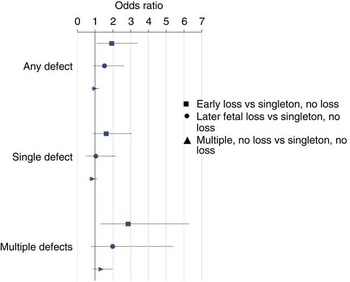
Figure 1 provides a graphical summary of the OR and 95% CI for birth defects separately for the early and later loss groups, and the multiple no loss group compared with the singleton no loss group. The presence of an empty sac was associated with an increased risk of birth defects for both ‘Any defect’ and for ‘Multiple defect’.
Odds ratio of birth defect by fetal loss category.

In this population, multiple pregnancy without fetal loss was not associated with an overall increased prevalence of defects compared with singletons continuing to birth (OR=0.95, CI=0.76–1.20), although the effects for single defect (OR=0.86, CI=0.65–1.13) and multiple defect (OR=1.34, CI=0.89–2.01) were in opposing directions of effect with CI including 1.
Specific classes of defect
ICD-9 categories of defects observed in the twin, early loss group included circulatory system, genital organs, urinary system, diseases of the nervous system and musculoskeletal system. The same groups were apparent in the twin, post 6–8 week loss group, but with the additional presence of diseases of the respiratory system, digestive systems and other which included syndromes and genetic diseases. The list of observed defect codes is in the Supplementary Table. The defects observed are broadly consistent with our previous report for excess defects in the ART group as a whole,Reference Davies, Moore and Willson 12 which included ICD-9 groupings for cerebral palsy, cardiac, urogenital, musculoskeletal and respiratory defects. Sub-analyses of birth defect within exposure groups were generally limited by low frequency of events. However, relative to singletons with no loss, births in the twin, early loss had an increased risk of any defects (OR=1.93 CI=1.09–3.40), multiple defects (OR=2.99 CI=1.36–6.58) and urogenital defects (OR=2.3 CI=1.02–5.55) which were attenuated slightly after adjustment, and in the case of urogenital defects had CI that included 1.
Relative to the singleton, no loss group an increased risk of respiratory defects was observed in the twin, no loss group (OR=9.72 CI=2.07–45.54), but with very wide CI due to the limited number of cases. In contrast, this group had a lower OR for musculoskeletal defects (BPA 75,400–75,699), (OR=0.38, CI=0.22–0.64) compared with the singleton, no loss pregnancies continuing to birth. Fetal loss (either early or late) was not significantly associated with an increase in any syndrome, although the frequency of events was very low in this cohort.
The previously reported association of invasive infertility treatment and congenital cerebral palsy was not significant in this study due to the low frequency of cases (three) in the early and later loss groups combined.
Discussion
This study reports that within a population of infertility patients, the experience of loss of a co-twin is associated with an increased risk of birth defects reported to age 5. The association was particularly evident for loss in early pregnancy observed as an empty sac. This study extends previous work on the risk of birth defects following loss of a co-twin by indicating that observable events in very early pregnancy are clearly associated with the risks of birth defects.
Consistent with our previous report for all singleton births,Reference Davies, Moore and Willson 12 the risk of birth defect in all singletons continuing to birth remained higher than for all births in the fertile population. This suggests that there are additional factors contributing to the excess of birth defects from ART other than the loss of a co-twin in early pregnancy. These may include unknown additional patient characteristics related to both infertility and risk of birth defect, or characteristics of the treatment regimes, such as the embryo culture media or exposure to drugs for ovarian hyperstimulation.
We propose two mechanisms that might explain why the early fetal loss in multiple pregnancies increases the risk of birth defect in a co-twin that survives to delivery.
The first relates to the intra-uterine environment, whereby the biological products of the non-viable co-twin following demise, or the altered endometrium following hormonal stimulation, modify gene expression in the placenta or surviving fetus.Reference Santos, Kuijk and Macklon 17
Alternatively, the presence of an empty sac is an important indicator of the quality of the embryo pool from which the surviving fetus was drawn. Embryos that co-exist are likely to have resulted from the same ovarian stimulation and embryo culture cycle, and therefore share a range of prior exposures affecting their development. Treatment factors include the process of multiple oocyte recruitment from the ovarian hyperstimulation cycle, which may accelerate the development of ovarian follicles that are relatively immature and prone to increased aneuploidy. Increased rates of embryo aneuploidy can result from the detrimental effect of ovarian stimulationReference Verberg, Macklon and Nargund 18 with an adverse impact on embryo progression.Reference Vega, Breborowicz, Moshier, McGovern and Keltz 19 We may hypothesize this contributes to the general observation that the singletons born from infertility treatment appear to have risks of birth defects that are comparable with twins. It is also important to note in this context, that the great majority of ART twins are dizygotic due to multiple embryo transfer, and it appears that where both embryos are developmentally competent, the risk of birth defects in ART conceptions is not greatly influenced by being transferred singly or in pairs. However, we also should consider the possibility that two embryos of different quality are transferred, in which case the higher quality embryo may meet the check-points for endometrial receptivityReference Teklenburg, Salker and Molokhia 20 and thereby increase the chance of a poor quality embryo implanting. If proven, this may provide a further impetus to elective single embryo transfer during infertility treatment.
When comparing the risk of birth defects in singletons and twins, the results here suggest that the additional risk of birth defect in multiple pregnancies in this population may be due primarily to embryo quality, and not multiple pregnancy per se, as the risk of defects in multiples is reduced to that of singletons after excluding pregnancies with a loss. Although speculative, this may also explain the reason why there was a lower risk in certain types of defect, specifically musculoskeletal defects in the twin conceptions that continued to birth, as this outcome may indicate that the embryos that survive to fetal development in this circumstance were particularly developmentally competent, and that aspects of embryo quality related to survivorship may be particularly important for this category of anatomical defect.Reference Hall 21 This observation and speculation requires further analysis in a larger study of specific defect types for which embryo survivorship was protective. Assembling the defect specific data on this finding will be a subject of future research, and is outside the scope of the current study.
Our results here have implications for research, specifically indicating a need to identify modifiable characteristics of embryo development that are subsequently observed as empty sacs at 6–8 weeks, as we may be able to identify early predictive factors for birth defect. This may assist in evaluating ovarian hyperstimulation protocols, embryo selection practices and developing embryo culture systems. At the level of the clinic, these finding may also place an increased emphasis on embryo ‘progression’ rates,Reference Vega, Breborowicz, Moshier, McGovern and Keltz 19 which is the proportion of embryos that proceed to becoming viable pregnancies, as a powerful indicator of long-term health of the offspring. Moreover, subsequent research may identify maternal or environmental factors, other than age, that predict the survival of developmentally compromised fetuses to birth that may be applied to the study of birth defects in the general population. Future related work may also elucidate the established association between multiple gestation and birth defects.
The particularly marked effect for multiple defects increases both the clinical significance of this study and suggests the involvement of a wide acting aetiological factor on fetal development.
Strengths of the study include that we have 92% of infertility treatment cycles, pregnancy outcomes, and birth defect registrations for a defined population operating under a single health jurisdiction. We also have an extended period of reporting for birth defects, which offsets the potential bias associated with potential increased early scrutiny of births after infertility treatment. However, the infrequency of the observed phenomenon of fetal loss with a survivor, together with a focus on major birth defects limits the power of the present study to discern subtle relationships. We also needed to pool observations for certain defects, and combine the low counts of triplets with other multiple pregnancies. The implication of this, however, is that the observed effects for fetal loss may be relatively conservative compared with a better powered study with greater capacity to discern more specific exposures. We were also unable to consider zygosity, which may influence the pattern of defects observed if this study is replicated in a naturally conceived cohort. However, due to the practice of multiple embryo transfer, the percentage of dizygotic twinning in this cohort was over 94%, calculated from the proportion of opposite sex twins.Reference Hardin, Selvin, Carmichael and Shaw 22 The frequency of pregnancy loss observed here was less than that estimated previously for pregnancies in a study with high rates of higher order pregnancies,Reference Dickey, Taylor and Lu 10 but comparable with that observed elsewhere,Reference Pinborg, Lidegaard and Andersen 3 , Reference Shebl, Ebner, Sommergruber, Sir and Tews 9 although our observation period commenced at 6–8 weeks of gestation and does not include instances of a positive biochemical pregnancy followed by no viable pregnancies at ultrasound.
Conclusion
Loss of a co-twin from assisted conception is associated with a risk of major birth defects in the survivor. The proportion of embryos that proceed to birth appears to be an important prognostic factor for subsequent major birth defect in surviving fetuses. This research has relevance for clinical practices that have the capacity to observe and modify conditions for early embryo development as part of infertility treatment.
Acknowledgements
The authors thank Repromed and Flinders Reproductive Medicine for providing clinical data, and the South Australian Department of Health for providing access to perinatal and births defect data. Authors’ contribution: M.J.D. had primary responsibility for the study design and preparation of the manuscript, A.R.R. contributed to the interpretation of findings and preparation of the manuscript, M.J.W. contributed to the interpretation of findings and the preparation of the manuscript, K.J.W. provided data management and statistical expertise, and contributed to the preparation of the manuscript, W.K.S. contributed to the provision of data, the interpretation of findings and the preparation of the manuscript, B.W.M. contributed to the interpretation of findings and the preparation of the manuscript, and V.M.M. contributed to the interpretation of findings and the preparation of the manuscript. All authors approved the final version of the manuscript.
Financial Support
Supported by grants from the National Health and Medical Research Council (349475, 349548, 453556, and 465455) and the Australian Research Council (FT100101018).
Conflicts of Interest
No editor or medical writer was involved in the preparation of this manuscript. None of the authors have interests to declare.
Ethical Standards
Approval for the study was obtained from the ethics committees of the South Australian Department of Health, the University of Adelaide, and the Flinders University of South Australia. Individual level consent was infeasible and not required.
Supplementary Material
To view supplementary material for this article, please visit http://dx.doi.org/10.1017/S2040174416000301