People typically experience many changes in their lives as they transition, for example, from school to work to retirement, or from dependent relationships to peer relationships to parenting relationships. Entry into a new life phase introduces new information and experiences to which people must adapt. In every life transition period, individuals are confronted with imposing and sometimes threatening life tasks (Cantor, Noreem, Niedenthal, Langston, & Brower, Reference Cantor, Norem, Niedenrhal, Langston and Brower1987), and the transition from high school to university is no exception (Bitsika, Sharpley, & Holmes, Reference Bitsika, Sharpley and Holmes2010; Brooks & Dubois, Reference Brooks and Dubois1995; McEwan, Reference McEwan2013).
First-year university students encounter a plethora of stressors: making new relationships, modifying existing relationships with parents and family, loss of income and increased costs, and developing study habits for a new and challenging environment while tackling the task of functioning as independent adults (Bitsika, Sharpley, & Rubenstein, Reference Bitsika, Sharpley and Rubenstein2010; Gerdes & Mallinckrodt, Reference Gerdes and Mallinckrodt1994). Furthermore, the new university environment can be intimidating and anxiety provoking for students for a number of other reasons, including taking first examinations and completing required papers, public speaking, and encountering thousands of other university students (Rodgers & Tennison, Reference Rodgers and Tennison2009). Recent research conducted in the United Kingdom showed that psychological wellbeing in students decreased significantly from before starting university to the first semester (Bewick, Koutsopoulou, Miles, Slaa, & Barkham, Reference Bewick, Koutsopoulou, Miles, Slaa and Barkham2010).
Stallman (Reference Stallman2008) conducted a study assessing the prevalence of psychological symptoms in students who were patients at a university health service. This study found that more than half of students presented with mild to very high levels of psychological distress in weeks 6–13 of the academic calendar. In addition, 22% of students younger than 18 years of age reported high or very high levels of psychological distress, which led to them having difficulties surrounding study and work. This has the potential to significantly reduce the capacity of these students to meet their educational and work commitments, consequently increasing their psychological distress. That is, a student's perceived levels of stress can have a strong effect on their academic success and adaptation to university (Leary & DeRosier, Reference Leary and DeRosier2012).
As students face a large amount of stressors when making the transition from high school to university (Gerdes & Mallinckrodt, Reference Gerdes and Mallinckrodt1994), it is unsurprising that some students fail to adjust. One indicator of this failure to thrive in the university environment is the rate of first year student attrition. Figures compiled by the Australian Government's Department of Industry, Innovation, Climate Change, Science, Research and Tertiary Education (2012) highlight that attrition rates for commencing bachelor degree students in Queensland universities have hovered around 22% for the period 2001 to 2010. This means that roughly one in five students who begin university will not re-enrol the following year. As completing a university degree provides extensive and lifelong benefits (Attewell & Lavin, Reference Attewell, Lavin, Domina and Levey2007; Belfield & Bailey, Reference Belfield and Bailey2011), it is imperative we understand the difficulties these students have in adapting to university and dealing with their perceived levels of stress. In understanding what influences such difficulties, steps can be made to improve the attrition rate at universities. In addition, understanding the impact of these stressors may provide insight into steps high schools can take to help their students prepare for this transition (Wristen, Reference Wristen2013).
Optimism
Previous research has focused on the personal characteristics that allow some individuals to adapt better to significant life transitions (Miller & Janis, Reference Miller and Janis1973). One such characteristic is optimism. Optimism has been defined as the tendency to expect positive outcomes (Kassinove & Sukhodolsky, Reference Kassinove and Sukhodolsky1995), or a tendency to look on the bright side of things (Silva, Pais-Ribeiro, & Cardoso, Reference Silva, Pais-Ribiero and Cardoso2004). The positive relationship between optimism and adaptation can be attributed to coping styles. The styles of coping elicited by stressful events are one of the important individual differences closely related to adaptation (Nes & Segerstrom, Reference Nes and Segerstrom2006). Researchers suggest there are two classes of coping: approach and avoidance. Approach coping refers to engaged coping strategies, in which the goal is to reduce, eliminate, or manage the internal or external demands of a stressor. Avoidance coping, on the other hand, refers to disengaged coping, in which the goal is to ignore, avoid, or withdraw from the stressor or its emotional consequences (Aspinwall & Taylor, Reference Aspinwall and Taylor1992; Endler & Parker, Reference Endler and Parker1990; Suls & Fletcher, Reference Suls and Fletcher1985; Tobin, Holroyd, Reynolds, & Wigal, Reference Tobin, Holroyd, Reynolds and Wigal1989).
Optimism is associated with more approach coping and less avoidance coping due to the fact that expectancies of positive outcomes lead to increased engagement and effort to overcome challenges, and expectancies of negative outcomes lead to disengagement. As optimism leads to more approach and less avoidance coping, it is understandable that more optimistic people cope well with both controllable and uncontrollable stressors (Conway & Terry, Reference Conway and Terry1992; Forsythe & Compas, Reference Forsythe and Compas1987; Vitaliano, DeWolfe, Maiuro, Russo, & Katon, Reference Vitaliano, DeWolfe, Maiuro, Russo and Katon1990).
Optimism and Adaptation to Educational Environments
Research has shown that optimism plays an important role in adaptation to new educational environments. In younger children, optimism affects levels of general interest in school and academic studies in adapting to school (Koizumi, Reference Koizumi1995; Stipek, Lamb & Zigler, Reference Stipek, Lamb and Zigler1981). Boman and Yates (Reference Boman and Yates2001) found students with high levels of optimism adjusted better to high school even when accounting for depression and anxiety. Optimism has also been shown to affect adaptation to college. Taylor, Buunk, and Aspinwall (Reference Taylor, Buunk and Aspinwall1990) showed that higher levels of optimism upon entering college were associated with lower levels of psychological distress 3 months later. Additionally, Scheier and Carver (Reference Scheier and Carver1991) found that across first semester at college, optimists became significantly less stressed, less depressed, less lonely, and more socially supported than did students with low levels of optimism.
Ruthig, Haynes, Stupnisky, and Perry (Reference Ruthig, Haynes, Stupnisky and Perry2009) examined the role of optimism and social support on the psychological health (depression levels and stress) of first-year university students in Canada. The researchers found that optimism and social support were significantly associated with less stress and depression, and increased levels of perceived academic control. Regression analyses, however, indicated that perceived academic control mediated the relationship between psychological health and optimism, and psychological health and social support. This mediating role of perceived academic control highlights the importance of examining a range of variables that impact on student wellbeing in order to determine the contribution they play.
Recently, Leary and DeRosier (Reference Leary and DeRosier2012) examined factors that promote resilience and positive adaptation in 120 first-year university students in America. Using hierarchical multiple regression, the impact of social connectedness, self-care behaviour, life skills and cognitive style on student stress were examined. Results revealed that lower stress among students was significantly and uniquely predicted by social support and cognitive styles characterised by optimism. These results align with other studies that demonstrate positive connections between social support and institutional commitment (McEwan, Reference McEwan2013), self-esteem and psychological health (Stupnisky, Perry, Renaud, & Hladkyj, Reference Stupnisky, Perry, Renaud and Hladkyj2013) and a flexible optimistic coping style and resilience (Galatzer-Levy, Burton, & Bonanno, Reference Galatzer-Levy, Burton and Bonanno2012) in first-year university students.
Optimism, Depression, and Anxiety
Numerous studies with varying populations have found a significant relationship between optimism and physical and mental health (for reviews, see Scheier & Carver, Reference Scheier and Carver1987, Reference Scheier and Carver1992). Although optimism has often been studied as a predictor of physical health and symptom reporting, investigators have shown that optimism is an important predictor of decreased depressive symptoms and negative affect (Ahrens & Haaga, Reference Ahrens and Haaga1993; Andersson, Reference Andersson1996; Scheier, Carver, & Bridges, Reference Scheier, Carver and Bridges1994; Sweetman, Munz, & Wheeler, Reference Sweetman, Munz and Wheeler1993). For example, optimistic men undergoing coronary artery bypass surgery reported less hostility and depression before surgery, greater relief and happiness 1 week post-surgery, and a more favourable quality of life at 6-month follow-up than did the pessimistic group (Scheier et al., Reference Scheier, Matthews, Owens, Magovern Sr, Abbott, Lefebvre and Carver1989). Similarly, in a 10-week longitudinal design in college students, optimism remained a significant predictor of depression level even after the effects of positive and negative affect, attributional style, daily hassles, and initial levels of depression were controlled (Vickers & Vogeltanz, Reference Vickers and Vogeltanz2000). Given such findings, optimism has been considered an important construct related to psychological wellbeing.
A review of the literature indicates that few researchers have investigated the relationship between optimism and anxiety. However, Schweizer, Beck-Seyffer, and Schneider (Reference Schweizer, Beck-Seyffer and Schneider1999) found that higher levels of optimism were associated with lower levels of trait anxiety (the tendency to respond with anxiety to threatening contexts or situations). Furthermore, results from Zenger, Brix, Borowski, Stolzenburg, and Hinz (Reference Zenger, Brix, Borowski, Stolzenburg and Hinz2009) provide evidence that there is a substantial relationship between optimism and self-assessed anxiety, depression and health-related quality of life in urogenital cancer patients.
Overall, the results of the previous studies discussed above lend support to the argument that individuals who score high in optimism generally adapt better to a range of situations, including academic situations, than individuals who score low on this variable. Therefore, when making the transition from high school to university, optimism should have a significant impact on an individual's level of anxiety.
Self-Efficacy and Life Transitions
Since Hackett and Betz (Reference Hackett and Betz1981) applied Bandura's (Reference Bandura1977) self-efficacy beliefs to vocational behaviour, self-efficacy has begun to play an important role in explaining such things as career development (Bandura, Reference Bandura1997; Lent, Brown, & Hackett, Reference Lent, Brown and Hackett1994) and adaptation and success in higher education (Wilson & Gillies, Reference Wilson and Gillies2005). Bandura (Reference Bandura1997) described self-efficacy as ‘the belief in one's capabilities to organize and execute courses of action required to produce given attainments’ (p. 3). Efficacy beliefs influence the particular courses of action a person chooses to pursue, the amount of effort that will be expended, perseverance in the face of challenges and failures, resilience, and the ability to cope with the demands associated with the chosen course.
Similarly to the effects of optimism on adaptation, self-efficacy beliefs are related to an enhanced ability to use effective problem-solving and decision-making strategies to plan and manage one's personal resources more efficiently, to entertain more positive expectations, and to set higher goals (van Dinther, Dochy, & Segers, Reference van Dinther, Dochy and Segers2011; Wilson & Gillies, Reference Wilson and Gillies2005). Central to these self-efficacy effects is the ability to manage the stressors created in demanding situations by means of a more positive analysis of extant risks and available coping resources, which results in the tendency to see demanding situations as challenges rather than threats.
The perception of a situation as challenging or threatening depends on the individual's phenomenological experience of the relationship between situational demands and coping resources. Students high in academic self-efficacy should see themselves as more able to meet the demands of the situation and should therefore be more likely to regard the first year of university as a challenge rather than a threat. Optimism, associated with more active coping styles, should be related both to higher expectations for success in academic pursuits and to more positive expectations and reactions to adversity or emotional demand (i.e., stress).
In assessing the influence of self-efficacy and optimism on challenge-threat evaluations, Chemers, Hu, and Garcia (Reference Chemers, Hu and Garcia2001) found that self-efficacy had strong direct and indirect influences on academic performance and personal adaptation among first- year college students. Optimism, through its effects on challenge threat evaluations, was related to academic performance and adaptation. As predicted, academic self-efficacy was significantly and directly related to academic expectations and academic performance.
More recently, Yusoff (Reference Yusoff2012) explored the role of self-efficacy and social support on the psychological adjustment of 185 international undergraduate students in Malaysia. Results revealed that students with higher levels of self-efficacy also reported higher levels of psychological adjustment, as did those students with higher levels of social support. These findings aligned with an earlier American study (Poyrazli, McPherson, Arbona, Pisecco, & Nora, Reference Poyrazli, McPherson, Arbona, Pisecco and Nora2002) which found that international graduate students who self-reported higher levels of self-efficacy also reported lower levels of adjustment problems at university.
Self-Efficacy, Anxiety, and Depression
As Bandura (Reference Bandura, Ramachaudran and Friedman1994) states, perceived self-efficacy to exercise control over stressors plays a central role in anxiety. People who believe they can exercise control over threats do not invoke disturbing thought patterns. However, those who believe they cannot manage threats experience high levels of anxiety. They dwell on their coping deficiencies, view many aspects of their environment as filled with danger, and magnify the severity of possible threats and worry about things that rarely happen. Through such inefficacious thinking they distress themselves and impair their level of functioning. Perceived coping self-efficacy regulates avoidance behaviour as well as anxiety arousal. The stronger the sense of self-efficacy, the bolder people are in taking on taxing and threatening activities. Therefore, individuals in first-year university who are experiencing low levels of perceived self-efficacy are more likely to experience heightened levels of anxiety.
Similarly to its relationship with anxiety, low sense of efficacy to exercise control also elicits higher levels of depression. As Ehrenberg, Cox, and Koopman (Reference Ehrenberg, Cox and Koopman1991) found, low perceived self-efficacy was associated with depression, whereas higher levels of self-efficacy were related to lack of depression. Academic self-efficacy showed the highest correlation with depression, suggesting that academic self-efficacy represents an area where perceptions of competence are of particular importance to adolescents. This is particularly important in the current study as students making the transition from high school to university are aware of these pressures, and it may be expected that high levels of academic self-efficacy will be adaptive and associated with positive personal adaptation.
While the role of self-efficacy on students’ academic performance (Carmichael & Taylor, Reference Carmichael and Taylor2005; Lane, Lane, & Kyprianou, Reference Lane, Lane and Kyprianou2004; Pajares, Reference Pajares1996, Reference Pajares2003; Pajares & Miller, Reference Pajares and Miller1994; Schunk, Reference Schunk2003) and motivation and learning (Linnenbrink & Pintrich, Reference Linnenbrink and Pintrich2003; Pintrich & De Groot, Reference Pintrich and Groot1990; Schunk, Reference Schunk2003; Zimmerman, Bandura, & Martinez-Pons, Reference Zimmerman, Bandura and Martinez-Pons1992) has been thoroughly explored, less research has examined its impact on students’ adaptation to university and life stress. Ghaderi and Rengaiah (Reference Ghaderi and Rengaiah2011) examined the influence of self-efficacy on depression, anxiety and stress among 160 Indian and Iranian postgraduate students in India. The results revealed that students who self-reported lower levels of self-efficacy had higher depression, anxiety and stress levels than those who self-reported higher levels of self-efficacy. The current study seeks to add to this body of research by examining the role that self-efficacy has on the successful adaptation of first-year university students in Australia.
The Present Study
The primary aim of the current study was to examine the effects that optimism and self-efficacy had on an individual's adaptation to university and life stress. In addition, this study sought to determine if depression and anxiety impacted on a student's level of life stress and adaptation when making the transition from high school to university. Existing research has not examined the effect that optimism and self-efficacy have on adaptation to university in Australia. Consequently, the present research contributes to existing research on optimism, self-efficacy, and adaptation. As mentioned previously, first-year university students encounter a plethora of stressors. In these times of increased stress and uncertainty, individuals need to understand ways in which they can make the transition from high school to university as enjoyable and positive as possible, schools need to understand how best they can prepare their students for the transition, and universities need to ensure they support their first-year students as the transition occurs.
Consistent with past research on optimism (e.g., Aspinwall & Taylor, Reference Aspinwall and Taylor1992; Kaslow, Rehm, Pollack, & Siegel Reference Kaslow, Rehm, Pollack and Siegel1988), it is expected that participants with high levels of optimism will adapt better to first-year university and have lower levels of stress compared with participants with low levels of optimism. Based on past research (e.g., Chemers et al., Reference Chemers, Hu and Garcia2001), it is predicted that participants with higher levels of self-efficacy will adapt more positively and will rank their level of stress as less than participants with low levels of self-efficacy. It is also expected that participants with higher levels of depression and anxiety will have significantly higher levels of stress and less successful adaptations to university than participants with lower levels of depression and anxiety.
The reason this study posits two dependent variables is to determine if optimism, self-efficacy, depression, and anxiety impact on both life stress and adaptation to university or if they are significantly related to one and not the other. Moreover, it is expected that life stress will relate positively to adaptation to university, therefore indicating that they can be treated as two important separate outcome variables for first-year university students. As there is little previous empirical research in these areas, this study has taken an exploratory approach to begin exploring these possible connections.
Method
Participants
A convenience sample of 84 first-year students from both the Schools of Psychology and Education at the Queensland University of Technology (60 female, 24 male, age range 17–18 years) completed the study. Students from the School of Psychology received course credit for their participation. Participants in the project were required to be studying full-time and to have come to university directly out of high school.
Measures
Revised Life Orientation Test (LOT-R)
The LOT-R (Scheier et al., Reference Scheier, Carver and Bridges1994) was used to measure participants’ levels of dispositional optimism. The LOT-R has been supported across different cultural contexts (Nakano, Reference Nakano2004), and is reported as having a Cronbach's alpha value of .76 (Scheier et al., Reference Scheier, Carver and Bridges1994). The LOT-R had an internal reliability (Cronbach's alpha) of .82 in our data. This scale consists of 10 items, 3 of which were worded positively (e.g., ‘In uncertain times, I usually expect the best’), 3 were worded negatively (e.g., ‘If something can go wrong for me, it will’), while the remaining 4 were filler items. Each item was rated on a 5-point scale (1 = disagree a lot, 5 = agree a lot).
General Self-Efficacy Scale (GSE)
The GSE (Jerusalem & Schwarzer, Reference Jerusalem, Schwatzer and Schwarzer1992) was found to be configurally equivalent across 28 nations, and it forms one global dimension of self-efficacy (Leganger, Kraft, & Roysamb, Reference Leganger, Kraft and Røysamb2000; Scholz, Dona, Sud, & Schwarzer, Reference Scholz, Dona, Sud and Schwarzer2002). An example item is: ‘I can always manage to solve difficult situations if I try hard’. Responses were reported on a 4-point scale ranging from 1 = not at all true, to 4 = exactly true. Leganger et al. (Reference Leganger, Kraft and Røysamb2000) found the scale to have a Cronbach's alpha of .82. In our data, the internal reliability for the GSE was .92.
Southern Child and Adolescent Mental Health Service Depression and Anxiety Scale (SCAMDA)
This scale was used in a major South Australian youth suicide study (Martin, Roeger, Dadds, & Allison, Reference Martin, Roeger, Dadds and Allison1997) and combines the 20-item CES-D, Center for Epidemiological Studies — Depression scale (Radloff, Reference Radloff1977), and the 7-item anxiety subscale from the HADS-A, Hospital Anxiety and Depression Scale (Zigmond & Snaith, Reference Zigmond and Snaith1983). An example item assessing depressive symptoms is: ‘I felt lonely’; and an example item assessing anxious symptoms is: ‘I feel tense or wound up’. Each item was rated on a 4-point frequency scale for situations occurring during the previous week (1 = less than one day, 4 = five to seven days). Boman and Yates (Reference Boman and Yates2001) found internal reliability for the CES-D scale to be 0.84 and for the hospital anxiety subscale (HADS-A) 0.82. In our data, the internal reliability for the CES-D scale was .93 and the HADS-A .87.
Student-Life Stress Inventory (SSI)
The SSI (Gadzella, Reference Gadzella1991) was used to measure stressors and reactions to stressors. Subjects responded to the inventory by rating each item in the SSI using a 5-point scale (1 = never, 5 = most of the time). The SSI contains 51 items, split into five sections indicating different types of stressors; frustrations (e.g., ‘As a student I have experienced failures in accomplishing my goals that I set’), conflicts (e.g., ‘I have experienced conflicts which were produced by two or more desirable alternatives’), pressures (e.g., ‘I experience pressures due to an overload’), changes (e.g., I have experienced rapid unpleasant changes), and self-imposed stressors (e.g., ‘As a person I like to compete and win’) as well as four sections assessing their reactions to the stressors; physiological (e.g., ‘During stressful situations, I have experienced sweating’), emotional (e.g., ‘When under stressful situations, I worry’), behavioural (‘When under stressful situations I cry’), and cognitive (e.g., ‘With stressful situations, I have thought about and analysed how stressful the situation was’). Gadzella and Baloglu (Reference Gadzella and Baloglu2001) found the SSI to have a Cronbach's alpha of .92. In our study, the SSI was shown to have strong internal consistency of .96.
College Adaptation Questionnaire (CAQ)
The CAQ (Crombag, Reference Crombag1968) contains 18 items assessing the perceived level of general adaptation at university. Participants responded to each item on a 7-point scale (1 = does not apply, 7 = applies very much). A sample item is: ‘I often ask myself what am I doing here’. A number of studies spanning many decades have used the CAQ to explore student adaptation to higher education (Crombag, Reference Crombag1968; Hommes, Rienties, de Grave, Schuwirth, & Scherpbier, Reference Hommes, Rienties, de Grave, Bos, Schuwirth and Scherpbier2012; Klip, Reference Klip1970; van Rooijen, Reference van Roojen1986). This scale has been shown to have a strong internal consistency coefficient alpha of .83 (van Rooijen, Reference van Roojen1986). The CAQ had an internal reliability alpha of .93 in our data.
Procedure
Students were recruited at the Queensland University of Technology during lectures in the 10th week of semester one. Ethical clearance was sought and approved by the Queensland University of Technology Ethics Research Unit prior to data collection. Participants completed a demographics page to determine their age, gender, degree, year of degree, and study status. After completing the demographics page, participants were handed a questionnaire assessing their levels of optimism, self-efficacy, depression and anxiety, life stress, and adaptation to college. All data collection was completed in tutorial rooms at the end of the participants’ tutorial classes.
Results
Descriptive Statistics
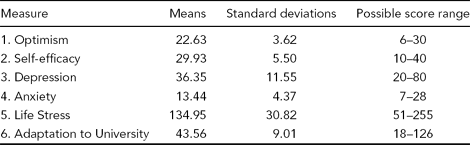
Prior to performing the main analyses, preliminary tests were performed to evaluate whether the data satisfied the assumptions of multiple regression. Inspections of the distributions of scale scores and skewness and kurtosis statistics revealed that the assumption of normality was not violated. Means, standard deviations and possible score range for the measured variables are presented in Table 1.
Means, Standard Deviations and Possible Score Range for All Variables

Correlational Analysis
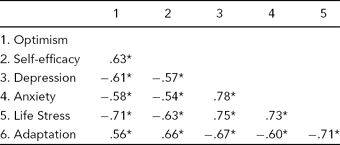
Table 2 presents the pattern of correlations for all variables. As expected, optimism and self-efficacy showed significant negative correlations with depression, anxiety, and stress; and a significant positive relationship with adaptation to university. Furthermore, students’ levels of depression and anxiety had a significant negative correlation with adaptation, and a significant positive relationship with stress. It should be noted that student life stress and adaptation to university showed a significant negative correlation, indicating that they are strongly connected as predictors of students’ overall adaptation to university.
Pearson Correlations for All Variables
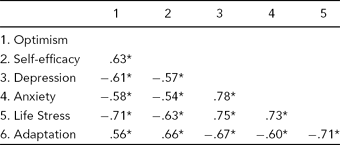
Note: Correlation is significant at the 0.01 level (2-tailed).
Prediction of Life Stress and Adaptation to University
A standard regression analysis was conducted to generate the significant predictors for student life stress. The predictors entered were optimism, self-efficacy, depression, and anxiety. Using G*Power 3 (Faul, Erdfelder, Lang, & Buchner, Reference Faul, Erdfelder, Lang and Buchner2007) for this design and analysis (setting the apriori effect size to .15, p level to .05, power to .80) with four predictor variables, a sample of 85 was needed; hence, the sample size for these analyses was sufficient.
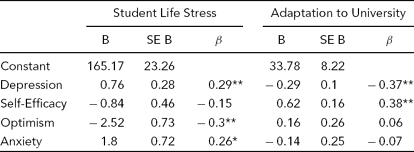
Table 3 shows the values from the standard regression. When these predictors were entered into the regression model, R was significantly different from zero, F(4, 79) = 47.64, p < .001. Together, the four predictors accounted for 69.2% of the variance in the student-life stress, adjusted R 2 = .692.
Multiple regressions With Student Life Stress and Adaptation to University as Criterion
Note: *p < .05, **p < .01.
This set of analyses established that optimism was a significant predictor of student-life stress t(79) = -3.44, p < .01. Thus, students who reported high levels of optimism reported lower levels of stress. In addition, depression and anxiety predicted student-life stress, t(79) 2.73, p < .01 and t(79) = 2.52, p < .05 respectively. Therefore, students with higher ratings of depression and higher ratings of anxiety reported higher levels of student-life stress. Contrary to expectations, self-efficacy did not predict student-life stress, t(79) = −1.81, ns, indicating that students with higher levels of self-efficacy did not significantly report lower ratings of stress. Individually, optimism accounted for 13%, depression 8.6%, anxiety 7.4%, and self-efficacy 4% of the total variance. Therefore, the interaction between the variables accounted for 36.2% of the variance.
A second standard regression analysis was conducted in order to generate the significant predictors for adaptation to university. The predictors entered were optimism, self-efficacy, depression, and anxiety. Table 3 shows the values from the regression. When these predictors were entered into the regression model, R was significantly different from zero, F(4, 79) = 26.38, p < .001. Together, the four predictors accounted for 55% of the variance in adaptation to university, adjusted R 2 = .55.
This set of analyses found that only self-efficacy, t(79) = 3.76, p < .001, and depression, t(79) = −2.90, p < .01, were significant predictors of student adaptation to university. Therefore, students with high levels of self-efficacy and lower levels of depression tend to adapt more easily to university than students with low levels of self-efficacy. Contrary to predictions, optimism and anxiety were not significant predictors of students’ adaptation to university. Individually, self-efficacy accounted for 15.2%, depression 9.6%, optimism .005%, and anxiety .004% of the total variance. Therefore, the interaction between the variables accounted for 30.2% of the variance.
Discussion
The primary aim of the current study was to examine the effects that optimism and self-efficacy had on an individual's adaptation to university and life stress. Furthermore, this study sought to determine if depression and anxiety impacted on a student's level of life stress and adaptation when making the transition from high school to university. Results of the present research provide strong support for the proposed research questions. As expected, students with higher levels of self-reported optimism experienced less stress levels than students with lower levels of self-reported optimism. This finding may be attributed to the coping styles implemented by optimistic students. Participants with higher levels of optimism may have adopted an approach coping style as opposed to an avoidance coping style (Aspinwall & Taylor, Reference Aspinwall and Taylor1992). Contrary to past research and prediction, optimism did not predict adaptation to university, although it did have a moderate correlation. The stronger correlation between self-efficacy and adaption to university resulted in it being the stronger predictor. This indicates that a student's belief in their ability to achieve and adapt may be a stronger predictor of their actual ability to adapt. Nevertheless, both optimism and self-efficacy have significant positive relationships to adaption to university.
In contrast to the effects of optimism, self-efficacy was found to be a strong predictor of students’ ratings of adaptation to university, indicating that students with higher self-reported levels of self-efficacy adapt better to university than students with lower self-reported levels of self-efficacy. Consistent with Chemers et al. (Reference Chemers, Hu and Garcia2001), students with high self-efficacy may have seen themselves as able to meet the demands of the situation and may have seen the transition from high school to university as a challenge rather than a threat. It is postulated that students with high levels of self-efficacy may have felt confident in managing the challenges of first-year university; for example, the amount of effort required, possible dangers, and the uncertainty of success.
It should be noted, however, that self-efficacy was not a significant predictor on students’ perceived levels of life stress. Results show that optimism appears to be a stronger predictor of life stress than self-efficacy. This indicates that an individual's active coping style may be a stronger predictor of their perceived levels of stress than their beliefs in their capabilities. This finding highlights the importance of schools and universities providing interventions for students that aim to develop their active coping skills and help students realise the personal control they have to deal with challenging situations (Leary & DeRosier, Reference Leary and DeRosier2012).
Consistent with predictions, students who self-reported higher levels of depression symptoms showed higher levels of life stress and more difficulty adapting to university. In addition, and consistent with past research, results showed that students who self-reported higher levels of anxiety also reported higher levels of life stress. As Jackson and Finney (Reference Jackson and Finney2002) state, younger adults with depressive or anxiety symptoms may lack the psychological resources of maturity or experience, or adopt ineffective strategies when faced with stressful situations. In addition, consistent with Uskan, Kisioglu, and Ozturk (Reference Uskan, Kisioglu and Ozturk2008), students with higher levels of depression and anxiety may have difficulty coping with the stressors of university such as dissatisfaction with social activities, relations with the other sex, worry about examination success, accommodation problems, fear of poor career choice, and worrying about the future. It must also be noted that students who report having difficulty adapting to university are more likely to experience higher levels of depression and anxiety. The present study is unable to determine a causal relationship between these variables.
Results from this study do not support the hypothesised negative relationship between anxiety and adaptation to university. This indicates that targeting students’ levels of anxiety will not directly influence their perceived levels of adaptation to university; however, it will strongly influence their levels of stress, which has a strong correlation with adaptation to university.
This study found a significant correlation between students’ perceived level of stress and adaptation to university. Therefore, if universities focus on what is impacting on students’ levels of stress, they may also discover what is affecting an individual's adaptation to university. By including the two dependent variables of life stress and adaptation to university in the current study, we were able to present the more complex nature of the transition to university. In addition, it is important to note that the combined effect, or interaction effect, of the predictors accounts for more variance than the individual predictors do in both dependent variables. That is, this study highlights that mental health may be more adequately explained by adopting a dual factor model (Wang, Zhang, & Wang, Reference Wang, Zhang and Wang2011) of mental functioning. A dual factor model of mental health posits that mental health factors can co-occur with mental illness factors. That is, mental health and mental illness are not on a continuum but are separate (Suldo & Shaffer, Reference Suldo and Shaffer2008). While the sample size in the current study needed a larger number of participants to adequately test for such a model, the results did show that the interaction of the variables accounted for more variance than the sum of each variable explored. It would be valuable to explore whether stress and adaptation is best for those students with the combination of low distress (depression and anxiety) and high dispositions (optimism and self-efficacy), as opposed to those who have no distress symptoms.
Implications
The present research demonstrates the importance of investigating the influence that optimism has on life stress and that self-efficacy has on students’ adaptation to university. In order to build optimism and self-efficacy in students making the transition to university, it might be helpful for lecturers and tutors to promote optimism and self-efficacy in class. Engaging first-year students in discussions around these constructs and allowing them to engage in activities designed to enhance these constructs may result in a greater awareness of, and ability to use, these personal characteristics. Focusing particularly on learning experiences that provide students with challenging practical experiences where they can apply their knowledge and skills has been found to be particularly effective in increasing higher education students’ self-efficacy (van Dinther et al., Reference van Dinther, Dochy and Segers2011). As universities strive for ways in which to improve the retention rates of their first-year cohort (Horstmanshof & Zimitat, Reference Horstmanshof and Zimitat2003), studies such as this provide insight into the psychological factors that may be impacting on students’ decisions to leave university. By promoting optimism and self-efficacy in class, students’ perceived levels of stress and difficulty adapting to university may be lessened, and their desire to persist with their studies may be increased.
As students with higher levels of self-reported depressive and anxiety symptoms have more difficulty dealing with life stress and adapting to university, the need for promoting and making aware the psychological services available at university is highlighted. Within a university setting, co-location of specialist mental health services can promote a team approach to mental health care, with GPs, psychiatrists and psychologists working together to increase the availability of care to students in need. In this way, any psychological distress or difficulties experienced in adapting to university can be assisted by promoting psychological services and providing effective intervention. Many universities in Australia do offer a wide range of support services to their students, and support is often free or at minimal cost. In addition, many universities introduce students at the beginning of their first year to the range of support services available, and tutors are often identified who students should approach if they feel they would like support. Unfortunately, not all students in need avail themselves of the support available, and it is often students who demonstrate an effective coping style who seek additional assistance (Julal, Reference Julal2013). It is therefore imperative that optimism and self-efficacy are enhanced not only in first-year university students, but also in the high school years, so that students understand the importance of adopting an effective coping style (Wristen, Reference Wristen2013).
Limitations
A number of limitations should be noted. As this study was conducted towards the end of the first semester, students may have already adapted to university more so than if they were in their first weeks of university. Future research could measure students’ levels of optimism, self-efficacy, depression and anxiety at the beginning of the year and then later around week 6, to develop a broader understanding of making the transition to university. With regards to life stress, it might be helpful to ask for a short written response, as well as completing the SSI, to gain a more accurate understanding about what particular stressors students are commonly dealing with at this point in time. This would help determine whether during the first semester of university, students are more commonly concerned with academic, social or emotional stressors. Moreover, it may be beneficial to assess different levels of social, emotional, and academic stress to determine if optimism, self-efficacy, depression, and anxiety have stronger effects for different kinds of stress. It must be noted that the instruments used in the current study are not clinical tools, but were designed to be used in research. As such, this study has not sought to identify students as clinically depressed or anxious, but rather to show tendencies toward depression and anxiety based on students’ self-reports.
Future Research
As the current study did not find the expected correlation between self-efficacy and student-life stress, or between optimism and students’ adaptation to university, future research needs to further explore these areas. As mentioned above, it may be that differences would be found in these variables if particular aspects of stressors (such as social, emotional, or academic) as opposed to overall stress were examined. Similarly, the measure used to determine adaptability to university (the CAQ) measures general adaptation. More meaningful findings may have resulted between optimism and adaptability to university if specific dimensions of adaptability to university had been explored. Finally, an avenue for future research could be to determine the influence that optimism, self-efficacy, depression and anxiety have on students’ academic performance in first-year university. It would be interesting to establish whether these variables significantly predict a student's level of academic achievement.
Due to the fact that more and more students are travelling interstate, from small communities, and from overseas to attend certain universities, it would be valuable to assess their levels of perceived stress and difficulties in adapting to university. Moving from one city or country to another to attend university may increase an individual's level of stress. Therefore, by looking at the levels of optimism, self-efficacy, depression, and anxiety of non-domestic students, it may show that extra support around their optimism and self-efficacy is needed to enable an easier transition to university.
Conclusion
This study sought to explore the impacts that optimism and self-efficacy have on an individual's adaptation to university. Additionally, this study examined whether self-reported depression and anxiety symptoms impacts on a student's levels of stress and adaptation when making the transition from high school to university. The study showed the significant impact that optimism, depression, and anxiety have on students’ perceived levels of stress, and the significant impact that self-efficacy and depression have on adaptation to university. It highlights the utility of holding an optimistic outlook and having a high level of self-efficacy when making the transition from high school to university.