Much recent scholarly debate has focused on the conceptualization of urban green space. The broad spectrum of definitions of the concept present a number of challenges. In his pioneering volume on the history of urban green space, Peter Clark exposed the absence of a theoretical perspective,Footnote 1 while Helen Meller, reviewing the book, added that ‘analysing green open space poses two almost overwhelming hazards: defining what is and is not green open space and determining its significance to place and people over periods of time’.Footnote 2 The debate is ongoing, but until now both historical research and contemporary surveys have focused exclusively on official public green spaces and on the study of official sources. To reveal the greenness of a city, present-day liveability surveys mathematically measure and compare the surface and the proximity of accessible green space, often disguising the real facts. Historical research too, is often biased by its overreliance on official sources, while the city dwellers’ point of view on urban (green) space remains invisible. The analysis of the surface area and the official figures on urban green spaces provide an interesting starting point, but from a historical viewpoint there is much more to it than meets the eye. The use of official data does not do justice to the significance of urban green space at large.
In the field of landscape research, human perception is a key element, and provides a valuable approach to the study of urban green spaces from the perspective of urban history. Alexander von Humboldt argued that ‘a landscape is the totality of all aspects of a region, as perceived by man’.Footnote 3 Based on Von Humboldt's definition of landscape, urban green space, as a part of the urban landscape, implies human perception. Inspired by Gerhard Ermischer's statement that ‘any landscape study has to start with the human ideas and concepts of a certain landscape’Footnote 4 and Michael Hough's observation that ‘understanding places begins with feelings’,Footnote 5 this article concentrates on the city residents’ use of urban green space. I will demonstrate that a one-sided focus on both official sources and official green spaces obscures much of the significance of urban green space. The point of this article is not to depreciate the value of existing research on official green space, but rather to complement it. Besides the expected discrepancy between official precepts and the alternative, day-to-day use and perception of public parks, I will also analyse users’ initiatives with regard to unofficial green spaces. My argument will be built upon two contrasts: the friction between official data and discourse on the one hand and city dwellers’ use and perception of official green space on the other hand; and the conflicting viewpoints on the value of ramparts and wasteland from the perspective of different actors.
The first contrast concerns the opposition between the strict rules and regulations in urban green space and the alternative uses found for them by urban dwellers. Scholarship on the use of urban green space in historical perspective is in its infancy, but is becoming internationally recognized. Research has mostly been based on official, government-generated sources and surveys, while the unofficial use of green space by city dwellers is rarely dealt with. A pioneering study on the alternative use of city parks in London was provided by Nan Dreher in ‘The virtuous and the verminous’. She focused on the contested use of public parks. Although there was a consensus that the use of urban parks encouraged respectability and good citizenship, more controversial behaviour was frequently exhibited. Dreher examined public opinion towards two specific types of park use – ‘public displays of affection by “courting couples”’ and the presence of ‘verminous persons’ (mostly vagrants)Footnote 6 – which led to a moral panic in the last decade of the nineteenth century. Dreher mainly based her research on reports from the Commons and Open Spaces Committee and other official sources and she was specifically concerned with revealing behaviour deemed offensive in public green spaces. She did however provide an insight into the day-to-day use of public parks in London at the end of the nineteenth century. City dwellers challenged the authority of the strict by-laws and surveillance in the parks. Dreher concluded that although bourgeois visitors demanded more rather than less control in public parks, park users frequently bent the rules.Footnote 7 Several other authors have touched upon the subject of park use and users, but most of the research so far has failed convincingly to challenge the official reading of park use.Footnote 8
The second contrast focuses on the value of wastelands and ramparts as a compensation for the lack of green space in the city. Both contemporary surveys and historical research usually overlook unofficial and semi-official urban green spaces. Recently, urban wastelands have been the subject of research in the field of landscape planning and agricultural sciences, but they have either been considered as an element in the improvement of the biodiversity of the twenty-first-century city, or in relation to their (re)development and the gentrification of the city.Footnote 9 Although previous research on urban green spaces indicated that
we must remember not only the parks and squares, garden suburbs and green belts which have attracted most attention from historians and others, but also the infinite multitude of churchyards, cemeteries, hospital grounds, sports and school grounds, river-banks and little strips of empty land at the end of streets, as well as the fields and woodland on the edges of the invading metropolis.Footnote 10
Unplanned, informal green spaces hitherto remained completely out of the picture. In the first part of this article, I will place the topic of urban green space in the context of Antwerp in the late nineteenth century. The most influential debates on the use and functions of public green space will be elaborated. In the second part, I will confront the official perspective on urban green space with the perception of city residents by means of published recollections, contemporary urban topographies and photographs. In the third part, the unofficial, vernacular green spaces will play the lead role.
’Une des plus belles villes d’Europe’
Throughout its evolution, Antwerp has been situated on the right bank of the Scheldt. Since the city was confined within its sixteenth-century walls, the centre became densely populated by the second half of the nineteenth century. Between 1846 and 1900, the population rose from 88,487 to over 300,000.Footnote 11 To remedy the burning issues of population pressure and the deficiency of open space, the city council consulted other port cities – Lille, Le Havre, Riga and Marseille – about their extension plans,Footnote 12 and planned the demolition of the ramparts from 1863 on. The vast open space that became available was the catalyst for the first discussions of the implementation of green spaces in the development plan, as there were only two public green spaces at the city's disposal – the very popular Promenade du glacis, and the neglected Warande – and the expensive zoological garden. In other European cities, where open space was created by the demolition of medieval city walls, large boulevards and city parks were laid out to create healthy, green lungs within reach of the city's inhabitants. The textbook example is the Haussmannization of Paris. Napoléon III commissioned a modernization programme of the inner city, which was under the supervision of prefect and civic planner, George-Henri Haussmann. The sanitary infrastructure was improved, the traffic congestion was dealt with and initiatives were taken to create light, air and open space.Footnote 13 An important part of the programmeme consisted of the creation of public green spaces, which mainly appeared as romantic landscape parks. The idea of the landscape park originated in London, where the ‘picturesque design features of the aristocratic country park were adapted to an urban setting’,Footnote 14 inspiring several future European park designers.
In Antwerp, the importance of the creation of public (green) spaces was emphasized by city engineer Théodore Van Bever's general report.Footnote 15 He stated that ‘la création d’une bonne voirie, l’érection des monuments, promenades et places publiques, dépendra l’immense splendeur à laquelle la ville d’Anvers est peut-être appelée dans les temps futures’.Footnote 16 Haussmann's influence on Van Bever's plan was abundantly clear, as he stated for instance that ‘la nécessité de créer des grandes artères de communication autant pour la facilité de la circulation que pour l’hygiène publique, est incontestable’.Footnote 17 He argued that a landscape park should be created, with a surface of at least 16 hectares in order to equal the surface of the new park in Brussels, and added that the different public green spaces should be interconnected by large boulevards planted with trees, turning Antwerp into ‘une des plus belles villes de l’Europe’.Footnote 18 The decision to pull down the ramparts threatened the popular promenade, which brought about a vehement discussion between the different members of the city council, several interest groups and individual city dwellers.
City extension plan by city engineer Théodore Van Bever, 1863
Source: City Archive Antwerp (SAA).

During the council meeting of the 15th of September 1864, the audience started applauding spontaneously when a council member stated that he would vote against the execution of Van Bever's plan. The council president repeatedly warned the audience to abstain from influencing the council.Footnote 19 Several members of the city council did not agree with Van Bever's view and stated that the suppression of the Promenade du glacis would be an irreparable mistake. However, what Van Bever pointed out as the major aim of the city extension – the creation of a wealthy, prestigious district characterized by statues, green spaces and monumental boulevards – was exactly what the majority of the council had in mind. The opinion of the inhabitants was nevertheless regarded as an important factor in the discussions. City council members quoted the local press on the matter of the promenade and even talked about rumours they had heard in the streets.Footnote 20 The public seemed to consider the transformation of the promenade as an important issue. In January 1865, three petitions, subscribed to by over 6,000 inhabitants of different political leanings, requested the preservation of the existing promenade.Footnote 21 The most influential arguments, however, were all closely related to the preconceived image of the park and its surroundings. A new rich quarter would be erected around the park, providing the city with a new point of attraction and prestige and increasing the city's property prices. Several studies of the historical evolution of urban green spaces stress the bourgeois focus on urban green space. Andreas Stynen argued that city districts, beautified with monuments and plantings, were in general meant for the bourgeoisie,Footnote 22 and Catharina Nolin cites the example of the Kungsträdgarden with its cafés, restaurants, sculptures and fountains, which became the quintessence of the urban bourgeois life style.Footnote 23 The city council meetings in 1864 and 1865 show that the city government reinforced this focus on the needs of the bourgeois population.
The majority of the members were confident that Edward Keilig's design would improve the international reputation of the city.Footnote 24 One councillor, who was also a member of the research committee made responsible for the investigation of the different projects on the transformation of the promenade, summarized the point of view shared by the majority of his colleagues: ‘Je suis d’avis que la ville d’Anvers doit aussi faire quelque chose pour son embellissement proprement dit. . .La beauté d’une ville lui constitue toujours un capital productif.’Footnote 25 Although the city council did value the opinion of the city inhabitants, they decided to transform the promenade into a city park as they had intended from the start. The council members based their decisions on arguments about embellishment and prestige, and the needs and wishes of the bourgeois population.
The transformation of the city park attracted most attention, but the second public park, the Warande, was also the subject of discussion from 1860 onwards. The park was said to be mostly deserted and even avoided by the residents, especially by women, as young criminals were said to gather in the park. One council member argued that the park should be sold, but the others agreed that the Warande had to be improved in order to attract respectable visitors.Footnote 26 Ten years later, the Warande still suffered from its bad reputation and was even called a forêt de Bondy.Footnote 27 Despite the fact that the park was one the few public green areas in the city, several council members argued that the Warande would be a suitable location to erect a new fine arts museum, reducing the park to several, inaccessible small gardens.Footnote 28
Although the Warande was transformed into a public park after several discussions, the idea of creating small, inaccessible gardens instead of a large accessible park is compatible with the nine days’ wonder of the late nineteenth century: the square. In this case, Antwerp did follow the international trend. The square movement had its roots in England, and spread to the Continent, initially to Paris where the urban transformation led by Haussmann provided the city with 19 new squares.Footnote 29 Originally, the squares were meant to improve public health, and the social cohesion of the different layers of the city population, but in the end, the social function was shrugged off, and the council focused on the decorative aspects of the squares.Footnote 30 The period between 1870 and 1905, marked by an enthusiastic attitude towards the new miniature status symbols, would later be characterized as an outbreak of ‘squaremania’.Footnote 31 The creation of large green areas in the urban environment no longer seemed a point of interest in Antwerp from the late nineteenth century, while ‘squaremania’ reinforced the decoration- and prestige-oriented attitude towards urban green space.Footnote 32
The discussions of the creation, transformation and use of public green space reveal an exclusive focus on the bourgeois population. The attention given to recreation and especially to working-class leisure was negligible during the nineteenth century. The city council mainly focused on the prestige of the city and its international status. It is striking that during the extensive debates, neither the needs of the users nor the recreational functions of the parks were discussed. The debate about the transformation of the Promenade du glacis into a landscape park clearly shows that Antwerp was not a trendsetter in the field of urban green spaces. While in big cities like Paris and London, but also in smaller cities like Stockholm and Helsinki, people's parks were created to provide the population with leisure spaces, green space in Antwerp was all about embellishment and bourgeois culture. In Britain, people's parks were ‘an important element in the ideology of Victorian liberalism’.Footnote 33 David Reeder stated that ‘nature, like art, was thought to have a morally beneficial influence as well as recuperative powers’.Footnote 34 In Stockholm, several new parks were created in 1879–80, all ‘intended for a variety of activities. Visitors could sit down on the grass wherever they wanted. . .play games and during the winter go skating and skiing.’Footnote 35 In short, it can be concluded that the bourgeois focus on urban green space in Antwerp during the nineteenth century can be seen to have reflected the city government's intention to create expensive districts and to provide the city with an international reputation, reinforced by prestigious new green spaces.
Official policy vs. alternative use
Passive forms of recreation (e.g. walking, sitting, reading) and the one-off recreation initiatives (e.g. concerts and annual city festivals) organized by the government did not meet the needs of city dwellers. The negotiations on the recreational filling-in and the day-to-day use of urban (green) areas reinforce the perception of the urban parks as a bourgeois location. Even the recreation of the bourgeois population was often encountered with a feeling of mistrust. Just after the new city park was inaugurated in 1869, the city council members pored over the difficulties that arose from the latest fashion: the pedal wagon. A member of the council coined the word vélocipédomanie to refer to the large number of people driving around in the park on their bicycles.Footnote 36 The cyclists were said to destroy the plantations, damage the trees and endanger the strollers in the park. The council members were indecisive about the regulations, but in the end it was decided that strict rules had to be imposed on recreational park use. They based the strict by-laws on the park regulations which applied in Brussels, Liège and Paris.Footnote 37 The 1870 regulations stated:
It is forbidden to enter the plantations; to climb trees, benches, fences and barriers; to catch birds or destroy their nests; to tread the lawns; to pick flowers; to cut branches or damage trees, plantings, benches, statues, fences and barriers in any way; to play; to organize gatherings which might hinder the passage; to leave garbage or to do anything that could violate modesty; to fish, to bathe or bathe animals in the ponds.Footnote 38
The park users were restricted by rigid by-laws and monitored by a large number of park rangers. This article, which foregrounds the memories and testimonies of citizens, puts previous assumptions into perspective and shows the multilayered character of public parks and the opportunities for bending the rules in the late nineteenth-century public green spaces. Based on a collection of published testimonies, a picture of the day-to-day park use in Antwerp around the turn of the century can be sketched.Footnote 39 David Reeder contested the widespread assumption that park design, by-laws and regulations determined the way in which parks were used. Based on two series of photographs dating from 1909 and 1939, Reeder demonstrated that different park users were a real challenge to the park managers.Footnote 40 London parks were known for their extensive recreational infrastructure, but during the fin-de-siècle the formation of the London County Council caused the tightening of park regulations.Footnote 41 The long list of prohibitions which included ‘brawling, fighting, quarrelling, cursing, swearing or using indecent or improper language, or taking part in any running, boxing, wrestling or walking match’ proved hard to implement.Footnote 42 Besides this preview of the diversity of the rules and regulations, most research has so far focused on the official view of park use, which revealed that park visitors lacked space to move about in the strict, bourgeois environment.
In contemporary landscape research, children's perceptions and the everyday uses of the urban environment receive considerable attention. Ian Simkins and Kevin Thwaites argued that children's everyday use of urban space should play a pivotal role in the arrangement of their environment.Footnote 43 Sophia Cele's study revealed the multidimensional experience of children with regard to urban parks.Footnote 44 Children and urban green space have become exceptionally popular topics in landscape and environmental studies, as the child-friendliness of the city is an important theme in our contemporary society.Footnote 45 The connection between youth, cities and the public sphere has also recently been the subject of historical research.Footnote 46 But since it is difficult to reconstruct the perception of children, studies generally focus on how children were perceived rather than children's perceptions of the city.Footnote 47 Simo Laakkonen was the first to shed light on the connection between children and their experience and the day-to-day use of urban space from a historical perspective.Footnote 48 Laakkonen focused on children's perceptions of urban space from an environmental viewpoint. He argued that the focus on children provided the most interesting results, and criticized previous approaches made from the perspective of white, middle-aged, middle-class and educated men.Footnote 49 However, he did not discuss the importance of the topic with relation to the understanding of urban space. Nevertheless, uses and perceptions of city dwellers provide urban (green) spaces with new meanings and nuance the prevailing view on urban space.
Several people who lived in the vicinity of the park during their childhood years wrote about their experiences in the park and their memories of its character. Louisa Duykers (1869–1959) described the environment of the park as a quiet, distinguished neighbourhood, which was in line with the expectations of the city council and the city engineer who designed the district.Footnote 50 However, she also revealed the real use made of the park by the children living in the surrounding district.
Above all, the park was the main point of attraction. Through the fata morgana of the years, it seems as if my entire childhood took place in the park. As a child I played there for whole days. I knew every corner, every tree, every plant. We were a whole gang of children from Quinten Matsijslei and we considered the Park as our property. Often, the park was so quiet that it was easy to imagine that it really was our own garden – a garden where ‘gardevilles’ (park rangers) could be annoying from time to time. But these small disadvantages were not able to spoil the park's great glory for us.Footnote 51
Despite the strict park regulations and surveillance by the police and the gardevilles, children could play almost undisturbed in the seemingly rigid bourgeois park. ‘We often played hide and seek behind the trees and the bushes, or around the statues. We walked through the lanes with our hoops, we rolled down the hills with a dizzying speed and we did not stay on the trails!’Footnote 52 Not only did the children ignore prohibitions on playing, they also walked over lawns, went into plantations and climbed fences and statues undisturbed. Simo Laakkonen quoted several ladies who remembered stealing flowers from the Helsinki city parks when they were little.Footnote 53 It was not only children who dared to bend the rules that applied in the public parks. Young couples made good use of the bushy environment and the official nightly activities like concerts to spend time together.Footnote 54
Children walking in the city park, late nineteenth century
Source: SAA.
Besides the alternative use of the public parks, the variety of visitors mentioned in the contemporary descriptions of the city parks challenge the idea of the successful creation of a bourgeois environment. Although the debates were always dominated by bourgeois arguments, and all contemporary authors characterized the district around the park as a wealthy, elegant area, the park also attracted less fortunate citizens. In his book Tableaux Anversois, published in 1905, A. Cleykens took the reader on a walk through the park. The park is depicted as a destination ‘d’une aristocratique propreté’,Footnote 55 but Cleykens paid particular attention to the people he met in the park. The picture he paints is not a rosy one, especially when he discusses the less fortunate. Cleykens stated that the park attracted and fascinated the masses: he came across both sad and comforting scenes on the flowery park trails and in the shadow of large trees.Footnote 56 He met a man suffering from tuberculosis racked by a painful cough. ‘Poor young man! Next year, he won't be able to relax under the mighty branches of an oak tree.’Footnote 57 Several unemployed maidservants and day labourers were immersed in their newspapers in search of job advertisements.Footnote 58 A drunk, ‘a victim of the deadly spirit, slumped on a bench. Indifferent to what was happening around him, drinking his treacherous and deadly liquor; ill-sounding or vulgar curses escaping his bloodless lips’,Footnote 59 was excluded from the park by the police when his behaviour became too disruptive. The city park was a favourite walking place but also a haven for drunks, homeless, sick and unemployed and a children's playground. The descriptions of several authors show that even in a strictly monitored and regulated urban space that was designed as an extremely bourgeois environment, different layers of society mingled (more than the bourgeoisie and the city council had hoped).
Besides bourgeois city parks, the appeal of green spaces and green squares in working-class areas was significant. The Sint-Jansplein, which during the nineteenth century consisted of large tree-lined unpaved squares, figured most often in the descriptions.Footnote 60 Even the children from the nearby ‘silent, bourgeois neighbourhood’ came down to the square. Frans Smits (1891–1968) remembered:
the greatest pleasure was the play of boys and girls in groups: tag, hide and seek, policeman and thief or hoodwinked. But it happened too seldom that we were allowed to play on the square and in the streets. The street is not an appropriate playground for respectable children. They get dirty, and they learn bad manners and four-letter words.Footnote 61
Smits claimed that they had to use tactics to get to the square without their parents noticing.Footnote 62 On the square, a police officer kept an eye on the events taking place. He guarded the square and ‘enjoyed it, when he could catch us while we were playing on the kiosk. . ., but we were not impressed by him!’Footnote 63 There were activities that were not tolerated by the authorities.
It was forbidden to fly kites, whose long tails got tangled up in phone wires. . .And when we had fun with the lighting of fireworks. . ., the sudden appearance of a guard was enough, to chase the whole gang of brats in the direction of another district, where the power of the guard automatically stopped.Footnote 64
Another very popular green square in the densely populated working-class neighbourhood was the Stuivenbergplein, which served as a cemetery until 1875, and was gradually cleared between 1875 and 1895. The surrounding neighbourhood was notorious for its ‘turbulent, adventurous, argumentative, often predatory residents’.Footnote 65 John Broeders who, was born in the neighbourhood, described the neglected character of the area.
The northern area of the square was littered with old iron, boilers, pipes and cisterns. The square was a shelter for beggars and vagrants and a receptacle for all kinds of smelly waste. The back and the south side of the cemetery looked as creepy. Especially at nightfall there was something ‘uncanny’ and gloomy about the area. This impression was reinforced by the memory of the many assaults that had occurred.Footnote 66
It was a relief for most people when the square was transformed into a playground and planted with trees around 1900. During the last decade of the nineteenth century, vast improvements were made. Renaat Korten (1900–63), who spent his childhood on the square, recalled happy memories.
Seven years, seven Easter holidays, seven summer holidays, I indulged myself on this square with my friends. The cemetery, as this square was still called by the neighbours, was a dream playground for the youth. In dry weather the fine sand was blown over the square like a desert wind and after the rain, you could paddle on the square just as wonderfully as at the coast.Footnote 67
Inauguration of the transformed Stuivenbergplein, 1906
Source: SAA.
Provision for working-class recreation and the development of recreational infrastructure was only implemented in official policy from the interwar years, but the perception of the public provides an alternative view of official green spaces at the turn of the century. One of the main subjects for debate was the fact that before World War I, city dwellers never took part in the discussions about the use and creation of urban green. Katri Lento has argued that ‘most ordinary people living in Helsinki, especially the working class, figured more as objects of discussion than as participants’,Footnote 68 a conclusion that perfectly applies to the city of Antwerp. An example that clearly illustrates the dissatisfaction of the citizens with the official green spaces was the recurrent problem of vandalism. The problem was the subject of regular discussions in the city council. Vandalism took many forms: from children throwing chestnuts at passers-by (which resulted in the authorities picking all the chestnuts from the trees and the growing of fruitless chestnut trees) to the destruction of entire squares and insulting police officers. All the squares were created to decorate the city and to enhance its appearance and atmosphere. Crowded and densely built working-class areas were provided with squares to beautify the life of the working-class population. The De Coninckplein and the Ijzerenwaag, both situated in areas marked by their poor and heavily built over character, were transformed into planted squares. The examples show that squares did not conform to the ideal type of green space in crowded working-class areas. Soon after their creation, the squares were either deliberately demolished or were found to be in a dreadful condition.Footnote 69 Between 1893 and 1895, the police had served over 25 street urchins with a summons for vandalizing the planting on the square of the De Coninckplein and for ridiculing and insulting the police officers who guarded the square.Footnote 70
Alternative green space
The descriptions of the use of green space and the examples of vandalism in public green spaces show that they were not always the strict, educative environments that the city government had in mind. It was possible to bend the rules. At the end of the nineteenth century, an international survey pointed out that Antwerp was provided with the smallest amount of public green space in Europe, which stimulated the city government to take action.Footnote 71 According to several researchers, the attitude towards urban green space shifted during the fin-de-siècle. Marijke Van Schendelen has argued that leading figures with different professional backgrounds stressed the importance of a healthy environment for the inhabitants of cities.Footnote 72 Maurits Van Rooijen also saw a change in the attitude towards urban green space, which was characterized by an increased attention to recreation-oriented green areas for the entire city population.Footnote 73 From his findings, he deduced that – at the start of the twentieth century – there was a shift from bourgeois green to societal green.Footnote 74 Moreover, from the start of the twentieth century, residents of cities started to be aware of cities as tourist destinations. The presence of accessible green spaces played a significant role in the perception of a city as a tourist destination and as a metropolis.
During the first decade of the twentieth century, the city of Antwerp underwent a considerable morphological change. In 1906, the government decided that the city walls – which were outdated soon after they had been built Footnote 75 – would be dismantled to provide accommodation for the rapidly expanding city population, to connect the inner city with the extra-muros districts and to provide the city with large new public parks. Renowned French architect Henri Prost, the winner of the competition for the city extension, convinced by the dominant ideal of the time, suggested the creation of a green belt around the city. He also put forward the idea of creating labourers’ settlements in a green environment, and people's parks, which would not only benefit the health of the labourers, but would also deal with alcoholism and other inappropriate public behaviour.Footnote 76 In his opening speech for the exhibition of the submitted plans, former Belgian Minister of Public Works August Delbeke expressed the city population's ambiguous attitude towards the Brialmont ramparts. ‘Si d’une part, l’enceinte militaire fut, et est encore une nuisance dont il faudrait faire disparaître jusqu’au souvenir, d’autre part elle apparait, pour beaucoup, comme une couronne de verdure à laquelle il ne manque que quelques apprêts pour la rendre belle et la faire aimer.’Footnote 77
Plan of Antwerp, 1906
Source: SAA.
The contradictory meanings of the ramparts – they functioned both as a carcan (straitjacket) and as a salubrious environment – made the area into a hybrid place. The ramparts, which at the same time connected and divided the urban and the rural, are often referred to as the urban fringe. Contemporary city dwellers like Rob Van Roosbroeck (1898–1988) characterized them as a border, a fringe, between the urban and the rural landscape. ‘The high walls, with their narrow dark gates, were not without charm for the cityscape. The broad belt of permanent green, which meandered around the city, gave each area a certain intimacy, which strongly recalled the atmosphere of a small village.’Footnote 78 Van Roosbroeck's perception clearly shows that the ramparts were used as urban green space, but that they also defined the urban territory. Cleykens created a poetic image of the ramparts as a point of contact between city and countryside: ‘A light transparent curtain of mist veiled the hot summer sun, a cool breeze glided along the walls, it was one of those days when we fled the fiery furnace of the city to wander among the green senses of the Flemish countryside.’Footnote 79
The urban fringe was characterized as the graveyard of nature and the cradle of the city. Michael Hough described the urban fringe as ‘a battlefield between rural activities (predestined to disappear) and the constantly expanding city, with only placelessness in between’.Footnote 80 Mattias Qviström has conducted research on the relationship between the planning of orderly places for urban expansion and unplanned areas to reveal the multifaceted significance and use of the urban fringe.Footnote 81 He has argued that ‘even if sometimes treated as a new phenomenon, the urban fringe and peri-urban landscapes do have a peri-urban history, and consequently they are affected by relicts and shadows of former rural–urban hybrids’.Footnote 82 Qviström mentioned their role as rare biotopes, informal playgrounds, liminal places for teenagers and hide-outs for shady activities.Footnote 83 The ramparts are a perfect illustration of the complex and multilayered nature of urban green space.
The wastelands at the outskirts of the city reveal their most important meanings when we study their use by city dwellers. Qviström and Saltzman were the first to touch upon the importance of vernacular activities and the day-to-day use of the ephemeral landscapes.Footnote 84 The study of unofficial urban green spaces helps us form a more nuanced approach to the official discourse on urban green space. Ramparts, fallow land and residual space form a vast area of urban green space, which has remained almost completely unexposed to historical research. Although research on unofficial green spaces is delicate – the daily use of a city is generally considered too trivial to write about, and improvised green spaces do not play a role in official documents – it is crucial for an adequate and full understanding of the urban (green) space. In the introduction to Weerspiegeld Antwerpen, Louis Franck stated that ‘the image of a city not only lives in the important matters and actions, in art, in wealth and in beauty! There is also the intimacy of the environment and of daily life.’Footnote 85 Franck expected that certain readers would consider the book shallow and pointless.Footnote 86 But he was convinced that ‘the more the city would change under the pressure of time, the more important it would become’.Footnote 87Weerspiegeld Antwerpen offers the twenty-first-century reader a unique insight into the daily experience of urban public space, and provides an alternative approach to the otherwise official discourse on the history of urban green space.
Public green spaces in densely populated urban areas were under pressure, but the maladapted public parks were not perceived as a major issue. A number of unofficial green spaces provided the city with a sufficiently green character. At the outskirts of the city, several partly accessible pleasure gardens and the nearby countryside made up for the lack of green space in the city centre, and the ramparts around the city were especially popular as promenades and playgrounds. The use of unofficial space by the townspeople is far more significant than previous studies have indicated or investigated, and of great importance for further urban historical research on public space. The fact that Antwerp proved to be the European city that was most deprived of public green space can be called into question when contrasted with the perception of the city dweller. Unofficial green areas such as fallow land and ramparts are of great significance in the perception of urban space by the townspeople of fin-de-siècle Antwerp. The perception of urban space shows not only the particular importance that many city dwellers attributed to urban green space, but also the extent to which unofficial urban green areas could offset the lack of official city parks, promenades and squares. These improvised urban green areas had a considerable impact on the quality of life of city dwellers and the perception of the quality of life in the city. Laakkonen argued that adults kept away from wasteland, and children took control of them,Footnote 88 but the Antwerpians sketch a more complex image of wasteland use.
Cleykens conceived his walk through the city as a sensory experience, and paid considerable attention to the individuals he met during his walk. With a sense of pathos, he described a poor man – ‘sa figure pâle, gravée, souffreteuse et douce, qui exhale la misère’ – who had no right arm, and carried a basket with some loaves of bread and cookies to sell to passers-by.Footnote 89 Leaning against the embankment of the canal was an old organ player: ‘le miséreux tourne, tourne sans cesse. . .De temps à autre, le vieillard jette un regard furtif sur les nombreux promeneurs que les affaires ou le soleil d’été attirent dans ces parages.’Footnote 90 Cleykens also reported the abuses that took place on the ramparts. ‘Gangs of young thugs roamed around the ramparts who, experimenting with marauding, theft and mischief, followed the example of their elders.’Footnote 91 Court records from the early twentieth century show that the city walls lent themselves to all sorts of crimes. The city walls frequently emerge as crime scenes in the limited research on sexual offences – and more specifically the sexual assault of minors.Footnote 92
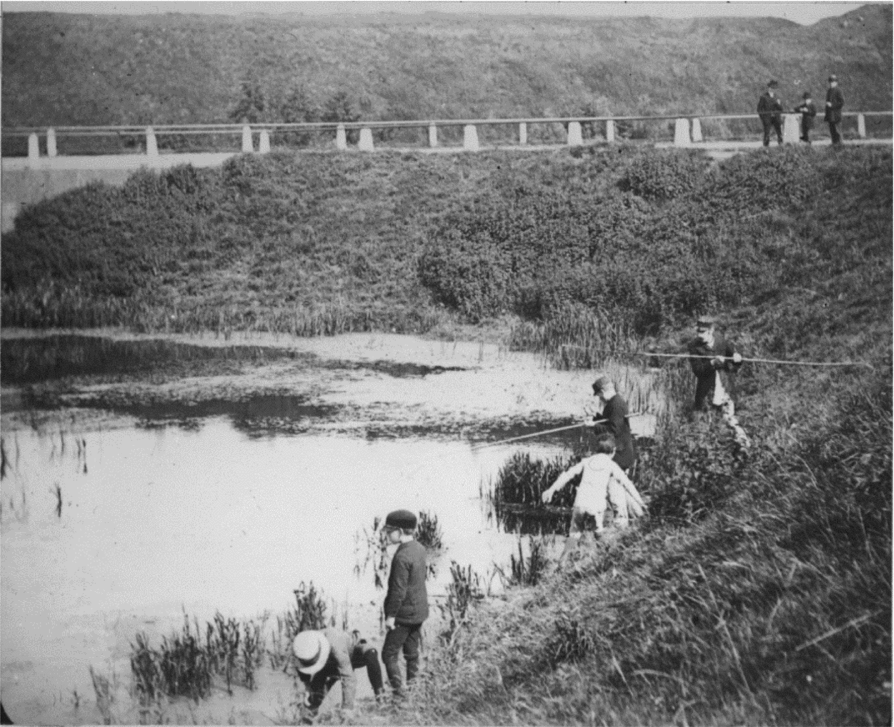
However, the ramparts were mainly a dream playground for the children who lived in the city and who, until the first decade of the twentieth century, had no playgrounds at their disposal. The authors of Weerspiegeld Antwerpen regularly described the ramparts as a popular playground. Their descriptions reflect the multilayered, easy accessible and seemingly uncontrolled nature of the green space. John Broeders (1885–1957), for example narrates that when he and his friends were eight to ten years old, the ramparts were their favourite place in the city. They could stroll around the meadows, fields and ditches uncontrolled, and could carry out all kinds of mischief.Footnote 93 Van Roosbroeck described the importance of the city walls as a playground.
The ‘mountains’, this was the great name they had given to the humble walls, were not only the strong armour of the city: not only the strong shield that gave especially young people this sense of urban superiority, they were also the local playground, where dozens of mothers held cosy and often very long conversations, surrounded by their romping offspring.Footnote 94
The ramparts assemble an amalgam of meanings, experiences, customs and images. Besides the physical and mental limits of the city, the ramparts also serve as playground, and sports field, as skating rink in winter and boating lake in summer, as military operation area, as boulevard, fish pond and secret café, as well as a haven for sexual offences, questionable business transactions and construction site for slum dwellings, etc.
In research on twenty-first-century wastelands, Anna Jorgensen and Marian Tylecote recently argued that on the one hand, fallow lands were said to possess wholesome strengths, while on the other hand they were regarded as dangerous, ‘lawless, disordered places disfigured by the traces these crimes and incivilities leave behind’.Footnote 95 Catharine Ward-Thompson argued that ‘it is precisely the tension between these polarities which create what is pleasurable in thinking about and using open space’.Footnote 96 Referring to the historical meaning, Gilbert named those contemporary wastelands ‘urban commons’, as they are ‘not in any man's occupation’, and each individual can use them in any chosen way.Footnote 97 Ward-Thompson argued that these places fulfil a multiplicity of different roles for different people in contemporary urban society. Late nineteenth-century urban wastelands already offered the same possibilities.
Children playing and fishing on the ramparts, late nineteenth century
Source: SAA.
Besides the very popular green ramparts, the wastelands which were located within the city limits were intensively used as alternative public green space. Like ramparts, wastelands were characterized by their hybrid status in the city. Describing their childhoods in the city at the end of the nineteenth century, most authors emphasized the importance of public (green) space in their perception of the city. Broeders described the fallow lands around Stuivenberg: ‘Thousands of children romped and swarmed around during their holidays, and new recruits were trained under the watchful eye of old people, vagrants and brats.’Footnote 98 Despite police checks carried out at irregular intervals, the fallow lands were a paradise for city children. A well-known and very popular area was called ‘chicken's meadow’ or just ‘the meadow’.Footnote 99 Access to ‘the meadow’ was officially banned, but the police had nothing against some ‘poor fellows who, unseen, facilitated the access to the meadow, by breaking some boards away from the wooden fence’, granting both children and adults access to the area. In the grassy part of the meadow, women bleached their laundry. The sandy part was reserved for the boys, to dig holes, build camps and to make mischief.Footnote 100 Another very popular area was the old railway yard, which was called the ‘wagons’ meadow’, where children enjoyed a complete disused train to play in.Footnote 101 Several authors from different districts described their journey through the city to get to the wagons’ meadow. Fons Van Hoof (1886–1967) noted that the fallow lands were not only used by children, but that all kinds of people like grinders, hawkers and tinkers also made use of the undefined spaces.Footnote 102
Children playing on fallow lands in the northern district of the city, late nineteenth century
Source: SAA.
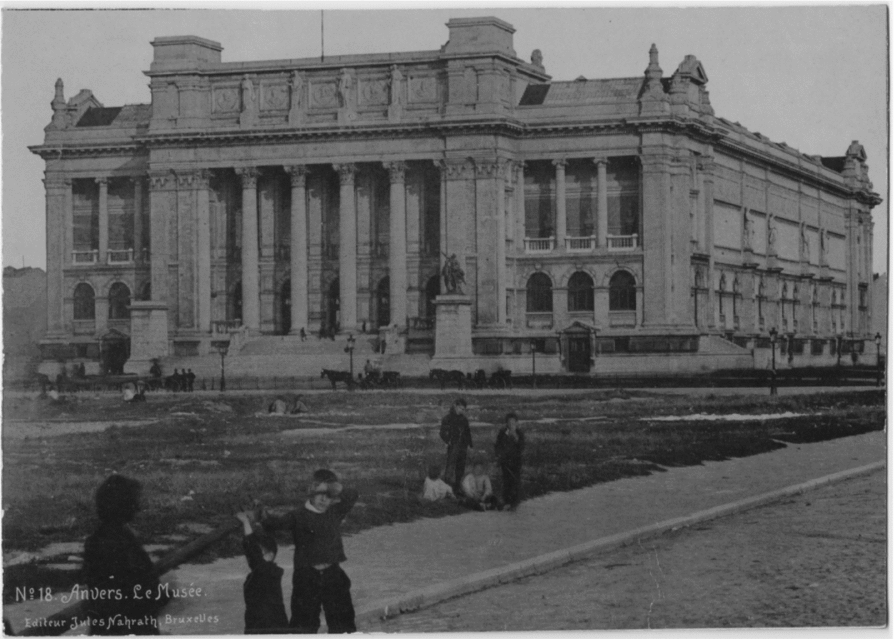
While the inhabitants of the northern, working-class neighbourhoods associated the ‘meadows’ primarily with juvenile mischief, bleaching laundry and grazing donkeys and horses, in bourgeois circles they were mainly associated with shady business. A crucial metaphor in understanding the disordered character of unofficial spaces is provided by weeds. Qviström argued that activities, plants, buildings and even people living in ephemeral areas were sometimes regarded as weeds. The negative image of the urban fringe particularly applied to fallow lands situated in the area of wealthy districts. Not only found in less well-off, peripherally situated neighbourhoods, fallow land was used for various purposes. The prominent quarter of Zurenborg, where affluent citizens lived in their stately homes, was lined with fallow grounds. In this context, the weed metaphor is particularly applicable. Ger. Schmook (1898–1985) argued that the undefined space was considered a blemish on the distinguished character of the neighbourhood. ‘In the corner of the district lay a dull, dark and narrow cave. Just like in the Middle Ages, the scum lived there crammed together outside the city walls.’Footnote 103 This ‘fortress of human bodies’ was a thorn in the side of the inhabitants. But despite the negative connotations, nineteenth-century photographs show children playing on the fallow land in between the little palaces that were being built in the district. The south district, which was characterized by a clear bourgeois character, is a second example. Until shortly after the construction of the district, much land remained fallow. Jef Horemans noted that parts of the south ‘behind its stiff and neat bourgeois look, in its deepest essence, had a genuinely popular image’.Footnote 104
A rare photo of the newly built museum in an otherwise still desolate area, shows several groups of children playing on the fallow land
Source: SAA.
Conclusions
Little attention was given to the recreational purpose of urban green space during the fin-de-siècle. It is significant that even the recreation of the upper echelons was considered problematic. While in other cities, an increasing amount of attention was being paid toward the recreational infrastructure of their public green spaces, Antwerp city council was very reluctant to consider the matter. The official decisions on the use of urban green areas were therefore often diametrically opposed to the needs and wishes of the townspeople. The city population looked for ways to avoid the official regulations in urban public spaces. The contested use of urban green was an important issue for the city government. Vandalism was the most extreme manifestation of civil disobedience, which, especially in the densely populated, working-class districts of the city, gave the government sleepless nights. However, the most common complaints about the abuse of green spaces related to the naughty boys who pelted passers-by with snowballs and chestnuts. The disputes about recreation, but also the increasing vandalism in public green areas show the contradiction between the functions that the city government awarded the spaces and what the townspeople themselves expected or considered necessary. To nuance the vision of the city government, it is of great importance to provide the residents’ perception with a central place in the historical research on urban (green) space use.
Urban green space has become an important element in the quality of life in cities, which is closely linked with the perception of urban residents and users of urban space. After all, apart from the good intentions of the city government, a discrepancy often arises between the intended functions of green space by policy makers and designers, and the perceived liveability of the city. That research into public green spaces has so far been unjust to the perception and use of the official green spaces from the perspective of the residents has been argued here. The study of the everyday use and perception of urban green spaces by the townspeople shows that official green spaces – which were considered by the city council and the prevailing socio-economic and cultural elite as a means of safeguarding the prestige of the city and bourgeois morality – possessed a much more multilayered, heterogeneous character than the latter intended.
The alternative use of official green spaces shows that city dwellers did not acquiesce in the official version, and bent the rules in public spaces to their expectations. While in the perception of users, public green spaces often turn out to be less strictly regulated than in the official vision, the unofficial green spaces such as city walls and fallow land – which have so far remained out of the picture in historical research – showed the extent to which the official vision and data on urban green lacks the users’ perception of urban green spaces during the late nineteenth century. This is evident from the fact that the descriptions of Antwerp – a city that during the nineteenth century scored very low in official green space statistics – indicate a wide range of unofficial urban green spaces which are not represented in official documents, but proved to be extremely important in city dwellers’ perceptions of the urban landscape and the quality of life in the city.