Introduction
Dementia involves progressive decline in several cognitive abilities, including processing speed, memory, language, and executive functioning (Alzheimer's Association, 2016). Although there are specific differences between the types of dementia that are described in detail elsewhere (Alzheimer's Association, 2000), problems with communication arise across all dementia types. In early stages of dementia, word finding (anomia), writing, and understanding complex language, such as analogies become more problematic (Haak, Reference Haak2002). As dementia progresses to its middle stages, spoken language has reduced meaningful content, words may be inappropriately substituted, written information becomes difficult to understand, and multi-step commands are difficult to follow or conceptualize (Haak, Reference Haak2002). In later stages, the individual may produce streams of non-sensical language or become mute (Alzheimer's Association, 2016). Given deterioration in language, individuals may be unable to communicate their needs (e.g. pain), and carers might struggle to understand what the person is attempting to communicate (Alzheimer's Society, 2016). Such communication discord could result in the person's needs being unmet, reduce their well-being, and heighten their distress (Downs and Bowers, Reference Downs and Bowers2014; Alzheimer's Society, 2016).
To overcome language production and comprehension difficulties, communication strategies have been recommended (Egan et al., Reference Egan, Bérubé, Racine, Leonard and Rochon2010; Downs and Bowers, Reference Downs and Bowers2014; Kindell et al., Reference Kindell, Keady, Safe and Wilkinson2016). Verbal strategies include short and simple sentences, verbatim repetition, paraphrasing, and conveying one question or idea at a time (Alzheimer's Society, 2016). In addition, speaking in a calm tone, maintaining eye contact, using physical contact, and eliminating environmental distractions are noted to support communication (Alzheimer's Society, 2016). A range of augmentative and alternative communication methods are also used to facilitate communication. These include picture boards, Talking-Mats, personal communication dictionaries, computerized speech-generating devices, and memory aids such as biographical books or reminiscence boxes (Murphy et al., Reference Murphy, Tester, Hubbard and Downs2005; Finke et al., Reference Finke, Light and Kitko2008; Purves et al., Reference Purves, Phinney, Hulko, Puurveen and Astell2015). Storytelling and life story work have also been suggested as useful conversational approaches to help the person express their experiences, retain their sense of self, as well as develop and maintain relationships (McKeown et al., Reference McKeown, Ryan, Ingleton and Clarke2015). Furthermore, person-centered communications wherein staff consider the person's values and embrace a respectful attitude have also been observed to increase conversations and positive reactions in residents with dementia (Savundranayagam et al., Reference Savundranayagam, Sibalija and Scotchmer2016).
Research around developing and evaluating communication strategies has predominantly been based on work with family caregivers and healthcare professionals and not from the perspective of people living with dementia. Although some studies have recruited people living with dementia (e.g. Savundranayagam et al., Reference Savundranayagam, Sibalija and Scotchmer2016), only observations of their behavioral responses to communication strategies were made; therefore their experiences and perspectives of communication remains unclear. Historically, people with dementia have been excluded from research as they were assumed to be incapable of participating due to cognitive declines (Cottrell and Schultz, Reference Cottrell and Schultz1993). However, it is increasingly recognized that this population experience thoughts and feelings and remain capable of expressing their opinions (Kitwood, Reference Kitwood1997; Hubbard et al., Reference Hubbard, Downs and Tester2003; Dewing, Reference Dewing2007; Hellström et al., Reference Hellström, Nolan, Nordenfelt and Lundh2007; Benbow and Kingston, Reference Benbow and Kingston2016). This recognition and developments in person-centered care have prompted the need to involve people with dementia in research to ensure services are relevant to their needs (Department of Health (DoH), 2012).
Good and meaningful communication has been found to create a sense of connectedness with others and may strengthen social relationships beyond the content of communication (Downs and Bowers, Reference Downs and Bowers2014). Understanding how people with dementia experience meaningful communication could be used to enhance social interactions, inform person-centered care, increase likelihood of meeting needs, and improve psychological well-being (Downs and Bowers, Reference Downs and Bowers2014; Alzheimer's Society, 2016). Therefore, the aim of this review was to examine studies that explored experiences of communication in people with dementia. Given many of the contacts people with dementia have are with family members and healthcare professionals (Downs and Bowers, Reference Downs and Bowers2014), communication within the context of these interactions were examined.
Methods
A mixed-methods approach, examining both qualitative and quantitative research, was adopted in the current review to broaden the inclusion of studies (Gough, Reference Gough2015). A systematic methodology was used, applying the same level of rigor with respect to identification, selection, analysis, interpretation, and appraisal of relevant research. Guidance outlined by the Joanna Briggs Institute (2014) was considered appropriate as this allowed examination of qualitative and quantitative studies. In accordance to this guidance, quantitative and qualitative data were assessed separately then integrated into one synthesis.
Search strategy
The electronic databases PsychINFO, MEDLINE, and EMBASE were systematically searched to identify appropriate studies to include in the review. Relevant terms best representing “communication in people with dementia and family, caregivers, and healthcare professionals” were identified and Boolean combinations were used to maximize the search. Given mapped terms to subject headings slightly differ between databases, effort was made to use the same or as close as possible terms. The following terms were searched across the three databases: dementia OR dementia with Lewy bodies OR vascular dementia OR frontotemporal dementia OR semantic dementia OR multi-infarct dementia OR pre-senile dementia OR senile dementia OR Alzheimer's disease AND communication OR non-verbal communication OR oral communication OR verbal communication OR interpersonal communication OR communication barriers OR written communication OR health communication AND family OR caregivers OR caregiver burden OR family members OR healthcare services OR carer OR family caregiver OR family caregivers OR hospitals OR hospital personnel OR healthcare delivery OR nurse's role OR healthcare professional OR healthcare practitioner OR healthcare provider OR healthcare worker OR home health aides OR public health officer. The search was limited to peer-reviewed and English language journals and duplicates generated from different databases were removed. The search was conducted in September 2016.
Inclusion and exclusion criteria
Inclusion criteria were defined to specify studies relevant to the current review. All abstracts were reviewed and those meeting the following eligibility criteria were included as follows:
-
1. The primary aim of the study was to examine experiences and perspectives of communication.
-
2. Communication specifically involved persons with dementia rather than occurring amongst others (e.g. between professionals and family).
-
3. Feedback on experiences and perspectives of communication was obtained from participants. Studies that only reported observational data were excluded.
-
4. All persons referred to have a diagnosis of dementia.
-
5. Population did not have any other cognitive impairment (e.g. learning disability).
-
6. Population did not have other communication impairments unrelated to dementia (e.g. deaf-mutism).
-
7. Quality criteria of the QATSDD were met.
-
8. Non-empirical studies (e.g. reviews), dissertation papers, community projects, intervention, and training programs were excluded.
Quality assessment
Quality assessment of each study was imperative in order to ascertain the reliability and validity of the methodology used as this would consequently guide the interpretation of the studies. The 16-item Quality Assessment Tool (QATSDD; Sirriyeh et al., Reference Sirriyeh, Lawton, Gardner and Armitage2011) was considered appropriate as it is used to determine the quality of qualitative (14-items), quantitative (14-items), and mixed-methods (16-items) studies conducted in healthcare services. This is in keeping with the mixed-methods approach of the current review. Each study is scored on every item (0 = not at all; 1 = very slightly; 2 = moderately; and 3 = complete), and the total score was subsequently converted into a percentage. In summary, the items examine theoretical framework, study aims, research settings, representativeness of sample, data collection procedure and rationale, appropriateness and reliability of data analysis, and discussions of study strengths and limitations. The quality of each study was assessed by the first author (SA) and seven of the 15 studies were randomly selected and quality assessed by two independent researchers to ensure reliability.
Selection process
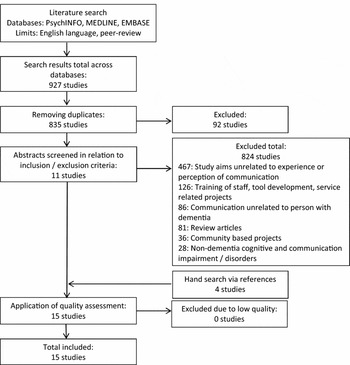
Figure 1 illustrates the selection process of the studies included and excluded at each stage.
Flow chart of the search strategy results.

Results
Overview of selected studies
The initial search identified 927 studies using the pre-defined key terms from the selected databases. Studies were subsequently excluded for reasons of duplication (92) and not meeting the inclusion criteria based on their titles and abstracts (824). Hand searching through references resulted in the inclusion of four relevant studies, which were not originally identified in the search. After applying the QATSDD criteria, none of the studies were excluded based on low quality. A final 15 studies were included in the current review. To gain inter-rater reliability, two independent researchers screened a total of 250 titles and abstracts (30.3% of the total 824 studies generated from the databases). An agreement of 96.0% and 94.4% was achieved between the first researcher (SA) and independent raters 1 and 2 respectively. These results indicated moderate agreement. Where disagreements occurred, the full studies were read to determine whether it met inclusion criteria.
In summary, 13 of the 15 studies were cross-sectional using qualitative (7), quantitative (5), and mixed-methods (1). The remaining two were qualitative longitudinal studies. Despite eight studies recruiting people with dementia, only one actively explored their experiences of communication while the other seven observed their responses. Fourteen of the fifteen studies examined the perspectives of family caregivers or healthcare professionals. Given the limited number of studies actively explored the experiences of people with dementia; all 15 studies are reported and critiqued. Generally, experiences were either openly explored without mention of particular strategies, or through examining experiences of pre-dictated communication strategies. As such, the results have been clustered accordingly: “open exploration” and “exploration of strategies.” Given the focus of this review was to examine experiences of communication, only relevant results are summarized.
Quality assessment results and critique
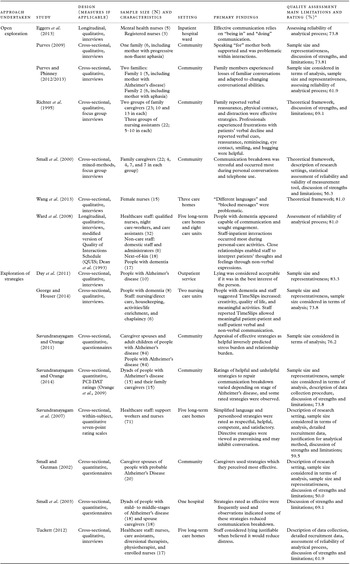
This section outlines general trends observed across the studies. Specific limitations that scored 0 (not at all) or 1 (very slightly) on the QATSDD items are outlined in Table 1. Relevant strengths and limitations are noted alongside the interpretation of study findings. Statistically significant (p < 0.00) inter-rater reliability of quality assessments was achieved across all three (the first researcher and two independent) raters. Analysis produced an intra-class correlation coefficient of 0.89 (95% Confidence Interval = 0.52–0.98, p = 0.00) between the first researcher and independent rater 1, and 0.96 (95% Confidence Interval = 0.80–0.99, p = 0.00) between the first researcher and independent rater 2. The outcomes suggest overall agreement in the quality ratings of each study and robustness of the QATSDD tool. However, differences in ratings were still discussed and consensus was reached.
Systematic review study characteristics

aAll studies had the limitation of not evidencing user involvement in the research design.
All studies scored 0 (not at all) on whether users were involved in the study design. Many of the studies stemmed from larger research projects (e.g., Ward et al., Reference Ward, Vass, Aggarwal, Garfield and Cybyk2008; Savundranayagam and Orange, Reference Savundranayagam and Orange2011; George and Houser, Reference George and Houser2014; Savundranayagam and Orange, Reference Savundranayagam and Orange2014). Although it is possible that the original projects involved service users during the consultation and design process, upon examination of these papers, involvement is not described (Orange et al., Reference Orange, Lubinski, Johnson, Purves and Small2009). It is, therefore, unclear whether the research questions and study aims were relevant to people with dementia or indeed their family caregivers or healthcare professionals. Furthermore, methods in which data were collected and analyzed may have been inappropriate for representing the experiences of people with dementia or carers. These criticisms were considered throughout the interpretation of the results.
A few studies were rated low with respect to including explicit theoretical frameworks on communication as they largely discussed communication difficulties consequential to dementia symptoms (Richter et al., Reference Richter, Roberto and Bottenberg1995; Small et al., Reference Small, Geldart and Gutman2000; Wang et al., Reference Wang, Hsieh and Wang2013). Neglecting psychological approaches of dementia care (e.g. Kitwood, Reference Kitwood1997) may reduce understanding of what this population experience as meaningful. Several studies recruited small samples that were not representative of all caregivers or dementia types (Purves, Reference Purves2009; Day et al., Reference Day, James, Meyer and Lee2011; Purves and Phinney, Reference Purves and Phinney2012/2013; George and Houser, Reference George and Houser2014). Others did not justify the sample size in terms of analysis (Small and Gutman, Reference Small and Gutman2002; Savundranayagam et al., Reference Savundranayagam, Ryan, Anas and Orange2007; Savundranayagam and Orange, Reference Savundranayagam and Orange2011; Reference Savundranayagam and Orange2014). These results might have limited generalizability and contain Type I or Type II errors, which have not been assessed.
Exploratory investigation
Seven studies explored experiences of communication without suggesting the implementation of specific communication strategies, thus appearing to be exploratory in nature (Richter et al., Reference Richter, Roberto and Bottenberg1995; Small et al., Reference Small, Geldart and Gutman2000; Ward et al., Reference Ward, Vass, Aggarwal, Garfield and Cybyk2008; Purves, Reference Purves2009; Purves and Phinney Reference Purves and Phinney2012/2013; Eggers et al., Reference Eggers, Ekman and Norberg2013; Wang et al., Reference Wang, Hsieh and Wang2013). Despite three of these studies recruiting people with dementia, their experiences and perspectives on communication were not described (Ward et al., Reference Ward, Vass, Aggarwal, Garfield and Cybyk2008; Purves, Reference Purves2009; Purves and Phinney, Reference Purves and Phinney2012/2013). Rather, all seven studies described families’ and professionals’ experiences; the results are therefore limited to this population and little is known about experiences from the perspective of people with dementia.
An overarching theme across several studies was around communication difficulties. Skill deterioration including failing to hear, understand, remember, or respond appropriately were described to make communication challenging as the person with dementia was perceived to struggle expressing themselves in a way carers could understand (Small et al., Reference Small, Geldart and Gutman2000; Ward et al., Reference Ward, Vass, Aggarwal, Garfield and Cybyk2008; Purves and Phinney, Reference Purves and Phinney2012/2013; Wang et al., Reference Wang, Hsieh and Wang2013). A phenomenological approach using content analysis was undertaken by Wang et al. (Reference Wang, Hsieh and Wang2013) to explore difficulties in communication from healthcare professionals’ perspectives. Two themes were uncovered; the first was “different language,” referring to differences in dialects wherein patients and nurses could not understand each other. This was evident within subthemes of “repetitive responses,” as misunderstood messages were repeated by both parties, and “lack of language consensus,” as both parties frequently had different perspectives or languages. The second theme was “blocked messages,” including subthemes “difficulty in accessing emotions” and “difficulty in understanding needs” as nurses struggled to interpret these due to patients’ verbal impairments. Communication problems were also noted to negatively affect activities of daily living, particularly with conversations around personal life and telephone use (Small et al., Reference Small, Geldart and Gutman2000; Wang et al., Reference Wang, Hsieh and Wang2013).
The studies by Wang et al. (Reference Wang, Hsieh and Wang2013) and Small et al. (Reference Small, Geldart and Gutman2000) provide some understanding on carers’ experiences when the person's skills have deteriorated. However, the results are limited as they focus on communication difficulties rather than strengths or helpful features. Wang et al. (Reference Wang, Hsieh and Wang2013) received a higher quality rating than Small et al. (Reference Small, Geldart and Gutman2000) overall, mostly for having a clearer fit between the research question, format of data collection, and choice of analysis. In addition, nurses’ perspectives were quoted and possible hypotheses could be made to interpret what people with dementia may have found helpful, for example, having a shared perspective when communicating (Wang et al., Reference Wang, Hsieh and Wang2013). Small et al. (Reference Small, Geldart and Gutman2000) are credited for recruiting a larger sample wherein a larger amount of information could be collected. However, interviews were interpreted quantitatively to identify percentages of caregivers who reported specific difficulties. This method is considered reductionist as the richness of peoples’ felt experiences is lost. Qualitative analysis was suggested, however, the type of analysis was vague and only three quotes were provided. Upon inspection of these quotes, further in-depth qualitative analysis such as thematic is warranted. For example, “my father and I never communicated much. . . I snapped. . . it will discourage us from initiating conversation” may suggest how the father with dementia perceived this instance of communication and what could have furthered communication. However, neither study examined the experiences of people with dementia; therefore such interpretations cannot be determined.
The theme of communication difficulties still transpired even when exploring overall experiences of communication (e.g. “how has it [dementia] affected your conversation with that person?”; Purves and Phinney, Reference Purves and Phinney2012/2013). All family members described losing familiar conversations with their loved one even though communication was experienced and acted upon differently between and within families (Purves and Phinney, Reference Purves and Phinney2012/2013). One family reported there was “no point” in communicating given declines in cognitive skills while the other family drew upon long-standing patterns of interactions to maintain conversations. Experiences may have been influenced by the level of skill decline, prior relationships with the person with dementia, and available resources. Again, data were not obtained from the family member with dementia and therefore this person was neglected within the family systems approach that the researchers claimed to use. Video- and audio-recordings of everyday conversations verified reports from family members; however, little is reported as to how the person with dementia potentially perceived the communication. Although collecting objective information is helpful particularly when an individual is non-verbal, caution must be taken to interpret observed responses as this might not accurately represent the person's experiences. Eliciting one's experiences may become more challenging with the progression of dementia; however, it may be helpful to use other tools to support the person's expressions alongside objective data while it is still possible. For instance, involving the person by using Talking-Mats and personal communication dictionaries can reduce ambiguity and improve accuracy of representing the person's experiences (Murphy et al., Reference Murphy, Tester, Hubbard and Downs2005; Finke et al., Reference Finke, Light and Kitko2008).
To overcome communication problems, certain techniques were acknowledged to facilitate communication (Richter et al., Reference Richter, Roberto and Bottenberg1995). Family members believed verbal reassurance (e.g. “I understand you are afraid”), physical contact (e.g. putting an arm around the person), and distraction (e.g. completing a different task) were the most effective forms of communication, particularly when the person with dementia was distressed. The helpfulness of these strategies was affirmed by nursing assistants who also reported using short verbal cues, reminiscence-based conversations, eye contact, smiling, and hugging to promote communication. In contrast to the above studies, this study is merited on exploring experiences of both helpful and difficult communication. Results of another study also identified that speaking on the behalf of the person with dementia was helpful as this supported social interactions and reduced possibilities of the person facing stressful situations (Purves, Reference Purves2009). However, speaking on behalf and instead of a mother with primary progressive aphasia was also seen as problematic by her family as she might find it difficult to make an objection if she disagreed with statements made. This would suggest frequent consultations with the person with dementia should be made to ensure communications were supportive of their needs and views.
Another theme was identified around the underling relationship with the person with dementia. Having a positive relationship with patients enabled staff to interpret many of their non-verbal expressions (e.g. the patient looked) as the underlying meaning of this was shared (Ward et al., Reference Ward, Vass, Aggarwal, Garfield and Cybyk2008). Staff reports as well as video-recordings suggested patients were capable of and sought communication; however, this was not always received when staff members were occupied elsewhere or could not interpret expressions (Ward et al., Reference Ward, Vass, Aggarwal, Garfield and Cybyk2008). This perhaps reflects the occurrence of communication difficulties when perspectives were not shared and there was a difference in dialect between staff and patients (Wang et al., Reference Wang, Hsieh and Wang2013). Eggers et al. (Reference Eggers, Ekman and Norberg2013) suggested both relational facets and communication techniques are required for communication to be helpful and meaningful. Nurses reported “being” in communication whereby they attuned to patients’ feelings and took on their perspectives. They also reported “doing” communication, which involved using communication strategies such as active listening, providing time to talk, and asking questions. These studies are merited for providing insight into the multiple co-existing aspects underlying communication, though understanding these from the perspective of people with dementia would be fruitful.
Exploration of specific strategies
Eight studies identified in the search examined perceptions and experiences of specific communication strategies that were recommended within the literature. Even though five of these studies recruited people with dementia, only one examined their experiences (Day et al., Reference Day, James, Meyer and Lee2011), while the remaining four observed their responses alongside reports from family caregivers or professionals (Small et al., Reference Small, Gutman, Makela and Hillhouse2003; Savundranayagam and Orange, Reference Savundranayagam and Orange2011; George and Houser, Reference George and Houser2014; Savundranayagam and Orange, Reference Savundranayagam and Orange2014). The other three studies exclusively examined the experiences of family caregivers or professionals (Small and Gutman, Reference Small and Gutman2002; Savundranayagam et al., Reference Savundranayagam, Ryan, Anas and Orange2007; Tucket, Reference Tuckett2012). Therefore, similar to the above cluster of studies, limited interpretations can be made with respect to the experiences of people with dementia. Furthermore, results are restricted to the remit of the pre-dictated strategies.
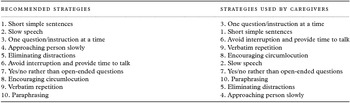
Small and Gutman (Reference Small and Gutman2002) identified ten communication strategies recommended across several public healthcare organizations (e.g. Alzheimer's Association, 2000). The authors examined caregivers’ use of these strategies and although all caregivers reported using all strategies, those appearing most frequently in the literature were not most frequently used (comparison illustrated in Table 2, obtained from Small and Gutman, Reference Small and Gutman2002). When examining the relationship between reported use and perceived efficacy of strategies, a significant correlation was identified (r s = 0.68; p < 0.01), with strategies 1, 4, 7, and 9 being most significant (p = 0.01). These results were replicated in a follow up by Small et al. (Reference Small, Gutman, Makela and Hillhouse2003); significant correlations (p < 0.01) were found between reported use and perceived effectiveness of strategies 1 (r s = 0.72), 4 (r s = 0.69), 7 (r s = 0.88), and 9 (r s = 0.74).
Recommended strategies versus used by caregivers ranked in order of frequency. Table taken from Small and Gutman (Reference Small and Gutman2002)

In both studies by Small and Gutman (Reference Small and Gutman2002) and Small et al. (Reference Small, Gutman, Makela and Hillhouse2003), it is unsurprising that caregivers reported using strategies they felt were most effective. However, when comparing audio-recordings of interactions against caregivers’ reports of strategy use, a Wilcoxon Signed Ranks Test indicated caregivers underestimated their use of strategies 1 (p = 0.00), 2 (p = 0.00), and 5 (p = 0.04) while they overestimated the use of strategy 4 (p = 0.00; Small et al., Reference Small, Gutman, Makela and Hillhouse2003). Although this data indicate discrepancy between perceived and actual use of strategies, little is suggested as to why this might have occurred. Fewer communication breakdowns (e.g. misunderstandings) were observed when strategies were used compared to when they were not (Small et al., Reference Small, Gutman, Makela and Hillhouse2003). However, this finding was only marginally significant (t(16) = –1.61, p = 0.06, one-tailed) and no differences were found between frequency of strategy use and breakdowns (r s = –0.09, p = 0.72). Interpretation of this data is limited and given this study recruited people with dementia, reports from them could have furthered understanding as to why or how communication breakdowns and reparations occurred. Such data however were not collected.
Both studies are merited for using a pre-dictated list of strategies recommended by large public health associations (e.g. Alzheimer's Association, 2000) as this method could have elicited views that would otherwise not be obtained. However, the 10 strategies selected were out of a possible 25 that are frequently recommended; only strategies involving language and environmental modification were selected (Small and Gutman, Reference Small and Gutman2002). Therefore, caregivers’ experiences of other communications (e.g. non-verbal) were neglected. Given communication occurs via several methods, a more appropriate way of analyzing perceptions of strategies would have been to include all 25 strategies. Furthermore, statistical assessments of the validity and reliability of these 10 strategies are not noted and therefore the meaningfulness of examining these strategies is questioned. Eliciting qualitative reflective accounts from caregivers and people with dementia may have furthered our understanding of communicative experiences.
Two studies (Savundranayagam and Orange, Reference Savundranayagam and Orange2011; Reference Savundranayagam and Orange2014) examined family caregivers’ experiences of communication using the Perception of Conversation Index – Dementia of the Alzheimer's Type (PCI-DAT; Orange et al., Reference Orange, Lubinski, Johnson, Purves and Small2009). The PCI-DAT is a tool measuring caregiver perceptions of conversations and contains a section of 22 strategies, suggesting repetition, rephrasing, simplifying, filling in missing information, gestures, and demonstrating meaning are effective while speaking louder and slower are ineffective strategies. The PCI-DAT has been standardized on healthy controls, people with early, middle, and late stages of Alzheimer's disease, and caregivers, making it a valid and reliable instrument (Orange et al., Reference Orange, Lubinski, Johnson, Purves and Small2009). The use of the PCI-DAT is therefore rated more highly than the list of 10 strategies outlined by Small and Gutman (Reference Small and Gutman2002) as it is validated and perceptions of a larger number of strategies are examined. However, the studies by Savundranayagam and Orange (Reference Savundranayagam and Orange2011; Reference Savundranayagam and Orange2014) have similar limitations to that described above around restrictions of using a pre-dictated list of strategies.
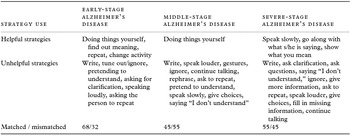
Caregivers’ appraisals of how helpful they perceived the PCI-DAT strategies varied depending on the stage of Alzheimer's disease (Savundranayagam and Orange, Reference Savundranayagam and Orange2014). Based on the results, caregivers’ appraisals along with matches between strategy appraisal and those observed are summarized in Table 3. Despite recruiting people with dementia, their perceptions of these strategies were not explored and are therefore unknown.
Caregivers’ appraisals of PCI-DAT communication strategies and matches between appraisals and observed strategies based on results by Savundranayagam and Orange (Reference Savundranayagam and Orange2014)

Caregivers used strategies they perceived as helpful though they did not always resolve communication breakdown. Rather, using strategies dictated as helpful in the PCI-DAT (e.g. giving more information, repetition, rephrasing, and simplification) were observed to successfully resolve communication breakdown (Savundranayagam and Orange, Reference Savundranayagam and Orange2014). Earlier research also suggested appraising communication strategies as effective in line with those dictated by the PCI-DAT was associated with lower stress (p < 0.01) and relationship burden (p < 0.05) in family caregivers (Savundranayagam and Orange, Reference Savundranayagam and Orange2011). Both studies suggest that strategies identified as most helpful in the PCI-DAT are beneficial for reducing communication breakdowns and caregiver burden. However, it is unclear how caregivers experience utilizing these strategies. For example, understanding how easy these are to implement could inform training programs.
Other studies explored professionals’ perceptions of person-centered communication methods. Healthcare professionals rated their views and imagined patients’ perspectives of “personhood” (e.g. “can I help?”) and “directive” strategies (e.g. “take your seat and you won't miss lunch”; Savundranayagam et al., Reference Savundranayagam, Ryan, Anas and Orange2007). Personhood strategies were perceived as respectful, helpful, competent, satisfactory, and patients were believed to more likely engage in future conversations. Conversely, directive strategies were viewed as patronizing and could result in patients being passive and afraid to complain if they were unhappy. In another study, staffs’ and patients’ perceptions of “TimeSlips” were examined (George and Houser, Reference George and Houser2014). TimeSlips is a storytelling program that encourages the person with dementia to identify and express their social roles and personal strengths they still retain. Although reports from patients were collected, this focused on how TimeSlips improved their engagement in meaningful activities rather than their experiences of self-expression and communication. Professionals suggested TimeSlips facilitated further verbal and non-verbal communications with patients as they spent time with patients and gained a deeper understanding of them. Although not established from the person with dementia's perspective, both studies suggest the value of person-centered techniques. For example, if the person with dementia feels the other person is making an effort to know them, they might feel more connected and seek further communication. Interviews with people with dementia could have verified this hypothesis.
Two of the studies examined the acceptability of lying to patients. Tuckett (Reference Tuckett2012) found healthcare professionals believed lying to patients was acceptable in circumstances where they anticipated the patient might not comprehend, forget, or be unable to respond. Lying was further justified when believed this would prevent patients experiencing distress (e.g. withholding information about death of a loved one). In another study where people with Alzheimer's disease were interviewed about how they felt being lied to, they too considered it acceptable if: it was in their best interest, they were treated respectfully, the interpersonal relationship was considered and maintained, no alternative explanations were available, and the lie was subtle (Day et al., Reference Day, James, Meyer and Lee2011). Lying however was considered patronizing, demeaning, and unacceptable if it elicited negative emotions, negatively affected their self-concept, and damaged their trust and relationships.
The study by Day et al. (Reference Day, James, Meyer and Lee2011) was the only one identified wherein experiences of communication in people with dementia were explicitly explored. This study, above the others, prioritized the views of an understudied population, which is vital given research, healthcare providers, and recommendations should place the patient at the heart of care (NHS England, 2013). This study illustrates the importance of respecting the person with dementia and preserving trust and social relationships, even during difficult circumstances, such as lying. Results also indicate that people with dementia are aware of communication difficulties. This study suggests feasibility of actively including people with dementia in research as well as the necessity of understanding their views to further scientific knowledge. However, results cannot be generalized given it was the only study that explored the perspectives of people with dementia and focused on the specific topic of lying rather than general experiences of communication.
Overview of strategies
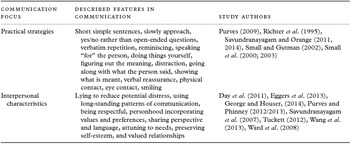
The studies reviewed note a range of strategies and upon their review, the strategies may be conceptualized in two ways (Table 4). The first focuses on practical techniques that the caregiver utilizes to engage in communication, such as short sentences and reminiscing. In the majority of cases, strategies reported by family caregivers and professionals as most effective did not correspond to those most recommended by healthcare providers and were not always observed to be most effective (e.g. Small and Gutman, Reference Small and Gutman2002; Small et al., Reference Small, Gutman, Makela and Hillhouse2003; Savundranayagam and Orange, Reference Savundranayagam and Orange2011; Reference Savundranayagam and Orange2014). The second category of strategies reflects more interpersonal characteristics present during communication, such as attunement and incorporating personhood. Such interpersonal characteristics were experienced as helpful by family caregivers and professionals. Furthermore, the only study that examined the perspectives of people with dementia suggests that interpersonal characteristics are valuable in enabling communication that is felt as meaningful (Day et al., Reference Day, James, Meyer and Lee2011). Although this distinction between the pragmatics and interpersonal characteristics involved in communication was not explicitly described by any of the studies, it is important to note as one's experiences of communication appeared to vary across the different strategies.
Experiences of “practical strategies” and “interpersonal characteristics” during communication

Discussion
The aim of the current paper was to review studies that examined the experiences of communication in people with dementia within the contexts of interactions with family caregivers and healthcare professionals. A total of 15 studies were identified and experiences were either explored openly without suggestions of communication strategies or through investigating experiences of specific communication strategies. Of the 15 studies, only one explored and described the views of people with dementia (Day et al., Reference Day, James, Meyer and Lee2011), while the other 14 studies explored the experiences of family caregivers and healthcare professionals. The results almost exclusively presented one side of communicative experiences and understanding communication from the perspectives of people with dementia is limited.
A range of strategies were experienced and perceived by family caregivers and professionals as supporting communication. As described in the results, these strategies could potentially be categorized into two approaches: practical strategies or interpersonal characteristics (refer to Table 4). Practical techniques might aid communication to occur in the first place (e.g. Savundranayagam and Orange, Reference Savundranayagam and Orange2014), although interpersonal features might contribute to the experience of communication being meaningful (Savundranayagam et al., Reference Savundranayagam, Ryan, Anas and Orange2007; Day et al., Reference Day, James, Meyer and Lee2011). Attuning to the person's needs and adjusting interactions accordingly may encompass a symbolic understanding of one another and result in a warm and welcoming connection (Hansebo and Kihgren, Reference Hansebo and Kihlgren2002). Behaviors of attunement and adjustment are said to both enable communication and be communication in itself (Downs and Bowers, Reference Downs and Bowers2014). Carers’ beliefs about the person with dementia might also influence communication. Beliefs the person is capable of reciprocating communication can cause carers to become more driven to communicate with them, strengthening their relationship and reducing isolation (Downs and Bowers, Reference Downs and Bowers2014). Such connectivity could facilitate person-centered care; if others are continually attuning to the person's needs; necessary adaptations could be detected and employed quicker (Acton et al., Reference Acton, Yauk, Hopkins and Mayhew2007). Such behaviors and beliefs are features within person-centered communications and have been observed to elicit positive responses in people with dementia (Downs and Bowers, Reference Downs and Bowers2014; Savundranayagam et al., Reference Savundranayagam, Sibalija and Scotchmer2016).
Overall, scientific knowledge on how people with dementia experience communication is lacking with only one study identified, which examines this (Day et al., Reference Day, James, Meyer and Lee2011). Although there are suggestions that certain practical techniques and interpersonal characteristics create good and meaningful communication, feedback from the person is limited. Collecting the views of people with dementia could inform our understanding of why certain techniques may be helpful or unhelpful. For example, practical strategies may be helpful but they do not always reduce breakdown (Small et al., Reference Small, Gutman, Makela and Hillhouse2003; Savundranayagam and Orange, Reference Savundranayagam and Orange2014). Breakdown might be inevitable given the progressive skill decline and strategies need to be continually adapted, which might reflect the need for better support and training from healthcare providers. However, neglecting to actively involve people with dementia in research means that their views of these strategies and what creates meaningful communication is unknown. Research in other areas where patients have been involved can be drawn upon to inform involvement of people with dementia. For example, people with aphasia were successfully interviewed about their experiences of interactions when using photographs that were meaningful to the individual of what it was like to live with aphasia (Brown et al., Reference Brown, Worrall, Davidson and Howe2010). Similarly, Cook (Reference Cook and Wilkinson2002) attempted to elicit communicative experiences of older adults through video-methodology; asking participants to reflect on their filmed interactions. Although Cook (Reference Cook and Wilkinson2002) was unable to obtain detailed information as participants were unable to provide consent or found engagement in the study difficult, the premise of utilizing alternative methods to support the person's engagement in research is important and may be helpful for people at early to middle-stages of dementia.
Involving service users in research
The lack of knowledge on the communicative experiences of people with dementia may negatively impact training programs as strategies recommended might not adequately meet the person's needs (NHS England, 2013). Furthermore, the fact that none of the studies identified involved service users (either people with dementia or caregivers) in the design phase begs the following questions: how relevant were the strategies examined and what would be important to explore. Therefore, there is a significant need for people with dementia to have more active involvement in research (DoH, 2012).
Policy-makers have increasingly acknowledged the need to involve people with dementia in research in order to successfully move toward person-centered care (DoH, 2012). Healthcare organizations proposed that people with dementia should be involved at consultation, collaboration, and participatory phases of research, rather than simply being “subjects” of research (DoH, 2012; NHS England, 2013). People with dementia also reported wishing to engage in research; involvement would be worthwhile of their time, they could contribute to service development, and they would be viewed as capable rather than incapacitated (Hubbard et al., Reference Hubbard, Downs and Tester2003; Dewing, Reference Dewing2007). Studies in other areas suggest it is both possible and fruitful to involve people with dementia (McKeown et al., Reference McKeown, Clarke, Ingleton and Repper2010; Reference McKeown, Ryan, Ingleton and Clarke2015; Benbow and Kingston, Reference Benbow and Kingston2016). However, given little is known about the experiences of communication in people with dementia, the extent to which recommended strategies are appropriate and person-centered could be questioned. Involving people with dementia have been recognized to inform helpful ways of managing communication breakdowns (Karlsson et al., Reference Karlsson2014).
Challenges of including people with dementia in research
Involving people with dementia in research may have been considered problematic as they were often viewed to lack capacity (Cottrell and Schultz, Reference Cottrell and Schultz1993). It may have been more practical to recruit professionals and family members given the lower likelihood of cognitive and verbal decline. To involve people with dementia in research, Dewing (Reference Dewing2007) developed a process adapted to this population to assess capacity and gain consent. Adaptations were advised where appropriate to support the persons’ capacity (e.g. simplified language) and that the person's capacity should be monitored on an ongoing basis throughout the research. This process was supported by other research wherein people with dementia were recruited (Hubbard et al., Reference Hubbard, Downs and Tester2003; McKeown et al., Reference McKeown, Ryan, Ingleton and Clarke2015). Although others who know the person well, for example, family members, may support the person in their decision to consent, caution must be taken to not overly-rely on proxy consent without empowering the person in decision-making (Dewing, Reference Dewing2007).
There may be a perception that people with dementia are unable to express their views given cognitive declines (Cottrell and Schultz, Reference Cottrell and Schultz1993). To support self-expression, adaptations (e.g. picture boards) could be used by researchers when exploring the research question (Murphy et al., Reference Murphy, Tester, Hubbard and Downs2005). Engagement could also be supported by researchers displaying empathy and creating a safe context where the person becomes familiar with the environment, study tasks, and researchers (Hubbard et al., Reference Hubbard, Downs and Tester2003).
Future directions
Future studies are advised to actively involve people with dementia and explore their experiences of good and meaningful communication as this could inform training programs, service development, and person-centered care (DoH, 2012). This may be explored within the context of interactions they most frequently have, for example, with family members. Conversation training in spouses of people with aphasia can be used as a framework to inform training programs in dementia (Sorin-Peters and Patterson, Reference Sorin-Peters and Patterson2014). Participants could reflect upon the various facets involved within their communications, interactions, and perhaps relationship that affect how communication is experienced. Research may need to begin by involving people at mild- and middle-stages of dementia before moving to later-stages as their experiences may be easier to access (Cook, Reference Cook and Wilkinson2002; Day et al., Reference Day, James, Meyer and Lee2011). With time and with more studies conducted, we can learn how best to support involvement of people with dementia at all stages by adapting research methods.
Excluded studies
A number of studies were identified as potentially relevant for this paper, however, were excluded on the basis of not being peer-reviewed (e.g. Orange, Reference Orange and Lubinski1991; Cook, Reference Cook and Wilkinson2002) or being entirely observational rather than eliciting feedback of the person's perceptions and experiences (e.g. Hydén and Örulv, Reference Hydén and Örulv2009). Other studies were excluded based on their objectives of examining the relationship of communication with other factors such as music (Gotell et al., Reference Gotell, Brown and Ekman2009) or delivery of healthcare (Karlsson et al., Reference Karlsson2014) rather than the experience of communication.
Strengths and limitations
This review examined an understudied area and a wide of a range of studies were reflected upon. Effort was made to prioritize people with dementia when evaluating the studies identified, as in line with healthcare policies (NHS England, 2013). Inter-rater reliability was obtained for screening and quality assessing the studies and consistency was established.
The methods involved in completing the search were reviewed on a number of occasions to ensure this was completed as comprehensively and accurately as possible, though limitations are acknowledged. Terms such as “perspectives” and “experiences” were not included within the search as such terms are difficult to capture given the individualized nature of “meaning-making occasions.” Including such terms may have confined the search to all appropriate literature meeting the inclusion criteria. However, a preliminary attempt of including the term experience* in addition to the described terms produced a total of 128 papers following removal of duplicates. This number of studies was considered too few and therefore the search term of “experience” appeared too restrictive. To avoid potential exclusion of relevant papers, this term was not used thus a broader number of studies were produced and screened.
A further limitation of the review was studies that aimed to examine experiences of caregivers and healthcare professionals were included. It could be argued that it was unfair to evaluate these studies with respect to how much they tell us about the experiences of people with dementia. However, it was felt appropriate and necessary to include these studies given the limited research that explores experiences of communications. It was also important to note these studies to illustrate the need for including people with dementia in research.
Conclusion
Limited knowledge exists on communicative experiences from the perspective people with dementia. Understanding what people with dementia perceive to make communications meaningful may be necessary to ensure person-centered care, promote social relationships, enhance quality of life, guide training programs, and improve researchers’ interaction with them. Given the important effects of meaningful communication, future researchers are advised to explore this from the perspective of the person with dementia and follow processes outlined by healthcare to support their involvement.
Conflict of interest
None.
Description of authors’ roles
S. Alsawy designed the research question for the review, collected and analyzed the data, and wrote the paper. W. Mansell, P. McEvoy, and S. Tai were involved in defining the inclusion and exclusion criteria for the review, they supervised the analysis of the data, and they assisted with writing the paper.