Introduction
Allergic eczema in horses, reflecting a hypersensitivity reaction to biting insects, is known under many names in different countries: ‘summer eczema,’ ‘sweet itch,’ ‘Queensland itch’ or ‘allergic dermatitis’ are some of the most commonly used names to describe the condition (Broström et al., Reference Broström, Larsson and Troedsson1987). Sensitive horses react, in particular, against bites of certain species of Culicoides, biting midges of the family Ceratopognidae, order Diptera, which are active during the grazing seasons. Environmental factors such as climate (wind, rainfall, temperature) and vegetation are important for the activity of biting midges (Cagienard et al., Reference Cagienard, Griot, Mellor, Denison and Stärk2006; van Grevenhof et al., Reference van Grevenhof, Ducro, Heuven and Bijma2007). Culicoides midges have host preferences (Raich et al., Reference Raich, Jacobson, Holbrook, Babion, Blair and Beaty1997) and also, different species feed at different sites on the host (Kettle, Reference Kettle1977). In Sweden, 80 different species of Culicoides have been found, and at least 25 of them bite (C. Dahl, personal communication). Knowledge is lacking on which species of biting midges cause allergic reactions in horses in Sweden. Different species of Culicoides seem to contain at least partly the same allergens (Anderson et al., Reference Anderson, Belton and Kleider1993), and there are indications that some of the antigens are shared by closely related families of the same sub-order (Nematocera) of Diptera (Hellberg et al., Reference Hellberg, Wilson, Mellor, Doherr, Torsteinsdottir, Zurbriggen, Jungi and Marti2006). At least 10 potential allergens for insect bite hypersensitivity in horses have been found in Culicoides and affected horses show a large variety of Immunoglobulin E binding patterns in immunoblots (Hellberg et al., Reference Hellberg, Wilson, Mellor, Doherr, Torsteinsdottir, Zurbriggen, Jungi and Marti2006).
Insect hypersensitivity has been observed in several horse breeds and is a well-known problem in Icelandic horses. Culicoides have not been found in Iceland, and horses exported from Iceland to areas where these biting midges are present have a high risk of developing hypersensitivity to their bites. Up to 50% of Icelandic horses exported from Iceland to another country develop problems after a few years (Björnsdóttir et al., Reference Björnsdóttir, Sigvaldadottir, Broström, Langvad and Sigurdsson2006). The condition also occurs in horses born in countries where the midges are present, but with a lower prevalence (Halldórsdóttir and Larsen, Reference Halldórsdóttir and Larsen1991). Summer eczema causes reduced welfare of the horse and economic losses to the owner. Affected horses suffer from intense pruritus, especially around the mane, tail and hind areas, and the scratching may sometimes result in open wounds with secondary infections. Severe eczema can make the horse unfit for use as a riding horse (Broström et al., Reference Broström, Larsson and Troedsson1987).
There are several previous studies of summer eczema in horses. Riek (Reference Riek1953b) was first to conclude that it was caused by hypersensitivity to insect bites, and this has been confirmed in later studies (e.g. Mellor, Reference Mellor1974; Larsen et al., Reference Larsen, Bakke and Mehl1988; Wilson et al., Reference Wilson, Harwood, Björnsdóttir, Marti and Day2001). The genetic background of the disease, however, has been less studied. Riek (Reference Riek1953a), Anderson et al. (Reference Anderson, Belton and Kleider1988), Marti et al. (Reference Marti, Gerber and Lazary1992) and, more recently, Reiher and Björnsdóttir (2004) observed that susceptibility to summer eczema seems to be related to the pedigree of the horse and that horses with affected parents (one or both) had an increased risk of developing eczema.
In a genetic analysis of summer eczema in 984 Icelandic horses in Germany, Unkel et al. (Reference von Unkel, Simon, Mayer and Sommer1987) concluded that there seems to be a polygenic background to the disease. They estimated heritabilities for insect hypersensitivity between 0 and 0.24 (s.e. 0.12) using different models and methods. van Grevenhof et al. (2006) estimated heritabilities of insect hypersensitivity at 0.08 and 0.10 in Dutch Shetland ponies and Friesian horses, respectively. They used linear models and analysed large data sets with about 3000 mares of each breed, recorded at foal inspections. Björnsdóttir et al. (Reference Björnsdóttir, Sigvaldadottir, Broström, Langvad and Sigurdsson2006) analysed a data set with 330 horses exported from Iceland to Germany, Denmark and Sweden. They found no evidence of sire effect on the prevalence of the disease and did not find a heritability different from zero.
The present study is part of a research project with an overall aim to study candidate genes involved in controlling summer eczema in horses. The aim of this study was to estimate genetic parameters for summer eczema in Swedish-born Icelandic horses, using information from horse owners. This knowledge is needed to evaluate whether severity of summer eczema could be reduced by breeding.
Materials and methods
Data
Data were gathered from early summer until end of December 2005, through a questionnaire to owners of Icelandic horses born in Sweden during 1991 to 2001 with sires with more than 50 Swedish-born offspring during this time period. The later time limit assured that the horses would have had at least three summer seasons to be exposed to the risk of developing summer eczema. The questionnaire recorded information on the horses identity, birth year, sex, country of birth, present location of the horse, severity of summer eczema, place and time of onset of summer eczema, time of year when the horse showed symptoms, affected areas of the body, other symptoms of allergy (e.g. urticaria) and information about possible clinical symptoms in the dam. Severity of summer eczema was recorded by the horse owner in four classes: 1 = healthy (unaffected), 2 = mild eczema (not affected if preventive measures are taken), 3 = moderate eczema (show itching even when preventive measures are taken) and 4 = severe eczema (show wounds even when preventive measures are taken).
Preventive measures were, for example, stabling of the horse or use of an anti-insect rug.
The selected criteria resulted in 33 stallions with a total of 3261 offspring born and located in Sweden during the given time period. The questionnaire was sent by regular mail to owners of the offspring, and it was also available on the internet. Addresses were collected from the Swedish Association of Icelandic horses, where most Icelandic horses in Sweden are registered. About 7% of the questionnaires sent by mail were returned due to incorrect address information. Information about the study and the web site of the questionnaire was also distributed via horse magazines, the Icelandic Horse Association and at large competitions during the summer of 2005. The questionnaire on the internet was closed on 31 December 2005. By then, complete records on 1250 horses were available for the study: 615 males (588 geldings and 27 stallions) and 635 females.
Three traits defined by different groupings of the four scores of eczema were created and analysed: Eczema4: severity of summer eczema in four classes (all classes from healthy to severe); Eczema3: severity of summer eczema in three classes (1 = healthy, 2 = mild or 3 = moderate to severe eczema); and Eczema2: summer eczema as a binary trait (1 = healthy or 2 = affected).
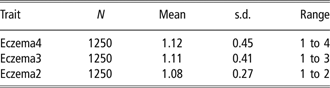
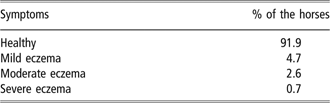
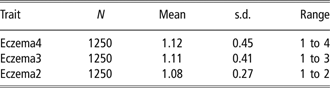
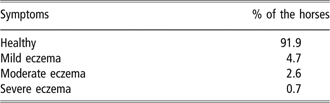
Averages and standard deviations (s.d.) for each trait are shown in Table 1, and the number of horses per severity class is shown in Table 2.
Number (N) of records, mean, s.d. and range for the different traits
Severity of summer eczema among the 1250 horses
Pedigrees of all horses were available through the international database for Icelandic horses: WorldFengur, in which pedigrees for all horses can be traced back to Icelandic founders (Árnason et al., 2006). Pedigree information used in the analyses dated back to the late 19th century and included 4511 individuals. The 1250 horses with complete records descended from 33 stallions and 942 dams. The number of offspring per sire ranged from 10 to 106, where 16 sires had more than 30 offspring. None of the sires was included as an individual with own record in the study. Among the dams, 61 had own individual records in the study. The number of offspring per dam ranged from one to five, and 217 dams had more than one offspring in the data set.
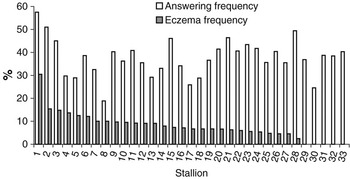
Among the 1250 horses in the study, 101 (8%) were affected with summer eczema. For 45% of the affected horses, and for 40% of the healthy horses in the data, information about the summer eczema status of the dam was available. On average, this was known for 43% of the horses (540 horses from 375 different dams). The answering frequency, in relation to the number of questionnaires sent by mail, varied among owners of offspring of the different sires. The lowest and highest answering frequencies for the offspring of individual sires were 19% and 58%, respectively, and the average was 38% (Figure 1).
Answering frequency and frequency of summer eczema in the offspring for the 33 stallions represented in this study (ordered by frequency of summer eczema among the offspring).

Statistical model
Statistical models were evaluated using the LOGISTICS procedure in SAS package (Statistical Analysis Systems Institute, 2004). The genetic analyses were based on the Markov Chain Monte Carlo methodology, using a Gibbs sampling algorithm implemented in the iBay package (Janss, 2007) to obtain marginal posterior distributions of model parameters. A single-trait sire threshold model assuming an underlying non-observable continuous random variable, called liability (λ), was applied for each trait. The liability is such that the observed responses (y = yijklm) are the results of the relationship:

where τc−1 and τc are the thresholds on the underlying (liability) scale that define category c.
The following model was assumed for the liabilities:

where agei is the effect of the ith age class, sexj is the effect of the jth gender of the horse (male or female), locationk is the effect of the kth geographical location of the horse, sirel is the effect of the lth sire and eijklm is a residual effect.
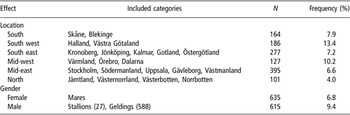
The age in years of the horses at the time of the study was divided into 11 classes: 4, 5, …, 13 and 14 years and older. The primary geographical locations of the horses at the time of the study were divided into six geographic areas: the south, south east, south west, mid-east, mid-west and northern part of Sweden (Table 3).
Number (N) of horses per region and per sex, and frequencies of eczema per fixed-effect class

The sire and residual effects were a priori assumed to be normally distributed with mean zero and variances for the sire effect and for the residual, where A is a numerator relationship matrix and I is an identity matrix. Uninformative priors were assumed for the other effects in the model. The parameters and τ 1 were set to some arbitrary values (1 and 0, respectively) to avoid identification problems.
For each trait (Eczema2, Eczema3 and Eczema4) five replicated Markov chains of each 200 000 cycles were run. The first 100 000 samples were discarded as burn-in, and after that every 50th sample of the sire variance was saved. For each sample the heritability was computed as The posterior mean, s.d. and the 95% highest posterior density region (HPDR) of the sire variance as well as the posterior mean and s.d. of the heritability were computed as summaries of the marginal posterior densities of these parameters.
To simplify comparisons with results from other studies, the resulting heritabilities on the liability scale were transformed to the visible scale as described by Gianola (Reference Gianola1982).
Results
Prevalence and severity of symptoms
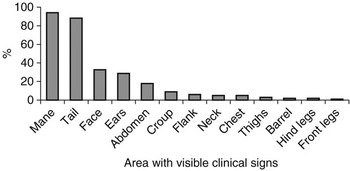
The prevalence of eczema due to insect hypersensitivity was 8%. More than 50% of the affected horses had mild signs of eczema and less than 10% of affected horses showed severe signs (Table 2). Among the 101 horses with eczema, 94% and 88% had signs of eczema in the mane and the tail, respectively. The third most common body area showing clinical signs was the head, including ears (Figure 2).
Frequency of reported scratching of different body areas in affected horses.

The prevalence of summer eczema varied from 4% in the northern region of Sweden to over 13% in the south west coast area of Sweden, and the geographic location of the horse significantly (P < 0.05) affected the prevalence and severity of summer eczema. The frequency of males affected by summer eczema was 9.4% compared with 6.8% of the females in the data. In addition, the effect of sex was significant (P < 0.05) for severity of summer eczema (Eczema4). Frequencies per region and per sex class are shown in Table 3. The average age of onset of eczema in affected horses was 4.8 years with a large variation (s.d. = 2.9). The effect of age of the horse was not significant in this study for prevalence or severity of eczema.
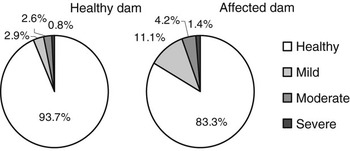
Horses with affected dams were more often affected by summer eczema, compared with horses with healthy dams (17% v. 6%) (Figure 3). Whether the dam was born in Iceland or outside of Iceland did not significantly influence severity of eczema in the offspring. Prevalence of summer eczema differed markedly between different paternal half-sib groups, ranging from 0% to 30% (Figure 1).
Frequency of different levels of severity of summer eczema among offspring of healthy and affected dams.

Variance components and heritabilities
The heritability for severity of summer eczema classified in four categories (Eczema4) was estimated at 0.33 (Table 4). Classifying the trait in two or three categories resulted, as expected, in lower estimated heritabilities (0.27 and 0.30, respectively). The heritability for summer eczema when expressed on the visible scale was about 0.1.
Posterior means for sire variances and heritabilities (h 2) on the underlying (liability) scale for the different summer eczema traits, estimated with threshold sire models, with s.d. and heritabilities transformed to the visible scale

HPDR = highest posterior density region.
Discussion
Prevalence
The prevalence of 8% summer eczema among the horses in this study is in close agreement with results from earlier studies on Icelandic horses born in Scandinavia. Broström et al. (Reference Broström, Larsson and Troedsson1987) found a prevalence of 6.7% among Swedish-born Icelandic horses, and Halldórsdóttir and Larsen (Reference Halldórsdóttir and Larsen1991) reported that 8.2% of Icelandic horses born in Norway were affected by summer eczema. A similar prevalence of 6.3% was reported for Icelandic horses born in Germany, by Reiher and Björnsdóttir (2004), whereas Lange et al. (Reference Lange, Hamann, Deegen, Ohnesorge and Distl2005) found a higher prevalence of 16% among German-born Icelandic horses. The prevalence of summer eczema among horses exported from Iceland to any of these countries is considerably higher: 26% to 72% has been reported (Halldórsdóttir and Larsen, Reference Halldórsdóttir and Larsen1991; Lange et al., Reference Lange, Hamann, Deegen, Ohnesorge and Distl2005; Björnsdóttir et al., Reference Björnsdóttir, Sigvaldadottir, Broström, Langvad and Sigurdsson2006). Horses born in Iceland are not exposed to Culicoides early in life and will not have the possibility to develop a normal immunity response to its antigen. This may explain the high risk of horses imported from Iceland to environments with Culicoides to develop summer eczema.
Fixed effects
We found that males, predominantly geldings, were more affected by summer eczema than females. This is in agreement with the findings of Braverman et al. (Reference Braverman, Ungar-Waron, Frith, Adler, Danieli, Baker and Quinn1983). Most studies, however, found no clear effect of gender on summer eczema (Broström et al., Reference Broström, Larsson and Troedsson1987; Halldórsdóttir and Larsen, Reference Halldórsdóttir and Larsen1991; Lange et al., Reference Lange, Hamann, Deegen, Ohnesorge and Distl2005). Those studies included fewer observations and, in most cases, less even distributions of males and females than in our study. The gender difference in our study needs, however, to be confirmed. It is possible that it is not biological to its nature, but a result of different management of mares and geldings.
Geographic location of the horse significantly affected the prevalence and severity of the eczema in our study. Several studies have shown effects of the location of the horse on the prevalence of eczema, either in terms of geographic regions (Broström et al., Reference Broström, Larsson and Troedsson1987) or defined according to altitude (McCaig, Reference McCaig1973; Braverman et al., Reference Braverman, Ungar-Waron, Frith, Adler, Danieli, Baker and Quinn1983), habitat or climate (Björnsdóttir et al., Reference Björnsdóttir, Sigvaldadottir, Broström, Langvad and Sigurdsson2006; van Grevenhof et al., Reference van Grevenhof, Ducro, Heuven and Bijma2007). These factors are assumed to be important for the amount of Culicoides that horses are exposed to.
The average age of onset in affected horses was found to be 4.8 years, which agrees well with previous studies (Broström et al., Reference Broström, Larsson and Troedsson1987; Halldórsdóttir and Larsen, Reference Halldórsdóttir and Larsen1991). In contrast with previous findings, we found no significant relationship between age of the horse and severity of summer eczema. Broström et al. (Reference Broström, Larsson and Troedsson1987) found that summer eczema usually appears during the third or fourth grazing season and that there is a clear tendency that the disease becomes worse with the increasing number of grazing seasons (age). Halldórsdóttir and Larsen (Reference Halldórsdóttir and Larsen1991) confirmed that the prevalence increased in older horses. This is believed to be the result of an increased risk of exposure to predisposing factors rather than an effect of age itself.
Heritabilities
Utilising all available information (four categories of eczema) resulted in the highest estimated heritability (0.33). The sire variance and the heritability increased with the number of categories considered. It is generally not recommended to apply an animal model in the context of categorical traits and single observation per animal (e.g. Wang, 1988), but Kadarmideen and Janss (Reference Kadarmideen and Janss2005) reported promising results from analyses of binary traits with a reduced animal model. Therefore, an attempt was made to analyse summer eczema as an all-or-none trait, assuming a reduced animal model on the liability scale, but unrealistically high heritabilities were obtained.
The level of heritability, when expressed on the visible scale, was similar to the estimates by van Grevenhof et al. (2006) where eczema was classified as 0 or 1 by foal inspectors. Our estimates were also within the range of heritabilities estimated by Unkel et al. (Reference von Unkel, Simon, Mayer and Sommer1987). Björnsdóttir et al. (Reference Björnsdóttir, Sigvaldadottir, Broström, Langvad and Sigurdsson2006) did not find a heritability of summer eczema different from zero. They analysed, however, a very small data set and the horses were all exported from Iceland to different countries in Europe and thus exposed to different environments.
Data quality
Dams affected by summer eczema more often had offspring with summer eczema, compared with healthy dams. This possibly reflects the genetic background of the disease, and also the fact that mares and foals share environment, at least during the first months. Stallions are less likely to share environment with their offspring. There was a rather large variation between sires in prevalence among offspring. As shown in Figure 1, there was no obvious relation between the answering frequency and the percentage of offspring with summer eczema for the sires. In addition to this, the similarity between the overall prevalence of summer eczema in this and earlier studies, and the even distribution of males and females in the data, indicates that the data were a representative sample, even though the answering frequency of the questionnaire was only about 40%.
The method of having horse owners classify the eczema status of their horses seemed to work well. Summer eczema is treated by horse owners, and if the horse is well protected from insects, the horse may not show clinical signs. Professional inspectors may be more objective compared with horse owners. However, the owner has experience of the horse’s condition over a longer period of time and may therefore be able to provide complete and accurate information.
The degree of expression of summer eczema in affected horses could be influenced by the level of exposure to biting midges. There may be differences in occurrence of Culicoides even within regions in our data. However, the higher genetic variances estimated when using more classes of severity of summer eczema in our analyses indicate that the classification describes, at least partly, some true differences in sensitivity between horses.
Including only Swedish-born Icelandic horses in the study reduced the prevalence of summer eczema in the data and also reduced the environmental variation considerably and, most likely, increased the heritabilities. Due to large differences in prevalence between horses born in different countries, and a different immunological challenge of horses exported from Iceland, mixing horses with different origin could be expected to complicate a genetic analysis.
Conclusions and implications
The prevalence of summer eczema of 8% confirms that this is not a negligible problem in Swedish-born Icelandic horses. The heritabilities estimated in this study show that genetic progress in this trait is possible. To achieve reliable breeding values, information from several offspring is needed. Recording of severity of summer eczema should be done using a graded scale with several classes, and information from horse owners is useful. How to best record continuous information about summer eczema on a larger scale in the Swedish Icelandic horse population remains to be solved, however. If genetic tests, at the molecular level, of individuals could be developed, this would add valuable information in the selection of breeding animals. Further research in that area is needed.
Acknowledgements
The Swedish Foundation for Equine Research (SSH) is gratefully acknowledged for providing research grants. Pedigree information was kindly provided by the International Horse Breeding Consultant AB, Morgongåva, Sweden. The Swedish Icelandic Horse Association (SIF) generously published the questionnaire, and horse owners made this study possible by answering it.