The role of contaminated environment in the transmission of multidrug-resistant organisms (MDROs) is well established.Reference Otter, Yezli, Salkeld and French 1 Microbiological studies have reported that MDROs can survive for months on dry hospital surfaces.Reference Kramer, Schwebke and Kampf 2 Patient privacy curtains, frequently touched by healthcare workers (HCWs) before and after performing patient care, were frequently contaminated by MDROs, namely vancomycin-resistant enterococci (VRE) (42%), methicillin-resistant Staphylococcus aureus (MRSA, 22%), and Clostridium difficile (4%).Reference Trillis, Eckstein, Budavich, Pultz and Donskey 3 In contrast to direct contact with patients, hand hygiene after contact with patient surroundings has often been missed.Reference FitzGerald, Moore and Wilson 4 Importantly, more than 90% of privacy curtains were rapidly contaminated within 1 week,Reference Ohl, Schweizer, Graham, Heilmann, Boyken and Diekema 5 yet the changing schedule was infrequent. Thus, privacy curtains can potentially act as vehicles for MDRO transmission. Studies of drug-resistant Acinetobacter baumannii and group A Streptococcus outbreaks have identified curtains as a potential source of transmission.Reference Das, Lambert, Hill, Noy, Bion and Elliott 6 – Reference Mahida, Beal, Trigg, Vaughan and Boswell 8
In Hong Kong, privacy curtains of general patients residing in public hospitals are changed every 4 weeks; for patients on contact precautions, curtains are changed every 2 weeks and upon discharge. Curtains that have built-in antimicrobial properties, which are recommended to remain hanging in situ for 3–6 months, present an attractive option. In addition to removing curtains as a source of MDRO transmission, antimicrobial privacy curtains may also avert costs related to changing and laundering of standard curtains. However, few studies attest to the antibacterial action of such curtains throughout months of hanging in clinical areas. The aim of the present study was to determine the efficacy of antimicrobial privacy curtains in clinical settings and the costs involved in replacing standard curtains with antimicrobial curtains.
Methods
Settings and study design
This open-labeled, prospective study was performed in the medical, surgical, neurosurgical, orthopedics, and rehabilitation units of 10 hospitals in the Hong Kong Special Administration Region, China, from November 2016 to November 2017. Two types of clinical settings were studied: (1) the rooms of patients with MDROs where antimicrobial curtains were changed upon discharge and (2) the cubicles of a ward where antimicrobial curtains hung for 3–6 months, according to manufacturers’ recommendations (except for the corner beds of cubicles where patients with MDROs resided, where curtains were changed upon discharge). Standard curtains were changed according to hospital policy. Commercially available antimicrobial curtains from 2 manufacturers were used in this study: antimicrobial curtain A (EcoMed Ultra built-in silver hospital disposable curtains, Ecomed, Hong Kong, China), made with nonwoven fabric impregnated with silver additives, and antimicrobial curtain B (Endurocide antimicrobial and sporicidal curtains, Aberdeenshire, Scotland, UK), made with a blend of quaternary ammonium chlorides (QAC) plus polyorganosiloxane. Standard curtains (100% polyester) were hung on the opposite side of the antimicrobial curtains. The study protocol was approved by the Institutional Review Board of the Hospital Authority, Hong Kong.
Microbial testing of privacy curtains
New antimicrobial and standard curtains were placed on day 0 of the trial. Because each curtain was shared between patients of 2 adjacent beds, culture samples were collected from all curtain surfaces twice per week for 2 weeks, followed by weekly intervals thereafter. An area 100 cm × 100 cm on each leading edge of the curtain surface was sampled with a sponge (Polywipes, Medical Wipe and Equipment, Corsham, UK) from 70 cm above the ground to 170 cm above the ground.
The sponge was immersed in 10 mL Tryptone Soya Broth (TSB) (Oxoid, UK). After vortexing for 30 seconds, 100 µL TSB was cultured aerobically at 35°C for 24–48 hours onto the following agars:
1. MRSA chromagar (bioMèrieux, Marcy-l’Étoile, France) for MRSA
2. CHROMagar Acinetobacter (CHROMagar, Paris, France) for carbapenem-resistant Acinetobacter spp (CRA) and multidrug-resistant Acinetobacter spp (MDRA), which was defined as resistance to all 5 antimicrobial classes: fluoroquinolones, aminoglycosides, cephalosporins, β-lactam and β-lactamase inhibitor combinations, and carbapenems
3. Tryptone Soya Agar (TSA) (Oxoid, UK) for total aerobic count (TAC)
The TSB was then incubated aerobically at 35°C. After overnight incubation, the TSB was subcultured onto CHROMagar Acinetobacter for isolation of CRA and MDRA.
Colony-forming units (CFU) were counted on each plate. Green colonies on MRSA chromagar and red colonies on CHROMagar Acinetobacter were confirmed as S. aureus and Acinetobacter spp, respectively, by mass spectrometry (MALDI Biotyper, Bruker Daltonics, Germany). Antimicrobial susceptibilities were performed according to the guidelines set by the Clinical and Laboratory Standards Institute (CLSI). 9
To ensure that the sampling process would not elute antimicrobial substances from the antimicrobial curtain, new antimicrobial curtains were sampled and processed as above, with subsequent addition of bacteria pellets (S. aureus, Acinetobacter baumannii, and Pseudomonas aeruginosa) at 104 CFU to the TSB. No inhibitory substances were found on the sampled sponge in the TSB, and there was no significant difference in the CFU of the inoculated bacteria upon subculture.
Data Collection
The direct costs (eg, new purchase) and indirect costs (eg, laundering, labor for changing, loss of avenue), in-use duration, and reasons for change of each piece of antimicrobial and standard curtain were recorded. The history of isolation of MRSA, CRA, and MDRA from clinical or screening specimens of the patients who resided in the study cubicles or in rooms was mapped to each curtain.
Statistical analysis
Results were analyzed both at the level of individual curtain and also individual curtain surface as the unit of analysis. The bivariable associations between curtain type and contamination were assessed with the independent-sample t test or the Mann–Whitney U test. Median time to first contamination was measured in days, from the day each curtain was hung to the day the first sample had a positive MDRO culture result (ie, any MRSA, CRA, or MDRA). The time to first contamination by MDROs was also examined using a nonparametric maximum likelihood estimation (NPMLE) approach that extended the Kaplan-Meier survival analysis from right-censored survival time data to interval-censored survival time data. All analyses were performed using R version 3.1.2 software (R Foundation for Statistical Computing, Vienna, Austria). The interval package was used for survival analysis.
Results
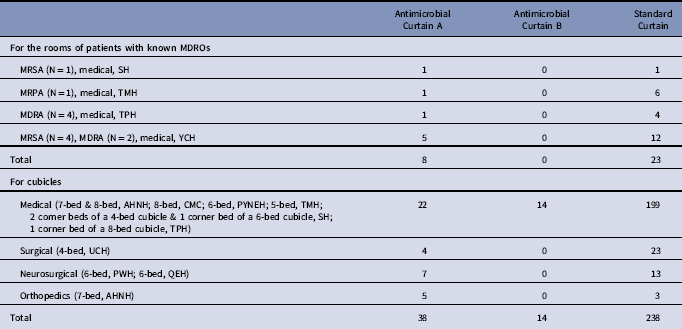
Overall, 31 curtains were placed in the rooms of patients with MDROs (N = 12; 668 patient bed days while curtains were hanging). Also, 290 were placed in 12 cubicles (8,839 patient bed days while curtains were hanging). The distributions of curtains by patient type, ward specialty, and hospital are presented in Table 1. The study in the orthopedics department (6-bed cubicle) of Queen Mary Hospital was terminated prematurely due to personnel changes of the infection control team. In addition, 12 pieces of antimicrobial curtain A were removed before the completion of the study:
Distribution of Antimicrobial Curtains and Standard Curtains by Patient Types and Specialties in 10 Hospitals

Note. MDROs, multidrug-resistant organisms; MRSA, methicillin-resistant Staphylococcus aureus; MRPA, multidrug-resistant Pseudomonas aeruginosa; MDRA, multidrug-resistant Acinetobacter species, TMH, Tuen Mun Hospital; YCH, Yan Chai Hospital; AHNH, Alice Ho Miu Ling Nethersole Hospital; CMC, Caritas Medical Centre; PYNEH, Pamela Youde Nethersole Eastern Hospital; SH, Shatin Hospital; TPH, Tai Po Hospital; UCH, United Christian Hospital; PWH, Prince of Wales Hospital; QEH, Queen Elizabeth Hospital.
MRSA count>100 CFU/cm2, median day 29 (N = 5); presence of MDRA, median day 45 (N = 3); grossly soiled, median day 67.5 (N = 2); miscommunication, median day 25 (N = 2). Also, 1 piece of antimicrobial curtain B was removed: grossly soiled, median day 131. The median hanging time of antimicrobial curtain A was 60 days; the median hanging time of antimicrobial curtain B was 173 days, and the median hanging time of the standard curtain was 15 days.
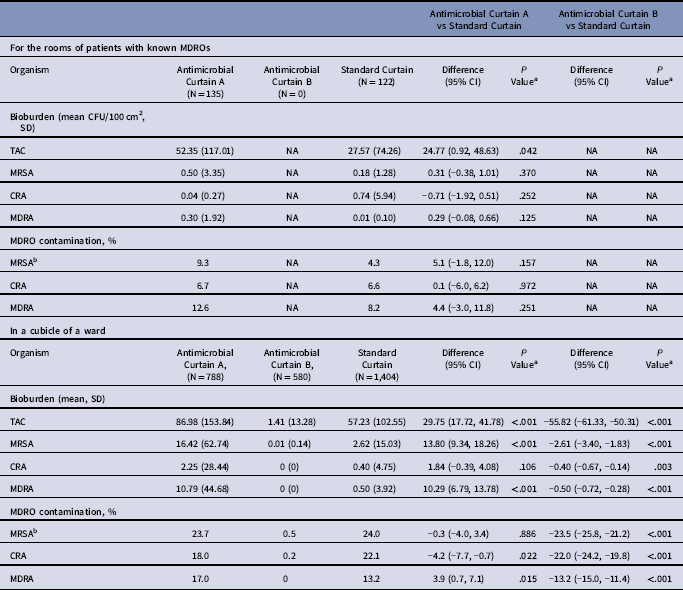
In total, 3,029 curtain surfaces were sampled: 923 antimicrobial curtain A surfaces, 580 antimicrobial curtain B surfaces, and 1,526 standard curtain surfaces; by clinical settings, 257 surfaces next to the rooms of patients with MDROs and 2,772 surfaces in cubicles. The bioburden, in terms of CFU/100 cm2 of TAC, MRSA, CRA, and MDRA, and the percentages of MDROs contamination, are presented in Table 2. Compared with the standard curtain, the bioburden and percentages of MDROs contamination on antimicrobial curtain B were significantly reduced, and the bioburden and percentages of MDROs contamination on antimicrobial curtain A were higher.
Bioburden and MDROs Contamination on Surfaces of Antimicrobial Curtains and Standard Curtains

Note. MDROs, multidrug-resistant organisms; TAC, total aerobic count; MRSA, methicillin-resistant Staphylococcus aureus; CRA, carbapenem-resistant Acinetobacter spp; MDRA, multidrug-resistant Acinetobacter spp; NA, not applicable; SD, standard deviation.
a Bold P values indicate statistical significance.
b For MRSA, broth enrichment culture was not performed.
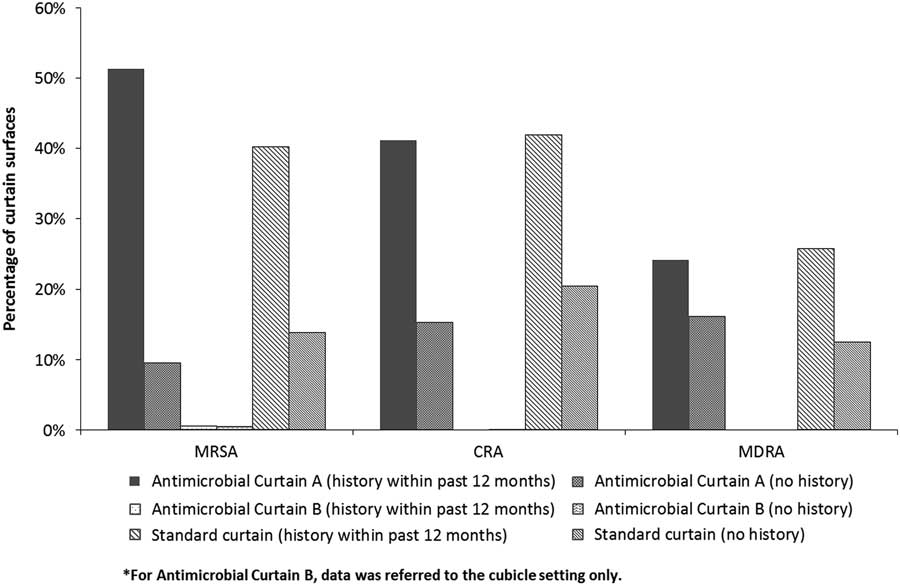
In total, 1,290 (42.6%) cultures were collected on the curtain surfaces next to patients having history of MDROs within the previous 12 months. The corresponding percentages of MDROs contamination on curtain surfaces for antimicrobial curtain A and standard curtain were higher if the residing patients had the same type of MDROs within the previous 12 months. For antimicrobial curtain A, MRSA contamination was found on 137 of 267 samples (51.3%). For CRA, 14 of 34 samples (41.2%) were contaminated. For MDRA, 7 of 29 samples (24.1%) were contaminated. On standard curtain surfaces, MRSA was found on 204 of 507 samples (40.2%); CRA was found on 13 of 31 samples (41.9%); and MDRA was found on 8 of 31 samples (25.8%). The differences in percentages of MDRO contamination between antimicrobial curtain B and antimicrobial curtain A were significant: MRSA difference, 50.7% (95% CI, 44.2%–56.7%) (P < .001); CRA difference, 41.2% (95% CI, 24.4%–57.8%) (P < .001); and MDRA difference, 24.1% (95% CI, 0.5%–42.1%) (P = .047). The differences in percentages of MDRO contamination between antimicrobial curtain B and standard curtain were also significant: MRSA difference, 39.7% (95% CI, 34.8%–44.0%) (P < .001); CRA difference, 41.9% (95% CI, 24.5%–59.2%) (P < .001); and MDRA difference, 25.8% (95% CI, 1.1%–43.2%) (P = .038). The increases in percentages of MDROs contamination of standard curtain surfaces next to patients with history of MDROs within past 12 months were also significant, when compared to curtain surfaces next to patients without such history: MRSA increase, 26.4% (95% CI, 21.6%–31.2%) (P < .001); CRA increase, 21.5% (95% CI, 5.8%–38.9%) (P = .004); and MDRA increase, 13.3% (95% CI, 1.1%–30.8%) (P = .028) (Fig. 1).
Rates of recovery of multidrug-resistant organisms (MDROs) by curtain type and MDRO history within the previous 12 months. MRSA, methicillin-resistant Staphylococcus aureus; CRA, carbapenem resistant Acinetobacter spp; MDRA, multidrug-resistant Acinetobacter spp. For MRSA, broth enrichment cultures were not performed.

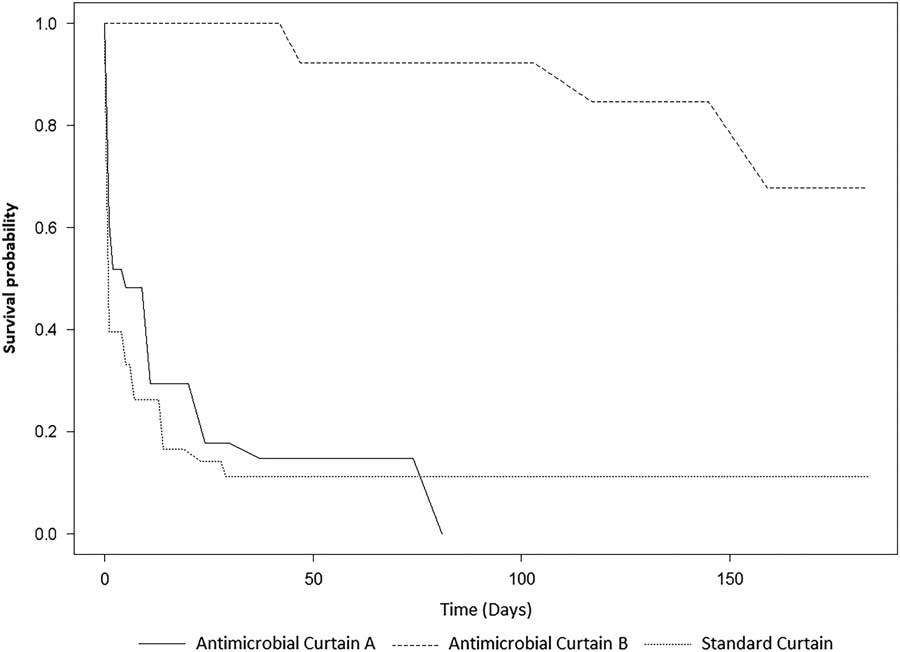
Among the contaminated curtains, the median time to first MDRO contamination of antimicrobial curtains A was 4 days (interquartile range [IQR], 1–12.8 days), the median time to first MDRO contamination of antimicrobial curtains B was 138 days (IQR, 99.5–159 days), and the median time to first MDRO contamination of standard curtains was 5 days (IQR, 2–7 days). The differences between antimicrobial curtains B and antimicrobial curtains A (134 days; 95% CI, 46–155; P < .001) were statistically significant, and those between antimicrobial curtain B and the standard curtain (133 days; 95% CI, 46–157; P = .001) were also statistically significant. The time to first MDRO contamination of each curtain type in cubicles was graphed using nonparametric maximum likelihood estimator (NPMLE) censoring after curtain removal or study completion (log-rank P < .001) (Fig. 2).
Nonparametric maximum likelihood estimation survival estimates for interval-censored time to first MDRO contamination, comparing antimicrobial curtain A, antimicrobial curtain B, and the standard curtain. MDROs, multidrug-resistant organisms.

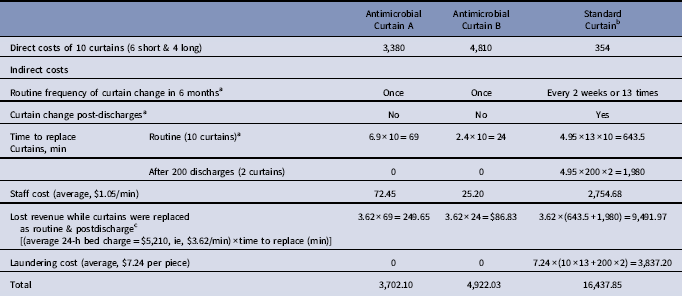
Using an 8-bed MRSA cohort cubicle in an acute medical ward as a template, the direct cost of new purchase and the indirect cost of time of replacement, staff wage, revenue loss and laundering were compared among antimicrobial curtain A, antimicrobial curtain B and standard curtain (Table 3).
Comparison of Costs Associated With the Use of Antimicrobial Curtains and Standard Curtains in an 8-Bed Cohort Cubicle of an Acute-Care Medical Ward for a 6-Month Period

Note. Data are $HK, unless otherwise indicated.
a Antimicrobial curtains are replaced every 6 months; standard curtains are replaced every 2 weeks (ie, 13 times within 6 months) and upon discharge of patients (2 curtains alongside a patient’s bed would be replaced).
b The normal lifespan of the standard curtain is 60 months, therefore the direct cost of standard curtains = direct cost of new purchase/10.
c Because patients could not be admitted to a bed while curtains were being replaced, loss of avenue = bed charges × time to replace curtains.
Discussion
In this multicenter field study, the rate of MRSA contamination on standard hospital curtains was 22.8% and the level of MRSA contamination was 2.644 CFU/100 cm2. These findings are comparable to previous reports.Reference Trillis, Eckstein, Budavich, Pultz and Donskey 3 , Reference Ohl, Schweizer, Graham, Heilmann, Boyken and Diekema 5 , Reference Klakus, Vaughan and Boswell 10 , Reference Shek, Patidar and Kohja 11 The overall bioburden, in terms of mean total aerobic count, was 58.2 CFU/100 cm2. This finding differs from the study by Shek et al,Reference Shek, Patidar and Kohja 11 which reported a much higher bioburden (305.9 CFU/100 cm2) on privacy curtain in a burn unit and a plastic surgery ward. The different study setting and sampling method (contact plates) might account for the discrepancy. Paradoxically, the bioburden and MDROs contamination rates were greater in the cubicle setting than in rooms where patients with MDROs resided. In the cubicle setting, the exposure of curtains was longer; in addition, curtains were shared between patients residing at adjacent beds, resulting in more frequent touching and contamination. Finally, 33.5% of patients residing in cubicles had a history of MDROs within the previous 12 months. These patients may have been carriers shedding MDROs to the immediate environment.Reference Luk, Ho and Ng 12
Disposable antibacterial privacy curtains represent appealing alternative that can reduce curtain contamination in hospitals. Nanoparticle silver has been demonstrated to have excellent bactericidal effects.Reference Bhat, Suman, Shetty and Hedge 13 The mode of action is postulated to be damage to the bacterial nucleic acid. When compared with standard curtains in a double-blinded, randomized, controlled trial performed in 2 intensive care units (ICU), curtains incorporating metal-alloy fiber significantly increased the time to first contamination from 2 days to 14 days and reduced the risk of VRE contamination by 8 times.Reference Schweizer, Graham, Ohl, Heilmann, Boyken and Diekema 14 In another field study performed in ICUs, curtains with silver fibers were free of MRSA, carbapenem-resistant Enterobacteriaceae (CRE), and C. difficile for up to 6 months.Reference Kotsanas, Wijesooriya, Sloane, Stuart and Gillespie 15 Our laboratory’s previous experience (unpublished data) with antimicrobial curtain A (impregnated with silver fibers) indicated that it had moderate antibacterial activity for up to 3 months. Nevertheless, compared to standard curtain with a median in-use time of 15 days, antimicrobial curtain A failed to demonstrate antibacterial efficacy after extended use (median hanging time, 60 days), which was indicated by significantly increased (P < .001) total aerobic count (TAC), MRSA count, and MDRA count, similar percentages of MDRO contamination, and similar median time to first contamination by MDROs (4 days). Our findings underscore the importance of verifying the efficacy of such products in a clinical setting. The laboratory validation reports provided by manufacturers might not account for organic matter contamination. The issue is further complicated by publication bias. Therefore, healthcare professionals should be cautious when placing products with build-in antimicrobial properties into clinical use.
The other agents impregnated in the curtains were QAC and polyorganosiloxane (a repellent negatively charged silicone). The biostatic and biocidal properties prevent bacteria from penetrating or multiplying on the curtain. Excellent antimicrobial activities, in terms of zone of inhibition and contact inhibition, against gram-negative and gram-positive bacteria, Candida albicans and C. difficile spores were achieved up to 24 months in an in vitro study.Reference Kotsanas and Gillespie 16 In this study, antimicrobial curtain B (QAC plus polyorganosiloxane) was highly effective in reducing the bioburden (TAC and counts of MRSA, CRA, and MDRA) and percentages of MDRO contamination (MRSA, −23.5%; CRA, −22%; MDRA, −13.2%) compared with the standard curtain, even after prolonged use (median hanging time, 173 days). For the curtain surfaces next to patients having history of MDROs within the past 12 months, the differences in MDRO contamination were even more drastic: MRSA, −39.7%; CRA, −41.9%; and MDRA, −25.8%. Notably, the same surfaces of antimicrobial curtain B that were culture positive for MRSA and CRA became negative upon repeated sampling a week later even though 1 patient with a history of CRA continued to reside in the cubicle during this period. We were unable to determine the time elapsed from the contamination of the curtain to the time of sample collection. A trial comparing antimicrobial curtain B and untreated polypropylene revealed 3–4 log reductions in CFU of Bacillus cereus, Enterococcus faecalis, and Serratia marcescens on imprint agar culture after 1 minute of inoculation (as stated in the manufacturer’s brochure). In our study, the time might not be sufficient for MDROs to be killed on curtains that had been contaminated just before sample collection. In addition, for antimicrobial curtain B, the median time to first contamination by MDROs substantially increased. On average, the standard curtain became contaminated within 5 days, whereas antimicrobial curtain B took >19 weeks to become contaminated. One hospital continued to use antimicrobial curtain B in a cubicle for 345 days, and the bioburden remained low: mean TAC, 1.58 CFU/100 cm2; MRSA count, 0.01 CFU/100 cm2; and CRA and MDRA counts, 0 CFU/100 cm2. In contrast to the study of Schweizer et al,Reference Schweizer, Graham, Ohl, Heilmann, Boyken and Diekema 14 who cultured all nosocomial pathogens from the curtains, our study focused on the isolation of MDROs related to intense transmission in our local healthcare setting.Reference Cheng, Wong, Ho and Yuen 17 Among S. aureus isolates identified in the public hospitals, 43.1% were MRSA, and 55% and 8.6% of Acinetobacter spp were carbapenem-resistant and multidrug-resistant, respectively (unpublished data). Given the speed of MDRO contamination of the standard curtain and the practical difficulty of changing curtains frequently, curtains that resist MDRO contamination for >19 weeks in an active clinical setting could potentially improve patient safety by eliminating a source of healthcare-associated pathogens.
With the widespread use of antimicrobial curtain B for a prolonged period, the development of microbial resistance to QAC should be seriously considered, given the well-documented examples related to its application in human medicine and industry.Reference Hegstad, Langsrud, Lunestad, Scheie, Sunde and Yazdankhah 18 Importantly, because of the diversity of resistance mechanisms, including overexpression of efflux pumps and reduced membrane permeability, microbial cross-resistance to clinically important antimicrobial agents is expected. When an antimicrobial curtain is applied in clinical settings, regular sampling of the curtain should be performed, and the susceptibility of the recovered microbes toward QAC and other antimicrobial agents should also be monitored.
Concerning cost benefits, replacing the standard curtain with an antimicrobial curtain could be cost saving if indirect costs such as laundering, time taken for staff to change curtains, and revenue loss are considered. Applying the practice in an 8-bed cohort cubicle of an acute-care medical ward for 6 months could offer a savings of US$1,476.39 ($HK 11,515.82). This finding was in accordance with previous studies.Reference Kotsanas, Wijesooriya, Sloane, Stuart and Gillespie 15 , Reference Kotsanas and Gillespie 16 In addition, most supporting staff regarded the weight of an antimicrobial curtain to be lighter than that of standard curtain, without any adverse contact effects reported. Also, frequent handling of heavy standard curtains on ladders could be avoided, reducing safety risks to the staff.
Our study had some limitations. Patient screening and molecular typing of MDRO isolates were not performed; therefore, we were unable to determine the transmission dynamics and patient acquisition of infections. Nevertheless, Trillis et al3 demonstrated the frequent transfer of pathogens from curtains to the gloved hands of healthcare workers. Without proper hand hygiene, the transferred pathogens could be transmitted to vulnerable patients from HCWs. In addition, our sampling frequency might not have been great enough to accurately determine the time of MDRO contamination. Still, our study provides important prospective data with relevance to routine practice. Finally, antimicrobial curtain B was only studied in a cubicle setting in medical wards, due to the difficulty in recruiting long-stay patients with MDROs residing in rooms that allowed multiple sampling of curtains before replacement and the high incidence and prevalence of MDROs in medical units.Reference Luk, Ho and Ng 12 For patients with Clostridium difficile infection, we did not recover any C. difficile isolates on either antimicrobial curtain A or the standard curtain placed in the isolation room. Therefore, we could not determine the sporicidal efficacy of antimicrobial curtain A for C. difficile.
In conclusion, privacy curtains were rapidly and frequently contaminated with MDROs. Antimicrobial curtain B (quaternary ammonium chlorides plus polyorganosiloxane), but not antimicrobial curtain A (built-in silver), did effectively reduce the microbial burden and MDRO contamination compared with the standard curtain, even after extended use in an active clinical setting. The median time of first contamination by MDROs was extended from 5 days (standard curtain) to 19 weeks (antimicrobial curtain B). Thus, replacing the standard curtain with an antimicrobial curtain could avert the costs related to curtain changing, laundering, and revenue loss, in addition to improving patient care by removing an environmental source of MDROs. Further studies to assess whether antimicrobial curtain can decrease the transmission of MDROs or lead to the emergence of antimicrobial resistance are needed.
Acknowledgments
We thank the hospital infection control teams and microbiology laboratory staff for data collection, specimen collection and processing.
Financial support
No financial support was provided relevant to this article.
Conflicts of interest
All authors report no conflicts of interest relevant to this article.