


Introduction
Since the onset of the COVID-19 pandemic, student absenteeism has worsened globally, and evidence suggests the problem is both persistent and widespread (Nathwani et al., Reference Nathwani, Shoaib, Shafi, Furukawa and Huy2021; Walters, Reference Walters2023). Absenteeism is associated with poorer academic performance and is linked to a range of adverse life outcomes, including delinquency and social disengagement (Rocque et al., Reference Rocque, Jennings, Piquero, Ozkan and Farrington2017). Consequently, the rising trend in absenteeism has drawn heightened attention from policymakers seeking effective ways to improve school attendance.
In New Zealand (NZ), student attendance rates are concerning when compared to other countries. In Terms 1 and 2 of 2019, only 58 per cent of learners attended more than 90 per cent of available half-daysFootnote 1 , compared with 73 per cent in Australia and 87 per cent in the United Kingdom (Education Review Office, 2022). In response, the government passed the Education and Training Act 2020, placing legal obligations on caregivers to enrol their children in school and ensure regular attendance, while requiring schools to take all reasonable steps to secure student participation (Ministry of Education, 2024).
Student absenteeism is a multifactorial outcome shaped by individual, family, school and structural factors, including health, school engagement, family circumstances, school discipline and socioeconomic disadvantage (Welsh, Reference Welsh2018). Housing instability is particularly important because, unlike many individual or family-level risk factors, it is a structural condition that can simultaneously disrupt multiple processes relevant to school attendance, including school continuity, family routines, caregiving arrangements and access to resources (Welsh, Reference Welsh2018). Despite its potential importance, the relationship between housing instability and student absenteeism remains underexamined.
Existing research has linked housing instability to broader educational outcomes, such as academic achievement, rather than directly examining absenteeism (Welsh, Reference Welsh2018). Moreover, studies that do examine attendance have largely focused on homelessness, which represents an extreme form of housing instability. For example, research consistently shows that students experiencing homelessness have higher levels of unjustified absenteeism than their housed peers (Nolan et al., Reference Nolan, Cole, Wroughton, Clayton-Code and Riffe2013; Thomas, Reference Thomas2024; Treglia et al., Reference Treglia, Cassidy and Bainbridge2023). However, less is known about whether more moderate forms of housing instability, such as frequent residential moves or changes in housing tenure without experiencing homelessness, are also associated with student absenteeism.
The existing evidence is further limited by its reliance on small samples or single-city studies, leaving a lack of nationally representative evidence on the relationship between housing instability and student absenteeism (Welsh, Reference Welsh2018). More importantly, relatively little is known about whether the relationship between housing instability and absenteeism differs across school stages, despite life-course research suggesting that instability may have different consequences depending on the timing and context in which it occurs (Elder, Reference Elder1998).
This study addresses this gap by examining the relationship between housing tenure trajectories and student absenteeism in NZ, and whether this relationship differs across school stages, using linked nationwide administrative data. Housing tenure trajectory, as one facet of housing instability, is defined as the dynamic sequence of housing tenure states experienced by individuals over time, capturing both transitions between tenure types and the duration spent in each state across the life course (Comeau et al., Reference Comeau, Laura, Katholiki, Li and Michael2020; Cristofalo & Trappolini, Reference Cristofalo and Trappolini2025). Although this remains a developing approach, recent studies have begun to examine housing tenure trajectories, particularly in relation to health outcomes (Comeau et al., Reference Comeau, Laura, Katholiki, Li and Michael2020; Cristofalo & Trappolini, Reference Cristofalo and Trappolini2025).
These prior studies suggest that housing trajectories can capture cumulative exposure to material, social and psychosocial conditions that are not adequately reflected by single-point-in-time measures of housing tenure or conventional socioeconomic indicators (Comeau et al., Reference Comeau, Laura, Katholiki, Li and Michael2020; Cristofalo & Trappolini, Reference Cristofalo and Trappolini2025). These accumulated exposures are plausibly linked to children’s capacity to maintain consistent school attendance (Buckley et al., Reference Buckley, Abdul-Masih, Yang, Ansari and Purtell2023; Ersing et al., Reference Ersing, Sutphen and Loeffler2009; Green et al., Reference Green, DeFosset and Kuo2019; Haugan & Myhr, Reference Haugan and Myhr2019; Voight et al., Reference Voight, Shinn and Nation2012).
The present study extends the emerging literature on housing tenure trajectories by examining educational outcomes, rather than focusing solely on health outcomes. In doing so, we highlight the potential for cross-sector interventions that integrate housing stability approaches into efforts to promote regular school attendance.
Theoretical framework
Life-course theory provides a framework for understanding how social and environmental exposures accumulate and interact over time to shape individual outcomes (Elder, Reference Elder1998). It emphasises the importance of timing (when events occur), frequency (how often they occur) and context (the social conditions in which they occur) in influencing developmental trajectories (Buckley et al., Reference Buckley, Abdul-Masih, Yang, Ansari and Purtell2023; Gasper et al., Reference Gasper, DeLuca and Estacion2010; South et al., Reference South, Lutz and Baumer2005). From this perspective, educational outcomes are shaped not only by whether children experience disadvantage, but also by when and under what conditions such experiences occur.
Moves during childhood are particularly disruptive, as children are both more vulnerable to environmental change and more responsive to intervention (Alaszewski, Reference Alaszewski2013). Early childhood is a particularly sensitive period, where instability may have a pronounced effect on behavioural and developmental outcomes, including increased externalising behaviours such as peer conflict, rule-breaking and bullying (Womack et al., Reference Womack, Wilson, Tong, Lemery-Chalfant and Shaw2022). This underscores the importance of considering developmental timing when examining associations between housing instability and school attendance.
In addition, the principle of cumulative disadvantage (Dannefer, Reference Dannefer2003) suggests that repeated or sustained exposure to housing instability can compound other stressors such as poverty, poor housing quality and periods of homelessness, reinforcing long-term inequalities in educational outcomes. Taken together, these perspectives imply that housing instability should be understood as a dynamic process rather than a single event, and that its consequences for school attendance may vary across different stages of childhood and schooling.
Housing instability
Housing tenure trajectories and residential mobility capture related but distinct dimensions of housing instability. Address changes measure the frequency of physical relocation (Buckley et al., Reference Buckley, Abdul-Masih, Yang, Ansari and Purtell2023; Ersing et al., Reference Ersing, Sutphen and Loeffler2009; Green et al., Reference Green, DeFosset and Kuo2019), while tenure trajectories capture deeper shifts in housing stability, affordability, household circumstances and state support (Preece et al., Reference Preece, Crawford, McKee, Flint and Robinson2020; Van Gent, Reference Van Gent2010). For example, a wealthy family moving from one owner-occupied property to another is vastly different from a low-income family being evicted from public housing into emergency housing. A tenure trajectory methodology captures this difference.
However, we do not assume that moves within the same tenure category are inconsequential. Previous research demonstrates that repeated residential mobility within rental housing is a significant form of instability (Desmond et al., Reference Desmond, Gershenson and Kiviat2015; Kang, Reference Kang2023). These studies often focus on low-income and socioeconomically disadvantaged groups, where movement of this kind is likely to have a significant impact. In a study of the general population, as is done here, housing tenure trajectory may better reflect the consequences of broader changes in housing security, socioeconomic position and long-term housing conditions (Comeau et al., Reference Comeau, Laura, Katholiki, Li and Michael2020; Cristofalo & Trappolini, Reference Cristofalo and Trappolini2025). The strength of this paper lies in its use of population-level data rather than a specific cohort (e.g. low-income populations). In this context, residential mobility may not represent the same form of instability as housing tenure trajectories.
Our paper investigates whether housing tenure trajectories are robustly associated with student absenteeism. The question is motivated by mixed findings in the existing literature. For example, Buckner et al. (Reference Buckner, Bassuk and Weinreb2001) and Buckley et al. (Reference Buckley, Abdul-Masih, Yang, Ansari and Purtell2023) found no robust association between housing instability and adolescent truancy, whereas Parke and Kanyongo (Reference Parke and Kanyongo2012) reported a consistent positive association across all school levels. There is some evidence that tenure trajectories may capture different outcomes than residential moves alone (Millard-Ball, Reference Millard-Ball2002).
The NZ context
In NZ, housing instability cannot be understood in isolation from broader structural shifts in the housing system since the 1990s. This period has seen a profound transition from housing as a public good – supported by substantial state provision – to housing as a market commodity shaped primarily by private investment and market forces (Thorns, Reference Thorns2000). The consequences of this shift have been far-reaching: housing affordability has steadily declined (Thorns, Reference Thorns2009); the private rental sector has expanded while remaining under-regulated, offering limited tenure security (James et al., Reference James, Bates, Coleman, Kearns and Cram2022; Thorns, Reference Thorns2000); and public housing has experienced long-term disinvestment and reduced availability (Barker, Reference Barker2019).
These structural changes have contributed to increasingly unequal and insecure housing pathways across the life course, as stable homeownership has become less attainable and reliance on insecure rental housing has increased. Housing tenure trajectories may therefore reflect broader systemic forces, such as housing policy shifts, market pressures and displacement processes. For example, tenure changes associated with the divestment of public housing and rising private rental costs may result in forced transitions between public housing and the private rental market. Such instability may disrupt children’s daily routines, school continuity, neighbourhood ties and access to supportive educational environments, all of which are associated with school attendance (Buckley et al., Reference Buckley, Abdul-Masih, Yang, Ansari and Purtell2023; Ersing et al., Reference Ersing, Sutphen and Loeffler2009; Green et al., Reference Green, DeFosset and Kuo2019). In this context, a housing tenure trajectory approach is particularly valuable because it captures cumulative patterns of housing security and disadvantage across childhood.
School stages
The literature on the relationship between housing instability and student absenteeism often focuses on a specific grade level (Ersing et al., Reference Ersing, Sutphen and Loeffler2009) or a particular age range (Buckley et al., Reference Buckley, Abdul-Masih, Yang, Ansari and Purtell2023; Cotton, Reference Cotton2016; Gasper et al., Reference Gasper, DeLuca and Estacion2010). Few studies examine outcomes across the entire school-age population. As a result, important questions remain unanswered. First, if a significant relationship exists between housing instability and student absenteeism, does it hold consistently across all school stages? Second, does the strength of this relationship vary by school stage? The present study addresses these gaps by examining the relationship across the full span of compulsory schooling in NZ and testing whether it is more pronounced among primary school students compared to those in intermediate/middle or high school. In NZ, primary school enrols children from Year 1 (age 5) through to Year 6 or Year 8, depending on the school. Intermediate school covers Years 7 and 8, where the primary school does not extend to these levels (New Zealand Qualification Authority, 2025).Footnote 2 Secondary education runs from Year 9 (approximately ages 12–14) through to Year 13 (approximately ages 16–18).
The education literature highlights that primary school is a critical period during which children establish foundational academic skills, routines and social connections with peers and teachers (Entwisle & Hayduk, Reference Entwisle and Hayduk1988), all of which can have lasting effects on future educational outcomes. For example, students who are truant in one term are more likely to be truant in subsequent terms (Gottfried, Reference Gottfried2017), emphasising the importance of establishing strong attendance habits early. Research also indicates that primary schooling can have long-term effects on students’ educational trajectories (Entwisle & Hayduk, Reference Entwisle and Hayduk1988; Vanwynsberghe et al., Reference Vanwynsberghe, Vanlaar, Van Damme and De Fraine2017). Taken together, these findings highlight the critical importance of investigating the association between tenure trajectories and absenteeism in primary school students.
Discrimination against Indigenous people
While there are higher rates of absenteeism amongst Māori, these must be seen in the context of the history of colonisation. Historical colonial processes of land confiscation fundamentally undermined the sovereignty of Māori, the Indigenous people of NZ, and forced many into substandard housing conditions (Rout, Reference Rout2022). Subsequent state housing policies actively promoted Māori urbanisation, disrupting traditional authority structures and pathways to intergenerational wealth accumulation (Rout, Reference Rout2022; Ryks et al., Reference Ryks, Howden-Chapman, Robson, Stuart and Waa2014). This shift generated conditions of urban poverty and overcrowding, undermining housing stability for children and disrupting their schooling (Ryks et al., Reference Ryks, Howden-Chapman, Robson, Stuart and Waa2014; Wanhalla, Reference Wanhalla2006).
These inequities were intensified during the wide-ranging neoliberal economic reforms of the 1980s and 90s, which deepened pre-existing disparities and heightened housing precarity for Māori and Pacific peoples (Rout, Reference Rout2022; Waldegrave et al., Reference Waldegrave, Love and Stuart2000). Institutional racism within the education system has further disadvantaged Māori students, as reflected in lower achievement, higher suspension rates and overrepresentation in behaviour-related special education (Agnew et al., Reference Agnew, Coupe and Hingston2025). The legacy of the Native Schools Act placed Māori education under settler control, entrenching low expectations, deficit theorising and stereotyping (Hetaraka, Reference Hetaraka2022; Walker, Reference Walker2016). Notably, achievement in Māori-led schooling is much higher (Channing, Reference Channing2024). These conditions intersect with housing instability, creating compounding barriers to regular mainstream school attendance for Māori children.
Methods
The data used in this paper were sourced from the Integrated Data Infrastructure (IDI), a NZ-linked and de-identified database that includes administrative data from various domains, such as demographics, housing, health and education (Statistics New Zealand, 2022). The IDI is widely used in the literature and is recognised both in NZ and internationally as a leading resource for population-level research and policy analysis (Pierse et al., Reference Pierse, Ombler, White, Aspinall, McMinn, Atatoa-Carr, Nelson, Hawkes, Fraser and Cook2019; Yu, Buchanan, Te Ora, et al., Reference Yu, Buchanan, Te Ora, Pehi, Leigh, Howden-Chapman, Paul and Pierse2025).
We described people’s housing tenure trajectories over a ten-year period from 2013 to 2022. As a starting point, we required individuals to have non-missing and identifiable housing tenure types in the 2013 Census. We then excluded individuals who died or were overseas for more than two years to ensure that the study population resided continuously in NZ during the study period. The study population was then linked to the address notification dataset to track residential mobility.
Information on housing tenure types for each address was retrieved from the bond lodgement dataset, where rental properties were classified as either private market rentals or public housing. If an address did not appear in the bond lodgement dataset, it was regarded as owner-occupied. The IDI address notification dataset does not contain tenure information. The bond lodgement dataset was the only available source for identifying tenure types. As a result, some informal living arrangements – such as boarding situations, living rent-free with relatives or friends or multigenerational households without formal bond lodgements – may be classified within the owner-occupied category. These situations are unlikely to appear as stable owner-occupation over time and are more likely to be captured within the ‘[Own–Rental] (unstable)’ trajectory category, which is classified as unstable in our framework. To assess the validity of our approach, we compared our tenure classifications with 2018 Census housing tenure information. Among individuals classified in the stable ‘Own’ trajectory group, more than 95 per cent were also recorded as living in owner-occupied housing in the Census, indicating strong alignment between our classification approach and Census-reported tenure.
Emergency housing was identified using the same approach applied in Yu et al. (Reference Yu, Buchanan, Jenkins, Pehi, Fraser, Aspinall, Howden-chapman and Pierse2025), with data sourced from the Ministry of Social Development’s (MSD) Ad-hoc Payments to Beneficiaries. Household members were grouped using dwelling IDs from the Census, as the MSD dataset includes only the main applicants of the Emergency Housing Special Needs Grant (EHSNG). We excluded households with more than fifteen members in emergency housing, as these often reflect mailing addresses used by support services for people experiencing homelessness.
In this paper, we focus on housing tenure trajectories rather than address changes (Desmond et al., Reference Desmond, Gershenson and Kiviat2015; Kang, Reference Kang2023) for both conceptual and data-quality reasons. Conceptually, transitions between tenure types may reflect broader structural changes in housing security, affordability, state support and household circumstances across the life course (Comeau et al., Reference Comeau, Laura, Katholiki, Li and Michael2020; Cristofalo & Trappolini, Reference Cristofalo and Trappolini2025). Methodologically, the IDI address notification dataset contains a substantial number of duplicate or short-duration address notifications within the same tenure category, making it difficult to distinguish temporary administrative changes from substantive residential moves. For example, individuals may appear to move from Address 1 to Address 2 and then return to Address 1 a few days later, without clear evidence that a genuine residential transition occurred. By contrast, transitions between tenure types provide a more robust indicator of meaningful changes in housing circumstances. Accordingly, we focus on longer-term tenure trajectories rather than short-term address fluctuations.
We identified twelve housing tenure trajectories, which were grouped into three major categories: stable, unstable and highly unstable tenure trajectories (Yu et al., Reference Yu, Aspinall, Le Gros, Fraser, Buchanan, Howden-Chapman, O’Sullivan and Pierse2026):
-
1. Stable tenure trajectories include ‘Own’, ‘Rental’ and ‘Public’, referring to individuals who remained exclusively in owner-occupied housing, private market rentals or public housing, from 2013 to 2022. This category also includes ‘Own–Rental’, ‘Rental–Own’, ‘Rental–Public’, ‘Public–Rental’ and ‘Public–Own’. These refer to individuals who began in the first tenure type and transitioned to the second, with two or fewer transitions between tenure types over the ten-year period. For example, ‘Own–Rental’ includes trajectories such as ‘Own–Rental–Own’ (e.g. a high-income household selling a property, renting temporarily while searching for another home and then purchasing again). In these cases, owner-occupied housing is more likely to reflect actual homeownership by the individual.
-
2. Unstable tenure trajectories include ‘[Own–Rental] (unstable)’ and ‘[Rental–Public] (unstable)’, referring to people who transitioned between the respective two tenure types three or more times from 2013 to 2022. For example, ‘[Own–Rental] (unstable)’ includes trajectories such as ‘Own–Rental–Own–Rental–Own–Rental’. In these scenarios, owner-occupied housing is less likely to represent ownership by the individual and more likely to reflect living with parents, grandparents or in boarding arrangements without a formal tenancy bond.
-
3. Highly unstable tenure trajectories include ‘[3+ tenure types] (unstable)’, referring to people who transitioned across three or more tenure types and changed tenure three times or more during the study period. This category also includes ‘Accommodated EHSNG’, referring to people who were placed in emergency housing at any point from 2016Footnote 3 to 2022.
We include people in the school-age range of 5 to 17 years. Our cohort therefore consists of 754,098 people born between 1996 and 2013, for whom housing tenure trajectories could be identified. This study population is then linked to the school attendance dataset from the Ministry of Education (MOE). We focus on two levels of absence – unjustified absence and truancy – as defined by MOE guidelines:
-
1. Unjustified absence (UA): Identified using the student attendance codes:
-
○ ‘?’ – Unknown reason
-
○ ‘G’ – Holiday during term time
-
○ ‘E’ – Explained but not approved
-
○ ‘T’ – Truancy
-
-
2. Truancy: Identified specifically using the student attendance code ‘T’.
Demographic and income information used in the descriptive analysis (Table 1) were obtained from the 2013 Census, and the Income Calendar Year Summaries Table supplied by Inland Revenue. The income analysis reflects the mean income of all members of a household, as young people are often supported by their parents or other family members within the household.
Descriptives

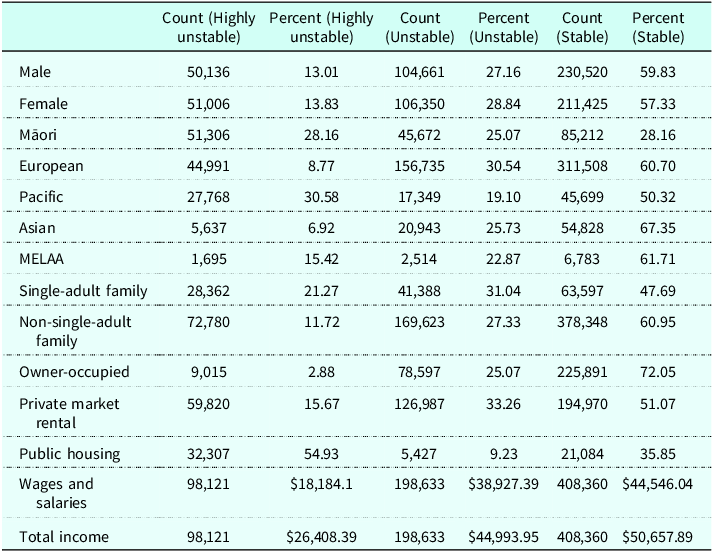
Table 1. Long description
Table 1 presents counts and row percentages for three housing tenure trajectory categories: highly unstable, unstable, and stable. Results are shown by sex, ethnicity, family type, 2013 housing tenure, wages and salaries, and total household income. Among males, 13.01% had highly unstable, 27.16% unstable, and 59.83% stable trajectories. Among females, the corresponding percentages were 13.83%, 28.84%, and 57.33%. By ethnicity, highly unstable trajectories were most common among Pacific people (30.58%) and Māori (28.16%), followed by MELAA (15.42%), European (8.77%), and Asian people (6.92%). Among single-adult families, 21.27% had highly unstable, 31.04% unstable, and 47.69% stable trajectories, compared with 11.72%, 27.33%, and 60.95%, respectively, among non-single-adult families. Housing tenure in 2013 showed substantial differences. Among owner-occupied households, 2.88% had highly unstable, 25.07% unstable, and 72.05% stable trajectories. Among private market renters, the corresponding percentages were 15.67%, 33.26%, and 51.07%. Among public housing households, 54.93% had highly unstable, 9.23% unstable, and 35.85% stable trajectories. For wages and salaries, the mean income was $18,184.10 for the highly unstable group, $38,927.39 for the unstable group, and $44,546.04 for the stable group. For total income, the corresponding means were $26,408.39, $44,993.95, and $50,657.89. Percentages are calculated as row percentages. MELAA refers to Middle Eastern, Latin American, and African. Individuals may identify with more than one ethnicity. A single-adult family is defined according to the actual number of adults in the same household and excludes single parents living with a son or daughter aged over 18 and single parents in multigenerational households. Housing tenure is measured using 2013 Census data. Income reflects the mean income of all household members because students aged 5–17 rely on the income of other household members.
Note:
1. Percentages are calculated as row percentages.
2. MELAA refers to Middle Eastern/Latin American/African.
3. Each individual may identify with more than one ethnicity.
4. A single-adult family is defined based on the actual count of adults in the same household. This category does not include single parents living with a son or daughter over 18 years old, nor single parents residing in multigenerational households.
5. Housing tenure types (owner-occupied, private market rental, and public housing) are measured using data from the 2013 Census.
6. The income analysis reflects the mean income of all members of a household, as students (aged 5-17) rely on the income of other household members.
We conduct univariate tests to describe and compare unjustified absences (UA) and truancy across the three housing tenure trajectory groups: highly unstable, unstable and stable (Table 2). We also perform the same univariate tests stratified by ethnicity (Table 2). Multivariate negative binomial regression analyses were then conducted, using UA and truancy as the dependent variables, with various control variables included (Table 3). A single-adult family is defined based on the actual count of adults in the same household. This category does not include single parents living with a child over 18 years old, nor single parents residing in multigenerational households. COVID refers to the period between 2020 and 2022. Negative binomial regression was chosen over Poisson regression due to the highly significant alpha (α) parameters, indicating that the negative binomial model provides a better fit for the data (Buckley et al., Reference Buckley, Abdul-Masih, Yang, Ansari and Purtell2023). We include an interaction between a dummy variable indicating whether the student is in primary school and the variables representing housing tenure trajectories. This allows us to examine whether the associations between tenure trajectories and attendance outcomes are more pronounced for primary school students (Table 4).
Mean of student attendance by tenure trajectory

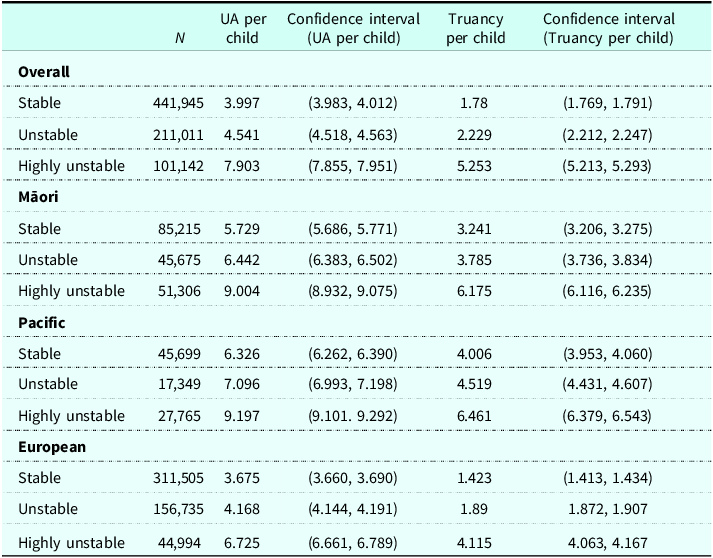
Table 2. Long description
Table 2 presents the number of students and mean unjustified absences (UA) and truancy per child, with 95% confidence intervals, by housing tenure trajectory. Results are shown for the overall population and separately for Māori, Pacific, and European students. For the overall population, students with stable housing tenure trajectories had a mean of 3.997 unjustified absences and 1.780 instances of truancy per child. The corresponding means were 4.541 unjustified absences and 2.229 instances of truancy for unstable trajectories, and 7.903 unjustified absences and 5.253 instances of truancy for highly unstable trajectories. Among Māori students, the mean number of unjustified absences was 5.729 for stable, 6.442 for unstable, and 9.004 for highly unstable trajectories. Mean truancy was 3.241, 3.785, and 6.175 instances per child, respectively. Among Pacific students, mean unjustified absences were 6.326 for stable, 7.096 for unstable, and 9.197 for highly unstable trajectories. Mean truancy was 4.006, 4.519, and 6.461 instances per child, respectively. Among European students, mean unjustified absences were 3.675 for stable, 4.168 for unstable, and 6.725 for highly unstable trajectories. Mean truancy was 1.423, 1.890, and 4.115 instances per child, respectively. Across all population groups shown, both mean unjustified absences and mean truancy were highest among students with highly unstable housing tenure trajectories, followed by those with unstable trajectories, with students with stable trajectories having the lowest levels. UA stands for unjustified absence. Confidence intervals are 95% confidence intervals. The overall population includes all individuals in New Zealand aged 5–17 between 2013 and 2022 for whom a housing tenure trajectory could be identified.
Note:
1. UA stands for unjustified absence.
2. The confidence interval refers to the 95 per cent confidence interval.
3. The overall population includes all individuals in New Zealand aged 5–17 between 2013 and 2022, for whom a housing tenure trajectory could be identified.
Multivariate negative binomial regression of student attendance and housing tenure trajectory

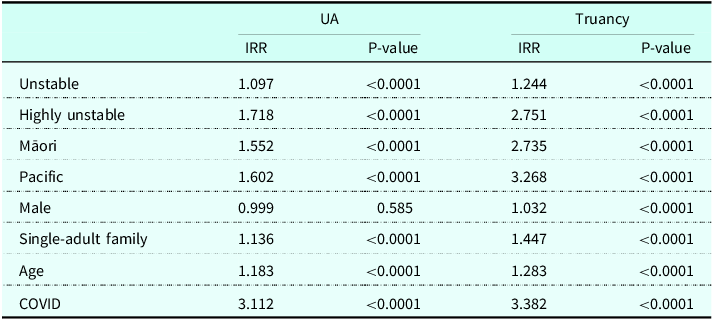
Table 3. Long description
Table 3 presents results from multivariate negative binomial regression models examining unjustified absences (UA) and truancy among students aged 5–17 in New Zealand between 2013 and 2022. Results are reported as incidence rate ratios (IRRs) and p-values, with students with stable housing tenure trajectories as the baseline group. Compared with students with stable housing tenure trajectories, students with unstable trajectories had 1.097 times the incidence of unjustified absences and 1.244 times the incidence of truancy. Students with highly unstable trajectories had 1.718 times the incidence of unjustified absences and 2.751 times the incidence of truancy. All associations for housing tenure trajectory were statistically significant with p-values below 0.0001. Māori students had IRRs of 1.552 for unjustified absences and 2.735 for truancy, while Pacific students had IRRs of 1.602 and 3.268, respectively. All p-values were below 0.0001. For other characteristics, males had an IRR of 0.999 for unjustified absences (p=0.585) and 1.032 for truancy (p<0.0001). Students from single-adult families had IRRs of 1.136 for unjustified absences and 1.447 for truancy, both with p-values below 0.0001. Each additional year of age was associated with IRRs of 1.183 for unjustified absences and 1.283 for truancy, both with p-values below 0.0001. The COVID period, defined as 2020–2022, had IRRs of 3.112 for unjustified absences and 3.382 for truancy, both with p-values below 0.0001. The model used negative binomial regression because the alpha parameter was highly significant, indicating that this model was more appropriate than a Poisson regression. IRR refers to incidence rate ratio. UA stands for unjustified absence. A single-adult family is defined according to the actual number of adults in the same household and excludes single parents living with a son or daughter aged over 18 and single parents in multigenerational households. The overall population includes all individuals in New Zealand aged 5–17 between 2013 and 2022 for whom a housing tenure trajectory could be identified.
Note:
1. The model used is a negative binomial regression rather than a Poisson regression because the alpha parameter is highly significant, indicating that the negative binomial model is more appropriate.
2. IRR refers to the incidence rate ratio.
3. The baseline group is students with stable housing tenure trajectories.
4. The overall population includes all individuals in New Zealand aged 5–17 between 2013 and 2022, for whom a housing tenure trajectory could be identified.
5. UA stands for unjustified absence.
6. A single-adult family is defined based on the actual count of adults in the same household. This category does not include single parents living with a son or daughter over 18 years old, nor single parents residing in multigenerational households.
7. COVID refers to the period between 2020 and 2022.
Multivariate negative binomial regression of student attendance by housing tenure, interacted with primary school status

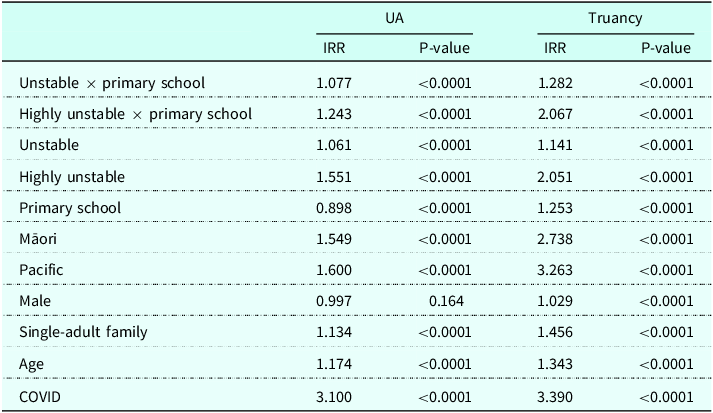
Table 4. Long description
Table 4 presents results from multivariate negative binomial regression models examining unjustified absences (UA) and truancy among students aged 5–17 in New Zealand between 2013 and 2022. The models examine housing tenure trajectories, interactions between housing tenure trajectories and primary school status, and other student characteristics. Results are reported as incidence rate ratios (IRRs) and p-values, with students with stable housing tenure trajectories as the baseline group. For unjustified absences, the interaction between an unstable housing trajectory and primary school status had an IRR of 1.077, while the interaction between a highly unstable trajectory and primary school status had an IRR of 1.243. For truancy, the corresponding IRRs were 1.282 and 2.067. All interaction terms had p-values below 0.0001. Among students who were not in primary school, unstable housing trajectories were associated with an IRR of 1.061 for unjustified absences and 1.141 for truancy. Highly unstable trajectories had IRRs of 1.551 and 2.051, respectively. Primary school status itself had an IRR of 0.898 for unjustified absences and 1.253 for truancy. All these associations had p-values below 0.0001. Māori students had IRRs of 1.549 for unjustified absences and 2.738 for truancy, while Pacific students had IRRs of 1.600 and 3.263, respectively. All p-values were below 0.0001. For other characteristics, males had an IRR of 0.997 for unjustified absences (p=0.164) and 1.029 for truancy (p<0.0001). Students from single-adult families had IRRs of 1.134 for unjustified absences and 1.456 for truancy, both with p-values below 0.0001. Each additional year of age was associated with IRRs of 1.174 for unjustified absences and 1.343 for truancy, both with p-values below 0.0001. The COVID period, defined as 2020–2022, had IRRs of 3.100 for unjustified absences and 3.390 for truancy, both with p-values below 0.0001. The model used negative binomial regression because the alpha parameter was highly significant, indicating that the negative binomial model was more appropriate than a Poisson regression. IRR refers to incidence rate ratio. UA stands for unjustified absence. Primary school status is coded as 1 for primary school students and 0 otherwise. A single-adult family is defined according to the actual number of adults in the same household and excludes single parents living with a son or daughter aged over 18 and single parents in multigenerational households. The overall population includes all individuals in New Zealand aged 5–17 between 2013 and 2022 for whom a housing tenure trajectory could be identified.
Note:
1. The model used is a negative binomial regression rather than a Poisson regression because the alpha parameter is highly significant, indicating that the negative binomial model is more appropriate.
2. IRR refers to the incidence rate ratio.
3. The baseline group is students with stable housing tenure trajectories.
4. The overall population includes all individuals in New Zealand aged 5–17 between 2013 and 2022, for whom a housing tenure trajectory could be identified.
5. UA stands for unjustified absence.
6. Primary school is a dummy variable that equals 1 if the student is a primary school student, and 0 otherwise.
7. A single-adult family is defined based on the actual count of adults in the same household. This category does not include single parents living with a son or daughter over 18 years old, nor single parents residing in multigenerational households.
8. COVID refers to the period between 2020 and 2022.
Finally, we perform propensity score matching to strengthen the analysis of the association between housing tenure trajectories and student attendance. First, we estimate a logistic regression model, with a dummy variable indicating ‘highly unstable’ group membership as the dependent variable. The logistic regression includes covariates that may be associated with both housing tenure stability and student attendance – specifically, ethnicity, age, gender and single-adult family status. The predicted values from this model are used as propensity scores for matching. The baseline group is drawn from individuals in the stable tenure trajectory group, matched one-to-one based on the closest propensity scores. We impose a caliper of 1 per cent, requiring that matched pairs have a difference in propensity scores of less than 0.01Footnote 4 . We then estimate multivariate negative binomial regression models on the matched sample, using UA and truancy as dependent variables, and the ‘highly unstable’ group indicator as the key independent variable (Appendix). To assess the impact of the matching procedure, we report the differences in demographic characteristics before and after matching (Appendix).
Result
Table 1 presents descriptive statistics for our cohort of students, disaggregated by housing tenure trajectories. Māori and Pacific students are disproportionately represented among those with highly unstable housing tenure trajectories. For instance, 28.16 per cent of Māori students experienced highly unstable tenures, compared with 8.77 per cent of European students. Family structure also mattered: 21.27 per cent of students from single-adult families experienced highly unstable tenure trajectories, nearly double the proportion observed among those from non-single-adult families (11.72 per cent). Housing tenure at baseline was similarly associated with subsequent tenure stability. Students living in owner-occupied housing at the time of the 2013 Census were much less likely to experience tenure instability over the following decade; only 2.88 per cent of these students went on to experience highly unstable tenure trajectories.
Income patterns followed a similar gradient. The average income of individual household members is significantly lower for students who experienced highly unstable housing tenure trajectories, both in terms of wages and salaries and total income from all sources. For example, the average total income of household members for students with highly unstable tenures was $26,408.39; roughly half that of those with stable tenure trajectories, whose households had an average income of $50,657.89.
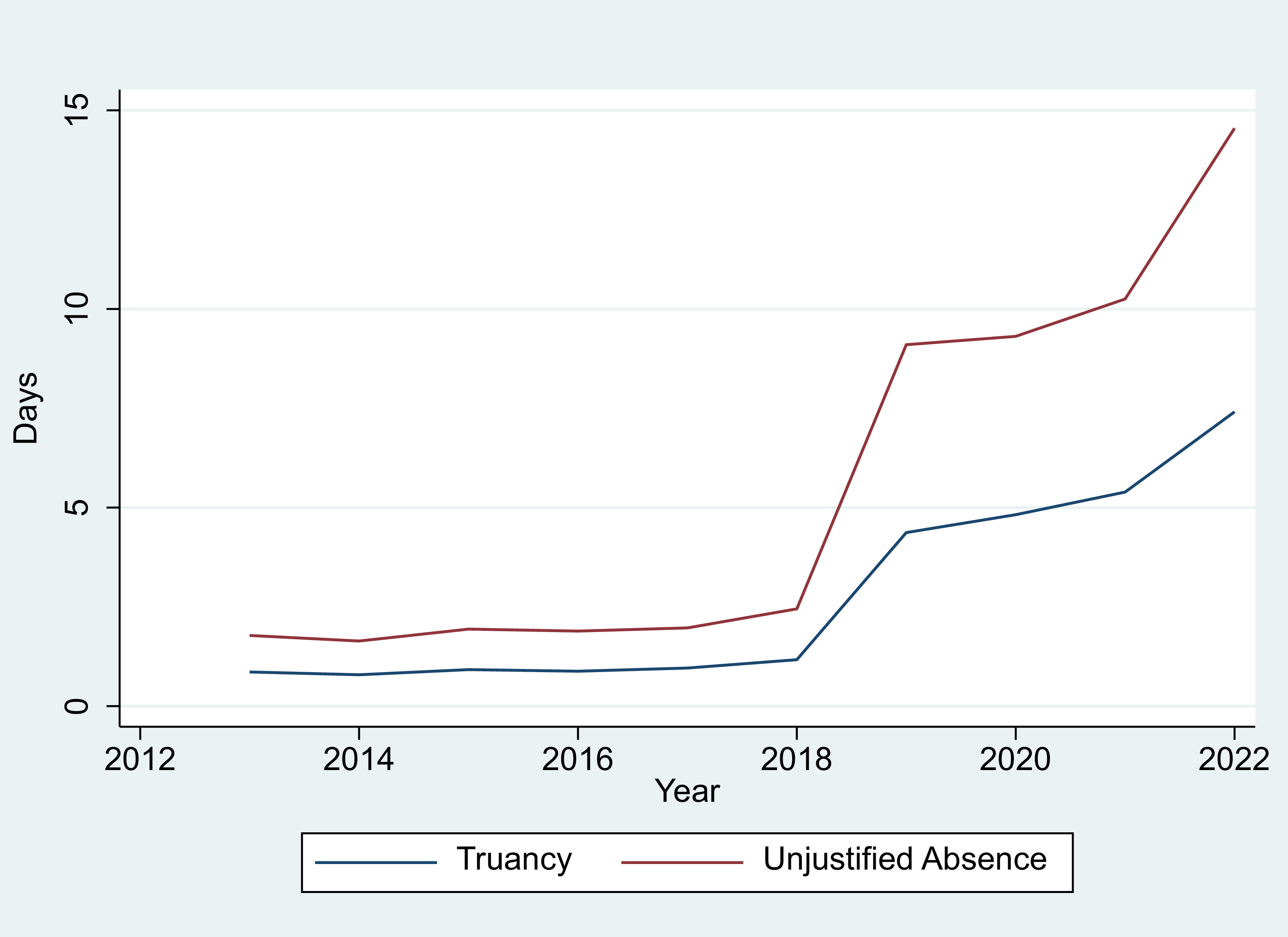
Figure 1 plots truancy and unjustified absence among students in NZ from 2013 to 2022. The data show that rates remained relatively flat before 2018, with a clear upward trend emerging from 2019 onward, particularly during and after the COVID-19 pandemic.
The trend of student attendance in New Zealand.

Figure 1. Long description
Figure 1 shows unjustified absences and truancy among students aged 5–17 years from 2013 to 2022. The y-axis represents the mean number of days of unjustified absence or truancy, ranging from 0 to 15, with major ticks at 0, 5, 10, and 15. The x-axis represents calendar years from 2012 to 2022, with major ticks at 2012, 2014, 2016, 2018, 2020, and 2022. Each year tick represents the end of the corresponding calendar year. The navy blue line represents truancy, while the maroon line represents unjustified absences. Both unjustified absences and truancy remained relatively stable at lower levels from 2013 to 2018. From 2019 onwards, both measures increased steadily and sharply through to 2022.
Table 2 presents the average number of days of unjustified absence and truancy per year for students, categorised by tenure trajectory between 2013 and 2022. The results show that students with unstable housing tenure trajectories have significantly higher levels of unjustified absence and truancy compared to those with stable trajectories. For example, students with unstable tenure trajectories have an average truancy rate of 2.229 days per year; approximately 25 per cent higher than the 1.78 days observed among students with stable tenure. Notably, students with highly unstable housing tenure trajectories exhibit the highest rates, with truancy more than three times greater than that of students with stable tenure. A clear pattern emerges: as the stability of housing tenure trajectory decreases, rates of unjustified absence and truancy increase.
Table 2 also disaggregates this analysis by major ethnic groups – Māori, Pacific and European. Across all three groups, students with unstable housing tenure trajectories experience significantly higher rates of unjustified absence and truancy than those with stable tenure; students in highly unstable situations showed the poorest attendance. This suggests that the negative relationship between stability of tenure trajectory and student attendance is robust and not driven by ethnicity.
Table 3 presents the results of the multivariate negative binomial regression models for unjustified absence and truancy. The findings show the incidence rate ratios (IRRs) for both unstable and highly unstable housing tenure trajectories are greater than 1 and statistically significant, as indicated by small p-values. For example, the IRR for unstable housing tenure trajectories on truancy is 1.244, meaning that students with unstable tenure trajectories have a 24.4 per cent higher rate of truancy compared to those with stable tenure trajectories, controlling for other factors. Similarly, the IRR for highly unstable housing tenure trajectories is 2.751, indicating that the rate of truancy is 2.75 times higher for this group relative to students with stable housing tenure trajectories, controlling for other factors. These multivariate results align with the patterns observed in the univariate analysis presented in Table 2. The results in the Appendix indicate that the significant relationship between unstable tenure trajectories and absenteeism remains robust in the matched sample after propensity score matching.
Table 3 also shows that Māori and Pacific students have higher rates of unjustified absence and truancy compared to other ethnic groups. For example, the IRR for Māori students regarding truancy is 2.735, indicating that their truancy rate is 2.74 times higher than that of non-Māori students. The results also reveal that students from single-adult households have higher rates of unjustified absence and truancy than those from households with more than one adult. Student attendance was significantly worse during and after the COVID-19 pandemic compared to other periods. The statistically significant IRR of 3.11 for unjustified absence and 3.28 for truancy associated with the COVID variable suggest that rates of unjustified absence and truancy were more than three times higher during this period. This pattern is also reflected in Figure 1.
Table 4 shows that the association between unstable or highly unstable housing tenure trajectories and both truancy and unjustified absence is stronger for primary school students. The IRR of the interaction term between unstable/highly unstable tenure and primary school students is greater than 1 and highly statistically significant. For example, the IRR for the interaction between unstable housing tenure trajectories and being a primary school student in relation to truancy is 1.282. This indicates that the association between truancy and unstable housing tenure trajectories is 28.2 per cent stronger for primary school students compared to students at other educational levels.
Discussion
Our study shows that tenure trajectories are strongly linked to student absenteeism, with IRR rising progressively as tenure trajectories become more unstable. Students with an unstable tenure trajectory have truancy rates approximately 25 per cent higher than those with a stable trajectory, while those with a highly unstable trajectory have rates more than double. This pattern holds across all ethnic subgroups and remains robust after controlling for demographics and in a propensity-score matched sample. The association is pronounced among primary school students, highlighting the higher level of disruption caused by unstable housing for younger children’s schooling.
These findings extend previous research on housing instability and educational outcomes. Although housing instability has been widely linked to educational outcomes (Cordes et al., Reference Cordes, Schwartz and Stiefel2019; Ersing et al., Reference Ersing, Sutphen and Loeffler2009; South et al., Reference South, Haynie and Bose2007; Voight et al., Reference Voight, Giraldo-García and Shinn2020), its relationship with student absenteeism remains underexplored, and the evidence is mixed (Buckley et al., Reference Buckley, Abdul-Masih, Yang, Ansari and Purtell2023; Parke & Kanyongo, Reference Parke and Kanyongo2012). By focusing on the housing tenure trajectories, our study shows that the degree of instability matters: greater tenure trajectory instability is associated with more pronounced educational disruption. This approach adds nuance to an otherwise inconclusive literature and provides stronger empirical evidence on how housing instability relates to school attendance. In addition, the national scope of our study, combined with longitudinal tracking, enables a more robust examination of the relationship between residential mobility and student absenteeism than has been possible in earlier studies.
Our paper provides further evidence that highly unstable tenures, like emergency housing, are not a suitable long-term solution for families with children. The overrepresentation of school-aged young people in emergency housing raises serious concerns about school attendance and equity of education outcomes. Additional wraparound support is needed to help these families secure long-term, stable housing (Yu, Buchanan, Jenkins, et al., Reference Yu, Buchanan, Jenkins, Pehi, Fraser, Aspinall, Howden-chapman and Pierse2025).
In our study, the association between unstable tenure trajectories and absenteeism varied by school stage, often absent from previous studies (Maynard et al., Reference Maynard, McCrea, Pigott and Kelly2012). Our findings address this gap by showing that unstable tenure trajectories have a stronger association with absenteeism among primary school students than among those in later school stages. This aligns with prior research suggesting that the timing of moves is a key factor in shaping social and educational outcomes (Garboden et al., Reference Garboden, Leventhal and Newman2017), with housing instability during a child’s early years having a range of negative effects across socioemotional and behavioural outcomes (Nathan et al., Reference Nathan, Robertson, Carr, Howden-Chapman and Pierse2019). These results highlight the importance of considering developmental stage when evaluating the risks associated with housing instability (Tønnessen et al., Reference Tønnessen, Telle and Syse2016).
The literature on the impact of housing instability at certain ages during childhood is mixed. For example, Tønnessen et al. (Reference Tønnessen, Telle and Syse2016) found that early moves/instability were not associated with long-term outcomes such as high school completion or adult income, whereas mobility during adolescence was more strongly related. In contrast, other studies identify the early school years – particularly primary school – as a period of heightened vulnerability. For example, Voight et al. (Reference Voight, Giraldo-García and Shinn2020) and Ersing et al. (Reference Ersing, Sutphen and Loeffler2009) found that mobility during primary school was associated with poorer academic performance. Our study aligns with this latter evidence, showing that tenure instability is more strongly associated with school absences among younger students.
Several mechanisms may help explain why the association between housing tenure instability and student absenteeism appears greater for younger children. First, primary school zones/catchment areas are smaller than secondary school zones (Rehm & Filippova, Reference Rehm and Filippova2008), so moving homes is more likely to result in a school change for primary students than for secondary students (Rehm & Filippova, Reference Rehm and Filippova2008). Second, developmental psychology suggests that younger students have more limited coping abilities and may struggle to adapt to changes in their home or school environment (Ersing et al., Reference Ersing, Sutphen and Loeffler2009). More active and adaptive coping strategies generally emerge between the ages of 9 and 11 – towards the end of primary school – making children below this age especially sensitive to the disruption caused by residential moves (Eschenbeck et al., Reference Eschenbeck, Schmid, Schröder, Wasserfall and Kohlmann2018). For primary school students, school attendance depends heavily on the logistical and emotional support of caregivers (Alaszewski, Reference Alaszewski2013; Ersing et al., Reference Ersing, Sutphen and Loeffler2009). When a family experiences the stress, disorganisation and competing demands associated with residential mobility, getting a child to school regularly can become a lower priority (Mullainathan & Shafir, Reference Mullainathan and Shafir2013; Yu, Buchanan, Jenkins, et al., Reference Yu, Buchanan, Jenkins, Pehi, Fraser, Aspinall, Howden-chapman and Pierse2025). Such moves may disrupt family routines, parental involvement and the consistency of school-related support, thereby increasing the risk of student absenteeism (Green et al., Reference Green, DeFosset and Kuo2019; Kim & Page, Reference Kim and Page2013; Mullainathan & Shafir, Reference Mullainathan and Shafir2013). Taken together, these perspectives suggest that frequent changes in living arrangements – especially those involving shifts in housing tenure – may have a compounded negative impact on primary school students. This is because housing instability not only introduces environmental change but can also undermine the caregiving relationships and support systems that are most critical for younger children’s school engagement. As our findings show, when unstable tenure trajectories coincide with the developmental stage in which children are most dependent on stable, supportive caregiving, the risk of absenteeism is heightened.
Furthermore, we found that Māori and Pacific students are disproportionately represented in highly unstable housing tenure trajectories and experience significantly higher levels of unjustified absence and truancy compared with other ethnic groups. The ongoing impacts of colonisation and structural racism have produced a housing system that disproportionately disadvantages Māori and Pacific peoples (Houkamau & Sibley, Reference Houkamau and Sibley2015; Norris & Nandedkar, Reference Norris and Nandedkar2022). Historical land alienation, combined with postwar urbanisation, has contributed to Māori overrepresentation in precarious housing (Rout, Reference Rout2022). Our findings show that highly unstable tenure trajectories are strongly associated with elevated student absenteeism, and that structural inequalities in the housing domain help explain the disproportionately high rates of unjustified absence and truancy among Māori and Pacific students in mainstream schooling.
Other factors also matter. Māori experience higher rates of unemployment, incarceration, state care of children and a range of health issues (Pratt, Reference Pratt, Deckert and Sarre2017; Walker, Reference Walker2016; Yu, Buchanan, Te Ora, et al., Reference Yu, Buchanan, Te Ora, Pehi, Leigh, Howden-Chapman, Paul and Pierse2025). These pressures can constrain the capacity of families to prioritise school attendance (Pratt, Reference Pratt, Deckert and Sarre2017; Walker, Reference Walker2016). More importantly, whether an absence is deemed justified or unjustified depends on the judgement of teachers and school leadership, which may overlook Māori cultural perspectives and be influenced by stereotypes and assumptions (White, Reference White2006).
Finally, it is worth noting that the results for other control variables across our models also contribute meaningfully to the literature. First, we find that unjustified absence and truancy were more than three times higher during and after the COVID-19 pandemic compared with pre-pandemic years, as also shown in Figure 1. This aligns with international evidence (Nathwani et al., Reference Nathwani, Shoaib, Shafi, Furukawa and Huy2021). Second, our findings show that students from sole-parent households have significantly higher absenteeism rates than those from other family structures. This contributes to the mixed evidence on the relationship between family structure and school attendance. For example, while Onongha (Reference Onongha2020) found no significant differences in absenteeism between sole-parent and other household types, research from Spain reported more frequent absences among students from sole-parent households than those in two-parent households (Mejías-Leiva & Moreno Mínguez, Reference Mejías-Leiva and Moreno Mínguez2024). Our findings are consistent with Mejías-Leiva and Moreno Mínguez (Reference Mejías-Leiva and Moreno Mínguez2024), suggesting that children in sole-parent households may face additional barriers to attending school regularly. These results highlight the need for greater support for sole-parent households to promote regular school attendance. Finally, our models consistently show that student absenteeism increases with age. This finding is consistent with prior research on the relationship between age and absenteeism (Attwood & Croll, Reference Attwood and Croll2006; Maynard et al., Reference Maynard, Vaughn, Nelson, Salas-Wright, Heyne and Kremer2017).
Limitations
The present study has several limitations. We are unable to exclusively identify boarding houses that do not involve a bond lodgement, as our analysis relies on the bond lodgement dataset to indicate rental tenure. However, this limitation is partially addressed through our approach to classifying housing tenure trajectories. As outlined in the Methods section, one of the tenure trajectories classified as ‘Unstable’ is ‘[Own–Rental] (unstable)’, where the owner-occupied dwelling is unlikely to represent actual ownership. Instead, it more likely reflects situations such as boarding houses without a bond lodgement or multigenerational co-residence. Therefore, although we cannot explicitly identify boarding houses without bond lodgement, such arrangements are already incorporated and reflected in our methodological framework.
Most importantly, this study examines changes in housing tenure rather than residential mobility within the same tenure type. Repeated moves within rental housing may also constitute an important form of instability, particularly for disadvantaged households experiencing displacement or insecure tenancies. Future research could integrate both address mobility and tenure transitions using other data sources to provide a more comprehensive understanding of housing instability. While there are limitations to our use of tenure trajectories, they offer nuance on the nature of moves that cannot be measured by residential mobility and a practical solution to data limitations (White, Reference White2006).
Conclusion
This study demonstrates a robust and significant relationship between unstable tenure trajectories and student absenteeism, contributing to the mixed and inconclusive literature on housing instability and educational outcomes. Notably, we find a progressive pattern: as tenure trajectories become increasingly unstable, student absenteeism increases. By focusing on housing tenure trajectories rather than address changes, this study captures deeper shifts in housing stability that are shaped by broader structural changes in housing policy and market dynamics. Furthermore, we show that the relationship between unstable tenure trajectories and student absenteeism is stronger for primary school students than for those in intermediate or high school. This finding offers valuable insight into a relatively underexplored area of research.
This study is particularly important in the context of rising concerns about student absenteeism in the aftermath of the COVID-19 pandemic (Nathwani et al., Reference Nathwani, Shoaib, Shafi, Furukawa and Huy2021), and it carries significant policy implications. Although the government has made efforts to improve student attendance (Ministry of Education, 2024), it has ignored key structural drivers of student absenteeism – particularly housing instability. Our findings suggest the government should integrate initiatives to reduce absenteeism, with efforts aimed at improving housing stability for students with highly unstable tenure trajectories, including those living in emergency housing, who often face significant barriers to exiting these temporary arrangements (Yu, Buchanan, Jenkins, et al., Reference Yu, Buchanan, Jenkins, Pehi, Fraser, Aspinall, Howden-chapman and Pierse2025). These housing-focused interventions should complement school-based strategies to reduce absenteeism, acknowledging that educational engagement is deeply interconnected with broader social and economic conditions.
Acknowledgements
We acknowledge Dr Sarah Bierre from the University of Otago, Wellington, for her proofreading and editing of this paper.
Funding statement
This work was supported by the Ministry of Business, Innovation and Employment: [Grant Number 2022 MBIE Endeavour Fund (UOOX2207)].
Competing interests
The authors declare that they have no competing interests.
Ethical standards
The data used in this paper are fully de-identified. The findings are interpreted within the broader context of social determinants rather than attributing negative outcomes to individuals or communities.
Disclaimer
Access to the data used in this study was provided by Stats NZ under conditions designed to give effect to the security and confidentiality provisions of the Data and Statistics Act 2022. The results presented in this study are the work of the authors, not Stats NZ or individual data suppliers. These results are not official statistics. They have been created for research purposes from the Integrated Data Infrastructure (IDI), which is carefully managed by Stats NZ. For more information about the IDI, please visit https://www.stats.govt.nz/integrated-data/.
Appendix
Descriptives

Table 1. Long description
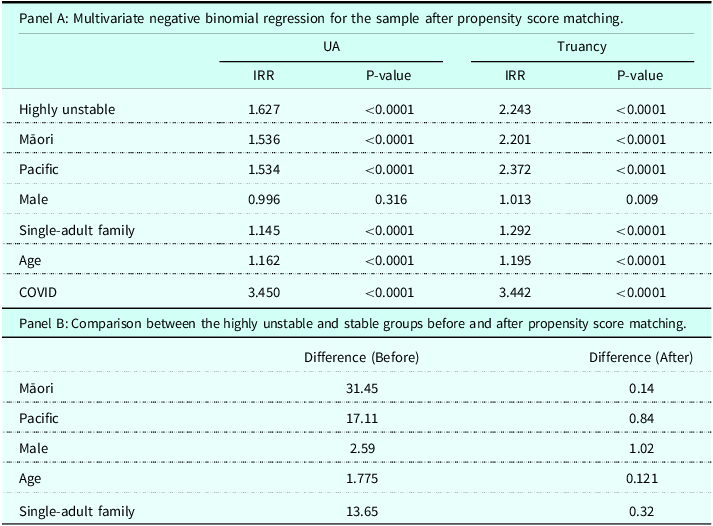
Panel A: A table showing multivariate negative binomial regression results after propensity score matching. The table has two main sections: UA and Truancy, each with columns for IRR and P-value. The rows include categories such as Highly unstable, Māori, Pacific, Male, Single-adult family, Age, and COVID. Panel B: A table comparing differences between highly unstable and stable groups before and after propensity score matching. The table has columns for Difference (Before) and Difference (After), with rows for Māori, Pacific, Male, Age, and Single-adult family.
Notes:
1. The model used is a negative binomial regression rather than a Poisson regression because the alpha parameter is highly significant, indicating that the negative binomial model is more appropriate.
2. IRR refers to the incidence rate ratio.
3. Each student in the ‘highly unstable’ group is matched with a student in the ‘stable’ group who has the closest propensity score. The matching method used is one-to-one matching without replacement, and only matched pairs with a propensity score difference of less than 0.01 are retained. We also tested other calipers, such as 0.05, and the results did not differ.
4. The baseline group consists of students in the ‘stable’ group who are matched with students in the ‘highly unstable’ group.
5. UA stands for unjustified absence.
6. A single-adult family is defined based on the actual count of adults in the same household. This category does not include single parents living with a child over 18 years old, nor single parents residing in multigenerational households.
7. COVID refers to the period between 2020 and 2022.
Panel A shows that, after controlling for various factors, truancy in the ‘highly unstable’ group is 2.24 times higher than in the ‘stable’ group, and unjustified absences are 62.7 per cent higher. Propensity score matching further strengthens the observed relationship between housing tenure stability and student attendance.
Panel B shows significant demographic differences between the two groups – for example, the proportion of Māori students is 31.45 per cent higher in the ‘highly unstable’ group. In the matched sample, these differences are substantially reduced: the gap in the proportion of Māori students drops from 31.45 per cent to 0.14 per cent. With the groups now demographically similar, any remaining differences in attendance are associated with unstable housing tenure.

 Open access

