Introduction
Much modern analysis of the polyphony of Guillaume de Machaut (c.1300–77) is undertaken through contrapunctus reduction. Such analyses represent a reverse-engineering of an often busy and dissonant surface back to consonant note-against-note counterpoint of the kind recommended as a starting point by medieval composition manuals.Footnote 1 While discant reductions have been fruitful for modelling Ars Nova counterpoint, such reductions are less able to represent the characteristically flexible metrical organisation of the period.Footnote 2 This study therefore introduces an adaptation to the contrapunctus method that not only discloses but also highlights the most intriguing features of the metrical grouping of sonorities, cadences and formal articulations.Footnote 3 While any pitch analysis will have considered metrical grouping at least implicitly, my focus is on developing a systematic analytical notation that explicitly presents metrical grouping as inextricable from tonal articulation.Footnote 4
Flexibility with metrical grouping will be shown to occur within a single voice (horizontally) as well as concurrently between voices of polyphony (vertically). In the more complex examples, metrical ingenuity is revealed in both of these ways simultaneously and across several levels of metrical breadth (i.e., tempus, modus, maximodus). The analyses begin by showing how irregular metrical grouping substantively shapes tonal articulation in Machaut's Motet 4, De Bon Espoir/Puis que la douce/Speravi. As Jacques Boogaart notes in his recent complete edition, ‘Transgressions in mensuration occur in this motet more than in any other.’Footnote 5 Metrical grouping will be further shown to play a central role in the tonal drama between two competing finals in this motet. Motet 17, Quant Vraie Amour/O Series summe rata/Super omnes speciosa, follows as an example of how a flexible approach to independent metrical groupings can clarify surface misalignments, even of the final cadence, without sacrificing the metrical integrity of each part individually. Finally, an examination of the four-voice Motet 5, Aucune gent/Qui plus aimme/Fiat voluntas tua/Contratenor, explores the complex tonal ramifications of a mensurally opposed tenor/contratenor pair, with metrical grouping further complicated by divergence of the upper-voice pair from the tenors. Throughout these analyses, my methodology is developed as a mode of modern critical reception and not of medieval production.Footnote 6
Among recent analyses that grapple with metrical flexibility in Machaut, Sarah Fuller highlights grouping play at the modus level in the score of Motet 22: three imperfect longs (=6 breves) in the space of two perfect longs (=6 breves).Footnote 7 Fuller also notes a similar case in which regular duple groupings are temporarily replaced by two triple ones (3+3 semibreves) in Machaut's Motet 7.Footnote 8 Jacques Boogaart describes flexibility at the modus level in the tenor of Machaut's Motet 17, in which ‘three imperfect longs taken together equal two perfect ones’.Footnote 9 David Maw points out the same hemiola in Machaut's Rondeau 5 and Ballade 2, among a wealth of other examples.Footnote 10 These references, like my own analyses later in this article, are metrical rather than mensural in their grouping of free rhythm within a measured space (e.g., of a long) rather than to one discretely notated duration itself.Footnote 11 Durational measurements independent of the particular rhythmic values that comprise them are dubbed ‘super-modes’ by Maw, building on Petrus frater dictus Palma ociosa's Compendium de discantu mensurabili (1336).Footnote 12
The notation of the three complete editions of Machaut's motets – by Friedrich Ludwig (1954), Leo Schrade (1956) and Jacques Boogaart (2018) – demonstrates their editor's investment in representing metrical grouping and its flexibility.Footnote 13 Following Schrade, Boogaart analogises mensural levels at the outset by a common practice time signature with a modus multiplier. For example, 2x 2/4 in the upper voices of Motet 4 indicates two groups (2x) of imperfect tempus (2/4). These bars proceed regularly until the manuscript notation dictates a change, in which case Boogaart and Schrade write in a new time signature. Ludwig's edition of Machaut's motets, in contradistinction to his edition of the secular songs, has no time signatures, though his bar lines are suggestive. Boogaart alone sometimes signs deeper mensural levels in his tenors, where the multiplier refers not to modus but to maximodus and the time signature to modus. Except for some four-voice motets (nos. 5, 21 and 23), Boogaart's initial labels of maximodus remain fixed, unlike his re-notations of mensural changes at smaller levels.Footnote 14 For Boogaart, ‘a consistent modus division often entails large-scale syncopations that exceed the modus bars’, which results in musical groupings that cut across editorial bar lines.Footnote 15 By contrast, the bar lines of my own examples derive from dynamic tonal articulations rather than representing an a priori grid against which a particular phrasing is interpreted as expanded, contracted or displaced.
The view of medieval metrical organisation advocated here is an emergent one, in which a particular grouping or its continuation is never supposed – through a regular metrical grid, for example – but is continuously created by the coordination of tonal and formal events.Footnote 16 The concept of syncopation, common to medieval mensural theory and its modern analysis, is precluded in a metrical approach that projects no norm against which to hear it.Footnote 17 It is my emphasis on metrical grouping as emergent and as inextricable from tonal articulation that distinguishes my approach from studies of mensural notation and from modern studies of medieval metre.
Describing mensural rhythm in the Notitia artis musicae (1321), Johannes de Muris began with the broadest level, what he called the first degree.Footnote 18 We may refer to this division as maximodus (i.e., major modus), the number of longs per maxima. Modus, breves per long, was a division of the second degree, and so on down. The Quatuor principalia musicae of 1351 presents a sample of these divisions in eight mensural trees all with the maxima as their trunk, maximodus its first branching.Footnote 19 While a secure theoretical possibility, Ugolino of Orvieto's Declaratio musicae disciplinae (c.1430) reports that systematic organisation at the maximodus level was so little employed by composers that mensuration signs, when they refer to modus at all, refer only to minor modus.Footnote 20 Echoing Ugolino's reservations about major modus, Elizabeth Eva Leach confirms that ‘it is relatively rare to find regular rhythmic organisation at this level [maximodus]’ in fourteenth-century French polyphony.Footnote 21 Yet a lack of regularity is not the same as the absence of musical structure. As Maw has suggested, irregularity may rather be valued as integral and expressive in reading Ars Nova motets today. I hope to demonstrate that these deep metrical levels are worth close scholarly attention, even in analyses focused mainly on pitch.
Drawing attention to the importance of the modus level in Ars Nova mensural theory, Maw situates Machaut's habitual flexibility at the level of ‘modus meter’ within a medieval aesthetic that valued variety, imperfection and novelty.Footnote 22 He regards metric displacement as the primary agent of misalignment among various musical stresses (e.g., agogic accent, recurrent motivic figures, stressed syllables) and interprets the degree to which these coincide with a prevailing metrical grouping.Footnote 23 In her recent monograph, Karen Desmond examines the destabilisation of modus through notated dots in some Ars Nova motets (not by Machaut). By taking notated rhythm as the analytical object, Desmond is able to separate out an underlying metre from rhythmic displacements that may obscure or even work against it. Tonal articulation can therefore arrive on any beat of a bar in Desmond's view. Following their subtle analyses, both Maw and Desmond call for a more nuanced representation of modus in modern editions.Footnote 24 The notation system developed in this article offers tools to further refine the modern representation of Ars Nova metrical grouping.
In his pioneering deep-mensural study, Graeme M. Boone observes ‘unequivocal evidence of consistent rhythmic patterning, aligned with steady pulse framework’.Footnote 25 While I agree that regular hypermetre can pool up in substantial excerpts from Machaut's works, my approach is based upon an opposite orientation. Rather, I define metrical units bottom-up wherever they occur rather than probing the degree to which consonance alignment and tenor patterns play off an axiomatically fixed metrical dot-grid. As with Maw and Desmond, Boone's view of metrical irregularity is shaped by displacement and his analytical perspective is one of omniscient remove. By contrast, I understand displacement as resultant from irregular metrical grouping (perfect vs imperfect) and regard metre as a vital process that unfolds moment by moment. I agree with Boone's characterisation of deep mensuration as often variable, and thus resistant to a hypermetric grid approach, and am prompted towards developing a more flexible approach to the analysis of medieval metre.Footnote 26
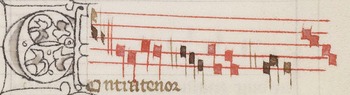
For my analyses, I have adapted the concept of colouration from medieval notation to signify alteration in metrical grouping. As mensural notation matured, composers of the fourteenth century began fluidly swapping perfect and imperfect groupings in the same voice as well as simultaneously against other voices. This technique was sometimes indicated through colouration, a change of ink from black to red or from filled to void note heads or both. Machaut's use of colouration connotes the imperfection of perfect rhythmic values (reduction by a third). In Figure 1, for example, groups of longs alternate between imperfect (red) and perfect (black) in Machaut's Motet 5, to be discussed in further detail later.
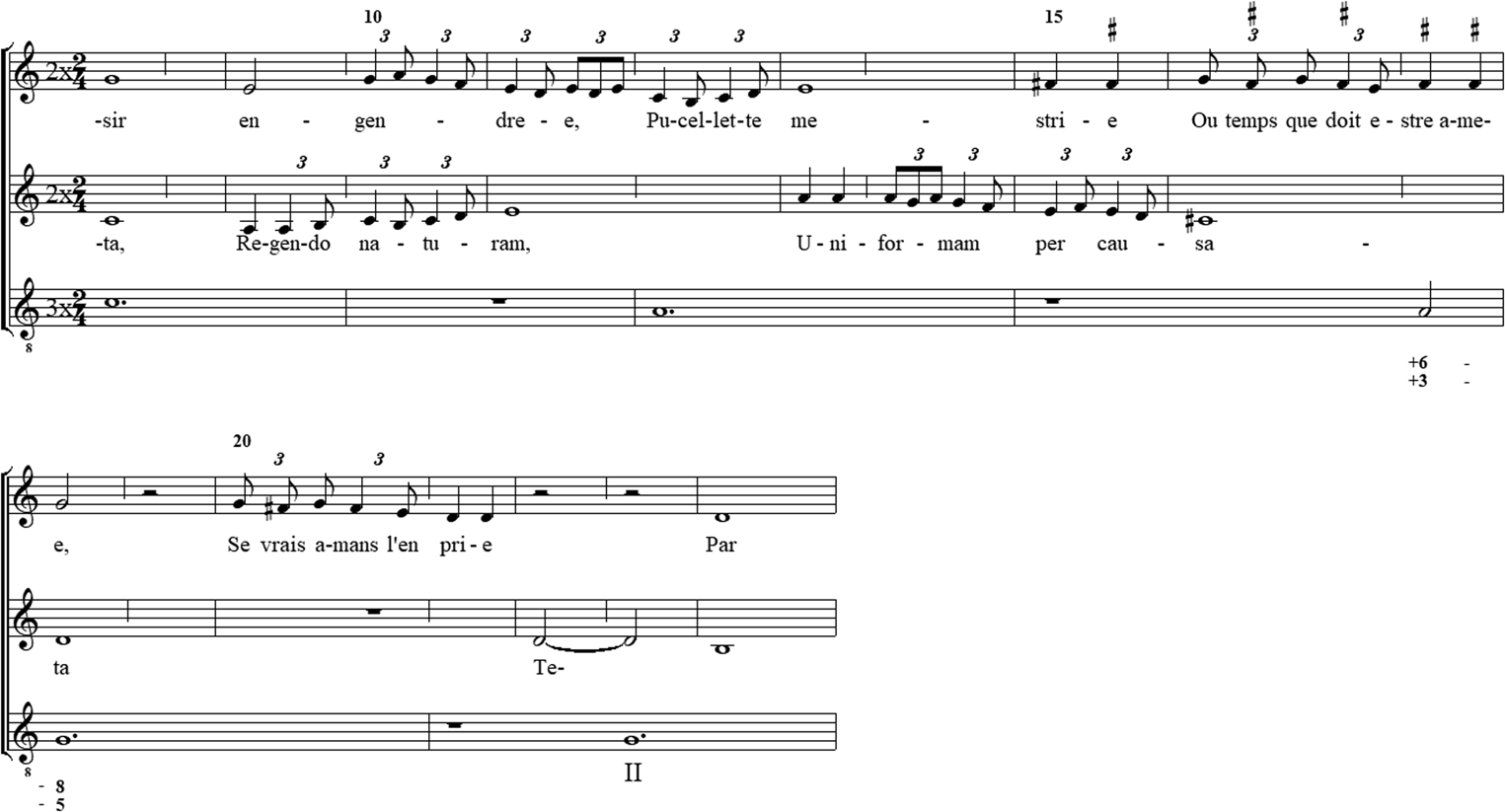
Colouration in the contratenor of Machaut's Motet 5 (T. Fiat voluntas tua); BnF fr. 1584, fol. 419r. (colour online)

Unlike the composer's colouration of single notated values in Figure 1, my analytical colouration is an interpretive tool that indicates something more abstract. Analytical colouration hereafter indicates a change of grouping – perfect to imperfect or vice versa – within some measured space of duration. For example, two longs-worth of any decorated surface rhythm, not necessarily two notated longs themselves, may be shown in the analysis with all concerned pitches ‘coloured’, here placed under brackets. This is not to say that each of those pitches’ durations has been individually imperfected, but that the bracketed pitches occur within a measure of duration that has been imperfected. The analysis is therefore in the domain of the metrical rather than the mensural and analytical colouration takes on a broader reference to grouping alteration. Since it is an act of modern critical reception, ‘hidden colouration’ went unnotated in the production of medieval manuscripts.
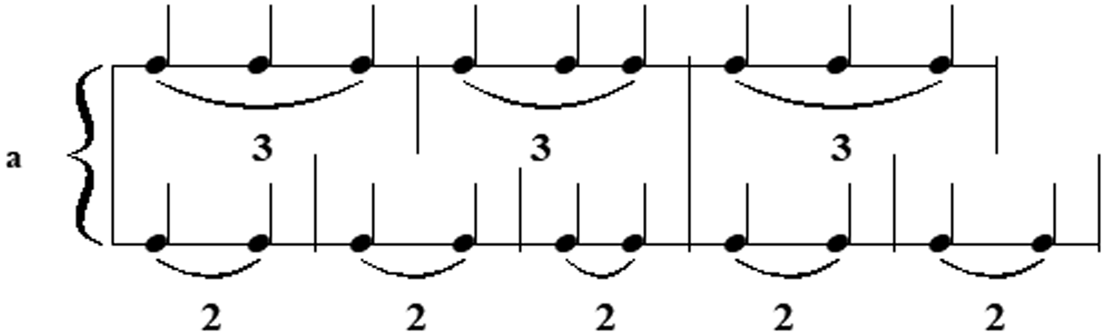
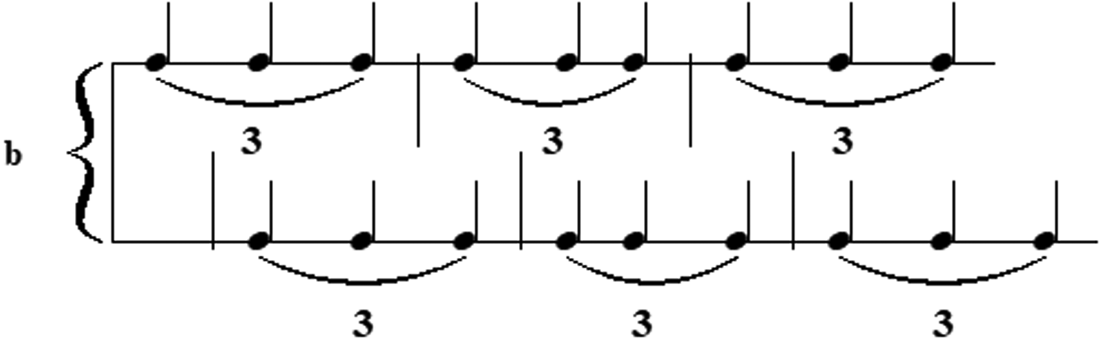
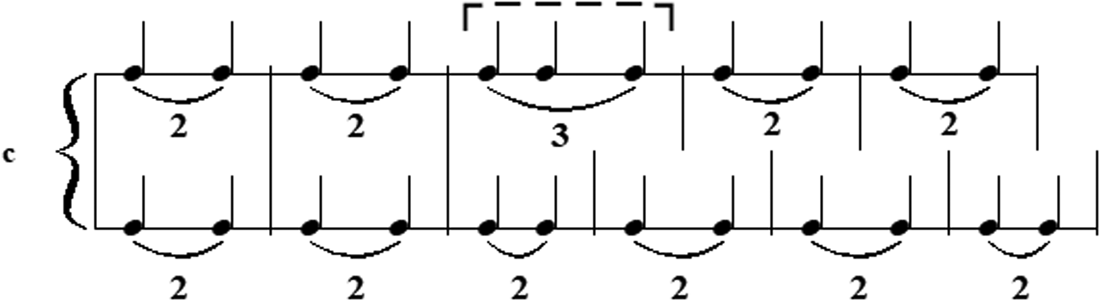
My interpretation of the toggling between duple and triple grouping independently in the voices of Machaut's motets is informed by Harald Krebs's two categories of metrical dissonance, shown in Examples 1a and 1b.Footnote 27 The category called grouping dissonance (3s against 2s in Example 1a) results in misaligned metrical accents that periodically coincide (here, every six beats). This is categorically distinguished from displacement dissonance, in which the same grouping (3s against 3s in Example 1b) is offset by some amount of beats. Note that metrically displaced voices will not periodically coincide unless a change of grouping brings their metrical stresses (back) into alignment. I call upon Krebs's two categories to draw a careful distinction from the preceding seminal authors. I argue that in Machaut's motets, the apparent metrical displacements are a result of dynamic metrical grouping. As shown in Example 1c, a pattern of regular duple grouping is disturbed by a single triple group in one voice. This momentary grouping dissonance causes that voice to appear displaced one beat thereafter, usually heard as a delay in otherwise clear harmonic units. The effect of metrical displacement in such cases is the result of a prior grouping dissonance, an instance of 3 against 2.
Krebs's grouping dissonance.

Krebs's displacement dissonance.

Displacement as a result of grouping dissonance.

Such metrical play has ramifications for how we regard harmonic structure, cadential strength and formal articulations; the elements metrically organised. In medieval theory and practice, consonance and metrical grouping were closely paired. For Franco of Cologne (whose Ars cantus mensurabillis musicae is dated c.1280), the triple grouping of tempora and the consonant sonority that marked the first tempus were both kinds of ‘perfection’.Footnote 28 Johannes de Garlandia similarly called for the coordination of stable sonority with the beginnings of mensural units.Footnote 29 Expanding upon this medieval perspective, for the modern analyst to mark the consonant arrivals of directed progressions is to draw a map of downbeats, defined as initiating a new metrical grouping (perfect or imperfect) at some level. The tonal emphases of perfect consonance thus engender a flexible in situ metric organisation.Footnote 30 As Desmond states, ‘the deployment of perfect sonorities and directed progressions within each talea contributes to this sense of mixed [perfect and imperfect] mensuration’; that is to say, tonal markers articulate metrical grouping, which can be irregular. In Maw's study of modus grouping in Machaut's songs, he similarly measures metrical groups as spans between points of simultaneous articulation, agogic accent, recurrent rhythmic figures and the like.Footnote 31 Charting sub-surface levels of metrical organisation in this study, my emphasis is rather on directed progressions and isorhythmic boundary points as articulating deeper metrical groupings. Karl Kohn was a pioneer of re-notating parts according to independent metrical streams that coalesce at cadences. Kohn lamented the loss of ‘the varied splendors of true rhythmic polyphony’ as modern editions packaged early music ‘into tidy but inappropriate and misleading measures’.Footnote 32 By his metrical re-notation of Machaut's Ballade 4, with comparison to Ludwig and Schrade, Kohn sought to ‘elucidate rhythmic contours in each part while clarifying their confluence into cadences where they truly occur’.Footnote 33 Although Kohn's methodology may lack today's precision and grounding in medieval concepts, his advocacy for the mutual dependence of downbeat and consonance is a principle worth pursuing.Footnote 34 I admit that a modern edition given to re-notating metres every few bars, and separately in each part, might be vexing at first glance. Yet may it also yield compensatory benefits. The independence of voices roving deliciously in and out of phase, encouraged by such a score layout, could pair well with the independence of Machaut's polytextual poetry. Second, a motet's form may become more readily discernible (if that is a virtue) as the voices more audibly snap together to mark important arrivals. The more obvious articulation of form can highlight Machaut's expressive play with expectations, as tonal arrivals and the formal seams of isorhythm are subtly attenuated or subverted.
Analyses
Motet 4
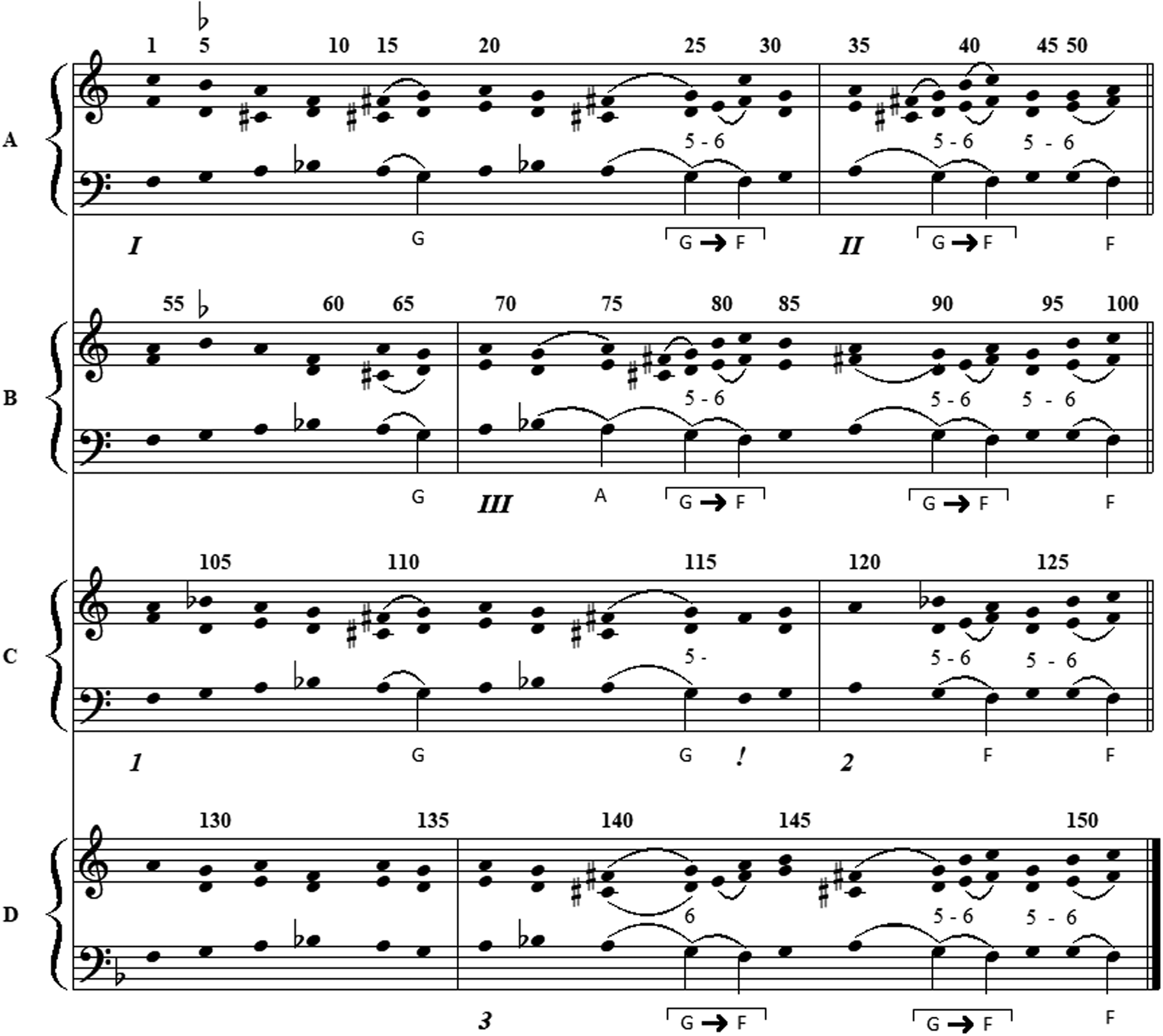
The analyses begin with a synoptic picture of Machaut's Motet 4, De Bon Espoir/Puis que la douce/Speravi. An ametrical contrapunctus reduction of the motet's complete polyphony is given in Example 2.Footnote 35 After a review of its tonal narrative, the effects of metrical grouping will be isolated for scrutiny. Motet 4's isorhythmic tenor is cast in 3:2 proportion: three taleae for every two colores (eighteen notes from chant).Footnote 36 There are four colores in all, the second pair in diminution by half. Each color statement, vertically aligned, closes on F and a slim majority of Machaut's directed progressions are also to F. Yet an almost equal number of directed progressions are to G and the first two of three taleae divisions conclude with G. If these competing pitch centres are roughly equal in appearance, Machaut's counterpoint makes their hierarchy clear.Footnote 37 With one exception, whenever a directed progression to G follows with another step down to F in the tenor, Machaut makes a subsequent directed progression there. Arriving thus on F undercuts the consonant stability of G through 5–6 exchange (bracketed in the Example 2), transforming a stable sonority (the perfect consonance G/d) into a directed one (the imperfect G/e, which resolves out to F/f).Footnote 38 The tonal weight of G, though of nearly equal frequency, is thereby superseded by the tonal hegemony of F. An exclamation mark in color C indicates the one place where Machaut omits this counterpoint, allowing G to stand and the following F to pass by without polyphonic emphasis. The following analysis reveals how G is subordinated to F at deep metrical levels at this moment and elsewhere throughout Motet 4.
Contrapunctus reduction of Machaut's Motet 4.

In Example 2, colores A, B, C and D denote repetitions of the chant tenor, concluded with double bar lines, while taleae I, II and III denote repetitions of the rhythmic series assigned to pitches of the colores and conclude with a single bar line.Footnote 39 Taleae 1, 2 and 3 are the same rhythmic series in diminution for the last two colores. Slurs highlight directed progressions, with arrivals accentuated by tenor stem and pitch label.Footnote 40
To bring the metrical groupings of these pitches to the fore, I shall now recast excerpts from the same reduction of Example 2 in a notation that captures duple and triple groupings in each voice independently.Footnote 41 Such a metrical contrapunctus logs not only the various stops along a tonal journey but also a detailed timetable. Machaut's motets prove fruitful ground indeed for such metrical analysis insofar as they ‘explore all the possibilities the Ars Nova theorists had uncovered by their systematization of rhythmic and notational experiments at the beginning of the fourteenth century’.Footnote 42
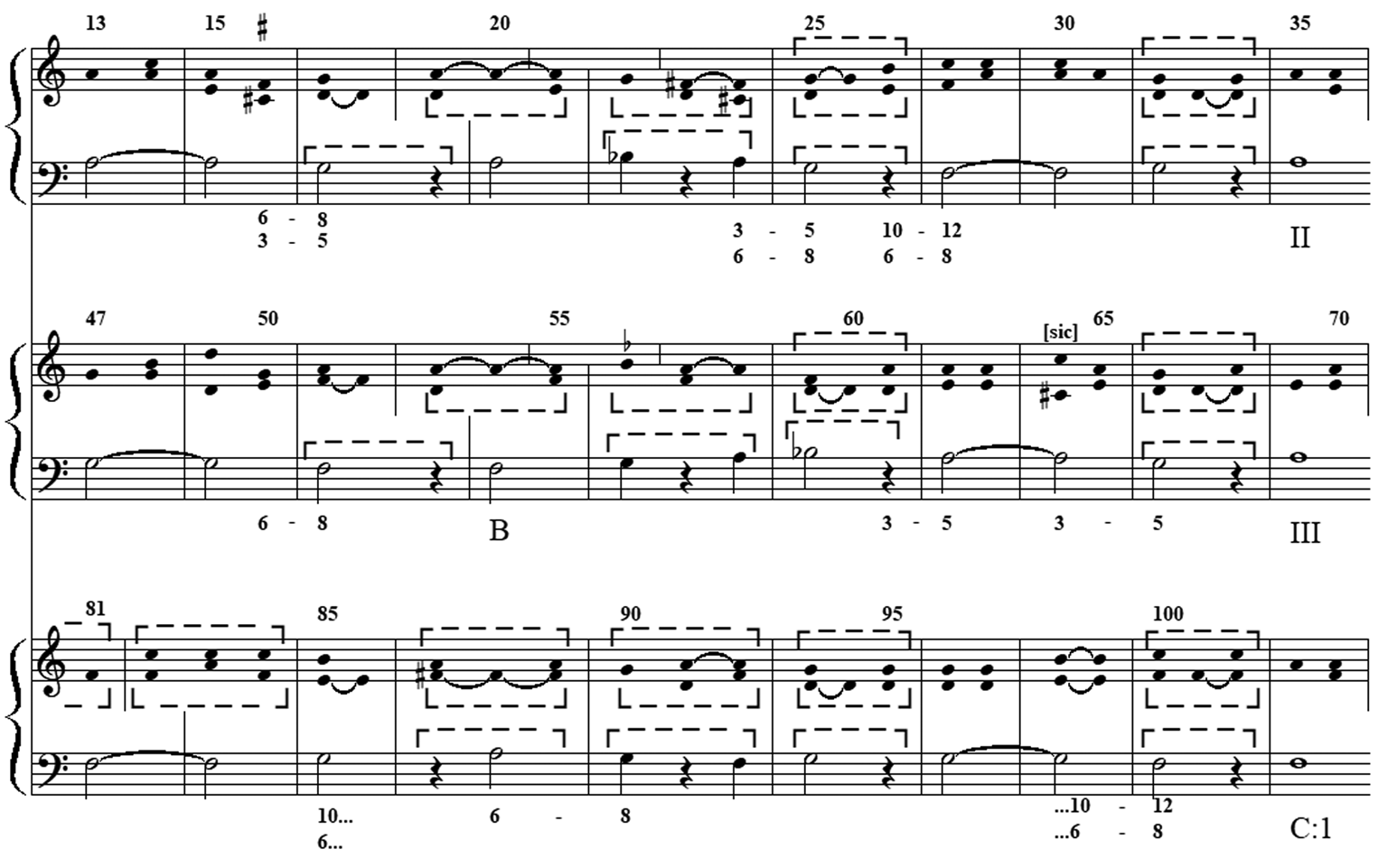
I first consider some correspondences between the first three taleae in the integer valor section of Machaut's Motet 4.Footnote 43 In the metrical contrapunctus of Example 3, a filled note head represents the manuscript's breve, while in the more abstract Example 2 each tenor pitch was presented successively without rhythmic consideration. The bar lines added in Example 3 are a visual aid that group music of a long's duration, perfect when equal to a count of three breves and imperfect when two. Because Machaut's harmony and directed progressions do not as a matter of course settle concurrently in every voice, my analytical notation bars each voice independently, as in Desmond and implicit in Boone. This offers a level of nuance beyond Maw's typical practice of ascribing one modus at a time to the polyphonic whole, however irregular their succession.Footnote 44 In my modern adaptation, analytical colouration serves dual purpose: not only indicating the customary reduction of perfect to imperfect (shown in square brackets), but also the enlargement of imperfect to perfect (shown in dashed brackets). That is, analytical colouration highlights any change from a prevailing metrical grouping. There is some historical precedent for this. In the Ars Nova treatise (c.1320), the author first explains that red ink imperfects perfect groupings of three tempora to two, but then also notes that ‘occasionally the converse is true’, citing the tenor of the motet Plures errores sunt as an example.Footnote 45 Because the metrical context in this example is of imperfect modus, analytical colouration here represents (with dashed brackets) broadening to triple groupings.
Metrical Contrapunctus reduction of Machaut's Motet 4, Talea boundaries in the integer valor section. Breves 13–36, 47–70 and 81–104.

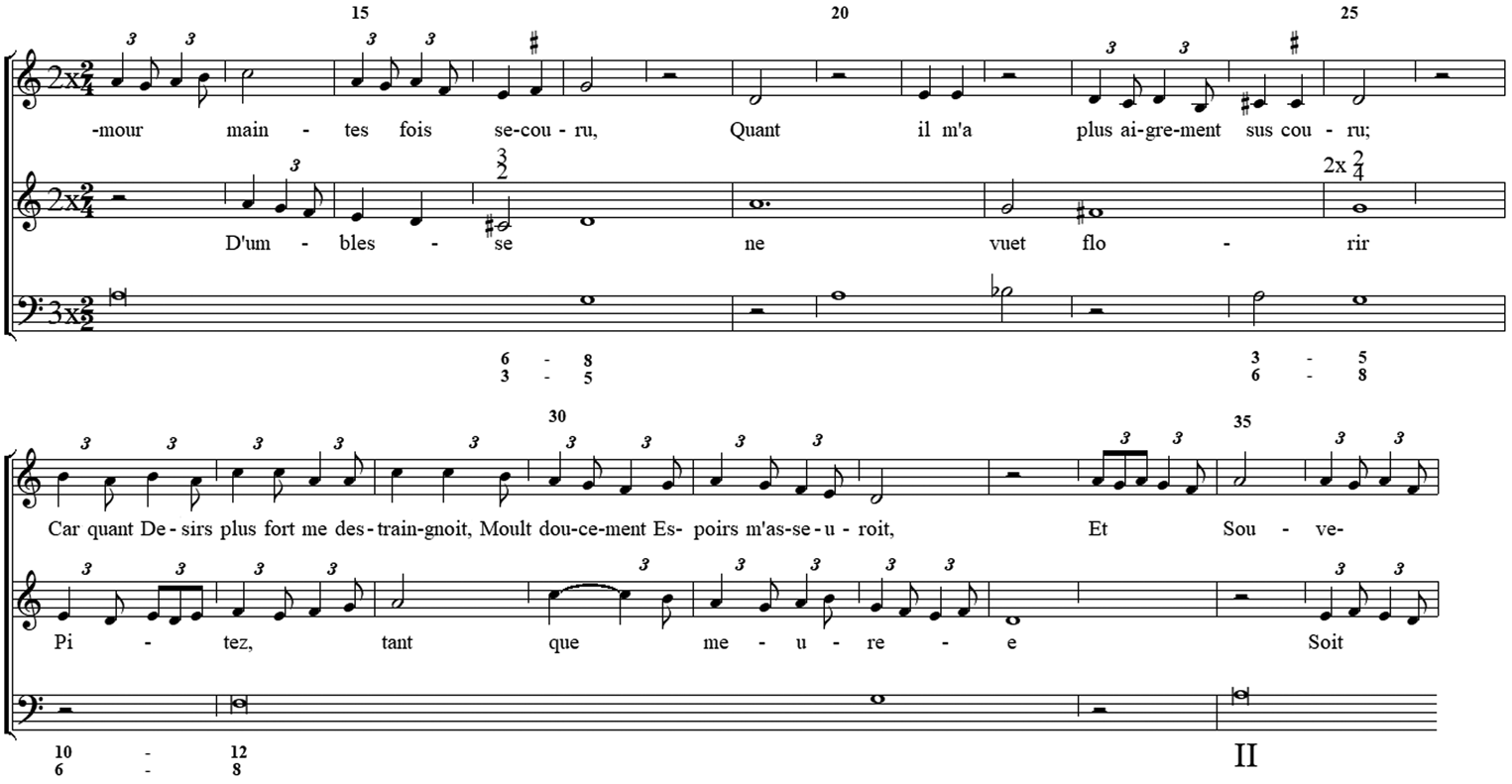
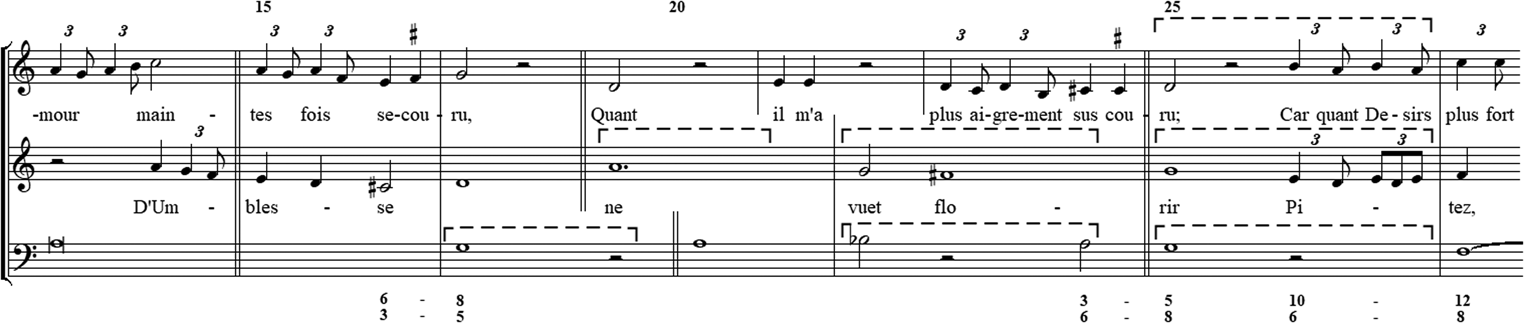
A passage of flexible metrical grouping at the beginning of Example 3 serves to introduce the analytical method. For the detailed discussion that follows, an annotated score of breves 13–36 is provided as Example 4a (corresponding to the first system of Example 3).Footnote 46 Example 4b then presents a metrically flexible score with weighted bar lines and analytical colouration as an intermediary between my metrical contrapunctus and the score itself.
Annotated score of Machaut's Motet 4, breves 13–36.

Metrical analysis of Machaut's Motet 4, breves 13–28.

The space from breves 17–25, spanning the first and second directed arrivals of the excerpt, is worth eight breves and could be read squarely in imperfect modus 2+2+2+2 as the motet's prevailing modus division. I will argue instead for a more metrically flexible reading defined by directed progressions, formal boundaries and isoharmonic parallelisms. The motetus alone in breves 19–24, voice crossed above the triplum (A–G–F♯), broadens into perfect modus while the triplum below it (D–E–E–D–C–D–B–C♯) retains the original imperfect grouping of the upper voices. This same metrical disjunction is also effected in talea II but not III, when all voices come together for an extended perfection swelling to the ultimate arrival on final F in breve 100. As the upper voices first briefly diverge, a strong 36 – 58 cadence on G in breve 25 (correlated with poetic closure, agogic accent and followed by rest in the triplum) capitalises on their periodicity. A larger implication of this cadence-downbeat is grouping alterations at two levels: a 2:3 modus perfection (minims per bar line in the Example 4b) that is balanced by 3:2 imperfection at the maximodus level (single bars per double bar line), both amounting to six breves. The subtle grouping dissonance that set up a cadence on G in breve 25 a step above the ultimate final of the motet is succeeded by the modus perfection of all voices together to herald the arrival of the ultimate final, F, in breve 28.Footnote 47 As opposed to the balanced metrical play of 3:2 vs 2:3 above, the effect in breves 25–7 is an audible broadening out of the highly directed sonority G+6+3. The way metrical disorientation was introduced and then mastered in this phrase resonates with the triplum's poetic narrative. Having been beset by the ‘fierce attacks’ of Desire, the amant is reassured by Good Hope and others and the voice parts snap back together metrically. Yet at this early point in the tonal rivalry of the two finals, F (breve 28) does not yet appear on a maximodus downbeat. The G of breve 25 is metrically stronger. F is only affirmed on the same grand scale in talea III, which concludes the integer valor section and the full motet after a repeat in diminution.
Further insight is gained by comparing the metrical grouping of this passage with its parallel in the next talea. All three complete Machaut editions – Ludwig, Schrade and Boogaart – initiate color B as a syncopated long on breve 2. If the directed progression at breve 51 is understood to instigate a perfection of modus in the tenor, however, the color's return is showcased on a downbeat at 54.Footnote 48 The metrical ramifications of this downbeat informed a parallel reading of the corresponding passage in talea I, in which the tenor's long at breve 20 was not syncopated by the preceding breve rest.
Allowing isorhythmic boundaries to define downbeats suggests considerable metrical flexibility across the work. If Motet 4's first such formal marker, the onset of talea II (breve 35), is a modus downbeat, and if the directed progression to F at breve 28 also defines a downbeat (as in the preceding discussion), then there is the odd sum of seven breves to account for between them. Breves 28–31 linger on the arrival sonority, F 5+3, followed by three breves of G 85. This G sonority (breves 32–34) may be heard as a passing tone linking talea I into talea II (tenor: F–G–A). Its modus perfection, indicated by a dashed bracket in Example 3, thus signals a build up to the formal boundary of talea II. In talea II, the corresponding place (breve 66, vertically aligned) sees a metrical expansion of the subordinate arrival sonority G85. In talea III, the same modus perfection underscores the concluding cadence of the integer valor section of motet, to be detailed later.
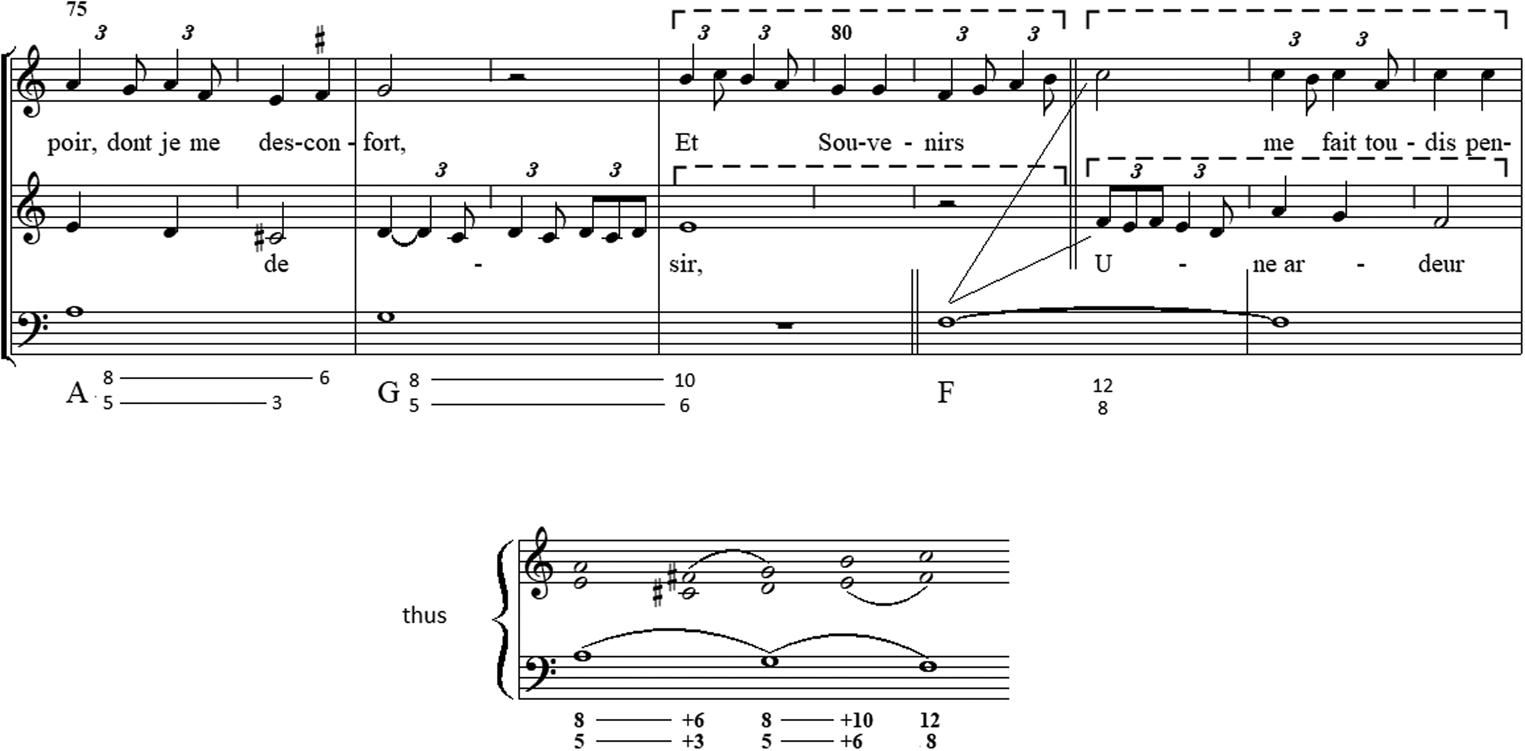
Near the beginning of talea III, a modus perfection in the upper voices stages the first arrival of F on a maximodus downbeat, shown in the annotated score of Example 5. Machaut's structural counterpoint is clear: a descending stepwise chain of sonorities alternately stable and directed. The tenor voice does not participate in the upper voices’ mensural expansion, like in breves 25–27 in Example 4, but sounds instead as if it jumps in a beat early (breve 81). Yet from a perspective of metrical independence, all voices arrive on their own beat 1 on every mensural level.Footnote 49 This interpretation is no theoretical sleight of hand, but eminently practical. Each singer from manuscript, counting their own part without score alignment, lands on F/F/C on their own beat 1.
Unaligned downbeat in Machaut's Motet 4, annotated score of breves 75–84.

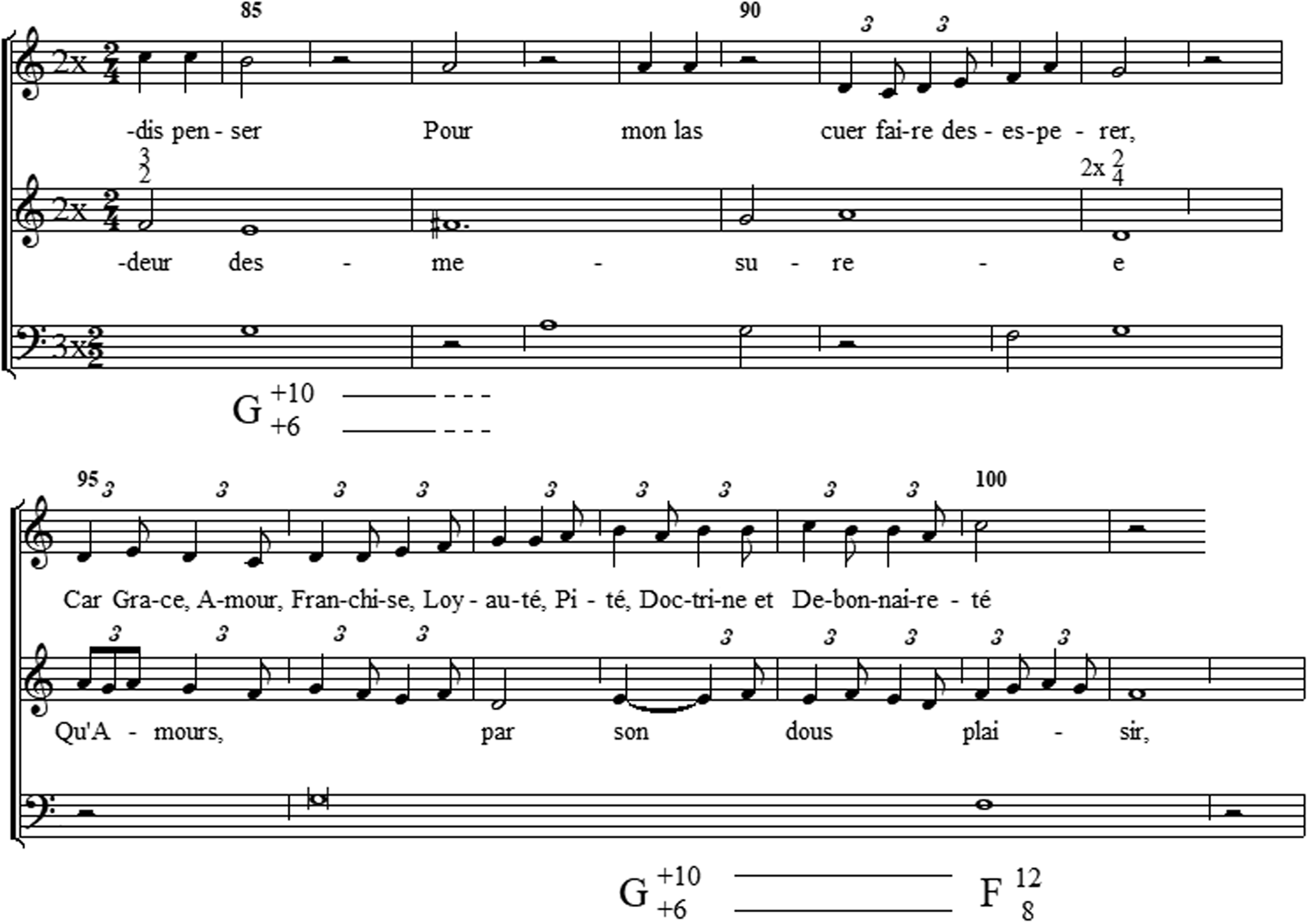
If grouping at the modus level is irregular in this motet, the swapping between imperfect and perfect groups is at least uniformly irregular across taleae I and II. The pattern is broken in talea III, however, the last of the integer valor section.Footnote 50 At breve 85, the doubly imperfect G +10+6 – the most pointed, energetic sonority the Ars Nova composer wielded – is not afforded resolution. Though primed to resolve out to the doubly perfect F85, the chant tenor steps up (G–A, breve 88) instead of down (G–F). The leading E of the motetus overshoots its mark as well, stepping too high to F♯ (breve 87) rather than resolving to F, in portrayal of the text ‘desmesuree’ (‘beyond measure’).Footnote 51 Leaving that G+10+6 hanging, there is little in Machaut's poetry or counterpoint that emphasises the subsequent tenor descent G–F (breves 90–2) as an arrival.Footnote 52 An annotated score is given in Example 6.
Annotated score of Machaut's Motet 4, breves 84–101.

Pure pitch analysis offers no hint as to why this obvious opportunity to highlight the work's global final was minimised if not passed over. A metrical contrapunctus, on the other hand, suggests a ‘perfect’ reason. Breve 92 is beat 3 of a modus perfection; not a place for tonal arrival but for propulsion to the next downbeat. Nor could this be mistaken for an imperfect group, given how squarely the harmony of the following perfection is set (breves 93–5, nearly isomelic with 32–4 of talea I). At breve 98, Machaut restores the same unresolved sonority from breve 85, G+10+6 the voicing is identical. Only now does this directed sonority find its mark, resolving firmly on F in breve 100, the final of the tenor's mode and of the motet when this all repeats in diminution.Footnote 53
It is remarkable to hold an expressively yearning sonority in mind across a swirling group of three perfect longs – one perfect maximodus (breves 87–95) on the next mensural level up, a metrical portrayal of ‘desmesuree’ – even subsuming within it a weak directed progression to a subordinate pitch (breve 90). Thus the gratification of the ultimate close on the chant's final is delayed across some fifteen breves, gradually broadening out in metrical divisions of 2+3+3+3+4, no less. In its tonal context, the triplum's ‘despairing weary heart’ on the G of breve 90 sounds a hopeful note insofar as it sets up the ultimate final F as salvific. While the benefits of a synoptic first-species view of counterpoint are many, it is a more comprehensive representation of the music that includes such compelling and explanatory metrical play.
Having discussed the end of the integer valor portion of Motet 4, this case study closes with the work's ultimate and unusual conclusion. The asynchronous alignment of the final cadence in Machaut's Motet 4 – like Motets 9, 10, 15 and 17 – has been the subject of some analytical inquiry.Footnote 54 As Margaret Bent recently stated, ‘The problem of these endings remains unresolved, and has hitherto been largely swept under the carpet.’Footnote 55 In editions of Motet 4, Schrade follows Ludwig in emending the tenor's penultimate G so that all voices cadence together on F. Yet, as Bent explains, this takes some purposeful misreading of the notated durations in the various Machaut manuscripts.Footnote 56 Boogaart's modern edition transcribes Mach A faithfully and lets the tenor arrive late.Footnote 57
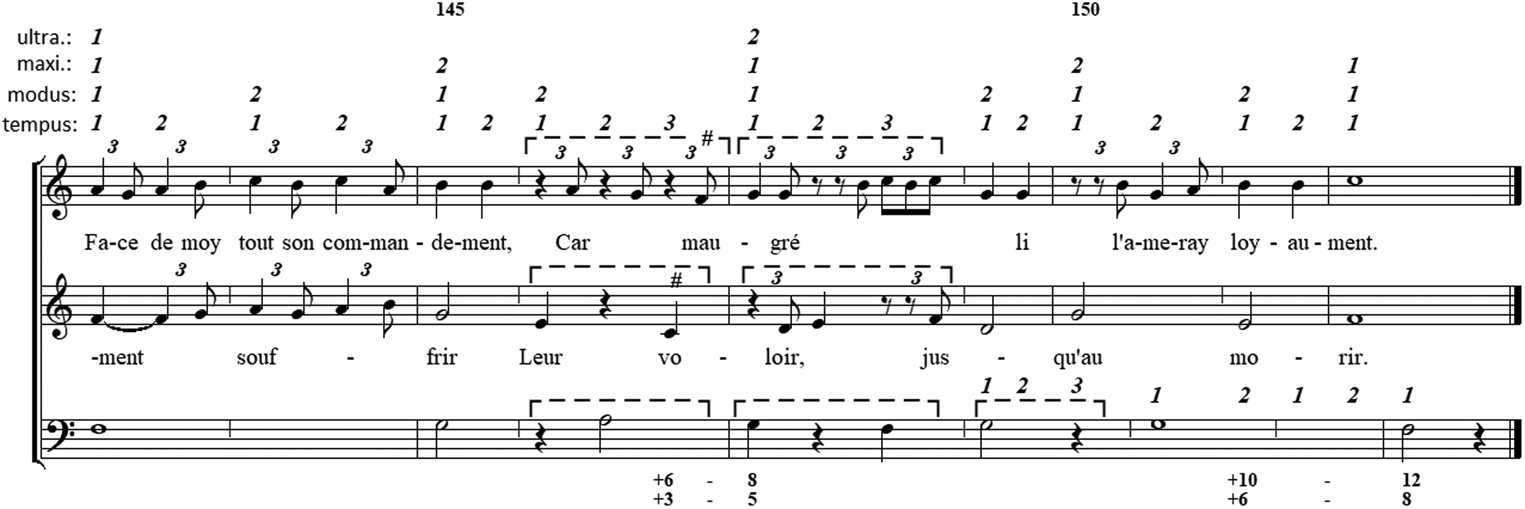
As shown in Example 7, Motet 4's imperfect tempus (usually transcribed as a bar of two crotchets) is upset in breves 146–7, where I interpret perfect grouping and re-bar Boogaart's edition to illustrate my metrically flexible reading. A count of 1–2–3 above the staff notes this temporary change from duple entrainment, with deeper mensural levels tracked above.Footnote 58 Such a metrical extension by one semibreve has the advantage of putting the directed progression to G at 147 on a tempus, modus and maximodus downbeat. This flexible reading is in contradistinction to the mostly regular barring of Ludwig, Schrade and Boogaart, all of whom pass over this strongly directed progression in the middle of a breve. While the contrapuntal resolution A+6+3–G 85 is strong, G as a final is subordinated to F in the text setting, where it is passed over in the middle of a word in both upper voices, and at the highest metrical level. The G of breve 147 arrives on an ultramaximodus upbeat (beat 2), appropriately subsidiary to the motet's ultimate final of F, which concludes the work on the following ultramaximodus downbeat.Footnote 59
Grouping play disrupts the conclusion of Machaut's Motet 4. A flexible re-barring of breves 143–53.

Following the directed motion to G at breve 147, the tenor's grouping diverges from that of the upper-voice pair. The tenor has one more perfected breve (counted above its staff) while the upper voices return to an imperfect division of two semibreves per breve. That additional length in the tenor pushes its final arrival on F a semibreve late without changing its mensural position as a downbeat. Rather, the displacement momentarily detaches the tenor into a metric stream independent of the upper-voice pair. Both streams end on a downbeat, those downbeats just come at slightly different times. One can easily imagine diminishing the tenor's G in breve 148 to a crotchet or simply omitting the crotchet rest that follows to snap the final cadence into surface alignment at the expense of the talea pattern.Footnote 60 Or, to preserve the tenor's rhythm, perfecting breve 148 in the upper voices as well, and extending the stable G85 sonority to three beats.Footnote 61 In the first of two possibilities presented on this point in Machaut manuscripts, the talea proceeds strictly and the final F arrives late, as in Mach Vg and Mach G (see Example 7). In Mach A and E, however, the penultimate long (semibreve G) has been reduced to a breve (minim), which only succeeds in making the tenor a beat early instead of a beat late. More egregiously, it places the final cadence of the piece on a modus, maximodus and ultramaximodus upbeat. The account offered here is not a solution but an explanation as to why the misalignment occurs, which for all we know may have been Machaut's original intent.Footnote 62 In any case, the issue is not with the penultimate breve, as the adjustment in the manuscript record might suggest, but rather lies with the consequences of divergent grouping.
As we have seen, Motet 4's counterpoint is brought into sharper focus when the metrical forces that inherently shape and, at times, distort its tonal content are highlighted. Metrical patterning at various layers was shown to support the large-scale tonal drama, whereby a local final G was comprehensively subordinated to F. Metrical broadening was shown to herald formal articulations like the onset of taleae. Finally, independent metrical grouping among voices was proposed as the cause of the final cadence's misalignment, perhaps in depiction of the ultimate disunity between the protagonist and the beloved.
Motet 17
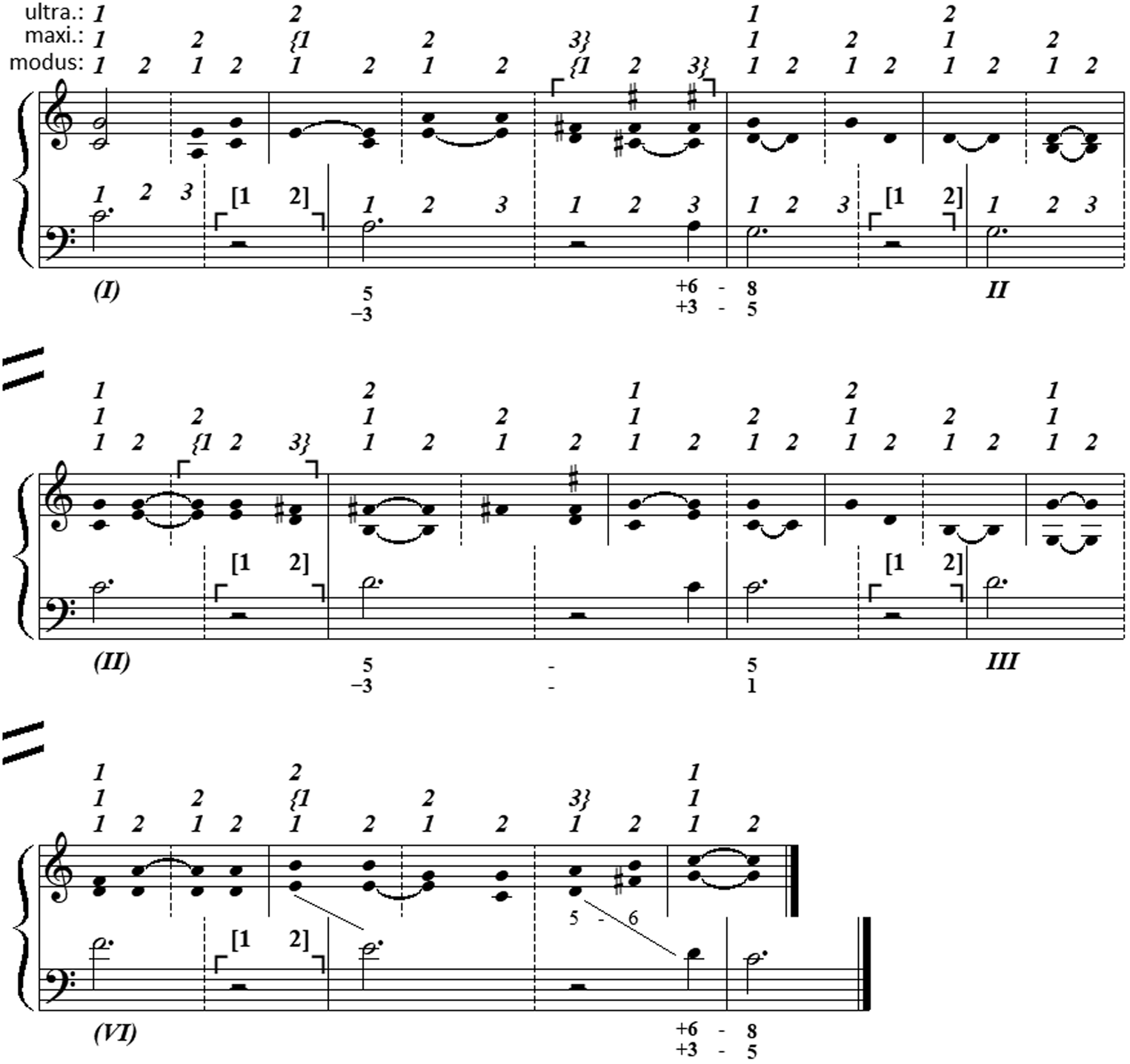
Grouping dissonance at deep metrical levels is pervasive among the voices of Machaut's Motet 17, Super omnes speciosa/O series summe rata/Quant vraie Amour, leading to another unaligned conclusion. Boogaart's edition, guided by the mensural value of notated durations, reads the tenor in perfect modus with ‘six imperfect longa rests in each color (two per talea) [that] add up to form a long-term syncopation’ against the upper voices in imperfect modus.Footnote 63 In Boogaart's reading, the upper voices’ duple grouping is bookended by two singleton breves (15 and 126) that first displace them from the tenor and then realign them at the last possible moment. By contrast, an analysis that groups according to harmonic identity and directed progressions, with no overarching grid of metrical expectation to syncopate against, distills Machaut's counterpoint into straightforward metrical groupings. A metrical contrapunctus of excerpts from the beginning and end of Motet 17 is given as Example 8, with taleae in roman numerals. Because brackets are needed to represent temporary groupings of both triple and duple in this example, bracketed counting without italics is used here to signal imperfection (see the tenor voice). Curly brackets are used to signal expansion to perfect grouping in the otherwise imperfect grouping of the upper-voice pair.
Metrical Contrapunctus of Machaut's Motet 17, breves 7–25, 29–47 and 117–28.

A lightly annotated score of breves 7–25, corresponding to the first system of Example 8, is given in Example 9.
Annotated score of Machaut's Motet 17, breves 7–25.

In talea I there is dynamic metrical organisation at multiple levels concurrently. The upper-voice pair is set in imperfect modus with irregular perfections (bracketed as deviation from its norm) while the tenor is the opposite, perfect modus with regular imperfections (customarily bracketed in modern transcription). The perfection of the upper-voice pair's long in breves 15–17 is amplified by the concurrent perfection of the maxima (accompanied by ‘just when it's the right time’ in the triplum text), where those breves are subsumed by long-count 3 above the staff (numbered in curly brackets) against a context of imperfect maximodus. In effect, this is a written-out ritard that intensifies the drive towards resolution in breve 18.Footnote 64
The 5−3 sonority that coalesces over the tenor's A in breve 12 began (as A5) in the upper voices a breve earlier, in 11. This A5−3 is harmonically stable for the first two longs. In the third long, the perfect extension of that maxima, the A sonority surges through 5–6 exchange to the charged A+6+3 (breve 16) targeting arrival on G85. Given all the metrical displacement in this motet it is remarkable that the cadence at breve 18 (correlated with poetic closure, agogic accent and followed by rest in the triplum) should arrive in all voices together. In fact, without a perfection drawing out the upper voices, they would have anticipated the tenor's arrival on G by a breve, as at breve 11 previously and later at the onset of talea II.
By zooming out to survey the deepest levels of metrical organisation, the misalignment of the talea II boundary (breve 23) amounts to a surface disturbance. As in Motet 4, it is a non-simultaneous modus and maximodus downbeat for both the upper-voice pair and the tenor, respectively. As before, it is easy to imagine perfecting the long in the upper voices at breve 18, which do no more than echo their stable arrival sonority (G85), to lock all voices together at talea II. At the ultramaximodus level, the first talea pitch figures as a beat 2 pickup throughout Motet 17, as the text setting also suggests.
Machaut's approach to talea III features even more metric flexibility. The cadence on C coalescing finally at breve 40 (with the very same cadential parameters as previously) is even further displaced: two breves early. Yet displacement, however pervasive, is only an effect. Flexible metrical grouping is its cause. As demonstrated earlier, in talea I the stable 5−3 sonority on A surged to an unstable +6+3 in its drive to G. The tenor's D at breve 34 similarly descends to cadence on C, but D is superficially found as the third of the harmony B 5-3. Its first long (breves 34–5) sounds like a stable B 5−3 (b/d/f♯), while retrospect casts its second long (breves 36–7) as unstable, in pursuit of C 51, though it is the very same pitches. That is, B5-3 in the second long acts as an ‘inverted’ D+6+3.Footnote 65 There is so much hurry to arrive on C in breve 40 – that is, to achieve the ‘perfect act of union’, ‘not to suffer breakage’ sung of by the upper voices – that the upper-voice pair arrives two breves early; even the tenor has an anticipation. This multivalent interpretation has it both ways. It captures the expressive excitement of the early arrival on the surface levels while at the same time reveals a satisfying structural downbeat in deep metrical reckoning. The upper voices in breve 38 and the tenor in breve 40 align on their own count 1, respectively.
Machaut truncates the sixth and final talea statement, shown in the bottom system of Example 8. Schrade's edition again diminishes the tenor's final rest in order to align the cadence. Boogaart, on the other hand, keeps the tenor late and lets the misalignment go off the end of the piece, the upper voices’ final semibreve aligning with eight beats-worth of tenor. From the more flexible metrical perspective advanced here, this ultimate misalignment is little to wonder at. Every talea boundary in Motet 17 is misaligned at the modus level. Indeed, the deep grouping dissonance between an imperfect upper-voice pair and their perfect tenor – not to mention the tenor's own toggling between perfect and imperfect modus – is a foundational feature of this motet, not a hiccup at the end to be edited away.Footnote 66 However salient, such misalignment resides ultimately on the music's surface. Each singer looking at their own part, unencumbered by score format in the fourteenth century, arrives on a downbeat in their own time.
Syncopation between polyphonic forces in Motet 17, however pervasive, has been considered here to arise out of grouping dissonance. The restoration of metrical regularity can be achieved through a second, compensatory grouping dissonance that realigns the tenor with the upper-voice pair. Yet a sense of closure can also be gleaned by counting each voice separately. Just as a melodic dissonance may decorate but not obliterate our recognition of standard harmonies, so too can we gather a metrically offset voice into one coherent downbeat in our mind.
Motet 5
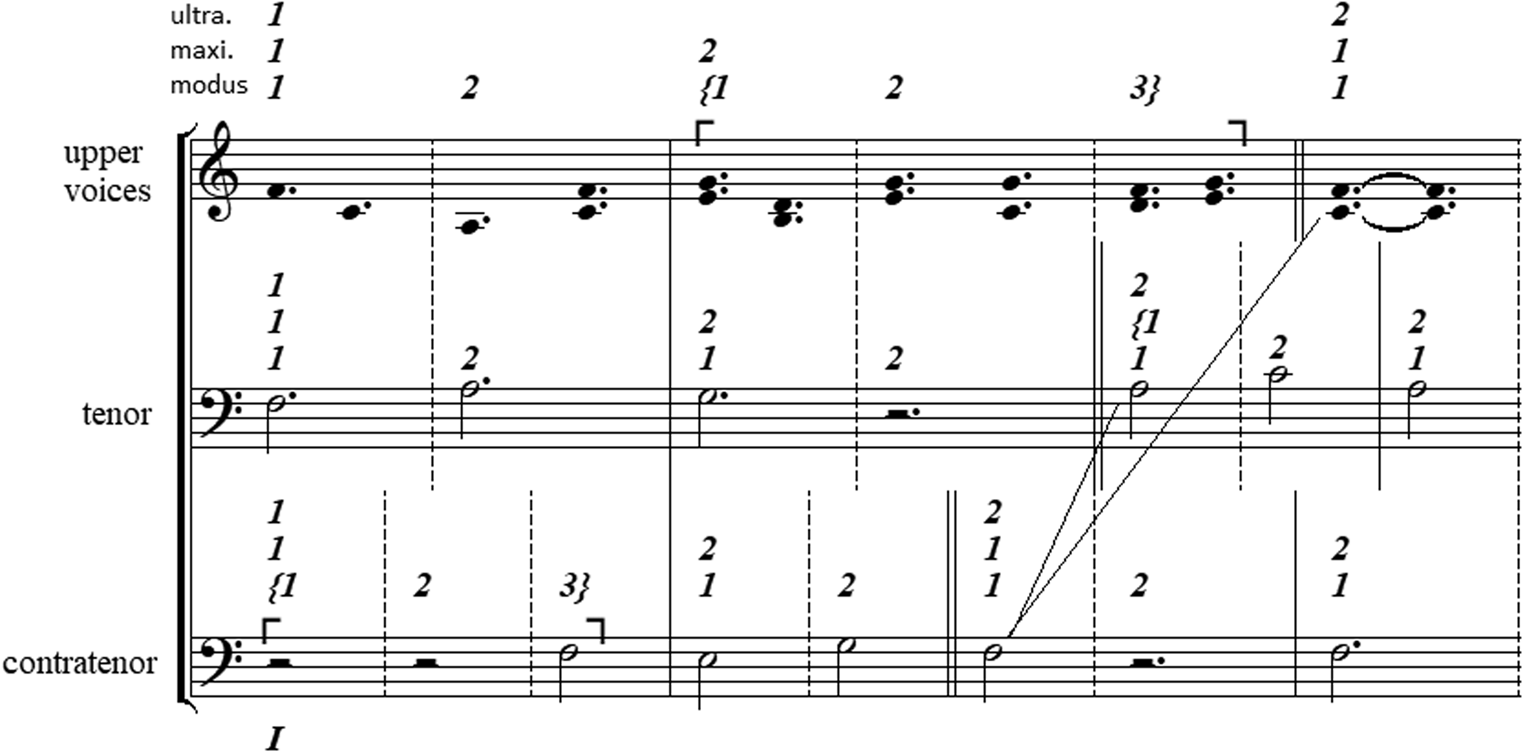
The presence of a contratenor affords another layer of potential metrical complexity of which Machaut takes full advantage in Motet 5. Machaut adopts the talea from Philippe de Vitry's motet Douce playsence/Garison/Neuma quinti toni for both his tenor and his contratenor, setting the latter in retrograde. Because this talea switches modus midway through (as indicated by red colouration in the manuscript example of Figure 1), Machaut's palindromic design effects a perpetual state of grouping dissonance (3:2) between his two tenors. The upper-voice pair begins in imperfect modus and maximodus until a temporary perfection of maximodus in longs 3–5 (breves 5–10), labelled 1–2–3 in curly brackets on the top system of Example 10. This broadening out pulls the upper voices away from the tenor, which continues in imperfect maximodus (labelled 1–2 in black on the middle system, comprising breves 5–8), and also the contratenor, which is simply shorter.
Flexible metrical reading of Machaut's Motet 5, breves 1–12.

For all its grouping play, Machaut's counterpoint is a straightforward harmonisation of the chant in lockstep with deep-mensural divisions. As a metrical contrapunctus reveals, the first maximodus bar (single bar line) expresses F85+3, the motet's home sonority. The second maximodus bar amounts to G8+6+3, the directed sonority that seeks a return to F85+3 in the third maximodus bar (breve 11, after the double ultramaximodus bar line), in conjunction with text terminations.Footnote 67 This simple neighbour figure concludes on a modus and maximodus downbeat no differently than one would expect in a simpler metrical context. In Motet 5, however, Machaut distributes that same downbeat across three different metrical plans such that the arrival sonority coalesces gradually from bottom to top: F–a–c/f.
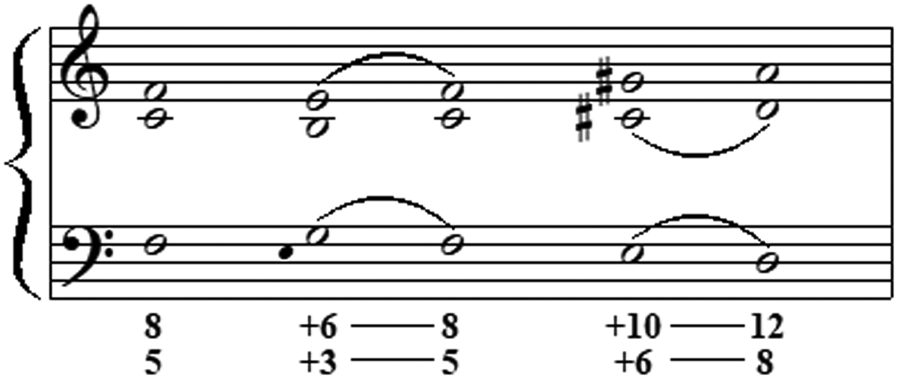
There is an anomalous surface harmony caught up in this extraordinary counterpoint that can be explained through metrical organisation. The tenor's a at the point it switches to imperfect modus (undotted minim, breve 9 of the upper voices) is the bass of an apparent 64 sonority: A/D/F. Notated as A in Mach A, this dubious surface sonority is replaced by b♭ in Mach B, C, E and Vg. While a B♭5+3 sonority makes better local sense than A64,Footnote 68 the propriety of a musical surface full of passing dissonances may be considered subordinate to the contrapuntal unfolding of a cadence, where that A takes its definition as the third above F. The imperfect sweetness of the tenor's third (a) in the arrival sonority F/a/c/f on ultramaximodus beat 2 is then contrasted by a stronger, doubly perfect directed progression to D/d/aa on the ultramaximodus downbeat that closes talea I (breve 15). The poetry that began a new grammatical unit after the previous cadence on F (breve 11) more weakly articulates this arrival on D, bridging across into talea II to complete its meaning. Example 11a provides a score of talea I followed by Example 11b, a tonal summary of its simple harmonic plan, blurred by tectonic metrical forces beneath the surface. Metrical analysis at the levels of modus and beyond proves valuable in clarifying such unaligned and dissonant surfaces.
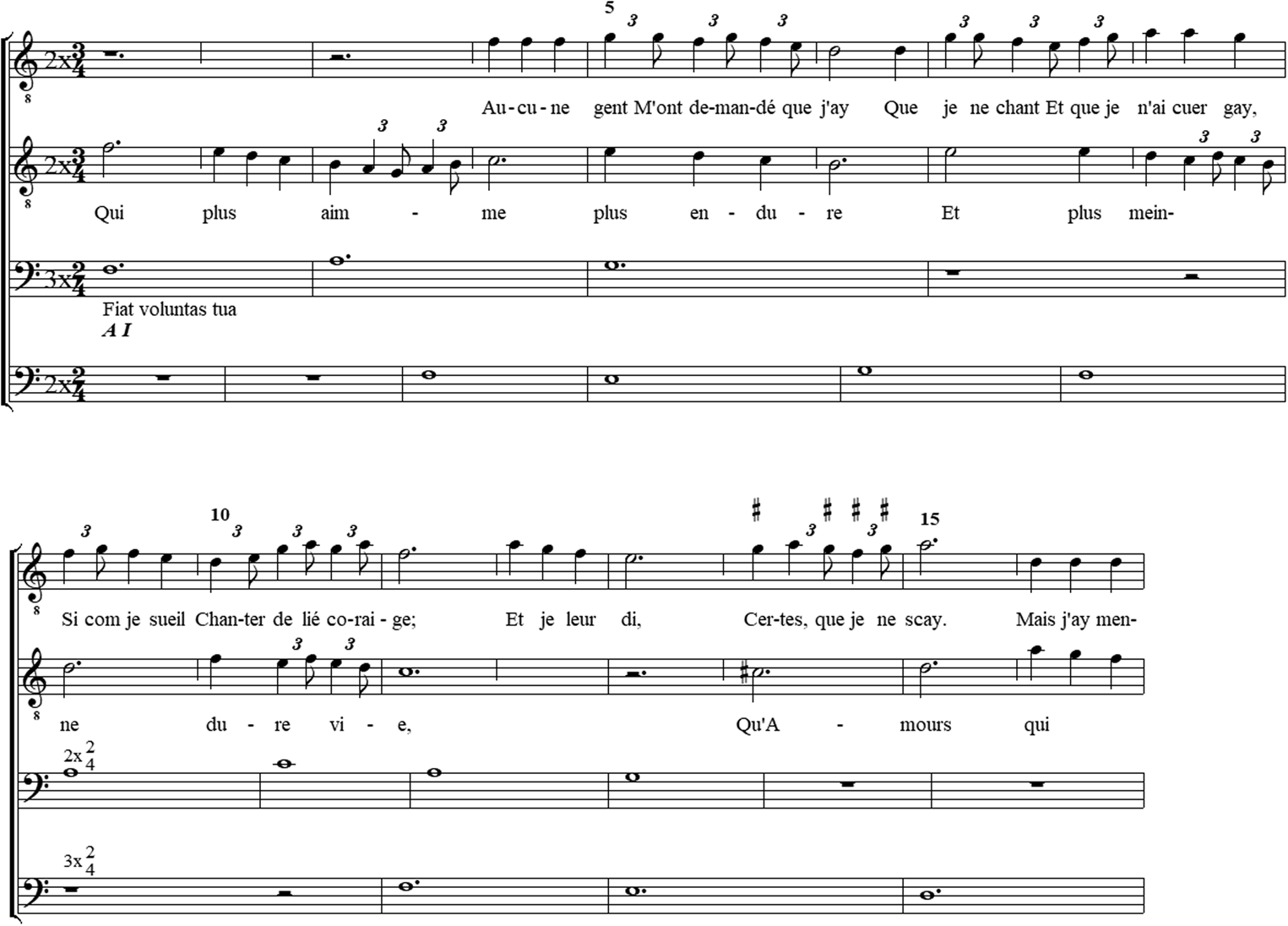
Score of Machaut's Motet 5, Talea I.

Tonal summary of Machaut's Motet 5, Talea I.

With its retrograde contratenor, Machaut's Motet 5 is an instructive case of metrical incongruity by design. Tying tonal and metrical articulation together reveals quite traditional counterpoint in this motet. What is extraordinary is how Machaut meted out standard directed progressions across three independent streams of metrical reckoning.
Analytical extensions
The representation of broad levels of metrical organisation as integral to contrapunctus pitch reductions can illuminate music beyond Machaut's works and fourteenth-century motets more generally. While the explicit signing of mensuration as well as complex play with grouping only came about at the end of this century and into the fifteenth, thirteenth-century polyphony might also be appropriately approached with a view to associating tonal and metrical articulations.Footnote 69 Indeed, with modus as its surface level, organisation at the maximodus and ultramaximodus levels only becomes more apparent in this earlier century. The viewpoints and methodology developed here are not limited to chant-based motets. Initial investigation of the coordination between deep metrical pulses and the formes fixes of French chansons, both polyphonic and monophonic, reveals a variety ripe for critical analysis.
As Maw has observed, ‘uniformity is clearly not important to Machaut's metrical technique’ in his polyphonic songs.Footnote 70 Yet our understanding of medieval counterpoint can only be enriched by the systematic representation of its flexible and layered metrical organisation. Dedicated attention to the grouping of tonal articulations at deep levels of metrical architecture, beyond single notated durations, proves a valuable tool for interpreting the complex polyphony of Machaut's motets and beyond.
Manuscript sigla
Mach A: Paris, Bibliothèque Nationale de France, fonds français 1584
Mach B: Paris, Bibliothèque Nationale de France, fonds français 1585
Mach C: Paris, Bibliothèque Nationale de France, fonds français 1586
Mach E: Paris, Bibliothèque Nationale de France, fonds français 9221
Mach G: Paris, Bibliothèque Nationale de France, fonds français 22546
Mach Vg: Ferrell-Vogüé, private ownership of James E. and Elizabeth J. Ferrell