





Introduction
In the current paper, we examine offline experimental data on the acceptability of control and infinitival structures in Brazilian Portuguese (BP). We present experimental data gathered via a Bi-modal Acceptability Judgment Task (B-AJT) to determine if BP speakers distinguish between sentences with inflected infinitives in partial control (PC) and no control (NC) contexts. This is a partial replication of Modesto’s (Reference Modesto, Santos and Gonçalves2018) methodology, which was designed to shed light on the adequacy of the Movement Theory of Control (MTC, e.g., Hornstein, Reference Hornstein1999) for BP. According to the MTC, a proposed refinement of Minimalist Program syntactic analysis (e.g., Chomsky, Reference Chomsky1995 et sequens), subject raising (1a) and subject-control sentences (1b) receive a uniform theoretical treatment in explaining BP data.
(1)
a.
Brian is likely to leave Athens
b.
Brian is reluctant to leave Athens
In BP, certain infinitive forms may additionally take inflectional morphology (2a–c), yielding a variety of different control interpretations.
(2)
a.
Eu
i
lembro EC
i/*j
ter
trabalhado pouco
I
remember.prs.1sg
have.inf
work.ptcp little
“I remember not having been working much”
b.
Eu
i
lembro EC
i+
termos
trabalhado pouco
I
remember.prs.1sg
have.inf-1p
work.ptcp little
“I remember us having been working little”
c.
Eu
i
lembro
(eles)/EC*i + j/j
terem
trabalhado pouco
I
remember.prs.1sg
they
have.inf-3p
work.ptcp little
“I remember them having been working little”
In (2a), we have a classic example of an obligatory control reading, in which the empty category (EC) in the subordinate clause subject position receives its reference from the superordinate clause subject. In (2b), we have a partial control reading, which allows a reading of the null subject (EC) of the subordinate clause as one that includes the main-clause subject in an inclusive first-person plural group with additional, discourse-salient referents. In (2c), we have what is typically called a “no(n) control” reading, owing to the fact that no part of the subordinate clause subject’s reference overlaps with the superordinate clause subject. According to the traditional formal account of control, examples (2a–b) are posited to have a PRO empty category, while phonologically null subjects of subordinate clause “NC” structures like (2c) are posited to have a pro empty category (see e.g., Stowell, Reference Stowell1983; Jaeggli & Safir, Reference Jaeggli, Safir, Jaeggli and Safir1989 for discussion of the empty categories pro and PRO).
For Modesto (Reference Modesto2014), an MTC account of the PC data with agreeing infinitives above would incorrectly predict the acceptability of impossible sentences in BP. However, he also argues that native speakers of BP only have knowledge of such sentences as result of memorized grammatical content from formal grammar instruction as part of public education. We seek to add more data to further explore this claim, testing the acceptability of agreeing infinitives experimentally. In “Background: Control, raising, and the MTC”, we briefly provide background on the leading theoretical accounts of control and raising as well as the empirical debate as it pertains to the interpretation of data with inflected infinitives in Brazilian Portuguese, paying particular attention to the disputed data in Modesto (Reference Modesto2014) and Rodrigues and Hornstein (Reference Rodrigues and Hornstein2013). In “Experimental methodology”, we present the experimental methodology employed in the offline experimental task carried out with native BP-speaking participants (n = 52) that were born in Brazil, but who were living in the Southeastern US at the time of data collection. We then examine the results and offer preliminary discussion. Despite a robust debate on the acceptability of agreeing infinitives in BP, the data presented reveal that our participants distinguish between PC and NC sentences with agreeing infinitives: although NC sentences are rated as acceptable, PC sentences are rated as unacceptable. In “Discussion”, we briefly examine the findings of the experimental study reported on in Merchant and Gupton (Reference Merchant and Gupton2025), which employed an online processing task with the same native BP-speaking participants. We then discuss the significance of combined results of the measures, which challenge claims in Rodrigues and Hornstein (Reference Rodrigues and Hornstein2013). In the final section, we examine the limitations of the current study and outline directions for further research.
Background: Control, raising, and the MTC
In the generative tradition, early accounts of control in English (e.g., Williams, Reference Williams1980; Chomsky, Reference Chomsky1981) proposed that, despite ostensible similarities, sentences like (1a) and (1b), repeated below, have differing underlying structures (3a, b).
(1)
a.
Brian is likely to leave Athens
b.
Brian is reluctant to leave Athens
(3)
a.
Brian
i
is likely [t
i
to leave Athens]
b.
Brian
i
is reluctant [PRO
i
to leave Athens]
An important asymmetry becomes evident when we examine the behavior of these predicates with overt expletive subjects and their ability to combine with the clause [that Brian will leave Athens], as in (4a, b).
(4)
a.
It is likely [that Brian will leave Athens]
b.
*It is reluctant [that Brian will leave Athens]
This difference is not related to the alteration of the sentence with an overt expletive; the difference remains when the same clause appears as a clausal subject (5a, b).
(5)
a.
[That Brian will leave Athens] is likely
b.
*[That Brian will leave Athens] is reluctant
In (5b), the proposition [that Brian will leave Athens] is unable to semantically saturate the predicate is reluctant. Within a feature-checking model of syntax (e.g., Chomsky, Reference Chomsky1995 et sequens), the clausal proposition [that Brian will leave Athens] in (5a) is understood to check an edge/EPP feature in Spec,TP, while the expletive it is proposed to do the same in (4a). The predicate is reluctant in the (b) examples, however, does not behave the same way in (4b, 5b) because the proposition [that Brian will leave Athens] is unable to saturate the predicate. Instead, the predicate [is reluctant] requires two arguments for theta role assignment: an experiencer [Brian] and a proposition [that Brian will leave Athens]. Additionally, Brian appears to be assigned a theta role by the predicate [is reluctant] as well as by the proposition [to leave Athens]—a possibility that stands in violation of the Theta Criterion (e.g., Chomsky, Reference Chomsky1981). Therefore, (1a) has been traditionally analyzed as an instance of raising (3a), while (1b) has been analyzed as an instance of (subject) control (3b).
In (3a), repeated below [Brian to leave Athens] is semantically marked as a theme by the predicate [is likely], while [Brian] is proposed to subsequently raise out of the subordinate clause to Spec,TP of the superordinate clause, where it checks an [EPP] feature and Nominative Case is valued.Footnote 1
(3)
a.
Brian
i
is likely [t
i
to leave Athens]
b.
Brian
i
is reluctant [PRO
i
to leave Athens]
In (3b), the phonologically null (and caseless) pronoun PRO is assigned, which absorbs the surplus theta role from the non-finite verb [leave].
Hornstein’s (Reference Hornstein1999) Movement Theory of Control (see also Hornstein, Reference Hornstein2001; Boeckx & Hornstein, Reference Boeckx and Hornstein2006; Boeckx et al., Reference Boeckx, Hornstein and Nunes2010; Hornstein & Polinsky, Reference Hornstein and Polinsky2010; henceforth MTC) proposes a unified analysis of both sentence types under a movement-based account (6), essentially disposing with the empty category PRO as well as the formal distinction between these sentence types.
(6)
Brian
i
is reluctant [t
i
to leave Athens]
Hornstein (Reference Hornstein1999: 72) argues that “the general properties of OC[obligatory control] structures can be reduced to movement”. Incorporating the assumptions of the copy theory of movement (Chomsky, Reference Chomsky, Hale and Keyser1993, et seq.), we can represent (3a) and (3b) as (7a) and (7b), respectively:
(7)
a.
Brian
i
is likely [TP [Brian]
i
to leave Athens]
b.
Brian
i
is reluctant [TP [Brian]
i
to leave Athens]
The representations in (7a, b) allow us to see the structural similarities between raising and obligatory control as proposed by the MTC. Given these proposed structural similarities, Merchant and Gupton (Reference Merchant and Gupton2025) extrapolated the prediction that raising and obligatory control sentences should be processed similarly—results that we will incorporate into the conversation in “Discussion”. However, it is worth mentioning that there is a crucial difference between (7a) and (7b) according to this account: the motivation for movement. In (7a), movement of the DP Brian should take place for reasons related to EPP-checking and nominative Case checking/valuation, and the predicate be likely only assigns a Theme argument to [Brian to leave Athens]. In (7b), however, the predicate [be likely] cannot assign a theta role to the DP Brian, which already has an Agent theta role. The fix for this then is that the standard view of theta theory (e.g., Chomsky, Reference Chomsky1981) must be disposed with in order to allow a constituent to be assigned more than one thematic role.Footnote 2 Additionally, we have to suspend the restriction against that movement to theta-related syntactic positions (e.g., Chomsky, Reference Chomsky1986).Footnote 3 This poses no such problem for Hornstein (Reference Hornstein1999), who further argues that theta-marking is inconsistent with Minimalist assumptions about the grammar and is an outdated remnant of the Government and Binding Theory (e.g., Chomsky, Reference Chomsky1981) that should be eliminated. Instead, he proposes that theta role assignment is a morphological feature subject to assignment/checking processes (Hornstein, Reference Hornstein1999: 79, following Lasnik, Reference Lasnik1995). If theta roles are to be considered like Case or formal features, as we see it, a similar problem may yet remain, since DPs do not get assigned or valued (as in e.g., Pesetsky & Torrego, Reference Pesetsky, Torrego, Karimi, Samiian and Wilkins2007) for more than one Case value or φ-feature value. However, in the interest of fairness, we will not dispute this issue further here, leaving the implications of multiple theta roles for the theory and for linguistic processing for further empirical research.
Types of control: The theoretical distinctions
According to Landau (Reference Landau2015: 53) an important opposition exists between obligatory control (OC) and NC. In his updating of the Agree-based model (e.g., Landau, Reference Landau2000, Reference Landau2004), this opposition is recast as a relation between complement type and agreement [+Agr], as in (8):
No Control (NC) contexts should result when agreement [+Agr] is present in T, a prediction that may be tested with European Portuguese (EP), which has inflected infinitives, thus exemplifying NC (9):Footnote 4
(8)
The OC-NC generalization (restated)
[+Agr] blocks control in attitude complements but not in non-attitude complements,
Or:
[+Agr] blocks logophoric control but not predicative control
(9)
a.
Eu penso/afirmo
[
ter-em
os deputados
trabalhado
pouco]
I think/claim
have.INF-3pl
the deputies
worked
little
“I think/claim that the deputies have worked a little bit”
b.
Eu penso/afirmo
[EC
ter-em
trabalhado
pouco].
I think/claim
have.INF-3pl
worked
little
“I think/claim that they have worked a little bit”
The postverbal subject of the subordinate clause in (9a), os deputados, does not include the subject of the superordinate clause (eu). In this sense, there is no control taking place. An embedded null subject is also possible (the EC in 9b) under the right discursive conditions. Given the lack of a control dependency in (9b), it is proposed that the subordinate clause empty category is pro. Footnote 5 Similar sentences are considered to involve pro according to the MTC account as well.
Turning to OC, Landau (Reference Landau2000: 5) identifies exhaustive control (ExC) and partial control (PC) as the two main control sub-types whose appearance depends upon the superordinate clause predicate type. For ExC (10), the reference of PRO must be identical to the controlling DP the chair:
(10)
The chair
i
managed [PRO
i/*i+ to gather the committee at 6]
PC-inducing predicates (11), however, differ from ExC in that the reference of PRO may include additional individuals beyond the controlling DP. Notably, the reference of PRO in PC contexts must include the controller DP (i.e., the chair in 11b).
(11)
a.
The chair
i
preferred [PRO
i+ to gather at 6]
b.
*The chair
i
preferred [PRO
i+ to gather without him
i
]
For Landau as well as Bianchi (Reference Bianchi, Guéron and Tasmowski2003), the distinction between ExC and PC has to do with whether an attitude or non-attitude context is present. According to Landau (Reference Landau2015: 18–19), attitude context-inducing predicates include desiderative (12a), propositional (12b), interrogative (12c), and factive predicates, while non-attitude context-inducing predicates include modal (13a), aspectual (13b), evaluative (13c), and implicative predicates.
(12)
PC complements: Attitude contexts
a.
Bill planned to meet Ralph soon
b.
Bill pretended to be Ralph
c.
Bill asked where to take Ralph for lunch
(13)
ExC complements: Non-attitude contexts
a.
Bill should greet Ralph
b.
Bill started to talk to Ralph
c.
It was rude of Bill to ignore Ralph
Attitude contexts involve states of affairs evaluated relative to “the epistemic or bouletic state of a participant in the reported situation and not relative to the actual world” (Landau, Reference Landau2015: 18) and allow PC. Non-attitude contexts, on the other hand, select states of affairs that are evaluated relative to the real world and force ExC.Footnote 6
According to the MTC, ExC sentences are proposed to involve movement of the controller DP from the phi-defective infinitival clause to the superordinate clause, which is phi-complete and may assign Nominative Case. PC sentences are explained as involving an argument and a null associative pro that are base-generated in argument position. The null associative pronoun requires identification in the preceding discourse, but the DP argument bearing [Agent] theta-features subsequently moves to Spec, TP of the embedded clause and then subsequently to Spec, TP in the superordinate clause, as in (14) from Rodrigues (Reference Rodrigues, Davies and Dubinsky2007: 220).
(14)
a.
A
vítima
quer
encontrar
bêbada
the
victim.f.sg
want.prs.3sg
meet.inf
drunk.f.sg
“The victim wants to meet drunk”
b.
[TP [a vítima] [T’ quer [vP [a vítima] [VP [V quer] [CP [TP [DP [a vítima] [T’[VP [VP [DP [pro] [a vítima]] encontrar] bêbada]]]]]]]]]
It is worth pointing out that the MTC account of PC still involves movement. As previously mentioned, a modification to theta theory is required by the MTC such that the controller DP (a vítima “the victim” in 14) may be assigned more than one thematic role. This elegant proposal disposes with the need for the empty category PRO. For Modesto (Reference Modesto2010), however, PC sentences like (15) pose a serious problem for an MTC analysis:
(15)
A presidente
i
disse
pro
secretárioj que [EC
i
]
preferia [EC
i + j
]
the president say.pst.3sg
to.the
secretary that
prefer.cond.3sg
se reunirem
em
outro dia
SE meet.inf.3pl
in
other day
“The presidenti told the secretary
j
that she
i
preferred them
i + j
meeting another day”
The issue is that a moved constituent originating in the lowest clause providing the antecedent indices (i.e., i + j) in (15) would have to be able to change its featural and referential identities during its movement to the next highest superordinate clause (i.e., as subject of preferia “she preferred”), where it is coreferential with a presidente in the matrix clause. Such movement is impossible according to current generative understandings of syntactic movement, which view moved traces of constituents as unpronounced copies (see Chomsky, Reference Chomsky, Hale and Keyser1993; Nunes, Reference Nunes and Boeckx2011 for further discussion). Rodrigues and Hornstein (Reference Rodrigues and Hornstein2013) claim that examples like (15) are not necessarily problematic for the MTC, given the proposal in Rodrigues (Reference Rodrigues, Davies and Dubinsky2007) suggesting that the additional reference may be accounted for via a null associative pro found in languages like Japanese and Mandarin, thus allowing it to escape the apparent limitations of syntactic movement. Therefore, determining discourse reference for phonologically null pronouns is shifted to whatever discourse-pragmatic module interfaces with the syntax.
Modesto points out that the MTC account makes erroneous predictions for ExC structures, such that a plural controller should trigger plural agreement in the infinitive as a reflex of its movement copy, contrary to fact (16).Footnote 7
(16)
Os meninos
conseguiram
vender(*em)
a casa
the boys
manage.pst.3pl
sell.inf(*3pl)
the house
“The boys managed to sell the house”
To this point, we have attempted to briefly summarize the basic tenets of the MTC and the key challenges for an explanatory account of BP. In the following section, we examine the key point of contention under investigation in this article: the acceptability of agreeing infinitives in BP and their ability to be associated with PC readings.
The empirical debate related to control
Modesto claims that (17a–c) are grammatical in European Portuguese (EP), but ungrammatical in Brazilian Portuguese (BP).
(17)
a.
*O Juca convenceu [o pai das meninas1]2 a
[EC]1
ficarem
com ele
the Juca convinced the father of.the girls
to
stay.inf.3pl
with him
“Juca convinced the girls’ father that they should stay with him”
b.
*[A filha dos Clinton1]2
espera [EC]1
ganharem
as eleições
the daughter of.the Clinton
hopes
win.inf.3pl
the elections
“The daughter of the Clintons hopes that they will win the elections”
c.
*O professor
mandou [EC]
fazermos
um trabalho
the teacher
asked
do.inf.1pl
a homework
“The teacher asked us to do a homework assignment”
Clarifying further, for Modesto (Reference Modesto, Santos and Gonçalves2018: 68–69), the sentences in (17) are only grammatical in the grammar of standard BP, which is largely identical to the grammar of EP. For Modesto, BP speakers may have exposure to inflected infinitives either via childhood exposure to parents who use them, or via schooling. He refers to those with childhood home exposure as “inflecting speakers,” and for these individuals, NC sentences like those in (17) are ungrammatical.Footnote 8 Modesto supports this claim via Acceptability Judgment Task (AJT) data suggesting that the 45 university-age, BP-speaking participants guessed the acceptability of NC sentences with inflected infinitives like those in (17). Those same participants rated PC sentences as totally acceptable with a probability density of 0.7.Footnote 9
Notwithstanding, Rodrigues and Hornstein (Reference Rodrigues and Hornstein2013) present epicene agreement data from Rodrigues (Reference Rodrigues2004) showing an unexpected asymmetry between obligatory control (18a) and non-obligatory control (18b) structures.Footnote 10
(18)
a.
A vítima
i
tentou
ser
transferida
i
/ ??transferido
i
para a
the victim try.pst.3sg
be.inf
transfer.ptcp.f/transfer.ptcp.m
for the
delegacia
de polícia
de College Park
station
of police
of College Park
“The victim tried to be transferred to the police station at College Park”
b.
A vítima
i
disse
que ser ??levada
i
/levado
i
para a
the victim say.pst.3sg
that be.inf take.ptcp.f/take.ptcp.m
for the
delegacia
de polícia
não
é
uma boa idéia.
station
of police
not
be.prs.3sg
a good idea
“The victim said that being taken to the police station is not a good idea”
In (18a), the grammatically feminine vítima agrees with the passive participle, regardless of whether the victim is male or female, as expected for epicene agreement. In (18b), however, the passive participle agrees with the gender of the victim in question instead of the invariable feminine grammatical gender of the word. In short, agreement between PRO and its antecedent a vítima in these examples should be either transparent or blocked, but no asymmetry should be expected. For Boeckx & Hornstein, the facts in (18) are straightforwardly explained by the MTC: in (18a), a copy of a vítima appears in Spec, TP, while in (18b), pro appears in this same position, receiving an arbitrary reading based on context.Footnote 11
Given Modesto’s disagreement with the BP judgments of Rodrigues (Reference Rodrigues2004), Rodrigues and Hornstein (Reference Rodrigues and Hornstein2013) report on data from two experimental tasks: an Acceptability Judgment Task (AJT) and a Truth Value Judgment Task (TVJT). For the AJT, participants consisted of 21 Brazilian undergraduate students from different parts of Brazil. The researchers also gathered some demographic information: place of residence, gender, age, and education level. The AJT stimuli related to a contextualized story prompt about a victim of gang violence. Participants rated the acceptability of 44 sentences (22 target items plus 22 distractors) on a 5-point Likert scale (1 = “not good”, 5 = “perfect”).Footnote 12 The target items involved epicene agreement matches and mismatches, with particular attention paid to obligatory control (OC) and NC constructions. The NC example contexts offered in Rodrigues and Hornstein (Reference Rodrigues and Hornstein2013) consist of arbitrary control sentences like (19) with and without agreement.
(19)
As testemunhas
acham
que
prestar depoimento
assustadas/assustados
the witnesses.f.pl
think
that
give.inf testimony
scared.f.pl/scared.m.pl
não
é
uma
boa
coisa
neg
is
a
good
thing
“The witnesses think that giving testimony scared is not a good thing”
Although Rodrigues & Hornstein do not include their list of stimuli in an appendix, it does not appear that the authors included partial control sentences, with or without agreement. This is unfortunate, as statistical analysis would have been able to support their suggestions of indeterminacy in these judgments. Statistical analysis of the BP data revealed a significant difference between the ratings of NC versus OC sentences, but no statistical difference between NC sentences and finite embedded clauses (CPs) with different subjects. On the one hand, the authors interpret this to mean that agreement in NC sentences is controlled by an embedded null subject, similarly to a finite embedded CP. Furthermore, this difference in ratings between NC sentences and finite CPs was not found in their data from Italian, which does not have inflected infinitives. This serves as support for their claim that BP epicene agreement data favors the MTC. However, it must be clarified that the same outcome would be predicted by the PRO account, given that NC sentences involve PROarb and CPs involve PRO. The TVJT consisted of one context (20) followed by a continuation sentence dyad (21a, b), with participants rating each sentence as “true” or “false”.
(20)
A director of a stationery store was going on a trip on Thursday to solve personal problems. On Wednesday, he found us, his employees, saying that we wanted to have a meeting to discuss the role of each of us in the company. The director, who really hates participating in meetings, told us that the meeting would happen on Friday because by then he would be back from his trip. But deep inside he really wanted us to meet on Thursday without his presence
(21)
a.
O director preferia
nos
reunirmos
na
quinta-feira
the director preferred.3.sg
cl.1pl
meet.inf.1pl
in-the
Thursday
“The director preferred us meeting on Thursday”
b.
O director declarou
se
reunir
na
sexta-feira
the director declared.3.sg
cl.se
meet.inf
in-the
Friday
“The director declared a meeting on Friday”
Rodrigues & Hornstein claim that the target truth-value answer for (21a) should be “false” on the (PC) interpretation that includes the director since (1) it is stated in the context that he will be unavailable for a Thursday meeting and (2) because the director states that the meeting will occur on Friday, following his return. This state of affairs also predicts a “true” answer for a sentence like (21b). Given that participants were privy to the director’s mental state indicating his factual preference, which differed from his stated preference, we assume that participants should be able to interpret (21a) under an NC reading, but only if their grammar permits it.Footnote 13 Since 85% of the 29 university-aged Brazilian participants rated (21a) as “true”, the authors conclude that BP speakers are able to assign NC readings to inflected infinitivals (i.e., one in which the subordinate clause nos “us” does not include reference to the matrix subject o director). This contradicts Modesto’s claim that sentences like (21a) are not entirely grammatical and would never be used by a BP native speaker.Footnote 14 On the basis of this fact, in combination with the claim in Pires and Rothman (Reference Pires, Rothman, Pires and Rothman2009, Reference Pires, Rothman, Guijarro-Fuentes and Domínguez2010) that agreeing infinitives do not form part of the core grammar of BP, Rodrigues & Hornstein conclude that they should not be used as evidence in theoretical debate, insisting that “the empirical status of Portuguese inflected infinitives as cases of partial control is not well established” (Reference Rodrigues and Hornstein2013: 305). They go on to argue that “it is not clear what kind of knowledge speakers have with respect to these verbal forms,” and that “it is unclear that these verbal forms are fully mastered by these speakers or how much their (late, explicitly tutored) mastery reveals about the basic operation of the grammar” (Reference Rodrigues and Hornstein2013: 307). If these statements are true, it would seem that we need more experimental studies done on inflected infinitives in BP, not fewer.
Seeking to advance the empirical issue
We question the rationale of ignoring intuition data related to structures that are claimed to not be fully mastered until 10–12 years of age. Late-mastered structures are hardly uncommon—for example, according to Blake (Reference Blake1983), certain uses of the subjunctive mood in Spanish are not mastered until around 12 years of age. Nonetheless, the subjunctive is not claimed to be a peripheral or unstable part of the i-language grammar of Spanish speakers.Footnote 15 Given the small quantity of data that has been gathered to date informing the suggestion that judgments of inflected infinitives in BP are indeterminate, we seek to contribute to this lacuna and use it as motivation for our first three research questions (22–24):
(22)
Research question 1: Are PC contexts in BP acceptable when an agreeing infinitive appears in the subordinate clause?
(23)
Research question 2: Are NC contexts in BP acceptable when an agreeing infinitive appears in the subordinate clause?
If it is the case that agreeing infinitive structures are not fully mastered, we should expect to find some degree of indeterminacy in acceptability judgments of sentences with agreeing infinitives. In other words, we would expect to find no significant differences in judgment between different sentences with agreeing infinitives in NC and PC contexts. Our third research question (24) involves a comparison of PC and NC acceptability ratings when appearing with agreeing infinitives:
(24)
Research question 3: Are NC and PC contexts equally acceptable in BP?
If acceptability is indeterminate for all structures with agreeing participles, we expect to find no difference in acceptability of PC and NC contexts. Furthermore, we formulate research question four (25) to gain insight on the factors that might favor the acceptability of agreeing infinitives:
(25)
Research question 4: If variation is present in the acceptability of agreeing infinitives, what variables predict its acceptability?
We examine the following independent variables related to RQ4: (1) self-reported participant gender; (2) matrix predicate type, either propositional or factive; (3) subordinate clause predicate type; and (4) participant region, to test for regional variation, given that Modesto (Reference Modesto, Santos and Gonçalves2018) suggests that some BP speakers have inflected infinitives in their grammars. If females favor (un)inflected infinitives, this may indicate a change in progress. If matrix predicate type is significant, this will be support for Landau’s account of infinitives. If embedded predicate type is significant, it will suggest that more attention should be paid to these structures and their relative frequencies. In the following section, we present the methodology employed in the Acceptability Judgment Task based on Modesto’s (Reference Modesto, Santos and Gonçalves2018) methodology in order to determine the acceptability of agreeing infinitives.
Experimental methodology
We explore the acceptability judgments of agreeing infinitives in BP by reporting on data collected from 52 native speakers (27 female) of BP who were residing in the Southeastern United States at the time of the study, and who were naïve to the purposes of the study. Most participants were undergraduate and graduate-level university students at a large public university in the Southeastern US, and were initially recruited via the International Student Life office at the university following institutional review board approval of the study protocol. Additional participants were recruited via the snowball sampling technique (see e.g., Johnson, Reference Johnson and Armitage2005), by which native speakers of BP recruited other speakers of BP among friends and acquaintances via word of mouth. Participation lasted 40–60 minutes and was compensated with gift certificates.Footnote 16 After participants completed the ethical consent process, there were four parts to the study: (1) a novel Cross-modal Repetition Priming (CMRP) task reported on in Merchant and Gupton (Reference Merchant and Gupton2025), (2) a Bi-modal Acceptability Judgment Task (B-AJT), (3) a familial and personal handedness questionnaire adapted from those used in the Bever Language and Cognition Lab at the University of Arizona, and (4) a shortened version of the Bilingual Language Profile (Birdsong et al., Reference Birdsong, Gertken and Amengual2012).Footnote 17 We describe the acceptability judgment task in the remainder of this section.
Bi-modal acceptability judgment task (B-AJT)
In order to test the status of agreeing infinitives in BP, and consistent with recent discussion recommending additional replication studies in linguistics (e.g., Grieve, Reference Grieve2021) we replicate Modesto’s (Reference Modesto, Santos and Gonçalves2018) methodology, but with the addition of audio to create our B-AJT. We did this because it was the most recently used methodology exploring inflected infinitives, and because the author agreed to share his materials. This untimed, Internet-based offline task was administered via SurveyGizmo (now Alchemer). For each sentence rated for acceptability, an audio file of a Brazilian speaker reading the sentence was included following recommendations in Kitagawa and Fodor (Reference Kitagawa, Fodor, Fanselow, Féry, Schlesewsky and Vogel2006) to ensure the intended meaning of the target sentences and to guard against unintended accommodation among participants. We also included audio recordings because we were interested in tapping participant intuitions related to this form in more natural spoken situations, such as storytelling.Footnote 18
The sentences rated were contextualized within the story of Will Robinson, a young boy whose family is lost in space. During their travels, Will’s family met Moia Glic and her family, who are from the planet Kandor and are also lost in space.Footnote 19 Will and Moia communicate via radio and talk about their families and experiences. Following this introduction to the Lost in Space (Allen, Reference Allen1965–1968) story, participants rated 60 pseudorandomized sentences on a four-point Likert scale (−2 to 2, without a “0” mid-point value) that included a separate “I don’t know” option to avoid the possibility of a mid-point rating serving as a proxy uncertain response.Footnote 20 Half of the contexts, which we call PC contexts, were designed to allow the possibility of a partial control (PC) reading. It is worth noting that Modesto (Reference Modesto, Santos and Gonçalves2018) refers to these as obligatory control (OC) contexts. However, since we want to avoid potential terminological confusion with exhaustive control (EC), we have decided to use PC, given that these are contexts that allow for PC readings. In order to make clear the intended PC reading, a paraphrase in parentheses followed the context, as in (26).
(26)
PC context
Como os Robinson não podem voar, Will lamenta serem do planeta Terra
“Since the Robinsons couldn’t fly, Will regretted them being from planet Earth”
(Will lamenta ele e seus pais serem do planeta Terra)
(“Will regretted him and his parents being from planet Earth”)
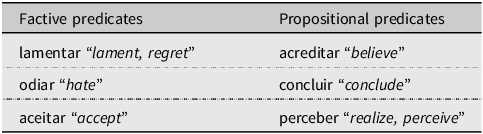
Half of these contexts included factive predicates in the superordinate clause (as in 26), while the other half included propositional predicates. These are summarized in Table 1.
BP matrix predicates by type included in the B-AJT

Table 1. Long description
A table with two columns and three rows. The columns are labeled ‘Factive predicates’ and ‘Propositional predicates’. The rows list the following pairs: ‘lamentar “lament, regret” and acreditar “believe”’, ‘odiar “hate” and concluir “conclude”’, ‘aceitar “accept” and perceber “realize, perceive”’.
As discussed in “Types of control: The theoretical distinctions”, Landau (Reference Landau2000) has proposed that both factive and propositional predicates may select PC in the subordinate clause; we therefore refer to these as PC predicates. The other half of the contexts did not allow a PC reading (27), and for this reason, we call these NC contexts (non-control in Modesto). As with the PC contexts, these sentences were also followed by a paraphrase within parentheses to make the intended reading clear.
(27)
NC context
Depois de saber o que aconteceu com os Glic, Will lamenta estarem perdidos
“After learning what happened to the Glic, Will regretted them being lost”
(Will lamenta os Glic estarem perdidos)
(“Will regretted that the Glic were lost”)
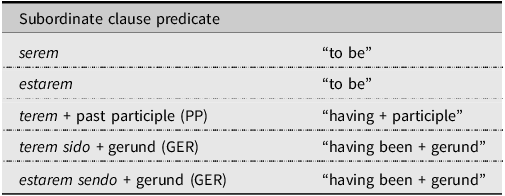
NC contexts included the same predicates that appear in Table 2. Additionally, all subordinate clause infinitives were inflected with third-person plural agreement and were of five possible types.
BP subordinate clause predicates by type included in the B-AJT
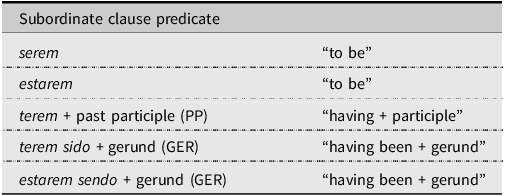
Table 2. Long description
A table with five rows and two columns. The columns are labeled ‘Subordinate clause predicate’ and translations. The rows are as follows: Row 1: serem, to be; Row 2: estarem, to be; Row 3: terem + past participle (PP), having + participle; Row 4: terem sido + gerund (GER), having been + gerund; Row 5: estarem sendo + gerund (GER), having been + gerund.
If the acceptability of agreeing infinitives in PC and NC sentences is found to exhibit no significant statistical differences, this will constitute an indeterminate judgment, thus confirming Rodrigues and Hornstein’s (Reference Rodrigues and Hornstein2013) suggestion that such sentences are indeterminate and, furthermore, data related to them should not be utilized in theorizing related to the syntactic analysis of raising and control. Although we had no reason to suspect that any differences would arise, we also decided to examine if subordinate clause type aids in the acceptability of PC contexts with agreeing infinitives as part of research question three.
Given the length of the task being replicated, the decision was taken to not include additional distractors, which would increase the potential for fatigue. This is informed by market research (e.g., la Bruna & Rathod, Reference la Bruna and Rathod2005) suggesting that the ideal questionnaire length for avoiding participant fatigue is 17–20 minutes.
B-AJT results
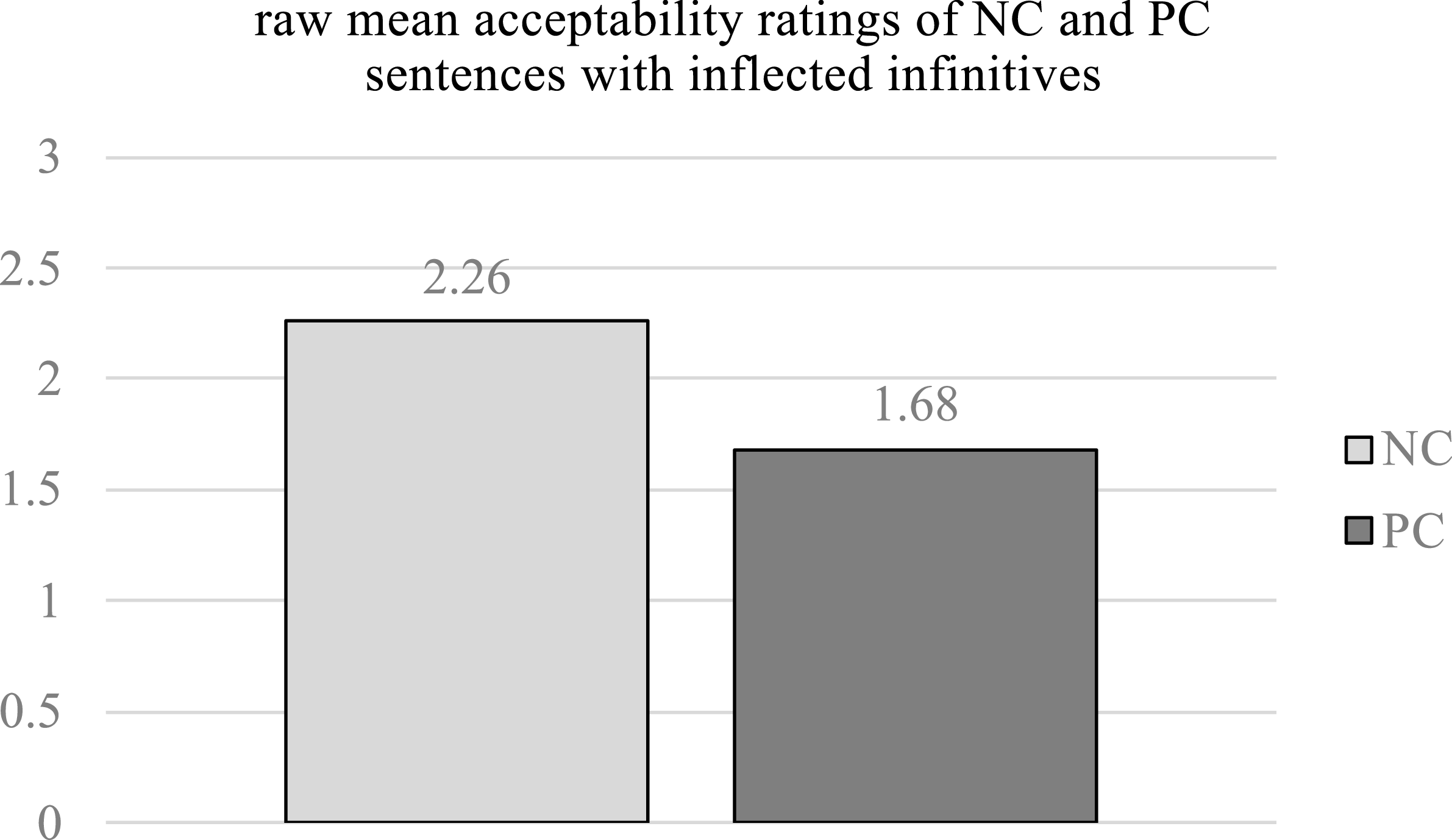
For the acceptability judgment, we examine data gathered from 45 out of 52 participants. Four participants were excluded from data analysis due to their linguistic background suggesting that they had less than eight years of formal education in Brazil delivered in Brazilian Portuguese. Three more participants were excluded owing to high quantities (10+) of “I don’t know” responses in this task.Footnote 21 A total of 2684 ratings were coded for the following independent variables: participant sex, subject ID number, context type (PC or NC), matrix predicate type (factive or propositional), and subordinate clause predicate type (ser, estar, ter+PP, ter sido+GER, estar sendo+GER). When converted to a four-point scale (0–3), the raw mean acceptability rating of PC sentences, the dependent variable, was 1.68, and 2.26 for NC sentences (Figure 1).
AJT. Raw mean acceptability ratings of NC and PC sentences.

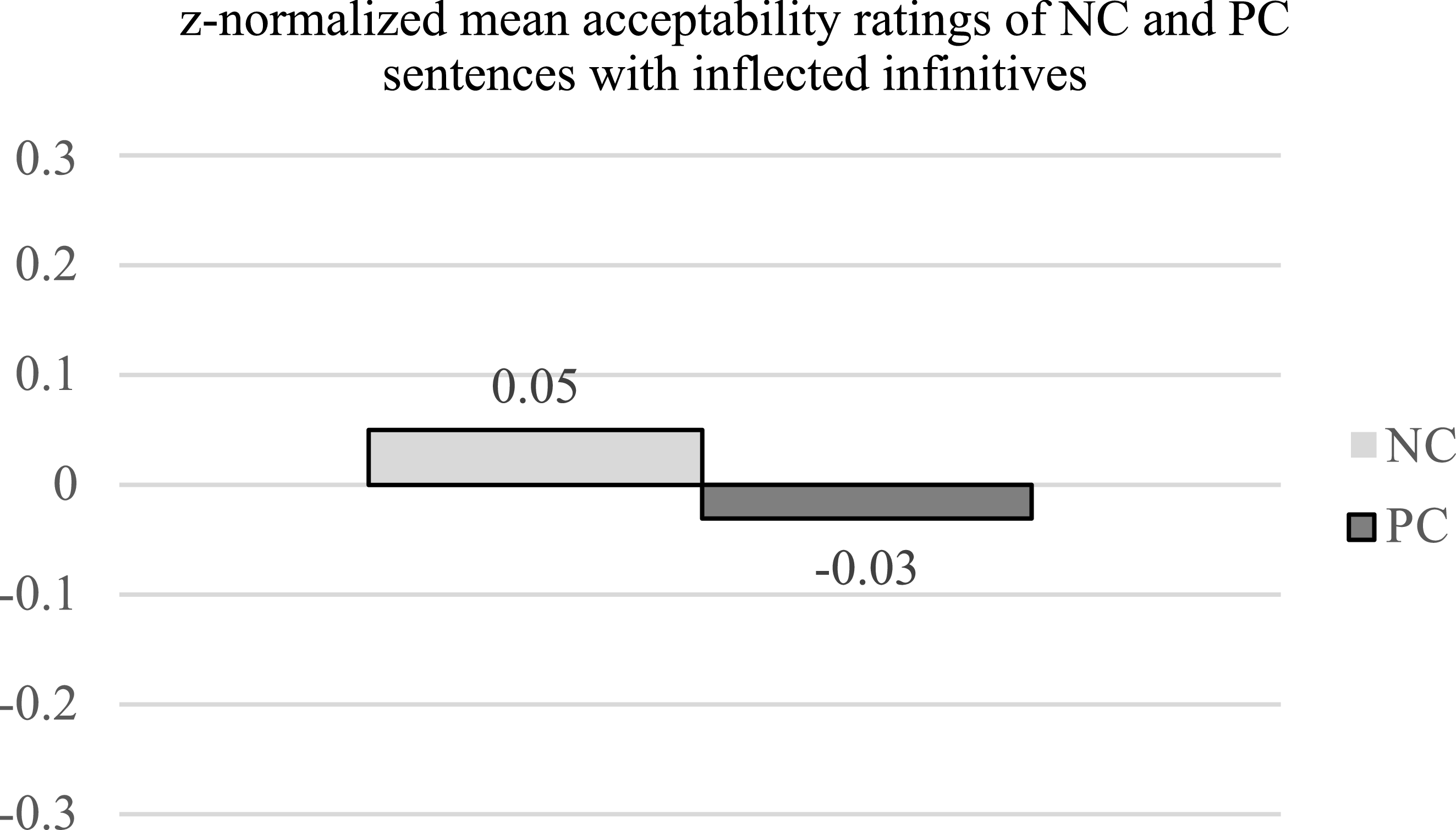
We then z-normalized these scores to ensure scale comparability among participants, following suggestions in Sprouse et al. (Reference Sprouse, Caponigro, Greco and Cecchetto2016), netting a minimum acceptability rating of −3.65 and a maximum of 2.22. The z-normalized mean acceptability of PC sentences was −0.03 (s.d. = 0.98), and for NC sentences it was 0.05 (s.d. = 0.93), as reported in Figure 2.
AJT. Z-normalized mean acceptability ratings of NC and PC sentences.
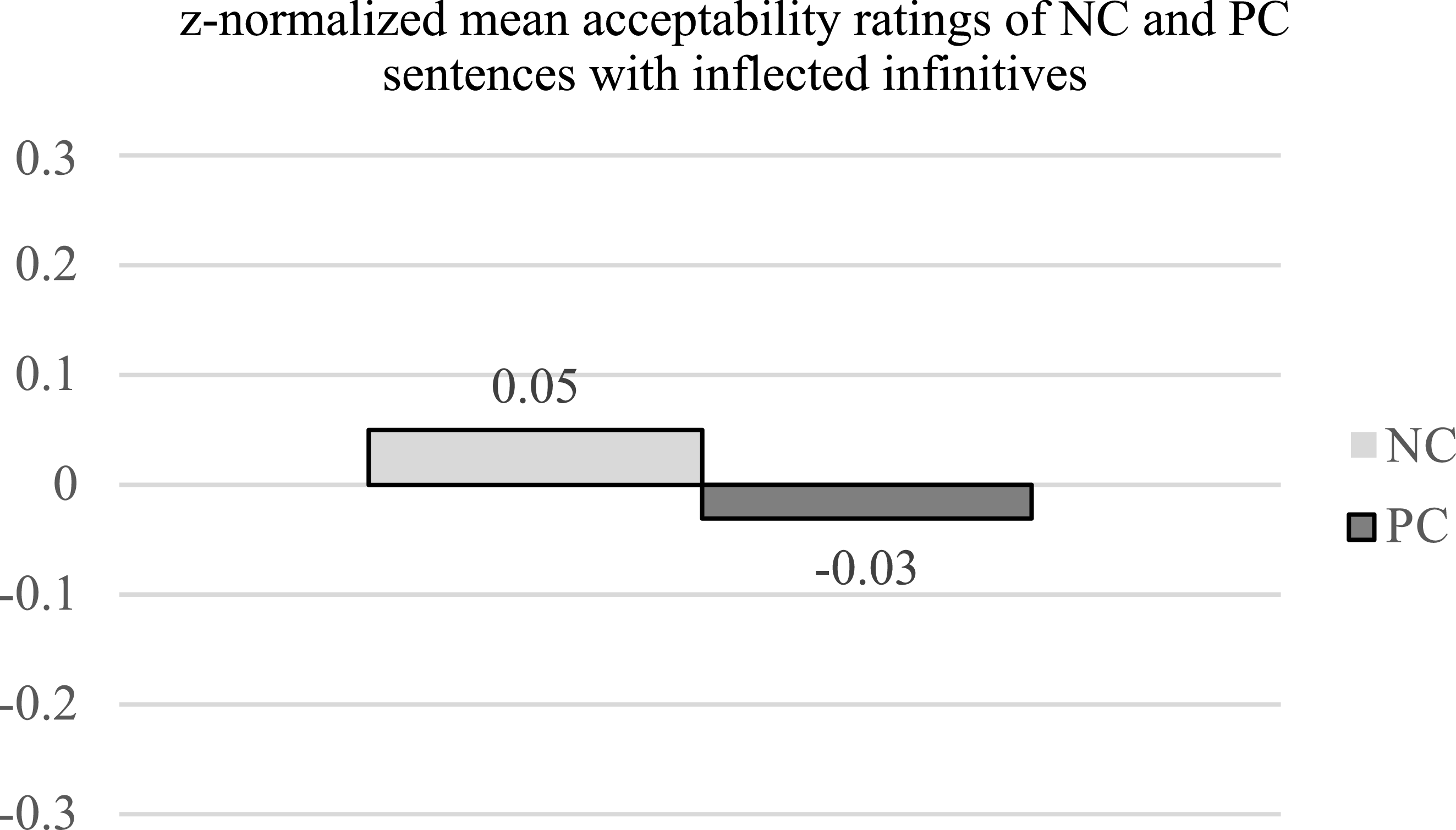
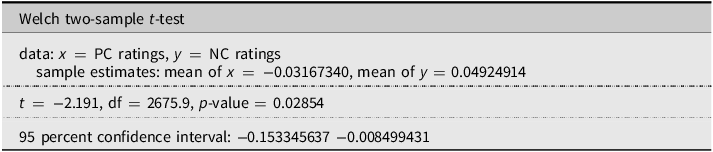
A Welch two-sample t-test (Table 3) revealed a statistically significant difference (p < 0.029) between the ratings of PC and NC sentences.
Welch two-sample t-test comparing acceptability ratings of NC and PC sentences
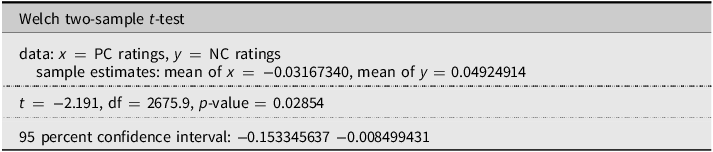
Table 3. Long description
A table showing results of a Welch two-sample t-test comparing PC and NC ratings. The table has 6 rows and 3 columns. Column headers are data, sample estimates, and t. Row 1: data, x equals P C ratings, y equals N C ratings. Row 2: sample estimates, mean of x equals negative 0.03167340, mean of y equals 0.04924914. Row 3: t, t equals negative 2.191, d f equals 2675.9, p-value equals 0.02854. Row 4: 95 percent confidence interval, negative 0.153345637 to negative 0.008499431.
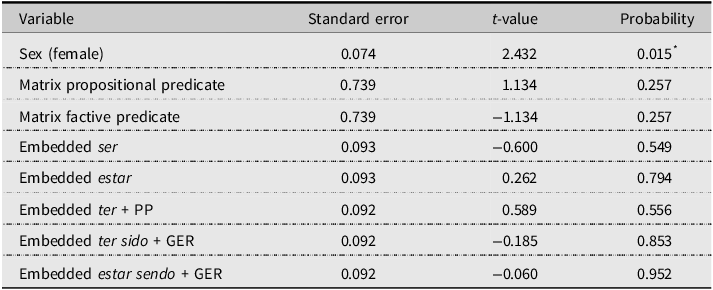
Linear regressions to test for interactions between the independent variables and sentence acceptability of PC sentences were conducted using the linear model (lm) function in RStudio. These results are summarized in Table 4.
AJT. Linear regression statistics, interaction of variables with acceptability of PC sentences
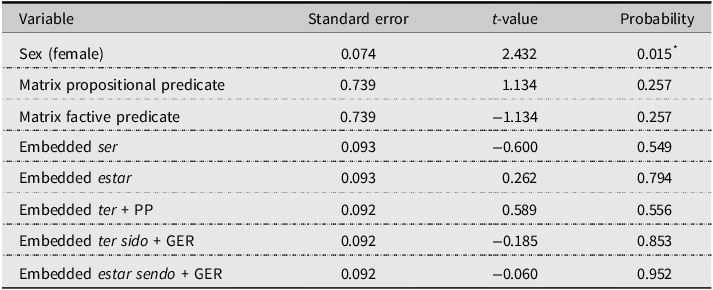
Table 4. Long description
A table titled AQ9 with linear regression statistics for various variables. The table has 8 rows and 4 columns. The columns are labeled Variable, Standard error, t-value, and Probability. The rows list different variables and their corresponding standard error, t-value, and probability. Row 1: Sex (female), Standard error 0.074, t-value 2.432, Probability 0.015. Row 2: Matrix propositional predicate, Standard error 0.739, t-value 1.134, Probability 0.257. Row 3: Matrix factive predicate, Standard error 0.739, t-value -1.134, Probability 0.257. Row 4: Embedded ser, Standard error 0.093, t-value -0.600, Probability 0.549. Row 5: Embedded estar, Standard error 0.093, t-value 0.262, Probability 0.794. Row 6: Embedded ter + PP, Standard error 0.092, t-value 0.589, Probability 0.556. Row 7: Embedded ter sido + GER, Standard error 0.092, t-value -0.185, Probability 0.853. Row 8: Embedded estar sendo + GER, Standard error 0.092, t-value -0.060, Probability 0.952.
* Statistically significant result at a confidence interval greater than 95%.
Of the independent variables examined in Table 4, participant sex was the only independent variable found to positively favor acceptability ratings of PC sentences. As a robustness check, we re-ran a linear model with matrix predicate type (in this case, factive), but entering participant number as a random factor. The result was non-significant when participant-related variables were removed from the model (SE = 0.067, z-value = −1.222, p = 0.222), therefore suggesting that these participant-related variables are significant predictors of the acceptability of PC sentences.
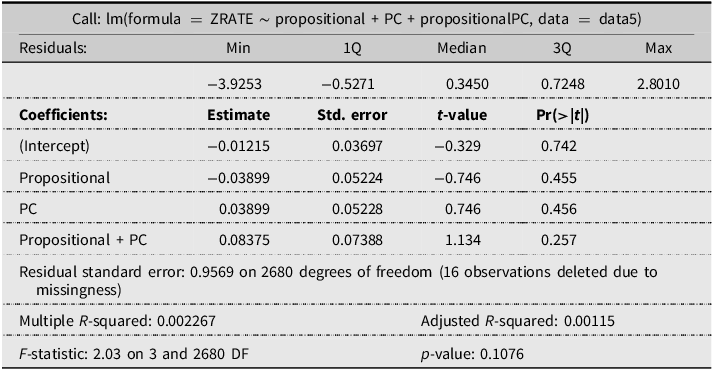
We then tested for particular interactions between either propositional or factive predicates in the matrix clause and positive acceptability of PC readings, running a linear model for each. In Table 5 we can see that, for sentences with matrix propositional predicates, no variable was found to be a significant predictor of acceptability.
Linear regression results for Task 1. PC sentences with propositional predicates
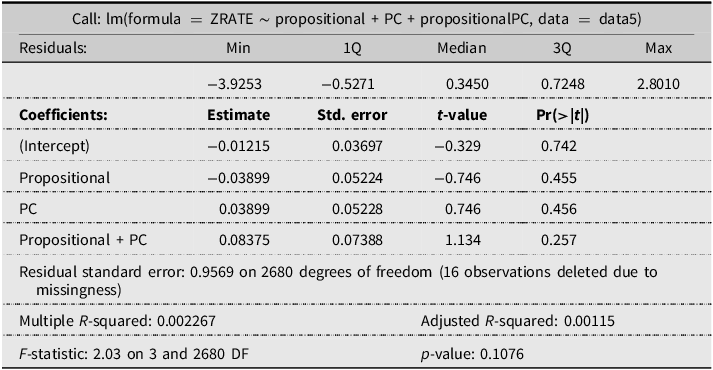
Table 5. Long description
A table displaying linear regression results for Task 1 with propositional predicates. The table has 10 rows and 6 columns. The columns are labeled Residuals, Estimate, Std. error, t-value, and Pr(>|t|). The Residuals row includes Min, 1Q, Median, 3Q, and Max values. The Coefficients section includes rows for (Intercept), Propositional, PC, and Propositional + PC, each with corresponding Estimate, Std. error, t-value, and Pr(>|t|) values. Notable values include an Estimate of -0.01215 for (Intercept) and a Pr(>|t|) of 0.455 for Propositional. The table also includes Residual standard error, Multiple R-squared, Adjusted R-squared, F-statistic, and p-value at the bottom.
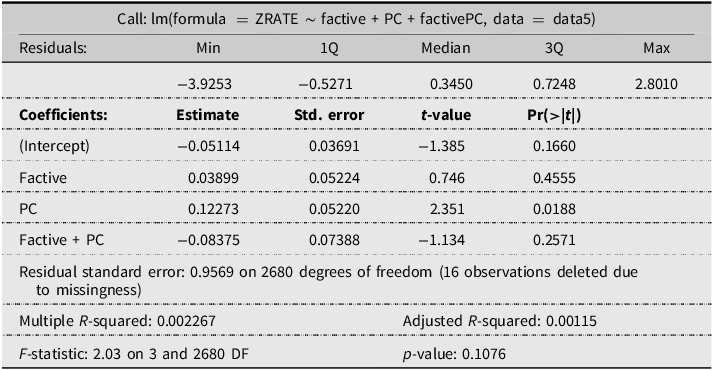
In Table 6 we can see that, for sentences with matrix factive predicates and PC readings, the PC reading was found to be a significant predictor (Est. = 0.12273, SE = 0.05220, t = 2.351, p = 0.019). We interpret this as further evidence against claims of indeterminate judgments as they relate to sentences with PC readings.
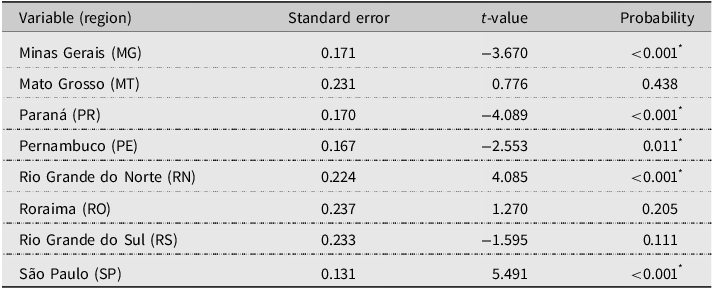
Curious as to whether there might be regional variation, in our methodology, we additionally attempted to gather information regarding where participants were from, but only 19/52 participants responded to this question. Two of those were among the participants excluded, leaving 17/45.Footnote 22 We therefore ran linear regression models, testing for interactions between geographic region in Brazil (as determined by state) and the acceptability of PC sentences. These statistics appear in Table 7.
Linear regression results for Task 1. PC sentences with factive predicates
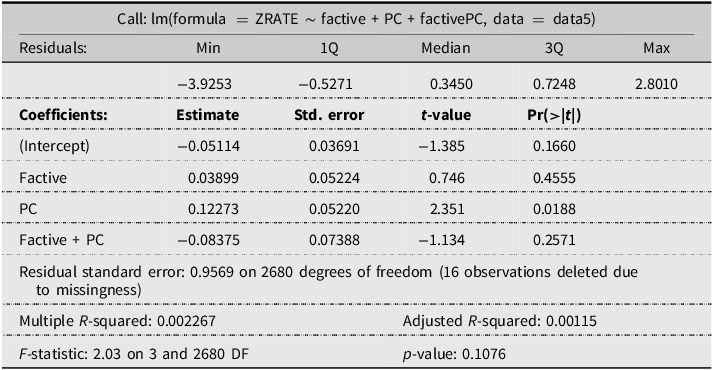
Table 6. Long description
A table displaying linear regression results for Task 1, focusing on sentences with matrix factive predicates and PC readings. The table has 10 rows and 6 columns. Column headers are Call, Residuals, Coefficients, Estimate, Std. error, t-value, and Pr(>|t|). Row labels include Min, 1Q, Median, 3Q, Max, (Intercept), Factive, PC, and Factive + PC. Residuals values are Min: -3.9253, 1Q: -0.5271, Median: 0.3450, 3Q: 0.7248, Max: 2.8010. Coefficients values are (Intercept) Estimate: -0.05114, Std. error: 0.03691, t-value: -1.385, Pr(>|t|): 0.1660; Factive Estimate: 0.03899, Std. error: 0.05224, t-value: 0.746, Pr(>|t|): 0.4555; PC Estimate: 0.12273, Std. error: 0.05220, t-value: 2.351, Pr(>|t|): 0.0188; Factive + PC Estimate: -0.08375, Std. error: 0.07388, t-value: -1.134, Pr(>|t|): 0.2571. Additional information includes Residual standard error: 0.9569 on 2680 degrees of freedom, Multiple R-squared: 0.002267, Adjusted R-squared: 0.00115, F-statistic: 2.03 on 3 and 2680 DF, p-value: 0.1076.
AJT. Linear regression statistics, interaction of geographical region with acceptability of PC sentences
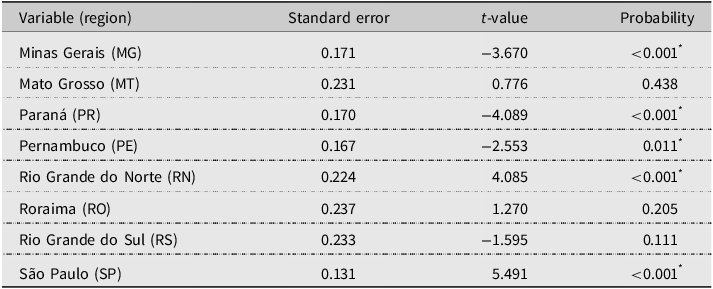
Table 7. Long description
A table titled AQ10 displaying linear regression statistics for different regions in Brazil. The table has four columns: Variable (region), Standard error, t-value, and Probability. It includes data for eight regions: Minas Gerais (MG), Mato Grosso (MT), Paraná (PR), Pernambuco (PE), Rio Grande do Norte (RN), Roraima (RO), Rio Grande do Sul (RS), and São Paulo (SP). Each row lists the standard error, t-value, and probability for the respective region. Notable values include Minas Gerais with a standard error of 0.171 and a t-value of -3.670, and São Paulo with a standard error of 0.131 and a t-value of 5.491.
* Statistically significant result at a confidence interval greater than 95%.
The regression results in Table 7 indicate that state of origin is a significant predictor of acceptability of agreeing infinitives in PC contexts. A positive t-value indicates positive acceptability for agreeing infinitives among participants from São Paulo and Rio Grande do Norte states. Negative t-values appear for participant data from the states of Minas Gerais, Paraná, and Pernambuco, which indicates a tendency to rate PC sentences with agreeing infinitives lower. With respect to participants from the states of Mato Grosso, Roraima, and Rio Grande do Sul, state of origin is not a significant predictor of acceptability of agreeing infinitives with PC readings. In “Discussion”, we discuss these findings in greater detail, relating them to our research questions.
Discussion
Recall that the current study seeks to shed light on the status of inflected infinitives among speakers of BP, following up on suggestions of indeterminacy as related to their status in the mental grammars of BP speakers. A finding of indeterminacy would serve to challenge the validity of experimental studies like Modesto (Reference Modesto, Santos and Gonçalves2018) and Merchant and Gupton (Reference Merchant and Gupton2025), which have gathered data on the processing and acceptability of inflected infinitives in BP that appear to challenge the MTC (e.g., Hornstein, Reference Hornstein1999). We sought to further explore this issue by examining independent variables such as gender and region in Brazil in addition to linguistic variables proposed by Landau (Reference Landau2000).
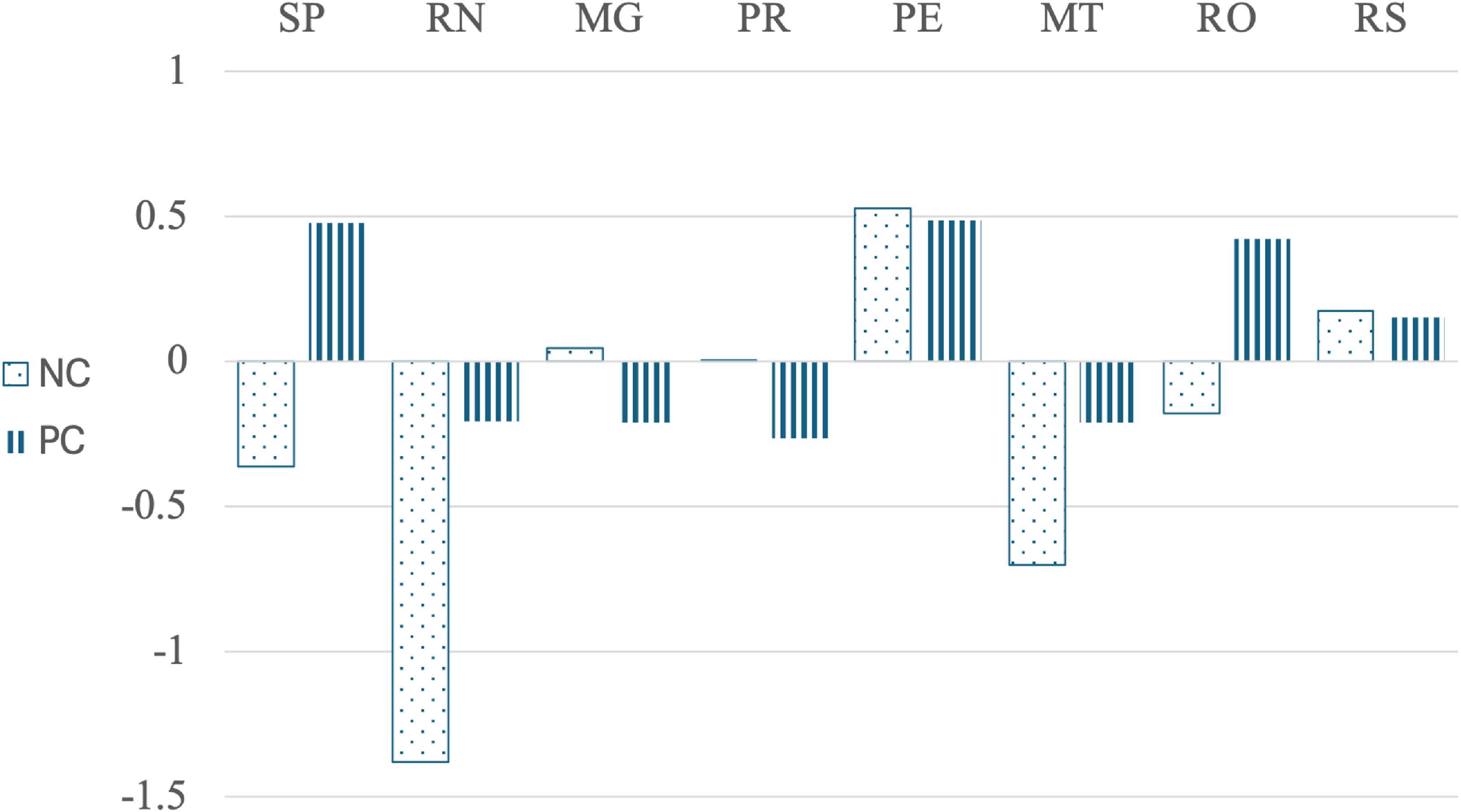
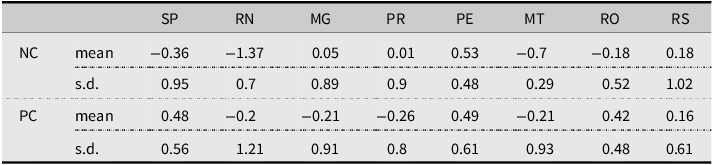
Given the results in “Experimental methodology”, we have summarized the z-normalized acceptability ratings according to geographic region for participants who provided this optional information in Table 8. In Figure 3, we can visualize more clearly which regions in Brazil distinguish between PC and NC sentences:
Z-normalized acceptability of NC and PC readings of inflected infinitives by Brazilian state.

As we can see, BP speakers from São Paulo and Roraima tend to accept PC sentences with agreeing infinitives, but do not accept NC sentences. While speakers from Pernambuco and Rio Grande do Sul accept PC sentences with agreeing infinitives, they do not appear to distinguish between NC and PC sentences. Results from four participants from São Paulo appear to be consonant with results gathered from 26 participants from the same area in Modesto (Reference Modesto, Santos and Gonçalves2018). However, we would like to caution the reader that these results are from extremely limited numbers of BP participants in this study, and as such, should be treated as pointing toward the need for further research.
Discussion of research questions
With respect to our first two research questions, PC contexts with agreeing infinitives were rated unacceptable overall by participants, while NC contexts with agreeing infinitives were rated as acceptable. This result initially appears to differ from Modesto’s (Reference Modesto, Santos and Gonçalves2018) results, given that intuitions in our results are not as robust and in opposite directions. However, regarding our third research question, we found that PC and NC contexts are not equally unacceptable. Our participants distinguish between PC and NC contexts with agreeing infinitives, which challenges the suggestion from Rodrigues and Hornstein (Reference Rodrigues and Hornstein2013) of indeterminacy in the i-grammar of BP with respect to agreeing infinitives. Regression results of data gathered from 17 participants who indicated their state of origin identify place of origin as a significant factor in determining whether BP speakers accept PC readings in sentences with agreeing infinitives (Table 7). As we have seen, BP speakers from São Paulo and Roraima accepted PC sentences with agreeing infinitives, but did not accept NC sentences. In our opinion, these results challenge the claim that intuitions associated with agreeing infinitives in PC contexts in the grammar of BP are somehow indeterminate. Furthermore, they are suggestive that the acceptability and use of agreeing infinitives is subject to diatopic variation, which may prove ripe for a syntactic microvariation account (e.g., Kayne, Reference Kayne, Cinque and Kayne2005). We would like to highlight that we report on region information for a limited number of participants; therefore, these findings should be treated with care. Nevertheless, they point toward the need for linguistic researchers to take this variable into account when considering future studies of infinitives in BP.
Regarding research question 4, the regression analyses reveal that, in sentences with agreeing infinitives and factive predicates, a PC reading favors acceptability. In sentences with agreeing infinitives and propositional predicates in PC reading contexts, none of these factors predict acceptability. This asymmetry is not predicted by Landau’s classification of predicate types. The only immediate difference between these predicate types that comes to mind is that factive predicates are traditionally understood to presuppose the truth of their complement (28a), while propositional predicates do not (28b), and may be canceled.Footnote 23
(28)
a.
John was shocked to have met Janet Jackson. (*but he didn’t)
b.
John claimed to have met Janet Jackson. (but he didn’t)
We would like to suggest that the cancelability of the complements of propositional predicates may be responsible for their lower acceptability rating. With respect to truth conditions, participants may have found the fictional story of Will Robinson difficult to evaluate and thus assigned lower ratings to these sentences.Footnote 24
Additionally, the regression results revealed unexpected differences among subordinate clause predicates, with estar and ter + PP favoring positive acceptability, while other predicates either predicted negative ratings (ser) or were not associated with any particular acceptability (ter sido + GER, estar sendo + GER). This detail should inform future experimental studies of control in general and PC in particular.
Although our research questions did not seek to determine any sex-related differences related to the acceptability of agreeing infinitives in PC contexts, regression results suggest that females rate them higher than males do. It is as yet unclear if this represents a change in progress, or perhaps the sociolinguistic tendency among women to emulate members of aspirational socioeconomic groups, a possibility that bears potential for supporting the claim that intuitions about agreeing infinitives and PC exist among those with the greatest amounts of formal education (see e.g., Meyerhoff, Reference Meyerhoff2019 for more on the tendency of women to emulate aspirational socioeconomic groups and to lead linguistic change). Such a scenario might favor viewing European Portuguese grammar, which allows for agreeing infinitives in PC readings, as the aspirational normative variety. We leave this issue for those working in sociolinguistics to determine. What seems clear to us is that there is diatopic variation within Brazil with respect to the relative acceptability of PC sentences. Therefore, we feel that there is good reason to consider acceptability judgments related to control and agreeing infinitives in BP as legitimate, and worthy of playing a role in theory building.
Now that we have confirmed that BP speakers have intuitions related to agreeing infinitives and distinguish between PC and NC readings, we can revisit the debate on the syntactic analysis of control sentences, combining these results with the linguistic processing of control and raising structures as reported in Merchant and Gupton (Reference Merchant and Gupton2025), which involved the same participant pool.
Acceptability and processing
Recall that, according to Rodrigues and Hornstein (Reference Rodrigues and Hornstein2013: 307), “Brazilian Portuguese inflected infinitives should not be used as evidence in favor of any theoretical issue, as it is not clear what kind of knowledge speakers have with respect to these verbal forms.” As we have seen, the acceptability results for partial control and NC sentences with agreeing infinitives examined in “Experimental methodology” and “Discussion” differ to a degree that is statistically significant. Therefore, the data examined further informs our collective knowledge regarding the theoretical status of agreeing infinitives in BP. We feel that the data presented challenge the suggestion of indeterminacy, while further justifying the experimental testing of the processing of control, raising, and similar structures in BP—some of which contain agreeing infinitives—to test the predictions of the MTC. Merchant and Gupton (Reference Merchant and Gupton2025) reason that, if raising and control structures are generated via the same syntactic mechanisms (as proposed by the MTC), then they should be processed similarly, as operationalized via reaction times (RTs) to stimuli. They employed a novel methodology called antecedent cross-modal repetition priming task (A-CMRP), which was designed to compare activation of phonologically overt pronouns/anaphora and theoretically-predicted empty categories (EC) at different points in the timecourse, with a particular interest in whether an EC or an overt pronoun reactivates its antecedent at the predicted gap positions, and whether target sentence types differ in the extent of reactivation, thus allowing for a comparison of partial and exhaustive control sentences to sentences with raising or overt anaphors.
The A-CMRP measured reactivation at three probe points: (1) following the matrix predicate, (2) at the predicted gap position, and (3) at the end of the sentence. We refer to these probe points as short [S], medium [M], and long [L] latencies, respectively, as in the following example of raising (29).
(29)
Os dados recolhidos resultaram [S] surpreendentemente [M] ser muito problemáticos para as hipóteses existentes [L]
“The data gathered turned out [S] surprisingly [M] to be very problematic for current hypotheses [L]”
For each sentence, a pair of probe words were chosen, an experimental target that appeared in the sentence prime and a non-target which did not appear in the sentence prime according to the participant’s assigned block. For (29) the prime was either recolhidos “gathered” or falsos “false”. Each subject saw either the target or non-target probe (randomized by trial).
The same participants who completed the B-AJT also completed the A-CMRP (engaging in the latter task first), while seated in an adjustable chair at a desk with a PC using e-Prime (Psychology Software Tools, 2016) and fitted with headphones.Footnote 25 During each trial, participants listened through a headset to a sentence prerecorded by a native speaker of BP. At one of three probe points in the recorded sentence, a central fixation point ([ # ]) was replaced by a probe word, which was displayed for 500 ms. Participants were asked to decide as quickly as possible, while still making sure to answer accurately, whether the probe that they saw had appeared earlier in the sentence they were listening to. If the word had appeared, they were asked to press the spacebar on a keyboard; if the word had not appeared in the sentence, they were asked to do nothing.Footnote 26 The computer recorded all response latencies, measured from the onset of the visual probe until the moment that the subject pressed a button in response. After a 2000 ms delay, the next trial began. As with the B-AJT, the same participants were excluded, thus leaving us with data gathered from 45 participants.
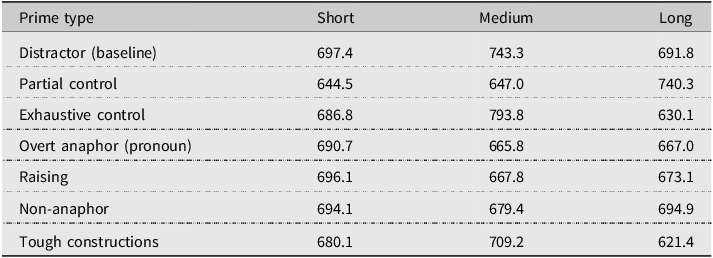
Table 9 shows evidence of similar reactivation in the gap position (i.e., at medium latency) in raising sentences and in those with overt pronouns, thus supporting the standard account of movement in raising constructions, where a trace/copy of the raised element reactivates it in the gap position. No such reactivation was found for exhaustive control sentences at medium latency; pairwise comparisons revealed that response times were significantly slower in EC sentences (793.8 ms) than in raising sentences (667.8 ms, SE = 61.877, t = 2.037, df = 1461, p = 0.042). They were also significantly slower than sentences with overt pronouns (665.8 ms, SE = 63.149, t = 2.027, df = 1461, p = 0.043).
Z-normalized acceptability ratings of NC and PC sentences by state in Brazil
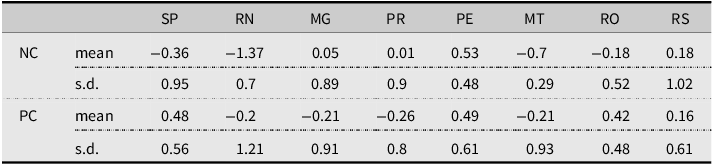
Table 8. Long description
A table comparing normalized acceptability ratings for NC and PC across various states in Brazil. The table has 2 groups, 8 columns, and 4 rows. Column headers are SP, RN, MG, PR, PE, MT, RO, RS. Row labels are NC mean, NC s.d., PC mean, PC s.d. Row 1: SP, -0.36; RN, -1.37; MG, 0.05; PR, 0.01; PE, 0.53; MT, -0.7; RO, -0.18; RS, 0.18. Row 2: SP, 0.95; RN, 0.7; MG, 0.89; PR, 0.9; PE, 0.48; MT, 0.29; RO, 0.52; RS, 1.02. Row 3: SP, 0.48; RN, -0.2; MG, -0.21; PR, -0.26; PE, 0.49; MT, -0.21; RO, 0.42; RS, 0.16. Row 4: SP, 0.56; RN, 1.21; MG, 0.91; PR, 0.8; PE, 0.61; MT, 0.93; RO, 0.48; RS, 0.61.
A-CMRP. Estimated marginal mean reaction times (in ms) for CRETs by prime type and probe latency
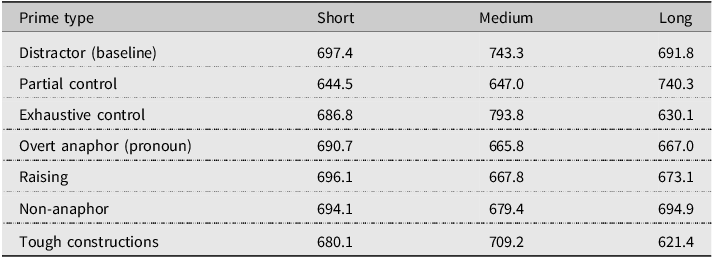
Table 9. Long description
A table comparing estimated marginal mean reaction times (in milliseconds) for different prime types and probe latencies. The table has 8 rows and 4 columns. The columns are labeled Prime type, Short, Medium, and Long. The rows are labeled with different prime types: Distractor (baseline), Partial control, Exhaustive control, Overt anaphor (pronoun), Raising, Non-anaphor, and Tough constructions. Each row lists the reaction times for short, medium, and long probe latencies. For example, the Distractor (baseline) row shows 697.4 ms for Short, 743.3 ms for Medium, and 691.8 ms for Long. The Exhaustive control row shows 686.8 ms for Short, 793.8 ms for Medium, and 630.1 ms for Long. The table provides detailed reaction times for each prime type across different probe latencies.
The results in Merchant and Gupton (Reference Merchant and Gupton2025) are convergent with those from two otherwise dissimilar experimental studies that also suggest a dissociation in the processing of raising and control structures. Sánchez et al. (Reference Sánchez, Sevilla and Bachrach2016) examined the processing of control and raising predicates and their interaction with grammatical gender in Porteño Spanish, employing a visually-primed repetition task that required participants to maintain an adjective stem in active memory while listening to audio presentation of the control/raising sentence, and subsequently produce the appropriate agreement on the adjective at the end of the sentence. Although they did not distinguish between EC and PC in their stimuli, they found significantly faster reaction times in raising sentences as compared to control, as well as a significantly higher rate of omissions (i.e., failure to respond with an inflected adjective) in the latter sentence type. Evidence for a dissociation between these sentence types is not limited to behavioral measures; an ERP study of subject control and raising in German (Experiment 6) in Featherston et al. (Reference Featherston, Gross, Münte and Clahsen2000) revealed a significant difference in P600 values at the gap position in raising and in subject-control sentences, leading them to conclude that this evidence is consistent with the standard theoretical account distinguishing between NP trace on the one hand and PRO on the other.
Merchant and Gupton (Reference Merchant and Gupton2025) conclude that the results examined in this section are highly suggestive of different linguistic mechanisms being involved in the processing of raising and control structures in BP. For them, if movement is operative in ExC as well as raising sentences, we should find similar patterns of reactivation of antecedents in the gap position. However, this prediction does not bear out: the significant differences in processing between raising and ExC in the gap position are inconsistent with what might reasonably be assumed to be the predictions of the MTC as to how these sentences are processed.Footnote 27 This, combined with the statistical similarities between raising and overt pronoun anaphors, strongly suggests that raising and ExC phenomena are represented differentially in the mental grammar of BP.
Challenges and future directions
In this study, we have attempted to shed light on the claim in Rodrigues and Hornstein (Reference Rodrigues and Hornstein2013) that BP speakers have indeterminate intuitions related to inflected infinitives. Data gathered from our native-speaker BP participants living in the US suggest that BP speakers overall have linguistic intuitions associated with agreeing infinitives, thus distinguishing between NC and PC readings with agreeing infinitives. The results also suggest that the nature of these intuitions is subject to regional variation, with speakers from the states of São Paulo and Roraima exhibiting the greatest acceptance. This result for speakers from São Paulo confirms Modesto’s (Reference Modesto, Santos and Gonçalves2018) findings regarding acceptability of inflected infinitives in BP. Furthermore, experimental data in Modesto et al. (Reference Modesto, Soto and França2023) suggest that inflected infinitives are not uncommon in production, at least among inflecting speakers of BP.
This is the first study that we are aware of to correlate geographical origin and judgments of agreeing infinitives in BP. However, the small numbers of participants who chose to provide information regarding place of origin are an obvious limitation of the current study. Nevertheless, the results examined in this study highlight the importance of collecting data on this variable in future studies. This should lead us toward a deeper understanding of the availability of different infinitive structures in BP as well as a greater understanding of diatopic variation in Brazil, which may reveal the presence of syntactic microvariation. Further research with BP-speaking participants inside and outside of Brazil will confirm or disconfirm these admittedly partial initial findings.
A related limitation has to do with the linguistic profile of our participants, all of whom are BP-English bilinguals to a greater or lesser degree. Given that many resided in the US at the time of data collection, we feel a responsibility to address the possibility of first language (L1) attrition among our participants, which carries the potential to adversely affect the data collected. If Pires and Rothman (Reference Pires, Rothman, Pires and Rothman2009) are correct and inflected INFs are primarily acquired via the formal education system in Brazil, attrition might be expected to target these structures in the event that varied contexts requiring formal registers become infrequent for BP speakers. Our study did not collect information capable of making a determination in this regard. Therefore, we are unable to arrive at a definitive conclusion as to whether the participants in our study have attrited L1 grammars—in fact, no data that we collected was conceived to answer this research question. Notwithstanding, we suspect that the same proviso applies to a vast body of native-speaker control data in second-language acquisition (SLA) research gathered over the last 40+ years from native-speaker controls residing outside their country of origin. Even though late-acquired SLA (L2) has been found to have influence on the L1 resulting in cross-linguistic interference, Pavlenko (Reference Pavlenko2000, Reference Pavlenko, Schmid, Köpke, Keijzer and Weilemar2004) has argued that L2 interference on the L1 is not necessarily evidence of L1 attrition. We would like to suggest that it is more likely a normal result of bilingualism/multilingualism. For Kasparian and Steinhauer (Reference Kasparian and Steinhauer2016), attrition results from decreased use of the L1 and reduced L1 activation accompanied by reduced proficiency.Footnote 28
Following Kasparian and Steinhauer (Reference Kasparian and Steinhauer2016, Reference Kasparian and Steinhauer2017), L1 attrition follows an inverse trajectory to that of (successful) L2 acquisition.Footnote 29 This sort of perspective on attrition can be informed by the Interface Hypothesis (IH), which was developed by Antonella Sorace and colleagues in order to account for subtle non-target-like (i.e., non-native) performance among extremely advanced L2 acquirers. In an early formulation (Sorace & Serratrice, Reference Sorace and Serratrice2009), the interface between syntax and other modules of the grammar was predicted to result in persistent optionality and instability. More recent research on the IH has found that not all syntactic interfaces are equally problematic, therefore motivating a split between internal and external interfaces (Sorace, Reference Sorace2011; see also White, Reference White2011 for a review and critical commentary). External interface phenomena tend to approach native-like levels of acquisition at advanced levels of L2 acquisition, and are typically subject to greater instability and residual optionality because they involve an interface between the syntax and an external module of the grammar, such as discourse-pragmatics, discourse-prosody, or discourse-information structure.Footnote 30 Internal interfaces are those involving the syntax and modules such as the lexicon or semantics, both of which are implicated in the acquisition of control and raising. Applied to attrition and the context of L1 BP-L2 English bilinguals living abroad, the IH would predict that control and raising structures should be less subject to interface-related instability than syntactic interface phenomena involving the consolidation of syntax with modules considered to be external.
In other studies on bilingualism over the last decade, there has been a proliferation of research on heritage as well as SLA problematizing the notion of the idealized native speaker—in particular, the notion that the native speaker should be monolingual (e.g., Gudmestad et al. Reference Gudmestad, Edmonds and Metzger2021; Kupisch & Rothman, Reference Kupisch and Rothman2018; Putnam & Sánchez, Reference Putnam and Sánchez2013; Rothman & Treffers-Daller, Reference Rothman and Treffers-Daller2014).Footnote 31 Tsehaye et al. (Reference Tsehaye, Pashkova, Tracy and Allen2021) advocate in favor of a more nuanced approach to capture native-speaker diversity. In the current study, we took a conservative approach and excluded participants who reported incomplete formal education in Brazil. Whether the data examined within differs significantly from native-speaking BP populations residing in Brazil is, for the moment, an open empirical question that we leave for future research. Despite the considerable challenges presented by the massive geographical area in which BP is spoken, future studies of control and similar phenomena in BP should strive to represent a multiplicity of dialect areas and sociolinguistic strata. Such efforts will provide us with greater insight on any changes taking place in Brazilian Portuguese.
Acknowledgements
We thank our Brazilian consultants, Camila Lívio Emidio, and Diogo Cosme, who were instrumental in designing and validating our stimuli. We thank Camila for lending her voice, Rachel Olsen for her tireless work on our sound files during the recording process, and Kit Callaway for her assistance with participants. We are grateful to our anonymous Applied Psycholinguistics reviewers, whose suggestions improved the present work. Finally, we offer special thanks to Marcello Modesto, Idan Landau, audiences at Going Romance XXXV, the UGA Linguistics Colloquium and Penn State’s Morphology and Syntax Syndicate (now the Morphology Circle), as well as Tom Bever, Acrisio Pires, Vera Lee-Schoenfeld, Paula Schwanenflugel, Luke Smith, Sara Carter, Sandra McGury, Jonathan Crum, the Department of Linguistics, Department of Romance Languages, and The Graduate School at UGA, the Department of Linguistics and Asian/Middle Eastern Languages at San Diego State University, and the Department of Linguistics at the University of Michigan.
Financial support
This study was not funded by any grant.
Ethical standards
All procedures performed in studies involving human participants were in accordance with the ethical standards of the institutional and/or national research committee and with the 1964 Helsinki declaration and its later amendments or comparable ethical standards.
Informed consent
Informed consent was obtained from all individual participants included in the study.

 Open access

