Language users often find themselves in multilingual communicative settings, such as when international business colleagues use both English and their native language (or their respective native languages). In such situations, language use is likely influenced by cross-language interactionsFootnote 1 , such as code-switching (e.g., Bullock & Toribio, Reference Bullock and Toribio2009; Kootstra, Reference Kootstra, Stell and Yakpo2015) or transfer of production preferences and/or processing strategies (e.g., Alferink & Gullberg, Reference Alferink and Gullberg2014; Runnqvist, Gollan, Costa & Ferreira, Reference Runnqvist, Gollan, Costa and Ferreira2013). Cross-language interactions are studied in relation to different dimensions of bilingualism, like language processing, cognitive consequences of bilingualism, grammar, second language acquisition, contact-induced language change. They are therefore clearly at the core of bilingualism research. Indeed, studying cross-language interactions may increase our understanding of how these different dimensions of bilingualism relate to each other.
In the present study, we focus on cross-language interactions from different sources of experience in the production of dative sentences by Dutch-dominant Dutch–English bilinguals. Dutch and English both have two constructions for expressing a dative sentence, namely the prepositional-object construction (PO) Jan geeft het boek aan Marie / John gives the book to Mary and the double-object construction (DO) Jan geeft Marie het boek / John gives Mary the book. Previous monolingual studies (e.g., Bresnan, Cueni, Nikitina & Baayen, Reference Bresnan, Cueni, Nikitina, Baayen, Bouma, Krämer and Zwarts2007; Jaeger & Snider, Reference Jaeger and Snider2013) have shown that the choice between these structures in language production can be influenced by both recent and prior experience. Recent experience refers to language experience people build up during the current discourse, such as the influence of the preceding discourse on syntactic choice (structural priming). Prior experience refers to language experience people have built up before the current discourse, such as the frequency with which specific structures are used in combination with specific verbs (verb bias). Studies have shown that these factors work together in intricate ways, indicating that language users adapt and update their language production strategies on the basis of both these types of experience (e.g., Bernolet & Hartsuiker, Reference Bernolet and Hartsuiker2010; Jaeger & Snider, Reference Jaeger, Snider, Wolter and Thorson2007, Reference Jaeger and Snider2013). However, these factors were mostly investigated in monolingual settings. We investigated syntactic choice in a bilingual setting, when a speaker listens in one language and produces in another language (as is, for example, done in certain business situations; see e.g., Ten Thije & Zeevaert, Reference ten Thije and Zeevaert2007).
Specifically, we investigated how cross-language structural priming (recent experience) and verb bias (prior experience) influence syntactic choice across languages in bilinguals. In doing so, we also paid attention to another source of experience that is unique to bilinguals: bilinguals’ language dominance, which can be seen as a measure of bilinguals’ personal experience with both languages. Findings from our study will be informative for models on the representational nature of lexical and syntactic information in bilinguals (e.g., Hartsuiker & Pickering, Reference Hartsuiker and Pickering2008), theories on experience-based and usage-based language processing (e.g., Jaeger & Snider, Reference Jaeger and Snider2013; MacDonald, Reference MacDonald2013) and perspectives on contact-induced language change (e.g., Muysken, Reference Muysken2013). Before moving on to our study, we now first discuss earlier research on the factors we investigated.
Cross-language structural priming: both a research tool and real-life discourse factor
An important experimental technique to study syntactic cross-language interactions in a bilingual setting is cross-language structural priming (see e.g., Hartsuiker & Pickering, Reference Hartsuiker and Pickering2008, for a review). In the cross-language structural priming technique, bilinguals are presented with a prime sentence with a specific structure in one language, and then have to describe a target picture in another language, which can potentially be described with the structure of the prime sentence. The logic of the technique is that if participants’ syntactic choices in the target pictures are influenced by the structure of the prime sentence, then this means that syntactic information from a non-target language can influence target language production (i.e., syntactic cross-language interaction).
One of the first studies on cross-language structural priming was done by Loebell and Bock (Reference Loebell and Bock2003). Using the guise of a memory task, they asked German–English bilinguals to reproduce a dative sentence with a specific structure (PO or DO) in a specific language (either German or English) and then describe a dative picture in the other language. The reproduced dative sentence indeed turned out to prime structural choices in the other language. Cross-language structural priming effects have since been found in many studies using various tasks and language combinations, both from L1 to L2 and from L2 to L1 (e.g., Bernolet, Hartsuiker & Pickering, Reference Bernolet, Hartsuiker and Pickering2007, Reference Bernolet, Hartsuiker and Pickering2012, Reference Bernolet, Hartsuiker and Pickering2013; Cai, Pickering, Yan & Branigan, Reference Cai, Pickering, Yan and Branigan2011; Desmet & Declercq, Reference Desmet and Declercq2006; Hartsuiker, Pickering & Veltkamp, Reference Hartsuiker, Pickering and Veltkamp2004; Kantola & van Gompel, Reference Kantola and van Gompel2011; Schoonbaert, Hartsuiker & Pickering, Reference Schoonbaert, Hartsuiker and Pickering2007).
Cross-language structural priming has also been shown to be modulated by participant-specific forms of language experience, like language dominance and proficiency. Bernolet et al. (Reference Bernolet, Hartsuiker and Pickering2013), for example, found that cross-language structural priming of genitive constructions in Dutch learners of English was stronger with increasing proficiency in English. Similarly, Kootstra, van Hell & Dijkstra (Reference Kootstra, van Hell and Dijkstra2012) found that priming of code-switches in sentence production was strongest in bilinguals with a relatively high proficiency in both languages. In another study, Schoonbaert et al. (Reference Schoonbaert, Hartsuiker and Pickering2007) tested Dutch-dominant Dutch–English bilinguals to investigate a bilingual version of the ‘lexical boost effect’ in structural priming – the effect that structural priming is enhanced when there is lexical repetition between the prime and target (e.g., Branigan, Pickering & Cleland, Reference Branigan, Pickering and Cleland2000). They found structural priming both from Dutch to English and from English to Dutch, but only found a lexical boost effect (or rather a ‘translation-equivalent boost’) in the direction from Dutch (L1) to English (L2), thus pointing to stronger cross-language links from the dominant to the non-dominant language than vice versa. An additional indication of the role of language dominance in this domain is that Cai et al. (Reference Cai, Pickering, Yan and Branigan2011) tested (close to) balanced bilinguals and actually found bidirectional translation-equivalent boost effects; the bidirectionality of the effects is likely to be related to the fact that these bilinguals were balanced in terms of language dominance.
Thus, cross-language structural priming in bilingual sentence production is a powerful technique to tap into cross-language interactions at the syntactic level and to investigate how these interactions are linked with other factors, such as lexical factors (translation-equivalent boost) and participants’ language dominance and/or proficiency. These results have mainly been used to inform a model on the representational nature of lexical and syntactic representations in bilinguals, which assumes that syntactic representations are connected to lexical representations from both languages and can thus be shared across languages (see e.g., Hartsuiker et al., Reference Hartsuiker, Pickering and Veltkamp2004; Hartsuiker & Pickering, Reference Hartsuiker and Pickering2008). Proficiency and/or language dominance is accounted for in this model by assuming that representations from the dominant / more proficient language are easier to activate and more difficult to de-activate than representations from the non-dominant / less proficient language, resulting in relatively strong influences of the dominant language on processing in the non-dominant language compared to the other way around (see Hartsuiker & Bernolet, Reference Hartsuiker and Bernolet2015, for a developmental account of this model). A more complete discussion of the model is given in the ‘General discussion’ section of this paper.
Importantly, in addition to serving as a methodological tool to gain insight into the bilingual processing system, structural priming is also an actual cue for syntactic choice in real-life discourse. Corpus studies of spontaneous language use have for example found that syntactic choices are influenced by recently encountered utterances in the previous discourse, both in monolingual and bilingual discourse (e.g., Bresnan et al., Reference Bresnan, Cueni, Nikitina, Baayen, Bouma, Krämer and Zwarts2007; Gries, Reference Gries and Wulff2005; Torres Cacoullos & Travis, Reference Torres Cacoullos and Travis2011).
These real-life findings make cross-language structural priming an even more important mechanism to investigate. Not only do they add ecological validity to the findings from experiments, they also raise interesting new issues that have not been investigated much in bilingualism research. The first issue has to do with the dynamics of structural priming: if structural priming, including cross-language structural priming, is indeed a cue for syntactic choice that is regularly used in real-life discourse, then this can mean that cross-language structural priming has cumulative effects. After all, when a specific structure is used (and not the alternative structure), priming can increase the likelihood that this structure is re-used. If this process takes place repeatedly, priming can, over time, influence the relative frequency of one structure over the other. This can be seen as a way in which recent language experience can accumulate and perhaps have long-term consequences. The second issue concerns the question to what extent cross-language structural priming, which can be seen as a form of ‘recent’ experience, combines with other cues that have been found to influence syntactic choice on the basis of prior experience, such as the frequency with which certain structures go together with certain verbs (verb bias). We now discuss these two issues in more detail.
Potential cumulative effects of cross-language structural priming
Long-term effects of structural priming have been studied much in monolingual studies. These studies have shown that structural priming persists over a number of intervening filler items between prime and target (e.g., Bock & Griffin, Reference Bock and Griffin2000; Hartsuiker, Bernolet, Schoonbaert, Speybroeck & Vanderelst, Reference Hartsuiker, Bernolet, Schoonbaert, Speybroeck and Vanderelst2008) and even over complete experimental sessions (e.g., Kaschak, Reference Kaschak2007; Kaschak, Kutta & Coyle, Reference Kaschak, Kutta and Coyle2014; Kaschak, Kutta & Schatschneider, Reference Kaschak, Kutta and Schatschneider2011). Similarly, and just as we suggested in the previous paragraph, speakers’ own recent linguistic choices and experience have been found to influence their current choices in a continuous way, in the sense that speakers are more likely to produce a specific construction when they have frequently produced or encountered this construction in the previous recent discourse (Jaeger & Snider, Reference Jaeger, Snider, Wolter and Thorson2007, Reference Jaeger and Snider2013). This can be seen as a form of cumulative priming, in which language users continuously adapt their language processing preferences on the basis of their ongoing experience (see also MacDonald, Reference MacDonald2013).
Given that priming is not only observed in monolingual discourse but also in bilingual discourse, there is no reason to assume that similar long-term and cumulative effects of structural priming do not take place across languages. To our knowledge, only one study has found evidence of long-term influences on syntactic choice with bilinguals. In a study on within- and between-language structural priming in Dutch–English bilinguals, Bernolet et al. (Reference Bernolet, Hartsuiker and Pickering2007) presented the same participants with a block of Dutch primes and English targets (i.e., cross-language block) and a block of English primes and English targets (i.e., within-language block), with the order of the blocks counterbalanced between participants. It turned out that priming was absent in the cross-language block: participants simply always used only one structure, irrespective of block order (which Bernolet et al. explain by the lack of a word order correspondence between both languages in these structures). In the within-language block, however, priming did occur, but only when it was the first block of the experimental session; when participants had just performed a cross-language block and then performed a within-language block, no priming effects were found. Bernolet et al. explained these findings by claiming that the non-variance of syntactic choice in the cross-language block must have spilled over to the subsequent within-language block, thus limiting priming in the within-language block. This suggested spill-over effect from one experimental block to the other can be seen as a form of cumulative, long-term priming, in the sense that syntactic preferences in the second block are influenced by syntactic preferences that were built up in the first block.
Importantly, although Bernolet et al.’s (Reference Bernolet, Hartsuiker and Pickering2007) findings suggest that long-term, between-block priming effects can affect syntactic choices in bilinguals, the target language in both blocks of Bernolet et al.’s experiment was always English, so the long-term priming effects in their study cannot be seen as evidence of cross-language long-term priming. One of the goals of the current study is to investigate between-block priming when the target language changes between blocks. In doing so, we will also investigate to what extent such long-term priming effects are reflected in cumulative forms of priming within the experimental blocks, as was found by Jaeger and Snider (Reference Jaeger, Snider, Wolter and Thorson2007) in monolingual discourse. Our reasoning is as follows: over the course of an experimental block, participants may build up a tendency to respond in a specific way. This response tendency may spill over to the new block, thus influencing linguistic choices in the next block. If this occurs when the target language in this new block is different from the previous block (as in our study), then this can be seen as evidence of how cumulative forms of priming can influence syntactic choice in a ‘language-non-selective’ way.
The potential influence of other cross-language cues: verb bias
In addition to potential long-term and/or cumulative effects of priming, which are based on recent experience, it is important to examine cross-language structural priming in combination with cues for syntactic choice on the basis of prior experience. One such cue is verb bias: the frequency with which particular verbs are used with specific structures. In English, for instance, verbs like tell or show are more strongly associated with DO constructions, whereas verbs like sell or take occur more often with PO constructions (Gries & Stefanowitsch, Reference Gries and Stefanowitsch2004; see also Bernolet & Hartsuiker, Reference Bernolet and Hartsuiker2010; Colleman, Reference Colleman2006; Ferreira, Reference Ferreira1996; Jaeger & Snider, Reference Jaeger and Snider2013). The influence of verb bias on syntactic processing is for example reflected in the finding that (experimentally induced) verb biases influence syntactic choices in sentence completions (Coyle & Kaschak, Reference Coyle and Kaschak2008), as well as in the finding that the presentation of a single verb can bias syntactic choices in subsequent target picture descriptions (Melinger & Dobel, Reference Melinger and Dobel2005) and in the reading of ambiguous sentences (Trueswell & Kim, Reference Trueswell and Kim1998).
Why is verb bias an interesting factor to investigate? Verb bias can be seen as a form of probabilistic knowledge about the relation between verbs and syntax, based on prior language experience and exposure. This relation between verbs and syntax is consistent with the model on the representational nature of lexical and syntactic representations we touched upon (Hartsuiker et al., Reference Hartsuiker, Pickering and Veltkamp2004), which assumes an interconnection between syntactic and lexical information in our mental lexicon. What is more, verb bias has been found to modulate structural priming effects, in the sense that priming effects tend to be stronger when the construction in the prime sentence is surprising on the basis of the verb, such as when the prime sentence is a PO sentence with a DO-biased verb (e.g., Bernolet & Hartsuiker, Reference Bernolet and Hartsuiker2010; Jaeger & Snider, Reference Jaeger, Snider, Wolter and Thorson2007, Reference Jaeger and Snider2013). Less research has been done on the interaction between structural priming and verb bias of the verb in the target sentence, which is the focus of the current study, although results from Bernolet and Hartsuiker (Reference Bernolet and Hartsuiker2010) suggest that here too, priming effects are stronger in combination with ‘surprising’ verbs in the target. These results have been taken as evidence that language users rapidly adapt and update their probabilistic knowledge of the linguistic environment. After all, adaptation effects will be stronger when there is more to adapt to; that is, when the linguistic environment is relatively surprising (Jaeger & Snider, Reference Jaeger and Snider2013).
An important question is now: does verb bias also influence language processing across languages, in the sense that the verb bias from the non-target-language influences target-language syntactic choices? If this would be the case, it would be interesting evidence of how cross-language activation at the lexical level (i.e., activation of the non-target-language verb and its associated bias) may influence linguistic decisions at the syntactic level.
A number of studies have investigated parts of this question in bilinguals. Salamoura and Williams (Reference Salamoura and Williams2006) presented Dutch–English bilinguals with a Dutch (L1) prime verb with a strong bias towards either the PO construction or the DO construction after which these bilinguals described a pictured dative event in English (L2), using a verb that could take both a PO or DO construction. The Dutch prime verbs indeed primed English syntactic choices, indicating that verb bias can influence syntactic choice across languages. Importantly, however, Salamoura and Williams only tested priming from Dutch (L1, dominant) to English (L2, non-dominant). It is therefore unclear to what extent cross-language effects of verb bias are bidirectional and/or influenced by language dominance, as was for instance found in the asymmetric translation-equivalent-boost effects in Schoonbaert et al. (Reference Schoonbaert, Hartsuiker and Pickering2007). In addition, Salamoura and Williams studied the role of verb bias as an operationalization of structural priming (i.e., lexically driven structural priming); they did not investigate cross-language verb bias effects in the target sentence.
In another study, Gries and Wulff (Reference Gries and Wulff2005) asked German learners of English to complete a series of sentence fragments in English (i.e., purely English task), and found structural priming effects that correlated with L2 verb bias (target language) but not with L1 verb bias. In addition, Flett, Branigan and Pickering (Reference Flett, Branigan and Pickering2013) studied the influence of L1 processing preferences in L2-to-L2 priming of dative sentences (not with respect to verb bias but with respect to whether the L1 actually has a dative alternation) in German and Spanish learners of English. Both groups of learners did not differ from each other in terms of their sensitivity to L2 structural priming, even though their respective L1s exhibit quite different preferences concerning the use of DO and PO constructions. Flett et al. concluded from this that L1 processing biases hardly influence L2 syntactic choices in (proficient) bilinguals. These conclusions are clearly different from the conclusions drawn by Salamoura and Williams (Reference Salamoura and Williams2006).
It is evident from these studies that the potential cross-language influence of verb bias is not yet clear. Perhaps this is due to the fact that the studies by Gries and Wulff (Reference Gries and Wulff2005) and Flett et al. (Reference Flett, Branigan and Pickering2013) tested within-language priming (single-language setting), whereas Salamoura and Williams (Reference Salamoura and Williams2006) tested cross-language priming (dual-language setting). Numerous studies have found that the likelihood of cross-language effects is lower in single-language settings than in dual-language settings (e.g., Christoffels, Firk & Schiller, Reference Christoffels, Firk and Schiller2007; Dijkstra, van Jaarsveld & ten Brinke, Reference Dijkstra, van Jaarsveld and ten Brinke1998; Hatzidaki, Branigan & Pickering, Reference Hatzidaki, Branigan and Pickering2011; see also Grosjean, Reference Grosjean1998, Reference Grosjean and Nicol2001). In addition, L2-to-L2 priming effects, such as the ones studied by Gries and Wulff (Reference Gries and Wulff2005) and Flett et al. (Reference Flett, Branigan and Pickering2013), have been found to be relatively strong (Nitschke, Serratrice & Kidd, Reference Nitschke, Serratrice and Kidd2014) and resilient to L1 transfer (Nitschke, Kidd & Serratrice, Reference Nitschke, Kidd and Serratrice2010). This may explain the lack of cross-language effects in Gries and Wulff (Reference Gries and Wulff2005) and Flett et al. (Reference Flett, Branigan and Pickering2013). Thus, to gain more insight into the potential cross-language influence of verb bias, we will test this factor in the dual-language context of a cross-language structural priming task. To investigate the extent to which this potential effect is bidirectional and/or influenced by language dominance, we will test priming from the stronger to the weaker language and the other way around.
The present study
The goal of our study is to investigate three types of language experience in the production of dative sentences in a bilingual setting. The first type is recent experience in the form of cross-language structural priming, focusing on both immediate forms of priming (i.e., the effect of a single prime sentence on syntactic choice in the subsequent target picture) and sustained forms of priming in the form of cumulative self-priming within experimental blocks and priming between experimental blocks. The second type of experience is prior experience in the form of verb bias. We will investigate how both target-language and non-target-language verb bias (of the verb in the sentence to be produced; not of the verb in the prime sentence) may influence syntactic choice in target picture descriptions, and how this form of language experience combines with potential effects of cross-language priming. The final type of language experience is bilinguals’ relative level of experience with both languages, by testing cross-language processes in both the dominant and the non-dominant language.
We used a structural priming memory task (based on Kootstra et al., Reference Kootstra, van Hell and Dijkstra2012; Loebell & Bock, Reference Loebell and Bock2003) in which Dutch-dominant Dutch–English bilinguals were asked to listen to dative (prime) sentences in one language and describe dative (target) pictured events in the other language, using verbs that varied in terms of their bias towards the PO or DO structure in the target language and non-target language. Both priming from English (L2) to Dutch (L1) and from Dutch to English were tested in the same participants in separate experimental blocks (order counterbalanced). The blocked design made it possible to investigate two types of long-term priming. First, we could investigate cumulative self-priming within each block by examining whether syntactic choices changed as a function of experimental trial number. Second, because the same participants described pictures in separate blocks with different target languages, we could analyze whether participants’ syntactic choices (in one language) in one block may influence their own syntactic choices (in the other language) in a subsequent block in which the target language was different (i.e., self-priming across languages). Finally, our design enabled us to investigate the extent to which cross-language effects are bidirectional or modulated by language dominance, because we can compare cross-language effects when the target language is the dominant language versus when the target language is the non-dominant language.
Based on earlier cross-language structural priming evidence, we predicted that syntactic choices in picture descriptions were influenced by cross-language structural priming. In addition, based on the available evidence on long-term and cumulative priming in combination with the idea that cross-language structural priming is not principally different from within-language priming, we expected that both cumulative forms of self-priming and between-block cross-language priming are likely to occur. Concerning verb bias, we predicted that target-language verb bias would always influence syntactic choices, either when the target pictures had to be described in the L1 or in the L2 (i.e., within-language verb bias effect). It was more difficult to predict the potential cross-language effect of non-target language verb bias (i.e., verb bias of the target verb's translation equivalent), since Salamoura and Williams (Reference Salamoura and Williams2006) found influences of L1 verb bias on L2 syntactic choices (in a dual-language context) whereas Gries and Wulff (Reference Gries and Wulff2005) did not find cross-language influences of L1 verb bias on L2 production (in a single-language context). Because our study was based on a dual-language context, we based our expectations on Salamoura and Williams’ findings, and predicted that cross-language effects of verb alternation bias on syntactic choices in dative sentence production would take place. Finally, we predicted that all cross-language effects could in principle be bidirectional, but could also be influenced by language dominance in the sense that cross-language effects are generally more likely to occur from the dominant to the non-dominant language than vice versa (see van Hell & Tanner, Reference van Hell and Tanner2012, for a review).
Method
Participants
Twenty-four students from Radboud University Nijmegen received course credit for their participation (Age: M = 19.38; SD = 1.69). All were native speakers of Dutch, who had taken 6 years of mandatory English language classes in secondary school and had been exposed to English through popular media and textbooks. Self-ratings (on a 10-point scale) of their spoken proficiency in English (i.e., ‘On a scale from 1 to 10, how well do you think you speak English’: M = 6.42; SD = 1.59), their written proficiency in English (i.e., ‘On a scale from 1 to 10, how well do you think you write in English’: M = 7.08; SD = 1.72), and their intensity of use of English (i.e., ‘On a scale from 1 to 10, how often do you use English in your daily life’: M = 3.96; SD = 2.35) suggest that they were moderately proficient speakers of English that use English occasionally in their daily lives, but were clearly dominant in Dutch.
Stimuli
To investigate cross-language structural priming and verb bias, we created experimental stimuli consisting of an auditory (prime) sentence in one language, followed by a (target) picture to be described in the other language with a specific verb. Each prime sentence either had a PO or a DO structure (similar to e.g., Schoonbaert et al., Reference Schoonbaert, Hartsuiker and Pickering2007). The verbs to be used in the target pictures varied in terms of verb bias in Dutch and English, which was calculated on the basis of a separate rating task.
Verb bias rating
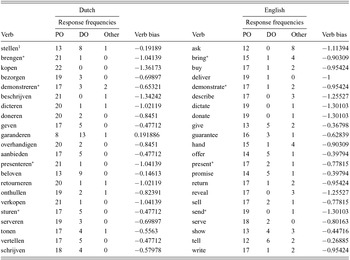
Forty-two participants who did not take part in the main experiments (but from the same population as the participants in the experimental task) described 22 pictures depicting an actor, recipient, theme and a printed verb (see Figure 1 for an example). All depicted entities were collected from a royalty-free clipart database (www.clker.com). The actor was always depicted on the left part of the picture. The location of the recipient and theme was counterbalanced within and between participants to control for scanning preferences that could influence syntactic choices. Each picture had a different verb, so 22 verbs were tested. The participants were instructed to produce a complete sentence using only and all the items presented on the screen. Fifty transitive and intransitive filler pictures were included to control for strategic responses. Twenty-four of the forty-two participants did the rating task both in English and in Dutch (order counterbalanced between participants; different combinations of actor, recipient, theme, and verb between blocks to prevent exact repetition of target pictures); eighteen participants performed only the English or the Dutch part of the task. Responses on the critical items were recorded and coded for PO, DO, or other. Verb bias was calculated for each verb as the log-odds for a DO response (based on Bernolet & Hartsuiker, Reference Bernolet and Hartsuiker2010; see Appendix A for the calculation). To reduce the risk of cross-language interference biases in the calculation of the verb biases in those participants who did both the Dutch and the English rating task (i.e., when the English and Dutch blocks are done by the same participants, this may lead to between-block priming in the rating task, thus influencing verb bias calculationsFootnote 2 ), the verb biases were calculated on the basis of only the responses in the first block of the task. Thus, verb bias calculations could not have been influenced by a previous block in the other language, resulting in Dutch and English verb biases that were methodologically independent from each other.
Example of a target picture. This example shows the recipient (bride) on the top right and the theme (dress) on the bottom right. To control for the influence of scanning preferences on syntactic choice, the positions of the recipient and theme relative to each other were counterbalanced in all target pictures.

Appendix A lists the 22 verbs and their verb biases in English and Dutch.
Stimuli for the priming task
Based on the rating, we created a total of 36 critical prime-target combinations in which both the prime sentence and the target picture represented a dative event involving an action, actor, recipient and theme (18 for the block with English primes and Dutch targets and 18 for the block with Dutch primes and English targets). The prime sentences were generated from a pool of 14 actors and recipients, 24 themes and 4 dative verbs (see Appendix B). The inclusion of only 4 verbs in the prime sentences was done to keep the potential influence of the prime sentence's verb bias constant, as we did not aim to investigate this factor (cf. e.g., Bernolet & Hartsuiker, Reference Bernolet and Hartsuiker2010; Jaeger & Snider, Reference Jaeger, Snider, Wolter and Thorson2007, Reference Jaeger and Snider2013, for more information on the influence of the prime's verb bias). We made sure that the 4 verbs were used equally often and counterbalanced across prime sentences and across stimulus lists, to control for any verb-specific priming effects. The target pictures were constructed in the same way as the target pictures in the verb bias rating task (see Figure 1). They were constructed from the same pool of 14 actors and recipients and 24 themes as the prime sentences, but with 18 different verbs, which varied in terms of their Dutch and English verb bias, based on the rating task (see Appendix B). Our operationalization of verb bias was based on these 18 verbs in the target pictures.
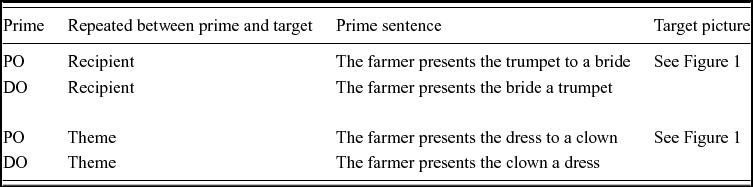
In addition to our manipulation of primed structure and our operationalization of verb bias in the target pictures, we also controlled and manipulated the amount of lexical overlap (or rather: translation-equivalent overlap) between the prime sentence and target picture. The target pictures always had different actors and verbs than those in the prime sentences (i.e., no repetition of translation equivalents), but we did manipulate repetition of the recipient and theme between the prime and target. This was done to explore the potential influence of given versus new information on syntactic choices. As evident from corpus studies (e.g., Bresnan et al., Reference Bresnan, Cueni, Nikitina, Baayen, Bouma, Krämer and Zwarts2007), given information usually precedes new information in a sentence. Therefore, it could well be that when the target picture's recipient is already introduced in the prime sentence, this would increase the chance of a DO structure, in which the recipient precedes the theme, whereas introduction of the target picture's theme in the prime sentence would increase the chance of a PO structure, in which the theme precedes the recipient. Although this manipulation was not central to our study, we were interested in exploring whether such a manipulation of given versus new information would influence syntactic choices in the experimental setting of our priming task. See Table 1 for an overview of the experimental conditions.
Examples of the experimental conditions in the priming task.

Note. The prime sentence was always in one language and the target picture in the other. So when the prime sentence was English, the target picture was to be described in Dutch; when the prime sentence was in Dutch, the target picture was to be described in English. The priming manipulation is of central interest; repetition between prime and target is of secondary interest. Verb bias was manipulated by printing the specific verbs to be used in the target pictures. These verbs varied in terms of verb bias in Dutch and English.
In addition to the critical trials, we constructed 70 transitive and intransitive filler items (based on a different pool of words than the critical items), consisting of 30 auditory sentences and 40 pictures with similar characteristics as the critical prime sentences and target pictures. The filler sentences and pictures were not paired like the prime-picture critical items; they constituted separate sentence trials and picture trials that were randomly ordered in the stimulus lists. This was done to avoid a predictable sequence of a picture after each sentence and thereby to disguise the experimental priming manipulation (see e.g., Bock, Reference Bock1986; Loebell & Bock, Reference Loebell and Bock2003; Kootstra et al., Reference Kootstra, van Hell and Dijkstra2012). In the block with English prime sentences and Dutch target pictures, filler sentences were also in English and filler pictures were to be described in Dutch; in the block with Dutch prime sentences and English target pictures, filler sentences were also in Dutch and filler pictures were to be described in English.
The prime-target items and the fillers were combined into four lists. Each prime-target item occurred in a different condition across lists, and within lists all conditions occurred equally often. Each list was pseudo-randomized into six versions, in which primes and targets of a prime-target pair were never interrupted by filler items and in which filler items were ordered randomly around the prime-target pairs. No two prime-target pairs occurred consecutively. See Figure 2 for a breakdown of the trial sequencing. Practice items for each list included eight randomly selected filler items from another list.
Example of the pseudo-randomized order of the different filler items and the critical prime-target items. Instructions and memory cover tasks for the filler sentence trials and picture trials were the same as the experimental sentence trials and picture trials. The prime sentence was always in one language and the target picture in the other; this particular example shows an English prime sentence with a target picture that is to be described in Dutch.

Procedure
Participants were tested individually in a quiet room, seated in front of a laptop. Participants were told that they would perform a memory task in which they had to listen to sentences in one language and describe pictures in the other language. In ‘sentence trials’, participants listened to a sentence and then indicated whether a specific object, shown as an image on the laptop screen, was mentioned in the sentence by pressing one of two buttons on the laptop (‘short-term memory’ cover task). In ‘picture trials’, participants had to describe a presented picture by means of a complete sentence using the given verb and then indicate whether they had described this picture before in the experiment (‘long-term memory’ cover task), again by pressing one of two buttons on the laptop. Twenty filler pictures were actually repeated in each list to make this memory task realistic for the participants. With this memory cover task, the participants were given the impression that they were presented with a randomly ordered series of pictures and sentences that tested their memory, while in fact the task contained systematic prime-target manipulations (see Figure 2).
The test session consisted of one block with English sentences and Dutch pictures and one block with Dutch sentences and English pictures. The block order was counterbalanced across participants, and different combinations of actor, recipient, theme, and verb in primes and targets were used between blocks to prevent exact repetition of primes and targets between blocks). In between blocks, participants completed a questionnaire on their language history, proficiency, and usage. An entire session took about 40 minutes.
Scoring and analysis
Critical picture descriptions were scored as DO, PO, or ‘other’. ‘Other’ responses were descriptions that were unscorable because no ditransitive construction was used, because the given verb was not used, or because of recording failure. The ‘other’ responses were excluded from the analyses, so the analyses were done on all PO and DO responses. We coded the responses in such a way that our outcome variable was the tendency to use a DO structure out of all DO and PO responses (i.e., DO descriptions were coded as ‘1’ and PO descriptions as ‘0’). Note that, because the data consisted only of PO and DO responses, this outcome variable is exactly complementary to the tendency to use a PO structure out of all DO and PO responses. In other words, with this outcome variable we do not only analyze the tendency to use a DO structure, but, as a complement, also the tendency to use a PO structure.
We analysed the data with mixed-effects logistic regression modelling (e.g., Baayen et al., Reference Baayen, Davidson and Bates2008; Jaeger, Reference Jaeger2008), using the lme4-package in R 2.11.1. This technique makes it possible to test effects of the central independent variables of interest (i.e., the fixed variables), while controlling for the potential effect of individual participants and items on the observed variance (i.e., random variables). Another advantage of mixed-effects logistic regression compared to for example ANOVAs is that it actually uses each single response per participant per item as a data point, and therefore does not require aggregation to mean responses per condition. This avoids problems with the interpretation of continuous scores (e.g., mean proportions of DO or PO choices) that are actually based on categorical responses (PO vs. DO choices).
The critical predictor variables in our analyses were primed structure (categorical predictor: DO vs. PO), verb bias in Dutch and in English of the verbs in the target pictures (both numerical predictors; the Dutch and English verb biases were centered on their means), block order (categorical predictor: whether the task was done as the first block vs. whether the task was done as the second block), and experimental trial number, which represents the consecutive order at which each experimental stimulus appeared in the list (numerical predictor: higher number = later in the list). This variable was coded within blocks (i.e., both in Block 1 and in Block 2, the first experimental item was coded as trial number 1). A final predictor variable that we included was the manipulation of given versus new information (categorical predictor: either theme or recipient is repeated), but this predictor was only included for exploratory reasons; it was not a critical variable for our research questions (see ‘Stimuli’ section of this paper.)
We started the analyses by exploring the role of the manipulation of given versus new information, both as a main effect and in interaction with the other critical predictors. Given that this variable was not central to our research questions, we only retained this variable if it reached significance in any of these analyses. We then continued with the central analysis, in which we started with a full model containing all predictors and interactions between the predictors, in terms of both random-effect and fixed-effect structure. Then, in a stepwise manner, we eliminated interactions that did not reach significance and tested the fit of the old model with the fit of the newer model, using likelihood ratio tests. The reasoning behind this backward elimination is that if the fit of a simpler version of a model is not significantly different from the fit of a more complicated model, then the simpler model can be considered a more optimal reflection of the data. We only did this with interactions; main effects of the critical predictors were never excluded from the analysis. See Appendix C for all details of the analyses.
Results and discussion
We report the results of the optimal mixed-effects models, summarized in tables reporting the influence of each fixed effect by giving its parameter estimate (representing the log odds for a DO response on the basis of the predictor), the standard error of the parameter estimate (SE), its z-value, and its p-value. Similar to other cross-language structural priming studies (e.g., Schoonbaert et al., Reference Schoonbaert, Hartsuiker and Pickering2007), the results will be presented separately for the two priming directions, and then later combined in an overall analysis.
Priming direction 1: English (L2) primes, Dutch (L1) targets
The experiment with English primes and Dutch targets yielded 432 picture descriptions in critical trials. Eleven were scored as ‘other’ and discarded from the analysis (6 in PO conditions and 5 in DO conditions). The analysis was based on the remaining 421 responses.
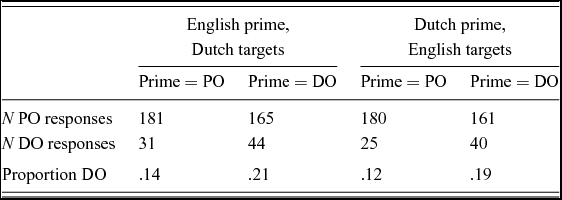
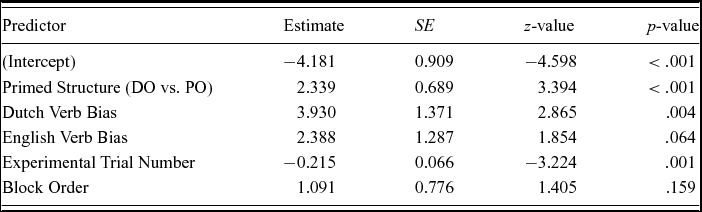
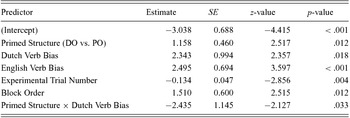
An overview of the responses per priming condition is given in Table 2. A summary of the mixed-effects model that best fits the data is given in Table 3. The effects in this table were coded such that positive values represent an increased likelihood of DO responses as a function of the given predictor and negative effects represent an increased likelihood of PO responses as a function of the given predictor. As can be seen in the table, the optimal model only contained main effects; none of the interaction effects that we tested reached significance. Additionally, the manipulation of given versus new information did not reach significance, so this predictor is not included in the optimal model.
Overview of responses per condition in both priming directions.

Fixed effects of the optimal mixed-effects logistic regression models for variables predicting the likelihood of using a DO-structure (versus a PO-structure) in the task with English primes and Dutch targets.

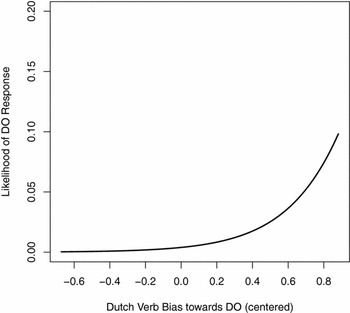
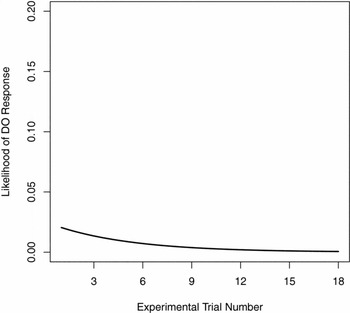
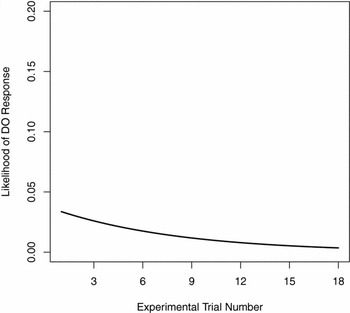
The optimal model yielded a significant effect of primed structure, indicating that the tendency to use DO (versus PO) was stronger after a DO prime than after a PO prime (see Table 2). There was also a significant effect of Dutch verb bias. The more the verb in the target picture was biased to DO in Dutch (which was the target language in the picture descriptions), the more it led to DO choices; see Figure 3. The effect of English verb bias (i.e., non-target language) went in the same direction, but was not significant. There was also a significant effect of experimental trial number. Participants tended to make fewer DO responses relative to PO responses as the experiment progressed (see Figure 4). This effect only occurred as a main effect, which indicates that obtained effects of priming and verb bias were not influenced by experimental trial number. Additionally, it indicates that the effect of experimental trial number was not influenced by block order: the effect was similar irrespective of whether the task was presented as the first block or was preceded by a block with Dutch primes and English targets. block order itself did not significantly influence the results.
Graphical illustration of the effect of Dutch (target-language) verb bias in the task with English primes and Dutch target pictures.

Graphical illustration of the effect of experimental trial number in the task with English primes and Dutch target pictures.

Priming direction 2: Dutch (L1) primes, English (L2) targets
The experiment with Dutch primes and English targets yielded 432 responses in critical trials. Twenty-six were scored as ‘other’ and discarded from the analysis (11 in PO conditions and 15 in DO conditions). The analysis is based on the remaining 406 responses.
An overview of responses per priming condition is given in Table 2. A summary of the mixed-effects model that best fits the data is given in Table 4. Just as in the task with English primes and Dutch targets, this analysis again did not yield any effect of the manipulation of given versus new information, so this predictor is not included in the model. We now explain each of the obtained effects.
Fixed effects of the optimal mixed-effects logistic regression models for variables predicting the likelihood of using a DO-structure (versus a PO-structure) in the task with Dutch primes and English targets.

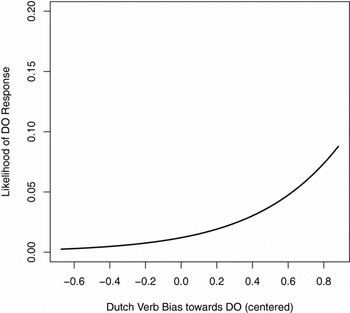
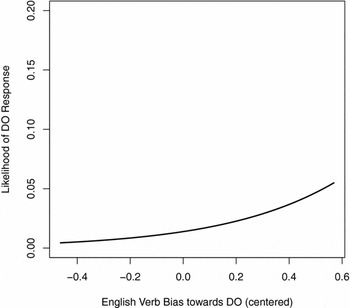
The analysis yielded a significant effect of primed structure, indicating that the proportion of DO versus PO choices was higher after a DO prime than after a PO prime (see Table 2), just as in the task with English primes and Dutch targets. The analysis further yielded significant effects of both English and Dutch verb bias. The more the verb in the target picture was biased towards a DO construction (either in Dutch or in English), the more DO choices were made; see Figures 5 and 6. There were also significant main effects of experimental trial number and block order. The effect of experimental trial number is illustrated in Figure 7, showing that the tendency to use a DO structure becomes weaker over the course of the experimental task, similar to the task with English primes and Dutch targets. The effect of block order further shows that the tendency to use the DO structure is particularly low when the task with Dutch primes and English targets is presented as the second block (i.e., when it is preceded by a block with English primes and Dutch targets), compared to when it is presented as the first block (see Table 5). As shown in Table 5, the low tendency to use the DO structure when it was presented as the second block (.09) can be traced back to the relatively low proportion of DO responses in the preceding block with English primes and Dutch targets (.14). This can be seen as an indication that syntactic choice tendencies from the first block of the experimental session with Dutch targets spilled over to the second block of the experimental session with English targets. The effects of block order and experimental trial number did not interact with each other or with any of the other variables we tested.
Graphical illustration of the effect Dutch (non-target language) verb bias in the task with Dutch primes and English target pictures.

Graphical illustration of the effect of English (target-language) verb bias in the task with Dutch primes and English target pictures.

Graphical illustration of the effect of experimental trial number in the task with Dutch primes and English target pictures.

Mean proportions of DO responses per block and priming direction.

Note. When the task with English primes and Dutch targets was presented as Block 2, it was preceded by a block with Dutch primes and English targets. Similarly, when the task with Dutch primes and English targets was presented as Block 2, it was preceded by a block with English primes and Dutch targets.
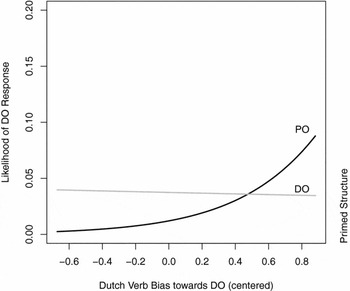
Interestingly, the analysis also yielded a significant interaction effect of primed structure with Dutch (target) verb bias. This effect is illustrated in Figure 8, showing that the priming effect (i.e., the difference in syntactic choice after a DO prime compared to after a PO prime) changed as a function of the Dutch verb bias of the target picture's verb. The figure indicates that Dutch verb bias only influenced syntactic choices when a PO sentence was primed: when a DO sentence was primed, Dutch verb bias hardly influenced syntactic choices. The figure even suggests a reversal of the priming effect, in which the tendency to produce a DO structure after a PO prime is relatively strong in verbs with a relatively high bias towards a DO structure.
Graphical illustration of the interaction between primed structure and Dutch verb bias in the task with Dutch primes and English target pictures.

Combined analysis
When comparing the results of the task with Dutch primes and English targets to the task with English primes and Dutch targets, it is evident that there are both similarities and differences. The similarities were that both tasks yielded effects of primed structure (i.e., cross-language priming), target-language verb bias (i.e., Dutch verb bias in the task with Dutch targets; English verb bias in the task with English targets), and experimental trial number. The differences were that the task with Dutch primes and English targets also yielded an effect of non-target-language verb bias (i.e., Dutch verb bias) which interacted with the effect of primed structure, and an effect of block order.
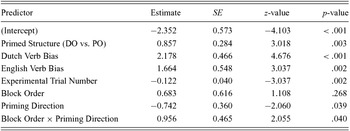
To obtain a more precise picture of the similarities and differences between both tasks, we now directly compare both tasks in an overall analysis, in which we combine the data from both priming directions. The procedure of this analysis was the same as in the separate analyses, but included one additional predictor, namely ‘priming direction’. Effects of priming direction would indicate differences between the task with English primes and Dutch targets and the task with Dutch primes and English targets. A lack of effects of priming direction would indicate that obtained effects are similar for both priming directions.
A summary of the mixed-effects model that best fits the data is given in Table 6. The analysis yielded significant effects of primed structure, Dutch verb bias, English verb bias, and experimental trial number. These effects can be traced back to the effects obtained in the separate analyses. In addition, the analysis yielded an effect of priming direction which interacted with the effect of block order. These findings confirm our findings from the separate analyses, in which effects of block order were only observed when participants were primed from Dutch to English (i.e., Dutch primes, English targets).
Fixed effects of the optimal mixed-effects logistic regression models for variables predicting the likelihood of using a DO-structure, overall analysis for both priming directions.

The fact that the combined analyses did not yield an interaction effect of English verb bias by priming direction may seem at odds with the results from the separate analyses, in which English verb bias was only significant in the task with Dutch primes and English targets. Note, however, that English verb bias showed a trend towards significance in the task with English primes and Dutch targets (see Table 3). Apparently, the difference of the effect of English verb bias in the two priming directions was too subtle to lead to a significant interaction effect in the combined analysis.
General discussion
Using a cross-language structural priming task, we investigated multiple forms of language experience in the production of dative sentences by Dutch-dominant Dutch–English bilinguals. We found effects of recent experience in the form of cross-language structural priming. The priming effects were not only immediate (trial-by-trial), but also long-term, in the form of cumulative priming within experimental blocks and cross-language priming between experimental blocks. In addition, we found effects of prior experience in the form of verb bias effects. Both target-language and non-target-language verb bias influenced syntactic choices, which indicates that verb bias can influence linguistic behavior both within and across languages. Finally, we found effects of bilinguals’ relative level of experience with both languages in that some of these cross-language effects were bidirectional and others only took place from the dominant to the non-dominant language. We now discuss these findings in more detail.
The role of recent experience: priming effects
First of all, we found trial-by-trial cross-language structural priming effects, both when the bilinguals heard a prime sentence in English (L2) and described target pictures in Dutch (L1) and when they heard a prime sentence in Dutch (L1) and described target pictures in English (L2). These effects confirm the robustness of the cross-language structural priming effect (e.g., Bernolet et al., Reference Bernolet, Hartsuiker and Pickering2007, Reference Bernolet, Hartsuiker and Pickering2012; Cai et al., Reference Cai, Pickering, Yan and Branigan2011; Desmet & Declercq, Reference Desmet and Declercq2006; Hartsuiker et al., Reference Hartsuiker, Pickering and Veltkamp2004; Kantola & van Gompel, Reference Kantola and van Gompel2011; Loebell & Bock, Reference Loebell and Bock2003; Schoonbaert et al., Reference Schoonbaert, Hartsuiker and Pickering2007). In addition, the bidirectionality of our priming effects is consistent with earlier findings, both in the domain of structural priming (e.g., Cai et al., Reference Cai, Pickering, Yan and Branigan2011; Loebell & Bock, Reference Loebell and Bock2003; Schoonbaert et al., Reference Schoonbaert, Hartsuiker and Pickering2007) and in other domains of bilingual language use (e.g., Brown & Gullberg, Reference Brown and Gullberg2011; Hohenstein, Eisenberg & Naigles, Reference Hohenstein, Eisenberg and Naigles2006; Morett & MacWhinney, Reference Morett and MacWhinney2013).
Although the cross-language priming effect itself was robust, we did find one instance where the priming effect was modulated by verb bias. That is, in the task with Dutch primes and English targets, the priming effect changed as a function of Dutch (non-target-language) verb bias, to the extent that the priming effect even appeared to flip in target verbs with a relatively high DO bias. This finding is similar to Bernolet and Hartsuiker (Reference Bernolet and Hartsuiker2010), who also found that (monolingual) priming effects changed as a function of verb bias. Our finding can be explained by the fact that the bias of these verbs with a relatively high DO bias was relatively ‘surprising’ in the context of the experiment. That is, the participants overwhelmingly used PO structures in the experiment (similar to e.g., Bernolet & Hartsuiker, Reference Bernolet and Hartsuiker2010), and most verbs had a stronger bias to a PO structure than to a DO structure. As discussed in the Introduction, the influence of surprising stimuli on syntactic choices and priming effects has been documented in earlier studies and is associated with the notion of dynamic adaptation of language use on the basis of previous language experience (e.g., Jaeger & Snider, Reference Jaeger, Snider, Wolter and Thorson2007, Reference Jaeger and Snider2013). Our evidence indicates that this can also take place across languages in bilingual situations.
In addition to these effects of immediate, trial-by-trial cross-language priming, we also found long-term, cumulative priming effects. The most stable was the effect of experimental trial number, which we found in both priming directions. Although this effect could be interpreted as a strategic way of performing the experimental task, it is very likely to be caused by forms of cumulative priming in the sense that a specific syntactic choice (say, a PO response) will increase the likelihood of the same syntactic choice later in following trials, which will subsequently further increase the likelihood of the same syntactic choice, and so on. Indeed, Jaeger and Snider (Reference Jaeger, Snider, Wolter and Thorson2007, Reference Jaeger and Snider2013) have found similar cumulative effects in monolingual structural priming, in which they relate the cumulativity effects to the notion of continuous updating and adaptation of syntactic distributional knowledge. As argued by Jaeger and Snider (Reference Jaeger and Snider2013), this adaptation is highly sensitive to the statistics of the current discourse, leading to dynamically evolving syntactic behavior on the basis of the recent linguistic environment. These environment-specific forms of adaptation make perfect sense in real-life discourse, given that communication fluency is greatly enhanced when speakers and listeners can adapt their language comprehension and production strategies to each other's way of communication and to the characteristics of the ongoing discourse (cf. e.g., Clark, Reference Clark1996; MacDonald, Reference MacDonald2013; Pickering & Garrod, Reference Pickering and Garrod2004).
The other long-term effect that we found was the effect of block order in the task with Dutch primes and English targets. In this task, the tendency to produce a DO relative to a PO structure was stronger when the task was presented as the first block of the experiment compared to when it was presented as the second block of the experiment. As explained earlier, this task in the second block was preceded by a block with English primes and Dutch targets. This first block with English primes and Dutch targets already had relatively low numbers of DO structures (see Table 5). It is plausible to conclude, therefore, that the relatively low tendency to produce DO structures in the first block (with English primes and Dutch targets) has spilled over to the second block with Dutch primes and English targets and thus primed the tendency to produce few DO structures in the second block. This form of sustained cross-language structural priming between blocks is consistent with earlier findings of long-term structural priming between blocks in the monolingual domain (e.g., Kaschak, Reference Kaschak2007; Kaschak et al., Reference Kaschak, Kutta and Schatschneider2011, Reference Kaschak, Kutta and Coyle2014) and in the bilingual/L2 domain (Bernolet et al., Reference Bernolet, Hartsuiker and Pickering2007).
Interestingly, the effect of block order is probably related to the obtained effect of experimental trial number: the effect of experimental trial number went in the same direction as the block order effect, in the sense that fewer DO responses were produced in later parts of the task. The continuous adaptation effects, as captured by the effect of experimental trial number, may have spilled over from the first block to the second block, in which the adaptation of syntactic choices during the experiment continued to take place, but then in a different target language (as evident from the fact that effects of experimental trial number were not different as a function of block order).
Thus, the combination of cross-language between-block effects and trial number effects in the present study suggests that cumulative forms of structural priming can take place both within languages and between languages. One limitation about the long-term effects is that the effects are based on the notion of ‘self-priming’ over the course of the experiment, and not on an independent manipulation of the frequency with which certain structures are presented over the course of the experiment (see e.g., Jaeger & Snider, Reference Jaeger and Snider2013; Kaschak, Reference Kaschak2007; Kaschak et al., Reference Kaschak, Kutta and Schatschneider2011, Reference Kaschak, Kutta and Coyle2014, for examples). This makes it a bit more difficult to tease apart cause and effect in our study. Still, this issue does not invalidate our findings, as self-priming is a strong mechanism of syntactic choice in real-life discourse (e.g., Gries, Reference Gries and Wulff2005) that is compatible with the notion of adaptive language processing on the basis of the statistics of the linguistic environment.
The role of prior experience: verb bias effects
In addition to the priming effects, we found both within-language and cross-language effects of verb bias. The within-language effects were present in both the task with English primes and Dutch targets (i.e., effect of Dutch verb bias) and in the task with Dutch primes and English targets (i.e., effect of English verb bias). These effects are relatable to earlier within-language effects of verb bias, both in the L1 (e.g., Bernolet & Hartsuiker, Reference Bernolet and Hartsuiker2010; Colleman, Reference Colleman2006; Coyle & Kaschak, Reference Coyle and Kaschak2008; Ferreira, Reference Ferreira1996; Gries & Stefanowitsch, Reference Gries and Stefanowitsch2004; Jaeger & Snider, Reference Jaeger, Snider, Wolter and Thorson2007, Reference Jaeger and Snider2013) and the L2 (Gries & Wulff, Reference Gries and Wulff2005). The cross-language effects were observed specifically in the task with Dutch primes and English targets, in which we found that Dutch (i.e., non-target-language) verb bias influenced syntactic choices.
The fact that we found a cross-language effect of verb bias illuminates the mixed picture from earlier research, in which Salamoura and Williams (Reference Salamoura and Williams2006) observed that L1 verb bias primed L2 syntactic choices, but Gries and Wulff (Reference Gries and Wulff2005) and Flett et al. (Reference Flett, Branigan and Pickering2013) did not observe cross-language effects of non-target-language (i.e., L1) structural biases in L2 sentence production. Obviously, our findings are consistent with those of Salamoura and Williams (Reference Salamoura and Williams2006). A plausible factor causing the mixed results on this issue is the bilinguality of the experimental context. As discussed in the Introduction, cross-language effects tend to be more prevalent in dual-language contexts than in single-language contexts (e.g., Dijkstra et al., Reference Dijkstra, van Jaarsveld and ten Brinke1998; Green, Reference Green2011; Hatzidaki et al., Reference Hatzidaki, Branigan and Pickering2011). This also appears to be the case here: those studies that did not find cross-language effects of non-target-language structural biases (Flett et al., Reference Flett, Branigan and Pickering2013; Gries & Wulff, Reference Gries and Wulff2005) were based on a context in which all stimuli were in one language only (i.e., L2 only), whereas those studies that did find cross-language effects (the present study; Salamoura & Williams, Reference Salamoura and Williams2006) were based on a context in which stimuli were in both languages. This explanation is consistent with the language mode hypothesis (Grosjean, Reference Grosjean1998, Reference Grosjean and Nicol2001), and supports the idea that it is most efficient to assume a fundamentally interactive language processing system that is open to cross-language activation at any level of processing (Kroll, Bobb & Wodniecka, Reference Kroll, Bobb and Wodniecka2006; Kootstra, van Hell & Dijkstra, Reference Kootstra, van Hell, Dijkstra, Isurin, Winford and de Bot2009), and in which various factors (such as the task context) can influence the extent to which language processing is indeed influenced by this cross-language activation.
It has to be noted that our study focused on the role of verb bias in the target picture to be described by the participant; not on the role of verb bias in the prime sentence – as was, for example, done by Bernolet and Hartsuiker (Reference Bernolet and Hartsuiker2010) and Jaeger and Snider (Reference Jaeger, Snider, Wolter and Thorson2007, Reference Jaeger and Snider2013), who investigated the role of surprisal in structural priming as a means to gain insight into predictive/adaptive language use. Based on our findings of cross-language verb bias in the target picture and on the notion of a fundamentally interactive language processing system, it is plausible to assume that cross-language effects of verb bias in the prime sentence are likely to occur as well. It would be interesting to study whether there are cross-language effects of prime-sentence surprisal, and thus whether cross-language effects influence predictive/ adaptive language processing in bilinguals.
The role of relative level of experience with both languages: bidirectional and asymmetric cross-language effects
Although most of our immediate cross-language effects were bidirectional, some of our findings reflected signs of asymmetric cross-language interactions. That is, we only found between-block structural priming in the task with Dutch primes and English targets, in the sense that Dutch syntactic choices from the first experimental block influenced English syntactic choices in a subsequent experimental block, but not the other way around. In addition, we found that English verb bias effects on Dutch sentence production were weaker than Dutch verb bias effects on English sentence production. In both these findings, the influence of the dominant language (Dutch) on the non-dominant language (English) was stronger than the other way around. This is consistent with findings on the interplay between dominant and non-dominant cross-linguistic influence in bilingual language use and second language acquisition (e.g., Costa, Caramazza & Sebastián-Gallés, Reference Costa, Caramazza and Sebastián-Gallés2000; Hernandez, Li & MacWhinney, Reference Hernandez, Li and MacWhinney2005; Kroll et al., Reference Kroll, Bobb and Wodniecka2006; van Hell & Tanner, Reference van Hell and Tanner2012), with cross-language priming findings in the lexico-semantic domain (i.e., L1-to-L2 priming tends be stronger and more consistent than L2-to-L1 priming; e.g., Jiang, Reference Jiang1999), and with the asymmetrical translation-equivalent boost effect with non-balanced bilinguals in Schoonbaert et al. (Reference Schoonbaert, Hartsuiker and Pickering2007).
A finding that deserves further research is that there was no interaction between English verb bias and priming direction in the combined analysis, even though it was significant in the task with English targets and not-significant in the task with Dutch targets. Inspection of the English verb bias effect in the task with Dutch targets indicates, however, that the effect of English verb bias is marginally significant, suggesting that bidirectional effects are not impossible. It would therefore be interesting to see whether a bidirectional effect of English verb bias would be found when this task was done with more balanced bilinguals. When the language processing system is indeed fully interactive as suggested by Kroll et al. (Reference Kroll, Bobb and Wodniecka2006) and Kootstra et al. (Reference Kootstra, van Hell, Dijkstra, Isurin, Winford and de Bot2009), it can be predicted that bidirectional effects of English verb bias would occur in balanced bilinguals. This would then also be consistent with the difference in findings between Schoonbaert et al. (Reference Schoonbaert, Hartsuiker and Pickering2007), who tested non-balanced bilinguals and found an asymmetrical translation-equivalent boost of cross-language structural priming, and Cai et al. (Reference Cai, Pickering, Yan and Branigan2011), who tested balanced bilinguals and found a bidirectional translation-equivalent boost of cross-language structural priming.
Another aspect of our findings that deserves further scrutiny is that, when focusing purely on first-block syntactic choices, the general tendency to produce a DO sentence was higher in English (.23; see Table 5) than in Dutch (.14; see Table 5). Although this finding does not seem to have anything to do with between-block priming or verb bias (the first-block responses can be seen as reflecting participants’ baseline tendencies without being influenced by their syntactic choices in a previous block), it is worth investigating why this was the case. It could be a tendency specific to Dutch–English bilinguals, a tendency specific to L2 learners of English in general, or a tendency reflecting input patterns of the English language. To test this, future studies could include groups of participants with multiple language backgrounds and multiple levels of experience with the English language.
Explanation in terms of a model on lexical and syntactic representations in bilinguals
We now discuss our findings in terms of a model specifying the cognitive representations underlying lexical and syntactic processing in (non-balanced) bilinguals (Hartsuiker et al., Reference Hartsuiker, Pickering and Veltkamp2004; Schoonbaert et al., Reference Schoonbaert, Hartsuiker and Pickering2007; Hartsuiker & Pickering, Reference Hartsuiker and Pickering2008), which is often used to account for cross-language structural priming effects.
In Hartsuiker et al.’s model (see Figure 9), lemma nodes (lexico-semantic information) are linked to conceptual nodes (shared for both languages), to combinatorial nodes (structural information) and to language nodes (which specify language membership information). This model explains cross-language structural priming as follows: recent activation of a particular combinatorial node (in a prime sentence, in one language) makes this node more available for selection, which facilitates subsequent activation of the same combinatorial node in the target sentence (in another language). The model can also explain cross-language verb bias effects, but only when making the additional assumption that the links between lemma nodes and combinatorial nodes are weighted (e.g., verbs with a strong bias towards the DO structure should have a stronger link with the DO node than with the PO node; see Figure 9 for an illustration). Based on this assumption, cross-language verb bias effects can occur because the activation of a lemma in one language (e.g., to describe a picture) will involve co-activation of its translation equivalent via the shared conceptual node (cf. e.g., Dimitropoulou, Duñabeitia & Carreiras, Reference Dimitropoulou, Duñabeitia and Carreiras2011; Forster & Jiang, Reference Forster, Jiang and Nicol2001). As Salamoura and Williams (Reference Salamoura and Williams2006) have shown with their cross-language priming effects on the basis of single verbs, this co-activation of the translation equivalent will also entail activation of the (weighted) link between the lemma node and combinatorial node. The co-activation of target-language and non-target-language lemma nodes and their links with combinatorial nodes can lead to cross-language influences of verb bias on syntactic choices.
Hartsuiker et al.’s (Reference Hartsuiker, Pickering and Veltkamp2004) and Schoonbaert et al.’s (Reference Bresnan, Cueni, Nikitina, Baayen, Bouma, Krämer and Zwarts2007) model for the representation of lexical and syntactic information in bilingual speakers (from Schoonbaert et al., Reference Schoonbaert, Hartsuiker and Pickering2007). The difference in thickness of the lines between conceptual nodes and L1 lemmas and the lines between conceptual nodes and L2 lemmas represents differences in relative language dominance. The difference in thickness between lemma nodes and combinatorial nodes is new to the model, and represents the verbs’ probabilistic biases towards the PO and DO constructions (in terms of weighted links).

The model can also explain our findings of language dominance. In the model, language dominance is accounted for by assuming that the link between lemma nodes and conceptual nodes is weaker for lemmas from the non-dominant-language than for lemmas from the dominant language (see Figure 9; this was first implemented by Schoonbaert et al., Reference Schoonbaert, Hartsuiker and Pickering2007, based on the Revised Hierarchical Model; e.g., Kroll & Stewart, Reference Kroll and Stewart1994). Lemmas from the dominant language, including their associated weighted links with combinatorial nodes, will thus be easier to activate (and more difficult to inhibit) than lemmas from the non-dominant language, leading to a relatively unbalanced co-activation of languages, in which dominant-to-non-dominant influences on syntactic choice will likely be stronger and more consistent than non-dominant-to-dominant influences.
The model does not provide a direct explanation for the observed cumulative structural priming effects. This is because it is a static model, providing the supposed cognitive architecture underlying the interface between lexical and structural representations in bilinguals, without providing information on potential longer-term dynamics (cf. e.g., de Bot, Reference de Bot and Kaplan2010). This does not mean, however, that the model cannot accommodate long-term effects. Indeed, as Hartsuiker and Bernolet themselves state in a recent publication (2015), the model can be seen as an advanced stage of a process in which the development of and interconnectivity between L1 and L2 lexical and syntactic representations in bilinguals and second language learners are driven by implicit learning processes. Structural priming, according to Hartsuiker and Bernolet, can then be seen as a form of syntactic learning, which will have cumulative, long-term effects (see also Dell & Chang, Reference Dell and Chang2014; Jaeger & Snider, Reference Jaeger and Snider2013).
With this additional assumption of priming as a form of implicit learning, the model can support the long-term effects that we found. The cumulative effects can be explained because combinatorial nodes are indirectly connected to language nodes and conceptual nodes in Schoonbaert et al.’s model (see Kootstra et al., Reference Kootstra, van Hell and Dijkstra2012, for details). This will lead to a mapping (through lemma nodes) between concepts and syntactic choices, specifying the relation between conceptual events and syntactic structure (which makes sense, since some conceptual events require specific syntactic structures), which can guide subsequent syntactic choices. When such mappings are repeatedly made in an experimental block, this can lead to the establishment of an environment-specific mapping between conceptual events and combinatorial nodes (based on implicit learning), specifying the tendency to produce specific conceptual events (e.g., dative events) with specific syntactic structures. Because the model is shared for both languages, such cumulative effects of structural priming can take place both within and between languages.
Thus, by including the additional assumption of weighted form-function mappings that are created and continuously updated on the basis of the statistics of the linguistic environment, our findings of both trial-to-trial and cumulative structural priming and verb bias strengthen and extend Hartsuiker et al.’s and Schoonbaert et al.’s model on the representation of lexical and syntactic information in bilinguals, and are consistent with Hartsuiker and Bernolet's (2015) recent suggestions of implicit learning in this model. These additional assumptions can be related to current ideas on usage-based language acquisition (e.g., Bybee, Reference Bybee2010; Tomasello, Reference Tomasello2003), adaptive language processing (e.g., Jaeger & Snider, Reference Jaeger, Snider, Wolter and Thorson2007, Reference Jaeger and Snider2013) and implicit learning of language production distributions (e.g., Dell & Chang, Reference Dell and Chang2014; MacDonald, Reference MacDonald2013).
Implications for perspectives on contact-induced language change
A final implication that we would like to discuss is that our cumulative and long-term cross-language priming effects can be linked to long-term outcomes of language contact, such as contact-induced language change. That is, given that structural priming continuously influences people's linguistic choices and can thus lead to cumulative effects, structural priming can in the long run influence the frequency distributions with which linguistic structures are used. Based on this argumentation, structural priming has been proposed as a potential mechanism of language change (e.g., Jäger & Rosenbach, Reference Jäger and Rosenbach2008; MacDonald, Reference MacDonald2013). When such priming effects take place between languages, like in our study, this may lead to contact-induced language change (cf. e.g., Kootstra & Şahin, under review; Loebell & Bock, Reference Loebell and Bock2003; Luka & Barsalou, Reference Luka and Barsalou2005; Muysken, Reference Muysken2013; Torres Cacoullos & Travis, Reference Torres Cacoullos and Travis2011). Although more research on this is clearly necessary, our findings of cumulative forms of priming in combination with trial-by-trial priming provide indications that cross-language priming is indeed a continuous process that may in the long run lead to language change, such as convergence between languages.
Conclusion
Using a cross-language priming experiment in Dutch-dominant Dutch–English bilinguals, we found both immediate and cumulative cross-language effects of structural priming and verb bias in the production of dative sentences in Dutch and English, some of which depended on the direction of the priming in relation to the participants’ relative level of language dominance. These findings show how multiple sources of language experience influence linguistic choices across languages, which is consistent with the notion of a fundamentally interactive language system (Kroll et al., Reference Kroll, Bobb and Wodniecka2006; Kootstra et al., Reference Kootstra, van Hell, Dijkstra, Isurin, Winford and de Bot2009) and with experience-based perspectives on language use in which language users continuously adapt and update their language processing strategies to the ongoing linguistic environment (e.g., Jaeger & Snider, Reference Jaeger and Snider2013). Our findings provide novel data that extend Hartsuiker et al.’s (Reference Hartsuiker, Pickering and Veltkamp2004) and Schoonbaert et al.’s (Reference Schoonbaert, Hartsuiker and Pickering2007) model on cross-language connectivity at the lexical and syntactic level of processing in bilingual language production. Finally, the findings lend support to the idea that cross-language priming may well drive long-term language contact phenomena like contact-induced language change.
Appendix A. Overview of the 22 verbs from the rating task, including their response frequencies and verb bias scores
The verb bias scores are the log-odds for a DO response: log([#DO + 1]/[#PO + 1]), based on Bernolet and Hartsuiker (Reference Bernolet and Hartsuiker2010). Thus, the more positive the score, the higher the likelihood that a verb will take a DO response; the more negative the score, the higher the likelihood that a verb will take a PO response. As can be seen in the table below, there was a general preference for PO responses in both English and Dutch (most verb biases are negative), but there was also clear variation in scores between the verbs. The overall preference for PO is quite normal in these kinds of picture description tasks (cf. Bernolet & Hartsuiker, Reference Bernolet and Hartsuiker2010). The between-verb variation allows for the inclusion of Dutch and English verb bias as continuous predictors in regression analyses.

Appendix B. Pool of words from which the critical stimuli were created
Actors and Recipients
boy–jongen; clown–clown; witch–heks; chef–kok; girl–meisje; waiter–ober; policewoman–politievrouw; postman–postbode; soldier–soldaat; nurse–verpleegster; farmer–boer; fireman–brandweer; wizard–tovenaar; bride–bruid.
Verbs used for the target pictures
ask–vragen; buy–kopen; deliver–bezorgen; describe–beschrijven; donate–doneren; dictate–dicteren; give–geven; guarantee–garanderen; hand–overhandigen; offer–aanbieden; promise–beloven; return–retourneren; reveal–onthullen; sell–verkopen; serve–serveren; show–tonen; tell–vertellen; write–schrijven.
Verbs used for the prime sentences
bring–brengen; demonstrate–demonstreren; present–presenteren; send–sturen.
Themes
laptop–laptop; statue–standbeeld; book–boek; car–auto; newspaper–krant; motorcycle–motor; cheese–kaas; guitar–gitaar; question–vraag*; shoe–schoen; dress–jurk; bicycle–fiets; house–huis; pizza–pizza; jacket–jas; story–verhaal*; ball–bal; parcel–pakketje; letter–brief; crown–kroon; icecream–ijsje; microscope–microscoop; painting–schilderij; tshirt–tshirt.
* The themes with an asterisk represent rather abstract words, which were depicted as a question mark (question–vraag) and as a text balloon (story–verhaal), respectively. Participants were familiarized with these two items before doing the tasks. Because syntactic choice and not lexical choice was investigated, it is unlikely that this familiarization has influenced responses.
Appendix C. Details of the mixed-effects analyses
We entered the following variables as fixed effects: primed structure, Dutch verb bias, English verb bias, experimental trial number, and block order. With respect to the random effects, we included by-participant random intercepts and random slopes for all fixed-effect predictors that varied within participants: primed structure, Dutch verb bias, English verb bias, and experimental trial number. With respect to the random-effect structure of the items, we only included random intercepts. We did this because the items were fully identified by verb bias, which was already included as fixed effects in our model. That is, we had 18 items per task, each of which had a unique verb with a unique verb bias. Inclusion of by-item random slopes for the fixed effects is the functional equivalent of an interaction effect between the items and the fixed effects (cf. Baayen, Reference Baayen2008: 271). Given that the items are identified by their verb bias, this would be the same as testing interactions between verb bias and the other fixed effects, which would be redundant and possibly leading to unstable outcomes, given that verb bias is already a predictor in the models.
An additional reason why it is valid to include only random intercepts for the items is that the items hardly differed from each other in nature: except for the specific verb that had to be used, all other aspects of the items that could have led to variable responses were controlled for: all items represented relatively neutral events that were about equally (un)likely to take place as a real-life event, and the position in the picture of the theme relative to the patient was counterbalanced within items. Thus, there is no reason to assume that response variation to the items was caused by something else than their verb bias.
We started the analysis by entering the predictors described above into the most complex model in terms of fixed-effect and random-effect structure. From this most complex model, we eliminated non-significant interaction effects until we reached the optimal model. Main effects of critical predictor variables were always retained in the model, even if they did not reach significance (except for the ‘givenness’ predictor, which was not a critical predictor variable; it was only included as an exploratory variable). Model fit comparisons were done in a step-wise, minimal-pair manner. The first step of the procedure was to eliminate the highest-order non-significant fixed-effect interaction predictor while keeping the random-effect structure intact, and then compare the fit of this model with the more complex model. The second step was to subsequently eliminate the random slope term of the just-eliminated fixed-effect interaction and compare the fit of this model with the model with the more complex random-effect structure. Thus, we never eliminated two non-significant interaction effects at the same time, we never eliminated fixed and random effects in one go, and the random-effect structure was never less complicated than the fixed-effect structure (following Barr, Levi, Scheepers & Tily, Reference Barr, Levy, Scheepers and Tily2013). This procedure was repeated until the optimal model was reached. Model fit comparisons were done using a likelihood ratio test that examines whether the log-likelihood of one model versus the other differs significantly from zero (cf. Baayen, Davidson & Bates, Reference Baayen, Davidson and Bates2008).
A final note about the analyses concerns the way in which we entered PO and DO primes in our analyses. We entered the PO and DO prime structures in such a way that PO primes are the reference category against which the effect of DO primes is calculated. Importantly, because we operationalized priming as a simple contrast between PO and DO primes (without a baseline), results should be exactly the same when we would have treated the DO structure as the reference category. After all, comparing the effect of DO primes relative to PO primes is the same as comparing the effect of PO primes relative to DO primes. We checked this for all our analyses, and this was indeed the case: none of the obtained effects changed when the DO condition was the reference level. In addition, based on a reviewer's comment, we also re-tested our models by centering the categorical predictors using contrast coding (e.g., PO primes = −0.5; DO primes = 0.5), so that the outcomes are not based on a specific reference level. These analyses led to exactly the same results as the analyses that we report, thus confirming the validity of our outcomes.
Based on the procedure described above, the R codes belonging to the reported models are:
-
English primes, Dutch targets:
-
lmer(Response ~ PrimedStructure + DutchVerbBias + EnglishVerbBias + ExperimentalTrialNumber + BlockOrder + (1|Item) + (1 + PrimedStructure + DutchVerbBias + EnglishVerbBias + ExperimentalTrialNumber|Participant), Data = EnglishPrimesDutchTargets, family = “binomial”)
-
Dutch primes, English targets:
-
lmer(Response ~ PrimedStructure * DutchVerbBias + EnglishVerbBias + ExperimentalTrialNumber + BlockOrder + (1|Item) + (1 + PrimedStructure * DutchVerbBias + EnglishVerbBias + ExperimentalTrialNumber|Participant), Data = DutchPrimesEnglishTargets, family = “binomial”)
-
Combined analysis:
-
lmer(Response ~ PrimedStructure + DutchVerbBias + EnglishVerbBias + ExperimentalTrialNumber + BlockOrder * PrimingDirection + (1|Item) + (1+ PrimedStructure + DutchVerbBias + EnglishVerbBias + ExperimentalTrialNumber|Participant), Data = CombinedData, family = “binomial”)