

1. Introduction
From 1970 to 1990, the percentage of elderly widows living alone grew from 52.1% to 64.2% in the USAFootnote 2, representing an increase of 23.2%. Surprisingly, in the same period, other types of living arrangements remained stable, except for the percentage of widows living with children which decreased by a similar magnitude from 32.0% to 21.0%. So we can summarize the change in distribution of living arrangements of elderly widows as being a trade-off between living alone and living with their children.
Although the economic status of the elderly has improved substantially over the past 50 years, a high fraction of the elderly, especially widows, still live in povertyFootnote 3. As argued by Hurd and Wise (Reference Hurd, Wise, Hurd and Naohiro Yashiro1996), living arrangements are considered quite important for determining the well-being of elderly people, and particularly the poverty rate. Clearly, economies of scale that operate within households are a key ingredient: poor elderly widows could afford higher levels of consumption living with their children than living alone. Consequently, it is understandable that the interest of politicians and economists has been focused on explaining the increasing proportion of elderly living alone in recent decades. Understanding how living arrangements are determined is a prerequisite for informed policy makers.
The purpose of this paper is to investigate the role that demographical characteristics of the children play in shaping their living arrangements and that of their widowed mothers. We are especially interested in both: measuring the contribution of the marital status variable in determining the living arrangements distribution and measuring the contribution of changes in the marital status distribution to explain the change in living arrangements.
Our first contribution is to identify key determinants in shaping decisions about elderly widows living arrangements. Whereas most of studies on the determination of elderly living arrangements are focused on their characteristics, only a few exceptions include characteristics of children. We explore in depth different features of families, such as number, sex, and marital status of children. Among the demographic determinants, we find that the only feature that really matters in shaping the living arrangements distribution is marital status.
Our second contribution is to build a model of the determination of living arrangements as the outcome of a game between the mother and her child (married or single), where both make investments that affect the probability of the specific living arrangement that ensues. The model features economies of scale in multi-person households; differences in the risk aversion between mother and child; direct preferences about the living arrangement itself (as a stand-in for other issues such as privacy) and the incomes of mother and child. It is worth noting that, married and unmarried children are potentially different with respect to these fundamentals. The model has a crucial technical property: it generates the distribution of living arrangements of mothers and children in the data as a function of parameters (which is a requirement for estimation) with homogeneous preferences across income groups.
Our third contribution is to estimate the model using data from 1970Footnote 4. In order to assess the performance of the model, we build a measure of the accuracy of the estimation which considers the performance of the model among all the groups of the population. This measure shows that we obtain an excellent fit, replicating the joint distribution of living arrangements by income groups of elderly widows and their children controlled by their marital status. The estimation shows us intriguing results. We find that: mothers prefer to live alone if their children are married but prefer to live with their children if they are single; mothers are less risk averse than their children; mothers face high utility costs of exerting effort to achieve the desired arrangement if their children are single, while the opposite is true for mothers with married children and; mothers receive a bigger portion of the total household consumption if they live with their married children instead of living with their single children. Interestingly, we also find that the economies of scale show increasing returns in total household income for married children and decreasing ones for single children. Everything being taken into account, mothers generally make an effort to live with their children if their children are single, but prefer to live alone if their children are married. However, children typically make an effort to live apart except for the poorest who are interested in living with their mothers.
Our fourth contribution is to use counterfactuals with the estimated model to measure the extent to which changes in marital status and income account for the changes in living arrangements. Particularly, we find that changes in the marital status distribution of the children predict a decrease in the fraction of elderly widows living alone. This is in contrast to the substantial increase that we observed in the data. Afterward, we study whether the positive income effect found in the literature still survives when it is considered jointly with the change in the marital status. To assess the quality of the prediction, we use the measure of accuracy which considers the performance of the model among all the groups of the population. In this case, we obtain that the model predicts that changes in the incomes of both the widow and her offspring and changes in the children's marital status account for the 83.4% of the increase in the number of widows living alone between 1970 and 1990. Therefore, we find that the income effect is strong enough to offset the negative effect of the marital status and, as a conclusion, we confirm that changes in income play a central role in accounting for the increase of the number of elderly widows that live alone.
Most of the empirical literature which analyzes the living arrangements of elderly is focused exclusively on analyzing the role of the elderly's income in a cross-sectionFootnote 5 or throughout timeFootnote 6. However, studies considering living arrangements of the elderly in relation to characteristics of other individuals, such as their children, are rare. The small sample size of the majority of databases, in addition to the impossibility of matching members of the same family who are living in different households, make a difficult task in the analysis including characteristics of other individuals. Hence, these studies have been confined to analyzing the characteristics of parents and children who are co-residingFootnote 7.
Regarding the papers which explicitly model the decision of the living arrangements, the most closely related paper to ours is Bethencourt and Ríos-Rull (Reference Bethencourt and Ríos-Rull2009). They estimate a structural model similar to ours where mothers and children decide their living arrangements jointly. They find that income changes generate about 75% of the increase in the number of elderly widows living alone between 1970 and 1990. Nevertheless, they focus exclusively on the role of income changes and do not deal with the demographical ones. Our model including the marital status of the children accounts for 83.5% of the increase in the percentage of elderly widows living alone. More recently, Pensieroso and Sommacal (Reference Pensieroso and Sommacal2014) built a theoretical general equilibrium model to explain the shift in intergenerational living arrangements from co-residence to non-co-residence of parents and children. They prove that this historical shift depends on the growth rate of relative income of children and parents rather than on its own level.
Finally, another set of studies examines the flip-side of co-residence: children's decision to leave the parental household, for example, Kaplan (Reference Kaplan2010), Whittington and Peters (Reference Whittington and Peters1996), Rosenzweig and Wolpin (Reference Rosenzweig and Wolpin1993), and McElroy (Reference McElroy1985) include the incomes of both children and parents in their analysis. All of them find that the better the economic opportunities of the children, the less likely they are to live in the parental home, they also find that co-residence is more likely when parents are well-off. This is consistent with Salcedo et al. (Reference Salcedo, Schoellman and Tertilt2012), who disregard specific relationships between household members and focus instead on the sharing of public goods. In their model, falling household sizes are an optimal response to growing incomes.
The structure of the paper is as follows. Section 2 explores the role characteristics of families, such as marital status, sex, and number of children, has in shaping the living arrangement distribution. We document the significant contribution of marital status. In section 3 we report the features of the data we are interested in: the main facts related to the joint distribution of incomes, the marital status, and the living arrangements in 1970 and in 1990. Section 4 describes our model. We propose a general model that is flexible enough to allow different attitudes toward consumption, different types of economies of scale, and different types of sharing arrangements. Section 5 describes how we estimate the model using 1970 data and also shows the estimation results. In section 6, we measure the role marital status changes have in shaping changes in living arrangements by computing the equilibrium of the model that we estimated with the 1970 data. Section 7 analyzes the role of changes in income when they are considered jointly to the change in the marital status distribution. In section 8, we draw some conclusions. The paper also includes three appendices: Appendix A describes how we select and refine the sample in both 1970 and 1990; Appendix B explains the approach we follow to construct main statistics and, finally, in Appendix C we report the income data we use.
2. The role of marital status of children
The majority of studies on the determination of living arrangements of the elderly are focused on their characteristics. There are a few exceptions that include characteristics of other individuals, especially those of children.
We now ask whether other relevant variables exist in shaping decisions about living arrangements. The evidence we present here is collected from the 1993 Asset and Health Dynamics Among the Oldest Old (AHEAD). The 1993 AHEAD is the first wave of the data collection of the study of the AHEAD and it is included in the Health and Retirement Study. The focus of the AHEAD is to understand how older Americans fare in three areas: health, finances, and family. The AHEAD universe is the population of individuals who are 70 years old or older, and not living in institutions. Its sample size is 17,718 individuals, of whom 8,222 are elderly people and the rest are relatives. Studying elderly people's family types and relationships is one of the main targets of the AHEAD. Thus, Section D of the survey is devoted to collect detailed information about the subjects’ relatives, whether or not they are co-residing.
Table 1 summarizes our findings about how various characteristics of widowed mothers and children pairs are related to their living arrangements.
Percentage of mothers living alone per selected characteristics of their children

Note: Sample size 925 elderly widows.
Number of children: There is an inverted U relationship between the number of children and the proportion of elderly widows living alone. In fact, if the number of children increases from one to two, the proportion of mothers living alone goes up. From then on, this proportion goes down. The interaction is strongly non-linear.
Sex of children: We observe that those mothers with either only sons or only daughters are equally likely to live alone, and the figures for more children do not differ by much. To study the effect of sex composition, we sorted the mothers into four groups on the basis of the proportion of daughters among their children. We found that there is not a big difference between those having a relatively high and those having a low proportion of daughters (the proportions living alone range from 70.8% to 73.7%)Footnote 8.
Marital status of children: We consider two different states of the marital status variable: married and single. Single includes never-married, widowed, separated, and divorced. In the absence of single children, more than 90% of the widows live alone, while less than 50% of widows without married children live alone. Increasing the number of single children decreases the proportion of widows living alone while the opposite is true for married children (note also that while married children constitute 68.1% of all children, 79.3% of those living with their mothers are single). We also calculated the effect of the marital status composition of the widow's offspring. We sorted the mothers by the proportion of married children. The percentages of those living alone by quartiles are 45.3%, 56.1%, 61.6%, and 87.7%, respectively. These numbers reflect the fact that having relatively more married children increases the probability of being alone. We conclude that marital status of children seems to be closely related to the determination of living arrangements.
Health of mothers: In our analysis, we have not considered the mother's health because it is not reported in the Integrated Public Use Microdata Series (IPUMS) database. Therefore, its consideration would have required us to infer it indirectly, which would require a procedure similar to the one we use to link the incomes of mothers and children living alone. Also, the health variable has been found to be more related to the probability of death or admission to a nursing home than in determining the relative propensity to live alone or with children [see, for instance, Börsch-Supan (Reference Börsch-Supan and Wise1989) and Mutchler and Burr (Reference Mutchler and Burr1991)].
Wealth of mothers: A similar situation occurs with the mother's wealth; a variable not reported in the IPUMS databases. While it could be possible that the low income of widows may be partially compensated with higher wealth holdings, Zick and Holden (Reference Zick and Holden1999) and Holden and Nicholson (Reference Holden and Nicholson1998) find that when the annuity value of wealth holdings is added to income, the gain is small and it does not alter the relative difference in measurements of economic well-being across groups. We believe that these findings justify omitting the health and wealth of the mother from the model.
To summarize, we find that marital status is a relevant variable in shaping living arrangements. It seems that the sex of children does not matter to a great degree. The number of children may also be relevant, but it is so in such unclear patterns that they defy simple modeling attempts. Moreover, the average number of children for elderly widows was 3.84 in 1970 and 3.64 in 1990, a difference of less than 6%. This small change in family size and the fact that there seems to be an inconclusive relation between family size and living arrangement are the reasons why we abstract from the family size in our model.
We now turn to the analysis of the relationship between the marital status and the living arrangements for 1970 and 1990Footnote 9.
3. The data
Information has to be collected on elderly widows and their children when they co-reside and when they live apart for 1970 and 1990. We use the census data as reported by the IPUMS samples for 1970 and 1990, a large representative sample of the US population (about 2 million individuals in 1970 and 2.5 million in 1990). From the IPUMS, we obtain the information about elderly widows and their children living together. However, it is impossible to match mothers with their children if they live apart. So, if an elderly widow is not living with her children, we do not have any information about her which represents a substantial problem for our analysis.
To deal with this problem, the IPUMS samples are combined with the information coming from the AHEAD. The AHEAD collects information about mothers and their children, whether or not they are co-residing. We start from the IPUMS database. We obtain information about the living arrangements of elderly widows and their children and calculate the marginal distributions of income, both for the mothers and their children. The size of the sample is 41,385 elderly widows in 1970 and 61,611 in 1990. Subsequently, these distributions are controlled by marital status of the children. Then, we turn to the AHEAD information. Assuming that the joint distribution of the income of elderly widows and the income of the households where their children live, by marital status, was the same for the studied periodFootnote 10, we finally obtain the distribution of living arrangements for 1970 and 1990 by merging the information from the AHEAD with the information from the IPUMS. Sections 3.1 and 3.2 describe properties of the data for both 1970 and 1990, respectivelyFootnote 11.
3.1. The data in 1970
Out of the 85.0% of elderly widows that do not live either in institutions or with unrelated adults, 62.0% live alone, while the remaining 38.0% live with their children. Within our sample, 57.3% of mothers are paired with a married child, while 42.7% are paired with a single child. Among those paired with a married child, 70.7% live alone, a much larger number than the 50.2% that live alone when paired with a single childFootnote 12.
Our analysis of the data can be summarized with the aid of Table 2 which shows the percentage of mothers living alone by marital status of the child and by income groups of mothers and children. As mentioned above, from the original 1970 data, the percentage of individuals belonging to each income interval cannot be obtained (we only know the number of people living together for each income interval). Hence, the construction of Table 2 requires the use of our assumption about the joint distribution of incomes and marital status.
Percentage of mothers living alone in 1970

In Table 3 we also report the percentage of each one of these groups over the married subset and the single subset, i.e., the relative frequencies for each subset. Consequently, adding up frequencies by columns and rows yields 100% in each sub-sample. Obtaining the relative frequencies for the entire sample implies controlling the frequencies of each subset by the marital status distribution. Note that the size of the groups along the diagonal is larger than that of groups away from the diagonal, which is an implication of the intergenerational persistence of income.
Relative frequencies by the married and the single subsets in 1970

Returning to Table 2, no universal pattern can be observed. For the most part, we see that for all the mothers’ income groups, the effect of the income of their children goes in different directions, more so when the child is single than when the child is married. For married children, a high income is associated with a large proportion of mothers living with them. For single children, on the whole, a high income reduces the proportion of those that live with their mothers. Regarding the mothers’ income, more income implies them living alone more often, when paired with a married child, however this relationship is not as strong for mothers paired with a single childFootnote 13.
3.2. The data in 1990
By 1990, the situation had changed considerably. Incomes had grown quite dramatically, especially those of widows, which went from being 20.5% of those of their children in 1970 to 29.6% in 1990. The distribution of marital status of children also changed significantly. Both the decrease in the marriage rate and the increase in the divorce rate led to the reduction of the portion of married people in the population from the seventiesFootnote 14. In our sample, from 1970 to 1990, the percentage of married children decreased from 57.3% to 42.7%, which represents a decrease of 25.5%.
Simultaneously, there had been an important change in the distribution of living arrangements. There was a shift from mothers living with their children to them living alone. The percentage of elderly widows living alone went from 62% in 1970 to 75.3% in 1990. This increase was experienced among those with married children and those with single children. Among those with a married child, it went from 70.7% to 85.5%, an increase of almost 21%. For singles, the percentage of widows living alone rose from 50.2% to 66.3%, an increase of 32%.
We have proceeded in the same way as that for 1970: from the 1990 IPUMS data-set, we obtain the percentage of people living together for each income group; then, we use our assumption about the joint distribution of incomes and marital status in order to get the proportion of individuals belonging to each income group (Table 4); and, finally, we obtain the percentage of those living alone (Table 5).
Relative frequencies by the married and the single subsets in 1990

Percentage of mothers living alone in 1990

Table 5 shows that in 1990 there has been an increase in the percentage of elderly widows living alone in all income groups, albeit not in the same proportion. In fact, the group which has increased the most is that of poor mothers with relatively rich married children. The increase is less sharp for the groups composed of mothers with higher income. However, the pattern of the relationships among rows and columns is the same as that of 1970. We also notice that the two observations we identified as outliers in the 1970 data (groups 3,3 and 2,1) are no longer present in the 1990 data. Now, these groups present higher values much more in accordance with the neighboring environment.
4. The model
We now present a model for the determination of living arrangements. The model proposes large numbers of two-agent pairs, a mother, denoted by m, and her child, denoted by h, who differ in preferences and in income. Moreover, children are different according to their marital status, denoted by  ${\rm {\cal Z}}$. Children can be married, denoted by
 ${\rm {\cal M}}$, or single, denoted by
 ${\rm {\cal S}}$. The agents have preferences about consumption, denoted by c; effort, denoted by e; and the specific living arrangements, if they live together, denoted by t, or apart, denoted by a. The direct preference for living arrangements reflects the preference for certain attributes associated with the arrangement (independence, privacy, decision-making rights, and so on), rather than to the arrangement itself.
Individuals consume their incomes and they have to choose the optimal effort to determine the probability of the desired living arrangement. The living arrangement is the outcome of the game between the mother and her child (married or single) characterized by the optimal efforts from each party. This way of modeling the determination of living arrangements is an alternative to the standard approaches which propose transferable utility and having agents living together only if both agents are better off when doing so. Our approach is better at capturing the actual interaction between mothers and children. The reason is that the outcome is continuous in the utility gains from mothers and children living together, which is not the case when both agents have to be better off when doing so. Notice that, to some extent, the approach we consider captures the mechanisms of the traditional approach of transferable utility without having to deal with the problem of the nature of the transfersFootnote 15.
We explored many alternative specifications by restricting some, but not all, of the parameters to be equal across married and single children pairs. The specification we report is the one that works best. In the next section, the parts of the model are described:
Probability of living alone: The functional form that determines how effort affects the probability of living alone is
 $$p^{\rm {\cal Z}}(e^m,e^{\rm {\cal Z}}) = \displaystyle{{\exp \lpar {e^m + e^{\rm {\cal Z}}} \rpar } \over {\exp \lpar {e^m + e^{\rm {\cal Z}}} \rpar + \rho ^{\rm {\cal Z}}\exp -\lpar {e^m + e^{\rm {\cal Z}}} \rpar }},$$
where em denotes mother's effort and  $e^{\rm {\cal Z}}$ denotes child's effort, with
 ${\rm {\cal Z}}\in \{ {\rm {\cal M}},{\rm {\cal S}}\} $. This function depends on only one parameter,
 $\rho ^{\rm {\cal Z}}$. This parameter reflects the possibility that the marital status of the children could have a relevant effect. This is a very flexible functional form. The function is designed so that for any pair of real numbers, we obtain a probability; for example, zero effort of both parties yields a probability of being alone of
 $1/(1 + \rho ^{\rm {\cal M}})$ for married children and
 $1/(1 + \rho ^{\rm {\cal S}})$ for single children. Also note that since efforts have different utility costs, they are not really symmetric.
Utility function: Let the utility of a mother that lives with her child be denoted by u m(c, e, t) and that of a mother that lives alone be denoted by u m(c, e, a). Likewise for a child, we have u h(c, e, t) and u h(c, e, a). Agents differ in income levels and marital status (the mother inherits the child's marital status).
The expected utility function of the mother is:
 $$u^m = -\alpha ^{{\rm {\cal Z}}m}(e^m)^2 + p^{\rm {\cal Z}}\lpar {e^m,e^{\rm {\cal Z}}} \rpar \log \lpar {c^{m,a}-{\bar{c}}^m} \rpar + \lsqb {1-p^{\rm {\cal Z}}\lpar {e^m,e^{\rm {\cal Z}}} \rpar } \rsqb \lsqb {\log \lpar {c^{m,t}-{\bar{c}}^m} \rpar + \eta^{\rm {\cal Z}}} \rsqb .$$
We specify the part of the utility function that depends on consumption as the log of consumption minus a constant that can be either positive or negative and which does not depend on the child's marital status. Moreover, the mother gets a direct utility from living with her child,  $\eta ^{\rm {\cal Z}}$, which may be negative and also depends on the child's marital status.
The effort of the mother generates a direct disutility, and we model it as  $-\alpha ^{{\rm {\cal Z}}m}\;(e^m)^2$, where αs are positive parameters and depend on the child's marital status. Note that this function is convex, implying that the more effort an agent expends, the higher the marginal disutility it produces. The expected utility function of the child is:
 $$u^h = -\alpha ^{{\rm {\cal Z}}h}\;(e^h)^2 + p^{\rm {\cal Z}}\lpar {e^m,e^h} \rpar \log \lpar {c^{h,a}} \rpar + \lsqb {1-p^{\rm {\cal Z}}\lpar {e^m,e^h} \rpar } \rsqb \log \lpar {c^{h,t}} \rpar .$$
As for the mother, the effort cost,  $-\alpha ^{{\rm {\cal Z}}h}\;(e^h)^2$ depends on the child's marital status, while the utility from consumption does not.
Economies of scale: With respect to the economies of scale, we use a flexible form of economies of scale that is non-linear (in contrast to standard specifications such as those of the Organisation for Economic Co-operation and Development weights). These budget constraints are c m,a = y m for the mother and c h,a = y h/γ for the child (we assume that γ = 1 in the case of single children) if alone, which implies another parameter, γ. If together, we propose that total private consumption is  $c^T = \chi ^{\rm {\cal Z}}(y^m + y^h)^{\theta ^{\rm {\cal Z}}}$ where the portion that goes to the mother is
 $c^{m,t} = c^T\lambda ^{\rm {\cal Z}}$ and the rest, which goes to the child's family, is normalized by size, yielding
 $c^{h,t} = (c^T/\gamma )(1-\lambda ^{\rm {\cal Z}})$Footnote 16.
Given their respective incomes, both agents choose their effort, taking into account the other agent's choices and how consumption depends on their living arrangement. The natural equilibrium concept is Nash. The problem of a mother (of a child type  ${\rm {\cal Z}},{\rm {\cal Z}} = \{ {\rm {\cal M}},{\rm {\cal S}}\} $) is:
 $$\eqalign{\mathop {\max} \limits_{e^m} u^m &= -\alpha ^{{\rm {\cal Z}}m}(e^m)^2 + p^{\rm {\cal Z}}\lpar {e^m,e^{\rm {\cal Z}}} \rpar \log \lpar {y^m-{\bar{c}}^m} \rpar \cr & \quad+ \lsqb {1-p^{\rm {\cal Z}}\lpar {e^m,e^{\rm {\cal Z}}} \rpar } \rsqb \lsqb {\log \lpar {\lpar {\chi^{\rm {\cal Z}}{\lpar {y^m + y^h} \rpar }^{\theta^{\rm {\cal Z}}}} \rpar \lambda^{\rm {\cal Z}}-{\bar{c}}^m} \rpar + \eta^{\rm {\cal Z}}} \rsqb .} $$
The child (of type  ${\rm {\cal Z}},{\rm {\cal Z}} = \{ {\rm {\cal M}},{\rm {\cal S}}\} $) solves
 $$\eqalign{\mathop {\max} \limits_{e^h} u^h = &-\alpha ^{{\rm {\cal Z}}h}(e^h)^2 + p^{\rm {\cal Z}}\lpar {e^m,e^h} \rpar \log \left( {\displaystyle{{y^h} \over \gamma}} \right) \cr & + \lsqb {1-p^{\rm {\cal Z}}\lpar {e^m,e^h} \rpar } \rsqb \log \left( {\displaystyle{{\lpar {\chi^{\rm {\cal Z}}{\lpar {y^m + y^h} \rpar }^{\theta^{\rm {\cal Z}}}} \rpar } \over \gamma} \lpar {1-\lambda^{\rm {\cal Z}}} \rpar } \right).} $$
For appropriately chosen functions u and p, problems of the mother and her child, respectively, are strictly concave and their solutions are given by the first order condition. A Nash equilibrium is just the solution to the system of the first order conditions from the problems of the mother and her child.
Mothers and their children differ in their income and the marital status of the children, which requires the specification of the joint distribution of incomes and marital status. Equilibrium is a pair of functions  $e^m(y^m,y^h;{\rm {\cal Z}})$ and
 $e^h(y^m,y^h;{\rm {\cal Z}})$ that give their efforts when the respective incomes are ym and yh, and the child marital status is
 ${\rm {\cal Z}}$. The law of large numbers applies and the proportion of mothers that live alone out of all pairs with the income ym and yh and, with marital status
 ${\rm {\cal Z}}$, is given by
 $p^{\rm {\cal Z}}[e^m(y^m,y^h;\;{\rm {\cal Z}}),\;e^h(y^m,y^h;\;{\rm {\cal Z}})]$.
With all these items, the model has a total of 16 parameters: the parameter that accompanies the mother's consumption in the log utility function,  $\bar{c}^m$; the mother's direct utility from living together, which depends on the child's marital status,
 $\eta ^{\rm {\cal Z}},\;{\rm {\cal Z}} = \{ {\rm {\cal M}},{\rm {\cal S}}\} $; four parameters from the effort cost functions,
 $\alpha ^{{\rm {\cal Z}}m}$ and
 $\alpha ^{{\rm {\cal Z}}h},\;{\rm {\cal Z}} = \{ {\rm {\cal M}},{\rm {\cal S}}\} $; two parameters in the probability of living alone function,
 $\rho ^{\rm {\cal Z}},\;{\rm {\cal Z}} = \{ {\rm {\cal M}},{\rm {\cal S}}\} $; economies of scale for children living alone, γ; four parameters to state the economies of scale when agents live together, χ z and
 $\theta ^{\rm {\cal Z}}$,
 ${\rm {\cal Z}} = \{ {\rm {\cal M}},{\rm {\cal S}}\} $; and two consumption-sharing parameters,
 $\lambda ^{\rm {\cal Z}},\;{\rm {\cal Z}} = \{ {\rm {\cal M}},{\rm {\cal S}}\} $.
5. Estimation
The next step is to parameterize our model using 1970 data. The way we proceed is to construct various pairs of mothers and children with incomes and marital status that match the data. We start by sorting mothers and their children into four equal-sized income levels. Next, we pair mothers and children into 16 groups and then, split them controlling by the children's marital status. Table 13 in Appendix C reports the average incomes of the mother and of the child of each of the 32 groups. We then construct the product pairs of mothers and children according to these criteria, obtaining 32 cells. Note that we are using 16 parameters to get 32 targets. This procedure allows us to use our assumption of stability of the joint distribution of relative incomes across mothers and children and, therefore, to define the joint distribution of mothers and children by marital status of the children.
5.1. Estimation procedure
The estimation procedure used was the minimization of the weighted sum of the squares of the differences between the proportion of mothers living alone generated by the model and the data, within each of the 32 income groups, subject to the requirement that they match the aggregate proportion of mothers living alone in the data. The weight of each income group corresponds to its actual relative size. Due to the intergenerational persistence of income, the groups close to the diagonal (see Table 3) are generally larger. However, estimates do not differ much when we use equal weights across groups.
5.2. Estimation results
We now report on the estimates of the model using 1970 data. We present the living arrangements resulting from the Nash equilibrium in the model and compare them with those in the data. A measure of accuracy that is essentially the proportion of the variance of living arrangements accounted for in the model is also provided. Formally,
 $${\rm Accuracy} = 1-\displaystyle{{\sum\nolimits_{\rm {\cal Z}} {\sum\nolimits_{i,j}^4 {}} {\lpar {A_{i,j}^{\rm {\cal Z}} -p^{\rm {\cal Z}}\lpar {e_i^m, e_j^h} \rpar } \rpar }^2\;\hat{P}_{i,j}^{\rm {\cal Z}}} \over {\sum\nolimits_{\rm {\cal Z}} {\sum\nolimits_{i,j}^4 {}} {\lpar {A_{i,j}^{\rm {\cal Z}} -0.626} \rpar }^2\;\hat{P}_{i,j}^{\rm {\cal Z}}}}, $$
where  $\hat{P}_{i,j}^{\rm {\cal Z}} $ is the proportion of mothers of income type j with children of income type i and marital status
 ${\rm {\cal Z}};\;A_{i,j}^{\rm {\cal Z}} $ is the proportion of elderly widows of type
 $\{ i,j,\;{\rm {\cal Z}}\} $ in the data who live alone;
 $p^{\rm {\cal Z}}\lpar {e_i^m, e_j^h} \rpar $ is the corresponding equivalent proportion of elderly widows living alone predicted by the model and 0.626 is the total proportion of elderly widows living alone in 1970.
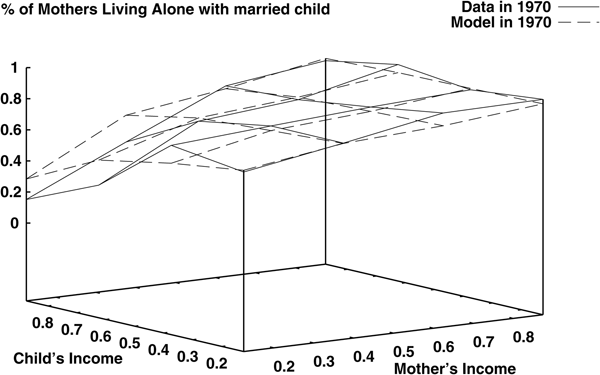
Table 6 shows the predictions of the model as well as its accuracy. We observe that the model replicates the key facts despite their strong non-linearities: first, the richer the mother, the more likely she lives alone for both married and single children; second, the richer the child, the more likely that he or she lives with the mother if married, and the more likely that he or she lives apart if single; and third, that for the single poorest children there is a flat relationship between the mother's income and the living arrangement. We think that the model's performance is very good, producing increases of different steepness in different directionsFootnote 17. The parameter estimates are reported in Table 7.
Predictions of the model for 1970 percentage of mothers living alone

Parameter estimates

We find interesting implications from the parameter estimates: (i) first of all, we see that zero effort when the child is married induces a very low probability of living alone (0.14 for ρ = 6.13), while the opposite occurs when the child is single (0.91 for ρ = 0.09). (ii) As one would expect, effort is a lot more costly for married children than for single ones  $(\alpha ^{{\rm {\cal M}}h} \gt \alpha ^{{\rm {\cal S}}h})$, reflecting perhaps the involvement of a spouse. (iii) It turns out that the mother does not like to live with her married child but she does indeed like to live with her single child (
 $\eta ^{\rm {\cal M}} \lt 0$ and
 $\eta ^{\rm {\cal S}} \gt 0$). This fact could reflect the preference of the mother for less crowded households or also her care-giving role of comforting and taking care of her child in the absence of a spouse. (iv) We also see that the economies of scale are very different for single and married children, showing increasing returns in total household income for married children and decreasing returns for single children
 $(\theta ^{\rm {\cal M}} \gt \theta ^{\rm {\cal S}})$. (v) The effort cost is bigger for mothers than for children in the single sample
 $(\alpha ^{{\rm {\cal S}}m} \gt \alpha ^{{\rm {\cal S}}h})$, while the opposite is true for married children
 $(\alpha ^{{\rm {\cal M}}h} \gt \alpha ^{{\rm {\cal M}}m})$. This could reflect the fact that single children have different lifestyles from those of married children, being more independent or more reluctant to share their privacy with others. (vi) Finally, we see that the portion of total household consumption devoted to mothers is bigger in the households of married children than in those of single ones
 $(\lambda ^{\rm {\cal M}} \gt \lambda ^{\rm {\cal S}})$.
Moreover, we find that mothers are quite risk neutral, and they have a low marginal utility (because of the large negative value of  $\bar{c}^m$). Thus, mothers are not very sensitive to children's income or consumption levels. In this context, the mother's direct preference for the living arrangement plays a crucial role in determining the sign of her effort. So in the married children groups, the mothers’ effort is aimed at living alone while in most of the single children groups the mothers’ effort is aimed at living together. On the contrary, children are risk averse and they value consumption more than mothers do, implying that children are very sensitive to the factors which account for their consumption level (mothers’ incomes, the economies of scale and the portion of total consumption devoted to them when living together). The combination of all these items means that in most cases children's consumption will be higher when living alone, and so children's effort will be aimed at living alone. Only the poorest single children make efforts to live with their mother. For example, in the first cell of the married sub-sample, mothers and children make a positive effort to live alone (1.09 and 0.16 respectively), while in the first cell of the single sub-sample mothers and children make a negative effort to live together (−1.39 and −0.09 respectively)Footnote 18.
Table 8 shows individuals’ efforts for all the groups. We find that the higher the income of mothers, the less attractive it is for them to live with their children and the more attractive it is for the children to live together. If we consider the income of the children instead, the higher their income, the less attractive it is for them to live together and the more attractive it is for the mothers. Due to the non-linear economies of scale, incomes are translated into effective consumption in a non-linear way and, therefore, the described relationships do not have to be monotone. In particular, increases in the income of single children have a hump-shaped effect on the effort of the richest groups of mothers. The reason is that the economies of scale have an inverse relationship with total income. So, for a poor mother, the higher income of her child is translated into an effective consumption level which encourages her to exert a large costly effort for living together, while it does not for a sufficiently rich mother.
Mothers’ and children's efforts to live alone by income level and marital status

Note: We divide by 100 to get the efforts supplied by the model.
Mothers and children decide strategically their respective efforts and the equilibrium of the game depends on the interaction of both efforts. Obviously, if the income level of just one player changes, then the efforts of both players change as well. Therefore, the actual living arrangements are complicated functions of those marginal efforts, and they do not display clear patterns along either rows or columns.
To give a graphical sense of the accuracy of the model, Figures 1 and 2 show the estimates and the data. Again, we see how good the estimates are, and how they look slightly better for married children. All in all, we think that this marital status model with 16 parameters and 32 observations has a very good fit with the data.
Proportion of mothers living alone who have a married child in the model and in the 1970 data.

Proportion of mothers living alone who have a single child in the model and in the 1970 data.

6. Predictions for 1990: the role of the marital status
We now use the model to assess the role of changes in marital status in accounting for the changes in living arrangements that happened between 1970 and 1990. To look at the effects of changes in the marital status distribution, we analyze the results of setting agents’ behaviors as the same as in 1970 and the marital status distribution as being the same as in 1990.
Given that the percentages of mothers living alone in 1970 for both married and single children's samples were 70.7% and 50.2% respectively, the change of marital status distribution predicts a reduction in the fraction of mother living alone which is 59.8%. This is not a surprising result given that during this period there was an increase in the number of single children (from 42.69% to 53.02% of the total sample), a factor that by itself leads to predict a reduction in the proportion of elderly mothers living alone.
This experiment shows that whereas marital status is a key variable in explaining cross-sectional living arrangements of 1970, it does not help to understand the sharp increase in the percentage of elderly widows living alone. Moreover, it implies that factors that produced the change in the living arrangements distribution were strong enough to offset the negative impact of the marital status.
7. Predictions for 1990: marital status and income
In this section, we introduce the effect of the change in income distribution. The aim of this section is to prove if the income effect observed in the literature [see e.g., Bethencourt and Ríos-Rull (Reference Bethencourt and Ríos-Rull2009) and McGarry and Schoeni (Reference McGarry and Schoeni2005)] still operates when it is considered jointly to the change in the marital status distribution. We want to know to what extent changes in income offset changes in marital status and so, account for the increase in the percentage of elderly widows living alone.
We now use the estimated model with the 1970 income data to obtain new equilibria results and to compare them with observations for the 1990 data. Note that we no longer try to match the data: we use the model to assess the role of changes in income to account for the changes in living arrangements that happened between 1970 and 1990. To do this, we construct a measurement of the accuracy of predictions.
We first obtain the predictions of the model for 1990: we obtain the equilibrium when the estimated model using 1970 data is fed with incomes from the 1990 data (see Table 14 in Appendix C). Next, we calculate a measurement of the accuracy of the predictions of the model for 1990 based on the prediction error. The measurement is essentially the proportion of the actual allocational change accounted for by the model, this is, the difference between 1 and the ratio of the prediction error of the model and the actual allocational change. Formally, the model accounts for
 $${\rm Accuracy} = 1-\displaystyle{{\sum\nolimits_{\rm {\cal Z}} {\sum\nolimits_{i,j}^4 \;} {\lpar {A_{i,j}^{{\rm {\cal Z}},90} -p^{{\rm {\cal Z}},90}(e_i^m, e_j^h )} \rpar }^2\;\hat{P}_{i,j}^{\rm {\cal Z}}} \over {\sum\nolimits_{\rm {\cal Z}} {\sum\nolimits_{i,j}^4 \;} {\lpar {A_{i,j}^{{\rm {\cal Z}},90} -A_{i,j}^{{\rm {\cal Z}},70}} \rpar }^2\;\hat{P}_{i,j}^{\rm {\cal Z}}}}, $$
where  $\hat{P}_{i,j}^{\rm {\cal Z}} $ is the proportion of mothers of income type j with children of income type i and marital status
 ${\rm {\cal Z}}$;Footnote 19
 $A_{i,j}^{{\rm {\cal Z}},t} $ is the proportion of elderly widows of type
 $\{ i,j,{\rm {\cal Z}}\} $ in the data who live alone in year t ∈ {70, 90}; and
 $p^{{\rm {\cal Z}},90}(e_i^m, e_j^h )$ is the equivalent proportion of elderly widows living alone predicted by the model when using the parameter estimates from the 1970 data and the actual incomes of 1990.
Table 9 shows the predictions of the model. We see that the model replicates the uniform increase in all income groups. We think that the model does it well, even for predicting the huge increase in the percentage of poor mothers with a married rich child living alone (while in the data the increase for this group went from 15.2% to 62.5% in 1990, the model predicts 40.6% in 1990).
Predictions of the model for 1990 percentage of mothers living alone

For the sample of single children, the proportion of widows living alone in 1990 was 66.3%, while it was 50.2% in 1970. The model predicts 64.3% of widows living alone in 1990 which implies that the model accounts for 90.0% of the change in number of widows living alone. For the sample of married children, the percentage of widows living alone in 1990 was 85.5, while it was 70.7 in 1970. The model predicts 78.3% of widows living alone in 1990 which implies that the model accounts for 72.5% of the change in number of widows living alone.
In the data in 1990, 75.3% of widows live alone, while 62.0% did so in 1970. The overall prediction of mothers living alone is 71.0% in 1990. Thus, the model predicts a 67.7% of the allocational increase between 1970 and 1990. However, the more precise statistic we define above to measure the accuracy of the model shows that the model accounts for 83.4% of the change in the number of widows living alone. Our model improves substantially on the results by Bethencourt and Ríos-Rull (Reference Bethencourt and Ríos-Rull2009). While they improve slightly our prediction with respect to the allocational increase between 1970 and 1990 (they account for about 6.7 extra points), the more precise statistic shows that their model only accounts for about the 75% of the change in the same period.
Thus, our findings reveal that the income effect as evidenced in Bethencourt and Ríos-Rull (Reference Bethencourt and Ríos-Rull2009) is strong enough to offset the effect of the marital status and so, to explain the observed changes in living arrangements distribution. Therefore, we conclude that the income variable plays a key role in accounting for the increase in the percentage of elderly widows living alone.
8. Conclusion
In this paper, we document the prevalence of children marital status in determining the living arrangements of elderly widows and their children among other characteristics of families.
We estimate an equilibrium model in which living arrangements are determined as the outcome of a game between the mother and her child (married or single), and where both make investments that affect the probability of the specific living arrangement that ensues. In this approach, the shape of the model's fundamentals (economies of scale and preferences) depends on the marital status of the children and both, the mother and the child's incomes, play a central role. The model is very good in accounting for the non-monotonic patterns in the data corresponding to 1970, both for mothers who have married children as well as for those with single children.
We then use the estimated model to measure the extent to which changes in marital status account for the changes in living arrangements between 1970 and 1990. We find that changes in the marital status distribution of children predict a decrease in the fraction of elderly widows living alone. This contrasts with the substantial increase that we observed in the data. In addition, we analyze whether the income effect found by Bethencourt and Ríos-Rull (Reference Bethencourt and Ríos-Rull2009) still survives when it is considered jointly to the change in the marital status. We find that changes in income and marital status distribution account for a high percentage of the changes in the living arrangements of elderly widows between 1970 and 1990: a 67.7% of the aggregated allocational increase, but an 83.4% when we consider the accuracy of the prediction among the different groups of population. Thus, we conclude that income changes play a key role in accounting for the increase in the number of elderly widows living alone.
This paper focuses on the distribution of the living arrangements of elderly widows and their children. However, the model we propose is flexible enough to account for other types of living arrangements. For instance, Matsudaira (Reference Matsudaira2016) and Kahn et al. (Reference Kahn, Goldscheider and García-Manglano2013) have documented a recent increase in co-residence of parent–adult child that has been accompanied by a growth in the financial dependence of children, increasingly unmarried. This is consistent with our theory which predicts that for single children a low income increases the proportion of those that live with their mothers; whereas regarding the mothers' income, there exist a weak negative relationship between income and co-residence.
This paper provides a framework to analyze how policies and socioeconomic changes that affect the elderly and their children translate into changes in the composition of the intergenerational households. In particular, this paper shows that changes that affect the marital status of the children have strong implications for their households and the households of their mothers. Moreover, it shows that relative changes in income among elderly widows and their children have different implications depending on the marital status of the children. In this setting, more relaxed divorce laws or the trend toward a single lifestyle may prevent an increasing tendency of elderly widows living alone. A relative impoverishing of children would increase the share of mothers and children living together, reinforcing the caregiving role of mothers. This evidences that co-residence continues to be an important source of support for individuals. Since living conditions are considered quite important for determining the well-being of elderly people and also are associated with the level of support received and offered by the elderly, governments should consider this fact in planning policies devoted to improve the standards of living of elderly widows and their children, for instance, child support programs and long term care programs. An interesting extension to this model is to consider the living arrangements’ decision in a life-cycle model to develop a framework for evaluating dynamically optimal policies.
Acknowledgements
I especially thank José-Víctor Ríos-Rull for his valuable contribution to the paper. I would also like to thank Richard Rogerson, Virginia Sánchez-Marcos, and the participants in seminars at the Universidad Carlos III de Madrid and the University of Pennsylvania for useful comments. I am also grateful to the University of Pennsylvania and the University of Minnesota for their hospitality. Finally, I thank the Spanish Ministry of Science and Technology for financial support, Grant ECO2016-76818-C3-2-P.
Appendix A: Data analysis
Sample of elderly widows
Between 1970 and 1990, the remaining life expectancy of 65-year-old women went from 17 to 19 yearsFootnote 20. To account for the increase in life span, we change slightly the definition of elderly widows in 1990. Thus, in 1970 we select widows from 65 to 82 years of age, while in 1990 we choose those widows from 67 to 84 years of age. The change in the age group we look at has the additional advantage of keeping the fraction of widows (49.1% and 47.8% in 1970 and 1990, respectively) nearly constant, as the increase in life expectancy also affects men.
Since we are interested in elderly widows who have been mothers in the past, we select elderly widows who gave birth to at least two children. The average number of children of the selected mothers is 4.41 in 1970 and 4.14 in 1990, a difference of less than 10%. This small change in family size and the fact that there seems to be a weak relationship between family size and living arrangements are the reasons we disregard family size in our model.
Living arrangements of elderly widows
We have used four types of living arrangements to characterize the data: living alone, with children, with others, and in an institutionFootnote 21. Table 10 shows the distribution of living arrangements of widows. Living with others and living in an institution are infrequent events, and they have remained relatively constant. Hence, we disregard those two living arrangements, and we consider only the options of living alone or living with children. In 1970, 62% of the widows who were not living with others or in institutions lived alone, while in 1990 this fraction was 75.3%. Therefore, the proportion of elderly widows living alone grew by 23.2% in the USA between 1970 and 1990. The set of women that we look at constitutes 66.6% of the unmarried women of age 65+ and 80% of the unmarried women for the age range defined previously.
Distribution of widows by living arrangements in percentages

Appendix B: The imputation process
We have restricted the living arrangements to two categories: living alone and living with children. As noted above, from the IPUMS database, we cannot identify who is the mother of each child if they are living apart, but the AHEAD 1993 can. Then, we assume that the intertemporal persistence of relative income and children's marital status remains stationary between 1970 and 1993Footnote 22. This assumption allows us to construct pairs of mothers and children that are not living together using the following detailed steps.
According to the IPUMS, the living arrangements of the elderly widows can be partitioned into four categories: living alone, living with children, living in institutions and living with others. The fraction of those that either live alone or with children constitutes about 85% of the sample, both in 1970 and in 1990. Thus, we have chosen to disregard those living in institutions or living with other unrelated adultsFootnote 23.
Once we restrict the living arrangements to either mothers and their children living together or living alone, the 1970 and 1990 mother–children pairs can be constructed by the following detailed steps.
(1) 1993 AHEAD: joint income distribution. We start by analyzing child and mother pairs in the 1993 AHEAD by splitting the sample in four equal sized income groups for both mothers and children. If the widow is living alone and has more than one child, we randomize and select one of the childrenFootnote 24. Then, we calculate the joint distribution of incomes of mothers and the household the children belong to (see Table 11).
(2) 1993 AHEAD: joint income distribution controlled by marital status. Once we obtain the joint distribution of incomes of mothers and children, we control it by the children's marital status and obtain the joint distribution of incomes and marital status.
Joint distribution of incomes of mothers and children

Table 12 shows the joint distribution in a synthetic way as the independent joint distribution of incomes for both married and single children. It shows the frequency of the resulting 16 groups when we combine the four different income groups for both mothers and children and when the children's marital status is  ${\rm {\cal Z}}$. The marital status,
 ${\rm {\cal Z}}$, is
 ${\rm {\cal M}}$ or
 ${\rm {\cal S}}$ if the children are married or single respectively. The mother inherits the child's marital status. This results in 32 different groups and
 $P_{i,j}^{\rm {\cal Z}} $ is the proportion of mothers of income type j with children of income type i and marital status
 ${\rm {\cal Z}}$. Finally,
 $\mu ^{\rm {\cal Z}}$ denotes the proportion of children (mothers) of marital status z, i.e.,
 $\mu ^{\rm {\cal M}} + \mu ^{\rm {\cal S}} = 1$. Note that
 $P_{.,j}^{\rm {\cal M}} $ does not have to be equal to
 $P_{.,j}^{\rm {\cal S}} $ (the same is true for
 $P_{j,.}^{\rm {\cal M}} $ and
 $P_{i,.}^{\rm {\cal S}} $). To get back to the joint income distribution we only have to do the followingFootnote 25:
 $$P_{i,j} = \sum\limits_z {\mu ^{\rm {\cal Z}}} P_{i,j}^{\rm {\cal Z}} = \mu ^{\rm {\cal M}}P_{i,j}^{\rm {\cal M}} + \mu ^{\rm {\cal S}}P_{i,j}^{\rm {\cal S}}, \quad i,j = 1,...,4\quad {\rm {\cal Z}} = {\rm {\cal M}},{\rm {\cal S}}.$$
(3) 1970 and 1990 IPUMS: subsample of individuals living alone. We then go to the 1970 and 1990 IPUMS samples and select a subsample of children living alone with the same size as that of widows living alone. The children are selected from the same age range as the children who live with their widow-mothers.
(4) 1970 and 1990 IPUMS: subsample of individuals living together. From the IPUMS, we select the pairs of mothers and children that live together for both 1970 and 1990, respectively.
(5) 1970 and 1990 IPUMS: marginal distributions of incomes of mothers and children by children's marital status. We start merging the subsamples of individuals living alone and mothers and children living together obtained in the previous steps. Next, we proceed as in step 1: we obtain the marginal distributions of incomes of mothers and children sorting all the children and all the widows into four income groups of equal size, and then we control the resulting distributions by children's marital status (step 2).
Joint distribution of incomes of mothers and children by children's marital status

Note that, as in step 2, marginal distributions of the single sample do not have to be equal to ones in the married sample; and, obviously, they could also be different in 1970, 1990 and 1993 (this is our case). Formally, for the marginal distribution of mothers:
 $$P_{.,j}^{{\rm {\cal Z}},70} {\ne} P_{.,j}^{{\rm {\cal Z}},90} {\ne} P_{.,j}^{\rm {\cal Z}}, \quad j = 1,...,4;\quad {\rm {\cal Z}} = {\rm {\cal M}},{\rm {\cal S}}.$$
However, as said before, it is true that:
 $$P_{.,j} = \sum\limits_{\rm {\cal Z}} {\mu ^{{\rm {\cal Z}},70}} P_{.,j}^{{\rm {\cal Z}},70} = \sum\limits_{\rm {\cal Z}} {\mu ^{{\rm {\cal Z}},90}} P_{.,j}^{{\rm {\cal Z}},90} = \sum\limits_{\rm {\cal Z}} {\mu ^{\rm {\cal Z}}} P_{.,j}^{\rm {\cal Z}} = 0.25.$$
Analogously, it is the same for children.
Next, we proceed as in step 4 matching mothers and children who live in the same household. Thus, we obtain the proportion of those that live together among the 32 different combinations of groups of mothers and children. These are denoted by  $T_{i,j}^{{\rm {\cal Z}},t} $ for t corresponding to 1970 and 1990.
(6) 1970 and 1990 IPUMS: imputation of the joint distribution of incomes and marital status. Given the fact that marginal distributions are different over the years, we cannot impute the joint distribution of income and marital status.
The solution is to impute the joint distribution using only one dimension, i.e., using the children's marginal distribution or the mothers’ marginal distribution. For instance, let us take the year 1970, and impute the marginal distribution of the children (analogously for 1990 and the mothers’ distribution). The way to do this is as follows:
 $$\hat{P}_{i,j}^{{\rm {\cal Z}},70} = P_{i,.}^{{\rm {\cal Z}},70} \displaystyle{{(P_{i,j}^{\rm {\cal Z}} )} \over {(P_{i,.}^{\rm {\cal Z}} )}},\quad i,j = 1,...,4\quad {\rm {\cal Z}} = {\rm {\cal M}},{\rm {\cal S}}.$$
Thus, the total proportion of individuals in each cell is obtained. Note that the marginal distribution of the children is the same after doing the imputation as before it.
 $$\hat{P}_{i,.}^{{\rm {\cal Z}},70} = \sum\limits_j {\hat{P}_{i,j}^{{\rm {\cal Z}},70}} = P_{i,.}^{{\rm {\cal Z}},70} \quad i,j = 1,...,4\quad {\rm {\cal Z}} = {\rm {\cal M}},{\rm {\cal S}}.$$
However, mothers’ marginal distributions after the imputation could be different to previous ones in the data. The higher the difference between the mothers’ marginal distribution of the data and the calculated one after the imputation, the higher the error of the imputationFootnote 26.
So, in order to impute, we select the mothers’ and children's marginal distributions that produce less error, that is, marginal distributions that are closest to the marginal distributions in the dataFootnote 27. As a consequence, we obtain for 1970 and 1990, the closest joint distributions to the ones we observe in the data (1993 AHEAD), which are:  $\hat{P}_{i,j}^{{\rm {\cal Z}},t}, \forall i,j,\forall {\rm {\cal Z}}$ and t = 70, 90.
Finally, we can calculate the proportion of individuals living alone in each group for 1970 and 1990 IPUMS. We combine the  $T_{i,j}^{{\rm {\cal Z}},t} $ from the IPUMS with the
 $\hat{P}_{i,j}^{{\rm {\cal Z}},t} $ from the AHEAD as follows:Footnote 28
 $$A_{i,j}^{{\rm {\cal Z}},t} = \hat{P}_{i,j}^{{\rm {\cal Z}},t} -T_{i,j}^{{\rm {\cal Z}},t}, $$
where  $A_{i,j}^{{\rm {\cal Z}},t} $ denotes the proportion of elderly widows with income i and with children with income j and marital status
 ${\rm {\cal Z}}$ who are living alone in year t,
 $\forall i,j$ and
 $\forall {\rm {\cal Z}}$.
To summarize, we randomize the IPUMS samples of children and mothers living alone, for both married and single samples and generate the child–mother income pairs, according to the imputed 1993 AHEAD joint distribution. Thus, we obtain the average income for mothers and children in each pair (see Appendix C).
Appendix C: Original income data by quartiles
Table 13 reports the average incomes of the mother and of the child of each of the 32 groups in 1970.
Total income for widows and their children by income quartiles in 1970

In order to calculate the predictions of our model, we have to deflate incomes in 1990 to compare them to incomes in 1970. While the Consumer Price Index (CPI) is the most popular price index, there is a relative consensus among economists that it overestimates inflation [see Gottschalk (Reference Gottschalk1997)], so we have corrected this bias following the same procedure as in Regalia and Ríos-Rull (Reference Regalia and Ríos-Rull1998). Hamilton (Reference Hamilton2001) has calculated the total bias for our sample period from 1970 to 1990. He found that the CPI overstated inflation by 3.0 percentage points per year between 1972 and 1981 and by 1.0 percentage point per year between 1981 and 1991. Costa (Reference Costa2001) obtained similar calculations for the same period. With a different database she finds that there was an upward bias in the CPI between 1972 and 1982, about 2.7 percent per year, falling to 0.6% between 1982 and 1994. According to these numbers, the adjusted CPI would imply that $1 in 1970 equates to $2.31 in 1990, which is very close to the one obtained by Hamilton (Reference Hamilton2001). In fact, our results do not change much if we consider the adjustment by Costa (Reference Costa2001). While unadjusted CPI states that $1 in 1970 is $3.37 in 1990, the corrections by Hamilton (Reference Hamilton2001) imply that $1 in 1970 equates to $2.22 in 1990. We used the adjusted CPI. Table 14 reports the average (deflated) incomes of the mother and of the child of each of the 32 groups in 1990.
Total income for widows and their children by income quartiles in 1990a