Implications
For humans especially in France, healthy fatty acids (FA) come primarily from animal products, whose quality is influenced by the FA composition of the animal diet. Innovative ingredients may consequently be added to animal diets to improve the nutritional quality of lipids in their meat. Plants such as rapeseed or linseed can be added to provide animals with α-linolenic acid (ALA) without supplying other n-3 polyunsaturated fatty acids (PUFAs). A new source of docosahexaenoic acid derived from microalgae may be added to livestock diets, but requires evaluation of its influence on technological and sensory qualities of meat.
Introduction
The enrichment of pork with n-3 PUFA has been widely studied. The most effective method to enrich meat is to include dietary FA contained in seeds such as linseed (Guillevic et al., Reference Guillevic, Kouba and Mourot2009; Corino et al., Reference Corino, Magni, Pagliarini, Rossi, Pastorelli and Chiesa2014), rapeseed (Corino et al., Reference Corino, Rossi, Cannata and Ratti2002; Högberg et al., Reference Högberg, Pickova, Andersson and Lundströma2003), hempseed (Mourot and Guillevic, Reference Mourot and Hermier2015) or fish oil (Missotten et al., Reference Missotten, De Smet, Raes and Doran2009). However, feeding pigs the n-3 PUFA precursor (ALA; 18:3n-3) contained in linseed, rapeseed or hempseed barely increased long-chain n-3 PUFA derivatives in meat, such as eicosapentaenoic acid (EPA, 20:5n-3), docosapentaenoic acid (22:5n-3, DPA) and docosahexaenoic acid (DHA, 22:6n-3). It was shown that in humans, the n-3 and n-6 PUFA families compete for desaturases, which are enzymes involved in PUFA synthesis (Lavialle and Layé, Reference Lavialle and Layé2010). It was also demonstrated that ALA competes with 24:5n-3 for the Δ6-desaturase (Portolesi et al., Reference Portolesi, Powell and Gibson2007). This competition decreases DHA synthesis, which can then be retroconverted into EPA (Gronn et al., Reference Gronn, Christensen, Hagve and Christophersen1991; Brossard et al., Reference Brossard, Croset, Pachiaudi, Paul Riots and Tavot1996). Consequently, deposition of de novo synthesized DHA in tissues is low. In contrast, feeding pigs with fish oil provides high proportions of EPA, DPA and DHA; however, it is expensive and may not be sustainable due to the dramatic decline in fish resources (Botsford, Reference Botsford1997). It is possible, however, to replace fish oil with microalgae (Sardi et al., Reference Sardi, Martelli, Lambertini, Parisini and Mordenti2006); the technology is based on a fermentation process that produces DHA-rich microalgae (Barclay et al., Reference Barclay, Meager and Abril1994).
Meat quality is defined by technological, nutritional and sensory traits that are especially influenced by animal feed. Specifically, the nutritional and sensory lipid quality of the meat depends on the FA composition. The objective of this study was to evaluate the influence of a dietary supply of linseed and microalgae on growth performances, carcass traits, and the nutritional and sensory qualities of meat of pigs in the growing and finishing period. Experimental diets containing high levels of n-3 PUFA were compared with a control diet with low n-3 PUFA content.
Material and methods
Animals and diets
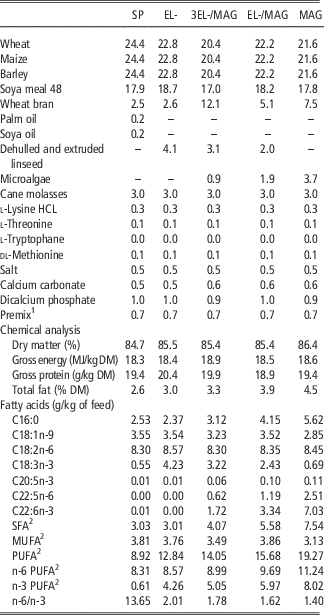
Animals in this experiment were reared and slaughtered in compliance with French regulations for the humane care and use of animals in research. The French National Research Agency authorized us (author J.M.) to experiment on living animals in the AGRALID project (ANR 12-ALID-003) (ministerial reference experiment number 02279). A total of 60 growing-finishing crossbred [(Large white×Landrace) sows×Pietrain boar] male pigs were assigned in experimental groups according to their initial liveweight (LW, 50.7±2.7 kg). Pigs were reared in individual pens from 14 weeks to 22 weeks of age. During these 8 weeks, they received feed and water ad libitum in individual crates on concrete flooring. They were fed with one of five experimental diets, including a control diet containing soybean and palm oil (SP). Other experimental diets included 100% dehulled and extruded linseed (EL-; TRADILIN®, Valorex, Combourtillé, France), or a mix of 75% dehulled and extruded linseed and 25% DHA-rich microalgae (3EL-/MAG), or a mix of 50% dehulled and extruded linseed and 50% microalgae (EL-/MAG). The fifth diet contained only the DHA-rich microalgae (MAG; DHA Gold®, Schizochytrium sp., DSM, Belgium) as a source of dietary lipids. Diets respectively contained 0.55, 4.23, 3.22, 2.43 and 0.69 g of ALA and 0.01, 0.00, 1.72, 3.34 and 7.03 g of DHA per kg of feed (Table 1). Diets contained 3% fat and 19% crude protein on average and were supplemented with wheat bran to be isoenergetic on a net energy basis (Sauvant et al., Reference Sauvant, Perez and Tran2004). Diets were also supplemented with 40 ppm of α-tocopherol acetate to prevent PUFA oxidation (Table 1). Since diets followed nutritional recommendations for pigs, amino acid content did not limit growth. Animal feed consumption was measured twice a week throughout the rearing phase by subtracting feed refusal from the amount of feed distributed. Animals were weighed once a week before the morning feeding. ‘Average daily gain’ equals total weight gain divided by the number of days in the experiment, while ‘feed ratio’ equals total feed consumption divided by total weight gain. One pig on the EL- diet was removed during the rearing period due to health problems.
Composition (g/100 g as fed) and analysis of experimental diets

SP=soya-palm diet; EL-=extruded linseed diet; 3EL-/MAG=75% dehulled and extruded linseed +25% microalgae diet; EL-/MAG=75% dehulled and extruded linseed+25% microalgae diet; MAG=microalgae diet.
1 g/kg – Ca: 267; Mg: 1.8; Cl: 25; S: 7; mg/kg – vitamin E: 20 000; Se: 50.
2 SFA=saturated fatty acid is the sum of 10:0, 12:0, 14:0 15:0, 16:0, 18:0, 20:0, 22:0 and 24:0; MUFA=monounsaturated fatty acid is the sum of 16:1n-9, 16:1n-7, trans-18:1n-9, cis-18:1n-9, 18:1n-7, 20:1n-9, 22:1n-11, 22:1n-9 and 24:1; PUFA=polyunsaturated fatty acid is the sum of trans-18:2n-6, cis-18:2n-6, 18:3n-6, 18:3n-3, 18:4n-3, 20:2, C20:4n-6, 20:3n-3, 20:4n-3, 20:5n-3, 22:4n-6, 22:5n-6, 22:5n-3 and 22:6n-3; n-6 PUFA is the sum of trans-18:2n-6, cis-18:2n-6, 18:3n-6, 20:3n-6, 20:4n-6, 22:4n-6 and 22:5n-6; n-3 PUFA is the sum of 18:3n-3, 18:4n-3, 20:3n-3, 20:4n-3, 20:5n-3, 22:5n-3 and 22:6n-3.
Tissue samples and meat quality variables
Pigs were stunned using electronarcosis and slaughtered by bleeding at 115±7.5 kg LW after a 16-h fasting period. The blood was collected at bleeding for FA analysis. After evisceration, the liver, heart and kidneys were removed from the carcass and weighed. The carcass was then cut in half lengthwise and weighed to obtain the total hot weight. 100±30 g of each tissue were sampled to determine the FA composition. The liver was sampled at the point of the second lobe, and the longissimus dorsi (LD) muscle and subcutaneous backfat (SCB) were sampled at the third-to-last rib on the right side of the carcass. Blood and tissue samples were then individually packaged and frozen at −20°C until analysis. During slaughter, one carcass from the MAG diet was removed from the experiment due to health problems, decreasing the number of pigs to 58.
In the slaughterhouse, the carcass meat percentage was measured using a Fat-O-Meter (CGM, Syleps, France) with a probe applied to two points between the third- and fourth-to-last lumbar vertebrae and the last rib. Carcasses were cooled at 1°C for 24 h, and the pH of the LD muscle was then measured using a mobile pH-meter at the third-to-last rib. Meat color indices L*, a* and b* respectively for the luminance, the red and yellow colors of the LD muscle were determined using a calibrated colorimeter (CR 300; Konica Minolta, Saint-Grégoire, France). Drip loss was determined using the method of Honikel (Reference Honikel1998).
Chemical analysis of feed and tissues
Diets were analyzed based on feed sampled pooled each week. Dry matter in the diets was measured according to AFNOR (1982) (Table 1). Crude protein content was measured according to ISO (2008), and crude energy content was measured using an adiabatic bomb calorimeter according to ISO (1998) (Table 1). Lipids in the erythrocytes and the plasma were extracted using the micro-method of Bligh and Dyer (Reference Bligh and Dyer1959). Lipids in feed and tissues were cold extracted using chloroform/methanol (v/v 2 : 1) (Folch et al., Reference Folch, Lees and Sloane Stanley1957). The FA methyl esters were saponified with a methanolic sodium hydroxide solution in the presence of 17:0 as the internal FA standard. They were then methylated with boron trifluoride (Morrison and Smith, Reference Morrison and Smith1964) and recovered with pentane and a distilled-water solution and were analyzed by gas chromatography (7890 GC system; Agilent Technologies, Marcy l’Etoile, France). The chromatograph was equipped with a 0.25 mm×30 m capillary column made from polysiloxane polymer filled with dimethylpolysiloxane and 50% cyanopropylphenyl in stationary phase. The oven temperature treatment began at 150°C and increased 4°C per minute up to 220°C, where it was maintained for 10.5 min. Injector and flame ionization detector temperatures were kept constant at 220°C and 280°C, respectively. Hydrogen was the carrier gas. Retention times and peaks were determined using the chromatography software ChemStation Agilent. Identities of peaks were verified by comparing peaks to the retention time of standard FA methyl esters. Results were expressed in mg per 100 g of tissue to estimate the quantity (g) in the whole tissue, as follows:
 $$\eqalignno{ & {\rm Quantity}\,{\rm in}\,{\rm whole}\,{\rm tissue}( {\rm g}){\rm {\equals}}( {{\rm weight}\,{\rm of}\,{\rm tissue}( {\rm g} ) }\cr & {\rm {\times}fatty}\,{\rm acid}\,{\rm content}\,( {{\rm mg\!/\!100}\,{\rm g}\,{\rm of}\,{\rm tissue}} ){\rm \!/\!100} ){\rm \!/\!1000}}$$
Meat quality
Fatty acid lipid peroxidation of SCB was measured using thiobarbituric acid-reactive substances following the procedure described by Buege and Aust (Reference Buege and Aust1978) as modified by Kornbrust and Mavis (Reference Kornbrust and Mavis1980). Briefly, 0.7 g of SCB was homogenized in 9 ml of potassium chloride; 100 μl of this homogenate was mixed with 500 μl of tris-maleate as a buffer, 200 μl of ascorbic acid as an antioxidant and 200 μl of iron sulfate to activate the reaction. The homogenate was then centrifuged at 2000×g for 10 min at 4°C. The supernatant was filtered; some of it was incubated at 37°C for 15 min, while the rest was mixed with 2 ml of mixture of thiobarbituric and trichloroacetic acid in HCl reagent and incubated for 60, 120, 200 or 300 min. The absorbance at 535 nm was recorded. Results were expressed as nmol malondialdehyde (MDA)/g of SCB.
Sensory analysis of the meat was performed at the Magneraud research station of INRA according to French regulations (AFNOR, 2010). Sensorial analysis were performed on the loin of pigs fed the control, EL-, EL-/MAG or the MAG. Loins were cooked in an oven at 250°C during 10 min before adjusting the oven temperature at 100°C in damp heat. The cooking finished when the temperature reached 80°C. A type-K probe temperature was placed in each piece of meat at the end of cooking. Loins were then presented using monadic testing so that they could be evaluated while hot. At each tasting session, trained judges (12 persons) evaluated the odor, tenderness, juiciness, texture and overall flavor of cooked pork loin coming from each experimental diet. Each received one whole slice per treatment and a self-completion questionnaire. Each criterion was rated on a continuous scale from 0 to 10, whose 0 means ‘dislike extremely’ and 10 means ‘like extremely.’ Panel members were invited to consume water, bread and/or an apple slice between samples. Tasting sessions lasted ~1 h.
Statistics
Data were analyzed using type-III analysis of variance (Proc GLM) in SAS® 9.4 software, with the diet as the main factor. Multiple comparisons between groups were applied using a Bonferroni test and accepted as significant if P<0.05. Results were calculated as least-square means by diet. Root square mean errors and the significance of the test were also calculated.
Results
Chemical composition of the diets
Experimental diets contained an average of 85.5% dry matter, 18.5 MJ/kg DM gross energy, 19.6% DM gross protein and 3.5% DM total fat. Fatty acid profiles of the five experimental diets differed depending on the ingredients (Table 1). The EL- diet had the highest ALA content (4.23 g/kg), while the MAG diet had the highest contents of 22:5n-6 (2.5 g/kg), DHA (7.0 g/kg), SFA (7.5 g/kg), PUFA (19.3 g/kg) and n-3 PUFA (8.0 g/kg). EL-/MAG and 3EL-/MAG diets had lower n-6/n-3 ratios (⩽2) than the SP diet (13.7).
Pig performances and carcass traits
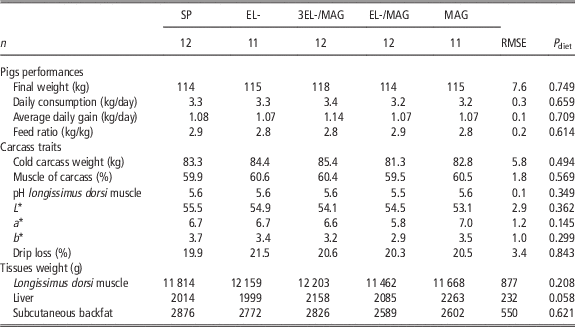
Pig performances and carcass traits are shown in Table 2. Diets had no significant effect on pig performances (animal weight, daily feed intake and performance ratios), carcass traits (weight, percentage of muscle and technological meat quality such as pH, color and percentage of water loss) or weights of tissues (LD muscle, liver and SCB; P>0.05). However, the liver tended to increase in weight as dietary intake of microalgae increased (P=0.058).
Performances and carcass traits of finishing pigs fed experimental diets

SP=soya-palm diet; EL-=extruded linseed diet; 3EL-/MAG=75% dehulled and extruded linseed +25% microalgae diet; EL-/MAG=75% dehulled and extruded linseed +25% microalgae diet; MAG=microalgae diet; RMSE=root mean square deviation.
Results are least-square means.
Total lipid content and fatty acid composition in blood and tissues
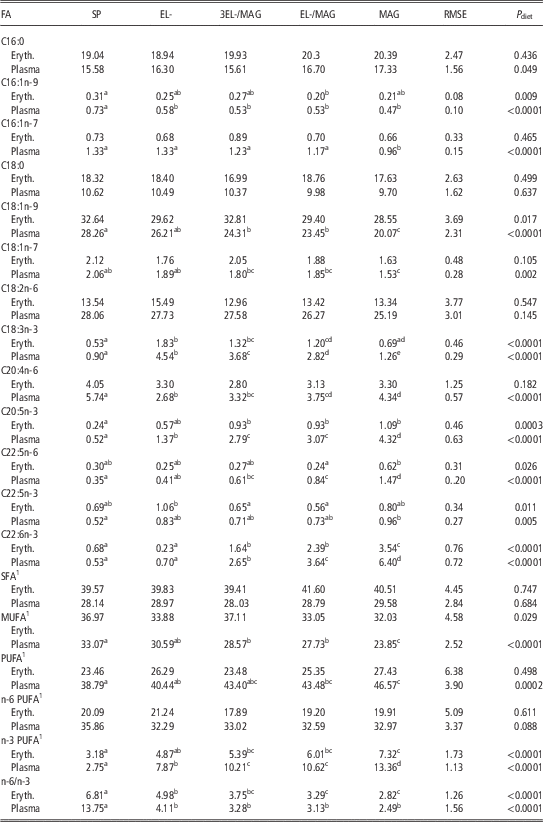
FA composition of diets influenced FA contents of blood (erythrocytes+plasma) (Table 3). Blood from pigs fed 3EL-/MAG and EL-/MAG diets had significantly lower 16:1n-9 content than that from pigs fed the SP diet (P<0.05). Plasma from pigs fed the MAG diet had significantly lower contents of 16:1n-7, 18:1n-9 and 18:1n-7 than that from pigs fed the SP or EL- diets (P<0.05). In contrast, blood from pigs fed the EL- diet had the highest 18:3n-3 content. Blood from pigs fed the SP diet had the lowest 20:5n-3 content, while that from pigs fed the MAG diet had the highest 22:5n-6 and 22:6n-3 contents. Plasma from pigs fed with linseed and/or microalgae had lower MUFA contents, even though these diets had higher total n-3 PUFA contents. Consequently, the dietary n-6/n-3 ratio decreased significantly as the dietary supply of linseed and microalgae increased (P<0.05).
Effect of experimental diets on fatty acid content (% of FA) in erythrocytes and plasma of finishing pigs (n=11 to 12)

SP=soya-palm diet; EL-=extruded linseed diet; 3EL-/MAG=75% dehulled and extruded linseed +25% microalgae diet; EL-/MAG=75% dehulled and extruded linseed +25% microalgae diet; MAG=microalgae diet; RMSE=root mean square deviation.
Results are least-square means.
1 SFA=saturated fatty acid is the sum of 10:0, 12:0, 14:0 15:0, 16:0, 18:0, 20:0, 22:0 and 24:0; MUFA=monounsaturated fatty acid is the sum of 16:1n-9, 16:1n-7, trans-18:1n-9, cis-18:1n-9, 18:1n-7, 20:1n-9, 22:1n-11, 22:1n-9 and 24:1; PUFA=polyunsaturated fatty acid is the sum of trans-18:2n-6, cis-18:2n-6, 18:3n-6, 18:3n-3, 18:4n-3, 20:2, C20:4n-6, 20:3n-3, 20:4n-3, 20:5n-3, 22:4n-6, 22:5n-6, 22:5n-3 and 22:6n-3; n-6 PUFA is the sum of trans-18:2n-6, cis-18:2n-6, 18:3n-6, 20:3n-6, 20:4n-6, 22:4n-6 and 22:5n-6; n-3 PUFA is the sum of 18:3n-3, 18:4n-3, 20:3n-3, 20:4n-3, 20:5n-3, 22:5n-3 and 22:6n-3.
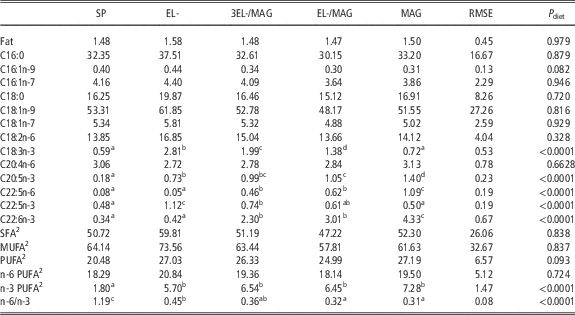
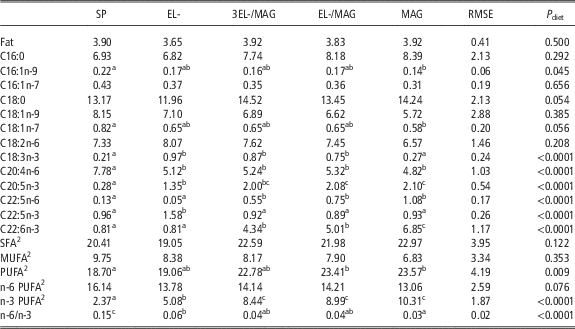
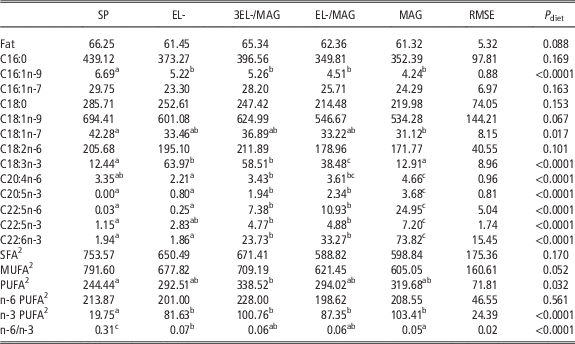
Diets did not influence lipid contents of the LD muscle, liver or SCB (P>0.05; Tables 4 to 6). In contrast, diets had an effect on PUFA content of the LD muscle, liver and SCB. The 18:3n-3 content was lowest in the muscle, the liver and the SCB from pigs fed the SP and MAG diets, while the 22:6n-3 content was lowest in these tissues from pigs fed the SP or EL- diets (P<0.05; Tables 4 and 5). Except for 22:5n-3 content in the muscle and liver, contents of 20:5n-3, 22:5n-6 and 22:5n-3 increased as the dietary supply of linseed and microalgae increased. Compared with SP diet, the 20:4n-6 content decreased in the liver with the supply of linseed and microalgae; but it increased in the SCB with the supply of microalgae. The amount of this PUFA in the LD muscle was the same regardless of the diet (P=0.66). Consequently, diets containing linseed and microalgae yielded higher PUFA contents in tissues than the SP diet (P<0.05). The increased amount of microalgae in diets decreased significantly 16:1n-9 and 18:1n-7 contents but just tended to decrease total MUFA content of the SCB (P=0.052).
Effect of experimental diets on fat (%) and fatty acid content (g) in whole longissimus dorsi muscleFootnote 1 of finishing pigs (n=11 to 12)

SP=soya-palm diet; EL-=extruded linseed diet; 3EL-/MAG=75% dehulled and extruded linseed +25% microalgae diet; EL-/MAG=75% dehulled and extruded linseed +25% microalgae diet; MAG=microalgae diet; RMSE=root mean square deviation.
Results are least-square means.
1 Fatty acid content of tissue (g) was calculated as follow: (weight of tissue (g)×fatty acid content (mg/100 g of tissue)/100)/1000.
2 SFA=saturated fatty acid is the sum of 10:0, 12:0, 14:0 15:0, 16:0, 18:0, 20:0, 22:0 and 24:0; MUFA=monounsaturated fatty acid is the sum of 16:1n-9, 16:1n-7, trans-18:1n-9, cis-18:1n-9, 18:1n-7, 20:1n-9, 22:1n-11, 22:1n-9 and 24:1; PUFA=polyunsaturated fatty acid is the sum of trans-18:2n-6, cis-18:2n-6, 18:3n-6, 18:3n-3, 18:4n-3, 20:2, C20:4n-6, 20:3n-3, 20:4n-3, 20:5n-3, 22:4n-6, 22:5n-6, 22:5n-3 and 22:6n-3; n-6 PUFA is the sum of trans-18:2n-6, cis-18:2n-6, 18:3n-6, 20:3n-6, 20:4n-6, 22:4n-6 and 22:5n-6; n-3 PUFA is the sum of 18:3n-3, 18:4n-3, 20:3n-3, 20:4n-3, 20:5n-3, 22:5n-3 and 22:6n-3.
Effect of experimental diets on lipid (%) and fatty acid content (g) in whole liverFootnote 1 of finishing pigs (n=11 to 12)

SP=soya-palm diet; EL-=extruded linseed diet; 3EL-/MAG=75% dehulled and extruded linseed +25% microalgae diet; EL-/MAG=75% dehulled and extruded linseed+25% microalgae diet; MAG=microalgae diet; RMSE=root mean square deviation.
Results are least-square means.
1 Fatty acid content of tissue (g) was calculated as follow: (weight of tissue (g)×fatty acid content (mg/100 g of tissue)/100)/1000.
2 SFA=saturated fatty acid is the sum of 10:0, 12:0, 14:0 15:0, 16:0, 18:0, 20:0, 22:0 and 24:0; MUFA=monounsaturated fatty acid is the sum of 16:1n-9, 16:1n-7, trans-18:1n-9, cis-18:1n-9, 18:1n-7, 20:1n-9, 22:1n-11, 22:1n-9 and 24:1; PUFA=polyunsaturated fatty acid is the sum of trans-18:2n-6, cis-18:2n-6, 18:3n-6, 18:3n-3, 18:4n-3, 20:2, C20:4n-6, 20:3n-3, 20:4n-3, 20:5n-3, 22:4n-6, 22:5n-6, 22:5n-3 and 22:6n-3; n-6 PUFA is the sum of trans-18:2n-6, cis-18:2n-6, 18:3n-6, 20:3n-6, 20:4n-6, 22:4n-6 and 22:5n-6; n-3 PUFA is the sum of 18:3n-3, 18:4n-3, 20:3n-3, 20:4n-3, 20:5n-3, 22:5n-3 and 22:6n-3.
Effect of experimental diets on lipid (%) and fatty acid content (g) in whole subcutaneous backfatFootnote 1 of finishing pigs (n=11 to 12)

SP=soya-palm diet; EL-=extruded linseed diet; 3EL-/MAG=75% dehulled and extruded linseed +25% microalgae diet; EL-/MAG=75% dehulled and extruded linseed +25% microalgae diet; MAG=microalgae diet; RMSE=root mean square deviation.
Results are least-square means.
1 Fatty acid content of tissue (g) was calculated as follow: (weight of tissue (g)×fatty acid content (mg/100 g of tissue)/100)/1000.
2 SFA=saturated fatty acid is the sum of 10:0, 12:0, 14:0 15:0, 16:0, 18:0, 20:0, 22:0 and 24:0; MUFA=monounsaturated fatty acid is the sum of 16:1n-9, 16:1n-7, trans-18:1n-9, cis-18:1n-9, 18:1n-7, 20:1n-9, 22:1n-11, 22:1n-9 and 24:1; PUFA=polyunsaturated fatty acid is the sum of trans-18:2n-6, cis-18:2n-6, 18:3n-6, 18:3n-3, 18:4n-3, 20:2, C20:4n-6, 20:3n-3, 20:4n-3, 20:5n-3, 22:4n-6, 22:5n-6, 22:5n-3 and 22:6n-3; n-6 PUFA is the sum of trans-18:2n-6, cis-18:2n-6, 18:3n-6, 20:3n-6, 20:4n-6, 22:4n-6 and 22:5n-6; n-3 PUFA is the sum of 18:3n-3, 18:4n-3, 20:3n-3, 20:4n-3, 20:5n-3, 22:5n-3 and 22:6n-3.
Lipid peroxidation and the sensory quality of the meat
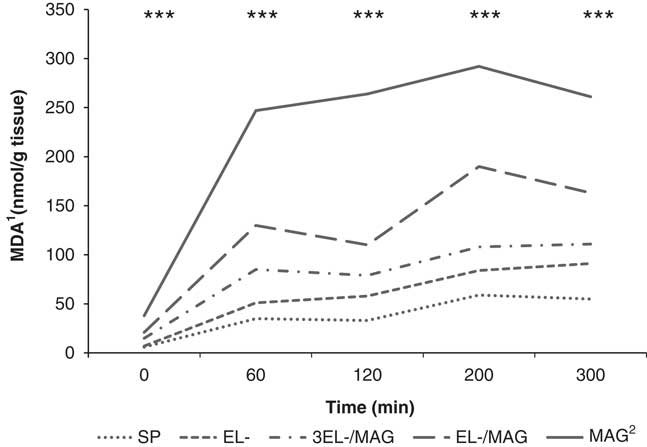
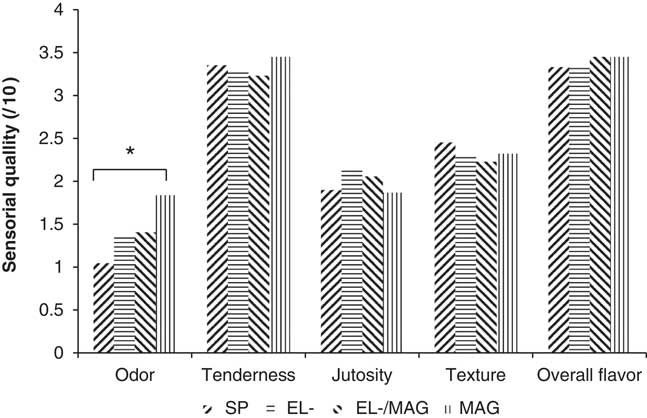
The amount of MDA measured in SCB from pigs fed the MAG diet was significantly higher than that in SCB from pigs fed the SP, EL- and 3EL-/MAG diets (P<0.05). It was also significantly higher than the amount measured at 0 and 120 min in SCB from pigs fed the EL-/MAG diet, but it did not differ significantly at 60, 200 or 300 min (Figure 1). Diets did not influence the sensory quality of meat, except for the odor of loin from pigs fed the MAG diet, which was significantly more pronounced than that of loin from pigs fed the SP, EL- and EL-/MAG diets (Figure 2).
Lipoperoxydation of fatty acids in subcutaneous backfat (nmol MDA1/g tissue) of finishing pigs. 1MDA=malondialdehyde; 2SP=soya-palm diet; EL-=extruded linseed diet; 3EL-/MAG=75% dehulled and extruded linseed+25% microalgae diet; EL-/MAG=75% dehulled and extruded linseed+25% microalgae diet; MAG=microalgae diet; RMSE=root mean square deviation; results are least-square means. ***P<0.0001.

Sensorial quality of the meat (roast) sampled from pigs fed experimental diets. SP=soya-palm diet; EL-=extruded linseed diet; EL-/MAG=75% dehulled and extruded linseed+25% microalgae diet; MAG=microalgae diet; *P<0.05.

Discussion
As expected, the EL- diet had the highest ALA content, while the MAG diet had the highest contents of DHA, SFA and 22:5n-6. The DHA-rich MAG diet also had the highest 16:0 content (31.9% of FA), while 22:5n-6 was the third highest FA in it (14.3% of FA). These dietary characteristics influenced the quality of the meat and the FA profile of tissues; however, incorporating n-3 PUFA in diets did not have a significant effect on performances and carcass characteristics, which agrees with previous studies of pigs (Kouba et al., Reference Kouba, Enser, Whittington, Nute and Wood2003; Guillevic et al., Reference Guillevic, Kouba and Mourot2009). The weight of the liver tended to increase as the amount of microalgae in the diet increased, though the lipid content (%) of the liver was not influenced by the FA composition of the diet. It was hypothesized that the liver could store carbohydrates contained in microalgae, but the experiment did not support this assumption.
Results indicated that including extruded linseed in pig diets enriched pig blood, liver, muscle and adipose tissue in n-3 PUFA, as demonstrated in many other studies with the use of linseed (Guillevic et al., Reference Guillevic, Kouba and Mourot2009; Corino et al., Reference Corino, Magni, Pagliarini, Rossi, Pastorelli and Chiesa2014) or the use of DHA-rich source (Marriott et al., Reference Marriott, Garrett, Sims and Abril2002; Sardi et al., Reference Sardi, Martelli, Lambertini, Parisini and Mordenti2006; Meadus et al., Reference Meadus, Duff, Uttaro, Aalhus, Rolland, Gibson and Dugan2010; Vossen et al., Reference Vossen, Raes, Van Mullem and De Smet2017). Circulating FA in plasma was influenced more than that in erythrocytes by dietary FA. Consequently, the FA composition of tissues, especially SCB, reflected the circulating FA, which depends on dietary FA, as described by Mourot and Hermier (Reference Mourot and Guillevic2001). As the amount of dietary FA increases, the FA content in tissues will increase. This observation is true even if diets were not totally isolipidic, the total fat content varying between 2% and 4% due to bias between predicted and chemical values. However, diets had no effect on the total fat content of tissues, so even if some pigs probably consumed more lipids than others, it could be concluded that only the composition of dietary fatty acids had an effect on the fatty acid composition of tissues.
Lipid peroxidation of enriched n-3 PUFA in SCB is due mainly to oxidation of these FA, which is especially true for the longest-chain and unsaturated FA such as 22:6n-3, which explains why SCB from pigs fed the MAG diet had the highest amount of MDA (Monahan et al., Reference Monahan, Buckley, Morrissey, Lynch and Gray1992). Unfortunately, lipid peroxidation in fresh meat or fat causes off-flavors to develop and is a major problem in meat processing (Monahan et al., Reference Monahan, Buckley, Morrissey, Lynch and Gray1992). According to the tasting panel, loin from pigs fed the MAG diet, besides having an off-flavor, had an ‘abnormal’ odor similar to that of fish or organ meat. Baéza et al. (Reference Baéza, Chartrin, Lessire, Meteau, Chesneau, Guillevic and Mourot2015) also found that inclusion of microalgae in chicken diets had a negative effect on the flavor of their meat. Despite the odor, the panel in our study consumed the meat, giving average to above-average scores to the other criteria, confirming the benefits of supplementing diets rich in PUFA with vitamin E to improve the oxidative stability of the meat (Botsoglou et al., Reference Botsoglou, Govaris, Ambrosiadis and Fletouris2012; Sobotka et al., Reference Sobotka, Flis, Antoszkiewicz, Lipiński and Zduńczyk2012; Vossen et al., Reference Vossen, Claeys, Raes, Van Mullem and De Smet2016). The amount of vitamin E added to the experimental diets (40 ppm) appears to have been insufficient, however, to limit peroxidation of DHA in SCB, indicating the importance of limiting the incorporation of microalgae and DHA due to their negative effect on flavor and susceptibility to oxidation, respectively. Depending on the results of this study, we recommended to include <1.5% of microalgae (Schizochytrium, sp.) in the feed corresponding to a maximum inclusion of 3 g DHA per kg of feed. The mix of 75% of linseed and 25% of microalgae as a lipid source in animal diet is the best compromise to supply ALA and DHA to consumers.
Finally, according to the results to this study, the consumption of 100 g of cooked loins from pigs fed 3EL-/MAG brings 10% of the daily needs of ALA and 38% of the daily needs of DHA to an adult who consumes 2000 kcal per day, needs 2.2 g of ALA and 250 mg of DHA per day.
Conclusion
The increase in n-3 PUFA contents in experimental diets had no effect on growth performance or carcass traits, except for an increase in the weight of the liver as amounts of microalgae in the diets increased. The nutritional quality of lipids contained in tissues corresponded to the composition of circulating FA, especially FA in the plasma, which reflects dietary FA. Sensory analysis revealed an abnormal odor in the meat of pigs fed microalgae, but not one strong enough to prevent the tasting panel from consuming the meat. Consequently, avoiding negative effects of microalgae on the oxidation susceptibility of pork and its sensory characteristics requires limiting incorporation of microalgae and DHA in animal feed (<1.5% of feed and <3 g/kg of feed, respectively) and combining them with an antioxidant. According to this study, it is more effective to combine linseed (75% of total lipids) and microalgae (<25% of total lipids) in animal diets to provide humans with n-3 PUFA precursor and derivatives.
Acknowledgments
This study was supported by the French National Research Agency and conducted within the national AGRALID project. The authors wish to acknowledge the technical and temporary staff at the INRA laboratory (Jaguelin-Peyrault, Y; Perrier, C; Robin, G; Carré, J; Rouaud, J.F; Guillemois, G; Liger, J; Alix, M and Karim-Lhuisset, S) for their skilled assistance. We are particularly grateful to Meteau, K., who conducted the sensory analysis. The authors also thank Valorex for providing the linseed. All authors read and approved the final version of the manuscript. The authors have no financial or personal conflicts of interest to declare.