

%20--%3e%3c!DOCTYPE%20svg%20PUBLIC%20'-//W3C//DTD%20SVG%201.0//EN'%20'http://www.w3.org/TR/2001/REC-SVG-20010904/DTD/svg10.dtd'%3e%3csvg%20version='1.0'%20id='Layer_1'%20xmlns='http://www.w3.org/2000/svg'%20xmlns:xlink='http://www.w3.org/1999/xlink'%20x='0px'%20y='0px'%20width='64px'%20height='64px'%20viewBox='5.5%20-3.5%2064%2064'%20enable-background='new%205.5%20-3.5%2064%2064'%20xml:space='preserve'%3e%3cg%3e%3ccircle%20fill='%23FFFFFF'%20fill-opacity='0'%20cx='37.785'%20cy='28.501'%20r='28.836'/%3e%3cpath%20fill='%23595959'%20d='M37.441-3.5c8.951,0,16.572,3.125,22.857,9.372c3.008,3.009,5.295,6.448,6.857,10.314%20c1.561,3.867,2.344,7.971,2.344,12.314c0,4.381-0.773,8.486-2.314,12.313c-1.543,3.828-3.82,7.21-6.828,10.143%20c-3.123,3.085-6.666,5.448-10.629,7.086c-3.961,1.638-8.057,2.457-12.285,2.457s-8.276-0.808-12.143-2.429%20c-3.866-1.618-7.333-3.961-10.4-7.027c-3.067-3.066-5.4-6.524-7-10.372S5.5,32.767,5.5,28.5c0-4.229,0.809-8.295,2.428-12.2%20c1.619-3.905,3.972-7.4,7.057-10.486C21.08-0.394,28.565-3.5,37.441-3.5z%20M37.557,2.272c-7.314,0-13.467,2.553-18.458,7.657%20c-2.515,2.553-4.448,5.419-5.8,8.6c-1.354,3.181-2.029,6.505-2.029,9.972c0,3.429,0.675,6.734,2.029,9.913%20c1.353,3.183,3.285,6.021,5.8,8.516c2.514,2.496,5.351,4.399,8.515,5.715c3.161,1.314,6.476,1.971,9.943,1.971%20c3.428,0,6.75-0.665,9.973-1.999c3.219-1.335,6.121-3.257,8.713-5.771c4.99-4.876,7.484-10.99,7.484-18.344%20c0-3.543-0.648-6.895-1.943-10.057c-1.293-3.162-3.18-5.98-5.654-8.458C50.984,4.844,44.795,2.272,37.557,2.272z%20M37.156,23.187%20l-4.287,2.229c-0.458-0.951-1.019-1.619-1.685-2c-0.667-0.38-1.286-0.571-1.858-0.571c-2.856,0-4.286,1.885-4.286,5.657%20c0,1.714,0.362,3.084,1.085,4.113c0.724,1.029,1.791,1.544,3.201,1.544c1.867,0,3.181-0.915,3.944-2.743l3.942,2%20c-0.838,1.563-2,2.791-3.486,3.686c-1.484,0.896-3.123,1.343-4.914,1.343c-2.857,0-5.163-0.875-6.915-2.629%20c-1.752-1.752-2.628-4.19-2.628-7.313c0-3.048,0.886-5.466,2.657-7.257c1.771-1.79,4.009-2.686,6.715-2.686%20C32.604,18.558,35.441,20.101,37.156,23.187z%20M55.613,23.187l-4.229,2.229c-0.457-0.951-1.02-1.619-1.686-2%20c-0.668-0.38-1.307-0.571-1.914-0.571c-2.857,0-4.287,1.885-4.287,5.657c0,1.714,0.363,3.084,1.086,4.113%20c0.723,1.029,1.789,1.544,3.201,1.544c1.865,0,3.18-0.915,3.941-2.743l4,2c-0.875,1.563-2.057,2.791-3.541,3.686%20c-1.486,0.896-3.105,1.343-4.857,1.343c-2.896,0-5.209-0.875-6.941-2.629c-1.736-1.752-2.602-4.19-2.602-7.313%20c0-3.048,0.885-5.466,2.658-7.257c1.77-1.79,4.008-2.686,6.713-2.686C51.117,18.558,53.938,20.101,55.613,23.187z'/%3e%3c/g%3e%3c/svg%3e)
%20--%3e%3c!DOCTYPE%20svg%20PUBLIC%20'-//W3C//DTD%20SVG%201.0//EN'%20'http://www.w3.org/TR/2001/REC-SVG-20010904/DTD/svg10.dtd'%3e%3csvg%20version='1.0'%20id='Layer_1'%20xmlns='http://www.w3.org/2000/svg'%20xmlns:xlink='http://www.w3.org/1999/xlink'%20x='0px'%20y='0px'%20width='64px'%20height='64px'%20viewBox='5.5%20-3.5%2064%2064'%20enable-background='new%205.5%20-3.5%2064%2064'%20xml:space='preserve'%3e%3cg%3e%3ccircle%20fill='%23FFFFFF'%20fill-opacity='0'%20cx='37.637'%20cy='28.806'%20r='28.276'/%3e%3cg%3e%3cpath%20fill='%23595959'%20d='M37.443-3.5c8.988,0,16.57,3.085,22.742,9.257C66.393,11.967,69.5,19.548,69.5,28.5c0,8.991-3.049,16.476-9.145,22.456%20C53.879,57.319,46.242,60.5,37.443,60.5c-8.649,0-16.153-3.144-22.514-9.43C8.644,44.784,5.5,37.262,5.5,28.5%20c0-8.761,3.144-16.342,9.429-22.742C21.101-0.415,28.604-3.5,37.443-3.5z%20M37.557,2.272c-7.276,0-13.428,2.553-18.457,7.657%20c-5.22,5.334-7.829,11.525-7.829,18.572c0,7.086,2.59,13.22,7.77,18.398c5.181,5.182,11.352,7.771,18.514,7.771%20c7.123,0,13.334-2.607,18.629-7.828c5.029-4.838,7.543-10.952,7.543-18.343c0-7.276-2.553-13.465-7.656-18.571%20C50.967,4.824,44.795,2.272,37.557,2.272z%20M46.129,20.557v13.085h-3.656v15.542h-9.944V33.643h-3.656V20.557%20c0-0.572,0.2-1.057,0.599-1.457c0.401-0.399,0.887-0.6,1.457-0.6h13.144c0.533,0,1.01,0.2,1.428,0.6%20C45.918,19.5,46.129,19.986,46.129,20.557z%20M33.042,12.329c0-3.008,1.485-4.514,4.458-4.514s4.457,1.504,4.457,4.514%20c0,2.971-1.486,4.457-4.457,4.457S33.042,15.3,33.042,12.329z'/%3e%3c/g%3e%3c/g%3e%3c/svg%3e)
%20--%3e%3c!DOCTYPE%20svg%20PUBLIC%20'-//W3C//DTD%20SVG%201.0//EN'%20'http://www.w3.org/TR/2001/REC-SVG-20010904/DTD/svg10.dtd'%3e%3csvg%20version='1.0'%20id='Layer_1'%20xmlns='http://www.w3.org/2000/svg'%20xmlns:xlink='http://www.w3.org/1999/xlink'%20x='0px'%20y='0px'%20width='64px'%20height='64px'%20viewBox='5.5%20-3.5%2064%2064'%20enable-background='new%205.5%20-3.5%2064%2064'%20xml:space='preserve'%3e%3cg%3e%3ccircle%20fill='%23FFFFFF'%20fill-opacity='0'%20cx='36.924'%20cy='28.403'%20r='28.895'/%3e%3cpath%20fill='%23595959'%20d='M37.442-3.5c8.99,0,16.571,3.085,22.743,9.256C66.393,11.928,69.5,19.509,69.5,28.5c0,8.992-3.048,16.476-9.145,22.458%20C53.88,57.32,46.241,60.5,37.442,60.5c-8.686,0-16.19-3.162-22.513-9.485C8.644,44.728,5.5,37.225,5.5,28.5%20c0-8.762,3.144-16.343,9.429-22.743C21.1-0.414,28.604-3.5,37.442-3.5z%20M12.7,19.872c-0.952,2.628-1.429,5.505-1.429,8.629%20c0,7.086,2.59,13.22,7.77,18.4c5.219,5.144,11.391,7.715,18.514,7.715c7.201,0,13.409-2.608,18.63-7.829%20c1.867-1.79,3.332-3.657,4.398-5.602l-12.056-5.371c-0.421,2.02-1.439,3.667-3.057,4.942c-1.622,1.276-3.535,2.011-5.744,2.2%20v4.915h-3.714v-4.915c-3.543-0.036-6.782-1.312-9.714-3.827l4.4-4.457c2.094,1.942,4.476,2.913,7.143,2.913%20c1.104,0,2.048-0.246,2.83-0.743c0.78-0.494,1.172-1.312,1.172-2.457c0-0.801-0.287-1.448-0.858-1.943l-3.085-1.315l-3.771-1.715%20l-5.086-2.229L12.7,19.872z%20M37.557,2.214c-7.276,0-13.428,2.571-18.457,7.714c-1.258,1.258-2.439,2.686-3.543,4.287L27.786,19.7%20c0.533-1.676,1.542-3.019,3.029-4.028c1.484-1.009,3.218-1.571,5.2-1.686V9.071h3.715v4.915c2.934,0.153,5.6,1.143,8,2.971%20l-4.172,4.286c-1.793-1.257-3.619-1.885-5.486-1.885c-0.991,0-1.876,0.191-2.656,0.571c-0.781,0.381-1.172,1.029-1.172,1.943%20c0,0.267,0.095,0.533,0.285,0.8l4.057,1.83l2.8,1.257l5.144,2.285l16.397,7.314c0.535-2.248,0.801-4.533,0.801-6.857%20c0-7.353-2.552-13.543-7.656-18.573C51.005,4.785,44.831,2.214,37.557,2.214z'/%3e%3c/g%3e%3c/svg%3e)
%20--%3e%3c!DOCTYPE%20svg%20PUBLIC%20'-//W3C//DTD%20SVG%201.1//EN'%20'http://www.w3.org/Graphics/SVG/1.1/DTD/svg11.dtd'%3e%3csvg%20version='1.1'%20id='Layer_1'%20xmlns='http://www.w3.org/2000/svg'%20xmlns:xlink='http://www.w3.org/1999/xlink'%20x='0px'%20y='0px'%20width='64.000977px'%20height='64px'%20viewBox='0%200%2064.000977%2064'%20enable-background='new%200%200%2064.000977%2064'%20xml:space='preserve'%3e%3cg%3e%3ccircle%20fill='%23FFFFFF'%20fill-opacity='0'%20cx='32.064453'%20cy='31.788086'%20r='29.012695'/%3e%3cg%3e%3cpath%20fill='%23595959'%20d='M31.943848,0C40.896484,0,48.476562,3.105469,54.6875,9.314453C60.894531,15.486328,64.000977,23.045898,64.000977,32%20s-3.048828,16.457031-9.145508,22.513672C48.417969,60.837891,40.779297,64,31.942871,64%20c-8.648926,0-16.152832-3.142578-22.513672-9.429688C3.144043,48.286133,0,40.761719,0,32.000977%20c0-8.723633,3.144043-16.285156,9.429199-22.68457C15.640137,3.105469,23.14502,0,31.943848,0z%20M32.060547,5.771484%20c-7.275391,0-13.429688,2.570312-18.458496,7.714844C8.381836,18.783203,5.772949,24.954102,5.772949,32%20c0,7.125,2.589844,13.256836,7.77002,18.400391c5.181152,5.181641,11.352051,7.770508,18.515625,7.770508%20c7.123047,0,13.332031-2.608398,18.626953-7.828125C55.713867,45.466797,58.228516,39.353516,58.228516,32%20c0-7.3125-2.553711-13.484375-7.65625-18.513672C45.504883,8.341797,39.333984,5.771484,32.060547,5.771484z%20M44.117188,24.456055%20v5.485352H20.859863v-5.485352H44.117188z%20M44.117188,34.743164v5.481445H20.859863v-5.481445H44.117188z'/%3e%3c/g%3e%3c/g%3e%3c/svg%3e)
Buried in the Red Dirt excavates quotidian dimensions of reproduction, illness, death, and birth control, topics peripheralized in the historiography and history of Palestinians who lived under British colonial rule. It also tells a larger systemic story about how colonialism produced suffering and premature death. The book “resists the event,” to use Megha Anwer’s terms, reorienting us to less “colossal” and catastrophic scales of history and experience (Reference AnwerAnwer 2014, 2, 7). It emphasizes nonevents such as the structural maldistribution of illness, disease, injury, hunger, and early death because of colonial, racial, and class status, as well as the sexual inequalities that allocate power, resources, pain, and pleasure unevenly. It reminds us that extraction of labor and life are the very grounds of imperialism and colonialism and are always legitimated by racializing the abjected group. It shows the prevalence of Zionist demographic competition in modern Palestine for well over a hundred years, an agenda too frequently paradoxically projected onto Palestinians. In challenging the ideological hyperbolization of Palestinian reproduction, the book also takes seriously Palestinian anti-reproductive desires and practices. It conveys that political and social regeneration and survival dominated in Palestinian literature and film after 1948, articulated on scattered ground colored by the prevalence of loss, forced dispersal and premature death.
The book does not claim that Palestinians are unaware of Israel’s less than subtle racial demographic project in historic Palestine, supported by Western powers, or that every Palestinian is immune to its competitive dimensions in their reproductive lives. In the late 1980s during the first Intifada, Palestinian nationalist iconography occasionally expressed such competitive reproductive desire. For example, I saw popular porcelain artwork that fetishized the Palestinian woman’s pregnant womb, with a gender-indistinguishable embryo armed and prepared to battle, when I interned in 1989 with the Palestinian Federation of Women’s Action Committees. Even during this period, however, the Palestinian mother was most likely to be symbolically represented as a source of steadfastness. A famous 1988 poster by the renowned Sliman Mansour of the Palestinian Liberation Art Movement, “Portrait of the Intifada … the Mother” (“lawhat al-intifada … al-umm”), shows a fully clothed woman in Palestinian village dress with a multitude of resistant adult men and women emerging from between her large magnified hands and crouched legs.Footnote 1 I read the Mansour poster image as valorizing the ubiquitous participation of women as fighters, defenders and protectors and reinforcing the quintessential place of mothers in Palestinian life and nationalism.
In reviewing almost ninety years of Palestinian posters indexed by the Palestine Poster Project Archive, I found that the Palestinian woman as breeder was not a discernable dimension of resistance representational discourse and symbolism. Even sentimental maternalist representations were rare. Most of the posters were created beginning in the 1960s by committed artists affiliated with the Palestine Liberation Organization’s Plastic Arts Section and Arts and Heritage Section. The artists created work in the inexpensive poster format to make it widely available to everyday Palestinians even as they also produced painting, sculptor, glasswork, and reliefs (Reference Farhat and HalabyFarhat and Halaby 2012). When depicting a Palestinian woman, the images are much more likely to present her as a fighter, usually carrying a weapon, such as in the 1976 poster titled “Palestinian Motherhood,” also by Mansour (see Figure 7.1).
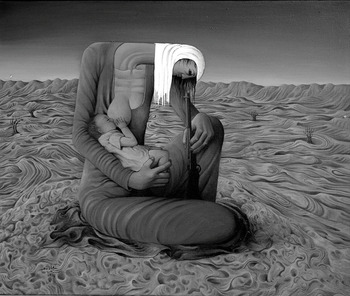
Mansour uses brutal realist lines in shades of brown and orange broken only by a white hair cover and the yellow line of a rising or setting sun. In the poster, he figures the Palestinian woman as a gargantuan exhausted mother, hair strands damp with sweat escaping downward around her bent profile as she sits on a cloth covering tumultuous terra. Her large strong left hand props a weapon and equally large right hand supports an infant’s head as it nurses from an exposed breast that emerges from her rippled brown chest.
When I probed friends and acquaintances for Palestinian rhetoric regarding demographic competition, some mentioned statements attributed to the late PLO leader Yasir Arafat. Research into the provenance of the first statement shared with me, “Rahm al-mar‘a al-`arabiyya huwa silahi al-aqwa” (“The Arab woman’s womb is my strongest weapon”), invariably led me to Zionist sources. For example, the statement takes center stage in an August 2019 article by Yehuda Shalim published in the religious right Zionist newspaper Israel Today.Footnote 2 The article was translated and published in English- and Arabic-language venues, amplifying its message. I read it in Arabic translation in the London-based online newspaper Al-Quds al-`Arabi. Shalim repeats the “womb” statement putatively made by Arafat to editorialize about Palestinian Authority Prime Minister Muhammad Ashtiyya insisting that Palestinians are a majority “between the river and the sea” and thus Israel cannot continue to colonize Palestinian land. This claim, Shalim asserts, is a postmortem release of Arafat’s “demographic demon,” a “scarecrow” that frightened Israeli leaders into giving up land to the Palestinians in the 1990s Oslo Accords. There is no reason for Jews not to keep what they’ve taken and to go further by confiscating the remaining lands of “Greater Israel,” he concludes, since as of 2009, Palestinian and Jewish fertility rates in historic Palestine are essentially equal.Footnote 3
If Arafat had indeed made the statement attributed to him, he would have more likely said the Palestinian woman’s womb and not the Arab woman’s womb, the latter a Zionist rhetoric of erasure. When I circulated the statement in Arabic to a WhatsApp group of researchers discussing COVID-19 in Jordan in May 2020, some were aware of it, but not of its provenance. One participant offered a different statement he attributed to Arafat: “`Indahum al-qunbila al-nawawiyya wa ihna `indana al-qunbila al-namawiyya” (“They have the nuclear bomb but we have the sperm bomb”). While I was unable to find a credible source substantiating that Arafat had made either statement, each reproduces a commonsense understanding of Palestinian reproduction as motivated by demographic competition.
Arafat’s nom de guerre from the 1960s, Abu `Ammar, ironically connotes his lack of biological reproductivity, at least of sons. A father in Arabic carries the honorific title “father of” (Abu …) the firstborn son’s name if he has one, or his oldest daughter’s name if he does not. Arafat had no biological sons and one biological daughter was born late in his life from his only marriage in 1990; he had adopted Palestinian war orphans (two girls and three boys) in the 1980s.Footnote 4 The name “Abu `Ammar,” however, does not refer to one of Arafat’s children. Instead, it denotes his status as a “builder” of the national resistance movement (he was trained as an engineer) even as the appellation reminds its users, listeners, and readers that he did not biologically sire any sons as far as we know.
Palestinian life, death, and regeneration have been folded together since 1948. Moataz Dajani’s installation “Besieged Shrines: Soul Houses to Epic Lives,” first exhibited in 2002, refashioned Palestinian stories and memories using terracotta, testimonial audio, personal photographs, found objects, stones, lit candles, artificial light, and natural life such as living vine planted in dirt, to create miniature houses and “womb-like” caves. “Besieged Shrines,” in his words during an interview, “memorializes the epic in people’s lives and struggles” as they “created life and hope amidst insurmountable adversity.” The shrines, which force viewers to bear witness, were inspired by “diverse ancient and folk arts and rituals from the Arab fertile crescent region, including story boxes and Canaanite ossuaries in Palestine.” The soul houses, he explained, “highlight magical fertility rituals and the life cycle of birth, growth, death, and regeneration.”Footnote 5
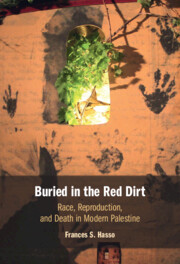
The following images are of three miniature Besieged Shrines I had the privilege of viewing in their multidimensionality in Amman in May 2018 (see Figures 7.2, 7.3, 7.4). The image of a fourth shrine from the exhibit, “Shrine of Witness,” is printed on the book’s cover. The shrines illustrate how Palestinian responses to loss and death since 1948 have been to regenerate through retelling, remembering, and rebuilding families and communities. The shrines and their captions evidence the pervasiveness of Israeli attempts to biologically, politically, and socially extinguish Palestinians. More importantly, they beautifully express stubborn endurance through kinship, politics, and creativity. The refusal to forget or be disappeared is cultivated in each Palestinian generation that follows.
Besieged Shrine to Hands of Thyme and Stone (1). Title from the Mahmoud Darwish poem. The shrine is dedicated to Nabil, Munir, and their children. Their father and half of the father’s extended family were massacred by Lebanese fascist militias in the Tel El Za`atar camp in east Beirut in 1976. The remaining family moved to the Shatila camp, where the mother and some of her children were killed by Lebanese militias during a 1982 siege by Israeli forces. Munir, the youngest child, was badly injured, while his oldest brother, Nabil, survived. Shrine of wood with thyme tree growing out of a rock. Scroll written on layers of silk and papyrus. Moataz Dajani.

Soul house to Kamal, Mariam, and their new children. Kamal and Mariam lost all five of their children in a shelter that Israel attacked with phosphorus bombs in the Borj Shmali camp, Tyre, south Lebanon, during the invasion of June 1982. Mariam was badly burned. They lived in Beirut while Mariam was being treated and returned to Borj Shmali to rebuild their lives and bring to life six new children. Terracotta, yarn, photographs, and found objects. Moataz Dajani.

Shrine to Bassam and his children. The seated figurine is modeled after a Canaanite goddess found near Ashdud in Palestine. An audiotape inside the basket plays the family story narrated by Bassam: “In 2007, I was carrying my mom to safety out of [the] Nahr el Bared camp under shelling from the Lebanese army. When we were out and safe she started crying. I said, “Mom, we are safe. Why are you crying?” She said, “I remembered 1948, when my mother carried me under shelling as we fled our village. Then I remembered when I carried you out of [the] Shatila camp during the massacre of 1982, when your father, sister, and brother were killed. Don’t let your children carry you out … leave Lebanon.” Silver seated figurine of a mother suckling a shell in a terracotta womb-like cave. Moataz Dajani.


 Open access