Somatotropin (ST) is a peptide hormone of approximately 22 kD. It is secreted by the pituitary gland, which regulates many anabolic processes in vertebrates related to growth, development and reproduction. Its effects on target organs may be direct or mediated by other molecules such as somatomedins (also known as insulin-like growth factors or IGFs).
The anabolic action of ST also involves the mammary gland, with stimulating effects on galactopoiesis (Peel et al. Reference Peel, Fronk, Bauman and Gorewit1983). For this reason, recombinant bovine somatotropin (rbST) has been produced in order to increase the milk yield of lactating cows (Bauman, Reference Bauman1992) and is nowadays used in dairy production. However, its use has been banned in a number of countries and by the EU, after a long moratorium, with the Council Decision 1999/879/EC.
Other than bovines, buffaloes (Bubalus bubalis) represent an important economic resource in some areas of the world (Borghese & Mazzi, Reference Borghese and Mazzi2005) and breeding them for milk production is becoming increasingly important (Borghese, Reference Borghese2005). Owing to the high phylogenetic similarity, rbST can be used for increasing milk yield in buffaloes as well as cows (Ludri et al. Reference Ludri, Upadhyay and Singh1989; Polidori et al. Reference Polidori, Sgoifo Rossi, Senatore, Savoini and Dell'Orto1997; Helal & Lasheen, Reference Helal and Lasheen2008).
Many studies have been carried out on rbST-treated cows from both physiological and zootechnical points of view, contributing to understanding the effect of exogenous ST administration on milk and animals as well as improving the general management of livestock. Furthermore, there are a number of studies on analytical methods to measure ST or IGF-1 in biological fluids in order to reveal rbST treatment. This research has produced a considerable amount of data on hormone variations in rbST-treated cows and has highlighted the difficulties in setting up valid methods for inspection purposes.
On the other hand, there are very few studies on buffaloes and no data have been provided on the hormone fluctuation after rbST treatment, which represents some of the potential parameters to be used for monitoring rbST use or misuse in producing animals.
To better understand the magnitude and the pattern of hormone variations in rbST-treated buffaloes, in order to address the development of further analytical methods and to identify the best period of sampling, a specific study was performed. We developed a two polyclonal sandwich ELISA for ST measurement in buffalo serum and we used it, together with two other previously developed sandwich ELISA, in order to investigate ST and IGF-1 concentrations in blood and of IGF-1 in the milk of buffaloes treated with rbST for a period of 10 weeks in mid lactation. The data obtained provided a good basis to evaluate the usability of the analysed parameter as rbST-treatment indicators.
Materials and Methods
Reagents and materials
Lyophilized highly purified pituitary bovine ST (pbST) was supplied by the National Hormone & Peptide Program (NHPP), Harbor-UCLA Medical Center (Torrance CA, USA). rbST was extracted from the slow release formulation (Boostin®, 500 mg/dose from LG Life Sciences, Seoul, Korea). Buffalo ST (BuST) was extracted from four pituitary glands according to the method proposed by Spitsberg (Reference Spitsberg1987), followed by affinity chromatography on a Sepharose column on which purified rabbit antibodies anti-bST were previously bound, according to the instruction of the manufacturer (GE Healthcare, Easton Turnpike CT, USA). Adjuvants and reagents (analytical grade) were purchased from Sigma-Aldrich (St. Louis MO, USA); bovine prolactin (bPRL) from Scripps Laboratories (San Diego CA, USA).
Experimental design, treatment and sample collection
Sixteen Mediterranean Italian buffaloes (parity >3), averaging 68±3 DIM (days in milk) and homogeneous for milk yield (8·93±0·65 l/d) were selected from the Animal Production Research Centre at Tormancina (Italy).
Buffaloes were housed in a free open-stall barn, with a concrete floor and a roof-covered area for resting and feeding, with access to an outdoor lot with a natural floor. They were fed a mixed diet (corn silage, alfalfa hay, maize flour, soybean meal) ad libitum. Fresh water was always available.
Treatment was performed by administering to 8 buffaloes a sustained release formulation of rbST (Boostin®, from LG Life Sciences) (500 mg in 2 ml of vehicle) by subcutaneous injections in the tailhead area, as suggested for cows by the drug manufacturer. Controls (n=8) were injected with a physiological saline solution. The treatment was performed over a period of 10 weeks (from the end of May to the end of July) starting from the tenth week post partum, for a total of five biweekly cycles of administration.
Animals were kept under veterinary observation throughout the whole experiment. They underwent an ordinary health check once a week and were managed during the study in compliance with Italian law on animal protection for experimental and other scientific purposes (D.L. No. 116/1992).
Blood was collected via venipuncture of the jugular vein, before the first meal of the day, twice a week, on days 2, 5, 9 and 14 after each rbST administration and the day before the onset of treatment (day −1). One of the day −1 samples belonging to the treated group could not be analysed. Blood was allowed to clot at room temperature and then centrifuged at 2200 g at 4°C for 20 min. Supernatants were stored at −20°C until analysis.
Milk was collected from the bulk at the end of the mechanized morning milking at the milk shed. Only samples belonging to day −1 and to days 2, 9 and 14, of the second and the fifth cycles of rbST administration could be analysed. Milk was defatted by centrifugation at 2200 g at 4°C for 20 min, and immediately frozen until analysis. To assess whether rbST treatment was effective, milk yield of each buffalo was measured on day 5 of each cycle.
rbST extraction
rbST was extracted from a syringe containing the slow release formulation (Boostin®). In order to separate the grease layer (upper layer) from the protein solution, 500 μl of the preparation was mixed with 9·5 ml of carbonate buffer (40 mm-NaHCO3, pH 9·6), gently vortexed and then centrifuged at 10 000 g at 4°C for 15 min. After centrifugation, 1 ml of the protein solution was collected and mixed again with 9 ml of carbonate buffer, gently vortexed and centrifuged as previously described. A 2-ml aliquot of the solution was then collected and the protein concentration was measured by 280-nm absorption (extinction coefficient of 14 690 cm−1mole−1) using a Nanodrop® ND-1000 spectrophotometer (NanoDrop Technologies Inc., Wilmington DE, USA). SDS-PAGE and Western blot were used to assess the purity of the protein in solution.
Buffalo somatotropin extraction
Buffalo somatotropin (buST) was extracted from four buffalo pituitary glands collected soon after slaughtering and immediately frozen. Pituitary glands were thoroughly homogenized in 45 ml of ice cold extraction buffer (40 mm-Tris-base–20 mm-NaCl–1 mm-phenylmethylsulphonyl fluoride–1 mm-benzamidine HCl–5 mm-EDTA, pH 8) in a glass tube kept in ice, using Ultra-turrax (Tekmar Co., Cincinnati, USA). The suspension was then centrifuged at 2700 g at 4°C for 15 min. The greasy upper layer was discarded and the clear supernatants was kept apart. The pellet was treated as before and the supernatant pooled with the first supernatant. This solution was brought to pH 7·4, sterile filtered, and subjected to affinity chromatography on a Sepharose column on which purified rabbit antibodies anti-bST were previously bound, according to the instruction of the manufacturer. The buST extracted was tested by SDS-PAGE and Western blot to assess the purity of the protein in solution.
Mice immunization
After the collection of pre-immunized serum, four 2-month-old female BALB/c (purchased from Morini, Polo D'Enza, Italy) were injected subcutaneously in two sites on the back with 50 μg of rbST dissolved in 50 μl of PBS (phosphate-buffered saline, 15 mm-Na2HPO4–5 mm-NaH2PO4–116 m-NaCl, pH 7·3) sterile solution mixed with 100 μl of Freund's Complete Adjuvant (FCA). After 14 d three more boosts were administered at 2-week intervals by intraperitoneal puncture, with Freund's Incomplete Adjuvant (FIA) instead of FCA. Ten days after the third boost, blood was collected from the tail vein, and titres for antibodies anti-bST were assessed by direct ELISA, while specificity was determined by Western blot analysis. As the titres were over 1:35 000, all four mice were injected via tail vein with 50 μg of rbST in PBS sterile solution without adjuvant. The sera were tested again after 10 d and samples collected after 14 d. Blood was allowed to clot for 30 min at room temperature and then centrifuged at 3000 g at 4°C for 15 min. The antisera obtained were mixed, aliquoted and stored at −20°C.
Serum ST sandwich ELISA
Rabbit polyclonal antibodies were obtained in a previous study (Castigliego et al. Reference Castigliego, Iannone, Grifoni, Rosati, Gianfaldoni and Guidi2007).
For the sandwich ELISA, samples were prepared by diluting 1 to 4 the collected buffalo sera in PBS plus 0·05% w/v Tween 20 (T-PBS), while standards were composed of previously ST-free buffalo sera purified by affinity chromatography. In brief, purified rabbit antibodies anti-bST were bound to two Sepharose NHS-activate columns. Thirty ml of a pool of five buffalo sera diluted 1 to 2 in PBS were flowed three times through each column. The purified sera were subsequently fortified to obtain concentrations of 80, 60, 40, 20, 4 and 2 ng/ml of rbST, with a final dilution of 1 to 4.
The ELISA process was as follows: 96-well polystyrene microtitre plates were filled with 100 μl/well of 5 μg/ml of rabbit polyclonal antibodies, previously purified by affinity chromatography in our laboratory (Castigliego et al. Reference Castigliego, Grifoni, Rosati, Iannone, Armani, Gianfaldoni and Guidi2009). They were diluted in PBS and kept for 3 h at 37°C. Plates were then washed three times with PBS and blocked for 1 h with 150 μl/well of 0·5% w/v BSA (bovine serum albumin) in PBS. After blocking, three washings in T-PBS followed. Samples and standard solutions were then added (100 μl/well) and left to incubate for 2 h. Without washing, 50 μl of the primary antibodies solution was added to each well and left to incubate overnight at room temperature. The solution was composed of the pooled mouse sera anti-ST diluted 1:2000 in T-PBS and rabbit normal serum, previously assessed for its non-reactivity against bST. The plates were then washed four times in T-PBS and peroxidase-labelled goat anti-mouse immunoglobulins in a dilution ratio of 1:3000 in T-PBS were added and incubated for 1 h. After five final washings in T-PBS, the substrate solution (100 μl/well of 0·1 mg/ml 3,3,5,5-tetramethyl benzidine in 0·1 m-phosphate/citrate buffer, pH 5 and 0·03% H2O2) was added and left to develop for 20 min in the dark. The reaction was stopped with 50 μl per well of 1 m-H2SO4 and the optical density was measured with a Biotrak II plate reader (GE Healthcare, Easton Turnpike CT, USA) at 450 nm (cut off 630 nm).
Assay performance
Assay performance was assessed by estimating sensitivity, expressed as limits of detection (LOD) and limit of quantification (LOQ), calculated as the concentrations corresponding to the blank mean OD plus 3 sd and 10 sd, respectively:
specificity (percentage of observed cross-reactivity with pbST, buST and bPRL);
parallelism (linearity), tested by diluting in T-PBS (1 to 2, 1 to 4 and 1 to 8) eight different samples ranging from 16 to 34 ng/ml. Concentrations were corrected for dilution. The experiment was repeated twice on two subsequent days;
accuracy: eight different samples ranging from 2 to 50 ng/ml, were spiked with low (2 ng/ml), medium (8 ng/ml) and high (32 ng/ml) amounts of ST. They were then analysed twice on two different days. Accuracy was calculated by averaging the ratio observed/expected values and expressed as a percentage by multiplying by a factor of 100;
repeatability: intra- and inter-assay variations were calculated by running eight different samples (the same as those used for the accuracy estimation) in replicates of ten across the microtitre plate, on three different days. Intra-assay CV was considered as the average of the ratios sd/means calculated from the eight samples. Inter-assay CV was considered as the average of the ratios sd/means from the ten replicates of each samples in one plate, calculated on the three days, divided by the grand mean of each sample calculated on the three days. CVs were expressed as a percentage.
IGF-1 measurement in serum and in milk
Because buffalo and bovine IGF-1 are identical, IGF-1 was measured in serum according to Castigliego et al. (Reference Castigliego, Grifoni, Rosati, Iannone, Armani, Gianfaldoni and Guidi2009). In brief, the assay consisted of a sandwich ELISA with specific mouse monoclonal antibodies and rabbit polyclonal antibodies as presenting and primary antibodies, respectively. The detection limit was 20 ng of IGF-1 per ml of serum. The within-assay CV averaged 6·7%, whereas the between-assay coefficient was 11·3%.
IGF-1 in milk was quantified according to Castigliego et al. (Reference Castigliego, Li, Armani, Mazzi and Guidi2011). The assay consisted of a sandwich ELISA with specific rabbit polyclonal antibodies and mouse monoclonal antibodies as presenting and primary antibodies, respectively. The detection limit was 0·1 ng of IGF-1 per ml of defatted milk. The within-assay CV was 6·3%, whereas the between-assay coefficient was 13%.
Statistical analysis
To assess the equality of variance between the treated and the control group, Levene's test was used.
Since dissimilar variances were found between groups, a non-parametric multi-way ANOVA (Scheirer-Ray-Hare extension of the Kruskal-Wallis test) was used to assess the effect of treatment, of time on treatment, and their interaction on:
ST serum concentrations on days 2, 5, 9, 14;
IGF-1 serum concentrations on days 2, 5, 9, 14;
IGF-1 milk concentrations on days 2, 9, 14.
A comparison was also performed in treated animals, using the Wilcoxon test (two-tailed) for paired samples between:
days 2–5; days 5–9; days 9–14 for hormone serum concentrations;
days 2–9; days 9–14 for IGF-1 milk concentrations.
Differences between the treated animals and the controls within the same day of sampling were evaluated by Student's t test with Welch's correction.
The trend of changes over time was evaluated using a linear regression analysis, in which values related to the controls were plotted against the day after the onset of the treatment. With regard to ST levels, only treated animals were evaluated, because part of the ST level of the controls was beneath the LOQ of the assay. Because of the fluctuations in hormone concentration, only values on day 2 and on day 5 after rbST injection (days 2, 16, 30, 44, 58) were considered separately.
Finally, Spearman's rank partial correlation was used to assess the relationship between circulating hormones and milk IGF-1.
Values are reported as means±sem. Data were processed using PRISM, version 5.01 (GraphPad Software Inc., La Jolla CA, USA) and JMP, version 5.01 (SAS Institute Inc., Cary NC, USA).
Results
Serum ST sandwich ELISA
The LOD and LOQ of the assay were 0·2 ng/ml and 1·9 ng/ml, respectively. For this reason, the minimum concentration for a standard curve was chosen as 2 ng/ml. Because the main purpose of this study was to highlight the differences between treated buffaloes and controls and not to precisely define the hormone basal levels, values lower than 2 ng/ml were set as 2 ng/ml. This allowed us not to overestimate both magnitude and significance of such differences and to better estimate their potential power as treatment indicators.
The CVw and the CVb were 7·6% and 14·6%, respectively. Accuracy, assessed as a percentage of recovery, was calculated as 95·2%, 92·6% and 100% for samples spiked with 2, 8 and 32 ng/ml, with absolute errors of 7·4%, 6% and 8·4%, respectively. Linearity, assessed as a percentage of recovery, was calculated to be 104·3% and 92% for dilutions of 1 to 2 and 1 to 8, respectively, with regard to the working dilution of the assay (1 to 4). Finally, cross reaction was ≅1% with bPRL, which can be considered low enough not to interfere with the assay; >99% with pbST, and ≅102% with buST. A complete cross-reaction of buST with rbST was expected, because buST primary sequences reported on databases (UniProtKB/Swiss-Prot) show no differences or differences of only one or two amino acids to the bovine protein.
Serum ST
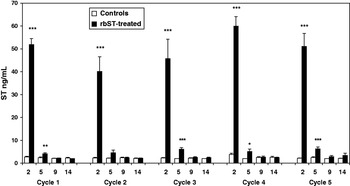
Serum ST levels were comparable between treated buffaloes and controls before the onset of treatment. Their concentrations increased as a consequence of the hormone administration, with differences between treated animals and controls strictly dependent on the day of blood collection after each rbST boost. ST concentrations sharply increased on day 2 after the rbST injection. The average ST levels were approximately 20-times greater in treated cows with respect to controls and differences were always highly significant (P<0·001) in all the five cycles of treatment (Fig. 1). Progression of lactation (‘time’ effect) did not have a considerable influence on the serum ST fluctuations observed after each boost (Table 1).
Serum somatotropin fluctuation after recombinant bovine somatotropin (rbST) treatment. Comparisons between treated buffaloes (n=8) and the controls (n=8) are reported for days 2, 5, 9, 14 of all the five cycles of injections. Data are reported as means±sem; * P<0·05; ** P<0·01; *** P<0·001.

Effect of recombinant bovine somatotropin (rbST) treatment and time (number of injection) on somatotropin (ST) and insulin-like growth factor 1 (IGF-1) concentrations in serum. Data were analysed by Scheirer-Ray-Hare non parametric tests. Significance related to treatment (Tr), time and their interaction (Tr×time) on days 2, 5, 9 and 14 after rbST injection are reported; NS=non significant

On day 5, differences between the two groups were still highly significant (P<0·001), with slight variations according to the number of cycles. However, hormone levels markedly decreased with respect to day 2, without exception, due to the number of cycles. Time effect was nevertheless negligible. Finally, the ST serum concentrations were comparable between the treated animals and the controls on day 9 and day 14 (Fig. 1, Table 1). A comparison of ST levels between different days is reported in Table 2.
Overall difference in somatotropin (ST) and insulin-like growth factor 1 (IGF-1) serum levels between different days. Wilcoxon's test was applied for paired comparison. Significance is reported for both the group treated with recombinant bovine somatotropin (T) and for the controls (C); NS=non significant

Serum IGF-1
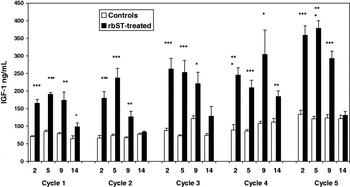
IGF-1 concentrations increased quickly after the rbST injection and persisted at high levels at least until day 9, with significant differences (P<0·001) between treated animals and controls. On day 14, these differences were much less conspicuous although, overall, still significant (Fig. 2, Table 1). This means that IGF-1 serum levels tended to be almost constantly above basal levels during the treatment. Influence of the number of injection (time) was found to be significant on days 2, 9 and 14 (Table 1).
Serum insulin-like growth factor 1 (IGF-1) fluctuation after recombinant bovine somatotropin (rbST) treatment. Comparisons between treated buffaloes (n=8) and the controls (n=8) are reported for days 2, 5, 9, 14 of all the five cycles of injections. Data are reported as means±sem; * P<0·05; ** P<0·01; *** P<0·001.

The propensity for IGF-1 basal concentrations to increase with lactation was found to be highly significant (P<0·001). Furthermore, even the IGF-1 rise in response to exogenous growth hormone increased with lactation, as shown by the slope of the regression line generated by plotting IGF-1 serum concentrations of treated buffaloes against time, which was significantly different from zero (P<0·001).
Correlation analysis performed on ST and IGF-1 serum levels showed that the two parameters were significantly correlated (r=0·222; P<0·001).
IGF-1 in milk
During the period of the study, milk yield of treated animals was increased on average by 32%, showing the effectiveness of the rbST treatment. Milk production decreased progressively as lactation proceeded, ranging from an average of 9·82±1·02 l/d for treated animals and 8·83±0·58 l/d for controls, after the first rbST injection, to 5·58±0·88 l/d and 3·92±0·36 l/d, respectively, after the last injection.
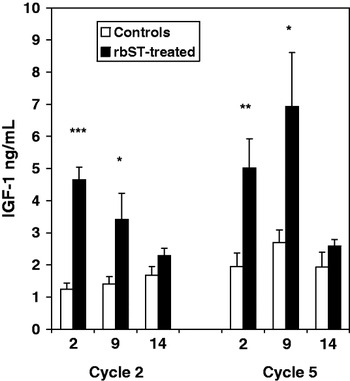
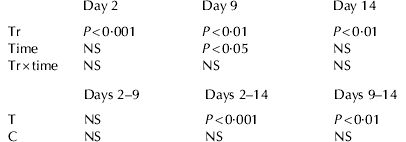
As with serum IGF-1, rbST treatment triggered a prompt increase in IGF-1 in milk, with a seemingly higher ratio between values in treated animals and controls in the earlier cycle (cycle 2) compared with the serum IGF-1 (Fig. 3). However, the general pattern of variation was very similar, with a still high significance (P<0·01) associated with the treatment factor on day 14. The influence of time was found to be significant only on day 9 (P<0·05) while treatment by time interaction was not significant (Table 3). A comparison of milk IGF-1 values between different days within a cycle is reported in Table 3.
Insulin-like growth factor 1 (IGF-1) variation in milk after recombinant bovine somatotropin (rbST) treatment. Comparisons between treated buffaloes (n=8) and the controls (n=8) are reported for days 2, 9, 14 of the cycles of injection 2 and 5. Data are reported as means±sem; * P<0·05; ** P<0·01; *** P<0·001.

Effect of recombinant bovine somatotropin (rbST) treatment and time on insulin-like growth factor 1 (IGF-1) concentrations in milk. Data were analysed by Scheirer-Ray-Hare non parametric tests. Significance related to treatment (Tr), time and their interaction (Tr×time) for rbST-treated group (T) and the controls (C) on days 2, 9 and 14 after rbST injection are reported; NS=non significant. In the bottom part of the table overall differences are reported in IGF-1 levels between different days. Wilcoxon's test was applied for paired comparison. Significance is reported for both the rbST-treated group (T) and for the controls (C); NS=non significant
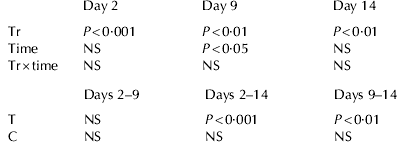
Lastly, partial correlation between IGF-1 levels in serum and in milk, calculated by taking into account the variance associated with treatment, was found to be appreciable (r=0·59, P<0·001). Correlation between ST levels in serum and IGF-1 in milk was also significant (r=0·282, P<0·001).
Discussion
Since, to our knowledge, other studies on hormone serum concentrations after rbST treatment have not been reported for buffaloes, results of our research can only be compared with results obtained on cows. Limiting the analysis only to those studies that have examined rbST treatment with slow release formulations, most of them clearly show that exogenous ST injection leads to a significant increase in serum ST levels, although different quantitative and qualitative effects have been reported. The fluctuations in serum ST observed in this study were comparable to those observed in cows in a previous study (Castigliego et al. Reference Castigliego, Grifoni, Rosati, Iannone, Armani, Gianfaldoni and Guidi2009) which had a similar experimental design. In both cows and buffaloes, ST sharply increased soon after each rbST injection and tended to decrease quite rapidly after a few days, reaching basal levels before the end of each cycle. However, in cows the decline was less pronounced and still on day 7 differences between treated animals and controls were numerically higher than in buffaloes on day 5, suggesting a longer persistence of the synthetic hormone in blood.
The fluctuation of ST serum concentration after rbST injection and its magnitude have been described differently in different studies. Results reported by some authors (Slaba et al. Reference Slaba, Krejci, Skarda, Huybrechts, Decuypere and Herrmann1994; Zhao et al. Reference Zhao, McBride, Trouten-Radford, Golfman and Burton1994) showed a pattern of variation with a similar rapid increase in ST concentration at the beginning of each injection cycle, followed by a quite rapid decrease in the next days. However, others observed a slower decrease (Schams et al. Reference Schams, Graf, Meyer, Graule, Mauthner and Wollny1991; Slaba et al. Reference Slaba, Krejci, Skarda, Huybrechts, Decuypere and Herrmann1994; Cushman et al. Reference Cushman, Desouza, Hedgpeth and Britt2001). In addition, different ST variation patterns have been reported, with an initial moderate increase, a climax in the middle days of the cycle, and a decrease afterwards (Bilby et al. Reference Bilby, Bader, Salfen, Youngquist, Murphy, Garverick, Crooker and Lucy1999). Moreover, the differences reported in maximal ST serum concentrations have sometimes been noticeable, ranging from a few ng/ml (Bilby et al. Reference Bilby, Bader, Salfen, Youngquist, Murphy, Garverick, Crooker and Lucy1999) to some tens (Hodate et al. Reference Hodate, Ozawa and Johke1991; Schams et al. Reference Schams, Graf, Meyer, Graule, Mauthner and Wollny1991; Zhao et al. Reference Zhao, McBride, Trouten-Radford, Golfman and Burton1994; Cushman et al. Reference Cushman, Desouza, Hedgpeth and Britt2001; Castigliego et al. Reference Castigliego, Grifoni, Rosati, Iannone, Armani, Gianfaldoni and Guidi2009). Finally, the tendency to return to basal levels before the end of the biweekly cycle, as observed in this study and reported in past experiments on cows (Schams et al. Reference Schams, Graf, Meyer, Graule, Mauthner and Wollny1991; Slaba et al. Reference Slaba, Krejci, Skarda, Huybrechts, Decuypere and Herrmann1994) has not been observed by others (Bilby et al. Reference Bilby, Bader, Salfen, Youngquist, Murphy, Garverick, Crooker and Lucy1999; Zhao et al. Reference Zhao, McBride, Trouten-Radford, Golfman and Burton1994). Furthermore, some authors have observed a carryover for an additional 14 d (Putnam et al. Reference Putnam, Varga and Dann1999).
It is worth noting that changes in experimental conditions and also the type of pharmaceutical product used (as clearly shown in Slaba et al. Reference Slaba, Krejci, Skarda, Huybrechts, Decuypere and Herrmann1994) may influence the outcome in terms of the measured parameters. This may in part explain why the ST levels in blood observed in this study on buffaloes and in previous studies on Friesian cows (Castigliego et al. Reference Castigliego, Grifoni, Rosati, Iannone, Armani, Gianfaldoni and Guidi2009) tended to reach very high values soon after the rbST injection and returned to basal levels more quickly than in other studies.
As well as for ST, IGF-1 levels in serum were found to promptly increase after each rbST boost. However, IGF-1 levels were significantly higher in the treated buffaloes than in the controls for a longer time within each cycle of injection. The fact that the rapid increase in serum IGF-1 after rbST injection was not followed by such a rapid decrease had already been observed in cows (Castigliego et al. Reference Castigliego, Grifoni, Rosati, Iannone, Armani, Gianfaldoni and Guidi2009), further supporting the hypothesis of the existence of independent mechanisms of IGF-1 production initially triggered by higher levels of serum ST. There is greater agreement in the pattern of IGF-1 fluctuation after ST stimulation compared with the pattern associated with ST itself. Generally, a long-lasting permanence of significantly higher concentrations of IGF-1 after a rbST boost occurs, but different magnitudes of increase have been observed, ranging from around 2-fold (Cisse et al. Reference Cisse, Chillard, Coxam, Davicco and Remond1991; Schams et al. Reference Schams, Graf, Meyer, Graule, Mauthner and Wollny1991; Schwarz et al. Reference Schwarz, Schams, Ropke, Kirchgessner, Kogel and Matzke1993; Zhao et al. Reference Zhao, McBride, Trouten-Radford, Golfman and Burton1994) to 3-fold (Castigliego et al. Reference Castigliego, Grifoni, Rosati, Iannone, Armani, Gianfaldoni and Guidi2009) or 4-fold or more (Hodate et al. Reference Hodate, Ozawa and Johke1991; Slaba et al. Reference Slaba, Krejci, Skarda, Huybrechts, Decuypere and Herrmann1994). However, very slight increases (Gallo & Block, Reference Gallo and Block1990; Bilby et al. Reference Bilby, Bader, Salfen, Youngquist, Murphy, Garverick, Crooker and Lucy1999) or no effect on IGF-1 serum levels (Holzer et al. Reference Holzer, Aharoni, Brosh, Orlov, Veenhuizen and Kasser1999) have also been reported.
Because of a different variation pattern in the serum, the good correlation between ST and IGF-1 serum levels probably only reflects the triggering action of ST on IGF-1 production.
With regard to the variation of IGF-1 secretion in blood, the progressive increase of IGF-1 response to rbST was also observed in cows in our previous experiments (Castigliego et al. Reference Castigliego, Grifoni, Rosati, Iannone, Armani, Gianfaldoni and Guidi2009) and by others (Schwartz et al. Reference Schwarz, Schams, Ropke, Kirchgessner, Kogel and Matzke1993; Zhao et al. Reference Zhao, McBride, Trouten-Radford, Golfman and Burton1994).
IGF-1 levels in milk reflect somehow the IGF-1 levels in blood. Similarities in their variation patterns together with the fact that their correlation was highly significant, suggest that serum IGF-1 takes part in milk IGF-1, or that it triggers and sustains its production.
Interestingly, in other studies on cows a gradual increase in IGF-1 in milk was observed until doubled values were reached after about 20 milkings (10 d) from rbST administration, with a bell-shaped curve in the IGF-1 variation (Daxenberger et al. Reference Daxenberger, Breier and Sauerwein1998). Other significant increases (2-times the control values) have been reported by McGuire et al. (Reference McGuire, Bauman, Miller and Hartnell1992) and Prosser et al. (Reference Prosser, Fleet and Corps1989). Whereas, Collier et al. (Reference Collier, Miller, McLaughlin, Johnson and Baile2008) did not observe any changes in milk IGF-1 concentrations even when the hormone increased in serum, and suggested that milk IGF-1 concentrations are regulated independently from serum concentrations. Mielke et al. (Reference Mielke, Lochmann, Simon, Bier, Jahreis, Hesse and Gallowitsch1990) only found slightly elevated levels in milk IGF-1 concentrations but still within the normal range.
All the controversial results reported about ST and IGF-1 levels in biological fluids after rbST treatment may be partially ascribed to the many different types of immunoassays developed to measure hormone concentrations of ST and IGF-1 in bovine blood and milk and also to the use of different rbST preparations of which, at present, there are essentially only two on the market (note of the authors). The standardization of an immunoenzymic method intended for a first screening on hormone concentrations would reduce one element of uncertainty. This also because of the difficulties found in establishing an easy to run, rapid and inexpensive methods to distinguish rbST from pbST. However, this approach would be particularly worthwhile especially with regard to ST serum concentrations which, in the treated animals, are tens of times higher than basal levels. Furthermore, owing to the difference in distributions of the values related to ST serum levels in treated animals and in the controls, the probability of superimpositions is likely to be very low, as is the possible incidence of false positives. On the other hand, although it might be possible to identify treated animals with a good degree of certainty, the rapid decrease after the peak limits the useful period for sample collection within each cycle. The markedly high rbST concentration in serum would also enable a confirmation method to be set up, in case of suspected positivity, and also in the light of the recent development of MS-based analyses for rbST treated cows (Le Breton et al. Reference Le Breton, Rochereau-Roulet, Pinel, Cesbron and Le Bizec2009). Nevertheless, although the research of these authors represents some of the most successful attempts to detect rbST in biological fluids, the method can distinguish only one of the two main commercial rbST. On the whole, based on the knowledge acquired so far, further studies are needed to improve or bring together existing analytical methods in order to provide unequivocal responses.
In conclusion, rbST treatment induces in buffaloes a marked increase in serum ST concentration in the first few days after each biweekly injection of the drug, with small differences with respect to cows. Such an increase, because of its magnitude, could be a good indicator of treatment, but its rapid decline would limit inspection of the sampling to a very short period between each injection. The significant increases of IGF-1 in serum and in milk, despite lasting more than the increase in serum ST, are of a limited magnitude. They can thus be considered as auxiliary indicators, with more significance if altered values, with respect to an average, were detected in a number of animals within a herd in production. However, the apparent contradictions observed in different studies on hormone levels in biological fluids suggest that quantification methods need to be harmonized in order to establish a range of acceptability above which an indication of treatment may be assumed.
This study was supported by the Ministry of Health (Current Research Grant IZSLT17/07RC).