In a rare comparison between the late Ottoman and British Indian Empires, C. A. Bayly identifies major parallels in their patterns of political and economic change.Footnote 1 In the nineteenth century, for instance, both India and the Ottoman Empire had a significant trade of textiles, constrained by free market capitalism and also saddled with large military costs. They were both dependent to different degrees and in different ways on Britain. In this respect, the 1838 Ottoman tariff agreement with Britain engendered similar consequences to the fierce free trade regime maintained in British India.Footnote 2 To bring parallels more sharply into focus, this article provides a comparative analysis of gender dynamics that shaped the transformation of Ottoman and Indian textiles in the nineteenth century. In so doing, it accentuates alternate paths to capitalist development in non-European settings. It also brings gender into the heart of key debates in world history, about economic transformation, convergence, and divergence.
Curiously, there are major similarities in the labour historiographies of the Ottoman and British Indian Empires. In post-independence India and the modern Turkish Republic, the modernist paradigm that held sway among labour historians well into the 1970s generated a tendency to focus on class-consciousness and political action. As a result, there emerged a narrow concern with the formal sector and trade union activity led by male industrial workers. Themes of culture, community, gender, and caste were either swept under the carpet or studied in connection with their influence on the working-class solidarity. In the past few decades, however, there has been a growing interest towards developing an alternate framework to understand labour in each context. A new generation of historians have shown that class, as a relation, existed in capitalist operations outside the formal sector, as did class resistance and struggle.Footnote 3 Moreover, recent studies have undermined the assumption that caste, community, and religion were relics of a pre-capitalist social order that divided the working class. Rajnarayan Chandavarkar, for instance, has shown that the very processes that constituted the working classes also fragmented them, and that diverse identities were not necessarily in competition with one another.Footnote 4
There is, of course, a gender aspect to the problem, which again bears great similarities in the two contexts. In Indian labour historiography, as pointed out by Samita Sen, ‘the common assumption was (and still is) that the low proportion of women workers in the modern industrial sector rendered them irrelevant to the stories of class’.Footnote 5 The bias has been more or less overcome in the Ottoman context.Footnote 6 In the past three decades, studies on women's labour in organized and informal sectors have increased significantly in both settings.Footnote 7 However, much of the research remains sparse and scattered, and ‘unconnected to long-term historical trends’.Footnote 8 Moreover, in South Asian and Ottoman women's studies alike, the main focus remains middle-class literate women who had greater access to the means of written communication.Footnote 9 Meanwhile, ‘the poor and the workingwomen have fallen between the two stools of labour and women's history – further silenced and divested of historical agency’.Footnote 10
This article looks at the working lives of those women: the workingwomen of Bombay and Bursa, two cities that harboured rapidly expanding textile industries of the nineteenth century. With detailed use of evidence collected from Bursa, Istanbul, Mumbai, Delhi, and London, I show that gender-based norms and hierarchies were integral to the organization of labour markets and processes, as well as to the construction of class identity. The focus on the industrial context is not an accidental one. The tendency in the literature to associate women's labour with rural, domestic, non-industrial forms of production, though not without substance, obliterates the analysis of how women's devalued labour subsidized profits in mechanized, urban industries. This was the case even when women did not directly or widely participate in industrial production.Footnote 11 In fact, the different ways in which female labour related to industrial capital makes the contrast between Bursa and Bombay interesting. While young women in Bursa composed the majority of the workforce in silk filatures, less than half of the workers were female in Bombay's cotton mills. It does not follow that female labour was immaterial in the development of the cotton industry. Agricultural work performed by women in rural contexts played an important role in the shaping of male workers’ wages and modes of employment in cotton mills. Despite the differences in the extent of women's workforce participation, female labour was at the heart of industrial activity in both places.Footnote 12
Before embarking on this comparative analysis, it is worth stating the basic differences that set these contexts apart. First and foremost, there was a tremendous contrast between the demographic scales of the two cities in the nineteenth century. According to census records, Bombay's population in 1906 was 977,822 whereas Bursa's population in the same year was not half in size, 357,265.Footnote 13 Second, there was a significant gap between cotton and silk sectors in terms of the size of capital investment, labour force, and market share. At the turn of the century, the Indian textile industry was largely concentrated in Bombay, with an average number of 82,162 hands employed daily in cotton spinning and weaving.Footnote 14 Although Bursa's silk-reeling industry recorded significant growth in the late nineteenth century, the overall number of workers employed in the sector was only 19,000.Footnote 15 To put the point starkly, the number of female operatives in Bombay was 10,794 in 1885, more than half of the total number of workers in Bursa.Footnote 16
There are, however, sufficient grounds to examine the links between gender and industrial labour. One such commonality is the introduction of waged employment in mills that operated on a very different logic to craft workshops and merchant-controlled domestic production networks. The physical separation of workplace from living areas, a greater pace and stricter discipline of work, the intermittency and unreliability of work contrasts, daily interaction with fellow workers, and ambiguities about communal boundaries were among the experiences that were commonly shared by industrial workers in both settings. The article analyses the role of gender in shaping these experiences. The parallels that emerge, however, need to be contextualized in geography, culture, political formation, and economic environment. For instance, the differing patterns and motives of rural migration largely influenced the gendering of the workforce in both places.
There are, of course, many aspects of the debate that fall outside of this study's scope. The link between women's labour and social reform measures of the nineteenth century is a very important one, yet cannot be duly analysed here due to space constraints.Footnote 17 Although I refer to legal enactments and cultural transformations that characterized the century, I mostly focus on labour processes and conditions of millwork. The article is organized in four sections, which include cross-references to each other, but are topically and geographically distinct. The first two sections deal with questions of labour supply, in Bombay and then Bursa. The last two sections look at the organization of labour processes and class politics in the same order.
I
There were at least three defining features of Bombay's cotton-spinning workforce in the 1870s and 1880s. First, workers were of mostly rural origin, recently migrated from the surrounding Ratnagiri, Poona, Thana, and Satara districts in search of seasonal employment. The dynamics of rural migration in this period are complex; however, it must be mentioned that large-scale famines and structural changes in the agricultural economy pushed a large number of peasants to the town throughout the century.Footnote 18 Construction, textiles, and transportation were the sectors that attracted the bulk of immigrant labour. In 1893, an estimated 30 per cent of Bombay's population was born in rural districts.Footnote 19 The emerging cotton industry could absorb only a small proportion of the city's immigrant labour supply, even in the 1870s when the number of mills increased exponentially.Footnote 20 Second, mill workers were mostly young, seldom over forty years of age.Footnote 21 Colonial reports insist that these individuals maintained ties with the countryside, moving back and forth between Bombay and their town of origin following cycles of cultivation and intermittent employment opportunities. The extensive emphasis in those reports on rural connections has carried a significant weight in the theoretical conceptualization of the Indian working class.Footnote 22 Even though it cannot explain every aspect of workers’ behaviour, continued importance of the rural base does emerge as an important aspect of the urban labour market in nineteenth-century Bombay. Lastly, in direct contrast with the pattern observed in Western Europe, the workforce was almost entirely male. Even before the Factories Act of 1891 that limited hours of work for the ‘protected classes’, the overall proportion of female workers did not exceed a quarter of the total workforce. The factory commission in 1885 found it curious that ‘while in Lancashire of 423,000 employed in the cotton factories, 253,000 are females, 138,000 are males, and the rest children; in the Bombay Presidency, of 49,928 operatives in textile factories, 38,159 are adult males, 10,794 are females, and 975 are children’.Footnote 23
This section begins by taking a closer look at the gender composition of Bombay's cotton-spinning workforce. It is a well-known fact that the cotton-textile industry in Europe was a staple employer of women and children. In most places in England, women supplied textile factories with cheap and flexible labour following the mechanization of spinning and weaving. Historians have shown that, with some important exceptions, the association of skilled work with male labour tended to drag women's wages down in manufacturing. Even before the industrial transformation in England, as shown by Sonya O. Rose, women were designated as a low-waged labour force.Footnote 24 The pattern was largely followed in non-European regions experiencing industrial capitalism. For example, capitalist profits in export-oriented tobacco and silk-reeling sectors in the Ottoman Empire were similarly reliant on the wide-scale use of cheap female labour.Footnote 25
Cultural interpretations and social organization of women's work, of course, varied across regions, and we do not know a great deal about how women's work was remunerated in Bombay before the mill industry emerged. However, there is ample evidence from the second half of the century to show that Bombay was no exception to the general pattern. Women were concentrated in low-paid and sweated jobs available in the bidi industry, domestic service, the ‘industries of the dress and toilet’, and municipal service. They were also commonly employed as sweepers and scavengers.Footnote 26 In cotton mills, women were at the bottom of the wage hierarchy.Footnote 27 The question is, then, why mill owners did not attempt to increase the number of females employed, or better yet, create a female-only labour force, to improve their cost advantage? This point becomes particularly intriguing given that Bombay's mill industry was in fierce competition with two major suppliers of raw cotton, first Lancashire and later Japan. Besides tax privileges, monopolies, and an established base of cheap labour power, Lancashire mill owners enjoyed the advantage of having started their business almost a century ago, meaning they no longer incurred the high costs of finding engineers and transporting and setting up the machinery. The only two advantages of Bombay's mill industry being the ample supply of raw material and local labour, it seems reasonable at first glance that Indian mill owners would attempt to shrink production costs to the absolute minimum by employing cheap female labour on a wide scale.
Another question that comes up in this connection concerns workers: why did poor women from rural families not join their husbands/sons to seek work in spinning factories? As a curious fact, scant evidence indicates that cotton spinning and reeling were regarded as women's tasks in most of West and North India. Based on the 1881 census of India, Douglas E. Haynes shows that spinning constituted an important source of women's employment in West India, as 90 per cent of cotton spinners in the 1881 census were female.Footnote 28 Tirthankar Roy argues that convicts in Indian jails started carpet manufacturing from the 1860s, but they hated spinning because it was considered women's work.Footnote 29 According to Geraldine Forbes, Gandhi saw the wheel as essentially a feminine device and spinning as a fundamental aspect of women's work.Footnote 30 In several missionary and traveller accounts, the ‘typical’ Indian woman appeared operating a spinning wheel.Footnote 31
It would be fallacious to assume that labour was organized in similar ways across India, or that the association of spinning with femininity was a fixed and ubiquitous phenomenon. Gendered meanings of particular tasks, including cotton spinning, varied through time and across regions. Also, official remarks about ‘domestic employment of women’ should be approached with caution, as the concept itself is the product of a certain history.Footnote 32 With all this noted, discourses about women's work have hardly been representative of any social reality. They rather naturalize and justify the gendered hierarchies established within and outside the workplace. To give an example, Radha Kumar has shown that in Bombay's cotton-spinning sector between 1919 and 1939, a substantial percentage of female workers were widows providing for entire households with two or more children.Footnote 33 Yet official reports stressed the supplementary nature of female labour, as part of a political programme to rationalize both the industry and working-class family. In this light, it remains a curious fact that mill owners in Bombay did not attempt to reinforce the ideas that associated spinning with femininity. Equally surprising is the low interest from poor women in factory work. Here, four inter-related factors come to the fore. First is the structure of the urban labour market, second is geography in connection with gendered division of labour at home, third is the age of marriage and social sanctions against women's mobility, and fourth is the low cost of male labour.
The structural constraints of the cotton-spinning sector are critical to any examination of class formation in Bombay. In his brilliant work on the development of industrial capitalism in India, Rajnarayan Chandavarkar has shown that mill owners operated within highly disorganized factor markets and a fluctuating global demand. Since prices of raw materials and products changed swiftly, mill owners tailored production closely to demand. This entailed devising ‘methods of recruitment which would enable them to employ additional men at short notice or lay them off as the market required’, instead of training or ‘settling’ an efficient workforce.Footnote 34 The structure of demand from the mill industry largely determined the gender composition of Bombay's migrant workforce. As stated by Chandavarkar, Bombay was ‘a city of male migrants’. The number of men living in the city almost doubled that of women in the mid-century.Footnote 35 This was because the irregularities of employment made it crucial for workers to retain their rural connections, and they did so by leaving women behind in the village. The importance of female labour in the rural sphere was enhanced in return. The 1872 census report from Ratnagiri, which supplied the majority of the mill labour, recorded that much of the fieldwork in the region fell upon women.Footnote 36 Having assumed the task of maintaining the family's rural base, women left their villages only under exceptional circumstances, for example, ‘when the village base of the family economy had crumbled’ or when they had been widowed.Footnote 37 Samita Sen shows that the process was nearly identical in Bengal's jute manufacturing sector.Footnote 38 According to Sen, the devaluation of female labour through women's confinement in the rural sphere was strictly connected to the spread of the dowry, the increasing restrictions on widow remarriage, the diffusion of purdah, and child marriage.Footnote 39
Bombay's increasing animosity towards the poor and needy may have also influenced rural migration patterns. Jim Masselos argues that towards the end of the century, migrants had come to be considered as carriers of disease polluting the urban environment and exploiting its resources, even though it was mostly the city itself that spread epidemics among the rural population.Footnote 40 After a hazardous and long journey, workers found accommodation in overcrowded and unsanitary quarters for which they paid high rents.Footnote 41 To manage costs, tenants shared these quarters with their friends, relatives, and caste-fellows, who collectively formed a network of recruitment for mills. As colonial officials observed, connections with the village enabled workers to endure the grim conditions of life and work in the city. For example, the collector of Khandesh noted: ‘if people devoted their lives to factory work and worked in factories every year and all the year long, possibly some effect on their health might be noticeable. But they simply dip in and out again.’Footnote 42 What remained unsaid in these reports was that women's labour in the village was critical in maintaining male workers’ presence in the city. Female agricultural labour operated as an informal welfare scheme and enabled mill owners to retain a flexible and low-cost labour pool.
The vast geography of the Bombay Presidency was a second factor influencing women's workforce participation. A widely observed aspect of women's employment has been their endeavour to balance workplace commitments with gendered tasks in the household. This, however, is not to say that women have an inherent, predestined attachment to the domestic sphere, one that is dictated by their biology or nature. Just like relations of production outside the home, the gendered division of labour inside the household is socially constructed.Footnote 43 Historically, however, the relationship between the two influenced patterns of employment of both sexes. As will be examined in the following pages, Bursa's first entrepreneurs built silk-reeling factories near residential areas to alleviate a potential conflict between women's paid work and domestic responsibilities. In comparison, factories were far removed from the Bombay Presidency's most economically deprived regions, which discouraged women from seeking millwork in large numbers. As a matter of fact, even within Bombay city itself, factory workspaces and workers’ dwellings were situated apart. Nikhil Rao argues in his recent book that the mills could not be accommodated within dwellings the way artisanal workshops had been until this time. Therefore, ‘the development of the industrial districts first in Tardeo and Byculla and subsequently in Lalbaug and Parel meant that workers lived in residences and travelled to factories’.Footnote 44
The question of geography is also connected with the age of marriage and cultural sanctions against women's mobility. Although there are exceptions to the pattern, scholars have repeatedly pointed out that Indian women's workforce participation has been rather unique because workers entered the workforce after marriage and childbirth.Footnote 45 In contrast with Bursa, where there existed a workforce composed of single females in their teens, the age of marriage in Bombay was significantly low. ‘Women's work inside the factory depended on a support system outside’, says Tirthankar Roy, ‘to look after young children and bring them to their mothers at certain times and places. And those that could needed to have large families.’Footnote 46 It seems reasonable to assume that married women who did not have such a support system found it difficult to combine childcare and paid work based in Bombay. Moreover, evidence from the later period shows that industrial growth went hand in hand with the contrast drawn between urban and rural life, peasant and industrial worker. There were increasing concerns about ‘peasant women being lured into immoral conditions of waged work’, which was further bolstered by the low sex ratio in the mills.Footnote 47 It is possible that characterizations of migrant women as prone to promiscuity deterred many married women from participating in the urban workforce.
Given these conditions, an option for employers could be pushing up the age of marriage. It seems, however, Bombay's mill owners were not interested in devising mechanisms of female recruitment because there was no significant cost-related concern about the employment of male workers.Footnote 48 The cost of male labour power was low enough to retain a competitive advantage in the global market, even as mill wages were considered respectable within Bombay's local economy. Rustomjee F. Wadia, manager of Pachora Press and Ginning Factory in Khandesh, noted in 1885 that they did not employ children because ‘when the wages are so low for the adults there is no advantage in employing children’.Footnote 49 I argue that a similar logic prevailed with respect to women's work: where the wages were low for adult men, employers saw no advantage in encouraging women's workforce participation. The argument can further be extended to say that industrial capital relied less on female labour when male labour was not ‘proletarianized’ in the conventional sense of the term – that is, as long as families did not entirely depend on wages for subsistence, the industry displayed less need for female labour.Footnote 50 The perceived drawbacks of female employment, such as low commitment to factory work, combined with the fear of factory legislation, further blocked the channels of recruitment for women.
II
The composition of the workforce in Bursa's silk-reeling sector, by contrast, was closer to the European example: the overwhelming majority of the textile workers were female. Here, gender ideologies functioned more visibly in providing the sector with cheap and flexible labour, rather than operating on a level of familial relations as in Bombay. Contemporary sources reveal that labour was meagre for the first filatures (silk-reeling factories) in Bursa. European travellers who visited the city in the mid-nineteenth century remarked on the difficulties of finding local labour.Footnote 51 Rural households accounted for at least 80 per cent of the Ottoman population at the time.Footnote 52 There were limits to the size of the urban working population, since Bursa lost most of its local workforce to Istanbul, the nearby capital city. The reported scarcity may also be attributed to increased concentration of rural households on silkworm raising together with the sustained trade of hand-woven silk fabrics. The latter is particularly important as there can still be observed a tendency in the literature to overemphasize the effects of the Anglo-Ottoman Treaty of 1838 on the local manufacturing. This treaty gave British merchants full access to the Ottoman markets to the detriment of local manufacturers. As shown by Donald Quataert and Roger Owen, it was the output generated by organized guild male labour that declined significantly in the late 1830s. Within the domestic market, Ottoman manufacturers successfully adapted to the conditions of competition by using cheap female and child labour, developing alternative production techniques, using new materials and addressing to new consumer types.Footnote 53 To substantiate Quataert's point, a telegraph from the Ministry of Finance to Vilayet-i Hüdavendigar (Hüdavendigar Province) reveals that handloom silk weaving had gained popularity in Bursa's Armenian neighbourhoods by 1848.Footnote 54
Besides the trade of silk fabrics, sericulture was a highly profitable source of income for locals. Notwithstanding steep fluctuations in demand, and periods of lapse caused by agricultural diseases, most families generated considerable cash income from the cocoon trade over the course of the nineteenth century. According to the British consul Maling, between 1846 and 1857 the production of silk in Bursa was equivalent to the yearly average of 435,448 kilogrammes worth 916,000 pounds sterling, of which only the value of 141,250 sterling was produced by the filatures. The balance represented the produce exported in its first form as cocoons.Footnote 55 A Scottish traveller noted in his diary, ‘silk is the staple and one standing topic of talk. In Smyrna they talk of nothing but figs for about two months of the year, but in Brusa they talk of silk! silk! silk! all the year around.’Footnote 56 The overall profitability of the cocoon trade likely led many villagers to maintain their link to the agricultural production and show little interest in factory employment. The situation in Bursa was therefore in stark contrast with that of Bombay's rural districts.
Another factor that complicated labour recruitment in Bursa was the ethnic composition of the filature capital. As opposed to Bombay where mill owners relied on a team of jobbers who used their own caste and familial links to recruit labourers, Bursa's filateurs (owners of silk-reeling factories) were personally involved in the recruitment process.Footnote 57 These entrepreneurs were mostly French and Italian, in partnership with local Greek and Armenian traders. Evidence shows that Bursa's locals, particularly the Muslim population who felt increasingly alienated by recent reform movements, viewed this foreign economic activity with suspicion. The local disquiet found its expression in a series of attacks on filatures. For instance, in the year 1865 ‘some individuals from Bursa’ demolished a filature owned by an Armenian, Fürmüzoğlu Kigork, for unexplained reasons.Footnote 58 Similar events took place in surrounding localities as well. In Izmit, for example, local groups repeatedly demolished a private filature, which according to the European owner was due to sheer vengeance and nothing else.Footnote 59
Under the circumstances where labour was scarce and expensive, filature owners turned to female labour. According to Quataert, raising silkworms in Bursa was an activity villagers performed to augment the household income in the agricultural off-peak seasons. The perception of women as ‘extra income producers’, he argues, led to female control of sericulture in the region. Employment in filatures, similarly, was seasonal in character, which ‘corresponded well with Ottoman society's view of female labour as supplemental’, and presumably dragged wages down.Footnote 60 This explanation may well fit with the European pattern, yet one must be cautious. In another study, Quataert underlines that both male and female members of rural families performed silk reeling.Footnote 61 In fact, there is no reliable information with regard to how reeling was gendered in the urban sphere. Even if women did dominate the task, it does not follow that they were invariably regarded as ‘extra income producers’. We do not know whether the male breadwinner model with its implications for women's waged work had come to prominence in the Ottoman Empire at the time. It is perhaps more reasonable to assume that filature owners, most of whom were former factory owners from Lyon, were simply following the example that they knew. That is to say, regardless of whether silk reeling had been a female-dominated task or not, the establishment of silk filatures certainly turned it into one.
The process, however, was long and laden with conflict. By the mid-century, many villagers had gone into debt because of the heavy taxes and sharp fluctuations in cocoon prices.Footnote 62 A common method of labour recruitment in Bursa, as in Mount Lebanon, was the provision of cash advances to peasants who agreed to send their daughters to filatures.Footnote 63 In a petition to the Ministry of Commerce and Public Works, female workers stated that factory owners had approached the families of the poorest with a cash payment of one lira (100 piasters).Footnote 64 It is important here to note that cotton spinning sharply declined in the region from the mid-1850s, just at the time when the filature activity gained ascendance.Footnote 65 Perhaps families in urgent need of cash found it more advantageous to send their daughters to factories instead of wasting their time in cotton spinning. By doing so, however, they risked social humiliation and disgrace. An Ottoman physician noted in 1909 that many of the factory women ended up returning to their villages with feelings of ‘shame and desperation’, as some male supervisors lured them into sexual favours and ‘stripped them off their honour’.Footnote 66 They consequently split up with their fiancées and lived the rest of their life ‘in regret and destitute’.Footnote 67 It is difficult to ascertain the frequency of such occurrences, yet it is clear that concerns about young women's morality made factory work questionable for those who could afford to forgo potential earnings of their wives and daughters.
The provision of cash advances was not the only mechanism of labour recruitment. The concentration of filatures on the eastern and western sides of the streams Gökdere and Cilimboz was as much connected with the calculations of labour supply as it was with the provision of water.Footnote 68 The proximity of residential quarters ensured that workers did not travel long distances to reach their workplaces. This alleviated concerns about street harassment and conferred women the ability to combine housework with the waged employment. Even so, the majority of workers were young, unmarried women who had presumably fewer engagements outside the workplace. These women also more readily accepted the terms of factory employment since they did not view it as a permanent occupation. Another critical aspect of labour recruitment was communal boundaries and potential ethnic conflicts. With the assumption that non-Muslim workers would least likely object to working under foreign employers, first entrepreneurs drew the majority of the workforce from Greek and Armenian neighbourhoods. Lastly, some filature owners brought female supervisors from France and Italy.Footnote 69 Experienced in silk reeling, these women instructed the new technology and demonstrated by example that it was appropriate for Christian women to work in a factory environment.
As the number of filatures increased, a female-dominated industrial workforce gradually emerged in Bursa. Maling reports that out of the 5,415 hands employed in seventy-five filatures working in 1872, only 217 were adult males, the rest being adult and non-adult females.Footnote 70 Wages, however, did not drop as swiftly as the filature owners would have liked them. Having recruited workers exclusively from Greek and Armenian quarters, the industry still relied on a relatively small labour pool. Georges Perrot argued that female workers’ salaries were exceptionally high in Bursa compared to Europe.Footnote 71 As per the information gathered by Perrot from an Italian filature owner, when all filatures were up and running in the city, the female spinners were paid as much as ten, and sometimes twelve piasters (2–2·4 francs). Even in ordinary times, their salaries were not lower than six or seven piasters (1·2–1·4 francs). Yet the Italian filatures paid only eighty to ninety centimes to workers who were ‘far more industrious, and wasted far less’.Footnote 72 It would be misleading to take Perrot's highly prejudicial statements as accurate depictions of the working conditions in the industry. However, it is clear that by the 1860s filature owners had been seeking additional ways to increase cost-effectiveness of their business by decreasing wages.
III
In the two decades following the establishment of the first silk and cotton factories in Bursa and Bombay, important changes took place in the composition of the workforce. In Bombay, the number of female workers significantly increased in the 1880s as a result of the changing character of rural migration. Large-scale famines in the 1870s and growing rural indebtedness led many families to abandon agriculture altogether and permanently settle in town.Footnote 73 The improvement of the transportation networks and rapid expansion of the industry contributed to the increasing volume of rural migration. Stephen Edwardes, the editor of several volumes of the Bombay Gazette, said: ‘In previous years, the man had sallied forth alone, had dared not risk the peace, perhaps the lives, of his wife and children in a journey to the unknown city.’ Yet the situation changed in the 1880s, when ‘the steam-boat and “the fire-carriage” had done their work, and the women of the Deccan, Konkan and Gujarat had come to share their masters’ fortunes in the factory and the docks’.Footnote 74 The 1891 census showed that large numbers of immigrant women had moved to areas where the mills were concentrated.Footnote 75 The industry's changed focus from weaving to spinning yarn from the late 1870s may have also attracted more women to the mills, as demand for reelers likely rose.Footnote 76
Women's increased participation in the workforce did not upset the extant division of labour in the sector. The newcomer women filled up the ranks of winders and reelers, whereas male workers continued to dominate spinning and weaving. In 1885, out of 49,928 operatives employed in textile factories in the Presidency, 10,794 were females. The vast majority of female workers performed reeling and winding.Footnote 77 In 1893, cotton spinning and weaving gave employment to 64,830 workers, of whom 15,969 were females. Again, almost all female workers were either reelers or winders.Footnote 78 The point is important, as it is directly connected to the debates about factory legislation. Chandavarkar argues that the limitation of women's hours of work to eleven in 1891 by the Indian Factory Act served to check the expansion of female employment.Footnote 79 However, it would appear that the daily hours of work in the reeling departments, where the majority of women found employment even before 1891, did not reach eleven.Footnote 80 That is, unless one could show that the increase in the number of women meant their improving ability to compete for male-dominated jobs, there appears to be no reason to assume that the legislation put a check on the expansion of female employment. If the number of women employed in factories decreased in the later years, other factors must have been at play, such as an increasing association of women's paid labour with promiscuity, or extensive emphasis on the idea of an ideal-type working-class family sustained solely by male wages. This does not mean that legislation did not have a negative impact on women's work. By limiting specifically women's and children's working hours, the 1891 Act consolidated the gendered wage and status hierarchy within the sector.
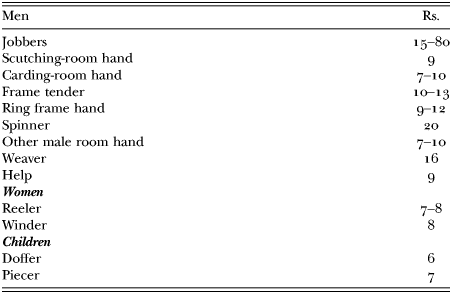
Table 1, which breaks down wages by skill in a cotton mill for 1893, provides a clear picture of the said hierarchy. Despite the persistent disadvantages of female employment, official reports indicate a high preference for millwork among women. This seems to be connected with, among other things, a lack of alternatives. As mentioned earlier, jobs available to women in the urban sector were low-paid, low-status, physically demanding, and/or morally ambiguous. According to Sakoo, a female overseer of reelers in the Colaba Mill, women working outside earned from three to four annas per day as opposed to seven rupees in the mills.Footnote 81 Akoo, a reeler in the same mill, said: ‘If I worked outside the mill I would get five or six rupees per month, but work outside is cooley work and would not suit me…I am strong enough to do millwork, but I am not strong enough to do outside work.’Footnote 82 It is hard to say how reliable these accounts are, given that mill owners, who felt strongly against government inquiries into the sector, filtered workers' testimonies. Bearing that in mind, one point that frequently came up in interviews with female workers brings to attention an overlooked aspect of women's work in Bombay. According to Sakoo and others, the biggest advantage of mill employment was that it conferred women the opportunity to earn wages without having to mix with men:
I would prefer reeling to having to work with men outside. I prefer working with women. If I could not get employment in reeling I would not work with men, I would do needle work. I do not know what the other women would do, but I do not think they would work outside if they could not get employment in the reeling room. Our husbands would prefer us working in the reeling rooms of a mill to working outside.Footnote 83
Average daily wages of operatives in Bombay's mills in the year 1893

Source: A. M. T. Jackson, chief inspector of factories, to the collector of land revenue, customs and opium, 21 June 1893, London, British Library, Provincial report on the working of the Indian Factories Act in the Bombay Presidency for the year 1892, IOR/V/24/1627:1 –892–1910, p. 14.
It would appear that gender segregation, the very element that devalued women's labour, also encouraged their participation in the workforce. The reasons for this preference are worth investigating in further detail. Reports from districts such as Ahmedabad and Surat show that women in cotton mills worked alongside men, performed similar tasks, and received better wages.Footnote 84 Why did women prefer to work separately from men in Bombay? The answer most likely lies in the difference between urban and rural contexts. As one inspector of factories pointed out, mill workers in Ahmedabad and Surat mostly came from the same quarter of the town and lived near to the mills.Footnote 85 Married couples usually worked together in the same mill. Having the mechanisms of marital and communal supervision in place, husbands did not object to their wives’ working in mixed-gender departments. In Bombay, by contrast, those control mechanisms were mostly absent: married couples were employed in different mills or sometimes husbands were employed in outdoor work. The operatives were mostly strangers to each other and some lived far from the mill. Under the circumstances where little, if any, supervision could be exerted over women, husbands insisted their wives worked ‘among equals of their own kind’.Footnote 86 Thus emerged among women a preference for gender-segregation, which presumably translated into being able to earn wages without having to deal with morality issues connected with working alongside strange men. This is a rather illuminating example of how gender ideologies were integral to the very organization of work and labour processes in Bombay's cotton-spinning sector.
Another curious point with respect to the relationship between gender and the organization of work is the subtle twist in gendered meanings of spinning yarn. As briefly discussed in the first section, cultural associations of spinning with femininity did not prevent men from taking over the spinning departments where they could earn a respectable cash income. As in England, the muscular strength required by the earlier forms of the spinning mule may have helped to establish the task as a male preserve.Footnote 87 Yet I suspect Bombay factories, having been set up in the 1850s, imported the latest form of the spinning mule, which could be operated by women as well as men. Moreover, the male monopoly of the power-driven machinery was not limited to spinning mules; rather, it comprised the entire spinning and weaving operation. John Hammet, engineer and manager of the New Great Eastern Mill, noted: ‘Women are not allowed near machinery turned by power in spinning mills, there the machinery is worked by hand only. Those who are employed in other departments where the machinery is turned by power are very few indeed.’Footnote 88 Sakoo said:
Children, young persons, and women are never allowed to clean machinery in motion, that is the work of men, women only clean their reels, which are worked by hand. The women never have any need to go near machinery turned by power, we are quite separate from the machinery in motion.Footnote 89
The stress on women's separation from machinery calls for a more nuanced reading of technology and its role in delineating the limits of what women can and cannot do. Here, the ‘dangerous’ machinery feature as belonging to the masculine domain, whereas femininity is associated with hand production. The formulation of the relationship has been a highly contingent one, though. For instance, in other parts of the Presidency, such as Ahmedabad, women found employment as operators of the power-driven machinery, the only exception being the spinning mule and scutcher. Women operated ‘the drawing, slubbing, intermediate and roving frames in the card room, and in the weaving department they are employed to work the winding frames’.Footnote 90 The fact that women were not allowed near any power-driven machinery in Bombay testifies to power relations between the sexes that shaped the division of labour in that particular context. It is worth mentioning that at exactly the same period, Ottoman silk workers operated steam-powered reeling engines with the presumption that the job was more suitable for women. Lastly, as stated by N. N. Wadia, manager of the Maneckji Petit Mill, ‘women are allowed in spinning mills near machinery in England. In England, the majority of factory operatives are women.’Footnote 91
In 1891, the colonial government passed the Indian Factories Act against the backdrop of the debates over the age of marriage. Although the two debates were not mutually entangled, according to Sen, both bore the ‘stamp of the nationalist construction of womanhood’ by drawing all Indian women into their orbit.Footnote 92 The 1891 Act was the by-product of a decade of negotiation among various actors struggling for power in the emergent urban context: mill owners, Manchester industrialists, government agents, social reformists, and representatives of workers. In addition to introducing a weekly holiday and mid-day stoppage for adult workers, the act limited the hours of women and children to eleven, to be completed during daytime.Footnote 93 This legally chained women to reeling departments, since spinning and weaving demanded longer hours than prescribed by the law. In Bombay, the campaign for legislation was led by Narayan Meghaji Lokhande, the founder and president of the Bombay Millhands Association. An enthusiast of state intervention in conditions of mill employment, Lokhande took hardly any note of issues specific to women's employment. It was, surely, not lost on Lokhande and his association that legislation dealing exclusively with the conditions of women's work was on the government's agenda. Yet his petitions, while pushing for protective laws encompassing all workers, dismissed potential consequences of a gender-specific legislation for women's status in the sector.Footnote 94 As pointed out in a recent study, his focus on standardization and uniformity made sense in ‘a working world made jagged by the differences in rights and conditions between mills’.Footnote 95 However, it also marked the beginning of a trend toward institutionalized exclusion of women from union politics. In the subsequent century, when the association of women with the domestic sphere gained ascendance, the male-dominated unions played an active role in eliminating women from the organized industrial workforce.Footnote 96
Meanwhile, women working in Ahmedabad frequently petitioned the government in the hope of dissuading the authorities from regulating their work.Footnote 97 In a straightforward and urgent tone, female weavers explained that the act would almost certainly throw them out of employment since mill owners had no reason to keep them if male labour became more advantageous. They stressed the difficulty of finding work elsewhere, despite the skills they had gained in years through factory employment. The difficulty was partly owing to the restrictions imposed by caste and religion, and partly to the foreign trade, which had eradicated their ‘hereditary home work’.
Most of Your Lordship's petitioners have learnt the art of working the machinery with a great trouble and lapse of time, and some of them know no other profession, and if they were turned out of the mill they will be actually starved to death. Some of Your Lordship's petitioners belong to the Muhammadan community, and they are precluded by their caste custom from working as out-door labourers, and as by the introduction of foreign paper and cloth they have lost their hereditary home work as workers of hand-made paper and hand-made cloth, they have no prospect of earning any livelihood if deprived of their present occupation.Footnote 98
The manifest difference here between female and male workers’ agenda with respect to factory legislation is a good example of how gender was integral to the relations that constituted class. Varying degrees of access of women and men to job opportunities provided by urban sectors appears to have been a major factor in shaping their experience and perceptions of factory employment. The colonial state, through legal regulations, created new hierarchies within the industrial workforce along the lines of gender. As stated by Chandavarkar, the very processes that constituted the working classes also fragmented them.Footnote 99 Here, it is worth noting the continued relevance of the issue in India's textile sector. In her ethnographic study of the Calcutta jute mills, Leela Fernandes demonstrates that gender and community constitute the structural layer of class, rather than merely circulating as ‘external symbolic or ideological forces’. According to Fernandes, the analysis of gender as a shared perception between male workers and management undermines the assumption of an autonomous ‘subaltern sphere’.Footnote 100 The following pages will exemplify the argument in another context, Bursa's silk-reeling sector.
IV
Georges Perrot noted in his diary in 1860 that the local silk-reeling industry in Bursa experienced a series of crucial problems. Although spinning on the spot provided filature owners with a considerable advantage, they incurred more expenses than their rivals in France and Italy: for one thing, they had to rely on wood instead of coal for fuel, which was more expensive and less efficient. Moreover, he argued, they lacked experience yet they were overly ambitious. They had set themselves in a ‘ruinous competition’ against each other, which increased costs. ‘Following the harvest’, he said, ‘there is a fierce competition among the factory owners, each one seeking to steal workers from his neighbour, by raising wages which ends up ruining all of them.’Footnote 101 He contended, ‘if the Muslim population which is far larger (than the Christian population), comes to seek with enthusiasm this type of gain, as it would appear the population is disposed to do, the factory owners’ position would improve considerably’.Footnote 102 Employers must have shared Perrot's conviction, as some filature owners travelled from village to village to widen the labour pool.Footnote 103 The task, however, was a difficult one. First, according to some sources, the Ottoman authorities endeavoured to prevent and discourage the recruitment of Muslim women.Footnote 104 Although there may not have been a straightforward prohibition, the disapproval of the authorities certainly did not work in favour of the industry. Second, filature work demanded an unusual discipline and a strange work environment. According to European observers, the work-rhythm that the locals were accustomed to was not strictly in line with the demands of factory production. One Scottish traveller, for instance, argued that women did not have the habit of ‘regular attendance, order and method’, instead, ‘their usual habit is to be busy for one day and idle for three or four, or to work very hard for one hour and loiter and saunter for three’.Footnote 105 There was also a gender aspect to the problem of recruitment. The fact that filature employment required young, unmarried females to spend a considerable time away from the supervision of their families fed into concerns about the moral suitability of waged work for women. Lastly, ethnic tensions among workers stood in the way. Perrot argued that with very few exceptions, Jewish women did not work in the filatures, and this was not because they disliked factory work but because it would be difficult to integrate them to the other female workers.Footnote 106 He also stated that the Jewish women refused to work on Saturdays, for which filature owners did not desire to employ them.
The sources are not clear as to how these perceived difficulties were overcome, yet it seems that filatures had incorporated a significant number of women into the paid workforce by the end of the period. Increasing rural indebtedness and the wave of migrations from the Balkan States and the Caucasus may have played a role in increasing the demand for filature work.Footnote 107 If so, the ratio of Muslim women within the workforce must have been increased. Travel journals from a later period reveal that young women from the surrounding villages were transferred to town in caravans at the beginning of each season, to be given accommodation in barracks built adjacent to filatures.Footnote 108 In the meantime, filature owners employed particular mechanisms of labour control to eliminate the effects of the so-called ‘ruinous competition’. As shown by Donald Quataert and Leila Erder, a system of certification (tezkere sistemi) provided that workers did not change jobs without the permission of their current employers.Footnote 109 The widespread application of this system presumably reduced workers’ bargaining power and strengthened their workplace commitment. The downward pressure on women's wages toward the end of the period may be explained by the settling of similar management practices, along with the expansion of the labour pool. As reported by the British Vice-Consul Maling, between 1858 and 1872 the average daily wage of a silk-reeler (çıkrıkçı) fluctuated between six and eight piasters.Footnote 110 By 1910, her wage had been reduced to three to four piasters.Footnote 111
There is not much information as to how women spent their earnings, apart from a repeated emphasis in secondary sources on their purchase of luxury items for the dowry. Although reelers had won a certain fame for spending on gold and jewellery, evidence from the Balkans show that the dowry was not so much a luxury as a major financial concern for poor families who had more than one daughter. For instance, in her work on female tobacco workers in Salonica, Gila Hadar has shown that the dowry was composed of basic items such as household utensils and bedding, yet ‘it was estimated in 1910 that a young girl of the working class would need to work ten to fifteen years to save enough money for a dowry’.Footnote 112 One must therefore be cautious before drawing any links between factory work and enhanced financial liberties for women.
It is worth underlining that the transition of spinning from home to factory brought about a different outcome in Bursa with respect to the gendered meanings of the task. While Bombay's cotton industry relied on the flow of male, poor immigrants to town in supplying its requirement for cheap labour, Bursa's cultivators had not yet detached from the land to the same degree. The urban male workforce was not strictly employable in factories as their wage scale exceeded what filature owners were willing to pay. According to Quataert, the daily wage of an average factory worker in the Ottoman Empire, usually male, was between twelve and fifteen piasters in the period.Footnote 113 Hence, filature owners actively engaged in creating and sustaining a female-only, cheap, seasonal labour force. The operation of the steam-powered machinery became a feminine task in the process, as opposed to Bombay, where machinery in motion emerged as belonging to the masculine domain. Both gender ideologies and rural connection was integral to this transition: Young female workers, usually from the poorest segment of the population, worked in filatures for a few subsequent seasons in exchange for low wages, which they invested in the dowry or used to meet certain household expenses, and quit employment as soon as they earned the sum required. The full proletarianization had once again neither been achieved nor desired.
The industry recorded a significant growth towards the end of the period, thanks to favourable market conditions and improved strategies of labour management. In the two decades following 1890, the number of factories around Bursa rose by 50 per cent.Footnote 114 By the end of the 1910s, the total number of workers was an estimated 19,000.Footnote 115 Meanwhile, workers devised their own mechanisms of bargaining and pushed for the regulation of the industry. A series of letters and petitions dated between 1908 and 1910 testify to increased organized action among filature owners in the Second Constitutional Era. Continuous petitioning led to a number of official investigations which culminated in a bill drafted by the local authorities in 1908. Besides regulating working hours and wages, the bill included detailed clauses about the relations between male and female personnel employed in filatures.Footnote 116 For instance, supervisors and managers were prohibited from receiving gifts from, and establishing friendly relationships with, female workers. The verbal abuse or defaming of workers was strictly prohibited. These clauses reflected workers’ grievances regarding treatment from male supervisors and perhaps to some degree aimed to eliminate the stigma attached to filature work. The bill did not pass the parliament, as members of the government expressed their concern with the unhindered progress of the industry. Workers then petitioned the sultan himself in 1909.Footnote 117 The petition once again entailed grievances of a kind that was specific to female employment: workers stated that the long working day exceeding sixteen hours in summer deprived them of the safety of travelling in the daylight. As a result, they were exposed to street harassment from idle men and drunkards. Their demand was the shortening of the working hours, with consideration of the hardships they encountered in their ‘womanhood’.Footnote 118 In a letter they sent to the journal İştiirak, they urged their brothers in the empire to protect the rights of the nation's future mothers.Footnote 119
The emphasis on sexual difference and feminine vulnerability helped workers to further their cause against filature owners. This was a different course of action from the one followed by female weavers, who stressed equality with, rather than difference from, men in order to keep their jobs. At the same time, the strategy was not uncommon in female-dominated sectors: Bombay's female reelers, similarly, stressed their roles outside the workplace as mothers and wives as they formulated their demands. For instance, during a strike that broke out in 1890 at the Jubilee Manufacturing Company at Sewree, women requested to come to work at a later hour in the morning as ‘many of them were married and had household duties to perform’.Footnote 120 The reserve army of labour in Bombay prevented women from achieving their demands. In Bursa, however, the strategy proved effective to some degree. Local authorities believed that street harassment indicated a serious threat to the public order and had to be addressed immediately. They urged the ministry to reconsider the bill that had been rejected earlier.Footnote 121 Despite the lack of success in these attempts, the co-operation of local officials must have provided some relief for women in the industry in terms of increasing their bargaining power against factory owners.
As mediation by the local government proved ineffective in making a real change in the working conditions, women went on a general strike in August 1910.Footnote 122 The protest lasted for about fifteen days, a considerably long period in the general context of Ottoman labour movements. Sixty filatures in the region participated in the strike. Basic demands listed were the shortening of working hours and an increase in wages. The sources are not entirely clear as to how filature workers sustained the protest for as long as they did, without any trade union oversight. Based on the lack of formal leadership, together with a short-term involvement of strikers with the Armenian socialist party Hınçakyan, it has been suggested that socialist groups may have used women for their own political ends.Footnote 123 This line of reasoning overlooks the independent agenda of silk reelers which is manifest in petitions and letters preceding the strike, as well as possible areas of overlap between their demands and socialist programmes. It also carries unfortunate resemblances to the colonialist discourse criticized in Ranajit Guha's works on peasant rebellions in India.Footnote 124 Guha asserts that many of the leftist and radical works on the rebellions shared the paradigm of their colonialist counterparts, by representing the masses as instruments of some other will (be it manipulative local leaders or the ideal consciousness of the working class) and refusing to acknowledge them as the subjects of their own history. Once caught in this line of reasoning, it becomes a matter of identifying the particular external influence that triggered reaction from otherwise passive masses. The tendency is stronger in women's labour history where trade unions are rarely in sight.Footnote 125
Instead of focusing on formal leadership, one can assume that horizontal networks consisting of representatives from different filatures, neighbourhoods, and towns formed an organizational basis for the 1910 strike. In fact, the petition in 1909 lists the names of thirty-four women from thirteen filatures as representatives of ‘one thousand and two hundred women working in Bursa's factories’.Footnote 126 Considering workers were recruited from the same villages and neighbourhoods, they could presumably employ pre-existing networks of association to frame the protest. As hinted in a local newspaper, the local government might have also provided aid to those in need.Footnote 127 The ambiguity regarding the organizational structure of the strike also applies to its outcome.Footnote 128 The most likely scenario is that members of the local branch of the Committee of Union and Progress, the ruling party, interfered and reached a mutual agreement between workers and their employers. Whatever the outcome might have been, the protest as well as preceding events reveals that it is imperative to shift the academic focus from male-dominated formal trade unions to more flexible, horizontal communal networks to understand better class action in Ottoman as well as South Asian contexts.
V
In his recent article on comparison in global history, Prasannan Parthasarthi has argued that the comparative method can lend great rigour and analytic sophistication to studies in the field. There are, according to Parthasarathi, three main reasons to use comparison as an analytical tool. First, the method forces the historian to formulate problems and questions that need answering. By doing so, it ‘pushes global historians beyond the descriptive mode into the analytic’.Footnote 129 Second, comparisons allow the historian to reveal mutual influences and connections that provide ‘a powerful logic and argument for the writing of global history’. Lastly, comparisons help to achieve a better interpretation of causation. By careful implementation, the method can be ‘broadened beyond an enumeration of similarities and differences to a far more rigorous and careful consideration of context’.Footnote 130
The starting point of this research was a simple question: ‘How did gender feature in industrial development?’ As far as I am aware of, this is the first attempt to answer this query through a comparison between the British Indian and Ottoman Empires. Despite a lack of studies in the field, the simultaneous exposure of these two political entities to the forces of industrial capitalism provides a crucial link that needs to be investigated. The nineteenth-century trade with the British fundamentally transformed the organization of textile production in the Ottoman and British Indian Empires. As hand-woven textiles lost their relative significance and competitive advantage in the global market, capital investment in mechanized industries expanded in coastal towns and major trade centres. Local actors and problems particular to each context determined specific courses of industrial development. Within this framework, a significant bulk of the urban population became waged workers in the cotton and silk industries of Bursa and Bombay. A thorough analysis of patterns that emerged in this process enables this article to situate shifting gender ideologies in a transforming economic context.
Yet the path is a rough one. Fundamental contrasts between the Ottomans and India in terms of demographic scale and nature of connection to the British Empire are obvious. I have addressed some of these issues in the introduction and throughout the article. Besides, most feminist historians remain deeply sceptical of the value of comparative analysis, despite its increasing popularity in the past few decades. One recurrent criticism concerns the homogenization of women's experience by way of broad comparisons.Footnote 131 While the risks and problems of comparative history have been widely recognized, recent works show that comparisons that are sensitive to particularities are vital in fulfilling the premises of feminist historiography. Anne Cova, for instance, states that the methods and objectives of comparative history overlap with that of the critical feminist theory: both ask different and often new questions that require looking beyond evidence offered by conventional sources. In fact, for an intellectual endeavour that had its roots in ‘rendering the invisible visible’ the possibilities of using comparative tools are immense.Footnote 132
This article uses contrasts to highlight different mechanisms by which gender interconnected with economic transformation in urban as well as rural contexts. The different patterns and motives of rural migration heavily influenced the ways in which the workforce was gendered in Bombay and Bursa. In late nineteenth-century Bombay, large-scale famines accompanied by structural shifts in the agricultural economy called forth waves of mass migration from rural districts to the industrial centre. The demand for labour in urban sectors, however, was unreliable and intermittent. Accordingly, a spatial and functional division of labour emerged between men and women in a rural household. In many economically deprived regions, such as Ratnagiri, men migrated to town to take up seasonal work in cotton mills, whereas women stayed in the village and sustained the agricultural base of the household as a fence against the risks of urban employment. The low age of marriage and social sanctions against women's mobility further prevented women from participating in the urban workforce. Women's unpaid labour in the rural sphere thus subsidized male wages and the sector's need for flexible labour. Those women who did get employment in the mills, mostly widows, were confined in the low-status and low-paid roles of reeling and winding. In Bursa, by contrast, the working population was not as large, and cultivators were not detached from the land to the same degree. Male labour was scarce and expensive; moreover, identity issues complicated the recruitment of a dominantly Muslim community into factories established by foreign entrepreneurs. To economize on labour costs, factory owners actively engaged in creating a female-only cheap labour force, predominantly from the ranks of non-Muslim communities. These women were young, unmarried teenagers who viewed factory employment as temporary and accepted exceptionally low wages. In neither context did employers seek to create an entirely wage-dependent workforce, since gender and rural connections of the labourers sustained profits.
The comparison shows that the ideas about work which is suited for women and men were integral to the very organization of work and labour processes. Silk-reeling factories in Bursa established mechanized reeling as a ‘women's job’, since using female labour power was cost-effective in that particular context. In Bombay, by contrast, male labour power was cheap and male immigrants dominated the workforce. Female workers, consequently, were kept apart from ‘the dangerous machinery’ in high-status weaving and spinning departments, based on the assumption that it was a man's job to tend the machinery in motion. In both places, a preference for gender segregation within the workplace prevailed among women who sought cash income but wanted to avoid social sanctions and stigmatization. Gender segregation, the very element that devalued women's work, thus provided access to formal employment. Despite gender-segregated work areas and protective measures, however, women's paid work was viewed as morally dubious in both settings. This further enhanced women's secondary status in the labour market.
The ways that women voiced dissent reflected the complex interaction of gender, economic, and political hierarchies. While female weavers in Ahmedabad stressed their equal standing with men to keep their jobs in a male-dominated line of work, reelers in Bombay and Bursa had recourse to difference, that is, their roles as wives and mothers, to obtain better wages and work hours. The emphasis on motherhood enabled reelers to gain the sympathy of a wider public and local authorities at a time when ideas about women's domesticity was gaining prominence. The article, in the last analysis, draws attention to the fluidity of ideas about gender which provides the means for establishing and subverting power relations. Factory owners capitalized on the secondary status attributed to women's work to maintain the flexibility and low cost of labour. Female workers had recourse to the same ideas to achieve better working conditions and to improve their overall welfare. On both sides, actors were engaged in an active struggle against the forces of industrial capitalism in the age of imperialism.