Implications
Rosmarinus officinalis L. extract-supplemented diet can influence the antioxidant properties of the meat of Nero Siciliano pigs, characterized by a high proportion of unsaturated fats and by a high susceptibility to lipid oxidation. Dietary supplementation with rosemary extract in pig diet induced an increase in the contents of the n-3 and n-6 polyunsaturated fatty acids in the m. longissimus lumborum, but it was not effective in improving the shelf-life of the meat; in fact, lipid oxidation and color deterioration of the meat progressed over storage duration. Rosemary extract could be used as a means of enhancing the nutritional properties of pork for the benefit of consumers.
Introduction
Consumers are increasingly aware of the relationship between diet, health and well-being, resulting in choices of foods that are healthier and more nutritious compared with the past. Moreover, the appearance of fresh retail meat is a major determinant of its appeal to consumers, and, consequently, the sales of the product. Efficient protection of meat products against oxidative deterioration depends on the optimization of the parameters identified at critical points along the production chain. Research has extensively demonstrated that the diet of the animal can have a strong impact on the oxidative stability of meat, by modulating the oxidative status of the muscle (Aouadi et al., Reference Aouadi, Luciano, Vasta, Nasri, Brogna, Abidi, Priolo and Salem2014). A high intake of oxidized lipids, such as the oxidized products of sensitive polyunsaturated fatty acids (PUFA) or of the pro-oxidants, and a low intake of nutrients involved in the antioxidant defense system increase the meat oxidation processes. It is widely accepted that the oxidative deterioration of muscle components such as lipids and myoglobin is responsible for the deterioration of nutritional and sensory properties of meat and meat products (Faustman et al., Reference Faustman, Sun, Mancini and Suman2010).
In this context, the use of natural antioxidants in animal feed with the intention of replacing synthetic food preservatives, which have been found to cause long-term toxicological effects, including carcinogenicity, is gaining popularity as a strategy to improve the oxidative stability of meat (Nieto et al., Reference Nieto, Diaz, Bañón and Garrido2010). Many herbs and plant extracts, such as rosemary, thyme and oregano, have antimicrobial activities and antioxidant properties, which make them useful as natural animal feed additives (Faixovà and Faix, Reference Faixovà and Faix2008). Several studies have been carried out to investigate the effects of dietary administration of natural antioxidants on the oxidative stability of meat and meat products. The greatest interest has been toward herbal products rich in phenolic compounds; one of which is R. officinalis L. (Labiatae), a common household plant grown in many parts of the world, which is recognized for its significant therapeutic benefits that include a potent antioxidant activity as well as anticancerogenic and antiviral properties (Aruoma et al., Reference Aruoma, Halliwell, Aeschbach and Loliger1992). Most constituents of rosemary are phenolic diterpenes, which may be considered as ‘natural functional ingredients’ (O’Connel and Fox, Reference O’Connel and Fox2001). The major phenolic diterpene is carnosic acid (CA), a lipophilic antioxidant that prevents lipid peroxidation and disruption of biological membranes by scavenging singlet oxygen, hydroxyl radicals and lipid peroxyl radicals (Aruoma et al., Reference Aruoma, Halliwell, Aeschbach and Loliger1992). CA may give rise to carnosol (CAR) – another abietane diterpene – after enzymatic dehydrogenation, or to highly oxidized diterpenes such as rosmanol (Ros), epirosmanol and methoxyepirosmanol, often present in small concentrations in rosemary extracts but with a high antioxidant activities (Thorsen and Hildebrandt, Reference Thorsen and Hildebrandt2003). CA has an antioxidant activity, approximately three times higher than that of CAR and seven times higher than that of the synthetic antioxidants butylated hydroxytoluene and butylated hydroxyanisole (Moñino et al., Reference Moñino, Martínez, Sotomayor, Lafuente and Jordán2008).
The use of rosemary as an additive is often limited due to its characteristic odor; therefore, commercial rosemary extracts are produced to extract components with high antioxidant activity while eliminating the essential oils that give rosemary its distinctive aroma. Puangsombat and Smith (Reference Puangsombat and Smith2010) have demonstrated that the use of rosemary extract as an additive can effectively inhibit the formation of heterocyclic amines in cooked beef, suggesting that the addition of rosemary extracts is an important factor in decreasing carcinogenic compounds in cooked beef.
The exact fate and metabolism of compounds present in rosemary extract in the porcine monogastric digestive system is still unknown; nevertheless, considering the well-known benefits of the use of R. officinalis L. in animal feed, the aim of this study was to evaluate the influence of dietary rosemary extract on the oxidative stability of the meat of Nero Siciliano pigs, which is characterized by a high proportion of unsaturated fats and by a high susceptibility to lipid oxidation.
Material and methods
Animals and diets
All the procedures used in this research were in compliance with the European guidelines for the care and use of animals in research (Directive 2010/63/EU). The study was carried out on 32 Nero Siciliano pigs bred on an authorized farm; all pigs were in good general health. During the growing–fattening period, the animals, 16 castrated males and 16 females, were allotted into two dietary treatment groups on the basis of their live weight (33.5±6 kg). All the pigs were housed in pens with two pigs per pen (one castrated male and one female). Pens, with grilled flooring made of metal, were located in the same room with controlled temperature and ventilation. In the front of the pen, a stainless steel trough was present. Water was supplied via nipples equipped with volume litter-counter at the back of the pen.
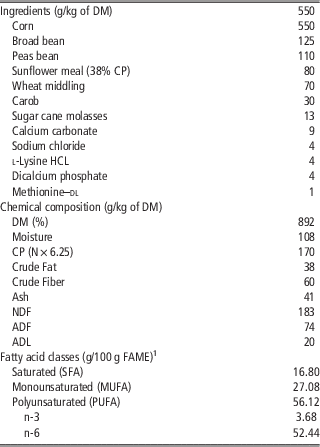
The animals were fed apelleted complete feed, rationed on the basis of 3% of the live weight supplemented either with 1 g/kg of a rosemary extract (ROX P® – Sevecom S.p.A.) (ROX group) or not (CTR group). ROXP® supplement (SEVECOM SpA., Italy; www.sevecom.it), a natural extract of R. officinalis L., is a hydrophobic powder, which is resistant to heating up to 110°C, with guaranteed minimum totals of 75 g/kg of antioxidants and of 16.5 g/kg of CA. ROXP® was integrated in the pelleted complete feed before the pelleting procedure, which was carried out at 70°C. The proportion of ingredients in the pelleted complete feed is reported in Table 1.
Ingredients and composition of the pelleted complete feed

DM=dry matter; FAME=fatty acid methyl esters.
Pelleted complete feed provided the following per kg: vitamin A (15 000 IU), vitamin D3 (2000 IU), alpha-tocopherol (40 mg), vitamin B1 (2 mg), vitamin B2 (5 mg), vitamin B6 (2 mg), vitamin B12 (0.02 mg), folic acid (1.75 mg), Zn (250 mg), Fe (300 mg), Mn (90 mg) and Cu (25 mg). Data were provided by the feed manufacturing industry: Mangimi Leone S.P.A., Italy.
1 The concentration of fatty acid classes was expressed as g/100 g, considering 100 g the sum of the areas of all FAME identified.
Pigs had free access to water. The trial lasted 90 days, coinciding with the growing–fattening period, preceded by a 15-day adaptation period to the experimental diet. The animals were slaughtered in an authorized commercial EU-licensed abattoir following the recommendations of European Union concerning animal care (Commission Regulation (EC) No 882/2004 of the European Parliament and Council). Every 35 days, individual BW of pigs was measured using an electronic balance. Feed intake of each pen was calculated for the entire experimental period by measuring the difference between the amount of feed administered and that remained in the trough. Based on the BW and daily feed intake, the average daily gain (ADG) and the feed conversion ratio (FCR=feed to gain ratio) of each piglet were calculated.
Collection and analysis of feed
Samples of the pelleted complete feed, obtained from the same batch for the whole trial, were collected for dry matter determination by oven-drying at 105°C for 24 h; for chemical analysis using the official methods of analysis (Association of Official Analytical Chemists (AOAC), 2007); and for the fatty acid profile determination using GC-FID (Table 1). In order to quantify the principal phenolic compounds, feed samples of the pelleted complete feed integrated with ROXP® were collected, once a month, from Day 0 to Day 90 of the trial for a total of four samplings. Quantification of the principal phenolic antioxidants of the samples of the pelleted complete feed integrated with ROXP® was carried out by HPLC. Fifty grams of integrated CPF (Pelletted Complete Feed) was ground in a vertical hammer mill (Cyclotec 1093 Sample Mill) at 0.8 mesh; 50 mg of the ground sample was extracted with 25 ml of methanol: water (2 : 1, v/v) in an ultrasonic bath, avoiding over-heating. Each sample was centrifuged, filtered and analyzed by HPLC-RP. The system was controlled with HPLC EZ START 7.3 software. From the absorption spectra of sample solutions, absorbance at 230 nm was used. The column used was an Adsorbosphere HS C18-RP, 250×4.6 mm ID, 5 μm particle size (Alltech Italia Srl., Sedriano, Italy). For elution of the four compounds (Ros, rosmarinic acid (RA), CAR and CA), a binary acidified gradient was used consisting of solvents A (MeCN-H2O-H3PO4; 65.1%:34.9%:0.02%) and B (MeCN-H2O-H3PO4; 22%:78%:0.25%). The retention times were as follows: for Ros=1.5 min, for RA=3.9 min, for CAR=7.4 min and for CA=10.4 min. Quantification of phenolic antioxidants was carried out by an external standard method. Each phenolic compound was expressed as mg/kg of concentrate, and results show the mean value of the five individual samples of CPF integrated with ROXP®.
Measurement of pH, color and lipid oxidation of the meat samples
The pH1 and pHu values of m. longissimus lumborum were determined 45 min and 24 h postmortem, respectively, using a WTW 330/SET 1 (Weilheim, Germany) pH-meter, equipped with a Hamilton Double-pore glass piercing electrode and an automatic temperature compensator. At 24 h postmortem, after refrigerated storage at 4°C, samples of m. longissimus lumborum (L2-L5) were taken from the left half-carcass of each animal, were packaged in polystyrene trays covered with an oxygen permeable polyethylene film and were stored at 4°C. The color was measured on a 2.5-cm-thick slice of meat using the Commission Internationale de l'Eclairage/ International Commission on Illumination (1978) system color profile for lightness (L*), redness (a*) and yellowness (b*) using a desktop photometer (Spectral scanner, DV Tecnologie d’Avanguardia, Padova, Italy) calibrated against a standard white tile using illuminant source D65. Before color evaluation, each sample was allowed to oxygenate at 4°C for 45 min covered with an oxygen permeable polyethylene film. After removing the polyethylene film, meat color was determined by taking one reading for the whole slice of each sample. The parameters referred to chroma (C*) and hue (H*) in raw pig m. longissimus lumborum were calculated according to the following formulas:
 $$\eqalignno{ {\rm Chroma}&=\left( {{\rm a}^{{\rm 2}} {\plus}{\rm b}^{{\rm 2}} } \right)^{{{\rm 1}/{\rm 2}}} \cr {\rm Hue}&={\rm tan}^{{{\minus}{\rm 1}}} \left( {{\rm b}/{\rm a}} \right).$$
The thiobarbituric acid-reactive substances (TBARS) assay was performed as described by Luciano et al. (Reference Luciano, Vasta, Monahan, López-Andrés, Biondi, Lanza and Priolo2001). In brief, a 2.5 g portion of m. longissimus lumborum was finely minced using a knife and homogenized with 12.5 ml of distilled water. Trichloroacetic acid (12.5 ml; 10%, w/v) was added to precipitate proteins. Samples were filtrated and 4 ml of the filtrate was mixed with 1 ml of 0.06 M aqueous thiobarbituric acid. Samples were incubated in a water bath at 80°C for 90 min and the absorbance at 532 nm was measured. The assay was calibrated using standard solutions of 1,1,3,3,-tetra-ethoxypropane in trichloroacetic acid (5% w/v). Results were expressed as mg of malondialdehyde (MDA)/kg of muscle. Three replicates (n=3) were run per sample. Color and TBARS were determined at 1, 3 and 5 days after storage at 4°C.
Lipid content and fatty acid composition of the meat
Lipid content in each sample was determined according to AOAC (2007). For the analysis of the acidic composition of intramuscular fats, in the individual lyophilized samples of m. longissimus lumborum, lipids were extracted using a mixture of chloroform/methanol (2 : 1, v/v), and fatty acids methyl esters of the intramuscular fat were prepared by direct transesterification with sulfuric acid/methanol (1 : 9, v/v) of a weighed portion (15 mg) of the total lipids and analyzed using the high resolution gas chromatography technique. The fatty acid methyl esters (FAME) of the m. longissimus lumborum were analyzed by GC-FID (Agilent Technologies 6890 N, Palo Alto, CA, USA) with a split/splitless injector, a flame ionization detector and fused silica capillary column Omegawax 250, 30 m×0.25 mm I.D., 0.25 μm film thickness (Supelco, Bellefonte, PA, USA). The column temperature was programmed: initial isotherm of 160°C (6 min), increment of 3°C/min and a final isotherm of 250°C (30 min). Temperature of the injector and detector was 250°C. Injection volume was 1.0 μl. The carrier gas used was helium (1 ml/min), and the split ratio was 1 : 50. Fatty acids were identified by comparing the relative retention times of FAME peaks from samples with standards from Supelco. Chromatogram peak areas were acquired and calculated using Chemstation software (Agilent). Concentration of each fatty acid was expressed as g/100 g, considering 100 g as the summation of the areas of all FAME identified. For each sample, the chromatographic analysis was repeated three times. On the basis of the identified fatty acids, the atherogenic index and the thrombogenic index were estimated using the equations proposed by Ulbricht and Southgate (Reference Ulbricht and Southgate1991).
Statistical analysis
For performance parameters, pen means served as the experimental unit for statistical analysis. Data were analyzed by ANOVA with the GLM procedure (v. 8.2, SAS Institute Inc., Cary, NC, USA; SAS/STAT, 2001), using treatment as the classification factor with the following model:
 $$Y_{{ijkl}} =\mu {\plus}{\rm D}_{i} {\plus}{\rm P}_{j} {\plus}{\rm A}_{k} \left( i \right){\plus}{\varepsilon}_{{ijkl}} $$
where Y ijkl are observations, μ the overall mean, D i the fixed effect of diet i (i=2), P j the fixed effect of period j (j=5 for BW; j=4 for ADG and FCR), A k (i) is the random effect of animal k (k=32) nested within diet i and ε ijkl is the random residual.
Data of lipid (TBARS) and color stability parameters were analyzed using a mixed model (Proc. MIXED of SAS, Version 8.2, 2001), which included the effects of diet (CTR, ROX), time of storage (Time; days 1, 3 and 5) and their interaction as fixed factors and individual pig as a random effect. Data of the lipid content, pH values (pH1 and pHu) and fatty acid profiles were analyzed using a mixed model (Proc. MIXED of SAS, Version 8.2, 2001), which included the effect of the diet (CTR, ROX) as fixed factor and individual pig as a random effect. The effect of sex was initially included in the model but it was not significant (P=0.50–0.90); thus, it was ultimately excluded. Least square means and root mean square error were calculated. Comparisons between LS means were performed using the Tukey test. Differences were considered significant at P<0.05.
Results and discussion
Principal phenolic antioxidants of the ROXP® integrated in the complete pelleted feed
Several factors linked to plants, such as season and cultivation conditions, or to storage and extraction methods (i.e. ratio of water and ethanol in the solvent), can affect the composition and the biological activity of phenolic antioxidants present in the rosemary extract (Puangsombat and Smith, Reference Puangsombat and Smith2010). This is due to the differential potentials of antioxidant compounds with different polarity (Okoh et al., Reference Okoh, Sadimenko and Afolayan2010). Ros, RA, CAR and CA were identified and quantified in the complete pelleted feed integrated with rosemary extract after pelleting, because these phenolics are the major antioxidants present in rosemary. The sum of the identified phenolic compounds was 209±5.0 mg/kg of concentrate integrated with ROXP®. In the rosemary extract, the phenolic compound with the highest content was RA (100±3.0 mg/kg), followed by CAR (73±2.5 mg/kg), CA (39±1.0 mg/kg) and Ros (23±0.8 mg/kg), a highly oxidized diterpene often present in small concentrations in rosemary extract, but with a high antioxidant activity (Thorsen and Hildebrandt, Reference Thorsen and Hildebrandt2003). The contents of examined phenolic compounds of the four samples of concentrate integrated with ROXP® were unaffected by the storage time (90 days).
In vitam performance traits
The introduction of a new product (rosemary extract) to animal diet implies control of the growth performances of animals; thus, the in vitam performance traits of both the groups were measured during the trial. Final BW (ROX: 73.73 kg v. CTR: 69.48 kg; P=0.106), average daily gain (ROX: 444 g/head per day v. CTR: 410 g/head per day; P=0.285), daily feed intake (ROX: 1.582 kg per day v. CTR: 1.642 kg per day; P=0.331) and feed conversion rate (ROX: 4.06 kg/kg v. CTR: 4.36 kg/kg; P=0.417) showed similar values in both the groups (data not shown). Mean values of water intake showed no significant differences between the two groups (ROX: 3.58 l per day v. CTR: 3.70 l per day; P=0.524).
The inclusion of rosemary had no beneficial effects on growth performances, according to the observations of Cullen et al. (Reference Cullen, Monahan, Callan and O’Doherty2005). No previous research has been found in the literature regarding the effects of rosemary on nutrient digestibility. Nevertheless, although the inclusion of rosemary extract had no beneficial effects on growth performance, several studies have shown its effects on fatty acid composition and lipid oxidation.
Lipid oxidation and color stability
The lipid content of the m. longissimus lumborum was unaffected by the dietary treatment (ROX: 3.00 g/100 g v. CTR: 3.12 g/100 g; P=0.629), as well as pH1 (ROX 6.28 v. CTR 6.19; P=0.666) and pHu (ROX 5.53 v. CTR 5.55; P=0.842) (data not shown).
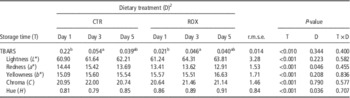
Table 2 reports the effect of the dietary treatment and storage time on lipid oxidation and color stability in meat stored over 5 days at 4°C. Lipid oxidation, expressed as TBARS (mg malondialdehyde/kg meat), was significantly affected by the time of storage (P<0.010); in particular, TBARS significantly (P<0.05) increased for all treatments at the beginning of the storage (Day 1 to Day 3) and then began to decrease (Day 3 to Day 5). According to Melton (Reference Melton1983), although malonaldehyde is a secondary product of lipid oxidation, it does not necessarily mean that the TBARS value continues to increase throughout storage. The low TBARS values could be the results of malonaldehyde reactions with proteins (Nassu et al., Reference Nassu, Goncalves, Pereira da Silva and Beserra2003). Specifically, TBARS value fluctuation during the storage period could be due to the production of hydrogen peroxide, during the oxidation of oxymyoglobin to metmyoglobin, the presence of which determines the instability of malondialdehyde (Kostka and Kwan, Reference Kostka and Kwan1989). Nevertheless, neither the diet (P=0.344) nor the dietary treatment×storage time interaction (P=0.400) affected lipid oxidation, measured in meat across 5 days of refrigerated storage in darkness, indicating a lack of effect of the rosemary extract used on the observed trend of development in lipid oxidation. Results are in accordance with Aouadi et al. (Reference Aouadi, Luciano, Vasta, Nasri, Brogna, Abidi, Priolo and Salem2014) in lambs receiving oral administration of R. officinalis essential oil and with Nieto et al. (Reference Nieto, Diaz, Bañón and Garrido2010) in ewes fed a diet supplemented with distilled rosemary leaf. This could be due to the concentration of the extract added, which was not sufficient to improve the shelf life of the meat. Probably, a significant loss of phenolic compounds occurred as lipid oxidation progressed, a finding of which may be understood on the basis of antioxidative activity and concomitant degradation of the phenolic compounds due to the development of free radicals in the primary stage of oxidation (radical trapping stage) during the chain-breaking antioxidant process (Masuda et al., Reference Masuda, Inaba and Takeda2001).
Effect of rosemary extract supplementation and storage time on the lipid oxidation (TBARS)Footnote 1 and color stability in porcine m. longissimus lumborum stored over 5 days at 4°C

a,bValues within a row with different superscripts significantly differ at P<0.05.
1 TBARS was expressed as mg of malonaldehyde/kg of muscle.
2 Dietary treatments: CTR, basal pelleted complete feed; ROX, basal pelleted complete feed supplemented with 1 g/kg of a rosemary extract (ROX P® – Sevecom S.p.A.).
Although many factors can influence the stability of meat color, the oxidation of myoglobin by free radicals or by lipid peroxidation products is predominant. The stability of meat color over time is determined by the extent of myoglobin oxidation and the accumulation of metmyoglobin, causing the loss of the appealing color of fresh meat, which can be instrumentally monitored by measuring the color descriptors (Mancini and Hunt, Reference Mancini and Hunt2005). In particular, the decrease in redness (a* values) and the increase in hue values (H*) appear to be suitable descriptors of meat color deterioration occurring over time; these descriptors impart a less-intense red color and a worse appearance of the meat (Nieto et al., Reference Nieto, Diaz, Bañón and Garrido2010). The variation of these descriptors and of hue values in particular have been proved to be highly associated with the accumulation of metmyoglobin on meat surface (Luciano et al., Reference Luciano, Moloney, Priolo, Röhrle, Vasta, Biondi, López-Andrés, Grasso and Monahan2011), as a consequence of the increased oxidation of oxymyoglobin to metmyoglobin (Chan et al., Reference Chan, Faustman and Decker1997). The meat samples of the two dietary treatments (Table 2) showed that redness decreased (P=0.046) and hue values increased (P=0.036). Moreover, in all the samples, lightness (Table 2) increased with storage time (P<0.001). It has been reported than an increase in lightness value may be related to an increase in metmyoglobin formation (Nieto et al., Reference Nieto, Diaz, Bañón and Garrido2010). Therefore, in the present study, it could be hypothesized that the high extent at which lipid oxidation developed with storage time might have contributed to promote color deterioration and that the dietary rosemary extract did not exert effects on color stability, as also observed by Aouadi et al. (Reference Aouadi, Luciano, Vasta, Nasri, Brogna, Abidi, Priolo and Salem2014). All the color descriptors showed similar values for meat in relation to dietary treatment×storage time interaction.
The level of bioavailability of phenolic compounds typically found in R. officinalis extracts is still controversial, and it has been reported that some compounds typically found in rosemary extract are bioavailable in animals, including humans. The bioavailability seems to be due to the transfer of phenolic compounds from feed to animal (Faixovà and Faix, Reference Faixovà and Faix2008). An in vitro fermentation study indicated that rosemary compounds were not fermented in simulated rumen conditions indicating their ‘potential availability’ for absorption in the bovine intestine (O’Grady et al., Reference O’Grady, Maher, Troy, Moloney and Kerry2006). The oral administration of CA from R. officinalis in a single dose to rats showed the absorption of the phenolic compound into the bloodstream and the recovery in feces, which represent its main elimination route (Doolaege et al., Reference Doolaege, Raes, De Vos, Verhé and De Smet2011).
Several evidences suggest that lipid and color stability in meat are linked (Aouadi et al., Reference Aouadi, Luciano, Vasta, Nasri, Brogna, Abidi, Priolo and Salem2014), and although the exact mechanisms of such connection are not yet fully understood, it has been reported that strategies able to reduce the extent of lipid oxidation often reduce myoglobin oxidation with a consequent improvement in meat color stability (Faustman et al., Reference Faustman, Sun, Mancini and Suman2010). In the present study, the rosemary extract was not effective in protecting meat from oxidative deterioration, but, at the same time, the dietary rosemary extract increased the concentration of oxidizable fatty acids in muscle. In fact, as reported by Gray et al. (Reference Gray, Gooma and Buckley1996), although many factors can influence the stability of meat color, the oxidation of myoglobin by free radicals or by lipid peroxidation products is predominant. Moreover, Mourot (Reference Mourot2009) reports that the susceptibility of meat to oxidation depends on factors such as muscle fatty acid composition; specifically, the susceptibility to oxidation increases with increasing unsaturation. From this point of view, it can be concluded that the incorporation of rosemary extract at 1 g/kg of pig diet was not sufficient to improve the meat antioxidant status.
Fatty acid profile
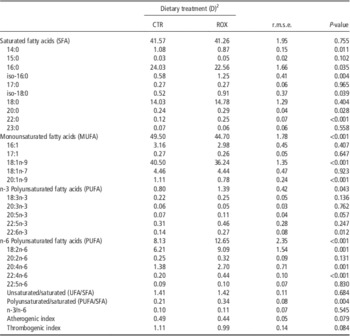
Dietary administration of rosemary extract influenced the fatty acid composition of meat. The most significant differences among the fatty acids of nutritional interest of the m. longissimus lumborum were observed for the 16 : 0 (P<0.05) among the saturated fatty acids, for the 18:1n-9 (P<0.001) among the monounsaturated fatty acids and for the 18:2n-6 (P=0.001), 20:4n-6 (P=0.001) and 22:6n-3 (P=0.012) among the PUFAs (Table 3).
Effect of rosemary extract supplementation on the fatty acid profile (g/100 g FAME)Footnote 1 , ratios and quality indexes of intramuscular fat in porcine m. longissimus lumborum

1 The concentration of fatty acid classes was expressed as g/100 g, considering 100 g the sum of the areas of all fatty acid methyl esters (FAME) identified.
2 CTR, basal pelleted complete feed; ROX, basal pelleted complete feed supplemented with 1 g/kg of a rosemary extract (ROX® – Sevecom S.p.A.).
With regard to the fatty acid classes, ratios and quality indexes of intramuscular fat of the m. longissimus lumborum (Table 3), the most significant differences were observed for the total PUFAs (P=0.001), for the PUFAs of the n-6 (P<0.001) and n-3 series (P<0.05) and for the PUFA/SFA ratio (P=0.004). The atherogenic and thrombogenic indexes, which characterize the atherogenic and thrombogenic potential of a vegetable or animal food (Fehily et al., Reference Fehily, Pickering, Yarnell and Elwood1994), showed no significant differences between the two groups (IA: P=0.079; IT: P=0.084), although slightly lower values were observed for the quality indexes in the ROX group than in the CTR group.
The significant increase in the content of the PUFAs in the meat of the ROX group could be due to powerful antioxidant activity of phenolic compounds against the oxidative deterioration of these food components. A primary mechanism for a phenolic antioxidant includes the trapping and stabilizing of species generated from the radical chain oxidation of food components. Although the first stage (radical trapping stage) is a reversible process, the second stage (radical termination stage) is irreversible and must produce stable radical termination compounds (Masuda et al., Reference Masuda, Inaba and Takeda2001), thus terminating the chain reaction and preserving PUFAs by the synthesis of hydroperoxides (Chen et al., Reference Chen, Shi and Ho1992). Another explanation could be that the rosemary extract increases the activity of the delta-5 desaturase (Δ5d) and delta-6 desaturase (Δ6d), which are the enzymes involved in the synthesis of 20:5n-3 and 22:6n-3 derived from the 18:3n-3 (Mourot, Reference Mourot2009). This could explain the fact that dietary rosemary extract by increasing the concentration of oxidizable fatty acids in muscle partially cancelled its antioxidant capacity on the muscle and it did not have any impact on the shelf-life of the meat, as also observed by Aouadi et al. (Reference Aouadi, Luciano, Vasta, Nasri, Brogna, Abidi, Priolo and Salem2014). Li and Liu (Reference Li and Liu2012) point out that there are many examples where color and lipid stability appear to be linked and, in particular, the lipid oxidation is a catalyst for the discoloration.
From a nutritional point of view, the preservation of the PUFAs by the peroxidation means an improvement in the nutritional quality of the meat. In fact, the beneficial effects of the longer chain n-3, eicosapentaenoic acid (20:5n-3) and docosahexaenoic acid (22:6n-3) in reducing the risk for cardiovascular disease, cancer and type-2 diabetes, as well as their critical roles for proper brain function, visual development in the fetus and for maintenance of neural and visual tissues throughout life, are well-recognized (Barceló-Coblijn and Murphy, Reference Barceló-Coblijn and Murphy2009). A recent meta-analysis of epidemiological studies has casted doubt on the relationship between saturated fatty acids and cardiovascular diseases (Siri-Tarino et al., Reference Siri-Tarino, Sun, Hu and Krauss2010). It is not completely clear which should be the optimal n-3/n-6 value for the human nutrition; a strong imbalance toward high dietary intakes of n-6 PUFA at the expenses of n-3 is positively correlated with a number of widespread human diseases. The studies on the relationship between n-3/n-6 ratio and the pathogenesis of many diseases indicate that the optimal ratio may vary with the disease or the condition under consideration; this is consistent with the fact that many diseases are multigenic and multifactorial. In general, a higher ratio of n-3/n-6 is more desirable in reducing the risk for several chronic diseases; several international organizations have recommended a dietary n-3/n-6 ratio between 1:4 and 1:10 (McDaniel et al., Reference McDaniel, Ickes and Holloman2013). In our study the n-3/n-6 ratio was within this range.
Conclusions
The dietary supplementation with R. officinalis L. for 90 days in Nero Siciliano pigs induced an improvement in meat fatty acid profile; in particular, the content of polyunsaturated fatty acids of the n-3 and n-6 series in the m. longissimus lumborum was increased. On the other hand, rosemary extract dietary supplementation was not effective in improving the shelf-life of the meat; in fact, lipid oxidation and color deterioration in meat progressed over storage duration. In this direction, it could be of interest to further examine the effect of dietary rosemary extracts on meat oxidative stability using different storage and display conditions of meat, such as modified atmosphere packaging. In conclusion, considering the nutritional value of meat as an important contributor to the overall quality, the results obtained in this study support the possibility of the dietary supplementation with R. officinalis L. extract in pigs as a valid strategy to ensure quality of the production.
Acknowledgments
Authors are grateful to the Feed Industry SEVECOM SpA, Milan, Italy.
The authors thank the Consorzio di Ricerca Filiera Carni of Messina, Italy, for providing financial support for the SAS license.
Conflicts of Interest
The authors do not have any conflict of interest to declare.