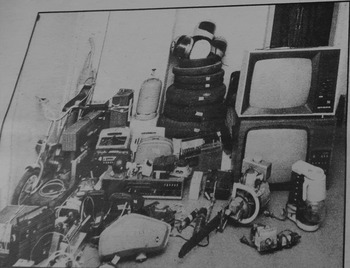
In 1984, the most popular weekly magazine in the German Democratic Republic (GDR), the Neue Berliner Illustrierte (NBI), reported across four pages the case of Gerhard W. from Görlitz. According to this article, Gerhard, a metal worker in his mid-forties, confessed to various crimes that he had committed before his arrest that year by the Volkspolizei (People's Police). He had apparently only admitted at first to breaking into a garage and stealing gas for his stolen car. Yet, when officers searched his house, they found more of the spoils of his career as a criminal: six television sets, eight cassette recorders, four coffee machines, a dozen electric power drills, as well as skis, tents, garden chairs, egg cups, refrigerators, glasses, tires, motorcycle helmets, car parts from at least thirty cars, a chainsaw, parasols, books, games, and a cuddly toy. There were even several stolen sheep in the cattle shed outside. In all, Gerhard W. admitted to having burgled fifty garages, fifteen bungalows, and nine farms, taking approximately eight hundred items (fig. 1).Footnote 1 Although similar instances of Alltagskriminalität (everyday criminality) rarely occurred on a scale comparable to this one-man crime wave, the undoctored crime statistics of the ruling Socialist Unity Party (SED) show that crimes such as burglary, theft, robbery, assault, arson, rape, and murder did take place in the GDR.Footnote 2
A small part of Gerhard W.’s haul of stolen goods. Source: “Vernehmung,” Neue Berliner Illustrierte, 26/1984.

Just as striking as the extent of Gerhard W.’s criminal adventures is the fact that the NBI reported them at all to East German citizens, for acknowledging that crime existed in the GDR directly challenged the SED's claim to have created a society of “really existing socialism.” Marxist-Leninist doctrine places the exploitation of workers by the capitalist elite at the root of all crime.Footnote 3 Crime and criminality were thus “alien” (wesensfremd) to the very essence of prevailing societal conditions in socialist and communist societies and ought to have disappeared as phenomena as soon as socialism was established.Footnote 4 Yet, even though the SED regime certainly massaged statistics for propaganda purposes in order to demonstrate its effective political leadership, it did not deny that everyday criminality existed and persisted in the GDR.Footnote 5 The party's annually published official statistics revealed to citizens that over one hundred thousand instances of everyday criminality occurred in each year of the state's existence from 1949 to 1989.Footnote 6 Moreover, a range of other official sources consistently communicated to citizens that crime was indeed occurring. In fact, the regime regarded Öffentlichkeitsarbeit (public relations work) concerning criminality as an “essential component part of its prevention.”Footnote 7 Consequently, reports of crimes appeared in the regional and national press, and criminal cases were dramatized in hugely popular television detective shows such as Polizeiruf 110 and Der Staatsanwalt hat das Wort, numerous feature films, and novels.Footnote 8
This article examines how the SED communicated and explained the existence and persistence of everyday criminality to its citizens. It analyzes the regime's account of everyday criminality as it appeared in reports and commentaries in the pages of the NBI. First published in 1945, the NBI quickly became the most popular weekly magazine in the GDR, with sales figures showing that vast numbers of citizens accessed the magazine.Footnote 9 Throughout the 1960s, the NBI had a weekly circulation of up to eight hundred thousand copies.Footnote 10 It remained well above seven hundred thousand in the 1970s, and, in the 1980s, each edition of the magazine sold just shy of eight hundred thousand copies.Footnote 11 Although reports of crime did appear in other press publications, such as the ruling party's official newspaper, Neues Deutschland, many citizens balked at the overtly political and often dense nature of these periodicals. In stark contrast, the NBI appeared to citizens as anything but a dry conduit for propaganda. That is not to say that the magazine was apolitical: political pieces featured in its pages, and many articles did contain some sort of underlying political message. Yet, the magazine's structure, format, and mix of political articles with human-interest stories, sports reports, music features, colorful photographs, and self-help guides meant that it appealed to a broad range of citizens from a wide range of socioeconomic and political backgrounds.Footnote 12 Citizens were far more likely to access the NBI than the dry academic books on criminology available to them.Footnote 13
This article considers pieces published in the NBI from August 1961, when the Berlin Wall was constructed, until the regime's demise in 1989. During this period in which the German–German border and the border between East and West Berlin were sealed, it was more difficult for the SED to argue convincingly—and citizens were less likely to believe—that West German criminals were to blame for incidents of crime in the GDR, as the regime had often claimed before 1961. The research for this article is based on an examination of every edition of the NBI published in this period, which led to the discovery of approximately 230 articles or commentaries about or referring to everyday crime. Sources housed in the Federal Archive in Berlin relating to public relations work by the Volkspolizei and the East German Ministry of the Interior were examined as well in order to get at regime policy toward crime reporting in the media, including evidence of possible censorship of NBI articles.
As this article shows, the SED regime did direct the media to shape citizens’ perceptions of crime in an attempt to convince them that they were safe from various forms of criminality. To that end, the NBI communicated to readers that crime rates were relatively low and persistently decreasing. The magazine and the state officials who were quoted in its pages emphasized to readers that no serious crime occurred in the GDR. Reports focused instead on instances of theft, thus underreporting or simply not mentioning other crimes such as murder or rape—which did occur in not insignificant numbers, according to available official statistics. By contrast, the NBI portrayed the West as an inherently lawless society riddled from top to bottom with serious and violent crime. The SED regime thus instrumentalized the phenomenon of crime in an attempt to create a psychological “demarcation” (Abgrenzung) on the part of its citizens vis-à-vis the West. The magazine accordingly cast the Berlin Wall as a crime prevention measure that kept out Western criminals, but nevertheless still provided citizens with reports of real-life instances of crime and thus a fuller picture of criminality in the GDR than they could have gleaned from more theoretical works by East German criminologists.
This article is not merely about which crimes the SED regime did or did not report to citizens, however. At its core lies the issue of how the party attempted to construct legitimacy in the minds of its citizens in order to win their consent and support. Realizing that citizens were not as enthusiastic about socialism as they desired, authorities sought other sources of legitimacy.Footnote 14 These included the state's antifascist founding myth and self-definition, as well as its efforts to construct a distinct notion of GDR Heimat and nationhood.Footnote 15 The SED's approach to the phenomenon of criminality belongs to these and similar efforts aimed at convincing ordinary East Germans that the socialist society it had constructed was superior to its capitalist counterpart in the West. Crime was not a constitutive part of socialist society. Rather, it was an alien phenomenon growing like a weed on the fringes of the socialist garden and, like any other weed, its roots could be located and permanently killed off. Criminality was thus presented as a curable condition, and the only cure for its causes was socialism. What this meant was that the only way that citizens could ensure that they and their property remained safe and secure from criminality was to adopt, support, and live according to the tenets of the socialist project and society that the SED was in the process of constructing.
Organizer, Propagandist, Educator
Media reporting of crime in the GDR was consistent with the dominant ideological model put forward by critical criminologists. According to this model, the media's portrayal of crime and law-and-order seeks to shape citizens’ perceptions of criminality in favor of and win consent for the state and its policies, while also denigrating persons or groups designated as threats to state power. The media's treatment of crime thus plays a key propagandistic role in confirming, consolidating, and gaining acceptance of the dominant ideology of a regime or government.Footnote 16
Following Leninist doctrine, the SED regime directed the printed press to be a partisan “organizer, propagandist, and educator” of the masses, which meant that it served as the mouthpiece of the party.Footnote 17 More specifically, the Ministry of the Interior directed media reporting about crime in the GDR, and its officials responsible for public relations drew up annual programs of subjects to be covered, followed by corresponding directives and other information.Footnote 18 As this orchestration by the Ministry of the Interior suggests, state control of the printed press was comprehensive, which meant that editors and journalists did not enjoy free reign over their publications.Footnote 19 From the founding of the state in 1949 (and even after the advent of television in the 1950s), the party directed the print media more generally through the Presseamt (Press Office), which was attached to the Ministerrat (Council of Ministers), a body that effectively rubberstamped decisions made by the SED leadership.Footnote 20 The press office's Abteilung Lektorat/Lizenzen (Editing/Licensing Department) made decisions about whether to grant publication permission to the print media, and this department monitored its output to ensure that it kept in line with party decrees.Footnote 21 Publications were essentially required to print content that would “fulfill the current requirements of socialist society.”Footnote 22 According to a 1983 statement by Erich Honecker, the General Secretary of the SED from 1971 to 1989, this meant informing citizens continually about the achievements of the GDR in areas such as socialist democracy, social policy, education, culture, youth policy, and other key aspects of everyday life. Honecker directed the press to report on “model citizens” in order to encourage others to follow their example. Wherever possible, he emphasized, this was to be presented in stark contrast to the dismantling of the welfare state (Sozialabbau) in West Germany.Footnote 23
No press censorship officially existed in the GDR, but the party clearly implemented processes aimed at ensuring that articles that appeared in the print media toed the line. The Abteilung Agitation (Agitation Department) of the Central Committee of the SED was also responsible for steering the press, and editors-in-chief were required to provide it with quarterly publication plans for approval.Footnote 24 These plans, which a party secretary would help editorial teams draw up, were to include detailed reports on the subjects that editors planned to cover.Footnote 25 Once they received these plans, officials at the Abteilung Agitation would then stipulate any changes that needed to be made.Footnote 26 Regime officials also regularly convened meetings with media representatives in order to give them direction and guidance. For example, Attorney General Josef Streit met with representatives of news publications (including the NBI) in 1971 to discuss how they should deal with the subject of criminality. Streit ordered them to focus on “mobilizing the public's sense of impatience and intolerance toward any type of criminal offense. ‘Looking the other way’ makes criminals’ work easier. Public opinion must be strengthened with regard to the notion that socialist law is unbreakable.”Footnote 27 A year later, the Ministry of the Interior reported that the police had apprehended more criminals in places where regional heads of the Volkspolizei had met with press representatives to direct article content because, it claimed, citizens had been better informed about—and “encouraged to show impatience” toward—crime.Footnote 28
Once approved, publications could be sent to press, but always several days before they were scheduled to go on sale. This allowed for the delivery of copies of the final print version to the Abteilung Agitation for last-minute approval, thus leaving time, if necessary, for changes to be made.Footnote 29 In special cases, articles were sometimes forwarded to appropriate ministers or authorities for further scrutiny.Footnote 30 This occurred in the case of one NBI article in 1974, for example, after the magazine had sent a draft article to Lieutenant-Colonel Twarog, the head of the press and information section of the Ministry of the Interior. The article was about the reintroduction of young offenders into society. Seeking Twarog's support for publication, the NBI explained that the article dealt with the successful reintegration into society of a young man called Bernd K. from the Young Offenders Institute in Wriezen. He had not committed any further crimes after his release and was now working on a collective farm. The NBI hoped to convince Twarog that the article demonstrated the positive results of the GDR's judicial system.Footnote 31 The piece was then passed on to Colonel Tunnst, the administrative head of correctional facilities. Tunnst subsequently advised Twarog in writing that he had verbally communicated to the NBI that some corrections were necessary in terms of the piece's content. He did not provide any details, but did refer to several photographs accompanying the article that he wanted “retouched” (retuschiert). Tunnst called for the removal of visible stains on and damage to the inside walls of the institute in Wriezen. He also wanted a picture removed (or adapted) that showed a group of inmates with no guard present. Tunnst concluded by recommending that a state prosecutor also examine the article before it could be published.Footnote 32
The fact that this article was passed to Twarog, Tunnst, and then a state prosecutor—despite its apparently positive political tone—demonstrates the dense system of checks involved in the publication process. This made spontaneous publication decisions nearly impossible.Footnote 33 Deviations from the plan usually only occurred when a rebuttal to claims made by West German media or politicians was urgently required.Footnote 34 There was post-publication scrutiny as well, usually in the form of critical reports and meetings with the Presseamt. These ensured that the press continued to produce reports that were, from the regime's perspective, “effective, socially significant, and relevant.”Footnote 35 In addition, there were weekly meetings (Argumentations-Sitzungen) involving editors-in-chief and the head of the Agitation Department, where state officials commented on the week's publications and offered editors “guidance” for the coming weeks. This meant, in practice, the distribution of lists of the latest taboo subjects or expressions. Publishing houses also maintained in-house lists of politically sensitive subjects to avoid.Footnote 36
Taking an Axe to the Root of Crime
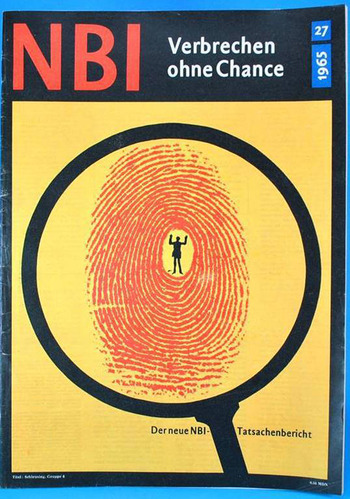
Friedrich Engels claimed that communists would “take an axe to the root of crime” and eliminate it completely as a phenomenon.Footnote 37 The belief that criminality would eventually die out after the establishment of “really existing” socialist societal conditions was, in fact, central to the SED regime's view of crime (fig. 2). Friedrich Dickel, the Minister of the Interior and head of the Volkspolizei, echoed in a 1985 interview with the NBI the decades-old conclusion of state criminologists that, although people were still committing criminal offenses in the GDR, “crime has no future.”Footnote 38 What did not remain static, however, was the regime's explanation of why crime persisted. According to class theory, which still dominated the state's interpretation of criminality in the 1950s, class difference was the main reason that people committed criminal offenses.Footnote 39 The concept of private property had supposedly created “unproductive, destructive conflict” among citizens, which manifested itself in multiple forms of “criminality, such as theft, assault, sex offenses, and murder.”Footnote 40 The construction of socialism in the 1950s would thus eliminate the main causes of crime and most crime itself by the end of the decade.Footnote 41 Once this proved not to be the case, the state and its criminologists sought other explanations.
“Crime has no chance,” according to the SED regime.

In 1965, the NBI recounted the police career of Major Alex W., a “worker turned criminal investigator” who had joined the Volkspolizei at its inception in 1945.Footnote 42 Major W. stated that “stamping out criminality altogether cannot be done quickly” because citizens needed to be educated to adopt a different mindset toward crime. He claimed that once citizens had learned to think and behave in new ways, crime would cease to exist, the Volkspolizei would become superfluous, and its files would be given to an archive.Footnote 43 This was an allusion to the “relict theory,” promoted by regime criminologists in the 1960s: at the core of this concept was the assertion that everyday criminality constituted a “birthmark” or “relict” of the old capitalist society.Footnote 44 Citizens were gripped by the “psychological heritage of the past,” which took the form of “specific conditions, relationships, views, and thought patterns” whose origin lay in “the material, psychological, and moral imperfections of the life that the old bourgeois society has bequeathed to us.”Footnote 45 Attorney General Streit stated in interviews with the NBI that the construction of a socialist society had removed the “socio-economic basis of crime,” but this did not mean that crime would instantly disappear: “old inherited perceptions and habits” would persist for a long period because “new socialist ways of behaving do not follow automatically from the new socio-economic basic structure of our society.”Footnote 46 The “relict theory” thus reframed criminality as a pedagogical rather than a societal problem: once citizens had been properly educated and developed a new “socialist personality,” they would realize that there was no reason to commit crime.Footnote 47
The “relict theory” never lost its prominent place as the central explanation for crime in the GDR, but there were only rare references to it in the NBI after 1968. This infrequent use of the term reflected contemporary adjustments that leading GDR criminologists such as John Lekschas and Erich Buchholz had made to the theory. These adjustments were made necessary because of the fact that crime persisted and, during some periods, even dramatically increased, despite regime claims that socialist societal relations had been stabilized, consolidated, and strengthened in the 1970s and 1980s.Footnote 48 State criminologists coined the term contradiction approach (Widerspruchsansatz) to describe the “contradictions” in GDR society that led citizens to commit criminal offenses.Footnote 49
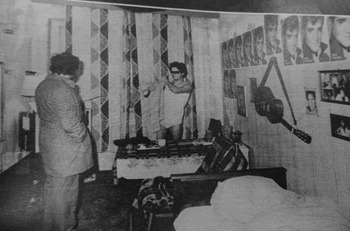
Readers of the NBI learned that internal influences or circumstances within GDR society had produced the vast majority of these contradictions, suggesting to readers that crime was actually homegrown. In fact, only three articles made an explicit link during this period between Western influence and crime. In 1972, the NBI questioned the upbringing of eight young men who were standing trial for assault, asking why it had never occurred to their parents to stop their sons from watching or listening to West German media.Footnote 50 A decade later in 1983, a photograph showed the apartment walls of a burglar, which were covered with Elvis Presley posters (fig. 3).Footnote 51 Six years later, Attorney General Günter Wendland stated in an interview that “a few young people—for example, so-called Skinheads—fall under the influence of Western examples and commit violence or other offenses.”Footnote 52 In the early 1970s, the public relations office of Attorney General Streit produced a booklet on criminality for the media which not only claimed that there was a link between “imperialist ideological diversion” and crime, but also directed journalists and editors to “create an offensive and clear image of the enemy [Feindbild]” in order to encourage “intolerant and partisan behavior toward capitalist ideologies and patterns of behavior.”Footnote 53 This concern about the potential influence of the West was not entirely disingenuous: officials were well aware that the majority of citizens accessed West German broadcast media, and that the SED's clumsy and unpopular attempts to stop this (including the tearing down in 1961 of television antennas pointing westward) had failed miserably.Footnote 54
Inside a criminal's apartment. Source: “Täter ermittelt,” Neue Berliner Illustrierte, 26/1983.

Articles about crime that appeared in the NBI suggested to readers other reasons as well for its persistence in the GDR, pointing, for example, to the “bad moral circumstances” in certain familial backgrounds that had led criminals to commit offenses. For example, in 1971 fifteen-year-old Bernd stole money in order to move away from home because his stepfather beat him.Footnote 55 A year later, commenting on a gang of eight young men standing trial for assault, the NBI accused the parents of neglecting their responsibilities and “hoping that somehow everything would turn out for the best.”Footnote 56 In 1980, the NBI similarly cited “difficulties” in the parental relationships of six young men charged with football hooliganism, assault, and theft.Footnote 57 Three years later, in a report about Andreas J.’s habit of robbing and destroying payphones, the magazine highlighted the fact that the culprit had not had a settled home life during his childhood: he had been constantly passed back and forth between his grandparents and his twice-married father.Footnote 58
This focus on familial background and the role that it supposedly played in criminal development was in line with later advances in GDR criminology, when practitioners began to focus more and more on the individual personality traits and development of criminal offenders.Footnote 59 Just as important, the link that these articles made between the poor quality of a citizen's family life and his or her later criminal development reflected state policy toward the family unit. The regime viewed the family as the smallest cell of the socialist collective, and the 1965 Law on the Unified Socialist Education System enshrined its “moral and educational” role in law. A good family unit was, above all, key to a citizen's development of a “socialist personality.”Footnote 60 It was for this reason that NBI articles often berated parents for not realizing that they were not just raising children but also socialist citizens.Footnote 61
In many of the criminal cases and commentaries it featured, the NBI made it clear that excessive inebriation had often led offenders to commit a crime. Alcohol consumption and rates of alcoholism were consistently high in the GDR: by the late 1980s, when it was estimated that one in every eight citizens was an alcoholic, the average East German was drinking some twenty-three bottles of spirits annually.Footnote 62 The SED had already recognized two decades earlier that growing alcohol consumption was linked to criminality.Footnote 63 In interviews with the NBI, Attorney General Streit and Minister of the Interior Dickel cited alcohol-related crime as a problem area in the fight against criminality.Footnote 64 The regime's plan to combat this was to communicate the consequences of such actions via the press.Footnote 65 The NBI consequently linked the excessive alcohol consumption of Joachim P. (“twenty half-liter bottles of beer per day”) to his career as a serial burglar.Footnote 66 Alcohol had also apparently played a role in the descent of Norbert S. into criminality, which culminated in the theft of antiques from a church.Footnote 67 Two men had, for their part, vandalized and ransacked their former school in 1985 while under the influence of alcohol.Footnote 68 The NBI also underscored the effect that excessive alcohol consumption by a family member could sometimes have on an offender. In 1984, for instance, readers learned that the father of fifteen-year-old offender Mike S. disrupted family life by often coming home drunk—which prompted Mike to leave school and become friends with Andreas O., who eventually led him astray: “The development of Mike S. once more makes clear the catastrophic effects on children when alcohol is king in the family.”Footnote 69 One mother not only drank but also regularly beat her daughter, which led the latter to skip school, loiter on the streets, and steal money.Footnote 70 In yet another case, because Ilona M. had received no support from her hard-drinking husband when released from prison for the fourth time, she subsequently committed an astonishing sixty-three burglaries in Dresden in the mid-1980s.Footnote 71
The 1968 article “Meister G. und unser Recht” (“Foreman G. and our law”), which recounted the experiences of a foreman who worked in a factory in the town of Riesa near Dresden, suggested that rapid industrialization and the expansion of urban areas had also led to criminality. Crime had apparently only decreased by 2 percent there, compared to the national average of 23 percent. The NBI explained this by making a direct link to the industrial expansion of the town and surrounding agricultural area, which had required an influx of new workers: the population of Riesa subsequently rose from 36,303 inhabitants in 1959 to 43,125 in 1966. This was “a process that must be taken into account when looking at criminality statistics.” The article suggested that the crime rate in Riesa was largely unchanged because many of the new workers were young men living away from home for the first time and in a “strange environment they cannot come to grips with.”Footnote 72 High levels of crime in newly industrialized or expanded areas were not just a problem in Riesa, of course. The East German economy could not keep pace with the SED's promise to erect new utopian towns filled with modern housing and other amenities; shortages of materials also made it difficult to renovate older dwellings adequately. With the disparity between reality and the SED's promises abundantly clear, levels of dissatisfaction and disgruntlement were particularly high in “new” industrial towns and cities such as Eisenhüttenstadt, Schwedt, and Halle, where crime rates soared above the national average.Footnote 73
A number of articles about instances of theft did not cite any particular political, social, or alcohol-related reason for the crime. Instead, they simply accused citizens of being careless with their property. Readers were thus warned that opportunists were likely to take advantage of open windows or unlocked cars.Footnote 74 Besides claiming with exasperation that no one seemed to lock their bicycles, the magazine noted the dismay of the Volkspolizei, whose job was made much harder as a result of such carelessness.Footnote 75 In order to demonstrate how easy it was to commit a crime, in 1973 a team of NBI journalists even stole pipes from a building site in broad daylight. Lamenting the fact that no “attentive citizen” had tried to stop them, the journalists rhetorically asked whether theft should be “this easy?”Footnote 76
The NBI continued to attribute some crimes to the causes outlined earlier, but the magazine focused more and more in the 1970s and 1980s on demonstrating to readers the “asociality” of criminal offenders. In 1973, in fact, Minister of the Interior and head of the Volkspolizei Friedrich Dickel specifically directed the NBI to concentrate on offenders’ asociality as the main cause of their criminal behavior.Footnote 77 This term had appeared in German law since the time of the Kaiserreich to denote criminal transgression.Footnote 78 The Nazis later employed it to justify their murderous extermination of “undesirable” people.Footnote 79 Given the use of this term during the Third Reich, it is interesting that the SED also chose to employ it to refer to people displaying “undesirable” behavior and/or personality traits, even if the consequences for those labeled “asocial” in the Third Reich and the GDR were starkly different.Footnote 80 The regime, which defined the fight against crime as “a fight against asocial manners of behavior,” applied the term asocial in the 1950s to alleged “class enemies” still living in the GDR, such as private business owners or farmers resisting the pressure to collectivize.Footnote 81 After the almost complete eradication of such groups by the early 1970s, those who earned income in “unseemly” or illegal ways were now the ones designated as asocial.Footnote 82 In 1981, state prosecutor Peter Przybylski linked asociality with citizens’ willingness to work, stating in an interview with the NBI that the road to asociality began with shirking (Arbeitsbummelei).Footnote 83 In the same year, an article concluded its account of a man stealing from churches with a rhetorical question: “Why spoil your life by not working?”Footnote 84 In another piece, the magazine described the thieves Frank S. and Frank P. as two lazy, “workshy” (arbeitsscheue) men who wanted to live “at the expense of others [auf Kosten anderer].”Footnote 85
In practice, the SED also categorized as asocial any citizen who was not, it deemed, living according to the rules, norms, and morals of socialist society.Footnote 86 According to a booklet about criminality in the GDR produced by the SED specifically to help journalists write their articles, the “development of asocial offenders is marked by alcohol abuse, disturbing the peace, leaving school or apprenticeships, frequently changing jobs, low education levels, primitive free-time pursuits.”Footnote 87 The SED was extremely suspicious of such citizens and believed that they were more difficult to observe and control.Footnote 88 In 1981, the NBI consequently portrayed as “asocial” the members of the crew of a pleasure cruiser who were overcharging their guests and pocketing the difference.Footnote 89 It bemoaned the fact that a woman had committed fraud and, in so doing, had rejected the “merits of socialism: respect, camaraderie, readiness to help others, and trust.”Footnote 90 In another article, a group of thieves who had been caught stealing and selling fruit were accused of “throwing overboard honesty and awareness of responsibility—those obvious requirements of our social coexistence.”Footnote 91
The party's categorization of criminals as “asocial” allowed it to explain the activities of criminal offenders who had been born, raised, and socialized in the GDR but nevertheless turned to crime.Footnote 92 This also allowed it to account for serious incidents of crime that are “difficult to understand for a citizen of our country”—such as the vandalism of a Jewish cemetery in the Prenzlauer Berg district of East Berlin in 1988. A group of youths had defaced and damaged 222 headstones with “fascist” slogans, while shouting antisemitic abuse, because they apparently believed, an article in the NBI explained, that this was what it meant “to be German.” Yet, the magazine did not address the apparent nationalist/racist motives behind this crime, focusing instead on what state psychologists claimed was the perpetrators’ “total lack of emotional bonds” and “lack of a sense of social responsibility and self-determination.” The NBI reported that it was these “deficiencies” that led them—as opposed to West German neo-Nazis—to commit this crime, not any kind of true belief in fascist ideology, nationalism, or antisemitism. The article stated that, under the influence of West German propaganda, they had used the “glorification of fascism” as a crutch for their asocial behavior, and concluded that the offenders had “placed themselves on the outskirts of a society in which religious and racial hatred constituted serious crimes.”Footnote 93 In another piece the NBI concluded that it was “unfortunately often the case that people do not act according to logic and make a conscious decision to commit a crime.”Footnote 94 The apparent rejection of socialism's norms and morals by such citizens was simply not “normal”: they were “aliens” in East German society in desperate need of “reeducation” (Umerziehung).Footnote 95 Once these citizens were identified, apprehended, and “reeducated,” their careers in crime—and crime itself—would come to an end.
“Mere Petty Offenses”
NBI articles on criminality informed the magazine's readers that crime was consistently decreasing in the GDR, and often supported this claim by referring to official statistics.Footnote 96 In 1978, Attorney General Streit proudly stated that crime had decreased from highs of approximately half a million annual offenses in the immediate postwar years to a current average of 120,000.Footnote 97 The regime clearly manipulated actual statistics. In fact, investigations carried out soon after German unification in 1990 suggest that the crime rate in the GDR had actually been three times higher than official figures suggested.Footnote 98 Attentive NBI readers might have concluded themselves that the statistics did not reveal the actual extent of crime. In an interview with the NBI in 1967, Minister of the Interior Dickel explicitly stated that the statistics did not include “petty offenses” (Ordnungswidrigkeiten) punishable by fines.Footnote 99 In 1968, the NBI ran a series of eight columns in which the state prosecutor Helmuth Rutsch explained to readers the regime's new penal code: many petty crimes (e.g., the theft of property worth below fifty marks) were to be decriminalized and categorized as Verfehlungen (misdemeanors). A pie chart (that did not include actual percentages) showed readers that 80–90 percent of all instances of criminal offenses in the GDR before 1968 had actually been Verfehlungen—or “mere petty offenses,” as Rutsch put it.Footnote 100 This was why, beginning in 1968, the regime did not include them in official crime statistics, which were thus kept artificially low.
Despite official claims about the supposedly low level of crime, NBI interviews with experts on criminality nevertheless suggested that the regime was, in fact, dissatisfied with the rate at which crime was decreasing. Attorney General Streit lamented in 1966, for instance, the “stagnation” in the GDR's crime rate since 1958. The following year, Minister of the Interior Dickel also alluded to crime rates that were stable but not decreasing. And in 1968, Streit informed readers, with reference to the crime rate, that “mastering criminality is, to be frank, a complicated and protracted process.”Footnote 101 The published official statistics did show that the annual reduction in crime rates was gradually slowing: whereas the average number of recorded offenses in the 1960s was approximately 15 percent lower than the average number recorded in the 1950s, the average number of recorded crimes in the 1970s was only 6 percent lower than the 1960s level, and the average number of recorded offenses in the 1980s was only 4.6 percent lower than the average of the previous decade. Published statistics even showed that, during some periods, recorded crimes increased from one year to the next. For example, 2,479 more offenses were recorded in 1979 than in the previous year (129,099 in 1979 and 126,620 in 1978). The number of recorded crimes increased again in 1980, but this time only by 171 offenses.Footnote 102 Later that decade, in July 1989, Attorney General Günter Wendland admitted in the NBI that crime had indeed recently increased, but qualified this by stating that the number of criminal offenses had decreased over the past ten years.Footnote 103 Despite such admissions, the regime was not prepared to publish statistics that revealed dramatic increases in crime. The increase in recorded criminal offenses was so high between 1971 and 1977—perhaps because of Honecker's crackdown on crime during the early years of his term in office, resulting in more crimes being detected and recorded—that no related statistics were published in the GDR between 1971 and 1977.Footnote 104
Besides using statistics to persuade readers that crime was not a serious problem in the GDR, the NBI also employed word choice to lessen the perceived severity of crime. The language the NBI used to describe most criminal offenses suggested to readers that no serious or violent crimes occurred in East Germany. It did not employ the word Verbrechen—a term meaning “crime” but with connotations of violence, abhorrence, and reprehensibility—to describe criminal offenses that took place in the GDR. Instead, it chose terms that were more neutral and thus downplayed their severity: Kriminalität (criminality), Straftaten (criminal offenses), Delikte (offenses), Ordnungswidrigkeiten (petty offenses), Vergehen (misdemeanors), Übertretungen (transgressions), and, as mentioned earlier, Verfehlungen (misdemeanors). Similarly, the NBI did not employ the term Verbrecher (a criminal who commits Verbrechen) to describe the perpetrators of crimes in the GDR; rather, these were Täter (perpetrators), Straffällige (offenders), Rechtsbrecher (lawbreakers), Verurteilte (sentenced individuals), Langfinger (pilferers), or unredliche Mitbürger (dishonest fellow citizens). Perpetrators were otherwise referred to according to the crime they had committed, such as Dieb (thief). The terms Verbrechen and Verbrecher only appeared in the NBI when the magazine or a state official described offenses (such as bank robbery, drug smuggling, kidnapping, and people trafficking) that had apparently died out in the GDR but were still occurring in the West.Footnote 105
With regard to offenses committed in the GDR, the NBI made it clear to readers that theft of property (Eigentumsdelikt) was the most common. Pieces that featured or alluded to instances of stealing ranged from the extreme example of Gerhard W. (described at the beginning of this article) to cases described in reader letters sent to the NBI’s legal advice column, “Dein Recht,” about theft at, for instance, the local supermarket.Footnote 106 Leading criminologists also acknowledged the problem of theft in the pages of the NBI. In an interview in 1966, Attorney General Streit explicitly identified this offense as a main focus of law enforcement authorities.Footnote 107 Twelve years later, he stated that instances of theft accounted for half of all the crimes.Footnote 108 This focus was consistent with the regime's official data, which showed that theft accounted for 40–50 percent of all crimes recorded annually. Yet, the magazine's emphasis on this offense also mirrored reality in the GDR, as well as in other Eastern Bloc countries.Footnote 109 One survey conducted in Czechoslovakia in 1988 found that 598 of 600 interviewees occasionally, regularly, or frequently procured items illegally.Footnote 110
The epidemic scale of theft reflected the “economy of scarcity” (Mangelwirtschaft) in the GDR and under state socialism more generally.Footnote 111 Kelly Hignett found in oral history interviews with former citizens of Czechoslovakia that many had taken up a life of crime in order to maintain a relatively decent standard of living. One person even claimed that the living conditions created by communism had led people to become criminals. Many also explained that they had started to steal things because so many people were doing it and because it had become socially acceptable.Footnote 112 Whatever the reasons, stealing in the GDR was not simply problematic for the East German regime because it meant that its own citizens were less secure and safe: the many instances involving theft of public property suggested to the SED that a large number of citizens simply rejected the concept of “socialist property.” In other words, the party had failed to convince citizens that they were “socialist co-owners” (sozialistische Miteigentümer), as the NBI put it—which meant that they were effectively stealing from themselves.Footnote 113
Most instances of theft reported in the NBI involved citizens stealing from places such as supermarkets or unlocked cars. Yet, the magazine also featured pieces that focused on theft at the workplace, which was widespread in the GDR—particularly of tools and construction materials.Footnote 114 Officials calculated in 1984 alone that such items with a value of approximately 778,000 marks had been stolen from the workplace.Footnote 115 The NBI rarely thematized this, however, despite the extent of this type of theft in the GDR. Given the prominence that workers enjoyed in communist ideology, it simply would not have been permissible to suggest that a large portion of them were criminals. The magazine directly addressed such crimes in only five articles appearing between 1961 and 1989, which suggested that individuals had stolen from their workplace for private gain. For example, one man embezzled money from his factory in order to earn “a second salary,” while a married couple was tried for embezzling thousands of marks.Footnote 116 Yet, it was often because materials and spare parts were in such short supply that many East Germans resorted to stealing at the workplace—such as the two young men who went on trial in 1965 for stealing parts to repair their motorcycles.Footnote 117
The high level of theft in the GDR and across the Eastern Bloc created “informal” or “shadow” economies in which stolen goods were exchanged or sold, resulting in huge losses of tax revenue for the state-socialist regimes.Footnote 118 Indications about the existence of such an “informal economy” in the GDR occasionally appeared in the pages of the NBI. There was a report in 1982, for example, about a man who had been accused of setting up a home business that sold protective gloves for manual workers. A year later, thieves were caught stealing and selling fruit from their workplace.Footnote 119 These instances outraged the NBI, which seemed to be more concerned about the fact that the perpetrators had not paid tax on their illegal earnings than about the fact that they had set up a private business: “We subsidize a considerable portion of our living standard with tax money. The building of houses, education, medical care, price subsidies for groceries, and much more come out of the ‘big pot.’”Footnote 120
Authorities reacted to high levels of theft by directing the media to focus on this area of criminality and “use their influence to promote respect for socialist law in all areas of societal life.”Footnote 121 Yet, in practice, the NBI advised readers on how to prevent their personal property from being stolen rather than focusing on how to prevent them from becoming thieves themselves. To that end, NBI journalists recounted their own theft of bicycles around Berlin to show readers how to make their possessions more secure.Footnote 122 Journalists also stole pipes in broad daylight from a building site (and staged other thefts) to show readers how these crimes might have been prevented.Footnote 123 In another article, a police officer claimed to have seen frequent situations in which citizens “endangered” their own property by leaving windows open or doors unlocked.Footnote 124 Despite such warnings, stealing remained the most commonly committed criminal offense, as judge Anneli Krömke informed NBI readers in 1986. She nevertheless qualified her statement by noting that most of the stolen property was not worth more than one thousand marks.Footnote 125
Compared to the number of articles recounting instances of theft, reports of serious or violent crimes such as murder and rape appeared in the NBI extremely rarely. In fact, only two articles about such crimes appeared in the period between 1961 and 1989. Such infrequent reporting ignored the fact that, according to published statistics, these types of crimes did happen—and not in insignificant numbers. The official rates in this period hovered annually between approximately 110 and 130 cases of murder and 600 to 700 cases of rape.Footnote 126 Laura Bradley found that the underreporting of serious crime in the media displeased the Volkspolizei, whose officials feared that such reporting made citizens complacent about such crimes.Footnote 127
The first of these two articles about violent crime was a report on the sexual assault of an eleven-year-old girl in a small town in Brandenburg in 1967—a crime that the NBI described as a “very rare occurrence for us.” In fact, the magazine even employed the term Verbrechen to emphasize this. The article focused neither on the crime nor the perpetrator, however, and did not mention the regime's interpretation of sex crimes as a product of citizens’ own failure to learn or adhere to “socialist” norms.Footnote 128 Instead, it focused on what could be achieved if all citizens worked together to fight crime, praising the “thousands across the GDR who mobilized to join the hunt for the perpetrator.” After recounting how a tip-off from a passerby had finally led the police to their man, the article concluded that the investigation would not have been nearly as successful without the “dynamic help of many of our citizens.”Footnote 129
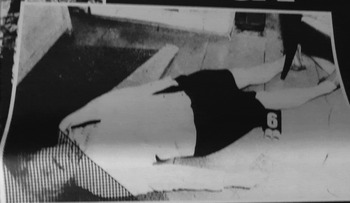
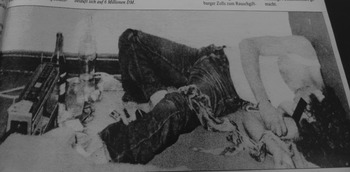
Thirteen years later, the NBI published its only report ever of the murder of a GDR citizen by a fellow GDR citizen, namely, the killing of pensioner Elsa B. by a burglar in Leipzig. Available evidence offers no clue why a murder report suddenly appeared in the magazine, and the official murder rate statistics experienced no particular spike at the time. The NBI recounted this crime in graphic detail, which was highly unusual: Elsa B. had apparently been “severely strangled,” and “broken ribs indicated that the perpetrator had knelt on her. He also hit her on the head with a ‘blunt’ object.” There was even an accompanying photograph of Elsa's body lying on the floor of her flat, with her face distorted to hide her identity (fig. 4). According to the article, the perpetrator, Joachim P., confessed to killing Elsa B. and graphically described how he had strangled her until she collapsed, and how he continued to do as she lay on the floor, pinning her down with his knees. He then made sure that she was dead by hitting her with a hammer that he had found in a drawer in her apartment. Despite the unusually detailed nature of this account, there was nothing unusual about how the NBI explained the killer's motive: Joachim P. was asocial. He had never shown any interest in working, preferring instead to drink twenty bottles of beer per day.Footnote 130
The body of Elsa B. Source: “Tatort vierter Stock,” Neue Berliner Illustrierte, 26/1980.

The “Clever and Friendly” Volkspolizei
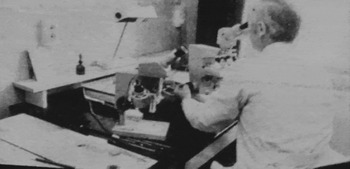
The NBI did not just report on East German crimes and their perpetrators, but also featured articles about the Volkspolizei and its officers.Footnote 131 The magazine published most of these pieces annually in celebration of the Tag der Volkspolizei (Day of the People's Police) on July 1, when parades, speeches, and award ceremonies commemorated the founding of the police in 1945. The Volkspolizei was also present, at least implicitly, in many other articles about criminality, for there was never a report about an unsolved crime: the Volkspolizei always got its man or woman—at least in the pages of the NBI. In fact, officials explicitly directed the press to emphasize the competency, efficacy, and success of the Volkspolizei in protecting East German citizens and their property, and in making them safe from crime.Footnote 132 The NBI accordingly portrayed police investigations as “painstaking,” “tireless,” or “arduous.”Footnote 133 At the same time, articles focused on the modern investigative methods and technologies at the disposal of the police: “Letters and documents can be investigated, dactyloscopic imprints evaluated, blood groups determined, and hairs compared. Forensic traces are analyzed and fibers investigated. The scientists can scientifically investigate any trace, no matter how small” (fig. 5).Footnote 134 Officers were able to help witnesses identify perpetrators with the aid of “8 different body shapes, 60 noses, 276 pairs of eyes, 336 hairstyles, 180 mouths, diverse ears, beards, glasses, and hats.”Footnote 135 In one instance, the Volkspolizei even identified a burglar by the ear print he had left behind while eavesdropping at a door.Footnote 136 This reporting also served as a warning to citizens that, if they committed an offense (of an everyday or political nature), the Volkspolizei would most definitely apprehend them.
A forensic scientist of the Volkspolizei at work. Source: “Tatort vierter Stock,” Neue Berliner Illustrierte, 26/1980.

What is perhaps most striking, however, about the articles in which the Volkspolizei explicitly featured is the fact that they not only focused on noncriminal incidents, but that they also emphasized the banality of the everyday routine of most officers. These articles thus downplayed the extent and seriousness of criminality in the GDR by suggesting to readers that the investigation and prevention of criminal offenses did not constitute most of the work performed by the Volkspolizei. Articles gave the distinct impression that the life of a police officer consisted mainly of the following tasks: controlling traffic, administering first aid, searching for missing children, escorting blood donors to hospitals, checking cars to make sure they were parked correctly, securing life preservers to railings near rivers, giving talks to school pupils, and, for certain specialists, defusing unexploded bombs from World War II. Police work was, the NBI claimed, usually “without sensation.”Footnote 137 The apparent ordinariness of everyday police work aimed to underscore the claim that there were “no career criminals here, no drug scene, no raids on the underworld.” Police work in the GDR was “not a detective story.”Footnote 138
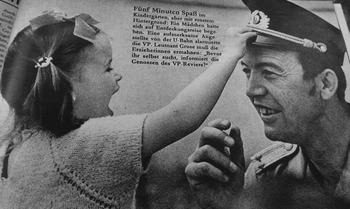
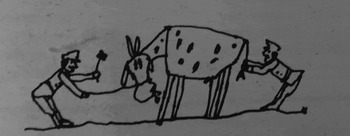
Officials also directed the press to focus on the personalities of the police officers featured in its articles rather than on their work, and were most concerned about highlighting members of the Volkspolizei who were “nice, trustworthy, selfless, courageous, clever, friendly, and willing to help.”Footnote 139 Accompanying photographs consequently depicted police officers having friendly chats with civilians or letting children play with their caps (fig. 6).Footnote 140 The apparent hope was that officers would remind citizens of people they might actually know and to whom they could therefore relate, in the belief that citizens were more likely to accept the authority of the police—and, by extension, the state—if officers appeared as real human beings rather than as faceless representatives of the regime.Footnote 141 Representations of the Volkspolizei were intended, then, to strengthen confidence in the regime.Footnote 142 To that end, the SED also directed the press to present readers with accounts of “genuinely humorous, original situations” involving the Volkspolizei.Footnote 143 Officers thus appeared in the pages of the NBI attempting to catch an escaped cow, or a monkey and two bison that had escaped from the Leipzig zoo.Footnote 144 Humorous poems about or caricatures of the Volkspolizei occasionally appeared as well (fig. 7).Footnote 145
“Five minutes of fun” with a friendly officer of the Volkspolizei. Source: “Alltag ohne Stationen,” Neue Berliner Illustrierte, 26/1973.

Caricature of a day in the life of the Volkspolizei. Source: “Berlin intim,” Neue Berliner Illustrierte, 27/1970.

The Discourse of Everyday Criminality and the Berlin Wall
In the early hours of Sunday, August 13, 1961, in Berlin, the GDR's security forces sealed the German–German border and erected barbed wire fences that would become the Berlin Wall. The SED regime took this measure to stem the vast tide of citizens leaving the GDR to escape repression and poor living conditions. Neues Deutschland offered readers a different explanation: the borders had been sealed as part of a “crackdown on enemy activity by the revanchist and militarist forces in West Germany and West Berlin,” and in order to prevent “fascist imperialist” forces in Bonn from triggering a war.Footnote 146 In the weeks and months that followed the sealing of the border in the former capital of the Reich, the NBI published several articles that echoed the official party line, namely, that the SED had taken the “measures” of August 13, 1961, to protect the “peace and security” of East Germans.Footnote 147 The NBI reported that “revanchist politicians and agents of militarism” would no longer be permitted to enter the GDR and that Willy Brandt, the mayor of West Berlin, had seen “his hopes for murder and war dashed on August 13.” The “rats and voles” in the Federal Chancellery under Hans Globke no longer had a foothold in East Berlin, where “the air must remain clean.”Footnote 148 The world “ought to exhale” now that the SED had “spoiled the devilish plan” of the West to threaten world peace.Footnote 149 Some ordinary East Germans no doubt welcomed the construction of the Berlin Wall and saw it as a necessary measure to protect their country; yet, many others questioned the logic of the official explanation for the new border controls. One Berliner, for instance, wondered why border guards stood at the Brandenburg Gate with their weapons trained on the East German side of the border if the Wall was meant to keep out and prevent an invasion by “Western fascists.”Footnote 150
In the following years, it became clear to authorities that most citizens rejected official claims about the role of the Berlin Wall in preventing Western invasion. Articles about or referring to the Wall that appeared in the NBI after its construction suggest how the SED attempted to recast the unpopular measure as a bulwark against crime and criminality. Articles depicting the Wall as the “savior of world peace” still appeared.Footnote 151 Yet, the NBI increasingly emphasized its supposed role in crime prevention—not only to demonstrate that the regime was taking measures to ensure the safety of its citizens from criminality, but also to convince them that the Berlin Wall was vital to such efforts. As such, the NBI articles attempted to “normalize” its presence, largely by emphasizing to readers that the Wall was preventing West German criminals from committing crimes in the GDR.Footnote 152 One article claimed in 1962, for example, that the Wall had protected the East German capital from the “fury” of a group of “rampaging” young West Berliners who had allegedly been stirred into a frenzy by Willy Brandt. Another piece from 1966 similarly claimed that the Wall was keeping West German criminals out of the East.Footnote 153 Another strategy was to emphasize the supposedly higher levels of criminality prior to the closing of the border—the dominant theme of the 1965 article series “Verbrechen ohne Chance” (“Crime has no chance”), which appeared in six editions of the NBI (covering a total of twenty-one pages) to celebrate the twentieth anniversary of the founding of the Volkspolizei. In the series, Major Alex W. of the Volkspolizei cited extensive examples of Western criminal activity that had allegedly taken place in the GDR before the SED had sealed the borders, noting that when the latter were open, “more than a few criminals [had] used this to their advantage. As long as the border was open, a whole range of crimes occurred in Berlin.” This included an organized group of criminals based in West Berlin whose members had been stealing scrap metal, lead piping, copper cables, and other metal products from East Berlin. There were other examples as well of what the Major referred to as “illegal exports,” e.g., lenses, typewriters, and cameras.Footnote 154 He concluded that the construction of the Berlin Wall had put a stop to such incidents because “we closed the door on the thirteenth [of August]. Since we do not have any more open borders, criminality has decreased even further.”Footnote 155 A subsequent article quoted Lieutenant-General Gerhard Lorenz, a deputy commander of the GDR's border guards, who similarly recalled the state of affairs before the border was closed: between July 1948 and July 1949 alone, he noted, 2,418 West German criminals had been apprehended at the still open border.Footnote 156
Besides preventing criminals from entering the GDR, the Wall also supposedly hindered them from leaving the country, enabling state security forces to apprehend them and thus further keep citizens safe from crime. On June 17, 1964, for instance, border guards arrested a man trying to scale a border fence in order to escape to West Berlin: during questioning he purportedly confessed to having murdered a young woman on the Baltic Sea island of Hiddensee. The border thus prevented, the NBI proclaimed, the escape of any criminal “for whom it [was] getting too hot in the GDR.”Footnote 157 Attorney General Streit similarly stated in 1966 that the “protective measures” taken on August 13, 1961, now prevented criminals from escaping justice by simply buying a twenty-pfennig train ticket to West Berlin.Footnote 158 There was, in fact, a temporary increase in the early 1960s in recorded crime rates, as more criminals were caught and convicted, but the trend had actually started in 1957 with a general crackdown on cross-border crime.Footnote 159
The construction of the Berlin Wall and the closing of the German–German border made it possible for the SED to seal off its citizens physically from the West; ideological delimitation (Abgrenzung) proved to be much more of a challenge, and the perception that the West enjoyed greater prosperity and higher living standards—thanks to daily penetration by the Western media—made this especially difficult to achieve. The SED regime tried to counter this by flooding its citizens with anti-Western rhetoric.Footnote 160 Articles in the NBI played a central role in this endeavor by focusing on crime and criminality in the West to suggest that life there was not as perfect as many believed. To that end, the magazine attempted to convince readers that they were much safer in the GDR than in the West, where people were, and had good reason to be, afraid of crime: “In New York people hide behind barred windows. In Munich and Hamburg the inhabitants in certain districts are afraid to go out after dark.”Footnote 161 The NBI often published official GDR crime rates alongside charts and tables that purportedly showed West German rates, which were much higher. “According to West German criminal statistics,” one 1963 article reported, “2,120,419 crimes were committed in 1961—over 86,000 more than in the previous year. That is 3,775 criminal offenses per 100,000 citizens. By comparison, the figure was 863 in the GDR.”Footnote 162 The magazine also tried to persuade readers that the types of crime committed in the West were much more serious, violent, and worthy of the term Verbrechen—which the NBI applied almost unilaterally to denote crime in the West. There were reports of murders, armed robberies and hostage-taking, violent assault, torture, people trafficking, drug dealing, and drug addiction among school children (fig. 8)—all forms of crime that supposedly did not exist or had “died out” in the GDR.Footnote 163 The magazine also informed readers that such Verbrechen would continue to occur in the West, for they were indelibly linked to the nature of capitalist society: “The [Western] mass media tries to hammer home in the minds of citizens that … the egoistical pursuit of profit at the cost of one's neighbor and the daily, ruthless, dog-eat-dog fighting for one's own existence at the cost of others were things to strive for.… Whoever exalts a society where the everyday fight for profit is brutal and violent must not be surprised when violence penetrates his street, his apartment.”Footnote 164 The NBI thus portrayed crime and criminality as system-immanent phenomena in the capitalist West: these crimes were not “alien” to capitalism but rather a hallmark of it—unlike in the GDR, where citizens who strayed could be “reeducated” and where crime as a phenomenon would eventually die out.
A dead “West German drug addict.” Source: “Drogen–Quelle des Todes und des Profits‚” Neue Berliner Illustrierte, 31/1988.

Conclusion
As the foregoing examination of the SED regime's policy on crime reporting demonstrates, the ruling party set the agenda for discourse of crime in the GDR in an effort to shape public perceptions of the phenomenon in accordance with the regime's dominant socialist ideology.Footnote 165 Writing soon after the fall of the Berlin Wall, Siegfried Schröder, the newly appointed editor-in-chief of the NBI, commented in an editorial—pointedly titled “Out of the Procrustean Bed”—that many journalists in the GDR had never lost their ability to perceive reality but were very rarely permitted to describe it accurately.Footnote 166
Reporting about crime in the NBI nevertheless did reflect the reality of criminality in the GDR, at least in part: the majority of its articles focused on theft, which, according to official statistics and research since the opening of the archives, was indeed the most common criminal offense in the GDR. At the same time, however, the NBI seriously underreported violent crime in the GDR. As we have seen, it only published two articles on violent crime committed by East German citizens between 1961 and 1989—one on the murder of an East German by a fellow citizen and one on a sex crime—even though the regime's own figures showed that these offenses did occur in not insignificant numbers. Its articles about crime may have rigidly toed the state line with regard to the causes of criminality in the GDR, but the NBI nevertheless did provide readers with reports of real-life instances of crime. It communicated to them the details of specific criminal incidents, presented them with photographs from crime scenes, and gave some details about victims and perpetrators. What this meant was that the magazine presented citizens with a fuller picture of crime than they could have gained from reading official crime figures or the theoretical studies of regime criminologists.
This analysis of the NBI’s reporting on everyday criminality has focused as well on a number of important strategies adopted by the regime after it had physically separated its citizens from the West after the construction of the Berlin Wall—such as its efforts to instrumentalize the phenomenon of crime in order to achieve a psychological barrier to the West. To that end, NBI articles about crime often cast the Berlin Wall as an effective means of crime prevention and detection in the GDR, claiming, for instance, that it kept out Western criminals. At the same time, the Wall allowed for the capture of domestic criminal offenders by closing off one of their main escape routes. This presentation of the Wall as a preventer and detector of crime—a 3.6-meter-high concrete policeman of sorts—suggests that the regime had hoped to “normalize” it as just another part of its policing measures aimed at keeping citizens and their property safe from criminals.
In a similar vein, the NBI communicated to readers that Western society was (and always would be), because of its capitalist nature, riddled from bottom to top with serious and violent crime. By directing the media to use crime to portray the West as a lawless and violent society—and thus as a threat not only to citizens and their property, but also to their societal values and interests—the SED hoped to create something akin to a permanent “moral panic” about the West. In short, the NBI communicated to its readers that, for their own safety, the West was not a place that any East German would want to visit—much less emigrate.Footnote 167
NBI articles about everyday crime and criminality in the GDR communicated to readers above all that they were safe and secure in East Germany. Articles that hoped to promote this message shared several features that are comparable to what Yvonne Jewkes has referred to as “crime news values,” i.e., criteria that incidents of crime must fulfill in order to be deemed newsworthy. These concern the value judgments that editors and journalists make when determining if a story has public appeal and is in the public interest.Footnote 168 Given the nature of journalistic practices in the GDR, one cannot speak, of course, of editors making independent decisions with regard to content. Rather, one must think in terms of “crime news stipulations” set forth by the SED, i.e., certain identifiable features, under- and overtones, as well as conclusions that officials demanded (and made sure) were included in news reports about criminality in order to communicate to East Germans that they were indeed safe from crime.
Such features can be divided into two groups. The first consisted of efforts to downplay the extent and seriousness of crime in the GDR. The NBI achieved this by focusing on less serious crime, as well as by carefully monitoring the language and terminology used to describe criminal acts. At the same time, articles periodically included quotes from regime officials claiming that crime rates were decreasing and that “we can quite rightly say that our citizens live safely and securely. Our citizens can walk the streets at night without having to feel afraid.”Footnote 169 The second group contained features intended to make readers reach the conclusion that crime would eventually cease to exist in the GDR. Chief among these was the message that the causes of crime were treatable and curable under state socialism—as opposed to capitalist society, where crime was supposedly an inherent part of the system. The articles made it clear that the only way to eliminate the causes of crime—and therefore the only way to ensure complete safety and security—was for citizens to live according to the socialist tenets set forth by the party. As this suggests, the regime used the media and its treatment of crime and criminality to win greater legitimacy and coopt citizens for the socialist project.Footnote 170