The Sacramento Valley of California is a diverse cropping region, where a wide variety of crops, ranging from fruit and nut trees to rice and other agronomic crops, are grown. The importance of walnut has been steadily increasing in the last 10 years, with 58,000 ha and a gross dollar value of about $800,000,000 reported in 2015 in the region (Anonymous 2016). Rice is also one of the most important commodities grown in the Sacramento Valley, with 165,000 ha harvested in 2015 for a gross dollar value of about $732,000,000 (Anonymous 2016; USDA 2016).
Weed control in rice is a major concern because weeds can reduce yields 32% to 48% (de Vida et al. Reference de Vida, Laca, Mackill, Fernández and Fischer2006). In California, almost all rice fields are treated with herbicides at least once during the growing season (Pedroso et al. Reference Pedroso, Al-Khatib, Abdallah, Alarcón-Reverte and Fischer2016). A standard weed control program in California rice fields includes herbicides applied at planting followed by one or two postemergence treatments later in the season. In California, propanil, bispyribac-sodium, and bensulfuron-methyl are commonly used to control weeds at the early tillering stage of rice.
Propanil, a photosystem II inhibitor herbicide, was introduced in California 50 years ago for the control of early and late watergrass [Echinochloa oryzoides (Ard.) Fritsch and Echinochloa oryzicola (Vasinger) vasinger, respectively] (Fisher et al. Reference Fischer, Ateh, Bayer and Hill2000). Traditionally, acetolactate synthase (ALS) inhibitor herbicides (EC 2.2.1.6), such as bensulfuron-methyl, were used for the control of California arrowhead (Sagittaria montevidensis Cham. & Schltdl.), redstem (Ammannia) species, smallflower umbrella sedge (Cyperus difformis L.), and ricefield bulrush [Schoenoplectiella mucronata (L.) J. Jung & H. K. Choi]. More recently, bispyribac-sodium, another ALS inhibitor herbicide, was introduced in California. Bispyribac-sodium is used for the control of grass species, such as early and late watergrass and barnyardgrass [Echinochloa crus-galli (L.) P. Beauv.], and broadleaf species, such as arrowhead, redstem, monochoria [Monochoria vaginalis (Burm. f.) C. Presl ex Kunth] and ducksalad [Heteranthera limosa (Sw.) Willd.].
Walnut trees are characterized by a polycyclic growth pattern in which annual shoots may be formed by one or more growth units. Shoots may grow in a spring flush (monocyclic shoots) or in two separate flushes of growth in spring and summer, separated by a resting phase (bicyclic shoots) (Sabatier et al. Reference Sabatier, Barthélémy and Ducousso2003). While leaves and shoots growing in summer differentiate in the current year, leaves and flowers growing in spring are predifferentiated between late May and early July of the previous year (Polito Reference Polito1985; Sabatier et al. Reference Sabatier, Barthélémy and Ducousso2003). In mature trees, female flowers are borne in the terminal position on spring shoots (Sabatier and Barthelemy Reference Sabatier and Barthélémy2001).
Many examples of ALS inhibitor damage on nontarget annual (Al-Khatib and Tamhane Reference Al-Khatib and Tamhane1999; Boutin et al. Reference Boutin, Lee, Peart, Batchelor and Maguire2000; Fletcher at al. Reference Fletcher, Pfleeger, Ratsch and Hayes1996; Rana et al.Reference Rana, Norsworthy and Scott2014) or perennial (Al-Khatib et al. Reference Al-Khatib, Parker and Fuerst1992, Reference Al-Khatib, Parker and Fuerst1993) species have been reported. Kjaer et al. (Reference Kjær, Strandberg and Erlandsen2006) found significant effects on growth indices and reproductive measures of English hawthorn (Crataegus monogyna Jacq.) the year following ALS inhibitor exposure. Furthermore, Bhatti et al. (Reference Bhatti, Al-Khatib, Felsot, Parker and Kadir1995) found that sweet cherry [Prunus avium (L.) L.] exposed to chlorsulfuron at high concentrations during the reproductive growth phase had reduced fruit production. Visual symptoms of bispyribac-sodium exposure on almonds [Prunus dulcis (Mill.) D. A. Webb] and walnuts have been reported (Al-Khatib Reference Al-Khatib2015), including chlorotic spots, general chlorosis, and leaf stacking due to internode shortening. However, to date, the effects of low rates of bispyribac-sodium on growth and yield of walnut are not known.
In the walnut-growing Sacramento Valley counties, the majority of rice herbicides are sprayed by airplane between May and early July (CalPIP 2016). While many rice herbicides are applied in granular form to minimize herbicide drift damage, propanil, bispyribac-sodium, and bensulfuron-methyl are applied in liquid spray mixtures. In general, propanil, bispyribac-sodium, and bensulfuron-methyl applications coincide with the period in which walnuts are initiating and differentiating buds that will form flowers and leaves in the subsequent year (Polito Reference Polito1985; Sabatier et al. Reference Sabatier, Barthélémy and Ducousso2003). In addition, at that time of the season nuts have typically reached their final size and have just begun accumulating fats in the kernel (Labavitch and Polito Reference Labavitch and Polito1985). Therefore, if exposed to a sublethal dose of an herbicide as a result of off-target drift, walnut growth, nut quality, and yield in the year of the exposure could be affected. Additionally, if the herbicide affects initiation of future reproductive structures, nut yield in the subsequent year could also be affected.
The objectives of this research were 1) to evaluate the symptoms and effects on walnut growth caused by simulated drift rates of propanil, bispyribac-sodium, and bensulfuron-methyl; 2) to evaluate the effects of simulated drift rates on walnut yield and nut quality the year of exposure; and 3) to evaluate the effects of rice herbicides on walnut yield the year following simulated drift.
Material and Methods
Studies were conducted at the University of California Plant Sciences Research Station, Davis, CA. The soil was sandy loam with an organic matter content of 0.75% and a pH of 7.3. Bare-root dormant ‘Chandler’ walnuts were transplanted in spring 2014 and spring 2015 using standard grower practices (Ramos Reference Ramos1997). Trees were spaced 6 m within and 6 m between rows. Trees were monitored for insects and diseases and were treated according to the University of California Cooperative Extension Walnut Pest Management Guidelines (Strand Reference Strand2003). Weeds in the experimental area were managed using conventional orchard herbicide programs; however, in order to avoid confusion with amino acids inhibiting herbicides no ALS inhibitors or glyphosate were used. Trees were irrigated with microsprinklers throughout the growing season.
Visual Injury and Walnut Growth
In 2015, the study was conducted in the orchard transplanted in 2014. The study was replicated the following year in another orchard that had been transplanted in 2015. Simulated drift treatments were applied the year after transplanting in both experiments. In both years, the study was carried out in a portion of the orchard with relatively uniform canopy size and tree height.
Herbicide treatments were bispyribac-sodium, bensulfuron-methyl, and propanil. Each herbicide was applied at four plausible drift rates (Al-Khatib and Peterson Reference Al-Khatib and Peterson1999): 0.5%, 1%, 3%, and 10% of the maximum product use rate in rice (45, 70, and 6725 g ai ha−1 for bispyribac-sodium, bensulfuron-methyl, and propanil, respectively). A nontreated control was also included. Nonionic surfactant (Broadspread®, Custom Ag Formulators, Inc., Fresno, CA) at 117 ml/ha was added to all the bispyribac-sodium treatments. Bensulfuron-methyl and propanil treatments were applied with 0.5% (v/v) crop oil concentrate (PRO C.O.C., Independent Agribusiness Professionals, Fresno, CA). Treatments were applied on one side of the walnut canopy with a hand-held, CO2-pressurized boom. The sprayer was equipped with three 8001 flat-fan tips spaced 50 cm apart and delivered 93 L/ha at 138 kPa. The boom was held aloft and the tree was sprayed in one pass from top to bottom. Spray time was checked with a stopwatch in order to ensure that each tree received the correct amount of solution. To minimize off-target drift, plots were sprayed when wind speed was calm. Treatments were applied on June 24, 2015, and May 31, 2016, respectively, in the two studies. In both years, trees were treated at the same growing stage: internode elongation following pistillate flowering. However, because of differences in the planting stock used, in the 2015 study the trees were 2 to 2.5 m tall, while in the 2016 study the trees were 1.7 to 2 m tall.
Visual injury ratings and leaf greenness estimates were determined 7, 14, 21, 28, and 56 days after treatment (DAT). At each visual injury rating date, two injured leaflets per tree were collected from the sprayed side of the canopy and scanned using a desktop scanner. Injured areas of the leaf were separated from the green area using picture thresholding software (Abramoff et al. Reference Abramoff, Magalhaes and Ram2004), and the percent injured area was calculated. Results are presented as a percentage of similar data from leaves collected from nontreated control trees (Ali et al. Reference Ali, Streibig, Duus and Andreasen2013), where 0 means a noninjured leaf and 100 means a completely dead leaf. Leaf greenness measurements were conducted in three randomly selected individual leaflets per tree at each evaluation. Leaves were picked from the side of the canopy exposed to the drift simulation spray and were collected from three heights: the top, middle, and lower portions of the canopy. Leaf greenness was estimated by using a chlorophyll meter (SPAD-502, Minolta Co. Ltd, Osaka, Japan).
The effect of simulated drift on shoot growth was also evaluated. Prior to herbicide treatment, three actively growing shoots on each tree were randomly marked: one each in the upper, middle, and lower parts of the canopy. The number of internodes on each shoot was counted and compared with that of nontreated trees. Internode number in treated and untreated trees was also recorded 28 and 56 DAT in 2015 and 7, 14, 21, 28, and 56 DAT in 2016.
Yield
Year After Drift Exposure
Walnut trees start producing during their second growing season, 1 year after transplant; however, growers would typically not harvest until the third or fourth growing season because of the economics of harvest operations (Ramos Reference Ramos1997). During the first year of the experiment (1 year after transplant), nut production was relatively low and highly variable among single-tree plots; thus, yield was not evaluated in the year of simulated drift treatment. However, these trees were used for evaluating the effect of simulated drift the year following the simulated drift exposure. Thus, walnut yield from trees treated in 2015 was collected on October 13, 2016, and trees treated in summer 2016 were harvested on October 20, 2017. Nuts were shaken from the trees with mallets and poles and were picked up by hand and separated from the hulls. Nuts were dried at 36 C for 36 hours and total in-shell nut weight and number of nuts per tree were recorded. Data are presented as in-shell nut weight per tree and average nut weight.
Year of Drift Exposure
The effect of simulated drift on same-year yield and nut quality was evaluated on two separate blocks of trees in the orchard transplanted in 2015. Because of the number of available uniformly sized trees and the visual symptoms and growth data collected in 2015 and 2016, this experiment included only bispyribac-sodium. Three drift rates were tested: 0.5%, 1%, and 3% of the maximum product rate in rice (45 g ai h−1). Nonionic surfactant (Broadspread®, Custom Ag Formulators, Inc., Fresno, CA) at 117 ml ha−1 was also added to all bispyribac-sodium treatments. A nontreated control was included. Treatments were applied one time following the procedure described above on May 15, 2017, in the first site and on May 22, 2017, in the second site, respectively.
Walnuts were harvested on October 20, 2017, as previously described. Kernel color, an important quality indicator (Olson and Coates Reference Olson and Coates1985), was also evaluated. A 40-nut subsample was taken from each tree and carefully unshelled by hand. Kernels were visually assessed and subdivided into four color-classes as defined by the Dried Fruit of California Association: extra light, light, light amber, and amber (DFA 2016). Because light-colored nuts are considered the best quality and preferred by the market, data are presented as percentage of light-colored nuts (extra light and light classes). In addition, each kernel was rated in a 1 to 4 score where 1 is extra light and 4 is amber, and the average color score is presented.
Statistical Analysis
All experiments were designed and analyzed as randomized complete blocks with four replicates and single trees as experimental units (Al-Khatib et al.Reference Al-Khatib, Parker and Fuerst1993; Bhatti et al. Reference Bhatti, Al-Khatib, Felsot, Parker and Kadir1995). Visual symptom and growth data were subjected to ANOVA with PROC MIXED in SAS 9.4 (SAS Institute Inc.), considering blocks as random effects. Means for each variable measured were separated according to Tukey’s test at the 5% level of probability. In order to meet ANOVA assumptions, visual symptom data were subjected to power transformation. It was not possible to meet the assumption of homogeneity of variance with data transformation for leaf greenness values, therefore, data were analyzed using the multcomp and sandwich packages in R as described by Herberich et al. (Reference Herberich, Sikorski and Hothorn2010). Because year by treatment interactions were not significant for injury symptom ratings, data were averaged over the two experiments. However, as the interaction between year and treatment was significant for internode counts at 28 DAT, ANOVA was conducted on these data by year. Yield and nut quality data in the year of drift exposure were subjected to ANOVA and linear regression using the lmerTest package in R (Kuznetsova et al. Reference Kuznetsova, Brockhoff and Christensen2016) considering site and block as random effects. Finally, the subsequent year yield data were subjected to ANOVA and linear regression using the lmerTest package in R (Kuznetsova et al. Reference Kuznetsova, Brockhoff and Christensen2016), considering year and block as random effects. In order to meet linear regression assumptions, yield data were subjected to logarithmic transformation. Detransformed data are presented. Because no interaction between year and treatments was found, data were averaged over the two sites.
Results and Discussion
Visual Injury and Walnut Growth
All herbicides caused symptoms on walnut trees, especially on the young and actively growing leaves and shoots. Symptoms were first noticed 3 days after application and became more apparent 7 DAT. The severity of symptoms caused by bispyribac-sodium and bensulfuron-methyl peaked 28 DAT and increased as the rate increased. Plants then started to recover from symptoms, as the new flush of growth was observed. The degree of recovery generally depended on herbicide and rate of application. Although propanil symptoms peaked 21 DAT and remained at similar levels throughout the study, this appeared to be due to the retention of injured leaves and not to any effects on leaves and shoots that formed after simulated drift exposure.
Bispyribac-sodium and bensulfuron-methyl caused typical symptoms for ALS inhibitor herbicides (Al-Khatib et. al. 1992; Rana et al. Reference Rana, Norsworthy and Scott2014): interveinal chlorosis, leaf deformation, chlorotic spots, and leaf stacking. Propanil caused leaf chlorosis, crinkling, and necrosis on leaves that were directly treated.
As expected for two herbicides with same mechanism of action, bispyribac-sodium and bensulfuron-methyl caused similar symptoms. Both herbicides caused significant levels of injury even when applied at the lowest rate (0.5% of their respective rice use rates). Seven DAT, bispyribac-sodium and bensulfuron-methyl caused the greatest visual damage to walnut foliage, while propanil symptoms were only apparent at the highest application rate (Table 1). The results 14 DAT showed a trend analogous to that of the earlier rating. Symptoms caused by propanil at 3% and lower rates were negligible. On the other hand, bispyribac-sodium and bensulfuron-methyl caused symptoms distinct from the effects of propanil. In particular, both herbicides caused more than 20% damage when applied at the higher (3% and 10%) rates (Table 1). By 21 DAT, the severity of the symptoms caused by propanil reached its peak, with 33% visual injury observed in the plants treated with 10% of the propanil use rate (Table 1). In later assessments, the severity of propanil symptoms remained at a nearly constant level, with 32% injury observed at 56 DAT at the 10% rate (Table 1). In contrast, at 28 DAT, bispyribac-sodium and bensulfuron-methyl caused the greatest symptoms observed throughout the study, with greater than 40% injury recorded for the highest (10%) rate for both bispyribac-sodium and bensulfuron-methyl. Subsequently, all trees exposed to bispyribac-sodium and bensulfuron-methyl simulated drift started recovering from symptoms, as the maximum level of visual symptoms recorded 56 DAT dropped to 23% and 14% for bispyribac-sodium and bensulfuron-methyl, respectively. Although no recovery was observed on leaves injured by propanil, the level of injury was generally lower than that caused by bispyribac-sodium and bensulfuron-methyl at any of the rates tested (Table 1). In general, chlorophyll content data showed a similar pattern to visual injury data at each assessment (data not shown).
Visual herbicide symptom ratings of walnut trees as affected by simulated herbicide drift rates of bispyribac-sodium, bensulfuron-methyl, and propanil at the University of California, Davis Plant Sciences field station, Davis, CA. Means are averaged over 2 years.

a Nonionic surfactant at 117 ml ha−1 was added to bispyribac-sodium treatments. Crop oil concentrate was added to bensulfuron-methyl and propanil treatments.
b Rate is expressed as percentage of rice use rate. Full rice use rate is 45, 70, and 6725 g ai ha−1 for bispyribac-sodium, bensulfuron-methyl, and propanil, respectively.
c Means followed by the same letter within a column are not statistically different according to Tukey’s test (P<0.05).
Abbreviation: DAT, days after treatment.
The effect of simulated drift on growth of young walnut shoots varied among herbicides and rates of application. In general, bispyribac-sodium and bensulfuron-methyl resulted in leaf stacking, whereas the effect of propanil on postapplication tree growth was negligible.
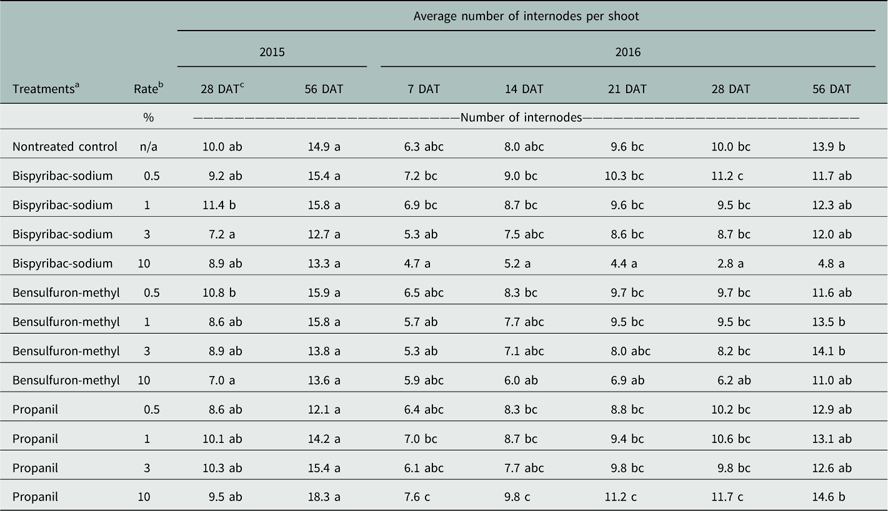
In 2015, none of the herbicides reduced the number of internodes per shoot compared to the nontreated trees. Although at 28 DAT the average number of internodes in trees treated with the high rates (3% and 10%) of bispyribac-sodium was 7 and 9 respectively, while nontreated trees had 10 internodes per shoot (Table 2), these differences were not statistically significant. By 56 DAT, all trees recovered from symptoms and no significant effect on number of internodes was recorded.
Average number of internodes per walnut shoot as affected by simulated herbicide drift rates of bispyribac-sodium, bensulfuron-methyl, and propanil at the University of California, Davis Plant Sciences field station, Davis, CA.

a Nonionic surfactant at 117 ml ha−1 was added to bispyribac-sodium treatments. Crop oil concentrate was added to bensulfuron-methyl and propanil treatments.
b Rate is expressed as percentage of rice use rate. Full rate is 45, 70, and 6725 g ai ha−1 for bispyribac-sodium, bensulfuron-methyl, and propanil, respectively.
c Means followed by the same letter within a column are not statistically different according to Tukey’s test (P<0.05).
Abbreviation: DAT, days after treatment.
In 2016, while bensulfuron-methyl and propanil did not significantly reduce shoot growth, bispyribac-sodium at the 10% use rate reduced the number of internodes per shoot compared to nontreated trees as early as 7 DAT. Although internode data were not statistically different between the nontreated control and the intermediate rates of bispyribac-sodium, trees treated with higher rates had numerically fewer internodes (Table 2). While during the growing season walnut trees recovered from visual injuries, like chlorotic spotting and leaf yellowing, 56 DAT the number of internodes in trees treated with 10% bispyribac-sodium remained lower than that of untreated trees (Table 2).
The differences in results between 2015 and 2016 may have been related to the difference in tree size between the two orchards. The orchard treated in 2016 had smaller nursery stock at planting, and these smaller trees may have received greater herbicide coverage than the larger trees treated in 2015. In addition, in 2016 air temperatures at application and during the following month were higher than those in 2015. Nevertheless, the data from 2015 were generally similar with those observed in 2016 (Table 2).
Yield
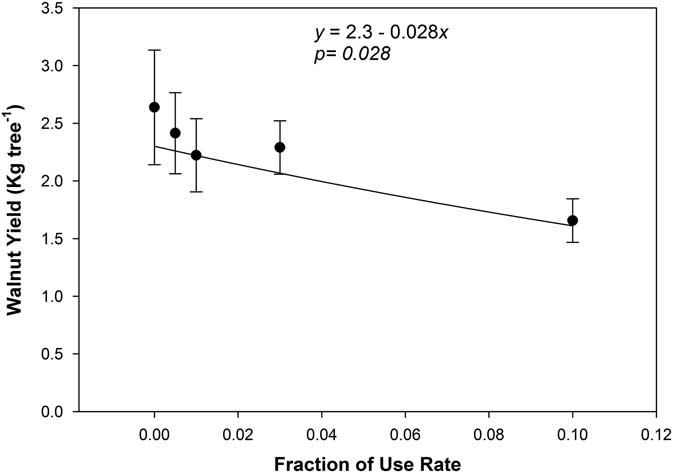
Because of the young age of the trees, yield greatly varied among these single tree plots, which resulted in high levels of variance and standard errors. No significant yield or average nut weight reduction was observed in either the year of simulated drift exposure or the subsequent season (data not shown). However, a linear correlation between bispyribac-sodium rate and yield was observed the year subsequent to simulated drift exposure (Figure 1). On the other hand, no linearity was recorded between bispyribac-sodium rates and yield in the year of drift exposure (data not shown), which supports the hypothesis that bispyribac-sodium exposure, while not directly affecting current-year yield, has the potential to impact the pre initiation of reproductive structures and, thus, affect the subsequent-year yield.
Effect of bispyribac-sodium rate on walnut yield 1 year after drift simulation treatment at the University of California, Davis Plant Science field station, Davis, CA. Full rate was 45 g ai ha−1.

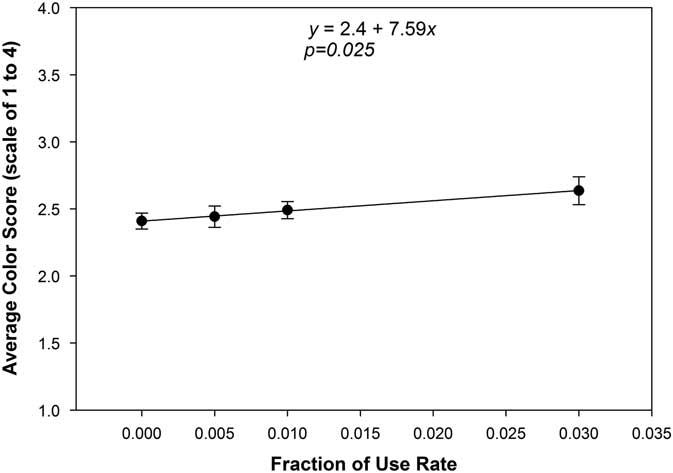
Furthermore, while the kernel color of nuts harvested from treated trees was not different from the color of nuts collected from nontreated trees (data not shown), there was a linear correlation between drift rates and average color score (Figure 2). Higher bispyribac-sodium drift rates tended to be associated with darker kernel color.
Walnut kernel color as affected by bispyribac-sodium. The nuts were collected the same year as the drift simulation treatment at the University of California, Davis Plant Science field station, Davis, CA. Full rate was 45 g ai ha−1.

This research shows that bispyribac-sodium and bensulfuron-methyl may damage nearby walnut orchards if they drift at significant amounts. The severity of the visual injury symptoms caused by bispyribac-sodium and bensulfuron-methyl peaked approximately 1 month after exposure but recovered by 56 DAT. In addition, the results show that bispyribac-sodium has the potential to affect kernel color the year of drift exposure and yield the year following drift exposure. Nevertheless, no yield, average nut size or quality reduction was observed. Considering that downwind drift deposits generally range from 1% to 8% (Al-Khatib and Peterson Reference Al-Khatib and Peterson1999), it is unlikely that in a field situation bispyribac-sodium would commonly drift at high enough levels to cause the symptoms observed from the 10% use rates in this study.
Acknowledgements
Walnut nursery stock for the test orchards was provided by Emerald Farms and Stuke Nursery. Funding for this research was provided by the Rice Research Board of California.