Existing evidence suggests that borderline personality pathology (BPP) comes with a negative perception of others and with severe negative affect in response to these perceptions (Ebner-Priemer et al., Reference Ebner-Priemer, Houben, Santangelo, Kleindienst, Tuerlinckx, Oravecz, Verleysen, Van Deun, Bohus and Kuppens2015; Hepp et al., Reference Hepp, Lane, Wycoff, Carpenter and Trull2018). According to Nock’s (Reference Nock2009) integrated model of non-suicidal self-injury (NSSI), sustained experiences of negative affect, which are key to BPP, also predispose individuals to the development of NSSI thoughts and behavior (Moselli et al., Reference Moselli, Casini, Frattini and Williams2021; Nakar et al., Reference Nakar, Brunner, Schilling, Chanen, Fischer, Parzer, Carli, Wasserman, Sarchiapone, Wasserman, Hoven, Resch and Kaess2016; Turner et al., Reference Turner, Jin, Anestis, Dixon-Gordon and Gratz2018). In that context, NSSI is conceptualized as an attempt to downregulate uncomfortable emotional experiences. Indeed, socio-emotional dysregulation as typically observed in individuals with BPP (i.e., negative emotions, interpersonal conflict, feelings of rejection,…) has been established as a key risk factor for NSSI in various studies with adult samples (for a review see Hepp et al., Reference Hepp, Carpenter, Störkel, Schmitz, Schmahl and Niedtfeld2020). Also at the earlier age of adolescence, consistent associations between self- harm and BPP-related personality traits such as negative emotionality (Dale et al., Reference Dale, Case, Dyson, Klein and Olino2021) and impulsivity (for a review see Lockwood et al., Reference Lockwood, Daley, Townsend and Sayal2017; see also Hamza et al., Reference Hamza, Willoughby and Heffer2015) have been found. Also Buelens et al. (Reference Buelens, Costantini, Luyckx and Claes2020) recently concluded from a network approach that BPP and NSSI in adolescence are interconnected by bridging symptoms that can be merely considered as personality traits related to impulsivity, separation anxiety and negative affect.
Corroborating such developmental perspective on the link between maladaptive traits and NSSI, established evidence learns us that there is a large overlap between more distal environmental risk factors for NSSI and those for BPP, such as childhood abuse (Brown et al., Reference Brown, Heines, Witt, Braehler, Fegert, Harsch and Plener2018), parental emotional invalidation (Gandhi et al., Reference Gandhi, Luyckx, Goossens, Maitra and Claes2018), and parental emotional reactivity (Perlman et al., Reference Perlman, Gromatsky, Salis, Klein and Kotov2018). This commonality is likely to result from similar mental constructions of early maladaptive attachment schemes (Fonagy & Bateman, Reference Fonagy and Bateman2008; Linehan, Reference Linehan1993; Sharp & Vanwoerden, Reference Sharp and Vanwoerden2015), as well as from dysfunctional role modeling of parents in emotion management throughout the socialization process of the child (Kaur & Sanches, Reference Kaur and Sanches2023). Less is known, however, about the potential role of distal temperamental factors of the child to understand the link between socio-emotional dysregulation and NSSI urges in adulthood. Conceivably, traits that form the core of the early BPP phenotype (Franssens et al., Reference Franssens, Costantini, Kaurin and De Clercq2023b), including anxiety, interpersonal hostility and distrust in others may play a significant role as distal childhood risk factors for both BPP and NSSI (Bozzatello et al., Reference Bozzatello, Garbarini, Rocca and Bellino2021; Fonagy & Bateman, Reference Fonagy and Bateman2008; Linehan, Reference Linehan1993), as they may form a shared sensitivity for negative perceptions and intentions of others. In the course of encountering even normative negative events, this sensitivity may hamper the growth towards a healthy feeling of self (Sharp & Vanwoerden, Reference Sharp and Vanwoerden2015; Sharp et al., Reference Sharp, Venta, Vanwoerden, Schramm, Ha, Newlin, Reddy and Fonagy2016) and increase the risk to develop maladaptive interpersonal schemes which undermine the consolidation of healthy attachment relationships. Alongside the evolving socio-emotional challenges of pre-adolescence, these children may then get increasingly stuck in the process towards acquiring effective emotion regulation and social skills and ultimately fail to develop an integrated identity (Sharp & Vanwoerden, Reference Sharp and Vanwoerden2015). This, in turn, may foster the inclination towards NSSI as a strategy to cope with emotional distress (Nock, Reference Nock2009) or as a way to unlock a sense of self during heavy dysregulated states by physically harming the own bodily tissue (Klonsky et al., Reference Klonsky, Glenn, Styer, Olino and Washburn2015).
Although this conceptual reasoning has been theoretically embedded within the literature, no prospective research has targeted the projection of such early personality trait vulnerabilities into process-based daily functioning in adulthood (but see Vanwoerden et al., Reference Vanwoerden, Hofmans and De Clercq2021; Vanwoerden et al., Reference Vanwoerden, Byrd, Vine, Beeney, Scott and Stepp2022), at least not with regard to the long-term significance of early trait vulnerabilities for understanding the much seen link between adverse socio-emotional experiences and NSSI urges and behavior in young adulthood.
From this perspective, the present study targets the long-term role of pre-adolescent BPP traits to understand dynamic links among processes of socio-emotional dysregulation and NSSI thoughts in early adulthood. Pre-adolescence can be considered as a sensitive developmental phase during which children are challenged to reach crucial milestones in emotional skill and impulse control development, as this period is marked by the complex interplay between physiological changes, cognitive maturation, and increasing social demands. At that age, personality vulnerabilities that are presumed to form the basis for insecure attachment schemes and a lacking sense of self may hence become more manifest and may represent meaningful long-term significance with regard to socio-emotional functioning and coping with adverse experiences later in life.
Specifically, the current study focuses on the dynamic links among processes of socio-emotional dysregulation and NSSI thoughts in young adulthood, and explores whether the strength of that relationship varies as a function of mother-reported pre-adolescent BPP traits. We conceive these pre-adolescent vulnerabilities along a set of age-sensitive maladaptive developmental traits from the DIPSI omnibus measure of early maladaptive traits (De Clercq et al., Reference De Clercq, De Fruyt, Van Leeuwen and Mervielde2006), that were proposed to capture relevant aspects of the early borderline personality phenotype. This early borderline-related phenotype includes Aggressive-Irritable traits, Anxious traits, Depressive traits, Emotional lability, Hyperexpressive traits, Impulsivity, Ineffective coping, Insecure attachment, Lack of self-confidence, Paranoid traits, and Risk taking; Franssens et al., Reference Franssens, Abrahams, Brenning, Van Leeuwen and De Clercq2021, Reference Franssens, Giletta, Vanwoerden and De Clercq2023a). In young adulthood, daily diary ratings of NSSI thoughts as well as socio-emotional dysregulation, conceptualized along daily-format items anchored on the 7 DSM-5 traits for BPP in the Alternative Model of Personlity Disorders (AMPD; APA, 2013) were collected and yielded a series of repeated measurements while participants engaged in their daily life. Such comprehensive and differentiated daily perspective is key to depict functional and clinically meaningful connections between daily negative socio-emotional experiences and NSSI thoughts, and allows to explore in detail whether and how early BPP traits shape these dynamics in young adulthood (Wright & Kaurin, Reference Wright and Kaurin2020). Such knowledge is needed to improve our knowledy on etiological mechanisms that drive the development of NSSI and to pinpoint targets for prevention and early intervention (Stead et al., Reference Stead, Boylan and Schmidt2019).
Based on previous findings (Bresin & Gordon, Reference Bresin and Gordon2013; Tatnell et al., Reference Tatnell, Kelada, Hasking and Martin2014), we first tested whether the daily ratings of experienced negative emotionality (daily format of the PID-5 facet Anxiousness, Depressivity and Emotional lability), disinhibition (daily format of the PID-5 Impulsivity and Risk taking facets), interpersonal distrust (daily format of the PID-5 Hostility facet) and rejection sensitivity (daily format of the PID-5 Separation insecurity facet) were positively related to young adult NSSI thoughts in daily life at both the between- and within-person level. As each of these processes of socio-emotional dysregulation are key indicators of BPP, and given the fact that BPP has significant developmental precipitants already in childhood (Bozzatello et al., Reference Bozzatello, Bellino, Bosia and Rocca2019), our central hypothesis was that the observed daily within-person link between these socio-affective processes and NSSI thoughts in young adulthood varied as a function of pre-adolescent BPP-related traits. More specifically, we hypothesized that the overall BPP-related trait phenotype (compound score of the BPP-related traits) assessed at the onset of adolescence would amplify the within-person associations between daily socio-affective processes and NSSI thoughts eight years later. To better understand the contribution of specific traits, we then explored the unique effects of each of the pre-adolescent BPP traits on the within-person links in young adulthood. Building on existing research (Dale et al., Reference Dale, Case, Dyson, Klein and Olino2021; Nock, Reference Nock2009), we hypothesized from this unique effect perspective that especially early traits related to negative emotionality would moderate the relationship between socio-emotional dysregulation and NSSI thoughts eight years later, because these traits may challenge children when faced with increasing socio-emotional challenges, hence hampering adequate emotion management and increasing the propensity for maladaptive coping strategies such as NSSI, especially in the event of socio-emotional distress. Additionally, drawing from theories on the development of BPP such as the biosocial (Linehan, Reference Linehan1993) and (hyper)mentalizing theory (Fonagy & Bateman, Reference Fonagy and Bateman2008; Sharp & Vanwoerden, Reference Sharp and Vanwoerden2015), we anticipate that traits related to interpersonal distrust in pre-adolescence will also have an important impact on this daily dysregulation-NSSI association in young adulthood, given their etiological role in the development of a healthy sense of self. In the experience of emotional distress, young adults may hence resort to self-harm not only as a means to downregulate negative emotions but also as a strategy to forge a connection with the desegregated self. Whereas early disinhibited behavior represents meaningful symptomatology in the co-occurrence of other BPP-related traits at young age, and proved to be relevant in the context of NSSI in adolescence and young adulthood, it must be noted that they are most subject to normative maturation processes across time (Wasserman et al., Reference Wasserman, Mathias, Hill‐Kapturczak, Karns‐Wright and Dougherty2020). We therefore hypothesized these trait manifestations in pre-adolescence (when normatively peaking) to not demonstrate a unique moderating effect on the association between socio-emotional dysregulation and NSSI thoughts in young adulthood.
Method
Participants and procedure
131 Subjects (64.9% females) were part of the ‘Personality and Affect Longitudinal Study’ (PALS; for a detailed description see e.g., Vanwoerden et al., Reference Vanwoerden, Hofmans and De Clercq2021), a large five-wave longitudinal study spanning more than 10 years of participants’ lives. Participants (64.9% females) came from a mixed community and referredFootnote 1 sample at wave 1 (Mage = 10.82, SD.age = 1.41) and were asked to participate in a daily diary design as adults (wave 5; Mage = 20.97, SD.age = 1.64). The community sample (nwave5 = 108) was at wave 1 recruited by trained third-year psychology students of Ghent University, who randomly selected subjects in their neighborhood. The clinical sample (n wave5 = 23) was at wave 1 recruited via local mental health centers (see Sametoğlu et al., Reference Sametoğlu, Denissen, De Clercq and De Caluwé2022). Consistent with dimensional conceptualizations of psychopathology (Stanton et al., Reference Stanton, McDonnell, Hayden and Watson2020), participants from the community and clinical sample were pooled to represent a larger range of variability in the measured constructs. Two years after baseline, a follow-up measure took place (wave 3; Mage = 12.76, SDage = 1.38), and when participants reached young adulthood, they were asked to participate in a daily diary design (wave 5; M age = 20.96, SD age = 1.63). A total of N = 157 participants originally agreed to participate in the daily diary study at follow-up. Of those 157 participants, 26 participants were excluded as they only provided one day of data, while our inclusion criteria required a minimum of two days of data. These excluded participants did not differ from those included (N = 131), with regard to gender [χ2 (1) = 1.14, p = 0.287], age [t(155) = 0.22, p = 0.828], nor employment status [χ2 (4) = 2.13, p = 0.713]. At baseline, 96.1% of participants’ fathers and 82.1% of the mothers were working. The majority of participants (75.2%) were full time students at the time of the daily diary study. In addition, 1.3% (n = 2) was working while in school, 18.5% (n = 29) was employed, and 4.5% (n = 7) was looking for a job. 97.4% of mothers and 96.7% of fathers of the participants identified with Belgian nationality. Parental education level and household income were assessed. 8% of participants' families belonged to a high SES category, 68% to a middle SES category, and 24% to a low SES category (Sametoğlu et al., Reference Sametoğlu, Denissen, De Clercq and De Caluwé2022). At wave 5, participants reported a life-time mental health care use of 24.8%. No differences were found for NSSI thoughts between the community and referred sample (Welch F [1, 129] = 1.508, p = .221), nor for any of the other daily-measured variables (Welch F [1, 129] = 1.512 – 3.361, p = .221 –.069). However, a significant difference for BPP traits was found (Welch F [1, 129] = 153.755, p = <.001), with referred subjects scoring slightly higher on BPP traits compared to participants drawn from the general population. Continued participation across all waves was 45%, with no significant differences between the respondents and nonrespondents for parental occupational level (Welch F [1, 462] = .683, p = 0.409). However, nonrespondents differed for gender (with 50.7% drop-out in girls vs. 61.6% in boys; Welch F [1, 462] = 4.663, p = 0.031) and BPP traits (Welch F [1, 462] = 10.503, p = .001), and were raised by parents with a lower educational level (Welch F [1, 462] = 14.397, p < .001). This research was approved by Ghent University Ethical Review Board and the study complied with all ethical requirements (protocol number 201 201).
Measures
Mother-Ratings of Pre-Adolescent Maladaptive Personality Traits. The Dimensional Personality Symptom Item Pool (DIPSI; De Clercq et al., Reference De Clercq, De Fruyt, Van Leeuwen and Mervielde2006) was administered to all mothers of participating children. For the current study, only DIPSI facets considered to be relevant to represent developmental borderline pathology, as outlined in De Clercq, and colleagues (2014) and validated in Franssens et al. (Reference Franssens, Abrahams, Brenning, Van Leeuwen and De Clercq2021), were included in the present analyses. These facets include Aggressive-Irritable traits, Anxious traits, Depressive traits, Affective lability, Hyperexpressive traits, Impulsivity, Ineffective stress-coping, Insecure attachment, Lack of self-confidence, Paranoid traits and Risk behavior. Across facets, a total of 33 items from the DIPSI were included, with each facet operationalized along 3 items. McDonald’s omega reliability coefficients ranged between .81 (Insecure attachment) and .92 (Impulsivity; see supplementary Table A for an overview). All trait scores were averaged into a total BPP trait score, with a McDonald’s omega reliability coefficient of .94. Daily Diary in Young Adulthood. Participants completed a 14-day daily diary protocol, receiving an email reminder each night containing a diary website link. If participants missed a diary entry, they would be emailed the next day to let them know they missed that record, and that the study would be extended for them by one day to meet the 14-diary record requirement. On average, participants provided 9.18 entries (SD = 4.92; 1211 diaries completed), with 38,9% completing 14 records, and 50,4 % completing at least 11 records. Participants were asked to rate daily NSSI thoughts (“Today, I had the feeling I wanted to hurt myself”) on a 5-point scale ranging from ‘Not true at all’ to ‘Very true’. Additionally, negative emotionality, disinhibition, interpersonal distrust, and rejection sensitivity, which collectively represent socio-emotional dysregulation, were assessed. These affective, behavioral and interpersonal processes during young adulthood were rated with contextualized items of the Personality Inventory for DSM-5 (PID-5; Krueger et al., Reference Krueger, Derringer, Markon, Watson and Skodol2012) and designed towards a daily format, i.e., negative emotionality (e.g., “Today I was seeing things dark/pessimistic”), disinhibition (e.g., “Today I did things before thinking”), interpersonal distrust (“Today I had the feeling that others wanted to hurt me”) and rejection sensitivity (“Today I was afraid to be rejected by someone who is important to me”). All items were rated on the same 5-point Likert scale. To minimize participant burden and to increase response rates, a concise measure with one to three items per daily-measured variable was used (Hasselhorn et al., Reference Hasselhorn, Ottenstein and Lischetzke2022). McDonald’s omega reliability coefficients were .71 (negative emotionality) and .81 (disinhibition) at the between-level, and .52 (negative emotionality) and .68 (disinhibition) at the within-level (see supplementary Table A and Q for an overview).
Data analysis
The daily diary data were hierarchically structured along a within and between-person level: repeated assessments of experienced negative emotionality, disinhibtion, interpersonal distrust, rejection sensitivity and self-harming thoughts (within-person level; Level 1) were nested within individuals (between-person level; Level 2). Dividing the variance into each level provides information about the proportion of variance attributable to individual differences as well as within-person daily fluctuations in those processes. We calculated the intraclass correlation (ICC), which can be interpreted as the proportion of total variance accounted for at the between-person level. Consequently, 1.0 – ICC captures the proportion of within-person variance. For the second portion of our analyses, we used multilevel structural equation modeling (MSEM; Sadikaj et al., Reference Sadikaj, Wright, Dunkley, Zuroff, Moskowitz and Rauthmann2021). This framework allowed us to test whether within-person covariation patterns of experienced negative emotionality, disinhibition, interpersonal distrust and rejection sensitivity with NSSI thoughts were amplified by pre-adolescent BPP traits assessed at age 13. All models were estimated in Mplus with Bayesian parameter estimation fixed to 10,000 iterations (version 8.4; Muthén & Muthén, Reference Muthén and Muthén2017). The nested data structure allowed decomposing NSSI thoughts as well as perceived negative emotionality, disinhibition, interpersonal distrust, and rejection sensitivity into several variance components such as day-to-day variability, as well as individual differences in average levels. MSEM also allows for the estimation of random effects (i.e., daily intercepts and slopes that vary across individuals). Figure 1 provides a diagram of the models tested. To establish the validity of our assessment of NSSI thoughts in daily life, we first tested four baseline models (Model 1). In those two-level models, daily (Level 1) ratings of NSSI thoughts were regressed on experienced negative emotionality, interpersonal distrust, disinhibition, and rejection sensitivity, at the within-person level (i.e., the NSSI urge paths in Figure 1). At the between-person level, the covariation among averages of the same variables was estimated. For within-person regressions, we estimated random slopes of NSSI thoughts, modeling individual differences in the strength of their daily within-person associations. Building on those results, we next tested a set of four cross-level moderation models (Model 2) to examine whether variability in day-level random slopes differed as a function of pre-adolescent BPP traits. We initially introduced these early BPP traits as a compound score and then separately, and explored their moderating effect in the within-person path. Additionally, we entered all BPP traits together in the model to explore their long-term significance relative to each other on individual differences in the link between experienced negative emotionality, interpersonal distrust, disinhibition, rejection sensitivity and NSSI thoughts in early adulthood.
Schematic depiction of the model used for all analyses. The highlighted path indicates the association of central interest summarized in Table 3.

Significance for each model parameter was based on 95% Credibility Intervals (CIs). In a follow-up analysis, we probed the robustness of our findings by calculating 99% CIs (supplementary Tables C and D). CIs excluding zero were interpreted to be indicative of a parameter that differed significantly from zero. Sex assigned at birth (0=male; 1=female) and age at assessment wave (centered on mean age) was included as covariate in all models at Level 2, and day number (i.e., day centered on mean of observations) were included as Level 1 covariates to account for possible change over time. Along with other parameters not reported in the tables (e.g., residual variances), coefficients for covariates are not depicted in the diagrams, but full specifications and detailed output from all models can be found online at OSF (osf.io/b2ywv/). Missing data was assumed to be at random. A Bayesian approach to SEM uses all available data in estimation: with increasingly large samples, it provides similar results to Full Information Maximum Likelihood to address missing data.
Results
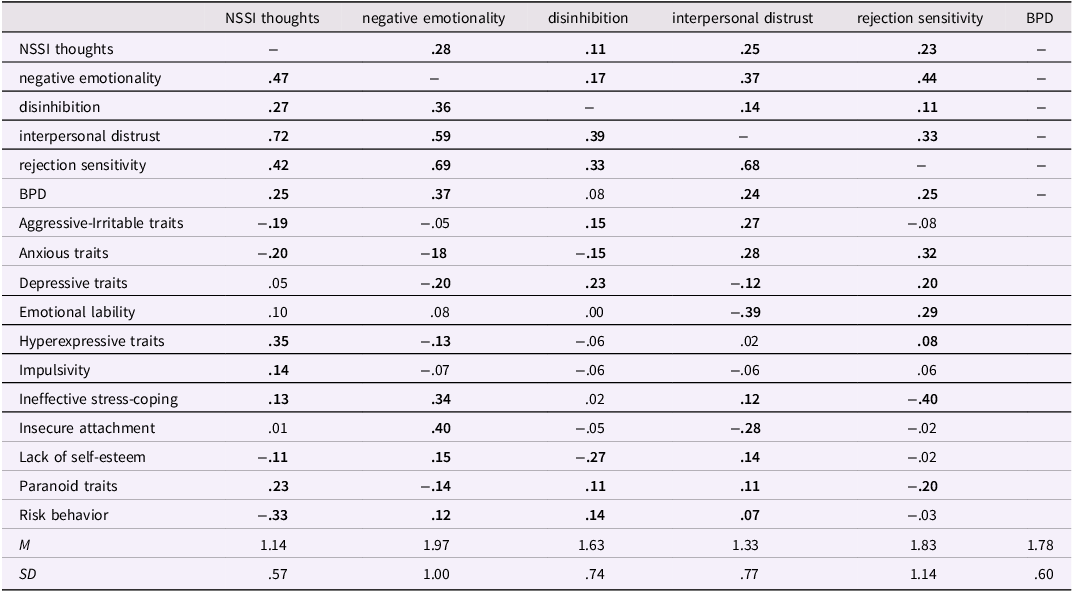
Preliminary analysis. Within- and between-person bivariate associations between all daily assessed variables are provided in Table 1. In young adulthood, daily-reported negative emotionality, disinhibition, interpersonal distrust and rejection sensitivity were significantly positively related to daily NSSI thoughts with coefficients ranging between r = .11 (disinhibition and NSSI thoughts) and r = .28 (negative emotionality and NSSI thoughts) for the within-level, and between r = .27 (disinhibition and NSSI thoughts) and r = .72 (interpersonal distrust and NSSI thoughts) for the between-level. Notably, pre-adolescent BPP traits were also positively related to all daily-reported socio-emotional dysregulation experiences (range between: r = .24 (interpersonal distrust); r = .37 (negative emotionality)) in young adulthood, with the exception of disinhibition (r = .08). 24,5% (n = 32) of participants endorsed NSSI thoughts at least once during the 14-day assessment period, and on average, participants reported 3.25 NSSI thoughts over 14 days. We found that processes with the highest ICCs were NSSI (.74), interpersonal distrust (.50) and rejection sensitivity (.48). This suggests that, on average, approximately half to two-thirds of the variance in these processes may likely be attributed to stable individual differences, and the remaining portion, to daily fluctuations. Socio-emotional processes characterized by a higher proportion of daily variability were internalizing negative emotionality (.38) and disinhibition (.31).
Within (above diagonal) and between-person (below diagonal) bivariate associations between all daily assessed variables and BPD trait vulnerabilities assessed at age 13

N = 131 (between), N = 1202 (within); NSSI = non-suicidal self-injury; BPD = borderline personality traits; Bolded values indicate significance at the 5% level. M = mean; SD = standard deviation.
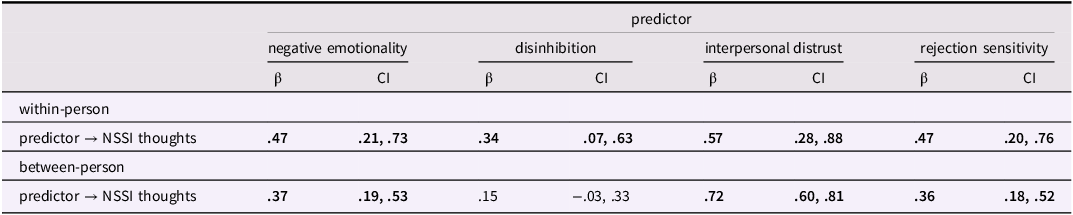
Daily association between socio-emotional dysregulation and NSSI thoughts in Young Adulthood. In Model 1, we examined whether negative emotionality, disinhibition, interpersonal distrust and rejection sensitivity were linked to NSSI thoughts at the within- and between-person levels (left side of Figure 1; Table 2). In line with our first hypothesis, we found a significant positive link at the daily level for all predictors (range of ramdom effects: .34 (disinhibition); .57 (interpersonal distrust)). Thus, on a given day, when individuals experienced higher levels of negative emotionality, disinhibition, interpersonal distrust, or when they felt more sensitive to rejection, their likelihood of experiencing self-harming thoughts was also elevated. This pattern of findings largely extended to the between-person portion of our model. Except for disinhibition (beta = .15; CI = −.03, .33), all predictors were significantly linked to NSSI thoughts in expected directions. Those who on average tended to experience more negative emotionality (beta = .37; CI = .19, .53), to perceive more interpersonal distrust (beta = .72; CI = .60, .81), or tended to be more sensitive to rejection (beta = .36; CI = .18, .52) were also at greater risk of experiencing more self-harming thoughts in general.
Key standardized coefficients from multilevel structural equation models predicting daily NSSI thoughts from negative emotionality, disinhibition, interpersonal distrust, and rejection sensitivity

N = 131 (between), N = 1834 (within); → indicates regression. NSSI = non-suicidal self-injury; Model parameter estimates are standardized. Bolded values indicate that 95% credibility interval of parameter estimates (CI) does not contain zero.
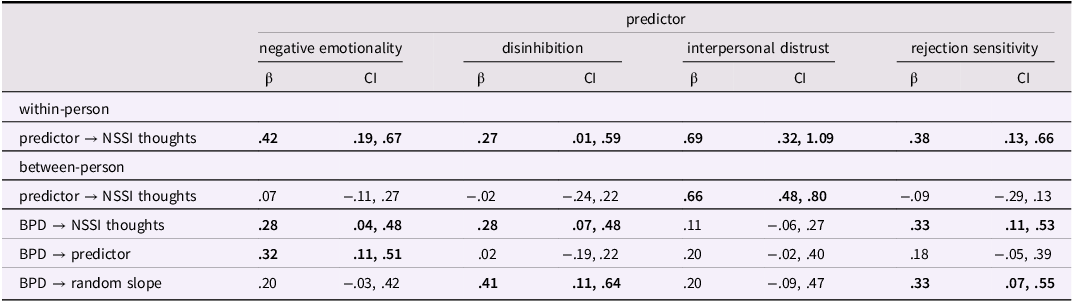
Key standardized coefficients from multilevel structural equation models predicting daily NSSI thoughts from negative emotionality, disinhibition, interpersonal distrust, and rejection sensitivity, and childhood BPD trait vulnerabilities

N = 131 (between), N = 1834 (within); → indicates regression. NSSI = non-suicidal self-injury; BPD = borderline personality compound score assessed at age 12.71; Model parameter estimates are standardized. Bolded values indicate that 95% credibility interval of parameter estimates (CI) does not contain zero.
Cross-level moderation of the compound pre-adolescent BPP trait score. Next, we evaluated whether the four within-person paths in young adulthood varied as a function of pre-adolescent BPP traits (right side Fig. 1; Table 3). Individual differences in the strength of negative emotionality, disinhibition, interpersonal distrust and rejection sensitivity paths were regressed on pre-adolescent BPP traits, as were the intercepts of negative emotionality, disinhibition, interpersonal distrust and rejection sensitivity. After adjusting for covariates, pre-adolescent BPP traits were only positively and significantly linked to negative emotionality (beta = .32; CI = .11, .51). Turning to effects of pre-adolescent BPP traits, adjusted for differences in the predictors, we found that NSSI thoughts were significantly elevated among those with higher parental ratings of BPP traits in pre-adolescence (range between: .28; .32), except for the model including interpersonal distrust as a predictor (beta = .11; CI = −.06, .27). In tests of cross-level interactions (right side Fig. 1), we found that also the daily, within-person link of disinhibition and rejection sensitivity and NSSI thoughts in young adulthood was amplified among those with higher parental ratings of BPP traits in pre-adolescence. These effects were indicated by significant regression coefficients of BPP traits on the within-person link between disinhibition and NSSI thoughts (beta = .41; CI = .11, .64) and between rejection sensitivity and NSSI thoughts (beta = .33; CI = .07; .55). This indicates that there is a stronger temporal coupling between disinhibition or rejection sensitivity and NSSI thoughts among those young adults who were described as scoring higher on BPP traits in pre-adolescence.
Cross-level moderation of individual pre-adolescent BPP traits. In a next step, pre-adolescent BPP traits were entered separately in the model to assess the unique effect of each of the traits on the within-person paths tested in Model 1 (see supplementary Tables C – M for a detailed overview of key coefficients). Overall, pre-adolescent Anxious and Paranoid traits amplified within-person links between young adult daily negative emotionality (Anxious traits: beta = .34; CI = .11, .55; Paranoid traits: beta = .41 ; CI = .19, .59), disinhibition (Anxious traits: beta = .46; CI = .20, .70; Paranoid traits: beta = .57; CI = .34, .78), interpersonal distrust (Anxious traits: beta = .35; CI = .10, .57; Paranoid traits: beta = .46; CI = .22, .65), rejection sensitivity (Anxious traits: beta = .33; CI = .09, .54; Paranoid traits: beta = .36; CI = .13, .56), and the experience of NSSI thoughts. Additionally, except for Risk behavior (beta = .23; CI = −.06, .53), all early developmental BPP traits amplified the daily within-person link between young adult disinhibition and NSSI thoughts (range between: .30; .57).
Furthermore, to uncover the most distinct moderator among all of the pre-adolescent traits, in a final model, they were entered simultaneously to control for shared variance (supplementary Table N). In this model, only pre-adolescent Paranoid traits remained a significant moderator of the within-person link between the daily occurrence of NSSI thoughts in young adulthood and the experience of negative emotionality (beta = .68; CI = .25, 1.08), disinhibition (beta = .84; CI = .29, 1.34), interpersonal distrust (beta = .71; CI = .18, 1.19) and rejection sensitivity (beta = .49; CI = .02, −.01).
Discussion
There is strong evidence for a persistent link between borderline personality pathology and enduring patterns of NSSI in adulthood (Turner et al., Reference Turner, Jin, Anestis, Dixon-Gordon and Gratz2018). Much of the established research, however, has assessed both constructs concurrently, explaining little of the long-term predictive value of early BPP traits for later NSSI. We therefore tested several hypotheses related to the role of pre-adolescent BPP traits for understanding daily NSSI thoughts and socio-emotional dysregulation in young adulthood.
In line with our first hypothesis, we found that in particular perceived interpersonal distrust was concurrently linked to NSSI urges in young adulthood, followed by negative emotionality, rejection sensitivity and disinhibition. This is consistent with evidence stating that increased negative emotionality and interpersonal dysregulation are related to the daily engagement in NSSI urges (Berghoff et al., Reference Berghoff, Dixon-Gordon, Chapman, Baer, Turner, Tull and Gratz2022; Bresin et al., Reference Bresin, Carter and Gordon2013; Turner et al., Reference Turner, Cobb, Gratz and Chapman2016), as well as with previous work suggesting that individuals experiencing behavioral dysregulation in daily life resign into self-injurious behavior, likely due to elevated levels of negative urgency, i.e. the tendency to act rashly when distressed (Peckham et al., Reference Peckham, Jordan, Silverman, Jarvi Steele, Björgvinsson and Beard2020). Our study broadens existing literature in this regard, by illustrating that the demonstrated link between NSSI and socio-emotional dysregulation in adulthood is not limited to NSSI acts but also encompasses NSSI thoughts, suggesting that cognitive mechanisms may play a crucial role in the etiology of manifest NSSI behavior (Allen & Hooley, Reference Allen and Hooley2019).
For the subsequent research aim, the longitudinal associations between early BPP traits as assessed by mothers in pre-adolescence and daily instances of NSSI thoughts in emerging adulthood were explored. Overall, we found that pre-adolescent BPP traits were related to (average levels of) NSSI thoughts in young adulthood, which is in line with established studies suggesting a prospective link between BPP-related temperamental factors and NSSI (Dale et al., Reference Dale, Case, Dyson, Klein and Olino2021). Of particular interest, pre-adolescent BPP traits as a set indeed appeared to amplify the link between young adult disinhibition/rejection sensitivity and NSSI thoughts, confirming that early BPP traits set the stage for contextualized, dynamic processes characteristic of NSSI thoughts in the daily lives many years later (Nock, Reference Nock2009).
When exploring the predictive role of all pre-adolescent BPP traits individually, the strongest and most consistent early predictor of the daily link between socio-emotional dysregulation and NSSI thoughts in young adulthood was paranoid traits, followed by anxious traits. These findings underline the plausibility of the earlier described etiological mechanisms that shape NSSI development, and may suggest that both interpersonal distrust as well as anxiety at the beginning of an important transition phase (pre-adolescence) may represent a common dispositional vulnerability that can be framed from an attachment-mentalization-based perspective (Fonagy & Bateman, Reference Fonagy and Bateman2008). At that age, the normative milestones in basic secure attachment and emotion management are generally obtained, making children armed to enter the adventure of adolescence. The current findings show that when feelings of distrust and suspiciousness towards others (paranoid traits) as well as a general tendency to expect the worst to happen (anxious traits) are manifest psychological features in pre-adolescence, the necessary foundation for a healthy socio-emotional functioning later in life has not been laid. Potentially, this distrustful and anxious phenotype at pre-adolescence evolves from an insecure emotional attachment process that unfolded over the childhood years, within a complex interactional process of child and parenting factors (Musetti et al., Reference Musetti, Pingani, Zagaria, Uberti, Meli, Lenzo, Gori, Franceschini and Galeazzi2022; Riggs, Reference Riggs2010). As a result, these children have not developed the necessary skills required for their ability to mentalize and to manage emotions, nor have they obtained a basic feeling of self-worth (Gandhi et al., Reference Gandhi, Luyckx, Goossens, Maitra and Claes2018; Sharp et al., Reference Sharp, Venta, Vanwoerden, Schramm, Ha, Newlin, Reddy and Fonagy2016; Tao et al., Reference Tao, Bi and Deng2020). In the event of socio-emotional distress many years later, overwhelming feelings caused by perceived social threats may then lead to self-destructive behavior (Sharp et al., Reference Sharp, Venta, Vanwoerden, Schramm, Ha, Newlin, Reddy and Fonagy2016) as a maladaptive coping strategy to regulate negative emotions, to communicate their need for help to others or to forge a connection with their segregated feelings of identity (Cawood & Huprich, Reference Cawood and Huprich2011; Di Pierro et al., Reference Di Pierro, Sarno, Gallucci and Madeddu2014, Hatkevich et al., Reference Hatkevich, Penner and Sharp2019; Luyten et al., Reference Luyten, Campbell and Fonagy2020; Yurkowski et al., Reference Yurkowski, Martin, Levesque, Bureau, Lafontaine and Cloutier2015). In this way, the interplay of early anxiousness and suspiciousness with other factors can represent a core early vulnerability factor that increases the likelihood of later self-harm.
Among the subset of early negative emotionality traits, it is noteworthy that only anxious traits exhibits a moderating influence on the daily association between young adult negative emotionality, interpersonal distrust, rejection sensitivity, and NSSI thoughts. The other aspects of negative emotionality (depressivity, emotional lability, and lack of self-confidence) did not play a significant role in this later daily association between socio-emotional adversity and NSSI thoughts. It should be noted, however, that while anxiousness was the only significant moderator, the other negative emotionality traits measured in pre-adolescence still demonstrated their relevance, as they contribute to the expression of either daily trait manifestations or levels of NSSI thoughts in young adulthood, highlighting their importance as distal risk factors that operate through distinct mechanisms compared to anxiousness.
Despite previous research linking impulsivity to the onset of NSSI in adolescence (Cassels et al., Reference Cassels, Neufeld, van Harmelen, Goodyer and Wilkinson2022), it seems that in pre-adolescence high impulsivity (when isolated from other manifestations of psychopathology) may rather be considered as part of normative turmoil and may therefore not be indicative of an increased risk for the development of NSSI in emerging adulthood. Nonetheless, it may be possible that impulsivity becomes a more significant antecedent of NSSI later in the developmental trajectory. This hypothesis can be advocated from a natural maturation process, with children gradually transitioning towards enhanced self-control and reduced impulsivity, and deviating trajectories from the normative mean becoming increasingly clinically relevant. Similarly, our findings did not support a unique moderating role of pre-adolescent Insecure attachment in the daily link between young adult NSSI thoughts and socio-emotional dysregulation, but only supported this hypothesis for the Paranoid traits facet. However, this finding may be understood from the current operationalization of this trait in the daily diary study, using an item referring to “ensuring help of others” hence tapping into behavior that can be considered normative in pre-adolescence. This operationalization may hence have failed to differentiate vulnerable from non-vulnerable children, due to its normative presence during this age stage. From this perspective, the long-term significant role of interpersonal distrust as suggested by the biosocial (Linehan, Reference Linehan1993) and (hyper)mentalizing theories (Fonagy & Bateman, Reference Fonagy and Bateman2008; Sharp & Vanwoerden, Reference Sharp and Vanwoerden2015), is in the current study empirically confirmed from the paranoid traits facet, which clearly taps into the core of insecure attachment.
Implications
Some clinical implications can be drawn from this study. The empirical identification of specific early intra-personal vulnerability factors for adult NSSI is crucial, because it underscores the relevance of indicated prevention tailored toward youth with a particular phenotypic combination of BPP traits. From the perspective of prevention of NSSI, this is notably important given the negative and harmful consequences associated with NSSI and its co-occurrence with suicide attempts (Ribeiro et al., Reference Ribeiro, Franklin, Fox, Bentley, Kleiman, Chang and Nock2016). In this regard, our findings indicate that enhancing early socio-cognitive abilities is crucial for reducing the risk to later engage in NSSI when confronted with negative experiences and perceptions. As such, Mentalization-based therapy (Bateman & Fonagy, Reference Bateman and Fonagy2004) may be a promising approach in youth high on interpersonal distrust, because this framework addresses the developmental perceptual and attributional biases that lead to feelings of fear, distrust, and suspicion towards others. As these socio-cognitive processes are still in full development during adolescence, a greater plasticity and thus a significant training effect can be expected. Additionally, early interventions may also be oriented towards training effective emotion-regulation strategies before entering the challenging developmental phase of adolescence (Thomassin et al., Reference Thomassin, Guérin Marion, Venasse and Shaffer2017), given that a lack of emotion-regulation skills and overwhelming feelings of anxiety during pre-adolescence increase the risk for later self-harm when confronted with socio-emotional challenging situations.
Strengths & limitations
This study relied on longitudinal data, spanning 10 years from childhood to young adulthood, and early trait vulnerabilities were assessed with a validated age-sensitive measure (De Clercq et al., Reference De Clercq, De Fruyt, Van Leeuwen and Mervielde2006). Whereas these early BPP traits were assessed by mothers, self-reports were used in young adulthood. Accordingly, shared measurement variance is avoided by relying on this multi-informant approach. Although prior work suggests significant discrepancies between youth and parent personality ratings (Göllner et al., Reference Göllner, Roberts, Damian, Lüdtke, Jonkmann and Trautwein2017), research has stated that for the prediction of NSSI, maternal reports of personality may be most useful as they have stronger predictive validity (Dale et al., Reference Dale, Case, Dyson, Klein and Olino2021). Additionally, our assessment of NSSI thoughts is based on information obtained in daily lives of young adults, revealing how trait vulnerabilities may project into daily experiences in the natural habitat of young adults.
Despite these strengths our work needs to be evaluated in light of some limitations. First, it is important to note that our variable NSSI thoughts exhibited a high ICC of .74. This suggests that NSSI thoughts demonstrated strong between-person differences, which is important to consider when differentiating interventions aimed at addressing fluctuations on a daily basis from those targeting the more enduring differences between individuals in terms of NSSI. Future research should delve into the development of targeted intervention strategies that can effectively address these distinct aspects of NSSI thoughts. Second, our daily measures rely on self-reports, however, evidence suggests that different raters are sensitive to different aspects of dysregulation (e.g., affective versus behavioral; Oltmanns & Widiger, Reference Oltmanns and Widiger2021). Thus, it is important for future research to include different raters on BPP-related dysregulation in order to gain a more complete picture of the context in which NSSI occurs. Third, dysregulation and NSSI thoughts were measured with a single assessment at the end of the day, holding the possibility of a retrospective recall bias that affects daily reconstructive reports (Turner et al., Reference Turner, Jin, Anestis, Dixon-Gordon and Gratz2018). As socio-emotional dysregulation may vary frequently throughout the day, an ecological momentary assessment design would allow the assessment of more fine-grained processes (Kaurin et al., Reference Kaurin, King and Wright2023). Furthermore, no validated measure of daily borderline-related dysregulation was used, however, items were based on research confirming risk factors of NSSI (Moselli et al., Reference Moselli, Casini, Frattini and Williams2021; Turner et al., Reference Turner, Jin, Anestis, Dixon-Gordon and Gratz2018) and formulated along the trait criterion B of the Alternative Model for Personality Disorders (APA, 2013). Furthermore, daily-measured constructs were operationalized along one to three items, in order to guarantee the response rate over the course of 14 days. However, this approach may have limitations in capturing the full complexity of each construct. Because we did not assess NSSI thoughts at baseline in our study, it is possible that participants with higher BPP traits may already have exhibited NSSI at baseline, which could potentially explain the patterns of NSSI thoughts in adulthood. Additionally, it is essential to acknowledge that only 45% of participants from the baseline wave participated in the daily diary wave. Lastly, it is important to note that our study focused on assessing the thoughts to engage in non-suicidal self-injurious behavior, rather than on the actual acts of self-harm. However, research has shown that NSSI thoughts, or the intense desire to engage in self-harm behaviors, can serve as a significant precursor to NSSI acts (APA, 2013; Ribeiro et al., Reference Ribeiro, Franklin, Fox, Bentley, Kleiman, Chang and Nock2016). Studies have more specifically found that NSSI thoughts are common among individuals who are prone to self-harm (Bresin & Gordon, Reference Bresin and Gordon2013), and can predict the frequency of NSSI acts in the following year (Turner et al., Reference Turner, Jin, Anestis, Dixon-Gordon and Gratz2018) as well as the frequency of NSSI at the time of discharge from treatment (Washburn et al., Reference Washburn, Juzwin, Styer and Aldridge2010).
Conclusion
Our findings provide evidence for the long-term predictive validity of pre-adolescent BPP traits for NSSI thoughts in young adults’ daily lives. Along the integrated model of NSSI development (Nock, Reference Nock2009), our findings suggest that pre-adolescent anxious and paranoid traits may serve as important distal risk factors for the engagement in NSSI in emerging adulthood, particularly when experiencing socio-emotional dysregulation. This finding highlights the need for early identification and intervention strategies that target these specific traits, in order to prevent the developmental cascade toward explicit NSSI and prevent long-term negative outcomes. These interventions may focus on strengthening socio-cognitive capacities on the one hand, and improved emotion-regulation strategies on the other, in order to reduce the risk for later self-harm when confronted with interpersonal challenging situations. Furthermore, our findings also underscore the importance of naturalistic methods to capture the projection of pre-adolescent trait vulnerabilities into daily processes of socio-emotional dysregulation, allowing for a more comprehensive understanding of the underlying mechanisms and risk factors associated with NSSI.
Supplementary material
The supplementary material for this article can be found at https://doi.org/10.1017/S0954579423001438.
Acknowledgements
None.
Funding statement
This research received no specific grant from any funding agency, commercial or not-for-profit sectors.
Competing interests
None.
Ethical approval
Approved by the institutional review board of Ghent University (No. 2007/21). This study was performed in line with the principles of the Declaration of Helsinki.
Consent to Participate
Informed consent and assent were obtained from all participants.