INTRODUCTION
Fan worms (Sabellidae) are usually found in shallow benthic marine habitats but records of members of this group of polychaetes in other environments have also been documented. There are, for example, species typically inhabiting benthic fresh water environments, like members of the genera Manayunkia and Caobangia (Leidy, Reference Leidy1858; Giard, Reference Giard1893; Jones, Reference Jones1974), and others that have been reported from deep sea waters, such as members of Fabrisabella, Perkinsiana, Potamilla, Potamethus, Potaspina and Euchone (Hartman, Reference Hartman1965; Knight-Jones, Reference Knight-Jones1983; Capa, Reference Capa2007 and references therein). Some sabellids tolerate highly variable conditions. Examples are Pseudopotamilla sp. A, found in a wide range of habitats from the intertidal to 800 m in Australia (Capa, Reference Capa2007 and personal observation); some Amphiglena species, inhabiting coralline algae in the superior intertidal zone (e.g. Capa & Rouse, Reference Capa and Rouse2007); or several Laonome species, living in estuarine conditions, with abrupt changes in salinity and temperature conditions (e.g. Hutchings & Murray, Reference Hutchings and Murray1984; Capa et al., submitted).
In the present paper we report for the first time a Bispira species from a deep-sea hydrothermal vent. The specimens collected at the Izena Hole, in the middle of the Okinawa Trough, have been identified as members of Bispira wireni, a scarce species reported only twice from other areas in Japan, Sagami Bay and Tokyo Bay, between 150 and 300 m deep (Johansson, Reference Johansson1922; Nishi et al., Reference Nishi, Sueyoshi-Dewa and Dewa2000). The present record constitutes an expansion of the geographical and bathymetrical range for this species.
Twenty-two species have been assigned to the genus Bispira (Knight-Jones & Perkins, Reference Knight-Jones and Perkins1998; Tovar-Hernández & Salazar-Vallejo, Reference Tovar-Hernández and Salazar-Vallejo2006; Costa-Paiva & Paiva, Reference Costa-Paiva and Paiva2007; Capa, 2008; Faasse & Giangrande, Reference Faasse and Giangrande2012) but the validity of the genus is uncertain since monophyly still needs assessment (Fitzhugh, Reference Fitzhugh1989, Reference Fitzhugh2003; Rouse & Fitzhugh, Reference Rouse and Fitzhugh1994; Fitzhugh & Rouse, Reference Fitzhugh and Rouse1999; Capa, 2008). Members of Bispira have been reported from Antarctica to the Artic Sea, including several tropical localities from the Atlantic and Indo-Pacific. Several species are confined to shallow water environments (less than 50 m deep), but others are typical from continental shelves and slopes, ranging 50–300 m deep. These are B. oatesiana (Benham, Reference Benham1927), from Antarctica; B. secusulotus (Hoagland, Reference Hoagland1920), from the Philippines; B. pacifica (Berkeley & Berkeley, Reference Berkeley and Berkeley1954), from Canada and B. mariae Lo Bianco, Reference Lo Bianco1893, from Naples (see Knigth-Jones & Perkins, 1998).
The hydrothermal vent field in the Izena Hole (27°16′N 127°04–05′E: 1310–1580 m depth), was discovered in 1988 (Kimura et al., Reference Kimura, Tanaka, Kyo, Ando, Oomori, Izawa and Yoshikawa1989). The fauna associated with this site to date includes the decapods Shinkaia crosnieri and Alvinocaris longirostris, barnacles belonging to the genus Neolepas, the bivalves Bathymodiolus platiforns and Calyptogena okutanii and a few polychaetes such as some vestimentiferans and Paralvinella hessleri (Kimura et al., Reference Kimura, Tanaka, Kyo, Ando, Oomori, Izawa and Yoshikawa1989; Tanaka et al., Reference Tanaka, Hotta, Sakai, Ishibashi, Oomori, Izawa and Oda1990; Miura & Ohta, Reference Miura and Ohta1991; Kojima, Reference Kojima2002; Watanabe et al., Reference Watanabe, Tsuchida, Fujikura, Yamamoto, Inagaki, Kyo and Kojima2005; and see http://www.godac.jamstec.go.jp/bismal/view/0001264 for collection data).
MATERIALS AND METHODS
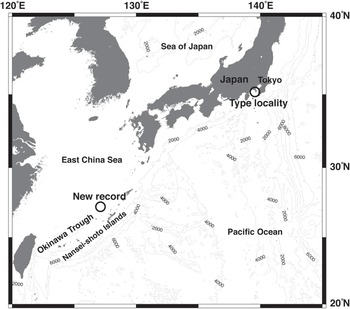
A dive of the ROV ‘Hyper-Dolphin' (Dive No. 1193) of the Japan Agency for Marine–Earth Science and Technology (JAMSTEC) was conducted on 22 September 2010, near JADE hydrothermal vent site in the Izena Hole, the Okinawa Trough, southern Japan (Figure 1). In situ observations were made using a digital Hi-Vision TV camera mounted on the ROV (Figure 2). Specimens were fixed in 99.5% ethanol. Some parapodia were gently squeezed between a microscope slide and cover glass while in glycerine for observation of chaetae under the microscope. Transverse sections of the radioles were also observed under the microscope, for the study of the internal structure and supporting ‘skeleton’. Some parapodia were dehydrated and critical point dried, covered with palladium, and uncini were observed under the scanning electron microscope (SEM) JSM-4600. Drawings were made from micrographs (Figure 3). Multifocus photographs were made using a Leica DFC 420 camera attached to a Leica MZ16A light microscope, merged into single images with the LAS V 3.7 software.
Collection sites of Bispira wireni.

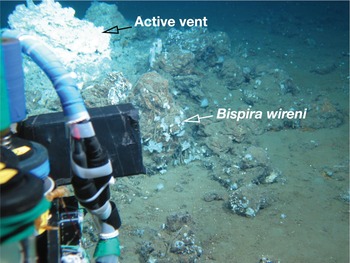
Living Bispira wireni near an active vent. In situ photograph by the ROV ‘Hyper-Dolphin'.

Drawings of Bispira wireni (CBM-ZW-1054): (A) base of crown and thorax, dorsal view; (B) same, ventral view; (C) lateral view; (D) base of crown showing detail of dorsal lip (dl), ventral lip (vl) and dorsal appendage (da); (E) distal part of radiole; (F–I) section of radiole at base (F), 1/4 (G) mid-basal (H) and middle part (I); (J) superior thoracic chaetae at 6th chaetiger; (K, L) inferior thoracic chaetae at 6th chaetiger; (M) companion chaeta; (N) thoracic uncini at 6th chaetiger; (O) thoracic uncini at 4th chaetiger, drawn from SEM micrograph; (P) abdominal chaeta; (Q) abdominal uncini; (R) lateral view of 3rd and 4th abdominal chaetigers. Scale bars: A–C, 1 mm; D–I, R, 0.5 mm; J–N, P, Q, 0.01 mm; O, 0.005 mm.

Studied specimens have been deposited in the Natural History Museum and Institute, Chiba, Japan (CBM) and Australian Museum, Sydney, Australia (AM). Type material from the Zoological Museum, University of Uppsala (ZMUU) was studied for comparison.
RESULTS
SYSTEMATICS
Order SABELLIDA Latreille, Reference Latreille1825
Family SABELLIDAE Latreille, Reference Latreille1825
Bispira wireni (Johansson, Reference Johansson1922)
Figure 3
Sabella wireni Johansson, Reference Johansson1922: 3, 4, pl. 1, figure 1, pl. 2, figures 1–6; 1927: 127, 128; Imajima & Hartman, Reference Imajima and Hartman1964: 363, 364.
Bispira wireni: Knight-Jones & Perkins, Reference Knight-Jones and Perkins1998: 439–441, figure 23, Nishi et al., Reference Nishi, Sueyoshi-Dewa and Dewa2000: 11.
TYPE LOCALITY
Okinose, near Misaki in Sagami Bay, Japan, 300 m.
MATERIAL EXAMINED FOR PRESENT STUDY
Holotype: ZMUU 218a, Okinose, near Misaki in Sagami Bay, Japan, 300 m.
Paratypes: ZMUU 218b and c, Okinose, near Misaki in Sagami Bay, Japan, 300 m.
Additional material: CBM-ZW-1054 (5 specimens), and AM W.42901 (2 specimens), Izena Hole near hydrothermal vent field, Okinawa Trough, 27°16.2′E 127°4.8′E, JADE site, 1335 m, by K. Fujikura, JASMTEC, 22 September 2010.
DESCRIPTION
Body 15–20 mm long and 3–4 mm wide at thorax, with eight thoracic (Figure 3A–C) and 30–40 abdominal segments. Circular in section in thoracic and anterior abdominal segments and flattened dorsoventrally in posterior abdominal region. Branchial crown 15–18 mm long (about the length of body), with lobes slightly involuted ventrally. Dorsal basal flanges absent (Figure 3A, D). Each branchial lobe with around 17–20 pairs of radioles, with narrow paired lateral flanges of similar width along their length (Figure 3E, I) and connected basally by short basal membrane (1.0–1.5 mm) of less than the length of one thoracic segment (Figure 3D). Tips of radioles smooth and fine, similar in length or slightly shorter than mid-radiole pinnules (Figure 3E). Radiolar eyes absent. Axial skeleton composed of four main transverse rows of vacuolated cells, some sections with six–eight cells at the base (Figure 3F–I); no vacuolated cells supporting the lateral flanges (Figure 3I). Dorsal lips with dorsal radiolar appendages of about the length of two thoracic segments, with radiolar appendage skeleton; dorsal lip radiolar lamellae without pinnular appendages (Figure 3D). Ventral lips and parallel lamellae well developed, with a pair of rounded and white ventral sacs, located exterior to branchial crown, exceeding the length of collar ventrally (Figure 3B, D). Collar covering the junction of crown and thorax, with margins separated dorsally by a wide gap (Figure 3A), with lateral margins similar in length, increasing in length ventrally and forming the two rounded ventral lappets; divided mid-ventrally by a long incision (Figure 3B, C). First segment slightly shorter than other thoracic ones, measured dorsolaterally (Figure 3A, C). Ventral shield of first chaetiger with anterior margin distinct, W-shaped and without pigmentation (Figure 3B). All thoracic tori separated from ventral shields (Figure 3B, C). Small black interramal eyespots present on both thoracic and abdominal chaetigers (Figure 3R), sometimes inconspicuous in thoracic region. Wide faecal grove on thoracic dorsum, thin and narrow on abdominal ventrum. Collar chaetae with long broadly hooded chaetae, with a thin limbation visible on both sides of the axis. Rest of thoracic segments with chaetae arranged in two rows; superior chaetae long (10–14 chaetae), elongate narrowly hooded (Figure 3J), inferior chaetae in two tiers (18–30 chaetae) with shorter spine-like chaetae, with a hood 1.5–2 times the width of shaft (Figure 3K, L). Neuropodia with uncini progressively smaller towards ventrum. Uncini with around 8–12 rows of teeth above the main fang, similar in size, occupying half of its length (Figure 3N, O); well-developed breast, long neck and short handle of similar length to the distance of main fang to breast (Figure 3N), slightly longer in ventral most uncini. Companion chaetae with a distal teardrop shaped membrane (Figure 3M). Abdominal chaetigers with neurochaetae arranged in two rows with a C-shape, on elevated neuropodia (Figure 3R), superior chaetae (5–7 chaetae), elongate narrowly hooded and inferior abdominal chaetae spine-like (8–9 chaetae), with hood up to 1.5 times wider than shaft (Figure 3P). Posterior segments lacking spine-like chaetae and with only about three elongate narrowly hooded chaetae present. Abdominal uncini similar to those in thoracic region, with around ten rows of teeth above main fang and handle similar in length to the distance of main fang to breast (Figure 3Q). Pygidium with median incision, and two subtriangular lateral structures; dark red small pygidial eyespots on both sides of pygidial lobes. Tube made of dark mud with an inner thick layer of solidified mucus, hard to tear off.
COLOUR PATTERN
Body and crown pale, colourless, with only some small eyespots visible between noto- and neuropodia of thoracic and abdominal segments.
REMARKS
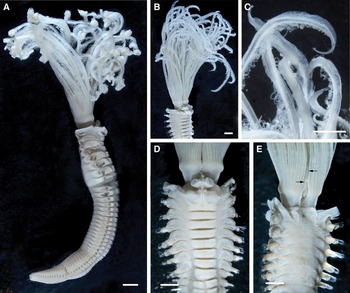
The specimens described herein mostly agree with the types of Bispira wireni, but some variations have been observed. Specimens from the Izena Hole have narrow radiolar flanges (being as broad as the radiolar rachis in the types; Figure 4C) and not supported by the radiolar skeleton (unlike the holotype; Knight-Jones & Perkins, Reference Knight-Jones and Perkins1998: 440, figure 23E). Moreover, the number of vacuolated cells supporting the radioles are generally four, but increasing to 6–8 in distal ends, while specimens from Izena Hole are the opposite, only the base showed to bear 6–8 rows of vacuolated cells. The size of the specimens described herein is similar to the holotype (body of 17 mm and crown of 15 mm) so the variation shown in these characters cannot be attributed to differences in size. However, we consider these differences as part of the intraspecific variation and insufficient to describe these specimens as a new species to Science.
Photographs of type material of Bispira wireni from Sagami Bay, Japan: (A) holotype ZMUU218a. Entire individual lateral view; (B–E) paratype ZMUU218B; (B) radiolar crown and anterior thoracic segments, ventral view; (C) types of radiolas, showing well developed radiolar flanges; (D) base of radiolar crown, thoracic and first abdominal segments, ventral view; (E) same, dorsal view; arrows point to narrow dorsal basal flanges. Scale bar: 1 mm.

Types collected in Sagami Bay were characterized by the absence of radiolar eyes (Figure 4A–C), presence of narrow radiolar flanges that increase in width to distal ends (Figure 4C) and supported by the radiolar skeleton of radioles, presence of a low basal membrane, absence of dorsal basal flanges (although a very narrow lappet has been observed in one paratype; Figure 4E), thoracic ventral shields separated from tori by a wide gap (Figure 4B, D), first segment similar in width to the following (Figure 4A, E) and thoracic uncini with several rows of teeth similar in size and with a long neck. The specimens collected in Izena Hole share all these features with the types of Bispira wireni.
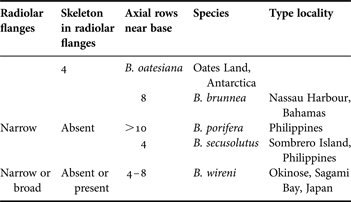
Other nominal species of Bispira lacking radiolar eyes are B. oatesiana from Antartica, B. brunnea from the Bahamas and B. porifera and B. secusolutus both from the Philippines. Bispira wireni differs from these species in the presence of radiolar flanges supported by the radiolar skeleton and also the absence of dorsal basal flanges (see Table 1). Moreover, B. wireni has a first chaetiger similar in width and length to the following (while B. porifera and B. secusolutus have long first segments), has the thoracic dorsum smooth (while B. porifera presents a spongy cushion) and has four vacuolated cells in the base of radioles (instead of the eight supporting the radioles in B. brunea or the more than ten in B. porifera).
Species of Bispira lacking radiolar eyes (modified from Capa, 2008).

DISTRIBUTION RANGE AND ECOLOGY
Bispira wireni has not been recorded outside Japan, with type series reported from Sagami Bay, at 300 m deep (Johansson, Reference Johansson1922) and a recent note from the Tokyo Bay, at 150 to 300 m deep (Nishi et al., Reference Nishi, Sueyoshi-Dewa and Dewa2000). The depth range is increased herein after the finding of some specimens at 1350 m. Before the present study, nothing was known about its habitat (Knight-Jones & Perkins, Reference Knight-Jones and Perkins1998), but collection data of the recently collected specimens indicate that this species lives on rocks and in sediments, 1 m from an active vent (Figure 1).
CONCLUSIONS
The present discovery is regarded as the first record of a Bispira species from hydrothermal vents and also below 300 m. The new record of B. wireni in the Okinawa Trough expands the geographical range 1000 km to the west and 800 km to the south (most southern record along the Japan Trench; see Figure 1) and it also increases the depth range of the species to more than 1300 m. This new material allows the redescription of the species, including more morphological variation than that shown in the type series, and including some features not taken in to account previously. The presence of B. wireni near hydrothermal vents indicates that the species is eurythermal, as has also been reported for other polychaetes widely distributed in hydrothermal deep-sea vents, like Paralvinella hessleri (Ohta & Kim, Reference Ohta and Kim2001).
ACKNOWLEDGEMENTS
We thank Drs Shinkuke Kawagucci and Hiromi Watanabe (both JAMSTEC), and the crews of RV ‘Natsushima', and the operation team of ROV ‘Hyper-Dolphin' for assistance with this study. We are grateful to Erica Sjölin (ZMUU) for the loan of the types of Bispira wireni. The study was partly supported by a postdoctoral position in NTNU (M.C.), the Environmental Research and Technology Development Fund (S9) of the Ministry of the Environment, Japan, and by KAKENHI No. 22510100 (to E.N.) and the Environmental Research and Technology Development Fund (S9) of the Ministry of the Environment, Japan (to K.T. and K.F.).