INTRODUCTION
Glucocorticoid (GC) receptors are widely distributed throughout the brain and research shows that morphological and functional brain changes are found under conditions of chronic overexposure to exogenous and endogenous GCs (Ling et al., 1981; Lyons et al., 2000; Newcomer et al., 1994; Newcomer et al., 1999). For example, research has shown associations between high levels of GCs and memory changes in otherwise healthy older adults (Lupien et al., 1994) and mild cognitive impairment (Wolf et al., 2002), as well as an association between higher cortisol levels and smaller hippocampal volumes in Alzheimer's disease patients (O'Brien et al., 1996). More recently, MacLullich and colleagues (2005) found higher cortisol levels to be associated with difficulties on cognitive measures in healthy older men.
Cushing's Syndrome (CS) is likely one of the best human models to study the effects of cortisol on the brain structure and function, because this disease is marked by high levels of GC. Whereas there are a number of possible etiologies for CS, the leading cause is an adenoma of the pituitary gland and this specific cause is referred to as Cushing's disease (CD). In other words, CD refers only to patients who have CS as a result of an adenoma on the pituitary gland. As noted, the hallmark symptom of CD is the overproduction of cortisol and successful treatment of CD leads to amelioration of hypercortisolemia. As such, we can explore not only the effects of elevated levels of GC on neuropsychological functioning, but also examine what if any negative effects may be ameliorated with successful treatment of the disease.
Past research has shown that patients with active CD have morphologic brain changes, specifically hippocampal formation volume (HFV) decreases, which are associated with concomitant changes in cognition, particularly memory (Bourdeau et al., 2002; Starkman et al., 1992; Starkman et al., 1999; Starkman et al., 2003). In addition, after successful treatment of CD the HFV was found to increase (Starkman et al., 1999). The degree of increase in HFV was associated with decrease in cortisol levels (Starkman et al., 1999) as well as improvement on tests of memory (Starkman et al., 2003).
Although there is an apparent association between cognitive dysfunction and cortisol, only a handful of studies have used active CS as a model to examine the effects of neuropsychological functioning in comparison to healthy controls, with even fewer including only CD patients to ensure a more homogeneous group of patients with more clearly characterized neurohormonal dysregulation (Dorn & Cerrone, 2000; Forget et al., 2000; Martignoni et al., 1992; Mauri et al., 1993; Starkman et al., 2001). Of these studies, four have reported significantly lower functioning of active CS or CD patients on various neuropsychological tests, including those of memory and intellectual functioning (Forget et al., 2000; Martignoni et al., 1992; Mauri et al., 1993; Starkman et al., 2001), whereas another investigation found no significant differences on tests of cognitive functioning (Dorn & Cerrone, 2000). Overall the effects of chronic elevation of GC would seem to be associated with some cognitive dysfunction.
Even fewer studies have examined the possible recovery of cognitive function following the return of cortisol levels to normal after treatment of CS. Mauri et al. (1993) reported that six months after successful treatment of CD, patients showed significant improvement on tests of immediate and delayed recall of verbally presented short stories, as well as on a test sensitive to disruptions of brief attention (i.e., digit span forward). In contrast, another study at 12 months after treatment (Forget et al., 2002) showed a different pattern of cognitive recovery. Forget and colleagues (2002) found that treated CS patients improved significantly only on a task of visual organization and a test of phonemic fluency, but not on tests of attention, memory, reasoning, language, or visual spatial processing. A possible explanation for differences in these findings is that Forget et al. (2002) used a more heterogeneous group of patients (i.e., those with CS), whereas Mauri et al. (1993) included only CD patients.
Given evidence that high levels of cortisol are associated with smaller HFV and negative effects on cognition (Starkman et al., 1999; Starkman et al., 2003), we sought to better understand whether the negative effects of cortisol on cognition can be reversed and, if so, how soon following successful treatment might this recovery begin. Because this is one of the first studies of its type, our primary aim was to characterize when cognitive change begins to occur following successful surgical treatment of CD. For our study, we examined only those with CD in an effort to decrease the heterogeneity of our sample, and we followed patients over repeated post-surgical assessment. A secondary aim was to correlate these cognitive findings with change in the HFV and cortisol. This latter aim has been more thoroughly examined in the literature (e.g., Starkman et al. 1999; Starkman et al., 2003), and we hoped to support previous research. A third aim of this project was to examine possible mitigating factors to cognitive recovery, such as duration of illness of CD and age of participant. In particular, we felt that age would be an interesting covariate to examine, particularly because high levels of cortisol have been implicated by some in cognitive decline in older adults (Lupien et al., 1994; Pomara et al., 2003). Specifically, we hypothesized that compared to younger patients, older patients will be more susceptible to the deleterious effects of cortisol and would take longer to rebound in terms of cognitive functioning following successful corrective surgery.
METHODS
Participants
Participants (N = 27) included patients diagnosed with CD. These patients had high cortisol and ACTH levels, absent or blunted circadian rhythms, and positive response to corticotropin releasing hormone (CRH). Participants were then followed in the Ambulatory Endocrine Clinic by one of the authors (DES) at approximately 3–5-month intervals post successful surgical treatment. Mean follow-up intervals from surgery were 103.36 days (SD = 33.99), 290.80 days (SD = 66.26), and 458.07 days (SD = 53.01).
Patients who had unsuccessful surgery (e.g., continued to have elevated cortisol post-surgery) were treated medically and were not included as participants in this study. None of the 27 participants had significant complications from surgery. This study was approved by the University of Michigan's Institutional Review Board for Medical Experimentation (IRBMED).
Entire sample
Ages of participants ranged from 18 to 72 years with a mean-age of 38.74 (SD = 13.24). Education level of the participants ranged from 9 to 17 years with a mean of 13.41 years (SD = 2.02). Twenty-three of the participants were female, and four were male, matching the usual gender distribution of this illness. Estimated duration of illness ranged from .50 to 10.00 years with a mean of 3.64 years (SD = 3.09). Duration of illness was determined through history and review of old photographs. This is a common method for estimating the onset of CD by looking for the earliest physical signs of the disorder (e.g., facial plethora), usually noticeable before a patient seeks treatment. In addition, typically, the disease can be easily recognized on a general medical examination.
Older and younger groups
Age was found to be a significant covariate and to better understand the effects of age on our dependent measures, we used a median-split for age to divide persons into older and younger groups. There were 14 participants in the younger group whose ages range from 18–39 years. There were 13 participants in the older group whose ages range from 40–72 years. These two groups did not statistically differ in their duration of illness, level of education, gender, or level of depression at baseline or at one-year follow-up.
Attrition
As previously noted, our evaluations mirrored CD patients' clinical follow-up sessions, and, unfortunately, not all patients returned for all follow-up appointments. Of the 27 participants who participated in the pre-surgical evaluation and at least one follow-up session: 11 participants (6 younger and 5 older participants) attended the 3–5 month follow-up session, 20 participants (10 younger and 10 older) attended the 6–12-month session, and 14 participants (8 younger and 6 older) attended the 13–18-month session. The primary factor for attrition was travel distance to the medical center. Gender, age, and education level were not found to be statistically significant factors associated with the number of sessions attended.
Neuropsychological and Psychological Measures
Buschke Selective Reminding Test
The SRT is an eight trial word-list learning task of unpaired words. On the initial trial, participants are read all 12 words and then asked to recall as many words as possible, regardless of order (Buschke & Fuld, 1974). With the subsequent trials, participants are asked to state the 12 words, and they are selectively reminded of the words they could not recall from the previous trials. Researchers have shown that poorer scores on the SRT are related to abnormalities in the left temporal lobe, specifically the left hippocampus (Martin et al., 1988; Sass et al., 1990). Alternate, equated test forms were used for each patient at each test session.
Digit span
This subtest of the Wechsler Adult Intelligence Test-Revised is comprised of two parts (Wechsler, 1981). The first is a forward span task, during which participants are asked to repeat a series of numbers as they are read to them, and the second is a backward span task, during which participants are asked to repeat the series of numbers in reverse order. During each task, the list of numbers becomes longer by increments of one. Participants are given two trials at each number length, with the failure to successfully complete two repetitions of the same number length ending the task. This subtest is sensitive to disruptions of brief attention (forward span) and working memory (backward span). Alternate test forms were used.
Verbal fluency
This task examines people's expressive language abilities and has been shown to relate to executive function and functional attention (Benton, 1968; Kimura, 1984; Ruff et al., 1996). Participants are given one-minute to state as many words as they can that begin with the letter “d, as in dog.” The participants were informed that they would not be given credit for proper nouns (i.e., names of people or places), and that each word must be distinct, such that “dog” and “dogs” would not count as two separate words. The total score is the number of acceptable words that the participant generates in one-minute. “D” words were chosen, as this letter has the highest frequency and imagery ratings for words, suggesting reasonably minimal practice effects (Kimura, 1984).
Symptom checklist 90—Revised
This self-report clinical rating scale of emotional distress yields nine symptoms scales including depression (13 items) (SCL-90-R; Derogatis, 1977). Items are rated on a 5-point Likert type scale, ranging from not at all distressing (0) to extremely distressing (4). This measure has been widely used to assess depression and emotional functioning in clinical and research settings (Cyr et al., 1985; Magni et al., 1986). For the purposes of this study, only the Depression subscale was chosen for analysis, based on the higher prevalence of depression symptoms among patients with CD (Cameron et al., 1995).
Cortisol measurement
Twenty-four hour urinary free cortisol (UFC) and plasma cortisol levels were measured using radioimmunoassay kits (Coat-a-Count Diagnostic Products Corporation; Los Angeles). This assay has a detection limit of .2 mcg/dL. The antiserum used is highly specific to cortisol with an extremely low (<1.4%) cross-reactivity to other naturally occurring steroids. Intra-assay and inter-assay variability coefficients are 2% and 5%, respectively. The mean of 12 samples taken every 2 hours during a 24-hour period was used in the analyses.
Magnetic resonance brain imaging
MRI data for 22 participants in this study have been published previously in a comparison of baseline to a single post-surgical evaluation (Starkman et al., 1999). For the purposes of this study additional participants and assessments have been collected, and the MRI data were analyzed to examine age-effects and other covariate effects. Because this was a clinical study, our MRI data mirrored that of when it was collected via their clinical schedules. Therefore we did not have neuroimaging data coinciding with all cognitive assessments.
MRIs were performed using a 1.5 Tesla super-conducting MR unit (General Electric: Milwaukee, Wisconsin). A T1-weighted, off-axis, spin-echo sequence was used for the images taken at baseline and one-year post surgery. Thickness was 4-mm per slice and a .5-mm inter-slice gap. Additional technical details have been reported (Starkman et al., 1999).
Image processing and analysis
All images were analyzed by a neuroradiologist (SSG) who was blind to patients' clinical and treatment status as well as the results of endocrine tests. Using the track ball and light pen systems of the analysis software on the radiologist's display console, the HFV and the caudate head volume (CHV) were measured using manual visual tracing. The hippocampal formation was defined as the dentate gyrus and hippocampus proper (Ammon's Horn). The HFV was measured from the pes, its most anterior aspect, to the body and tail tissue included on the most posterior coronal section. The volumes from these tracings were manually summed by taking slide thickness into account and adding the interslice gap. The caudate head was chosen as a comparison because it contains nearly the same neuronal density as the HFV, is also a gray matter nucleus, and has a concentration of glucocorticoid receptors comparable to the remainder of the brain (Reul & deKloet, 1985, 1986). Because HFV and CHV are proportional to overall head size, total intra-cranial volume was also measured and used to normalize each volume (Free et al., 1995).
Procedures
Prior to participation, volunteer participants signed University of Michigan IRBMED-approved consent forms. The patients were evaluated before treatment, and at 3–5-month, 6–12-month, and 13–18-month assessment periods after successful surgical treatment. At these four assessment intervals, cortisol samples were collected, and patients were administered a brief battery of neuropsychological tests by trained examiners. To help control for practice effects, alternate test forms of the Buschke SRT and Digit Span Tests were used at each time interval. At the times of testing, the examiners had no knowledge of the patient's imagining results or cortisol concentrations. Notably, patients only received neuroimaging (cranial MRI) and depression screening (SCL-90-R) at two time points, at baseline and approximately one-year post surgery.
Data analysis plan
For our primary aim, we used repeated measures analysis of covariance (ANCOVA) to examine the change in cortisol measures and neuropsychological test scores over time. Initially, within each model for the cognitive tests, the main effect of time was tested using baseline plasma cortisol, baseline UFC, duration of illness, and age as covariates in order to test for possible effects of confounders (Little et al., 2000). Across analyses, duration of illness was not found to be a significant covariate, although age was found to be significant in several of the analyses. As previously noted in the Methods, age of participants was dichotomized using a median-split into younger (18–39 years) versus older (40–72 years) participants. All significant main and interaction effects were further examined using a least squares means approach.
For the measures that only occurred at two assessment points, including the SCL-90-R Depression Subscale as well as the MRI variables, HFV and CHV, repeated measures ANOVAs were also run, first using age as a covariate and then dichotomizing the variable, age, using a median-split and entering it into the model.
In regard to effect sizes, our group is unaware of a universally agreed upon method of characterizing effect sizes in the context of an unbalanced repeated measures ANOVA, as implemented by PROC MIXED in SAS/STAT. Consequently, in order to characterize the magnitude of effects in the data set, estimates of effect sizes from simpler statistical models were used (SAS/SAT, 2006).
For our secondary aim, bivariate correlations were performed to examine the relationships among change scores (one year minus pre-surgical baseline) for UFC, plasma cortisol, digit span, SRT recall, verbal fluency, and SCL-90-R Depression Scale as well as percent change scores of HFV and CHV.
RESULTS
Repeated Measure Analyses
Cortisol measures
Table 1 lists means, standard deviations, and F-values for these two analyses. Plasma cortisol was found to significantly decrease over time, [F(3,35) = 56.90, p < .0001]. Follow-up analyses showed that plasma cortisol measured at the pre-surgery baseline was significantly higher than at any of the post surgery follow-ups. There were no significant differences between the plasma cortisol levels at follow-up times, though a general trend was for a lowering of cortisol values. UFC was found to significantly decrease overtime [F(3,31) = 15.64, p < .0001], such that UFC at baseline was significantly higher than at any follow-up session. Age was not found to be a significant factor.
Repeated measure ANOVAs for Cortisol and UFC changes over time

Buchke's Selective Reminding Task
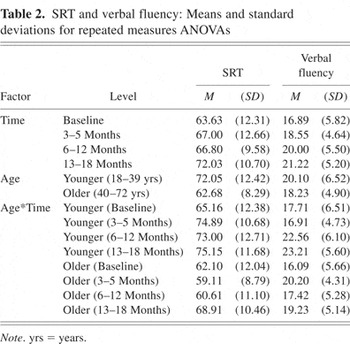
Selective Reminding Task (SRT) recall score significantly improved over time, [F(3,38) = 2.87, p = .049]. See Table 2 for means and standard deviations for SRT. Follow-up tests showed that the total recall at baseline (M = 63.63, SD = 12.31) was significantly lower than at the 13–18-month follow-up period (M = 72.03, SD = 10.70), t (38) = 2.78, p = .05. There was a marginal effect for age (older vs. younger), such that patients in the younger group (M = 72.05, SD = 12.42) recalled more words than patients in the older group (M = 62.68, SD = 8.29), [F(3,38) = 3.93, p = .059]. The interaction between time of testing and age groups was also nearing significance, [F(3,38) = 2.80, p = .053].
SRT and verbal fluency: Means and standard deviations for repeated measures ANOVAs

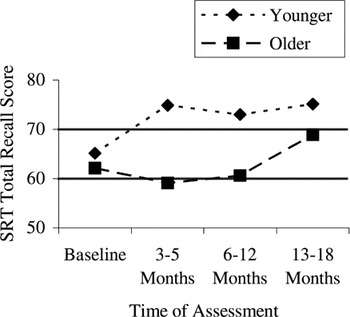
Follow-up tests for each age group were performed to examine improvement from baseline. See Figure 1 for a graphical depiction of the younger and older group's performance on the SRT. For the younger group, participants showed a significant improvement on their SRT recall scores from baseline (M = 65.16, SD = 12.38) compared to their scores at the 3–5-month post surgery assessment period (M = 74.89, SD = 10.68), t (38) = 2.85, p = .007. For the younger group, the comparison between baseline SRT recall scores (M = 65.16, SD = 12.38) and 6–12-month SRT recall scores (M = 73.00, SD = 12.71) was also significantly different [t (38) = 2.15, p = .04]. In addition, baseline (M = 65.16, SD = 12.38) compared to 13–18-month SRT recall scores (M = 75.15, SD = 11.68) was significantly different, t (38) = 2.40, p = .02. For the older group, none of the comparisons between baseline and follow-up assessments were significantly different. Although as shown in Figure 1, the older group begins to show a more noticeable improvement at the 13–18-month assessment time.

SRT Total Recall: Interaction between Age-group and time.
Digit span
The analysis of digit span did not yield significant main or interaction effects.
Verbal fluency
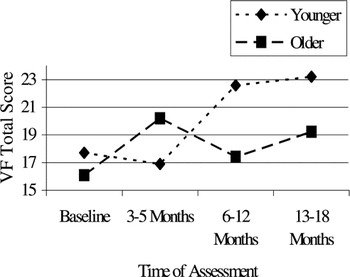
Performance on the test of verbal fluency showed significant improvement over time, [F(3,38) = 2.98, p = .04]. The interaction between age group and time of assessment was significant, [F(3,38) = 3.72, p = .02]. See Table 2 for means and standard deviations. Follow-up tests for each age group were performed to examine improvement from baseline. See Figure 2 for a graphical depiction of the younger and older group's performance on the verbal fluency task. For the younger group, the comparison between baseline verbal fluency scores (M = 17.71, SD = 6.51) and the 6–12-month scores (M = 22.56, SD = 6.10) was significantly different [t(38) = 2.53, p = .02]. The younger group's verbal fluency baseline scores (M = 17.71, SD = 6.51) were also significantly different from their 13–18-month scores (M = 23.21, SD = 5.60), t(38) = 2.57, p = .01. For the older group, their verbal fluency scores at baseline (M = 16.09, SD = 5.66) were significantly lower than their scores at the 3–5-month follow-up session (M = 20.20, SD = 4.31), t(38) = 2.46, p = .02. The significant difference for the older group is likely caused by an outlier, which when controlled for makes this mean comparison non-significant. The comparisons between the older group's baseline verbal fluency scores (M = 16.09, SD = 5.66) and the 6–12-month assessment (M = 17.42, SD = 5.28), as well as baseline to the 13–18-month assessment (M = 19.23, SD = 5.14) were not significantly different.

Verbal Fluency (VF): Interaction between Age-group and time.
Depression
Using outpatient psychiatric norms for the calculation of the T-scores, the mean T-scores for the older and younger groups, at baseline and at one-year post surgery, were below 50, which suggest that these groups were not significantly depressed according to this measure. The younger group's mean T-score at baseline was 44.36 (SD = 9.14) and the older group's was 47.73 (SD = 10.91). The younger group's one-year post surgery mean T-score was 35 (SD = 5.73) and the older group's was 39.56 (SD = 7.50). These means are not statistically significantly different from each other.
Controlling for age, scores on the SCL-90-R depression scale were not significantly different from baseline (M = 47.00, SD = 11.70) to one-year post treatment (M = 37.05, SD = 6.80). In addition, the change score in depression was not significantly different between the younger (M = −10.36, SD = 15.16) and older (M = −9.44, SD = 14.18) groups.
Imaging
Controlling for age, HFV showed a significant increase from baseline (M = .0035, SD = .00029) to one-year post-treatment (M = .0036, SD = .00024), [F(1,18) = 8.89, p = .008]. Controlling for age, CHV was not significantly different from baseline (M = .0074, SD = .00047) to one-year post treatment (M = .0074, SD = .0047).
Effect sizes
Because the PROC MIXED analysis package does not include an effect size calculation and considering that the most interesting within subjects effects were observed between baseline values and those observed after treatment, the effect sizes for these comparisons were calculated using a paired t-test model (SAS/SAT, 2006). Our sample revealed large effects associated with changes in cortisol and UFC. The effect sizes for cortisol ranged from 2.44 to 2.58; those for UFC ranged from 1.10 to 1.85. Effects sizes for SRT ranged from .70 to 1.27 for younger participants and from .19 to .39 for older participants. The corresponding effect sizes for verbal fluency ranged from .14 to 1.35 for younger participants and from .28 to .97 for older participants. It is apparent that the effect sizes were consistently lower for the older participants.
Effect sizes for comparisons between young and old subjects at specific time points were addressed in the context of two-sample t-test models. Effect sizes for SRT ranged from .16 to .59; those for verbal fluency ranged from .02 to .59.
An estimate of effect sizes for the time by age group interaction was obtained by looking at the 2-sample comparisons of the differences between baseline and subsequent time points. For the younger participants the effect sizes for SRT were 1.34, .75, and .68; the corresponding effect sizes for verbal fluency were 1.02, .79, and .36. The decreasing pattern of these effect sizes is consistent with our observation that the older participants did not return to the pre-treatment values as quickly as younger participants.
Correlations
Improvement with recall was associated with a decrease in cortisol values and an increase in HFV. Specifically, change in recall had a significant negative correlation with change in UFC (r = −.61, p = .02), and a significant positive correlation with percent change in the HFV (r = 0.72, p = .003). Change in recall was not significantly correlated with percent change in the caudate. Change in verbal fluency was only significantly associated with change in depression score (r = .60, p = .01). Change in digit span was not significantly correlated with any of the variables. Furthermore, estimated duration of illness was not significantly correlated with change in UFC or change in HFV. Other correlations between cognitive, neuroimaging, depression, and cortisol were not significant.
DISCUSSION
Cortisol is one of the most omni-present hormones in the human body, and, in excess, it can negatively affect cognition and brain morphology (particularly the HFV; Starkman et al., 2003). CD is an interesting model in which to look at these effects because it can occur at all times in the lifespan and this disease can frequently be successfully treated. Our aims for this study were to examine the effects of chronic overexposure of cortisol on brain structure and cognitive function. One of our primary aims of this project was to begin to understand when the deleterious effects of prolonged over exposure to cortisol may begin to reverse; because age appeared to be a factor in recovery of function, we used this to set the stage for the review of our findings. We also sought to re-affirm the association between structural changes in the HFV and high levels of cortisol (Starkman et al., 2003), which we felt was supported by our current study. With these aims in mind, we offer a review of our findings and possible theoretical implications of the results.
In regard to recovery of function, older and younger patients showed comparable levels of cognitive dysfunction at baseline (pre-treatment), but the age of CD patients appeared to significantly affect when and how quickly cognitive function showed signs of recovery. As hypothesized, younger individuals show a more rapid improvement on a word list-learning task with a significant improvement beginning at the 3–5-month follow-up period, whereas older adults do not begin to show a tendency towards improvement until about the 13–18-month time period. For verbal fluency, the younger adults appear to improve at the 6–12-month assessment period and continue to improve up to 18 months post-treatment. Although the older adults show a tendency toward improvement at the 3–5-month follow-up session, an extreme outlier in the data likely influenced these results and when controlled for, it makes the comparison not significant. There were no group differences for a task of brief attention.
Of note is the younger person's tendency to rebound more quickly on select cognitive tests. One explanation we considered was duration of illness, such that older persons, by the nature of their age, possibly had a greater length of exposure to hypercortisolemia. However the duration of illness did not significantly differ between age groups. We also considered plasticity of relatively younger brains being an important factor, because this would suggest greater resiliency with younger age leading to less detrimental effects from GC exposure. In an effort to explore this idea, we turned our attention to our neuroimaging findings, but there were no age-related structural changes in the HFV. We, therefore, felt that structural changes may not necessarily mirror the differences noted for age and cognition. This impression must be viewed cautiously, however, because it is possible that we were unable to capture significant age-related change in the HFV because we did not parallel cognitive assessments with those of the neuroimaging and sensitivity of the neuroimaging techniques employed in this project may not have been sufficient to reflect the relationship from only two scans. Certainly, additional research is needed in order to better understand the relationship among age and cognitive and structural evidence of improvement following successful treatment of CD.
Improvement on the memory task seems to begin more rapidly after successful treatment than improvement on the verbal fluency task. This finding would, in part, follow suit with previous research from Mauri et al. (1993), who assessed CD patients at 6 months post-treatment and found improvement in memory function. Because the mechanisms behind this are not known at this time, it is possible that the greater density of GC receptors in the hippocampus, as compared to other brain regions, make this structure more sensitive to successful treatment of hypercortisolemia. Because verbal learning (e.g., SRT performance) has been consistently related to hippocampal integrity, this measure most likely best reflects the cognitive improvement seen following successful surgery.
The eventual improvement in verbal fluency may relate to several factors. There is some preliminary evidence from animal studies that the medial prefrontal cortex, which is relatively rich in GC receptors, also may be at increased risk following prolonged exposure to GC (Cook & Wellman, 2004; Lyons et al., 2000). As the verbal fluency task has been suggested to be associated with frontal cortex functioning (Ruff et al., 1996) and also shows some functional rebound following successful CD surgery, one may anticipate the frontal cortex may also begin to rebound, but possibly at a slower rate. In addition, verbal fluency testing using the same measurement approach has been tied to both frontal and mesial temporal and hippocampal metabolism (Boivin et al., 1992).
When examining the effects of age on cortisol level, age was not found to be a significant factor. We had anticipated that age would be a significant factor in cortisol rebound as age was a mitigating factor in some of the cognitive results. It seems, however, that cortisol levels rebound so quickly in all patients (i.e., by the first post-operative assessment) and dramatically that it would be difficult to detect any possible age-associated differences.
Depression has been linked to elevated levels of cortisol and concomitant deleterious effects on cognition, especially declarative memory (Brown & Chandler, 2001; Brown et al., 2004). However, despite the high levels of cortisol associated with CD, only about 50 percent of persons with this disease report being significantly depressed (Kelly, 1996). In regard to this study, this sample of CD patients did not report clinically significant levels of depression, compared to a psychiatric outpatient sample, either at baseline or at one-year following surgery. It would seem less likely that depression significantly detracted from their overall cognitive performance, though certainly a different measure of depression may have yielded different results.
Compared to the Mauri et al. (1993) and Forget et al. (2002) studies, our study included fewer neuropsychological tests. With this in mind, we offer a comparison of findings. Consistent with those of Mauri and colleagues, both studies showed improvement in verbal memory. Yet, unlike Mauri et al. (1993), who found significant post-surgical improvement on the Digit Span task, our group did not. In fact, the Digit Span Task was not found to be associated with time or age in our study. It is not entirely clear what may be contributing to this difference in findings. In regard to the Forget et al. (2002) study, their significant findings mostly pertained to improvements on a number of visual spatial tests, which were unfortunately not included in this study. Forget and colleagues (2002) did show an improvement in phonemic fluency following treatment, which also was noted in this study.
Certainly there are limitations of our study, such as attrition, though we have employed statistical techniques to adjust for such issues. In addition, we tried to control for practice effects using alternative forms for most tests, but certainly without a control group it is difficult to fully determine what role practice effects have played in the improvement of scores across time. The findings of the present study do highlight the importance of assessing cognitive function of treated CD patients over a year following successful treatment, particularly as these results suggest that recovery in cognitive function can continue up to at least 18 months following successful surgical treatment of CD.
In all, the findings of this study are preliminary but offer interesting areas for future research in the differential effects by age on recovery of cognitive function following chronic hypercortisolemia. Functional imaging studies seem to represent a logical step to characterize possible age-related difference in the activation in the hippocampus during behavioral tasks with these patients. We also feel that research with CD patients can continue to have important implications for other syndromes and diseases in which abnormally high levels of cortisol have been implicated. For example, certain psychiatric problems, such as depression and posttraumatic stress disorder, as well as chronic stress, have been related to high levels of cortisol. It is, therefore, possible that if one suffers from negative cognitive effects as a result of these illnesses, younger persons may rebound more quickly than older adults.
ACKNOWLEDGMENT
This study was supported in part by a grant from the National Institute of Health (NIH 5RO1 DK 51337).