




No CrossRef data available.
Developmental antecedents of late adolescence substance use patterns
Published online by Cambridge University Press: 28 March 2006
Abstract
This longitudinal study examined antecedents of substance use behavior among 176 (53% male) adolescents. Adolescents were classified as (a) abstainers (n = 19), (b) experimenters (n = 65), (c) at-risk youth (n = 63), and (d) abusers (n = 29) based on their reported substance use behavior at age 17.5. Parental behavior, peer competence, and problem behavior, measured from early childhood through age 16, were examined as predictors of substance use patterns. Multinomial logistic regression models revealed that early maternal hostility, externalizing behavior problems in first grade and at age 16, internalizing behavior in first grade and at age 16, and parental monitoring at age 16 significantly differentiated substance use groups. The study provides evidence that experiences occurring early in development, in addition to those that occur later in development, can play a pivotal role in setting the stage for late adolescent substance use behavior.
Preparation of this work and the research described herein were supported by a grant from the National Institute of Mental Health (R01MH40864-18). We acknowledge the participants and their families for their continued participation in this research. Special thanks to Judy Cook, W. Andrew Collins, and the numerous graduate and undergraduates who made this project possible.
Information
- Type
- REGULAR ARTICLE
- Information
- Copyright
- 2006 Cambridge University Press
By late adolescence, experimentation with substances is statistically normative for youth in the United States. According to recent Monitoring the Future statistics (Johnston, O'Malley, Bachman, & Schulenberg, 2004), by the time youth reach 12th grade, 77% of students report having tried alcohol with 28% reporting binge drinking: five or more drinks on one occasion in a 2-week period. In addition, about 46% of high school seniors report having tried marijuana, with 6% reporting daily marijuana use. These statistics suggest that the majority of adolescents are likely to experiment with one or more substances before they reach young adulthood.
One possible explanation for the normality of substance use experimentation during adolescence may be attributed to the process of identity formation, a salient developmental task of the adolescent period (Erikson, 1963). Erikson asserted that adolescents form autonomous identities through experimentation with diverse behaviors, opinions, and feelings. During this period of exploration, adolescents may actively explore the world of drugs as one facet of identity formation. As Newcomb and Bentler (1988) suggest, “experimental use of various drugs, both licit and illicit, may be considered a normative behavior among contemporary United States teenagers in terms of prevalence, as well as from a developmental task perspective” (p. 214). Several other researchers have also proposed that experimental or occasional drug use may be best understood as a developmentally normative activity that occurs during middle to late adolescence (e.g., Baumrind, 1991; Chassin, Pitts, & Prost, 2002; Shedler & Block, 1990).
Although experimental substance use may be considered a normative activity during late adolescence, advancement beyond experimentation during this developmental period may be abnormal (Cicchetti & Rogosch, 1999). Compared to experimentation, substance abuse occurs at a much lower frequency during adolescence. The National Survey of Drug Use and Health, 2003 (Substance Abuse and Mental Health Services Administration [SAMHSA], 2004) found that 8.9% of youth ages 12–17 were diagnosed with a substance use disorder. No significant difference was observed among diagnoses for boys (8.7%) and girls (9.1%). Males did report greater illicit drug use, especially marijuana, and binge drinking compared to females, but did not experience an increase in substance use diagnoses as a result of such use. However, it has been suggested that males may be at a greater risk for experiencing problems associated with substance use compared to females (Galaif, Stein, Newcomb, & Bernstein, 2001; Johnson & Pandina, 2000). Even though the percentage of adolescents who are diagnosed with a substance use disorder is relatively low compared to the percentage of adolescents who experiment with substances, there are still adolescents who meet the criteria for a substance use disorder.
Not all adolescents who engage in substance use behavior that exceeds experimentation meet the full criteria for a substance use disorder. Some adolescents engage in substance use behavior that disrupts their adaptation, but not to the level of disruption sufficient for a substance use diagnosis. The substance use behavior of these adolescents, however, may interfere with their psychosocial adaptation and increase the risk for a future substance use diagnosis. Studies in the literature have observed poor psychosocial adaptation among adolescents who engage in substance use behavior that exceeds experimentation. Shedler and Block (1990) found that compared to experimenters, frequent users were observed to be alienated, deficient in impulse control, and distressed. Furthermore, there is evidence that adolescents who engage in early alcohol use and frequent alcohol and drug use are at an increased risk of experiencing poor psychosocial adaptation (e.g., work, autonomy; Barnes, Welte, & Dintcheff, 1992; Chassin, Pitts, & DeLucia, 1999; Friedman, Bransfield, & Kreisher, 1994) and developing substance use disorders in young adulthood (Chassin et al., 2002; Grant & Dawson, 1997). The literature suggests that some adolescents exceed substance use experimentation, but are qualitatively distinct from adolescents who abuse substances as they experience fewer problems of adaptation. These adolescents could be considered “at risk” for a diagnosis of substance abuse.
In addition to adolescents who experiment with substances, abuse substances, or are at risk for substance abuse, there is another group of adolescents who abstain from substance use. Research findings have been inconclusive with respect to whether or not young people who abstain from substance use during adolescence experience positive or negative developmental adaptation. For example, Shedler and Block (1990) observed that young people who abstained from marijuana use were more anxious, more emotionally constricted, and lacking in social skills compared to adolescents who experimented with marijuana. Baumrind (1991), on the other hand, found that adolescents who engaged in “rational” abstinence demonstrated social competency, whereas young people who engaged in “risk-avoidant” abstinence were more likely to demonstrate fearfulness and maladjustment. Research has not clearly established patterns of adaptation for abstainers, thus necessitating a need for further inquiry. What is relatively clear, however, is that adolescents who abstain from alcohol and drug use form a distinct group from adolescents who use substances.
Variables Associated With Adolescent Substance Use
Previous researchers have identified a number of variables associated with adolescent substance use (see reviews by Hawkins, Catalano, & Miller, 1992; Swadi, 1999). Variables that have consistently been identified as related to adolescent substance use include parental behavior, peer competence, and behavior problems.
Parental behavior
Researchers have observed a relation between contemporaneous parental behavior and adolescent substance use behavior. Supportive parenting during adolescence has been linked to later initiation of substance use, less frequent substance use, and less engagement in heavy or problematic use (Anderson & Henry, 1994; Barnes & Farrell, 1992; Barnes, Reifman, Farrell, & Dintcheff, 2000; Barnow, Schuckit, Lucht, John, & Freyberger, 2002; Marshal & Chassin, 2000; Piko, 2000; Wills, McNamara, Vaccaro, & Hirky, 1996). In contrast, young people who experience hostile or coercive parenting are more likely to engage in problematic substance use compared to their contemporaries (Barnes & Farrell, 1992; Barnow et al., 2002; Baumrind, 1991; Pandina & Schule, 1983). Additionally, researchers have found that higher frequencies of substance use are related to lower levels of parental monitoring, whereas active parental monitoring appears to discourage substance use (Barnes et al., 2000; Baumrind, 1991; Brown, Mounts, Lamborn, & Steinberg, 1993; Dishion & Loeber, 1985; Kosterman, Hawkins, Guo, Catalano, & Abbott, 2000).
Researchers have also suggested that parental behavior that occurs early in a child's development may predict the degree to which a young person uses substances during adolescence. Interestingly, low levels of parental support experienced early in development, cold and unresponsive parenting in early childhood, and coercive parenting during middle childhood have been associated with both abstinence and abuse during adolescence (Baumrind, 1991; Pandina & Schule, 1983; Shedler & Block, 1990) suggesting diverse developmental pathways from early parenting to adolescent substance use behavior. These studies point to the need for developmental research examining the relation between parenting in early childhood and substance use patterns in adolescence.
Despite these formative studies, previous research examining parental influence on the development of adolescent substance use behavior has largely focused on the period from late childhood to adolescence rather than examining relationships between parents and children in early childhood. As suggested by the limited research during early childhood, parenting during this period of development may influence the degree to which a young person engages in substance use during the adolescent years (Block, Block, & Keyes, 1988; Shedler & Block, 1990). From a developmental perspective it is important to consider the influence of early parent–child relationships on later substance use behavior, as these early experiences provide a foundation for later development (Bowlby, 1982; Sroufe, 1979).
Peer competence
Research literature also suggests that social competence with peers is associated with concurrent adolescent substance use. Research findings are somewhat contradictory, however, regarding how social competence with peers in adolescence affects substance use behavior. On the one hand, evidence suggests that youth who are more competent with their peers are more likely to engage in substance use compared to less competent youth (Feldman, Rosenthal, Brown, & Canning, 1995; Fondacaro & Heller, 1983; Scheier & Botvin, 1998; Wills, Vaccaro, & McNamara, 1992). Youth who are socially skilled may have increased opportunities to use substances because they participate in social activities that are associated with drug use, such as parties and romantic relationships. On the other hand, problems within peer relationships have been found to be associated with heavy or frequent use. Dishion and Skaggs (2000) found that monthly increases in substance use among early adolescents were related to conflict with peers and peer problem behavior occurring within the same month. Social competence with peers may prove pivotal to an adolescent's likelihood of engaging in divergent patterns of substance use.
A child's level of competence with peers in childhood provides a basis for later adolescent peer relationships (Englund, Levy, Hyson, & Sroufe, 2000; Sroufe, Egeland, & Carlson, 1999); because adolescent competence with peers is associated with substance use behavior, a developmental perspective would suggest that peer relationships in childhood may also be related to later adolescent substance use. Some researchers have examined the effects of earlier peer interactions on substance use in adolescence. Hops, Davis, and Lewin (1999) examined the developmental histories of individuals who had abstained from substance use by middle adolescence and those who had used one or more forms of substances. Overall, those adolescents who engaged in higher rates of substance use in adolescence had greater social difficulties during elementary school compared to those who engaged in lower rates of substance use. In contrast, adolescents who engaged in alcohol use only, in comparison to those who used a number of substances, were significantly more likely to have reciprocated positive peer interactions in grade school. Adolescents who abstained from substance use were significantly less likely to have reciprocated positive peer interactions in grade school compared to those who only used alcohol in adolescence. Woodward and Fergusson (1999) report similar findings; those children who demonstrated poor social skills during the elementary school years were more likely than their peers to use higher levels of substances during adolescence. This relation between social skills and substance use was moderated by early conduct problems in their sample. Shedler and Block (1990) also found that adolescents engaging in frequent substance use at age 18 were deficit in social skills as early as age seven. These research findings indicate that troubled-peer interactions early in development may be precursors to more extreme patterns of substance use behavior in adolescence.
Behavior problems
Numerous studies have found that aggression, conduct disorder, and disruptive behavior, both prior and concurrent, are associated with adolescent substance use (Barber, Bolitho, & Bertrand, 1999; Chassin et al., 2002; Disney, Elkins, McGue, & Iacono, 1999; Fergusson & Lynskey, 1998; Kellam, Rebok, Ialongo, & Mayer, 1994; Shedler & Block, 1990; Tarter et al., 1999; Winters, Latimer, Stinchfield, & Henly, 1999). In a retrospective study, Windle (1993) found that adolescents who had early externalizing behavior problems were more likely to have an earlier age of substance use onset than their peers. Furthermore, Nurco, Blatchley, Hahlon, and O'Grady (1999) found from retrospective self-reports that deviant and conduct-disordered behavior were related to precocious and excessive substance use in adolescence. Others have also found that an early history of attention problems or conduct disordered behavior contributes to youth's greater susceptible to substance abuse in adolescence (Boyle et al., 1993; Fergusson, Lynskey, & Horwood, 1997). These studies suggest that prior or current deviant or conduct-disordered behavior may be associated with problematic substance use in adolescence. However, it is important to keep in mind that engagement in delinquent activity has been found to be developmentally normative during adolescence in contrast to engagement in delinquent behavior prior to adolescence (e.g., Moffitt, 1993). Therefore, delinquent behavior that begins prior to adolescence may be more predictive of problematic substance use behavior during adolescence.
In addition to the relation between externalizing behavior problems and substance use behavior, researchers have also been interested in how internalizing behavior problems relate to substance use behavior during adolescence. Two competing hypotheses for the role internalizing problem behavior plays in the development of substance use behavior exist in the literature. One hypothesis suggests that adolescents with internalizing behavior problems use substances to alleviate their symptoms. This hypothesis is consistent with studies that find that internalizing behavior problems are related to greater involvement with substances during adolescence and young adulthood (Loeber, Stouthamer-Loeber, & White, 1999; Steele, Forehand, Armistead, & Brody, 1995; Sussman, Dent, & Galaif, 1997). In contrast, others hypothesize that internalizing behavior problems may decrease the likelihood that individuals will engage in risk-taking behavior commonly associated with externalizing behavior problems, including substance use (Kaestner, Rosen, & Appel, 1977; Steele et al., 1995). Steele et al.'s (1995) research supports this hypothesis. They found that higher levels of internalizing behavior problems in adolescence predicted less marijuana and hard drug use in young adulthood for males, but not for females. Other researchers have also identified a psychological profile consistent with internalizing behavior problems among adolescents who abstained from marijuana use (Shedler & Block, 1990). These adolescents were more likely to be tense, overcontrolled, isolated, emotionally constricted, and lacking in interpersonal skills compared to adolescents who experimented with marijuana.
Research is not specific with respect to how internalizing behavior problems influence substance use behavior. It is possible that adolescents who suffer from internalizing behavior problems may be less likely to use substances because they are less likely to interact with peers. Substance use during adolescence is often perceived of as a social activity. Internalizing behavior problems may influence young people to withdraw from peers or delay entry into peer networks (Windle, 1993). If youth are not active in the peer culture as a consequence of internalizing behavior problems, they may be more likely to refrain from substance use because of decreased opportunities to use substances. Therefore, internalizing behavior problems, especially the early onset of problems, may be associated with substance use abstinence during adolescence.
Current Study
The purpose of the current study was to identify developmental antecedents that differentiated adolescents with various substance use patterns. Using data from a longitudinal study of high-risk children, four groups of adolescents were identified: (a) adolescents who abstained from substance use in late adolescence (i.e., abstainers); (b) adolescents who experimented with alcohol and/or marijuana, but did not exhibit any problems as a result of substance use (i.e., experimenters); (c) adolescents who experimented with substances and exhibited problems as a result of substance use, but did not meet full criteria for substance abuse (i.e., at risk); and (d) adolescents diagnosed with a substance abuse disorder for alcohol, marijuana, and/or other illicit drugs as defined by the Diagnostic and Statistical Manual of Mental Disorders Third Edition, Revised (i.e., abusers; DSM-III-R; American Psychiatric Association [APA], 1987). Although the adolescent groups were defined by substance use behavior and the problems associated with the substance use, it is important to keep in mind that these groups are most likely heterogeneous rather than homogeneous as adolescent substance use behavior likely is determined by varied reasons. For example, Baumrind (1991) identified two different groups of adolescent abstainers, risk-avoidant nonusers and rational nonusers. Although these groups of adolescents were similar in that they abstained from substance use, their reasons for abstaining were unique to each group. Although the current study was not able to differentiate adolescents within the substance use groups based on the reasoning of the adolescent for engaging in particular substance use behavior, conceptual predictions of diverse patterns of substance use behavior can be made by reviewing previous literature.
We hypothesized that patterns of substance use behavior could be differentially predicted based on parental behavior early in development, parental monitoring in adolescence, peer competence in middle childhood and adolescence, and externalizing and internalizing behaviors in middle childhood and adolescence. More specifically, we hypothesized that abstainers compared to experimenters would have developmental histories characterized by (a) poorer quality maternal caregiving in early childhood and higher levels of parental monitoring in adolescence, (b) lower levels of peer competence in childhood and adolescence, and (c) higher levels of internalizing behavior problems in both elementary and high school. There is evidence to suggest that extreme substance use behavior, including abstinence, may follow from a history of maladaptation (Baumrind, 1991; Shedler & Block, 1990). We further hypothesized that at-risk youth compared to experimenters would have developmental histories characterized by (a) lower levels of parental monitoring in adolescence, and (b) higher levels of externalizing behavior problems in childhood and adolescence as their substance use behavior resulted in a least one significant psychosocial problem. The occurrence of a substance use related problem for this group may have been a result of a lack of parental monitoring or possibly engagement in delinquent behavior. These predictions were derived from research that suggests that substance use exhibits a negative relation with parental monitoring (e.g., Barnow et al., 2002) and a positive relation with externalizing behavior problems (e.g., Disney et al., 1999; Fergusson & Lynskey, 1998). The ability, however, to make additional predictions is limited due to the modest research in this area. Finally, we also hypothesized that abusers compared to experimenters would have developmental histories characterized by (a) poorer quality early maternal caregiving and lower levels of parental monitoring in adolescence, (b) lower levels of peer competence during both grade school and in high school, and (c) higher levels of externalizing behavior problems in childhood and adolescence. These predictions are consistent with the current state of the literature.
Although we were specifically interested in the comparison between experimenters and abstainers, at-risk youth, and abusers, we were also interested in potential differences among abstainers, at-risk youth, and abusers. We speculated that abstainers compared to at-risk youth would have histories characterized by (a) higher levels of parental monitoring in adolescence, and (b) higher levels of internalizing behavior problems in both elementary and high school. We also hypothesized that abstainers compared to abusers would have histories characterized by (a) higher internalizing behavior problems, and (b) lower externalizing behavior problems in grade school and high school. These hypotheses are based on the work by Shedler and Block (1990). Finally, it was hypothesized that at-risk youth, compared to abusers, would demonstrate a lower level of externalizing behavior problems in grade school and high school. This prediction was made based on the knowledge that adolescents who are diagnosed with a substance use disorder experience multiple psychosocial problems. This suggests a higher level of externalizing behavior problems compared to at-risk youth who experience only one symptom of a substance use disorder.
Method
Participants
The participants (N = 176; 94 males, 82 females) were drawn from a longitudinal study of first-born children of mothers who were below the poverty level, the majority of whom were receiving welfare (N = 267; see Egeland & Brunnquell, 1979). Women receiving prenatal care through the Minneapolis Health Department between the years 1975 and 1977 were recruited for the study during their third trimester of pregnancy. Recruitment was conducted by project staff when participants were at the clinic for their prenatal visit. In the current sample, the mothers' ages at delivery ranged from 15 to 34 (M = 20.60; SD = 3.52). Sixty-two percent of the mothers were unwed and 35% had not completed high school at the time of their child's birth. Eighty-four percent of mothers were Caucasian, 11% were African American, and 5% were Native American or Hispanic. Sixty-seven percent of the adolescents had two White parents.
The sample used in the current study included participants who completed the 17.5-year assessment. By age 2, 212 families (80%) remained in the longitudinal study, with residential mobility being the primary reason for attrition prior to age 2. Of the 267 original participants 66% have been retained through age 17.5. Attrition, since age 2, has resulted from mobility (n = 21), refusal to participate (n = 14), and death (n = 1). To assess whether the sample used in this study was representative of the original sample, comparisons between demographic measures were made between the current participants and those who were no longer participating in the study at age 17.5 (N = 91). No differences were identified between current participants and the attrition group for prenatal socioeconomic status, maternal race, mother's age, or educational level at the child's birth. There was a significant difference for mother's marital status at the time of the child's birth. A greater percentage of current participant mothers (70%) were married at the time of the child's birth compared to those not included in the current study (30%).
Substance use groups
The four substance use groups (abstainers, experimenters, at risk, and abusers) were identified based on responses to questions from the Adolescent Diagnostic Interview (ADI; Winters, Stinchfield, Fulkerson, & Henly, 1993) assessing past and present substance use. The ADI was included as part of the Kiddie Schedule for Affective Disorders and Schizophrenia for Adolescents (11–18 years; Puig-Antich & Chambers, 1978) given at age 17.5 years. The ADI is a structured diagnostic interview that assesses DSM-III-R criteria for psychoactive substance use disorders in adolescents. The information obtained from the interview is related to alcohol, marijuana, and other drug use onset, frequency, duration, and symptoms, as well as level of adolescent functioning. Substance use scores are derived from the ADI based on items pertaining to abuse or dependence behaviors and symptoms, and a clinical diagnostic decision is made regarding major substance use diagnostic classifications (Winters et al., 1993). Winters and colleagues (1993) reported that the ADI demonstrates good reliability and good to excellent concurrent and criterion validity.
Responses to substance use questions on the ADI were used to assign participants to substance use groups. Specifically, responses to ever using a substance (i.e., alcohol, marijuana, or other illicit drug), frequency of use, and consequences associated with the use of a substance were used to assign adolescents to one of four groups.
- Abstainers (n = 19; 9 females, 10 males) included adolescents who indicated they had never used alcohol or drugs, past or present.
- Experimenters (n = 65; 32 females, 33 males) included adolescents who used alcohol and/or marijuana at one time or another, but not other illicit drugs. Adolescents were assigned to the “experimenter” group if they had used alcohol and/or marijuana, but did not endorse any symptoms for a clinical diagnosis of substance abuse/dependence. This group of adolescents reported low frequencies of alcohol (M = 2.12, SD = 4.15; range = 0–20 times) and marijuana (M = 3.33, SD = 6.26; range = 0–20 times) use within the past 6 months.
- At Risk (n = 63; 38 females, 25 males) included adolescents who reported that they had used alcohol, marijuana, and/or other illicit drugs and also experienced at least one symptom for a substance use disorder but did not fully meet DSM-III-R (APA, 1987) criteria for a substance use disorder. This group of adolescents, although not meeting criteria for a substance use disorder, demonstrated at least some impairment in functioning as a result of substance use. Adolescents who endorsed at least one symptom for substance abuse may have advanced beyond experimentation, but were not at a level of substance use that is considered by DSM criteria (APA, 1987) to be abusive. The frequency of substance use among these adolescents for the past 6 months was: alcohol (M = 4.98, SD = 7.04; range = 0–38 times), marijuana (M = 15.85, SD = 36.97; range = 0–180 times), and other drugs (M = 3.29, SD = 5.38; range = 0–15 times).
- Abusers (n = 29; 3 females, 26 males) included
adolescents who met DSM-III-R (APA,
1987) criteria for a substance use disorder. To meet diagnostic
criteria for abuse, adolescents had to exhibit a pattern of repeated
problems in at least two areas of functioning (e.g., driving while drunk
on multiple occasions and failing grades due to skipping school frequently
to drink) that was a consequence of using the substance. Adolescents
meeting the diagnostic criteria for dependence met the criteria for abuse
in addition to exhibiting tolerance and/or withdrawal behavior. These
youth met diagnostic criteria for at least one past or present substance
abuse or dependence disorder (i.e., alcohol, marijuana, and/or other
illicit drug). Sixty-three percent of the adolescents (n = 18)
met diagnostic criteria for only one substance use disorder whereas 37% of
the group (n = 11) met diagnostic criteria for more than one
substance use disorder (e.g., alcohol abuse and marijuana dependence). The
frequency of substance use among these adolescents for the past 6 months
was: alcohol (M = 18.31, SD = 30.22; range = 0–124
times), marijuana (M = 70.62,1SD = 75.10; range = 0–224 times), and other drugs (M = 31.00, SD = 68.76; range = 1–200 times). Selection into the abuse group was dependent on a substance abuse or dependence diagnosis; the substance used was not of primary concern. Our rationale for aggregating across various substances is based on research that suggests pathological substance use is similar in nature across substances (Kosten, Rounsaville, Babor, Spitzer, & Williams, 1987), the developmental progression of substance use disorders (Kandel & Logan, 1984), the comorbidity of substance abuse disorders (Degenhardt, Hall, & Lynskey, 2001), and similar methodological and assessment issues (Carroll, 1995). In recognizing the similarities among pathological substance use, we combined adolescents abusing alcohol, marijuana, and/or other illicit drugs into the abuse group.
An outlier (998 times) was removed from the calculation of the mean frequency of marijuana use in a 6-month period for the abuse group. Without the removal of the outlier, the mean and standard deviation would have been inflated resulting in a bias estimate of the data. Removal of outliers is a method that has been used to achieve valid estimation of data (e.g., Brand & Brinich, 1999).
Developmental predictors
Data were comprehensive, gathered at many points in time, and obtained from multiple informants. Data used in the current study were collected when the participants were 24 months, 42 months, in first grade, and 16 and 17.5 years of age.
Early maternal care: Supportive presence and hostility
Data gathered from observational assessments of children with their mothers at 24 and 42 months were used to assess the quality of care the participants experienced in early childhood. When participants were 24 months old, they participated with their mothers in a dyadic tool task (see Matas, Arend, & Sroufe, 1978). The assessment consisted of a play period, a cleanup period, and a set of four tool tasks that increased in complexity. For the tool tasks, mothers were instructed to see if their child could solve the problem on his or her own first, and then provide any help the mother felt the child needed. At 42 months of age, participants and their mothers participated in a teaching task requiring interaction between the child and his or her mother in four problem-solving situations. The mother was instructed to give the child whatever help she thought appropriate for each task. The 24- and 42-month assessments were videotaped and rated for several parenting behaviors by trained coders. The scales of supportive presence and hostility, coded from the 24- and 42-month assessments, were used in the current study.
The supportive presence scale assessed the degree that the mother provided emotional support to help the child have a positive and enjoyable learning experience, no matter the difficulty level of the task. The scale ranged from low scores indicating failure to provide support demonstrated by maternal emotional and physical unavailability to high scores indicating encouragement, support, confidence in the child's abilities, and physical support when needed (range: 1 = low to 7 = high).
The hostility scale assessed the mother's expression of anger, discounting, or rejection of the child. The scale ranged from low scores indicating no signs of rejection or other hostile behavior toward the child to high scores indicating expressions of anger accompanied by strong, barely controlled emotions (range: 1 = low to 7 = high).
Intraclass correlations were computed to assess interrater reliability for the 24- and 42-month scales: supportive presence = .85 and .87 and hostility = .75 and .85, respectively. Supportive presence at 24 and 42 months was correlated at r = .48, p < .001, and hostility at 24 and 42 months was correlated at r = .21, p < .01.
Supportive presence and hostility at 24 and 42 months were coded on a 7-point scale. At 42 months, the scale scores from two independent coders were added to create a scale range of 2–14. The 42-month scores were divided by 2 to create equivalently scaled variables at 24 and 42 months. The supportive presence variable is an average of the 24- and 42-month measures of supportive presence. The hostility variable is an average of the 24- and 42-month measures of hostility. Higher scores reflect a higher level of maternal supportive presence and hostility, respectively. Supportive presence at 24 and 42 months and hostility at 24 and 42 months were correlated at r = −.67, p < .001.
The indicators of supportive presence and hostility from 24 and 42 months were combined to create one measure for each indicator of early maternal care. The constructs were combined in this manner as they are conceptually distinct indicators of early maternal care. Previous research further supports the distinctiveness of these constructs. For example, Denham et al. (2000) found that early childhood supportive presence predicted fewer behavior problems several years later, whereas early childhood anger predicted more behavior problems. Although anger is not the same as hostility, both are negative parental behavior. The knowledge that these constructs uniquely predict developmental outcomes suggests that the variables should remain distinct constructs but should be combined across ages so as to create an early childhood measure of supportive presence and an early childhood measure of hostility.
Peer competence
As part of the first grade and 16-year high school assessments, a teacher nomination procedure was used to assess each participant's level of social competence with their peers (i.e., peer competence). The teachers were asked to read a description of peer competence and rank order the target child in relation to the other children in the classroom. The general characteristics of peer competence were that a child was well liked by others and had clear, identifiable, mutual friendships. In addition, a child with a high score would be sociable, widely accepted among peers, friendly, show social skills and leadership skills, and understand and accept other children's perspectives and desires.
Each child's rank score was calculated into a percentile rank by taking the number of children below the child's ranking divided by the number of children in the class multiplied by 100. For example, a child ranked 12th in a class of 20 would receive a score of 40. A higher score indicates that the child showed a higher level of peer competence in relation to other children in the classroom.
Externalizing and internalizing problem behavior
When the participants were in the first grade, their teachers completed the Teacher's Report Form (TRF; Achenbach & Edelbrock, 1986). The TRF is designed to obtain informants' reports of the child's problems and adaptive functioning in a standardized format. Teachers rated the items on the behavior checklists on a 3-point scale of 0 = not true, 1 = somewhat or sometimes true, and 2 = very true or often true. Narrow-band scales (e.g., somatic complaints, aggression) and broad-band externalizing and internalizing scales were developed through factor analysis of these items.
The externalizing and internalizing normalized t scores were used in the current study. For first grade, the externalizing scores ranged from 39.00 to 86.00 (M = 54.98, SD = 9.71) and the internalizing scores ranged from 36.00 to 79.00 (M = 52.02, SD = 10.47). The externalizing and internalizing scores were correlated at r = .54, p < .001, with a higher score indicating a higher level of behavior problems.
At age 16, adolescents' English teachers completed the TRF to obtain standardized reports of behavior problems. For age 16, the externalizing scores ranged from 40.00 to 80.00 (M = 55.81, SD = 8.86) and the internalizing scores ranged from 38.00 to 76.00 (M = 54.07, SD = 8.14). For age 16, the externalizing and internalizing scores were correlated at r = .44, p < .001.
Parental monitoring
As part of the 16-year assessment, mothers of our adolescent participants completed audiotaped interviews. Included in these interviews were a series of questions regarding parental monitoring. Six questions assessed (a) caregivers' knowledge of their adolescent's friends, activities; (b), adolescents' whereabouts; and (c) caregivers' limit-setting behavior. Sample questions include, “Do you generally know where your child is if he/she goes out at night?” and “When your child goes out at night do you usually ask where he/she is going?” Based upon open-ended answers to these questions, a global rating of parental monitoring was assigned for each participant that ranged from 1 = low to 3 = high. Two coders scored the interviews independently with a 20% overlap to determine reliability. Interrater reliability, measured by the intraclass correlation, was r = .70.
Missing data
Missing data points (5.06%) for the cases were estimated by using Estimation Maximization in PRELIS (Jöreskog & Sörbom, 1996; Little & Rubin, 1987; Schafer, 1997). Multiple imputation estimates missing data with plausible values generated from an iterative process (Graham & Hofer, 2000). This approach to missing data is superior to other missing data approaches, such as mean substitution, because multiple imputation is more likely to provide accurate standard errors and test statistics (Graham & Hofer, 2000).
Results
Data analyses proceeded in two steps. First, bivariate correlations were computed to determine the interrelations among variables. Second, variables were entered into two multinomial logistic regression models (Hosmer & Lemeshow, 1989). The first multinomial logistic regression model regressed substance use group membership on early childhood and first grade predictor variables (i.e., childhood model). The second model was used to examine the combined predictive ability of childhood and middle adolescent antecedent variables (i.e., comprehensive model). This model allowed for the examination of whether more proximal measures to adolescent substance use would better predict group membership compared to more distal measures. All statistical tests and odds ratios were calculated with reference to experimenters to determine whether independent variables differentially predicted abstainers, at risk, and abusers from experimenters.
Correlations
Bivariate correlations were computed for continuously scaled variables (Table 1; N = 176). Fifteen of the 36 correlations were significant. All correlations were in the expected directions.
Bivariate correlations between predictors of late adolescent substance use patterns (N = 176)

Multivariate prediction of substance use behavior in late adolescence
Multinomial logistic regression models were used for multivariate prediction of substance use group membership. Multinomial logistic regression is a more general form of binary logistic regression where more than two categories are permissible. Parameter estimates (B), standard errors of B (SE B), and odds ratios (OR) with 95% confidence intervals (95% CI) of the OR for each of the substance use group contrasts are summarized in Tables 2 and 3.
Multinomial logistic regression predicting adolescent substance use behavior from childhood measures (N = 176)

Multinomial logistic regression predicting adolescent substance use behavior from childhood and adolescent measures (N = 176)

Adolescents who experimented with substances were used as the reference group in the multinomial logistic regression analyses. Experimenters were selected as the reference group based on the perspective that substance use experimentation in late adolescence is statistically and, perhaps, developmentally normative (Baumrind, 1991; Chassin et al., 2002; Johnston et al., 2004; Newcomb & Bentler, 1988; Shedler & Block, 1990). Because experimenters were the reference group, Tables 2 and 3 show parameter estimates (B) and associated information for abstainers, at-risk youth, and abusers contrasted with experimenters. Data presented are interpreted as the increased or decreased chance of being an abstainer, at-risk youth, or abuser compared to an experimenter. For example, when the predictor coefficient for abstainers is positive, the OR indicates the increased odds of being an abstainer rather than an experimenter when there is a one-unit increase in the independent variable (e.g., a one-unit increase in internalizing behavior t score). When the predictor coefficient for abstainers versus experimenters is negative, the OR indicates the decreased odds of being an abstainer rather than an experimenter when there is a one-unit increase in the independent variable (e.g., a one-unit increase in peer competence). In each multinomial model, participant's gender was entered as a covariate to adjust for main effects due to gender.
In addition to the multinomial logistic regression models that were run with experimenters as the reference group, models were reestimated using abstainers and abusers as the reference group. By using abstainers as the reference group we were able to compare abstainers to at-risk youth and abusers. In addition, by using abusers as the reference group we were also able to compare abusers to at-risk youth. These results are reported in the text. Results are not presented in table format, but can be requested from the authors.
Childhood predictors of adolescent substance use behavior
Table 2 summarizes the results of the multinomial regression model that examined childhood predictors. Independent variables included in this model were participant's gender, supportive presence, and hostility at 24–42 months; and externalizing behavior problems, internalizing behavior problems, and peer competence in first grade. Three of the six independent predictors significantly predicted substance use group membership. Having a mother who displayed a higher level of hostility at 24–42 months increased the likelihood that an adolescent would be an abstainer compared to an experimenter (OR = 2.54, 95% CI = 1.20–5.37). Exhibiting a higher level of externalizing behavior problems in first grade increased the likelihood that a young person would be an abuser compared to an experimenter (OR = 1.07, 95% CI = 1.00–1.15). Being female decreased the odds that a young person would be an abuser rather than an experimenter (OR = 0.10, 95% CI = 0.03–0.40). The current model had a pseudo-R2 of 27% (Nagelkerke, 1991). The model correctly predicted 15.8% of abstainers, 52.3% of experimenters, 57.1% of at-risk youth, and 37.9% of abusers with an overall 47.7% correctly predicted.
When a model was estimated with abstainers as the reference group, a higher score on hostility at 24–42 months decreased the odds that an adolescent would be an at-risk youth rather than an abstainer (OR = 0.42, 95% CI = 0.20–0.91). Being female decreased the odds of being an abuser compared to an abstainer (OR = 0.11, 95% CI = 0.02–0.51). Finally, when a model was estimated with abusers as the reference group, being female increased the odds that a young person would be an at-risk youth compared to an abuser (OR = 13.90, 95% CI = 3.62–53.32).
Childhood and adolescent predictors of adolescent substance use behavior
Table 3 summarizes the results of the multinomial regression model that examined both childhood and adolescent predictors of substance use behavior at age 17.5. Independent variables included in this model were participant's gender; supportive presence and hostility at 24–42 months; externalizing behavior problems, internalizing behavior problems, and peer competence in first grade; and externalizing behavior problems, internalizing behavior problems, peer competence, and parental monitoring at age 16. Five of the 10 independent variables significantly predicted substance use group membership. Having a mother who displayed a higher level of hostility at 24–42 months (OR = 3.50, 95% CI = 1.50–8.18) and a higher score for internalizing problems at age 16 (OR = 1.13, 95% CI = 1.03–1.25) increased the likelihood that an adolescent would be an abstainer rather than an experimenter. A higher score for externalizing behavior problems at age 16 decreased the odds of being an abstainer rather than an experimenter (OR = 0.90, 95% CI = 0.83–0.98). A higher score on parental monitoring at age 16 decreased the odds that an adolescent would be an at-risk youth compared to an experimenter (OR = 0.41, 95% CI = 0.19–0.85). A higher externalizing behavior problem score at age 16 (OR = 1.14, 95% CI = 1.04–1.24) increased the likelihood that a young person would be an abuser compared to an experimenter. A higher score on parental monitoring at age 16 (OR = 0.20, 95% CI = 0.07–0.55) and being female decreased the odds that a young person would be an abuser compared to an experimenter (OR = 0.04, 95% CI = 0.01–0.22). The current model had a pseudo-R2 of 46% (Nagelkerke, 1991). The model correctly predicted 26.3% of abstainers, 55.4% of experimenters, 55.6% of at-risk youth, and 41.4% of abusers with an overall 50.0% correctly predicted.
When a model was estimated with abstainers as the reference group, a higher score on hostility at 24–42 months (OR = 0.32, 95% CI = 0.13–0.76), a higher score for internalizing behavior problems in first grade (OR = 0.92, 95% CI = 0.85–1.00), a higher score on internalizing behavior problems at age 16 (OR = 0.90, 95% CI = 0.81–0.99), and a higher parental monitoring score at age 16 (OR = 0.29, 95% CI = 0.09–0.99) decreased the odds that an adolescent would be an at-risk youth compared to an abstainer. A higher score on externalizing behavior problems at age 16 (OR = 1.11, 95% CI = 1.02–1.21) increased the odds that a youth would be at risk compared to abstinent. Being female (OR = 0.02, 95% CI = 0.00–0.16), having a higher score for internalizing behavior problems at age 16 (OR = 0.87, 95% CI = 0.78–0.98,) and having a higher parental monitoring score at age 16 (OR = 0.14, 95% CI = 0.03–0.58) decreased the odds of being an abuser compared to an abstainer. A higher externalizing behavior problem score at age 16 (OR = 1.26, 95% CI = 1.13–1.41) increased the odds that a young person would be an abuser versus an abstainer.
Finally, when a model was estimated with abusers as the reference group, being female increased the odds that a young person would be an at-risk compared to an abuser (OR = 34.41, 95% CI = 6.35–186.33). A higher externalizing behavior problem score at age 16 decreased the likelihood that an adolescent would be an at-risk youth compared to an abuser (OR = 0.88, 95% CI = 0.81–0.96).
Discussion
The aim of this study was to identify the developmental antecedents that differentially predicted adolescents who experimented with substances from those who abstained from substance use, were at risk for substance abuse, or abused substances by age 17.5. Researchers have suggested that experimentation with substances may be a normative activity during the adolescent years and may be associated with developmental adaptation (Baumrind, 1991; Newcomb & Bentler, 1988; Shedler & Block, 1990). In contrast, patterns of substance use deviating from experimentation may be developmentally nonnormative and associated with developmental maladaptation. Previous research on substance use that deviates from experimentation provides a strong foundation for the association between developmental maladaptation and substance abuse during adolescence (e.g., Disney et al., 1999; Hops et al., 1999; Shedler & Block, 1990), whereas the literature is less conclusive about an association between maladaptation in childhood and adolescence and abstinence from substance use during adolescence (Baumrind, 1991; Shedler & Block, 1990) or substance use that exceeds experimentation, but does not reach the level of substance abuse. The identification of developmental antecedents that increase the likelihood that adolescents will engage in particular patterns of substance use behavior may help to clarify the association between substance use and developmental adaptation from childhood to adolescence and could be instrumental in identifying important targets for prevention and intervention programs.
In the current study four groups of adolescents who engaged in diverse patterns of substance use behavior in late adolescence were identified: abstainers, experimenters, at-risk youth, and abusers. Based on previous work in this area, this study focused on several individual and social factors as predictors of differential group membership: early maternal supportive presence and hostility (24–42 months), peer competence (first grade and age 16), internalizing and externalizing behavior problems (first grade and age 16), and parental monitoring (age 16). The results suggest that patterns of adolescent substance use behavior can be predicted from specific aspects of a youth's developmental history, in particular, aspects of parental behavior and problem behavior.
Experimenters
Substance use experimentation during adolescence was more likely to be predicted from developmental indicators of adaptation compared to maladaptation. Parental behavior and problem behavior differentially predicted substance use experimentation during adolescence. In early childhood, experimenters, compared to abstainers, experienced a lower level of hostile parenting. Across a 14-year period of time, hostile parenting behavior during the early childhood period continued to predict substance use behavior even after including more contemporaneous variables. Although a significant relation between early supportive presence and experimentation was not found in the current study, adolescents who experienced a lower level of maternal hostility were more likely to have experienced better parent–child relationships compared to youth who abstained from substance use. The parents of these youth continue to be involved during adolescence. Experimenters were more likely to experience a higher level of parental monitoring during adolescence compared to both at-risk youth and abusers. Positive parental behavior appeared to contribute to the development of a pattern of substance use experimentation during adolescence in contrast to other divergent patterns.
In addition to parenting behavior, the participant's behavior further predicted substance use group membership. Problem behavior began to predict to substance use experimentation in childhood. Experimenters engaged in lower levels of externalizing behavior problems compared to youth who abused substances. By age 16, experimenters engaged in higher levels of externalizing behavior problems compared to abstainers, but continued to engage in lower levels of externalizing problem behavior compared to abusers. The experimenters' scores, however, did not reach a pathological level of externalizing behavior problems. The fact that experimenters engaged in lower levels of externalizing behavior problems during childhood compared to abusers, but increased their engagement in externalizing behavior problems compared to abstainers in adolescence suggests a pattern of behavior consistent with developmental adaptation. Engagement in delinquent activity has been found to be developmentally normative during adolescence in contrast to engagement in delinquent behavior prior to adolescence (e.g., Moffitt, 1993). Adolescents who experiment with substances and engage in some delinquent behavior may be engaging in behavior that is developmentally appropriate for the adolescent period. Adolescents who experimented with substances also experienced a lower level of internalizing problem behavior at age 16 compared with abstainers. This is consistent with what Shedler and Block (1990) observed among their adolescents: adolescents who abstained from marijuana use exhibited a pattern of behavior consistent with internalizing behavior problems, whereas adolescents who experimented with marijuana did not exhibit this pattern of behavior.
The developmental history of experimenters would suggest a history of adaptation that will predict future adjustment. Previous research supports the perspective that youth who confidently explore new activities and behaviors have developed a view of themselves as competent and skillful; this confident exploration emerges from early supportive and responsive parent–child relationships (Waters, Wippman, & Sroufe, 1979). Adolescents who view themselves as competent and skillful may engage in the exploration of developmentally normative activities in response to the task of identity formation during adolescence (Erikson, 1963). Erikson asserted that the way adolescents form autonomous identities is to experiment with diverse behaviors, opinions, and feelings. During this period of exploration, adolescents may be more inclined to explore “risk” behaviors as a way to solidify an identity. Experimentation with substances and engagement in minor delinquent activity during adolescence may be a manifestation of healthy identity exploration that is necessary for the development and integration of the self. However, this experimentation does occur within a context of parental monitoring.
Substance abusers
Substance abuse during adolescence was more likely to be predicted from developmental indicators of maladaptation compared to adaptation. Parental behavior and problem behavior differentially predicted substance abuse during adolescence as did gender.
Parenting behavior in adolescence appeared to influence adolescents' use of substances. Parents of abusers were less likely to monitor their behavior in adolescence than the parents of their peers. A lower parental monitoring score increased the likelihood that a youth would be an abuser compared to an experimenter or abstainer. Parents, through their actions or, in this case, nonactions, appear to have an effect on their children's substance use (Barnes et al., 2000; Baumrind, 1991; Brown et al., 1993; Dishion & Loeber, 1985; Kosterman et al., 2000). The parents of these youth appear to be unable to provide the structure, supervision, and appropriate monitoring of activities that is obviously needed by these adolescents.
Abusers, as early as first grade, engaged in higher levels of externalizing behavior than experimenters. At age 16, abusers continued to engage in higher externalizing behaviors compared to experimenters as well as engaging in higher levels compared to abstainers and at-risk youth. Results suggest that adolescent substance abusers begin to follow an externalizing pathway as early as first grade, but a more proximal measure of externalizing behavior problems appeared to better predict substance abuse. This indicates that the relation between early externalizing behavior problems and substance abuse may be mediated by later externalizing behavior problems. Our results support previous literature indicating that a history of externalizing problem behavior is related to heavy or frequent substance use in adolescence (Boyle et al., 1993; Disney et al., 1999; Fergusson et al., 1997; Nurco et al., 1999; Windle, 1993). Abusers, in comparison, to abstainers, were likely to have a lower level of internalizing behavior problems at age 16. The fact that this group of adolescents demonstrates a higher level of externalizing behavior problems compared to their peers and experiences a lower level of internalizing behavior problems compared to abstainers suggests a strong relation between behavior problems and substance abuse.
Being a male also increased that likelihood that adolescents would be abusers compared to abstainers, experimenters, and at-risk youth. Although data from the National Survey of Drug Use and Health, 2003 reported that (SAMHSA, 2004) substance use diagnoses for youth ages 12–17 occurred at about equal rates for males (8.7%) and females (9.1%), they also found that males of this age period were more likely to report greater illicit drug use, especially marijuana, and binge drinking compared to females. In addition, previous literature indicates that males are more likely to experience problems associated with substance use (Galaif et al., 2001; Johnson & Pandina, 2000). Adolescent boys also report a higher level of externalizing behavior problems compared to girls (Dekovic, Buist, & Reitz, 2004). Our data supports this body of work in that males were more likely to be diagnosed with substance abuse in the current study. This suggests that males were more likely to experience substance-related problems compared to females.
Although engagement in substance use may be developmentally normative among late adolescents (Baumrind, 1991; Chassin et al., 2002; Newcomb & Bentler, 1988; Shedler & Block, 1990), it is possible that substance use, in combination with high levels of externalizing behavior problems, a lack of parental monitoring, and being male, may lead to substance abuse. For adolescents who are classified as substance abusers, substance abuse may be just another characteristic of a larger constellation of problem behaviors that include conduct problems, delinquency, and other health-compromising behavior (Barone et al., 1995; Donovan & Jessor, 1985, Donovan, Jessor, & Costa, 1988).
At-risk youth
Similar to the prediction of substance use experimentation and abuse, parental behavior and problem behavior predicted a pattern of substance use that increased the risk of substance abuse. Adolescents identified as at risk were more likely to experience less maternal hostility compared to abstainers in early childhood. At-risk youth may experience a better quality parent–child relationship early in development that would suggest a path to more competent behavior (Waters et al., 1979). However, this group of youth experienced lower levels of parental monitoring during adolescence compared to experimenters and abstainers. Decreased monitoring by parents in adolescence may increase the likelihood of greater substance use involvement (Barnes et al., 2000; Baumrind, 1991; Brown et al., 1993; Dishion & Loeber, 1985; Kosterman et al., 2000).
Problem behavior also predicted at-risk substance use behavior. At age 16, at-risk youth did not show an increased level of externalizing problem behavior compared to experimenters, but demonstrated a higher level of externalizing behavior compared to abstainers and a lower level compared to abusers. Adolescents who are at risk for substance use are also more likely to experience lower levels of internalizing behavior problems in childhood and adolescence compared to abstainers. The adolescents who were at risk for substance abuse in the current study experienced or exhibited similar developmental histories, with the exception of parental monitoring, as substance use experimenters, similar to the results of Shedler and Block (1990).
Adolescents who engage in substance use behavior that is likely to increase their risk for substance abuse experience and exhibit a constellation of developmental antecedents consistent with developmental adaptation and maladaptation. These youth exhibit a pattern of development similar to experimenters except for the fact that they experienced a lower level of parental monitoring compared to experimenters. The lack of parental monitoring during adolescence among this group of young people might increase the risk that adolescents will experience problems associated with their substance use. The fact that at-risk youth experience a history that demonstrates both adaptation and maladaptation suggests that this group may be the most responsive to substance use intervention in adolescence so that their current substance use behavior does not escalate to substance abuse.
Abstainers
Although abstainers could be differentiated from some subgroups of their peers in relation to certain variables, not as many differences as were predicted emerged. It was observed that abstainers engaged in a lower level of externalizing behavior problems in adolescence compared to youth in the abuse group. This finding has been found in earlier work as well (Baumrind, 1991). It was also observed that maternal hostility in early childhood significantly differentiated abstainers from the other groups of adolescents. In early childhood, the mothers of future abstainers were more hostile compared to mothers of experimenters and at-risk youth. This finding is similar to Shedler and Block's (1990) work in which they found that adolescents who abstained from substance use were more likely to have experienced harsher parenting in childhood compared to other substance use groups.
Abstainers were also likely to experience a higher level of internalizing problem behavior compared to their peers. A higher level of internalizing problem behavior predicted substance use abstinence compared to other patterns of substance use. This prediction was more pronounced in adolescence. This finding is consistent with that of Shedler and Block (1990) and Baumrind (1991) with respect to the risk-avoidant group.
The current state of the literature with respect to the developmental adaptation of abstainers is not clear (Baumrind, 1991; Shedler & Block, 1990). The current study was able to support some of the previous findings in the literature that indicate that abstainers may experience a developmental history with indicators of maladaptation. As observed by Baumrind (1991) there may be unique groups of adolescents who abstain from substance use for specific reasons. The current study was not able to differentiate adolescents within the abstinence group based on their reasoning for abstaining from substance use. Future work in this area should take into consideration the differential reasons that adolescents abstain from substance use.
Limitations
The current longitudinal study provides unique insight into the development of substance use behavior by late adolescence through the use of detailed data from multiple informants. Nevertheless, the study does have limitations. One limitation of the present study is sample size. Although all participants who were assessed at the age of 17.5 were included in the study, the size of several of the substance use groups is relatively small. The sample size of specific substance use groups may influence the degree to which the results of this study can be generalized, and as such, results should be interpreted with caution. A replication of this study is needed to provide further support for the results. In addition, research should examine samples of middle and high incomes levels to determine if the results found in this low-income sample are similar for other income levels.
Not included in the present study, but of interest in adolescent substance use research, is peer and parental substance use behavior. Previous studies have found a positive relation between peer substance use behavior and adolescent substance use (Dielman, Butchart, Shope, & Miller, 1991; Jenkins & Zunguze, 1998; Jones & Heaven, 1998), however, there is inconclusive evidence as to the direction of the influence (Bachman et al., 2002). Previous studies have also investigated parents diagnosed with a substance use disorder, used measures of parental substance use, and measured parents' norms regarding substance use (Brook et al., 2001; Coombs, Wellisch, & Fawzy, 1985; Gutierres, Molof, & Ungerleider, 1994). These studies have provided insightful information about adolescent substance use in relation to peer and parental substance use during the adolescent years. It would be of interest to examine peer and parental substance use longitudinally to identify their unique effects on adolescent substance use. These measures were not available in the current study as peer and parental reports of substance use were not assessed as part of the longitudinal study.
The temporal order of the variables is a further limitation. Because substance use was not measured prior to age 17.5, it is not possible to determine if age 16 variables preceded substance use group membership. In addition, there is a possible issue of collinearity. The results should be interpreted with some caution.
Despite these limitations, the current research is unique in its examination of the influences of developmental antecedents across more than a decade of life on adolescent substance use behavior. The study provides evidence that experiences early in development may play a pivotal role in setting the stage for later substance use behavior as developmental antecedents of substance use behavior in late adolescence were identified beginning as early as the second year of the child's life. Even with the importance of early experience in the development of diverse substance use behavior, the study also reveals that it is important to account for more proximal measures of adaptation in the prediction of substance use behavior. The development of adolescent substance use behavior appears to be a complex interplay of distal and proximal measures of parental and individual behavior.
References
REFERENCES
Achenbach, T. M., &
Edelbrock, C.
(1986).
Manual for the teacher's report form and teacher version of the
child behavior profile.
Burlington, VT:
University of Vermont, Department of Psychiatry.
American Psychiatric Association.
(1987).
Diagnostic and statistical manual of mental disorders
(3rd ed., revised).
Washington, DC:
Author.
Anderson, A. R., &
Henry, C. S.
(1994).
Family system characteristics and parental behaviors as predictors
of adolescent substance use.
Adolescence,
29,
405–420.Google Scholar
Bachman, J. G.,
O'Malley, P. M.,
Schulenberg, J. E.,
Johnston, L. D.,
Bryant, A. L., &
Merline, A. C.
(2002).
The decline of substance use in young adulthood: Changes in social
activities, roles, and beliefs.
Mahwah, NJ:
Erlbaum.
Barber, J. G.,
Bolitho, F., &
Bertrand, L. D.
(1999).
Intrapersonal versus peer group predictors of adolescent drug
use.
Children and Youth Services Review,
21,
565–579.CrossRefGoogle Scholar
Barnes, G. M., &
Farrell, M. P.
(1992).
Parental support and control as predictors of adolescent drinking,
delinquency, and related problem behavior.
Journal of Marriage and the Family,
54,
763–776.CrossRefGoogle Scholar
Barnes, G. M.,
Reifman, A. S.,
Farrell, M. P., &
Dintcheff, B. A.
(2000).
The effects of parenting on the development of adolescent alcohol
misuse: A six-wave latent growth model.
Journal of Marriage and the Family,
62,
175–186.CrossRefGoogle Scholar
Barnes, G. M.,
Welte, J. W., &
Dintcheff, B.
(1992).
Alcohol misuse among college students and other young adults:
Findings from a general population study in New York State.
International Journal of the Addictions,
27,
917–934.CrossRefGoogle Scholar
Barone, C.,
Weissberg, R. P.,
Kasprow, W. J.,
Voyce, C. K.,
Arthur, M. W., &
Shriver, T. P.
(1995).
Involvement in multiple problem behaviors of young urban
adolescents.
Journal of Primary Prevention,
15,
261–283.CrossRefGoogle Scholar
Barnow, S.,
Schuckit, M. A.,
Lucht, M.,
John, U., &
Freyberger, H.
(2002).
The importance of a positive family history of alcoholism, parental
rejection and emotional warmth, behavioral problems and peer substance use
for alcohol problems in teenagers: A path analysis.
Journal of Studies on Alcohol,
63,
305–315.CrossRefGoogle Scholar
Baumrind, D.
(1991).
The influence of parenting styles on adolescent competence and
substance use.
Journal of Early Adolescence,
11,
56–95.CrossRefGoogle Scholar
Block, J.,
Block, J. H., &
Keyes, S.
(1988).
Longitudinally foretelling drug usage in adolescence: Early
childhood personality and environmental precursors.
Child Development,
59,
336–355.CrossRefGoogle Scholar
Bowlby, J.
(1982).
Attachment and loss: Vol. I. Attachment
(2nd ed.).
New York:
Basic Books.
Boyle, M. H.,
Offord, D. R.,
Racine, Y. A.,
Fleming, J. E.,
Szatmari, P., &
Links, P.
(1993).
Predicting substance use in early adolescence based on parent and
teacher assessments of childhood psychiatric disorder: Results from the
Ontario Child Health Study follow-up.
Journal of Child Psychology and Psychiatry,
34,
535–544.CrossRefGoogle Scholar
Brand, A. E., &
Brinich, P. M.
(1999).
Behavior problems and mental health contacts in adopted, foster, and
nonadopted children.
Journal of Child Psychology and Psychiatry and Allied
Disciplines,
40,
1221–1229.CrossRefGoogle Scholar
Brook, J. S.,
Brook, D. W.,
De La Rosa, M.,
Whiteman, M.,
Johnson, E., &
Montoya, I.
(2001).
Adolescent illegal drug use: The impact of personality, family, and
environmental factors.
Journal of Behavioral Medicine,
24,
183–203.CrossRefGoogle Scholar
Brown, B.,
Mounts, N.,
Lamborn, S., &
Steinberg, L.
(1993).
Parenting practices and peer group affiliation in
adolescence.
Child Development,
64,
467–482.CrossRefGoogle Scholar
Carroll, K. M.
(1995).
Methodological issues and problems in the assessment of substance
use.
Psychological Assessment,
7,
349–358.CrossRefGoogle Scholar
Chassin, L.,
Pitts, S. C., &
DeLucia, C.
(1999).
The relation of adolescent substance use to young adult autonomy,
positive activity involvement, and perceived competence.
Development and Psychopathology,
11,
915–932.CrossRefGoogle Scholar
Chassin, L.,
Pitts, S. C., &
Prost, J.
(2002).
Binge drinking trajectories from adolescence to emerging adulthood
in a high-risk sample: Predictors and substance abuse outcomes.
Journal of Counseling and Clinical Psychology,
70,
67–78.CrossRefGoogle Scholar
Cicchetti, D., &
Rogosch, F. A.
(1999).
Psychopathology as risk for adolescent substance use disorders: A
developmental psychopathology perspective.
Journal of Clinical Child Psychology,
28,
355–365.CrossRefGoogle Scholar
Coombs, R. H.,
Wellisch, D. K., &
Fawzy, F. I.
(1985).
Drinking patterns and problems among female children and
adolescents: A comparison of abstainers, past users, and current
users.
American Journal of Drug and Alcohol Abuse,
11,
315–348.CrossRefGoogle Scholar
Degenhardt, L.,
Hall, W., &
Lynskey, M.
(2001).
The relationship between cannabis use and other substance use in the
general population.
Drug and Alcohol Dependence,
64,
319–327.CrossRefGoogle Scholar
Dekovic, M.,
Buist, K. L., &
Reitz, E.
(2004).
Stability and changes in problem behavior during adolescence: Latent
growth analysis.
Journal of Youth and Adolescence,
33,
1–12.Google Scholar
Denham, S. A.,
Workman, E.,
Cole, P. M.,
Weissbrod, C.,
Kendziora, K. T., &
Zahn-Waxler, C.
(2000).
Prediction of externalizing behavior problems from early to middle
childhood: The role of parental socialization of emotion
expression.
Development and Psychopathology,
12,
23–45.CrossRefGoogle Scholar
Dielman, T. E.,
Butchart, A. T.,
Shope, J. T., &
Miller, M.
(1991).
Environmental correlates of adolescent substance use and misuse:
Implications for prevention programs.
International Journal of the Addictions,
25,
855–880.CrossRefGoogle Scholar
Dishion, T., &
Loeber, R.
(1985).
Adolescent marijuana and alcohol use: The role of parents and peers
revisited.
American Journal of Drug and Alcohol Abuse,
11,
11–25.CrossRefGoogle Scholar
Dishion, J. J., &
Skaggs, N. M.
(2000).
An ecological analysis of monthly “bursts” in early
adolescent substance use.
Applied Developmental Science,
4,
89–97.CrossRefGoogle Scholar
Disney, E. R.,
Elkins, I. J.,
McGue, M., &
Iacono, W. G.
(1999).
Effects of ADHD, conduct disorder, and gender on substance use and
abuse in adolescence.
American Journal of Psychiatry,
156,
1515–1521.CrossRefGoogle Scholar
Donovan, J. E.., &
Jessor, R.
(1985).
Structure of problem behavior in adolescence and young
adulthood.
Journal of Consulting and Clinical Psychology,
53,
890–904.CrossRefGoogle Scholar
Donovan, J. E.,
Jessor, R., &
Costa, F. M.
(1988).
Syndrome of problem behaviors in preadolescence: A
replication.
Journal of Consulting and Clinical Psychology,
56,
762–765.CrossRefGoogle Scholar
Egeland, B., &
Brunnquell, D.
(1979).
An at-risk approach to the study of child abuse: Some preliminary
findings.
Journal of the American Academy of Child Psychiatry,
18,
219–235.CrossRefGoogle Scholar
Englund, M. M.,
Levy, A. K.,
Hyson, D. M., &
Sroufe, L. A.
(2000).
Adolescent social competence: Effectiveness in a group
setting.
Child Development,
71,
1049–1060.CrossRefGoogle Scholar
Erikson, E. H.
(1963).
Childhood and society
(2nd ed.).
New York:
Norton.
Feldman, S. S.,
Rosenthal, D. R.,
Brown, N. L., &
Canning, R. D.
(1995).
Predicting sexual experience in adolescent boys from peer rejection
and acceptance during childhood.
Journal of Research on Adolescence,
5,
387–411.CrossRefGoogle Scholar
Fergusson, D. M., &
Lynskey, M. T.
(1998).
Conduct problems in childhood and psychosocial outcomes in young
adulthood: A prospective study.
Journal of Emotional and Behavioral Disorders,
6,
2–18.CrossRefGoogle Scholar
Fergusson, D. M.,
Lynskey, M. T., &
Horwood, L. J.
(1997).
Attentional difficulties in middle childhood and psychosocial
outcomes in young adulthood.
Journal of Child Psychology and Psychiatry,
38,
633–644.CrossRefGoogle Scholar
Fondacaro, M. R., &
Heller, K.
(1983).
Social support factors and drinking among college students
males.
Journal of Youth and Adolescence,
12,
285–299.CrossRefGoogle Scholar
Friedman, A. S.,
Bransfield, S., &
Kreisher, C.
(1994).
Early teenage substance use as a predictor of
educational–vocational failure.
The American Journal on Addictions,
3,
325–336.CrossRefGoogle Scholar
Galaif, E. R.,
Stein, J. A.,
Newcomb, M. D., &
Bernstein, D. P.
(2001).
Gender differences in the prediction of problem alcohol use in
adulthood: Exploring the influence of family factors and child
maltreatment.
Journal of Studies on Alcohol,
62,
486–493.CrossRefGoogle Scholar
Graham, J. W., &
Hofer, S. C.
(2000).
Multiple imputation in multivariate research. In
T. D. Little,
K. U. Schnabel, &
J. Baumert (Eds.),
Modeling longitudinal and multilevel data (pp.
201–218).
Mahwah, NJ:
Erlbaum.
Grant, E. F., &
Dawson, D. A.
(1997).
Age at onset of alcohol use and its association with DSM-IV
alcohol abuse and dependence: Results from the National Longitudinal
Alcohol Epidemiologic Survey.
Journal of Substance Abuse,
9,
103–110.CrossRefGoogle Scholar
Gutierres, S. E.,
Molof, J., &
Ungerleider, S.
(1994).
Relationship of “risk” factors to teen substance use: A
comparison of abstainers, infrequent users, and frequent users.
International Journal of the Addictions,
29,
1559–1579.CrossRefGoogle Scholar
Hawkins, J. D.,
Catalano, R. F., &
Miller, J. Y.
(1992).
Risk and protective factors for alcohol and other drug problems in
adolescence and early adulthood: Implications for substance abuse
prevention.
Psychological Bulletin,
112,
64–105.CrossRefGoogle Scholar
Hops, H.,
Davis, B., &
Lewin, L. M.
(1999).
The development of alcohol and other substance use: A gender study
of family and peer context.
Journal of Studies on Alcohol,
Supplement 13,
22–31.CrossRefGoogle Scholar
Hosmer, D. W., &
Lemeshow, S.
(1989).
Applied logistic regression.
New York:
Wiley.
Jenkins, J. E., &
Zunguze, S. T.
(1998).
The relationship of family structure to adolescent drug use, peer
affiliation, and perception of peer acceptance of drug use.
Adolescence,
33,
811–822.Google Scholar
Johnson, V., &
Pandina, R. J.
(2000).
Alcohol problems among a community sample: Longitudinal influences
of stress, coping, and gender.
Substance Use and Misuse,
35,
669–686.CrossRefGoogle Scholar
Johnston, L. D.,
O'Malley, P. M.,
Bachman, J. G., &
Schulenberg, J. E.
(2004).
Monitoring the future national results on adolescent drug use:
Overview of key findings, 2003.
Bethesda, MD:
National Institute on Drug Abuse.
Jones, S. P., &
Heaven, P. C. L.
(1998).
Psychosocial correlates of adolescent drug-taking behavior.
Journal of Adolescence,
21,
127–134.CrossRefGoogle Scholar
Jöreskog, K., &
Sörbom, D.
(1996).
Prelis 2: User's reference guide.
Chicago:
Scientific Software International.
Kaestner, E.,
Rosen, L., &
Appel, P.
(1977).
Patterns of drug abuse: Relationships with ethnicity, sensation
seeking, and anxiety.
Journal of Consulting and Clinical Psychology,
45,
462–468.CrossRefGoogle Scholar
Kandel, D. B., &
Logan, J. A.
(1984).
Patterns of drug use from adolescence to young adulthood: I. Periods
of risk for initiation, continued use, and discontinuation.
American Journal of Public Health,
74,
660–666.Google Scholar
Kellam, S. G.,
Rebok, G. W.,
Ialongo, N., &
Mayer, L. S.
(1994).
The course and malleability of aggressive behavior from early first
grade into middle school years: Results of a developmental
epidemiologically-based preventive trial.
Journal of Child Psychology and Psychiatry,
35,
259–281.CrossRefGoogle Scholar
Kosten, T. R.,
Rounsaville, B. J.,
Babor, T. F.,
Spitzer, R. L., &
Williams, J. B. W.
(1987).
Substance use disorders in DSM-III-R: Evidence for the
dependence syndrome across different psychoactive substances.
British Journal of Psychiatry,
151,
834–843.CrossRefGoogle Scholar
Kosterman, R.,
Hawkins, J. D.,
Guo, J.,
Catalano, R. F., &
Abbott, R. D.
(2000).
The dynamics of alcohol and marijuana initiation: Patterns and
predictors of first use in adolescence.
American Journal of Public Health,
90,
360–366.Google Scholar
Little, R. J. A., &
Rubin, D. B.
(1987).
Statistical analysis with missing data.
New York:
Wiley.
Loeber, R.,
Stouthamer-Loeber, M., &
White, H. R.
(1999).
Developmental aspects of delinquency and internalizing problems and
their association with persistent juvenile substance use between ages 7
and 18.
Journal of Clinical Child Psychology,
28,
322–332.CrossRefGoogle Scholar
Matas, L.,
Arend, R., &
Sroufe, L. A.
(1978).
Continuity and adaptation: Quality of attachment and later
competence.
Child Development,
49,
547–556.CrossRefGoogle Scholar
Marshal, M. P., &
Chassin, L.
(2000).
Peer influence on adolescent alcohol use: The moderating role of
parental support and discipline.
Applied Developmental Science,
4,
80–88.CrossRefGoogle Scholar
Moffitt, T.
(1993).
Adolescence-limited and life-course persistent antisocial behavior:
A developmental taxonomy.
Psychological Review,
100,
674–701.CrossRefGoogle Scholar
Nagelkerke, N. J. D.
(1991).
A note on the general definition of the coefficient of
determination.
Biometrika,
78,
691–692.CrossRefGoogle Scholar
Newcomb, M., &
Bentler, P.
(1988).
Consequences of adolescent drug use: Impact on the lives of young
adults.
Newbury Park, CA:
Sage.
Nurco, D. N.,
Blatchley, R. J.,
Hahlon, T. E., &
O'Grady, K. E.
(1999).
Early deviance and related risk factors in the children of narcotic
addicts.
American Journal of Alcohol Abuse,
25,
25–45.CrossRefGoogle Scholar
Pandina, R. J., &
Schule, J. A.
(1983).
Psychosocial correlates of alcohol and drug use of adolescent
students and adolescents in treatment.
Journal of Studies on Alcohol,
44,
950–973.CrossRefGoogle Scholar
Piko, B.
(2000).
Perceived social support from parents and peers: Which is the
stronger predictor of adolescent substance use?
Substance Use and Misuse,
35,
617–630.Google Scholar
Puig-Antich, J., &
Chambers, W.
(1978).
The schedule of affective disorders and schizophrenia for
school-aged children.
New York:
New York Psychiatric Institute.
Scheier, L. M., &
Botvin, G. J.
(1998).
Relations of social skills, personal competence, and adolescent
alcohol use: A developmental exploratory study.
Journal of Early Adolescence,
18,
77–114.CrossRefGoogle Scholar
Shedler, J., &
Block, J.
(1990).
Adolescent drug use and psychological health: A longitudinal
inquiry.
American Psychologist,
45,
612–630.CrossRefGoogle Scholar
Sroufe, L. A.
(1979).
The coherence of individual development: Early care, attachment, and
subsequent developmental issues.
American Psychologist,
34,
834–841.CrossRefGoogle Scholar
Sroufe, L. A.,
Egeland, B., &
Carlson, E.
(1999).
One social world: The integrated development of parent–child
and peer relationships. In
W. A. Collins &
B. Laursen (Eds.),
Relationships as developmental context: The 30th Minnesota symposium
on child psychology (pp.
241–262).
Hillsdale, NJ:
Erlbaum.
Steele, R. G.,
Forehand, R.,
Armistead, L., &
Brody, G.
(1995).
Predicting alcohol and drug use in early adulthood: The role of
internalizing and externalizing behavior problems in early
adolescence.
American Journal of Orthopsychiatry,
65,
380–388.CrossRefGoogle Scholar
Substance Abuse and Mental Health Services
Administration.
(2004).
Results from the 2003 national survey on drug use and health:
National findings
(NHSDA Series H-25, DHHS Publication No. SMA 04-3964).
Rockville, MD:
Author.
Sussman, S.,
Dent, C., &
Galaif, E. R.
(1997).
The correlates of substance abuse and dependence among adolescents
at high risk for drug abuse.
Journal of Substance Abuse,
9,
241–255.CrossRefGoogle Scholar
Swadi, H.
(1999).
Individual risk factors for adolescent substance use.
Journal of Drug and Alcohol Dependence,
55,
209–224.CrossRefGoogle Scholar
Tarter, R. E.,
Vanyukov, M. M.,
Giancola, P.,
Dawes, M. A.,
Blackson, T.,
Mezzich, A. C.,
et al.
(1999).
Etiology of early age onset of substance use disorder: A
maturational perspective.
Developmental Psychopathology,
11,
657–683.CrossRefGoogle Scholar
Waters, E.,
Wippman, J., &
Sroufe, L. A.
(1979).
Attachment, positive affect, and competence in the peer group: Two
studies in construct validation.
Child Development,
50,
821–829.CrossRefGoogle Scholar
Wills, T. A.,
McNamara, G.,
Vaccaro, D., &
Hirky, A. E.
(1996).
Escalated substance use: A longitudinal grouping analysis from early
to middle adolescence.
Journal of Abnormal Psychology,
105,
166–180.CrossRefGoogle Scholar
Wills, T. A.,
Vaccaro, D., &
McNamara, G.
(1992).
The role of life events, family support, and competence in
adolescent substance use: A test of vulnerability and protective
factors.
American Journal of Community Psychology,
20,
349–374.CrossRefGoogle Scholar
Windle, M.
(1993).
A retrospective measures of childhood behavior problems and its use
in predicting adolescent problem behaviors.
Journal of Studies on Alcohol,
54,
422–431.CrossRefGoogle Scholar
Winters, K. C.,
Latimer, W. W.,
Stinchfield, R. D., &
Henly, G. A.
(1999).
Examining psychosocial correlates of drug involvement among drug
clinic-referred youth.
Journal of Child and Adolescent Substance Abuse,
9,
1–17.Google Scholar
Winters, K. C.,
Stinchfield, R. D.,
Fulkerson, J., &
Henly, G. A.
(1993).
Measuring alcohol and cannabis use disorders in an adolescent
clinical sample.
Psychology of Addictive Behaviors,
7,
185–196.CrossRefGoogle Scholar
Woodward, L. J., &
Fergusson, D. M.
(1999).
Childhood peer relationship problems and psychosocial adjustment in
late adolescence.
Journal of Abnormal Child Psychology,
27,
87–104.CrossRefGoogle Scholar
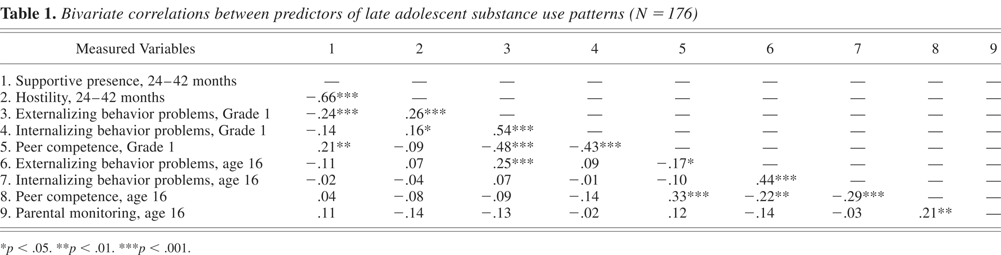
Bivariate correlations between predictors of late adolescent substance use patterns (N = 176)
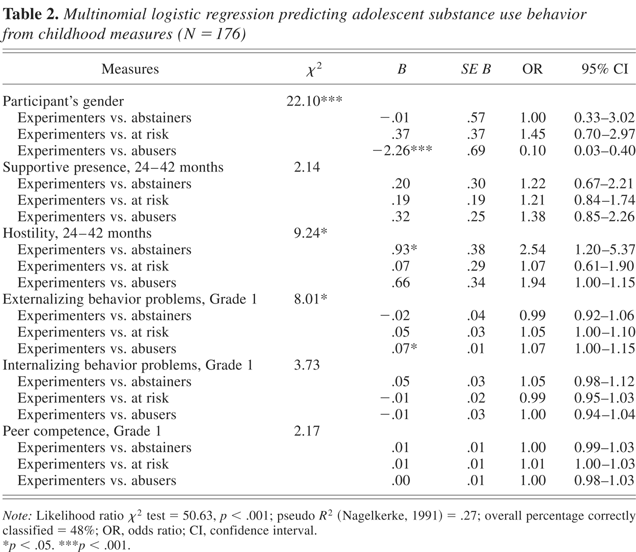
Multinomial logistic regression predicting adolescent substance use behavior from childhood measures (N = 176)
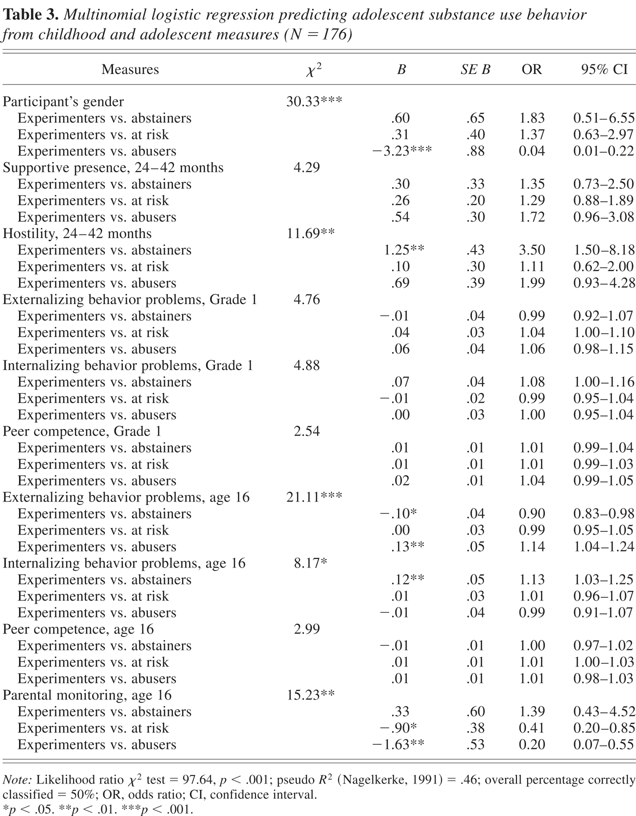
Multinomial logistic regression predicting adolescent substance use behavior from childhood and adolescent measures (N = 176)
 You have
Access
- 51
- Cited by