Nurses, as the largest group of health care professionals, play a pivotal role in supporting the public health infrastructure related to disaster preparedness and response. 1 , 2 In 2015, the US experienced a 33% increase in the number of natural disasters when compared with the annual average of 21 natural disasters over the last decade.Reference Guha-Sapir, Hoyois and Below 3 Recent disasters have revealed deficiencies in the US public health infrastructure and highlighted the need to strengthen the country’s disaster preparedness and response capabilities.Reference Gursky and Bice 4
National and international health care organizations have provided guidance in an effort to increase the disaster preparedness and response capabilities of the health care workforce. 5 , 6 Specific to nursing education, the American Association of Colleges of Nursing designated disaster preparedness and response as an essential aspect of baccalaureate nursing education. 5 More specific guidance, from the International Council of Nurses (ICN) and World Health Organization (WHO), delineated 10 competencies relevant to nursing roles across the disaster continuum (prevention, preparedness, response, and recovery). 6 Evidence of commonly accepted disaster nursing education content to achieve increased disaster nursing knowledge (actual or perceived) and confidence relative to these competencies exists, including disaster preparedness, disaster triage, and incident command system (ICS) content.Reference Atack, Parker, Rocchi, Maher and Dryden 7 - Reference Zapko, Ferranto and Brady 11
Even with recent advances in disaster nursing education methods, practicing nurses continue to have deficiencies in disaster nursing competencies.Reference Jacobson, Soto Mas, Hsu, Turley, Miller and Kim 12 , Reference Whetzel, Walker-Cillo, Chan and Trivett 13 Specific deficiencies include training gaps related to the ICS, disaster triage, bioterrorism, lack of knowledge related to disaster nursing roles, low confidence to care for disaster victims, and low willingness to collaborate with state and local officials during disaster.Reference Jacobson, Soto Mas, Hsu, Turley, Miller and Kim 12 , Reference Whetzel, Walker-Cillo, Chan and Trivett 13 Countering these deficiencies is challenging since no decisive set of guidelines for disaster-related nursing education exists.Reference Veenema, Griffin and Gable 14 Further, heterogeneity in disaster nursing delivery methods, make it difficult to establish disaster nursing education best practices.Reference Jose and Dufrene 15
A recent “Call to Action” by US disaster nursing leaders emphasized, “efforts to develop evidence-based and competency-driven didactic and clinical learning opportunities using multiple delivery platforms,”Reference Veenema, Griffin and Gable 14 including interprofessional training tools. While disaster nursing education methods have incorporated recommended disaster nursing competencies, pre-licensure disaster nursing education lacks teaching strategies commensurate with those of other disciplines that respond to disaster. The incorporation of training strategies from other disciplines (ie, emergency management) may offer strategies to optimize disaster nursing education competency achievement and improve interprofessional coordination skills for use in disaster upon entry into practice. 5 , 16 , 17
The use of the Homeland Security Exercise and Evaluation Program (HSEEP) guidelines offers an approach to the development of disaster nursing education methods that may facilitate improved disaster competency achievement. HSEEP guidelines foster interprofessional communication and collaboration as well as encourage varied education delivery methods. HSEEP approach consists of a step-wise program that begins with didactic education, progresses to operational tabletop exercises and drills, and then concludes with a full-scale experience that tests disaster preparedness and response capabilities. 18 , Reference Trainor and Subbio 19 The use of HSEEP across governing agencies specific to public health has been strongly encouraged as it represents the closest method to a national standard for all disaster preparedness exercises. 18 - Reference Singleton, DeBastiani, Rose and Kahn 20 Therefore, the use of HSEEP guidelines may offer a uniform, novel approach to disaster nursing education design consistent with the training of other professionals who respond to disaster. For this study, pre-licensure disaster nursing education was developed using the HSEEP approach with comprehensive coverage of existing disaster nursing competencies. The purpose of this study was to evaluate changes in pre-licensure nursing students perceived disaster nursing knowledge, training/response, and confidence after participation in the disaster nursing education.
Methods
Participants and Setting
The disaster nursing education was part of a population health nursing course in a pre-licensure baccalaureate nursing program with students in the both the traditional (4 year) and the accelerated (1 year) programs. The placement of the course in the curriculum was in the final semester of coursework for students in both the traditional and accelerated nursing program options. Although the traditional and accelerated nursing students were in different sections of the population health nursing course, the course offering was the same for both groups with each section co-taught by the same 2 nurse faculty members. The disaster nursing education progressively unfolded over the 15-week semester of the population health nursing course. Approval for the study was obtained before data collection through the university’s institutional review board.
Disaster Nursing Education Development
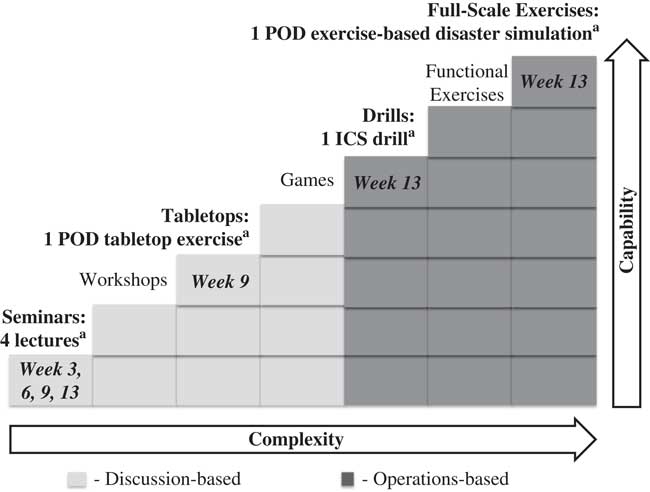
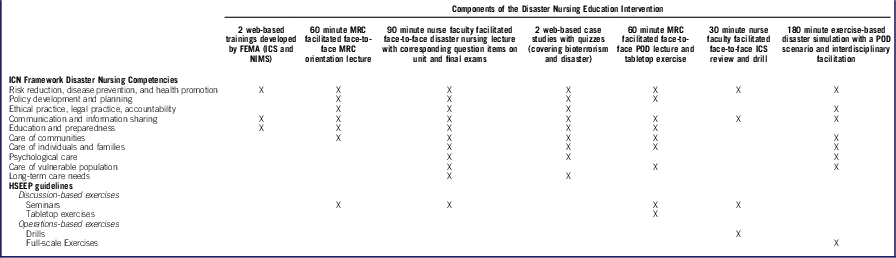
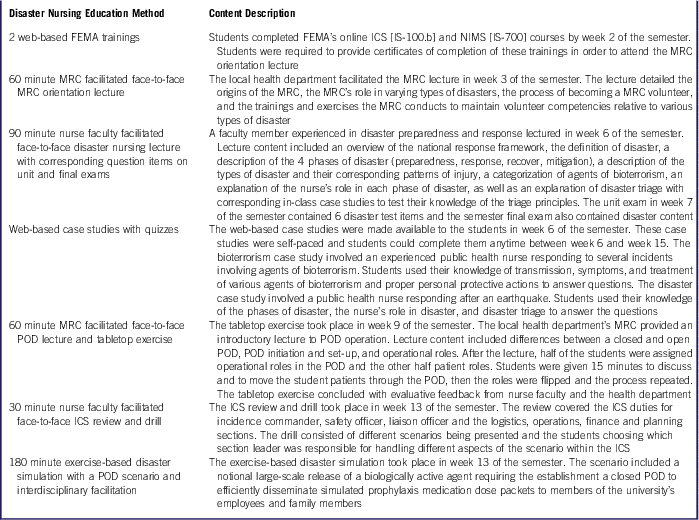
The disaster education method utilized the integration of the ICN framework of disaster nursing competencies and HSEEP guidelines to guide the development of the educational offering (Table 1). 5 , 18 In order to implement the HSEEP approach, 1 nurse faculty completed the HSEEP training course before the disaster nursing education development. The integration of the educational offering into the population health nursing course involved a progressive approach consistent with HSEEP guidelines, where discussion-based exercises (eg, seminars and tabletop exercises) and operations-based exercises (eg, drills and full-scale exercises) that reflect the overall course and simulation objectives unfolded throughout the semester with increasing complexity (Figure 1, Table 1). Figure 1 shows the variety of exercises in HSEEP compliant programs, and highlights the types of exercises in this method. Although a variety of exercises, ranging in complexity and capability, exist that could be included in HSEEP compliant programs, the specific exercises implemented in this disaster nursing education method consisted of web-based trainings, face-to-face instruction, drills, and an full-scale exercise-based simulation (Table 2). All disaster exercises used built upon each other in complexity as the knowledge and skills of the students progressed throughout the semester. Participation in each exercise during the disaster nursing education was mandatory for all nursing students enrolled in the course.
Disaster Nursing Education Method in relation to HSEEP Guidelines (Adapted from the Department of Homeland Security 21 ). Abbreviations: HSEEP, Homeland Security Exercise and Evaluation Program; POD, point of distribution; ICS, Incident Command System.aExercise included in the disaster education method.

Mapping of Disaster Nursing Education Components to ICN and HSEEP Guidelines

Abbreviations: FEMA, Federal Emergency Management Agency; ICS, incident command system; NIMS, National Incident Management System; MRC, Medical Reserve Corps; POD, point of distribution; HSEEP, Homeland Security Exercise and Evaluation Program.
Description of Disaster Nursing Education Method

Abbreviations: FEMA, Federal Emergency Management Agency; ICS, incident command system; NIMS, National Incident Management System; MRC, Medical Reserve Corps; POD, point of distribution.
The disaster education began with a series of web-based trainings and face-to-face lectures. Two web-based trainings developed by FEMA (ICS [IS-100.b] and NIMS [IS-700]) were followed by 2 face-to-face lectures (1 Medical Reserve Corps [MRC] facilitated and 1 nurse faculty facilitated). Following the nurse faculty-facilitated lecture, 2 online case studies addressing bioterrorism and sheltering in natural disasters were completed. The next step in the disaster nursing education method included an MRC-facilitated point of distribution (POD) lecture with tabletop exercise, and 1 nurse faculty-facilitated ICS review and drill. The final step allowed students to translate their knowledge and skills into an interprofessional, full-scale, exercise-based disaster simulation. The simulation included interprofessional collaboration with responders from the university and community such as the university’s emergency manager, emergency manager coordinator, university police, the local community’s fire department, a local emergency medical service’s personnel and ambulance, and the local health department’s MRC representatives.
To achieve meaningful interprofessional collaboration, the simulation not only evaluated the nursing students’ knowledge, skills, and ability to meet the disaster objectives, but also exercised the functionality of the university’s emergency management POD plan. Four collaborative, interdisciplinary meetings were held with interdisciplinary representatives over a 3-month period of time prior to the implementation of the exercise-based disaster simulation. POD exercise objectives, resources, and layout details were established in these meetings to develop the master scenario and exercise plan. Five planning meetings were held among the 2 population health nursing course faculty and the school of nursing’s simulation director over a 4-month period of time prior to the simulation. In these meetings, disaster nursing simulation objectives were established and interwoven into the established master scenario and exercise plan. A final training with the nursing school staff (nurse faculty, clinical instructors, the simulation director, and simulation instructors) was held 1-week before the exercised-based, disaster simulation to train them on their role in evaluating/facilitating the simulation. Debriefing, in the form of HSEEP’s “hot wash,” was conducted among simulation facilitators and participating students immediately following the simulation and a post-simulation debriefing and evaluation was conducted among simulation facilitators 2 weeks following its implementation.
Measures
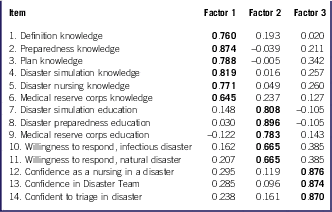
A 14-item pre-post survey was completed on a voluntary basis on week 2 and week 14 of the population health nursing course. An exploratory factor analysis with principle axis factoring and varimax rotation in SPSS 18 was used to examine whether a smaller number of factors could explain scores on each of the 14 items. Inspection of Eigenvalues and the scree plot suggested three factors explained 71% of the variation in all 14 item (Table 3). The 3 factors were named: (1) perceived disaster nursing knowledge (items 1-6), (2) disaster nursing training and response (items 7-11), and perceived disaster nursing confidence (items 12-14).
Factor Loadings of Disaster Education Survey Administered to Nursing Students Start of SemesterFootnote a

a Loadings in bold show items that were assigned to each factor.
Perceived Knowledge
Perceived disaster nursing knowledge was assessed with 6 items, asking respondents how they would assess their current knowledge of: (1) the definition of a disaster, (2) disaster preparedness, (3) disaster plans, (4) disaster simulation, (5) nursing roles in disaster response, and (6) the MRC. Response options to knowledge questions had a 5-point scale, from 1=“no knowledge” to 5=“expert knowledge.” The scale had good internal consistency before (a=0.88) and after (a=0.88) education.
Training and Response
Disaster nursing training was assessed with 3 items asking the respondents’ agreement about different disaster trainings occurring in nursing education, such as: (1) disaster simulations occurring in nursing education, (2) nursing students being educated in disaster preparedness in general, and (3) the inclusion of MRC content in nursing education. Disaster nursing response was assessed in this scale by 2 items asking the respondents agreement about (1) willingness to provide nursing care in the event of an infectious disease pandemic (eg, H1N1 and Ebola) and (2) willingness to provide nursing care in the event of an natural disaster (eg, hurricane, tornado, and flood). Response options to the disaster training and response question items had a 5-point scale, from 1=“strongly disagree” to 5=“strongly agree.” The scale had good internal consistency before (a=0.84) and after (a=0.87) education.
Perceived Confidence
Perceived disaster nursing confidence was assessed with 3 items asking the respondents whether they felt confident in their ability to: (1) act effectively as a nurse in a disaster situation, (2) work effectively with members of a disaster response team, and (3) to triage patients during a disaster event. Response options to disaster confidence questions had a 5-point scale, from 1=“strongly disagree” and 5=“strongly agree.” The scale had good internal consistency before (a=0.93) and after (a=0.89) education.
Analysis
We used independent samples t-tests in SPSS 18 to examine changes in the perceived knowledge, training and response, and perceived confidence scales. Cohen’s d was used to calculate the effect sizes using the guidelines of 0.2 small, 0.5 medium, and 0.8 large.Reference Cohen 22 As a follow-up test, we used Wilcoxon signed-rank test in SPSS 18 to test changes in each of the items within the 3 scales.
Results
There were 52 traditional nursing program students and 54 accelerated nursing program students enrolled in the population health nursing course. Overall response rate to the survey was 84%, with nearly equivalent response rates in the traditional and accelerated groups (83% and 85%, respectively). Respondents were evenly distributed between the two nursing program options of traditional and accelerated (n=43, 48.3% and n=46, 51.7%, respectively). The mean age was 25, SD=4.62, years. The majority was female (n=80, 89.9%) and did not have prior experience working in health care (n=60, 67.4%). The majority did have previous disaster experience (n=76, 85.4%).
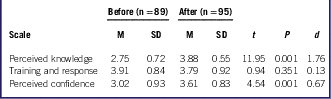
The analysis revealed a large increase in perceived disaster nursing knowledge (d=1.76) after the course (Table 4). No change was observed in disaster nursing training and response from pre to post-disaster nursing education. A medium-sized increase in perceived disaster nursing confidence (d=0.67) was observed after the course. The results of the analysis of individual survey items revealed that all items associated with the perceived disaster nursing knowledge scale had significant differences, positively, before and after the nursing education. The disaster nursing training and response scale items had no differences, and all items associated with the perceived disaster nursing confidence scale had significant differences, positively, before and after the nursing education.
Differences in Each Scale Before and After Education

Discussion
This disaster nursing education method presented a novel way to approach improving nurses’ disaster preparedness and response capabilities. This method was the first to utilize the HSEEP approach to guide disaster nursing education development while comprehensively addressing existing recommendations on disaster nursing competencies. Incorporation of the HSEEP method allowed for incremental building of disaster nursing knowledge and skill throughout the semester in a way that is consistent with the training of other disaster response professionals. This facilitated seamless integration of other disaster professionals rooted in the HSEEP guidelines into the exercise-based disaster simulation and offered the opportunity for disaster professionals to exercise a real-world disaster plan with specific exercise objectives, while also incorporating nursing simulation objectives into the exercise. This integration allowed for both the evaluation of the university’s emergency management POD plan and the evaluation of nursing student disaster knowledge and skills. The utilization of the HSEEP method helped to facilitate the preparation of nursing students to play a meaningful role in a real-world disaster exercise, as well as improve collaborative capabilities with other disaster professionals during the exercise. This integration could possibly have contributed to the significant increases in perceived disaster nursing knowledge and confidence after the course.
The large increase in perceived disaster nursing knowledge after the education is consistent with previous disaster nursing education methods. Both solely didactic disaster education and combination education, with both preparatory didactic content and disaster simulation, have shown improvements in disaster preparedness knowledge and disaster management competencies.Reference Atack, Parker, Rocchi, Maher and Dryden 7 , Reference Austin, Bastepe-Gray and Nelson 8 , Reference Hutchinson, Haynes, Parker, Dennis, McLin and Welldaregay 10 , Reference Chan, Chan and Cheng 23 , Reference Kaplan, Connor, Ferranti, Holmes and Spencer 24 Results from this educational method provide additional evidence that disaster-related concepts delivered through varied teaching methods, including both didactic and simulation-based strategies, increase disaster nursing knowledge attainment.
The large effect size in perceived disaster nursing knowledge may have resulted from several aspects of the educational method. First, following HSEEP guidelines ensured the step-wise integration of disaster content throughout the semester using varying teaching strategies (ie, lecture, a tabletop exercise). This allowed for different learning styles to be accommodated, reducing differences in student learning and performance because of 1-sided teaching methodologies.Reference Flanagan and McCausland 25 Additionally, layering content throughout the semester allowed for repeated content exposure, and may have further facilitated nursing student learning. Repetition of content, when not overused, can lend to improved retention and may be particularly relevant when teaching complex content.Reference Bastable 26 Finally, formative and summative learning evaluation strategies built into the method components allowed students to reflect on their progress toward meeting disaster-specific objectives of the population-focused nursing course. Formative evaluation often occurred with the operations-based exercises, including informal feedback after the ICS drill and the exercise-based disaster simulation. Summative evaluation often occurred with the discussion-based exercises and included quizzes following the web-based bioterrorism and disaster case studies as well as disaster question items on both a unit and final exam following the disaster nursing lecture. The varied ways students could reflect on their progress toward achieving disaster-specific objectives allowed students multiple opportunities to clarify their understanding of the complex disaster-related content throughout the course, likely lending to improved knowledge attainment of disaster concepts. In this way, receiving feedback through various modes of evaluation offers students a more comprehensive view of their overall outcome achievement.Reference Billings and Halstead 27
Significant changes in nursing student agreement about disaster nursing training and response after the course were not observed. This lack of change in disaster training and response from pre to post-disaster education could possibly be attributed to a statistical ceiling effect as scale mean scores were high pre-educational method (M=3.91) and remained high post-educational method (3.79). The large percentage of the nursing students (M=85.4%) reporting previous disaster experience could be related to this effect.
Previous disaster experience has been associated with practicing nurses who reported possessing disaster capabilities.Reference Baack and Alfred 28 The high percentage of students reporting disaster experience in this study may stem from a mandatory high-fidelity exercise-based disaster simulation at the nursing school the previous year for Ebola response preparation. The fidelity, or level of reality, of a simulation ranges from low to high, with the integration of simulated patients and real-life actors representing the highest level of simulation fidelity.Reference Maran and Glavin 29 Although not a “real-world” disaster, high-fidelity exercise-based disaster simulations, like that included in this disaster nursing educational offering, may prime students with enough “real-world” experience to increase perceived disaster training and response capabilities. Simulations with less realism may not impart a rich enough experience for participants to perceive themselves as possessing disaster capabilities. These findings may substantiate the time and resources utilized in developing high-fidelity exercise-based disaster simulations as a part of disaster nursing education curricula.
Significant changes in nursing students’ perceived disaster nursing confidence were observed from baseline to post-disaster nursing education. High self-reported confidence in the ability to handle emergency preparedness situations and confidence working effectively in teams have also been observed after undergraduate nursing student participation in a disaster simulation, however these reported perceptions were post simulation only.Reference Kaplan, Connor, Ferranti, Holmes and Spencer 24 Although there was no comparison group, the pre-post evaluation in this method allowed for more definitive conclusions to be made about the role of the educational method in disaster confidence than post method studies.
The use of HSEEP guidelines engrained interprofessional collaboration as a key aspect of this method. Nursing students had the opportunity to collaborate with public health officials during the MRC orientation lecture and the POD lecture and tabletop exercise. Those same officials also collaborated during the exercise-based disaster simulation. Nursing students may have gained comfort with these officials during the pre-simulation components of the education, which allowed for a richer interaction during the exercise-based disaster simulation. These positive interprofessional interactions over the course of the semester may have impacted the nursing students improved sense of disaster nursing confidence after participation in the education.
As confidence is associated with willingness to respond to disaster, challenges exist in sustaining confidence beyond the education intervention to achieve the long-term goal of disaster nursing confidence in practice.Reference Barnett, Thompson and Errett 30 Although significant changes in disaster nursing confidence were observed at the completion of this disaster nursing education, the moderate effect size observed in our sample may speak to the continued need for disaster-based education upon entry into practice. Previous studies also suggest that disaster-related education for nurses should not only occur within the confines of a nursing school, but practicing nurses should also have an opportunity for continued disaster-related training.Reference Jacobson, Soto Mas, Hsu, Turley, Miller and Kim 12 , Reference Baack and Alfred 28 To sustain the obtained level of disaster nursing confidence, future exposure to disaster-related content may be necessary to maintain newly acquired disaster skills. The mandatory MRC enrollment as a part of this disaster nursing education gave the students immediate access to continued disaster training opportunities upon graduation. As employers may be constrained in offering continued disaster training and exercising, coordinating with volunteer emergency response teams, like the MRC, gives nurses expanded avenues for disaster skill development upon entry into practice.Reference Veenema, Griffin and Gable 14
This novel disaster nursing education method comprehensively covered ICN disaster nursing competencies and utilized HSEEP approach in its design. Consideration of the ICN’s framework of disaster nursing competencies ensured the method components addressed nursing-specific roles across the disaster continuum. Application of HSEEP guidelines allowed for simulated integrated systems coordination with interprofessional agencies that respond to disasters. In this way, students received an education method that was consistent with federal guidelines and gained practical disaster response skills commensurate with those needed to collaborate in real-world disaster settings. This disaster nursing education method was also consistent with international research priorities in disaster nursing that identified the need to improve collaborative approaches in disaster settings and disaster education methods.Reference Ranse, Jeeawody, Hutton and Wilson 31 Further, a “culture of volunteerism” was also emphasized in the “Call to Action” by encouraging or facilitating the engagement of nurses to coordinate with volunteer agencies such as the MRC, American Red Cross, among other organizations.Reference Veenema, Griffin and Gable 14
Developing innovative teaching strategies to achieve disaster competencies can be a challenge given already overburdened curricular demands in nursing education.Reference Turale 32 Collaboration with university and community-based resources was key to the success and feasibility of offering such a full-scale exercise-based disaster simulation. Other collaborative efforts with community-based constituencies in need of disaster exercising have also contributed to the feasibility of providing nursing students with full-scale, high-fidelity disaster simulations in other nursing programs.Reference Alfred, Chilton and Connor 33 , Reference Culley 34 Constrained resources can limit the ability to implement full-scale disaster simulations and force educators to consider other modalities for achieving disaster competencies.Reference Colleran-Santos and Toronto 9 , Reference Foronda, Shubeck and Swoboda 35 Despite success in some of these simulation approaches (eg, virtual reality, tabletop exercises), more research in the effectiveness of such educational methods is needed to demonstrate superiority in achieving disaster competencies. Full-scale, exercise-based simulations may offer the most impact on long-term retention of disaster competencies and be feasible if appropriate university- and community-based resources are leveraged.
This study has some limitations. The evaluation used in this educational method does not allow for differentiating which components of the method contributed most to the perceived change in knowledge and confidence. Therefore, the effect of the entire educational package must be considered. Despite the assessed change in perceived disaster nursing knowledge and confidence, definitive conclusions about achieving educational outcomes related to disaster cannot be made due to the self-report nature of the data. Further, the self-reported nature of the data may increase the likelihood of social desirability and self-selection bias. The survey focuses solely on perception of knowledge and not actual knowledge or ability. However, perceived knowledge has been positively correlated with actual knowledge in previous studies of practicing nurses and perceived levels of preparedness have been shown to correlate with actual preparedness in the general population.Reference El-Deirawi and Zuraikat 36 , Reference DeBastiani, Strine, Vagi, Barnett and Kahn 37 Additionally, individual responses to the pre and post surveys were not tracked, which led to the analysis of group means instead of paired means. As such individual variation in the experience of this educational method cannot be elucidated. Further, long-term effects of the method cannot be evaluated as students were not followed for outcome data after entry into practice.
Conclusions
As the frequency of disasters and issues of national security increase, the need for more health care professionals trained in disaster preparedness and response is also increasing. To date, disaster preparation for nurses has a large amount of variation.Reference Jose and Dufrene 15 In the context of this disaster nursing education method, statistically significant changes in perceived disaster knowledge and disaster confidence were observed among pre-licensure nursing students in a population-focused nursing course. Adding to the literature, our findings demonstrate evidence for a dynamic disaster nursing educational methodological approach, through the use of HSEEP, that combines didactic and exercise-based simulation education as well as community-based resources and expertise to achieve disaster competencies in pre-licensure nursing programs. While more research on this and other approaches are needed, the HSEEP offers a novel approach to disaster education curriculum development and may serve to fill the current gaps in educational strategies to achieve disaster nursing competencies both during nursing programs and upon entry into practice. Future research may also seek to determine if further integration of disaster concepts across a nursing curriculum, and not just in the context of a population-based nursing course, adds additional benefit to the provision of disaster nursing competencies. Evaluation of such initiatives should include both group and within-subject differences in disaster competencies pre and post-educational intervention.