Introduction
On the eve of the SangleyFootnote 1 revolt in 1603, Spanish governor-general Pedro de Acuña ordered the establishment of infantry captaincies in the pueblos of Philippine natives in Manila and surrounding provinces.Footnote 2 An account of the revolt relates that “the governor sent out his sargento mayor, Don Juan de Arceo, with two hundred infantrymen, eighty cavalrymen, one hundred Pampangos, and four hundred Tagal indians, all with firearms and two pieces of cannons.”Footnote 3 In the 1639 Sangley uprising governor-general Sebastian Hurtado de Corcuera reported that three thousand Tagalogs and one thousand Pampangos were enlisted to help two hundred Spaniards suppress the insurrection.Footnote 4
From the beginning of the Spanish presence in the Asia-Pacific region, the Spaniards relied upon the collaboration of indigenous groups to advance their imperial expansion and stabilise their presence in the territories they had colonised. An indisputable sign of their presence was the establishment of pueblos that were administered by natives. Moreover, pueblos also deployed men whenever the Spaniards required help in their military endeavours in uncolonised territories in the Philippines and in neighbouring territories. Although at first the military collaboration of natives with Spaniards was an ad hoc response to pressing emergencies like threats of invasion by foreigners or to the demands of conquest, this military collaboration appeared to be standard practice by the first half of the seventeenth century. Standard practice refers to the fact that there were recognised ranks with corresponding dues that native officials paid when they were appointed to those ranks. The period of standardisation in military appointments of natives coincides with the union of Spain and Portugal under one crown, which faced compounded threats to their interests in the region. For Spain, the challenge of local expeditions to hostile regions in the Philippines was compounded by the growing menace of Dutch and other enemies of Portugal in the Asia Pacific. The Spaniards, therefore, had to deploy their scarce military to fight on different fronts. Because of the lack of Spanish recruits to fill positions in the army, the Spanish government in the Philippines had to make alliances with indigenous groups in colonised regions who could support them with fighting men. The early institutionalisation of the native militia in the Philippines in the first decade of the seventeenth century was part of Spain's overall strategy to win the contest for supremacy on the Asian side of the empire.Footnote 5 The emergence of the native militia under the leadership of the indigenous elite helped consolidate the elite's position in colonial society through military posts, benefits, and rewards accorded to them.
This paper will examine the native militia in the Philippines in this period, focusing on the province of Laguna de Bay, some ninety kilometres southeast of Manila. The bulk of the sources come from lists of payments of the media anata from 1633 to 1700, culled from the Contaduría section of the Archivo General de Indias. The media anata was a tax imposed on people who occupied a post in government or the military, or anyone who received a benefit from the government. The amount was equivalent to half-a-year's salary. Spain originated this tax in 1631 and it was applied two years later in the Philippines.Footnote 6
While earlier works have delved into the emergence of the principalía (indigenous elite) linked to their political roles in the pueblo, Philippine historiography has not examined exhaustively their role as soldiers in the nascent colonial military structure in the seventeenth-century Spanish Philippines. This paper argues that the military role of the Philippine indigenous elite strengthened their position in colonial society and was a continuation of their pre-Hispanic role as military leaders. Although the military dimension was important in shaping their role in colonial society, scholarship on the Philippines has not fully examined it. The paper aims to fill this gap to complete our understanding of the part that indigenous leaders played and the space that allowed them to exercise power in Spanish Philippines.
In this paper I discuss the structure of the Philippine native militia from its inception in the seventeenth century as a stable source of manpower for the Spanish army in the region. Next, I investigate the careers of individual native elites who held officer positions in the militia. Using microhistory, I examine the careers of the elite who became maestres de campo, or field marshals, and consider the position of the Filipino indigenous elite in the Spanish colonial and military activities in the Pacific in the early modern era. While the native militia was a colonial structure, the Spaniards relied on existing pre-Hispanic ties and social structure to guarantee they had men for their military endeavours, using the native elite to recruit fighting men. This reliance on the native elite and their network of followers to aid the Spanish in fighting wars and ensuring peace bolstered the position of the indigenous elite and enabled them to gain power that went beyond the realm of the military. I have reduced the scope of this study to focus on one Tagalog province. I believe this geographic region, due to its proximity to the colonial capital, will be illustrative of indigenous experiences in other neighbouring provinces in lowland Luzon.
The Indigenous Elite of the Philippines
Throughout their colonies, the Spaniards forged alliances with indigenous leaders to advance their conquest. In the Philippines the first conquistadores allied with native leaders of barangays, the smallest political unit, made up of thirty to one hundred families. The barangay was led by a datu. Indigenous leaders in the precolonial barangay performed political, military, religious, and economic roles.Footnote 7 The datu was chief in his barangay and in charge of peace, justice, and economic life. He was aided by freemen (Tagalog maharlika or Visayan timawa). One of the duties of the freemen was to take up arms for their datus. At the bottom of the social structure were slaves, or alipin. The cause of slavery was usually debt or capture in war. There were different categories of slaves. Some were allowed relative freedom to own property. Others were totally dependent on their masters. Barangays in the Philippines were generally autonomous. Except for the existing sultanates in the south like Maguindanao and Sulu, the datu's jurisdiction was limited to the confines of his barangay. Some neighbouring barangays and their chiefs joined in a territory called bayan and the chiefs in the bayan would be ranked according to wealth and military power.Footnote 8 Bayans like precolonial Manila could be the site of chiefdoms, typically ruled by a rajah or lakan. Sometimes barangays banded together to engage an enemy in battle. The natives waged war and raiding campaigns against other barangays to settle grievances. And they honoured their men for bravery in battle by holding feasts and remembered their valour for the rest of their lives.Footnote 9
The indigenous elite's role gradually transformed when the Spaniards arrived in the Philippines. Once the role of the native elite was clarified when the Synod of Manila clamoured for respect for indigenous authority,Footnote 10 the early colonial era saw the transformation of the datu to a cabeza de barangay (chief of the barangay) or gobernadorcillo or gobernador de naturales, the head of the pueblo. Phelan discusses the transformation of the Philippine native elite in terms of their political role in the Spanish colony.Footnote 11 Sánchez likewise discusses the native elite or principalia with respect to their roles in the governance of the pueblo de indios but does not tackle the native leaders’ gradual incorporation into the militia.Footnote 12 More recently, Perez contextualised the emergence of the Philippine principalia within the rise of pro-Indianist thought among Spanish thinkers, which saw the indios as potential allies.Footnote 13 The political jurisdiction of these native allies was limited to local government and administration of justice in their pueblos.
The Spanish government retained the barangay as the smallest unit of tribute collection. Each barangay was headed by a cabeza. A number of barangays formed a pueblo, headed by the native gobernadorcillo. In the seventeenth century, the indigenous leaders in the pueblos and the barangays also had to answer Spain's call for arms through the native militias established in the provinces surrounding Manila. The elite found a space to exercise military power through the positions they occupied in the militia.
The Native Militia: Aiding the Spanish Empire's Aims
Long neglected in the historiography of Spanish America, military collaboration between Spaniards and their native allies, indios amigos, has been the subject of a growing body of works in recent years. This kind of collaboration had made the conquest of vast regions in Latin America possible. Apart from fighting, the indigenous allies also pacified regions and ensured that pacified territories remained secure.Footnote 14 The number of native soldiers and noncombatant aides that supported Spanish military activities throughout the sixteenth century was staggering.Footnote 15 Although in recent years, more works examining the roles of native allies in the conquest and colonisation of Latin America have emerged, only a few have focused on the military structure that these native allies occupied. The study of the flecheros, natives from Indian pueblos that provided military service to the Spaniards in Nueva Galicia, looks at the institutionalisation of this group, which arose to abate conflicts with Chichimecos in the mining region north of New Spain.Footnote 16 Güereca has done a comprehensive study of the history and structure of the native militias in New Spain.Footnote 17 Interestingly, she mentions that in the eighteenth century the native militias became an official institution across Mexico, but in some regions the militia was established earlier, as in the distant regions of Nueva Tlaxcala, Sinaloa, and Sonora. The native militias in the Philippines were like those in the peripheral regions of New Spain. As in those far-flung areas, the Tagalog and Pampanga militias of the Philippines were established officially early in the seventeenth century. This early institutionalisation of the Philippine native militias was due to the kind of military activities and the ongoing threats the Spanish colony faced.
Although the history of imperial powers show their reliance on indigenous allies, Philippine historiography has not focused on this theme.Footnote 18 At best, earlier works have acknowledged the importance of Spanish military activities in the formation of the Philippine military but do not discuss the native militia before the nineteenth century.Footnote 19 The tardy focus of Philippine historiography on indigenous roles in Spanish military activities may be attributable to Filipino historians’ framing of the discussion within the grand narrative of resistance to and liberation from imperial powers.Footnote 20 This framework glossed over those native activities that seemed to support the expansion of the Spanish Empire in the Philippines. More recently historians of the early modern Pacific have begun exploring native military activities within the Spanish army, but these studies are few and focus on the Pampangos whom the Spaniards recruited from the late sixteenth century to aid them in their expeditions and wars.Footnote 21 The Spanish regard for the Pampangos’ military prowess grew especially during the Spanish-Dutch War as they helped the Spanish army fend off the Dutch threat in the region. Borao studied the progressive recruitment of Pampangos and Cagayanos to the militia from the sixteenth century and described them as volunteers.Footnote 22 Mawson discussed the recruitment of ordinary indigenous fighters and their possible motivations for enlisting, distinguishing the native elite who gained rewards from ordinary natives who enlisted to pay debt obligations.Footnote 23 There are a few attempts to examine the roles of individual native elites in the military, such as the maestres de campo and their responses to Spanish policies. Nicholas Sy argues that the maestres de campo exercised both military and political authority beyond the confines of their pueblos. These native maestres de campo enjoyed privileges like prestige and rewards in the form of encomiendas.Footnote 24
Scholars are silent about the Philippine native militia in the eighteenth century except for some mention of the multiethnic army that the Spanish government assembled to fight the British when they invaded Manila during the Seven Years’ War.Footnote 25 In a more comprehensive study of the Filipinos in the Spanish army in the nineteenth century, Sophia Marco discussed the systematic recruitment of non-elite Filipinos in the Spanish colonial army through the policy called contribución de sangre, literally blood tax, which referred to the compulsory drafting of men from the towns. Marco's article focuses on the state-propelled recruitment that no longer relied heavily on the Philippine native elite.Footnote 26 What is missing in the literature is a discussion of the native elite involvement in the militia and the Philippine native militia as an institution that continually provided fighting men for the Spanish army.
Origins of Native Military Collaboration
Military collaboration between indigenous groups and Spaniards began as soon as the Spaniards started expanding their domains in the Pacific region. When Miguel Lopez de Legazpi settled in the Visayan islands of Cebu and Panay in 1565 and 1569, native groups helped him reconnoitre the region. In 1571, six hundred Visayans accompanied 110 Spaniards in Martin de Goiti's first expedition to Manila.Footnote 27 Legazpi and his successors sent endless requests to the king of Spain to deploy forces to the Philippines to ensure the continuity of the conquest and to secure the colony. But recruits from Spain and Mexico were never enough to meet the need of the Philippine colony. Native arms helped the Spaniards not only in expeditions within the Philippines and neighbouring islands but also in the fight against Chinese corsair Limahong.Footnote 28
The shortage of recruits from Spain and Mexico was always a problem for the Spanish government in the Philippines. The few Spaniards in the Philippines were not attracted to serve in the military. In 1613, Juan de Silva observed that some of the good soldiers would rather settle in Malacca to engage in trade.Footnote 29 The years 1630 to 1634 saw a slump in the number of Spaniards who arrived in the Philippines just when there was a need for able-bodied men to secure the territory.Footnote 30 In a desperate attempt to produce soldiers, the government even tried to create a recruitment programme from among orphaned Spanish and mestizo students in the Dominican school San Juan de Letrán in the first half of the seventeenth century.Footnote 31 However, the government lamented that the recruits who were conscripted from New Spain were not satisfactory, as many of them were either convicts or not Spaniards. Governor-general Diego Fajardo, who ruled the Philippines from 1644 to 1653, believed that the Pampangos recruited to the army were not enough.Footnote 32 Meanwhile the Spaniards had to battle on all fronts keeping invaders at bay, while ensuring that the local populations were under control.
From 1575 to 1644 the native soldiers deployed in separate expeditions to Philippine regions and nearby Borneo, Moluccas, Taiwan, and others outnumbered the Spanish contingent.Footnote 33 Native soldiers were recruited to fight defensive wars, aid in expeditions, and serve in the standing armies that secured presidios. The soldiers from Pampanga, Tagalog regions, and others were paid a salary and had their own native officers.Footnote 34 It is uncertain when native soldiers officially formed part of the standing armies to guard the presidios in the Philippines. But as early as 1603, there were native infantry captaincies to fight the Sangley threat to the Spanish foothold in the Philippines. In 1632, long after the Sangley uprising, a report indicated that there were native companies that guarded the presidios.Footnote 35 However, there is no certainty that there were Tagalogs deployed to these fortresses. Native militias were also recruited to help Spaniards fight the Dutch throughout the first half of the seventeenth century. Borao noted that this era marked a new phase in the recruitment of natives to the Spanish army as the Spaniards faced a new threat to their power in the Pacific.Footnote 36 In 1606, Tagalog and Pampango recruits accompanied the Spaniards on the Moluccas expedition, which aimed to engage the Dutch in battle.Footnote 37 We can assume that a number of these Tagalogs came from the Laguna province because it was among the few Tagalog provinces that had been organised into pueblos. Recruits from other native groups were deployed in local expeditions organised to advance the conquest of the islands.Footnote 38 Even after the end of the Hispano-Dutch war, there was an ongoing need for native arms to quell local uprisings in various parts of the Philippines.Footnote 39 Thus, the recruitment of indigenous soldiers continued throughout the seventeenth century, reaching the highest numbers in the time of governors-general Sebastian Hurtado de Corcuera and Diego Fajardo (1635–1654).Footnote 40 When the British invaded Manila in 1762, governor-general Simon de Anda raised an army made up of native militias and companies of Sangleys and mestizo troops to battle against the British army, which was also made up of various ethnicities assembled from its own colonies.Footnote 41
Recruitment through the Native Elite
Governor-general Pedro de Acuña described how he recruited natives to the military and how he treated them:
I wrote to the alcaldes-mayor and the fathers; they sent me a memorandum of those who appeared to them most fit, saying that they had told them that they should immediately get their people ready and well-armed, each one with rations for a month. While this was being agreed upon, the uprising took place, and this precaution was of the greatest importance; for they were able to come without delay, and be of so much use that without them I know not what would have happened. . . . I have made much of them, given them presents, and thanked them for what they have done, for which they are grateful and contented with whatever may come to them.Footnote 42
At the beginning of the seventeenth century and possibly before that, both Spanish officials and religious missionaries in charge of the pueblos identified those native leaders who could help the Spaniards in their expeditions and wars. These indigenous leaders took their men in tow to whatever battle they were to wage. The Spaniards used the existing form of datu–timawa (freemen) relations, which were carried over into the seventeenth century, to wage war against their enemies. With reference to the recruitment of Pampangos, Borao argued that the Spanish motivated the natives to join their forces by rallying for aims that matched local aspirations, like the defence of their territory, booty, revenge against enemies, and rewards.Footnote 43 The indigenous elite's role in recruiting men to serve in the military was crucial even up to the eighteenth century, despite Spanish attempts to reform the recruitment system.Footnote 44 It was only towards the end of the eighteenth century that reforms gradually took effect. Finally, in the nineteenth century, the state ceased to count on the native elite as recruiters with the establishment of a more centralised recruitment process. In the seventeenth century, Spain's heavy reliance on the native elite both in the governance of towns and military recruitment enabled this social class to carve their position in colonial society. Still the Spanish military attempted some uniformity and standardisation in the native militia by ranking the officers, possibly before 1633. These elites were ranked as maestre de campo, capitán, sargento, and so on.
Among the groups deployed to aid the Spanish armies in their military campaigns and conquests were the Tagalogs of Luzon. One of the Tagalog provinces that fielded their elite to the military from the beginning of the seventeenth century was Laguna. The earliest contact of Laguna natives with the Spaniards happened in 1571 when Juan de Salcedo, accompanied by some Spaniards and natives called Sogbohanin, made inroads into the lake region. After a few skirmishes with the natives in the towns surrounding the lake, the Spanish contingent established alliances. The region came to be known as Laguna de Bay after the prominent town of Bay, one of the first that welcomed the Spaniards. By 1588, Laguna was an alcaldía (geographical region governed by an alcalde mayor) with eleven thousand tribute-paying inhabitants and twelve houses for Franciscan and Augustinian missionaries.Footnote 45 Tribute was a form of tax collected from pueblo inhabitants. One tribute could be equivalent to one family (husband, wife, and children) or to an adult, single man or woman. Some pueblo inhabitants could be exempt from paying tribute depending on their position in society or age.Footnote 46
The Native Elite in the Militia of Laguna
The main research source on the military appointments of native elites from Laguna are the yearly financial reports of the Real Hacienda compiled in the Contaduría section of the Archivo General de Indias. The records span almost three-quarters of the seventeenth century, from 1633 to 1700. I have also perused contemporary accounts from secular and religious sources. Like other government officials, the natives, Sangleys, and Spaniards who held military posts were bound to pay the media anata tax upon their appointment. The media anata was imposed by Philip IV in 1631 in a bid to collect more tax for the royal coffers.Footnote 47 The tax was later applied in all the colonies and was paid by anyone who received privileges from the Spanish government. The Real Hacienda's yearly financial report sent to the Consejo de Indias listed the natives who paid their media anata. Each payment entry includes details on the payer, their provenance, and the reason for payment. Entries of payments coming from Laguna natives who received appointments as officers were first registered in 1634.Footnote 48
Since the registration provided details about the posts being paid for, it has been possible to list the positions that native officers occupied in the militia and present its organisation in a diagram. Each town in Laguna had a company of natives headed by a captain. Together, these companies were under the authority of a native maestre de campo. This is deduced from the list of media anata payments indicating that the maestre de campo was either a leader for the naturales de la provincia, i.e., for all the natives of the province, or maestre de campo general de los naturales del pueblo, with only the pueblo company under his command. Those who held officer posts were usually elites of the pueblos. Frequently, these elites also held posts in the town government.
Map of Laguna province in 2022
Laguna, “PhilAtlas,” 2022, accessed 29 March 2023, https://www.philatlas.com/luzon/r04a/laguna.html.

The chart in Figure 2 enumerates the military posts according to different levels: provincial, sub-provincial (i.e., covering some pueblos), and pueblo level. I have arranged the hierarchy according to the cost of the media anata that native officers paid.
Positions of native officers in the militia of Laguna. Chart created by the author based on media anata payments. AGI, Contaduría, 1206 to 1247.

Aside from the provincial level of command, the militia was also structured to cover sub-provincial commands that grouped upland and lowland pueblos together. An overall maestre de campo headed the provincial militia, which included all the pueblo militias. By law, the governor-general appointed officers to the native militia.Footnote 49
More study is needed to understand the specific functions of the posts in the militia. The maestre de campo appear more frequently in the literature because they had more transactions with the government. For instance, a few requested privileges like tribute exemptions or encomiendas.Footnote 50 Still, little is known about the duties of the native maestre de campo. In the Spanish army the maestre de campo was a high official in command of the tercio, regiments made up of three thousand men.Footnote 51 He relayed orders from the highest command to the officers under him and took charge of the administration of the regiments in the tercio. The tercio became powerful and well-organized in seventeenth-century Spain, in charge of ensuring the security of the peninsula.Footnote 52 Since the Spaniards exported this structure to the Pacific, we can presume that indigenous maestre de campo likewise functioned as a field marshal.Footnote 53
Little else is known about the functions that the sub-officers performed. In the Spanish tercio, the sergeant major was second to the maestre de campo and in charge of passing orders to the other officers. He also organised the movement of troops.Footnote 54 In Mexico, the indigenous captain's task was to assemble the members of his company every so often and make sure that his men had enough weapons. At the frontier region of Colotlán, the company assembled every fifteen days for training.Footnote 55 This practice might have been observed in regions beset by raiding bands from the Muslim south, but not in relatively more peaceful Tagalog inland regions like Laguna.
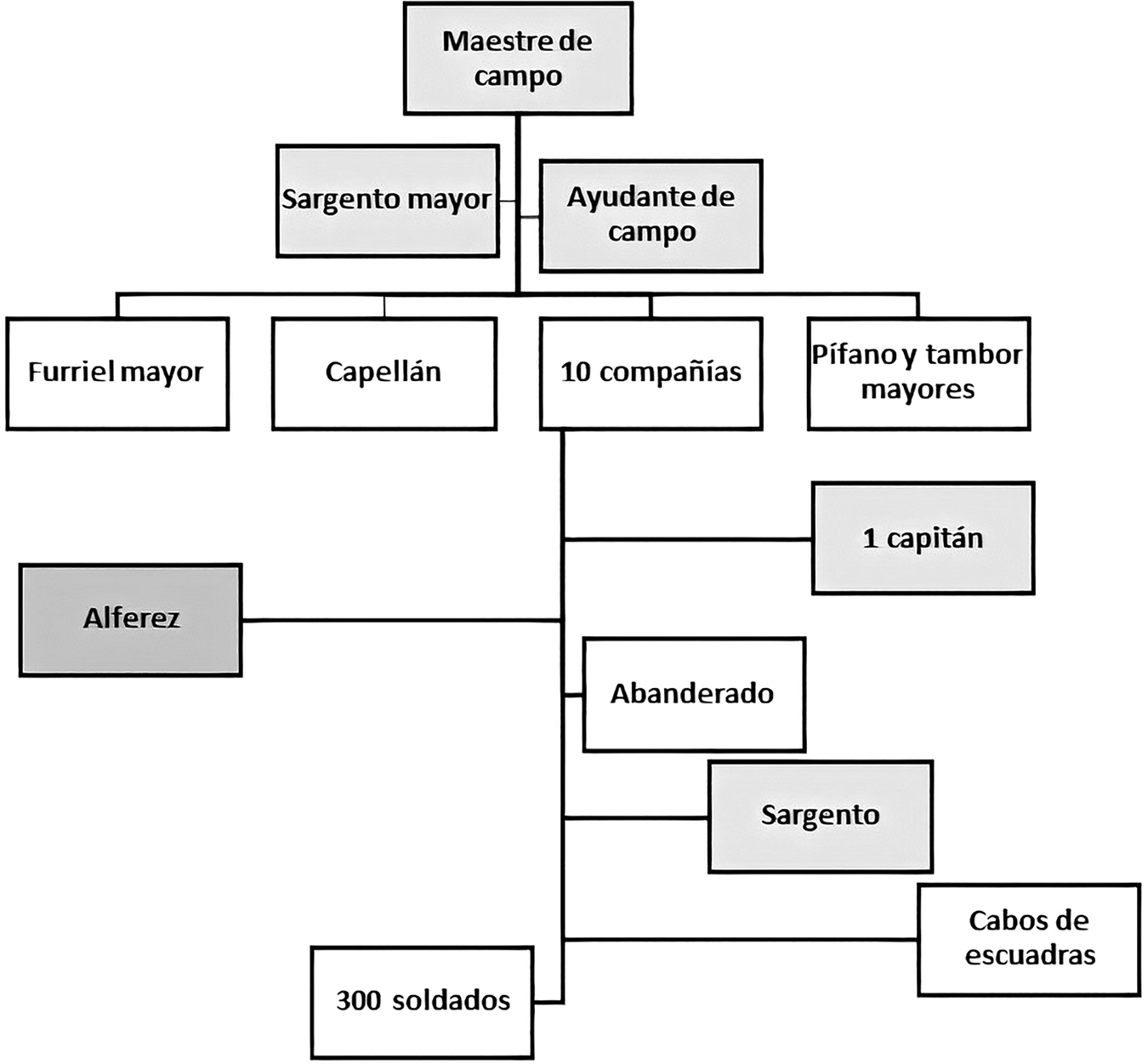
The organogram in Figure 3 depicts the structure of the Spanish army in the peninsula in the seventeenth century. We can see some similar posts also existed in the native militia. I have highlighted the posts that are like those that existed in the native militia, at least based on the entries of the accounts of the Royal Hacienda.
Structure of the Spanish peninsular tercio in the seventeenth century. Redrawn chart by the author based on “Organización de un tercio”Footnote 59

The teniente in the provincial, sub-provincial, and pueblo levels was the second in command.Footnote 56 The capitán was directly in command of a company of soldiers. The cabo was a corporal, while the sargento was an officer of the lowest rank.Footnote 57 I have found appointments of people to the post capitán and cabo of the pueblo. And at other times, the gobernador de naturales of the pueblo could also be the capitán.
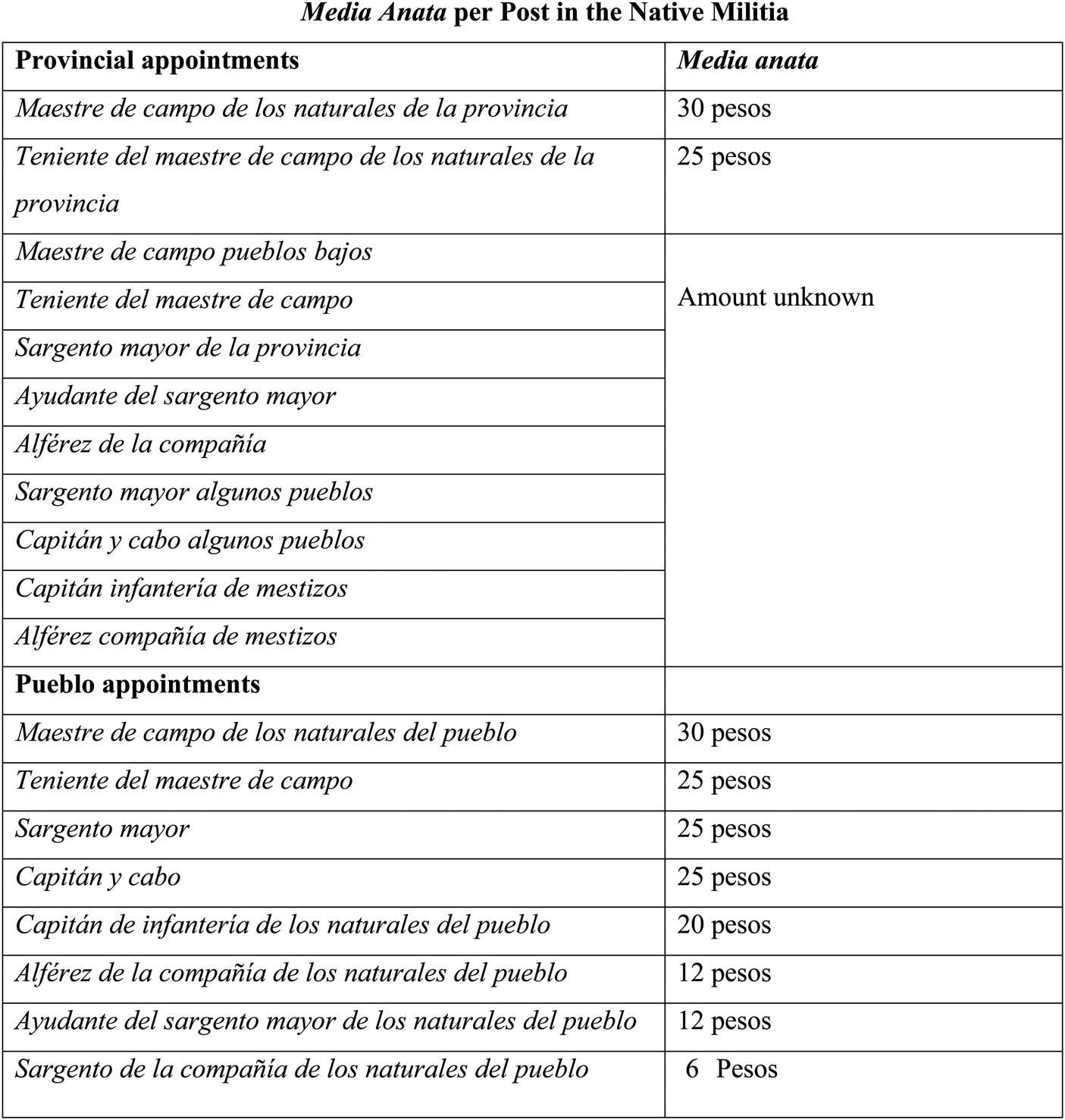
Elites from the different pueblos of the province filled the command posts in the provincial militia. The posts in the pueblo level refer to military commands within their pueblo of residence. Each post had a corresponding media anata tax. The schedule of rates is shown in Figure 4.
Amount of media anata paid for different posts in the native militia. Chart created by the author, based on entries of the financial reports from 1634–1700 in AGI, Contaduría,1206 to 1247.

Additionally, these entries provide pertinent details on the people appointed as militia officers. Each entry identifies the person who made the payment, their ethnicity (native, Sangley, Spaniard, mestizo, etc.), their provenance, and other pertinent details like the purpose for the payment, the name of the guarantor (if there was any), the payee's religion (especially in the case of Sangleys). Most of those who were appointed to military posts were identified with the title “Don.” A few did not have this title before their names, possibly due to the scribe's oversight. The officials were recruited from the pueblos, and most of them were identified as natural y principal, or native and elite, of their respective pueblos. Some held civil posts in the local government as gobernador, teniente, or other official. From the records it does not look like there was a limit to the number of years one could occupy a military post. Some resigned and were replaced. Even some smaller neighbourhoods called visita had a militia with its own native captain.Footnote 58
Most payments registered in the media anata lists were for appointments as capitán de infantería. The person appointed as captain of a company of soldiers of a specific pueblo usually hailed from the same pueblo and was a principal of that pueblo. The Spaniards relied on almost all ethnicities to form their own militia. Chinese mestizo officers in the militia of Laguna appeared in the record for the first time in 1678. However, there were mestizos appointed as maestre de campo earlier in the 1650s in areas surrounding Manila.
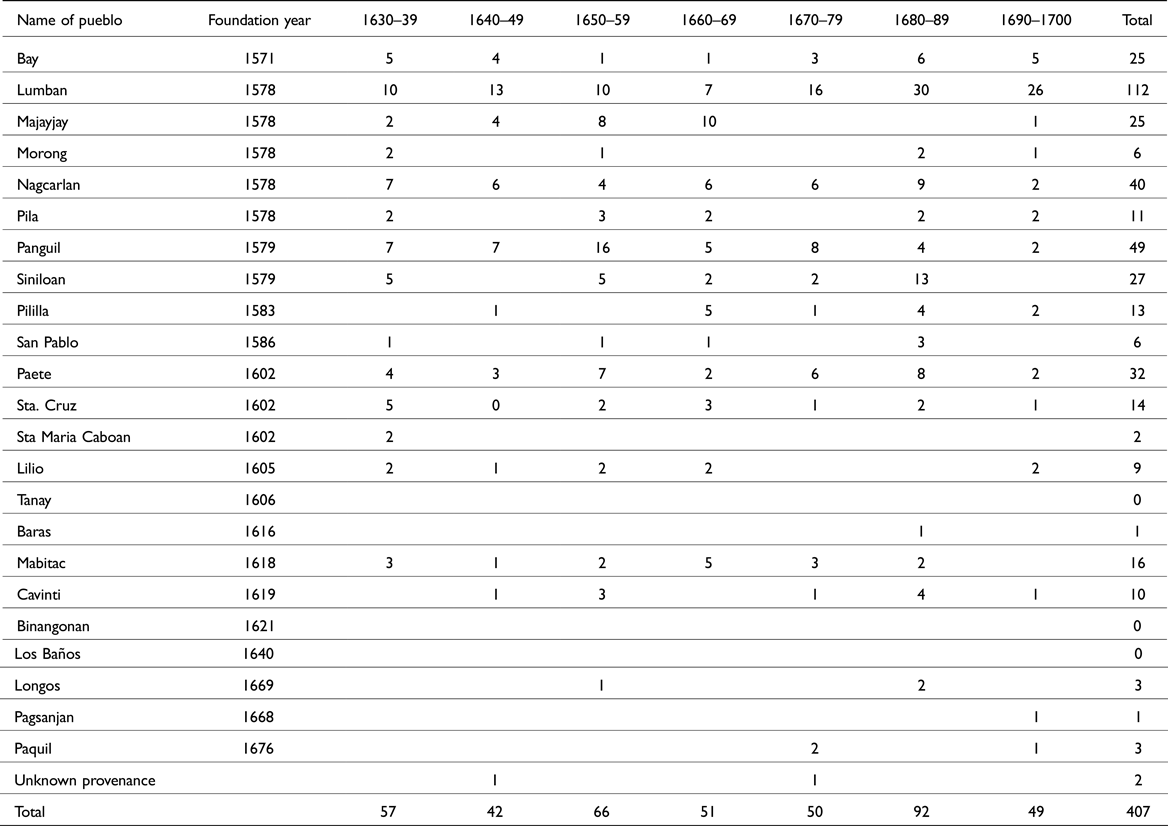
Media anata payments by native officers in this period show that some pueblos had more officers in the militia than others. A few pueblos not only had officers for their respective pueblo militias but also supplied officers to the provincial militia. Table 1 lists towns with the number of native officers who paid their media anata from the 1630s to 1700. The source is limited because there is no guarantee of accurate record-keeping. For instance, there were records of payments for earlier years recorded a later year. In any case, the records are indicative of the continuous appointments to positions in the native militia for the period, with most payments received in the 1680s. From 1633 to 1700 Lumban pueblo had the largest number of native officers submitting their payments of media anata for their positions in pueblo and provincial commands. I have grouped the appointments into ten-year periods, extending the beginning to 1630. I also indicate the foundation year of each town, i.e., when the town had its own native governor and, presumably, enough tributes to deploy residents to the militia.Footnote 60
Number of Native Officers Who Paid Their Media Anata for Positions in the Militia, 1630–1700.Footnote 61

Bar graph illustrating the data on Table 1.

We can draw several observations from the data in Table 1 illustrated on the bar graph (figure 4). Of the towns listed, only four of them had not been founded officially as towns by 1633 when the royal treasury began collecting media anata payments from native officials. The number of officials from Laguna, especially from Lumban, increased steadily from 1633 to 1700, reaching its peak in the 1680s, when thirty native residents of the town submitted their media anata payments for different local and provincial posts in the militia. It also boasted of having the greatest number of maestres de campo in the whole province.
The number of tributes and location were contributing factors to account for the number of appointments to military posts. Lumban pueblo was among those with the larger tribute counts and had the greatest number of media anata payments for militia posts.Footnote 62 In the mid-1600s, Lumban, Majayjay, and Nagcarlan were the largest pueblos of Laguna. The maestres de campo of the provincial native militia hailed from these towns. But tribute numbers alone did not fully account for the number of officers appointed to the militia. Geography and internal power dynamics within the province seemed to be weightier factors. The case of Lumban pueblo best illustrates the interplay of location and internal politics that may have influenced native officer appointments.
Lumban was conveniently close to the provincial capital, Pagsanjan, where Chinese merchants had established their community. The pueblo was strategically located on the coast of Laguna de Bay and by the Lumban river, one of the navigable rivers of Laguna. It opened to a well-known route to southern Luzon leading to the Camarines region where Paracale was located. Paracale was a known source of gold and the Spaniards hoped to harness it in the early seventeenth century.Footnote 63 Lumban was an important pueblo, among the oldest in the province, founded in 1578 by Franciscan missionaries. In 1599 it was the meeting place of indigenous chiefs who gathered to decide on tribute payment to the king of Spain.Footnote 64 The town became a religious centre where other pueblos converged. The church of Lumban was the site of a procession that honoured the Eucharist in 1600, the first of its kind outside Manila.Footnote 65 Nearby, at about 11 kilometres, was the port of Pagsanjan, a growing centre of commercial activity involving Sangley merchants. The growing resentment of the Spanish government against the Sangleys, especially after the uprisings of 1603 and 1639, would have accounted for the enlistment of native officers from Lumban as a measure to keep the Sangleys in check, even if they were far from Manila, where most Spaniards were settled. Pagsanjan, though a bustling port, was a small settlement that depended on Lumban pueblo until 1669. No native officer from Pagsanjan was registered with the royal treasury until the 1690s.
In contrast to Lumban pueblo, towns like Binangonan, Tanay, and Los Baños had no registered payments of media anata from any native official. Was it possible that these towns did not have a militia? We can only speculate on the reason for their absence in the registry. The small tribute-paying population may be the reason. There are no available tribute counts for these towns in the seventeenth century, but they remained relatively small towns in the eighteenth century with tributes ranging from one hundred to three hundred.Footnote 66 The data from Laguna can be complemented by lists of media anata entries from other regions in the Philippines. Because of the limitation in archival research done for other provinces for the seventeenth century, I have only been able to complete the list of media anata payments for officer appointments to the native militia of Laguna province for the seventeenth century. Payments made for appointments in other provinces from Luzon, the Visayas, and faraway Mindanao for the years 1654 to 1660 show thirty-three maestres de campo paying media anata for the position from outside Manila, including Tondo, Cavite, Batangas, Bulacan, and Pampanga, and more distant provinces like Ilocos in the north, and the Visayas.Footnote 67
Native officials of Laguna might have staffed the fortresses in different parts of the Philippines which continued to need security well into the seventeenth century, despite the end of the Dutch wars and the division of the united Iberian crowns. The position of the Philippines in the Spanish Empire's Pacific region would have been the rationale behind this continuing recruitment to the native militia. Throughout the seventeenth and eighteenth centuries, the Spanish had an ongoing need to protect their interests in the Spanish “lake” and secure the Pacific frontier of their empire, hence the need for a sustained recruitment of native companies in the militia.Footnote 68 Moreover, the prevalence of local uprisings also warranted the continuation of these militias.
The Indigenous Maestre de Campo: Broker of Negotiations
The highest position that natives of Laguna could occupy in the militia was that of maestre de campo, who exercised both political and military authority that went beyond the confines of the pueblo.Footnote 69 There were instances when maestres de campo used their power to their political advantage.Footnote 70 The title had political and military significance. Having the staff (like a baton of command) of the maestre de campo meant a great deal for the town the maestre de campo hailed from, as seen for example when rebels in eighteenth-century Pangasinan bargained with the government, requesting that they retain the staff of the maestre de campo. Footnote 71 Anyone appointed to the post paid thirty pesos of media anata, a huge amount considering that a whole tribute then was eight reales or one peso, increased to ten reales in 1589. If the maestre de campo paid the media anata every year, he must have been quite wealthy. So, we can infer that ability to pay the media anata would have been one factor to consider in appointing a maestre de campo.
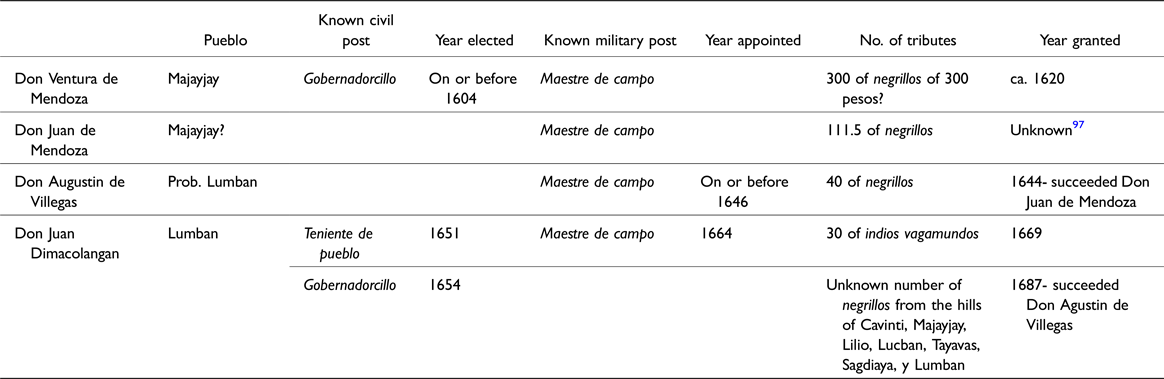
The media anata registry provides evidence that native maestres de campo of Laguna province received encomiendas. I have identified six maestres de campo from Laguna. Following is a list of them with the year they first appeared in the records of the Real Hacienda. I am not able to estimate how long they held their post based on the records given.
ca. 1604 Don Ventura de Mendoza (Majayjay)Footnote 72
1634 Don Juan de Mendoza (unknown provenance, probably Majayjay)Footnote 73
1642 Don Francisco Macapuli from NagcarlanFootnote 74
1644 Don Agustin de Villegas probably from LumbanFootnote 75
1660 Don Juan Dimacolangan from LumbanFootnote 76
1661 Don Estevan de la Cruz from NagcarlanFootnote 77
Four of these maestres de campo held encomiendas. By the encomienda system natives were placed under the charge of the encomendero, the person tasked to ensure that they were taught Catholic doctrine and were given protection.Footnote 78 In exchange, the encomendero could collect tributes from his charges.Footnote 79 Miguel Lopez de Legazpi began distributing encomiendas to the conquistadores of the Philippines in 1572.Footnote 80 By the second half of the seventeenth century encomiendas that became vacant tended to be returned to the crown to ease the financial burden of the royal treasury. However, even after 1678, many encomiendas were still granted to private individuals, including native maestres de campo. In 1686 the royal cedula of 31 January ordered Governor Corcuera to distribute the vacant encomiendas to the worthiest individuals (the beneméritos)—descendants of conquistadores, former government officials, and soldiers.Footnote 81
The encomiendas that native maestres de campo received in Laguna were those of baptised and unbaptised natives who resided in the mountains of that province and persistently refused to reside in the pueblos. The Spanish government thus relied on native encomenderos to carry on the pacification of those groups, like a conquistador would do. Putting the differences aside, these native encomenderos could be likened to the Indian conquistadores of Latin America.Footnote 82 But instead of carrying out their conquest in far-flung regions inhabited by different groups, these Filipino encomenderos carried out their conquest within their own place of origin, expanding the coverage of Spanish rule in their own province.
When we examine the careers of the maestres de campo on the list above, some striking features surface, indicating their roles as power brokers and intermediaries between the colonial government and the indigenous people of the pueblos. It was not uncommon for the native elite of Laguna to seek exemptions based on prior military collaboration with the Spaniards. As early as 1601, the Council of the Indies decided on a request from a certain Don Juan Agta from the Bay pueblo in Laguna province. He claimed privileges based on his father's military service to the Spaniards in the late sixteenth century. Agta requested permission to bear arms like the ones that Spaniards used. He also asked to be granted exemption from any type of tribute for himself, his wife, and his descendants.Footnote 83 Like Agta, a few of the native elite who were appointed to military positions received privileges. As a reward for their service, they received encomiendas of natives who were scattered in the mountains. Once they held encomiendas, they applied for more. So one could very well attach to these elite the name “Indio conquistador,” since the Spanish government devolved the task of conquest and pacification to them. Compared to Spaniards, however, Filipinos granted encomiendas in the seventeenth century are few. Santiago located ten of them: two from Laguna, listed above, one from Batangas, two from Pangasinan, and five from Pampanga.Footnote 84 There were others and I will discuss a few details about them below. These native maestres de campo/encomenderos all claimed to have fought side by side with the Spaniards in numerous wars that aimed to keep both external and internal threats at bay.Footnote 85 Among these encomenderos were Don Ventura de Mendoza, Don Juan de Mendoza, Don Juan Dimacolangan, and Don Agustin de Villegas.
Don Ventura de Mendoza was one of the two indigenous elites whom the Spaniards singled out for their loyalty during the Sangley uprising of 1603. When the Chinese residents of the Philippines revolted in Manila, Don Ventura was gobernadorcillo of Majayjay pueblo in Laguna. He held that government position from 1600 to 1610. He then commanded a troop of two hundred Pampangos to engage fifteen hundred Chinese who fled to the mountains of Laguna. On 13 September 1608, the king of Spain issued a royal decree expressing his gratitude to Don Ventura de Mendoza and the Pampango Don Guillermo Dimaracot for their unflinching loyalty to the crown.Footnote 86 After the event, the lawyer of the Audiencia Hernando Rios Coronel petitioned the king to officially acknowledge the help that the two gave the Spaniards and to order the missionaries to treat them well. Rios Coronel pointed out that the two were maestres de campo of their respective provinces. So Don Ventura de Mendoza simultaneously held a civil position as gobernador de naturales and a military post as maestre de campo.
During the time of the war of the Sangleys when the native indios from around Manila and Laguna de Bay and especially the province of Pampanga rose up and fought very well against the Sangleys, and they faithfully and gladly helped us. And if they allied themselves with the enemies, it would have been the end of the Philippines. May Your Highness order the Governor that in Your Highness’ name, they (the natives) should be thanked which would greatly please them, and especially some principales like Don Guillermo who was maestre de campo of the indios of Pampanga on that occasion, and Don Ventura who was that of the indios of Laguna de Bay. And may it be ordered that the religious who are in charge of doctrinas treat them well, since they usually restrict them over light matters, and the same thing goes for the native women principals.Footnote 87
In 1620 the Spanish governor-general granted Don Ventura an encomienda of three hundred tributes of “Christian and pagan” negrillos Footnote 88 who lived in the mountains of Majayjay pueblo, where he remained active in public life. When the townsfolk wanted to rebuild the pueblo church in 1616, Don Ventura led a group of principales to ask the government for permission to build it.Footnote 89
Don Ventura's son, Don Juan de Mendoza, inherited part of his father's encomienda when Ventura died in 1628. Like his father, Don Juan became maestre de campo of Laguna.Footnote 90 There is a record in the Real Hacienda accounts for 1634 of Don Juan de Mendoza's payment of media anata for 111.5 tributes of “negrillos” of Laguna. Another part of that encomienda went to Don Agustin de Villegas, another elite of the indigenous militia. Don Agustin held the encomienda from 1644.Footnote 91 When Villegas died the encomienda went to yet another native maestre de campo, Don Juan Dimacolangan.
Dimacolangan had a long history of negotiations with the colonial government. Among the maestres de campo of Laguna, his career was the best documented. Sometime before 1700 he wrote a letter to the Spanish governor-general requesting either an encomienda or tribute exemption for his wife, his brother, and his brother's descendants up to the fourth generation. His letter reached Charles II of Spain, who issued a decree granting Dimacolangan the encomienda but refusing tribute exemption.Footnote 92 This grant would have been Dimacolangan's third encomienda. To support his request, Dimacolangan presented a long list of credentials. He was principal of Lumban and maestre de campo from 1660.Footnote 93 He also served as sargento mayor, maestre de campo, and maestre de campo general at different times. In 1650 he joined the Spaniards in an attack in Malaya in a final bid for dominance in the Moluccas.Footnote 94 He also helped the Spaniards in their battle against the Chinese warlord Zheng Chenggong (Koxinga) in 1662.Footnote 95 Aside from his military service, he also served in civil posts as native governor of a Laguna town in different years. Dimacolangan thus exemplified a native who moved deftly within the Spanish colonial realm.
When Dimacolangan succeeded to Don Agustin de Villegas's encomienda in 1687, he already held another encomienda of thirty tributes of indios vagamundos who refused to live in pueblos and remained in the mountains of the province.Footnote 98 Dimacolangan might have managed to gather those indios at some point because he paid sixty pesos for the six-year exemption from the labour and personal services of those thirty tributes. A typical reason for requesting exemption from tribute and the obligatory labour or polos was the need to spend years to work on their own farming lands. Dimacolangan as encomendero would have used this labour to clear mountain lands for farming. In 1687 he took over Don Agustin Villegas’ encomienda of negrillos. Footnote 99
Native Maestres de Campo of Laguna and Their EncomiendasFootnote 96

Conclusion
The Philippine native militia, as the case of Laguna illustrates, became an institution in the first decades of the seventeenth century. The militia was actively involved in neutralising foreign enemies of the Spanish empire, supporting expeditions outside the Philippine archipelago, and aiding Spanish expansion in Philippine territories. The soldiers were recruited through the native elite who were appointed officers of the militia. The structure partly resembled the Spanish army, with a few distinctions. Little else is known about the power dynamics that obtaining such appointments entailed. The media anata registry shows that some natives who held official positions in the militia also held posts in the pueblo government. Their capacity to pay the media anata yearly would indicate their economic power. So we can argue that in the seventeenth-century Philippines, the native elite monopolised the political, military, and economic dimensions of power in the pueblo. In the case of the maestre de campo, his military command transcended pueblo boundaries if he was appointed at the provincial level. Furthermore, the few who received encomiendas of negrillos and natives who lived in the mountains on the fringes of Spanish power, became native conquistadores in charge of gathering these unconquerable groups to ensure that they paid tribute and became colonial subjects. The maestre de campo title survived until the first half of the eighteenth century. After the British occupation of Manila (1762–1764), the Spanish government adopted measures to reform the military, including the provincial militias, the officer posts, and recruitment. From 1769, the head of the militia was the coronel. The maestre de campo was no longer included in the list of officers.Footnote 100 However, the title continued to be given to indigenous leaders as an honorific up to the early nineteenth century.Footnote 101
In examining the structure of the native militia and its indigenous officers in Laguna as illustrative of other Philippine native militias, our notion of indigenous involvement in the Spanish army takes a more definitive shape. The discussion also sheds light on the native elite's military role. Much of Philippine historiography has dwelt on the native elite's political roles but has overlooked their military involvement. Additionally, this historiography depicts the native elite of the nineteenth century with well-established roles in the political and religious life of the colonial pueblo. Considering the forgoing discussion, it can be said that the seventeenth-century native elite better resembled their precolonial counterparts who wielded both political and military power. As in any institution, some people profited, and others did not. The native militia gave the elite a space to exercise power and receive privileges but not before risking their own position to aid Spanish expansion. In the colonial system they were given a place to exercise power in their pueblos and at times beyond their pueblos. The Spanish reliance on the elite cemented their position not only in the army but also in colonial society. When in the nineteenth century the state deployed a recruitment system of drawing lots, the elite's role in the military was rendered irrelevant. But by that time they had already secured their position in Philippine colonial society.
Acknowledgements
I wish to thank Svetlana Camacho, Kristie Flannery, and Nicholas Sy for their comments on earlier drafts of this work. I am also grateful to the anonymous reviewers for their insights. This article is definitely the result of collaborative work.
Funding Statement
This research was carried out with grants from the University of Asia and the Pacific, Ayuda Hispanex, the University of the Philippines, and the National Historical Commission of the Philippines.