


Introduction
Palmer amaranth and common waterhemp are among the most troublesome weeds in the United States (Van Wychen Reference Van Wychen2016). While two separate species, it is difficult to distinguish common waterhemp and tall waterhemp (Amaranthus tuberculatus Moq. J.D. Saur) (Steckel Reference Steckel2007), and the International Survey of Herbicide Resistant Weeds (Heap Reference Heap2017) combines both species. Palmer amaranth and waterhemp have an aggressive growth rate (Horak and Loughin Reference Horak and Loughin2000) and vast seed-production abilities, which contributes to their competitiveness with crops (Schwartz et al. Reference Schwartz, Norsworthy, Young, Bradley, Kruger, Davis, Steckel and Walsh2016; Sellers et al. Reference Sellers, Smeda, Johnson, Kendig and Ellersieck2003; Steckel et al. Reference Steckel, Sprague, Hager, Simmons and Bollero2003; Webster and Grey Reference Webster and Grey2015). In addition, populations of Palmer amaranth and waterhemp have been confirmed with resistance to six different herbicide sites of action (Heap Reference Heap2017).
The emergence of Palmer amaranth and waterhemp closely coincides with that of soybean (Bell et al. Reference Bell, Norsworthy and Scott2015; Hartzler et al. Reference Hartzler, Battles and Nordby2004). The critical weed-free period in soybean based on an acceptable yield loss level of 5% is between the VE to the V3 stage of development (Van Acker et al. Reference Van Acker, Swanton and Weise1993). While Palmer amaranth and waterhemp density have been related to yield loss in soybean (Bensch et al. Reference Bensch, Horak and Peterson2003), the time of Amaranthus spp. emergence was found to be more important than Amaranthus spp. density in the prediction of yield loss in soybean (Dieleman et al. Reference Dieleman, Hamill, Weise and Swanton1995, Reference Dieleman, Hamill, Fox and Swanton1996). This is probably attributed to the indeterminate phenological development of Amaranthus spp. (Ward et al. Reference Ward, Webster and Steckel2013).
Amaranthus spp. utilize the C4 photosynthetic pathway while soybean utilizes the C3 photosynthetic pathway, giving Palmer amaranth and waterhemp a physiological advantage over soybean in high temperatures and limited moisture conditions (Challet and Ogren Reference Stoller and Myers1975; Ehleringer Reference Ehleringer1983; Pearcy and Ehleringer Reference Pearcy and Ehleringer1984; Stoller and Myers Reference Stoller and Myers1989). Some Amaranthus spp., such as Palmer amaranth, have physiological and morphological adaptations to shading (Jha et al. Reference Jha, Norsworthy, Riley, Bielenberg and Bridges2008) as well as diaheliotropism, which aids in light interception through solar tracking (Ehleringer and Forseth Reference Ehleringer and Forseth1980). These adaptations increase the competitiveness of Palmer amaranth, resulting in higher growth rates and more biomass accumulation under high temperatures, even in the presence of a competing crop such as soybean, when compared to other weed species that do not possess these adaptations. For example, competition from Palmer amaranth at eight plants m–2 and waterhemp at eleven plants m–2 resulted in 78 and 56% soybean yield reduction, respectively (Bensch et al. Reference Bensch, Horak and Peterson2003).
Double-crop soybean after winter wheat can be profitable (Ibendahl et al. Reference Ibendahl, O’Brien and Shoup2015) and add diversity to the cropping system for Kansas farmers (Ciampitti et al. Reference Ciampitti, Ruiz Diaz, Jardine, Peterson, Whitworth, Rogers and Shoup2016). 187,530 and 147,757 ha of double-crop soybean after winter wheat were planted in Kansas in 2015 and 2016, respectively (NASS 2017). There is considerable uncertainty associated with planting double-crop soybean in Kansas. Poor soybean emergence, inadequate soil moisture, and limited profitability are some of the factors that Kansas farmers must assess before choosing to plant double-crop soybean. To mitigate some of these challenges, double-crop soybean is normally no-till planted into wheat residue immediately after winter wheat harvest (Ciampitti et al. Reference Ciampitti, Ruiz Diaz, Jardine, Peterson, Whitworth, Rogers and Shoup2016).
Glyphosate-resistant soybean has been an option for producers to easily and cost-effectively achieve broad-spectrum weed control in double-crop soybean without the use of residual herbicides (Krausz and Young Reference Krausz and Young2001; VanGessel et al. Reference VanGessel, Ayeni and Majek2001). Sequential applications of glyphosate in glyphosate-resistant crops without the use of multiple effective sites of action have been widely used in most cropping systems (Norsworthy Reference Norsworthy2003; Norsworthy et al. Reference Norsworthy, Smith, Scott and Gbur2007; Wilson et al. Reference Wilson, Young, Matthews, Weller, Johnson, Jordan, Owen, Dixon and Shaw2011). Because the widespread use of glyphosate has resulted in the evolution of glyphosate-resistant weeds and associated loss of POST glyphosate efficacy, weed control expense and seed costs have increased (Gianessi Reference Gianessi2008).
Pyroxasulfone, a very-long-chain fatty acid–inhibiting herbicide, and pendimethalin, a microtubule-inhibiting herbicide, are labeled for application in winter wheat and can provide residual control of Palmer amaranth and waterhemp in soybean (Anonymous 2016c, 2016d, 2016e). Control of both grass and broadleaf weeds in double-crop soybean has been achieved with microtubule-inhibiting herbicides applied in the winter wheat at Feekes 4 developmental stage (McHarry and Kapusta Reference McHarry and Kapusta1979). Pyroxasulfone applied PRE provides excellent residual control of Palmer amaranth and waterhemp in soybean (Mahoney et al. Reference Mahoney, Shropshire and Sikkema2014; Meyer et al. Reference Meyer, Norsworthy, Young, Steckel, Bradley, Johnson, Loux, Davis, Kruger, Bararpour, Ikley, Spaunhorst and Butts2016). Pendimethalin has also been shown to provide residual control of Palmer amaranth (Steckel et al. Reference Steckel, Sprague and Hager2002); however, Palmer amaranth resistant to microtubule-inhibiting herbicides has been documented in the mid-south but not confirmed in Kansas (Heap Reference Heap2017; Gossett et al. Reference Gossett, Murdock and Toler1992).
An additional herbicide application timing for the control of Amaranthus species in double-crop soybean is a preharvest treatment prior to winter wheat harvest. Many preharvest treatments are used for desiccation of the vegetation to aid in winter wheat harvest (Armstrong Reference Armstrong2009). 2,4-D and flumioxazin are labeled as harvest aids in winter wheat and for control of emerged Palmer amaranth and waterhemp in some states (Anonymous 2006; 2016d). Flumioxazin also provides residual control of Palmer amaranth and waterhemp in soybean (Mahoney et al. Reference Mahoney, Shropshire and Sikkema2014; Meyer et al. Reference Meyer, Norsworthy, Young, Steckel, Bradley, Johnson, Loux, Davis, Kruger, Bararpour, Ikley, Spaunhorst and Butts2016).
Planting into weed-free fields has been recognized as a best management practice for controlling herbicide-resistant weeds (Norsworthy et al. Reference Norsworthy, Ward, Shaw, Llewellyn, Nichols, Webster, Bradley, Frisvold, Powles, Burgos, Witt and Barrett2012). Paraquat provides control of emerged Palmer amaranth and waterhemp (Gossett et al. Reference Gossett, Murdock and Toler1992; Shoup et al. Reference Shoup, Al-Khatib and Peterson2003; Steckel et al. Reference Steckel, Sprague and Hager2002) and has been used to control emerged weeds before no-till planting of double-crop soybean into winter wheat stubble (Triplett Reference Triplett1978). The use of a residual herbicide, in combination with a nonselective herbicide such as paraquat, has increased double-crop soybean grain yield when compared to using only a residual herbicide or paraquat alone (Triplett Reference Triplett1978). The lack of crop canopy in double-crop soybean can result in extended emergence of Palmer amaranth and waterhemp. This requires the use of a residual herbicide in conjunction with a nonselective herbicide at the time of the PRE herbicide application.
The objectives of this study were to assess the control of Palmer amaranth and waterhemp with a) paraquat as a PRE treatment and with b) various herbicide(s) at spring-POST, preharvest, and PRE application timings in double-crop soybean.
Materials and Methods
General
Field experiments were conducted in 2015 and 2016 near Manhattan (39.12567°N, 96.613488°W), and Hutchinson (37.931114°N, 98.029392°W), KS, and in 2016 near Ottawa (38.539265°N, 95.244301°W), KS, for a total of five site-years. Palmer amaranth populations at Manhattan and Hutchinson contained a natural population of Palmer amaranth while Ottawa contained a natural waterhemp population. No mixed populations of Palmer amaranth and waterhemp were present at any site-year. At the time of the PRE application, Amaranthus spp. were present at 20 plants m–2 or higher during all site-years. Soil properties (type, texture, pH, organic matter, and cation exchange capacity), herbicide application dates, and Palmer amaranth and waterhemp details are presented in Table 1. Three different herbicide application timings were utilized in this experiment: spring-post, preharvest, and PRE. Various labeled treatments were selected to assess the control of Palmer amaranth and waterhemp (Table 2). All treatments were applied using a four-nozzle CO2 pressurized backpack sprayer calibrated to deliver 144 L ha–1 at 241 kPa. Experiments were conducted using a randomized complete block design with four replications. Plots at all sites were 3 m wide and 9 m long and initiated prior to spring-POST herbicide applications. Clethodim (56 g ai ha–1) was applied as needed for grass weed control. Palmer amaranth and waterhemp control was visually evaluated compared to the nontreated control 2, 4, and 8 weeks after planting (WAP) the double-crop soybean. Visual ratings were based on 0% = no Palmer amaranth or waterhemp control and 99% = complete Palmer amaranth or waterhemp control. Soybean grain was harvested from the center two rows of the four-row plots and adjusted to 13.5% moisture for yield comparisons.
Herbicide application dates, soil characteristics, winter wheat grain yield, and Palmer amaranth and waterhemp densities and heights at experiment sites.a, b, c

a Abbreviations: meq, milliequivalents; PH, preharvest; PRE, preemergence; SP, spring-POST.
b Manhattan and Hutchinson contained an indigenous population of Palmer amaranth whereas Ottawa contained an indigenous population of waterhemp.
c All soil characteristics assessed from a 0 to 7.6 cm soil sampling depth.
d Pigweed height determined by the 15 cm cutter bar height at wheat harvest.
f Loss-on-ignition (Ball Reference Ball1964).
g Adjusted to 7 pH (Rich Reference Rich1969).
h Wheat grain moisture content adjusted to 12.5%.
Herbicides, rates, and adjuvants for spring-POST, preharvest, and PRE application timings.a

a Abbreviations: AMS, ammonium sulfate; chlo, chlorimuron-methyl; COC, crop oil crop concentrate; dime, dimethenamid-P; flum, flumioxazin; flut, fluthiacet-methyl; fome, fomesafen; imaz, imazethapyr; metr, metribuzin; MSO, methylated seed oil; para, paraquat; PH, preharvest; PRE, preemergence; pyro, pyroxasulfone; S-met, S-metolachlor; safl, saflufenacil; SP, spring-POST; sulf, sulfentrazone.
b Adjuvant rates: AMS, 2.8 kg ai ha–1 (N-Pak, Winfield, St. Paul, MN); MSO, 1% v/v (Destiny, Winfield Solutions LLC, St. Paul, MN); COC, 1% v/v (Prime Oil, Winfield Solutions LLC, St. Paul, MN).
Spring-POST Application Timing
‘Everest’ winter wheat was planted drilled at approximately 56 kg ha–1 during the preceding October and November at all sites. When the winter wheat reached the Feekes 4 stage of development, two treatments (i.e., pendimethalin and pyroxasulfone [Table 2]) were applied in March of 2015 and 2016 (Table 1). Palmer amaranth and waterhemp had not emerged at the time of spring-POST application at any of the sites. Application was made using TeeJet (TeeJet Technologies, Springfield, IL) Air Induction Extended Range (AIXR) 110015 nozzles.
Preharvest Application Timing
Preharvest treatments were applied in June each year two weeks prior to anticipated winter wheat grain harvest (Table 1). Turbo TeeJet (TT) 110015 nozzles were used and all appropriate adjuvants were utilized according to label recommendations (Table 2). Palmer amaranth and waterhemp height and density at time of application are listed in Table 1.
PRE Application Timing
‘Asgrow 3634’ glyphosate-resistant soybean (Monsanto Company, St. Louis, MO 63167) was no-till planted in 76-cm rows into the winter wheat residue after grain harvest (Table 1). Thirteen PRE herbicide treatments, many of which contained paraquat, were applied after soybean was planted; 1% v/v crop oil concentrate was utilized with all PRE treatments (Table 2). Soybean planting and PRE herbicide applications were completed within 24 h after winter wheat grain harvest. Turbo TeeJet 110015 nozzles were used in all PRE herbicide treatment applications. Palmer amaranth and waterhemp height and density at the time of application are listed in Table 1.
Data Analysis
Data were analyzed using the Mixed Procedure in JMP Pro 12 (SAS Institute, 100 SAS Campus Drive, Cary, NC 27513-2414) and means were separated using Fisher’s Protected LSD at α = 0.05. Data were corroborated for assumptions of normality and of equal variance prior to being subjected to ANOVA. Site-year combinations within a given species (i.e., Palmer amaranth at Manhattan and Hutchinson and waterhemp at Ottawa), replications (i.e., nested within site-year), and all interactions of these effects were considered random effects (Carmer et al. Reference Carmer, Nyquist and Walker1989). Treatment was considered as a fixed effect. By considering site-year environments as random effects, it has been demonstrated that research results can be used to predict weed control across a wide range of environments (Hager et al. Reference Hager, Wax, Bollero and Stoller2003; Johnson et al. Reference Johnson, Norsworthy and Scott2014; Stephenson et al. Reference Stephenson, Bond, Walker, Bararpour and Oliver2004a, Reference Stephenson, Patterson, Faircloth and Lunsford2004b; Zhang et al. Reference Zhang, Webster and Leon2005).
Results and Discussion
In-Season Precipitation
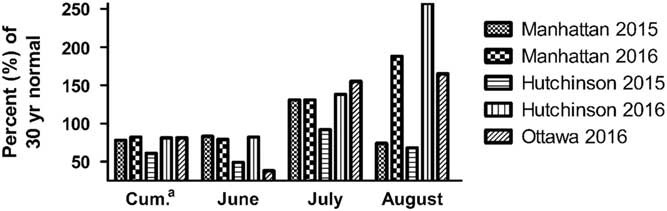
Thirty-yr precipitation normals from 1980 to 2010 were referenced for each site from the National Oceanic and Atmospheric Administration (Argruez et al. Reference Arguez, Durre, Applequist, Squires, Vose, Yin and Bilotta2010). Cumulative precipitation percentages of the 30-yr normal from January 1 to July 1 and June precipitation (Figure 1) indicate that moisture conditions leading into double-crop soybean planting in all five site-years were slightly dry. This may have contributed to reduced surface moisture at the time of double-crop soybean planting; however, adequate rainfall for germination and emergence was received within 1 WAP in all site-years, with the exception of Hutchinson in 2015 (Table 3). Because of dry soil conditions at planting and lack of moisture until 4 WAP at Hutchinson in 2015, highly variable double-crop soybean emergence was observed. Ample rainfall for herbicide activation (>5.0 cm) was also received within 1 WAP at all site-years except for Hutchinson in 2015. Periodic moisture events occurred each week (≥0.4 cm) up to 8 WAP. This helped to contribute to new Palmer amaranth or waterhemp emergence at each rating interval.
Rainfall at five site years as a percentage of the 30-yr normal from 1980 to 2010 for June, July, and August from the National Oceanic and Atmospheric Administration (Arugez et al. 2010). Abbreviations: Cum., cumulative rainfall percentage of 30-yr normal from January 1 to July 1 for each site-year.
Rainfall data for each week after PRE application.

a Date of PRE application for each site-year.
Spring-POST Application Timing
Poor Palmer amaranth and waterhemp control was observed at all observation times for both spring-POST treatments (Tables 4 and 5). At 2 WAP, the results at Ottawa indicate pyroxasulfone controlled waterhemp 40% and pendimethalin controlled waterhemp 30%, but control dropped to 0% 4 WAP (Table 5). At 2 WAP at Manhattan and Hutchinson, pyroxasulfone and pendimethalin controlled Palmer amaranth 14 and 5%, respectively (Table 4). At 4 WAP, spring-POST applications resulted in less than 5% Palmer amaranth control, and at 8 WAP, 0% Palmer amaranth control was observed (Table 4). The lack of Palmer amaranth and waterhemp control with the spring-POST treatments is not surprising given the extended emergence of Palmer amaranth and waterhemp in double-crop soybean. At the time of double-crop soybean planting, both treatments had been applied in excess of 90 d.
Palmer amaranth control and double-crop soybean grain yield at Manhattan and Hutchinson, KS.Footnote a , Footnote b

a Abbreviations: chlo, chlorimuron-methyl; dime, dimethenamid-P; flum, flumioxazin; flut, fluthiacet-methyl; fome, fomesafen; imaz, imazethapyr; metr, metribuzin; para, paraquat; PH, preharvest; PRE, preemergence; pyro, pyroxasulfone; S-met, S-metolachlor; safl, saflufenacil; SP, spring-POST; sulf, sulfentrazone; WAP, weeks after planting.
b Means followed by the same letter within a column are not statistically different according to Fisher’s Protected LSD (α=0.05).
c Application timing: SP, Feekes 4 stage; PH, 2 weeks prior to wheat harvest; PRE, at soybean planting.
d Treatment only present in 2016 site-years.
Waterhemp control and double-crop soybean grain yield at Ottawa, KS 2016.Footnote a , Footnote b

a Abbreviations: chlo, chlorimuron-methyl; dime, dimethenamid-P; flum, flumioxazin; flut, fluthiacet-methyl; fome, fomesafen; imaz, imazethapyr; metr, metribuzin; para, paraquat; PH, preharvest; PRE, preemergence; pyro, pyroxasulfone; S-met, S-metolachlor; safl, saflufenacil; SP, spring-POST; sulf, sulfentrazone; WAP, weeks after planting.
b Means followed by the same letter within a column are not statistically different according to Fisher’s Protected LSD (α=0.05).
c Application timing: SP, Feekes 4 stage; PH, 2 weeks prior to wheat harvest; PRE, at soybean planting.
d Treatment only present in 2016 site-years.
Pyroxasulfone is susceptible to microbial degradation in the soil and has a half-life of 16 to 26 days (Shaner Reference Shaner2014). As described by Busi et al. (Reference Busi, Gaines, Walsh and Powles2012), it was possible to select for pyroxasulfone resistance in rigid ryegrass (Lolium rigidum Gaudin) through repeated low-dose exposure. While research on this topic has not been conducted with pyroxasulfone in Palmer amaranth or waterhemp, it is likely that repeated exposure at low doses such as might occur with these spring-POST applications could select for pyroxasulfone resistance in Palmer amaranth or waterhemp.
Preharvest Application Timing
By 2 WAP, 2,4-D controlled Palmer amaranth and waterhemp 22 and 14%, respectively (Tables 4 and 5). Less than 20% Palmer amaranth and waterhemp control was observed 4 WAP. No Palmer amaranth and waterhemp control was observed in any site-year 8 WAP (Tables 4 and 5). The higher efficacy of 2,4-D 2 WAP (41% waterhemp control) could have been due to the lower density of waterhemp at Ottawa at the time of application for the preharvest treatments (Table 1).
Flumioxazin applied preharvest resulted in Palmer amaranth and waterhemp control greater than or equal to 90, 86, and 83% at 2, 4, and 8 WAP, respectively, and resulted in similar control delivered by many PRE treatments that contained a residual herbicide plus paraquat at each of the observation intervals. Flumioxazin also provided control of emerged Palmer amaranth and waterhemp comparable to the level of control observed with PRE treatments that contained paraquat (Tables 4 and 5).
PRE Application Timing
At 2 WAP, most PRE treatments that included paraquat provided superior control of emerged Palmer amaranth and waterhemp compared to those treatments that did not include paraquat. A high level of control was achieved despite various sizes of Palmer amaranth and waterhemp present at the time of application. In two of the site-years (i.e., Hutchinson 2015 and Manhattan 2016), paraquat was applied to Palmer amaranth that had sustained injury from a 15-cm cutter bar height during winter wheat harvest (Table 1). PRE paraquat treatments were applied within 24 h of injury to Palmer amaranth stems without leaves. Although the herbicide label requires leaf regrowth after cutting and before paraquat application (Anonymous 2016b), these results indicate that paraquat may provide control of these species even when ample time for weed leaf regrowth is not available (i.e., winter wheat harvest and double-crop soybean planting).
At 2 WAP, Palmer amaranth and waterhemp control from paraquat alone did not differ from other PRE treatments that included paraquat (≥90%) (Tables 4 and 5). Reductions in control were observed at some locations; however, this was due to extended emergence rather than recovery of emerged Palmer amaranth and waterhemp at the time of application (data not shown). PRE treatments that did not include paraquat (e.g., S-metolachlor plus metribuzin and S-metolachlor plus fomesafen) resulted in less Palmer amaranth control 2 WAP when compared to the identical treatments with the addition of paraquat (Table 4). This demonstrates that while residual herbicides such as fomesafen and metribuzin have POST Palmer amaranth and waterhemp activity (Abendroth et al. Reference Abendroth, Martin and Roeth2006; Bond et al. Reference Bond, Oliver and Stephenson2006), the addition of paraquat can increase control when targeting large (>6 leaves) Palmer amaranth and waterhemp, which would otherwise be off label for herbicides such as fomesafen (Anonymous 2016a).
At 4 and 8 WAP, reduced control of both Palmer amaranth (81 and 61%, respectively) and waterhemp (40 and 35%, respectively) was observed with saflufenacil plus paraquat compared to all other PRE treatments (Tables 4 and 5). This is likely due to the limited residual activity of saflufenacil at the 25 g ai ha–1 rate (Morichetti et al. Reference Morichetti, Ferrell, MacDonald, Sellers and Rowland2012).
Imazethapyr plus dimethenamid-P plus saflufenacil plus paraquat provided excellent Palmer amaranth and waterhemp control at Manhattan and Hutchinson in all site-years, but poor control at Ottawa (Tables 4 and 5). This is likely due to resistance in the waterhemp to acetolactate synthase (ALS)-inhibiting herbicide imazethapyr at Ottawa compared to Manhattan and Hutchinson where a greater proportion of the Palmer amaranth were sensitive to the ALS-inhibiting herbicides (data not shown). Producers selecting herbicide for the control of Palmer amaranth and waterhemp must carefully consider the presence of an ALS-resistant population when making herbicide decisions (Gaeddert et al. Reference Gaeddert, Peterson and Horak1997).
Contrasts confirmed that the combination of paraquat plus residual herbicide(s) improved Palmer amaranth and waterhemp control (Tables 6 and 7); this is likely a result of the extended emergence pattern of Palmer amaranth and waterhemp during the development of double-crop soybean. At 2 WAP, Palmer amaranth and waterhemp control with PRE treatments that did not contain paraquat was 68%; however, treatments that did contain paraquat resulted in 95% control (Table 6). This contrast was significant (P ≤ 0.0001) through 8 WAP where residual herbicide treatments without paraquat resulted in 44% control while treatments that included paraquat with at least one residual herbicide resulted in 86% control of Palmer amaranth. PRE treatments that did not include paraquat resulted in recovery of emerged Palmer amaranth and waterhemp at the time of application, which contributed to reduced efficacy ratings.
Contrasts of various treatments for Palmer amaranth control and double-crop soybean grain yield at Manhattan and Hutchinson, KS.Footnote a

a Abbreviations: flum, flumioxazin; metr, metribuzin; NS, not significant; para, paraquat; sufl, sulfentrazone; WAP, weeks after planting.
b Means of contrast different at *P=0.1 to 0.05, **P=0.05 to 0.01, ***P=0.01 to 0.0001, ****P≤0.0001 levels.
Contrasts of various treatments for waterhemp control and double-crop soybean grain yield at Ottawa, KS.Footnote a

a Abbreviations: flum, flumioxazin; metr, metribuzin; NS, not significant; para, paraquat; sufl, sulfentrazone; WAP, weeks after planting.
b Means of contrast different at *P=0.1 to 0.05, **P=0.05 to 0.01, ***P=0.01 to 0.0001, ****P≤0.0001 levels.
At 8 WAP, PRE treatments that included sulfentrazone or flumioxazin plus paraquat resulted in a higher level of Palmer amaranth control (89%) when compared to other PRE treatments that consisted of paraquat plus residual herbicide(s) (81%) (Table 6). Similar results were obtained with the addition of sulfentrazone or flumioxazin for waterhemp control at Ottawa 4 and 8 WAP (Table 7).
While the addition of sulfentrazone or flumioxazin tended to result in a higher level of control, there was no significant difference in Palmer amaranth and waterhemp control observed between the treatments that contained either of the two herbicides (Tables 6 and 7). As seen in the contrast (Tables 6 and 7), PRE treatments that included metribuzin plus sulfentrazone or flumioxazin resulted in higher Palmer amaranth (P = 0.0012) and waterhemp control (P = 0.10) when compared to other residual herbicide treatments. Whitaker et al. (Reference Whitaker, York, Jordan and Culpepper2010) reported that the addition of metribuzin plus chlorimuron-methyl to S-metolachlor, applied PRE, increased Palmer amaranth control by 22% in soybean. Therefore, these results indicate metribuzin should be considered as an additional effective site of action for residual Palmer amaranth and waterhemp control.
Grain Yield
Winter wheat grain yield differences between treatments were not significant; therefore, average wheat grain yield for each site-year was reported (Table 1). PRE treatments generally resulted in the highest double-crop soybean yield when compared to other application timings. Specific treatments at Manhattan and Hutchinson that resulted in the highest soybean yield (>2,700 kg ha–1) included flumioxazin plus metribuzin plus chlorimuron-methyl plus paraquat, sulfentrazone plus paraquat, sulfentrazone plus metribuzin plus paraquat, S-metolachlor plus metribuzin plus paraquat, pyroxasulfone plus flumioxazin plus paraquat, and flumioxazin plus paraquat. Spring-POST treatments of pyroxasulfone and pendimethalin did not differ from the nontreated control (Table 4).
Based on contrasts, PRE treatments that included residual herbicides without paraquat yielded less (1,907 kg ha–1) than PRE treatments that contained residual herbicides in combination with paraquat (2,667 kg ha–1). The inclusion of metribuzin in combination with flumioxazin or sulfentrazone with paraquat in PRE treatments resulted in higher grain yield (P = 0.004) when compared to PRE treatments comprised of paraquat plus residual herbicides (Table 6).
Grain yields in Ottawa were highly variable; only the PRE treatments of S-metolachlor plus metribuzin and S-metolachlor plus metribuzin plus paraquat resulted in higher yields than the spring-POST treatment of pyroxasulfone, preharvest treatment of 2,4-D, and the nontreated control (Table 5).
Practical Implications
Spring-POST applications of residual herbicides such as pyroxasulfone and pendimethalin can provide some suppression of Palmer amaranth and waterhemp by the time of planting of double-crop soybean. However, when compared to other herbicides at different application timings, this application timing resulted in less Palmer amaranth and waterhemp control. As a preharvest treatment for Palmer amaranth and waterhemp control, flumioxazin provided better control of Palmer amaranth and waterhemp than 2,4-D across all site-years and observation timings. Flumioxazin has additional utility as a preharvest treatment it has both foliar and residual activity. When applied as a 2 wk preharvest treatment, the temporal separation between the residual herbicide application and double-crop soybean emergence is increased compared to PRE residual herbicide application to double-crop soybean. Therefore, the chances of receiving enough rainfall to dissolve the herbicide into soil water are increased; however, complete control of emerged Palmer amaranth and waterhemp at the time of double-crop soybean planting was not observed in any of the site-years with preharvest flumioxazin. Therefore, a sequential treatment, such as a POST application, would need to be implemented to control late-emerging Palmer amaranth and waterhemp if a preharvest treatment of flumioxazin were to be effectively implemented.
Paraquat provided effective control of emerged Palmer amaranth and waterhemp prior to the emergence of double-crop soybean. Based on this research, PRE application of paraquat combined with residual herbicides to double-crop soybean is recommended.
While herbicides applied POST in double-crop soybean were not evaluated in this experiment, the potential utility of a POST herbicide is evident by the reduced Palmer amaranth and waterhemp control observed 8 WAP in all treatments in all site-years. None of the treatments provided complete Palmer amaranth and waterhemp control 8 WAP. The inclusion of a POST application of herbicide (i.e., glufosinate) with an effective site of action would likely increase the overall Palmer amaranth and waterhemp control.
Acknowledgments
The research received no specific grant from any funding agency, commercial or not-for-profit sectors. No conflicts of interest have been declared. The authors thank Mrs. Cathy Minihan, fellow graduate students, and the experiment field staff for their assistance with this project.



