Introduction
The Swiss Parliament has passed a law prohibiting castration of piglets without anaesthesia taking effect in 2009. This new situation challenges the production chain in finding the best-adapted alternative for the Swiss market. Fattening entire male pigs could be one solution. However, boar taint, an unpleasant odour and flavour can develop in the meat from some entire male pigs. Androstenone (5α-androst-16-en-3-one) and skatole (3-methyl-indole) are thought to be the key contributors to boar taint (Bonneau et al., Reference Bonneau, Kempster, Claus, Claudi-Magnussen, Diestre, Tornberg, Walstra, Chevillon, Weiler and Cook2000). Rearing entire males instead of castrates has a number of advantages including higher efficiency, leaner carcasses and lower faecal and urinary nitrogen losses (Bonneau, Reference Bonneau1998). It also offers welfare advantages due to the absence of castration pain and stress (Prunier et al., Reference Prunier, Bonneau, von Borell, Cinotti, Gunn, Fredriksen, Giersing, Morton, Tuyttens and Velarde2006). Results of some studies also report higher growth rates for entire males than for C (Andersson et al., Reference Andersson, Schaub, Andersson, Lundström, Thomke and Hansson1997; Turkstra et al., Reference Turkstra, Zeng, van Diepen, Jongbloed, Oonk, van de Wiel and Meloen2002). However, responses of anabolic steroids production by entire males are inconsistent because performance differences between entire males and castrates depend on genotype and housing conditions. The available results on growth performance are based on older genotypes and also on individually penned animals and, therefore, might not fully reflect the present situation under commercial conditions (Dunshea et al., Reference Dunshea, Colantoni, Howard, McCauley, Jackson, Long, Lopaticki, Nugent, Simons, Walker and Hennessy2001; Suster et al., Reference Suster, Leury, Kerton, Borg, Butler and Dunshea2006). Compared to castrates (Cronin et al., Reference Cronin, Dunshea, Butler, McCauley, Barnett and Hemsworth2003) and gilts (Rydhmer et al., Reference Rydhmer, Zamaratskaia, Andersson, Algers, Guillemet and Lundstrom2006), entire males are more aggressive and sexually active and their fighting and mounting behaviour can result in leg problems and skin damage.
Androstenone is synthesized in the testes of sexually mature boars and released into the blood, while skatole is formed by intestinal bacteria from l-tryptophan and absorbed into the blood (Claus et al., Reference Claus, Weiler and Herzog1994). Both substances accumulate in the adipose tissue. Thus, their tissue concentrations are related to sexual maturity at the time of slaughter (Babol et al., Reference Babol, Zamaratskaia, Juneja and Lundström2004; Zamaratskaia et al., Reference Zamaratskaia, Babol, Andersson and Lundström2004). Feeding fermentable carbohydrates such as raw potato starch (RPS) has been shown to strongly reduce skatole concentration in the adipose tissue of barrows (Claus et al., Reference Claus, Losel, Lacorn, Mentschel and Schenkel2003) and entire male pigs (Andersson et al., Reference Andersson, Andersson, Zamaratskaia, Rydhmer, Chen and Lundström2005; Zamaratskaia et al., Reference Zamaratskaia, Babol, Andersson, Andersson and Lundström2005a). As skatole breakdown in the adipose tissue occurs rapidly, when microbial formation is reduced, feeding resistant starch during the week prior to slaughter seems sufficient to achieve significant reductions (Lösel and Claus, Reference Lösel and Claus2005). These authors suggested a dietary incorporation of 30% RPS to be a good compromise between economic considerations and the achieved reduction in the skatole concentration in the adipose tissue.
In Switzerland, the last trials aiming to evaluate performances and meat quality of entire males were conducted more than 20 years ago (Stoll, 1982; Schnegg et al., 1985). Since then, genetics improvements occurred, in particular carcass leanness increased markedly. As the carcass composition has a major impact on adipose tissue composition (Bee et al., Reference Bee, Gebert and Messikommer2002), which is part of the routine carcass quality evaluation in Switzerland and is also relevant for the market price of the carcass, changing the production system to fattening entire males would likely require dietary adaptations to correct for those changes. There is also a lack of scientific investigations regarding androstenone and skatole levels in the adipose tissue from Swiss pigs.
Thus, the aims of the present study were to evaluate performance, carcass composition, meat quality and boar taint of entire male pigs compared to castrates reared under Swiss environment- and welfare-friendly housing conditions. In addition, the effect of RPS feeding for 1 week prior to slaughter was evaluated.
Material and methods
Growth trail and carcass measurements
The Swiss Federal Committee for Animal Care and Use approved all procedures involving animals.
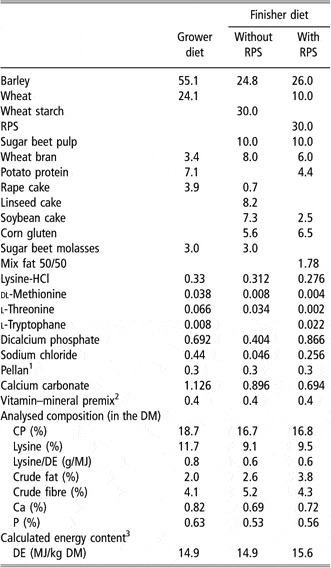
The experiment was conducted from February to July 2006 and included a total of 36 Swiss Large White male pigs originating from 12 litters. From weaning until the start of the experimental period (mean ± s.e. BW = 21.6 ± 0.3 kg; age = 65 ± 0.9 days), pigs were group-penned and had ad libitum access to a commercial starter diet. At an average BW of 13.1 ± 0.4 kg, the littermates were allocated to the three experimental groups according to BW. One group of 12 animals was surgically castrated (C). From 21.6 to 65 kg BW, and from 65 to 105.8 kg BW, the entire males and C had ad libitum access to the same grower and finisher diet (Table 1). For the last 7 days prior to slaughter, one group of entire males (EM+; n = 12) received a finisher diet with 30% RPS (Emsland-Stärke GmbH, D-49824 Emlichheim, Germany), whereas C and the remaining entire males (EM; n = 12) were kept on the finisher diet without RPS. The RPS was replaced with wheat starch and special care was taken to maintain a similar nutrient composition. All diets were pelleted (4.5-mm diameter) at 60°C.
Composition of the growing and finishing diet (as-fed basis)

RPS = raw potato starch; DE = digestible energy; DM = dry matter.
1Pellan = a binder that aids in pellet formation (Mikro-Technik GmbH & Co., KG, Germany).
2Vitamin–mineral premix supplied the following nutrients per kg of diet: 20 000 IU vitamin A, 200 IU vitamin D3, 39 IU vitamin E, 2.9 mg riboflavin, 2.4 mg vitamin B6, 0.010 mg vitamin B12, 0.2 mg vitamin K3, 10 mg pantothenic acid, 1.4 mg niacin, 0.48 mg folic acid, 199 g cholin, 0.052 mg biotin, 52 mg Fe as Fe-sulphate, 0.16 mg I as Ca(IO)3, 0.15 mg Se as Na2Se, 5.5 mg Cu as CuSO4, 81 mg Zn as ZnO2, 15 mg Mn as MnO2.
3DE content calculated according to the formula: DE = 18.974 × CP (g/g DM) + 33.472 × crude fat g DM) + 16.611 × NFE (g/g DM) − 21.216 × crude fibre (g/g DM) + 16.611 × NFE (g/g DM). NFE = DM − ash − CP − crude fat − crude fibre.
The three group-pens in which C, EM and EM+ were reared were equipped with single-space computerized feeders as previously described (Bee et al., Reference Bee, Jacot, Guex and Biolley2008). Pigs were weighed weekly and feed intake was recorded daily. From 80 kg BW until slaughter (BW = 105.8 ± 0.9 kg), pens were cleaned daily and barn ventilation set at maximum power to reduce skatole absorption through the skin and the lungs (Hansen et al., Reference Hansen, Larsen, Jensen, Hansen-Moller and Barton-Gade1994). Feed was withheld 15 h from the pigs before transportation to the research station abattoir where they were electrically stunned, exsanguinated, scalded, mechanically de-haired and eviscerated. Internal organs were removed and hot carcass weight was obtained. The weight of the testes, bulbourethral and salivary glands as well as the heart, liver and kidneys were assessed. Furthermore, a fat sample over the croup was taken for the determination of the fat score according to the method previously described (Scheeder et al., Reference Scheeder, Bossi and Wenk1999). Thirty minutes after exsanguination, the carcasses entered the air-chilling system (3°C) for 24 h. One day after slaughter, the left side of each carcass was weighed and dissected according to meat cutting standards applied by the Swiss Performance Testing Station (MLP, Sempach, Switzerland), as previously described by Bee (Reference Bee2001).
Objective meat quality measurements
The pH of the longissimus muscle (LM) at 30 min and 24 h post mortem was measured using a pH meter (pH196-S, WTW, Weilheim, Germany) equipped with an electrode (Eb4; WTW) and a temperature probe. Sets of measurements were obtained at the 10th rib of the right carcass side at 30 min by insertion of the pH and temperature probe between the ribs from the inside of the carcass.
At 24 h post mortem, the LM from the 10th to 13th rib level was excised and pH was determined at the 10th rib level. Subsequently, four 1.5-cm-thick LM chops were cut and labelled A, B, C and D. From chops A and C, drip loss was determined as the amount of purge formed during storage of chops at 4°C for 48 h (Honikel, Reference Honikel1998). The A and C samples were then vacuum-packed and stored at −20°C. From chops B and D, light reflectance coordinates (L*: lightness, a*: redness and b*: yellowness) of the muscle surface were determined following a 10 min bloom, using a Chroma Meter CR-300 with a D65 light source (Minolta, Dietikon, Switzerland). After colour measurements were made, the samples were vacuum-packed and stored at −20°C until Warner-Bratzler shear force was determined.
Frozen samples were thawed for 24 h at 2°C, subsequently kept at room temperature for 1 h and the thaw loss was determined. Both samples were then cooked on a grill plate (Beer Grill AG, Zurich, Switzerland) at 190°C to 195°C to an internal temperature of 69°C, and cooking losses were measured. Using a Warner-Bratzler shear device (Model 3000; G-R Electric Mfg. Co., Manhattan, KS, USA), shear force values were determined as previously described (Bee et al., Reference Bee, Calderini, Biolley, Guex, Herzog and Lindemann2007). In addition, adipose tissue (both layers) was sampled at the 10th to 13th rib level, vacuum-packed and stored at −20°C until further analysis.
Analysis of skatole and androstenone in adipose tissue and in plasma
Androstenone, skatole and indole concentrations in the adipose tissue were analysed according to the method described by Hansen-Moller (Reference Hansen-Moller1994). Briefly, adipose tissue samples were liquefied in a microwave oven for 2 × 2 min at 250 W. The liquefied lipids were centrifuged for 2 min at 11000 × g at 20°C and kept at around 47°C. The water was then removed and 0.50 ± 0.01 g water-free liquid fat was placed in 2.5 ml eppendorf tubes in duplicates and an internal standard was added (1 ml methanol containing 0.496 mg/l androstanone and 0.050 mg/l 2-methylindole). After vortexing for 30 s, the tubes were incubated for 5 min at 30°C in an ultrasonic-water bath (RK 255 H; Bandelin Sonorex, Zürich, Switzerland), kept at 0°C on ice for 20 min and then centrifuged for 20 min at 11000 × g at 4°C. Finally, 50 μl of the supernatant was transferred into a high-performance liquid chromatography (HPLC) vial for androstenone, skatole and indole analysis with an HPLC system from Hewlett-Packard series 1100. The procedure of the analysis with the HPLC is similar to the one described by Hansen-Moller (Reference Hansen-Moller1994). Concentrations were expressed per g of the lipid fraction from adipose tissue. The detection limits were 0.3 μg for androstenone and 0.03 μg for skatole and indole. Blood samples from pigs were collected at exsanguniation, centrifuged at 840 × g for 15 min and plasma stored at −20°C until analysis. Subsequently, skatole and indole levels in the plasma were determined by HPLC after ether extraction using the method described by Lösel (2006).
Statistical analysis
Data for growth performance, carcass characteristics and meat quality traits were analysed with the MIXED procedure of SAS (v. 9.1; SAS Institute, Cary, NC, USA). The model used included litter and experimental groups as fixed effects. The individual pig was the experimental unit for analysis of all data. Least square means were separated using the PDIFF option (P < 0.05). Tendencies were established at a P < 0.10. Androstenone, skatole and indole concentrations in the adipose tissue and plasma were analysed with the non-parametric Mann–Whitney U test with the statistical software package NCSS (version 2007; NCSS, Kaysville, Utah, USA). Two-tail test for androstenone and indole and one-tail test for skatole, right-tail in favour of EM+, were considered. Spearman’s Rank correlation coefficients were determined between androstenone, skatole and indole levels in the adipose tissue and plasma and the organ weights.
Results
Growth, carcass characteristics and organ weights
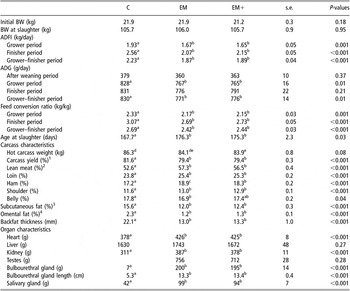
Despite the late time point of castration, growth from weaning until the start of the experiment did not (P = 0.37) differ among the experimental groups (Table 2). From 21.6 kg BW until slaughter, EM and EM+ grew slower (P < 0.01), consumed less feed (P < 0.001) and were more efficient (P < 0.001) than C. The differences for average daily feed intake (ADFI), average daily gain (ADG) and feed conversion ratio (FCR) were already apparent during the grower period. Because of the slower growth rate, EM and EM+ were 8.1 days older (P = 0.03) at slaughter than C. Feeding RPS the last week before slaughter did not affect overall growth performance (data not shown).
Growth performance, carcass characteristics and organ weights from castrates (C) and entire males fed a finisher diet without (EM) or with raw potato starch in the diet (EM+)

ADFI = average daily feed intake; ADG = average daily gain.
a–cSignificant effect of the experimental groups (P < 0.05).
d,eSignificant effect of the experimental groups (P < 0.10).
P-values = probability values for the experimental groups.
1Carcass yield = hot carcass weight as percentage of the BW at slaughter.
2Lean meat percentage = sum of denuded shoulder, loin and ham weights as percentage of cold carcass weight.
3Subcutaneous fat = sum of external fat from the shoulder, loin and ham expressed as percentage of cold carcass weight.
4Omental fat percentage = weight of the omental fat as percentage of cold carcass weight.
Carcass yield was lower (P < 0.001) and lean meat percentage was markedly higher (P < 0.001) in EM and EM+ than C (Table 2). In accordance, subcutaneous fat percentage and backfat thickness were lower (P < 0.001) in carcasses of EM and EM+ compared to C. The greater carcass leanness resulted from the higher (P < 0.001) loin, ham and shoulder percentages in entire male carcasses. Compared to C, the carcasses of EM had lower (P = 0.04) belly percentage with intermediate values for EM+. Entire males had heavier hearts and kidneys compared to castrates (P < 0.001 for both; Table 2). Bulbourethral and salivary glands were also heavier and bulbourethral gland was longer in EM and EM+ compared to C (P < 0.001 for each). The dietary RPS did not (P > 0.10) affect the weights of the evaluated organs as no differences were observed between EM and EM+.
Meat and backfat quality
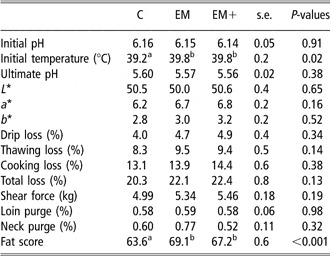
The effects of the experimental groups on quality traits of the LM were minor (Table 3). The muscle temperature 30 min post mortem of the EM and EM+ was lower (P = 0.02) than that of C. The LM from EM and EM+ had numerically higher (P = 0.16) a* values and lost more (P = 0.14) purge during thawing than the LM of C. Feeding RPS the last week before slaughter did not (P > 0.10) affect objective meat quality traits as no differences were observed between EM and EM+. The fat score was markedly higher (P < 0.001) in the adipose tissue of EM and EM+ compared to C, indicating a higher degree of unsaturation. The fat score was closely related to carcass fatness as suggested by the negative correlations between fat score and subcutaneous fat percentage (r = −0.81, P < 0.001) and croup fat thickness (r = −0.70, P < 0.001).
Meat quality traits determined in the longissimus muscle and fat score analysed in the backfat from castrates (C), and entire males fed a finisher diet without (EM) or with raw potato starch in the diet (EM+)

a,bSignificant effect of the experimental groups (P < 0.05).
P-values = probability values for the experimental groups.
Androstenone and skatole concentrations
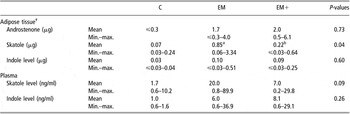
Androstenone concentrations in the adipose tissue of all C were below the detectable limits of the used method (Table 4). The androstenone concentrations did not (P = 0.73) differ in the adipose tissue of EM and EM+. A high variability in the androstenone concentration was observed ranging from below detection limits up to 4 and 6.1 μg/g of the lipid fraction from adipose tissue in EM and EM+, respectively. However, skatole concentrations were lower (−74%; P = 0.044) in EM+ than in EM, indicating a marked effect of dietary RPS supply. The lowest skatole concentrations were observed in C. Nevertheless, it is worthwhile mentioning that in the adipose tissue of one C skatole concentration was, with a concentration of 0.24 μg, high. In accordance with the findings in the adipose tissue, the average skatole concentration in the plasma from EM+ tended to be lower (P = 0.09) than for EM. The skatole concentrations in the adipose tissue and plasma were highly positively correlated (r = 0.91, P < 0.001). Although the indole concentrations in both the adipose tissue and plasma were not (P ⩾ 0.26) affected by the diet, the concentrations of this compound were highly correlated (r = 0.81, P < 0.001) between adipose tissue and plasma. In contrast, androstenone and skatole concentrations in the adipose tissue were not (r = 0.24, P = 0.46) related.
Skatole and indole levels in the adipose tissue and in plasma and androstenone concentrations in the adipose tissue from castrates (C) and entire males fed a finisher diet without (EM) or with raw potato starch in the diet (EM+)

a,bSignificant effect of the experimental groups EM and EM+ (P < 0.05).
†Androstenone, skatole and indole concentrations in the adipose tissue are expressed as μg/g liquefied lipids.
The androstenone concentration in the adipose tissue was negatively correlated with the percentage subcutaneous fat (r = −0.57, P < 0.001) and backfat thickness (r = −0.51, P = 0.001). Similarly, skatole concentrations were also correlated with both traits (percentage subcutaneous fat: r = −0.48, P < 0.01 and backfat thickness: r = −0.46, P < 0.01). Furthermore, with increasing androstenone concentrations in the adipose tissue, the weight of the salivary (r = 0.63, P ⩽ 0.001) and bulbourethral gland (r = 0.67, P ⩽ 0.001) increased as well as the bulbourethral gland was longer (r = 0.49, P = 0.02). In contrast, no correlations were found between androstenone concentrations in the adipose tissue and the testes weight (r = 0.35, P = 0.09). The correlation coefficients between skatole or indole concentrations and the aforementioned organ weights and length were not significant (P > 0.05).
Discussion
Differences in performance, carcass characteristics, meat quality and boar taint level between entire males and castrates were reported to depend on a variety of factors including genetics, nutrition and housing conditions (Barton-Gade, Reference Barton-Gade1987; Bonneau, Reference Bonneau1998). However, in particular, the reported differences in feed intake and weight gain have been inconsistent (Xue et al., Reference Xue, Dial and Pettigrew1997). In this study, EM and EM+ consumed markedly less feed than C. First, this could be due to a negative influence of sexual hormones on appetite. Claus and Weiler (Reference Claus and Weiler1987) reported that oestrogen and androgen influenced negatively feed intake. They showed that in castrates, the application of an implant of testosterone reduced feed intake by about 25%. Second, the lower ADFI could be related to the observed higher physical activity of EM and EM+, which was not limited to the finisher period, but both EM and EM+ already showed more mounting and aggression at the end of the grower period. In agreement, several authors (Giersing et al., Reference Giersing, Lundström and Andersson2000; Cronin et al., Reference Cronin, Dunshea, Butler, McCauley, Barnett and Hemsworth2003; Rydhmer et al., Reference Rydhmer, Zamaratskaia, Andersson, Algers, Guillemet and Lundstrom2006) reported that entire males spent less time eating and more time mounting, a behaviour observed primarily after the onset of sexual maturity. Suster et al. (Reference Suster, Leury, Kerton, Borg, Butler and Dunshea2006) suggested that such changes in behaviour could also induce social stress, which could stimulate cortisol production. Elevated cortisol levels have been shown to reduce feed intake, decrease production of growth hormone and IGF-1 (Black et al., Reference Black, Giles, Wynn, Knowles, Kerr, Jones, Strom, Gallagher and Eamens2001). The observed consequences of the reduced feed intake were not surprising. In fact EM and EM+ gained on average less than C (ADG: −54 g/day), but were still more efficient (FCR: −0.26 kg/kg). These findings are in line with recent studies reporting a tendency towards lower ADG for entire males reared in group compared to castrates (Dunshea et al., Reference Dunshea, Colantoni, Howard, McCauley, Jackson, Long, Lopaticki, Nugent, Simons, Walker and Hennessy2001; D’Souza and Mullan, Reference D’Souza and Mullan2002; Suster et al., Reference Suster, Leury, Kerton, Borg, Butler and Dunshea2006). Contrarily, some previous studies reported that entire male pigs had higher ADG and better FCR than castrates (Whittemore et al., Reference Whittemore, Tullis and Emmans1988; Campbell et al., Reference Campbell, Steele, Caperna, McMurtry, Solomon and Mitchell1989; Dunshea et al., Reference Dunshea, King, Campbell, Sainz and Kim1993). This might be surprising as the genetic growth potential was markedly improved in the last decade due to breeding efforts. However, compared to recent experiments, these studies with entire males of the nineties were carried out with individually penned pigs, which limited the social interactions and, thus, lowered the energy expenditure on activities unrelated to growth.
Carcass yield and carcass fat deposition were lower in EM and EM+ than in C, which confirms the results reported by Sather et al. (Reference Sather, Jeremiah and Squires1999), Dunshea et al. (Reference Dunshea, Colantoni, Howard, McCauley, Jackson, Long, Lopaticki, Nugent, Simons, Walker and Hennessy2001) and Zeng et al. (Reference Zeng, Turkstra, Jongbloed, van Diepen, Meloen, Oonk, Guo and van de Wiel2002). It is well known that lower backfat deposition rate affects lipid composition of the adipose tissue as the degree of unsaturation of the lipids increases (Bee et al., Reference Bee, Gebert and Messikommer2002). In accordance, EM and EM+ had higher fat scores than C and the fat score was negatively correlated with backfat thickness. These findings are in line with earlier studies of Barton-Gade (Reference Barton-Gade1987) who determined higher iodine value in the backfat of entire males than castrates.
While general meat quality parameters were not affected by treatment, specific parameters involved in boar taint did markedly differ. Boar taint is mainly caused by the accumulation of androstenone and skatole or both in the adipose tissue. Androstenone is produced in the testes and its concentration increases with sexual maturity (Bonneau, Reference Bonneau1982). Comprehensive studies have shown that between 18 and 42% of the entire males have androstenone levels above 1.0 μg/g adipose tissue (Walstra et al., Reference Walstra, Claudi-Magnussen, Chevillon, von Seth, Diestre, Matthews, Homer and Bonneau1999; Bonneau et al., Reference Bonneau, Kempster, Claus, Claudi-Magnussen, Diestre, Tornberg, Walstra, Chevillon, Weiler and Cook2000). The androstenone concentration of 1 μg/g adipose tissue has been proposed to be the threshold value for consumer acceptability in the EU (Desmoulin et al., Reference Desmoulin, Bonneau, Frouin and Bidard1982; Bonneau et al., Reference Bonneau, Denmat, Vaudelet, Veloso-Nunes, Mortensen and Mortensen1992; Annor-Frempong et al., Reference Annor-Frempong, Nute, Whittington and Wood1997). When this value is expressed on the basis of the lipid fraction from the adipose tissue only, as requested by the analytical procedure used in this study, the concentration is 1.7 μg. This relation between both methods was determined after analysis of samples with both extraction methods (lipid fraction from the adipose tissue only and adipose tissue). The average androstenone concentrations reported in the present trial are just at or above the aforementioned threshold level. Very limited information is available on androstenone and skatole concentrations in the Swiss pig population. In a recent large field trial, Pauly et al. (2007) showed that only 3.8% of the analysed adipose tissue samples (n = 170) from entire males had androstenone levels above 1.7 μg/g of the lipid fraction from adipose tissue. Fredriksen et al. (Reference Fredriksen, Lium, Marka, Heier, Dahl, Choinski and Nafstad2006) reported that the herd average androstenone level varied considerably in three herds in Norway (expressed per g adipose tissue: means from 0.66 to 1.67 μg; and expressed per g of the lipid fraction from the adipose tissue: 1.12 to 2.83 μg), even when adjusted for fattening system, season, breed and carcass weight. This suggests that feeding strategies, ADG, and also genetic and environment (e.g. photoperiod) are factors that can influence puberty and, thus, affect the development of boar taint. Sexual maturity of entire male pigs is difficult to determine because it is a continuously developing process (Malmgren, 1993). However, in accordance to Andersson et al. (Reference Andersson, Hullberg, Malmgren, Lundström, Rydhmer and Squires1999), the weights of the testes and bulbourethral glands indicated that the majority of the EM and EM+ had attained puberty at slaughter. Furthermore, animals born earlier, which were heavier and slaughtered first, showed a tendency for higher androstenone levels in the adipose tissue. Giersing et al. (Reference Giersing, Lundström and Andersson2000) reported that the level of plasma androstenone was related to rank order: high rank is often associated with higher BW. As heavier pigs were reaching sexual maturity earlier, they could have stimulated sexual development and androstenone secretion in other pen mates, which could explain the overall high androstenone concentrations in the EM and EM+ of this study. Besides the sexual organs, heart and kidney weights of EM and EM+ were also higher than for C. To our knowledge, no information has been reported about such differences in pigs. In rats, blood pressure and the degree of cardiac hypertrophy were decreased by castration and increased by testosterone substitution (Morano et al., Reference Morano, Gerstner, Ruegg, Ganten, Ganten and Vosberg1990). Implanted steers with estradiol benzoate, progesterone and then with estradiol, trenbolone acetate, had higher circulating IGF-1 concentrations compared to bulls, and with it a significantly higher heart weight at slaughter (Schoonmaker et al., Reference Schoonmaker, Loerch, Fluharty, Turner, Moeller, Rossi, Dayton, Hathaway and Wulf2002).
Skatole is a bacterial metabolite of tryptophan synthesized in the large intestine. The production of skatole greatly depends on the composition of the diet and the intestinal microflora (Jensen et al., Reference Jensen, Cox and Jensen1995; Claus et al., Reference Claus, Losel, Lacorn, Mentschel and Schenkel2003). Important quantities of butyrate are produced when RPS is fermented in the large intestine (Martin et al., Reference Martin, Dumon, Lecannu and Champ2000; Mentschel and Claus, Reference Mentschel and Claus2003), which reduces epithelial cell apoptosis (Claus et al., Reference Claus, Losel, Lacorn, Mentschel and Schenkel2003). Because tryptophan from cell debris is a substrate for skatole formation, lower skatole tissue and plasma levels can be expected. In accordance, a marked decrease in skatole content in the adipose tissue, and a tendency towards lower plasma levels were observed in EM+ compared to EM. Nevertheless, three animals on the RPS diet had skatole levels in the adipose tissue above the sensory threshold of 0.25 μg/g lipid fraction of the adipose tissue (0.16 μg/g adipose tissue), suggesting marked differences in the individual response to the diet. Genetic and dietary differences are thought to be two of the main factors explaining the sex-dependent and individual variation in the carcass adipose tissue skatole concentration of pigs. Skatole levels increase with puberty (Babol et al., Reference Babol, Zamaratskaia, Juneja and Lundström2004; Zamaratskaia et al., Reference Zamaratskaia, Rydhmer, Chen, Madej, Andersson and Lundström2005b), so that sexual maturity may affect the skatole levels (Babol et al., Reference Babol, Squires and Lundström1998b). Furthermore, there are important indications that genetic factors influence the skatole level in pigs. These include differences in skatole level between breeds (Babol et al., Reference Babol, Zamaratskaia, Juneja and Lundström2004), intermediate heritability estimates for skatole in the adipose tissue (Bergsma et al., 2007) as well as genetic differences in activities of cytochrome P450 (CYP), isoforms 2E1 and 2A6, which are two of the key enzymes responsible for skatole breakdown in the liver (Babol et al., Reference Babol, Squires and Lundström1998a; Diaz and Squires, Reference Diaz and Squires2000; Lin et al., Reference Lin, Lou and Squires2006).
In this study, RPS was distributed only one week before slaughter, because RPS is an expensive nutritive compound. In contrast, other researchers offered RPS for 2 or 3 weeks (Andersson et al., Reference Andersson, Andersson, Zamaratskaia, Rydhmer, Chen and Lundström2005; Lösel and Claus, Reference Lösel and Claus2005; Zamaratskaia et al., Reference Zamaratskaia, Babol, Andersson, Andersson and Lundström2005a) and obtained a complete wash-out of skatole from the adipose tissue; however, skatole concentration in the adipose tissue of control entire males was lower than in our study. Claus et al. (Reference Claus, Losel, Lacorn, Mentschel and Schenkel2003) measured a marked reduction in the adipose tissue accompanied by minimal skatole levels in the faeces and very low levels in the plasma by day four after RPS feeding. The skatole breakdown in the liver can be efficient and fast as the half-life of skatole in the adipose tissue is about 12 h (Hansen et al., Reference Hansen, Larsen, Jensen, Hansen-Moller and Barton-Gade1994). Thus, feeding RPS only one week before slaughter should be sufficient to decrease skatole concentration in the fat to the genetic level. As feeding RPS decreased skatole in adipose tissue, a reduction in indole could also be expected. In the present study, no effects of RPS on indole concentrations in the adipose tissue and plasma were observed. Indole synthesis in the large intestine is mediated by many types of bacteria, whereas skatole production requires the presence of highly specific bacterial populations. Feeding RPS affected skatole-producing bacteria; however, indole-producing bacteria remain unaffected (Chen et al., Reference Chen, Zamaratskaia, Andersson and Lundström2007).
In conclusion, the present results confirm that RPS supply was efficient in reducing skatole tissue concentrations. However, the androstenone concentrations in the adipose tissue of Swiss Large White entire males reared in a production system with high welfare standards were on average higher than the suggested threshold values for consumer acceptability in the EU. Meat quality did not differ among sexes but the adipose tissue composition might cause technological problems for further meat processing due to the high degree of unsaturation. Thus, specific feeding strategies need to be studied for entire male production. Besides the high androstenone concentrations, the lower ADG and in particular the low ADFI will pose a major challenge to implement fattening entire males instead of castrates. No conclusive result was obtained to show whether the lower ADFI was due to more active and aggressive behaviour or a general low ingestion capacity of entire male pigs.
Acknowledgements
The authors would like to thank C. Biolley, B. Dougoud, S. Dubois, G. Guex, G. Maïkoff and P. Stolll from Agroscope Liebefeld Posieux Research Station ALP (Posieux, Switzerland) for their support and technical assistance.
Prof. Dr R. Claus and Dr M. Lacorn from the University Hohenheim (Stuttgart, Germany) are gratefully acknowledged for technical support and determination of skatole levels in the plasma and UFAG-Laboratorien (Sursee, Switzerland) for determination of the fat score.
This trial was a part of the project ‘ProSchwein’. Project ProSchwein is acknowledged for supporting the present study. We thank the Federal veterinary office, Migros, Suisseporcs, Coop, Suisag, Federal Office for Agriculture, Proviande and Swiss animal protection for financial support.