Introduction
The fourth International Polar Year 2007–08 (IPY) involved scientists from 63 countries working to better understand the Arctic and the Antarctic regions and the processes that influence the rest of the world (Carlson & Salmon, Reference Carlson, Salmon, Kaiser, Zicus and Allen2010). IPY also stimulated the engagement of thousands of educators (defined here as persons involved in education, such as kindergarten/primary/secondary educators, university professors, informal educators), students and the general public around the world (Baeseman, Xavier, Lantuit, & Taylor, Reference Baeseman, Xavier, Lantuit, Taylor, Krupnik, Allison, Bell, Culer, Hik, Lopez-Martinez, Rachold, Sarukhanian and Summerhayes2011; Salmon et al., Reference Salmon, Carlson, Zicus, Pauls, Baeseman, Sparrow and Raymond2011; Zicus et al., Reference Zicus, Almeida, Edwards, Hik, Huffman, Kaiser, Xavier, Krupnik, Allison, Bell, Cutler, Hik, López-Martinez, Rachold, Sarukhanian and Summerhayes2011) in a wide range of educational activities (Barber et al., Reference Barber, Baeseman, Carlson, Edwards, Kaiser, Poort, Straka, Kaiser, Zicus and Allen2010; Salmon et al., Reference Salmon, Carlson, Zicus, Pauls, Baeseman, Sparrow and Raymond2011; Zicus et al., Reference Zicus, Almeida, Edwards, Hik, Huffman, Kaiser, Xavier, Krupnik, Allison, Bell, Cutler, Hik, López-Martinez, Rachold, Sarukhanian and Summerhayes2011).
International Polar Weeks began with International Polar Days, an educational initiative developed during IPY (which ran from March 2007 to March 2009) to raise awareness of polar regions and, in particular, polar science (Salmon et al., Reference Salmon, Carlson, Zicus, Pauls, Baeseman, Sparrow and Raymond2011; Zicus et al., Reference Zicus, Almeida, Edwards, Hik, Huffman, Kaiser, Xavier, Krupnik, Allison, Bell, Cutler, Hik, López-Martinez, Rachold, Sarukhanian and Summerhayes2011). Due to the popularity of International Polar Days, the IPY Education and Outreach community decided to expand their efforts from International Polar Days to International Polar Weeks. The first two International Polar Weeks were held in October 2009 and March 2010, with the theme “What happens at the poles affects us all” (Zicus et al., Reference Zicus, Almeida, Edwards, Hik, Huffman, Kaiser, Xavier, Krupnik, Allison, Bell, Cutler, Hik, López-Martinez, Rachold, Sarukhanian and Summerhayes2011).
The Association of Polar Early Career Scientists (APECS), a major legacy of IPY (Allison et al., Reference Allison, Béland, Alverson, Bell, Carlson, Cutler and Yamanouchi2009; Krupnik et al., Reference Krupnik, Allison, Bell, Cutler, Hik, López-Martinez and Summerhayes2011; Provencher et al., Reference Provencher, Baeseman, Carlson, Badhe, Bellman, Hik and Zicus2011), took over responsibility for International Polar Weeks from March 2012, with Polar Educators International (PEI) offering support in some countries, including Portugal. International Polar Weeks have since been organised twice a year, around the equinoxes in March and September, and include a series of national and international events to promote the science that takes place in polar latitudes and to educate the public about all things polar.
Many countries have engaged in International Polar Weeks, with a wide range of initiatives and approaches, both online and in-person, that link major polar scientific and educational themes (e.g. climate change) to local, regional and national perspectives (Caramello et al., Reference Caramello, Ivar do Sul, Souza, Santos, Piuco, Affonso and Costa2017; Xavier, Fugmann, Beck, Huffman, & Jensen, Reference Xavier, Fugmann, Beck, Huffman, Jensen, Castro, Azeiteiro, Bacelar-Nicolau, Filho and Azul2016). Simultaneously, with the creation of Polar Educators International (PEI) in 2012, polar education issues started to be addressed internationally by educators in a multidisciplinary way (Liggett, Reference Liggett2015; May, Huffman, Xavier, & Walton, Reference May, Huffman, Xavier and Walton2014; Walton, Xavier, May, & Huffman, Reference Walton, Xavier, May and Huffman2013). PEI brings together more than 1500 educators and polar scientists from 30 countries to engage schools, universities, museums and other public-related organisations in educational activities related to the polar regions. In this context, the mutual interests of APECS and PEI are apparent, as by combining the efforts of the two organisations, International Polar Weeks have had a greater reach to the community in general and the school community especially. As a result, in some countries (incuding Portugal), both organisations are involved in organising International Polar Weeks.
Since the IPY, there has been a significant boost in educational activities in “non-polar” countries, defined here as countries that are not geographically located in the polar regions, do not have any claims to any territory in the polar regions and have not had a long tradition of carrying out activities, such as research, exploration and fishing, in the polar regions (such as Portugal), which are developing polar programmes (Kaiser, Zicus, & Allen, Reference Kaiser, Zicus and Allen2010; Schiermeier, Reference Schiermeier2009; Xavier, Gray, & Hughes, Reference Xavier, Gray and Hughes2018). However, few studies have measured the usefulness of these initiatives (Xavier et al., Reference Xavier, Fugmann, Beck, Huffman, Jensen, Castro, Azeiteiro, Bacelar-Nicolau, Filho and Azul2016). Quantifying how many students, schools and scientists have participated in International Polar Weeks since the IPY, as well as discussing ways in which other “non-polar” countries can implement and participate in International Polar Weeks in the future, is therefore crucial. This paper aims to address this issue, using the non-polar country Portugal as an example.
Despite its location far from the poles, Portugal was very involved in the IPY, both scientifically and educationally, and has since continued to expand its efforts (Azinhaga, Reference Azinhaga2014; Kaiser et al., Reference Kaiser, Zicus and Allen2010; Xavier, Vieira, & Canário, Reference Xavier, Vieira and Canário2006; Xavier et al., Reference Xavier, Barbosa, Agusti, Alonso-Sáez, Alvito, Ameneiro and Catry2013, Reference Xavier, Fugmann, Beck, Huffman, Jensen, Castro, Azeiteiro, Bacelar-Nicolau, Filho and Azul2016). For example, Portugal joined several international polar-focused scientific organisations, including the Scientific Committee on Antarctic Research (SCAR), the International Arctic Science Committee (IASC), and APECS; it established its own national polar-focused programme (PROPOLAR) (Xavier et al., Reference Xavier, Barbosa, Agusti, Alonso-Sáez, Alvito, Ameneiro and Catry2013, Reference Xavier, Fugmann, Beck, Huffman, Jensen, Castro, Azeiteiro, Bacelar-Nicolau, Filho and Azul2016, Reference Xavier, Gray and Hughes2018); and it coordinated several educational programmes focused on polar issues (e.g. Latitude60!, Profession: Polar Scientist, Education PROPOLAR) (Kaiser et al., Reference Kaiser, Zicus and Allen2010; Zicus et al., Reference Zicus, Almeida, Edwards, Hik, Huffman, Kaiser, Xavier, Krupnik, Allison, Bell, Cutler, Hik, López-Martinez, Rachold, Sarukhanian and Summerhayes2011).
The focus of this paper is to describe International Polar Weeks in Portugal between 2012 and 2017, and in particular to
(1) Quantify the participation of students, schools, educators and polar scientists in the International Polar Weeks organised by Portugal.
(2) Provide an overview of the diversity of educational activities carried out during International Polar Weeks in Portugal.
(3) Discuss how International Polar Weeks can be improved and maintained as a valuable educational polar activity.
(4) Discuss how International Polar Weeks can be established in other countries, particularly in “non-polar” countries that are still developing their national polar programmes.
International Polar Weeks in Portugal
Ten International Polar Weeks were organised in Portugal between September 2012 and March 2017. The main coordinators of International Polar Weeks in Portugal (the first three authors of this paper) are members of APECS Portugal and of PEI and have the support of APECS international, with their efforts endorsed by PROPOLAR. This support has enabled Portugal to maintain a year-round coordination committee for International Polar Weeks, initially coordinated by APECS Portugal, and since 2012, with PEI. The Portuguese International Polar Week takes place twice a year, at similar dates to the international Polar Week events around the world (organised by other national committees of APECS), close to the equinoxes in March–April and September–October. While most Portuguese International Polar Weeks are organised over the same dates as the International Polar Week, others are in the week(s) leading up to or following them, so as to coordinate with the school term.
Methodology used in implementing International Polar Weeks in Portugal
Each International Polar Week in Portugal is organised as follows: e-mail all interested Portuguese educators (the e-mail list is created from those educators who have shown interest in International Polar Week or educational activities over the years) in early December (for the International Polar Week in the following March/April) or early July (for the International Polar Week in the following September/October). It is also advertised online, such as on Facebook pages (https://www.facebook.com/semanaspolarespt/ and https://www.facebook.com/educacaopropolar/). A separate e-mail is sent to polar scientists potentially interested in participating in International Polar Weeks. After gathering all replies from educators and scientists, the schools are matched up with polar scientists (trying to avoid polar scientists returning to schools they have visited previously, unless requested) and an e-mail is sent to the educator, with instructions (i.e. how to contact the polar scientist, how to set a date and time, the location of the school and the number of talks requested, age groups of the students and scientific topic). After the International Polar Week, another e-mail is sent to the educators thanking them for participating and asking them to fill out a form with the number of students (and age groups), number of educators, name of scientist, type of activity (e.g. talk, Skype call), topic addressed and observations on how the activity went. A report of each International Polar Week is produced and distributed to all participating educators and polar scientists. If activities are carried out outside International Polar Week, the numbers are reported in the following International Polar Week report.
Over the years, the committee coordinating International Polar Weeks in Portugal has collected valuable information regarding participant numbers, international collaborations and types of activities. These data were collected via short forms filled out by the educators, activity feedback by e-mail from scientists, and reports from the organisers of International Polar Week. The numbers below are for the 10 International Polar Weeks organised in Portugal from 2012 to 2017.
Participant numbers
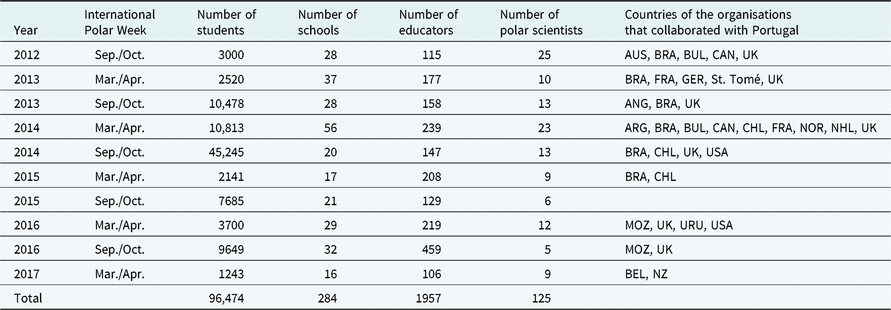
Participant numbers are the absolute numbers (i.e. if a scientist or educator participated in two different International Polar Weeks in a given year, we counted two scientists/educators). These numbers result from the total sum of the number of student and educator participants, collected through a report of the activity carried out in each school. In the case of public exhibitions and science fairs, numbers were reported by the local hosts/organisers. These numbers provide a good overall indication of the reach of the Portuguese International Polar Week activities. In total, 96,474 students, 284 schools (excluding participating universities of the polar scientists), 1957 educators and 125 polar scientists participated in the Portuguese International Polar Weeks during 2012–2017 (Table 1, Fig. 1), showing a continuous interest of educators/polar scientists in engaging in International Polar Week. Of the individual educators involved in more than one International Polar Week, 77.1% participated in the immediately following International Polar Week.
The number of students participating in International Polar Weeks in Portugal between 2012 and 2017 (S: International Polar Week in September/October; M: International Polar Week in March/April).

The participants of International Polar Weeks organised by Portugal, between September 2012 and March 2017 (ARG, Argentina; AUS, Australia; BEL, Belgium; BRA, Brazil; BUL, Bulgaria; CAN, Canada; CHL, Chile; FRA, France; GER, Germany; NHL, Netherlands; NOR, Norway; NZ, New Zealand; MOZ, Mozambique; S. Tomé, São Tomé and Principe; UK, United Kingdom; USA, United States of America).

The number of students, schools, educators and polar scientists varied significantly over the years (Table 1, Fig. 1). For example, the number of students ranged from 1243 in March 2017 to over 45,000 in September 2014 (Table 1, Fig. 1). There are two distinct reasons for the high values observed in 2014: (1) Several joint activities were organised that year, in cooperation with the APECS National Committee in Brazil, which boosted the number of students in September; (2) high participation may have been due to the March International Polar Week falling at a time when several dedicated, funded educational projects (i.e. Education PROPOLAR, Profession: Polar Scientist) sponsored scientists to go into schools and promote collaboration among countries. The high number of educators in the International Polar Week of September 2016 includes all educators who participated in a Science Fair (the data were not available in other years). Finally, information obtained from Facebook shows that nearly 200 followers and >600 people viewed our page during the International Polar Weeks in Portugal.
International collaboration
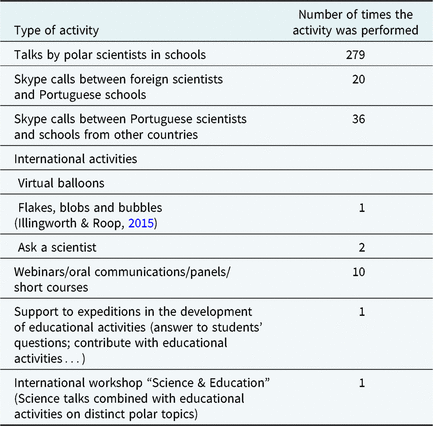
There are only approximately 100 polar scientists in Portugal (from 15 research institutes/universities) (Xavier et al., Reference Xavier, Vieira and Canário2006, Reference Xavier, Gray and Hughes2018), so the Portuguese International Polar Week organisers collaborated with schools and polar scientists from other countries, particularly the United Kingdom and Brazil (Table 1), to draw on a wider international pool of Antarctic researchers. These collaborations were based on existing, established contacts between polar scientists or between organisations (e.g. PEI, APECS). Several collaborations were established that facilitated the development of educational activities, such as Skype calls between foreign scientists and Portuguese schools or between Portuguese scientists and schools from other countries, Webinars, international activities such as “virtual ballons” (in which schools from around the world launch a virtual balloon of their school on an online world map) and “ask the scientist” (in which students e-mail questions to scientists while they are in the field), and international workshops (Table 2).
Activities developed in collaboration between Portugal and other countries during International Polar Weeks organised by Portugal, between September 2012 and March 2017.

Types of activities
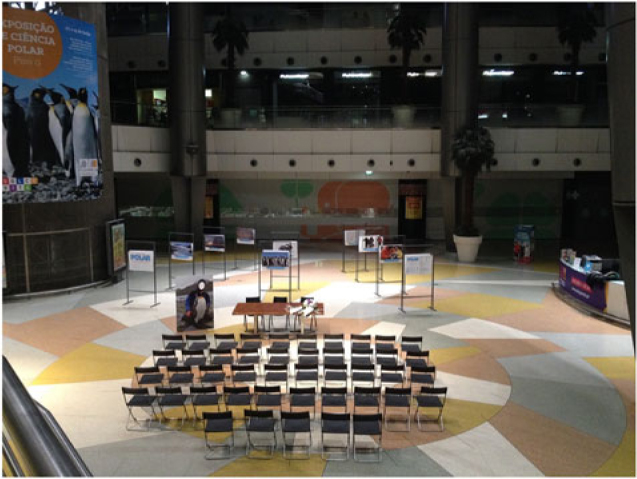
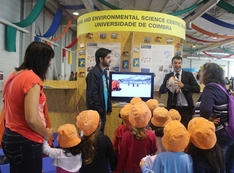
The most common educational activities carried out during International Polar Week in Portugal were talks in schools (n = 279) and Skype calls by Portuguese polar scientists in the field or by international polar scientists (n = 56); a range of other educational activities were regularly added to International Polar Week to complement these activities (Table 2, Figs 2–4).
Participants (educators and polar scientists) of the first workshop for Portuguese polar educators, at the Institute for Education and Citizenship (IEC, Mamarrosa, Portugal) in 2014.

Photo exhibition about Portuguese Polar research at a shopping centre in Coimbra, Portugal.

Scientists at the Science Fair (Oliveira do Bairro, Portugal) with students and their educators during a science demonstration.

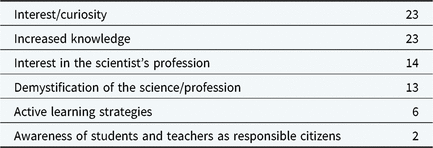
Schools were requested to provide feedback on the activities using a short survey comprising questions about the type of activity carried out (talk/Skype call/other); the number of students and teachers involved; the area of research that was discussed; and comments on how the initiative went (Supplementary Material 1). The data obtained were distributed into categories following content analysis (Creswell, Reference Creswell2007). During the second phase, these categories were organised to form conceptual categories using both inductive and deductive analyses (Table 3). All data submitted between 2012 and 2017 (n = 43) were analysed. All the activities were evaluated as excellent (n = 40) or good (n = 3). The activities carried out had a positive impact (Table 3) on (1) students’ interest and curiosity about the topic (n = 23), (2) students’ knowledge about the topic (n = 23), (3) interest in the scientist’s profession (n = 14), (4) the demystification of the science/profession (n = 13), (5) the promotion of active learning strategies (n = 6), and (6) the awareness of students and teachers as responsible citizens (n = 2). Feedback (translated from Portuguese) from educators included the following examples: “The different sessions were very positive for the teaching and learning process, and the students’ reactions were enthusiastic. The feedback from students in the classroom was extremely positive as they have continued to raise questions on the subject.” “Many students are already fans of the research that is taking place in Antarctica. The inspiration of the talks of the scientists stayed with the students and maybe we’ll have some students that wish to follow the footsteps of scientists and want to be researchers …” “This activity was a plus for our students, who loved it. This is a good practice to continue. Thank you and we count on your presence next year.” No negative feedback was received.
Categories of positive aspects from the activities developed in Portugal during the International Polar Weeks between 2012 and 2017 referred to by teachers (n = 43).

It was possible also to verify that the activities carried out during International Polar Weeks can boost other learning activities, as illustrated in the following words (translated from Portuguese) from an educator: “We had a Skype call with Dr Anne-Mathilde that reached the parents through the students. The parents are very satisfied with the motivation that this activity generated in the students … the students launched themselves into Antarctic related issues, requesting books and materials that would allow them to learn more about the Antarctic region.”
The use of simple and captivating language by polar scientists (n = 14) was mentioned by both teachers and students, as expressed in the following words (translated from Portuguese) from students (“I liked the presentation and learned more about the poles. I was able to understand everything”) and teachers (“There should be more initiatives like this in my school in order to motivate our students so that they get interested in these professions”). Feedback from scientists on the activities carried out was also positive, as illustrated in the words of a Portuguese polar scientist: “Simply spectacular! I’ve never had an audience so committed and well-behaved.”
Although the data collected via the short survey, completed by educators from schools involved, do not provide an effective measure of the success of the International Polar Weeks, they do provide us with some insights. The results showed that educators valued International Polar Weeks because students were interested in learning more about the research of polar scientists. It also provided a particular view of how students think about polar science. Studies comparing these outcomes with other educational projects will be welcomed in the future.
Lessons learned and potential future directions of work
The above data show the broad reach of International Polar Week activities in Portugal, the scope of its international collaborations, and the variety of activities organised. From our perspective, the apparent success of International Polar Weeks, as an educational activity in Portugal, may be attributed to several factors.
Firstly, the coordination of International Polar Weeks was conducted jointly by polar scientists (including early career scientists) and educators, which made it easier to organise and carry out the educational activities (see Kaiser et al., Reference Kaiser, Zicus and Allen2010).
Secondly, engaging with polar scientists and educators from other countries (1) enhanced organisers’ ability to define a common strategy to communicate polar knowledge collectively (e.g. polar scientists speaking Portuguese with educators/scientists from other “non-polar” countries such as Angola, Brazil, Mozambique and São Tomé and Principe); (2) highlighted the importance of sharing cultural experiences beyond polar education (e.g. asking the question “what is your pet?” to introduce a cross-cultural discussion on biodiversity, conservation and preservation of animals in different regions/countries/continents) (Caramello et al., Reference Caramello, Ivar do Sul, Souza, Santos, Piuco, Affonso and Costa2017; Liggett, Reference Liggett2015; May et al., Reference May, Huffman, Xavier and Walton2014; Walton et al., Reference Walton, Xavier, May and Huffman2013; Xavier et al., Reference Xavier, Fugmann, Beck, Huffman, Jensen, Castro, Azeiteiro, Bacelar-Nicolau, Filho and Azul2016); and (3) created networking opportunities for early career scientists to improve their communication skills and develop research contacts (Caramello et al., Reference Caramello, Ivar do Sul, Souza, Santos, Piuco, Affonso and Costa2017).
Thirdly, the impressive engagement of Portuguese polar scientists in planning and implementing International Polar Weeks could be attributable to Portugal being a relatively small country and having a recently established polar programme (Xavier et al., Reference Xavier, Vieira and Canário2006, Reference Xavier, Gray and Hughes2018). Sharing information with the small scientific community was straightforward, and engagement in innovative educational activities was easy.
Fourthly, working closely with APECS, PEI and other organisations, such as SCAR and IASC, was important in enabling International Polar Week to flourish in Portugal, by giving it an international context (i.e. by providing a platform to engage educators and polar scientists from around the world), and in helping the engagement of more countries in sharing and implementing educational activities (Xavier, Mateev, Capper, Wilmotte, & Walton, Reference Xavier, Mateev, Capper, Wilmotte and Waltonin press). Indeed, from a policy networking perspective, the Antarctic Treaty Consultative Meetings (ATCM) have also proven to be a great platform to share information about educational activities, such as International Polar Weeks (Portugal, Brazil, Bulgaria, France, & United Kingdom, 2016), thus also contributing to a further development of these activities in Portugal (Portugal et al., 2016; Xavier et al., Reference Xavier, Mateev, Capper, Wilmotte and Waltonin press).
Finally, International Polar Weeks have practical advantages. They are not costly to organise, are attractive to scientists (including early career), educators and students, and have the support of APECS and PEI. However, International Polar Weeks (in Portugal, and probably elsewhere) and their related educational activities have relied on a huge number of volunteer hours from the organisers, educators and polar scientists, with only occasional support of educational/research projects to cover management/logistical costs (e.g. to cover polar scientists travelling to schools, instead of these costs being supported by the schools). Substantial long-term funding support for polar educational activities, such as International Polar Weeks, is needed to enable further development of the activities; for example, paying an officer responsible for coordinating contacts with schools and polar scientists, developing educational materials, developing new activities, outcomes assessment (e.g. surveys on the impact of International Polar Weeks), and providing incentives for polar scientists to continue to engage in these activities (Xavier et al., Reference Xavier, Fugmann, Beck, Huffman, Jensen, Castro, Azeiteiro, Bacelar-Nicolau, Filho and Azul2016).
Our recommendations for initiating International Polar Weeks in a new country are as follows: (1) establish a small team of educators and polar scientists under the umbrella of APECS and PEI and with the endorsement and support of your national polar programme, if it exists; (2) develop a network (initially small) of schools and polar scientists (either from your country or abroad) who are happy to engage in International Polar Week; (3) define a strategy, with clear milestones, to develop and produce polar educational materials that support educators/polar scientists in the classrooms and introduce polar subjects into the national curriculum.
Moving forward, it is important to assess the impacts of International Polar Week (Xavier et al., Reference Xavier, Fugmann, Beck, Huffman, Jensen, Castro, Azeiteiro, Bacelar-Nicolau, Filho and Azul2016), by (1) gathering information from all participants, i.e. students, educators and scientists (e.g. number and age of students, number of educators and scientists (and their affiliations), subject of the educator, type of activity; Supplementary Material 1), (2) conducting pre-visit and post-visit surveys, using proper survey design techniques and robust evaluation methods explicitly created for that purpose by or with social scientists, (3) carrying out follow-up surveys, and qualitative interviews, to track lasting change, influence and impact, and (4) considering using technology-enhanced evaluation tools (e.g. www.qualiaanalytics.org, www.qualia.org.uk, www.culturesmile.org).
Additional suggestions to aid the implementation of International Polar Weeks (Kaiser et al., Reference Kaiser, Zicus and Allen2010; Salmon et al., Reference Salmon, Carlson, Zicus, Pauls, Baeseman, Sparrow and Raymond2011; Xavier et al., Reference Xavier, Fugmann, Beck, Huffman, Jensen, Castro, Azeiteiro, Bacelar-Nicolau, Filho and Azul2016) include the following. (1) Utilise the latest accessible digital technologies. International Polar Weeks can be coordinated very cheaply and effectively online (Salmon et al., Reference Salmon, Carlson, Zicus, Pauls, Baeseman, Sparrow and Raymond2011), with some of the most used activities, e.g. Skype calls, having minimal or no carbon footprint. (2) Help polar scientists. To aid verbal presentations given by polar scientists, visual tools, such as photographs of the most active polar research teams (and their collaborators), can be helpful. We have found that a standard template for an engaging oral presentation by a polar scientist describes their career path, provides videos/field gear/specimens from their fieldwork and includes information on what he/she does and why the research is important, as suggested by Kaiser et al. (Reference Kaiser, Zicus and Allen2010). It is also crucial to adopt language appropriate to the age of the students and material relevant to what they are working on in their classrooms. Information on this can be collected beforehand through discussions with the educators. (3) Continue to engage educators. Understanding the needs of educators is essential (e.g. videos, educational games, flexibility in the curriculum to incorporate polar issues), according to their subject and the students’ age group.
Supplementary material
To view supplementary material for this article, please visit https://doi.org/10.1017/S0032247418000621.
Author ORCIDs
Jose Xavier, 0000-0002-9621-6660.
Acknowledgments
We thank the editors Rebecca Priestley and Rhian Salmon for reviewing various drafts of the manuscript. We also acknowledge all schools, scientists and organisations (e.g. Universities, Agency Ciência Viva) from around the world involved directly or indirectly in International Polar Weeks, particularly those from Portugal, with the support from APECS and PEI and endorsed by the Portuguese Polar Program PROPOLAR. We thank Clare Eayrs and Betty Trummel for reviewing an early draft of the manuscript. This work is an international effort from the Scientific Committee on Antarctic Research (SCAR) associated programmes, namely SCAR AnT-ERA and ICED. JX was supported by the Investigator FCT programme (IF/00616/2013), JS by the PhD FCT grant (SRFH/PD/BD/113487), and this study benefited from the strategic programme of MARE, financed by FCT (MARE- UID/MAR/04292/2013).