Introduction
Preserving long-term economic stability and quality of life requires widespread behavioural changes to reduce the human impact on the environment (Millennium Ecosystem Assessment 2005). However, environmental behaviour is motivated by a complex set of cognitive and emotional mechanisms that are as yet poorly understood (Gifford & Nilsson Reference Gifford and Nilsson2014), despite decades of research and dozens of predictive models. Kollmuss and Agyeman (Reference Kollmuss and Agyeman2002) point out that while early research proposed a linear path from environmental knowledge to attitudes to behaviour, models have increasingly abandoned the notion of this simple causal chain. Much research uses the theory of reasoned action (Fishbein & Ajzen Reference Fishbein and Ajzen1975) and its extension, the theory of planned behaviour (Ajzen Reference Ajzen1991), both of which insert ‘behavioural intention’ as a mediator between expected outcome and behaviour, but neglect the effects of non-rational factors such as personal morals, emotions or habits (McLeod et al. Reference McLeod, Hine, Please and Driver2015). The value–belief–norm theory (Stern et al. Reference Stern, Dietz, Abel, Guagnano and Kalof1999) helps bridge this gap, and other models such as the ‘affect heuristic’ ascribe even more predictive power to non-rational components of decision-making, including emotions, biases and habits (McLeod et al. Reference McLeod, Hine, Please and Driver2015). Each model captures new cognitive facets to improve the ability to predict environmental behaviour, but the models’ limited predictive ability suggests there are still factors and relationships left undetermined (Kollmus & Agyeman Reference Kollmuss and Agyeman2002, Han Reference Han2015).
Locus of control (LOC) is one potential avenue for explaining the persistent gap between attitudes and behaviours. LOC is “a measure of an individual’s expectations of his or her behaviour bringing about change” (Hamid & Cheng Reference Hamid and Cheng1995, p. 684). People with internal LOC believe their own behaviours can produce significant change, while those with external LOC believe their behaviours have little influence relative to external circumstances. In this context, LOC is the extent to which people believe their own actions impact the environment. People who accept personal inconveniences and sacrifices for the benefit of the environment may be willing to do so because they believe their actions have a significant impact on the environment, whereas others may not act if they feel their actions are too insignificant to be worth the personal cost. Although several authors have argued for the impact of LOC on environmental behaviour, there have been relatively few empirical studies on its effect (Berger & Corbin Reference Berger and Corbin1992, McNairn & Mitchell Reference McNairn and Mitchell1992, Allen & Ferrand Reference Allen and Ferrand1999, Hawthorne & Alabaster Reference Hawthorne and Alabaster1999, Engqvist Jonsson & Nilsson Reference Engqvist Jonsson and Nilsson2014). Hawthorne and Alabaster (Reference Hawthorne and Alabaster1999) and Engqvist Jonsson and Nilsson (Reference Engqvist Jonsson and Nilsson2014) found that internal LOC was associated with routine environmental behaviours, and with few exceptions (Hamid & Cheng Reference Hamid and Cheng1995), studies have supported arguments for LOC’s role in environmental behaviour. However, little is known about how LOC interacts with other social and cognitive factors to influence environmental behaviour.
Many studies have addressed how environment behaviour differs by demographic group. Studies consistently identify education as a powerful predictor of environmental behaviour (Hawthorne & Alabaster Reference Hawthorne and Alabaster1999, Kollmuss & Agyeman Reference Kollmuss and Agyeman2002, Xiao & Hong Reference Xiao and Hong2012, Vicente-Molina et al. Reference Vicente-Molina, Fernández-Sáinz and Izagirre-Olaizola2013), possibly because better-educated people are “better aware of the potential damage” (Vicente-Molina et al. Reference Vicente-Molina, Fernández-Sáinz and Izagirre-Olaizola2013, p. 130). Urban dwellers also tend to have more pro-environmental behaviours, possibly because they are exposed to more environmental harm than their rural counterparts (Fransson & Gärling Reference Fransson and Gärling1999, Xiao & Hong Reference Xiao and Hong2012). It is also commonly accepted that environmental attitudes and behaviour are positively correlated with social class and income (Fransson & Gärling Reference Fransson and Gärling1999, Hawthorne & Alabaster Reference Hawthorne and Alabaster1999, Chen et al. Reference Chen, Peterson, Hull, Lu, Lee, Hong and Liu2011) and negatively correlated with age (Fransson & Gärling Reference Fransson and Gärling1999, Whitmarsh & O’Neill Reference Whitmarsh and O’Neill2010). Studies conflict over the effect of gender: a majority find women show greater environmental concern and/or behaviours (Kollmuss & Agyeman Reference Kollmuss and Agyeman2002, Chen et al. Reference Chen, Peterson, Hull, Lu, Lee, Hong and Liu2011), whereas a few studies have found men to be more environmentally engaged (Fransson & Gärling Reference Fransson and Gärling1999, Xiao & Hong Reference Xiao and Hong2012). While there is some degree of consensus on demographics and environmental behaviour, most research has focused on Western countries with limited transferability to other cultures (Feng & Reisner Reference Feng and Reisner2011).
LOC can also differ across sociodemographic factors, which may help to explain the differences in environmental behaviour among groups. Studies often find men have more internal LOC than women (Hawthorne & Alabaster Reference Hawthorne and Alabaster1999, Fiori et al. Reference Fiori, Brown, Cortina and Antonucci2006), and Hawthorne and Alabaster (Reference Hawthorne and Alabaster1999) found that young and middle-class people had more internal LOC. These findings partially reflect trends in environmental behaviour research, which usually finds that pro-environmental behaviour is greater for younger people (Hines et al. Reference Hines, Hungerford and Tomera1987, Chen et al. Reference Chen, Peterson, Hull, Lu, Lee, Hong and Liu2011) and sometimes for people with higher income (Hines et al. Reference Hines, Hungerford and Tomera1987, Chen et al. Reference Chen, Peterson, Hull, Lu, Lee, Hong and Liu2011). However, men tend to have lower rates of pro-environmental behaviour (Hunter et al. Reference Hunter, Hatch and Johnson2004, Chen et al. Reference Chen, Peterson, Hull, Lu, Lee, Hong and Liu2011) despite more internal LOC, highlighting the potential for interactions among LOC and other variables.
Although external LOC can inhibit pro-environmental behaviour, this barrier may be overcome by other cognitive factors, such as perceived social norms or moral obligations (Newhouse Reference Newhouse1990, Dunlap et al. Reference Dunlap, Van Liere, Mertig and Jones2000, Stern Reference Stern2000, Kollmuss & Agyeman Reference Kollmuss and Agyeman2002, Engqvist Jonsson & Nilsson Reference Engqvist Jonsson and Nilsson2014). Social norms and morals may overpower external LOC to produce desirable behaviours (Newhouse Reference Newhouse1990). Similarly, Engqvist Jonsson and Nilsson (Reference Engqvist Jonsson and Nilsson2014) found that people with external LOC were more motivated by their own values; they conjectured that this was because individuals with highly self-transcendent values ‘did not need’ an internal LOC to act environmentally. This suggests that people’s motivation to ‘do the right thing’ may help override a perceived insignificance of a behaviour.
We address interactions among LOC, environmental attitudes and environmental behaviour in China, which has experienced unprecedented environmental degradation that has threatened human health and safety within and beyond the country’s borders. This has pushed the environment towards the forefront of the state’s agenda in recent years, although major changes are still needed to curb the environmental impacts of this increasingly affluent nation (Liu & Diamond Reference Liu and Diamond2005). Most research on environmental behaviour has been done in Western contexts, and much evidence suggests environmental attitudes and behaviour differ considerably between China and the West. In China, levels of environmental concern and behaviour are lower, and rural dwellers often lack understanding of environmental issues (Harris Reference Harris2006). Furthermore, Chinese people tend to ascribe less aesthetic or intrinsic value to the environment (Harris Reference Harris2006). These cultural differences highlight the need to explore drivers of environmental behaviour within China rather than extrapolate findings from the West.
The effects and interactions regarding LOC may be especially prominent in China, which has a well-accepted cultural tendency towards external LOC (Bond & Hwang Reference Bond and Hwang1986, Sastry & Ross Reference Sastry and Ross1998). Chinese people tend to expect the government and other organizations to take responsibility for environmental protection (Harris Reference Harris2006), and people who expect institutions to take care of the environment are less likely to act themselves (Blake Reference Blake1999). Such uncertainties regarding the influence of LOC on environmental behaviour, especially LOC’s interactions with other cognitive influences, inhibit the ability of environmental advocacy organizations to manage the potentially large effect of audiences’ LOC on environmental behaviour in order to optimize campaign effectiveness.
This study tests two hypotheses: (1) people with more internal LOC have higher rates of pro-environmental behaviour; and (2) the positive effect of environmental attitudes on behaviour is larger for people who lack internal LOC. Hypothesis 1 is based on Western case studies (McNairn & Mitchell Reference McNairn and Mitchell1992, Engqvist Jonsson & Nilsson Reference Engqvist Jonsson and Nilsson2014) that have found positive relationships between internal LOC and environmental behaviour. Hypothesis 2 is based on the idea that pro-environmental attitudes establish a moral motivation to act environmentally, even for those who feel powerless over environmental problems (i.e., those who have external LOC), helping override perceptions of personal ineffectiveness. To the best of our knowledge, this is the first study to test the interactive effect of environmental attitudes and LOC on a broad range of environmental behaviours. It is also the first study to test the effect of LOC on behaviour at a national level outside the Western world.
Methods
We use data from the 2010 China General Social Survey of 11 783 households, of which approximately a third (3687) were randomly selected to participate in a sub-questionnaire on environmental attitudes and behaviours. The General Social Survey of 2010 was administered by Renmin University of China, from whom the data are available upon request (http://cgss.ruc.edu.cn). Respondents were selected using a stratified random sampling design to include all 22 provinces, 5 autonomous regions and 4 municipalities in mainland China. Hong Kong, Macau and Taiwan were excluded from the survey due to logistical constraints. Data were collected through in-person interviews with a response rate of 72.0% for the entire survey. Environmental behaviour was measured by the self-reported frequency with which respondents engaged in six pro-environmental behaviours: sorting recyclables; buying organic produce; driving less to conserve fuel; conserving energy at home; conserving water at home; and avoiding buying environmentally harmful products. Respondents reported frequency on a scale of 0 (never) to 3 (often), or ‘no access’, which was a response option for recycling, buying organic produce and driving less. To account for differences in access, the environmental behaviour score was calculated as someone’s summed environmental behaviour score as a percentage of his or her maximum possible score (Hunter et al. Reference Hunter, Hatch and Johnson2004). For example, a respondent with a score of 6 who answered ‘no access’ to three behaviours would have three possible behaviours remaining, each with possible frequency scores from 0 to 3. That person’s maximum possible environmental behaviour score would be 9, so his or her final score would be 67%. Intercorrelation analysis of the six behaviours yielded a Cronbach’s α of 0.7740, indicating the high reliability of our environmental behaviour scale.
We measure environmental attitudes using the new environmental paradigm (NEP) scale (Dunlap & Van Liere Reference Dunlap and Van Liere1978, Dunlap et al. Reference Dunlap, Van Liere, Mertig and Jones2000), which is among the world’s most commonly used measures of environmental attitudes (Bechtel et al. Reference Bechtel, Corral-Verdugo, Asai and Riesle2006). The NEP has demonstrated reliability in many cultures (Hawcroft & Milfont Reference Hawcroft and Milfont2010), including in China (Dunlap Reference Dunlap2008, Xiao & Hong Reference Xiao and Hong2010, Chen et al. Reference Chen, Peterson, Hull, Lu, Lee, Hong and Liu2011). The survey contained 15 questions taken from the 2000 revision of the NEP questionnaire (Dunlap et al. Reference Dunlap, Van Liere, Mertig and Jones2000; Appendix A, available online); each ‘question’ was a statement to which the respondents answered on a scale from 1 (strongly disagree) to 5 (strongly agree), or ‘do not know’. All ‘do not know’ responses were recoded as 3 (neither agree nor disagree). Half the statements were worded as agreement with an anti-environmentalist statement; responses to these questions were recoded in reverse order so that 1 represented strong agreement and 5 represented strong disagreement. The NEP score was then calculated by summing the scores for all statements. Possible NEP scores ranged from 15 (low pro-environmental attitudes) to 75 (high pro-environmental attitudes). Intercorrelation analysis of the 15 NEP questions yielded a Cronbach’s α of 0.8027, indicating high reliability. LOC was measured using respondents’ agreement with the following statement: “My efforts to protect the environment do not make sense unless everyone else participates.” Agreement with this statement represented external LOC, disagreement represented internal LOC and ‘neither agree nor disagree’ represented moderate LOC. Respondents could also answer ‘do not know’, which formed an additional category.
Data were analysed through ordinary least squares (OLS) regression with robust standard errors. We controlled for five demographic factors as is standard in environmental behaviour research: education level, urban registration, income, age and gender. Environmental behaviour percentage score was the dependent variable; environmental attitudes (NEP score) and LOC were interacting independent variables. NEP score was treated as continuous (Hawcroft & Milfont Reference Hawcroft and Milfont2010). LOC was treated as categorical with ‘external’ as the reference group due to the small number of groups (four) and to preserve data from respondents who answered ‘do not know’. Results were reported in coefficients and standardized coefficients based on Fisher’s transformation in order to gauge the relative importance of each predictor variable on environmental behaviour. Separate ordinal logistic regressions were run for each behaviour, using ‘never’ as the reference category. Ordinal logistic regression was chosen over OLS regression for the single-behaviour models due to the small number of possible responses for each behaviour (four). Only those with access to the given behaviour were included. These regressions helped illustrate how each behaviour contributed to the results of our aggregated model, helping us to draw more detailed conclusions about what motivates specific types of environmental behaviour. To illustrate how demographics may promote environmental behaviour through LOC, we also performed a logistic regression with ‘internal LOC’ as the binary dependent variable and age, education, urban status, gender and income as independent variables.
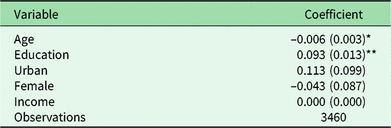
Results of logistic regression using demographic variables to predict likelihood of internal locus of control (standard errors in parentheses)

*p < 0.05, **p < 0.01.
Results
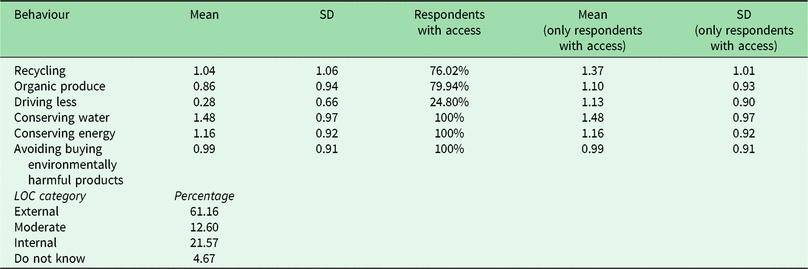
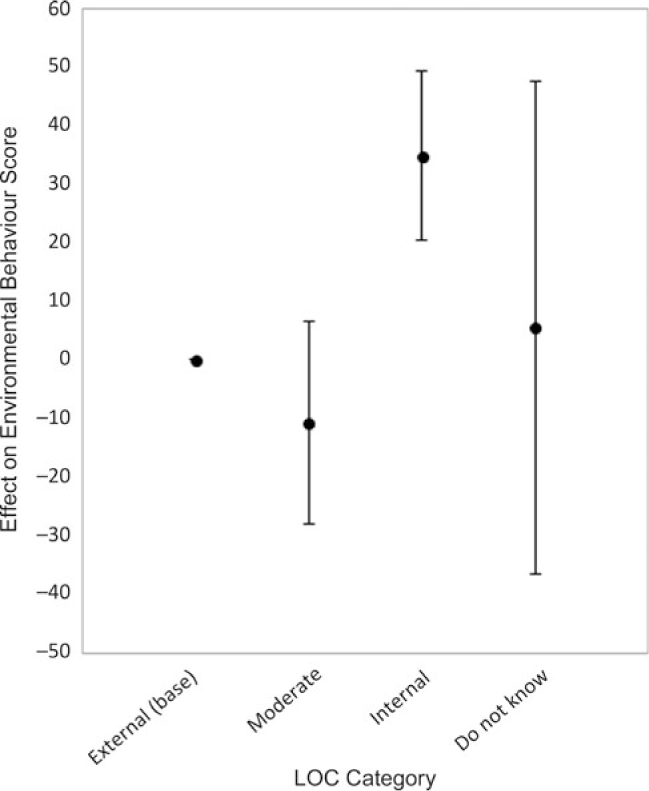
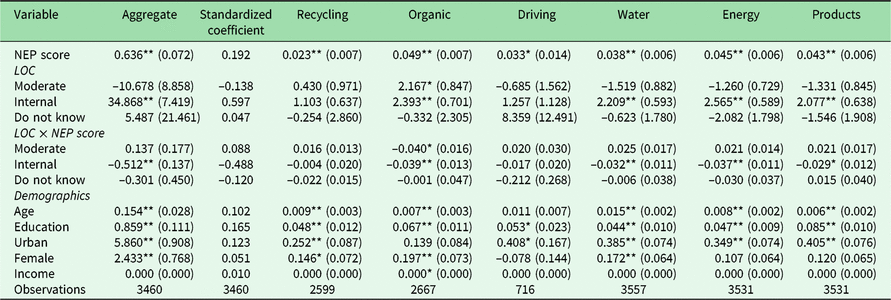
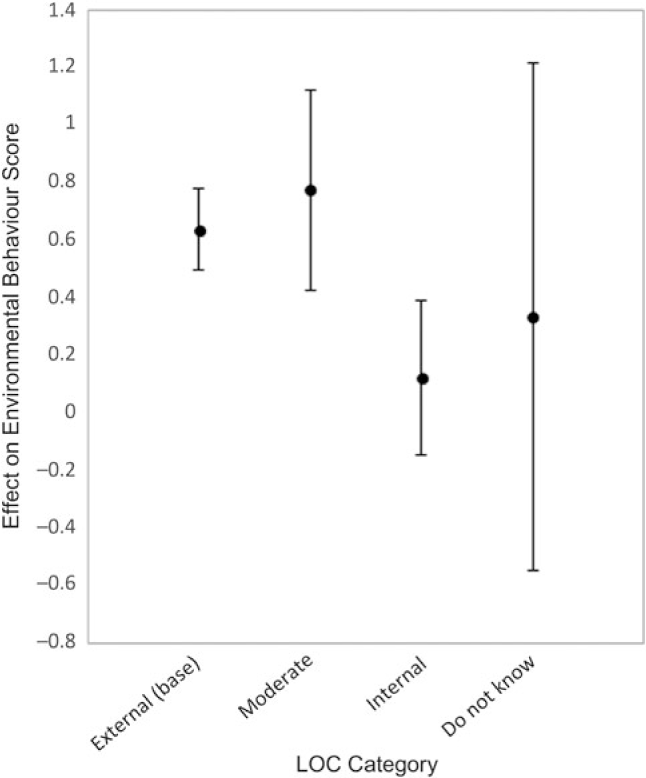
Respondents represented a diverse cross-section of Chinese adults; they had a mean age of 46.2 years (SD 7.39 years, minimum 17 years, maximum 91 years), a mean of 9.56 years of education (SD 4.72 years) and a mean of 41 026 yuan (US$1 = 6.78 yuan in 2010; SD 103 566 yuan) in annual household income. The sample was split approximately evenly between male (45.1%) and female (54.9%) and between urban (48.8%) and non-urban (51.2%) respondents. The logistic regression showed that younger (p < 0.05) and more educated (p < 0.01) people were more likely to have internal LOC; there was no significant correlation between internal LOC and urban status, gender or income (Table 1). Most (61.16%) respondents had external LOC; 12.60% had moderate LOC, 21.57% had internal LOC and 4.67% answered ‘do not know’ (Table 2). Conserving water and energy were the most frequently performed environmental behaviours, with mean scores between ‘sometimes’ and ‘often’, followed by recycling (‘sometimes’), avoiding environmentally harmful products (‘sometimes’), buying organic produce and driving less (between ‘never’ and ‘sometimes’). The 76.0% of respondents who had access to recycling did so with a mean frequency of between ‘sometimes’ and ‘often’; the 79.9% who had access to organic produce bought it with a mean frequency of ‘sometimes’; and the 24.8% who had access to a motor vehicle drove less (i.e., conserved fuel) with a mean frequency of between ‘sometimes’ and ‘often.’ Respondents with internal LOC had higher rates of pro-environmental behaviour than those with external LOC (Fig. 1), but were less affected by environmental attitudes than those with external LOC. Those with internal LOC scored an average of 34.9 percentage points higher on environmental behaviour than those with external LOC (p < 0.01) (Table 3), but the effect of each additional NEP point on environmental behaviour score was 0.51 percentage points smaller for respondents with internal LOC than for those with external LOC (p < 0.01) (Fig. 2). The significant interaction between internal LOC and environmental attitudes suggests LOC moderated the effect of environmental attitudes: for individuals with internal LOC, environmental attitudes had a smaller effect on environmental behaviour than for those with external LOC. The interactions between LOC and environmental attitudes among respondents with moderate LOC were not significant. The magnitude of the interaction between internal LOC and environmental attitudes (β* = –0.488) indicated heavy moderation of the link between behaviour and internal LOC (β* = 0.597) and the link between behaviour and environmental attitudes (β* = 0.192).
Sample descriptives for environmental behaviours and locus of control (LOC)

Estimated coefficients for the effect of locus of control (LOC) on environmental behaviour score with 95% confidence intervals.

Results of regression using environmental attitudes, locus of control (LOC) and demographic characteristics to predict aggregate environmental behaviour score, standard coefficient of aggregate environmental behaviour score and score for each behaviour (base = ‘external’; standard errors in parentheses). NEP = new environmental paradigm

*p < 0.05, **p < 0.01.
Estimated effect of each additional new environmental paradigm point on environmental behaviour score for each locus of control (LOC) category with 95% confidence intervals.

Regressions for separate behaviours generally reflected the aggregated model, although there were some significant differences. As in the aggregated behaviour score model, the NEP score was positively correlated with all six behaviours (p < 0.01 for all behaviours except driving less (p < 0.05)). Internal LOC was positively correlated with four of the six behaviours (p < 0.01), including buying organic produce, conserving water, conserving energy and avoiding environmentally harmful products. The interaction between the NEP score and LOC was also visible for these four behaviours; the positive effect of each NEP point on behaviour was smaller for respondents with internal LOC than for those with external LOC (p < 0.01 for organic, water and energy; p < 0.05 for avoiding environmentally harmful products). For buying organic produce, the positive effect of more internal LOC and the negative interaction with NEP score were also visible among those with moderate LOC (p < 0.05). Recycling and driving less, however, showed no significant relationship or interaction involving LOC (Table 3).
Several sociodemographic variables were correlated with overall environmental behaviour score (Table 3). Environmental behaviour score increased by 0.86 percentage points for each year of education and 0.15 percentage points for each year of age. Standardized coefficients for the overall environmental behaviour score indicate education (in years) was the most influential demographic predictor of behaviour (β* = 0.165); age (β* = 0.102) and urban status (β* = 0.123) were also influential. Gender was less influential (β* = 0.051). Most demographic predictors appear less influential than internal LOC (β* = 0.597) and its interaction with environmental attitudes (β* = –0.488). Furthermore, higher education predicted greater participation in all six behaviours, and older age predicted greater participation in all behaviours except driving less. Urban respondents scored higher on every behaviour except buying organic produce. Women scored higher on three behaviours: recycling, buying organic produce and conserving water. Relationships between gender and driving less, conserving energy and avoiding environmentally harmful products were not significant. We did not detect a relationship between income and any environmental behaviour except buying organic produce, which wealthier respondents were more likely to do (Table 3).
Discussion
The interaction between environmental attitudes and LOC in predicting environmental behaviour in China may be explained in at least two ways. First, environmental attitudes may help override external LOC. Even if a person feels his or her actions are insignificant to the environment (i.e., her or she has an external LOC), pro-environmental attitudes may motivate that person to perform the behaviour anyway because it seems like the ‘right thing to do’. This is consistent with Engqvist Jonsson and Nilsson’s (Reference Engqvist Jonsson and Nilsson2014) conjecture that “people who give a high priority to self-transcendence values ‘do not need’ an internal LOC to behave pro-environmentally” (p. 298). If this is the case, attitude-based environmental messaging may be more effective among audiences with generally external LOC in China than it is among Western audiences where researchers have lost faith in the attitude–behaviour relationship (Kollmuss & Agyeman Reference Kollmuss and Agyeman2002, Vermeir & Verbeke Reference Vermeir and Verbeke2006). A second interpretation of the interaction may be a ‘ceiling effect’ on pro-environmental behaviour, wherein people with both internal LOC and highly pro-environmental attitudes already behave near the limit of what most people are willing to do for the environment, so a slight addition to pro-environmental attitudes would not produce a substantial change in behaviour. This suggests that there is a limit to how much LOC-based or attitude-based messaging can improve environmental behaviour; campaigns targeted to audiences who already have highly pro-environmental attitudes and internal LOC may thus provide little return on investment. In these contexts, an approach focused on changing the marginal benefits of the behaviour (e.g., taxes, incentives) may be more effective.
Despite environmental behaviour’s positive relationship with internal LOC and its interaction with environmental attitudes, recycling and driving less did not exhibit either of these relationships. Recycling may be uncorrelated with LOC because it is overwhelmingly motivated by other cognitive factors. Studies in rural China (Tang et al. Reference Tang, Chen and Luo2011) and urban Norway (Bratt Reference Bratt1999) have suggested that concern for the community and social norms are stronger determinants of recycling than knowledge of environmental impacts, and many other studies have also shown that social norms heavily influence recycling behaviour (Fornara et al. Reference Fornara, Carrus, Passafaro and Bonnes2011). Prevalent pro-recycling norms may thus override external LOC for many respondents, bringing their recycling behaviour closer to that of respondents with internal LOC. Driving less may not be correlated with environmental LOC because purchasing a motor vehicle is a major investment, and those who have paid the high upfront cost may be reluctant to forego its use over environmental concerns. Moderate LOC and its interaction with attitudes might predict buying organic produce because this behaviour is driven by a different mix of cognitive factors; for example, Thøgersen and Zhou (Reference Thøgersen and Zhou2012) found that beliefs about healthfulness and taste strongly influenced whether urban Chinese people preferred organic food.
One unexpected finding was the positive relationship between age and environmental behaviour, which suggests that cultural factors in China may lead to different outcomes outside Western cultural contexts. This correlation appeared for total environmental behaviour score and for each individual behaviour except driving less (Table 3). This is not the first study to find a positive relationship between age and at-home environmental behaviour in China (Xiao & Hong Reference Xiao and Hong2010), although more studies have found the opposite effect (Chen et al. Reference Chen, Peterson, Hull, Lu, Lee, Hong and Liu2011, Zhao et al. Reference Zhao, Gao, Wu, Wang and Zhu2014). Our finding may be explained by older adults, especially those who have retired, having more free time for pro-environmental behaviour than younger adults with full-time jobs or young children; this reflects Chen et al.’s (Reference Chen, Peterson, Hull, Lu, Lee, Hong and Liu2011) suggestion that married adults in urban China exhibit lower environmental behaviour because they have less free time. There is also evidence that older people in urban China use less energy (Wang et al. Reference Wang, Zhang, Yin and Zhang2011) and less water (Zhang & Brown Reference Zhang and Brown2005), possibly due to different housekeeping and hygienic routines learned earlier in life. Furthermore, older people in East Asia are often reluctant to spend their retirement savings (Kim & Lee Reference Kim and Lee2007), which could lead them to conserve water and energy in order to save money. Meanwhile, the lack of a relationship between age and driving less may reflect older adults in China choosing to drive less due to declining physical abilities (West et al. Reference West, Gildengorin, Haegerstrom-Portnoy, Lott, Schneck and Brabyn2003); thus, an older adult may have ‘access’ to the behaviour by owning a car, but abstain from unnecessary driving for non-environmental reasons.
Other demographic predictors of environmental behaviour were generally consistent with previous research in China and other countries. Education correlated with higher overall environmental behaviour scores and higher participation in every behaviour, likely because better-educated people are more aware of environmental problems and remediating actions (Vicente-Molina et al. Reference Vicente-Molina, Fernández-Sáinz and Izagirre-Olaizola2013). Female and urban respondents also exhibited greater levels of environmental behaviour, both of which are typical. Women were more likely to recycle, buy organic food and conserve water, perhaps because women are more often in charge of household tasks like sorting recycling (Martin et al. Reference Martin, Williams and Clark2006, Chen et al. Reference Chen, Peterson, Hull, Lu, Lee, Hong and Liu2011), choosing groceries and cleaning (i.e., using water). Urban respondents scored higher on recycling, driving less, conserving water and energy and avoiding environmentally harmful products. This may be because urban areas have better-developed recycling services, public transportation and retail markets with greener alternatives to common goods. Meanwhile, urban respondents’ propensity to conserve water and energy may be a result of public awareness campaigns in China’s water- and energy-strapped cities (Cheng et al. Reference Cheng, Hu and Zhao2009, Zhao et al. Reference Zhao, Li and Ma2012). Finding no relationship between income and overall environmental behaviour is not entirely atypical, as studies have conflicted over income’s influence (Hines et al. Reference Hines, Hungerford and Tomera1987, Diekmann & Preisendörfer Reference Diekmann and Preisendörfer1998). In single-behaviour regressions, income was correlated only with buying organic produce, which may easily be motivated by non-environmental attitudes about quality or health, especially since there was no correlation between income and other ‘green’ retail habits.
Trends in LOC in this study largely conformed to expectations established by previous research. A majority of respondents (61%) exhibited external LOC (Table 2), supporting past studies that have asserted generally external LOC in China (Bond & Hwang Reference Bond and Hwang1986, Sastry & Ross Reference Sastry and Ross1998). The logistic regression (Table 1) suggested younger respondents were more likely to have internal LOC, which is consistent with the prior literature (Hawthorne & Alabaster Reference Hawthorne and Alabaster1999). We found internal LOC positively correlated with education, suggesting education may improve environmental behaviour not only by informing people of environmental problems (Vicente-Molina et al. Reference Vicente-Molina, Fernández-Sáinz and Izagirre-Olaizola2013), but also by shifting environmental LOC inwards and helping people recognize the potential impacts of their own pro-environmental actions. The greater level of environmental behaviour among Chinese people with internal LOC highlights the potential value of outreach in order to promote internal LOC. Research in public health has shown messaging that emphasizes the efficacy of pro-health behaviours increases people’s propensity to perform them (Witte & Allen Reference Witte and Allen2000); this lesson may also apply to environmental behaviour campaigns. For example, rather than emphasizing the threat of climate change, a campaign could illustrate how many kilograms of CO2 emissions one person would prevent by taking public transport instead of driving 10 miles. This is supported by a recent study (Xue et al. Reference Xue, Hine, Marks, Phillips, Nunn and Zhao2016) that found that Beijing residents were more confident in their personal efficacy and had stronger intentions to act on climate change if they were presented with remediating behaviours in addition to information on the severity of climate change. Another way to promote internal LOC may be to incorporate audiences’ personal experiences, as these experiences have been shown to affect LOC (Kormanik & Rocco Reference Kormanik and Rocco2009). To capitalize on this power of experience to shift LOC, messaging may emphasize environmental harms already experienced (e.g., loss of air quality, natural aesthetics, etc.) and how reasonable, local-level behavioural changes may have reduced those harms. Future research should test the extent to which environmental messaging can persuade individuals that their actions have meaningful impacts on the environment, which would further inform this study’s recommendation to design messaging to shift environmental LOC inwards.
Our results also suggest that attitude-based environmental messaging should focus on audiences with external LOC, for whom the marginal benefits of impacting attitudes are highest. Attitude-based messaging has limited support among many researchers who find blurred correlations between environmental attitudes and behaviour (Newhouse Reference Newhouse1990, Straughan & Roberts Reference Straughan and Roberts1999, Vermeir & Verbeke Reference Vermeir and Verbeke2006), but these studies have overwhelmingly been performed on Western populations, which generally have internal LOC. This study demonstrates that people with more external LOC are more influenced by attitudes; in societies like China with generally external LOC, attitude-based messaging may thus be more effective than previous studies have suggested.
This study provides a rare examination of the relationship between LOC and environmental behaviour outside the Western world and is the first demonstration of how LOC moderates the effect of attitudes on environmental behaviour there. The results highlight an opportunity to improve environmental behaviour in China by designing messages to shift LOC inwards and present an unexpected defence of environmental attitudes as drivers of behaviour. Whereas recent studies have chipped away at the usefulness of appealing to attitudes in order to improve environmental behaviour, this study suggests that attitude-based messaging still has a place among audiences with generally external LOC.
Supplementary Material
For supplementary material accompanying this paper, visit multimediafluids.uam.elogim.com/core/journals/environmental-conservation
Supplementary material can be found online at https://doi.org/10.1017/S0376892919000043
Acknowledgements
We thank the China General Social Survey coordinators at Renmin University of China for compiling this extensive dataset. We are also grateful to the Editor in Chief and three anonymous reviewers for their insightful and specific suggestions for improving this article.
Financial Support
We gratefully acknowledge the financial support from the US National Science Foundation (grant number DEB-1212183).
Conflict of Interest
None.
Ethical Standards
None.