1. Introduction
This paper concerns the words many, much, few, and little, and their comparative and superlative forms, as well as their equivalents in other Germanic languages, including Scandinavian languages:
(1)


The main focus is on the interpretation of the superlative forms of quantity words (henceforth quantity superlatives). Besides their basic morphological structure, quantity superlatives share a number of properties with quality superlatives such as tallest, but there are also some important differences. In general, quantity superlatives are more variable across languages in their morphosyntax and interpretation.
For a dramatic example of the kind of variability in question, observe that definiteness marking has opposite effects on the interpretation of quantity superlatives in Swedish and English (Teleman Reference Teleman1969, Teleman et al. Reference Teleman, Hellberg and Andersson1999, Coppock & Josefson Reference Coppock, Josefson, Csipak and Zeijlstra2015). What English marks as definite, Swedish leaves bare, and vice versa. Compare the Swedish examples in 2 to their translations into English.
(2)

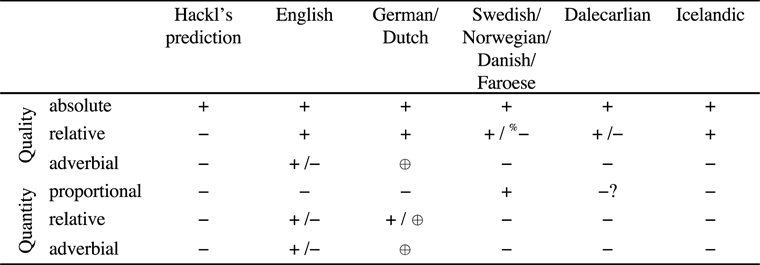
In the terminology of Hackl Reference Hackl2000, the example in 2a has a relative reading and the one in 2b has a proportional reading. German and Dutch exhibit yet a third pattern: Definite-marked quantity superlatives can receive either a proportional or a relative reading (Hackl Reference Hackl2009, Roelandt Reference Roelandt2016a,b). The fourth cell in the paradigm—no definiteness marking for either a relative or a proportional reading—is filled by Övdalian (Coppock & Kastrup Reference Coppock and Kastrup2016, Kastrup Reference Kastrup2016) and, as this paper shows, Icelandic. This paper demonstrates, through a thorough side-by-side comparison of English, German, Swedish, Norwegian, Danish, Dalecarlian, Icelandic, and Faroese, that every possible relationship between definiteness marking and interpretation is attested. The majority of the data is based on a questionnaire asking participants to translate a short story involving 17 sentences into their native language; the list of sentences is given in the appendix.
This situation poses an analytical challenge for those who, in the spirit of Hackl Reference Hackl2000, Reference Hackl2009, seek to build up the semantics of these expressions from the semantics of their parts (quantity words, superlative morphology, and definiteness marking). How can the same atomic units combine to produce such radically different results from one language to another? An important first step toward understanding this variability is to recognize the opposing forces that these words are torn between. Consider where information about the declension and use of quantity words is found. Invariably, it is distributed across two parts of a descriptive grammar: the part on adjectives, which covers the compara-tive and superlative grades, and the part on what descriptive grammars often label “pronouns”, including quantificational determiners. Thus, quantity superlatives have the morphological structure of adjectives insofar as they have comparative and superlative forms, but many syntactic and semantic properties of quantificational determiners.
As Solt (Reference Solt2015) discusses, quantity words such as much and little have a distribution that partially overlaps with quantifiers (as in many students attended the lecture), partially—with adjectives (as in they are few and the many students), and partially diverges from both classes (as in many more/fewer than 100). This unstable identity is reflected in the diversity of analyses that have been given: quantificational, adjectival, and degree-modificational (see Solt Reference Solt2015 for a recent overview). For example, according to Sapp & Roehrs Reference Sapp and Roehrs2016, German viel ‘many’ has undergone a syntactic reanalysis over the course of its development; in Dutch, inflected vele and uninflected veel are thought to occupy different syntactic positions (Kester Reference Kester1996:107, Broekhuis Reference Broekhuis2013:283, Ruys Reference Ruys2017). Thus, such words lie on a fault line between the realm of adjectives and the realm of quantifiers, a rather unstable plot of grammatical real estate.
A detailed look at the data reveals a range of cracks on the surface, as it were, in the form of agreement mismatches. These are found both with relative readings and with proportional readings, but different kinds of agreement mismatches are found in each case. One consistent pattern is that quantity superlatives with adverbial morphology and neuter singular agreement features give rise to a relative interpretation. In contrast, whenever definiteness marking appears on a quantity super-lative with a proportional reading, the superlative shows plural number marking, if it shows number marking at all. This suggests that the definiteness marking in relative readings is driven by a different force than the definiteness marking in proportional readings.
I conclude that quantity superlatives are not structurally analogous to quality superlatives on either relative or proportional readings (at least not always). However, depending on their interpretation, quantity superlatives depart from a plain attributive structure in different ways. On a relative reading, I suggest, they are in some cases structurally akin to pseudo-partitives, as in a cup of tea. In contrast, on a proportional reading, quantity superlatives involve either an attributive structure parallel to the one that quality superlatives have, or a quantificational structure, sometimes including a true partitive, as in some of the milk. The former is generated compositionally based on the ordinary semantics of the superlative marker. Note that the attributive structure is unstable and subject to grammatical pressure for reanalysis as a quantificational structure. This pressure is resolved differently for count and mass nouns. Quantity superlatives that quantify over the count domain can easily grammaticalize into generalized quantifiers, but not those that quantify over the mass domain. In the latter case, a partitive structure emerges as strongly preferred and, in some cases, required.
With respect to agreement mismatch, I suggest that the agreement features that a superlative exhibits depend on the domain from which the target argument is drawn (the Target-Domain Hypothesis; see section 11): When the target is a degree, as it is with adverbial superlatives and certain superlatives under a relative reading, default neuter singular emerges. In contrast, when the target is a subpart or subset of the domain indicated by the substance noun, as it is with superlatives under a proportional reading, the superlative shows number agreement.
As far as definiteness is concerned, under a relative reading, definiteness marking on quantity superlatives is driven by the same process that drives definiteness with adverbial superlatives, as explained below. Subtle aspects of how the comparison class and the superlative marker are construed determine definiteness marking under a proportional reading. If the superlative marker is understood in the style of Hackl Reference Hackl2009, then no definiteness marking is predicted; if it is understood in the style of Hoeksema 1983 or Coppock & Josefson Reference Coppock, Josefson, Csipak and Zeijlstra2015, then definiteness marking is predicted.
The structure of this article is as follows: In sections 2–8, I discuss the relevant data from English, German, Dutch/Flemish, Mainland Scandinavian, Dalecarlian, Icelandic, and Faroese. Section 9 summarizes the crosslinguistic picture. Section 10 outlines previous analyses. In section 11, I present my own proposal. Section 12 concludes the paper.
2. English
The review of the data begins with English. As the issues in question have been thoroughly studied in English, this section also provides an opportunity to motivate and explain the distinction between absolute and relative readings for quality superlatives, and the distinction between proportional and relative readings for quantity superlatives.
2.1. English Quality Superlatives
The superlatives of ordinary gradable adjectives such as tallest have been argued to be ambiguous between two readings, referred to as absolute and relative. As far as I know, this contrast was first discussed by Szabolcsi (Reference Szabolcsi, Fukui, Rapoport and Sagey1986), who observed that relative superlatives were capable of obviating certain constraints on definites. For example, definite noun phrases with a quality superlative do not constitute barriers to extraction, as in 3c; they can function as the argument of relational have, as in 4c; and they can serve as the pivot of an existential construction, as in 5b.Footnote 1
(3)
(4)
(5)


Apparently, certain definite noun phrases containing superlatives can behave as indefinites.
Szabolcsi (Reference Szabolcsi, Fukui, Rapoport and Sagey1986) also pointed out that these indefinite-like superlative noun phrases exhibit focus sensitivity. For instance, her example given in 6 (Szabolci’s example 21) has two different interpretations, depending on where focal emphasis lies.
(6)

With focus on Bill, it has an interpretation where John showed a higher mountain to Bill than to any other relevant alternative; with focus on John, it has an interpretation where John showed a higher mountain to Bill than anybody else did. Following Heim Reference Heim1999, I refer to the determinate, non-focus-sensitive reading as an absolute reading, and the indeterminate, focus-sensitive reading as a relative reading.Footnote 2
As Heim (Reference Heim1985) discusses, one way to disambiguate in favor of a relative reading (or strongly encourage it) is by using an overt of-phrase corresponding to the focal element of the sentence, as shown in 7.
(7)

Using this tool, Coppock & Beaver (Reference Coppock, Beaver and Snider2014) give additional evidence for the indeterminacy of superlative nominals under a relative reading. Under this reading, superlative nominals do not license anaphora or nonrestrictive readings of relative clauses, as shown in 8.
(8)

With an of-phrase of this kind, the superlative is consistent with the absence of any satisfier of the description, as in 9a. If there is an overt comparison class inside the nominal instead, the preferred reading is one on which existence is required, as in 9b.
(9)

To summarize, the superlatives of ordinary gradable adjectives can have either absolute or relative readings. On absolute readings, they are determinate and focus-insensitive, and on relative readings, they are indeterminate and focus-sensitive. An overt comparison class can bias in favor of an absolute or a relative reading, and thereby force or eliminate focus sensitivity; as a result, the noun phrase would behave as determinate or indeterminate, as measured by an array of diagnostics.Footnote 3
As seen above, regardless of whether an absolute or a relative reading is intended, the definite article precedes a superlative adjective. In contrast, the superlatives of gradable adverbs can optionally lack a definite article, as in 10a. Notice also that adverbial superlatives are focus-sensitive (Coppock et al. Reference Coppock and Kastrup2016): The sentences in 10b and 10c with focus on Tuesday and John, respectively, do not have the same meaning.
(10)

Adverbial superlatives thus have a relative reading, with an optional definite article.Footnote 4
2.2. English Quantity Superlatives
The landscape of possible readings is slightly different when it comes to the superlative forms of the quantity words much, many, little, and few (often referred to as Q-adjectives; see, for example, Stateva Reference Stateva2002; Krasikova Reference Krasikova2011; Solt Reference Solt, Reich, Horsch and Pauly2011, Reference Solt2015; Kotek et al. Reference Kotek, Sudo and Hackl2012, and Wellwood Reference Wellwood2014; Rett Reference Rett2008 refers to them as m-words). Note that, following Schwarzschild (Reference Schwarzschild2006), I use the term substance noun for the underlined noun in examples such as the following:Footnote 5
(11)

With English quantity superlatives, there is a morphological distinction between the two relevant readings. In this case, the two readings in question are referred to as proportional and relative.Footnote 6 As Hackl (Reference Hackl2009) discusses, these two readings are morphologically distinguished by definiteness in English, with definite-marked quantity superlatives being unambiguously relative. In 12, only the relative reading is available.
(12)

Note that there is focus-sensitivity in this case as well: With focus on John, this sentence means that John visited more continents than anybody else; with focus on last year, it means that John visited more continents last year than during any other comparable and relevant timespan.
If the definite article is removed, the more than half-reading, or the proportional reading becomes prominent, that is, the reading on which John visited more than half of the continents.
(13)

As discussed by Szabolcsi (Reference Szabolcsi, Chereches, Ashton and Lutz2012), bare most does have a relative reading as well; she offers a number of corpus examples, such as the following:
(14)

However, a partitive phrase can disambiguate in favor of a proportional reading:
(15)

Relative readings also arise with the superlatives of few and little, as in the following example:
(16)

However, as Hackl (Reference Hackl2009) notes, these cases do not have proportional readings, that is, they cannot be interpreted as “less than half”. Note that not even a partitive phrase can force such a reading; the following examples have only a relative reading.
(17)

As a side note, it is curious that the fewest of the letters is acceptable even though *the most of the letters is not.
As Hackl (Reference Hackl2009) discusses, relative readings of quantity and quality superlatives are dependent on the presence of a licensor, which is typically focus. In the following example, there is no licensor for a relative reading, so the definite-marked variants are ungrammatical (examples from Coppock & Josefson Reference Coppock, Josefson, Csipak and Zeijlstra2015):
(18)

Since least and fewest can only have a relative reading, they cannot be used in settings where there is no licensor, with or without a definite article:
(19)

Another environment in which the relative reading disappears involves universally quantified subjects (Hackl Reference Hackl2009). Here again, the variant with the definite article is ungrammatical (note that this kind of example only works with a relation such as know, which is one-to-many). Also, there is no interpretation for least or fewest:
(20)

This diagnostic (that is, incompatibility with universally quantified subjects) confirms that the most, (the) least, and (the) fewest are unambiguously relative.
Relative quantity superlatives, like relative quality superlatives, are indeterminate, as Szabolcsi (Reference Szabolcsi, Fukui, Rapoport and Sagey1986) observed and Coppock & Beaver (Reference Coppock, Beaver and Snider2014) gave further evidence for. For example, they can occur as the pivot of an existential construction or as the argument of relational have, as in 21a and 21b, respectively. Szabolcsi (Reference Szabolcsi, Fukui, Rapoport and Sagey1986) also observes that they pattern with indefinites in being able to serve as the specifier of ago, as in 22.
(21)
(22)


Furthermore, as Coppock & Beaver (Reference Coppock, Beaver and Snider2014) observe, relative quantity superlatives do not license anaphora or nonrestrictive relative clauses, and they do not require existence, as shown in 23.
(23)

Relative quantity superlatives are also focus-sensitive. The sentence in 24a has different truth conditions depending on whether focus is on John, Peter, or last year. In contrast, 24b is not focus-sensitive (and thus has only one reading): It contains most followed by a partitive phrase, which makes it unambiguously proportional.
(24)

Regardless of where emphasis is placed, the sentence in 24b is true if and only if more than half of the letters from Peter (or a sufficient quantity to qualify as “most”) were received by John in the previous year.
Proportional most is usually classified as a strong quantifier, and as such it is not acceptable in the pivot of existential constructions, as shown in 25.
(25)

In light of these examples, proportional most seems not to be indeterminate. However, it is not clear that it is determinate either, as suggested by 26.
(26)

The determinate/indeterminate distinction applies to descriptions, and not to quantificational expressions, so a third possibility is that proportional most is quantificational rather than determinate or indeterminate.
Adverbial quantity superlatives, like adverbial quality superlatives, appear to have only relative readings, and here again, the definite article is optional.
(27)

Thus, quantity and quality adverbial superlatives both have optional definiteness marking, just like quantity superlatives under a relative reading.
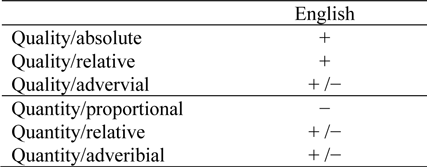
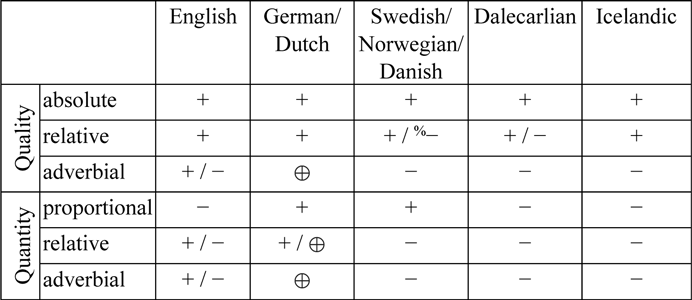
To summarize the situation in English, superlatives of ordinary gradable adjectives can have either absolute (non-focus-sensitive, determinate) or relative (focus-sensitive, indeterminate) readings, and are marked as definite on both readings. Quantity superlatives are sometimes accompanied by definiteness marking, and sometimes are bare. In the former case, they are unambiguously relative; in the latter case, they can, in principle, be interpreted either as proportional or relative, although least and fewest can only have relative readings for independent reasons. Adverbial superlatives—both quality and quantity—appear to have only relative readings, and definiteness marking is optional in this case.
These facts are summarized in table 1, where “+” indicates definiteness marking, and “−” indicates a lack thereof. Furthermore, on relative readings, nominals containing quantity superlatives are indeterminate and focus-sensitive, just like nominals containing quality superlatives. In contrast, on proportional readings, such nominals are not focus-sensitive, and are neither clearly indeterminate nor clearly determinate.
Summary of definiteness marking patterns for quality and quantity superlatives in English.

Sections 3–8 below present the crosslinguistic picture. They document the grammar of quantity superlatives in German, Dutch, Flemish, Swedish, Norwegian, Danish, Dalecarlian, Icelandic, and Faroese. All four logically possible combinations of definiteness marking and interpretation of quantity superlatives are attested among these Germanic languages. The data furthermore reveal that within each language, a particular definiteness marking pattern is quite systematic across different quantity words. This consistency suggests that the patterns of definiteness marking are driven by rules of the grammar rather than being idiosyncratic lexical differences. Certain contrasts are repeated consistently across languages as well: i) on proportional readings, quantity superlatives with count nouns tend to favor nonpartitive constructions, while quantity superlatives with mass nouns tend to favor partitive constructions; and ii) while agreement mismatches between the quantity word and the substance noun do occur under proportional readings, these mismatches do not involve number; in contrast, quantity words under relative readings often appear in a default neuter singular form.
3. German
Data on German were reported by Hackl (Reference Hackl2009), who shows that German quantity superlatives accompanied by definiteness marking have both proportional and relative readings. This observation is supported by the survey data I collected from 16 native speakers, which also spotlight certain additional subtleties.
3.1. German Quality Superlatives
Superlatives of ordinary gradable adjectives modifying a noun are always preceded by a definite article that agrees in number and gender with the noun.Footnote 7 The examples in 28 have an absolute reading (28b is from my translation survey).Footnote 8 The example in 29 has a relative reading.
(28)
(29)


In 29, the superlative bears weak inflection and is preceded by a definite article with the appropriate case value that agrees in number and gender with the noun.
Adverbial quality superlatives are introduced by am, a contraction of an ‘on’ and the neuter singular determiner dem:
(30)

More examples of this form are given below, with relative readings of quantity superlatives.
3.2. German Quantity Superlatives
The basic inventory of quantity words in German is provided in table 2. As the table shows, unlike English, German does not make a distinction between little and few, or any other count/mass distinction.
Inventory of quantity words in German: viel ‘many/much’, wenig ‘few/little’.

Hackl (Reference Hackl2009) reports that the following sentence is ambiguous between ‘Hans read most of the books’ and ‘Hans read more books than anybody else’:
(31)

Leaving out the definite article is not a grammatical option here (with or without strong inflection on the quantity word), in contrast to English, where the definite article is absent under the proportional reading: Hans read most of the books.Footnote 9 Thus, definiteness marking is obligatory for both relative and proportional readings of meisten.
German superlatives of inferiority behave similarly with respect to definiteness marking, although it is not clear whether they also have a proportional reading. Hackl (Reference Hackl2009) reports that die wenigsten ‘the least/fewest’ has a relative but not a proportional reading, so the example in 32 can only mean ‘Hans read fewer books than anybody else’, not ‘Hans read less than half of the books’.
(32)

In line with this observation, Hackl reports that quantity superlatives of inferiority are not acceptable in the absence of a licensor, as in 33a, or when the only potential licensor position is filled by a universal quantifier, as in 33b.
(33)

However, some German speakers I have consulted report that die wenigsten can, in fact, have a proportional interpretation, and naturally occurring examples can be found, as reported in Coppock & Josefson Reference Coppock, Josefson, Csipak and Zeijlstra2015. The example in 34 is simplified.
(34)

Note that the corresponding example in English certainly does not have that interpretation:
(35)

Thus, it is not just a matter of finding the right context; there seems to be a real difference between English and German. However, it should also be mentioned that some German speakers find 34 archaic. In any case, proportional readings of quantity superlatives of inferiority do not appear to constitute a conceptual impossibility, contra Hackl Reference Hackl2009.
The ambiguity of 31 is supported by the data that I collected, where die meisten was used to translate sentences in contexts that invite a relative interpretation, as well as contexts that invite a proportional interpretation. All 16 of my German-speaking participants translated the sentence Most of the children who go to my school like to play music using die meisten Kinder, as shown in 36.
(36)

Note in addition that although the English sentence to be translated involved a partitive phrase, most of the children, the German translation never included one, suggesting that in this example, a nonpartitive construction is preferred, perhaps strongly, to a partitive one. In contrast, when the sentence to be translated contained an anaphoric pronoun in the partitive phrase, the German speakers used a partitive pronoun, as in 37.
(37)

Of course, in 37 a nonpartitive construction would be impossible because there is no common noun to occupy the relevant slot.
The examples above all involve count nouns. Quantity superlatives with mass nouns also uniformly require a definite article. However, they are associated with the opposite preference vis-a-vis the construction: The participants strongly prefered a partitive construction if they wanted to express proportional meaning. In their translation of I drank most of the milk, many participants avoided simple die meiste Milch and gave alternative formulations such as fast die ganze Milch ‘almost the whole milk’ or einen großen Teil der Milch ‘a big part of the milk’; two of them used das meiste von der Milch, as in 38.
(38)

One participant commented, “If I say Ich habe auch die meiste Milch getrunken, it would imply that I drank e.g. 2l of milk, my brother 1.5l, and nobody else more than 1l.” In other words, the sentence would have only a relative reading. This strong preference for the partitive with mass nouns is also found in other languages, as shown below.
German provides an additional option for expressing a relative interpretation through what Roelandt (Reference Roelandt2016b) refers to as a “rogue” form involving am, just as shown in 30 for adverbial quality superlatives.
(39)

Note that in 39 there is a mismatch in the number feature between the substance noun and the article am: The noun is plural, but am is singular (am is a contraction of an and dem, where dem is masculine or neuter dative singular). The form am does not agree in gender either: For example, in am meisten Frauen ‘the most women’, the noun is feminine. Given that agreement feature mismatches of this kind occur throughout the Germanic family and tend to involve a singular neuter form (shown below), it strikes me as reasonable to suspect that am in am meisten is a neuter form, so I gloss it as neuter singular.
The am form was chosen by many of the German participants in the translation questionnaire. For the sentence designed to elicit a relative reading, Of all the children in my school, I’m the one who plays the most instruments, there was a mix: Some participants used die meisten Instrumente and some participants used am meisten Instrumente.
(40)

There was a similar mix of translations for the sentence The member of my family who plays fewest instruments is my sister Karin:
(41)

The preference for am appears to be stronger with mass nouns (though not categorical). There was a very high proportion of am meisten for the sentence It was probably Hans who drunk the most coffee (12 out of 16):
(42)

This preference was even stronger with superlatives of inferiority, as in the least coffee; only one participant offered den wenigsten Kaffee instead of am wenigsten Kaffee:
(43)

To conclude the discussion of quantity superlatives, the am-form is always a good option for relative readings, and never a good option for proportional readings. However, the degree to which it is preferred over an ordinary definite article seems to vary across different types of sentences. It is not clear to me whether any of these preferences are categorical.
When it comes to adverbial quantity superlatives, the am-form is, in fact, required, as shown in 44, where am cannot be replaced by a simple determiner such as die.
(44)

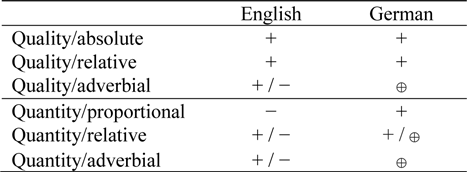
Table 3 summarizes the discussion in sections 2 and 3. The ⊕ sign indicates a special kind of definiteness marking.
Summary of definiteness marking patterns for quality and quantity superlatives.

Abstracting away from some of the details, the pattern of definiteness marking in German enriches the picture presented in table 2. Further-more, in German, on the proportional reading, partitive constructions are (strongly) dispreferred with count nouns and (strongly) preferred with mass nouns.
4. Dutch/Flemish Quality and Quantity Superlatives
Dutch behaves very much like German insofar as definiteness marking is pervasive, but there are some interesting differences: Although the am-form does not seem to be used, for some speakers the nonagreeing neuter singular definite determiner het is an option in the case of a relative reading. This option was documented by Roelandt (Reference Roelandt2016a) and confirmed by my survey of 10 native Dutch speakers (carried out prior to the publication of Roelandt’s work).
Let me begin with the basic case of quality superlatives. As in German, superlatives of ordinary gradable adjectives are accompanied by a determiner that agrees in number and gender with the noun being modified, regardless of whether these adjectives receive an absolute or a relative interpretation.
(45)
(46)


Adverbial quality superlatives are introduced by the singular neuter definite determiner het:
(47)

When it comes to quantity superlatives, a definite determiner combines with meeste ‘most’ to express both relative and proportional readings, as in German. However, the agreement on the determiner follows a slightly different pattern. Roelandt (Reference Roelandt2016a, chapter 18) reports that in Flemish Dutch, the neuter singular het can be used to express a relative reading, regardless of the gender or number feature of the noun. First, consider examples with count nouns:Footnote 10
(48)

Roelandt also reports that the neuter variant het meeste can be used as the pivot of an existential construction, while the agreeing variant de meeste cannot:
(49)

This pattern was also found in the data I collected from speakers who did not identify as Flemish Dutch speakers. Although all speakers translated most of the children in subject position as de meeste kinderen, some of the speakers (2 out of 10) translated the most instruments under a relative reading as het meeste instrumenten, using a singular neuter definite determiner:
(50)

One of these two participants also translated the most cookies using het, along with another participant (who, nonetheless, did not choose het when translating the most instruments).
Six out of the ten Dutch-speaking participants used het in the translation of the fewest instruments:
(51)

This kind of variation also exists with quantity superlatives modifying mass nouns. Two out of the ten Dutch-speaking participants used het in the translation of the most coffee in a sentence supporting a relative reading (het meeste koffie); the others used de meeste koffie, where de shows gender agreement with koffie. Four out of ten used het in the translation of the least coffee. More than half of the participants followed the het-pattern at least once and none of them followed it consistently, which suggests that this pattern is less common but not completely absent in Standard Dutch.
A nonagreeing het also appeared in translations of some sentences with proportional readings, in this case accompanied by a partitive phrase:
(52)

One participant, who opted for bijna alle melk ‘almost all [the] milk’ instead of anything involving meeste, offered the following comments:
I think de meeste is used in Dutch more when it comes to numberable things […] Ik heb ook de meeste melk opgedronken is really weird. Then it sounds like you have many small packages of milk and you have opened and drank most of them.
Indeed, only one participant offered de meeste melk in this case, with the majority using bijna alle melk ‘almost all [the] milk’ or het grooste deel van de melk ‘the greatest part of the milk’. This suggests a fairly strong split in Dutch between count and mass nouns when it comes to the proportional reading.
Thus, at a gross level of generalization, Dutch is just like German. The relative and proportional readings are both associated with definiteness marking, and there is a neuter singular “rogue” form that appears with adverbials and with quantity superlatives under a relative reading. In addition, as in German, there is a preference for partitive structures when one wants a quantity superlative with a mass noun to receive a proportional reading. For some speakers, this preference appears to be so strong as to be categorical. In contrast, when it comes to the proportional reading of superlatives with count nouns, there is a preference for nonpartitive structures. This preference appears to be quite strong.
5. Mainland Scandinavian
As mentioned above in connection with the data in 2, what English marks as definite, Swedish leaves bare. This section illustrates the pattern more completely, on the basis of data from 10 native Swedish speakers. This section also discusses Danish and Norwegian, on the basis of data from four native Danish speakers and one native Norwegian speaker.
5.1. Quality Superlatives in Mainland Scandinavian
The superlatives of ordinary gradable adjectives exhibit the usual double definiteness pattern used in Swedish and Norwegian, as illustrated by 53 from the Swedish Academy Grammar (Teleman et al. Reference Teleman, Hellberg and Andersson1999).
(53)

This example has an absolute reading, referring to the pine tree that is taller than all other pine trees. Note that -a is the weak ending found on adjectives in definite and plural contexts, hence the gloss wk.Footnote 11
Superlative descriptions may completely lack definiteness marking, though. In that case, only a relative reading is available. For example, 54 does not mean that Gloria sold the ice cream that was more delicious than any other contextually-relevant ice cream (which could be true even if multiple people sold it); it means that Gloria sold more delicious ice cream than all of the contextually-salient alternatives to Gloria.
(54)

According to Teleman et al. (Reference Teleman, Hellberg and Andersson1999), example 53 involves “direct selection,” where “the member of the group that has the given property to a greater degree than the others” is distinguished (volume II, sections 45–46). Example 54 involves what is referred to as “indirect selection,” presumably because Gloria is compared with other ice cream sellers indirectly, through the tastiness of their ice cream. The terms direct selection and indirect selection correspond to the more flat-footed but commonly used absolute and relative.
Interestingly, this bare superlative pattern extends to expressions with plural nouns, where neither definiteness marking nor plural marking is found on the superlative:
(55)

The plural form of dyrast ‘most expensive’ is dyraste, but that is not what appears in 55. This is not just because of the pluralia tantum; Swedish speakers I consulted agreed that the following was the best description of a picture in which three people had each caught between one to three fish, and one person had caught two equally big fish, which were bigger than everyone else’s.
(56)

The superlative adjective in 56 is competely devoid of inflectional morphology, including both definiteness and plural marking, despite three opportunities to display it: on a free standing article preceding the adjective, on the adjective, or on the noun. These bare superlatives on a relative reading are formally similar to adverbial superlatives, which also lack any definiteness marking or plural marking:
(57)

The bare form fortast in 57 can thus be seen as Swedish’s analogue of the “rogue” adverbial form. Although this bare form is unambiguously relative, the definite form is not unambiguously absolute; degree superlatives accompanied by definiteness marking can have a relative reading in some cases, as Teleman et al. (Reference Teleman, Hellberg and Andersson1999, volume II, p. 79) note. For example, 58 can mean either that Fredrik bought the wine that is more expensive than all other wine (absolute reading), or that Fredrik bought more expensive wine than anyone else (relative reading).
(58)

Nevertheless, there is some evidence to suggest that it is preferable to use a bare form when a relative interpretation is intended, at least in some cases. An ambiguous absolute-relative form (as in 54) was offered in all eight Swedish translations of I’m not the one in the family who has the thinnest waist:
(59)

In 59, one participant offered den smalaste midjan, with definiteness marking, in addition to the bare form; all others used only the bare form.
To summarize, with ordinary gradable adjectives, complete absence of definiteness marking on a quality superlative unambiguously signals a relative reading, whereas a definite-marked quality superlative can receive either an absolute or a relative reading.Footnote 12
5.2. Quantity Superlatives in Mainland Scandinavian
Now I turn to the superlative forms of quantity words. As shown in table 4, the Swedish inventory of quantity words is slightly richer than the one in English: More and most each have two counterparts in Swedish, one for count nouns and one for mass nouns (just like English, Swedish also distinguishes between less and fewer).Footnote 13 Since English many is used specifically with count nouns and much is not, in this section I gloss flest as ‘many.sprl’ and mest as ‘much.sprl’.
Inventory of quantity words in Swedish: mången ‘many’, mycken ‘much’, få ‘few’, lite ‘little’.

Quantity superlatives accompanied by a definite article have a proportional interpretation, which is reported by Teleman et al. Reference Teleman, Hellberg and Andersson1999 and confirmed by the eight translations of the 17-sentence story into Swedish that I collected. Below are two examples, with a plural count noun in 60a and a pronoun in 60b.
(60)

Note that the partitive av ‘of’ is optional in 60a (and slightly but certainly not categorically dispreferred) but obligatory in 60b, as one might expect, given the presence of an anaphoric pronoun in the partitive phrase.
Definiteness marking yields a proportional reading with mass nouns as well, although with mass nouns, there is a preference to use a neuter singular determiner with the quantity superlative along with a partitive phrase, as shown in 61b.
(61)

The noun mjölk ‘milk’ has common gender, as shown by the -en ending that it bears (as opposed to -et), but the determiner det has neuter gender, so it is clearly not agreeing with mjölk. The same pattern was most common with most of the music they play on the radio. This phrase was most often translated as det mesta av musik-en som spelas på radio, again with a neuter gender determiner and a partitive phrase including a common gender definiteness marker on the noun. The wording den mesta musiken was also offered as a translation by some participants, and native speakers I have consulted confirm that this wording is acceptable, but the translation det mesta appears to be preferable.
There are also examples of proportional readings in Swedish where the substance noun is not definite. In 62a, the noun is kvinn-or ‘women’ (the definite form would be kvinn-or-na ‘the women’). It is also possible to find such examples with mass nouns, as in 62b, where the noun is ost ‘cheese’ (the definite form would be ost-en ‘the cheese’).
(62)

In general, examples translated into English using most N rather than most of the N are those where the substance noun is not marked as definite. In these cases, it is not possible to insert an overt partitive phrase: *De flesta av kvinnor gillar choklad is ungrammatical. Note that even though there is no agreement in definiteness between the quantity superlative and the substance noun in 62, there is still agreement in gender and number. Thus, these elements appear to stand in a somewhat tenuous syntactic relationship.
To express a relative reading, a bare form of quantity superlatives is used, just as with quality superlatives discussed in section 5.1. Below are some examples from the 17-sentence story:Footnote 14
(63)

The eight Swedish speakers were unanimous on how these sentences should be translated; all of them used the patterns just reported, and there were no other options offered. Like ordinary gradable adjectives, bare quantity superlatives have only a relative interpretation. Hence, they are ungrammatical in sentences that lack a licensor for a relative reading (Coppock & Josefson, Reference Coppock, Josefson, Csipak and Zeijlstra2015):
(64)

The connection holds in the other direction as well: Unlike ordinary gradable adjectives, definite-marked quantity superlatives cannot receive a relative interpretation in Swedish. Evidence comes from the fact that they cannot be used as the pivot of an existential construction, as shown by the grammaticality contrast in 65 (see also 25 above).
(65)

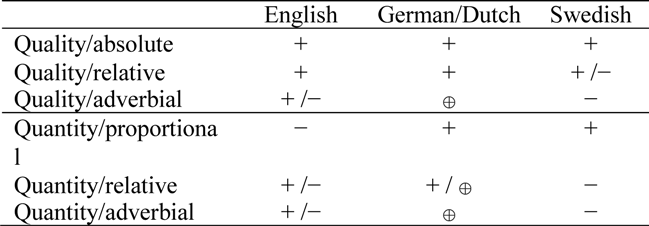
Abstracting away from certain details, the facts outlined in sections 5.1 and 5.2 are summarized in table 5: Adnominal quality superlatives can always be accompanied by definiteness marking, and on relative readings they can be bare. Definite-marked quantity superlatives in Swedish have only a proportional reading; the bare ones have only a relative reading.Footnote 15 Adverbial superlatives, which can only have a relative reading, are always bare.
Summary of definiteness marking patterns for quality and quantity superlatives.

Note that one might as well have used the ⊕ symbol rather than the “−” symbol in the Swedish column, given that the form in question is not just indefinite, but devoid of all agreement features.
5.3. Danish Quality and Quantity Superlatives
With respect to quality superlatives, for the purposes of this study Danish behaves almost exactly like Swedish. There is a slight difference: Unlike their Swedish counterparts, Danish ordinary gradable adjectives under a relative reading are obligatorily definite. According to the speakers I consulted, leaving out the definite determiner den in 66 renders the sentence ungrammatical. Note also that Danish does not have double definiteness, in contrast to Swedish, and so when a noun phrase contains a definite article, the head noun is not marked for definiteness.
(66)

Adverbial quality superlatives consistently follow the bare pattern: Their bare forms can receive a relative interpretation, as shown in 67.
(67)

Observe that although the bare form is consistently used for adverbial superlatives in both languages, it is available as an option for expressing a relative reading with adnominal quality superlatives only in Swedish. The strong association between the bare form and adverbial uses lends further support to the idea that the bare form is essentially an adverbial form, which may have acquired a wider range of uses in Swedish.
With respect to quantity superlatives, note first that the inventory of quantity words in Danish is structurally identical to that in Swedish, except that it does not have a gap for the superlative of few. The Danish inventory is shown in table 6.
Inventory of quantity words in Danish: mangen ‘many’, meget ‘much’, få ‘few’, lite ‘little’.

Definite quantity superlatives in Danish, with either count or mass nouns, are regularly used to convey the proportional reading. For example, English most of the children is rendered as de fleste børn, and most of them as de fleste af dem. This matches the Swedish pattern exactly. Consistent with the lack of double definiteness in Danish, however, definiteness marking on the substance noun is ungrammatical. The example with a definite-marked noun in 68 was found on the web but confidently judged ungrammatical by two native speakers.
(68)

Thus, under proportional readings, Danish quantity superlatives follow the regular pattern of ordinary adjectival modifiers.
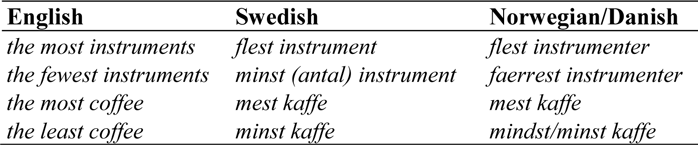
Danish definite quantity superlatives with mass nouns also have a proportional reading, just like their Swedish counterparts. As with count nouns, there is a strong preference for a partitive construction. For example, most of the milk is translated into Danish as det meste af mælken. Almost all Danish speakers translated most of the music they play on the radio as det meste af den musik de spiller i radioen.Footnote 16 Danish speakers also use flest ‘most’ exactly the way Swedish speakers do, which is illustrated in table 7.
Examples of quality superlatives with relative readings in English and Mainland Scandinavian

On a relative interpretation, quantity superlatives in Danish are just like their Swedish counterparts: They are completely devoid of any definiteness or plural marking (see table 7). Note that the lack of definiteness marking on quantity superlatives under a relative reading (found in both Swedish and Norwegian) does not entail the lack of definiteness marking on quality superlatives under a relative reading (Swedish, but not Norwegian). These appear to be two independently moving pieces.
Adverbial quantity superlatives, like adverbial quality superlatives and quantity superlatives under a relative reading, are bare in Danish:
(69)

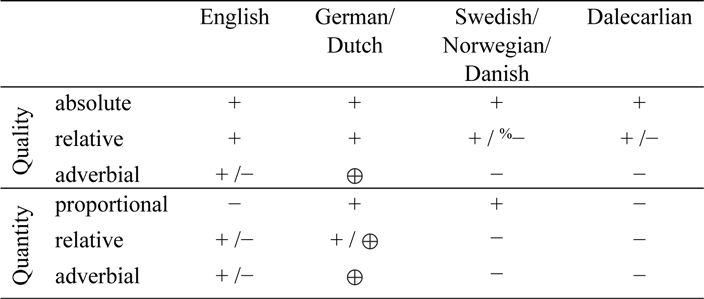
To summarize, Danish is identical to Swedish except when it comes to the relative reading of quality superlatives: In Swedish, relative quality superlatives can be bare or definite (and preferably bare, at least in some cases), while in Danish, they are obligatorily definite. In future iterations of the summary table, Swedish, Norwegian, and Danish are combined in a single column, with notation + /%− representing the variation among these languages with respect to quality superlatives on relative readings.
6. Dalecarlian
So far, three general patterns of definiteness marking on quantity superlatives have been discussed:
(i) Definiteness marking under the relative reading, no definiteness marking under the proportional reading (English; setting aside the fact that bare most can have both readings);
(ii) Definiteness marking under both relative and proportional readings (German, Dutch);
(iii) Definiteness marking under proportional readings but not relative readings (Swedish, Norwegian, Danish).
What is missing from this list is the case of no definiteness marking under either a relative or a proportional reading. The missing cell is filled by Dalecarian varieties (spoken in western Sweden), which retain many features from Old Norse (see, for example, Bentzen et al. Reference Bentzen, Rosenkvist and Johannessen2015). This section mainly reports data from the Övdalian dialect but also includes some data from the Orsa dialect.Footnote 17
The information about Övdalian reported here comes from i) grammatical descriptions (Levander Reference Levander1909, Åkerberg Reference Åkerberg2012), ii) in-person interviews with five Övdalian speakers that I conducted in Älvdalen, iii) anonymous surveys of an additional four speakers, and iv) a diary written by an Övdalian speaker named Frost Anders during the early 1940s, recently digitized and transcribed by Bengt Åkerberg and Mats Elfqvist (two of the speakers I interviewed). The anonymous surveys and the in-person interviews all centered around translating the 17-sentence story from Swedish, supplemented with some picture-based elicitations.
Some of the anonymous survey participants felt rather insecure about their knowledge of Övdalian, as they learned it as children but moved away and now mainly use Swedish in their daily life. However, the five speakers I inteviewed (aged 45–91) use Övdalian every day. Further-more, the interview setting provided an opportunity to ask follow-up questions and obtain additional comments to verify the participants’ level of certainty about their translations. Therefore, I concentrate mainly on the interview data. For Orsa, I conducted an interview with two speakers (simultaneously), and made use of a dictionary that included many naturally occurring examples (the two speakers happen to be the authors of the dictionary.) All of the example sentences in this section are from Övdalian unless otherwise specified.Footnote 18
6.1. Background
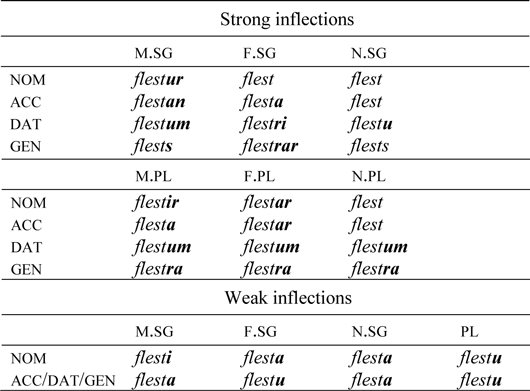
Some background information is useful in making sense of the results. Like Icelandic, Övdalian inflects for nominative, accuative, and dative case (as well as genitive, but the genitive form is predictable from other forms), and there are three genders: masculine, feminine, and neuter. As an example, table 8 provides the inflectional paradigm of the masculine noun kripp ‘child’ (Åkerberg, Reference Åkerberg2012, 132).Footnote 19
Paradigm for the word kripp ‘child’ in Övdalian.

Adjectives typically inflect for number, gender, case, and, under certain circumstances, definiteness. For example, a big man (masculine) is ien stur kall in nominative, ienum sturum kalle in dative, and ien sturan kall in accusative; several big men is flier stur kalla in accusative; a big house (neuter) is iet sturt aus in nominative and accusative (Åkerberg, Reference Åkerberg2012, 190). The choice of inflection depends on whether the adjective is independent (that is, serving as the head of the phrase, for example, with nominal ellipsis) or unified with a nominal complement, as in the examples just given. For instance, the feminine singular accusative form of stur ‘big’ is stur when it precedes a noun, as in ien stur kullu ‘a big woman’ so the -a ending in 70a reflects the fact that the adjective stands independently. When the adjective stands alone in this way, it can also bear definiteness marking, as -ą in 70b shows.
(70)

How adjectives would be inflected in definite noun phrases with an overt head noun is not clear, as this strategy is strongly avoided in favor of one in which the adjective is incorporated into the noun (Åkerberg, Reference Åkerberg2012, 200), as shown in 71.
(71)

Although Övdalian does have definiteness marking on nouns, it makes use of definite articles so rarely that they are not mentioned in Åkerberg’s (Reference Åkerberg2012) grammar. I know of only one or two potential examples.Footnote 20 It is somewhat difficult to determine to what extent Övdalian differs from Swedish in this respect, though, given that adjectives are so often incorporated into the noun they modify. In Swedish, definite articles only appear when there is an attributive modifier of the noun (for example, bilen ‘the car’ versus den röda bilen ‘the red car’). A case where the adjective is incorporated into the noun would not meet the criteria for insertion of a definite article in Swedish.
6.2. Övdalian and Orsa Quality Superlatives
Whether or not this is to be expected, quality superlatives do not co-occur with a definite article. The example in 72a from Åkerberg Reference Åkerberg2012:205 is ambiguous: Although the absolute reading (the car that was more expensive than all the other cars) seems most likely, the sentence is arguably compatible with a relative interpretation as well (where the car that the speaker bought is more expensive than the car(s) that anyone else bought). In contrast, example 72b from the Frost Anders corpus seems unambiguously absolute.
(72)

Note that in addition to lacking a definite determiner, quality superlatives in 72 do not show any sign of definiteness (but as far as I can tell, there is no reason to believe that this fact is specific to superlatives). In contrast, the head noun is clearly marked as definite. Note also that superlative adjectives can carry a kind of definiteness marking, but only when used independently, as shown in 73a from Åkerberg Reference Åkerberg2012:205. An example of this kind from the Frost Anders corpus is given in 73b (context: two young maids had visited).
(73)

However, in such cases, the adjective is substantivized and the ending is the kind of ending that appears on nouns; the adjectives in 73 do not appear to be carrying weak inflection.
Now I turn to relative readings of quality superlatives. Övdalian appears to allow the Swedish pattern, where definiteness marking is absent on superlatives of ordinary gradable adjectives under a relative reading, based on the translations that I gathered, as in 74a. The Orsa speakers also used an indefinite form, as in 74b.
(74)

However, for at least one Övdalian speaker (Bengt Åkerberg, the author of the definitive grammar on Övdalian), the definite form is preferred; he provided me with several examples, including the following:
(75)

These examples demonstrate that under the relative interpretation of quality superlatives, there appears to be some variation with respect to definiteness marking on the head noun.
Finally, an example of an adverbial quality superlative is given in 76.
(76)

As might be expected, Övdalian adverbial quality superlatives under a relative interpretation are unmarked for definiteness.
6.3. Övdalian and Orsa Quantity Superlatives
The inventory of quantity words in Övdalian is provided in table 9 (pieced together from Levander Reference Levander1909, Åkerberg Reference Åkerberg2012, Steensland Reference Steensland2010, and interviews with native speakers).Footnote 21 Orsa has a similar inventory (Olhsén & Olander Reference Olhsén and Olander2010, interviews).Footnote 22
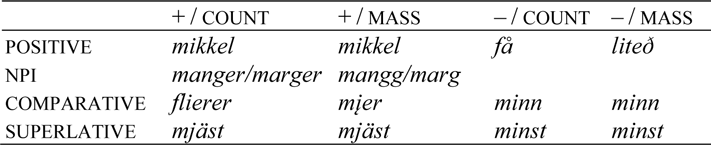
Inventory of quantity words in Övdalian: mikkel ‘many/much’, få ‘few’, liteð ‘little’.

Both inventories happen to feature a word for many that is only used in negative enviroments (two words, in fact; but marger is not used as often according to Åkerberg Reference Åkerberg2012:247), hence the annotation NPI (negative polarity item). Övdalian example 77a is from the Frost Anders corpus (context: the narrator wanted to have some coffee, but thought better of it). Orsa example 77b is from the Orsa dictionary (Olhsén & Olander, Reference Olhsén and Olander2010).
(77)

Both Levander (Reference Levander1909:59) and Åkerberg (Reference Åkerberg2012:247) report that mangg is restricted to negative environments in Övdalian; Olhsén & Olander (Reference Olhsén and Olander2010) imply this with respect to the Orsa form mönggör as well.
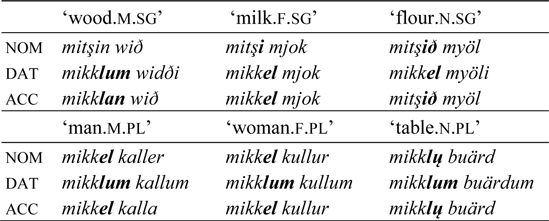
Let me now turn to inflection. According to Åkerberg (Reference Åkerberg2012), mitşin ‘much’ inflects for case, number, and gender, as in table 10. Note that these are the forms that are supposed to appear when the word is unified with a noun (förenat in Swedish); different rules apply when the word is independent (självständig) in the nominal phrase.
Inflection paradigm for mitşin ‘much’ in Övdalian.

In Orsa at least, there is a distinction between weak and strong forms of many. A weak form (mikkel) occurs after demonstratives, as in 78.
(78)

The weak forms in 78 are clearly distinct from the strong forms that would appear in a nondefinite environment preceding a noun. Hence the inflection pattern is parallel in structure to that of adjectives in other Scandinavian languages.
The word flierer (ambiguous between ‘several’ and ‘more’), which morphologically is the comparative of ‘many’, also has a variety of inflectional forms. In 79a, flierer is unified with the following noun; in 79b, it is independent (Åkerberg Reference Åkerberg2012:248).
(79)

This pattern is surprising, given that comparative forms of adjectives do not normally inflect when they modify a noun. Perhaps the word is being treated as a determiner rather than an adjective.
The same generosity appears not to be extended to determiners that are morphologically superlative, though. Of these, there are only two: mjäst ‘most’ and minst ‘least’. Unlike Swedish, Övdalian does not have a superlative of ‘many’ reserved specifically for count nouns; the word mjäst is the superlative of both mikkel ‘many’ and mitşin ‘much’, like English most.Footnote 23 The interview data I collected suggest that uninflected mjäst can have either a proportional or a relative reading, with either a mass or a count noun. An example of a proportional use with a count noun is given in 80.
(80)

Note that the form krippum is ambiguous between definite and indefinite dative plural. However, one of my consultants explicated it with the Swedish-like form kripp-ar-na ‘kid-pl-def.pl’, which is unambiguously definite plural, so it is clear that a definite reading was intended at least in that case. Note also that there were not many participants (only three, in fact) who offered 80 as a translation for the sentence in question, and the speakers I interviewed in person clearly found it very difficult to think of a good translation for Swedish de flesta. Besides the three participants who offered some version of 80 as a translation for the English sentence, one participant proposed mjast kripper ‘much.sprl child.nom.pl’, and the other six participants did not use any form of mjäst, opting instead for alternatives such as ‘almost all’, ‘the greater part’, ‘there are many … who’. Indeed, regarding the form flierer, Åkerberg (Reference Åkerberg2012:248) writes (translated by me from Swedish) that it “functions as a comparative to mikkler” but “there is no superlative. For de flesta [proportional ‘most’ in Swedish] paraphrases are used, for example styöst dieln åv gardum (most of the farms).” This account echoes Levander (Reference Levander1909:56), who writes that there is no counterpart to flesta in Swedish.Footnote 24 Thus, even though the example in 80 might be slightly problematic, it was offered independently by three informants. I take this as an indication that it is generated by the grammar of Övdalian.
The Orsa dictionary (Olhsén & Olander Reference Olhsén and Olander2010) documents the following uses of mjåst, which is listed in the dictionary as the translation of Swedish flest ‘many.sprl’: In 80a, mjåst is unified with the following noun krippär ‘child’, whereas in 81b mjåst is independent.
(81)

Note that these examples were not collected under circumstances that would encourage overuse of mjåst. Therefore, they provide clear evidence that it is natural to use indefinite mjåst for a proportional reading in Orsa.
The discussion so far has focused on the proportional interpretation of mjåst combined with count nouns. Let me turn now to proportional readings involving mass nouns. The 17-sentence story included two sentences intended to elicit a proportional reading with a mass noun: I don’t like most of the music that they play on the radio and I drank most of the milk too. For the first of these sentences, there were only three speakers who offered a translation involving a quantity superlative, and no two of these were the same. One translated most of the music as eð mjastað åv musitsem, with a neuter singular determiner eð and a definite neuter singular ending on mjäst. Another used just mjästað åv musitsem, again with a definite neuter singular ending on mjäst but without eð. The third speaker rendered it as mjäst åv ollum musik ‘most of all music’. Since each of these expressions occurred only once, it is not clear to what extent they are part of the language. The sentence involving milk produced a somewhat more consistent pattern of results. Several informants provided the following translation:
(82)

The Orsa dictionary gives one example of an independent mjåst that arguably has a proportional noncount interpretation:
(83)

I am not sure what to make of the determiner in 83, as Orsa does not normally use determiners, like Övdalian. It may be a borrowing from Swedish. In any case, my Orsa consultants also used a definite ending on mjåst for a proportional reading with milk:
(84)

There appears to be a difference between Orsa and Övdalian with respect to definiteness marking on mjåst. Either Orsa retains definiteness marking from an earlier stage or Orsa has been influenced by Swedish. Indeed, Orsa is closer to Swedish on the dialect continuum than Övdalian.
Turning now to relative readings—and returning to Övdalian—I found a similar avoidance of mjäst in translations of sentences intended to elicit relative readings of quantity superlatives. Nevertheless, there were two kinds of responses that emerged with some regularity: One involved an NP, as in 85a, the other—a PP headed by åv ‘of’, as in 85b.
(85)

The variant with åv was also elicited under somewhat more naturalistic conditions. The participants were shown a picture of several animals, each of which had a different number of apples, and were asked to identify the one with the most apples:
(86)

This use of åv ‘of’ is consistent with Levander (Reference Levander1909:59), who suggests that miäst in combination with åv can be used to express relative meaing. As shown in 87a, he gives the two variants—without and with åv—and glosses them both as ‘the greatest number of farms’ (Swedish största antalet gårder). There is perhaps an indirect suggestion by Levander that the same strategy is not available for a proportional reading: His example, given in 87b, only has the åv-option.
(87)

Bare mjåst may receive a relative reading in the Orsa dialect as well. Olhsén & Olander (Reference Olhsén and Olander2010) helpfully list two examples that receive a relative reading, both using the same form.Footnote 25
(88)

In this study, I obtained similar results for Övdalian superlatives of inferiority with count and mass nouns, as shown in 89a and 89b,c, respectively. The translation minst åv instrumentum in 89a was only used by one participant.
(89)

Bare mjäst is also used as an adverbial quantity superlative, as in 90.
(90)

To summarize, although quantity superlatives are not perfectly happy in sentences expressing proportional or relative meaning, they can be used in those contexts. When they are, they appear without a definite determiner or any other definiteness marking (although in Orsa, definiteness marking on quantity superlatives is found in constructions with a proportional reading). As the data in this section show, in Dalecarlian definiteness marking accompanies adjectival quality superlatives and no other type of superlatives (with one exception in Orsamål, as in 84).
The results for the languages discussed so far are summarized in table 11.
Summary of definiteness marking patterns for quality and quantity superlatives.

Some words of caution are in order, however. It is not clear whether one should expect to find definiteness marking on a quantity superlative, given that superlatives generally lack definiteness marking. Where one should expect to see definiteness marking is on the head noun, if there is one. Under the relative reading of a quantity superlative, the head noun clearly lacks definiteness marking. To express proportional meaning partitive constructions are typically used; this means that the substance noun is (arguably) no longer the head of the noun phrase in which the superlative operates, and so there is arguably no host for definiteness marking. I only collected one example of a nonpartitive construction, namely, mjäst kripper ‘most children’. This construction does contain an indefinite head noun, suggesting that perhaps the phrase as a whole is marked indefinite. Recall, however, that in Swedish, de flesta barn ‘most of the children’ has definiteness marking on the quantity word and no definiteness marking on the substance noun. If that kind of mismatch is possible, then the definiteness value of the substance noun alone does not determine the definiteness value of the noun phrase as a whole. All this is to say that the “−” value in the Quantity/proportional column in table 11 should be taken with a grain of salt. This issue becomes much less murky with Icelandic.
7. Icelandic
7.1. Icelandic Quality Superlatives
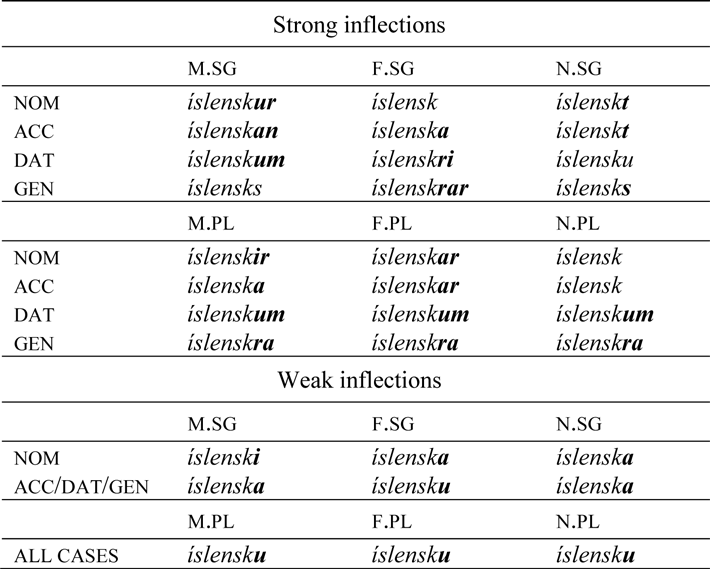
Icelandic, like Övdalian, does not use definite articles. However, as discussed in section 7.2, it does display inflectional endings on quantity superlatives, which indicate definiteness, among other things. These data allow one to see clearly that Icelandic occupies the missing cell in the two by two paradigm, as quantity superlatives under either a proportional or a relative reading are clearly indefinite. The adjectival paradigm is illustrated in table 12 using the adjective íslenskur ‘Icelandic’.
Adjectival inflections in Icelandic.

Roelandt (Reference Roelandt2016b) reports that the following sentence is ambiguous between an absolute and a relative reading in Icelandic:
(91)

The claim that 91 is ambigous is supported by the data I collected: The examples in 92 both contain a quality superlative with a weak ending followed by a definite noun. Yet 92a has an absolute reading, whereas 92b has a relative reading.
(92)

One participant out of 16 used mjóst mitti ‘thinnest waist’ following the Swedish pattern. These examples show that definiteness marking accompanies both absolute and relative readings.
Finally, adverbial quality superlatives lack any kind of definiteness marking, as shown in 93.
(93)

The data in 93 support the generalization that the bare pattern for adverbial superlatives is thus shared across all Scandinavian languages. In general, with respect to quality superlatives, the definiteness marking patterns in Icelandic are in line with those in Danish and Norwegian.
7.2. Icelandic Quantity Superlatives
The inventory of quantity words in Icelandic is given in table 13. Note that margur is the masculine singular form; the feminine singular is mörg, neuter singular is margt, masculine plural is margir, feminine plural is margar, and neuter plural is mörg (Kupca 2016:23).
Inventory of quantity words in Icelandic: margur ‘many’, mikill ‘much’, fá ‘few’, lítill ‘little’.

Note also that some participants used margur in the singular to mean ‘much’, but mikill was consistently used when translating the phrase how much coffee, which suggests that it is the closest correlate of English much in Icelandic:
(94)

Unlike Övdalian quantity superlatives, their Icelandic counterparts inflect for gender and number, following the regular adjectival pattern, as far as I can tell. Extrapolating from table 13 gives the paradigm in table 14.Footnote 27 These paradigms are consistent with the usages I have observed, as shown in examples below.
The inflectional paradigm of flest ‘most’ in Icelandic.

Icelandic quantity superlatives are not marked for definiteness under either proportional or relative reading: In both cases, they carry indefinite (strong) inflection. Let me begin with the proportional reading involving count nouns. In the context of a discussion about the syntax of partitive doubling, Wood et al. (Reference Wood, Sigurðsson, Zanuttini, Bui and Özyldiz2015) provide the example in 95a, and possible alternatives in 95b,c.
(95)

In all of the examples in 95, the inflection on flest ‘many’ is clearly negatively specified for definiteness; the definite (weak) ending would be flestu. The results of the translation survey provide further corroboration for the acceptability of these three patterns. Because the verb like sometimes takes a dative subject, the sentence Most of the children in my school like to play music elicited many responses involving dative case, as shown in 96.
(96)

Two participants came up with flestum krakkanna instead of flestum krökkunum, with a genitive ending. Eight participants used nominative flestir rather dative flestum, thereby revealing another split between case agreement and genitive case on the noun; some participants used flestir krakkarnir, with nominative case on both the determiner and the noun, and others suggested flestir krakkanna.Footnote 28
Another example used to elicit proportional readings was Mom baked cookies yesterday and I ate most of them. Translations of this example included plain flestar ‘many.sprl-nom.f.pl’, þær flestar lit. ‘them.f.acc many.sprl-nom.f.pl’, mest af þeim lit. ‘much.sprl.acc of them.dat’, or flestar þeirra lit. ‘many.sprl-nom.f.pl them.gen’ as in 97.
(97)

What is common to all of these translations is that definiteness marking is conspicuously absent from the quantity word, and not because the quantity word does not inflect.
Definiteness marking is also lacking in general statements, the kind that contain most N in English rather than most of the Ns. The Icelandic example from Wiktionary in 98 contains the indefinite form flest (the definite form of the quantity word would be flestu).Footnote 29
(98)

The examples discussed so far indicate that in Icelandic, just as in English, there is no definiteness marking on the quantity word under a proportional reading.
The results do not look quite the same for proportional readings with mass nouns. A majority of the participants used something other than mest to translate I drank most of the milk. The most common option appears in 99a. Other options included næstum alla mjólkina ‘almost all the milk.acc.def’ and meiri hlutann of mjólkinni lit. ‘more part of the milk.dat.def’. Some participants used mest af mjólkinni, as in 99b.
(99)

I take mest in 99b to be an indefinite (strong) neuter singular form, because it is not a definite (weak) form (which would end in -u in accusative feminine singular or in -a in accusative neuter singular), nor is it an indefinite accusative feminine singular form, which would have an -a ending.
To make sure that 99b really has a proportional interpretation, I asked the Icelandic speakers who participated in the study to translate the sentences in 100, where the relevant NP is in subject position and therefore more likely to have a proportional reading.
(100)

Proposed translations of 100a included megnið af mjólkinni (most common), followed by mest öll mjólkin ‘(al)most all milk’, and in one case, mest af mjólkinni ‘much of the milk’, given in 101a.Footnote 30 Example 100b was translated using a range of strategies, two of which are given in 101b.Footnote 31
(101)

These examples suggest that mest af is a grammatical, though dispreferred option for expressing the proportional meaning of quantity superlatives with mass nouns.
Let me now turn to the relative reading involving count nouns, whose grammatical expression was much more consistent. The most common translations of the phrase I am the one who eats the most cookies are given in 102, both of which lack definiteness marking. Deviations from these patterns were exceedingly rare.
(102)

Translations of the fewest instruments were also highly consistent, as shown in 103.
(103)

The example in 104, found via Google (one of several of this kind), shows that fæst ‘fewest’ does inflect under a relative reading.
(104)

Definiteness marking is also absent with mass nouns.
(105)

Adverbial superlatives follow the same pattern:Footnote 32
(106)

The results for the languages discussed so far, including Icelandic, are presented in table 15.
Summary of definiteness marking patterns for quality and quantity superlatives.

To summarize the discussion in this section, Icelandic uses indefinite (strong) inflections on quantity superlatives under both proportional and relative readings.
8. Faroese Quality and Quantity Superlatives
In this section, I briefly review the situation in Faroese before summarizing the general situation in Germanic. Faroese is genetically classified as closer to Icelandic than to Mainland Scandinavian; it declines adjectives according to exactly the same paradigm Icelandic does (Lockwood Reference Lockwood1977:46ff.). Yet Faroese quantity superlatives behave more like their counterparts in Mainland Scandinavian, according to translations I received from seven Faroese speakers.
I begin with quality superlatives. The English quality superlatives were translated into Faroese using definiteness marking on the head noun, whether a relative or absolute reading was indended, as shown in 107a and 107b, respectively. Other options for 107a included ta tunnastu miðjuna ‘the thinnest-wk waist’ and minstu miðju ‘smallest-wk waist’, both with definiteness marking on the head noun.
(107)

As for Faroese adverbial quality superlatives, they lack definiteness marking, just like their counterparts in all of the other Scandinavian languages:
(108)

The inventory of quantity superlatives in Faroese is quite similar to that in Icelandic (Lockwood Reference Lockwood1977:52), as shown in table 16.
Inventory of quantity words in Faroese: nógvur/flieri/mangur ‘many’, nógvur/mikil ‘much’, fáur ‘few’, lítil ‘little’.

Note that, oddly enough, fleiri is ambiguous between ‘many’ and ‘more’. Multiple survey participants gave the sentence in 109a as a translation for My brother Hans plays many instruments, but not more than me. However, the first flieri can be replaced by nógv. The latter is the only word for ‘many’ that showed up in the how much/many context, as shown in 109b.
(109)

In other Scandinavian languages, a cognate of flieri means ‘several’, in addition to ‘more’. Perhaps in Faroese, the meaning ‘several’ was extended, and now flieri also means ‘(positive) many’.
Now consider definiteness marking on Faroese quantity superlatives. To express proportional meaning, the speakers always used quantity superlatives with definiteness marking on both the adjective and the noun, although in some cases, the translations varied in whether or not they included a prenominal article, as in 110a.
(110)

To express relative meaning, the speakers always used uninflected quantity superlatives (hence neuter singular) followed by an indefinite noun, as in Swedish. An example is given in 111.
(111)

Example 111 is surprising from an Icelandic perspective: The agreeing weak inflection would be flestar, since kłkur ‘cookies’ is feminine. Indeed, one informant (out of seven) did use flestar kłkur, but the rest used the fully uninflected form flest (four cases) or mest ‘much’ (two cases).
The other translations of quantity words on a relative interpretation also showed no inflection on the adjective. Absence of inflection could signal indefinite neuter (singular or plural) features, agreeing with the following noun, which is neuter. The examples in 112 and 113 contain count and mass nouns, respectively.
(112)
(113)


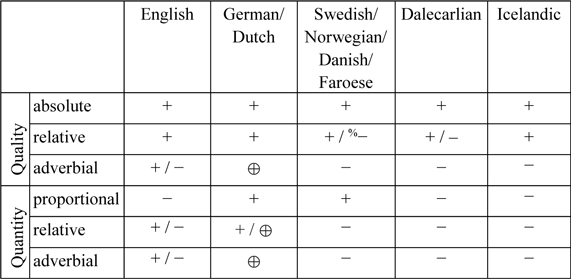
The range of definiteness marking patterns across the languages investigated in this study, including Faroese, is presented in table 17.
Summary of definiteness marking patterns for quality and quantity superlatives.

Thus, in terms of definiteness marking, Faroese patterns with Danish, even though it has a much richer inflectional system. Due to the rich inflectional system, the unmarked, nonagreeing forms of quantity superlatives in Faroese can be analyzed as indefinite neuter singular. In contrast, in Mainland Scandinavian, where superlatives do not show gender distinctions, the bare form is not obviously neuter.
9. The Crosslinguistic Picture: Summary
Table 17 shows an enormous amount of variability in the definiteness marking of quantity superlatives. In contrast, adjectival quality superlatives are much more orderly than quantity superlatives. Therefore, it is clearly impossible to account for this crosslinguistic variation by appealing to differences in how the superlative morpheme operates. The quantity words are the volatile elements.
To understand the variation, it is helpful to consider not just definiteness, but other agreement features as well. Whether definite or not, quantity superlatives under relative readings do not behave gram-matically like ordinary attributive adjectives. The following agreement mismatches have been observed under relative readings:
(i) German am meisten Berge ‘the.n.sg most mountains.m.pl’: the determiner is neuter singular and the substance noun is masculine plural.
(ii) Dutch het meeste bergen ‘the.n.sg most mountains.m.pl’: the determiner is neuter singular and the substance noun is masculine plural.
(iii) Mainland Scandinavian flest kakor ‘many.sprl cookies.pl’, minst kakor ‘few.sprl cookies.pl’: the determiner is nonplural, but the substance noun is plural.
(iv) Faroese flest køkur ‘many.n.sg cookies.f.pl’: the determiner is neuter singular, but the substance noun is feminine plural.
Notice that all of these mismatches involve a neuter singular form. Notice also that these examples have the grammatical structure of adverbial superlatives: Every time a mismatch gives rise to a relative reading, the phrase has the structure of an adverbial. Moreover, the following generalization holds: Whatever structure is used for adverbial superlatives, that structure, applied to a quantity word, gives rise to a relative reading.
Quantity superlatives under a proportional reading are not gram-matically parallel to ordinary attributive adjectives either: They can take partitive phrases as complements, and even when they do not, occassional mismatches in definiteness do arise:
(i) Swedish de flesta kvinnor ‘most women’, den mesta ost ‘most cheese’: the determiner is definite but the substance noun is not.
(ii) Icelandic flestir bílarnir ‘most cars’: the determiner is indefinite but the substance noun is definite.
These mismatches would not happen if the quantity superlatives in those expressions were functioning as ordinary attributive modifiers. In contrast, with quality superlatives, there is almost always full agreement, across all Germanic languages. The only exception involves number mismatches with bare superlatives in Swedish (and perhaps Swedish-influenced varieties of Dalecarlian), illustrated above with dyrast kläder ‘expensive.sprl clothes.pl’ in 55 and störst fiskar ‘big.sprl fish.pl’ in 56.
Crucially, however, quantity superlatives exhibit distinct types of mismatches under relative and proportional readings. Mismatching superlatives on relative readings are always singular, even if the substance noun is plural. In contrast, under a proportional reading, quantity superlatives never disagree in number with the substance noun. In particular, if the substance noun is plural and the superlative can show number agreement, it always shows plural agreement. Furthermore, quantity superlatives under a proportional reading do not always agree with the head noun in gender, as in the Swedish example det mesta av mjölken ‘the.n.sg most.sprl.wk of milk.c.sg’. Finally, mismatches in definiteness were mentioned above as well.
The empirical observations are summarized in the list below.Footnote 33
(i) Variability with quantity superlatives: Generally speaking, every logically possible combination of definiteness marking and interpretation is attested.
(ii) Uniformity with quality superlatives: Definiteness marking is always used under an absolute reading, and is always at least an option under a relative reading. Only in Swedish and Dalecarlian can quality superlatives be bare, following the adverbial pattern.
(iii) The adverbial-relative connection: Whatever the grammatical structure of adverbial superlatives, that structure, when applied to quantity superlatives, gives rise to a relative reading.
(iv) Markedness of proportional readings: Quantity superlatives are less likely overall to be used in translations of sentences with proportional readings than with relative readings; alternative translations such as almost all or the majority of are often preferred.
(v) The proportional-partitive connection: True partitive structures receive a proportional interpretation, but not a relative one.
(vi) The mass-partitive connection: With count nouns, nonpartitive structures are often preferred as a means of expressing a proportional meaning, but with mass nouns, partitive structures are strongly, sometimes categorically preferred as a means of expressing such a meaning.
(vii) The number-marking generalization: Mismatching superlatives on relative readings are always singular, even if the substance noun is plural. In contrast, on proportional readings, the superlative never disagrees in number with the substance noun.
The following sections address the extent to which previous theories of quantity superlatives can account for the patterns observed. The final section outlines a way of improving upon those accounts.
10. Previous Analyses
10.1. Proportional as Absolute: Hackl 2009, Coppock & Josefson 2015
Can the relative and proportional readings of quantity superlatives, and their grammatical properties, be derived from a simple set of assumptions about the meaning of the items involved (quantity words, superlative endings, and the definite articles)? Hackl (Reference Hackl2009) answers “yes” and offers a proposal for how this can be done. His analysis builds on the idea from Szabolcsi Reference Szabolcsi, Fukui, Rapoport and Sagey1986, made explicit by Heim (Reference Heim1999), that under a relative reading, the superlative ending -est undergoes movement at Logical Form (LF) from its surface position within the noun phrase to a position by the focussed consituent. For example, in 114a, -est (along with a silent pro-form C interpreted as the comparison class) moves up to a position near JohnF (where the subscriptF indicates focus marking, à la Rooth Reference Rooth1985), leaving a degree-type trace. The resultant LF structure is given in 114b.
(114)

The definite article is thought to be deleted and replaced by an indefinite article at LF; this eliminates the barrier that would otherwise block the movement of -estC and is consonant with the indefinite behavior of superlative-containing noun phrases under relative interpretation, though it is unclear what grammatical principles allow for this and how they are constrained. The superlative takes a comparison class argument C, a relation between individuals and degrees G (in this case, how high of a mountain one climbed), and a target argument x (in this case, John): x bears G to a greater degree than any distinct element of the comparison class C (Heim Reference Heim1999). This formula derives the truth conditions for the relative reading: The statement is true if and only if John climbed a higher mountain than anyone else in C did.
Hackl (Reference Hackl2009) proposes to treat most as the superlative form of many, rather than as an atomic lexical unit. Then the relative reading of most can be derived in a parallel manner. The LF for 115a would be 115b.
(115)

This LF, again, correctly derives the truth conditions for the relative reading of most: The statement is true if and only if John climbed some plurality of mountains that is more numerous than any plurality of mountains climbed by any distinct member of C (where C contains alternatives to John, that is, alternative mountain climbers).
On this kind of theory, absolute readings of quality superlatives arise when -est remains inside the noun phrase, although it does undergo a short movement within the noun phrase. The LF for 116a is given in 116b.
(116)

The truth conditions that 116b yields are satisfied if and only if John climbed a mountain that is higher than all other mountains in C.
Hackl (Reference Hackl2009) analogizes proportional readings of quantity superlatives to absolute readings of quality superlatives. The LF for 117a is given in 117b.
(117)

There is no definite article in this case, and the noun phrase is interpreted with existential closure (indicated in the LF as Ǝ). In order to derive the truth conditions under which any majority of the substance noun denotations satisfies the description, Hackl makes the additional assumption that two entities are distinct if and only if they do not overlap. With this assumption, 117b yields truth conditions satisfied if and only if John climbed a plurality of mountains that is more numerous than any nonoverlapping plurality of mountains in C. If C can contain arbitrary sums of Ns, then there are many pluralities X that satisfy the description, as many as there are majorities. Since such a description is not inherently unique, definiteness marking is not expected.
Thus, Hackl’s theory makes some accurate predictions for English, though other facts remain puzzling even for English. It correctly predicts that quantity superlatives have both a relative reading and a proportional reading, and that the proportional reading arises in the absence of definiteness marking. What is puzzling under Hackl’s theory is why relative readings of quality or quantity superlatives would be associated with definiteness marking, given that the definite article must be deleted at LF. In the absence of any motivation for this deletion process, the prediction under this view would be that quantity superlatives always lack definiteness marking, and quality superlatives have definiteness marking only on absolute readings.
In order to make predictions about definiteness marking in the context of adverbial superlatives, Hackl’s theory would have to be supplemented with assumptions about the semantics of adverbs. However, given that adverbial superlatives all have relative readings, and that the relative reading is derived through movement, it is hard to imagine an extension of his theory that would predict the co-occurrence of a definite article with adverbial superlatives.
Hackl’s predictions, juxtaposed with the facts of other languages, are shown in table 18. As Coppock & Josefson (Reference Coppock, Josefson, Csipak and Zeijlstra2015) point out, Hackl’s prediction that a relative reading never arises in the presence of definiteness marking is actually borne out in Swedish, modulo the fact that definite-marked quality superlatives can have relative readings as well as absolute readings. This prediction is also borne out in Dalecarlian. However, it is important to keep in mind that definiteness is not all that is missing from the quantity superlatives in Mainland Scandinavian; they also lack plural marking: Rather than *flest-a kakor for ‘the most cookies’, with plural marking on flest, uninflected flest kakor is used.
Hackl’ predictions about definiteness versus definiteness patterns in Germanic.

The Icelandic system also matches Hackl’s predictions quite well, as proportional readings emerge in clearly indefinite contexts. However, relative readings of Icelandic quality superlatives are always accompa-nied by definiteness marking. As in Swedish, Övdalian uses the nondefinite pattern for quality superlatives; but unlike in Swedish, even proportional readings are associated with a nondefinite pattern, Thus, Övdalian is arguably the language that fits Hackl’s predictions most closely, although there is still the problem that definite-marked quality superlatives can have relative readings. Note, however, that nothing in Hackl’s theory explains why proportional or relative readings would ever be accompanied by definiteness marking or why there would be so much more variability with quantity superlatives than with quality superlatives. Furthermore, it does not account for the adverbial-relative connection, the markedness of proportional readings, the proportional-partitive connnection, the mass-partitive connection, or the number marking generalization. Therefore, it is worth considering alternatives.
One such alternative is found in Coppock & Josefson Reference Coppock, Josefson, Csipak and Zeijlstra2015. The authors develop a theory of the contrast between Swedish, German, and English that builds on the analysis of -est in Coppock & Beaver Reference Coppock, Beaver and Snider2014. On this analysis, -est does not move and is interpreted in situ, but is supplied with an association relation argument R along with the comparison class C (referred to as contrast set due to the ambiguity of the term comparison class), gradable predicate G, and subject x. In case of absolute readings, this association relation is assumed to be the identity relation. In this case, the analysis employs Heim’s lexical entry, which does not involve an association relation parameter.
In contrast, in case of relative readings, the association relation is nontrivial. For example, in a sentence such as JohnF grew the biggest tomato, the association relation would be the relation that holds between x and y if and only if x grew y; the gradable predicate would be a relation that holds between y and d if y is d-big, and the contrast set would contain John and his contextually-relevant focal alternatives. In concert with an analysis of the definite article as a marker of uniqueness rather than existence (Coppock & Beaver Reference Coppock and Beaver2015), Coppock & Beaver (Reference Coppock, Beaver and Snider2014) show that this analysis of -est can derive indefinite-like behavior of definite-marked superlatives on relative readings. This result gives Coppock & Beaver’s proposal an advantage over the movement theory, on which definiteness marking with relative readings is entirely mysterious (though see Bumford Reference Bumford2017 for a critique and an alternative).
Coppock & Josefson (Reference Coppock, Josefson, Csipak and Zeijlstra2015) propose that the bare superlatives in Swedish are derived through compositional saturation of the association relation R. Thus, in a case such as John grew the biggest tomato, the superlative phrase biggest tomato takes the verb grow as an argument. Pragmatic saturation of the association relation (where the variable R is filled in by context) takes place regularly in English and German, and is also an option for quality superlatives in Swedish; hence definiteness marking with relative readings.
To account for proportional readings of definite-marked quantity superlatives (de flesta in Swedish, die meisten in German), Coppock & Josefson (Reference Coppock, Josefson, Csipak and Zeijlstra2015) propose that the comparison class may be consituted of two pluralities: one that bears the property determined by the rest of the sentence and one that does not. They refer to this approach as the partition strategy for constructing the comparison class. This view, previously put forth for Dutch by Hoeksema (Reference Hoeksema and ter Meulen1983), is compatible with the presence of definiteness marking on superlatives under both relative and proportional readings. It also goes some distance to explaining why there would be more variability with quantity superlatives than with quality superlatives. The Hackl-style in-situ analysis accounts for indefiniteness of quantity superlatives but not quality superlatives; but it does not explain the adverbial-relative connection, the markedness of proportional readings, the proportional-partitive connection, the mass-partitive connection, or the number marking generalization.
10.2. Dobrovie-Sorin 2013 (and Giurgea), and Pancheva 2015
Dobrovie-Sorin (Reference Dobrovie-Sorin, Aloni, Franke and Roelofsen2013) and Dobrovie-Sorin & Giurgea (Reference Dobrovie-Sorin and Giurgea2015) contribute a number of insights to the discussion that the proposal to be made in section 11 incorporates. Their ideas shed light on the markedness of proportional readings, the proportional-partitive connection, and the mass-partitive connection. Dobrovie-Sorin & Giurgea (Reference Dobrovie-Sorin and Giurgea2015) take as a point of departure the case of French, where a proportional reading for le plus ‘the most’ (lit. ‘the more’) is not available at all, as shown in 118.
(118)

As discussed by Coppock et al. (Reference Coppock, Nouri-Hosseini, Bogal-Allbritten and Stiefeling2017), the use of the superlative of many to express proportional meaning is typologically uncommon. This tendency is reflected even among the Germanic languages, where the use of superlatives for expressing proportional readings is avoided in many cases. Dobrovie-Sorin & Giurgea (Reference Dobrovie-Sorin and Giurgea2015) offer an explanation for this pattern. They propose that crosslinguistically, the superlative form of many can function either as a measure phrase, parallel to two liters in two liters of milk, or as a quantificational determiner, parallel to some in some (of the) girls. The former use yields a relative reading, whereas the latter use yileds a proportional reading. Wilson (Reference Wilson, Bade, Berzovskaya and Schöller2016) provides additional arguments for the idea that relative interpretation arises in pseudo-partitive structures, and proposes a compositional analysis. Dobrovie-Sorin & Giurgea further propose that the quantificational determiner use arises through a process of grammaticalization, which is absent from the vast majority of languages because they lack the requisite preconditions. This explains why the proportional interpretation of many is typologically marked.
Dobrovie-Sorin & Giurgea argue further that there are two kinds of quantifiers: generalized quantifiers, which combine directly with set-denoting plurals, and partitive quantifiers, which take a (possibly plural) individual as an argument. Given that the proportional interpretation only arises with quantifiers (that is, under the quantificational determiner use of the superlative form of many), and given that quantifiers are the only elements that license partitive constructions, it follows that partitives can only have a proportional reading. Thus, the proportional-partitive connection is accounted for.
The mass-partitive connection is also explained. Dobrovie-Sorin & Giurgea (Reference Dobrovie-Sorin and Giurgea2015) follow Dobrovie-Sorin (Reference Dobrovie-Sorin, Aloni, Franke and Roelofsen2013), who argues that nonpartitive quantification—the kind found with classical generalized quantifiers (some boys, no boys, most boys)—is restricted to count domains. As this nonpartitive strategy is unavailable for mass domains, the only option left is to use a partitive construction.
Thus, Dobrovie-Sorin & Giurgea (Reference Dobrovie-Sorin and Giurgea2015) contribute several important pieces of the puzzle. However, several questions remain. First, it is not clear what the source of the grammaticalization process giving rise to the quantificational determiner use is. Second, the adverbial-relative connection and the number marking generalization also remain to be explained, although these observations are compatible with their ideas.
Pancheva (Reference Pancheva and Aparicio2015) addresses the fact that in many languages, including Slavic languages, a proportional reading of quantity superla-tives is not available. According to her proposal, quantity superlatives participate in pseudo-partitive structures in all languages, but different languages have different kinds of pseudo-partitive structures. As she notes, two kinds of pseudo-partitives have been identified: individuating, in which the container or measure noun is the head, and measure, in which the substance noun is the head. The sentence John broke two glasses of water involves an individuating reading, while John added two glasses of water to the soup most plausibly has a measure reading. Pancheva’s proposal is that in Slavic-type languages, the individuating structure is always used, with an abstract NUMBER noun head. This means that the comparison class will consist of cardinalities of articles. In English-type languages, on the other hand, the measure structure is used, so that the substance noun is the head, meaning that the comparison class consists of elements in the domain of the substance noun. Presumably, under Pancheva’s assumptions, all Germanic languages are of the English type, given that both relative and proportional readings are available for the superlative of ‘many’. So this theory does not shed much light on the variability within Germanic, nor does it have much to say about partitives, mass vs. count, or adverbials. But it does contain some elements that bear some similarities to the proposal to be given in the next section, as the reader will see.
11 Proposal
11.1. Quantificational Determiner and the Part versus Amount Distinction
As mentioned in the previous section, Dobrovie-Sorin & Giurgea (Reference Dobrovie-Sorin and Giurgea2015) suggest a historical process that gives rise to a quantificational determiner morphologically identical to the superlative form of many. This process took place in languages where the superlative form of many can have a proportional reading. The question is what the source of such a grammaticalization process might be. There ought to be a prior stage of the language, where the superlative of many exists, but not as a quantificational determiner. Moreover, there ought to have been constructions in which it behaved sufficiently like a quantificational determiner to warrant its reanalysis in other contexts.
The analyses offered by Hackl (Reference Hackl2009) and Hoeksema (Reference Hoeksema and ter Meulen1983) shed light on how such a transition might have taken place. Both of these approaches compositionally derive a proportional meaning for quantity superlatives in their own way. Under both of these accounts, the quantity superlative denotes a predicate of pluralities. A predicate of pluralities can trivially be reconceptualized as a predicate of sets. The same is true for a generalized quantifier (a quantificational determiner), which can also be seen as a predicate of sets. This shift in how the meaning is conceptualized could be what allows a quantity superlative to transition from a predicate (of pluralities) to a quantificational determiner. The states of affairs envisioned by these authors could be seen as precursors to the generalized quantifier stage.
If, furthermore, as Dobrovie-Sorin (Reference Dobrovie-Sorin, Aloni, Franke and Roelofsen2013) suggests, nonpartitive proportional quantifiers are restricted to plurals, then this view comes with an explanation for the difference between mass nouns and count nouns. If proportional readings come about only when the quantity superlative is a proportional quantifier, then partitive and nonpartitive constructions are predicted to be available for count nouns, whereas partitive constructions should be the only option for mass nouns.
To explain the number marking generalization (number vii in section 9), I would like to put forth the working hypothesis that the grammatical features of the quantity superlative depend on the sort of entity that it characterizes. Observe that under a proportional reading, during the precursor stage, the quantity superlative characterizes an individual that falls under the extension of the substance noun. For example, flesta in de flesta barn ‘most of the children’ characterizes a plurality of children that is greater than the plurality constituting the other children. In contrast, under a relative reading, the quantity superlative may characterize an abstract quantity rather than a satisfier of the substance noun.Footnote 34 Indeed, the measure noun that typically surfaces with a relative reading is usually synonymous with number or amount. For example, reading about the recent U.S. election in Swedish, I came across the following headline:
(119)

This sentence is judged as slightly redundant and awkward (it should contain störst antal ‘greatest number’), but it nevertheless suggests that superlatives under a relative reading characterize quantities rather than individuals. In contrast, the measure noun that typically surfaces with a proportional reading is usually synonymous with part, as in Norwegian flesteparten lit. ‘most part’ or Italian maggior parte lit. ‘most/many parts’ (among many other examples in many other languages).
According to Koptjevskaja-Tamm (Reference Koptjevskaja-Tamm, Dahl and Koptjevskaja-Tamm2001:523), the difference between parts and amounts lies in the distinction between pseudo-partitives and partitives. In a partitive construction, such as a piece of the cake, one is “talking of a PART of something rather than AMOUNT of some substance, as we do in [a cup of tea].” Following this line of reasoning, Dobrovie-Sorin & Giurgea (Reference Dobrovie-Sorin and Giurgea2015) draw an analogy between pseudo-partitives and quantity superlatives under a relative reading, such as the most cookies, on the one hand, and true partitives and quantity superlatives under a proportional reading, such as most of the cookies, on the other. This contrast is illustrated in 120.
(120)

The suggestion to be made here is based on the idea that with relative readings, at least in some cases, one is “talking of an amount.” With proportional readings, one is “talking of a part”.
More specifically, I propose that under a relative reading, the target of the superlative is a degree (or “amount”), whereas under a proportional reading, the target is a (possibly plural) individual, one that can be seen as a “part” of a larger collection of individuals. Combined with other assumptions relating the semantic type of target argument of the superlative to its agreement features, this assumption can shed light on the patterns of agreement that one finds. The hypothesis I wish to explore is as follows:
(121)

To make this hypothesis testable, it is necessary to specify what is meant by the target argument and the domain from which [a given argument] is drawn, as well as exactly how the agreement features are determined. The term target is borrowed from the world of comparatives: In a sentence such as John is taller than Mary, the target is John and the standard is Mary. Analogously, in a sentence with a predicatively used quality superlative, such as John is the tallest, the target is John. Under a standard view of quality superlatives, a superlative takes three arguments: a gradable predicate G, a comparison class C, and an individual x. The individual x corresponds to the target. There may not be any constituent in the sentence corresponding to the target, as the target may be bound by an operator. When a quality superlative functions as an attributive modifier to a noun, as in John ate the biggest sandwich, the individual argument of the superlative is bound by an operator rather than being syntactically realized.
Theories differ as to exactly what array of arguments a superlative morpheme takes (Heim Reference Heim1999, Solt Reference Solt, Reich, Horsch and Pauly2011, Krasikova Reference Krasikova, Aloni, Kimmelman, Roelofsen, Sassoon, Schulz and Westera2012, Szabolcsi Reference Szabolcsi, Chereches, Ashton and Lutz2012, Coppock & Beaver Reference Coppock, Beaver and Snider2014), but most posit an argument that could be labelled the “target argument” (one exception is Heim Reference Heim1999:21, example 62, where -est does not take any external argument). Under an absolute reading, the target argument can be identified in a fairly straightforward way: Typically, it is the one that comes last in the compositional order. For example, the target in John ate the biggest sandwich is sandwich. However, when it comes to relative readings, the identity of the target is more dependent on the analysis. On a movement analysis (Szabolcsi Reference Szabolcsi, Fukui, Rapoport and Sagey1986, Heim Reference Heim1999, Hackl Reference Hackl2009 among others), the superlative moves to a position where it can take the focus as its target argument. Thus, in JOHN ate the biggest sandwich, the target is John. On in-situ analyses (Gawron Reference Gawron1995, Farkas & É. Kiss Reference Farkas and Kiss2000, Sharvit & Stateva Reference Sharvit and Stateva2002, Gutiérrez-Rexach Reference Gutiérrez-Rexach, Heusinger and Turner2006, Teodorescu Reference Teodorescu2009, Pancheva & Tomaszewicz Reference Pancheva, Tomaszewicz, Arnett and Bennett2012, Coppock & Beaver Reference Coppock, Beaver and Snider2014, Coppock & Josefson Reference Coppock, Josefson, Csipak and Zeijlstra2015), the target is still sandwich. On an analysis in the style of Krasikova (Reference Krasikova, Aloni, Kimmelman, Roelofsen, Sassoon, Schulz and Westera2012), along the lines re-envisioned by Szabolcsi (Reference Szabolcsi, Chereches, Ashton and Lutz2012), the target is a predicate of degrees, formed by abstraction over the position of the superlative. Below I suggest that, given the patterns of agreement-marking found crosslinguistically, the target-domain hypothesis leads one to prefer a Krasikova-style analysis in some cases.
As far as the domain is concerned, intuitively, the domain from which [a given argument] is drawn is simply the collection of sortal constraints placed on the discourse referent. If the discourse referent is constrained to be a sandwich, then it is drawn from the domain of single sandwiches. If it is constrained to be a plurality of sandwiches, then it is drawn from a plural domain. If it is constrained to be some portion of milk, then it is drawn from a mass domain. If it is constrained to be a degree, then it is drawn from the domain of degrees. I assume, inspired by the Discourse Representation Theory (Kamp & Reyle Reference Kamp and Reyle1993), that semantic representation involves discourse referents, and that the syntax-semantics mapping specifies an association between discourse referents and agreement features.
I make the following assumptions regarding the mapping from domains to agreement features: If a given discourse referent is drawn from a plural individual domain, then it is associated with plural agree-ment features. If it is drawn from a nonplural individual domain, then it has singular agreement features. For discourse referents drawn from domains of individuals, the gender feature depends on the domain. In contrast, a discourse referent associated with a domain of nonindividuals has default agreement, which is neuter singular in Germanic languages.
11.2. Explaining the Number Marking Generalization
In this section, the approach outlined above is applied to quantity superlatives, which under a relative interpretation always have singular agreement features. This view can be made to work under the assumption that the relative reading arises in a pseudo-partitive structure, as Dobrovie-Sorin & Giurgea (Reference Dobrovie-Sorin and Giurgea2015) suggest. The assumption that a pseudo-partitive structure lies in the background is motivated for quantity words in general, not just for their superlative forms. According to Schwarzschild (Reference Schwarzschild and Jackson2002), who cites Jackendoff Reference Jackendoff1977 for precedent, too much gold is a pseudo-partitive construction, which for certain reasons requires no of. Pseudo-partitives such as two ounces of gold are sometimes analyzed as involving a functional head, instantiated by of in this case, which mediates between the measure phrase (two ounces) and the substance noun (gold). The functional head goes by a number of different names: Schwarzschild (Reference Schwarzschild and Jackson2002) terms it Mon for Monotonicity, and argues that it encodes a monotonicity constraint. Rett (Reference Rett2014) advocates a similar analysis insofar as it posits a semantically contentful head that mediates between the measure phrase and the substance noun; the category head is extended to include quantity words. This kind of analysis contrasts with those of Hackl (Reference Hackl2009) and Wellwood (Reference Wellwood2014, Reference Wellwood2015), who assume that the quantity word combines directly with the substance noun in a manner analogous to the way that gradable adjectives combine with the noun they modify.
Assuming Schwarzschild’s (Reference Schwarzschild and Jackson2002) and Rett’s (Reference Rett2014) analyses, a phrase such as the most instruments is a pseudo-partitive, where the most is a measure phrase separated from the substance noun by a functional head. Then the agreement mismatches observed in Flemish Dutch, German, and Swedish are explained: If two ounces of milk has the structure in 122a and too much salt has the structure in 122b, then the most instruments has the structure in 122c.
(122)

Note that this view implies that the most forms a constituent, which is fully in line with Roelandt’s (Reference Roelandt2016a:350) analysis of Flemish nonagreeing het meeste ‘the most’: The quantity word does not stand in an attributive relationship to the noun, but rather forms a constituent with the determiner to the exclusion of the noun, as shown in 123.
(123)

This is also how Krasikova (Reference Krasikova, Aloni, Kimmelman, Roelofsen, Sassoon, Schulz and Westera2012) analyzes relative readings in general, including for quality superlatives (I am not inclined to go so far, given that quality superlatives usually show full grammatical agreement). Such a structure would also provide a host for the of seen with Övdalian relative readings, as in mjäst åv epplum ‘the most apples’. Moreover, the bracketing in 123 is independently motivated by the fact that nonagreeing relative superlatives are formally similar to adverbial superlatives. When used as an adverbial (as in John ran the most), the most clearly constitutes a unit, so the grammar must generate phrases consisting just of the most.
Semantically, as well, I would like to propose that the most in the most instruments is parallel to two ounces in two ounces of gold. Both denote degrees (or quantifiers over degrees), and are glued together by the meaning of the substance noun via the functional head, in the way Schwarzschild (Reference Schwarzschild and Jackson2002) and Rett (Reference Rett2014) envision. One possible semantic account is proposed by Wilson (Reference Wilson, Bade, Berzovskaya and Schöller2016): The semantics of the most is built up locally, without any (local) movement, so that the phrase denotes the degree d that is greater than any other degree in C. However, in the absence of additional assumptions, this analysis has the same difficulty with ties that Krasikova’s (Reference Krasikova, Aloni, Kimmelman, Roelofsen, Sassoon, Schulz and Westera2012) analysis suffers from: If John and Bill both drank two liters of milk, and nobody else drank any more, and the set of salient degrees is the set of amounts of milk that relevant people in the context drank, then it would be true that John drank the most milk, and Bill did too. Another option would be to assume that -est undergoes movement to the focus position. If many can measure degrees in terms of their cardinality, then the d-many—where d is the trace left by -est—would denote the degree with cardinality d. If -est moves to a position near the focus and binds this trace d, then a focus-sensitive relative reading arises, and the presence of the definite article is not a problem.Footnote 35
As far as the semantics of adverbial superlatives is concerned, one may assume either that the target is an event, or that it is a degree; both assumptions would be consistent with the target-domain hypothesis. Wellwood (Reference Wellwood2014:85) treates adverbial comparatives such as more in John ran more than Bill did as complex units. She decomposes more into much + -er and assumes that the entity measured by much is an eventuality (see also Wellwood Reference Wellwood2015). The context provides an appropriate measure of magnitude for eventualities, allowing them to be compared; the sentence thus means that there was a running eventuality carried out by John that had a magnitude greater than the running eventuality carried out by Bill.
Wellwood’s (Reference Wellwood2014) approach can be extended to superlatives: John ran the most means that John participated in some running eventuality that was greater in magnitude (according to the contextually-relevant measure) than any other contextually relevant (running) event. Under such an analysis, the target argument of the adverbial superlative is not an individual, but rather an event. Alternatively, reference to degrees may be involved in adverbial superlatives. I currently know of no evidence to distinguish between these two assumptions.
I also leave open the question of the precise source of the definite article in adverbial superlatives. Selkirk (Reference Selkirk, Culicover, Wasow and Akmajian1977:298) makes the following suggestion with respect to the definite article in, for example, ran the fastest in English:
[It] occupies the position in the tree that in deep structure was occupied by the superlative Det -est, and that this -est, which we take to be [+Definite], is postposed and encliticized to the Q. In so doing, it leaves behind an empty [+Definite] determiner node; it is into this position that the is inserted.
In fact, there is some reason to believe that in English, the definiteness marker in adverbial and relative quantity superlatives may have a different historical origin from the ordinary one. At a stage of Old English before definite articles had been established, there was an element ðe, which co-occurred with superlatives. The following example is cited by Sommerer (Reference Sommerer2012), who credits Mitchell (Reference Mitchell1985); I thank Peter Hallman for pointing it out to me.
(124)

This element ðe is clearly distinct from the contemporaneous demonstrative seo (also seen in 124), which is the uncontroversial source of modern the. Further research is required, but if indeed the definite article in the most has a distinct historical source from the the definite article in other cases, then there is justification for treating it separately to some extent.
However, this picture of relative readings does not cover all cases. Sometimes, a relative reading arises despite full agreement between the adjective and the noun. In this case, the Target-Domain Hypothesis suggests an attributive analysis in which the superlative remains in situ. On an in-situ analysis, the target is drawn from the same domain as the substance noun, so matching agreement features are expected. This strategy appears to be available in Dutch and German for quantity superlatives, but not Scandinavian languages, for reasons that are unclear to me.Footnote 36
12. Conclusion
From the discussion above, the following picture emerges: The agreement that a superlative exhibits depends on its target. With quality superlatives, the superlative serves as an attributive modifier of the noun, so the target is always an entity that can be characterized by the substance noun; hence uniformity with quality superlatives. When the target is an event or a degree, the superlative shows the default neuter singular agreement. This is the case with adverbial superlatives, as well as relative superlatives analyzed as the measure phrase in pseudo-partitive constructions; hence the adverbial-relative connection, and some of the variability within quantity superlatives.
Proportional readings of quantity superlatives can be compositionally derived in the manner envisioned by either Hackl (Reference Hackl2009) or by Hoeksema (Reference Hoeksema and ter Meulen1983), in an attributive structure parallel to the one posited for quality superlatives. I suggest that this kind of compositional derivation is available, but only as a precursor to a generalized quantifier stage, perhaps because this kind of analysis is unstable. Due to the attributive structure, there is full agreement, including in number. Definiteness marking in this case depends on subtle aspects of how the comparison class and the superlative marker are construed: If the comparison class in question constitutes a specific binary partition, definiteness marking emerges; if the comparison class consists of all pluralities of entities of the kind denoted by the substance noun, there is no definite marking and an indefinite description emerges (noting the semantics of the superlative morpheme that requires comparison be restricted to nonoverlapping pluralities). The availability of both options is a source of variability within quantity superlatives.
However, I suggest that the attributive structure that features full agreement is unstable when it contains a quantity word. As a result, quantity superlatives (along with any preceding determiners) are reanalyzed as quantifiers. Once they have been reanalyzed as quantifiers, mismatches in definiteness may emerge, as in de flesta barn ‘most of the children’. As quantifiers, quantity superlatives can combine with partitive phrases; hence the proportional-partitive connection. At the same time, nonpartitive quantifiers are restricted to count domains, and so there is a preference for partitive constructions in the realm of mass nouns; hence the mass-partitive connection.
Overall, the patterns of definiteness marking and agreement of Germanic quantity superlatives under various interpretations show that they are not always structurally parallel to quality superlatives, despite the fact that they carry adjectival derivational and inflectional endings. Quantity superlatives depart from an ordinary attributive structure notably in two cases: When they function as the measure phrase in a pseudo-partitive structure (yielding relative readings), or when they function as a quantificational determiner, with or without a partitive complement (yielding proportional readings). Yet quantity superlatives can sometimes function as attributive modifiers; indeed, such a structure is the historical basis for the quantificational determiner use, and even relative quantity superlatives sometimes show full grammatical agreement. In that sense, quantity superlatives exist on a volatile fault line between the realm of adjectives and the realm of determiners.
Appendix Translation Questionnaire
Instructions. Please translate the sentences below into your native language. More literal translations are preferred, but only as long as they sound natural. Give as many translations as you like, and comments are welcome but not required. (No need to translate the parts in parentheses; they are just supposed to help explain what is meant.)
1. Most of the kids who go to my school like to play music. (For example, there are 100 kids in my school, and 65 of them like to play music.)
2. Of all the kids in my school, I’m the one who plays the most instruments. (For example, I play 7 instruments, two of my friends play 6 instruments, and lots of people play one or two instruments, but nobody else plays more than 4.)
3. I don’t like most of the music they play on the radio.
4. My brother Hans also plays many instruments, but not more than me.
5. The member of my family who plays fewest instruments is my sister Karin.
6. During most of the summer we have played music every day.
7. I don’t know how much coffee we’ve drunk and how many cookies we’ve eaten during the summer.
8. But it is probably Hans who has drunk the most coffee. (For example, Hans drank three cups every day, and the rest of us drink one or two cups every day.)
9. Mom says that he ought to drink less coffee.
10. I am the one who drinks the least coffee.
11. But I am also the member of our family who eats the most cookies. (For example, I eat on average 5 cookies per day, and other members of my family eat on average 4 or fewer cookies per day.)
12. Mom baked cookies yesterday and I ate most of them. (For example, she baked 20 cookies and I ate 14.)
13. I drank most of the milk too. (For example, there were two liters of milk and I drank 1.5 liters.)
14. I’m not the one in the family with the thinnest waist.
15. I ought to eat fewer cookies.
16. But it’s hard since mom bakes the yummiest cookies in the whole world.
17. Many try, but few can resist mom’s cookies!