Central-line–associated bloodstream infections (CLABSIs) are one of the most common healthcare-associated infections in children, and they are associated with increased morbidity, mortality, length of stay, and cost.Reference Srinivasan, Wise and Bell 1 – Reference Goudie, Dynan, Brady and Rettiganti 3 CLABSIs are particularly harmful for patients in the pediatric intensive care unit (PICU).Reference Elward, Hollenbeak, Warren and Fraser 4 – Reference Simon, Ammann and Bode 6
An evidence-based, best-practice “bundle” of care practices around central venous catheter (CVC) insertion and maintenance has been developed to prevent CLABSI.Reference Miller, Griswold and Harris 7 – Reference Pronovost 9 Compliance with the prevention bundle is associated with significantly lower infection rates.Reference Jeffries, Mason and Brewer 10 , Reference Edwards, Herzig and Liu 11 A significant amount of effort has been expended nationally to disseminate the CLABSI bundle across pediatric hospitals, but CLABSI rates persist above target thresholds across the country.Reference Ista, van der Hoven and Kornelisse 12 , Reference Lyren, Brilli, Zieker, Marino, Muething and Sharek 13 Locally, our PICU has maintained average bundle compliance rates of ∼88% or greater for the study time period, and our CLABSI rate remains above our goal level, suggesting that risk factors beyond bundle compliance are contributing to these infections.
Previous investigations have identified several risk factors for CLABSI in the PICU population, such as duration of catheter use, nonoperable cardiac disease, presence of a gastrostomy tube, blood transfusions, and total parenteral nutrition.Reference Miller, Griswold and Harris 7 , Reference Wylie, Graham and Potter-Bynoe 14 , Reference Elward and Fraser 15 However, many of the risk factors highlighted in previous studies are minimally or not at all modifiable, making it difficult to design risk-factor targeted strategies to further reduce CLABSI rates. In addition, the provision of critical care medicine has evolved (eg, higher hemoglobin thresholds for transfusion, more use of enteral vs parenteral nutrition, and new therapies for nonoperative cardiovascular diseases like pulmonary hypertension), and the level of risk conferred by certain factors may also have shifted.Reference Doctor, Cholette and Remy 16 – Reference Abman, Hansmann and Archer 18
Considering the persistent morbidity and mortality associated with CLABSI in critically ill children, an updated examination of risk factors and exploration for new and modifiable risk factors is urgently needed. Our objective was to identify novel and modifiable risk factors for CLABSI in PICU patients to inform new and effective strategies to reduce CLABSI rates.
Methods
Study design and population
We performed a retrospective matched case-control study. This study utilized existing data, reviewed for quality improvement purposes, and was deemed exempt from institutional review board (IRB) oversight at the Children’s Hospital of Philadelphia (CHOP). The CLABSI cases were identified through routine active surveillance performed by the CHOP Department of Infection Prevention and Control using National Healthcare Safety Network (NHSN) definitions. 19 Case patients were patients admitted to the CHOP medical-surgical PICU from April 1, 2013 through December 31, 2017, who had a CVC and who developed a CLABSI attributable to the PICU (>2 days of PICU admission). CVCs included percutaneous temporary CVCs, peripherally inserted central catheters, apheresis/hemodialysis catheters, tunneled CVCs, port-a-caths (ports), and umbilical venous catheters per NHSN criteria. Control patients were selected from those admitted to the PICU for at least 2 days and had a CVC in place for at least 3 days and who did not develop a CLABSI. The episode end date for cases was defined as the date of the positive blood culture that was deemed to be a CLABSI. The episode end date for controls was selected as a random date between line insertion and line removal when the patient was in the PICU. We did not select line removal date or discharge date for the controls in order to reduce bias inherent in such a date. Control patients ready to have their line removed or be discharged from the ICU are likely in a fundamentally different state of illness than case patients who have just developed a bloodstream infection.
Each case (CLABSI) was matched to 4 control patients (line without a CLABSI) where possible. Cases were matched to controls based on age of patient at line insertion, number of complex chronic conditions (CCCs, categorized as 0, 1, 2, or >2); and hospital length of stay (LOS, using LOS from admission to CLABSI date for case patients, and from admission to randomly selected end date for control patients). A patient could not act as his/her own control, and 2 control lines could not come from the same patient. A patient could be included more than once if they had 2 separate lines and each had a CLABSI, but each line was used only once.
Pediatric CCCs were defined in 2000 by Feudtner et alReference Feudtner, Christakis and Connell 20 as “any medical condition that can be reasonably expected to last at least 12 months (unless death intervenes) and to involve either several different organ systems or 1 organ system severely enough to require specialty pediatric care and probably some period of hospitalization in a tertiary care center.”Reference Feudtner, Christakis and Connell 20 The CCC system has been applied in a variety of research investigations including topics such as pediatric mortality, end-of-life care, risk adjustment, prediction of adverse health outcomes, and identification of populations with high health care utilization.Reference Feudtner, Hays, Haynes, Geyer, Neff and Koepsell 21 – Reference Feudtner, Feinstein, Zhong, Hall and Dai 24 Matching patients based on number of CCCs was performed to account for illness complexity and the burden of comorbidities of both the case and control patients, while still allowing the individual diagnosis categories to remain as variables of interest in the model.
A list of potential risk factors for CLABSI was developed via literature review and clinical expertise (Supplements 1 and 2online).Reference Wylie, Graham and Potter-Bynoe 14 , Reference Miller, Griswold and Harris 25 , Reference Krishnaiah, Soothill, Wade, Mok and Ramnarayan 26 One novel risk factor we included was “acute behavioral health needs,” defined as need for inpatient consult to psychiatry/psychology/behavioral health or orders for as-needed antipsychotic medications that in our unit are typically used for short-term management of agitation or delirium (Supplement 2 online). Case and control patients were screened for these risk factors via computer-driven query of the electronic medical records and were verified by manual retrospective chart review of the medical records. A dedicated data analyst developed code for each risk factor and performed the computer query of the electronic medical record. Subsequently, groups of 15–20 charts were randomly assigned to each study team member for the verification process, for each risk factor of interest. Discrepancies or inaccuracies identified during the chart review process led to corrections in the computer code or query process, until repeat chart review confirmed accuracy. Operational definitions of these risk factors are included in Supplement 2 online.
Statistical analysis
Descriptive summary statistics and comparison of patient demographics and hospital outcomes were performed for both the cases and controls using mean, median, standard deviations, and ranges for continuous variables and counts or percentages for categorical variables. Two-sample t tests and the χ2 test were used to compare characteristics of cases versus controls. Univariate conditional logistic regression models were used to evaluate the association between individual risk factors and the occurrence of CLABSI. Risk factors significant at the P = .10 level were then used to construct a multivariable model via backward stepwise regression. Risk factors significant at the .05 level were included in our final model. Additionally, we included risk factors just over the .05 threshold that reflected a disparity among different language groups warranting continued exploration.
Statistical analyses were performed using R version 3.3.2 software (R Foundation, Vienna, Austria).
Results
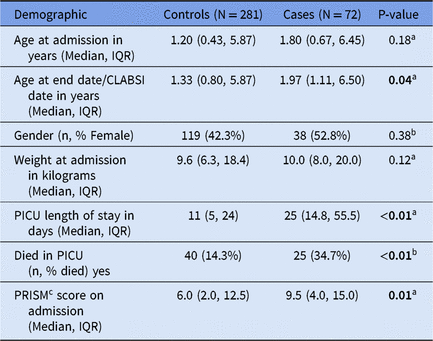
Between April 2013 and December 2017, 72 CLABSIs were identified in the PICU and were matched to 281 PICU controls (Table 1). CLABSI case patients were sicker than controls by multiple metrics, including higher admission severity of illness scores, PICU length of stay, and mortality than the control patients. There was no difference in admission weight, gender, or age between cases and controls. For case patients, median time from central venous catheter placement to development of CLABSI was 28 days (IQR, 13–52 days). The most common type of CVC in both cases and control patients was a PICC line (50% of cases and 47% of controls), and the least common type of CVCs were apheresis/hemodialysis catheters and umbilical venous catheters (2.8% and 4.3%). CVC type, location, and month/year of CVC placement were not significant in our analysis. During the 5-year study period, the overall PICU CLABSI rates per 1,000 central venous line days were 1.44 for year 1, 1.28 for year 2, 1.92 for year 3, 2.51 for year 4, and 1.95 for year 5, with no statistically significant difference between the year 1 and year 5 rates. Median line days per month were 817 for year 1, 716 for year 2, 701 for year 3, 745 for year 4, and 902 for year 5.
Demographic and clinical characteristics of patients with and without central-line associated bloodstream infection (CLABSI) in a pediatric intensive care unit, April 1, 2013–December 31, 2017

IQR = interquartile range
a = p-value attained via wilcoxon mann-whitney non-parametric t-test
b = p-value attained via two-sample proportion test
c = Pediatric risk of mortality score, model 3
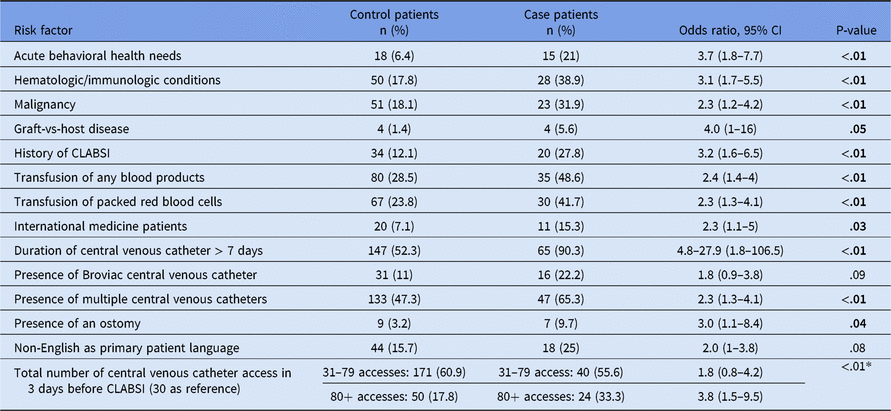
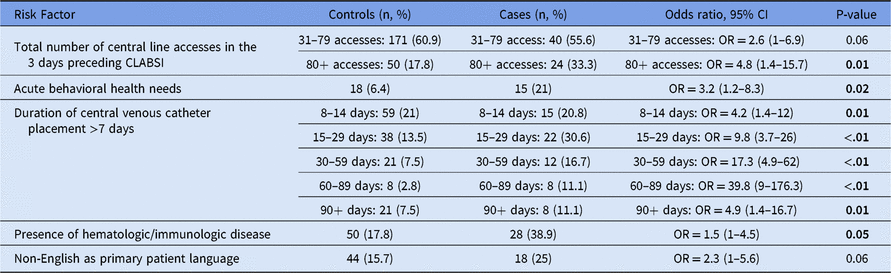
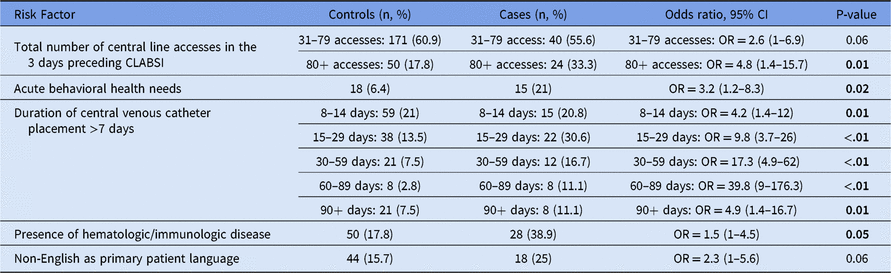
Univariate analysis revealed 14 risk factors that were significant at the 0.10 level (Table 2). This analysis produced many of the same variables previously identified in earlier studies, as well as novel variables, such as acute behavioral health needs and non-English as a primary patient language. Risk factors that remained significant after adjustment in the multivariable analysis included: total number of central line accesses in the 3 days preceding CLABSI, acute behavioral health needs, central line duration exceeding 7 days, and the presence of hematologic/immunologic disease (Table 3). Notably, non-English as a primary patient language also approached statistical significance (Table 3).
Risk factors for central-line associated bloodstream infection in pediatric intensive care unit patients, univariate model
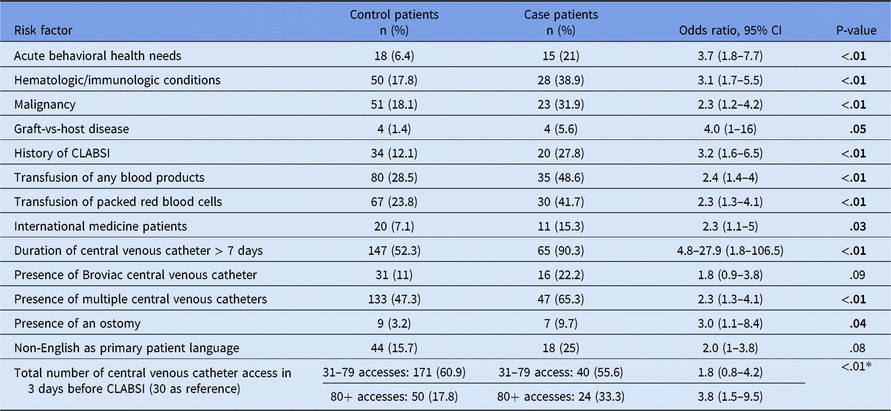
* Wald test statistic for this variable, non-stratified
Independent risk factors for central-line associated bloodstream infection in the pediatric intensive care unit
Discussion
We report our examination of CLABSI risk factors among a population of PICU patients to explore new or modifiable risk factors. We identified acute behavioral health needs, total number of CVC accesses, catheter dwell time, and the presence of hematologic/immunologic disease as independent risk factors for CLABSI in our cohort. Our study has quantified the number of CVC accesses associated with CLABSI risk in critically ill children in a manner not previously reported. In addition, to our knowledge, this is the first study showing an association between acute behavioral health needs and development of CLABSI in this patient population.
The association between acute behavioral health needs and risk of CLABSI is a notable finding and warrants further investigation. Previous reports have made a case for special consideration of CLABSI risk in these patients.Reference Brooks, Christy, Mack and McFadden 27 Behavioral health needs are an important issue for pediatric patients, with nearly 500,000 pediatric admissions annually including behavioral disorders.Reference Egorova, Pincus, Shemesh and Kleinman 28 Accounting for 3%–10% of pediatric admissions, pediatric inpatient mental health is emerging as a priority topic for quality improvement and measurement on a national scale.Reference Bardach, Coker and Zima 29 Pediatric patients admitted with a non–behavioral health diagnosis but who have a behavioral health comorbidity have significantly increased length of stay and cost of care.Reference Bardach, Coker and Zima 29 An increased risk of healthcare-associated conditions such as CLABSI may be contributing to this increased resource utilization. The reason for this association is unknown, but we speculate that conditions leading to the need for inpatient behavioral health team involvement or antipsychotic medications could compromise catheter care (ie, frequent catheter dressing dislodgement or inadvertent contamination of catheter connections) and could occur more easily in agitated patients. Patients with behavioral issues may lack capacity to understand or comply with CLABSI preventative strategies such as daily chlorhexidine treatments. Furthermore, behavioral issues could potentially impact staff behaviors, such that priority may be given to overall patient safety over accomplishing CLABSI preventative tasks. A partnership with behavioral health clinicians is now underway at our institution to better understand and mitigate this risk factor.
Although not statistically significant, we may have revealed an emerging signal that having a primary language other than English confers increased risk of CLABSI. There is some precedent for an association between patient language and patient harm: Patients with limited English proficiency may experience more severe adverse events than patients whose primary language is English, and the errors experienced by non-English speaking patients are more likely to be attributed to communication failure.Reference Divi, Koss, Schmaltz and Loeb 30 , Reference De Moissac and Bowen 31 We speculate that non–English-language-speaking patients may experience challenges related to catheter maintenance practices that English-speaking patients (and their families) do not experience. For example, nursing discussions with patients and families about the importance of daily chlorhexidine bathing, or the need to keep soft limb restraints in place to ensure a patient does not inadvertently dislodge or disconnect a catheter, may be more difficult if the team is having to wait on the arrival of an interpreter or may be truncated if conducted via interpreter telephone service. Considering the wealth of evidence that racial disparities contribute to worse outcomes in sepsis, additional exploration of this variable is warranted despite the P value just above .05.Reference Mayr, Yende and Linde-Zwirble 32 , Reference Jones, Fingar and Miller 33
We also noted a clear association between the number of accesses into a CVC in the 3 days preceding infection date and the development of CLABSI, with a suggestion of risk increasing with 31–79 accesses, and then reaching statistical significance with 80 or more accesses. Intraluminal contamination (contaminated infusates or contaminated catheter hubs) is a known major source of CLABSI.Reference Mermel 34 Each access into a patient’s CVC provides an opportunity for intraluminal contamination with bacteria. Protocols for cleaning the catheter hub prior to access are integrated into CLABSI prevention bundles, although these can vary across institutions. Data regarding the ability of intermittent catheter hub cleaning to adequately remove bacteria before CVC use are mixed, and continuous passive disinfection with 70% alcohol cap may offer additional benefit, but that technique is not standard in PICUs across the nation.Reference Rupp, Yu and Huerta 35 , Reference Wright, Tropp and Schora 36 In addition, in practice, ensuring that every access is accompanied by a fully compliant “hub scrub” of an appropriate length of time is challenging; it relies on bedside clinicians to remember to perform this step numerous times per day. Determining compliance to this practice is difficult, as it either relies on self-reported data susceptible to bias, or requires time-intensive direct observation, but data suggest that it may be fairly low.Reference Caspari, Epstein, Blackman, Jin and Kaufman 37 As providers access a patient’s catheter more frequently, the chance of inadequate decontamination before medication administration or a blood draw may increase as well. Evidence of a specific threshold for line access at which the odds of infection in a PICU patient significantly increase have been limited thus far, but this finding is particularly important as it is a potentially modifiable risk factor for CLABSI. Providers may be able to transition medications from an intravenous to enteral route, administer nonvesicant medications via peripheral intravenous catheter, and adjust laboratory draw frequency to mitigate excess central venous catheter use and reduce CLABSI risk.
Duration of catheter placement was also an independent risk factor for infection in our cohort, consistent with prior published literature.Reference Wylie, Graham and Potter-Bynoe 14 , Reference Elward and Fraser 15 , Reference Marschall, Mermel and Fakih 38 However, the receipt of blood transfusions or TPN was not significant, unlike previous investigations. The reason for this is uncertain, but we offer several possible explanations. First, prior studies have suggested a dose-response relationship between volume of blood products received and risk of CLABSI.Reference Houbiers, van de Velde and van de Watering 39 In the last decade, there has been a clear paradigm shift in the approach to blood product use in the pediatric critical care population, with growing evidence of lack of benefit and possible harm from “liberal” transfusion thresholds (goal hemoglobin, 10–12 g/dL) versus conservative thresholds (goal hemoglobin, 7–8 g/dL).Reference Doctor, Cholette and Remy 16 The lack of association we find here between transfusions and CLABSI risk may reflect a general decreased use of blood products owing to new practice patterns to something below the potential dose–response threshold for CLABSI after transfusion.
Alternatively, multiple studies have speculated that the association between interventions like blood transfusions and TPN and the development of CLABSI may be reflective of an increased severity of illness. Reference Wylie, Graham and Potter-Bynoe 14 In previous studies, data on central line access frequency as a critical step on the causal pathway between transfusion and/or TPN administration and CLABSI was unavailable or limited. In our cohort, frequent CVC access was an independent risk factor for CLABSI, which may suggest that the repeated entry into the CVC, rather than blood or TPN itself, confers risk.
Patients in our cohort who developed CLABSI had higher PRISM (pediatric risk of mortality) scores and mortality than our controls, consistent with prior literature. We did not include PRISM scores in our model for 2 reasons: (1) PRISM reflects illness severity at admission, which is not modifiable and (2) this illness severity is unlikely to be reflective of illness acuity at the time of CLABSI occurrence (considering median length of time for CLABSI occurrence was 28 days after line placement). We did include other more discrete metrics related to severity of illness in the 3-day window before CLABSI (such as need for vasoactive infusions and invasive or noninvasive ventilation), which were not significant in the multivariable model.
Finally, the presence of hematologic/immunologic disease was also an independent risk factor for development of CLABSI in our cohort. This is consistent with prior literature that compromised immune status is associated with both the development of and worse outcomes from CLABSI.Reference Wolf, Curtis and Worth 40 – Reference Moskalewicz, Isenalumhe and Luu 42 In our study, the hematologic/immunologic disease indicator is a data element inclusive of many diagnoses: sickle cell anemia, thalassemia, aplastic anemia, myelodysplastic syndromes, rheumatoid arthritis, systemic lupus erythematosus, vasculitis, congenital immune deficiencies, HIV, sarcoidosis, and a variety of other conditions. Additional work is needed to understand this indicator in greater detail and to determine whether the risk for CLABSI varies among different subpopulations of patients with specific hematologic/immunologic diseases.
Our study has several limitations. The single-center nature of the work may limit generalizability, and the case-control methodology limits the degree of causal inference that can be established between risk factors and occurrence of CLABSI. Although the core components of the CVC insertion and maintenance bundles did not change during the study period, and date of CVC placement was not a significant risk factor in our analysis, it remains possible that minor changes in CVC line care practices (eg, changing type of catheter claves after a product recall) could have impacted the development of CLABSIs. Inability to obtain accurate data about blood transfusion frequency for a historical control period before our study window prevented full analysis of the impact of transfusion practice changes on CLABSI occurrence. Separating the number of CVC accesses from overall severity of illness remains challenging, and surrogate markers of acuity in the 3-day window before CLABSI were not significant in our analysis. Finally, we also acknowledge that the behavioral health risk factor does not have a standardized case definition that could be readily used in multicenter studies to validate our single-center findings, and it is challenging to reliably capture all patients with this risk factor using a computer-driven query of the electronic medical record.
In conclusion, CLABSI remains an important cause of morbidity and mortality among PICU patients, despite continuous efforts to ensure optimal bundle compliance. Novel risk factors include acute behavioral health needs and >80 total CVC accesses in the 3 days before CLABSI, with >30 total accesses and non-English as a primary patient language also emerging as new potential factors of interest in our cohort. These risk factors represent modifiable targets for innovative improvement interventions that may prevent or reduce the occurrence of CLABSI in the high-risk PICU patient population.
Supplementary material
To view supplementary material for this article, please visit https://doi.org/10.1017/ice.2019.302
Acknowledgments
The authors acknowledge Dr Avram Mack for his valuable assistance in project development.
Financial support
There were no direct sources of funding for this work. Dr Woods-Hill receives support from a National Institute of Health Ruth L. Kirschstein National Research Service Award (grant no. T32HL098054-55) and from The Agency for Healthcare Research and Quality (grant no. 1R18HS025642). Dr Sammons receives research support through a CDC Epicenters grant for healthcare-associated viral infections.
Conflicts of interest
The authors have no financial relationships relevant to this article to disclose.