Introduction
A native speaker of English from Australia might hear variants of the word authentic that sound to them like [oːˈfentik] when they encounter speakers from Manchester UK; or fish may sound to them like [fəʃ] when uttered by South African English speakers. If, in addition, this listener also knows a second language, for example Italian, they may hear variants of intelligenza, which has a geminated or “doubled” medial /l:/ in ‘standard’ Italian, produced with a singleton /l/ as [intɛli'dʒentsa] by speakers from Italy's Friuli region (northeast corner), where the singleton-geminate distinction is minimized. In standard Italian, geminate consonants contrast phonologically with singleton consonants, as in palla ‘ball’ versus pala ‘shovel’ (Loporcaro, Reference Loporcaro1996). Regional accents are among the most common forms of systematic phonetic variation within a language, so recognizing such accented words becomes of crucial importance in interchanges with people from around the country or the world, not just around the listener's own town or neighborhood. And this ability is important for both the first (L1) and second languages (L2) of bilinguals.
However, most studies looking at the effects of regional accents on speech processing have concentrated on native monolingual listeners (e.g., Evans & Iverson, Reference Evans and Iverson2004; Floccia, Butler, Goslin & Ellis, Reference Floccia, Butler, Goslin and Ellis2009; Floccia, Goslin, Girard & Konopczynski, Reference Floccia, Goslin, Girard and Konopczynski2006; Goslin, Duffy & Floccia, Reference Goslin, Duffy and Floccia2012; Sumner & Samuel, Reference Sumner and Samuel2005, Reference Sumner and Samuel2009), while the investigation of bilinguals has instead focused primarily on cross-language perceptual adjustmentFootnote 1 (e.g., Flege, Reference Flege1992; Flege & Eefting, Reference Flege and Eefting1987; Hazan & Boulakia, Reference Hazan and Boulakia1993). Native listeners have been shown to adjust better than non-native (L2) listeners to noisy or accented speech in a given language (Garcia Lecumberri, Cooke & Cutler, Reference Garcia Lecumberri, Cooke and Cutler2010; Tuinman, Mitterer & Cutler, Reference Tuinman, Mitterer and Cutler2012). These and other findings of L1-L2 differences in speech perception are posited to arise from the phonological interpretation of the signal rather than from low-level insensitivity to its phonetic details (Best, McRoberts & Sithole, Reference Best, McRoberts and Sithole1988; Diaz, Mitterer, Broersma & Sebastián-Gallés, Reference Diaz, Mitterer, Broersma and Sebastián-Gallés2012; Larraza, Samuel & Oñederra, Reference Larraza, Samuel and Oñederra2016; Samuel & Larraza, Reference Samuel and Larraza2015). However, no studies have compared how the very same bilinguals accommodate regional accent variation in both their L1 and L2. The aim of the present study is to understand how bilinguals with different L2 acquisition profiles perceptually adjust to accent variation in L1 and L2 prelexical and lexical processing, i.e., in discriminating phonemic contrasts and recognizing spoken words that contain those phonemes.
L2 age of acquisition (AoA) has been a key concept in second language processing research, showing that many language abilities such as phonetic-phonological processing, phonetic-to-lexical mapping, or the performance on different morphosyntactic rules, depend on the age listeners started learning the L2 (e.g., Johnson & Newport, Reference Johnson and Newport1989; Samuel & Larraza, Reference Samuel and Larraza2015; Sebastián-Gallés & Soto-Faraco, Reference Sebastián-Gallés and Soto-Faraco1999). We already know that L2 phonetic processing differs from native-like performance if L2 acquisition begins at 7 years (e.g., Caramazza, Yeni‐Komshian, Zurif & Carbone, Reference Caramazza, Yeni‐Komshian, Zurif and Carbone1973; Silverberg & Samuel, Reference Silverberg and Samuel2004) or even as early as 4 years (e.g., Pallier, Colomé & Sebastián-Gallés, Reference Pallier, Colomé and Sebastián-Gallés2001; Samuel & Larraza, Reference Samuel and Larraza2015; Sebastián-Gallés, Rodríguez-Fornells, de Diego-Balaguer & Diaz, Reference Sebastián-Gallés, Rodríguez-Fornells, de Diego-Balaguer and Diaz2006). In a recent study that examined L2 AoA effects on speech perception and lexical processing across accent variation, bilinguals with different L2 profiles systematically recognized L2 accented words regardless of how well or poorly they discriminated the critical contrast (Larraza et al., Reference Larraza, Samuel and Oñederra2016). Spanish–Basque and French–Basque early bilinguals who learned Basque (L2) before the age of 3 and also Spanish–Basque late bilinguals (Basque AoA = 7 years) were prompt to accept L2 accented variants as valid words. The accented variants presented in a lexical decision task referred to nonwords that contained some Basque dialectal characteristics differing from the standard pronunciation. Specifically, nonwords exchanged one of the consonants of the L2 critical contrast to the opposing consonant, in order to turn the original Basque word into a nonword. The broad acceptance of accented variants shown by both early and late bilinguals was therefore interpreted as perceptual adjustment to L2 dialectal variation, a mechanism that allows efficient speech processing. However, when bilinguals were presented nonwords that involved ‘unlicensed’ variation in terms of Basque accentual characteristics, there was an AoA cost, in the form of spurious activation of nonwords that had no dialectal basis. The later the L2 was learned, the more the bilinguals accepted those true mispronunciations as correct words, despite having a very good command of the second language. Thus, lexical access was poorer for late than early bilinguals.
The current investigation extends the study of early and late bilinguals’ perceptual and lexical processing both to L1 and L2 regional accents, addressing predictions from the Perceptual Assimilation Model, PAM (Best, Reference Best and Strange1995). PAM holds that native phonological categories strongly affect non-native speech perception, and a gradient of performance across diverse types of non-native contrasts is foreseen. In the case of our focus on perception of accent variation within the L1 and the L2, if our listeners take both non-native-accented segments of a contrast as phonetically equivalent in goodness of fit to a single native-accent consonant, this will result in Single Category (SC) assimilation, and discrimination will be poor. In contrast, if they perceive a phonetic distinction between good versus poor exemplars of a single native-accent consonant, discrimination will be much better, consistent with the Category Goodness (CG) assimilation type. More specifically, based on hypotheses of the extension of PAM to L2 learning, PAM-L2 (Best & Tyler, Reference Best, Tyler, Bohn and Munro2007), CG assimilation types should be likely to show perceptual improvement with increasing L2 learning, in which case late bilinguals should perform differently from early bilinguals on the L2-accented materials in our study. Indeed, both PAM and Flege's Speech Learning Model, SLM (Flege, Reference Flege and Strange1995) propose that L2 AoA will play a role in bilinguals’ prelexical and/or lexical level of processing for the second language. For lexical representations containing accent-varied pronunciation, we predict that late bilinguals will show larger processing costs, as they would suffer from less efficient L2 lexical processing. By comparison, early and late bilinguals should be identical in their processing of L1. Given that they all have a common L1 linguistic background, listeners should assimilate variation coming from L1 regional accents to the phonetic-phonological properties of their native accent. Perceivers would accomplish this by detecting phonological constancy across the natural variation of speech, i.e., the abstract phonological form of a spoken word that remains stable across different phonetic instantiations (Best, Reference Best, Romero and Riera2015).
Related to the central point of this paper regarding how bilinguals deal with phonetic variation, Samuel and Larraza (Reference Samuel and Larraza2015) investigated why proficient bilinguals regularly accept certain mispronunciations of L2 words. In a word learning paradigm with Spanish–Basque very early and proficient bilinguals, they tested two possibilities. The first one examined whether listeners store dual representations of the items they heard either as accurate or mispronounced versions of the words (as a result of having heard non-native speakers produce them). The other possibility was that the two different phonetic utterances, the accurate one and the mispronounced one, would map onto one lexical representation, i.e., a dual-mapping procedure that allows listeners to map either phonetic version to the same single abstract lexical representation. After being taught new L2 words under conditions that only allowed for a single lexical representation (eliminating any possibility of two phonetically different representations, as the dual representation approach requires), listeners showed the same tolerance for mispronunciations. That is, the results unambiguously support dual-route mapping to a single lexical representation, rather than dual lexical representations. This would result from the exposure pattern received by these bilinguals, for whom it is very common to hear Basque words mispronounced, i.e., with one of the critical affricates of the target contrast replaced by the other affricate. Thus, for purposes of lexical access, such listeners learn to treat the two pronunciation variants as allophonic representations of a single lexical entry.
The results summarized above are well in line with perceptual adaptation/learning experiments in which listeners are familiarized to talkers with ‘unusual’ pronunciation of a given consonant in their L1 (e.g., Bradlow & Bent, Reference Bradlow and Bent2008; Kraljic & Samuel, Reference Kraljic and Samuel2005; Norris, McQueen & Cutler, Reference Norris, McQueen and Cutler2003), as well as with studies that show effective perceptual remapping of phonemes that are pronounced differently in a regional accent other than that of the listeners (e.g., Dufour, Brunellière & Nguyen, Reference Dufour, Brunellière and Nguyen2013; Evans & Iverson, Reference Evans and Iverson2004; Larraza, Samuel & Oñederra, Reference Larraza, Samuel and Oñederra2017; Sumner & Samuel, Reference Sumner and Samuel2009). The existence of such abstract and flexible prelexical representations (McQueen, Cutler & Norris, Reference McQueen, Cutler and Norris2006) is believed to be essential to listeners’ mapping of varied word forms in incoming speech to their existing phonemic categories and lexical representations.
Spoken word recognition is generally accepted to reflect multiple levels of representations (e.g., features, phonemes, syllables, semantic features, etc.) that comprise the internal structure of words, and that interact with each other in lexical processing. Research on L2 listeners reveals that non-native processing difficulties become more accentuated with tasks involving lexical processes than acoustic-phonetic perception tasks (e.g., Broersma, Reference Broersma2002; Broersma & Cutler, Reference Broersma and Cutler2008; Diaz et al., Reference Diaz, Mitterer, Broersma and Sebastián-Gallés2012; Hayes-Harb, Reference Hayes-Harb2007). Thus, the present study examines both basic speech perception and lexical recognition. Measuring listeners’ discrimination of regionally-varying phonetic distinctions allows comparison of prelexical perception of phonemic contrasts with performance at the lexical level. Speech discrimination tasks have been used heavily in cross-language perception research to gauge perception of both native and non-native phonemic contrasts (see summary in Weber & Cutler, Reference Weber and Cutler2004).
The Basque bilinguals tested previously were in a strongly bilingual environment, who encounter both their L1 and L2 across a range of Spanish and/or French regional accent variation on a daily basis. But the majority of the world's bilinguals are in a quite different situation, in which there is one mainstream language and they hear/use their other language less often and in more restricted situations. Examining the effects of this language-context difference will provide critical insights into fundamental theoretical debates over the involvement of episodic learning versus abstraction in phonemic processing and lexical recognition, especially as these issues relate to understanding how those processes are recruited in bilinguals' L1 versus L2. Moreover, those previous studies looked at perceptual effects of accent variation either in the L1 or L2, not both, and it is crucial to the theoretical issues above to be able to compare the effects of L2 accent variation to analogous effects in the L1.
In order to analyze whether perceptual adjustment operates in the same way in L2 listening as in L1 listening, particularly for bilinguals raised and living in a highly L1-dominant environment rather than a bilingual environment, we use a cross-linguistic approach that exploits the substantial multilingual variation present in Sydney (Australia). We tested native speakers of Australian English who also spoke Italian, either as early or late bilinguals. Our participants grew up and reside in a highly dominant Australian English (L1) context, where the L2 is much less commonly encountered and reflects much less accent variation when it is encountered: L2 exposure is primarily restricted to standard Italian as spoken in central and southern Italy. Our early bilinguals started learning the L2 by age 4 and were fluent in Italian; our late bilinguals started after puberty and were less fluent, with an intermediate Italian level.
One of our main goals was to measure how effectively bilinguals with different L2 AoAs are able to map prelexical phonetic information to lexical representations in the case of L1 and L2 accented variants. For that, we tested discrimination of critical consonant contrasts, and auditory lexical decisions involving those contrasts, both in Italian (L2) and English (L1). To measure perceptual adaptation to L1 regional accents, the Manchester accent from the northwest region of England was selected as the unfamiliar accent. It phonologically minimizes the critical L1 voiceless and voiced interdental versus labio-dental fricative contrasts in intervocalic position as: /θ/~>/f/ and /ð/~>/v/. The unfamiliar L2-Italian regional accent for our Sydney listeners was that spoken in Friuli, in the extreme northeast of Italy, which minimizes the critical singleton-geminate consonant length distinctions of standard Italian; e.g., /r:/~>/r/ and /l:/~>/l/Footnote 2. Comparing how the target contrasts of Manchester English (/f/-/θ/, /ð/-/v/) and Friuli Italian (/r:/-/r/, /l:/-/l/) are processed both at the prelexical and lexical level will shed light on the phonetic-to-lexical mapping of L1 and L2 regional accents. In principle, there should be a greater cost for bilinguals’ performance on the contrasts of interest in the L2 regional accent – especially for those listeners who started learning Italian later – than on those in another L1 accent.
The four tasks of the current study were run within-subjects. All participants first completed the Italian (L2) part of the study followed by the English (L1) one. Within each of the languages, the AXB discrimination task always came first and the auditory lexical decision task second. This order of tasks was used to minimize lexical effects in the discrimination task, which is critical to our interest in examining the prelexical and lexical levels of processing separately. As our main focus is on the mapping from phonetic to lexical representations in second language listening, we ran the Italian tests first so as to minimize immediate influences of the L1 tests on L2 performance. The results for the L2 (Italian) will be presented first, and then compared to the L1 (English), to see whether differences between the home and the unfamiliar accent also appear for the native language.
Experiment 1: L2-Italian phonetic-to-lexical mapping
To study how listeners accommodate to an unfamiliar L2 accent, we must first assess how accurately they discriminate non-native contrasts in the target accent. We used an AXB discrimination task to measure bilinguals’ perception of the /r:/-/r/ and /l:/-/l/ gemination contrasts of standard Italian that Friuli Italian has minimized to /r:/~>/r/ and /l:/~>/l/. The degemination process in the Friuli Italian accent results from contact between Italian and the regional base dialect of Friuli, a separate Romance language (Loporcaro, Reference Loporcaro1996) that lacks gemination. Following PAM's hypotheses, our late bilinguals would be expected to assimilate the L2-Italian critical contrasts as Category Goodness differences from English (Italian /r:/-/r/ to English /r/, Italian /l:/-/l/ to English /l/), which should thus yield higher performance by the early than the late bilinguals.
Given that our aim is to see whether listeners’ capacity to recognize L2 accented words depends on L2 phonetic discriminability, participants also completed a lexical decision task on target items containing the critical accent-differing consonant, as compared to control items. Hence, bilinguals’ L2-Italian lexical processing abilities will be compared with their discrimination capacity in that language.
Method
Participants
36 native speakers of Australian English (age range = 18–50 years, mean: 34.03, SD: 10.2) completed these tasks. All were recruited from the greater Sydney area and received standard payment for participation. None reported hearing or speech disorders. They all spoke Italian as an L2 and were classified in two groups based on their age of acquisition. 18 participants (13 female) were early bilinguals who learned both English and Italian at home by 4 years of age. The mean age of acquisition (AoA) of English was 1.2 years (range = 0–3 years, SD = 2.07) and of Italian was 3.1 years (range = 0–4 years, SD = 5.24). English was the dominant language for the vast majority (83.2%) and Italian for the rest (16.7%). The 18 late bilinguals (13 female) had a mean AoA of 17.7 years (range = 14–31 years, SD = 10.99); English was their dominant language (100%). All participants completed a questionnaire on their language backgrounds, L1 and L2 regional accent exposure, proficiency and age of acquisition for Italian. Standard Italian was the familiar accent for all of them, and none spoke or had been exposed to Friuli Italian or dialect. As for the Experiment 2 criteria, although they reported minor exposure to some varieties of British English through media, movies, music, etc., none had lived in England; none had experience with Manchester speakers, nor regular extended exposure to other British accents.
Stimuli
An adult male bidialectal speaker of Friuli regional Italian and Friuli dialect, originating from Codroipo (Udine province, Friuli region of Italy), was recorded producing multiple tokens of all items selected for the experiment into a Sennheiser ME65 microphone connected to a Marantz PMD-671 digital recorder (44.1 kHz sampling).
Italian AXB discrimination task
Disyllabic nonword stimuli were used, in which the two phonemic contrasts of interest (i.e., /l:/-/l/, /r:/-/r/) were embedded in intervocalic position. Vowels shared by Friuli Italian and standard Italian were employed (e.g., /ul:u/, /ola/, /ele/, /ir:in/, /ajra/). Participants listened to 40 critical trials (the 4 target consonants [/l:/, /l/, /r:/, /r/] x 5 vowel contexts each x 2 positions [AAB, ABB]). 160 control trials were made in the same way, but using phonemic contrasts shared by Friuli Italian and standard Italian (/f/-/s/, /s/-/ʃ/, /n/-/m/) (see Appendix A).
Italian Auditory Lexical Decision task
The stimuli included 40 critical items: 10 /r:/-words, 10 /l:/-words, 10 /r:/-nonwords and 10 /l:/-nonwords. The nonwords were created by replacing a critical geminated consonant of a real Italian word with its corresponding singleton, to mimic the degemination found in the Friuli accent: e.g., /kitar:a/ ‘guitar’ > /kitara/, /kaval:o/ ‘horse’ > /kavalo/. Each list also contained 80 control words that contained none of the critical /r:/, /r/, /l:/, /l/ consonants. 120 control nonwords were also included (however, two of these had to be excluded from analyses due to incompatibilities with the Italian lexicon). They were generated by making single phonetic changes to real words, using contrasts that are legal in both standard and Friuli Italian (/f/-/s/, /s/-/ʃ/, /n/-/m/): e.g., cena ‘dinner’ /tʃena/ > /tʃema/ (see Appendix B for stimuli).
Acoustic analyses
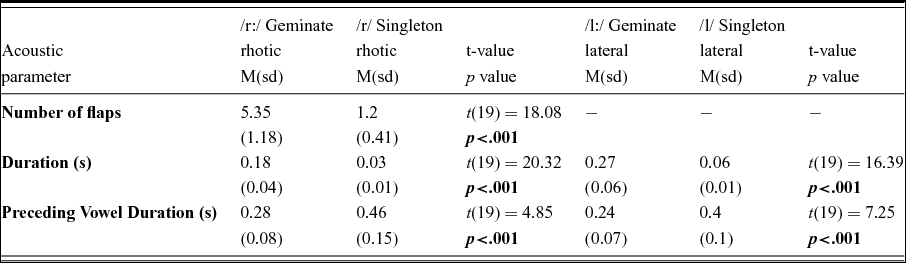
To determine whether the critical Friuli contrasts nonetheless displayed reliable acoustic differences, the extracted critical consonants were measured using Praat (Boersma, Reference Broersma2002). In the AXB stimuli, /r:/ was significantly longer than /r/ (t(19) = 20.32, p < .001), contained a larger number of taps (t(19) = 18.08, p < .001), and the preceding vowel was shorter for /r:/ than /r/ (t(19) = 4.85, p < .001). Likewise, /l:/ was longer than /l/ (t(19) = 16.39, p < .001), and the preceding vowel was shorter for /l:/ than /l/ (t(19) = 7.25, p < .001) (see Table 1).
Acoustic characteristics of the Friuli Italian /r:/-/r/ and /l:/-/l/ contrasts extracted from disyllables used in the Italian AXB discrimination task.

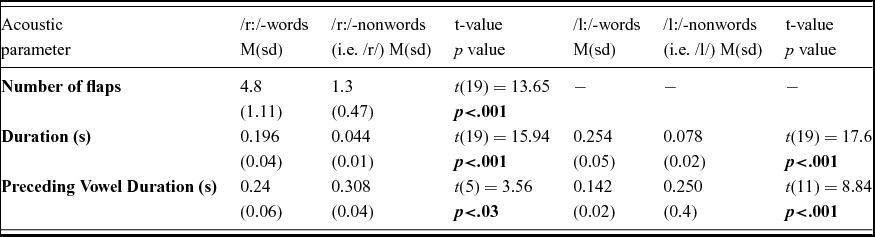
Regarding the stimuli used in the lexical decision task, critical /r:/- and /l:/-words were comparable in terms of frequency and syllable length, based on the Colfis database (Laudanna, Thornton, Brown, Burani & Marconi, Reference Laudanna, Thornton, Brown, Burani and Marconi1995). Out of the 3.8 million entries included in the database, mean frequency for /r:/-words was 176.5 and for /l:/-words was 77.6 (t(19) = 1.69, p > .05). /r:/-words had 2.8 syllables and /l:/-words 3.2 syllables, on average (t(19) = 1.76, p > .05). In perfect agreement with the AXB stimuli, /r:/ was significantly longer than /r/ (t(19) = 15.94, p < .001), had a larger number of taps (t(19) = 13.65, p < .001), and had a shorter preceding vowel (N = 6, t(5) = 3.56, p < .03). Similarly, /l:/ was significantly longer than /l/ (t(19) = 17.6, p < .001) and had a shorter preceding vowel (N = 12, t(11) = 8.84, p < .001) (see Table 2). Degrees of freedom differ for preceding vowel duration because we only included items in which the primary accent fell on the vowel preceding the critical consonant.
Acoustic characteristics of the Friuli Italian /r:/, /r/, /l:/ and /l/ consonants extracted from words and nonwords used in the Italian Lexical Decision task.

Note that tests in the case of the preceding vowel duration, the degrees of freedom do not match the rest of the values because only those items where the accent fell on the vowel that preceded the singleton/geminate consonant were included.
These reliable acoustic differences indicate that in Friuli Italian, the gemination distinction is minimized but not fully merged, i.e., it is a near-merger. In near-mergers, speakers maintain small but reliable differences in production, but no longer reliably distinguish them in perception, thus treating minimal-pair items like carro ‘wagon’ -caro ‘expensive’ as homophonous. Such near-merger effects have been reported for many phonologically-neutralized contrasts across languages (e.g., Russian palatalization: Diehm & Johnson, Reference Diehm and Johnson1997; Utah English pre-lateral vowels: Faber & Di Paolo, Reference Faber and Di Paolo1995; German final stop devoicing: Fourakis & Iverson, Reference Fourakis and Iverson1984; numerous languages: Labov, Karen & Miller, Reference Labov, Karen and Miller1991; Dutch final stop devoicing: Warner, Jongman, Sereno & Kemps, Reference Warner, Jongman, Sereno and Kemps2004).
Procedure
To assure understanding of both tasks, participants first performed a practice set with standard Italian stimuli, the familiar accent for them. These were recorded by an adult female native speaker from the Province of Venice, in the Veneto region of northern Italy, which maintains consonant gemination contrasts. Friuli Italian was used for the real task. All stimuli were presented binaurally over Sennheiser HD 440 Studio headphones at a comfortable listening level. Trial order was randomized for each listener; participants were asked to respond as quickly and accurately as possible.
Italian AXB discrimination task
Each AXB trial presented three tokens, and the participant's task was to decide whether the phonemic category of the middle item matched the category of first token (AAB) or the last token (ABB). The middle “X” item was always a different utterance of both the “A” and “B” items. Subjects were instructed to press one button on a computer keyboard with the left index finger when the middle item matched the first item, and a different button with the right index finger when it matched the last item. The labels “1” and “3” (first token matched X; third token matched X) were shown on the left and right sides, respectively, of a computer monitor. The Inter Stimulus Interval (ISI) among these items was 300 ms. The Inter Trial Interval (ITI) was 1000 ms after the subject made a response. If no response was made within 2500 ms, the next trial began. All subsequent tasks used this ITI and no-response interval.
There were two counterbalanced lists of 200 randomized trials (40 critical, 160 control), which only differed in whether for each trial the item matching X appeared in first or third position (i.e., ABB vs. AAB were switched between lists). Each list was used for half of the participants.
Italian Auditory Lexical Decision task
There were two counterbalanced lists of 240 trials (40 critical, 200 control), such that the word and nonword version of the same item never appeared in the same list. Half of the participants were tested with one of the lists and the other half with the other list. The Inter Trial Interval (ITI) was 750 ms. Participants were informed in advance that nonwords would only present subtle differences in relation to real words, to encourage attention to pronunciation details. Since not all participants had the same knowledge of Italian, we asked them to classify the words used in the task in a post-test questionnaire. Early bilinguals knew 79.4% of the Italian words, had never heard of 14.7%, and were unsure about the remaining 5.9%. As expected, late bilinguals’ Italian lexicon was smaller: they knew 69.2% of the words, had never heard of 16.2%, and were unsure about 14.6%. One subject from the late bilingual group was excluded because she did not fill in the post-test questionnaire, preventing us from assessing her knowledge of the Italian words used in the experiment. Another extra subject was added instead. Only the Italian words that the subjects reported to know were included in the posterior analyses.
Results and discussion
Italian AXB discrimination task
The main goal of this task was to assess whether less familiar regional accents of the L2 pose any difficulties for listeners at the prelexical phonetic level. To address this question, data were analyzed using the lme4 package (Bates, Maechler, Bolker & Walker, Reference Bates, Maechler, Bolker and Walker2013) for linear mixed-effect models in R (R Development Core Team, 2012). For this and for the following experiments, we built a series of models following a forward model selection procedure in order to determine the best fitting model. Starting with a null model that only included the random intercepts, we incrementally added predictors and random-effects structure until the fit no longer improved. We used likelihood ratio tests (Baayen, Davidson & Bates, Reference Baayen, Davidson and Bates2008; Dixon, Reference Dixon2008) to determine whether each additional fixed and random factor significantly improved the fit of the model. The base model included by-subjects and by-items random intercepts and random slopes. Group, Contrast and Position were the fixed factors, together with an interaction of Group by Contrast by Position. Early vs. late bilinguals were the levels for Group; rhotic vs. lateral vs. control were the levels for Contrast; and AAB vs. ABB were the levels for Position. Accuracy and reaction times (RT) were analyzed separately as dependent variables, with RTs measured from the onset of the item. The reference level for the intercept was set to the early bilingual group, control contrast and AAB position, to evaluate the effect of contrast and position in late bilinguals’ accuracy. The intercept, the estimated regression coefficients (Estimate), standard error (SE) and t/Wald's z values resulting from the linear mixed-effect model analysis are reported for each comparison of interest. The significance of fixed-effect factors and interactions was evaluated based on Z-scores and associated p-values for non-Gaussian models. For Gaussian models, we used an absolute t-value exceeding 2 as a robust indicator of significance for an alpha level of .05 (Baayen, Reference Baayen, Cohn, Fougeron and Huffman2012; Baayen et al., Reference Baayen, Davidson and Bates2008). Missing responses (0.5%), trials with responses faster than 200 ms (1%), and time-outs (1.3%) were excluded from the analysis. Due to a software problem, the data file of one subject was corrupted, leaving 17 participants in the group of late bilinguals.
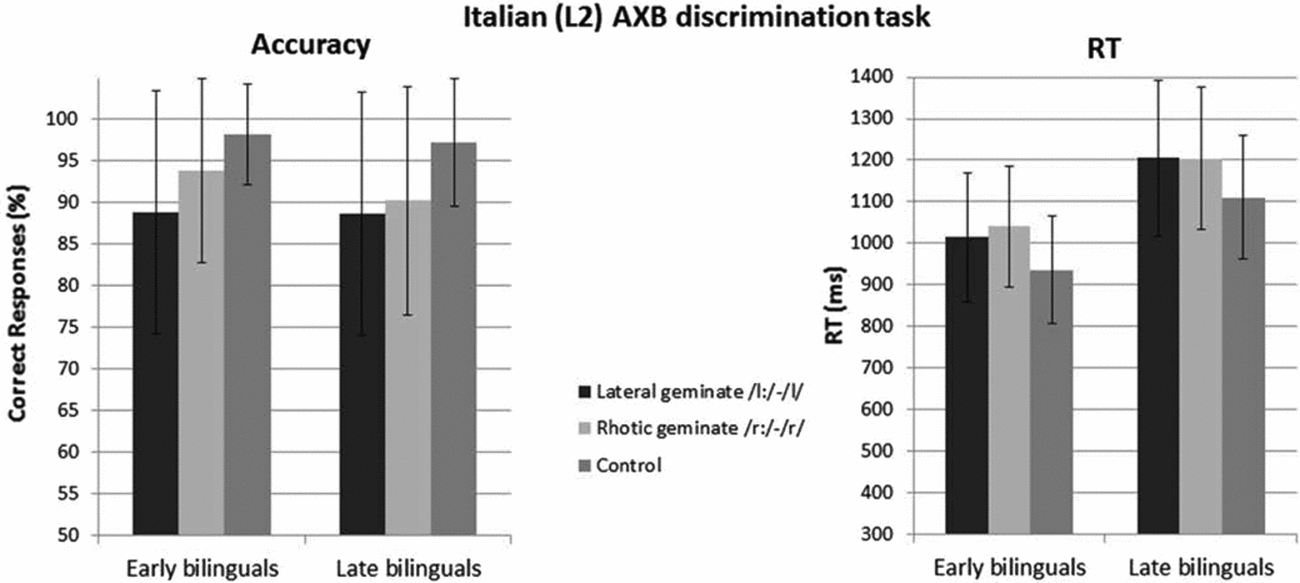
Late bilinguals had only slightly greater discrimination difficulties with the Friuli accent contrasts (95.7% correct) than did the early bilinguals (96.9%), as the marginal effect of Group demonstrates (Intercept: 4.66, SE: 0.34, β: −0.8, SE: 0.43, Wald's z: −1.86, p = .06); it did not interact with Position or Contrast (−1.1 ≤ z ≤ 0.1, .2 ≤ p ≤ .9). The significant Contrast effect resulted from poorer performance of both groups on the /l:/-/l/ contrast (88.7% correct) than the /r:/-/r/ (92.1% correct, Intercept: 5.24, SE: 1.02, β: −2.13, SE: 0.97, Wald's z: −2.19, p < .05) and control contrasts (97.7% correct, Intercept: 4.66, SE: 0.34, 97.7% correct, β: −1.53, SE: 0.55, Wald's z: −2.78, p < .01). The discrimination of /r:/-/r/ was less accurate in ABB than AAB position, as indicated by a significant interaction of Contrast by Position (β: −2.2, SE: 1.1, Wald's z: −2, p < .05).
Incorrect trials (3.7%) were excluded from the RT analysis. Late bilinguals showed not only significantly greater costs to accuracy, but also slower performance (1127 ms) relative to the early bilinguals (953 ms), as the main effect of Group demonstrates (Intercept: 960.6, SE: 34.51, β: 174.21, SE: 47.41, t: 3.67). This did not interact with Contrast or Position (0.8 ≤ t ≤ 1.4, all nonsignificant). Overall, listeners took longer to distinguish /l:/-/l/ (1109 ms, β: 137.63, SE: 53.87, t: 2.56) and /r:/-/r/ (1122 ms, β: 124.28, SE: 48.49, t: 2.56) than the control contrasts (1022 ms). The significant effect of Position (β: −49.74, SE: 14.24, t: −3.49) indicates overall faster responses for the ABB position (1017 ms) than the AAB position (1062 ms).
Accuracy and reaction time results for the Italian AXB task by English–Italian early and late bilinguals. The error bars in this Figure and in all other Figures represent 95% confidence intervals. Results for AAB and ABB positions were merged in this Figure.

Italian Auditory Lexical Decision task
Model fit was obtained using the same procedure as in the AXB task, which determined that a base model with the fixed factors of Group (English–Italian early and late bilinguals), Lexicality (word, nonword) and Consonant (/r:/, /l:/, control), and a 3-way interaction among these predictors was the best fit. The best fitting model also included random intercepts and random slopes for both subjects and items. Reference level for the intercept was set to the bilingual group, the word condition and control contrast. Missing responses (1%) and time-outs (12.3%) were not included in the analysis.
The central question addressed by this task is whether the two groups of L2 listeners recognize Italian critical nonwords as real words, reflecting perceptual accommodation to regional accents where geminate and singleton consonants tend to be pronounced similarly, such as in the Friuli accent. For pragmatic purposes, the acceptance of either a critical or a control nonword as a real word was counted as an error in the accuracy analysis. However, at the theoretical level, critical nonwords that listeners accepted as valid words should instead be interpreted as indicators that listeners showed some degree of perceptual remapping of the Friuli accented consonants to the corresponding Italian consonants for those words.
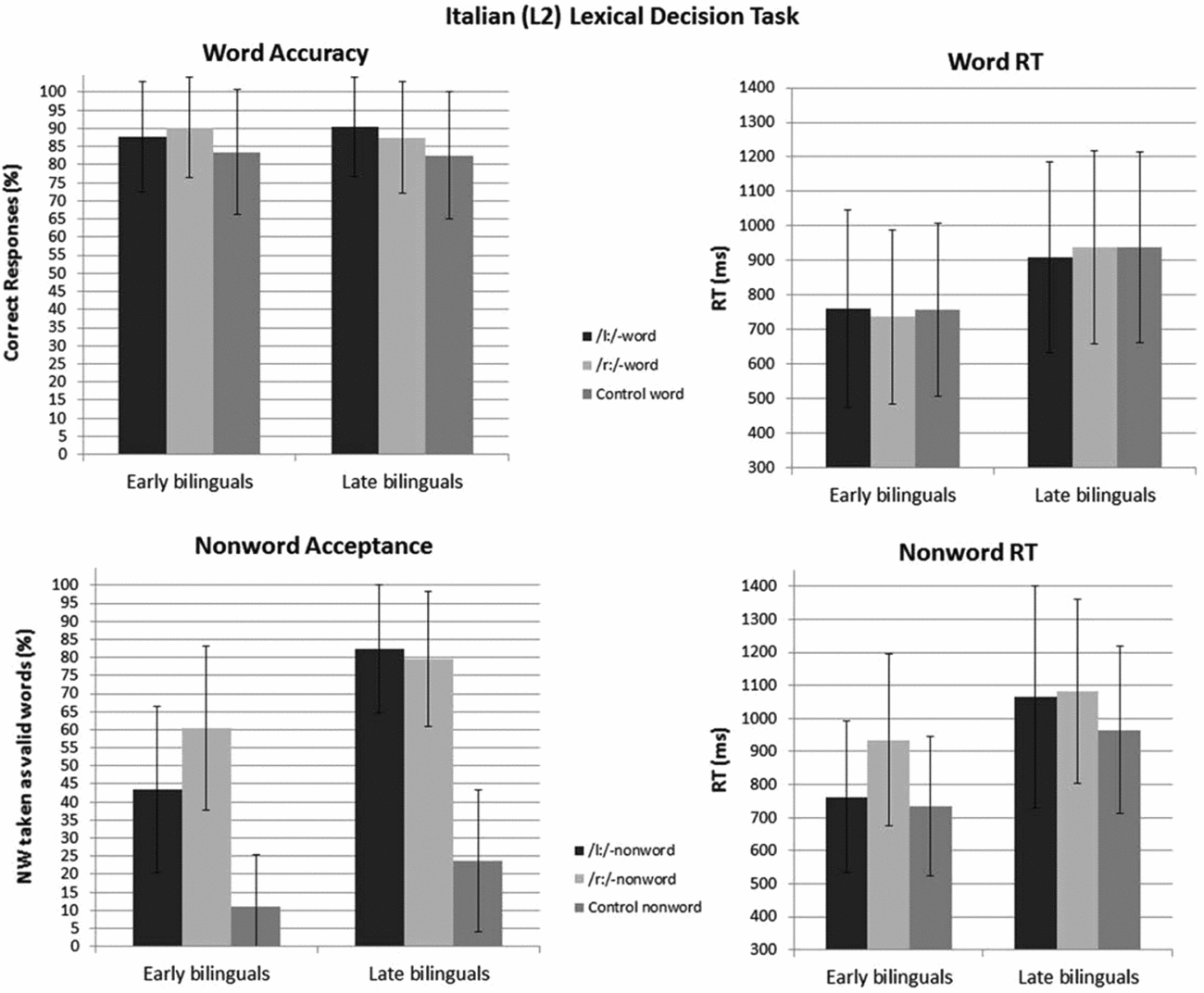
Lexicality was marginal (Intercept: 2.18, SE: 0.3, β: 0.74, SE: 0.4, Wald's z: 1.88, p = .06), indicating that correct performance was somewhat better on words (85.5%) than on nonwords (74.2%). Consistent with hypotheses, nonword accuracy was especially affected in the case of critical nonwords, as the significant interaction of Lexicality by Consonant indicates both for /l:/-nonwords (β: −2.72, SE: 0.66, Wald's z: −4.13, p < .001) and /r:/-nonwords (β: −4.72, SE: 0.67, Wald's z: −7.06, p < .001). The interaction of Group by Lexicality (β: −1.11, SE: 0.49, Wald's z: −2.28, p < .03) demonstrates that English–Italian late bilinguals had more difficulties with nonwords; this did not interact with Consonant (−1.6 ≤ z ≤ 1.2, .09 ≤ p ≤ .19).
Incorrect trials (21.9%) were not included in the RT analysis. Even though nonwords (846 ms) were rejected a bit more slowly than words were recognized (831 ms), this difference was not significant (Intercept: 686.89, SE: 93.54, β: 26.62, SE: 43.51, t: 0.61, n.s.). A significant interaction of Lexicality by Consonant (β: 180.86, SE: 65.32, t: 2.77), however, revealed that /r:/-nonwords provoked significantly slower responses than control nonwords. Late bilinguals (945 ms) performed significantly more slowly than early bilinguals (750 ms) (β: 307.59, SE: 133.13, t: 2.31). For the comparison of greater interest, late bilinguals were significantly slower than early bilinguals in rejecting /l:/-nonwords, as the 3-way interaction of Group by Lexicality by Consonant reflects (β: 251.17, SE: 126.36, t: 1.99).
Accuracy and reaction time results for words and nonwords in the Italian Lexical Decision task by English–Italian early and late bilinguals. The left panel below shows the percentage of nonwords that were taken as valid Italian utterances, showing that participants, especially late bilinguals, systematically accepted /l:/- and /r:/-nonwords.

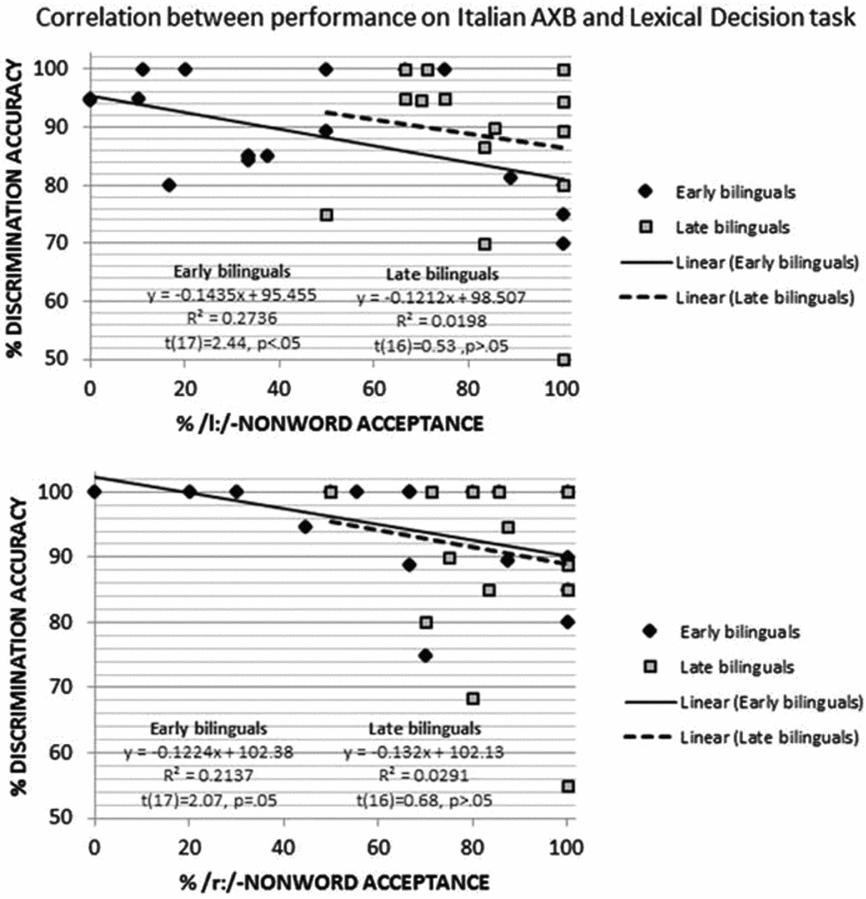
It remains crucial to determine whether the two types of listeners accepted L2 nonwords as valid utterances due to perceptual difficulties discriminating the L2 critical contrasts, or whether, instead, other forces were driving critical nonword recognition. Remember that /l:/- and /r:/-nonwords are plausible variants of real words in the Friuli accent. Thus, accepting them as words would reflect some kind of perceptual accommodation to the target accent, a tendency that is clearly not applicable to control nonwords. Correlation analyses between the results of the Italian AXB and lexical tasks show a divergent pattern between the two groups. Early bilinguals show a negative correlation between AXB discrimination accuracy on /l:/-/l/ and acceptance of /l:/-nonwords (r = −0.52, t(17) = 2.44, p < .05), and also between /r:/-/r/ discrimination accuracy and /r:/-nonword acceptance (r = −0.46, t(17) = 2.07, p = .05). The more accurate their discrimination in the AXB task, the less they accepted /l:/- and /r:/-nonwords as real words. Thus, early bilinguals recognized Italian critical nonwords as plausible correct pronunciations based on their discrimination capacity. In contrast, for late bilinguals, neither the acceptance of /l:/-nonwords (r = −0.14, t(16) = 0.53, p > .05), nor of /r:/-nonwords (r = −0.17, t(16) = 0.51, p > .05) were correlated with discrimination performance.
Correlation between the accuracy on the discrimination of Italian critical contrasts (AXB task) and the acceptance of critical nonwords (Lexical Decision task), by English–Italian early and late bilinguals. Results above correspond to the /l:/-/l/ contrast and /l:/-nonwords, and results below to the /r:/-/r/ contrast and /r:/-nonwords.

Given that discrimination difficulties at the phonetic level are not the cause of late bilinguals’ acceptance of critical nonwords, some kind of perceptual mechanism may be operating to allow them match the surface phonetic variants with the stored lexical representationsFootnote 3. We consider specifically what these mechanisms might be in the General Discussion. First, however, we turn to the comparison context: perceptual effects of accent variation in the L1.
Experiment 2: L1-English phonetic-to-lexical mapping
To provide the critical L1 baseline comparison, we tested perception of accented realizations of L1-English contrasts in AXB discrimination and lexical decision tasks like those of Experiment 1, in which the same two groups of listeners were tested on the two selected fricative contrasts in the target Manchester English accent: /f/-/θ/, /v/-/ð/. These phonemic contrasts exist in the listeners’ native accent (Australian English), but differ in acoustic-phonetic properties between the two English accents. Specifically, the Manchester accent (unlike Australian English) has been described as having an /f/-like realization for intervocalic /θ/, and a /v/-like realization for intervocalic /ð/.
We predicted Category-Goodness discrimination of the Manchester accent critical contrasts, because they are phonetically less distinct than in Australian English. If the contrasts are shown to be near-mergers rather than full neutralizations, they should not yield Single Category assimilations to the L1 accent, but instead they should be discriminated as a Category Goodness difference relative to the L1 native accent. Still, the Manchester-accented critical contrasts might produce poorer performance, though above chance, than control contrasts, which should be equally discriminable across both English accents. As these are native contrasts both for early and late bilinguals, we do not expect the two groups to differ in either task in this experiment.
Method
Participants
The participants were the same as those in Experiment 1: 18 early and 18 late bilinguals.
Stimuli
Items were recorded by an adult male native speaker of Manchester, UK, English, following the procedures described for the Italian recordings.
English AXB discrimination task
Disyllabic nonword stimuli were used in which the target fricative place contrasts, interdental voiceless /θ/ versus labio-dental voiceless /f/ and interdental voiced /ð/ versus labio-dental voiced /v/, occurred in intervocalic position. Manchester speakers tend to minimize each of these contrasts in intervocalic position, resulting in near-substitution of /θ/~>/f/ and /ð/~>/v/ (see Appendix C). Participants listened to 40 critical trials (4 consonants [/θ/, /f/, /ð/, /v/] x 5 vowel contexts each x 2 positions [AAB, ABB]). 120 control trials were also included, using contrasts that are legal and fully realized in both Australian and Manchester English (/s/-/∫/, /n/-/m/, /n/-/l/).
English Auditory Lexical Decision task
The test stimuli included 40 critical items: 10 /θ/-words, 10 /ð/-words, 10 /θ/-nonwords and 10 /ð/-nonwords. Critical nonwords were made by exchanging the original /θ/ and /ð/ phonemes with the other member of the contrast, always in intervocalic contexts: e.g., cathedral /kəθiːdrəl/ ~> /kəfiːdrəl/, mother /mʌðə/ ~> /mʌvə/. 210 control items were also included: there were 90 English words that did not contain any of the critical consonants (/θ/, /f/, /ð/, /v/), together with 120 control nonwords made of single-phonetic-feature-changes, similar to the critical exchanges. Control nonwords involved phonemic contrasts shared by Manchester British and Australian English (/d/-/t/, /b/-/p/, /g/-/k/, /n/-/m/). Out of the 17.9 million word lemmas included in the Celex database (Baayen, Piepenbrock & van Rijn, Reference Baayen, Piepenbrock and van Rijn1995), the mean occurrence of /θ/-words was 6169 and that for /ð/-words was 9839 (t(19) = 0.67, p > .05) (see stimuli in Appendix D). If participants accept more of the critical nonwords than control nonwords as real words, this would indicate some perceptual accommodation to the pronunciations of /θ/ and /ð/ in the Manchester accent.
Acoustic analyses
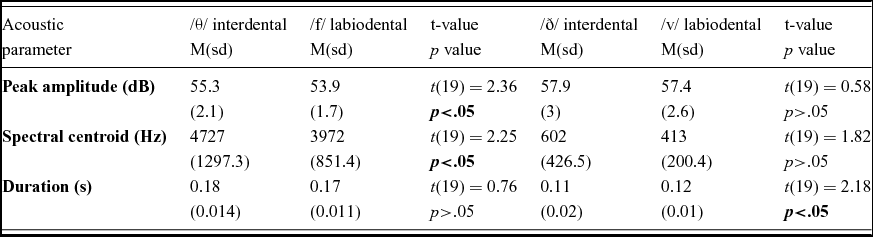
For the English AXB stimuli the “fronted” interdental /θ/ fricative was louder (t(19) = 2.36, p < .05) and had a higher spectral centroid (t(19) = 2.25, p < .05) than the true labio-dental /f/, but their durations did not differ significantly. The true labio-dental /v/ and the “fronted” interdental /ð/ differed significantly only in duration (t(19) = 2.18, p < .05), not in amplitude or spectral centroid (see Table 3).
Acoustic characteristics of the Manchester English /f/-/θ/ and /v/-/ð/ contrasts extracted from disyllables used in the English AXB discrimination task.

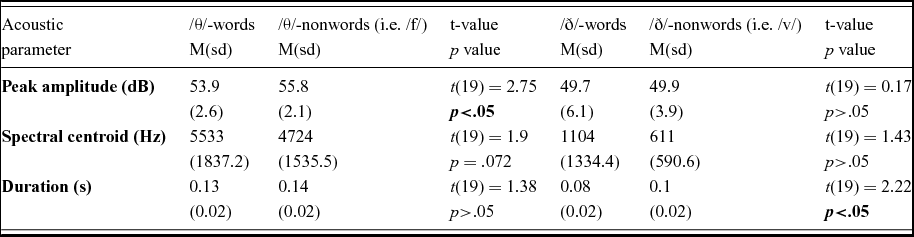
For the English lexical decision task stimuli, /θ/-words (M = 3.05 syllables) were on average significantly longer than /ð/-words (M = 2.2 syllables) (t(19) = 3.89, p < .001). Table 4 summarizes the results of the acoustic analyses. Consistent with the English AXB stimuli, the fricative portion of /θ/-words and /θ/-nonwords (i.e., with /f/ substituted for /θ/) were significantly different in peak amplitude, with the /θ/-nonword fricatives being louder (t(19) = 2.75, p < .05). The fricative in /ð/-nonwords (i.e., with /v/ substituted for /ð/) was significantly longer than that in /ð/-words (t(19) = 2.22, p < .05).
Acoustic characteristics of the Manchester English /θ/, /f/, /ð/ and /v/ fricatives extracted from words and nonwords used in the English Lexical Decision task.

The reliable acoustic differences between /f/-/θ/ and /v/-/ð/ suggest these contrasts are near-mergers rather than completely phonetically merged, as with the Friuli near-mergers for the geminate contrasts.
Procedure
Participants first completed a practice set for each task in their familiar Australian English accent, recorded by an adult female native speaker from Sydney, Australia. The Manchester accent was only used for the real task.
English AXB discrimination task
There were two counterbalanced lists of 160 trials (40 critical, 120 control). The Inter Stimulus Interval (ISI), Inter Trial Interval (ITI) and treatment of missing responses were the same as in the Italian AXB Discrimination task.
English Auditory Lexical Decision task
There were two counterbalanced lists of 250 trials (40 critical, 210 control), such that the word and nonword version of the same item never appeared in the same list. We followed exactly the same procedure as in the Italian lexical decision task. The post-test revealed that the participants knew 98.3% of the English words included in the task, had never heard of 1.5%, and were unsure about the remaining 0.2%.
Results and discussion
Accuracy and RT were modeled in the same manner as in Experiment 1.
English AXB discrimination task
The base model included by-subjects and by-items random intercepts and random slopes. Contrast and Position were the fixed factors, together with an interaction of Contrast by Position. Voiceless fricative, voiced fricative and control contrasts were the levels for Contrast, and AAB and ABB were the levels for Position. In an initial analysis, Group was also included as a fixed factor. But, consistent with our expectations and their very similar L1 profiles, neither the main effect nor any interactions with it were significant. Therefore, all the analyses presented here combined them into a single group of native speakers. The reference level for the intercept was set to the control contrast and AAB position. Missing responses (0.5%) and trials with responses faster than 200 ms (1%) were not included in the analysis.
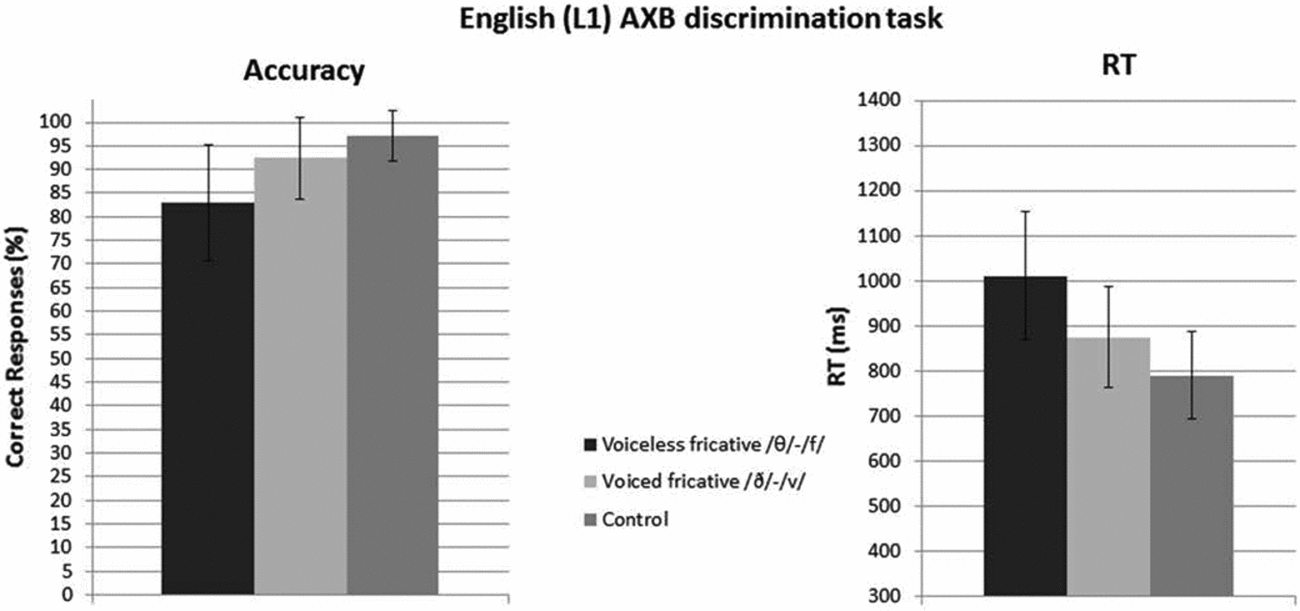
Figure 4 shows that, as expected, performance was significantly better on control contrasts (97.2%) than on the critical voiceless (83% correct, Intercept: 3.96, SE: 0.29, β: −2.02, SE: 0.41, Wald's z: −4.94, p < .001) and voiced fricative contrasts (92.4% correct, β: −1.17, SE: 0.4, Wald's z: −2.92, p < .005). The difference between the voiceless and voiced fricative contrasts was also significant (Intercept: 1.93, SE: 0.32, β: 0.87, SE: 0.39, Wald's z: 2.21, p < .03). The effect of Position was non-significant (β: −0.05, SE: 0.42, Wald's z: −0.13, p > .05), as was the interaction of Contrast by Position (−0.1 ≤ z ≤ 0.6, 0.8 ≤ p ≤ 0.5).
Accuracy and reaction time results for the three contrast types in the English AXB task by native speakers of Australian English. Results for AAB and ABB positions were merged in this Figure.

In the analysis of reaction times, incorrect trials (5.2%) were excluded. The RT results agreed with the accuracy results: responses were faster for contrasts with higher accuracy, and the voiced fricative contrast was discriminated more slowly (875 ms) than control contrasts (790 ms), but faster than the voiceless fricative contrast (1011 ms). The Contrast effect revealed significantly slower RTs for the voiceless fricative contrast (Intercept: 847.37, SE: 29.46, β: 181.91, SE: 46.3, t: 3.93) and marginally slower RTs for the voiced fricative contrast (β: 63.39, SE: 35.19, t: 1.8), relative to the control contrasts. Overall, the Position effect was significant, indicating that contrasts were discriminated faster in ABB than AAB position (β: −75.52, SE: 16.6, t: −4.55). The Contrast by Position interaction was non-significant (0.3 ≤ t ≤ 1.1), indicating that this Position tendency held for both critical and control contrasts.
Consistent with our predictions, the discrimination results indicate that not all phonemic contrasts are equally easy to discriminate, even within the native inventory (Bundgaard-Nielsen, Baker, Harvey, Kroos & Best, Reference Bundgaard-Nielsen, Baker, Harvey, Kroos and Best2015; Miller & Nicely, Reference Miller and Nicely1955). Actually, our listeners show poorer performance on the voiceless than the voiced fricative contrast, consistent with prior evidence that the salience of acoustic-phonetic parameters influences even L1 phonetic discrimination (e.g., Miller & Nicely, Reference Miller and Nicely1955). More importantly, our results are consistent with the acoustic measurements indicating that the Manchester accent has not merged the critical contrasts completely, but rather they both reflect a near-merger situation. That is, there remains sufficient acoustic differentiation that even listeners of another accent can discriminate them as well as 83–92%, which is well above chance (50% on AXB tasks) for both the voiceless (t(35) = 15.45, p < .001) and the voiced fricative contrasts (t(35) = 42.67, p < .001).
English Auditory Lexical Decision task
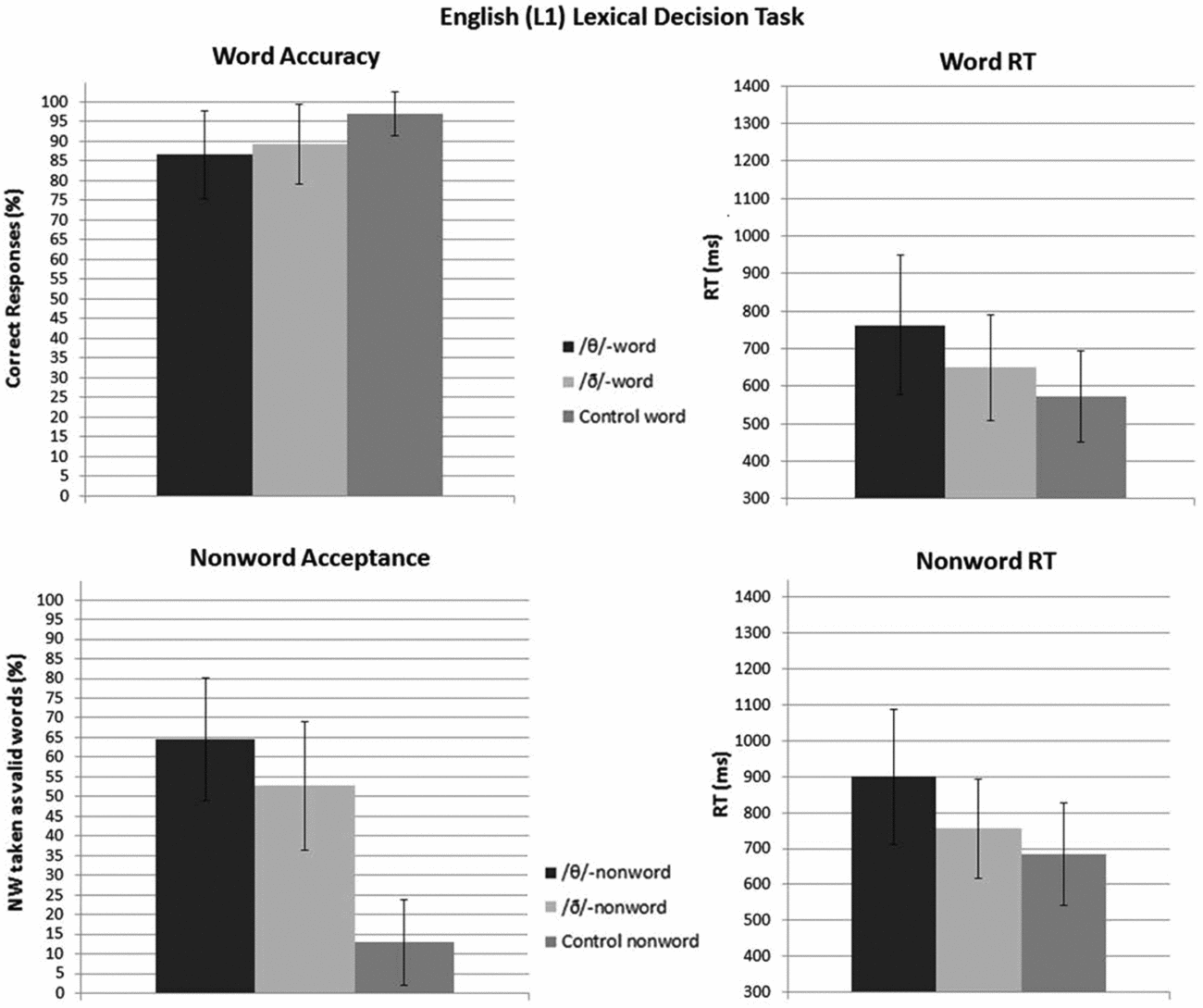
The best fitting model included Lexicality (word, nonword) and Consonant (/θ/, /ð/, control) as fixed factors, with by-subject and by-item random intercepts and by-subject random slope. To account for possible confounding interactions among these predictors, the model included an interaction between the fixed factors. The reference level was set to the word condition and control consonants. Missing responses (0.2%) and time-outs (13.5%) were treated as in Experiment 1. Figure 5 presents the accuracy and reaction time data for the word and nonword stimuli.
Accuracy and reaction time results for words and nonwords in the English Lexical Decision task by native speakers of Australian English.

As expected, accuracy was better on words (95.3%) than nonwords (80.8%), creating a significant effect of Lexicality (Intercept: 4.44, SE: 0.25, β: −1.73, SE: 0.27, Wald's z: −6.47, p < .001). There was also a significant effect of Consonant driven by the lower accuracy for critical consonants than for control consonants (91.1% correct): voiceless /θ/ (59.3% correct, β: −1.66, SE: 0.5, Wald's z: −3.35, p < .001) and voiced /ð/ (67.7% correct, β: −1.47, SE: 0.48, Wald's z: −3.09, p < .005). The interactions of Lexicality by Consonant demonstrate that accuracy was most severely affected for critical nonwords: both /θ/-nonwords (β: −1.84, SE: 0.62, Wald's z: −2.97, p < .005) and /ð/-nonwords (β: −1.49, SE: 0.61, Wald's z: −2.43, p < .03) showed significantly poorer results than control nonwords.
Incorrect trials (13.1%) – i.e., those accepted either as valid English words when they actually were nonwords, or taken as nonwords when they were real English words – were not included in the RT analysis. In general, participants performed more slowly in rejecting nonwords (694 ms) than in recognizing words (594 ms), which yielded a significant effect of Lexicality (Intercept: 547.16, SE: 47.92, β: 134.94, SE: 15.96, t: 8.46). There was also a main effect of Consonant, due to the processing difficulties that /ð/ (688 ms, β: 98.73, SE: 34.46, t: 2.87) and especially /θ/ (806 ms, β: 165.71, SE: 48.68, t: 3.4) seemed to impose, relative to listeners’ more rapid decisions for correct rejections of the control consonants (637 ms). It might be that stimulus length differences have had a partial effect here, given that /θ/-words were longer on average. /θ/ slowed down performance particularly in nonwords, as the significant interaction of Lexicality by Consonant indicates (β: 111.54, SE: 51.97, t: 2.15).
Note that the left panel in Figure 5 shows the percentage of nonwords that were taken as valid English utterances, showing that participants accepted /θ/- and /ð/-nonwords as real words over 50% of the time.
Correlation analyses found no significant correlation between discrimination accuracy on the /θ/-/f/ contrast and acceptance of /θ/-nonwords in the lexical decision task (r = −0.24, t(35) = 1.43, p = .16). The same is true for /ð/-nonwords (r = 0.07, t(35) = 0.41, p = .68). That is, the extent to which listeners accept /θ/- and /ð/-nonwords as valid English items was not determined by how accurately they discriminated the /θ/-/f/ and /ð/-/v/ contrasts. In contrast, there was a significant negative correlation for control nonwords (r = −0.49, t(35) = 3.24, p < .005); the more poorly listeners discriminated the control contrasts, the more they accepted control nonwords as correct pronunciations. This divergent pattern of correlations indicates that accommodation to regional accent variation does not depend on the phonetic information detected at the prelexical level. Instead, some phonetic-to-phonemic mapping mechanisms may operate, enabling matching between the “deviant” phonetic input and stored word forms. This clearly contrasts with the relevant phonemic level contribution to rejection of the control nonwords.
General discussion
The goal of this study was to investigate differences in the phonetic-to-lexical mapping of L1 and L2 regional accents by subjects who speak two languages. Having compared listeners’ L1 versus L2 discrimination accuracy, we first conclude that accent familiarity plays a role on phonemic perception across bilinguals’ two languages. That is, listeners showed less phonetic difficulties with contrasts maintained in their familiar regional accents, i.e., the control contrasts, independently of the L1 and L2. More importantly, our examination of the source of dialectal effects on speech processing represents an important step forward in the understanding of human speech perception. We tested whether L1 and L2 accented variants were recognized as valid items due to phonetic discrimination difficulties. That option was ruled out for the recognition of critical nonwords in the native language, English. The correlation analyses we ran (cf. English AXB and lexical decision tasks) clearly showed that perceptual adjustment to the target L1 accent led to the acceptance of /θ/- and /ð/-nonwords, a mechanism that was not applicable to control nonwords. Thus, even though Australian English listeners were not familiar with the Manchester UK accent, they were still able to perceptually adjust to its phonetic properties in such a way that lexical access was not impeded. /θ/- and /ð/-nonwords were regularly recognized as valid English words, although less often and more slowly than correct pronunciations were correctly recognized.
Given previous findings (e.g., Clarke & Garrett, Reference Clarke and Garrett2004) that listeners can very rapidly adjust to accented speech, our results raise the question of whether adaptation to the unfamiliar accent developed over the course of each of the experiments. In order to test that possibility, we statistically compared the data of the first and second halves of our tasks (both for the AXB and lexical decision tasks in the L1 and L2) separately, adding ‘experiment-part’ as a within subjects factor. But in all cases, no differences were found between the results of the first and second halves of the tasks, suggesting that invented nonword disyllables and isolated word/nonword stimuli were insufficient to induce perceptual learning in the current study.
Our results indicate that phonetic variation is handled differently in the L2 (Italian) than in the native language, and that the age of L2 learning affects this process. Concerning phonetic processing abilities, English–Italian late bilinguals show a discrimination cost (both in accuracy and RT) for accented variants of consonant contrasts that are not part of their native repertoire. Overall, accuracy on Italian critical contrasts was above 85% correct, consistent with the Category Goodness (CG) assimilation type proposed by the Perceptual Assimilation Model, PAM (Best, Reference Best and Strange1995), in which non-native contrasts are perceived as good versus deviant exemplars of a single native consonant. More specifically, the better performance shown by early bilinguals than late bilinguals is consistent with the PAM-L2 hypothesis: CG assimilation types should show perceptual improvement with increasing L2 learning (Best & Tyler, Reference Best, Tyler, Bohn and Munro2007).
Results of the Italian lexical decision experiment showed that phonetic variation may be more easily accommodated in the L2 than in the native language, where listeners were stricter in rejecting small mispronunciations in L1-English words that did not reflect regional accent differences (i.e., control nonwords). The difference in control nonword acceptance in Italian versus English is evident; our participants accepted 3.1% of L1 control nonwords, while this percentage increased considerably when they performed in their L2 (Italian). English–Italian early bilinguals took L2 control nonwords as (known) real words 10.9% of the time, i.e., more than 3 times as often. Thus, when small L2 phonetic differences are presented in a lexical context, participants are generally more likely to ignore them – and thus to perceive a nonword as a word – than in the L1.
The most intriguing finding comes from late bilinguals’ L2 performance at the lexical level. In spite of the accurate (97.2% correct) phonetic discrimination found with Italian control contrasts, late bilinguals erroneously accepted L2 control nonwords as real Italian items more than twice as often as early bilinguals did (23.8%), and more than 7 times as often as in L1-English. This suggests that L2 lexical representations were either less established in late bilinguals or they had a smaller lexicon than early bilinguals, due to their shorter and more indirect experience with Italian, considerably increasing spurious word activation. The very same phonemes that were clearly discriminated in the nonsense stimulus discrimination task were misidentified in words. This finding is in line with studies showing that tasks involving lexical processes provoke lower accuracy than perceptual tasks in second language listeners (e.g., Broersma, Reference Broersma2002; Broersma & Cutler, Reference Broersma and Cutler2008; Diaz et al., Reference Diaz, Mitterer, Broersma and Sebastián-Gallés2012; Hayes-Harb, Reference Hayes-Harb2007).
In relation to the acceptance of L2-Italian critical nonwords, there is a clear division between what early and late bilinguals seem to be doing. The negative correlations shown by early bilinguals between the AXB accuracy results and critical nonword acceptance indicate that lexical performance is based on their L2 phonetic discrimination capacity, rather than on perceptual accommodation. This result is surprising, as one might have expected early bilinguals to show larger capacity to accommodate to L2 regional accents, as we found for Spanish–Basque and French–Basque early bilinguals who systematically recognized L2 accented variants as valid items (Larraza et al., Reference Larraza, Samuel and Oñederra2016). The divergent patterns of exposure to L2 regional accents can explain the differences in the performance of the current English–Italian and the Spanish/French–Basque early bilinguals. For bilinguals living in a highly L1-dominant environment rather than a bilingual environment, the accommodation to L2 regional accents is less automatic, even when the second language was acquired at an early age.
The lexical processing abilities of the late bilinguals deserve separate consideration. Recall that no correlations were found between late bilinguals’ discrimination results and their acceptance of /l:/- and /r:/-nonwords. This lack of correlation could be interpreted as perceptual accommodation to the less familiar accent (cf. interpretation of the L1 English results). However, we believe this is not a plausible explanation for late bilinguals’ L2 processing. Contrary to what early bilinguals reported in the linguistic questionnaire, late bilinguals admitted not knowing any Italian regional accent that (near-)merges the consonants we presented in the Italian lexical decision task. The Samuel and Larraza (Reference Samuel and Larraza2015) study sheds light on the mechanism behind this behavior: our late bilinguals’ performance is consistent with the dual-route mapping rather than dual lexical representations that their participants showed. That is, it appears that English–Italian late bilinguals only have one word form represented, and in their mapping from the phonetic to the lexical level a dual route operates, making them systematically match the critical L2 consonants to any lexical item that presents one or the other accent variant.
Another plausible interpretation would have been to propose that our late bilinguals have dual representations for /l:/ and /r:/-words: a representation for the “standard” pronunciation (their home accent version in standard Italian) and a representation for non-standard pronunciations (other less familiar accents). If so, listeners would have developed different representations of the same word, as a consequence of listening to speakers with different regional accents pronounce those words differently. But given that our late bilinguals were not exposed to or even aware of any degeminating Italian accent, this account is not sustainable for the current findings. No listener develops a representation of a pronunciation she has not heard nor even knows could exist. In fact, these subjects started learning Italian as adults, with standard Italian being the variety they were exposed to – the most usual practice in second language teaching. Therefore, our late bilingual findings are best explained by the dual mapping account.
We showed that listeners recognize both L1 and L2 accented words even when they are not very familiar with the target regional variety. Regarding the main question of this study, our findings indicate that the mechanisms that operate in phonetic-to-lexical mapping are different in the native versus the second language. Abstract and flexible L1 prelexical representations allow bilinguals to efficiently overcome any mismatch present in regular variants of regional accents, in agreement with what Goslin et al. (Reference Goslin, Duffy and Floccia2012) and Sumner (Reference Sumner2011) found for the processing of regional variation in the native language. All participants accommodated to the Manchester accent and substantially recognized /θ/- and /ð/-nonwords as real English items. In contrast, we demonstrated that L2 accented variants are not adjusted by the same means. Even early bilinguals, who had longer exposure to the L2, recognized accented variants based on their phonetic discrimination abilities, leaving scarce space for perceptual accommodation. In the case of late bilinguals, for whom the accented variants were not represented in their L2 lexicon, they mapped standard and accented exemplars to the same lexical representations. That is, they heard L2 items with similar consonants as homophones in the course of lexical access.
Thus, the differences in phonetic-to-lexical mapping of L1 and L2 regional accents lie in how abstract and flexible bilinguals’ phonemic categories are, which results in qualitatively distinct yet similarly effective phonetic-to-lexical mapping strategies both for L1 and L2 regional accents. For cases where L2 accented variants are not represented in the bilingual's mental lexicon, dual mapping to one representation (Samuel & Larraza, Reference Samuel and Larraza2015) is an efficient mechanism for dealing with regional accents. Overall, this study offers evidence that regional accent variation does not impede lexical access in bilinguals with different ages of acquisition and corresponding levels of command of the second language. By extending the analysis of perceptual adaptation to both L2 and L1 regional accents and L1-dominant environment rather than the more studied bilingual environment, this study has increased our understanding of how bilingual listeners adjust to systematic phonetic variation in speech.
Appendix A
A representative sample of the stimuli and trials used in the Italian AXB discrimination task. IPA symbols are used for clarity. Correct answer is in boldface. Both critical and control contrasts were always combined with vowels pronounced similarly in Friuli and Standard Italian.

Appendix B
Stimuli used in the Italian Lexical Decision Task.

Appendix C
Representative sample of stimuli and trials in the English AXB discrimination task.

Appendix D
Stimuli used in the English Lexical Decision Task.