Transmission-based precautions (ie, contact, droplet, and airborne precautions) are applied to patients with suspected or confirmed infections transmissible via skin-to-skin contact, respiratory droplets, or airborne particles, respectively. Healthcare workers (HCWs) and visitors are required to don personal protective equipment before contact with the patient or the patient’s environment. Reference Siegel, Rhinehart, Jackson and Chiarello1 Infants in neonatal intensive care units (NICUs) are frequently placed on isolation precautions to prevent horizontal and indirect transmission of nosocomial pathogens. Reference McMicken2 However, isolation precautions have also been associated with adverse outcomes, including less interaction between patients and HCWs. Reference Morgan, Diekema, Sepkowitz and Perencevich3-Reference Saint, Higgins, Nallamothu and Chenoweth6 Data regarding the impact of isolation precautions on neonates are limited. Therefore, we aimed to determine whether the frequency of HCW and visitor interaction differs between infants on isolation precautions versus infants on standard precautions in the NICU.
Methods
We performed a case-control study in the University Hospital bay layout NICU (San Antonio, TX) from May to August, 2019. We collected data via “secret shopper” observations Reference Morgan, Pineles and Shardell5 ; they observed Reference Siegel, Rhinehart, Jackson and Chiarello1-Reference Abad, Fearday and Safdar4 infants from a discrete seating point during 1 of 4 designated observation periods, and we recorded the number of patient interactions each infant experienced. The NICU medical director and nurse manager were the only staff aware of the study hypothesis and secret shopper’s purpose. When observers were asked about their intentions by staff or family members, they stated only that they were involved with an observational research project.
Definitions
Cases were defined as infants on ≥1 isolation precautions. Controls were infants who were not on isolation precautions. For every case, 3 controls were matched by day of week, observation shift, and level of respiratory support. Respiratory support was recorded to control for severity of illness and was divided into 2 categories: room air or respiratory support (eg, nasal cannula, face mask, ventilator). A patient interaction was defined as beginning when an HCW or visitor arrived at an infant’s bed space with intent to interact with the infant and ending when they walked away from the infant’s bed to perform other duties.
Statistical analysis
After the first 12 infants (3 cases and 9 controls), an interim power estimated a decrease in contact of 35%. A power calculation showed that a minimum of 40 case observations would be needed for 90% power to detect a 35% reduction in patient interactions, given a 2-sided α of 0.05. Usual summary statistics were performed for all variables. For bivariate analyses, χ Reference McMicken2 testing and Wilcoxon rank-sum tests were used for categorical and continuous variables, respectively. To analyze factors associated with infant interaction, a multivariable linear regression model using forward and backward stepwise regression was performed. Isolation precautions and shift time were included as a priori variables. Stata version 15.1 software (StataCorp, College Station, TX) was used for all analyses. This study was approved by the Institutional Review Board at the University of Texas Health San Antonio.
Results
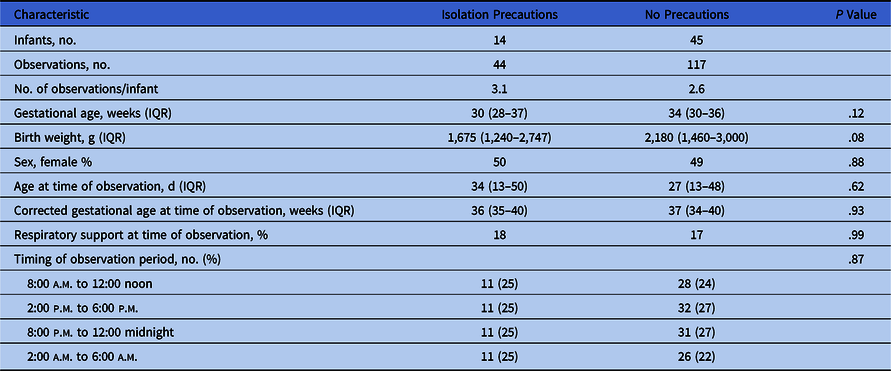
Data were collected from 59 infants (14 cases and 45 controls) during 161 observation periods (44 cases and 177 controls). Demographic and clinical characteristics of the observed infants are shown in Table 1. There were no significant demographic or clinical differences between cases and controls. Although the median gestational age and birth weight were lower among cases than control infants, the difference did not reach statistical significance.
Demographic and Clinical Features of Infants on Isolation Precautions (Cases) and Those Not on Isolation Precautions (Controls)

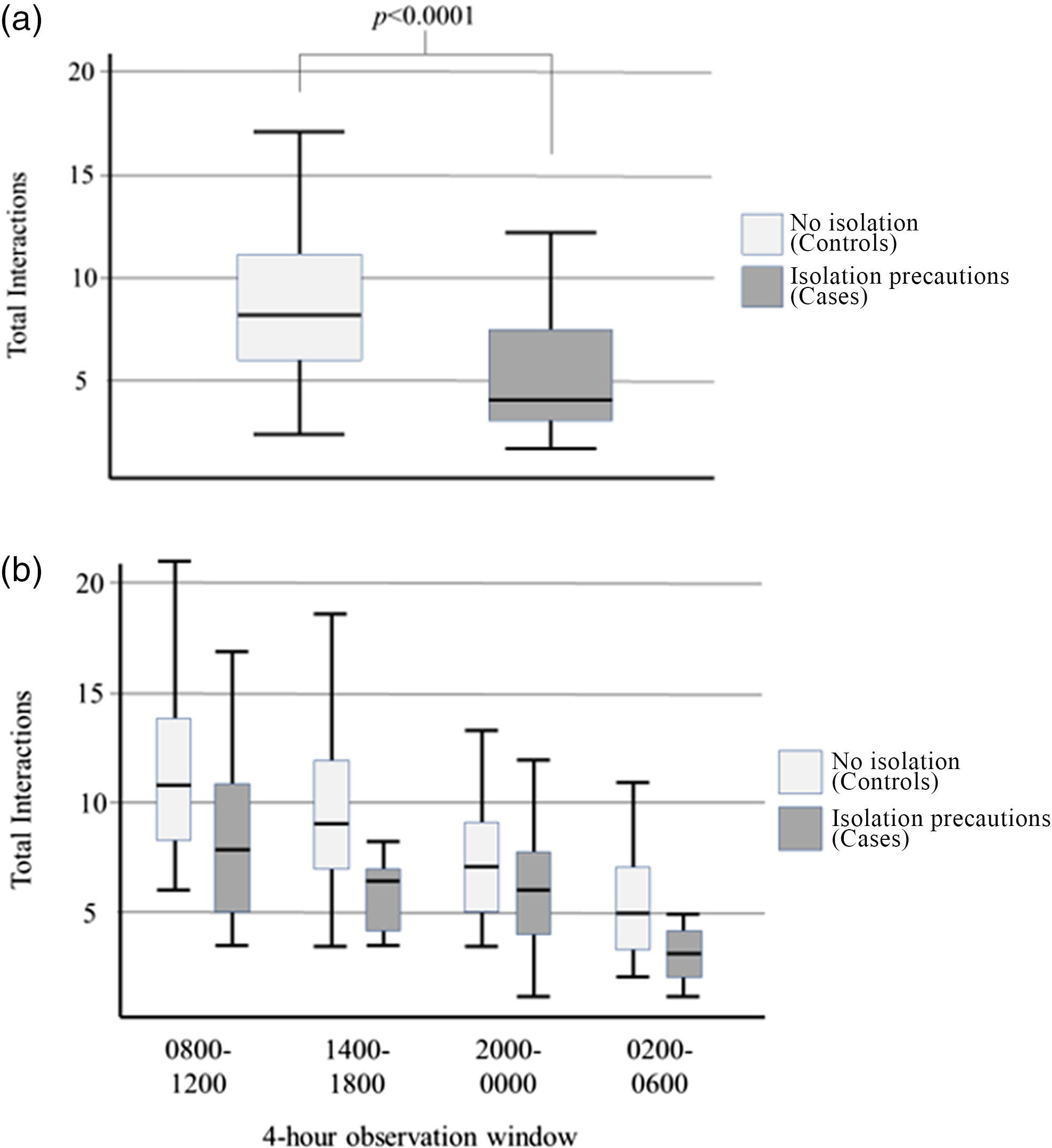
In bivariate analysis, infants on isolation precautions had fewer total interactions than control infants: mean, 39% decrease; median, 4 (interquartile range [IQR], 3–7) versus 8 (IQR, 6–11) (P < .0001) (Fig. 1). Isolated infants experienced an average decrease in interaction of 30%–50%. Total interaction was highest during the daytime, regardless of isolation precautions, and decreased in the evening and overnight: 8:00 a.m. to 12:00 noon = Reference; 2:00 p.m. to 6:00 p.m. = −1.1 (95% CI, −0.1 to −2.4]; 8:00 p.m. to 12:00 midnight = −2.5 (95% IC, −3.7 to −1.3); and 2:00 a.m. to 6:00 a.m. = −3.8 (IQR, −4.7 to −2.8). However, the decrease in total interaction with infants on isolation precautions compared with those not on precautions was consistent when observation time was controlled. In multivariable analysis, only isolation precautions and shift time were predictors of infant interaction.
Total infant-caregiver interactions (a) during 4-hour observation periods and (b) by 4-hour observation window. Infants not on isolation precautions (controls, light gray) had significantly more interactions than infants on isolation precautions (cases, dark gray). Median, interquartile range, minimum and maximum values are shown in the box plots.

Discussion
In this case–control study, infants on isolation precautions had reduced interaction with caregivers. Potential concerns regarding decreased infant interaction include increased risk for adverse medical events. Multiple studies note an increase of noninfectious adverse medical events such as falls and pressure ulcers for adult patients on isolation. Reference Morgan, Diekema, Sepkowitz and Perencevich3 We speculate that infants on isolation precautions could be at increased risk for certain medical complications, such as hardware displacement, intravenous line infiltration, or delay in detection or response to new clinical changes. Other concerns arise from decreased family and decreased enrichment activities. Numerous studies have detailed the benefits of skin-to-skin contact, including improved thermoregulation, glucose control, and pain relief. Reference Boundy7 Isolation precautions may interrupt skin-to-skin contact, either by reducing the number of caregiver visits or by physically interfering with skin-to-skin time (kangaroo care).
However, there may be potential benefits of decreased caregiver contact in the NICU. Infants in the NICU can experience toxic stress as a result of multisensory overstimulation (eg, high volumes, excessive lighting) which can impair neurodevelopment. Reference Weber and Harrison8 Infants may experience less toxic multisensory stimulation when in single-patient isolation rooms. Reference Meredith, Jnah and Newberry9 Isolettes also retain humidity and proper temperature more effectively if they are opened less frequently. Therefore, if isolated infants in isolettes experience decreased interaction, they may have improved thermoregulation and moisture retention compared to their nonisolated counterparts. Finally, studies have indicated that isolation precautions are an effective measure for preventing the spread of infectious disease in the NICU when combined with measures such as active surveillance cultures and patient cohorting. Reference Cipolla, Giuffrè, Mammina and Corsello10 Decreased interaction would also limit exposure to nosocomial pathogens.
This study had some limitations in addition to those inherent to case–control studies. One of the main limitations was the lack of a timed component for the interactions we counted. For example, a 4-minute interaction with the infant’s physician and a 4-hour interaction with the infant’s mother each counted as 1 interaction. Future studies should time these interactions, especially interactions with family who may stay at the bedside for prolonged periods. In addition, our relatively small sample size and single center data limits our generalizability to other centers. Reproducibility of our findings in multicenter studies would be important.
Multicenter studies would also allow comprehensive matching on a wider range of clinical variables; for example, matching for respiratory support did not help compare severity of illness for infants without respiratory complications (eg, an isolated infant with gastroschisis on room air compared with nonisolated infants in a step-down bay on room air). Finally, the Hawthorne effect (ie, the degree to which people alter their behavior when they are aware that they are being observed) was a major consideration for this study. We aimed to minimize the Hawthorne effect by limiting the staff who were aware of the purpose. Alternative designs for future studies could consider the use of hidden cameras or a larger pool of data collectors as possible ways to further minimize the Hawthorne effect.
In conclusion, in this study, we found a decrease in the overall number of interactions between isolated infants and their caregivers. Additional studies are needed to validate this finding and to determine whether there are adverse outcomes associated with decreased HCW interaction among infants in the NICU.
Financial support
This project was supported in party by the US Department of Education (Title V grant no. P031S150048).
Conflicts of interest
The authors have no financial considerations or conflicts of interest to declare.