





Journalists who cover distant wars perform an important role in our civil society by keeping us informed of events that have the potential to affect us all. Recent evidence suggests this work is becoming increasingly dangerous. William Howard Russell is generally considered the first civilian war reporter dispatched by a news organisation to report on a distant war. His account in The Times of London on 14 November 1854 of the Charge of the Light Brigade in the Crimean War still makes gripping reading today. Reference Knightley1 While Russell survived the conflict, subsequent generations of his colleagues have been less fortunate. Data kept by the Committee to Protect Journalists (CPJ) list 2391 journalists killed since 1992 when the organisation first started collecting such data. 2 Graphs provided by the CPJ track the yearly mortality and imprisonment rates going back to 1992. A closer look at data over the past 5 years reveals 45 journalists were killed in 2021, 68 in 2022, 90 in 2023, 116 in 2024 and 110 in 2025. To place these numbers in a historical context, 67 Western journalists were killed between 1939 and 1945 during the Second World War. 3 This number increases when Soviet journalists are included, but to what degree is uncertain as data here are unreliable. General MacArthur summed it up well when he observed that ‘in war, you win or lose, live or die – and the difference is just an eyelash’. Reference Hunt4
Given the grave dangers that come with this work, it is notable that nothing was published on the psychological toll of covering war on journalists until fairly recently. The first empirical data appeared in 2002 and revealed that the lifetime prevalence of post-traumatic stress disorder (PTSD) and major depression in a group of front-line journalists who had covered war for over a decade was 28.6 and 21.4%, respectively. Reference Feinstein, Owen and Blair5 Since then, a burgeoning literature has documented high levels of trauma and mood-related symptoms in journalists who cover not only war but other traumatic events such as man-made Reference Lee, Ha and Pae6 and natural Reference Dworznik-Hoak7 disasters, mass-shootings, Reference Backholm and Björkqvist8 riots, Reference Kocan and Miller9 the migration crisis, Reference Feinstein, Pavisian and Storm10 online harassment Reference Feinstein, Storm, Mead and Sharkey11 and the COVID pandemic. Reference Osmann, Meera and Feinstein12
These emerging data are consistent in revealing the degree to which journalists may be affected psychologically by front-line work. However, there are a number of significant limitations in the data to date. To begin with, virtually all the studies rely only on self-report questionnaire data. While informative, this approach cannot generate psychiatric diagnoses. Furthermore, these data only provide information on how journalists are feeling emotionally within a brief window of a few weeks at most. This point is indicative of a second major deficit in knowledge. There are no studies examining the psychiatric condition of journalists many years after their work in war zones. Therefore, we do not know what the long-term psychiatric outcome is for journalists who worked in the world’s most dangerous places. Indirect clues come from studies in the military that speak to the adverse long-term psychiatric effects of exposure to danger, often decades on from the conflict. Reference Marmar, Schlenger, Henn-Haase, Qian, Purchia and Li13 Whether this holds true for journalists after a decade or more of intense exposure to combat, therefore, warrants investigation.
With these shortcomings in mind, we have undertaken an observational, qualitative study incorporating a combination of structured psychiatric interviews and self-report psychometric measures with the aim of determining the long-term psychiatric sequelae of exposure to war in journalists from major news organisations who covered conflicts that date back to the attacks of 11 September 2001.
Method
Working with five news organisations – CNN, The New York Times, the Washington Post, the Associated Press and National Public Radio (NPR) – we obtained the names of 324 journalists who had covered wars in Afghanistan and the Middle East between September 2001 (following the terrorist attacks of 9/11) and 2013, the waning of the popular uprisings in Tunisia, Syria, Yemen, Egypt and Libya known as the Arab Spring. Of the 202 (62.34%) journalists who were traceable, 16 (4.94%) were deceased, 156/186 (83.87%) agreed to take part and 30/186 (16.13%) declined.
The journalists were contacted by an email that explained the purpose of the study and requested their participation. Those who agreed to take part were assigned a unique numerical ID for anonymity and given a link to the study website. The website contained a consent form that participants had to respond to by clicking their consent before accessing the study questionnaires.
The following data were collected:
-
(a) Demographic questions: age, gender, marital status, years working as a journalist, current status as a journalist and highest level of education.
-
(b) Journalism questions specific to conflict work in the Middle East or Afghanistan:
-
(i) Between 2001 and 2013, how much total time did you spend working as a journalist in conflict zones?
-
(ii) Were you physically injured while covering conflict between 2001 and 2013?
-
(iii) How often were you exposed to traumatic events while covering conflict between 2001 and 2013?
-
(iv) If you are no longer working as a journalist, was exposure to trauma a factor in leaving the profession?
-
(v) Did you cover war/conflict prior to the attacks of 9/11?
-
-
(c) Psychometric data:
-
(i) The Generalised Anxiety Disorder seven-item (GAD-7) scale. Reference Spitzer, Kroenke, Williams and Löwe14 Cronbach’s α = 0.92.
-
(ii) The nine-item Patient Health Questionnaire (PHQ-9) measured depressive symptoms. Reference Kroenke, Spitzer and Williams15 Cronbach’s α = 0.90.
-
(iii) The PTSD Checklist for DSM-5 (PCL-5). Reference Weathers, Litz, Keane, Palmieri, Marx and Schnurr16 In the PCL-5 stressor criterion text, a sentence was added to instruct journalists to respond based on their work as a journalist. Cronbach’s α = 0.94.
-
-
(d) Psychiatric data:
-
(i) After completing the self-report questionnaires, 99 of the 156 (63.4%) journalists agreed to an interview via Zoom. They were administered the Structured Clinical Interview Schedule for DSM-5 (SCID-5-RV) Reference First, Williams, Karg and Spitzer17 to elicit 12-month and lifetime prevalence rates of psychiatric diagnoses. The interviewer was blind to psychometric data.
-
(ii) The level of physical risk was obtained during the interview but after completing the SCID and defined as mild (lived in the region but never left the security of the fortified, guarded news bureau), moderate (lived in the region and left the security of the bureau, but was not attacked personally or caught up in an attack), severe (lived in the region, left the security of the bureau and was attacked or caught up in an attack but was not injured and there were no fatalities) and very severe (lived in the region, left the security of the bureau, was attacked or caught up in an attack or kidnapped, was injured and witnessed fatalities).
-
(iii) Journalists were asked whether they had ever received mental health therapy, defined as taking psychotropic medication and/or counselling, for trauma- and non-trauma-related emotional difficulties. Responses were divided according to 12-month, lifetime and pre-journalism treatment periods.
-
-
(e) Organisational support was assessed as follows:
-
(i) Rate the level of psychological support given to you by your news organisation while working in a conflict zone from 2001 to 2013 on a scale from 0 (none) to 10 (a lot).
-
(ii) Did your employer offer counselling at company expense?
-
Statistical analyses
Associations between journalism-conflict and risk questions were sought with Spearman-rank correlations. Correlations between the GAD-7, PHQ-9 and PCL-5 were undertaken with Pearson r correlation coefficients. Between-group comparisons were either two-sided t-tests or chi-square tests depending on continuous or ordinal data. Predictors of a lifetime time diagnosis of PTSD, major depression, all anxiety disorders and alcohol use disorder were sought with logistic regression. Small sample sizes precluded a similar analysis for 12-month psychiatric diagnoses. Statistical significance was set at p = 0.01 to control for multiple comparisons.
The authors assert that all procedures contributing to this work comply with the ethical standards of the relevant national and institutional committees on human experimentation and with the Helsinki Declaration of 1975, as revised in 2013. All procedures involving human subjects/patients were approved by the Research and Ethics Board at Sunnybrook Health Sciences Centre, fully affiliated with the University of Toronto. Project Identification Number: 3127.
Results
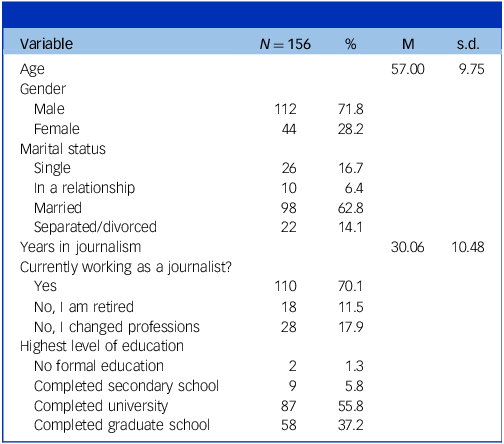
The demographic data appear in Table 1. The sample was predominantly male and university educated. Three (0.02%) journalists still worked in war zones.
Demographic data

Table 1 Long description
The table presents demographic data of journalists with 156 entries. It includes variables such as age, gender, marital status, years in journalism, current employment status, and highest level of education. The table has 8 rows and 4 columns. Column headers are Variable, N = 156, %, M, and s.d. Row 1: Age, 57.00, 9.75. Row 2: Gender, Male, 112, 71.8, Female, 44, 28.2. Row 3: Marital status, Single, 26, 16.7, In a relationship, 10, 6.4, Married, 98, 62.8, Separated/divorced, 22, 14.1. Row 4: Years in journalism, 30.06, 10.48. Row 5: Currently working as a journalist, Yes, 110, 70.1, No, I am retired, 18, 11.5, No, I changed professions, 28, 17.9. Row 6: Highest level of education, No formal education, 2, 1.3, Completed secondary school, 9, 5.8, Completed university, 87, 55.8, Completed graduate school, 58, 37.2.
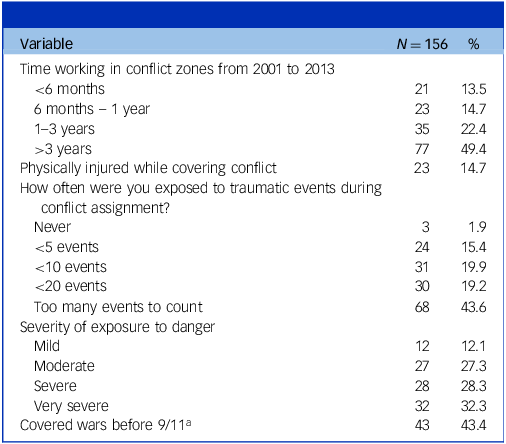
Journalist-risk data appear in Table 2. Half the sample had spent more than 3 years in war zones with 60% of the journalists exposed to a level of risk objectively rated as severe or very severe. Cumulative time in a war zone correlated significantly with severity of risk (r = 0.476, p < 0.001) but was not significantly correlated with being injured (r = 0.189, p = 0.018). Being injured correlated significantly with severity of risk (r = 0.342, p = 0.001).
Journalism-risk data

Table 2 Long description
A table summarizing journalist risk data from 2001 to 2013. The table has 10 rows and 3 columns. The columns are labeled Variable, N, and Percent. The rows detail various aspects of journalists' exposure to risk. Row 1: Time working in conflict zones from 2001 to 2013, less than 6 months, 21, 13.5 percent. Row 2: Time working in conflict zones from 2001 to 2013, 6 months to 1 year, 23, 14.7 percent. Row 3: Time working in conflict zones from 2001 to 2013, 1 to 3 years, 35, 22.4 percent. Row 4: Time working in conflict zones from 2001 to 2013, more than 3 years, 77, 49.4 percent. Row 5: Physically injured while covering conflict, 23, 14.7 percent. Row 6: How often were you exposed to traumatic events during conflict assignment, never, 3, 1.9 percent. Row 7: How often were you exposed to traumatic events during conflict assignment, less than 5 events, 24, 15.4 percent. Row 8: How often were you exposed to traumatic events during conflict assignment, less than 10 events, 31, 19.9 percent. Row 9: How often were you exposed to traumatic events during conflict assignment, less than 20 events, 30, 19.2 percent. Row 10: How often were you exposed to traumatic events during conflict assignment, too many events to count, 68, 43.6 percent. Row 11: Severity of exposure to danger, mild, 12, 12.1 percent. Row 12: Severity of exposure to danger, moderate, 27, 27.3 percent. Row 13: Severity of exposure to danger, severe, 28, 28.3 percent. Row 14: Severity of exposure to danger, very severe, 32, 32.3 percent. Row 15: Covered wars before 9/11, 43, 43.4 percent.
a Interview-based data, n = 99.
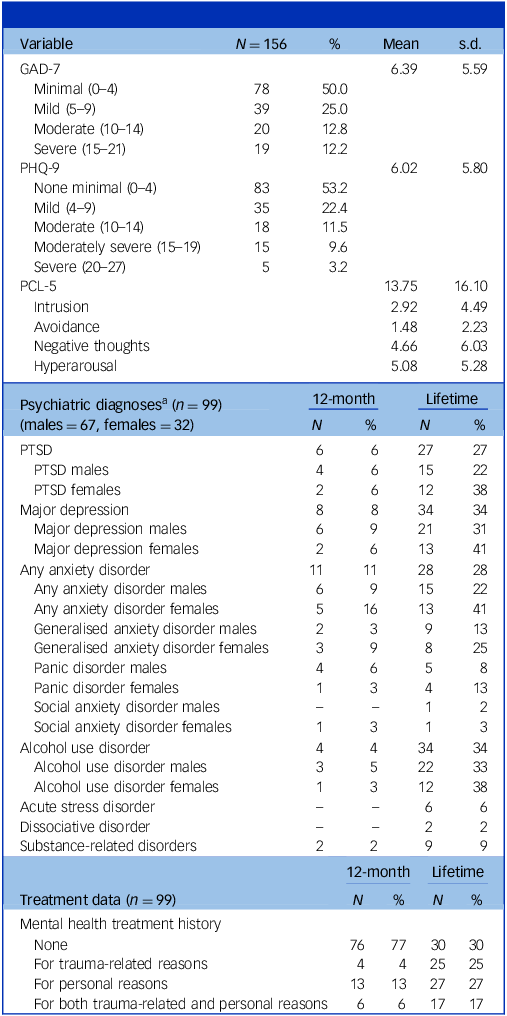
The psychometric (N = 156) and psychiatric (n = 99) data appear in Table 3. There were no significant differences between journalists who were interviewed (n = 99) and those who were not (n = 57) with respect to age (t = −0.70, d.f. = 154, p = 0.482), gender (χ 2 = 2.27, d.f. = 1, p = 0.132), time spent in war zones (χ 2 = 1.23, d.f. = 3, p = 0.746), frequency of exposure to traumatic events (χ 2 = 0.56, d.f. = 4, p = 0.968) and PCL-5 (t = 0.99, d.f. = 154, p = 0.322), PHQ-9 (t = 1.38, d.f. = 154, p = 0.171) and GAD-7 (t = 1.45, d.f. = 154, p = 0.148) psychometric scores. While the overall mean GAD-7 and PHQ-9 scores fell in the mild range, 25 and 24.3% of the sample had anxiety and depression scores in the moderate to severe range, respectively. The GAD-7 correlated significantly with the PHQ-9 (r = 0.840, p < 0.001) and PCL-5 (r = 0.777, p < 0.001) and the PHQ-9 correlated significantly with the PCL-5 (r = 0.817, p < 0.001).
Psychometric and psychiatric data

Table 3 Long description
The table presents psychometric and psychiatric data for a sample of 156 journalists. It includes columns for variable names, sample sizes, percentages, means, and standard deviations. The variables include GAD-7, PHQ-9, and PCL-5 scores, along with psychiatric diagnoses and treatment data. The table is divided into sections: the first section lists the distribution of GAD-7, PHQ-9, and PCL-5 scores, with categories ranging from minimal to severe. The second section details psychiatric diagnoses over 12-month and lifetime periods, specifying conditions like PTSD, major depression, and various anxiety disorders, with separate counts for males and females. The third section covers mental health treatment history, indicating reasons for treatment such as trauma-related or personal reasons. Row 1: GAD-7, N = 156, 6.39, 5.59. Row 2: Minimal (0-4), 78, 50.0. Row 3: Mild (5-9), 39, 25.0. Row 4: Moderate (10-14), 20, 12.8. Row 5: Severe (15-21), 19, 12.2. Row 6: PHQ-9, N = 156, 6.02, 5.80. Row 7: None minimal (0-4), 83, 53.2. Row 8: Mild (4-9), 35, 22.4. Row 9: Moderate (10-14), 18, 11.5. Row 10: Moderately severe (15-19), 15, 9.6. Row 11: Severe (20-27), 5, 3.2. Row 12: PCL-5, N = 156, 13.75, 16.10. Row 13: Intrusion, 2.92, 4.49. Row 14: Avoidance, 1.48, 2.23. Row 15: Negative thoughts, 4.66, 6.03. Row 16: Hyperarousal, 5.08, 5.28. Row 17: Psychiatric diagnoses (n = 99), 12-month, Lifetime. Row 18: PTSD, 6, 6, 27, 27. Row 19: PTSD males, 4, 6, 15, 22. Row 20: PTSD females, 2, 6, 12, 38. Row 21: Major depression, 8, 8, 34, 34. Row 22: Major depression males, 6, 9, 21, 31. Row 23: Major depression females, 2, 6, 13, 41. Row 24: Any anxiety disorder, 11, 11, 28, 28. Row 25: Any anxiety disorder males, 6, 9, 15, 22. Row 26: Any anxiety disorder females, 5, 16, 13, 41. Row 27: Generalised anxiety disorder males, 2, 3, 9, 13. Row 28: Generalised anxiety disorder females, 3, 9, 8, 25. Row 29: Panic disorder males, 4, 6, 5, 8. Row 30: Panic disorder females, 1, 3, 4, 13. Row 31: Social anxiety disorder males, 1, 3, 1, 3. Row 32: Social anxiety disorder females, 1, 3, 1, 3. Row 33: Alcohol use disorder, 4, 4, 34, 34. Row 34: Alcohol use disorder males, 3, 5, 22, 33. Row 35: Alcohol use disorder females, 1, 3, 12, 38. Row 36: Acute stress disorder, 1, 1, 6, 6. Row 37: Dissociative disorder, 2, 2, 2, 2. Row 38: Substance-related disorders, 2, 2, 9, 9. Row 39: Treatment data (n = 99), 12-month, Lifetime. Row 40: Mental health treatment history, 76, 77, 30, 30. Row 41: For trauma-related reasons, 4, 4, 25, 25. Row 42: For personal reasons, 13, 13, 27, 27. Row 43: For both trauma-related and personal reasons, 6, 6, 17, 17.
GAD-7, General Anxiety Disorder seven-item scale; PHQ-9, nine-item Patient Health Questionnaire; PCL-5, PTSD Checklist for DSM-5; PTSD, post-traumatic stress disorder.
a. Structured clinical interviews for DSM-5 (SCID-5-RV). Reference Weathers, Litz, Keane, Palmieri, Marx and Schnurr16 .
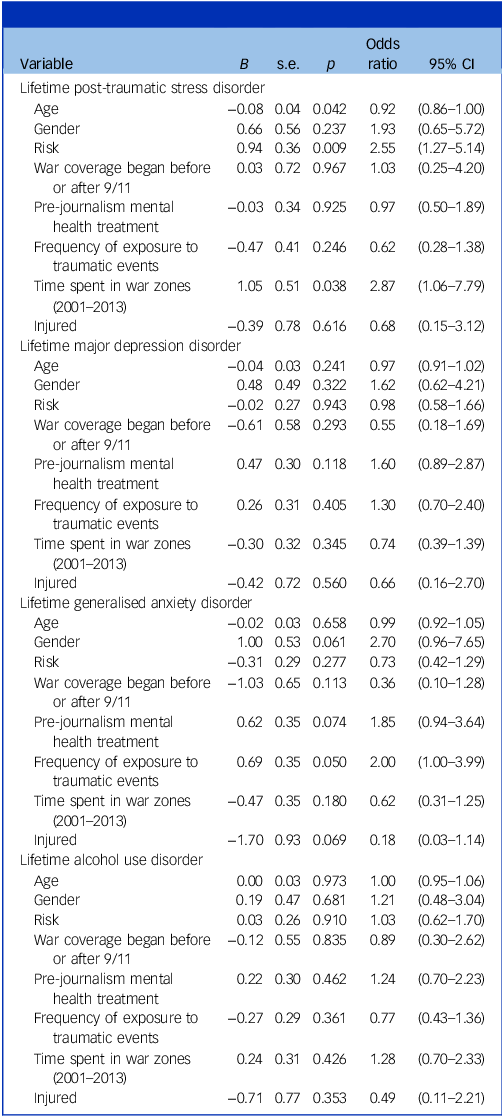
The following predictors of lifetime psychiatric diagnoses were entered into a logistic regression model: age, gender, risk, coverage of war prior to 9/11, history of psychiatric treatment pre-dating work as a journalist, frequency of exposure to life-threatening events, total time spent in a war zone and injured while in a war zone. The results appear in Table 4.
Predictors of lifetime psychiatric diagnoses

Table 4 Long description
A table showing predictors of lifetime psychiatric diagnoses with various variables and their statistical data. The table has 5 rows and 7 columns. The columns are labeled Variable, B, s.e., p, Odds ratio, and 95% CI. The rows are grouped by different psychiatric diagnoses: Lifetime post-traumatic stress disorder, Lifetime major depression disorder, Lifetime generalised anxiety disorder, and Lifetime alcohol use disorder. Each diagnosis group includes variables such as Age, Gender, Risk, War coverage began before or after 9/11, Pre-journalism mental health treatment, Frequency of exposure to traumatic events, Time spent in war zones (2001-2013), and Injured. Each cell contains specific values for B, s.e., p, Odds ratio, and 95% CI.
For a lifetime diagnosis of PTSD, odds ratios were elevated for women, risk, total time in a war zone and covering conflict pre-9/11. Only risk was statistically significant. These variables accounted for 38.4% of the variance.
For a lifetime diagnosis of major depression, odds ratios were elevated for women, frequency of exposure to life-threatening events and psychiatric treatment pre-dating work as a journalist. None of these variables was statistically significant. They accounted for 14.4% of the variance.
For a lifetime diagnosis of any anxiety disorder (generalised anxiety disorder [GAD], panic disorder, social anxiety disorder), odds ratios were elevated for women, frequency of exposure to life-threatening events and psychiatric treatment pre-dating work as a journalist. None were statistically significant. They accounted for 22.9% of the variance.
For a lifetime diagnosis of alcohol use disorder, odds ratios were elevated for women, psychiatric treatment pre-dating work as a journalist and total time in a war zone. None were statistically significant. These variables accounted for 4.7% of the variance.
Counselling was available to 63 (40.4%) journalists during their time covering conflict. Overall, journalists rated the level of psychological support provided by their news organisations during this time as poor (μ = 2.81, s.d. = 2.78). To current date, 69 (69.7%) of the 99 journalists interviewed had received therapy (see Table 3).
Discussion
Data from journalists working for five major news organisations revealed a high lifetime and 12-month prevalence of psychiatric disorders in journalists who covered wars in Afghanistan and the Middle East and revolutions (the Arab Spring) between 2001 and 2013. With our sample’s mean age of 57 years and all journalists but three no longer covering war, the data provide a first, unique look at long-term psychiatric correlates of their work in zones of conflict.
There is, to the best of our knowledge, only one other study dating back to 2002 that used SCID interviews to arrive at psychiatric diagnoses for journalists who cover war. Reference Feinstein, Owen and Blair5 The present study, with a sample size three times larger, reveals similar rates of lifetime PTSD: 27.3%, compared with 28.6% reported earlier. However, a higher lifetime rate of major depression was found, namely 34.3% versus 21.4% reported earlier. While both studies comprised predominantly male journalists (71.8% versus 76.1%), the mean age of participants in the current study was almost two decades older. Our findings here are in accord with a population-based study in the UK that found, especially in men, rising rates of depression in the 45–59 years age range. Reference Arias de la Torre, Vilagut, Ronaldson, Dregan, Ricci-Cabello and Hatch18
Journalists are civilians so it is therefore informative to view their psychiatric data alongside those from the general population where a lifetime PTSD prevalence rate of 6% was found in a representative population-based sample of over 36 000 US adults. Reference Goldstein, Smith, Chou, Saha, Jung and Zhang19 This is well below that for journalists in our study and, instead, closer to our 12-month prevalence data. The latter, in turn, remains higher than the 12-month prevalence rate of 3–4% in the general population. Reference Kessler, Petukhova, Sampson, Zaslavsky and Wittchen20,21 The SCID interviews revealed that none of the journalists diagnosed with PTSD had evidence of complex PTSD. Confirmatory evidence of the high rates of lifetime PTSD in journalists covering war comes when we switch comparisons to military populations. The lifetime PTSD prevalence rate for Afghanistan/Iraq war veterans is 29% and overlaps with the journalist data in our study. Reference Na, Schnurr and Pietrzak22 However, the 12-month prevalence rate in Iraq war veterans of 15% suggests that chronic PTSD is more prevalent in combat veterans than journalists. Reference Na, Schnurr and Pietrzak22
The lifetime prevalence of major depression elicited in our sample is well above the 20.6% documented in US civilian adults Reference Hasin, Sarvet, Meyers, Saha, Ruan and Stohl23 but approximates figures in front-line veterans. Reference Blore, Sim, Forbes, Creamer and Kelsall24 The 12-month prevalence, however, is similar to general population estimates. Reference Kessler, Petukhova, Sampson, Zaslavsky and Wittchen20,Reference Kessler, Chiu, Demler and Walters25 The lifetime and 12-month prevalence of GAD and panic disorder are higher in journalists than the general population. Reference Kessler, Petukhova, Sampson, Zaslavsky and Wittchen20,Reference Kessler, Chiu, Demler and Walters25–27 The reverse is true for social anxiety disorder. 21,Reference Kessler, Chiu, Demler and Walters25
The lifetime prevalence rates of alcohol use disorder is almost three times that seen in the general population, Reference Kessler, Berglund, Demler, Jin, Merikangas and Walters26 but is similar to that reported in the veterans’ population. Reference Eisen, Schultz, Vogt, Glickman, Elwy and Drainoni28 The 12-month prevalence, however, is similar to general population estimates. Reference Blore, Sim, Forbes, Creamer and Kelsall24 The SCID interview data are helpful here in establishing a timeline for they indicate that excessive consumption of alcohol can be traced back to times spent in war zones. This matches anecdotal accounts of journalists drinking heavily while covering war. Reference Feinstein29 Notably, the elevated odds ratio for gender as a predictor of problem drinking pertained to female, not male journalists, although this finding was not statistically significant. The possibility of women journalists having more of a problem with alcohol than men reverses the general population finding of alcohol abuse being more common in men, although the gap is diminishing with time. Reference White30
The regression analyses revealed that predictors of lifetime psychopathology were more robust for PTSD than other diagnoses. The reasons for this may be found in the extraordinarily dangerous nature of war journalism as attested to by half our sample spending more than 3 years in war zones where almost two-thirds were exposed to severe or very severe levels of risk that included being shot at, kidnapped, caught up in suicide bombings, witnessing mass fatalities in the aftermath of suicide bombings and losing a colleague to violence. Indeed, physical risk emerged as the most significant predictor of lifetime PTSD in our study. These observations underscore the often replicated finding of PTSD being linked directly to the severity and proximity of the stressor. Reference May and Wisco31,Reference Huțul, Karner-Huțuleac, Măirean and Huțul32 This construct, however, does not apply to the same degree when it comes to depression, anxiety and alcohol abuse, as our data reveal. Odds ratios with respect to major depression and all anxiety disorders, modestly elevated for frequency of exposure to traumatic events, fell short of statistical significance. The same is true for psychiatric difficulties present before beginning work as a journalist. A history of emotional challenges pre-dating exposure to a severe stressor has previously been reported as a risk factor for PTSD in journalists who cover conflict. Reference Feinstein and Osmann33 It is a robust finding in the general psychiatry literature too. Reference Bomyea, Risbrough and Lang34 On the other hand, the absence of injury as a predictor of PTSD in our data contradicts the broader trauma literature, Reference Al-Ozairi and Feinstein35 and may be explained by only 3 of the 22 injured journalists in our study reporting serious injury. It is also possible that the constant danger and grave threat experienced by this group are so extensive that previous mental health difficulties don’t hold the same valence under these conditions.
News organisations did not make mental health therapy and support widely available while journalists were in the field covering war, and journalists rated their news organisations poorly on this score. One should, however, view these findings through a historical lens. Going back almost a quarter of a century, the mental distress in journalists covering war was often overlooked or ignored and with this came a lack of therapeutic resources. Reference Feinstein, Owen and Blair5 Today, there are well-defined protocols for helping journalists with their mental health and there is evidence that interventions in real-time reduce symptoms of PTSD, depression and anxiety. Reference Osmann, Meera and Feinstein12,36 This evolution in care fits with our data showing that over the years since returning from covering conflict, 69% of our sample received therapy for trauma and personal-related problems. In part, this might explain their improved 12-month relative to lifetime prevalence rates for psychiatric disorders.
Our study does have certain limitations. We could not trace just under 40% of our sample. The 60% response rate nevertheless exceeds the average response rate of 44% for online surveys reported in a meta-analysis of 1071 studies. Reference Wu, Zhao and Fils-Aime37 In addition, 57 of 156 (36.5%) journalists were not interviewed. Journalists who were and were not interviewed did not differ on key demographic, risk-related or psychometric variables, but these response rates leave open the possibility of sample bias.
As noted previously, our study is primarily descriptive. While we elicited some data that quantified trauma severity, and here exposure to grave risk emerged as the standout critical variable implicated in journalists’ PTSD, we did not capture additional data that could shed light on vulnerabilities and resilience to developing psychiatric disorders. In trying to understand better why some journalists develop trauma-related mental illness, we would have needed to look in depth at pre-, peri- and post-trauma factors. Reference Martin-Soelch and Schnyder38 This, however, was beyond the scope of the present study. Finally, our data are confined to journalists from five news organisations. The findings can be extrapolated cautiously to other front-line journalists who match the demographic and work profiles of our sample, but they should not be construed as indicative of the profession as a whole.
In summary, data from journalists working for five major US news organisations reveal a high lifetime prevalence of PTSD, major depression, GAD, panic disorder and alcohol use disorder in journalists who covered wars after 9/11 in Afghanistan, Iraq and elsewhere, including the revolutions that followed in the Arab Spring. With time, the clinical picture improves, but 12-month prevalence rates remain elevated, albeit less so, for PTSD, GAD and panic disorder. War journalism can be hazardous in the extreme and risk emerged as a key correlate of PTSD in our sample. With the Global Peace Index continuing to decline, 39 data like these provide a timely reminder to journalists and their news organisations of the psychiatric toll that covering war can exact.
Data availability
The data supporting the findings of this study are available from the corresponding author (A.F.) upon reasonable request.
Author contributions
A.F. was responsible for securing funding, study design, data collection, data analysis, manuscript preparation and manuscript revisions in response to reviewers. J.M. was responsible for data collection, data analysis, manuscript preparation and manuscript revisions in response to reviewers. E.N. was responsible for study design, data collection, manuscript preparation and manuscript revisions in response to reviewers. B.S. was responsible for study design, data collection, manuscript preparation and manuscript revisions in response to reviewers. P.B. was responsible for securing funding, study design, data collection, manuscript preparation and manuscript revisions in response to reviewers. S.F. was responsible for securing funding, study design, data collection, manuscript preparation and manuscript revisions in response to reviewers.
Funding
Funding was provided by the MacArthur and Knight Foundations.
Declaration of interest
A.F. reports grants from the MS Canada, book royalties from Johns Hopkins University Press, Cambridge University Press, Amadeus Press and G Editions, and speaker’s honoraria from Novartis, Merck and Roche. All other authors report there are no competing interests to declare.
Analytic code availability
An analytic code supporting the findings is not yet available to other researchers. We are in the process of completing further analyses on this rich data-set with a view to publishing additional manuscripts. Such a code will be established and made available once our research team has completed these analyses.
Research material availability
All our raw data and data analyses will be collated in one repository once we have completed further analyses. At that point, these materials will be made available to other researchers upon reasonable request.

 Open access


eLetters
No eLetters have been published for this article.