


Introduction
People with schizophrenia form one of the largest groups of older people with severe mental health problems and there is a predicted growth in numbers due to increasing longevity (Cohen et al., Reference Cohen, Cohen, Blank, Gaitz, Katz and Leuchter2000). The group have significant unmet psychological needs, which are associated with a higher risk of social exclusion, institutionalization and the use of other intensive and expensive services (Berry and Barrowclough, Reference Berry and Barrowclough2009). There is a strong evidence base for psychological treatments in younger adults with schizophrenia, but research trials have traditionally excluded people over the age of 65 years (Wykes, Steel, Everitt and Tarrier, Reference Wykes, Steel, Everitt and Tarrier2008). Older adults often have unique needs requiring specifically tailored and validated interventions (Woods, Reference Woods2003; Department of Health, 2005, 2009, 2011). Interventions with older people may require age-relevant adaptations, such as using repetition, rehearsal and presenting information in different modalities to compensate for cognitive or sensory problems. For younger people with psychosis primary targets have been reductions in psychotic symptoms. However, psychotic symptoms often improve with age and older people are more likely to report problems with social functioning and daily living (Berry and Barrowclough, Reference Berry and Barrowclough2009). According to a recent report by the Health Care Commission (2009) we run the risk of indirectly discriminating against older adults, by opening up services to older people but not tailoring interventions to age-related needs.
Three groups in the USA have developed and evaluated group-based psychological treatments for middle-aged and older adults with schizophrenia. The primary targets of these interventions are social functioning and independent living skills as opposed to psychiatric symptoms. The interventions all include age-relevant adaptations to compensate for possible cognitive problems and their primary targets are social functioning and independent living skills as opposed to psychiatric symptoms.
Granholm and colleagues have developed a cognitive-behavioural, social skills training intervention. The intervention is administered over 24 sessions and focuses on teaching social skills and challenging thoughts that interfere with the execution of activities in the community, for example, “I will be harmed if I go out” or “I'm too old to learn” (Granholm et al., Reference Granholm, McQuaid, McClure, Auslander, Perivoliotis and Pedrelli2005). These authors carried out a randomized controlled trial (RCT), comparing their intervention with treatment as usual, with a sample of 76 middle-aged and older outpatients with schizophrenia. They found that the cognitive behavioural skills training intervention was associated with increases in social activities, greater cognitive insight and greater skills mastery compared to treatment as usual (Granholm et al., Reference Granholm, McQuaid, McClure, Auslander, Perivoliotis and Pedrelli2005). However, the treatment group effect was not significant for symptoms, including depression. In a later follow-up study, the authors report that increases in social activities and skills mastery were maintained at 12-months, although the effect for cognitive insight was not (Granholm et al., Reference Granholm, McQuaid, McClure, Link, Perivoliotis and Gottlieb2007).
Mueser and colleagues have developed a skills training intervention aimed at teaching independent living and social skills. The intervention consists of weekly training sessions and bi-weekly community practice sessions over a period of one year, in addition to health care management, which involves a nurse specialist ensuring patients’ physical health care needs are met. The authors report a larger randomized study involving 183 patients that compared their intervention with treatment as usual. They found significant improvements for older adults assigned to the intervention compared to treatment as usual in terms of social skills, community functioning, negative symptoms and self-efficacy (Mueser et al., Reference Mueser, Pratt, Bartels, Swain, Forester and Cather2010).
Patterson and colleagues have developed a 24-session, behavioural-based, functional adaptation skills training intervention aimed at teaching everyday living skills to patients residing in supported accommodation. The authors report an RCT involving 240 patients that had the advantage of including a time-equivalent attention-control group. They found that compared to patients in the attention control group, patients receiving the adaptation skills training intervention demonstrated significant improvements in performance of independent living skills and performance of social skills at 6-months follow-up. However, there were no treatment effects for medication management or secondary outcomes, such as symptoms or health-related quality of life (Patterson et al., Reference Patterson, Mausbach, McKibbin, Goldman, Bucardo and Jeste2006).
Retention rates were good across all studies (around 80%) and effects sizes were comparable to those found for younger adults with schizophrenia (Patterson et al., Reference Patterson, Mausbach, McKibbin, Goldman, Bucardo and Jeste2006; Granholm et al., Reference Granholm, McQuaid, McClure, Link, Perivoliotis and Gottlieb2007; Mueser et al., Reference Mueser, Pratt, Bartels, Swain, Forester and Cather2010). The use of groups would seem well suited to NHS settings as it is a cost effective method of delivering psychological interventions. The group format also has the benefits of offering social support, reducing isolation and stigma, and providing a forum for learning from peers. However, the US interventions are primarily skills-based and focus on didactic teaching of independent living and social skills. This contrasts with UK Cognitive Behavioural Therapy (CBT) interventions, which are collaborative and focus on coping with difficult thoughts and feelings.
Although UK RCTs of group CBT for psychosis have failed to produce reductions in positive symptoms, they have found improvements in self-esteem, reductions in hopelessness and improvements in social functioning (Wykes et al., Reference Wykes, Hayward, Thomas, Green, Surguladze and Fannon2005; Barrowclough et al., Reference Barrowclough, Haddock, Lobban, Jones, Siddle and Roberts2006), which may be more important outcomes for older people with schizophrenia (Berry and Barrowclough, Reference Berry and Barrowclough2009). There is also evidence to suggest that group CBT may reduce negative symptoms in schizophrenia (Johns, Sellwood, McGovern and Haddock, Reference Johns, Sellwood, McGovern and Haddock2002), which may be more significant problems in old age than positive symptoms (Berry and Barrowclough, Reference Berry and Barrowclough2009).
Using expertise from the US and UK, we aimed to adapt US manuals to make them suitable for use in UK NHS settings and to be in line with group treatments for younger people with psychosis in the UK. In accordance with the Medical Research Council's (2000) guide for developing complex interventions, this study aims to provide an initial evaluation of the feasibility and acceptability of the adapted intervention and inform a future programme of research in this area.
Method
Design
For the quantitative part of the study we used a within groups comparison design comparing participants on a range of potentially relevant outcomes at baseline and posttreatment. The key deliverables of the research related to the feasibility and acceptability of the intervention. Therefore the inclusion of a control group was not considered essential during this preliminary stage of the research programme.
Participants and procedure
Participants were referred from old age and adult psychiatry services in one Trust site in Greater Manchester. Inclusion criteria were: a) ICD-10 (World Health Organization, 1992) diagnosis of schizophrenia or related psychosis; b) ≥ 55 years; c) informed consent; d) English speaking; e) a score of > 19 on the Mini Mental State Examination (MMSE; Folstein, Folstein and McHugh, Reference Folstein, Folstein and McHugh1975), which was used as an inclusion criterion in our previous research with this group (Berry, Barrowclough, Byrne and Purandare, Reference Berry, Barrowclough, Byrne and Purandare2006); and e) sufficient levels of attention and concentration to complete study assessments, as our previous experience of running groups with people with psychosis suggests that severe attentional problems may have adverse effects on group cohesion (Barrowclough et al., Reference Barrowclough, Haddock, Lobban, Jones, Siddle and Roberts2006). Potentially eligible participants were referred by clinicians and screened by a research assistant to verify that they met inclusion criteria and wished to take part. All posttreatment assessments were completed in less than one month following treatment.
Adaptations to the US manuals
Consultations with local clinicians and service users suggested that the US manuals adopted an “illness” or “deficit” model of schizophrenia and did not incorporate notions of self-efficacy and hopefulness, which are key philosphies in the NHS. In collaboration with service users and local clinicians working with older people, we therefore adapted the manuals. More specifically, we selected independent living and social skills modules from US manuals that were most relevant to the needs of the UK population. We also included exercises focusing on increasing self-esteem and hopefulness, and we changed the format to include more opportunties for discussion. The philosophy that service users had become “experts” in coping with their own experiences over time was emphasized throughout, as was the concept of learning from each other.
Intervention
The intervention was group-based and consisted of 16 weekly sessions of 2-hours duration. The sessions were facilitated by a clinical psychologist who is an accredited CBT therapist (KB) and at least one of three other professionals (one registered mental health nurse and two occupational therapists), who received 3 days training in the intervention, but who had no previous training in psychological interventions. All facilitators met weekly for group supervision with KB. The aim of each training and supervision session was to ensure that co-facilitators understood the rationale and content of the group sessions, and were able to work with difficulties that arose from group dynamics. Training and supervision methods included presentations, group discussion and role-play exercises.
Intervention topics included: a) group ground rules; b) identifying strengths; c) developing goals and action plans; d) making decisions; e) problem solving; f) managing symptoms and stress; g) social skills; h) daily living skills and self-care; i) increasing social contacts; and j) planning for the future. The intervention incorporated behavioural techniques, such as identifying and rehearsing key skills, and cognitive techniques, such as identifying and challenging thoughts (e.g. poor self-efficacy and negative expectations), which were likely to interfere with skills development and practice.
Each meeting followed the same format. The group started with setting an agenda, followed by a review of the previous week, a recap of the previous session, and a review of between-session tasks. One of the facilitators then gave a brief presentation on the week's topic using power point slides and gave an example of the session's task with the co-facilitator, a volunteer or a video. Following a 20-minute break, participants were asked to practise a task or carry out an exercise in pairs. There was then an opportunity for the participants to feed back to the group as a whole and set a between-session task. The meeting concluded with a summary and eliciting feedback. In order to facilitate support for generalization of learning in the group, the intervention included an initial meeting and two feedback sessions with care co-ordinators (one mid-treatment and one post-treatment). The purpose of these meetings was to outline progress in therapy and future goals. Copies of the training and intervention manuals can be obtained from the first author.
Measures
The study included a number of outcome measures reflecting the multidimensional nature of the investigation of the intervention. Treatment progress and retention consisted of monitoring retention in treatment and number of sessions attended. Due to the exploratory nature of the study, we did not have a primary outcome measure, but included a number of potentially important outcomes. The outcome measures were chosen on the basis of consultations with local service users, US research and research of groups of CBT for psychosis in the UK.
The Rosenberg Self-Esteem Scale (Rosenberg, Reference Rosenberg1989) was used to measure self-esteem. This 10-item self-report measure asks respondents how they feel about themselves on a 4-point scale ranging from strongly agree to strongly disagree. Higher scores indicate higher levels of self-esteem (range 0–30).
The Beck Hopelessness Scale (BHS; Beck, Weissman, Lester and Trexler, Reference Beck, Weissman, Lester and Trexler1974) was used to assess hopelessness. It is a 20-item self-report inventory that was designed to measure three major aspects of hopelessness: feelings about the future, loss of motivation, and expectations. The responses are in a true or false format and higher scores indicate greater hopelessness (range 0–20).
The Positive and Negative Syndrome Scale (PANSS; Kay, Fiszbein and Opler, Reference Kay, Fiszbein and Opler1987) was used to measure symptoms. The PANSS is a 30-item, semi-structured interview with positive, negative and general psychopathology subscales. A total symptom score can also be derived by summing subscale scores and this was used as a measure of severity of psychiatric symptoms. Higher scores indicate more severe symptoms and scores for the total scale range from 30 to 210.
The Calgary Depression Scale for Schizophrenia (CDSS; Addington, Addington and Schissel, Reference Addington, Addington and Schissel1990) was also used. The CDSS is a structured interview measure specifically designed for use in samples with schizophrenia as it distinguishes between depression and negative symptoms. It comprises eight questions and one observational measure based on the entire interview. Items are scored on a 0 to 3 scale with higher scores indicating higher levels of depression and total scores are calculated by summing items (range 0–27).
The Social Behaviour Schedule (SBS; Wykes and Sturt, Reference Wykes and Sturt1986) was used to assess social functioning. It measures the severity of problematic behaviours, such as social avoidance, appropriateness of interactions, and manners. The original SBS was designed to be completed by front line staff for psychiatric inpatients. In line with Mueser and colleagues (Reference Mueser, Pratt, Bartels, Swain, Forester and Cather2010), we used an adapted version of the SBS, which contains 23 of the original 30 items. In addition to dropping items not relevant to outpatients, probe questions for informants were added, and the rating scale was modified to use a consistent 1–5 scale for all items. Scores ranged from 23 to 115, with higher scores reflecting worse functioning.
The Independent Living Skills Survey (ILSS; Wallace, Liberman, Tauber and Wallace, Reference Wallace, Liberman, Tauber and Wallace2000) was used to assess functioning in relation to activities of daily living. A composite score of five different domains assessed both self- and informant-reported living skill activities performed during the previous month: appearance and clothing; personal hygiene; care of possessions; food preparation and storage; health maintenance; money management; transportation; and community and leisure. Higher scores reflect better functioning. The self-report measure ranges from 0–1 and the informant-report measure ranges from 0–4.
Treatment acceptability was also assessed by semi-structured interviews conducted at the end of treatment. The interview was based on a topic guide, which included a series of open questions regarding participants’ experiences of the treatment and any recommendations for improving the intervention. Interviews were conducted by a research assistant who carried out all other assessments, but who did not attend the groups. All interviews were recorded following consent.
Analysis
Data for treatment adherence, progress, and retention are presented descriptively.
Treatment outcome data were analysed at a group level using SPSS for Windows release 16. Two variables had significantly skewed distributions (BHS and informant ILSS), so for consistency and ease of interpretation, all data sets were analysed using Wilcoxon matched-pairs tests.
Acceptability interview data were transcribed and subjected to thematic analysis (Braun and Clarke, Reference Braun and Clarke2006). Transcripts were read a number of times to capture an overall impression of the data. Responses were examined using a constant comparative analysis approach, so each piece of data (in this instance a statement or phrase) was taken and compared with all others for similarities and/or differences. Observations about the whole data set were recorded to begin to generate a list of potential codes, which were ultimately grouped into themes. The themes were then applied to the full interview transcripts to ensure they fully captured the entire data set. Analysis was completed by the first author, but composition of codes and themes was agreed on in discussion with other members of the team.
Results
Uptake and retention
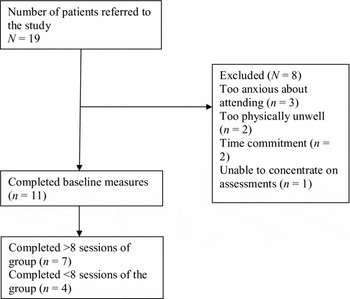
A flow diagram outlining uptake, exclusions and drop-outs for the study is presented in Figure 1. Although 69% of participants who were referred to the study met inclusion criteria and agreed to participate, we experienced difficulties in encouraging clinicians to refer to the study. They frequently reported that potential participants would not be suitable for a psychosocial intervention due to their psychiatric symptoms or cognitive impairment.
Flow diagram of uptake, exclusions and drop-outs

We initially completed baseline data with 11 participants, but one participant did not attend any of the sessions due to physical ill health, and one participant only attended one session and dropped out due to feeling uncomfortable in a group setting. Two participants only attended three sessions, also due to physical ill health. A total of seven participants therefore attended more than half the sessions and completed a mean of 12.86 sessions over all (SD = 2.55, range = 9–16).
Sample characteristics
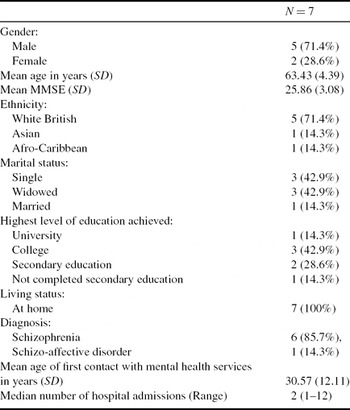
The demographic and clinical characteristics of participants who completed more than eight sessions of the group are presented in Table 1.
Demographic and clinical characteristics of participants completing > 8 sessions of the group

Outcome measures
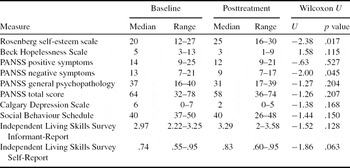
Table 2 presents the descriptive and inferential statistics for measures at baseline and posttreatment. There were significant improvements in self-esteem and negative symptoms.
Median and range scores for outcome measures baseline and posttreatment with associated statistical tests

Feedback interviews
All of the participants and the three co-facilitators completed feedback interviews. The following themes were extracted and are discussed below.
Social contact
All of the participants and facilitators commented on the benefits of the group in terms of social contact:
Just by going I think it helped. I mean that was positive if nothing else. You know that's one step in the right direction, rather than just stopping here you know, not seeing anybody. (Participant 7)
Getting out in the afternoon, you know. And it was nice. (Participant 1)
But I think everyone else who attended got something out of it on some level, whether it be social interaction or a forum to be listened to. . . So yeah, I think that maybe those would be the two main things, socializing and opportunity to talk. (Co-facilitator 2)
Skills learnt
Several participants commented on new activities or changes that they had tried as a result of attending the group:
[R] It's given me the go-ahead for one or two things, you know.
[I] Ok. What kinds of things?
[R] Doing my own cooking and things like that, taking a cooking course. Getting to know people as well. (Participant 1)
I'm more active, I don't sit about and do nothing. I go, I get up and I get out and about. I've been, as you say, as I've told you I'm doing volunteer work now. . . It's encouraged me to get out and about in the community now which I've not been doing before, and getting out and meeting people, and talking to people as well. (Participant 2)
And, I never noticed the signs before, but being at the group and hearing other people give out their signs for possible illness made me think about what were my signs. . . So I know if I'm moving into that sort of a situation, it's time for me to get help from somebody. (Participant 9)
They said you could listen to music and things like that, so I got some CDs. (Participant 4)
Co-facilitators also specifically mentioned that they had increased their own skills as a result of running the groups:
Well I suppose it's good because it's increasing your experience and confidence in running groups. (Co-facilitator 1)
I think it maybe helps you sort of empathize more with people who have got a diagnosis of schizophrenia or schizo-affective disorder, kind of seeing things through their eyes. (Co-facilitator 2)
Group composition and dynamics
Several participants commented on how the group worked together. Participants who were regular attenders expressed anger about people not attending regularly, leaving sessions early and not contributing as much as themselves:
Well, there was some people – perhaps this is not my business to say this, but some people came for only one or two sessions at the beginning and then gave up altogether. I think people should have given it a good - a few weeks before they made a decision not to come anymore. (Participant 7)
As I say, it's only when people didn't turn up sometimes, it was only about four of us there you know, so it wasn't a very reliable group. (Participant 1)
Well, each week they had a blackboard, and on the blackboard we put negative points, positive points. Now I got up four or five times and – and annotated on this note – on this board. But other people wouldn't get up and do it . . . I thought more people could have been, could have been encouraged. (Participant 2)
However, the majority of participants and the facilitators commented on how the group bonded well together:
People got on well together. There was no “I'm better then you” attitude in the group at all, it was all people got on well together, there was a great cohesiveness in the group . . . people got on well together. (Participant 1)
It was good, I enjoyed it, like a family. Everybody was very friendly. Nice. (Participant 1)
I thought it was nice the way we all bonded as a group and the rapport that we got, we had going, it was quite sad for it to finish really. (Co-facilitator 1)
Three participants commented on how they valued sharing problems and ideas with people in similar circumstances:
Its friendliness and it's the fact that people, people are willing to share their problems with other people and not only share problems with other people but share solutions as well. . . we all had similar events in our lives. . . There was some solutions that I picked up there that I've incorporated into my, into my little program that I have at home. (Participant 9)
That is, the very first time in over 25 years I've had this problem, that I've been able to discuss it with somebody else with similar problems to myself and that was very, very helpful. (Participant 2)
And you learn a lot from the other patients and all, how they – how they're dealing with their situation and things like that you know? . . . You know you're not the only one with mental illness sort of thing. . . it was. . . . a group of people you know coming together and it was positive, yeah, got a positive feeling. (Participant 1)
In addition to the above themes it is also noteworthy that the majority of participants explicitly stated that they wanted to attend further groups.
I'd like to do another one; if they had another one I'd do it. (Participant 10)
I hope that we do have another one next year and they do bring some more topics in as well. (Participant 2)
Discussion
The current study provides preliminary support for the feasibility of a group psychosocial intervention for older people with schizophrenia. The majority of participants (70%) were retained in treatment for at least half of the sessions, giving retention rates similar to the US studies (Granholm et al., Reference Granholm, McQuaid, McClure, Auslander, Perivoliotis and Pedrelli2005; Patterson et al., Reference Patterson, Mausbach, McKibbin, Goldman, Bucardo and Jeste2006; Mueser et al., Reference Mueser, Pratt, Bartels, Swain, Forester and Cather2010). Referral rates to the study were, however, poor, which raises concerns about the viability of recruiting an adequate sample to allow further evaluation of the treatment.
On the basis of this small uncontrolled study, it is difficult to interpret the lack of significant findings in relation to the majority of outcome measures. Compared to the US studies, participants also had high levels of independent living skills and higher social functioning pretreatment, thus introducing ceiling effects. However, it was encouraging that at a group level there were statistically significant improvements in self-esteem and negative symptoms. The positive effects on self-esteem are consistent with trials of group CBT for younger adults (Wykes et al., Reference Wykes, Hayward, Thomas, Green, Surguladze and Fannon2005; Barrowclough et al., Reference Barrowclough, Haddock, Lobban, Jones, Siddle and Roberts2006). Improvement in self-esteem is likely to be an important outcome for service users (Barrowclough et al., Reference Barrowclough, Haddock, Lobban, Jones, Siddle and Roberts2006) and studies have shown that older people with schizophrenia have more negative self-beliefs than their peers (Berry et al., Reference Berry, Barrowclough, Byrne and Purandare2006). In adapting the US manuals, we specifically incorporated sessions on recognizing strengths and consistent with a recovery-based philosophy we placed an emphasis on highlighting participants’ own resources throughout the group (Perkins, 2006). The positive effect on negative symptoms is also important, as these are often associated with high levels of distress (Provencher and Mueser, Reference Provencher and Mueser1997) and have not traditionally been the target of CBT for psychosis (Wykes et al., Reference Wykes, Steel, Everitt and Tarrier2008).
Although the clinical significance of improvements in outcomes is difficult to determine, the feedback interviews suggested that participants had made real changes in their lives as a result of the groups. The feedback interviews also highlighted the benefits of the group in terms of reducing social isolation and the opportunity to learn from each other in a supportive context. It is possible that this social benefit of the group had a direct positive effect on self-esteem and negative symptoms. Negative feedback focused on factors such as poor attendance or contribution by some members. This highlights the importance of recruiting participants who are committed to the idea of the group from the outset and actively encouraging all members to participate in group work and discussions.
In spite of its limitations, this pilot evaluation is the first evaluation of a UK psychosocial intervention for older people with schizophrenia. This study shows that the intervention is feasible and associated with high levels of satisfaction, although further work is needed to identify and overcome barriers to recruitment. To explore potential barriers to recruitment, we are therefore conducting a survey of clinician views of referring older people with schizophrenia to clinical trials of psychological treatments. It is likely that these barriers are associated with the generally poor access older adults have to psychological interventions (Healthcare Commission, 2009) and may reflect negative attitudes towards the clinical needs of older people, such as the belief that older people are too old to learn new skills and do not want to talk about their problems. It is important to identify and overcome these barriers, as the intervention could help with some of the secondary disability associated with the diagnosis of schizophrenia, and the intervention is clearly acceptable to older adults.
Acknowledgements
This study was funded by the BUPA Foundation. We would like thank all the service users who took part in the research, the co-facilitators who ran the groups, the service users and clinicians who were consulted in developing the manuals and all three US research groups who provided us with their manuals. Sadly, one of the authors, Dr Nitin Purandare, died before this work was published, so we would like to specifically acknowledge his contribution.



Comments
No Comments have been published for this article.