Introduction
Aphidophagous ladybirds exploit time and size-limited resources in short-lived aphid colonies and in doing so both larvae (Ruzicka, Reference Ruzicka1997) and adults (Nakashima et al., Reference Nakashima, Birkett, Pye, Pickett and Powell2004; Mishra & Omkar, Reference Mishra and Omkar2006; Mishra et al., Reference Mishra, Singh, Shahid and Omkar2012a), leave their footprints (i.e., semiochemicals) as they walk. These secretions contain non-volatile hydrocarbons (Hemptinne et al., Reference Hemptinne, Lognay, Doumbia and Dixon2001; Magro et al., Reference Magro, Tene, Bastin, Dixon and Hemptinne2007), and act as signals for predators to identify previously searched areas and cues for prey species in detection of predators (Swihart et al., Reference Swihart, Pignatello and Mattina1991; Ferrero et al., Reference Ferrero, Lemon, Fluegge, Pashkovski, Korzan, Datta, Spehr, Fendt and Liberles2011). Chemical analyses show that tracks of different species vary greatly (Hemptinne et al., Reference Hemptinne, Lognay, Doumbia and Dixon2001; Michaud & Jyoti, Reference Michaud and Jyoti2007). The female ladybirds refrain from laying eggs (Ruzicka, Reference Ruzicka1997; Doumbia et al., Reference Doumbia, Hemptinne and Dixon1998; Yasuda et al., Reference Yasuda, Takagi and Kogi2000), and the larvae probably desist from exploiting the aphid colonies, where they perceive the presence of semiochemical tracks left by other ladybirds.
However, studies have shown that marking areas that have already been exploited can have significant fitness consequences, as it reduces unfruitful expenditure of time searching for prey (Amat et al., Reference Amat, Desouhant and Carlos Bernstein2009). Larvae of Harmonia axyridis Pallas used tracks to avoid areas they had already searched and thereby improved their foraging efficiency on soybean aphids. These tracks, although not evolved to increase foraging efficiency, but are either: (i) the physiological by-products of some other process or (ii) may originally be used to increase adherence to plant surfaces (Meisner & Ives, Reference Meisner and Ives2013). Laying tracks has greatest value when the larvae are aggregated on plants or when environment is heterogeneous, as tracks increase the information that larvae have about their spatial environment (Meisner & Ives, Reference Meisner and Ives2013).
The semiochemical tracks left by ladybirds during foraging (Hemptinne et al., Reference Hemptinne, Dixon and Coffin1992; Doumbia et al., Reference Doumbia, Hemptinne and Dixon1998; Nakashima et al., Reference Nakashima, Birkett, Pye, Pickett and Powell2004) also serve several other functions, such as: (i) a means of avoiding cannibalism and competition with other aphidophagous ladybirds (Hemptinne & Dixon, Reference Hemptinne and Dixon2000; Kajita et al., Reference Kajita, Yasuda and Evans2006; Ruzicka & Zemek, Reference Ruzicka and Zemek2008; Magro et al., Reference Magro, Ducamp, Ramon-Portugal, Lecompte, Crouau-Roy, Dixon and Hemptinne2010), (ii) reduce overexploitation of a food resource limited in time and space (Nufio & Papaj, Reference Nufio and Papaj2001), and (iii) signals for other species to prevent intra-guild competition (Nakashima & Senoo, Reference Nakashima and Senoo2003; Nakashima et al., Reference Nakashima, Birkett, Pye and Powell2006; Meisner et al., Reference Meisner, Harmon and Anthony2011). Thus, besides oviposition-deterring pheromones (Ruzicka, Reference Ruzicka2003, Reference Ruzicka2006; Michaud & Jyoti, Reference Michaud and Jyoti2007; Ruzicka & Zemek, Reference Ruzicka and Zemek2008; Mishra et al., Reference Mishra, Singh, Shahid and Omkar2012a) these semiochemicals, although not experimentally proved earlier, may also behave as foraging deterrent pheromones (FDPs).
Numerous studies are present in the literature on semiochemical tracks of both larvae and adults, but these were conducted only to evaluate oviposition deterrence by either (i) egg surface semiochemicals (Mishra et al., Reference Mishra, Singh, Shahid and Omkar2012a, Reference Mishra, Singh, Shahid and Omkar2013), (ii) conspecific and/or heterospecific larval (Hemptinne et al., Reference Hemptinne, Dixon and Coffin1992; Ruzicka, Reference Ruzicka1997, Reference Ruzicka2003, Reference Ruzicka2006; Michaud & Jyoti, Reference Michaud and Jyoti2007; Ruzicka & Zemek, Reference Ruzicka and Zemek2008; Mishra et al., Reference Mishra, Singh, Shahid and Omkar2012a) and/or adult tracks (Mishra & Omkar, Reference Mishra and Omkar2006; Mishra et al., Reference Mishra, Singh, Shahid and Omkar2012a), or (iii) conspecific related (sibling) and unrelated (non-sibling) larval tracks (Martini et al., Reference Martini, Haccou, Olivieri and Hemptinne2009, Reference Martini, Dixon and Hemptinne2013). However, there are very few studies on the effect of conspecific and/or heterospecific larval and adult female tracks on predation parameters of immature stages of ladybirds, in terms of (i) consumption rate, (ii) conversion efficiency, (iii) growth rate, and (iv) developmental duration.
In the present study, we hypothesized that the semiochemicals within larval and adult female tracks might act as FDP and would reduce the predation efficiency, e.g., consumption rate, conversion efficiency, and growth rate, and would prolong total developmental duration of ladybird predators. On account of the hypothesis, the study was designed considering two most commonly co-occurring ladybird predators of Indian agroecosystems, i.e., Coccinella septempunctata (L.) (C7) and Coccinella transversalis F. (Ct) and the pea aphid, Acyrthosiphon pisum (Harris). We further assumed that the study would answer certain questions such as: (i) whether the feeding deterrence effects of semiochemical tracks are density dependent? (ii) whether the conspecific larval/adult female tracks have more negative impacts on predation efficiency than heterospecific larval/adult female tracks? We also expected that the findings might be helpful in understanding the role of semiochemicals as a cue that regulates the foraging behaviour of ladybirds in natural agroecosystems.
Materials and methods
Stock maintenance
Adults of C7 and Ct (n=40 each) were collected from three agricultural (cereal/oil crops) and five horticultural (vegetable crops/pulses) fields close to Lucknow, India (26°50′N, 80°54′E). They were paired and reared in plastic Petri dishes (14.5×1.5 cm2) under optimum abiotic conditions (27±2 °C; 65±5% RH; 14:10 LD) in biochemical oxygen demand (BOD) incubator (YORCO; York Scientific Industries Pvt. Ltd, India). Ladybirds were provided with ad libitum aphid, A. pisum (Ap) that were maintained on broad bean (Vigna unguiculata L.; Fabaceae), maintained in a polyhouse (22±1 °C; 65±5% RH and 14:10 LD photoperiod). The eggs laid by female ladybirds were collected every 24 h, observed for hatching and the neonates obtained were used in the experiments. Being the most voracious predatory stages, fourth instars (12 h after moulting) and 10-day-old unmated adult females were used in the experiments for forming footprints, i.e., semiochemical tracks.
Experimental design
Two C7 fourth instars (12–16 h after moulting) of equal biomass (to avoid cannibalism) that had been starved for 12 h were placed in a Petri dish for a period of 1 h to deposit tracks. Thereafter, they were removed and a pre-weighed (electronic balance, Sartorius CP225-D; 0.01 mg precision) newly hatched larva (neonate) of C7 was placed in the Petri dish containing the conspecific larval tracks along with 50 mg of aphids for 24 h under optimum abiotic conditions (mentioned above) in BOD incubator. After 24 h, the same larva was shifted to another Petri dish also bearing conspecific larval tracks of two fourth instars and 50 mg aphid prey, and simultaneously the biomass of the neonate along with the biomass of the remaining aphid prey was recorded. This was repeated every 24 h until adult emergence. Along with daily prey consumption by immature stages in the presence of conspecific larval tracks, duration of all immature stages also was recorded. The same experiment was conducted using neonates of Ct in presence of conspecific larval tracks of two fourth instars of equal biomass. Both the experiments were replicated ten times, totalling 20 neonates of both the ladybird species.
In similar manner, neonates of C7/Ct were reared until adult emergence in the Petri dishes containing tracks laid by 12 h starved: (i) two heterospecific (Ct/C7) fourth instars of equal biomass (to avoid intraguild predation), (ii) three conspecific fourth instars of equal biomass, (iii) three heterospecific fourth instars of equal biomass, (iv) four conspecific fourth instars of equal biomass, (v) four heterospecific fourth instars of equal biomass, (vi) two conspecific 10-day-old unmated females of equal biomass, (vii) two heterospecific 10-day-old unmated females of equal biomass, (viii) three conspecific 10-day-old unmated females of equal biomass, (ix) three heterospecific 10-day-old unmated females of equal biomass, (x) four conspecific 10-day-old unmated females of equal biomass, and (xi) four heterospecific 10-day-old unmated females of equal biomass. Each experiment, i.e., from (i) to (xi), was replicated ten times per ladybird species.
For a control, daily consumption and development of neonates of both the ladybird species were recorded in Petri dishes containing 50 mg aphid prey with no previously laid tracks (replicated ten times per ladybird species). To assess the natural reduction in aphid biomass, if any, in absence of predators, the weighed biomass, i.e., 50 mg, was placed in Petri dish and kept under similar conditions for 24 h, reweighed and considered as control. The average loss of biomass, if any, based on five replicates, was used to normalize the data on consumption prior to calculating the various parameters.
Consumption rate, conversion efficiency, and growth rate of larvae (per stage) were calculated using the following formulae:
1. Consumption rate (mg day−1) (modified after Lucas et al., Reference Lucas, Demougeot, Vincent and Coderre2004)=Aphid biomass (mg) consumed by larval instar/duration (days) of larval instar.
2. Conversion efficiency (modified after Dixon, Reference Dixon2000)=Increase in biomass (mg) of larval instar/aphid biomass (mg) consumed by larval instar.
3. Growth rate (day−1) (modified after Mishra et al., Reference Mishra, Omkar, Kumar and Pandey2012b)=Fresh biomass gain (mg) by larval instar/duration (days) of larval instar×mean body mass (mg) of larval instar.
Statistical analysis
Entire data were checked for normal distribution using the Kolmogorov–Smirnoff test for normality and Bartlett's test for homogeneity of variances prior to subjecting to further analysis.
For each ladybird species, the predation parameters (dependent factors), i.e., consumption rate, conversion efficiency, and growth rate, were individually subjected to repeated measures of analysis of variance (r-ANOVA), followed by Tukey's post hoc comparison of means. Stage of semiochemical tracks (larval or adult female), types of semiochemical tracks (conspecific or heterospecific), larval stages (first, second, third, and fourth instars), and their interactions were the independent factors in this analysis. However, when total developmental duration of immature stages of each ladybird species was subjected to r-ANOVA along with Tukey's post hoc comparison of means, stage of semiochemical tracks, types of semiochemical tracks, and their interaction were the independent factors.
Pearson correlation coefficients were also calculated for each ladybird species, between the density of semiochemical tracks (two, three, or four) of larvae/adult females and predation parameters/total developmental duration of immature stages. All statistical analyses were performed using the statistical software SAS (Version 9.0).
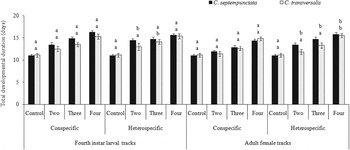
Total developmental duration of immature stages of Coccinella septempunctata and Coccinella transversalis when exposed to larval and adult conspecific and heterospecific semiochemical tracks of varying density (values are observed mean±SE; upper and lower letters are for Coccinella septempunctata and Coccinella transversalis, respectively; small letters represent comparison of means between semiochemical tracks types).

Results
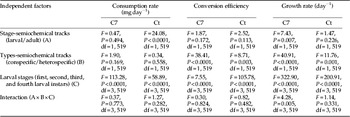
In the present study, values of r-ANOVA (table 1) revealed significant influence of the larval stage (first, second, third, and fourth instars) on the consumption rate of larvae of C7 and Ct. Although the stage of semiochemical tracks (larval or adult) significantly influenced the consumption rates of larvae of Ct but did not influence the consumption rates of larvae of C7. Moreover, the consumption rates of larvae of neither C7 nor Ct were significantly affected by the types of semiochemical tracks (conspecific or heterospecific) and the interaction between the three independent factors (stage of semiochemical tracks, types of semiochemical tracks, and larval stage). Values of Pearson correlation coefficients furthermore revealed inverse relationships between density of semiochemical tracks and consumption rate of the larvae of C7 (r=−0.485; P<0.0001) and Ct (r=−0.404; P<0.0001).
The effect of independent factors on consumption rate, conversion efficiency and growth rate of larvae of ladybirds, Coccinella septempunctata (C7) and Coccinella transversalis (Ct) (F-values significant at P<0.05).

The conversion efficiency (table 1) of first, second, third, and fourth larval instars of both C7 and Ct was significantly influenced by the types of semiochemical tracks and the larval stage, but neither by the stage of semiochemical tracks nor by the interaction between the three independent factors (stage of semiochemical tracks, types of semiochemical tracks, and larval stage). Values of Pearson correlation coefficients revealed inverse relationships between density of semiochemical tracks and conversion efficiency of larvae of C7 (r=−0.538; P<0.0001) and Ct (r=−0.395; P<0.0001).
The r-ANOVA values (table 1) further revealed significant influence of the types of semiochemical tracks and larval stage on the growth rate of the larvae of C7 and Ct. Although the stage of semiochemical tracks and the interaction between the three independent factors (stage of semiochemical tracks, types of semiochemical tracks, and larval stage) influenced the growth rate of larvae of C7 but did not influence the growth rate of the larvae of Ct. Values of Pearson correlation coefficients revealed inverse relationships between density of semiochemical tracks and growth rate of the larvae of C7 (r=−0.448; P<0.0001) and Ct (r=−0.398; P<0.0001).
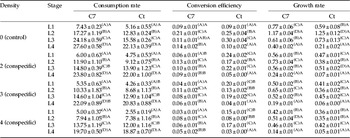
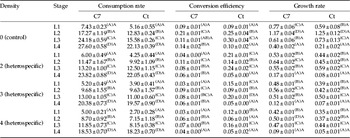
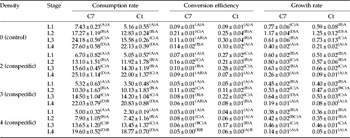
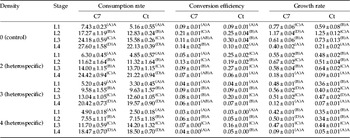
The results therefore exemplified that the consumption rate, conversion efficiency, and growth rate of larval instars of both the ladybirds decreased significantly when exposed to an increasing density of zero, two, three, and four conspecific/heterospecific larval/adult female tracks (tables 2–5). Despite the presence/absence of semiochemical tracks, consumption rate was highest for the fourth instars and lowest for the first instars of C7 and Ct. In contrast, the conversion efficiency and growth rate of early instars (first to third instars) of both the ladybird species were higher than the fourth instars. Also, the larvae reared under conspecific larval/adult tracks had higher consumption rate, conversion efficiency, and growth rate than the larvae reared under heterospecific larval/adult tracks. Moreover, C7 had higher consumption rate and growth rate, whereas conversion efficiency was relatively higher in Ct (tables 2–5).
Predation parameters of immature stages of ladybirds, Coccinella septempunctata (C7) and Coccinella transversalis (Ct) when exposed to conspecific fourth instars’ larval tracks (values are observed mean±SE; L1, L2, L3, and L4 represent first, second, third, and fourth larval instars, respectively; large letters in parentheses and large letters represent comparison of means between immature stages and between semiochemical tracks types, respectively).

Predation parameters of immature stages of ladybirds, Coccinella septempunctata (C7) and Coccinella transversalis (Ct) when exposed to heterospecific fourth instars’ larval tracks (values are observed mean±SE; L1, L2, L3, and L4 represent first, second, third, and fourth larval instars, respectively; large letters in parentheses and large letters represent comparison of means between immature stages and between semiochemical tracks types, respectively).

Predation parameters of immature stages of ladybirds, Coccinella septempunctata (C7) and Coccinella transversalis (Ct) when exposed to conspecific adult female's tracks (values are observed mean±SE; L1, L2, L3, and L4 represent first, second, third, and fourth larval instars, respectively; large letters in parentheses and large letters represent comparison of means between immature stages and between semiochemical tracks types, respectively).

Predation parameters of immature stages of ladybirds, Coccinella septempunctata (C7) and Coccinella transversalis (Ct) when exposed to heterospecific adult female's tracks (values are observed mean±SE; L1, L2, L3, and L4 represent first, second, third, and fourth larval instars, respectively; large letters in parentheses and large letters represent comparison of means between immature stages and between semiochemical tracks types, respectively).

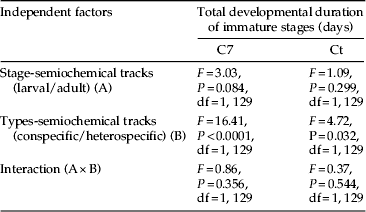
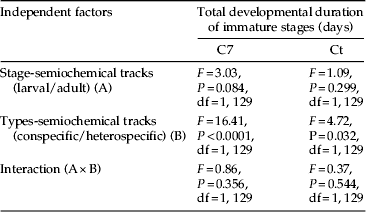
Further, significant influence of the types of semiochemical tracks was recorded in the present study on the total developmental duration of immature stages of C7 and Ct (table 6). However, neither the stage of the semiochemical tracks nor the interaction between the two independent factors (types of semiochemical tracks and stage of the semiochemical tracks) affected the total developmental duration of immature stages of both the ladybird species. Values of Pearson correlation coefficients showed significant positive relationships between density of semiochemical tracks and total developmental duration of immature stages of C7 (r=0.636; P<0.0001) and Ct (r=0.604; P<0.0001).
Effect of independent factors on total developmental duration of immature stages of ladybirds, Coccinella septempunctata (C7) and Coccinella transversalis (Ct) (F-values significant at P<0.05).
In the absence of larval or adult female tracks, the total developmental duration of immature stages was shortest for both C7 (11.00±0.30 days) and Ct (11.10±0.38 days). It was recorded to be the longest when immature stages of C7 were exposed to four conspecific larval tracks (16.30±0.33 days) and those of Ct to four heterospecific adult female tracks (15.50±0.48 days). The total developmental duration of immature stages of Ct was slightly shorter than C7 (Fig. 1).
Discussion
Results of the present study reveal a reduction in predation parameters, viz. consumption rate, conversion efficiency, and growth rate of larval instars of C7 and Ct, in the presence of larval or adult female tracks; and this reduction was species specific.
The highest consumption rate was recorded in the absence of larval or adult female tracks in the present study. This may possibly be due to the tendency of larval instars of these ladybirds to avoid foraging in the areas containing semiochemical tracks of conspecific/heterospecific larvae/adults. Their tendency to avoid semiochemical tracks of conspecifics or heterospecifics is probably an attempt to protect themselves from cannibalism or intraguild predation. But this tendency reduces their foraging and searching areas and diminishes their access to aphid prey that results in their decreased consumption rate.
Detection and avoidance of chemical tracks resulting in reduced or no foraging has been demonstrated earlier by the larvae of Hippodamia convergens Guerin-Meneville by Rutledge et al. (Reference Rutledge, Eigenbrode and Ding2008), Cycloneda limbifer Say by Ruzicka & Zemek (Reference Ruzicka and Zemek2008), and H. axyridis by Moser et al. (Reference Moser, Haynes and Obrycki2010). Apart from the foraging, the oviposition-deterring response of female ladybirds to larval/adult tracks (both conspecific and heterospecific) also were reported (Hemptinne et al., Reference Hemptinne, Dixon and Coffin1992; Ruzicka, Reference Ruzicka1997, Reference Ruzicka2003, Reference Ruzicka2006, Reference Ruzicka2010; Michaud & Jyoti, Reference Michaud and Jyoti2007; Ruzicka & Zemek, Reference Ruzicka and Zemek2008; Mishra et al., Reference Mishra, Singh, Shahid and Omkar2012a).
Among larval instars, maximum consumption of aphid prey was observed for the fourth instars, which may be attributed to their: (i) larger size, (ii) higher energy requirements, and (iii) increased metabolic costs. Higher consumption rates of fourth instars have been reported by Isikber & Copland (Reference Isikber and Copland2001), Ahlawat et al. (Reference Ahlawat, Singh, Singh and Rohilla2008), Finlayson et al. (Reference Finlayson, Alyokhin, Gross and Porter2010) and Mishra et al. (Reference Mishra, Singh, Shahid and Omkar2012a, Reference Mishra, Omkar, Kumar and Pandeyb) in ladybirds, and Omkar & Afaq (Reference Omkar and Afaq2011) in Parthenium beetles.
The foraging deterrence to larval/adult tracks was higher in terms of lower prey consumption in Ct in the present study. This may be attributed to: (i) its relatively strong responses (detection and avoidance) to the tracks of conspecifics or heterospecifics, (ii) its higher risk of being predated by C7 (Kumar et al., Reference Kumar, Bista, Mishra and Omkar2014), and (iii) its relatively small size. Previous studies have shown that ladybird species produce species-specific alkanes as semiochemical signatures of defence (Pasteels et al., Reference Pasteels, Deroe, Tursch, Brakeman, Daloze and Hootele1973; Marples et al., Reference Marples, Brakefield and Cowie1989; Dixon, Reference Dixon2000; Hemptinne & Dixon, Reference Hemptinne and Dixon2000; Hemptinne et al., Reference Hemptinne, Lognay, Gauthier and Dixon2000b; Magro et al., Reference Magro, Tene, Bastin, Dixon and Hemptinne2007); and use their olfactory system to detect the semiochemicals of conspecifics (Al Abassi et al., Reference Al Abassi, Birkett, Petterson, Pickett and Woodcock1998; Schaller & Nentwig, Reference Schaller and Nentwig2000; Omkar et al., Reference Omkar, Pervez and Gupta2004; Mishra et al., Reference Mishra, Singh, Shahid and Omkar2012a) or heterospecifics (Mishra et al., Reference Mishra, Singh, Shahid and Omkar2013).
Higher conversion efficiency and growth rate of larval instars in the absence of tracks, in the present study, may be attributed to their higher consumption rates. In presence of conspecific/heterospecific semiochemical tracks the larvae consume less, and probably utilize the prey biomass less efficiently into their own biomass. This further leads to reduced conversion efficiency and growth rate than the usual.
Higher conversion efficiency of earlier instars over the fourth instars in the present study may probably be due to their small size and lower energy requirements. Many earlier studies in ladybirds have also reported higher conversion efficiencies in the early instars and lower in the late instars (Isikber & Copland, Reference Isikber and Copland2001; Jalali et al., Reference Jalali, Tirry and De Clercq2009; Mishra et al., Reference Mishra, Kumar, Shahid, Singh and Omkar2011, Reference Mishra, Omkar, Kumar and Pandey2012b; Hodek et al., Reference Hodek, van Emden and Honek2012). The reduced growth rate of fourth instars over the early instars may be due to their: (i) decreased ability in converting prey biomass into their own body mass, and (ii) greater metabolic costs associated with their large size. Decreases in growth rate from early instars to fourth instar, as recorded in the present study have been reported in other insect species by Rath (Reference Rath2010) and Omkar & Afaq (Reference Omkar and Afaq2011).
The higher conversion efficiency of Ct over C7 in the present study may be attributed to its small size. Despite being small, the lower growth rate in Ct may be attributed to: (i) reduced consumption of aphid prey, owing to strong foraging deterrence in the presence of conspecific/heterospecific tracks. In contrast, the higher growth rate of C7 may be attributed to weaker responses to tracks of conspecifics and heterospecifics that probably promote higher prey consumption. Weaker responses of C7 to heterospecific larval tracks in terms of prey consumption have been reported earlier by Magro et al. (Reference Magro, Tene, Bastin, Dixon and Hemptinne2007).
The shortest developmental durations of immature stages in the absence of larval tracks, in the present study are probably due to the higher consumption, conversion, and utilization of prey biomass into their own biomass by the larval instars. In the presence of conspecific or heterospecific tracks, larvae probably consume less and with lower efficiency. As a result individual developmental stages become longer and prolong the total developmental duration. In comparison to C7, slightly shorter developmental durations of Ct in the present study may be attributed to its small size and higher growth rates.
Moreover, in the present study, increased foraging inhibitory effects, e.g., reduced consumption rate, conversion efficiency, and growth rate, and longer developmental duration, have been recorded with increases in density of semiochemical tracks. This further indicates that the effect of these FDPs is density dependent.
When compared with heterospecific tracks, higher/slightly higher conversion efficiency and growth rate of larval instars, and shorter/slightly shorter developmental durations of immature stages in the presence of conspecific tracks are possibly due to: (i) social feeding behaviour in the neonates of ladybirds that promotes growth, development and increases the chances of survival (Hemptinne et al., Reference Hemptinne, Doumbia and Dixon2000a; Omkar & Pathak, Reference Omkar and Pathak2009) and (ii) familiarity with the harmless nature of semiochemicals of conspecifics that are more easily metabolized than those of heterospecifics (Rieder et al., Reference Rieder, Newbold, Sato, Yasuda and Evans2008; Ware et al., Reference Ware, Yguel and Majerus2009). Higher deterrence, although in terms of oviposition, in the presence of heterospecific tracks demonstrated by Michaud & Jyoti (Reference Michaud and Jyoti2007) in ladybird predators and Taylor et al. (Reference Taylor, Muller and Godfray1998) and Takizawa et al. (Reference Takizawa, Yasuda and Agarwala2000) in insect parasitoids also support the findings that ladybird predators are more sensitive to heterospecific chemicals. Contrary to these findings, earlier studies have shown that aphidophagous ladybirds are more sensitive to the chemicals of conspecific larval tracks (Martini et al., Reference Martini, Haccou, Olivieri and Hemptinne2009; Almohamad et al., Reference Almohamad, Verheggen, Francis and Haubruge2010; Magro et al., Reference Magro, Ducamp, Ramon-Portugal, Lecompte, Crouau-Roy, Dixon and Hemptinne2010) and avoid ovipositing in patches of aphids that have already been exploited by conspecific larvae; since laying eggs in such patches would greatly increase the risk of cannibalism (Doumbia et al., Reference Doumbia, Hemptinne and Dixon1998; Laubertie et al., Reference Laubertie, Martini, Cadena, Treilhou, Dixon and Hemptinne2006; Mishra et al., Reference Mishra, Singh, Shahid and Omkar2013).
Although, detection and avoidance of the tracks produced by either conspecific or heterospecific ladybird's larvae or adults reduced the risk of competition (cannibalism or intraguild predation) and reduced the time and energy spent on searching for prey, findings of the present study suggest that the semiochemical tracks significantly reduce the predation potential and prolong the developmental duration of conspecific and heterospecific larvae.
In brief, the present study is an attempt to investigate semiochemical tracks as FDPs. This study indicates that the deterrence in oviposition, as reported earlier (Hemptinne et al., Reference Hemptinne, Dixon and Coffin1992; Ruzicka, Reference Ruzicka1997, Reference Ruzicka2003, Reference Ruzicka2006, Reference Ruzicka2010; Michaud & Jyoti, Reference Michaud and Jyoti2007; Ruzicka & Zemek, Reference Ruzicka and Zemek2008; Mishra et al., Reference Mishra, Singh, Shahid and Omkar2012a) may possibly be due to the simultaneous effects of: (i) semiochemical tracks of other larvae/adults, and (ii) the consumption of less prey by the focal females. Further exploration of this simultaneous effect is still needed. Moreover, the semiochemical tracks are not analysed chemically/biochemically in the present study, but future experiments need to be designed to analyse the biochemical nature of conspecific/heterospecific semiochemical tracks to validate the present findings. Also, the same experiments may be conducted at variable temperatures to calculate the lower developmental threshold and the sum of effective temperatures and may be compared with the known database (Jarosik et al., Reference Jarosik, Honek, Magarey and Skuhrovec2011) to identify whether semiochemical tracks further influence the developmental rate in ladybirds or not?
Acknowledgements
The authors are grateful to the Department of Higher Education, Government of Uttar Pradesh, India for providing financial assistance in the form of Centre of Excellence in Biocontrol of Insect Pests.