Introduction
Autism spectrum disorders (ASDs) and bipolar disorder (BD) are highly heritable conditions, with heritability estimates ranging from 46% to 57% for BD (Song et al., Reference Song, Kuja-Halkola, Sjölander, Bergen, Larsson, Landén and Lichtenstein2018) and as high as 91% for ASDs (Tick, Bolton, Happé, Rutter, & Rijsdijk, Reference Tick, Bolton, Happé, Rutter and Rijsdijk2016). Based on their diagnostic criteria, they have little in common (American Psychiatric Association, 2013), yet there is growing evidence that they co-occur relatively frequently. ASDs and BD each have prevalence rates of approximately 1–2%, yet 3–11% of adults with ASDs have been reported to have BD (Buck et al., Reference Buck, Viskochil, Farley, Coon, McMahon, Morgan and Bilder2014; Croen et al., Reference Croen, Zerbo, Qian, Massolo, Rich, Sidney and Kripke2015; de Bruin, Ferdinand, Meester, de Nijs, & Verheij, Reference de Bruin, Ferdinand, Meester, de Nijs and Verheij2007; Hofvander et al., Reference Hofvander, Delorme, Chaste, Nydén, Wentz, Ståhlberg and Leboyer2009; Verheij et al., Reference Verheij, Louwerse, van der Ende, Eussen, Van Gool, Verheij and Greaves-Lord2015), which increases to 25–31% in clinically referred samples (Joshi et al., Reference Joshi, Petty, Wozniak, Henin, Fried, Galdo and Biederman2010, Reference Joshi, Wozniak, Petty, Martelon, Fried, Bolfek and Biederman2013b). Similarly, 30% of individuals with BD have been reported to have ASDs (Joshi et al., Reference Joshi, Biederman, Petty, Goldin, Furtak and Wozniak2013a). One study of a Japanese clinical sample reported that when ASDs co-occur with mood disorders, in 75% of cases the latter is BD (Munesue et al., Reference Munesue, Ono, Mutoh, Shimoda, Nakatani and Kikuchi2008), suggesting a particular association between ASDs and BD. A review paper indicated that existing studies of ASDs and BD are based on sample sizes ranging from 35 to 4343 individuals, and that up to 21% of individuals with ASDs have been reported to have BD (Skokauskas & Frodl, Reference Skokauskas and Frodl2015). This suggests that BD co-occurs relatively commonly with ASDs across the lifespan, thus emphasizing that a better understanding of their association is needed.
Despite this strong phenotypic link, relatively few studies have focused on the association between ASDs and BD, meaning that the reasons behind their association remain poorly understood. One possibility is that the genetic and environmental factors associated with ASDs also influence BD. There is no robust evidence in ASD research for this hypothesis in relation to other conditions, such as attention-deficit/hyperactivity disorder (ADHD) and anxiety disorders (Hallett, Ronald, Rijsdijk, & Happé, Reference Hallett, Ronald, Rijsdijk and Happé2010; Lundström et al., Reference Lundström, Chang, Kerekes, Gumpert, Råstam, Gillberg and Anckarsäter2011; Ronald, Simonoff, Kuntsi, Asherson, & Plomin, Reference Ronald, Simonoff, Kuntsi, Asherson and Plomin2008; Taylor et al., Reference Taylor, Charman, Robinson, Plomin, Happé, Asherson and Ronald2013). It is, however, less well known whether this applies to ASDs and BD, with only preliminary evidence. Recent common variant genome-wide correlations between these conditions have been estimated at 0.11–0.18, indicating a modest overlap between clinical diagnoses of these disorders in adults (Grove et al., Reference Grove, Ripke, Als, Mattheisen, Walters, Won and Børglum2019; Stahl et al., Reference Stahl, Breen, Forstner, McQuillin, Ripke, Trubetskoy and Sklar2019).
These estimates only account for common genetic variation, thus the full extent of genetic overlap between ASDs and BD is unclear. Twin and family studies have considerable value in understanding genetic overlap between conditions, since they account for all sources of genetic variation. Family studies suggest that siblings of individuals with ASDs are more likely to have BD than siblings of controls, and children of individuals with BD are more likely to have ASDs (Jokiranta-Olkoniemi et al., Reference Jokiranta-Olkoniemi, Cheslack-Postava, Sucksdorff, Suominen, Gyllenberg, Chudal and Sourander2016; Sullivan et al., Reference Sullivan, Magnusson, Reichenberg, Boman, Dalman, Davidson and Lichtenstein2012). In one family study, over 50 000 individuals with BD were identified from the Swedish population; their relatives were diagnosed with ASDs more frequently than relatives of controls and the more closely related individuals were, the more likely they were to have ASDs, suggesting a genetic link between clinical diagnoses of these conditions. In the same study, twin analyses yielded a genetic correlation of 0.24 between these diagnoses (Song et al., Reference Song, Bergen, Kuja-Halkola, Larsson, Landén and Lichtenstein2015).
Nonetheless, genetically informative studies of the association between ASDs and BD remain scarce. Most existing studies report on broad age ranges and focus on clinical diagnoses (Grove et al., Reference Grove, Ripke, Als, Mattheisen, Walters, Won and Børglum2019; Song et al., Reference Song, Bergen, Kuja-Halkola, Larsson, Landén and Lichtenstein2015; Stahl et al., Reference Stahl, Breen, Forstner, McQuillin, Ripke, Trubetskoy and Sklar2019). Although BD typically has its onset during adulthood, many individuals with BD report experiencing hypomanic symptoms as teenagers (Perlis et al., Reference Perlis, Dennehy, Miklowitz, DelBello, Ostacher, Calabrese and Sachs2009). For instance, as many as 10% of adolescents show elevated degrees of hypomania, which may confer increased risk for subsequent BD (Hosang et al., Reference Hosang, Cardno, Freeman and Ronald2017; Hudziak, Althoff, Derks, Faraone, & Boomsma, Reference Hudziak, Althoff, Derks, Faraone and Boomsma2005; Waugh, Meyer, Youngstrom, & Scott, Reference Waugh, Meyer, Youngstrom and Scott2014). This has led to discussion around whether BD should be considered as a diagnosis in pediatric populations, albeit this has proven to be a contentious issue, with some clinicians remaining hesitant to diagnose BD in these individuals. Given the vulnerability of individuals with ASDs to mental health difficulties, and the frequent emergence of many persistent mental health problems during adolescence, there is thus considerable value in studying hypomania during adolescence. Whether hypomania is associated with ASDs has not yet been comprehensively examined.
We therefore used a large, longitudinally assessed twin cohort to test whether ASDs were associated with adolescent hypomania. Since there is evidence to suggest that the genetic influences on ASDs also influence autistic traits in the general population, we also examined whether autistic traits in childhood were linked with adolescent hypomania. We then used twin methods to assess whether etiological influences on childhood autistic traits also influence adolescent hypomania. There is evidence to suggest that specific autistic traits, such as communication difficulties and repetitive behavior, are partly distinguishable in terms of etiology (Ronald, Happé, Bolton, Butcher, & Price, Reference Ronald, Happé, Bolton, Butcher and Price2006), and some studies indicate that the strength of the association between autistic traits and other phenotypes differs across these specific domains (Polderman, Hoekstra, Posthuma, & Larsson, Reference Polderman, Hoekstra, Posthuma and Larsson2014; Ronald et al., Reference Ronald, Larsson, Anckarsäter and Lichtenstein2014; Taylor, Charman, & Ronald, Reference Taylor, Charman and Ronald2015a, Reference Taylor, Robinson, Happé, Bolton, Freeman and Ronald2015b). We therefore also compared associations with hypomania across specific autistic trait domains. We expected ASDs (and autistic traits) to be associated with hypomania, both phenotypically and etiologically. We further expected that the magnitude of these associations would differ across specific autistic trait domains.
Method
Participants
When twins are born in Sweden, their parents can voluntarily register them in the Swedish Twin Registry (STR). Based on the STR, all twins born in Sweden since 1992 were invited to participate in CATSS from 2004 when twins were aged 9 (earlier cohorts included 12-year-olds), with an initial response rate of 75% (Anckarsäter et al., Reference Anckarsäter, Lundström, Kollberg, Kerekes, Palm, Carlström and Lichtenstein2011). Follow-ups are conducted when the twins are aged 15 or 18. The respective response rates among those who have turned 15 or 18 are 61% and 59%. Online Supplementary Table S1 shows the numbers of individuals with neurodevelopmental or psychiatric disorders who participated at each wave, and indicates that a greater proportion of participants had at least one of these conditions than those who did not participate. Exclusions were performed for brain injuries (N = 194) and chromosomal syndromes (N = 27). The sample sizes are shown in Table 1. Zygosity was ascertained using a panel of single nucleotide polymorphisms or an algorithm of twin similarity (Hannelius et al., Reference Hannelius, Gherman, Mäkelä, Lindstedt, Zucchelli, Lagerberg and Lindgren2007). Only twins with at least a 95% probability of correct classification have had their zygosity ascertained using the latter method.
Descriptive statistics

CATSS, Child and Adolescent Twin Study in Sweden; A-TAC, Autism-Tics, ADHD, and other Comorbidities inventory at age 9 or 12; CMRS, Child Mania Rating Scale at age 15; MDQ, Mood Disorders Questionnaire at age 18; A-TAC Broad, broad screening diagnosis, based on a score of 4.5 or more; A-TAC Strict, strict screening diagnosis, based on a score of 8.5 or more for ASD; MZF, monozygotic female twins; DZF, dizygotic female twins; MZM, monozygotic male twins; DZM, dizygotic male twins; DZOS, F, female twins in opposite-sex dizygotic pairs; DZOS, M, male twins in opposite-sex dizygotic pairs.
CATSS families provide written informed consent prior to participation. CATSS has ethical approval from the Regional Ethical Review Board in Stockholm County (2016/2135-31).
Measures
Autistic traits
The Autism-Tics, AD/HD, and other Comorbidities inventory (A-TAC) is a 96-item structured interview, completed by parents over the telephone when the twins were aged 9 or 12 (Hansson et al., Reference Hansson, Svanström Röjvall, Rastam, Gillberg, Gillberg and Anckarsäter2005). ASD is assessed by 17 questions, each of which can be answered ‘yes’ (scored as 1), ‘yes, to some extent’ (0.5), or ‘no’ (0), giving scores ranging from 0 to 17. Specific autistic traits were measured using three subscales: social interaction difficulties (six items), communication problems (six items), and inflexibility (five items). The total scale was used to assign screening diagnoses of ASD. Scores of 8.5 or more denote a strict screening diagnosis of ASDs, which has a sensitivity of 0.71 and a specificity of 0.95. A score of 4.5 or more yields a broad screening diagnosis, with a specificity of 0.96 and a sensitivity of 0.80 (Larson et al., Reference Larson, Anckarsäter, Gillberg, Ståhlberg, Carlström, Kadesjö and Gillberg2010). A longitudinal follow-up study replicated this validity (Larson et al., Reference Larson, Lundström, Nilsson, Selinus, Råstam, Lichtenstein and Kerekes2013). The A-TAC was used as a continuous scale and to assign screening diagnoses in the phenotypic analyses, in order to test whether hypomania was associated with different manifestations of ASDs. Due to power concerns, the A-TAC was only used as a continuous scale in the twin analyses.
Clinical diagnoses of ASDs
CATSS was linked with the Swedish National Patient Register (NPR), which records specialist in-patient and out-patient care given to residents of Sweden. Clinical diagnoses of ASDs were identified, defined as ICD-10 code F84 (excluding Rett Syndrome, other childhood disintegrative disorders, and overactive disorder associated with intellectual disability and stereotyped movements). These diagnoses have been validated specifically for Stockholm County. These clinical diagnoses were used in the phenotypic analyses, described below.
Hypomania
Two parent report measures assessed hypomania, both of which are among the three most highly recommended instruments for assessing hypomania (Waugh et al., Reference Waugh, Meyer, Youngstrom and Scott2014). We relied on parental reports here, as they have been shown to outperform teacher and self-report measures of hypomania in adolescents (Youngstrom, Genzlinger, Egerton, & Van Meter, Reference Youngstrom, Genzlinger, Egerton and Van Meter2015). At age 15, the shortened Child Mania Rating Scale (CMRS) was used. The 10 CMRS items are designed to briefly screen for behaviors, thoughts, and emotions characteristic of hypomania and mania, such as irritability, high energy levels, and impulsivity. Questions can be answered ‘never’ (scored as 0), ‘sometimes’ (1), ‘often’ (2), or ‘very often’ (3), giving a range of scores from 0 to 30. The shortened CMRS has a sensitivity of 0.90 and a specificity of 0.96 in detecting individuals with BD, and also distinguishes BD from ADHD with a sensitivity of 0.84 and a specificity of 0.92. The CMRS was used as a continuous scale in all analyses.
At age 18, parents completed the Mood Disorders Questionnaire (MDQ) (Hirschfeld et al., Reference Hirschfeld, Williams, Spitzer, Calabrese, Flynn, Keck and Zajecka2000). The MDQ comprises 13 questions, covering elevated mood, irritability, and high energy levels. A cut-off of seven or more endorsed questions gives a sensitivity of 0.73 and a specificity of 0.90 in identifying BD (Dineen Wagner et al., Reference Dineen Wagner, Hirschfeld, Emslie, Findling, Gracious and Reed2006; Hirschfeld et al., Reference Hirschfeld, Williams, Spitzer, Calabrese, Flynn, Keck and Zajecka2000). The MDQ was used as a continuous scale in all analyses.
Data analyses
Phenotypic analyses
We first tested whether ASDs showed phenotypic associations with hypomania. Four ASD definitions were used, as described above: autistic traits, broad screening diagnosis, strict screening diagnosis, and clinical diagnosis. These definitions allowed us to test associations between ASDs of differing degrees and hypomania. Regression models tested whether autistic traits and ASDs were associated with hypomania at ages 15 and 18. Linear regressions were implemented as generalized estimating equations with robust standard errors to account for the non-independent sample. Sex and birth year were both adjusted for in the models. Standardized scores were used in these analyses to improve comparability across analyses.
Twin analyses
We utilized the classical twin design to assess whether genetic and environmental influences on autistic traits at ages 9 and 12 influenced hypomania at ages 15 and 18. The twin design partitions variance in a continuous trait into genetic and environmental components, based on the assumption that monozygotic (MZ) twins share all of their segregating DNA code, compared to approximately 50% in dizygotic (DZ) twins. Higher within-pair resemblance in MZ compared to DZ twins indicates genetic influences on a given trait. Four sources of variance are estimated: additive genetic (termed ‘A’), non-additive genetic (D), shared environment (C), and nonshared environment (E), which incorporates measurement error. The multivariate twin model aims to estimate the degree to which these influences on one trait influence other traits. Initially, twin correlations can be used to determine the degree to which overlap in these components accounts for the covariance between two traits, and involve correlating one twin's score on one trait with their co-twin's score on another trait. Genetic influences on the covariance between these two traits are implied when these correlations are higher in MZ than DZ twins. A more comprehensive overview of the twin design is given elsewhere (Rijsdijk & Sham, Reference Rijsdijk and Sham2002).
These twin correlations were initially estimated from a saturated model of the observed data. We then fitted a multivariate Cholesky decomposition to assess the degree to which genetic and environmental influences on autistic traits in childhood influence adolescent hypomania. This estimated the proportion of variance in CMRS and MDQ scores that was explained by genetic and nonshared environmental influences shared with autistic traits, as well as the proportions that were unique to each trait. The MDQ at age 18 was additionally influenced by etiological factors shared with the CMRS at age 15. Only one of C and D was estimated for each measure, as these components confound one another in the classical twin design. Based on previously published univariate results for the measures used here, we allowed A, D, and E to influence autistic traits, and A, C, and E to influence hypomania (Hosang, Lichtenstein, Ronald, Lundström, & Taylor, Reference Hosang, Lichtenstein, Ronald, Lundström and Taylor2019; Taylor et al., Reference Taylor, Gustafsson, Larsson, Gillberg, Lundström and Lichstenstein2018). No covariance was estimated for D and C. Furthermore, we have previously detected sibling contrast effects for autistic traits (Taylor et al., Reference Taylor, Gustafsson, Larsson, Gillberg, Lundström and Lichstenstein2018), which refer to the influence of one twin's phenotype on their co-twin's phenotype; these effects were thus estimated here for autistic traits. All estimates were initially permitted to differ in magnitude by sex (quantitative sex limitation), and were subsequently equated. We then fitted nested models from whichever of these two models fit best to test the significance of individual groups of parameters. Model fit was assessed using Bayesian Information Criteria (BIC), which has been shown to outperform other fit indices when fitting multivariate twin models to large samples (Markon & Krueger, Reference Markon and Krueger2004). Lower BIC values suggest better-fitting models, and so the best-fitting model was defined by having the lowest BIC value. After performing analyses on the full A-TAC scale, we repeated all twin analyses on the three subscales.
All of the twin analyses were performed using the OpenMx package of R (Neale et al., Reference Neale, Hunter, Pritikin, Zahery, Brick, Kirkpatrick and Boker2016). Full information maximum-likelihood estimation was used in the analyses, an estimation method that is robust to missing data.
Results
The sample size at each age, descriptive statistics, and the number of individuals with each ASD diagnosis are shown in Table 1.
Phenotypic analyses
Figure 1 shows the associations between ASDs and hypomania. All ASD definitions were associated with increased hypomania scores at ages 15 and 18. Each standard deviation increase in autistic traits was associated with increases in hypomania of 0.31 and 0.24 standard deviations at ages 15 and 18, respectively. Diagnoses of ASD were associated with stronger increases in hypomania; for broad ASD, these were 1.19 and 0.84 standard deviations at ages 15 and 18, respectively; for strict ASD, 1.29 and 1.66; and for clinical ASD, 0.90 and 0.71.
Association between ASDs and hypomania. The above plot shows the standardized regression coefficients from generalized estimates equations, which reflect the mean increase in hypomania at ages 15 and 18 associated with ASD and autistic traits. Autistic Traits: continuous score on the Autism-Tics, ADHD, and other Comorbidities inventory (A-TAC). Broad ASD: screening diagnosis of ASD, based on a score of at least 4.5 on the A-TAC. Strict ASD: screening diagnosis of ASD, based on a score of at least 8.5 on the A-TAC. Diagnosed ASD: diagnosis of ASD recorded in the National Patient Register. Error bars depict 95% confidence intervals.

Twin analyses
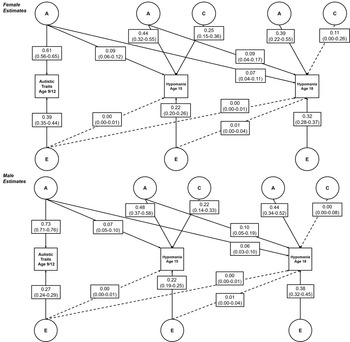
Phenotypic and twin correlations are shown in Table 2. Phenotypic correlations between autistic traits and hypomania varied from 0.24 to 0.28, dependent on sex and age. Cross-trait cross-twin correlations were all higher for MZ than DZ twins, indicating genetic influences on the covariance between autistic traits and hypomania. Table 3 shows the twin model fit statistics. The best-fitting model included quantitative sex limitation; D could be dropped for autistic traits. The model estimates are shown in Fig. 2b (estimates with confidence intervals are shown in online Supplementary Table S1). All of the shared variance between autistic traits and hypomania was genetic; all nonshared environmental pathways from autistic traits to hypomania were estimated at 0. Additive genetic influences explained 61% of the variance in autistic traits in females, and 73% in males. These genetic influences on autistic traits explained 9% of the variance in hypomania at age 15 in females, and 7% in males. At age 18, 7% of the variance in hypomania was explained by genetic influences shared with autistic traits in females, and 6% in males. This means that of the 53–55% heritability in hypomania at age 15, 13–17% was accounted for by genetic influences shared between hypomania and autistic traits. At age 18, 10–13% of the 55–60% heritability of hypomania was accounted for by genetic influences shared with autistic traits.
Cholesky decomposition of autistic traits and adolescent hypomania. (a) Additive genetic influences; (c) shared environmental influences; (e) nonshared environmental influences. All path estimates are shown as the proportion of variance explained in each phenotype by that path. Numbers in parentheses are 95% confidence intervals. Dashed lines indicate paths that are not statistically significant, based on 95% confidence intervals overlapping with 0.

Twin correlations

A-TAC, Autism-Tics, ADHD, and other Comorbidities inventory; CMRS, Child Mania Rating Scale; MDQ, Mood Disorders Questionnaire; rPH, F/rPH, M, phenotypic correlations, in females and males respectively; MZF, female monozygotic twins; DZF, female dizygotic twins; MZM, male monozygotic twins; DZM, male dizygotic twins; DZOS, opposite-sex dizygotic twins.
Twin model fit statistics for multivariate models.

The best-fitting model is highlighted in bold italics.
A-TAC, Autism-Tics, ADHD, and other Comorbidities inventory; CMRS, Child Mania Rating Scale; MDQ, Mood Disorders Questions; A, additive genetic influences; D, non-additive genetic influences; C, shared environmental influences; E, nonshared environmental influences; s, sibling interaction parameters; Hom, homogeneity, indicating no sex differences; −2LL, fit statistic, which is −2*log-likelihood of the data; df, degrees of freedom; BIC, Bayesian Information Criteria; Δχ2, −2LL difference between two models, distributed χ2; Δdf, difference in degrees of freedom between models, equal to the difference in number of parameters.
The results of the subscale-specific analyses are shown in online Supplementary Tables S2–S6. The strongest phenotypic correlations were between social interaction difficulties and hypomania (0.25–0.27). Phenotypic correlations between inflexibility and hypomania varied from 0.18 to 0.21, while the weakest phenotypic correlations were between communication problems and hypomania (0.12–0.19). This was reflected in the twin analyses, where 6–8% of the variance in social interaction difficulties was explained by genetic influences shared with autistic traits, compared to 5–6% for inflexibility and 2–5% for communication problems. Confidence intervals overlapped, however. As a posthoc analysis, we reran these analyses using subscales based on DSM-5 criteria for ASDs, which combined the social and communication subscales into one social communication subscale. The results of these analyses are shown in online Supplementary Table S8, and indicated that social communication showed stronger associations with hypomania than inflexibility.
Discussion
To our knowledge, our study is the first to show that ASD diagnoses and autistic traits are associated with hypomania during adolescence, prior to the typical age of onset for BD. Genetic factors associated with autistic traits also play a role in adolescent hypomania, with this association particularly driven by social interaction difficulties characteristic of ASDs. This adds to the growing picture of clinical and genetic overlap between ASDs and psychiatric outcomes, extending it to adolescent hypomania.
A limited number of previous studies on ASDs and BD have shown an association between these conditions at the level of clinical diagnoses, especially in adults (Skokauskas & Frodl, Reference Skokauskas and Frodl2015), with a modest degree of overlapping genetic factors underlying this association (Grove et al., Reference Grove, Ripke, Als, Mattheisen, Walters, Won and Børglum2019; Song et al., Reference Song, Bergen, Kuja-Halkola, Larsson, Landén and Lichtenstein2015; Stahl et al., Reference Stahl, Breen, Forstner, McQuillin, Ripke, Trubetskoy and Sklar2019). Our results extend these findings to show that ASDs, and autistic traits, are associated with hypomania during adolescence. Hypomania during adolescence is a potential risk factor for subsequent onset of BD (Perlis et al., Reference Perlis, Dennehy, Miklowitz, DelBello, Ostacher, Calabrese and Sachs2009). More research is clearly needed in order to elucidate whether hypomania in individuals with ASDs follows a trajectory toward clinically impairing symptoms, yet may be useful for clinicians to be aware of hypomania in adolescents with ASDs, even if they do not yet qualify for a diagnosis of BD.
Our results more broadly concur with evidence to indicate that ASDs, and autistic traits, show an association with multiple psychopathological symptoms in adolescence that may, at their extreme, reflect adult-onset psychiatric disorders. As well as being associated with hypomania, ASDs are linked with psychotic experiences in adolescence (Cederlöf et al., Reference Cederlöf, Pettersson, Sariaslan, Larsson, Östberg, Kelleher and Lichtenstein2016; Taylor et al., Reference Taylor, Charman and Ronald2015a, Reference Taylor, Robinson, Happé, Bolton, Freeman and Ronald2015b), and subsequently schizophrenia (Joshi et al., Reference Joshi, Biederman, Petty, Goldin, Furtak and Wozniak2013a, Reference Joshi, Wozniak, Petty, Martelon, Fried, Bolfek and Biederman2013b). There is no robust evidence to suggest that such psychotic experiences are phenotypically and genetically linked with a variety of adverse outcomes, including mental health problems, substance abuse, and suicide (Cederlöf et al., Reference Cederlöf, Kuja-Halkola, Larsson, Sjölander, Östberg, Lundström and Lichtenstein2017; McGrath et al., Reference McGrath, Saha, Al-Hamzawi, Andrade, Benjet, Bromet and Kessler2016). The evidence on whether hypomania predicts subsequent outcomes remains scant, however. If a similar pattern emerges in future research as is currently the case for psychotic experiences, then it will be important for the full constellation of adolescent symptoms of adult-onset psychiatric disorders to be monitored in adolescents with ASDs, to help with screening, rapid diagnosis and treatment of emerging problems.
Our result also indicated that a model which allowed for sex differences in the genetic and environmental influences underlying autistic traits and hypomania was the best-fitting model. This model assumed that the same genetic and environmental factors operate across sexes, but allowed their magnitude to differ. However, the degree to which the variance in hypomania was explained by genetic influences on autistic traits was similar in both sexes. A model allowing for sex differences likely fit better than other models due to the lower heritability of autistic traits in females, meaning that our findings do not indicate that there are sex differences in the association between autistic traits and hypomania. Few existing studies have reported on sex differences in the associations between ASDs, autistic traits, and BD. Croen et al. (Reference Croen, Zerbo, Qian, Massolo, Rich, Sidney and Kripke2015) reported that 13.8% of women with ASDs also had BD, compared to 9.3% of men. The most recent GWAS of ASDs and BD reported genetic correlations between these conditions collapsed across sex. Thus, more research is needed to fully appreciate whether there are sex differences in the association between ASDs and BD, and autistic traits and hypomania.
In terms of genetic research, our results add to the growing picture that ASDs show genetic overlap with a multitude of psychiatric and other neurodevelopmental phenotypes. A number of twin studies have focused on the genetic overlap between ASDs, ADHD, and internalizing disorders in childhood (Hallett et al., Reference Hallett, Ronald, Rijsdijk and Happé2010; Lundström et al., Reference Lundström, Chang, Kerekes, Gumpert, Råstam, Gillberg and Anckarsäter2011; Ronald et al., Reference Ronald, Simonoff, Kuntsi, Asherson and Plomin2008; Taylor et al., Reference Taylor, Charman, Robinson, Plomin, Happé, Asherson and Ronald2013). Our results suggest that hypomania in the general population is another psychiatric outcome that shows genetic overlap with autistic traits, indicating that the etiological associations between autistic traits and other phenotypes extend to hypomania. ASDs have thus now been linked to a multitude of psychiatric outcomes using twin methods.
Our results have implications for understanding the origins of adult-onset psychiatric disorders. For example, it has been hypothesized that schizophrenia may have neurodevelopmental origins (Owen, O'Donovan, Thapar, & Craddock, Reference Owen, O'Donovan, Thapar and Craddock2011). This neurodevelopmental hypothesis has received somewhat less attention in relation to BD. In a recent study, we reported genetic links between ADHD traits and adolescent hypomania (Hosang et al., Reference Hosang, Lichtenstein, Ronald, Lundström and Taylor2019). Together with the present findings on autistic traits, these studies support the notion that genetic factors associated with neurodevelopmental conditions could influence hypomania. It may thus be beneficial for future research to further test a neurodevelopmental framework for BD using other behavioral genetic methods.
At the same time, we note that the magnitude of the associations observed here suggests that adolescent hypomania is not just an extension of existing childhood autistic traits, which also concurs with our existing work on ADHD and hypomania (Hosang et al., Reference Hosang, Lichtenstein, Ronald, Lundström and Taylor2019). The associations we observed here appear to be relatively modest, with a large proportion of the variance in hypomania accounted for by genetic factors that were independent of autistic traits. While the observed associations were likely attenuated to a degree by the gap between measurements of autistic traits and hypomania, the results do emphasize that there is considerable value in studying hypomania in adolescence in its own right.
Further to this, it is also worth highlighting that the associations we observed differed across different autistic trait domains. Different autistic trait domains are partly independent at an etiological level, and we found social interaction difficulties to be more strongly associated with hypomania. This contrasts somewhat with other studies that have examined the association between specific autistic traits and other conditions, where inflexible behavior and communication problems show stronger genetic overlap with internalizing traits and traits of ADHD than social interaction difficulties (Ghirardi et al., Reference Ghirardi, Pettersson, Taylor, Freitag, Franke, Asherson and Kuja-Halkola2019; Hallett, Ronald, Rijsdijk, & Happé, Reference Hallett, Ronald, Rijsdijk and Happé2012; Polderman et al., Reference Polderman, Hoekstra, Vinkhuyzen, Sullivan, van der Sluis and Posthuma2013, Reference Polderman, Hoekstra, Posthuma and Larsson2014; Taylor et al., Reference Taylor, Charman, Robinson, Plomin, Happé, Asherson and Ronald2013, Reference Taylor, Charman and Ronald2015a, Reference Taylor, Robinson, Happé, Bolton, Freeman and Ronald2015b). The social interaction difficulties covered by our measure of autistic traits relate to difficulties interacting with peers, behaving in ways that are not expected by peers, and not sharing interests with others. In future, it will be informative for longitudinal studies with data on hypomania and autistic traits collected concurrently across ages to investigate ways in which these behaviors may contribute to the subsequent development of hypomania.
It is important to caveat our findings by pointing out that the genetic links between autistic traits and hypomania reported here do not necessarily mean that the genes that influence variation in autistic traits directly influence variation in hypomania. Two traits could appear genetically linked with one another for reasons other than that they share these genetic factors. It might be that autistic traits and hypomania are genetically linked through other traits that both appear to share genetic influences. For example, both have been shown to be associated with ADHD (Hosang et al., Reference Hosang, Lichtenstein, Ronald, Lundström and Taylor2019; Ronald et al., Reference Ronald, Simonoff, Kuntsi, Asherson and Plomin2008; Taylor et al., Reference Taylor, Charman and Ronald2015a, Reference Taylor, Robinson, Happé, Bolton, Freeman and Ronald2015b). It will be important for future studies to employ sophisticated multivariate models to examine whether the association between autistic traits and hypomania is independent of such associations. Furthermore, other confounding factors that we did not measure here could also have influenced the association between autistic traits and hypomania, such as current psychotropic medication use and drug use. It will thus be important for future research to further consider whether these factors contribute to the association between autistic traits and hypomania.
There were several strengths and limitations to our study. Our large, longitudinal sample, with follow-ups from middle childhood to emerging adulthood, enabled us to perform the first twin study of autistic traits and hypomania. This lays the foundation for subsequent studies to further understand the development of BD in individuals with ASDs. Our data collection only started at age 9, however. Data on autistic traits, as well as hypomania, at even earlier ages would have allowed for a more comprehensive overview of the association between these phenotypes. One potential challenge regards whether hypomania in adolescence is a valid construct, or simply reflects ADHD. However, we have previously shown that hypomania in adolescence is separable genetically and phenotypically from traits of ADHD, and that their association also extends to inattention, which is phenotypically more distinguishable from hypomania than hyperactivity and impulsivity (Hosang et al., Reference Hosang, Lichtenstein, Ronald, Lundström and Taylor2019). We are thus confident that our findings reflect an association between autistic traits and hypomania, rather than being driven by the established strong association between ASDs and ADHD. However, we are unable to rule out the possibility that irritability associated with ASDs drove our findings. Irritability is commonly reported among individuals with ASDs (Mayes, Calhoun, Murray, Ahuja, & Smith, Reference Mayes, Calhoun, Murray, Ahuja and Smith2011), and was not measured here. Data were collected from twins, which may raise questions about generalizability, albeit there is evidence to suggest that autistic traits and BD are not elevated in twins relative to singletons (Curran et al., Reference Curran, Dworzynski, Happé, Ronald, Allison, Baron-Cohen and Bolton2011; Kläning et al., Reference Kläning, Laursen, Licht, Kyvik, Skytthe and Mortensen2004). Finally, the Cholesky decompositions fit the observed data poorly according to the likelihood-ratio test; it is worth noting, however our models fit well according to an index better suited to multivariate models in larger samples (Markon & Krueger, Reference Markon and Krueger2004). Finally, our study considers one hypothesis of the association between ASDs and BD; it will be informative for future studies to consider alternative explanations, such as phenotypic causality.
It is finally worth noting that there are substantial controversies surrounding BD in younger populations, with long-held clinical consensus positing that BD is an adult-onset disorder. This appears particularly so for BD in prepubescent individuals (Duffy, Carlson, Dubicka, & Hillegers, Reference Duffy, Carlson, Dubicka and Hillegers2020). In this study, we focus on an adolescent sample, and thus our results do not address the controversial issue of BD in younger children. Nonetheless, we acknowledge that research on the clinical meaning of adolescent hypomania remains at a highly preliminary stage. While there is emergent evidence to indicate that many individuals with BD report having experienced symptoms earlier in adolescence (Perlis et al., Reference Perlis, Purcell, Fagerness, Kirby, Petryshen, Fan and Sklar2008), relatively few studies have examined the nature of hypomania symptoms in large-scale, representative samples. In some studies, the prevalence of elevated hypomania symptoms is substantially higher than that of BD (Hosang et al., Reference Hosang, Cardno, Freeman and Ronald2017), indicating that for many individuals these are likely transient symptoms. Thus, our findings should be interpreted in the context of the preliminary nature of research on adolescent hypomania.
This study shows that both ASDs and autistic traits in childhood are associated with hypomania as early as adolescence, prior to the typical age of onset for BD. A certain degree of shared genetic liability underlies this association. ASDs and hypomania can thus be expected to co-occur with one another. Future studies need to consider whether this pattern extends beyond adolescence, and whether elevated levels of hypomania put individuals with ASDs at a greater risk for mental health outcomes in adulthood. The results further provide new insights into the shared genetic architecture of different neurodevelopmental and psychiatric phenotypes.
Supplementary material
The supplementary material for this article can be found at https://doi.org/10.1017/S0033291721000374.
Acknowledgements
We thank the participants in the Child and Adolescent Twin Study in Sweden (CATSS) for their ongoing participation.
Financial support
CATSS is funded by the Swedish Council for Health, Working Life and Welfare (project number 2012-1678) and the Swedish Research Council (project number 2016-01989). We acknowledge financial support from the Swedish Research Council through the Swedish Initiative for Research on Microdata in the Social and Medical Sciences (SIMSAM) framework (grant number 340-2013-5867).
Conflict of interest
None.
Ethical standards
The authors assert that all procedures contributing to this work comply with the ethical standards of the relevant national and institutional committees on human experimentation and with the Helsinki Declaration of 1975, as revised in 2008.