Controlling non-White bodies and relegating persons of color to subordinate economic, social, and political positions have been prominent features in American politics since the founding days of the republic. A vast body of research reveals that politicians and policymakers across multiple generations have either used or relied on the law and the criminal justice system as tools in furtherance of these aims (e.g. Alexander Reference Alexander2010; Garland Reference Garland2002; Lopez Reference Lopez2010; Murakawa Reference Murakawa, Lowndes, Novkov and Warren2008; Scheingold Reference Scheingold1984; Sidanius and Pratto, Reference Sidanius and Pratto1999; Simon Reference Simon2007; Wacquant Reference Wacquant2000; Weaver and Lerman, Reference Weaver and Lerman2010; Western Reference Western2006; Zimring and Johnson Reference Zimring and Johnson2006).Footnote 1 These studies provide compelling evidence that crime and punishment have been weaponized and targeted against some racial and ethnic minority groups in response to perceived or imagined threats to White hegemony. One consequence of this is that African Americans and Latinos are the most incarcerated groups in the United States. While they are 13% and 17% of the U.S. population respectively, 38% of state prisoners are African American and 21% are Latinos. The incarceration rate of African Americans in state prisons is more than five times the rate of Whites, and Latinos are imprisoned at a rate that is 1.4 times that of Whites (Nellis Reference Nellis2016).
The collective findings of the extant research reveal that mass incarceration has significant social and economic effects. For example, we have learned how mass incarceration disrupts families and communities, and how the criminal justice system is sometimes a more consequential agent of socialization for young African Americans and Latinos than are the family, schools, and places of employment (Weaver and Lerman, Reference Weaver and Lerman2010).Footnote 2 Mass incarceration is linked to voter disenfranchisement, and thus researchers also have shown that the hyper-racialized carceral state has profound consequences for politics and the democratic process. For example, we know that individuals who have negative contact with the criminal justice system are more likely to have lower levels of trust in government, are less inclined to participate in civic organizations, and have a lower propensity to vote than individuals who lack such contact (Weaver and Lerman, Reference Weaver and Lerman2010). The political effects of mass incarceration are not limited to the individuals who have direct contact with the justice system. In a study of the effects of felon disenfranchisement laws on political participation, Melanie Bowers and Robert R. Preuhs (Reference Bowers and Preuhs2009) show that these laws have collateral consequences for entire communities. They find: “Not only do FD [felon disenfranchisement] policies directly prohibit a disproportionate share of the black community from participating in one of the more basic political acts, FD also reduces the likelihood of voter participation in the black community” (p. 740-741).
In addition to their effects on political participation, there is persuasive evidence that mass incarceration and felony disenfranchisement can actually alter the outcomes of elections. In a seminal study, Christopher Uggen and Jeff Manza (Reference Uggen and Manza2002) find that between 1972 and 2000 felon disenfranchisement laws may have affected the outcome of one presidential election and as many as seven U.S. Senate elections by taking votes from the Democratic Party. Racialized mass incarceration and felon disenfranchisement, then, are not only means for controlling non-White bodies, they also are means for suppressing and containing minority group political power and influence.
My aim in this essay is to direct renewed attention to and call for more systematic analyses of how racialized mass incarceration threatens and impedes African American and Latino political power. My focus is on how the carceral state negatively affects African Americans and Latinos as political groups. Specifically, building on Uggen and Manza (Reference Uggen and Manza2002), I illuminate how mass incarceration and voter disenfranchisement are hindrances to an emergent African American and Latino-led coalition that has the potential to reconfigure American government and politics at the national, state, and local levels.
DEMOGRAPHIC CHANGE AND THE RISE OF A RAINBOW COALITION
Upon his election as president of the United States in 2008, Barack Obama became the most visible representation of a political transformation that began with the passage of the Voting Rights Act of 1965. The Voting Rights Act (VRA) dismantled state institutions and state-sanctioned practices that made it difficult or prevented African Americans from voting, holding elected office, and otherwise participating in American democracy. Shortly after its enactment, there was a dramatic increase the number of Black voters, which subsequently led to equally dramatic increases in the number of Black citizens elected to public office. For example, in 1965 there were just three African American state legislators in the entire South. By 1985, that number had grown to 176 (Grofman and Handley, Reference Grofman and Handley1991). Today, there are more than 650 African American state legislators nationwide (National Conference of State Legislatures). The VRA also contributed to increases in African Americans elected to Congress and various municipal positions.
Obama’s election represented another notable transformation. After the 2000 census, California became the second state after Hawaii to have a non-White majority population. Census projections indicated that New Mexico and Texas would quickly follow suit, and indeed, they did. By 2005, both states also had transitioned to majority minority states. So, by the time of Obama’s election, it had become clear that the U.S. was undergoing demographic changes that had the potential to reorder and reconfigure American politics in ways that were barely imaginable just five years before. Most important among these changes was the census projections that Whites would become a minority of the United States’ population by 2045 (Flores Reference Flores2017; Frey Reference Frey2018).
Obama became the visible embodiment of a version of the aphorism “demographics are destiny,” which holds that the population transformation would give rise to a powerful African American and Latino-led rainbow coalition that would lead to Democratic Party dominance in presidential elections, enhance Democratic political power in several states, and result in more African American and Latino elected officials at all levels of government.Footnote 3 The term rainbow coalition refers to a political alliance of multiple racial, ethnic, religious, and class groups that advocates for political empowerment and policy responsiveness on behalf of those who are disadvantaged or disenfranchised (Williams Reference Williams2013).Footnote 4 When we examine recent demographic data and population change patterns, we find evidence that an African American and Latino-dominated rainbow coalition has indeed emerged on the political landscape. As I show below, this coalition has the potential to significantly alter U.S. politics as we currently know them.
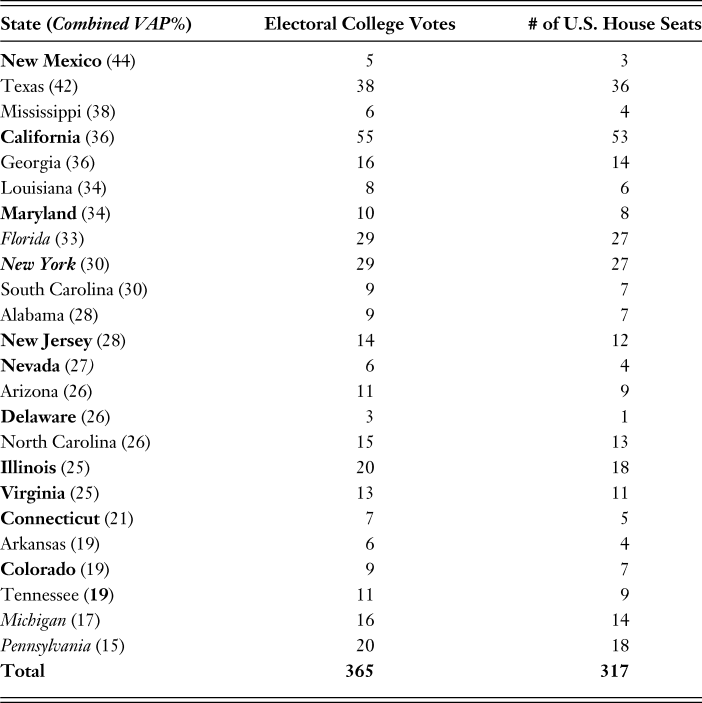
There are twenty-four states in which the combined African American and Latino voting age population (VAP) is between 15–44% of the state’s total voting age population (see Table 1). These twenty-four states have a combined 365 Electoral College votes, ninety-five more than is needed to win the presidency. The Democratic Party candidate for president, the candidate supported by an overwhelming majority of African American and Latino voters, won eleven of these twenty-four states in each of the past three election cycles—2008, 2012, and 2016. The Democratic candidate has won fifteen of these twenty-four states in two of the past three elections. These fifteen states have a combined total of 236 Electoral College votes—87% of the number needed to win the presidency.
Combined African American and Latino Voting Age Population of Selected States

States in bold won by Democrats in past three presidential elections. States in italics won by Democrats in two of the past three elections.
Source: U.S. Department of Commerce. 2015 American Community Survey. Retrieved from www.census.gov/acs.
Seven of these fifteen states were designated as battleground or swing states in each of the past three presidential elections (CO, FL, MI, NV, NC, OH, and VA). Barack Obama, the Democratic Party candidate, won all of them in 2008, and all of them except North Carolina in 2012. Obama’s 2008 victory in North Carolina and Virginia was the first time a Democrat had carried those states in forty-two and forty-four years respectively. In both states, increased African American and Latino turnout were among the decisive factors in Obama’s victory. Also in 2008, Latino voters shifted away from the Republican Party in substantial numbers, which helped Obama win Colorado, Florida, Nevada, and New Mexico (Preston 2008).
African American and Latino voters were factors in Democrat Hillary Clinton’s failed 2016 presidential election bid. Clinton lost eight of that year’s eleven battleground states, even though the Democratic Party nominee had won seven of those states in both 2008 and 2012. It was not a shift to the Republican candidate by these voters that contributed to Clinton’s defeat. Instead, the loss indicated unrealized potential in the form of lower African American and Latino voter turnout.
Among the top ten states in terms of combined African American and Latino voting age population, there are five states—TX, MS, GA, LA, and SC—that no Democratic Party presidential candidate has won since 1996. This is especially noteworthy given that African Americans and Latinos combined are more than a third of the voting age population in each of these states (see Table 1). Nevertheless, without winning any of these states, a Democrat won two of the past five presidential elections. Ironically, the fact that Democratic Party presidential candidates consistently lose five of the top ten states with the greatest rainbow coalition potential, yet remain competitive in and even are able to win some presidential races, is illustrative of the potential power of the combined African American and Latino vote, which enables the Democratic Party to win the presidency without winning a single state in the deep South. The additional support the Democrats are gaining in the Southwest, the Mountain West, and the Midwest, especially among Latinos, is more than sufficient to overcome any disadvantages they might have because of unrealized potential in the South (Schaller Reference Schaller2008).
Obama’s 2008 and 2012 wins in the battleground states of Colorado, Iowa, Nevada, New Mexico, and Ohio, are concrete evidence that indeed there is a route to Democratic Party presidential election success that can bypass states with the greatest rainbow coalition potential (García Bedolla and Haynie, Reference García Bedolla and Haynie2013). Recall that the Democrats have won fifteen of the twenty-four African American-Latino high VAP states in at least two of the past three presidential elections. These fifteen states, along with the traditional Democratic Party strongholds of Hawaii, Massachusetts, Oregon, Vermont, Washington, and the District of Columbia, have more than enough electoral college votes to propel Democratic candidates to the presidency. If in future elections more African American and Latino voters mobilize on behalf of the Democratic Party candidate in one or more of the five southern states where they are a sizeable segment of the voting age population (TX, MS, GA, LA, and SC), the Democratic Party could dominate presidential elections for decades.
There is evidence that such a mobilization is already underway. Georgia and Texas are among the top states where the demographic revolution of the past few decades is most noticeable and consequential. The Latino population in Texas grew by more than 1.4 million between 2010 and 2018 (U.S. Census). While White Texans remain the largest population group in Texas, their rate of growth since 2010 has been much slower than that of Latinos and African Americans. Over the past decade, the growth rate for Whites in Texas has been just 4%, while it has been 16% and 18% respectively for African Americans and Latinos. Similarly, Georgia’s non-White population has doubled over the past four decades, and it has the fastest growing Latino population of any state. According to U.S. Census Bureau projections, Georgia will become a minority majority state by 2033 (Pew Research Center 2014).
The population changes in Georgia and Texas have contributed to noteworthy political changes. For example, the Republican Party candidate’s margin of victory in Georgia in the 2000 presidential election was 11.7%. In Texas, it was 21.3%. In the 2012 presidential elections, the Republican margin of victory had dropped to 7.8% in Georgia, and 15.8% in Texas. The Democratic Party’s progress in these states continued in 2018, when the Democratic candidates in statewide races came surprisingly close to winning. Stacey Abrams, the Democratic gubernatorial candidate in Georgia and Beto O’Rourke, the Democratic U.S. Senate candidate in Texas, lost their race by 1.4% and 2.6% respectively. Although Abrams and O’Rourke both lost, the African American and Latino vote make it possible again for Democratic candidates to run competitive statewide races in two states that, for nearly twenty-five years, have been reliable Republican strongholds. Moreover, the data in Table 1 show that African Americans and Latinos have the capacity to have changed the fortunes of both candidates. These data and the examples from Georgia and Texas demonstrate the potential of an African American and Latino-led coalition to alter politics in ways that could have profound and lasting national consequences.
The potential effects of this rainbow coalition extend beyond presidential and statewide electoral contests. In addition to the twenty-four governorships and forty-eight U.S. Senate seats, there are 315 U.S. House of Representatives seats, 3,517 state legislative districts, and thousands of municipal and local elected offices in the twenty-four states with sizeable combined African American and Latino voting age populations (Table 1).Footnote 5 Thus, there are multiple foundations from which African Americans and Latinos might increase their presence and influence in policymaking institutions. An emergent rainbow coalition could be the impetus for new policy agendas and policy paradigms that incorporate and respond to a broader set of needs and interests than do our current institutions (Jennings Reference Jennings and Jennings1994).
MASS INCARCERATION AS AN IMPEDIMENT TO MINORITY GROUP POLITICAL POWER
Racialized mass incarceration is an impediment to African American and Latino political power. The linkages between incarceration and voter disenfranchisement function as brakes on a powerful political locomotive that has the potential to determine winners and losers in American politics well into the future. As several studies have shown, felony disenfranchisement has material and significant political consequences (e.g. Bowers and Preuhs, Reference Bowers and Preuhs2009; Uggen and Manza, Reference Uggen and Manza2002; Weaver and Lerman, Reference Weaver and Lerman2010). Disenfranchisement plays a role in elections, sometimes a decisive one, as it can actually alter the outcomes.
According to a Sentencing Project report, in 2016 more than six million people, or 2.5% of the total U.S. voting age population, were disenfranchised because of a felony conviction (Uggens et al., Reference Uggen, Larson and Shannon2016). Neither incarceration nor disenfranchisement are randomly or equally distributed across racial and ethnic groups. As noted above, African Americans and Latinos are the most incarcerated groups in the U.S. population. The incarceration rate of African Americans in state prisons is more than five times the rate of Whites. Latinos are imprisoned at a rate that is 1.4 times that of Whites (Nellis Reference Nellis2016). Rates of incarceration vary widely by state. The prison population is more than 50% Black in twelve states (AL, DE, GA, IL, LA, MD, MI, MS, NJ, NC, SC, and VA). Latinos are disproportionately incarcerated in four states (MA, CT, PA, and NY).
African Americans and Latinos are also disproportionately disenfranchised. Nearly 7.5% of African American adults are disenfranchised compared to just under 2% of the non-Black population. Like incarceration rates, African American disenfranchisement also varies significantly by state. There are four states (FL, KY, TN, VA) in which more than 20% of African Americans are disenfranchised (Uggens et al., Reference Uggen, Larson and Shannon2016). It is especially noteworthy that incarceration and felon disenfranchisement rates for African Americans and Latinos are most pronounced in the very states where these groups collectively have the greatest potential for political power and influence. In seven of these states (AL, AZ, DE, FL, MS, NV, and VA) individuals who have completed their sentence do not automatically regain the right to vote; in some cases they may never regain it (Uggens et al., Reference Uggen, Larson and Shannon2016).
We know from previous studies that felon disenfranchisement can reduce voter turnout in African American communities and plays a role in determining election outcomes. Recall, for example, that Uggen and Manza (Reference Uggen and Manza2002) found that felon disenfranchisement laws and high rates of criminal punishment may have affected the outcome of one presidential election and as many as seven U.S. Senate elections between 1972 and 2000. In the conclusion of their study, Uggen and Manza write, “…we find considerable evidence that ballot restrictions for felons and ex-felons have a demonstrable impact on national elections, and in this sense rising levels of felon disenfranchisement constitute a reversal of the universalization of the right to vote” (2002, p. 796). This dynamic is not race neutral. Because they are both disproportionately incarcerated and disenfranchised, the consequences for African Americans and Latinos are especially acute. For example, if there had been no felon disenfranchisement, the Democratic Party candidates would have won the eight altered elections in the Uggen and Manza study. In other words, the party with which most African American and Latinos identify lost these elections because a disproportionate number of African American and Latino voters were legally disenfranchised. Moreover, the study’s results show that the Democratic Party would have gained control of the U.S. Senate in 1986 and remained in control at least through 2000 (Uggen and Manza, Reference Uggen and Manza2002, p. 794). This change alone likely would have resulted in significant policy and political consequences for the country in general, and for African Americans and Latinos in particular.
The political consequences of racialized mass incarceration and felon disenfranchisement for African Americans and Latinos, as well as for the country as a whole, perhaps are more consequential today than they were in 2000, the last data point for the Uggen and Manza study. As I show above, in the nearly two decades since that study was completed, a powerful African American and Latino dominated rainbow coalition has emerged. This coalition already has demonstrated its ability to influence the outcomes of elections. My examination suggests that felon disenfranchisement is a factor in keeping African Americans and Latinos from having a revolutionary effect on politics and policymaking at all levels of government. The rainbow coalition could have altered the results in recent gubernatorial and U.S. Senate races, and also altered the outcome of the 2016 presidential election. In the 2016 presidential election, Donald Trump’s margin of victory in eight states was lower than the number of disenfranchised felons in those states. State and local governments are far more consequential to the day-to-day lives of ordinary citizens than is the national government. Indeed, felon disenfranchisement laws are enacted by state legislatures. There are 3,517 legislative seats in the twenty-four states with sizeable combined African American and Latino voting age populations. It is safe to say the impact of felon disenfranchisement laws would be nonexistent, or at least greatly reduced if ex-felons, parolees, and probationers were allowed to vote for the representatives who debate and determine these policies.
There is a long history of voter suppression in the United States. Restricting the right to vote is as old as the country itself. African Americans and language minorities have been the most frequent targets of these suppression efforts. After Reconstruction, state legislatures enacted a number of laws and sanctioned various practices intended to exclude these groups from participating in the electoral process. Poll taxes, literacy tests, English competency tests, Whites-only primaries, voter intimidation, and racial gerrymandering are the most notable examples of these devices (Keyssar Reference Keyssar2000). While court decisions and federal laws have outlawed them, some of these practices are still in use and new suppression tactics have appeared in recent years. Allegations of voter intimidation and gerrymandering remain as perennial issues in contemporary politics (e.g. Horwitz Reference Horwitz2016; McDonald Reference McDonald2018; Li et al., Reference Li, Wolf and Lo2018), and since Obama’s election in 2008, state legislatures have passed new suppression measures like strict voter ID laws and reductions in early voting days (Brennan Center for Justice 2018). Social scientists, political activists, and legal scholars have long paid attention to and examined how these devices unjustly limit the participation and political influence of voters of color. My intent here has been to elevate mass incarceration and felon disenfranchisement as matters in need of renewed attention.
As the demographic transformation of the country continues to evolve, and the African American-Latino rainbow coalition continues to emerge as a major political force, it is important that there be greater African American and Latino visibility and influence in state and national policymaking. As I suggested in an earlier study, the future health of our democracy depends not only on our political system’s ability to incorporate and respond to the interests of an increasingly diverse electorate, but also on society’s willingness to accept a more racially diverse slate of political leaders (Haynie Reference Haynie, Junn and Haynie2008). Efforts and laws that impede these transformations and seek to contain African American and Latino political power could result in political turmoil and social unrest, and thus merit more of our attention.